




Abstract
While poverty can be regarded as an issue with many different causes and dimensions, research indicates that enhancing digital inclusion may positively contribute to alleviating poverty. Therefore, it is of great importance to better understand the factors that may hinder internet appropriation for households facing poverty. However, no clear overview exists of the barriers to and outcomes of internet appropriation for this exact target audience. Therefore, a systematic literature review using framework synthesis was conducted to explore and map these obstacles in different stages of internet appropriation: attitude and motivation, material access, skills, and usage. Respective outcomes were also identified. Following the Preferred Reporting Items for Systematic Reviews and Meta-Analyses (PRISMA) protocol, a total of n = 1,596 unique records were identified after a systematic search in the Scopus, Web of Science, and PsycINFO databases. Of these articles, n = 40 met the selection criteria and were included in the final review. The results underline the interwovenness of barriers in different stages of internet appropriation. The findings also highlight the importance of being sensitive toward one’s living environment in understanding barriers that prevail. In addition to barriers, a multitude of positive outcomes have been identified that highlight the potential benefits the internet can provide to people in situations of financial deprivation. Implications are discussed and future research directions are proposed to assist in enhancing digital inclusion for households facing poverty.
Introduction
Many people worldwide live below national poverty lines, indicating that they are unable to meet the living standards generally accepted in their society (Ravallion & Chen, 2019; Vrooman, 2009). Reducing poverty is not a straightforward process, but research indicates that poverty may be alleviated by enhancing digital inclusion (Figueiredo et al., 2012). Internet use can result in positive outcomes and enhance one’s position in society (Van Deursen et al., 2021; Van Dijk, 2017). Unfortunately, the risk of digital exclusion is three to five times greater for people facing poverty than for people in better financial circumstances (Anrijs et al., 2023). Moreover, the fact that some people are able to profit more from the opportunities the internet offers could exacerbate existing divides in society (DiMaggio et al., 2004; Lutz, 2019; Van Deursen et al., 2015). Hence, it is important to identify the factors that hinder internet appropriation for people living in poverty.
Over the past decades, digital inclusion has been explored on a global scale for different target audiences. Examples are older adults (Blažič & Blažič, 2020; Kiel, 2005; Romano et al., 2015; Van Deursen & Helsper, 2015a), migrants (Merisalo & Jauhiainen, 2020; Safarov, 2021), and youth (Calderón Gómez, 2019; Harris et al., 2017; Kiss et al., 2020; Oyedemi, 2015). However, to the best of the authors’ knowledge, no clear overview exists of the barriers to and outcomes of internet appropriation for households living in poverty. Notably, poverty entails not being able to meet the living standards that are deemed necessary in a certain society, which is often overshadowed in research focusing on a more general categorization of low income. Therefore, a systematic literature review was conducted to identify what barriers prevail concerning four phases of internet appropriation (Van Dijk, 2005), namely attitude and motivation, material access, skills, and usage, as well as the outcomes of internet use. Important to note is that the phases of internet appropriation continuously influence each other and that barriers found in one stage, as a result, may also influence barriers in other stages. Therefore, for digital inclusion interventions and policies it is vital that all phases are tackled simultaneously (Van Deursen & Van Dijk, 2015). This makes it valuable to provide an overview of barriers categorized over the different internet appropriation phases. This review holds the following main research question:
- What barriers to and outcomes of internet appropriation are described in the academic literature about households living in poverty?
In addressing this question, potential research gaps and future research directions will be proposed. Providing a comprehensive overview of barriers and outcomes will also assist policy-makers and practitioners in designing and implementing effective digital inclusion interventions that focus on reducing poverty.
This paper is structured as follows. First, the term poverty will be discussed, followed by an elaboration on the four phases of internet appropriation. Next, after concisely describing the applied method, the results of the literature review will be presented. The paper ends with a discussion of the most important conclusions of this study, including limitations and avenues for future research.
Theoretical Background
Complexity of Poverty
The complex nature of poverty makes it difficult to define it. In approaches used for defining poverty, whether by scientists, professionals in the field, or policy-makers, no coherent definition of poverty seems to exist. What poverty entails and what it is are quite complicated and context-sensitive issues that may differ from individual to individual (Gweshengwe & Hassan, 2020). Poverty “is experienced differently by men and by women and can differ according to geographical area, social group, and political or economic context” (Ali-Akpajiak & Pyke, 2003, p. 5). For example, in some areas of the world, women tend to be poorer than men, and poverty is often concentrated in rural areas or areas with mountains and hills (Acharya, 2004). The complex nature of poverty results in different approaches when defining national poverty lines (Gweshengwe & Hassan, 2020; Ravallion & Chen, 2019). In some countries, poverty implies not having the necessary means to afford housing and food and the necessary means to survive. However, in prosperous countries, poverty may mean not being able to achieve a minimal living standard that is commonly set and accepted in society (Vrooman, 2009).
Studying low-income households in general does not do justice to the complexity of the poverty issue. Poverty is regarded as surpassing merely having a low income to also having low wealth and low consumption (Headey, 2008). This makes the term “poverty” inherently relative and subjective to a large extent (Witte, 2021). To provide a broad definition as a starting point for this review, to be regarded as poor, one should persistently lack the means to attain the minimal necessities that prevail in one’s society (Vrooman, 2009). Living in poverty often means that financial deficiencies ultimately lead to exclusions in other domains of life, causing gaps with others in society (Gweshengwe & Hassan, 2020; Raeymaeckers et al., 2018). For example, living in poverty may affect an individual’s social network and participation in society (Gweshengwe & Hassan, 2020). Nevertheless, research shows that beneficial internet usage may positively influence a wide array of domains of life (Van Deursen et al., 2021; Van Dijk, 2017). The complex dynamics of poverty underline the relevance of identifying barriers to and outcomes of internet appropriation for households living in poverty.
Four Phases of Internet Appropriation
To identify potential barriers to internet appropriation, it is important to examine the history of digital inequality research. To date, research has focused on three levels of the digital divide. Early research primarily focused on having proper internet connection access, also referred to as the first-level digital divide (Van Deursen & Van Dijk, 2019). In later research, the second-level digital divide was introduced, which explains that even when access is considered universal, divides can be found in internet skills and types of usage (Van Deursen & Van Dijk, 2019). Even more recently, not only access, skills, and usage but also (positive and negative) outcomes accompanying internet appropriation have received attention. Research indicates that some people achieve more positive outcomes in several domains of life (e.g., economic, social, cultural, or personal) as a result of internet usage than others, also referred to as the third-level digital divide (Van Deursen & Helsper, 2015b; Scheerder et al., 2017; Wei et al., 2011). The three levels of the digital divide – (i) access, (ii) skills and usage, and (iii) outcomes – serve as points of departure to understand the process of internet appropriation.
To incorporate the different levels of the digital divide in this review, we used the core of Van Dijk’s (2005) resources & appropriation theory (see Figure 1). The theory depicts the continuous interplay between personal and positional categories, one’s resources, and how these ultimately influence access and participation in society (Van Dijk, 2005, 2020). The theory’s core argument, which underpins this review, describes technology acceptance as a behavioral process, also called appropriation, rather than a single acceptance decision (Van Dijk, 2020). First, people need to possess a positive attitude and motivation, meaning they should feel inclined to use a certain technological innovation. Second, people need to acquire the technology, accounting for actual material access. Third, people should learn how to use the technology by acquiring relevant skills, which can be either medium-related (i.e., using the device itself) or content-related (i.e., creating content on the device). This third phase is followed by the usage step, in which the actual frequency and nature of use are described. Important to note is that the four phases in the model have a sequential and conditional nature (Van Deursen & Van Dijk, 2015). While having material access does not automatically mean that one develops skills, the model does imply that, for example, skills will not be developed in the absence of sufficient attitude and motivation or without actual access. Still, “…all stages have their own grounds of determination and interact together to shape cumulative digital inequalities” (Van Deursen & Van Dijk, 2015, p. 387). Hence, effective digital inclusion policy should tackle all phases in the model simultaneously. To add to the understanding of the model, all four phases can be influenced by categorical inequalities, also called exclusion indicators, which can be personal (e.g., age, gender, ethnicity) or positional (e.g., labor position, education, network). This four-step process is closely related to the first-level and second-level digital divides, as mentioned earlier.

Internet appropriation process (based on Van Dijk, 2005).
The third-level digital divide suggests that these four steps ultimately also influence one’s position, both online and offline, in terms of economic, personal, cultural, and social outcomes (Helsper, 2012). As the backbone of the theory presented in Figure 1 shows, these unequal outcomes influence the exclusion indicators, thereby reinforcing the process. If the internet is used to one’s advantage, this might improve one’s societal position as well (Van Deursen et al, 2021; Van Dijk, 2017). This indicates that people who benefit most from the internet are able to reinforce their already stronger societal positions, thereby increasing notions of social inequality (DiMaggio et al., 2004; Lutz, 2019; Van Deursen et al., 2015; Van Dijk, 2005). This phenomenon underlines the relevance of further investigating the barriers to internet appropriation faced by people living in poverty.
Method
Systematic Literature Review
To provide a comprehensive overview of barriers to and outcomes of internet appropriation, a systematic literature review was conducted. The systematic approach provides clarity into the process and enhances the interpretation of the results (Booth et al., 2016). To be more precise, the “best fit” framework synthesis approach was used. According to this approach, the reviewing process “begins by creating a framework of a priori themes and coding data from a review’s included studies against that thematic or conceptual framework” (Carroll et al., 2013, p. 1) and thus allows us to systematically identify theories based on a framework that can be used for synthesis (Sutton et al., 2019). This approach can be seen as transparent and pragmatic (Carroll et al., 2013; Dixon-Woods, 2011). Furthermore, this method allows us to clearly categorize the information found and offers the starting point for formulating the search query.
Search Terms
To retrieve the relevant articles needed to answer the research question, the search query included terms regarding the four stages of internet appropriation, outcomes, and key terms related to living in poverty. The query was inserted into Scopus, Web of Science, and PsycINFO, three well-established databases covering a broad range of social sciences literature. Boolean searches were applied as a common approach to identify relevant literature (Linnenluecke et al., 2020) and to provide proper structure and overview to the extensive search query. To identify relevant search terms, a thesaurus was used to find synonyms to be included, and relevant articles were scanned for potential keywords. Each key term was checked to determine whether it added results to the total query, which will be described further in the upcoming sections.
Poverty
First, the literature needed to discuss the phases of internet access in relation to living in poverty. Hence, the search terms (poverty OR “poor household*” OR “poor famil*” OR “poor population*” OR “deprived household*” OR “deprived famil*” OR “deprived population*” OR “household wealth status” OR (poor AND income)) were applied. The addition “AND ‘income’” was made due to the rather generic character of the word “poor,” which can be applied in a multitude of contexts.
Attitude & Motivation
Second, key terms regarding the four phases of internet appropriation needed to be determined to find relevant articles. The first phase is motivation and attitude. To find articles matching these terms, the following combination of search terms was applied: (((motivation OR attitude OR anxiety OR fear) AND (Internet OR computer* OR digital OR online)). Because individual terms such as “internet attitude,”“internet motivation,”“internet anxiety,”“proxy use,”“digital anxiety,” and “internet fear” did not provide any additional results to the rest of the query, these terms were not included in the search string. However, to find articles that discussed relevant topics, the search string was specified as presented above to find suitable articles. Importantly, within the key terms identified for the “usage” stage, the terms “use the internet,”“using internet,” and “using the internet” were introduced, meaning that key terms such as “motivation to use the internet” or “attitude toward using the internet” were also covered.
Material Access
Third, search terms related to internet access have been defined. It was deemed important to account for both software- and hardware-related terms. Furthermore, terms related to specific devices have been added to ensure that the query would be as complete as possible. This resulted in the following search terms: (“Internet access” OR “broadband” OR “Internet connection” OR “access to internet” OR “access to the internet” OR “device ownership” OR “computer ownership” OR “smartphone ownership” OR “mobile phone ownership”). Additional search terms such as “laptop ownership,”“tablet ownership,”“Internet availability,” or “device opportunity” and “device diversity,” as previously mentioned by Van Deursen and Van Dijk (2019), did not provide any additional results.
Skills
Fourth, key terms accompanying the skills phase needed to be identified, resulting in the terms (((skills) AND (Internet OR computer* OR digital OR online)) OR “digital literacy” OR “digital competence*” OR “information literacy”). Because the terms “internet skills” and “online skills” in this form did not provide any additional results, these terms were not specified in the query.
Usage
Fifth, search terms related to the usage phase needed to be identified. To find as many relevant articles as possible, the usage of specific devices was included as well. The following search terms were used for the “usage” phase: (“Internet use” OR “Internet usage” OR “online activities” OR “use the internet” OR “using internet” OR “using the internet” OR “computer use” OR “mobile phone use” OR “mobile phone usage” OR “smartphone use” OR “smartphone usage” OR “tablet use” OR “ICT use” OR “ICT usage”). The terms “internet activities,”“computer usage,”“tablet usage,”“laptop use,” and “laptop usage” did not yield any additional results and were omitted.
Outcomes
Finally, to ensure that the search query was as complete as possible, key terms related to the outcomes step were also identified. This resulted in the addition of the key terms (“effects of internet” OR “benefits of internet”). Because the keywords “outcomes of internet,”“Internet benefits,”“Internet outcomes,”“Internet effects,” and “Internet opportunities” did not yield any additional results, they were not included.
Importantly, terms related to the keyword “technology” were also tested in the query. For example, the search term “technolog*” was queried in relation to motivation, anxiety, attitude or fear as well as the terms “technolog* skills,”“technology use,” and “technology usage.” Because these keywords yielded additional results mainly related to topics such as energy poverty, sustainability, solar technologies, and farming, these keywords were omitted from the query. We tested whether the term “internet appropriation” delivered additional results, but this was not the case.
Selection Criteria
In addition to the search query itself, additional criteria were formulated to select relevant articles. First, the focus was placed on academic literature, for which only English-language literature was included. Hence, these language and source types were applied as filters to the results. In addition, the query was applied to identify the search terms in the title, abstract, and/or keywords. This decision was made to identify the most relevant articles in which the discussed topics held a central position. Furthermore, to limit irrelevant articles, the following additional selection criteria were formulated. The articles should…
1) Relate to households living in poverty rather than households that merely had a low income. Meaning, articles were included if authors explicitly mentioned the research participants living in poverty, or if the article text otherwise indicated that the participants lack the means to afford minimal necessities prevailing in a certain society. Articles only discussing general income distinctions without providing clarity or indication whether (part of the) participants live in poverty, were excluded, hence limiting the included number of articles;
2) Address barriers to and/or outcomes of internet appropriation;
3) Be based on empirical research data;
4) Elaborate on the usage of technological devices using the internet, meaning articles elaborating context-specific technologies only aimed at a niche of households were excluded;
5) Not focus on the usage of internet applications by specialized patient/business groups, although the use of the internet by the general population in relation to health or employment was included;
6) Not have the main aim of testing the effectiveness of specific applications or technological interventions, which means that the respective target audience needed to have a central position in the study rather than just the intervention effectiveness itself.
Study Selection
The final query yielded a total of 2,175 articles up to July 4, 2022. The query was applied at the topic level, meaning that search terms needed to be identifiable in the title, abstract, and/or keywords. In addition to English-language peer-reviewed journal articles, conference/proceedings papers, and early access papers were included in the review to retrieve the latest insights. After deleting duplicates, 1,596 articles remained. Following the Preferred Reporting Items for Systematic Reviews and Meta-Analyses (PRISMA) protocol (Liberati et al., 2009), the articles were screened for relevance, after which 177 articles remained. When a full-text article turned out to be inaccessible, the respective authors were contacted directly to find the missing articles. After full-text review, a total of 40 articles remained that were included in the final review. The procedure is visualized in Figure 2, including a view of how many articles were excluded in the full-text review phase per the selection criteria. The articles included in the literature review are marked with a * in the reference list.
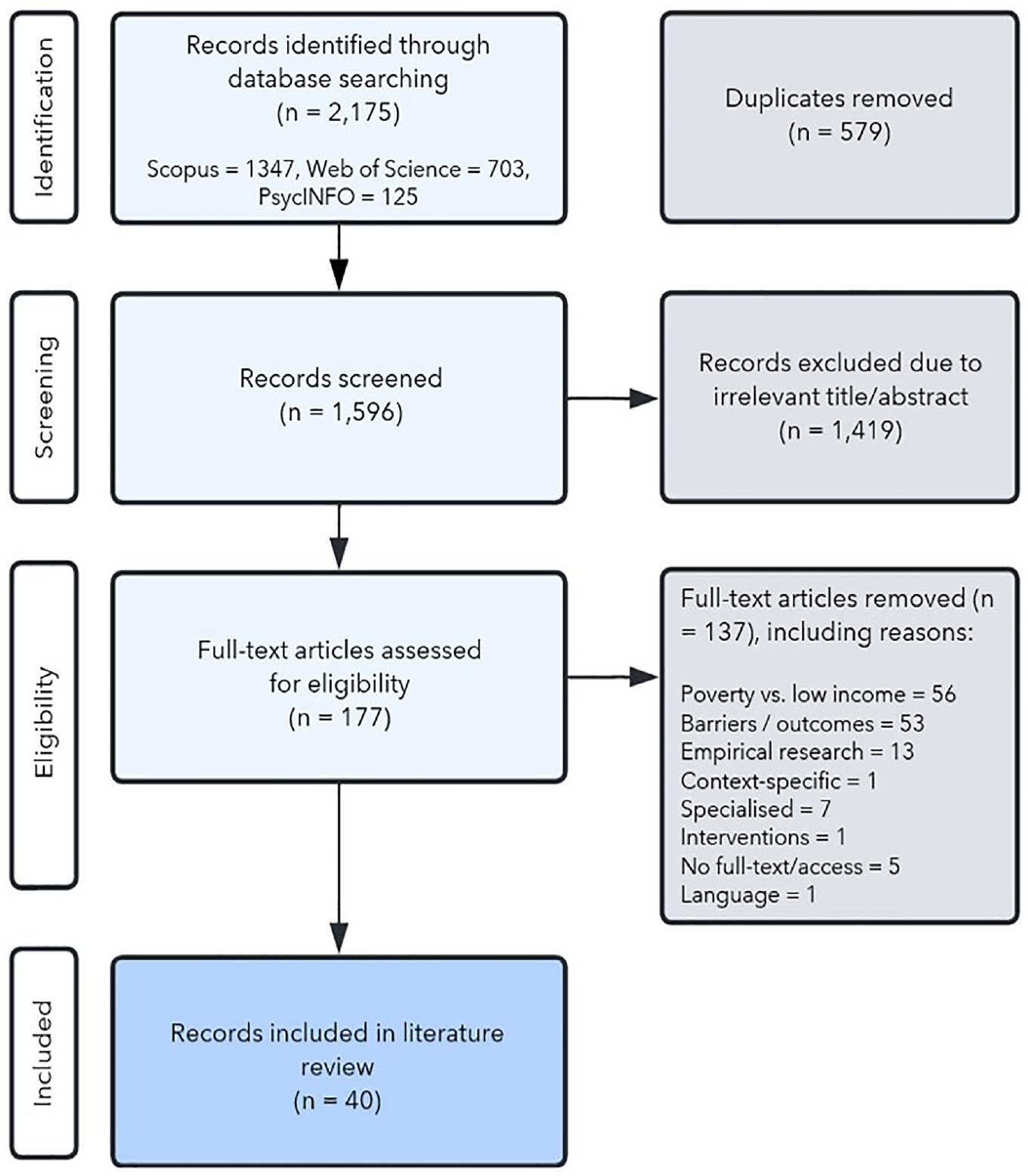
PRISMA-flowchart.
Selection Bias
Throughout the process of conducting a systematic literature review, one should be aware of the risk of selection bias when assessing articles (Booth et al., 2016; Linnenluecke et al., 2020). Therefore, a set of clearly defined selection criteria were used as the basis for gathering and filtering articles to be used for answering the research question. The selection criteria were closely followed by the reviewer to limit this form of bias. The predefined selection criteria were determined in cooperation with the full research team, including different experts (Linnenluecke et al., 2020). To further limit bias in the selection process, a second reviewer assessed >10% of the unique articles found with the search query. In the first round of double review, this resulted in insufficient agreement, with a kappa of 0.48. Both reviewers discussed their disagreements and made sure to clarify the selection criteria where needed. The two reviewers mainly disagreed on the second selection criterion, so a discussion was conducted to determine when something was classified as a barrier and when it was not. Furthermore, some disagreement was found concerning the first selection criterion, after which the reviewers further discussed the concept of poverty. This process was also discussed in accordance with the full research team. Afterward, a second round of double review with a new selection of >10% of the articles was conducted. Because both reviewers included the same set of articles, this review round resulted in perfect agreement.
Results
This section starts with an overview of the distribution of articles over time, region, methods, and target audiences. Then, the barriers to internet appropriation are categorized according to the internet appropriation process and further elaborated. Finally, the positive and negative outcomes are presented.
Time, Geographic Distribution, Methods, and Target Audiences
In Table 1, a concise overview is provided of the time, geographic distribution, methods, and target audiences of the articles included in this systematic review. Time concerns the year the research paper has been published. The first article found within the scope of this review dates from 2004 (n = 1). The most recent articles date from 2022 (n = 4). As shown in Table 1, most of the articles were written after 2012 (n = 32).
Time, Geographic Distribution, Methods, and Target Audiences.

With regard to geographic distribution, both the continent in which the study took place was noted, as well as the country that was subject of study in the article. The majority of articles concern different regions within North America as their research context (n = 21). A significant portion of the articles takes Asian countries as their research context (n = 8), such as Indonesia, India, and Thailand. This is closely followed by the number of articles focusing on Africa (n = 7), of which most articles concern South African citizens (n = 4). Notably, very few articles considered the European (n = 3) and South American contexts (n = 1), and no articles concerned the Australian context.
Regarding methods, 17 articles employed qualitative approaches, such as in-depth interviews (structured, semi-structured, and unstructured), participant observation, and focus groups. Similarly, 17 articles employed a quantitative method, including surveys, recording internet use, or using demographic nationwide data. A total of six articles applied a mixed-methods approach using a combination of both qualitative and quantitative studies, such as combining surveys and focus groups or combining records of internet use and surveys with home visits.
Finally, an overview was drafted of all specified audiences that were central in the articles included in this systematic literature review. As people experiencing poverty cannot be seen as one homogeneous audience experiencing similar barriers, it is important to be attentive to potential differences due to the diversity in target audiences. Therefore, the subjects of study in every article were reported and categorized (see Table 1). This resulted in a total of 10 subcategories of specified audiences: children from immigrant families (n = 2), high-poverty areas/communities (n = 8), high-poverty schools/students (n = 4), persons without/(at risk of) unstable housing (n = 4), rural households (n = 5), students from rural areas (n = 1), urban communities experiencing poverty (n = 8), women from rural communities (n = 2), women in poverty/from high poverty areas (n = 4), and youth in poverty (n = 2). It should be noted that while some studies seemed to match multiple categories (e.g., rural households and women from rural communities), some additional categories were made in case the target audience was further specified in the article (e.g., women in particular, in this case). Every article was categorized so it matched one target audience category.
Barriers to Internet Appropriation
To provide a proper overview of the identified barriers, they were categorized according to the components of the internet appropriation process as defined in the core of the resources & appropriation theory (Van Dijk, 2005). First, the barriers were categorized as belonging to either attitude and motivation, material access, skills, or usage. In categorizing these barriers, it is important to note that the phases in the model are interrelated and influence each other. Still, as effective digital inclusion interventions and policies should address all phases simultaneously (Van Deursen & Van Dijk, 2015), having a cohesive overview of barriers categorized per phase is considered to be relevant. Hence, while certain barriers in one phase may also lead to barriers in other phases, each barrier was categorized in the phase it deemed to fit best. Furthermore, barriers were only categorized when explicitly mentioned in the articles based on empirical evidence. Because of the interrelatedness of concepts and the relevance of the context, further details and references to the barriers are provided in-text in this section as well. To obtain an overview of how many articles mentioned a certain barrier, frequencies are presented after the respective barriers. These frequencies point to the number of articles in which a certain barrier was mentioned (see Table 2). Because sensitivity toward the context in which an article was written is vital for its interpretation, the barriers were also documented per target audience. This overview has been added as an Appendix.
Barriers Categorized.

Attitude & Motivation
With regard to attitude and motivation, several preconceptions about the internet appeared as barriers to internet appropriation. For example, some people believed that the internet was not for them (Mariscal Avilés et al., 2016) or that a telecenter was meant only for more experienced users (Alao et al., 2021). The role of gender in such preconceptions was highlighted as well. For example, the research underlined that women saw the telecenter as a male-dominated space, hindering them from visiting it (Alao et al., 2021) and that women’s gender awareness provided a hurdle in using internet kiosk services (Best & Maier, 2007). Furthermore, research showed the relative unimportance of computers experienced by parents when compared to purchasing meals in the school environment (Pal et al., 2009). A similar finding was underlined in a study among rural Kenyan households, highlighting the considerations between buying airtime and other necessities of life (Wyche & Murphy, 2012).
Another barrier was fear, such as the fear of humiliation when using services in the telecenter, accompanied by not knowing how to operate a computer (Alao et al., 2021) or a fear of technology in general (Vitak et al., 2018). The perceived difficulty of using the internet was highlighted as well, for example, in the online learning context (Azhar et al., 2021) or in using Facebook (Marler, 2021). This barrier also included a lack of confidence to go online. For example, women lacked confidence and, as a result, did not go to telecenters (Alao et al., 2021).
A lack of awareness about internet services also played a role. For example, some people were unaware of internet services such as email or social media (Mulyaningsih et al., 2021) or of the full options of free services offered on mobile phones (Duncan, 2013; Wyche et al., 2013). In addition to awareness, the research found a lack of interest in using the internet in internet kiosks (Best & Maier, 2007) or as a barrier to home access (Mossberger et al., 2012). In line with this, a lack of time created a barrier, such as when other family responsibilities were prioritized (Kontos et al., 2007). Similarly, a study among the urban poor in Boston in the US showed that 70% of respondents reported a lack of free time as a barrier to computer use (McCloud et al., 2016a).
Finally, content-related barriers were addressed. Research has revealed that a lack of trust in online content concerning parenting and childcare advice or an experience of information overload could hinder one’s motivation to turn to the internet as a source of information (Loignon et al., 2022). Furthermore, a lack of local content may hinder households from using internet services as the content may be deemed irrelevant to local needs (Ariansyah, 2018).
Material Access
The most frequently identified barriers concerned material access. Multiple articles emphasize barriers related to having limited access to home computers (e.g., Eamon, 2004). In addition, research has highlighted a lack of proper facilities to use a computer (Alao et al., 2021; Tarannum, 2021). In line with this, finding a place to obtain accessible Wi-Fi (Gershon & Gonzales, 2021), unsuitable locations of internet kiosks (Best & Maier, 2007), or a lack of privacy and distractions because of having to use the internet in shared rooms (Gocotano et al., 2021; Marchi, 2017) were hindrances.
Material access barriers also included hindrances regarding improper mobile phones, such as mobile phones that did not support high-end technology (Matli & Ngoepe, 2022) or “spoiled” phone batteries and phones that were unable to support local usage, in which batteries and SIM cards are often swapped (Wyche & Murphy, 2012). In addition, not having a formal address or bank account could hinder one’s access to PayPal online payment services (Wyche et al., 2013).
Further barriers regarding mobile phones included the costs of purchasing one, having to share a mobile phone within a household, and having limited airtime to utilize the phone (Velghe, 2012). Regarding device costs, those in poverty may lack devices such as mobile phones because of their unaffordability (Mulyaningsih et al., 2021). Next, regarding service costs, expensive internet data are a barrier to access (Gocotano et al., 2021), and a lower income relates to being less likely to adopt broadband at home (Weiner & Puniello, 2014).
Furthermore, several barriers related to the usage of internet kiosks or telecenters were mentioned. For example, research pointed to the costs of using an internet kiosk forming a hindrance (Wyche et al., 2013) as well as the minimum or maximum computer time provided at telecenters, libraries, or cyber cafes (Alao et al., 2021; Marler, 2021; Wyche et al., 2013).
Regarding problems with internet service, the quality of the service (Laeeq Khan et al., 2020; Marchi, 2017) or internet service that was less accessible due to underinvestment in broadband services presented difficulties in high-poverty or rural areas (Ariansyah, 2018; Galperin et al., 2021b). Moreover, some people frequently needed to resort to others to receive (proper) internet services (Casado et al., 2019). In line with this, access to electrical power played a role. This could be either related to available electricity to power the base transceiver station (Ariansyah, 2018) or having a place to charge a phone, as described by Raven et al. (2018). This is similar to hindrances caused by the lack of electricity in rural areas (Wyche & Murphy, 2012).
Finally, barriers were found in relation to having devices taken away. Examples included stolen or lost mobile phones (e.g., Matli & Ngoepe, 2022; Raven et al., 2018) or experiences of oppression. Concerning the latter, in one study, a woman was summoned by her boss to take away her work computer, likely because the boss was ashamed that a female worker was more skilled (Kvasny, 2006). Regarding family usage rules, the barrier of family conflicts regarding time allocation on a device was highlighted, such as restrictive mediation strategies that limited children’s access to their phones (Casado et al., 2019).
Skills
In relation to digital skills, first, illiteracy or language barriers formed a hindrance. For example, having limited English skills could cause a barrier to asking for computer-related help or accessing English-language websites (Vitak et al., 2018). Second, digital literacy and digital skills played a role. For example, a study among Scottish children in primary schools showed that financial deprivation affected knowledge levels and password remembrance abilities (Prior & Renaud, 2022). In line with this, immigrant children knew how to handle social media but lacked the skills to find basic services and information online (Casado et al., 2019). Moreover, research conducted in rural areas of the Philippines showed that most students did not possess sufficient digital skills (Gocotano et al., 2021), and a US study focusing on jobseekers without housing found limited skills concerning checking messages or remembering passwords, which hindered internet use (Gershon & Gonzales, 2021). Third, the lack of guidance from others in using computers was highlighted as a barrier. To illustrate, people were more likely to use the internet if someone in the family also used the internet, a finding attributed to the family member possibly serving as an infomediary to train others about the functionalities of the internet (Alderete, 2019). Fourth and last, the costs of acquiring skills were mentioned as a barrier, even when there was the willingness to learn (Velghe, 2012).
Usage
A first usage-related barrier was partaking in limited capital-enhancing activities, such as visiting news, health, or government-related websites. For example, research found that low usage of capital-enhancing websites was related to limited health information seeking (McCloud et al., 2016b) and that frustrations or dissatisfaction about information found online may limit health information seeking (McCloud et al., 2016a). Moreover, information overload or false information online may cause people to limit their visits to informational fora (Loignon et al., 2022).
In addition, the limited usage of functionalities formed a barrier. Having limited skills also resulted in only using basic internet functionalities rather than more advanced ones (Mulyaningsih et al., 2021), and a fear of technology could lead people to avoid certain functionalities of the internet related to behaviors that were perceived as risky, such as online banking or applying for jobs (Vitak et al., 2018). Furthermore, those in poverty were less likely to use computers for nonacademic purposes because of limited home computer access.
Several barriers were perceived in finding jobs online, for example, because of limitations with devices (Wyche et al., 2013). Furthermore, limited internet access could lead to the inability to get in contact with employers quickly during the application process and could ultimately lead people to avoid job-seeking involving online contact altogether (Gershon & Gonzales, 2021). A further barrier was limited (social) contact, such as not being able to contact friends and relatives or quickly reach someone in case of emergencies. For example, a lack of affordability of mobile phones led to the inability to communicate with friends, family, or authorities (Duncan, 2013).
Finally, several studies underlined limited internet usage frequency in general, mainly caused by access hindrances but also by a lack of motivation or skills. For example, access instability resulted in infrequent internet usage, which could, in turn, result in negative outcomes such as disadvantages in finding employment (Galperin et al., 2021a).
Outcomes of Internet Appropriation
Several articles point to possible outcomes of internet appropriation or a lack thereof. To provide a detailed overview of these outcomes, a distinction is made between positive and negative outcomes (see Table 3).
Outcomes Categorized.

Positive Outcomes
Different articles discuss outcomes related to improved employability because of using the internet. For example, people who have friends on social networks outside their area are more successful in finding employment on Facebook (Wyche et al., 2013). Furthermore, limited access to the internet is likely to lead to a limited ability to find a job (Gershon & Gonzales, 2021). In line with this, internet appropriation may lead to improved economic standards, such as increased household income and welfare (Alao et al., 2021; Ariansyah, 2018; Nguyen et al., 2022; Wyche et al., 2013). Next, a link was found between internet usage and better school achievements as well as an increased interest in school. For example, internet use was likely to result in higher GPAs and better reading achievements (Jackson et al., 2006), and a lack of proper devices was likely to result in negatively affected performance (Gocotano et al., 2021).
Furthermore, multiple articles discussed strengthened social capital due to internet usage, including outcomes related to feeling included and feeling a sense of belonging. For example, people with internet access were more likely to have frequent contact with neighbors or relatives or to receive financial social support when needed (Kearns & Whitley, 2019). In addition, using a telecenter can lead to strengthened social capital (Alao et al., 2021) and increased confidence over time (Kontos et al., 2007).
Internet users had better mental well-being scores than nonusers and were less likely to report being lonely (Kearns & Whitley, 2019). Furthermore, phones provided users with a sense of comfort as they enabled them to stay connected and available in case of emergencies (Galperin et al., 2021a; Wyche & Murphy, 2012). Additionally, internet use could stimulate people to become more active (Kearns & Whitley, 2019) or could lead to positive health-related behaviors, such as the likelihood of being tested for HIV-AIDS (Mpabe Bodjongo, 2023). Health benefits were also found in the sense of acquiring new knowledge and skills, such as knowing about disease symptoms and acting upon this knowledge when necessary.
Research has also underlined that internet usage enhances the development of one’s own political position (Marchi, 2017) and that internet use and the use of (social) services or shopping amenities in the neighborhood are linked (Alao et al., 2021; Kearns & Whitley, 2019). In addition, internet access and skills could lead to the acquisition of information on the functioning of the municipality, thereby enhancing commitment to public community life (Mariscal Avilés et al., 2016).
Additional outcomes mentioned were that telecenters could save women in rural areas time and money, enabling them to spend this time and money on other life necessities (Alao et al., 2021); that searching for information online assisted people in not falling for potential scams (Vitak et al., 2018); that training classes supported improving skills such as typing, navigating, and browsing (Kontos et al., 2007); and that ICT appropriation could enhance the development of the capabilities to communicate and to produce and share content (Mariscal Avilés et al., 2016). In line with the latter, frequent internet use can lead to overcoming the fear of using a computer (Alao et al., 2021). Finally, adults who were trained in basic skills by their children experienced more interest in ICT as a result (Mariscal Avilés et al., 2016).
Negative Outcomes
Two studies underlined the potential anxiety that online information could cause (Casado et al., 2019; Loignon et al., 2022). In addition, a longer time spent on technological devices can result in health problems such as back pain, headaches, and eye strain (Gocotano et al., 2021). The same study also indicated that increased online learning activities can result in a loss of motivation to further pursue education because of the barriers experienced in the learning process, and that using online social network sites could potentially distract students from pursuing online learning activities. Moreover, a lack of clear usage rules set by parents may lead to excessive mobile phone use by children (Casado et al., 2019). This same study highlighted that excessive internet use may lead to loss of sleep time. Furthermore, while properly using the internet may assist in avoiding scams, frequent internet use can lead people to be more susceptible to online scams, which could have negative consequences if not adequately countered (Vitak et al., 2018).
While strengthened social capital was identified as a positive outcome multiple times, a study also found that internet use was associated with a smaller likelihood of feeling part of a community and knowing many people in the area (Kearns & Whitley, 2019). Furthermore, when children become more knowledgeable about the internet, the credibility of their parents may diminish (Pal et al., 2009). Parents who are already facing illiteracy find that their children are less inclined to listen to them and more inclined to listen to their teachers for advice instead. Finally, while the positive outcomes highlighted saving time and money, research also indicated that the high costs of airtime on phones inhibited the purchase of other essential goods, such as food and electricity (Duncan, 2013).
Discussion
Main Findings
The main objective of this systematic review was to gain an overview of the barriers to internet appropriation as well as respective outcomes among households living in poverty. It is important to note that poverty in this study was considered different from studies applying a more general categorization of low income, as poverty entails not being able to meet the living standards that are deemed necessary in a certain society. Before discussing the barriers and outcome-related results, relevant insights can be shared about the operationalization of poverty. Within the articles included here, some scholars provided a specific definition and classified individuals as poor on the basis of certain characteristics. For example, scholars defined someone as poor when they could not meet a certain percentage of the national poverty threshold and specified poverty as experiencing financial deficiencies or housing instability or as being at risk of exclusion in society. Rural households were also considered to be a subject of research on poverty. For example, some articles defined how people in rural households struggle with connectivity, lower incomes, or worse development possibilities in comparison to others. Despite the substantial variations in the operationalizations of poverty, the commonality is that the people under study struggle to meet their basic needs or experience a gap with others in society.
Concerning the barriers identified, the review results add to the notion that “households living in poverty” cannot be treated as a homogeneous group. The included studies show that different target audiences experience different barriers. For example, persons without housing or with unstable housing seem to be at greater risk of having their devices stolen, and people from rural areas are more likely to suffer from location-related problems related to internet connections or power outages. Moreover, women seem to be the victim of preconceptions about the internet more often. Even within studies, differences in the severity of experienced barriers could be found. For example, McCloud et al. (2016a) found that while frustrations in searching online information may cause people with health issues to stop seeking information, this dissatisfaction may serve as a motivation to search further for those who do not face health problems. They attribute this difference in usage to the emotional strain of searching for information about one’s own health issues. However, in addition to these differences between target audiences, common ground can be found as well. Barriers regarding service costs, device costs, limited digital skills, and usage frequency can be found across many target audiences. Nevertheless, the review results stress the importance of understanding personal circumstances in looking at internet appropriation barriers.
With regard to the first internet appropriation phase, attitude and motivation, multiple studies highlighted how negative perceptions of the internet could inhibit usage. For example, a lack of interest or not seeing the need for the internet could prevent people from accessing the internet. Alternatively, even when access is addressed, limited awareness of the existence of functionalities can form a hindrance. The latter is also closely related to skills.
Concerning the second phase, material access barriers are identified often. People in poverty may lack the financial means to access proper materials, meaning that access-related barriers are omnipresent. While many scholars discussed a multitude of different material access barriers, the large amount of attention given to material access barriers in research does not mean that these are necessarily the most prevalent in practice as well. Additionally, different phases in the internet appropriation process are continuously influencing each other. To illustrate this, even when it was not given particular attention in the studies, limited access may lead to other hindrances, such as a lack of skill development or infrequent usage of the internet for certain purposes (Van Dijk, 2005). In contrast, research showed that limited connectivity could motivate people to use the internet elsewhere (Alderete, 2019; Mossberger et al., 2008). However, when access is realized, it does not automatically mean all material access barriers have vanished. For example, Marchi (2017) highlighted that people with access to computers often must use them in rooms with limited privacy. After material access, second-level digital divides prevail in terms of remaining connected or having a proper support network for assistance (McCloud et al., 2016a).
Regarding the third internet appropriation phase, skills, limited digital skills pose a barrier to benefiting from the opportunities offered by the internet. A lack of proper support was also mentioned. For example, Vitak et al. (2018) noted that many people found that their family and friend circle possessed similar skills as themselves and thus were not a source of help. This finding suggests the need to look beyond individual skills and to account for people’s living environment in its entirety.
Fourth and last, with regard to usage, both hindrances regarding the frequency and the type of usage were mentioned. These hindrances stemmed from barriers in the other phases, being attitude and motivation, material access, or skills. This underlines the continuously reinforcing nature of the different phases. For example, usage frequency often seemed to be limited due to lack of access or limited affordability, and limited usage of functionalities could result from anxiety or a lack of knowledge. Although this review categorized internet barriers among the phases of internet appropriation, these phases and barriers are largely interwoven. McCloud et al. (2016a), for example, showed that being low-literate may contribute to being even more overwhelmed by the vast amounts of information available online, and Vitak et al. (2018) highlighted that language barriers may not only hinder the understanding of websites, but also pose barriers to asking for help. Such findings stress the need to be aware of the broad spectrum of experiences of households facing poverty. Simply countering or overcoming one barrier does not imply direct improvement if other barriers remain. The interrelatedness of barriers aligns with the complexity of living in poverty and the interconnected dimensions at its base (Gweshengwe & Hassan, 2020).
Finally, regarding the outcomes of internet appropriation, this review identified a multitude of potential positive outcomes of using the internet. These could contribute to improving the lives of people in situations of financial deprivation. The extensive list of outcomes also highlights the notion that using the internet, or having proper skills or access to do so, could result in a variety of outcomes that enhance one’s societal position. However, the papers included in this review also underlined that many households in poverty are unable to profit from these positive outcomes due to the identified barriers that prevail. Lastly, the identified negative outcomes highlight the need to be aware of potential pitfalls in internet use. This finding adds to the relevance of overcoming barriers to internet appropriation for households facing poverty to enable them to fully benefit from the opportunities offered by technological innovations.
Limitations
While this systematic literature review was executed with the greatest care and considerable effort was made to formulate a specific yet precise search query, certain search terms may be omitted unintentionally. Synonyms and related terms for each relevant concept were identified to minimize this possibility. However, despite these efforts, the usage of different terms may have yielded potentially different or additional results. For example, adding more keywords to ICT in general or adding proxy operators to the query and thus somewhat more flexibility in the exact wording used may have identified an even broader spectrum of articles. An example of such an article is the study by Goedhart et al. (2019), in which the digital divide for Dutch mothers is discussed. While broadening the query may have made the scope of this article too extensive, it could have added further relevant articles to the query. Nevertheless, this review aimed to include as many relevant articles as possible by means of an elaborate search query.
In addition to the search terms regarding the four stages of internet appropriation and the outcomes, query limitations may also hold true for the concept of poverty. In this review, efforts were made to keep in mind the research context of the study in the review process, but certain articles may have not been identified with the search query because poverty-related keywords that are relevant in a national context may have not been included. Or, authors may have used different terms to describe poverty than those are included in the query of this review. Hence, while great efforts have been made to be as complete as possible in the search, relevant articles may have been unintentionally omitted. Nevertheless, by means of using multiple synonyms of poverty and by adding “income” as a term in combination with “poor”, the authors aimed to include as many relevant articles as feasible.
In line with this, among the articles, differences could be detected at the level of the wealth of the participants. For example, some studies were conducted in high-poverty areas, which does not necessarily mean that all participants were equally financially deprived, potentially affecting the results. However, the iterative process applied to retrieve the articles is believed to have resulted in many relevant results for this systematic literature review.
Avenues for Future Research
This paper provides several directions for future research. First, while this review highlights a multitude of barriers at different stages of internet appropriation, it would be of interest to further understand the dynamics in which these barriers arise. As the steps in the model continuously reinforce each other, future insights may benefit from identifying how the barriers actually lead to certain outcomes and how these outcomes ultimately reinforce societal inequalities. Understanding not only the barriers that prevail but also the processes that accompany them will provide a better understanding of the interrelatedness of internet appropriation and societal inequalities. In line with this, given the relevance of the societal context to poverty as well as local differences in the operationalization of poverty, it would be useful to further explore the role that geographical region plays in these processes. While this review provides an overview of barriers and outcomes on a global scale, identifying barriers and outcomes on a local scale may provide valuable insights into how the geographical context influences processes of internet appropriation.
Furthermore, this review showed that the aspects of attitude and motivation, usage, and skills were found less frequently. Future studies might concentrate on what hinders households living in poverty in the process of internet appropriation in these phases. A first direction could be to investigate the motivational barriers in depth. While this review highlights several barriers related to fear, lack of time, or lack of interest, it would be desirable to learn more about what may cause fear or lack of motivation to use the internet. Future qualitative studies may be of help in developing this issue. A second direction in this theme concerns receiving support in internet tasks. According to Helsper and Van Deursen (2017), “those who experience most problems online also seem to have the most difficulty obtaining high-quality support even when it is available, creating an even larger ‘gap’ between those who do and do not need support.” (p. 700) Hence, focusing on the barriers perceived in skills support is vital. In this review, some barriers were found, ranging from the direct informal environment of family and friends to support from formal parties such as libraries or telecenters. However, insights regarding the potentially different outcomes of these different types of support could be strengthened. Earlier research among older adults has investigated whether informal or formal training is more effective (Geerts et al., 2023). With an eye toward taking action to assist people in poverty in their internet usage, it may be important to further investigate what types of support may provide the most help considering one’s support needs.
Footnotes
Appendix – Barriers Per Target Audience
Barriers Per Target Audience.

| Target audience | Barriers | |
|---|---|---|
| Children from immigrant families | • Problems with Internet service (MA) (2) • Limited access to home computers (MA) • Mobile phone stolen/lost/broken (MA) • Service costs (MA) |
• Lack of proper facilities (MA) (2) • Family usage rules (MA) (2) • Limited digital literacy/skills (S) (2) |
| High-poverty areas/ communities | • Limited awareness of Internet services (AM) (2) • Fear of technology (AM) • Perceived difficulty to use the Internet (AM) • Lack of trust (AM) • Service costs (MA) • Problems with Internet service (MA) (4) • Lack of proper facilities (MA) (2) • Limited mobile phone credit (MA) (2) • Costs of Internet kiosk (MA) • Limited access to electrical power (MA) • Restricted telecentre time (MA) |
• Lack of a formal address/account (MA) • Device costs (MA) • Lack of support/guidance (S) (3) • Limited digital literacy/skills (S) (2) • Illiteracy or language barriers (S) • Limited usage of functionalities (U) (3) • Limited usage frequency (U) • Limitations in searching for jobs online (U) (2) • Limited (social) contact (U) • Limited capital-enhancing activities (U) (2) |
| High-poverty schools/ students | • Limited access to home computers (MA) (2) • Limited digital literacy/skills (S) |
• Limited capital-enhancing activities (U) • Limited usage of functionalities (U) |
| Persons without/(at risk of) unstable housing | • Perceived difficulty to use the Internet (AM) • Mobile phone stolen/lost/broken (MA) (3) • Limited access to electrical power (MA) (3) • Lack of proper facilities (MA) (4) • Restricted telecentre time (MA) • Service costs (MA) |
• Limited digital literacy/skills (S) • Lack of support/guidance (S) • Limitations in searching for jobs online (U) • Limited usage frequency (U) • Limited (social) contact (U) |
| Rural households | • Other expenses are relatively more important (AM) (2) • Preconceptions about Internet (AM) (2) • Lack of relevant content (AM) • Limited awareness of Internet services (AM) (2) • Perceived difficulty to use the Internet (AM) • Device costs (MA) (2) • Problems with Internet service (MA) • Service costs (MA) (2) • Limited access to electrical power (MA) (2) |
• Limited mobile phone credit (MA) • Lack of proper facilities (MA) • Limited digital literacy/skills (S) • Lack of support/guidance (S) • Illiteracy or language barriers (S) • Limited usage frequency (U) • Limited usage of functionalities (U) • Limited capital-enhancing activities (U) (2) |
| Students from rural areas | • Problems with Internet service (MA) • Lack of proper facilities (MA) • Service costs (MA) • Limited digital literacy/skills (S) |
• Lack of support/guidance (S) • Limited (social) contact (U) • Limited usage of functionalities (U) |
| Urban communities experiencing poverty | • Lack of trust (AM) • Information overload (AM) • Perceived difficulty to use the Internet (AM) (3) • Limited awareness of Internet services (AM) • Lack of time (AM) (2) • Lack of interest (AM) • Limited access to home computers (MA) (2) • Problems with Internet service (MA) (2) • Device costs (MA) • Service costs (MA) (2) |
• Lack of proper facilities (MA) (2) • Limited access to electrical power (MA) • Family usage rules (MA) (2) • Limited digital literacy/skills (S) (2) • Illiteracy or language barriers (S) • Limited capital-enhancing activities (U) (2) • Limited usage of functionalities (U) (2) • Limited usage frequency (U) • Limited (social) contact (U) |
| Women from rural communities | • Lack of time (AM) • Preconceptions about Internet (AM) (2) • Lack of interest (AM) • Fear of humiliation (AM) • Perceived difficulty to use the Internet (AM) • Limited awareness of Internet services (AM) |
• Costs of Internet kiosk (MA) • Lack of proper facilities (MA) (2) • Restricted telecentre time (MA) • Illiteracy or language barriers (S) (2) • Limited digital literacy/skills (S) • Limited usage frequency (U) |
| Women in poverty/from high-poverty areas | • Preconceptions about Internet (AM) • Information overload (AM) • Lack of trust (AM) (2) • Experience of oppression (MA) • Device costs (MA) • Mobile phone as a shared asset (MA) • Limited mobile phone credit (MA) • Illiteracy or language barriers (S) |
• Lack of support/guidance (S) • Limited digital literacy/skills (S) (2) • Costs to learning how to use Internet (S) • Limited capital-enhancing activities (U) • Limitations in searching for jobs online (U) • Limited usage of functionalities (U) • Limited usage frequency (U) |
| Youth in poverty | • Limited access to home computers (MA) • Problems with internet service (MA) • Lack of proper facilities (MA) • Mobile phone stolen/lost/broken (MA) • Costs of Internet kiosk (MA) |
• Service costs (MA) • Limited digital literacy/skills (S) • Limited non-academic use (U) • Limitations in searching for jobs online (U) • Limited usage frequency (U) |
Declaration of Conflicting Interests
The author(s) declared no potential conflicts of interest with respect to the research, authorship, and/or publication of this article.
Funding
The author(s) disclosed receipt of the following financial support for the research, authorship, and/or publication of this article: This work was financially supported by ‘ING Nederland fonds’. The funder has not been involved in the study design, data collection, analysis and reporting of the results, or the decision to publish the paper.
ORCID iDs

Data Availability Statement
The articles included in this literature review are marked with a * in the reference list.