




Abstract
Digital inequality is imperative to combat the perpetuation of national development and significantly exists in developing countries. Thus, the purpose of this article is to provide the underlying factors of creating digital inequality in Bangladesh. A mixed-method research approach was followed where both the qualitative and quantitative data were collected using focus group discussion (FGD), semi-structured interviews, and survey. The FGD and interviews were replicated with a total of 60 participants (each study with 30 participants), while 326 respondents participated in the survey study. The content analysis, word cloud, affinity diagram, and descriptive statistics were used to analyze the data. As an outcome, the studies revealed 23 factors that create digital inequality in Bangladesh. The factors were clustered into five groups (referred as elements) of digital inequality through an affinity diagram. The resultant elements of digital inequality were educational, infrastructural, social, economic, and usable design. The results reflect on what factors should consider ensuring the inclusion, adoption, and contributions of information and communications technology in Bangladesh, which in turn contributes to reducing the digital inequality in Bangladesh. As a practical contribution, this research provides an in-depth scenario of digital inclusion and exclusion in Bangladesh, and the underline factors of creating digital inequality, so that nongovernmental organizations and government organizations may take necessary initiatives toward each dimension of digital inequality. The results also include identification of future research agenda toward reducing digital inequality.
Keywords
Introduction
Nowadays, the social and economic aspects of any country significantly depend on citizens’ access to information and communications technology (ICT) (Islam, 2020b; Hoque & Sorwar, 2015). With the increase of internet, the exclusion escalates (Robinson et al., 2015). The term digital inequality can be defined as the discrepancies in knowledge and skill of using ICT among individuals with socioeconomic backgrounds, IT experiences, different demographics, and the like (Lee, 2016). The digital inequality, formed because of the digital divide, is one of the most critical issues for the social and economic growth of a country (Asheq, 2017; Hoque & Sorwar, 2015; Hsieh et al., 2008). Digital divide highlight the differences between the “haves” and “have-nots” of the proper access to the ICT, while digital inequality refers not only to the differences in accessing the ICT but also how the differences exist among the users in terms of their IT skills (Asheq, 2017). Thus, digital inequality reduces the digitization process, its deployment, and adoption in any developing nation like Bangladesh.
Bangladesh is a young independent country that is aiming to enter the digital world with a vision of making the country as a Digital Bangladesh by 2021 (Waughen et al., 2015). Bangladesh is the eighth populous country in the world with an estimated 2019 population of 168.07 million (Worldometers, 2017). A few statistics of the country include a Gross Domestic Product (GDP) of $249.7 billion (Bank, 2019), a growth rate of 7.3% (Bank, 2019), a GDP per capital of $1516.5 (Bank, 2019), and the Human Development Index (HDI) is 0.608 (UNDP, 2019). As of February 2019, there were approximately 92 million internet users which is a 54.8% penetration rate, and 28 million Facebook users which is a 16.7% penetration rate (internet World Stats, 2017), while the country first experienced connectivity in 1996 (Internet World Stats, 2017). Mobile phone subscriber as of March 2019 was 159.780 million (BTRC, 2019). The deregulation in telecommunication has introduced to provide a competitive market and service pricing (Yusuf et al., 2010). Till date, many ICT initiatives have been taken in Bangladesh to make the country digitize, which include security and general services (immigration support, case filing and status checking, etc.); utility services (line connection and complain management, utility bills); transport services (vehicle registration, bus-train tickets, licensing, renewals, etc.); land records digitization; and educational services (e-learning, online registrations, etc.) (Asheq, 2017; Hoq, 2012). Very recently, the country introduced the Internet of Things (IoT) and 5G technology to cultivate the project of “Digital Bangladesh” (Budda, 2018).
The digitization process in Bangladesh focuses primarily on four directions: developing human resources, connecting citizens, providing services to citizens’ doorsteps, and enhancing the ICT-based business opportunities (see Figure 1) (Prime Minister Office, 2009). With this effort, Bangladesh should continue to achieve the nation’s goal of being a Digital Bangladesh by 2021 (Budda, 2018). The basic measures of access to the ICT have large gap between the socioeconomically privileged and non-privileged (OECD, 2015). However, only providing the technology is not good enough in a developing country, and there needs to be guidance and education to ensure the adoption of the technology by the end users (Waughen et al., 2015). Moreover, recent studies showed that citizens in Bangladesh are not equally receiving electronic services, able to access online information, participating in mass communication, conducting business online, and the like, which in turn creates the digital divide not only between urban and rural areas but also between literate and illiterate people of Bangladesh (Babar, 2017; Hsieh et al., 2008; Rahman & Bhuiyan, 2016).

Directions of digitization process (adopted from Prime Minister’s Office, 2009).
Digital inclusion is not only important for the economic and social development, but also for ensuring a greater openness, accountability, and transparency in governance system. Thus, understanding the underlying reasons that creates digital inequality is very crucial for any country for taking necessary initiatives to address the root causes of digital inequality. Therefore, the objective of this study is to explore all possible factors of creating digital inequality in Bangladesh. The research question can be formulated as “What factors create the digital inequality in Bangladesh?” To attain the effective answer to the research question, three studies were conducted, where both the qualitative and quantitative data were collected and analyzed to reveal a set of factors that create digital inequality in Bangladesh.
The remaining section will be organized as follows: the related work is discussed in the following section. Third section presents how the studies were designed and carried out. The data analysis and study findings are discussed in the fourth section followed by the discussion, limitations, and future work in the last section.
Related Work
This section briefly discusses the work related to the digital inequality and digital divide.
Ragnedda and Muschert (2019) provided theories of digital divides to analyze different perspectives of digital inequalities. In another study (Kreitem et al., 2020), a framework was proposed to depict and compare the differences in digital inequalities in Russia and European Post-Soviet states. In another study, Kar et al. (2019) addressed the challenges for urban-biased initiatives (e.g., smart cities) taken for digitization in a rural dominated country like India and Bangladesh. In this contextual study, the authors proposed a framework: Digital Nation that goes beyond the concept of smart cities.
Factors of creating digital inequality in Russia are explored in Viktorovna (2016). The study found a variety of sociodemographic factors like age, income, education, type of residence that affects the internet usage, while gender does not affect the internet use though men are more willing to use the internet comparing to the female. Krumsvik (2008) studied the digital divides in Norwegian schools; especially, they studied whether the new additions like the increased status of digital literacy and ICT-based exam in the national curriculum creates any digital inequality among the vulnerable citizens.
Rashid (2016) explored the gender differences in ICT provision in Chile, Ghana, Brazil, Bangladesh, and the Philippines, while the outcome showed that women in Bangladesh are more likely to suffer from digital exclusion. Mariscal (2005) investigated the issues of the digital divide in Mexico and claimed that the social capital issue is one of the useful factors to reduce the digital divide in terms of ICT access. Similarly, in Arredondo Ramírez (2017), digital connectivity was found as one of the key indicators of digital inequality in the state of Jalisco (in Mexico). In another study, Rallet and Rochelandet (2007) explored the impact of ICT to create the digital inequalities in different context like developed country, developing country, urban or rural areas, and so on and highlighted two issues of creating digital divide: uses of ICT, and regional discrimination due to the network support; while Nemer et al. (2013) showed how the materiality of digital artifacts contributes to digital inequalities in Brazil’s urban areas. Hseih et al. (2008) studied digital inequality from socioeconomic point of view. Their experimental results using Continued Use Behavioral Models revealed a clear distinction between those who are socioeconomically privileged and those are not in accepting ICT inventions.
Again, a study conducted by Gillwald (2017) found that developing broadband infrastructure and introducing public policy are not enough to reduce the digital inequality in African countries and recommended to reduce the cost of ICT services, develop the relevant local content and applications, increase the e-literacy, and implement the national skills development plans. The study also proposes multiple strategies across the ICT ecosystem that could result in more inclusive digital development. While most of the literatures focused on the scalability of digitization, an important factor, security, has been overlooked, which has been discussed in Mir et al. (2020). Another overlooked factor of digital inequality, the reasons behind the rejection of digital service, was investigated by Mustafa et al. (2020). Their investigation results showed that the outcome and customers’ satisfaction of digital services are greatly impacted by information, functional, system and service failure.
On the other hand, a very limited number of studies have been conducted focusing on the digital divide in context of Bangladesh. For example, Waughen et al. (2015) identified the key consideration of digital divide to assess the technological position of a country. He also investigated the current technological progress in Bangladesh based on the identified elements of digital divide to achieve the nation goal of becoming a Digital Bangladesh by 2021. Hoque et al. (2016) found that awareness about the benefits of ICT, support from government and top management along with the economical support are important factors adopting ICT in rural small-medium enterprises in Bangladesh.
A literature survey conducted by Rahman (2007) explored the problems of using ICT based applications, which in turn lead to create the digital divide in Bangladesh. The study highlighted four underlying reasons of Digital divide: lack of multilingual supportive applications, cost of software, cost of internet bandwidth, and the inability to use the ICT. An empirical study conducted by Babar (2017) focused on the digital divide that exists in Bangladesh to establishing an equitable information society in Bangladesh. As outcome, he provided a set of recommendations to improve the ICT infrastructure for enhancing ICT facilities throughout the Country, which includes the modification of the ICT and telecom laws & policies, increasing (government and external) investment for ICT, establishing connectivity throughout the country and with the other parts of the world, enhancing the collaboration and establish control over all ICT operators & ISPs, and the like. In another study, Akbar (2002) discussed the possible factors of digital divide in the women community in Bangladesh and highlighted the following concerns for bridging the digital divide: lack of education, English language, technology savviness, and the facility to access ICT; economic status; work place or professional need; and their family responsibility.
Again, the existence of digital divide in Bangladesh is showed by a study conducted by Islam and Tsuji (2011). In this study, authors discussed all the initiatives that has been already taken by the government of Bangladesh with a special focus on the Community Information Centers (CICs) and found that CICs played a key role to reduce the digital divide. Similarly, Rahman and Bhuiyan (2016) found that though the Multipurpose Community Telecenters (MCTs) in rural Bangladesh contribute to the socioeconomic development of Bangladesh, they work better for the emerging middle class, while they did not work much for the hardcore poor. Hossain (2010) highlighted the importance of development of ICT for disabled people to reduce the digital divide. The study also investigated ICT services developed for the disabled persons in Bangladesh and what other initiatives can be taken in future to bridging the digital divide in Bangladesh. A survey study conducted by Khalid (2011) in the educational institutes situated at capital of Bangladesh did not find a significant digital divide between teachers and students, while English-medium students were much advanced than the Bengali-medium students in terms of the ability to use the ICT and the ownership of IT gadgets in Bangladesh. Another study conducted by Chaklader et al. (2013) showed that a low-cost wireless LAN in rural village of Bangladesh can contribute to reduce the digital divide to some extent by providing the opportunities for data collection, store and sharing, communication, instant messaging, form submission, online education, and the like for the village (rural) people.
Furthermore, a significant number of studies have been conducted focusing on the ICT uses, development, adoption, and the like in context of Bangladesh (Islam, et al., 2020c). For example, Debnath et al. (2018) explored the acceptability issues of wearable device in Bangladesh; similarly, Sharif, Anzum, et al. (2018) found the challenges and opportunities of using the augmented reality in education in context of Bangladesh. Karim et al. (2017) depicted the overall picture of mobile health applications developed in Bangladesh, while the use of e-government websites of Bangladesh were analyzed by Islam et al. (2020a); Bouwman et al. (2020) and Islam et al. (2017). Some other studies focused on the development of new ICT-based product to be used explicitly in the context of Bangladesh like automated electricity bill monitoring (Sharif, Muaz, et al., 2018), cloud-based e-commerce application (Rukhsara et al., 2016), web portal to share the left-over medicines to poor or low-income people (Islam et al., 2017), a wearable system for women safety (Islam et al., 2018), interactive web portal “PonnoAalap” for sharing the consumer experience about a specific product to promote the online business (Hoque et al., 2020), secure mobile money transfer system for the small-medium enterprises (Islam et al., 2019), mobile applications for mental health care during COVID-19 pandemic (Islam et al., 2021), and the like.
The above discussion clearly depicted two issues. First, a significant number of researches have been conducted on digital divide and digital inequality but a few of them focused on the context of Bangladesh. Second, research, development, and innovations in ICT have been increased tremendously during the last few decades in Bangladesh, but the country faces the challenges of adoption, acceptance, and uses of ICT in economic, social, health, and educational enhancement, which indicated that the digital inequality exists in Bangladesh. Therefore, this research focuses on revealing all possible factors of digital inequality in Bangladesh, so that the outcomes of this research may contribute to reduce the digital inequality in Bangladesh for its sustainable social and economical growth.
Study Methodology
From methodological perspective, an exploratory study was conducted following a mixed-method research approach (Burke Johnson & Onwuegbuzie Anthony, 2004). The study data were collected through focus group discussion (FGD), semi-structured interviews, and survey.
A total of 30 participants were recruited through snowball sampling method (Biernacki & Waldorf, 1981) to conduct the FGD at the Software Engineering laboratory of authors’ institute. Both the professionals and students were recruited as key informants (participants) of FGD. Participants’ ages were in between 17 and 46, with an average age of 27. Among them, 19 were male and 11 were female; eight (27%) participants were recruited from rural area, and the reaming 73% were from urban area; and the percent of illiterate participants was 32%. Two focus group sessions were conducted, while each session was replicated with 15 participants. In each session, participants were initially briefed about the purpose of the study and informed them that the study is not for judging them rather to understand their opinion about the possible reasons of digital inequality in Bangladesh. Each session was audio-video recorded and later the key discussions were transcribed for qualitative analysis.
The semi-structured interviewing was conducted with other 30 participants recruited through snowball sampling method (Biernacki & Waldorf, 1981). The participants having different kind of biographical profiles like the FGD were recruited for interviews, where 57% participants were male, 39% were from rural areas, 33% was illiterate, and their ages were in between 21 and 37 years. The interviews were taken through filed visit (visited the places of interviewee). Each interview session lasted about 15 to 20 min. Interviews were audio recorded and later transcribed for the analysis.
The outcomes of the focus group and semi-structured interviews were used to construct the survey questionnaires (statements). For example, “Technology Savviness” found as a potential factor of digital inequality. Thus, statement like “Non-tech savviness may create digital divide” was included in the survey questionnaires. Respondents were primarily asked to rate the statements on a 5-point rating scale, where 1 represents strongly disagree and 5 represents strongly agree. The survey questionnaires were distributed through social media, email, and by printed copy (especially for the remote and rural areas). The online and offline data were collected from a total of 326 respondents during the early 2018. Like the FGD and interviewing, 72% participants were male, 39% were from rural areas, 27% were illiterate, and their ages were in between 25 and 42 years.
The study thus collected both the qualitative and quantitative data and then analyzed using noticing-collecting-thinking model (Seidel, 1998) and descriptive statistics, respectively, to revel the all possible factors of digital inequality in Bangladesh. Finally, the factors revealed by the FGD, interviews, and survey were analyzed through the Affinity Diagram (Lucero, 2015) to present the factors more intuitively and effectively.
Data Analysis and Findings
The study outcome showed that the digital inequality exists in Bangladesh. Digital inequality observed mostly in rural part of the country and to the people having illiteracy comparing to the urban and literate people. The findings of each study are discussed in the following sub-sections.
FGD
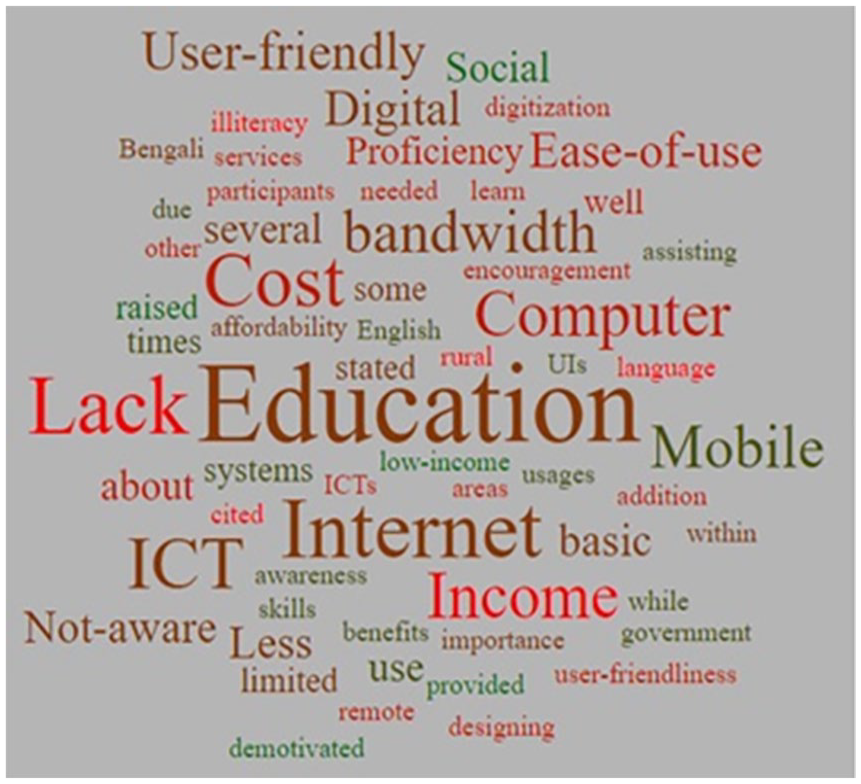
Transcribed report of FGD was analyzed through a qualitative analysis approach aiming to find the factors that create digital divide in Bangladesh. The outcomes of the qualitative analysis (important related text) were then analyzed by generating the word cloud. The outcome of the word cloud (see Figure 2) showed that the highly cited words were education (21), cost (14), income (12), internet (12) and ICT (11).
Word cloud of focus group discussion.
The results thus indicate the lack of basic education, literacy and skills in computer, mobile and internet; the lack of affordability to use the ICT; as well as the low-income and cost of internet bandwidth as the primary factors of digital inequality. Participants also stated about the ease-of-use and user-friendliness of the IT systems; and the lack of motivation to use and learn the IT systems. Lack of awareness about the benefits of digitization and the ICT usages, as well as the existing limited connectivity to the remote or rural areas, was also cited several times in the FGD. Lack of encouragement and assistance for IT education was stated several times while some of them raised about the limited use of ICT within the government, some other raised the importance of designing user interfaces (UIs) in Bengali in addition to English language. Figure 2 shows the word cloud, where the volume of words represents its frequency.
Semi-Structured Interviews
A total of 18 factors (see Figure 3) were found by the analysis of interview data; among them 11 (61%) factors were also observed in FGD. Again, the FGD and interviewing studies together produce 23 factors; among them 11 (48%) factors were found by both studies, while a total of five and seven problems were uniquely identified by the FGD and interviews, respectively. The factors those were found only in interviewing study are marked by asterisk in Figure 3.

Factors revealed by semi-structured interviewing.
Some participants (20%) stated about the lack of opportunity for digitization-based investment in the rural or remote areas. Similarly, some other participants (27%) stated that they did not have enough skill or expertise to use IT for business or earning money, though they were familiar with smartphone and internet mainly for information searching and entertainment. The uses of ICT in government sectors increased significantly during the last decades, but most of the participants were not habituated to use the ICT in government sector due to the lack of motivation, proper training, and promotional activities, while some states that man-machine ratio was very low in government sectors and the educational institutions. About half of the participants stated about their lack of confidence and trust in ICT because they heard a lot about the IT security, fraud of money, information leakage, and so on. Many of them also cited about the fairness to use ICT for online money transaction as well. Again, one third of the participants stated that the lack of consistent power supply in the rural or remote areas may create disparity in accessing the ICT. Few example responses related to the lack of internet skills, socioeconomic inequality, and lack of awareness are presented below, respectively: I know that government introduced an online system to check the results of Secondary School Certificate (SSC) exam, but I do not know how to access this system to search for a result; but I can do it by sending a mobile SMS. Data and bandwidth costs are too high; my parents do not give me any extra money to bear the internet cost though I am very much aware about the benefits of internet in education. I am not aware about earning money through internet, and that I can promote my business through a website; I thought these are only for enjoyment, education and fun!
Survey
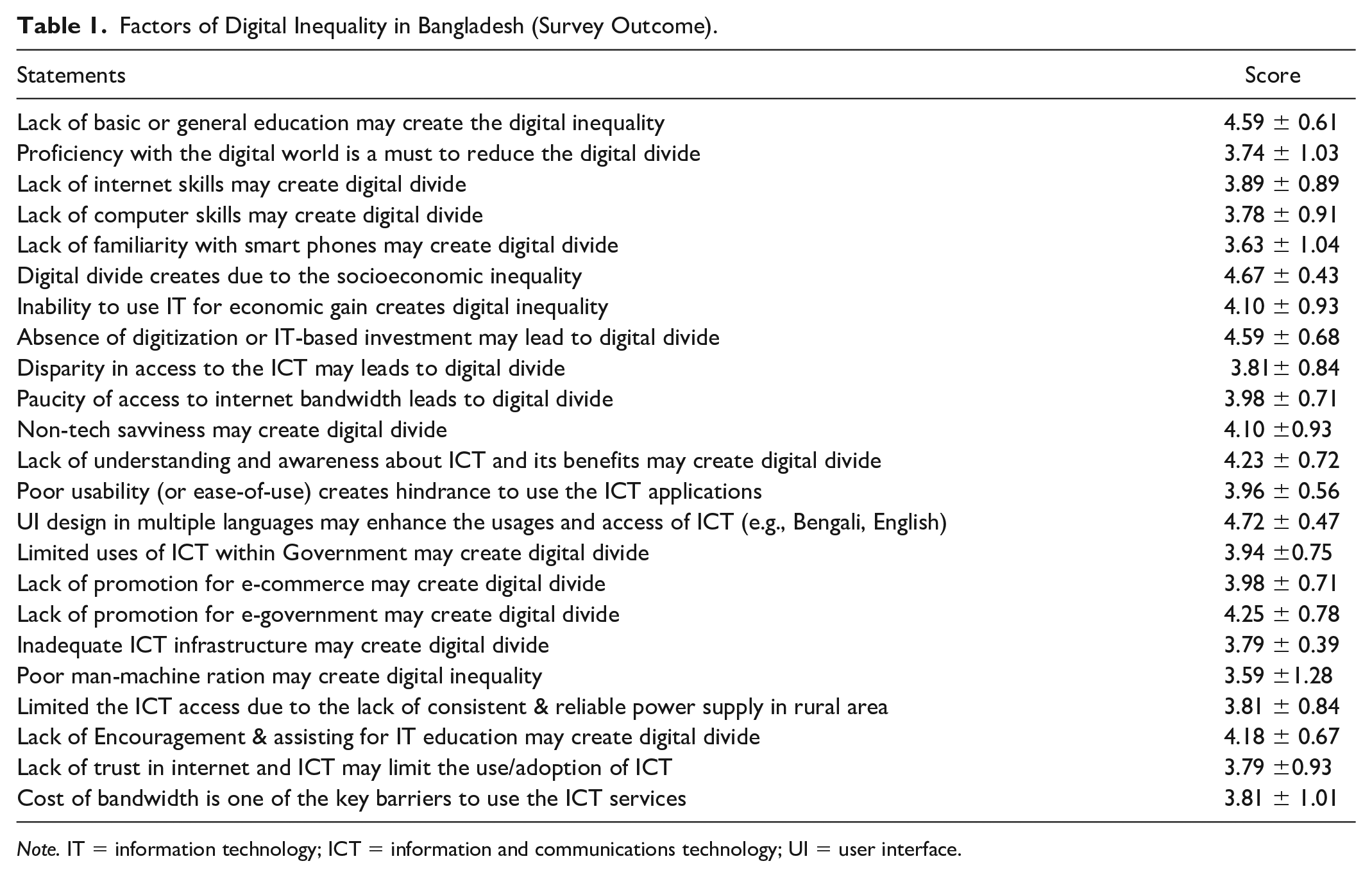
The survey results showed that all the factors revealed from the qualitative (FGD and semi-structured interviewing) studies were valid and well supported by the survey respondents (see Table 1). All the respondents provided vote to “Neutral” to “strongly agree” and none of them were disagreed/strongly disagreed with any of the factors or statements. The strongly agreed factors were general education, income differences, lack of digital/IT-based business investment, and the lack of user-friendly UI to make the ICT accessible for all. A comparative less agreement showed toward the ICT infrastructure, man-machine ratio, and user experiences with the internet, mobile, and computer. The minimum average score (3.59) was found to the poor man-machine ratio, while maximum score (4.72) was found for the UI design in multiple languages. About one fifth (18%) of the total statements showed scores of more than 4.50, while scores between 4.00 and 4.50 were showed for the one fourth (23%) of the total statements. The remaining statements (59%) showed scores between 3.50 and 4.00.
Factors of Digital Inequality in Bangladesh (Survey Outcome).
Note. IT = information technology; ICT = information and communications technology; UI = user interface.
Affinity Diagram
The factors that promote the digital inequality were analyzed using the affinity diagram (Lucero, 2015) and classified into different dimensions or groups based on their thematic or focused area. Analysis using affinity diagram was carried out by both authors of this article. In practice, first each app was stack in different similar cluster or group based on their thematic or focused area; second, experts added the group or cluster header; third, affinity diagram was drawn by organizing these on the board and experts reviewed the grouping and relations between the groups and then modified the diagram where needed; finally, to maintain the research rigor and to avoid the possible biases, all experts (authors) mutually discussed, made some adjustment (where needed), and finally agreed in grouping the factors. The groups or dimensions are referred here as the elements of digital inequality. The observed elements were educational, infrastructural, social, economical, and motivational as showed in Figure 4.

Determinants of digital inequality in Bangladesh.
Educational
The educational element primarily focuses on educating the citizens or to enhance their skills to use and administrate the information technologies, which includes the factors like lack of basic education, non-proficiency in digital world, and lack of skills in accessing the internet, computer, and smartphone. Lack of education resists citizens to adopt ICT in their daily and social life. In Bangladesh, the internet subscriber, mobile and computer users, and the literacy rate have increased noticeably in recent years but still about one third of the total population are illiterate (BTRC, 2018; UNESCO, 2017). The illiterate people are not able to use and far behind to adopt the ICT-based services. Thus, it is a challenging to educate this huge number of populations not only in basic education but also in IT education to accept the digitization.
Infrastructural
This element considers the facilitating issues that help citizens having easy and effective access to the information technologies. High-speed internet connectivity is required to get the optimum benefits from the digital applications and ICT (UIT, 2018; UNESCO, 2016). The ICT infrastructure and connectivity are well established in capital and main divisional city, while these are still under development in the rural and remote cities. A recent statistic showed that irrespective of geographic regions millions of people are still disconnected in Bangladesh (BTRC, 2018). The broadband divide exists in Bangladesh that leads to create the disparity in access to the ICT and paucity of access to internet bandwidth. In many cases, participants raised the issues of man-to-machine ratio at government organizations and in educational institutions. Again, consistent and reliable power supply in the rural and remote part of the country is another key concern to establish the excellent platform to make the ICT accessible to all.
Social
This element focuses on the citizens’ perspectives (e.g., trust, awareness) about the ICT uses and the issues of social/economical. Thus, the social element includes social inequality in terms of their income, gender, age, special need, and the like. In Bangladesh, the people’s income vary person to person, family to family; thus, socioeconomic inequality is raised as an obstacle to adopt digital services. The low-income people are not interested in internet use, while a small percent of population use internet in mobile phone for limited access. Again, lack of trust in internet is found as another key barrier for digitization, especially for the illiterate, semi-literate, and rural people in Bangladesh. This finding demands a more targeted approach (awareness, enhance security, privacy, etc.) to building trust on ICT access in context of Bangladesh. This element includes non-tech savviness and lack of awareness. Rural and illiterate people are not much aware of (or rightly motivated) and similarly not getting support or mentor to learn and use digital services for their economic development. Although government has taken several initiatives to integrate ICT, user intention to use and adopt the ICT is very slow mainly due to the lack of enough encouragement and motivation, and for the non-tech savviness.
Economical
This element highlights the importance of ICT uses from economical perspective and includes lack of digitization-based investment and the limited opportunity for online-based business. Nowadays, access to the digital economy is pervasive, while e-commerce is one of the key means of the evolution of the digital economy (UNCTAD, 2018). Although several online-based e-commerce sites like Daraz, PryoShop, Bikroy.com, Rokomari, ClickBD, and ChalDal exist in Bangladesh, most of them are operated in the Capital or main divisional city (Hossain, 2017). Rural and illiterate citizens are not willing to invest for digitization-based business, and likewise, they are not able to use the e-commerce sites. Moreover, government of Bangladesh invested a huge amount of money and implemented a number of IT-based projects to establish digital government, but the rural parts of the country are still suffering less connectivity of broadband internet and 4G/5G mobile network.
Usable design
This element focuses on how easily citizens may use the ICT and includes usability, user experience (UX), UI in multiple language and accessibility. The study found that rural and illiterate people are not educating and motivating enough to use the systems in spite of facing difficulties in accessing and using the digital systems due to the lack of usability and UX. The resent studies also showed the IT systems developed in Bangladesh are facing the noticeable problems of usability, accessibility, and good UX, which creates hindrance to use the ICT systems (Islam et al., 2020c; Kundu et al., 2020; Muaz et al., 2021; Rahman et al., 2020). Again, the study found that UI design in multiple languages may enhance the usages and access of ICT (e.g., Bengali, English), which is also noticed in the recent studies as well (Islam et al. (2020a)).
Discussion
The study explored the fundamental factors of digital inequality in Bangladesh. Five elements of digital inequality in Bangladesh were revealed that encompass 23 factors. Elements of the digital inequality include educational, infrastructural, social, economical, and usable design. The outcome of this research contributes to theory, practice, and research.
Theoretical Contributions
The theoretical contribution is discussed here with respect to the prior related research conducted focusing on the context of Bangladesh. As discussed in the related work section, Waughen et al. (2015) considered a set of elements of digital divide like education, internet access, skill of teachers, government roles, and technological skill to assess the technological progress of Bangladesh in the year of 2015 based on the literature survey and content analysis. They found that technological support for ICT was enough but there was a huge gap on providing necessary guidance and education for creating, disseminating, and accessing information through ICT. This research investigated the similar issues following a grounded theory approach and provided a more extended and updated scenarios of digital inequality and revealed all possible reasons beyond digital inequality. In another study, Babar (2017) provided a set of recommendations to enhance the ICT infrastructure to reduce the digital divide in Bangladesh, which may not reflect the underlying facts to understand the root causes of creating digital inequality in Bangladesh; while this research explicitly focused to reveal all possible factors of creating digital inequality. Thus, the outcome of this research can help the government or nongovernmental organizations (NGOs) to understand the underlying fact of creating digital divide, so that government may take necessary initiatives to overcome the barriers in a more practical way. Again, this research extends the finding of Akbar (2002), since Babar (2017) explored only the factors of digital divide that explicitly associated with the women community in Bangladesh.
Practical Contributions
As practical contribution, this research provides an in-depth scenario of digital inclusion and exclusion in Bangladesh, and the underline factors of creating digital inequality, so that NGOs and government organizations may take necessary initiatives toward each dimension of digital inequality. Digital literacy can help to bridge this digital divide (Mukherjee et al., 2019; Nimish et al., 2017). For example, for educational element government may incorporate ICT in the national educational curricula and provide effective IT training for end users (including illiterate, farmers, and experts) to improve their digital proficiency and to accelerate the ICT usages. The infrastructural factors could be addressed by ensuring huge (internal and external) investment in ICT; bringing the rural and disadvantage areas under the ICT connectivity while ensuring connectivity with the other parts of the world; and establishing the effectiveness, cooperation, and interoperability among the ICT operators and ISPs in Bangladesh. From social point of view, government and NGOs may take initiatives like ensuring better usability and user experience (UX) to develop the IT systems, ensure free or low-cost connectivity, provide hands-on training and other related opportunities for accessing ICT by the poor/low-income and special need people. Again, providing the infrastructural and financial support to enhance the online based business; ensuring the authenticity, trust, and transparency in providing e-services; ensuring the cost-effective and labor-less internet-based business opportunity to earn foreign money could be the possible exemplar initiatives for economic factors. A variety of motivational initiatives for creating awareness about the usage of ICT among the citizens can be taken, such as offering some sorts of incentives (reducing service charge, time saving, tax exemption or reducing, etc.) to individuals for taking services online and to organizations for integrating ICT in their business; providing support and encouraging them to learn and use the ICT; and enhancing the tech-savviness by NGOs, educational institutions, and media so that people may understand the importance and usages of ICT. Moreover, aggerated databases provide important information (Brooks et al., 2005). Thus, they can serve as an important tool to reduce the digital inequality.
Research Contributions
The findings of this research also unfolded several new research topics and valid problems that need further investigation. A few studies have been conducted focusing on specific issue of digital divide to investigate how it creates the digital divide and then proposed solutions to reduce the digital divide. For example, M. A. Islam and Tsuji (2011) explored the contribution of Community Information Centers to reduce the digital divide, while Hossain (2010) explored the significance of ICT usages by the disabled persons in Bangladesh to bridging the digital divide; Khalid (2011) investigated digital divide that exist between the teacher and students in rural and urban institutions; Islam et al. (2020a) investigated how the development of a usable (user-friendly) application may increase the acceptance of mobile health applications in Bangladesh, while Chaklader et al. (2013) explored the effect of a low-cost wireless LAN in rural village of Bangladesh to reduce the digital divide. The existing work and the findings of our research showed that several issues or factors of digital inequality exist in Bangladesh, which require further research or investigation to bridge the digital inequality in Bangladesh. For example, future research can be conducted to explore how the development of user-friendly applications can contribute to the special group of users (e.g., aging population, digital immigrants, and illiterate users) that would focus on the usability/UX factor of social element; what motivates citizens to learn, use, and accept the ICT that would focus on the awareness of motivational element; how to improve the citizens trust and reliability on digital based investment that would focus on the digital investment of economical element; how to establish or increase trust in e-commerce in Bangladesh that would focus on the digital commerce of economical element, and the like.
Conclusion
It is utmost important for the citizens of Bangladesh to adopt, accept, and use the ICT to achieve the nation’s goal of establishing the Digital Bangladesh within 2021. In other words, to make the country digitize, challenges that create the digital inequality as well as digital divide need to be addressed and overcome. Thus, this research outcome will greatly contribute to overcome the challenges of digital inequality and help the government to achieve its national goal, that is, to make a Digital Bangladesh.
The research has a few limitations as well: First, the number of participants for each study was inadequate comparing to the number of populations in Bangladesh. Second, the qualitative data collected through FGD and by semi-structured interview were analyzed following a qualitative data analysis method, which is totally subjective, and depends on the researcher’s skill, knowledge, and inferences. However, to alleviate these limitations, a total of three studies were conducted and replicated with a total of 386 participants having different biographical profile in terms of gender, education, age, income, living place, and so on. Furthermore, a survey study was conducted to collect the quantitative evidence to overcome the problem of possible bias in analyzing the qualitative data. Finally, since the survey data were collected only to explore how the adequate number of participants opined about the factors revealed through FGD and interviews, thus no multiple regression analysis was conducted.
The future work will propose a framework encompassing a set of recommendations to address the revealed factors to reduce the digital inequalities in Bangladesh. The effectiveness and applicability of the proposed framework will be assessed through a longitudinal field study in context of Bangladesh. Future work will also focus on exploring the relations between the participants’ demographic profiles and on the factors of digital inequality. Furthermore, future work may also focus on collecting more survey data and analyzing the data using multiple regress analysis to validate the revealed factors.
Footnotes
Acknowledgements
The authors thank the participants of focus group discussion and interviews whose participation made the study possible. Their efforts are gratefully acknowledged.
Declaration of Conflicting Interests
The author(s) declared no potential conflicts of interest with respect to the research, authorship, and/or publication of this article.
Funding
The author(s) received no financial support for the research and/or authorship of this artcle.
Ethical Statement
We confirm that ethical approval was applied for conducting this research. The target of the study was to collect subjective data from human participants thorough FGD and interviews. No human data, human tissue, or any clinical data were collected for this study. Therefore, the ethical committee headed by the Research & Development Wing of Military Institute of Science and Technology (MIST) decided that it is not required to have formal approval. We also declare that we have taken written consent from each participant of FGD and interviews to participate in the evaluation study.
