



Abstract
A growing body of research has explored the conditions that motivate employees to engage at work. While employees’ attitudes and behaviors are socially influenced by their significant others’ perceptions, the divergent perceptions of organizational climate are underexplored. This study examines the socio-psychological mechanisms by which employees’ and managers’ perceptions of social climate enhance employee engagement at work. Based on the postulate that “psychological state engagement” are the primary catalyst for “behavioral engagement,” this study presents a serial mediation model that examines the role of divergent perceptions of social climate (as characterized by cooperation, shared codes and language, benevolence, and integrity) in fostering individual engagement through the mechanisms of organizational identification and growth satisfaction. Data were collected from both managers and employees, using a time-lagged design at two-time points. The findings revealed that managers’ collective perceptions of social climate were associated with organizational identification and growth satisfaction, which in turn fostered employee engagement at work. Contrary to expectations, there was no statistically significant relationship between employees’ collective perceptions of social climate and their engagement. However, individuals who had more favorable perceptions of the social climate (compare to colleagues’ collective perception) reported higher levels of organizational identification. These results point to ways in which social climate can impact employee engagement, and underscore the importance of taking divergent perceptions of organizations into account. They advance theories on the inherent tension between individuals’ desire for inclusion and the need to maintain a sense of individuality and distinctiveness.
Plain Language Summary
While employees’ attitudes and behaviors are socially influenced by their significant others’ perceptions, the divergent perceptions of organizational climate are underexplored. This study examines the how employees’ and managers’ perceptions of social climate enhance employee engagement at work. Based on the postulate that “psychological state engagement” are the primary catalyst for “behavioral engagement,” this study presents a serial mediation model that examines the role of divergent perceptions of social climate (as characterized by cooperation, shared codes and language, benevolence, and integrity) in fostering individual engagement through the mechanisms of organizational identification and growth satisfaction. Data were collected from both managers and employees, using a time-lagged design at two-time points. The findings revealed that managers’ collective perceptions of social climate were associated with organizational identification and growth satisfaction, which in turn fostered employee engagement at work. Contrary to expectations, there was no statistically significant relationship between employees’ collective perceptions of social climate and their engagement. However, colleagues’ perceptions do matter. Individuals who had more favorable perceptions of the social climate (compare to colleagues’ collective perception) reported higher levels of organizational identification. These results point to ways in which social climate can impact employee engagement, and underscore the importance of taking divergent perceptions of organizations into account. They advance theories on the inherent tension between individuals’ desire for inclusion and the need to maintain a sense of individuality and distinctiveness.
Keywords
Introduction
Engaged employees are key to fueling a competitive edge and generating improved outcomes at the individual, group, and organization levels (Gutermann et al., 2017; Macey & Schneider, 2008; Rich et al., 2010). Studies have pointed to the importance of job and personal resources in fostering engagement in the workplace (see review by Bakker et al., 2011). Previous studies have explored the workplace conditions that foster a high level of engagement at work (Hakanen et al., 2008; May et al., 2004; Schaufeli & Salanova, 2007). These works primarily draw on Kahn’s (1990) seminal ethnographic work which defined the psychological conditions (meaningfulness, safety, and availability) leading people to personally engage or disengage at work. Studies have also explored the implications of subjective relational experiences for employees’ engagement at work (Vinarski-Peretz et al., 2011). This line of research has produced important insights into the psychological and relational conditions that influence personal engagement. However, since psychological conditions develop in a particular social context, an in-depth examination of a given organization’s social climate can reveal which psychological and relational conditions influence engagement at work (Schneider et al., 2013). Currently, however, the operational definition of a “social climate for engagement” (Bakker et al., 2011, p. 11) has remained relatively underdeveloped both theoretically and empirically on several fronts, and is fueled by controversies over conceptualizations and measures.
This study shifts the lens from the psychological conditions, which capture the experiences of the rational and unconscious elements of work contexts at the individual level (Kahn, 1990, p. 695), to the organizational level of social climate (Collins & Smith, 2006). Further, assessing the social climate of an organization through employee perceptions can only capture the views and interpretations of one side of the story. It ignores the fact that employees are social entities, whose attitudes and behaviors are influenced by their significant others’ perceptions of the social settings in which they work. In other words, centering exclusively on employees fails to examine whether the construed perceptions of peers or the upper echelon have a differential influence, that is, likely to influence employee work engagement. Thus, to obtain a more complete theoretical and empirical picture, this study assessed both employees’ and managers’ perceptions of social climate as well as the similarities and differences between individuals’ perceptions and their colleagues’ collective perception. This framework made it possible to evaluate whether individuals’ attitudes and behaviors are influenced by their colleagues’ perceptions and membership in the collective, or alternatively by their own perceptions which enables them to maintain their uniqueness and distinctiveness. The findings can thus advance theories on the inherent tension between the desire for inclusion and the need to maintain a sense of individuality (Ashforth et al., 2008; W. K. Smith & Lewis, 2011).
On a broader level, it remains unclear how social climate, and particularly divergent perceptions of social climate, can stimulate employee engagement. Previous research (Macey & Schneider, 2008; Vinarski-Peretz et al., 2011) has argued that behavioral engagement is driven by psychological state engagement. Here it was hypothesized that employees’ behavioral engagement is catalyzed by two manifestations of psychological state engagement: organizational identification and growth satisfaction.
The mediation model (Figure 1) suggests that divergent perceptions of social climate influence employees’ organizational identification and help develop growth satisfaction, which in turn affects their level of engagement at work. Specifically, it was theorized that the more positively the social climate is perceived (by managers collectively, employees collectively, and by individuals), the stronger the organizational identification and consequently the greater sense of growth satisfaction. This, in turn, was posited to result in higher levels of engagement at work. In so doing, this model aims to better define the socio-psychological mechanisms by which these perceptions of social climate contribute to driving employee engagement at work.
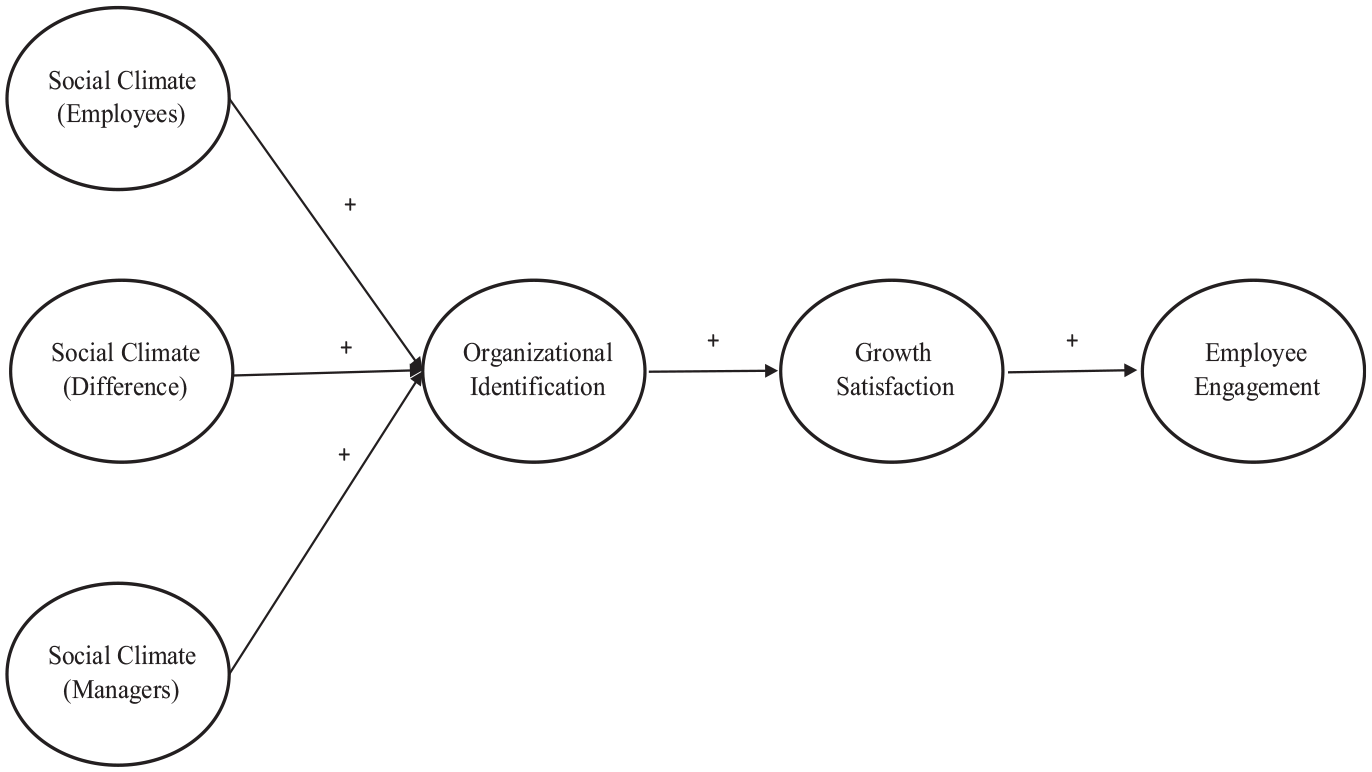
The hypothesized research model.
Theoretical Background and Hypotheses
Social Climate and Employee Engagement at Work
Personal engagement is defined as “the simultaneous employment and expression of a person’s ‘preferred self’ in task behaviors that promote connections to work and to others, personal presence (physical, cognitive, and emotional) and active, full role performances” (Kahn, 1990, p. 700). Engaged employees invest efforts and psychological resources (e.g., attention, focus, mental energy) even when confronting difficulties, are enthusiastic about their work and its challenges, tend to be immersed in their job, and perform at higher levels (Ho & Astakhova, 2018; Macey & Schneider, 2008).
Organizational climate is particularly conducive to people’s engagement at work (Macey et al., 2009; Vinarski-Peretz & Kidron, 2018). It is defined as employees’ shared perceptions and the meaning they ascribe to organizational policies, practices, procedures, and observations of what is rewarded, supported, and expected (Schneider et al., 2013, 2017). However, centering research on a “focused climate” (such as service climate, climate for innovation, or climate for safety) has been argued to be more useful to a better understanding of specific outcomes than more generic studies of organizational climate (Bakker et al., 2011; Schneider et al., 2013). One recent study, for example, showed that in an organizational climate of care and concern for employees, employees responded by caring more for the organization, which was manifested in higher levels of engagement (Saks, 2022).
This study focuses on social climate, as a specific form of organizational climate. Social climate is defined as the collective set of norms, values, and beliefs that express perceptions of how organizational members interact with one another while performing their job (Collins & Smith, 2006). Social climate is a multi-dimensional construct encompassing: (1) cooperation, (2) shared codes and language, (3) benevolence, and (4) integrity (K. S. Smith et al., 2005). Cooperation refers to the organizational norms governing personal efforts toward group outcomes or tasks rather than individual outcomes (Wagner, 1995). Shared codes and language comprise a common set of terms, symbols, and understandings that allow individuals to communicate effectively with one another, which can facilitate their ability to gain access to people and their information (Nahapiet & Ghoshal, 1998). Benevolence refers to the desire to do good for the other, beyond an egocentric instrumental-related motive. Integrity refers to the belief that the other is motivated by accepted principles of fairness. Benevolence and integrity are the cornerstones of trusting relationships where individuals are willing to make themselves vulnerable to others, irrespective of the ability to monitor or control them (Mayer & Davis, 1999).
The social climate literature considers that perceptions about social climate in an organization can predict employees’ attitudes and behaviors (e.g., Binyamin & Brender-Ilan, 2022), since individuals need to make sense of cues in their work environment before acting. The social climate provides social and emotional support, which are essential resources for coping with job demands (Bakker & Leiter, 2010). Trust in co-workers and supervisors enhances job engagement, because it nurtures the willingness to be vulnerable to the actions of others, and alleviates fears of revealing a lack of abilities, or threats to valued rewards (Ho & Astakhova, 2018). Provision of a secure, encouraging, and helpful working environment where employees can express their suggestions, share good experiences, identify mistakes, share knowledge, and feel free to seek help, all enhance their engagement at work (Saleem et al., 2020). In this type of environment where employees perceive their organization’s climate as supportive in ways that satisfy their psychological needs, they work with more dedication and commitment, and become more psychologically present at work (Inam et al., 2021). A social climate that manifests shared codes and language, cooperation, benevolence and integrity builds a safer environment in which employees can express themselves more freely without concerns for their self-image, status, or career advancement. In such environments, people also feel that the organization values their contributions, thereby driving engagement at work.
One of the key unresolved issues in the literature is the mechanisms enabling these relationships to unfold. Here it was hypothesized that organizational identification and growth satisfaction may account for the association between social climate and engagement.
The Mechanisms of Organizational Identification and Growth Satisfaction Between Perceptions of Social Climate and Employee Engagement
Perceptions of the Social Climate and Organizational Identification
Social identity theorists define organizational identification as the extent to which individuals feel a psychological connection and sense of belonging to their organization, and where individuals develop self-conceptions through their affiliation or connection and experience the organization’s successes and failures as their own (Mael and Ashforth, 1992).
Organizational climates such as a communication climate (Smidts et al., 2001) or a supportive climate (Lam et al., 2016), which rely on positive and supportive relationships foster organizational identification. Employees who can collaborate, trust their colleagues, and develop shared codes and language, are more likely to identify with the organization. Shared values provide a common ground and consistency, thus making the organization more appealing to its members who can align their self-concepts with organizational identity (Shamir et al., 2000). Shared values reduce subjective uncertainty about perceptions, attitudes, feelings, and behaviors (Hogg & Terry, 2000), enabling members to express their opinions and reveal their authentic selves. Conversely, when employees perceive that their personal goals are hindered and their well-being is compromised, this can lead to an identity threat and subsequently reduce their identification with the organization (Koçak & Kerse, 2022). Studies have indicated that social climate is positively associated with a sense of belonging (Bartram et al., 2021), and negatively with intentions to leave the organization (Bilginoğlu & Yozgat, 2023).
Hence it was hypothesized that social climate would be positively associated with employees’ organizational identification.
Hypothesis 1. There is a positive relationship between social climate and employees’ organizational identification.
Works have suggested that employees’ shared perceptions and interpretations are a proximal predictor of individual-level constructs, which translates into a range of important outcomes (Norton et al., 2017; Schneider et al., 2017). Aggregating members’ perceptions of social climate, which can be affected by personal characteristics and attitudes, makes it possible to ascertain the ways in which environmental factors shape employees’ outcomes (David et al., 2021). This is because the social context of climate has a gestalt or emergent group effect in the sense that higher-level aggregate variables of climate may account for the additional variance in individual outcomes beyond what is explained by analogous individual-level counterparts (Schneider et al., 2017). A strong climate in which employees perceive social climate in the same way may thus yield consistently positive outcomes (Schneider et al., 2002). Hence, colleagues’ collective perception has a social influence on employees’ attitudes, in that when colleagues have a positive perception of the social climate, they are more likely to offer emotional support, encouragement, and assistance. This support creates positive emotional connections, which enhances employees’ sense of belonging and identification with the organization.
Hypothesis 1a. There is a positive relationship between colleagues’ collective perception of the social climate and employee’s organizational identification.
Nevertheless, research has shown that individuals experience their work in different ways and may develop different perceptions of the social climate. Individuals’ own perceptions are influenced by their personal experiences, interactions, and observations in the organization. Hence, even within the same workgroup, members can have different perceptions or experiences of the same work context (Liao et al., 2009). Studies have suggested that individuals not only seek to become members of a social group and exhibit behaviors that match an ingroup-based identity, which corresponds to a “prototype-based depersonalization” (Hogg & Terry, 2000), but also strive to maintain their unique self. This inherent tension between inclusion and uniqueness (Ashforth et al., 2008), which is also known as the “paradox of belonging” (W. K. Smith & Lewis, 2011), relates to the need for belonging on one hand, and the need to remain independent and maintain a sense of individuality on the other.
Studies have shown that individuals become independent from others and express their unique thoughts, feelings and actions in a mandated way (Markus & Kitayama, 1991), and thus vary in the extent to which they represent the social context. This lack of uniformity in employees’ experiential-based perceptions points to the need to examine employees’ individual perceptions as compared to their colleagues (Liao et al., 2009) to better understand how the socio-psychological processes underlying social climate influence employee engagement.
Individuals tend to engage in social comparisons, where they evaluate the extent to which their views align or differ from their colleagues. A positive discrepancy may arise in cases of more positive personal relationships, specific positive experiences, or a generally optimistic outlook. This positive discrepancy is more likely to lead to a sense of belongingness. It reinforces employees’ belief that they fit into the organization and share its goals and values. They may believe that the organization represents an important part of their self-identity, which enhances their motivation to contribute to the organization’s success and fosters a sense of pride and belongingness. When employees have more positive perceptions than their colleagues, they may also develop a sense that their organization is attentive, open, and tolerant to diverse and different perceptions. These attributes shape positive perceptions among members about the organization, and thus help to develop a sense of identification. In this context, the organization is seen as a terrain for individuals not only to develop a sense of belongingness, but also to express their unique self, thus reconciling themselves to what appears to be differing needs. Conversely, when individuals have perceptions of the social climate that are below the group average, they may encounter difficulties in finding their place within the social context and are likely to develop lower levels of organizational identification.
Hypothesis 1b. The higher the employee’s perception of the social climate as compared to the collective (group’s) perception of the social climate, the higher this employee’s extent of organizational identification.
Although individuals’ perceptions of social climate affect their identification, the ways managers perceive the organization also influence employees and their attitudes toward the organization (Greguras & Ford, 2006). Leaders are representative figures of the organization and symbolize its identity (Shamir et al., 2000) such that employees are likely to seek cues that affirm their beliefs by construing what values and norms their managers believe in and pursue. Thus, employees’ attitudes and behaviors are partly shaped by the ways in which managers perceive the social climate because they seek signals and cues about the norms that they believe in. Hence, managers’ perceptions of the social climate can affect the level of identification employees develop toward the organization.
Hypothesis 1c. There is a positive relationship between managers’ perception of the social climate and employee’s organizational identification.
Organizational Identification and Growth Satisfaction
Theoretical frameworks have proposed that individuals strive to satisfy fundamental psychological needs that are crucial for personal development, growth, self-esteem, and self-actualization (Alderfer, 1972; Hackman & Oldham, 1975). However, despite efforts to better understand positivity (thriving in particular; see Carmeli & Spreitzer, 2009) in organizations, growth satisfaction has rarely been studied, and has only recently attracted renewed interest in the literature (Binyamin & Carmeli, 2017). Growth satisfaction encompasses the feeling of satisfaction individuals experience when they engage in learning, develop new skills, and advance their careers. It derives from their personal and professional development within the organization (Kulik et al., 1987). It taps people’s sense of worth and accomplishment which evolves through the execution of specific work tasks, leading to an enhanced sense of fulfillment and personal wholeness (Schneider & Alderfer, 1973).
To further explore the antecedents of growth satisfaction as a specific type of satisfaction in contemporary organizations, organizational identification is likely to play a crucial role. When employees develop a sense of belongingness toward their organization that enables them to affirm their self-identity and feel valued, they tend to experience personal growth (Ashforth et al., 2008). The emotional value derived from belonging to an organization is often associated with the attribution to it of positive qualities. Consequently, strong identification with the organization empowers employees by connecting them to a larger and more influential entity, thereby boosting their sense of self-worth and self-esteem, and raising their self- and collective-efficacy beliefs (Ashforth et al., 2008; Dutton et al., 1994). In this regard, organizational identification has a significant impact on organization-based self-esteem, which is defined as individuals’ belief that they can satisfy their needs for self-worth by participating in roles within the organization (Bergami & Bagozzi, 2000).
A meta-analysis by Lee et al. (2015) found a positive correlation between organizational identification and attitudinal outcomes such as job satisfaction, as well as behavioral outcomes including in-role and extra-role performance. Organizational identification plays a more significant role than job design in explaining work motivation (high job satisfaction, OCB, personal accomplishment, and low turnover intentions) and well-being (Koçak & Kerse, 2022; Wegge et al., 2006), mainly because strong identifiers tend to perceive their work within the organization as a favorable job environment (Lee et al., 2015).
Research has shown that organizational identification is linked to career satisfaction across different sectors, such as students who identify with their institution (Al Hassani & Wilkins, 2022), but also lawyers (Pham, 2020). Srivastava et al. (2020) explained these relationships by highlighting the sense of unity with co-workers, the feeling of belongingness, and perceiving the organization as supportive of achieving individuals’ career goals, all of which drive individuals to contribute to the organization’s success. Bartram et al. (2021) argued that individuals who identify with their organization have greater access to learning from others, enjoy their encouragement and therefore achieve greater success from learning episodes.
Thus overall, when employees identify with their organization, they are more likely to experience higher levels of satisfaction with their personal and professional development. Thus,
Hypothesis 2. There is a positive relationship between organizational identification and growth satisfaction.
Growth Satisfaction and Employee Engagement
Positive job-related affect and job resources (such as social support) help fulfill basic human needs and stimulate personal growth and development, thus augmenting positive psychological states such as work engagement (Bakker & Leiter, 2010). When individuals satisfy their psychological needs, their psychological resources are augmented, and they are more likely to engage in specific behaviors (Deci & Ryan, 2000). Because individuals seek opportunities to grow and develop, they are likely to experience growth satisfaction such that their psychological resources are expanded, and they tend to engage by channeling their cognitive, emotional, and physical resources to perform their job (Fredrickson, 2001; Kahn, 1990).
Carmeli and Spreitzer (2009) found that when employees developed a sense of thriving, they reported higher levels of engagement in innovative behaviors at work. Binyamin and Carmeli (2017) observed that when employees experience growth satisfaction, they tend to be more engaged in creative behaviors. This is primarily because the sense of growing personally or professionally at work heightens employees’ confidence and efficacy by encouraging them to proactively take risks, try new things, and come up with new ideas. Thus,
Hypothesis 3. There is a positive relationship between growth satisfaction and employee engagement at work.
The Mediating Role of Organizational Identification and Growth Satisfaction in the Relationship Between Social Climate and Employee Engagement
Social identity theory (SIT; Stets & Burke, 2000) argues that individuals think and act on behalf of an organization in which they feel a sense of belongingness. They translate their organizational membership into ways to define and enhance their self-esteem. Recent research has integrated social identity from the social psychology literature and social exchange from the applied psychology literature to show that members reciprocate organizational efforts by engaging in extra-role behaviors oriented toward the organizational interests (Tavares et al., 2016).
When employees identify with the organization, they are more likely to exert greater efforts, because it empowers them and affirms their self- and collective-efficacy beliefs (Kark et al., 2003). When individuals believe that organizational values are congruent with their personal values and self-image, they feel that they can express their true self. Hence, they are more willing to make greater personal investments in the pursuit of organizational goals, and exhibit higher engagement in work assignments (Macey & Schneider, 2008; May et al., 2004; Rich et al., 2010).
Social identification is a plausible socio-psychological mechanism that activates the influence of organizational climate on employee work engagement. Through the organizational identification process, people find a place in which they feel safe to learn, experiment, seek help from others and explore opportunities to grow personally and professionally. The social climate can provide a rich context in which people are able to learn from each other and fulfill their needs for personal and professional growth (DeRue & Morgeson, 2007). Social climate that develops a sense of belonging and bolsters self-enhancement enables employees to achieve their work goals, and provides opportunities for learning, growth, and development, which constitutes a motivational mechanism for fostering employees’ engagement (Bakker & Leiter, 2010).
The social climate facilitates access to knowledge and increases individuals’ motivation to interact with colleagues and exchange knowledge (Collins & Smith, 2006; Nahapiet & Ghoshal, 1998). Previous studies have noted the key role of social climate in fostering growth satisfaction. Reinboth and Duda (2006) found that the social climate (as compared to an ego-involving climate) increased personal growth needs satisfaction. Binyamin and Carmeli (2017) found that working with professionals (human capital) was not sufficient to enhance employee growth satisfaction unless the teams had high social capabilities of cooperation and trust (social capital).
Thus, based on claims that a “psychological state” is a motivational driver of behavioral engagement (Macey & Schneider, 2008; Vinarski-Peretz et al., 2011), social climate is likely to motivate employees to engage at work more fully, through the development of organizational identification and a sense of growth satisfaction.
Hypothesis 4a. Organizational identification and growth satisfaction will mediate the relationship between employees’ perceptions of social climate and their engagement at work.
Hypothesis 4b. Organizational identification and growth satisfaction will mediate the relationship between individual employees’ perception of the social climate (as compared to the collective perception of the social climate), and employee engagement at work.
Hypothesis 4c. Organizational identification and growth satisfaction will mediate the relationship between managers’ perceptions of social climate and employees’ engagement at work.
Method
Sample and Procedure
The participants were recruited through referral sampling, facilitated by graduate students who distributed the questionnaire to their coworkers and members of various organizations. The participants were managers and employees working in 24 departments across different organizations in the public sector in Israel. These organizations encompassed a broad range of industries, including 19 local authorities (municipalities), 2 communication technology organizations, and 3 fire departments.
The inclusion of participants from diverse industries was aimed at enhancing the external validity and increase the generalizability of the findings (Cook & Campbell, 1979). Note that the Israeli public sector is two percentage points larger than the OECD average and that the share of public employment has been declining since 2007 (OECD, 2021, p. 12). Employee engagement has been dropping significantly in the public sector (across OECD countries), which threatens to erode important organizational performance outcomes (OECD, 2015). Engaged employees are critical to successfully managing change in public administrations, enhancing service orientations, and ensuring customer satisfaction. The analysis of work engagement in public organizations is an emerging stream of studies and provides broad data on the antecedents and the positive outcomes of engagement including employee retention (Ancarani et al., 2021; Fletcher et al., 2020). However, some potential antecedents of engagement have rarely been studied.
This study implemented a two-wave time-lagged design. At Time 1, 244 questionnaires were collected (for a response rate of 77.2%), and at Time 2, 216 matching questionnaires. However, because of missing data, the totals were 186 employees, and 63 managers (two or three from each department). To achieve a more objective evaluation of social climate, the managers were not necessarily the direct supervisors of the employees. The data for the 186 employees was subjected to a CFA, but, due to missing control variable data, only 176 employee surveys were usable for the HLM analysis. Data collection took place with a lag of 2 to 4 weeks between each wave (which was determined by the availability of the employees and representatives). To ensure anonymity, employees’ questionnaires were matched by a code composed of month of birth, hospital where they were born and their mothers’ maiden name. Specifically, at Time 1, the employees completed a survey on the independent variable (i.e., the social climate in their organization), and at Time 2 filled in a survey about the mediating and dependent variables (i.e., organizational identification, growth satisfaction, and engagement).
The participants were nested in 24 departments, each in a different organization, with an average of 7.75 employees per organization (SD = 5.66). Fifty-eight percent of the participants were women. The average age of the employees was 42 (SD = 10.8), and their average organizational tenure was 12.53 years (SD = 9.93). Educational levels varied from a high school diploma to a Ph.D.: 2% of the participants had not completed high school, 30% had a high school diploma, 34% had a technical diploma (after high school graduation) or university credits, 20% had a bachelor’s degree, and the remainder of the participants (13%) had a Master’s degree or above.
Measures
The survey was administered in Hebrew. The original English language measurement items were translated into Hebrew and then back-translated into English (Brislin, 1986). All responses were assessed on a 5-point Likert scale ranging from 1 = strongly disagree and 5 = strongly agree, except for the growth satisfaction measure.
Social Climate
Collins and Smith’s (2006) scale was used to assess the four dimensions of organizational social climate: cooperation, shared codes and language, benevolence and integrity. Cooperation was assessed with four items from the five-item scale employed by Chatman and Flynn (2001). Sample items are: (1) “Employees in my organization are willing to sacrifice their self-interests for the benefit of other employees”; and (2) “There is a high level of sharing between employees in my organization.”The shared codes and language measure was assessed with four items from the measure employed by Collins and Smith (2006), which was based on Nahapiet and Ghoshal (1998). Sample items are: (1) “Employees here share their own code to talk about work”; and (2) “Employees are always on the same page when they talk about work.”Benevolence was assessed on the 5-item scale from Mayer and Davis (1999). Sample items are: “The employees in this organization will go out of their way to help each other with work”; “People’s needs and desires are very important to the others in my organization.”Integrity was measured with five items from the scale employed by Mayer and Davis (1999). Sample items are: “Employees in this organization try hard to be fair in dealings with others”; “Employees in my organization never have to wonder whether other employees will stick to their word.” The measures showed good reliability (α = .79 for cooperation; and α = .86, shared codes and language; α = .91 for benevolence and α = .92 for integrity). To assess the construct validity of this measure, a confirmatory factor analysis of the social climate construct was conducted. The goodness-of-fit indices were: AIC = 7526, χ2(129) = 285.06; CFI = 0.93; TLI = 0.91; RMSEA = 0.08; SRMR = 0.04, and all indicators were significantly related to their respective constructs (p < .001). The fit of this model was compared to a three-factor model in which the Cooperation and Benevolence items were loaded onto one factor. The fit of this model was poorer than the four-factor model: AIC = 7535; χ2(132) = 295.7; CFI = 0.92; TLI = 0.91; RMSEA = 0.08; SRMR = 0.04. A one-factor model where all items were loaded onto the same latent variable was poorer than the four-factor model: AIC = 7660.8; χ2(135) = 402.3; CFI = 0.87; TLI = 0.86; RMSEA = 0.10; SRMR = 0.05.
Given the focus on social climate at the organizational level, the intra-class correlation coefficient (ICC1) was examined before aggregating this measure to the firm level. The ICC(1) value was .28 (p < .01) and the ICC(2) value was .75 (p < .01), and the mean Rwgj values for the four subscales were between 0.76 and 0.86, consistent with conventional standards for aggregating individual questionnaire responses about group level analysis in field research (see Bliese, 2000). Therefore, employees’ responses for social climate were averaged within each firm to create an aggregated measure. The difference (deviation) of each individual’s evaluation of social climate from that person’s group average of social climate was also calculated. These differences are also called group-mean centered scores. Calculating the group-mean-centering of each employee’s measure on social climate made it possible to determine whether employees who assessed social climate as higher than their group’s assessment (+1) reported a higher level of identification than the mean for group members [and conversely; (−1)].
In addition, firm-level social climate was also rated by two or three managers in each work unit (i.e., departments). The measures showed good reliability (α = .70 for cooperation; α = .87 for shared codes and language; α = .88 for benevolence; and α = .83 for integrity). Tests revealed that the managers from each organization had a high level of agreement on the firm-level social climate. The mean Rwgj values for each of the four subscales were between 0.80 and 0.88; ICC(1) = .24 and ICC(2) = .44 (p < .05), which justified averaging the managers’ responses within each organization to create aggregated measures of organization-level social climate.
To assess both employees’ and managers’ evaluation of social climate, the items in each subscale were first averaged (cooperation, shared codes and language, benevolence and integrity) and then the four averaged dimensions were averaged.
Organizational Identification
Mael and Ashforth’s (1992) 6-item scale was implemented to assess organizational identification. Sample items are: (1) “When someone criticizes my organization it feels like a personal insult (reverse-scored item)” and (2) “When I talk about my organization, I usually say ‘we’ rather than ‘they’.” (α = .88).
Growth Satisfaction
Staw and Oldham’s (1978) 4-item scale, which was initially developed and validated in Hackman and Oldham (1975) was used. Respondents were asked to report the extent to which they were satisfied with various aspects of their job on a five-point scale ranging from 1 = not at all to 5 = to a very large extent. They were asked for example: “How satisfied are you with: (1) “the amount of personal growth and development I get in doing my job”, and (2) “the amount of challenge in my job”. (α = .82).
Employee Engagement at Work
May et al.’s (2004) composite scale was used. The four reverse-coded items, which did not reflect the construct when translated and also showed poor reliability were removed. Sample items are: “Performing my job is so absorbing that I forget about everything else,” and “Time passes quickly when I perform my job” (cognitive); “I really put my heart into my job,” and “I get excited when I perform well on my job” (emotional); and “I exert a lot of energy performing my job,” and “I stay until the job is done” (physical). The overall scale exhibited good reliability and some balance across the three forms of engagement (α = .83).
Control Variables
Respondents’ gender and tenure in the organization was controlled for, to examine whether they accounted for some of the variance in employee engagement.
Data Analysis
Given the hierarchical structure of the data (i.e., subjects nested in 24 organizations) and within-unit clustering, random intercept models were fitted in order to allow for the different levels of each of the dependent variables: organizational identification (M1), growth satisfaction (M2), and employee engagement (Y) across the organizations. These models are formulated in Appendix A. The three models (for M1 M2 and Y) were estimated using the SAS Mixed procedure (Version 9.4). The results of the Mixed Model Analysis appear in Table 2. This was followed by testing hypothesized indirect effects by deriving their confidence intervals.
Results
The means, standard deviations, and correlations for the variables are presented in Table 1.
Means, Standard Deviations, and Correlations.

Note. N = 176. SC_dev = Social Climate—deviation (difference) of employee evaluation from collective evaluation; SC_emp(Mean) = Social Climate—collective evaluation of employees in the organization; SC_mng(Mean) = Social Climate—Mean of managers’ evaluations.
p < .01.
Confirmatory Factor Analyses
A series of confirmatory factor analysis (CFA) was conducted to assess the measurement model for the employees’ dataset. The hypothesized four-factor model was tested to assess whether each of the measurement items would load significantly onto the scales with which they were associated. The results of the overall CFA showed acceptable fit with the data: Akaike (AIC) = 1,6254.671; χ2(619) = 1,034.6; CFI = 0.89; TLI = 0.89; RMSEA =0.060; SRMR = 0.060, and all indicators were significantly related to their respective constructs (p < .001).
The fit of the measurement model was compared to a series of three-factor models to assess the discriminant validity of the research variables. In the first model, the organizational identification and growth satisfaction items were loaded onto one factor. The fit of this model was poorer than the four-factor model: AIC =16,411.628; χ2(620) = 1,177.97; CFI = 0.86; TLI = 0.85; RMSEA = 0.070; SRMR = 0.068. In the second model, the organizational identification and employee engagement items was loaded onto one factor. The fit of this model was poorer than the four-factor model: AIC = 16,434.162; χ2(620) = 1,199.99; CFI = 0.85; TLI = 0.84; RMSEA = 0.071; SRMR = 0.064. In the third model, the growth satisfaction and employee engagement items were loaded onto one factor. The fit of this model was also poorer than the four-factor model: AIC = 16,374.47; χ2(620) = 1,144.07; CFI = 0.87; TLI = 0.86; RMSEA = 0.067; SRMR = 0.064. Finally, a one-factor model was evaluated where all the items were loaded onto the same latent variable. The fit of this model was poorer than the four-factor model: AIC = 17,122.03; χ2(625) = 1,836.93; CFI = 0.69; TLI = 0.67; RMSEA = 0.10; SRMR = .20. Taken together, the fit of the four-factor measurement (the hypothesized model) had a better fit with the data than did the alternative (three-factor, two-factor, and one-factor) models.
Multilevel Mediation Model Testing
As a first step, to examine the need for using mixed models, the degree of dependency between sample observations within units was estimated, for each of the dependent variables. The ICC(1) (Klein & Kozlowski, 2000) of the mediating and dependent variables were as follows: ICC(1) organizational identification = .09 (p < .05), ICC(1) growth satisfaction = .13 (p < .01), and ICC(1) employee engagement = .30 (p > .05).
Then a series of mixed-effects models were run to test the mediation model using HLM. The results are presented in Table 2. As shown, social climate was positively related to organizational identification, when social climate was evaluated by managers (β = .33, p < .01) and by the difference of individual perception from collective perception (β = .34, p < .01), but not by the collective evaluation of the employees (β = −.07, p > .05). Thus, H1b and H1c were supported, but H1a was not supported. In addition, organizational identification was positively related to growth satisfaction (β = .41, p < .01); thus, H2 was supported. Further, organizational identification and growth satisfaction were positively related to employee engagement (β = .35, β = .25, p < .01, respectively), hence H3 was also supported.
Results of the Mixed Model Analysis for the Multilevel Mediation Model.

Note. N = 176. SC_dev = Social Climate—deviation (difference) of employee evaluation from collective evaluation; SC_emp(Mean) = Social Climate—collective evaluation of employees in the organization; SC_mng(Mean) = Social Climate—Mean of managers’ evaluations.
p < .05. **p < .01.
To analyze the mediating role of organizational identification and growth satisfaction in the relationship between social climate and employee engagement, confidence intervals were used to test the significance of the indirect effect implementing a parametric bootstrap with 5,000 replications. This method applies the Monte Carlo approach proposed by MacKinnon et al. (2004) for a single level which was adapted to the multilevel mediation model by Bauer et al. (2006). In the mediation model, the effect of the independent variable (X) on the dependent variable (Y) is transmitted via the mediator variables M1 (identification) and M2 (growth satisfaction). An indirect effect is said to be present when the confidence intervals do not include zero (Preacher & Hayes, 2004). The findings, as shown in Table 3, indicate that organizational identification and growth satisfaction mediated the relationships between social climate and employee engagement. These results were found when social climate was evaluated by the managers (H4b) and by the difference between employees and colleagues (H4c), but not when evaluated by the employees (H4a).
Confidence Intervals for the Indirect Effect.

Note. Unstandardized estimates are reported. SC_emp(Mean) = Social Climate—collective evaluation of employees in the organization; SC_dev = Social Climate
The results also indicated that organizational identification mediated the relationship between social climate and employee engagement when social climate was evaluated by the managers and by the difference between the employees and colleagues (co-workers), but not when evaluated by employees. Finally, growth satisfaction only mediated the relationship between social climate and employee engagement when social climate was evaluated by the difference between employees and colleagues (co-workers).
Discussion
Theoretical Implications
The objective of this study was to provide insights into the influence of perceptions of social context on employee engagement in the workplace. Overall, the findings for the time-lagged data revealed a positive relationship between social climate characterized by cooperation, shared codes and language, benevolence, and integrity (Collins & Smith, 2006), and employee engagement, mediated by employees’ identification with the organization and their growth satisfaction. However, a more comprehensive picture emerged when further probing how employees’ attitudes and behaviors were influenced by their significant others’ perceptions. The results showed that managers’ perceptions of the social climate, more than the collective perceptions of the employees, correlated the most strongly with organizational identification, growth satisfaction, and ultimately employee engagement. Employees who had more favorable perceptions of the social climate than their colleagues exhibited a stronger sense of organizational identification. This heightened identification, which in turn, fostered growth satisfaction and consequently drove higher levels of work engagement.
These findings contribute to research and theory in several ways. They highlight the crucial role of the social environment in facilitating personal growth and development in the workplace. Specifically, this study is one of the first to explore the connections between social climate and employee engagement, particularly within work settings. By documenting the socio-psychological conditions that enable individuals to flourish and fully engage at work (Alderfer, 1972), the findings enrich the literature and contribute to the field of Positive Organizational Scholarship (POS: Cameron et al., 2003). This growing body of work focuses on fostering positive work environments and generative dynamics that cultivate human strengths and performance.
Previous studies have primarily focused on individual-level perceptions of organizational climate. By contrast, the current study responds to a recent call by Schneider et al. (2017) to investigate climates using multiple sources. By going beyond individual-level or collective perceptions alone, divergent perceptions of social climate could be assessed. Contrary to expectations, no statistically significant relationships were found between the collective perceptions of social climate and organizational identification. These findings may imply that the value employees attribute to their colleagues’ collective perceptions might not be a highly-ranked criterion for identification with the organization. However, further analyses suggest that colleagues’ collective perception of social climate does matter, when employees engaged in comparisons, namely when they compared them to their own perception. When employees had more favorable perceptions of the social climate than their colleagues, their identification with the organization was stronger, leading to increased growth satisfaction, and engagement at work. Conversely, lower individual perceptions relative to colleagues’ collective perception resulted in lower levels of organizational identification, growth satisfaction, and employee engagement. These results may be explained by more positive/negative personal relationships, prior experiences, or optimistic/pessimistic personality traits.
However, more broadly, these findings can also contribute to a better understanding of the contradictory needs: the need to belong and the need to maintain a unique self (Ashforth et al., 2008; Stets & Burke, 2000). The findings extend this line of theory and empirically show that beyond a general tendency for inclusion and belongingness, individuals seek to satisfy the need for distinctiveness/uniqueness within a group, as part of their self-conception or definition process, particularly in large organizations, where people often feel over-included (Hogg & Terry, 2000). These findings also align with previous studies which indicated that individuals’ own perceptions influence their attitudes and behaviors and shape their connections with the organization (Markus & Kitayama, 1991). Individuals who prioritize revealing their true selves are more likely to build and conserve vigor and achieve success at work (David et al., 2021).
The findings on the effects of managers’ perceptions of social climate on employees’ organizational identification also underscore the importance of managers’ perceptions in activating employees’ social identity and promoting their attitudes and behaviors (Binyamin, 2020; Kark et al., 2003). This expands on Greguras and Ford’s (2006) study in which managers’ perceptions explained the variance in employees’ attitudes and behaviors beyond what was explained by employees’ perceptions. Leadership research has tended to focus on employees’ perceptions to capture leadership influence and organizational climate. The current findings highlight the importance of measuring social constructs from both the employees’ and managers’ perspectives, to better predict certain outcomes. Furthermore, since the managers in this study were not the direct supervisors of the employees, it is more likely that their perceptions of the social climate were related to the employees’ identification, and not the result of compliance with authority figures, or identification with leaders as role models (Binyamin, 2020). Instead, the managers’ perceptions may have reflected the organization and what it stands for. This notion is consistent with a supposition in Shamir et al. (2000) who posited that leaders are representative figures of the organization and a symbol of its identity. Managers may transmit their positive perceptions to the employees around them (even when they are not their direct managers). They also may signal that having a positive social climate is important and appreciated. Thus, employees are more likely to identify themselves with an organization in which the management team recognizes the value of social context. On the other hand, when managers perceive the social climate as low, they may signal negativity or at least a less positive social atmosphere at work, which is likely to translate into lower levels of organizational identification.
The current study also expands the emerging literature on engagement at work and sheds further light on the complex processes by which social climate may foster employee engagement at work. In particular, it extends theorizing in previous studies (Macey & Schneider, 2008; Vinarski-Peretz et al., 2011) that distinguished between psychological state engagement and behavioral engagement, which suggested that psychological state engagement is a primary catalyst of behavioral engagement. The findings here may imply that organizational identification and growth satisfaction can be manifestations of psychological state engagement, which serve as the catalysts for behavioral engagement.
Although identification processes serve to enhance one’s self-esteem and define the self-concept, the findings here may point to positive psychological experiences such as growth satisfaction as a mechanism derived from individuals’ sense of belongingness and which is cultivated by their perceptions of social climate. Growth satisfaction has been understudied in the emerging literature on thriving and flourishing in organizations (e.g., Carmeli & Spreitzer, 2009). Finally, there were gender differences as regards social climate, where women perceived the social climate as more positive than men. This might be attributed specifically to the public sector setting, which is going through transformational changes in attempts to cultivate fairness and equality.
Practical Implications
Organizations and their leaders face the key challenge of developing engaged employees, which may be key to competitive advantage and contribute to improved outcomes at the individual, group, and organization levels. The findings here have critical practical implications for managers and human resource personnel in their quest to nurture engaged employees and drive organizational success. By understanding and applying these insights, managers can create a work environment that cultivates employee engagement by fostering a positive social climate and maximizing employee growth satisfaction.
First and foremost, managers should recognize the pivotal role of a positive social climate. It is evident that social climate, which is manifested by cooperation, shared codes and language, benevolence, and integrity, can lead to more employee engagement. The results should prompt managers to be more mindful and attentive to actively designing and nurturing a social climate that embodies these qualities. This can be achieved, for example, by recruiting and hiring employees with social skills as well as training and rewarding them for their contribution to creating a positive social climate in the organization. In so doing, managers can create a sense of belongingness and identification among employees. This, in turn, may enable employees to satisfy their growth needs and fuel their engagement in work tasks.
The findings also underscore not only the importance of creating this type of climate, but the significance of developing managers’ positive perceptions of this climate. Managers who have positive perceptions of the social climate are more likely to have engaged employees. Their positive perceptions act as social cues signaling the desired norms, values, and expectations to organizational members. Therefore, it is crucial for managers to cultivate a mindset that values trust, integrity, cooperation, and shared language. This will help shape a positive social climate and inspire employees to go above and beyond their assigned work tasks.
Further, managers and practitioners should recognize the importance of employees’ need to maintain their own perceptions of the social climate. Employees who have more positive perceptions than their colleagues are likely to exhibit higher levels of engagement. This highlights the need for managers to foster an environment where each employee’s perception is acknowledged and valued. This will allow managers to create a sense of personal attachment to the organization and stimulate personal growth, which, in turn, can enhance employee engagement. Managers should encourage open communication and celebrate employees’ diverse perspectives. This is particularly important when personal engagement is considered the expression of the employee’s “preferred self” in task behaviors (Kahn, 1990).
The findings further emphasize the key role of employee growth satisfaction. To foster engagement, organizations must prioritize employees’ opportunities for learning, skill development, and personal growth. Satisfying growth needs is essential in contemporary organizations, where employees perceive organizations as an environment in which they can gain knowledge, advance skills and thrive. Managers and practitioners should invest resources and design initiatives that align individual growth satisfaction needs with organizational goals and constraints. By creating congruence between these factors, managers can nurture a work environment that supports employees’ growth aspirations, thus ultimately enhancing their engagement and performance.
Overall, embracing these practical implications will not only foster a more vibrant and productive workplace but also provide a significant competitive edge in today’s dynamic business landscape.
Limitations and Future Research Directions
The data were collected from organizations in diverse industries in the public sector in Israel. Hence, caution should be exercised when generalizing the findings of this study to other industries or cultural contexts. There are conflicting findings on the differences between the public and private sectors in relation to the experience of engagement (see Fletcher et al.’s [2020] systematic review of engagement). Prosocial motives of serving society may take a different form of motivational force in the public sector, which may thus enhance levels of engagement. On the other hand, the burden of red tape and accomplishing excessively “pointless” formal tasks can discourage public servants’ work engagement, since they limit levels of job autonomy, so that employees become alienated from their work (Vinarski-Peretz, 2020; Zahari & Kaliannan, 2023). Note that the public sector itself is not homogeneous.
The relatively small sample size is also one of the limitations of this study. Future research should consider using larger randomized samples across a wider time span in different industry sectors and cultural contexts (such as collective versus individualistic cultures, hierarchical versus non-hierarchical organizations, or the private and public sectors).
To mitigate the potential bias of same-source data, data were collected at two points of time, and from two different sources: employees and managers. Nevertheless, the data were correlative, and thus preclude making causal inferences. A longitudinal study would make it possible to investigate changes over time, and causal relationships between the model constructs. Using experimental designs in future studies could also orient toward causal relationships between variables (e.g., by comparing the effects on the dependent variable in an experimental group and a control group).
The reverse-coded items were removed here to enhance reliability. This bias may be derived from language differences, which is common especially in cross-cultural studies (Weijters et al., 2013). In the future, a constructive replication with and without the reverse-coded items could enhance the validity of the findings.
Research on engagement in work activities has merit, but a more complete picture can be obtained by incorporating performance indicators. Although a coherent theory was provided to explain employee engagement, it is important to acknowledge that additional factors could enhance employees’ engagement such as commitment, vitality and satisfaction. In addition, research could further advance work on engagement with specific behaviors (e.g., Vinarski-Peretz et al., 2011; Vinarski-Peretz & Kidron, 2018).
Footnotes
Appendix A
Acknowledgements
I am extremely grateful to Professor Abraham Carmeli, Coller School of Management, Tel Aviv University, for his substantial contribution to the research.
I also wish to thank Etti Doveh, Statistical Laboratory, Technion-Israel Institute of Technology, for her assistance with the statistical analysis.
Declaration of Conflicting Interests
The author declared no potential conflicts of interest with respect to the research, authorship, and/or publication of this article.
Funding
The author received no financial support for the research, authorship, and/or publication of this article.

Data Availability Statement
The datasets generated during and/or analyzed during the current study are available from the corresponding author on reasonable request.