



Abstract
This paper uses socioeconomic, political, psychological, information seeking and trust-related factors to characterize different beliefs on global challenges—vaccine beliefs (COVID-19) and climate change—to inform effective science and public health communications and interventions. We surveyed a sample of 1,790 Australians (73.1% female) aged 18 to over 75 years on their vaccine beliefs, perceptions of climate change risks, demographics, and various political and attitudinal beliefs. Six groups representing different levels of belief across the two challenges were identified. Canonical linear discriminant analysis identified two clear functions—Progressive Liberalism and Conspiratorial Anti-politics—emerged as explanatory for positive and negative loaded worldviews towards vaccine mandates, respectively. Willingness to act on climate change loaded strongly and positively onto both functions. The implications of this politicized worldview are discussed, including the distinction of these composites.
Plain Language Summary
People’s opinions and beliefs are shaped by many things, including their social circles, the information they consume, who they trust and respect, their education, occupation, religion, political views, as well as personality traits and life experiences.
These opinions and beliefs contribute to how people respond to challenging issues that involve science and society, such as COVID-19 vaccination behaviours and climate change. Our research was interested in understanding peoples’ beliefs on these issues, and how peoples’ beliefs in one issue (COVID-19 vaccination behaviours) related to the other (climate change).
We conducted an online survey open to adults, who were able to answer the survey questions at their leisure. Our survey asked participants a variety of different questions, including (but not limited to) their beliefs on vaccines, COVID-19, climate change, and politics. Over 1,500 people completed the survey. We then categorised people into groups based on their beliefs about climate change and vaccines, and examined factors that could be influencing these beliefs.
We identified two categories that helped us understand how people thinking about science and society issues. Both these categories were driven largely by political beliefs. These categories reflected distinctly different views on the economy, trust, conspiracy-theories, and other questions are survey explored. The relationship between COVID-19 vaccination behaviours and climate change was largely shaped by these political categories, rather than age, income, or other individual beliefs alone.
Our hope is that this research will help inform science communication and public health interventions. However, while this study provides useful information, it is just a starting point. More research is needed to understand these patterns to find ways to use this information to promote positive social, political, and health related behaviours.
Introduction
Australia had a relatively successful COVID-19 vaccination program (Australian Department of Health, 2022; Mathieu et al., 2020), thanks in part to high degrees of vaccine acceptance (Sallam et al., 2022) and mandates, noting that there were initial concerns around vaccine hesitancy during the early stages of the vaccine rollout (Kaufman et al., 2022). Understanding the psychological factors behind vaccine hesitancy becomes increasingly important for future public health responses, especially as healthcare and pandemic management become more fraught and politicized (The COCONEL Group et al., 2020; Kerr et al., 2021).
Vaccine hesitancy is described as an uncertainty towards taking a vaccine and is understood in relation to vaccine acceptance (passive or active engagement with vaccinations) and vaccine resistance (active refusal to take the vaccine) (Murphy et al., 2021). The share of papers about vaccines that mention “hesitancy” increased from 3.3% in 2019 to 8.3% in 2021 (Attwell et al., 2022). Globally, vaccine hesitancy rates are variable (Bono et al., 2021; Lazarus et al., 2021; Neumann-Bohme et al., 2020), with a meta-analysis of 56 studies finding a global prevalence of 25% (Fajar et al., 2022). Some studies also define vaccine resistance, which is estimated to cover 6% to 10% of respondents (Murphy et al., 2021; Sherman et al., 2021).
In Australia, assessments of vaccine acceptance conducted during the early stages of the vaccine booster rollout found that 75% of Australians were willing to get the booster vaccination, 22% probably would and 6% probably or definitely would not (Biddle & Steinhauser, 2021). This translated into actual vaccination behaviors, with 94.2% of Australians receiving at least two vaccine doses as of January 2022(Biddle, 2022). The World Health Organization flagged pandemic fatigue as an emerging area of concern in October 2020 (the reduced motivation to engage in health protective behaviors after prolonged exposure to the COVID-19 crisis) (WHO, 2020). While there are mixed results on whether pandemic fatigue is associated with vaccine resistance (Kyprianidoua et al., 2023; Lindholt et al., 2021), this association has not been assessed in an Australian sample and could help explain the drop off in the number of Australians engaging in subsequent COVID-19 vaccination boosters (Biddle, 2022).
Given the significant public health issue that vaccine hesitancy (and rejection) presents in managing future public health risks, there has been a wealth of research into potential predictors of these beliefs. These factors differ between countries and regions (Lindholt et al., 2021), but there are some sociodemographic predictors that are common across studies. Women are generally more likely to be COVID-19 vaccine hesitant than men with minimal gender differences shown between vaccine rejectors (Alley et al., 2021; Attwell et al., 2021; Borga et al., 2022; Edwards et al., 2021; Murphy et al., 2021; Prickett et al., 2021). Age is also a common predictor of intention to vaccinate, with older adults more willing to get vaccinated than younger cohorts (Borga et al., 2022; Edwards et al., 2021; Murphy et al., 2021; Trent et al., 2022). Vaccine resistance is also associated with lower income (Edwards et al., 2021; Lazarus et al., 2021; Murphy et al., 2021), low education levels (Alley et al., 2021; Khubchandani et al., 2021; Murphy et al., 2021; Trent et al., 2022), negative attitudes towards migration (Edwards et al., 2021), conservative/right-wing political views (Borga et al., 2022; Edwards et al., 2021; Kerr et al., 2021), higher social media consumption (Allington et al., 2021; Ebrahimi et al., 2021; Murphy et al., 2021), and higher levels of religiosity (Edwards et al., 2021; Murphy et al., 2021; Toll & Li, 2021).
This confluence of factors suggests that any psychological conception of vaccine hesitancy is like socio-ecological in nature. Socio-ecological psychology argues that psychological states (cognition, emotion, action etc.) are not just the product of internal neuropsychological states. Instead, they are realized through links with the broader environment, including the interpersonal environment (e.g., urban vs. rural locality; population density) physical environment (e.g., climate), economic (e.g., wealth and inequality), and political environment (e.g., governance structure) (Oishi, 2014; Uskul & Oishi, 2020). The advantages of a socio-ecological approach are self-evident in the context of vaccine hesitancy, given that vaccine hesitancy is attenuated by both intrapsychic qualities (Pourrazavi et al., 2023) but also broad societal, environmental, and geographical factors (Carrieri et al., 2023; Kafadar et al., 2023). Further, a socio-ecological approach uses the concept of niches to illustrate how specific and contextual socio-ecological milieus give rise to and reinforce psychological states (e.g., how different communities respond to political-economic circumstances through different coping strategies or worldview that then become persistent). Niches thus help understand the persistence of beliefs in specific groups or communities.
While we might understand vaccine hesitancy at a broad level as socio-ecological, a detailed understanding of the individual, interpersonal and societal factors that influence vaccine hesitancy is less clear. Less clear still are psychological factors that influence vaccine hesitancy in specific socio-ecological contexts, such as that of Australia. Murphy et al. (2021) profiled the psychological characteristics associated with individuals who are accepting of, hesitant about, or resistant to the COVID-19 vaccine in an Irish and UK sample. Vaccine hesitant and resistant groups were more likely to be more distrusting of scientists, health professionals and the state, show less altruism towards others, prefer hierarchical social structures and hold an internal locus of control relative to vaccine supporters. They were also more likely to hold more negative attitudes towards migrants and have personality traits with more disagreeable tendencies. These two groups also differed in terms of beliefs in conspiracies and trust in experts and authorities, with individuals more likely to hold stronger beliefs in conspiracies and lower levels of trust in scientists and healthcare professionals.
Another study conducted in New Zealand explored the connection of adverse childhood experiences to emergent personality traits linked to vaccine resistance and hesitancy, such as nonconformism, valuing personal freedom and disagreeable tendencies (Moffitt et al., 2022). Rossen et al. (2019) have compared the profile of vaccine supporters, those who are vaccine hesitant (referred to as fence sitters) and rejectors in the context of childhood vaccination attitudes among parents. Relative to vaccine supporters, fence sitters and rejectors hold a stronger moral preference for the rights of an individual and have a heightened sensitivity to harm violations. In line with Murphy et al. (2021), Rossen et al. (2019) also found that the vaccine rejectors were also less likely to endorse authority relative to both supporters and fence sitters.
As the first pandemic to occur in the context of widespread digital connectivity, beliefs on vaccines and COVID-19 have intersected with ongoing concerns about mis- and disinformation in the digital space, and the role of digital platforms (such as social media) in contributing to negative cyberpsychological situations including information overload (Islam et al., 2020), polarization (Islam et al., 2020), and extremism (Baker, 2022). The same platforms that became foundational mechanisms of social contact to many experiences during COVID-19 lockdowns or quarantines, may also have amplified previously described sociodemographic variables (such as political mistrust, negative attitudes towards migrants and social institutions) and conspiratorial or fringe world views via attention driven algorithmic ranking and profiling systems that support these platforms (Cinelli et al., 2020). By providing greater visibility of these views to new audiences (Vosoughi et al., 2018), or by constantly reinforcing these views and variables to existing audiences (Del Vicario et al., 2016; Cinelli et al., 2020), mis- and disinformation becomes more prevalent and difficult to identify, and attitudes relating to vaccine hesitancy may have been enhanced.
Given the broad scope of factors relating to vaccine hesitancy, and the gaps in knowledge in the Australian context, our study had two aims. Our first aim was to understand what factors contribute to varying levels of vaccine acceptance/hesitancy by examining the role of a broad range of sociodemographic, political, psychological, information seeking, and trust-related variables encompassed by the socio-ecological framework. This aim was formed with the view to inform future public health and science communication campaigns and extends upon previous observations by combining a range of potential correlates, as opposed to looking at each factor in isolation. To extend this portfolio, our second aim was to examine whether similar factors predict attitudes towards other global crises of science and society. This objective would help us better understand if these characteristics predict a general view against challenges with scientific solutions and identify the commonalities (if any) in the predictors of attitudes and behaviors towards vaccine hesitancy and other global challenges for science and society. These aims align with and leverage a socio-ecological view through acknowledging the need to address a broad variety of factors (environment and psyche-based) to understand science and society challenges.
We chose climate change as our comparator to vaccine hesitancy given it too reflects a significant and global challenge. Many studies have compared COVID-19 and climate change (Zang et al., 2021), noting commonalities in areas such as the need for communication policies that address perceptions of risk (Botzen et al., 2021), the potential for both to exacerbate social inequalities (Klenert et al., 2020), and the challenges around communicating expert advice and misinformation (Hulme et al., 2020). Where these two global crises differ, however, is in their spatial and temporal scale: climate change has been slow to emerge and its impacts are perceived as distant, compared with COVID-19 which materialized rapidly and required urgent responses in the absence of complete scientific knowledge around the virus and its management (Richardson et al., 2023; Zang et al., 2021).
Some authors have speculated that vaccine hesitancy and rejection of climate change science might have common antecedents given that both threaten personal, community and global health (Ebi et al., 2021); require a coordinated response with potentially disruptive societal transformation (Ebi et al., 2021); and are influenced by trust in science (Rutjens et al., 2021; Dobson, 2022). A survey of the Australian public found that more people ranked climate change as a significant problem than COVID-19 (Patrick et al., 2021) and a survey of 16 major economies found that 78% of people are more worried about climate change prior to or following the experience of the COVID-19 pandemic (Mohommad, 2022). Other research conducted in the United States and United Kingdom suggests personal experience with global threats, such as COVID-19, sensitized people to other threats such as environmental issues (e.g., climate change) and was associated with increased pro-environmental behavioral intentions (Latkin et al., 2022; Shulman et al., 2022). Australian studies have found associations between experience of traumatic life events, including natural disasters such as bushfires, and associated PTSD with willingness to receive COVID-19 vaccine, whereby direct exposure to natural disasters reduce willingness to vaccinate, but indirect exposure increased willingness to vaccinate (Christou-Ergos et al., 2023).
Latkin et al. (2022) found that stronger perceptions of climate change risk were associated with greater perceived risk of COVID-19 in the United States. Those who were concerned about climate change were more likely to engage in health protective behaviors (e.g., mask wearing, social distancing) and those who were less concerned tended to not be vaccinated. This association could be driven by political ideology, social identity and norms, media information consumption and trust in experts or authority figures (Latkin et al., 2022). Conversely, Richardson et al. (2023) found acceptance of climate change did not translate to acceptance of the COVID-19 vaccine in an Australian sample. Both groups of most concerned, and most skeptical about climate change, were more supportive of the COVID-19 vaccine, whereas those with moderate climate change views were more vaccine resistant. Age, gender and political identities influenced these interactions, suggesting the potential role of demographics and other predictors in shaping these attitudes.
The paper aimed to profile the socioeconomic, political, psychological, information seeking, and trust-related factors that may be associated with two global challenges facing Australia: COVID-19 vaccine hesitancy and climate change. We sought to also explore whether psychological factors related to perceptions around the COVID-19 vaccine could be used to predict attitudes towards climate change. Many of the predictive factors included in this research were based on previous research, but we additionally extend upon this work by leveraging a socio-ecological framework to look at the convergence of multiple factors in predicting positions towards the COVID-19 vaccine and climate change within the layers of individual, interpersonal, organizational and societal influence. These findings serve to inform strategies for effective communication of complex science and health topics in public campaigns and messaging.
Materials and Methods
Participants
A convenience sample of 1,790 participants from the general adult population in Australia were recruited via a survey advertised through social media. Data were collected in February 2022. Inclusion criteria for the survey required that participants were aged 18 years or older and residing in Australia at the time of data collection, use social media at least once per month and were able to complete the survey in English. Once informed consent was gained through the online survey platform, participants completed the survey and were able to go into a draw to win one of five $100 gift vouchers. This research protocol was approved by the [institution anonymized] Human Research Ethics Committee (reference number: [identifier anonymized]).
Procedure
The online survey took approximately 20 min to complete. It included various measures capturing attitudes towards the specific scientific challenges (vaccine and climate change), political beliefs/world views and experience, psychological dispositions and interactions with information seeking to capture separate levels of the socio-ecological framework. All measures were selected based on their previous application and publication in the literature with preference for those used in Australian samples. Most measures captured general constructs that could be associated with particular views across a variety of challenges such as trust in science (Rutjens et al., 2021) and political/world views (Richardson et al., 2023). These constructs were extended by inclusion of dispositional psychological variables associated with how people manage stressful events or large challenges (Smith et al., 2008), how they perceive risk (Sapp & Harrod, 1993) or that have been associated with the uptake of positive behavior. A small selection of challenge-specific items was included to understand personal experience (Latkin et al., 2022) and whether willingness to address one concern is associated with the other, as this remains unclear. Finally, given the growing role of information, misinformation and disinformation in relation to scientific challenges, and to capture the possible influence of broader societal factors, items on information seeking were included.
Variables
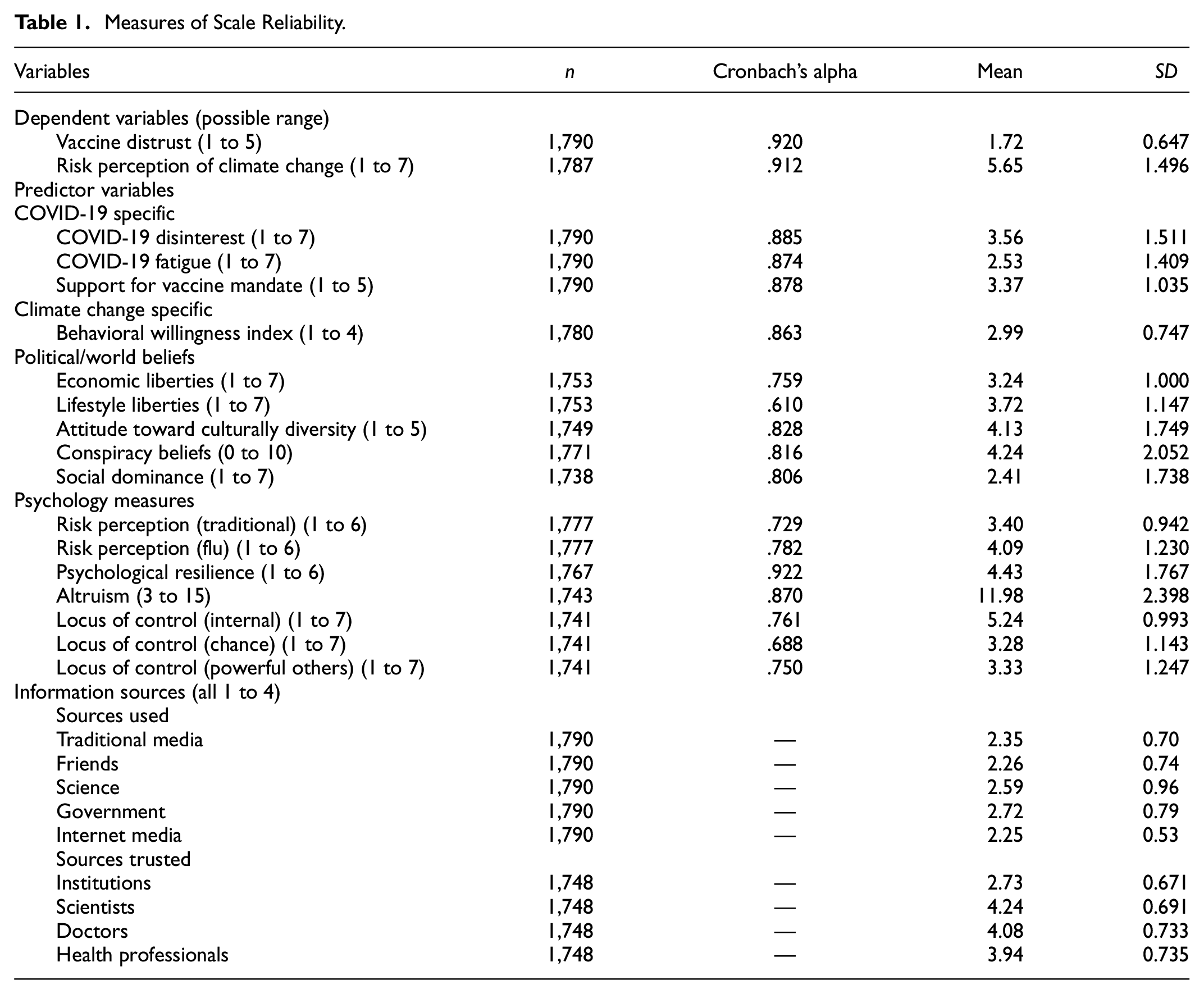
Scale reliability was calculated using means and Cronbach Alpha for all scales, and are displayed in Table 1.
Measures of Scale Reliability.
Dependent Variables
Vaccine Hesitancy
The Vaccine Confidence Inventory measure (Rossen et al., 2019) is an 18-item scale that assesses respondents’ support for the rhetoric that is commonly expressed by anti-vaccination activists. It is designed to measure five main areas of concern: vaccines are unsafe (e.g., “Vaccines have not been adequately tested for safety”); vaccines are ineffective (“Vaccines can cause or worsen allergies”); negative perceptions of government and pharmaceutical companies (“Pharmaceutical companies purposefully conceal information about the safety of vaccines”); perception of vaccines as unnatural/preference for alternative remedies (“Homeopathic medicines are an effective alternative to conventional vaccines”) and parents’ right to decide whether to vaccinate their child (“People should be able to decide whether or not to vaccinate their children”). The response scale ranged from 1 “strongly disagree” to 5 “strongly agree,” where higher scores reflect lower confidence in vaccines.
Climate Change
Risk Perception of Climate Change (Xie et al., 2019) was assessed through four items measuring personal and societal risks. Personal Risk measures included “How concerned are you with climate change?”; “How likely are you, sometime during your life, to experience serious threats to your health or overall well-being, as a result of climate change?”; and “How often do you worry about the potentially negative consequences of climate change?” The Societal Risk measure asked was “How likely do you think it is that climate change will have very harmful, long-term impacts on our society?” The variables were combined for the analysis.
Predictor Variables
COVID-19 Specific
Pandemic Fatigue
The Pandemic Fatigue Scale (Cuadrado et al., 2021) consists of six items that measure participants’ level of pandemic fatigue specifically in relation to the COVID-19 pandemic. This measure covers items relating to “disinterest,” a reduction in motivation to follow COVID-19 protective behaviors (e.g., “I am already so tired of the COVID issue that I am not as careful as I was at the beginning”) and “fatigue,” a lack of interest in pandemic-related information (e.g., “I am fed up with the COVID topic being talked about so much in all the media”). Responses are made using a 7-point scale ranging from 1 “strongly disagree”; to 7 “strongly agree,” where higher scores reflect greater fatigue around the COVID-19 pandemic.
Climate Change Specific
Willingness
The Personal Willingness subscale of the Behavioral Willingness index (Xie et al., 2019) was used to measure participants’ willingness to personally engage in behaviors that contribute to climate change mitigation (e.g., “Pay more for fuel and use my vehicle less often”). All responses are measured on a 4-point scale ranging from 1 “not at all willing” to 4 “very willing,” where higher scores reflect a stronger willingness to engage in climate change mitigation behaviors.
Political/World Beliefs
Liberty
The Liberty subscale of the Moral Foundations Questionnaire (Graham et al., 2009; Iyer et al., 2012) measures Economic Liberty (e.g., “People who are successful in business have a right to enjoy their wealth as they see fit”) and Lifestyle Liberty (e.g., “People should be free to decide what group norms or traditions they themselves want to follow”). Items are presented in two sections to assess the moral relevance and agreement with moral statements with 6- and 7-point scales. Higher scores reflect a stronger endorsement of liberty.
Attitudes Towards Cultural Diversity
Four items were taken from the Challenging Racism Project Survey (Blair, 2017) to measure participants’ attitudes towards cultural diversity. These were, (1) “It is a good thing for a society to be made up of different cultures,” (2) “Having a multicultural population has been good for Australia,” (3) “People from racial, ethnic, cultural and religious minority groups should behave more like mainstream Australians” (reversed item), and (4) “Australia is weakened by people of different ethnic origins sticking to their old ways” (reversed item). The response scale consisted of 5 points ranging from 1 “strongly disagree” to 5 “strongly agree,” where higher scores reflect greater acceptance of cultural diversity in Australia.
Conspiracy Beliefs
The Conspiracy Mentality Questionnaire (Bruder et al., 2013) was used to measure participants’ general tendency to believe in conspiracy theories. This scale consists of five items (e.g., “Many very important things happen in the world, which the public is never informed about”), where each item is scored using a 11-point scale ranging from 0 “certainly no 0%” to 10 “certainly 100%.” Higher scores reflect greater support for conspiracy ideation.
Social Dominance
The brief version of the Social Dominance Orientation Scale (Ho et al., 2015) was used to measure participants’ preference for hierarchical group structures and inequalities between social groups. This 8-item scale covers two subscales: Dominance (e.g., “An ideal society requires some groups to be on top and others to be on the bottom”) and Anti-egalitarianism (e.g., “Group equality should not be our primary goal”). Participants respond using a 7-point scale ranging from 1 “strongly oppose” to 7 “strongly favor,” where higher scores represent a stronger preference for social dominance.
Psychological
Risk Perception
Eight items were adapted from a previous study on SARS-related risk perceptions (Brug et al., 2004). Each item asks participants, “Compared to most people your age and sex, what would you say your chances are of being affected by the following?” in relation to the following risks: COVID-19, seasonal influenza (flu), accident at home, cancer, heart attack, traffic accident, food poisoning and HIV/AIDS. Participants respond on a 5-point scale ranging from 1 “very unlikely” to 5 “very likely,” where higher scores reflect a stronger perceived risk.
Psychological Resilience
The Brief Resilience Scale (Smith et al., 2008) is a 6-item measure of participants’ capacity to bounce back after a stressful or adverse event (e.g., “I tend to bounce back quickly after hard times”), with responses made on a 5-point scale ranging from 1 “strongly disagree” to 5 “strongly agree.” Higher scores reflect higher levels of resilience.
Altruism
A subset of items was adapted from the Identification with All Humanity scale (McFarland et al., 2012) to measure the extent to which participants identify with, care for, and desire to help others. Consistent with Murphy et al. (2021), participants were asked to respond to the following statements in relation to “people in my community,” “Australians” and “all humans everywhere”: (1) “How much do you identify with (feel a part of, feel love toward, have concern for)…,” (2) “How much would you say you care (feel upset, want to help) when bad things happen to…,” (3) “When they are in need, how much do you want to help…” Responses were made using a 5-point scale ranging from 1 “not at all” to 5 “very much,” where higher scores reflect stronger identification, care and desire to help others. All Humanity was calculated by summing the values responses for “all humans everywhere.”
Locus of Control
The brief 9-item version of the Locus of Control Scale was used to assess participants’ tendency to attribute control over the outcomes of events in their life to internal versus external sources (Sapp & Harrod, 1993). The measure has three components: Internal Locus (e.g., “My life is determined by my own actions”), Chance (e.g., “To a great extent, my life is controlled by accidental happenings”) and Powerful Others (e.g., “People like myself have very little chance of protecting our personal interests where they conflict with those of strong pressure groups”). Items were scored on a 6-point scale ranging from 1 “strongly disagree” to 6 “strongly agree,” where higher values reflect stronger agreement with each construct.
Information Sources and Trust
Information Sources
Two questions were adapted from a previous COVID-19-related vaccine hesitancy study (Murphy et al., 2021) to assess the level of consumption and trust placed in a range of information sources. Participants were first asked, “How much information about COVID-19 have you obtained from each of these sources?” in response to 11 different types of information sources (“newspapers,” “television,” “radio,” “internet websites,” “social media,” “social, mobile or digital messaging services,” “scientific materials like conference proceedings and papers,” “your doctor,” “other health professionals,” “government agencies,” “friends and family”). The question was repeated later in the survey in relation to climate change. Participants responded using a 4-point scale ranging from 1 “none” to 4 “a lot,” where higher scores reflect a greater amount of information consumed from that source. Ultimately, responses for each domain were averaged across vaccine and climate change to represent the general use of the different informational sources. Further, some categories were combined to represent traditional media (newspapers, television, radio), internet media (“internet websites,” “social media,” “social, mobile or digital messaging services”), friends and family, science and government sources. Due to the modal response for the use of health professionals being never for climate change, this variable was not used in the final predictive model.
Trust
A similar approach was taken for trust items as per Murphy et al. (2021). The item asked, “How much do you trust the following groups?” and participants rated political parties, parliament, government, police, legal system, scientists, doctors and other health professionals using a 5-point Likert-type scale. The average rating for trust in political parties, the parliament, the government, the police and the legal system were combined to form the variable, trust in “institutions.”
Data Cleaning and Analysis
Cleaning and analyses were performed using SPSS version 26 (IBM). Measures were screened for normality and distribution. Bivariate correlation was also used to determine any overlap in variables. Existing measures including the climate change outcomes, Pandemic Fatigue Scale, Locus of Control and Conspiracy Mentality Questionnaire revealed good consistency and consistent factor structures (where subscales were present) to those previously published (Table 1). For the Vaccine Confidence Inventory, factor analysis failed to confirm a single-factor structure with a clear indication based on Eigenvalues that this scale captured two constructs. Vaccine distrust captured most of the variance for the scale (47.43%), with attitudes to vaccine mandate capturing a small amount of additional variance (8.55%) from the scale (Items 2 (reversed), 7 (reversed), 10 and 18 (reversed) from original scale). Given the novelty of the scale and other work suggesting that these are separate issues of concern in Australians (Ryan et al., 2021), we favored dividing this scale into two separate measures (Table 2). The vaccine distrust component was treated as a dependent variable to capture possible hesitancy while views around vaccine mandates were treated as predictor variables.
Amended Vaccine Hesitancy Measure from Rossen et al. (2019) Capturing Vaccine Distrust.

Initial internal consistency was low for the items on Perceived Risks Scales. Factor analysis suggested the separation of flu and COVID-19 risks from other risks and the removal of risks around HIV and AIDS. The result was two subscales assessing the risk of COVID/seasonal flu, and traditional risks (risks of accident, cancer, heart attack, and traffic accident combined).
Several variables had long tails indicating a high skew in the responses. For ordinal variables including income and age with small representation in lower categories, the bottom response categories were combined. Attitudes to cultural diversity were highly skewed (>1). Altruism (All Humanity) and SDO also featured a small number of extreme responses which resulted in moderate skew (>0.6). To reduce this, outlying responses were combined into the highest or lowest group. The value of these caps was determined using cut-offs based on standard deviations and histograms. The neglect subscale of the Pandemic Fatigue Scale could not be corrected in a way suitable for analysis, and was abandoned for further use.
The main outcome measures—climate change risk perception and vaccine distrust—were both highly skewed toward higher perceived risk (skew −1.7) and lower vaccine distrust (skew 1.7) with means below and above the midpoint respectively. Three-level variables were created for each outcome that represented people with the least favorable or the most favorable opinions (top and bottom 20% of agreement) and those in the middle. Given the sway toward more favorable opinions, some of those in the “low” climate risk perception and “high” vaccine distrust groups still had some level of positive attitude toward these topics and therefore do not represent anti-vaccination or rejection of climate change damage. The full factorial comparison of nine groups was not possible given small cell sizes for some groups, therefore some groups with small numbers and “medium” views were combined which resulted in six groups. These six categorizations describe different combined stances on the two issues (Table 4). Follow-up ANOVA revealed that these six groupings varied significantly from each other both in terms of climate change risk perceptions (F [5, 1,781] = 1,217.67, p < .001) and vaccine distrust (F [5, 1,781] = 878.58, p < .001).
Canonical linear discriminant analysis was used as the primary analysis. This involved the prediction of membership to different groups of stances across the two domains of Vaccination Distrust and Climate Risk Perception using the predictor variables described in Table 1. Model statistics were checked to ensure the appropriateness of the data. Despite some moderate bivariate correlations between variables, there did not appear to be issues with multicollinearity in the final model. Standardized function scores were then compared between the six groups using ANOVA and Bonferroni pairwise comparisons to inform where key differences lie.
Results
Sociodemographic Characteristics
The demographic characteristics of the respondents are described in Table 3. A total of 1,790 people completed the survey in February 2022. The sample population were predominantly born in Australia (76.4%) and identified as female (73.1%). Approximately one quarter of the respondents (23.1%) followed Christian faiths, while over half of the sample reported no religion or atheist (41.4% and 20.4% respectively). Respondents were predominantly employed in professional roles (36.0%) or retired (35.8%) (Table 3.)
Sociodemographic Characteristics of the Survey Sample.

Note. For cell sizes with less than 20 cases, categories have been combined; “Personal experience with extreme weather” is purely descriptive and not included in the analysis.
Exposure to COVID-19
To assess experience with COVID-19, participants were asked, “Have you ever been diagnosed with COVID-19?” and “Have any of your close family or friends ever been diagnosed with COVID-19?” Participants were classified as a “direct experience” if they responded “Yes” to being diagnosed with COVID-19 and as a “close experience” if they responded “Yes” to having a close family member or friend be diagnosed with COVID-19. Participants were also asked if they had received their recommended two doses of COVID-19 vaccination (the recommended number of COVID-19 vaccination doses at the time of survey completion).
Personal Experience with Extreme Weather Events
To assess whether participants had personally experienced extreme weather events, they were asked, “Considering roughly the last 5 years, have you personally experienced any type of extreme weather event in your local Australian area (e.g., severe heat waves, droughts, flooding, storms, hurricanes, cyclones, etc.)?” Participants were classified as a “direct experience” if they responded “Yes” to personally experiencing an extreme weather event in the past 5 years. This measure was included in the context of unprecedented flooding, fire, and hail events in Australia at the time, which had been connected to discussion on climate change. This variable was purely descriptive, and not included in the analysis.
Descriptive Statistics
There was a moderate bivariate correlation between the outcome variables of climate risk perceptions and levels of vaccine distrust (r = −.41, p < .001), indicating that participants who perceived a higher climate risk were less likely to distrust the vaccine. The vaccination status of the sample was slightly higher than the general population at the time of the survey (94%–95% of those aged 16 years or over) (Australian Department of Health, 2022; Biddle, 2022; Mathieu et al., 2020). A small percentage of the sample reported previously having COVID-19, and over half the sample knew friends and/or family who had previously had COVID-19 (Table 3). In contrast, most of the sample reported personal experience of an extreme weather event in the last 5 years (personal experience with climate change, Table 3). Compared to the total sample, there were a higher proportion of males in Group 1, and Group 3. To a lesser extent, both groups with least supportive attitudes towards climate change (Table 4).
Group Classifications Based on Vaccine Distrust and Climate Risk Perception Scores.
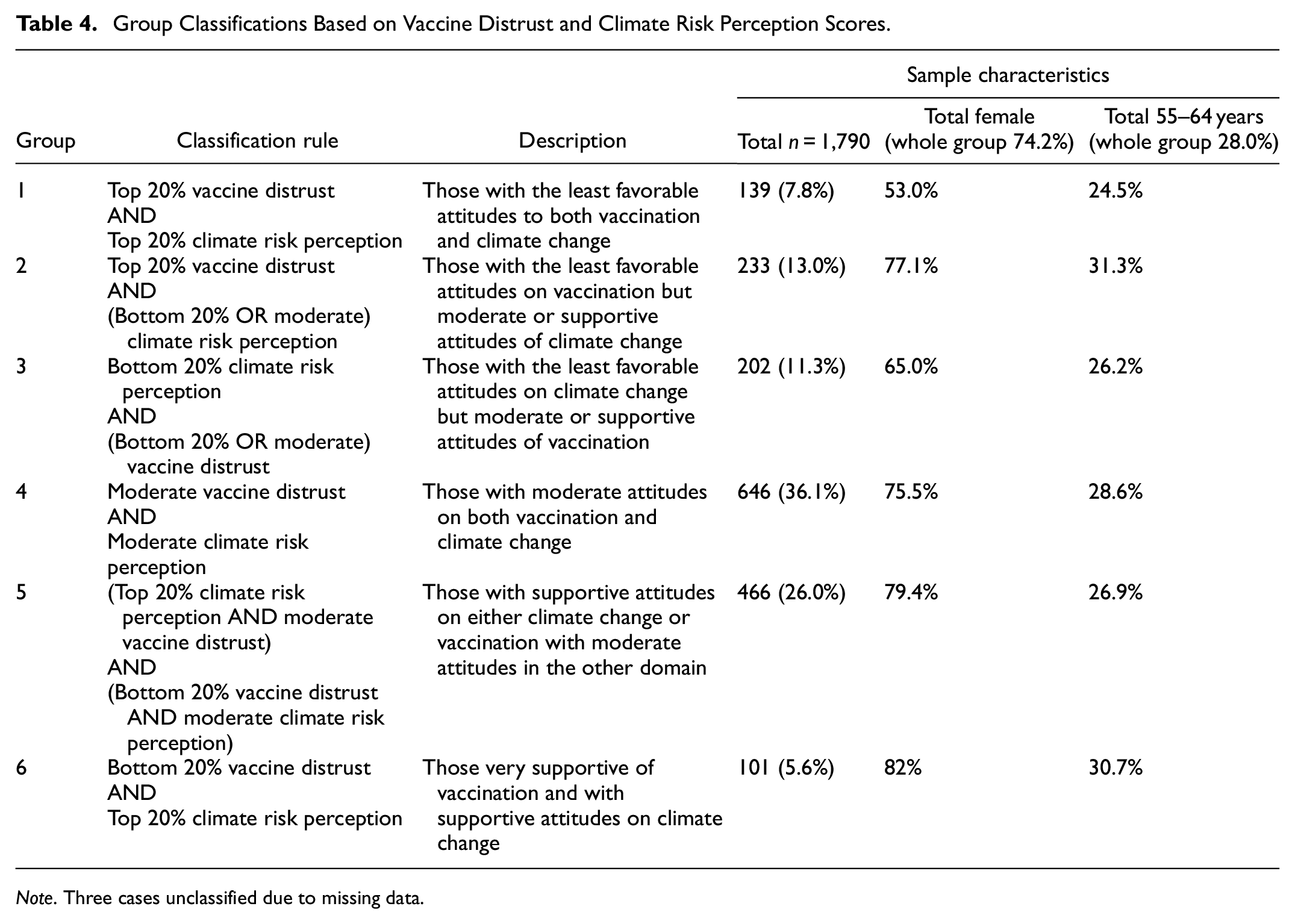
Note. Three cases unclassified due to missing data.
Classification of Vaccine and Climate Attitudinal Groups
Wilks Lambda indicated that the first three functions effectively separated cases into different groups. The Eigenvalues and explained variance for each of the three canonical discriminant functions fell from 1.51 (78.7%) to 0.287 (15.0%) to 0.071 (3.7%) suggesting a large reduction in discriminating power. Based on these values, it was decided to retain two functions, which were named Progressive Liberalism (Function 1) and Conspiratorial Anti-politics (Function 2) based on the strongest correlates associated with each function. The factors contributing to each of these functions and the strength of each are shown in Table 5.
Standardized Canonical Discriminant Function Coefficients for Two Functions Based on Linear Discriminant Regression.

Note. Variables that had loadings below 0.2: gender (female); age group; born in Australia (v not); employed (v not); income level; city/suburb (v not); some religion (v religion); atheist (v religion); primary caregiver of child/ren (v not); risk flu (capped); risk traditional; locus of control (internal); psychological resilience; general friends as source information; traditional media as source information; science materials as source information.
These variables were capped due to reduce skew.
Function 1—Progressive Liberalism
Function 1 accounted for 78.7% of variance of group membership and significantly differentiated (p < .01) all groups aside from Groups 2 and 3 (i.e., those with moderate views on one issue, but the least accepting view on either Vaccines or Climate Change). Except for these groups, there is an increase in levels of this function as people enter groups with less vaccine distrust and higher climate risk perceptions. Based on the group centroid, Function 1 differentiates those with the least favorable attitudes to those with the most by over three standard deviations (Figure 1).

Standardized conical discriminant functions for each group by two core functions.
The strongest correlates categorized under Function One was classified as representing a progressive liberal political world view, emphasizing trust in science and medicine, skepticism of free-market economics, and a greater acceptance of cultural diversity and social uncertainty. Cultural diversity may also be taken to indicate a belief in human rights and universal values, although statements on this from the altruism metric were removed to reduce skew. Factors correlated with this group include willingness to act on climate change, low acceptance of economic liberty, support for vaccine mandates, trust in scientists, lower acceptance of social dominance, support for cultural diversity and low pandemic fatigue.
Function 2—Conspiratorial Anti-Politics
Function 2, accounted for 15.0% variance of group membership, which was made up of variables that seem to indicate a more conspiratorial and anti-institutional view. This function differentiated those with the least favorable vaccination attitudes from those with the least favorable climate change attitudes (Figure 1). The magnitude of this difference is about two standard deviations. Those with greater distrust of vaccination are higher on this function compared to those with low climate risk perception. The level of this function is notably different between Groups 2 and 3. Scores on this function were significantly different (p < .01) between the Group 2 (high vaccine distrust) and all other groups. They were also different between Group 3 (low climate change risk perception) and all other groups (Figure 1).
This function correlated most strongly with low support for the vaccine mandate, high willingness to act on climate change, a tendency to believe in conspiracy beliefs, low trust in institutions and an external locus of control in powerful others. This function might be more closely linked to a notion of anti-politics (Fieschi & Heywood, 2004), and the rejection traditional political order in favor of more cynical and divisive accounts of politics, such as nativist populism (Fieschi & Heywood, 2004; Beveridge & Featherstone, 2021). However, the willingness to act on climate change exists as somewhat of an outlier to the political narrative around anti-politics, with climate change firmly established in many institutions and the broader social narrative.
Discussion
This study aimed to provide a more robust understanding of the factors driving acceptance/resistance to the COVID-19 vaccine and how this relates to perceptions around other complex global issues, such as climate change. We measured perceptions towards the COVID-19 vaccine and climate change and segmented participants based on their position on distrust towards vaccination and perceived climate risk. Two composite functions emerged—Progressive Liberalism and Conspiratorial Anti-politics—as important broad factors for understanding the relationship climate risk perceptions and vaccine distrust, which reflected distinct positions on socioeconomic, political, psychological, information seeking and trust-related factors.
Our results align with existing studies that have shown the link between negative vaccination attitudes with high conspiratorial beliefs (Hornsey et al., 2018), low trust in science institutions and health professionals (Murphy et al., 2021; Sturgis et al., 2021), more negative attitudes towards migrants/cultural diversity (Murphy et al., 2021) and higher acceptance of social dominance (Murphy et al., 2021). The association between lower levels of pandemic fatigue and higher support for the vaccine mandate aligns with the previous observation that vaccine resistant respondents are likely to shower higher levels of vaccine fatigue (Kyprianidoua et al., 2023). From a climate risk perception perspective, our findings are consistent with previous studies that link climate change skepticism with conspiratorial thinking (Lewandowsky, Gignac, et al., 2013; Lewandowsky, Oberauer, et al., 2013; Uscinski et al., 2017) and low trust in science (Latkin et al., 2022) and institutions (van der Linden, 2015). Results associated with SDO (anti-egalitarianism) are also consistent with prior work, showing negative associations with environmental behavior (Stanley et al., 2017), climate mitigation behaviors and belief in climate change (Stanley & Wilson, 2019). These associations between psychological beliefs, social institutions, and political orientation support a socio-ecological approach to understanding vaccine hesitancy, especially given climate change beliefs are directly associated with intrapsychic states relating to the biophysical world.
The definition of Progressive Liberalism and Conspiratorial Anti-politics functions suggest two very different political and ideological worldviews are shaping how individuals respond to multiple science-related issues within society, with other factors relating to science/society issues converging into these functions. A majority of variance between groups (78.7%) was determined by the Progressive Liberalism function which was statistically significant in all groups, except Groups 2 and 3, who had a moderate view on vaccines or climate change but were the least accepting of the other issue. This finding aligns with Richardson et al. (2023), who found that people with moderate perceptions towards climate change were the most vaccine resistant (the equivalent to our Group 2). Though vaccine supporters tended to either be the most concerned about climate change (Group 6 equivalent) or most skeptical (no covered in our sample).
Existing research aligns with convergence of factors that loaded heavily on the Progressive Liberalism function. A left-leaning, political progressive ideological world view has been associated with greater vaccine acceptance (Borga et al., 2022; Edwards et al., 2021; Kerr et al., 2021), and the importance of political and ideological views have been shown as strong predictors of climate change beliefs (Falkenberg et al., 2022; Stanley et al., 2017). More left-leaning and liberal ideologies have also been associated with belief in science (Blank & Shaw, 2015; Gauchat, 2012), lower acceptance of inequality (Hirsh et al., 2010; Jost et al., 2007) and social domination (Kugler et al., 2014), and more accepting of cultural diversity and multiculturalism (Reyna et al., 2006; Yogeeswaran & Dasgupta, 2014). Thus, the Progressive Liberalism function represents a useful catchall and summary for these existing positions.
There is some nuance to this function, however, especially around aspects of liberalism outside of the economic. At a broad level, a left-leaning work view, as implied by the Progressive Liberalism function, might also connect with values and rights that emphasize liberalism (i.e., the maximization of human freedoms). This includes a belief in human rights and personal liberties. Interestingly, our results indicate a weak negative correlation between the lifestyle liberties factor and Progressive Liberalism, and a weak positive correlation between lifestyle liberties factor and Conspiratorial Anti-Politics. This might appear counter-intuitive at first, especially since evidence indicates an association between left-leaning political ideology and human rights and freedoms in global (Scruggs, 2018) and national surveys (Galli & Modesto, 2023; McFarland & Mathews, 2005). However, the COVID-19 pandemic represented an exceptional event that required curtailment of some freedoms to manage the public health crisis, such as implementation of vaccine mandates, mask wearing requirements, and lockdowns. These all directly challenge fundamental concepts of personal freedom and liberty and require some re-evaluation of their importance currently. Acceptance of these curtailments may have lowered scores in the lifestyle liberty factor amongst the Progressive Liberalism function, while rejection of COVID-19 related restrictions might explain the positive association for the Conspiratorial Anti-Politics function. This would align with recent the historical relationship between freedoms and vaccine refusal (Colgrove & Samuel, 2022), and qualitative evidence amongst vaccine hesitant, low vaccine uptake communities (Capurro et al., 2022). It also aligns with recent research on resistance to climate change, where individualism (and therefore individual liberty) was related to opposition to climate change action (Ballew et al., 2020).
Regarding human rights specifically, our data does not clearly articulate a belief in human rights and associated cultural values with the Progressive Liberalism function. However, given existing research and measures of cultural diversity in this data, it is a logical assumption to make. Interestingly, altruism was weakly loaded with the Conspiratorial Anti-politics function. This might reflect the fact that the Conspiratorial Anti-Political groups could possess moderate views on one issue, while rejecting the other. Alternative, it may reflect the fact that cultural presentations of conspiratorial or reactionary politics sometime use the language of liberty, freedom, and human value in establishing their world view (Melley, 2000; Raab et al., 2023). The altruism measure may have inadvertently captured this without additional context.
The Conspiratorial Anti-politics function was most explanatory for the differences in people with a moderate view on one issue but the least accepting view of the other. This cohort of people was associated with stronger conspiracy beliefs, lower trust in institutions and a tendency to associate control in powerful others. This aligns with Pisl et al. (2021), who found locus of control in powerful others and belief in conspiracy account for 40% of the variance in vaccination willingness. This finding highlights some critical factors that could weigh into a tendency to disagree with more conventional attitudes and beliefs towards vaccines and/or climate change. Where science-society challenges involve uncertain events and outcomes, as was the case with a new, global vaccine, these characteristics may become more important.
Conspiratorial Anti-politics might reflect a deeply cynical position towards all political institutions and actors, regardless of where they sit on the left/right or progressive/conservative scale, and a wholesale rejection of established political processes (i.e., democracy in general). A potential link maybe drawn here to analysis of extremist and fringe cultural positions that circulate online (Baker, 2022; DiMaggio, 2022; Dow et al., 2021), where any established position (regardless of political orientation) is conceptualized as complicit in some form of conspiracy. It is unknown if these characteristics were greater in the most vaccination hesitant group because of the nature of the COVID-19 pandemic or its association to health which is very individual. It is also important to note that the only information seeking variable that loaded (weakly) onto the Conspiratorial Anti-politics function was use of internet resources which themselves can create echo-chambers (Williams et al., 2015; Vosoughi et al., 2018) and facilitate the spread misinformation (Vosoughi et al., 2018).
The findings suggest that perceptions of global crises and science/society challenges are most strongly predicted through these worldview and political measures. However, it is important to note the nuance of these positions, and that while being political, they are also situated within specific contexts. For example, across the six group classifications we identified, levels of vaccine hesitancy varied more than climate risk perception. Willingness to act on climate change was also the highest loading measure across both functions, despite each function reflecting opposing viewpoints in areas such as support for vaccine mandates, lifestyle liberty and belief in conspiracies. The Conspiratorial Anti-politics function was most strongly associated with distrust of vaccination, but not necessarily with lower climate risk perception.
How is it then that the most conspiratorial and anti-institutional group could be more resistant towards vaccines, but also willing to take action on climate change? These results could reflect the sustainability of conspiracy over time (Uscinski et al., 2017) and the lower politicalization of climate change. Recent studies into climate skepticism in Australia that indicate increased acceptance in the human-induced cause and consequences of climate change (Hornsey et al., 2022; Morrison et al., 2018)—an attitudinal driver that underpins the largest increase in acceptance of climate change in Australia over the last decade in conservatives (Hornsey et al., 2022). Greater evidence, awareness, and public discourse may have pushed climate change to a point of broad acceptance where conspiracy is inherently unsustainable (Uscinski et al., 2017). Whereas at the time of the survey, vaccine mandates and employer requirements were making significant news and had not reached a point of widespread acceptance. Thus, the situated context of these politically infused factors is critical to understanding them.
An interesting element of our findings is that typical socio-demographic indicators of conservativism did not feature strongly in our data. Indeed, the analysis showed demographic and social variables including age, gender, place of residence, employment, income, religion were not significant corelates contributing to the profiles of Progressive Liberalism or Conspiratorial Anti-politics. This finding aligns with previous studies that have found values, ideologies, worldviews and political orientation have a stronger influence on belief in climate change than demographic factors, like sex, age, income and education (Hornsey et al., 2016). This connects to the above statements on the importance of nuance and the situated nature of these factors; broad demographic and political overtones exist but are playing out in individual ways depending on context.
While it is unclear if all science/society relationships can be equated through a political world view, our findings do suggest that it is worth considering the influence of political polarization on public perceptions and attitudes towards other global science-based challenges. These worldviews may change over time and individuals can hold multiple, potentially opposing, views on different issues facing the world, which they draw upon depending on the context (Richardson et al., 2023). Public information campaigns, which are core to public health, could easily be reframed as disinformation for a world view defined by Conspiratorial Anti-politics. The polarizing, persistent, and sometimes virulent politically motivated conspiracies associated with global challenges could undermine the impact and effectiveness of public health campaigns when perceived by those with a Conspiratorial Anti-politics worldview. This was observed in the context COVID-19 pandemic with the polarization around public health measures (Lasco, 2020; Stjernswärd & Glasdam, 2021; The COCONEL Group et al., 2020).
Reflecting on our results and this potential politicization through the lens of socio-ecological theory, it may be that Conspiratorial Anti-politics and Progressive Liberalism represent the formation of “niches” for those that subscribe to this view. Socio-ecological psychology takes the term niche from ecology to describe how psychological states might give rise to specific socio-ecological spaces or habitats that beings come to inhabit, for example, the formation of a community group to support those with anxiety in the community (Oishi, 2014). As Osborne and Rose (2024) note, niches are relational and constructed, in that their qualities are defined by relationship to their broader socio-ecological milieu, and the product of humans seeking a desired space for their lives. These spaces are often reconfigured because of external socio-ecological stimuli (e.g., a change in the community milieu).
Our two worldviews might represent specific niches that have emerged to deal with the relational dynamics of contemporary science/society relations and the significant change that the COVID-19 pandemic and other events has brought to these groups. They are socio-ecological and psychic adaptation created as active responses to uncertainty, anxiety, (dis)trust, and other psychic states, magnified by social, political, and economic uncertainty. These niches are also enabled by digital networks and data infrastructure that represented a unique factor in the COVID-19 pandemic. Given the nuances in our data it is important not to overstate or totalize this reflection, but instead simply say that the emergence of these two composite factors may potentially represent the creation of unique socio-ecological spaces in which these views come to inhabit. If this is the case, however, it would be worth probing these niches in more detail, as they have the potential to influence other elements in the broader socio-ecological milieu. For example, should Conspiratorial Anti-Politics become an embedded and resilient socio-ecological and psychological space, such as a space could potentially support and legitimate the psychological traits and broader worldviews of this position. Enabled by other factors in this milieu (e.g., digital communication and social uncertainty) this might present barriers to vaccine acceptance, climate change, and other science/society issues. This may represent a novel direction for research using a socio-ecological psychology approach. To our knowledge, there has been no research done explicating the potential of socio-ecological niches for science/society relations, although theoretically innovative approaches to answering these questions have been suggested (e.g., Osborne and Rose, 2024).
We acknowledge there are limitations resulting from the convenience sampling methods employed such as a female bias which may influence results to individual measures such as SDO and pandemic fatigue. The sample was also relatively supportive of both scientific challenges with few people being truly anti-climate change or vaccination. This is possibly an artifact of using our scientific institution’s page to advertise the study as it generally attracts people who are educated, older and supportive of science. Unlike Rossen et al. (2019) no specific effort was made to recruit those with anti-science attitudes and therefore these results only reflect those with fairly positive sentiment. However, the final sample size was much larger than previous studies (296 vs 1,790). At the time of the survey, significant rainfall and flooding were impacting large parts of eastern Australia which is likely to have impacted the participants high risk perception of extreme weather events and willingness to take action on climate change (Morrison et al., 2018; van der Linden, 2015; van Eck et al., 2020). The conscious choice was made to include a variety of demographics in line with observations of previous studies. Income was chosen over level of education as a marker of socioeconomic status based on previous studies (Murphy et al., 2021). However, as already noted, relative to the other factors considered, demographic variables contributed little to the overall functions observed. Thus, while our sample was appropriate empirically and theoretically for the aims of the study, it is not representative of the Australian population as a whole and it should not immediately be generalized to the broader population.
The groupings compared in this study were based on data-driven cut-offs and a factorial structure that included high, moderate and low perceptions with efforts to reduce these groups in ways that aided interpretation and maintained manageable group sizes. Scores for vaccine distrust and climate change risk perception were significantly different between these groups. However, these definitions need to be interpreted in the context of the sampling limitations and attitudes that were largely positive toward the key issues examined. Future work will be needed to validate the distinctness of the six groups.
In addition to this validation, there are a variety of other options for future research that might build upon this research. Additional survey research could be conducted to explore the correlation of additional variables with the two primary functions. This might include specific measures of political ideology (especially those around humans rights and liberty so that their association two our factors might be empirically tested), measures of identity or self-concept (to establish how the two primary functions contribute to overall psychological identity), and other measures that might nuance or support the socio-ecological approach we have taken here (for instance, measures of income inequality). Alternatively, given this research provides an initial quantitative indication of Progressive Liberalism and Conspiratorial Anti-Politics, other qualitative or multimodal approaches might also be employed to add nuance and depth to these results. As Raab et al. (2023) note, conspiratorial thinking and narration presents unique storytelling elements. Exploring the narrations of those who identify with this view through interviews or text mining of online sources (e.g., Reddit), would help to establish the quality of both positions. This could be combined with network analysis approaches to present these psychological functions in relation to broad socio-ecological factors like demography, locality, and economy. This is advocated by Venturini and Munk (2022) as part of a process called “controversy mapping” that can help engage with contested science/society issues.
In future, tactics to better understand and engage with the Conspiratorial Anti-politics cohort may be important. This may take the form of long-term engagement, communication, and deradicalization of potential groups, targeting the sources of dis/mis-information that facilitate such views (such as social media and other platforms), and understanding the psychological and political levers that are necessary to overcome or counteract these views. Ultimately, it would mean rethinking public health to focus less on information and more on engaging certain pockets (or niches) of the community. Though, when it comes to climate change perceptions at least, other Australian surveys have shown that the share of respondents that identify as climate change skeptics are low, suggesting that the majority accept climate change as a real phenomenon (Richardson et al., 2023).
Conclusion
This is the first study of its kind to consider multiple global events using a large variety of demographic, socio-political and psychological variables. In our sample, responses to multiple global events might be understood through two broadly political functions—Progressive Liberalism and Conspiratorial Anti-Politics—which while aligning with existing research on vaccine acceptance/hesitancy and climate change, also suggest some nuance. Traditional demographic variables seem less explanatory, and instead a more complex interplay between ideologies and worldviews comprised of different factors contributes to the (non)acceptance of science-based interventions to global crises. These composite factors could explain why conspiracy theories, misinformation and perceptions of distrust could have a stronger influence on perceptions towards vaccines and climate change than scientific and expert advice for some audiences. Our results our initial and tentative in nature. In order to enhance the legitimacy and credibility of our findings further research is required to gather more evidence on the generalizability of the two functions, and to further test these two functions against different variables and measures. It will be important in the future to determine which events are likely to trigger these views to identify opportunities to intervene and proactively mitigate possible damage caused by anti-social viewpoints to future global threats.
Footnotes
Acknowledgements
We would like to thank our internal reviewers at CSIRO for their helpful feedback and acknowledge the helpful work colleagues who laid the foundations for this work.
Author Contributions
AL: Research and development of theoretical concepts, manuscript writing and rewriting, development of argument and discussion; MS: Background literature review, research and development of conceptual background, manuscript writing and rewriting; CKN: Background literature review, development of conceptual background, survey instrument development, manuscript writing and rewriting; MR: table building, editing, paper preparation, development of quantitative instruments; EB: survey instrument development, critical feedback, quantitative data analysis, table building, manuscript writing and rewriting. All authors reviewed the final manuscript.
Declaration of Conflicting Interests
The author(s) declared the following potential conflicts of interest with respect to the research, authorship, and/or publication of this article: The authors are employed by the Commonwealth Science and Industrial Research Organisation (CSIRO) and conduct research and advisory services for state and federal government agencies and enterprises in Australia and internationally.
Funding
The author(s) disclosed receipt of the following financial support for the research, authorship, and/or publication of this article: This research was funded internally by CSIRO and did not receive any specific grant from funding agencies in the public, commercial, or not-for-profit sectors.

Data Availability Statement
Data sharing not applicable to this article as no datasets were generated or analyzed during the current study.