



Abstract
This study aimed to separately examine the mediator role of two different variables in the relationship between perceived motivational climate and personal-social responsibility in physical education lessons. A total of 406 students (Mage = 12.91, SD = 1.01), 217 girls (Mage = 12.88, SD = 1.03) and 189 boys (Mage = 12.93, SD = 0.99), from the 6th, 7th, and 8th grades attended the study. In the research, the Learning and Performance Orientations in Physical Education Classes Questionnaire, the Personal-Social Responsibility Questionnaire, and Physical Self-Perception Inventory for Children (physical condition and sport competence) were used. To realize the purpose of the research, the measurement models were first tested using the structural equation model; next, multiple regression analysis applications were made. Mediation analysis was carried out separately for the “learning and performance climate dimensions” for the perceived motivational climate questionnaire. For this purpose, the mediating effect of physical condition and sport competence in the relationship between each perceived motivational climate dimension and personal-social responsibility, was examined. In the analyzes, it was found that neither learning nor performance dimensions of perceived motivational climate had any mediating effect on the relationship between personal-social responsibility. However, the perceived learning climate could moderately predict personal-social responsibility whereas the perceived performance climate could not. As a result, it can be said that the most important effect on personal- social responsibility in physical education lessons belongs to “the student learning orientation” factor which belongs only to the perceived learning climate. Since the student’s sport competence or physical condition is not effective in influencing personal-social responsibility, it has become necessary for physical education teachers to make efforts to create a learning-oriented climate that is associated with positive outcomes.
Keywords
Introduction
For 20 years or more, researchers have been trying to understand what factors affect the motivation or perception of students, to obtain rational and scientific findings to contribute to more positive outputs during physical education lessons. Nicholls (1989) has suggested a pioneer theory to explain the antecedents and influencing factors between motivation and behavior in educational settings. Achievement Goal Theory (AGT) has presented evidence of how contextual factors may influence a student’s behavior in this particular context (Cid et al., 2019). According to the theory, personal (dispositional orientations) and contextual (motivational climate) factors influence the person’s point of view, feelings, and behaviors (Duda & Nicholls, 1992). The two dispositional orientations called task and ego orientations. Task orientation defines that competence is self-referenced and the success is about effort intensity while ego orientation defines that perception of competence derives from the comparison with others, and success depends on chance and others’ poor performance (Horn, 2008; Roberts, 2001). A person who is ego orientated values success by exerting minimal effort (Duda, 2001). Another concept is contextual factors which are defined motivational climate which is a psychological environment composed of significant others. For example, physical education teacher creates a motivational climate emphasizing what is recognized, rewarded, valued, and accepted within the social context of the lesson atmosphere (Ames, 1992). Mastery (task) involving climates emphasizes improvement and effort, whereas performance (ego)—involving climates, emphasizes norm-referenced achievement and favorable comparisons to others (Ames, 1992; Horn, 2008; Papaioannou, 1994). The extensive research found that positive outputs were related to mastery involved climate whereas negative outputs were related to performance-involved climate (Cid et al., 2019; Treasure & Roberts, 2001; Viciana et al., 2007).
The Taking Personal and Social Responsibility (TPSR) Model (Hellison, 2011) is the latest approach for character and value development, especially in physical education lessons. It has been reported that the TPSR model shares conceptual similarity with task involvement of AGT (Newton et al., 2006). This model uses physical activity for guiding positive children and youth development (Hellison et al., 2000). TPSR aims to instill character characteristics such as personal and social responsibility to children through physical activity and to develop themselves in gaining basic values as a whole (Hellison, 2011). For this reason, the motivational climate is an important concept to provide the desired character and value development. Additionally, the motivational climate of a context involves the achievement goals emphasized, as well as the values conveyed to the participants by significant others, such as teachers, parents, and coaches (Ames, 1992; Duda, 1993). Kavussanu et al. (2002) examined the role of climate and moral atmosphere on the moral functioning of basketball players. They found that the perceived moral atmosphere of their team had a significant effect on moral functioning, while the effect of performance motivational climate on moral functioning was not significant. Cid et al.’s (2019) study showed that climate-oriented learning has a positive impact on the basic psychological needs satisfaction of students. They also have stated that the motivational climate in PE classes, seems to have a significant impact on the satisfaction of basic psychological needs (competence, autonomy, and relatedness). Thus, students will be able to have more self-determined behaviors and feelings through the perception of a learning motivational climate.
Self-related concepts are among the most examined psychological concepts due to their role in happiness in daily life, success in different dimensions of life, and their important role in establishing an effective and good relationship with people (Folkins & Sime, 1981; Hughes, 1984). The first inventory that emphasized the multiple structures of physical self-perception was the Physical Self-Perception Profile (PSPP), which was developed by Fox and Corbin (1989) and its validity and reliability were tested in many cultures (Altıntaş et al., 2009). There are considerable studies (Biddle & Asare, 2011; Calfas & Taylor, 1994; Dapp & Roebers, 2019; Ekeland et al., 2005) about sport-related settings that help children to adopt more positive self-concepts. If the experience and context of physical activity are negative like ridicule, embarrassment, perceived failure could equally damage self-esteem (Biddle et al., 2019).In the literature it has been stated that physical activity (PA) and exercise develop the children’s self-esteem and self-concept characteristics (Bayar, 2006). For example, Karaday and İlker (2018) found that students’ autonomy, competence, and relatedness need satisfaction in physical education positively predicted students’ global self-esteem. Some studies (Colquitt et al., 2012; Meredith & Welk, 2010) also showed that physical activity-related self-concept have a strong relation with positive outcomes in the related context. In addition, Eklund et al. (1997) informed summarizing the literature about self-concept, which is strongly linked with mental health and motivation. In a different education setting, Dapp and Roebers (2019) investigated the mediation role of self-concept and they found a full mediation, indicating PA to improve mathematical self-concept, which, in turn, positively affected mathematical achievement. This result showed that supporting adolescents’ self concept through physical activity helps to promote their academic achievement.
Some researchers (e.g., Cox et al., 2008; Digelidis et al., 2003; Lonsdale et al., 2013; Rokka et al., 2019; Vira & Raudsepp, 2002) explained that the perceived learning climate was related to positive outputs in PE lessons. Therefore, this study has aimed to be one of the limited studies examining the mediator role of self-perception in PE lessons. For example, Canpolat (2012) carried out a study exploring a mediator role of self-efficacy in the relationship between class climates and goal orientations in physical education. It was found that the sense of self-efficacy has a mediator effect on task and ego orientation. Additionally, it was explained that while the mediator effect of self-efficacy and performance climate on task orientation is clear, the direct effect of self-efficacy on ego orientation is much more than its mediator effect. Hein and Mürr (2004) explained that the self-regulation and use of strategies were the most important mediators between the perceived learning-oriented climate and physical activity intention. Although the effect of the learning climate in physical education lessons on positive outcomes have already proved by many researchers, there was a lack of studies concerning the role of self-concept or perception in the relationships between motivational climate and personal-social responsibility. Therefore, the current study aims to explore the role of different variables. The effort to find the mediators in the relationships between motivational climate and personal-social responsibility can be facilitating the understanding of how the physical education lesson climate affects the students. No studies have been found to measure through the same approach in the Turkish PE environment, consequently, current research has contributed to the existing literature.From these points of view, this study aims to examine whether sport competence and physical condition have a role on the quality of the relationship between motivational climate and personal-social resposibility. The studies (Holt et al., 2017; Pozo et al., 2018) established a bond between the contextual situation and personal-social responsibility. TPSR indicates positive values, autonomy, life skills, and prosocial behavior. Following the literature above, we hypothesized that there is a mediation role of sport competence and physical condition in the relationship between motivational climate and personal and social responsibility. We thought that students who have positive perceptions about sport competence and physical condition can perceive the learning climate and more responsibility whereas students who have negative perceptions about sport competence and physical condition can perceive the performance climate and less responsibility.
Materials and Methods
Participants
This research is a cross-sectional study conducted according to the descriptive survey model. The sample of this study consisted of six secondary schools, which are randomly sampled from all districts in Mersin city. The public schools were included in this study which had similar facilities. A total of 406 students (217 girls [53.4%] and 189 boys (46.6%) in sixth, seventh, and eighth grade participated in the study. The participants were between 11 and 15 ages (Mage = 12.91, S = 1.01). The study has been approved by the Provincial Directorate for National Education in Mersin city in 2019 and was realized per the Declaration of Helsinki. Permission was taken from the directors of the schools to collect the data from the classrooms.
Measures
Learning and performance orientations in PE classes questionnaire (LAPOPECQ)
The Turkish version (Daşdan Ada et al., 2012) of the LAPOPECQ (Papaioannou, 1994) was used to measure perceived motivational climate in classroom environments. This questionnaire is suitable for secondary school students (between the ages of 9 and 16 years). Participants were presented with a common stem in the questionnaire: “During today’s PE lesson. . ..” Responses were provided using a five-point Likert type scale from 1 (strongly disagree) to 5 (strongly agree). The questionnaire consists of 26 items and the following five subscales: Student learning orientation, teacher-initiated learning orientation, student worry about mistakes, outcome without effort, and student competitive orientation. The Cronbach alpha coefficients were .50 for the outcome without effort; .88 for student learning orientation; .68 for teacher-initiated learning orientation; .67 for student competitive orientation; .72 for student worry about mistakes (Daşdan Ada et al., 2012). The Cronbach alpha coefficients for this study are as follows .33, .76, .72, .45, .75, respectively.
Personal and social responsibility questionnaire (PSRQ)
PSRQ, developed by Li et al. (2008) and translated into Turkish by Filiz and Demirhan (2015), consists of 13 statements about personal-social responsibility behaviors. PSRQ can be applied to children between the ages of 9 and 15 years. In the Turkish version, the result of the analysis showed that there were differences between the factor loadings of the original scale and this form. The findings of EFA indicated that the scale included only one factor and the one structure of the factor is acceptable. This factor was named “behaviors of responsibility.” Participants responded to each question on a 6-point scale that ranged from 1 (strongly disagree) to 6 (strongly agree). There is no reverse score item. Scores can range from 13 to 78. The internal consistency coefficient was calculated as 0.93. The reliability value is 0.87 for this study.
The children and youth physical self-perception profile (CY-PSPP)
The CY-PSPP, developed by Whitehead (1995) and translated into Turkish by Asçi et al. (2005), has been used to assess physical self-perceptions. This measurement tool was developed for children and adolescents. It is a 36-item instrument designed to measure the following six scales: Physical condition, sport competence, body attractiveness, and strength, physical self-worth and self-esteem. In this study, we used only the subscales of physical condition and sport competence. Participants responded on a four-point Likert scale. In this format, the child decides which of the two opposing definitions identifies him or herself. The reliability coefficients are 0.57 for sport competence and 0.65 for physical condition in this study.
Procedure
This research was carried out in the public schools of Mersin in the 2019 to 2020 academic year. The research and application permission were obtained from the Mersin Provincial Directorate of National Education. All permits were completed, the schools were contacted. Participation approval and parental approval forms were distributed to the students that will participate in the study. Through these forms, all potential participants have been informed about the current study via a written document and have a right to decide to participate voluntarily. Questionnaires were administered by the first author. Before completing the questionnaire, the participants were given information about the study objectives, anonymity, and confidentiality of their responses and were allowed to refuse to participate. The students completed the questionnaires during lesson hours determined by the school management. This process took approximately 20 minutes.
Data Analysis
Before proceeding to the analyzes necessary to accomplish the purpose of the research, the process of making the data suitable for the analysis was performed. Firstly, all data were checked for entry errors and cleaning of lost data was performed. Next, the scales were scored. Once the scales were scored, kurtosis, and skewness values were checked and a check for any outliers occurred. Critical values were found to be between −2 and +2 values. Descriptive statistics and averages of the data are given in the Table 1.
Descriptive Statistics and Means That Obtained From Scales According to the Gender of Participants.
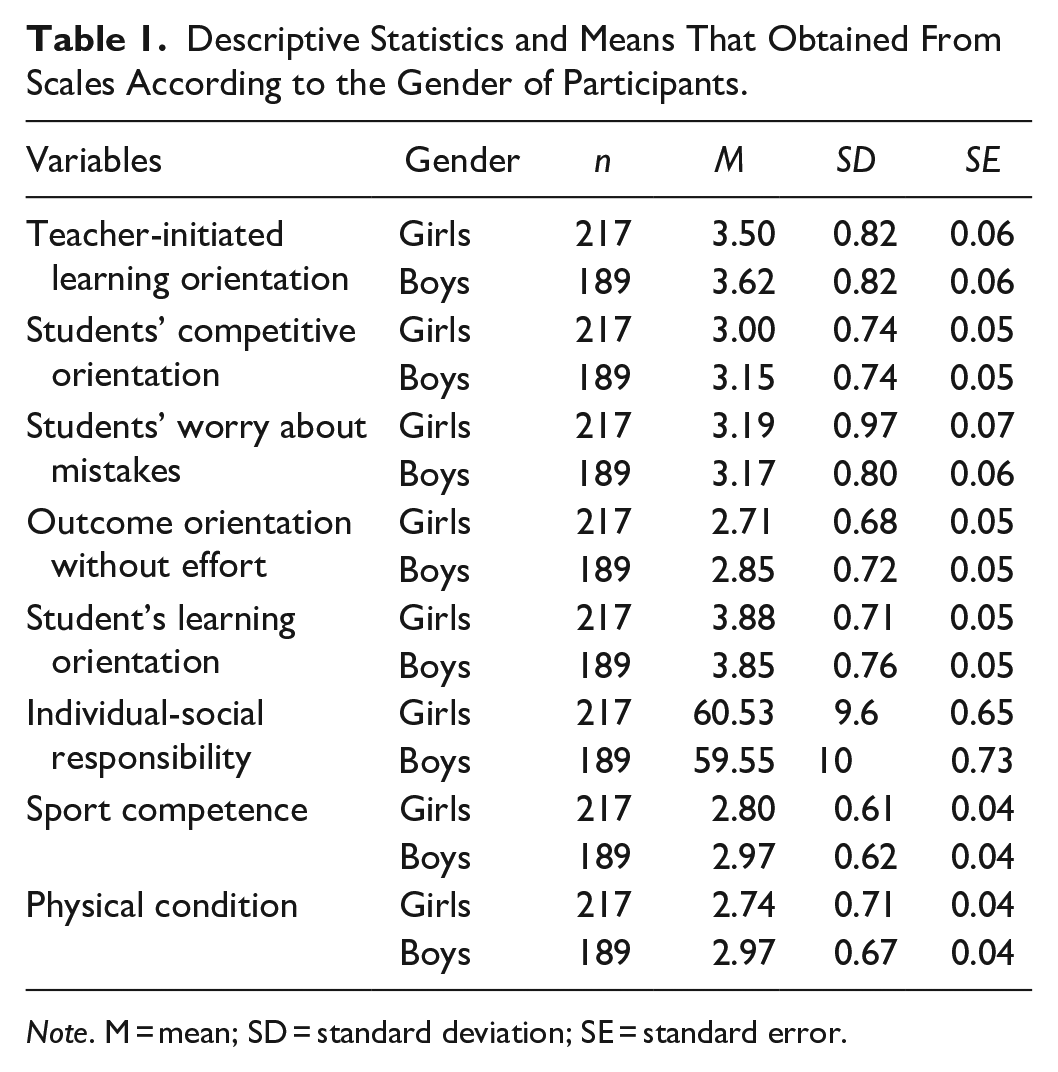
Note. M = mean; SD = standard deviation; SE = standard error.
Firstly, to realize the objectives of the study, the measurement model, which includes all variables required for each mediation equation, was tested through multiple regression analysis. Physical condition (M) and sport competence (M) were the mediating variables in the relationship between perceived motivational climate (Y) and personal-social responsibility (X), as shown in Figure 1.

The mediator role of sport competence or physical condition in the motivational climate and personal-social responsibility (n = 406). A mediational model of motivational climate on personal and social responsibility by sport competence or physical condition.
For performing mediation analysis, the Baron and Kenny (1986) approach was adopted. The four different mediation effects related to the structural model are as follows:
Mediating effect of physical condition in the relationship between perceived learning climate and personal-social responsibility
Mediating effect of sport competence in the relationship between perceived learning climate and personal-social responsibility
Mediating effect of physical condition in the relationship between perceived performance climate and personal-social responsibility
The mediating effect of sport competence in the relationship between perceived performance climate and personal-social responsibility
In mediation tests, the relationship between the dependent and the independent variable is desired to be high. The main purpose of mediation tests is that the relationship between these two variables stipulates the existence of another variable completely or to some degree. In other words, it is to discover that the effect of a variable that we already know exists on another variable, is provided by another mediator. This means discovering a situation beyond the apparent relationship dynamics (Şimşek, 2007). However, the suitability of the measurement model must be tested before conducting a mediating analysis (Gürbüz & Şahin, 2018). Therefore, to make a theoretical explanation of the relationship, it is necessary to test the measurement model and see that the relationships are meaningful. All data analyses occurred within IBM SPSS Statistics (v. 20) and LISREL 8.54.
Results
The first aim of this research is to examine the role of two different (physical condition and sport competence) mediating variables in the relationship between perceived motivational climate (independent variable) and personal-social responsibility (dependent variable). Therefore, the analysis was commenced by testing the measurement model in which all these variables are included. The measurement model has been tested by including five sub-dimensions of the LAPOPECQ, Personal-Social Responsibility Scale, and two sub-dimensions (physical condition and sport competence) of the children and youth physical Self-Perception Profile (CY-PSPP). Due to the normal distribution of the data, a covariance matrix was created using the Maximum Likelihood method (Kline, 2011). As a result of the analysis, acceptable values were obtained in the fit index values (χ² [n = 406] = 2115.7; p < .01; χ²/df = 1.97; RMSEA = .049; CFI = .93; IFI = .93). After determining that the measurement model was verified for all variables, the measurement model was re-tested for each mediation equation and the implicit structural model was tested separately. In the calculation of the parameter values in the structural model, the covariance matrix used in the measurement model was also used. There are relationships required for mediation analysis. If these are not provided, then the basic mediation model cannot be mentioned. Accordingly, the relationship between the independent and dependent variables and the relationship between the mediator variable and the dependent variable must be significant. At this stage, SPSS program was used to run mediation analysis through multiple regression analysis.
As can be seen in Table 2, only two factors belonging to the learning climate dimension (teacher initiated learning orientation [r = 0.35; p < .01] and student learning orientation [r = 0.48; p < .01]) among the motivational climate factors determined as independent variables have a significant relationship with the personal-social responsibility situation that enters the model as a dependent variable. Furthermore, it was also provided that the mediator variable had significant relationships with the dependent variable, and it was determined that the variables of sport competence (r = 0.23; p < .01) and physical condition (r = 0.27; p < .01) had a significant relationship with the personal-social responsibility. However, the analysis only continued with the factors related to the learning climate since the factors related to the performance dimension of the motivational climate and their relationship with the personal-social responsibility situation were not significant.
The Correlation Analysis Results Among Motivational Climate, Personal-Social Responsibility, Sport Competence, and Physical Condition.

Note. M = mean; SD = standard deviation; PSR = personal-social responsibility; TILO = teacher-initiated learning orientation; SLO = student’s learning orientation; SCO = students’ competitive orientation; SWAM = students’ worries about mistakes; OOWE = outcome orientation without effort; SC = sport competence; PC = physical condition.
p < .05. **p < .01.
Mediation Analysis
Before the path analysis to calculate the first mediation effect, the measurement model which includes the variables of “two dimensions of perceived learning climate (teacher-initiated learning orientation and student learning orientation), personal-social responsibility and physical condition” was tested first. The findings obtained showed that the fit indexes were at an acceptable level (χ² [n = 406] = 1146.22; p < .01; χ²/df = 2.87; RMSEA = .068; CFI = .94; IFI = .94). After validated the model, the mediating effect of physical condition (MV) in the relationship between perceived learning climate (IV) and personal-social responsibility (DV) was examined. In the test of the measurement model, it was found a positive relationship between “personal-social responsibility” and “teacher-initiated learning orientation” dimension (r = .35; p < .01), and also “student learning orientation” dimension (r = .48; p < .01) of perceived learning climate.
The regression analysis was conducted to try to understand whether the “physical condition” variable is the mediator of the relationships in Table 3; in the first step, only the positive and significant effect of the student learning orientation on personal-social responsibility (β = .42, p < .01) was shown; in the second step, the positive and significant effect of student learning orientation on the physical condition, which is the mediating variable (β = .29, p < .01), was shown. In the third step, the mediating physical condition had a positive and significant effect (β = .27, p < .01) on personal social responsibility. In the fourth step, when the effects of student learning orientation and physical condition were examined on personal-social responsibility, it was found that the positive and significant effect of student learning orientation (β = .43, p < .01) and physical condition (β = .14, p < .01) continued.
Regression Analysis Results Regarding the Mediating Role of Physical Condition in the Effect of Perceived Learning Climate on Personal Social Responsibility.

Note. PSR = personal-social responsibility; TILO = Teacher-initiated learning orientation; SLO = Student’s learning orientation; PC = physical condition.
p < .01.
In other words, when physical condition (MV) is added to the model, student’s learning orientation (IV) did not lose its significant effect on personal social responsibility (DV). In light of these findings, it can be said that physical condition has no mediating role in the relationship between student learning orientation and personal social responsibility. Before the path analysis to calculate the second mediation effect, the measurement model, which includes only two dimensions of the perceived learning climate (teacher-initiated learning orientation and student learning orientation), personal-social responsibility, and sports competence, was tested. The findings showed that the fit indexes were acceptable (χ² [n = 406] = 1008.80; p < .01; χ²/df = 2.71; RMSEA = .065; CFI = .94; IFI = .95). Following the verification of the model, the mediating effect of sports competence in the relationship between perceived learning climate and personal-social responsibility was examined. In the analysis, two dimensions of the learning climate were perceived as an independent variable (teacher-initiated learning orientation and student learning orientation), personal-social responsibility as a dependent variable, and sports competence as a mediator variable were determined. The relationship between the “teacher-initiated learning orientation” dimension and “the personal and social responsibility” was found to be 0.43, and the relationship between “student learning orientation” and “the personal and social responsibility” was found to be 0.57 (p < .01).
The regression analysis was conducted to try to understand whether these relationships are mediated by the sport competence in Table 4; in the first step, the positive and significant effect of student learning orientation on personal social responsibility (β = .48, p < .01) was found; in the second step, the positive and significant effect of student learning orientation on sport (β = .26, p < .01) was found; in the third step, the mediator variable which is sport competence had a positive and significant effect (β = .28, p < .01) on personal social responsibility.
Regression Analysis Results on the Mediation Role of Sport Competence in the Effect of the Perceived Learning Climate on Personal Social Responsibility.
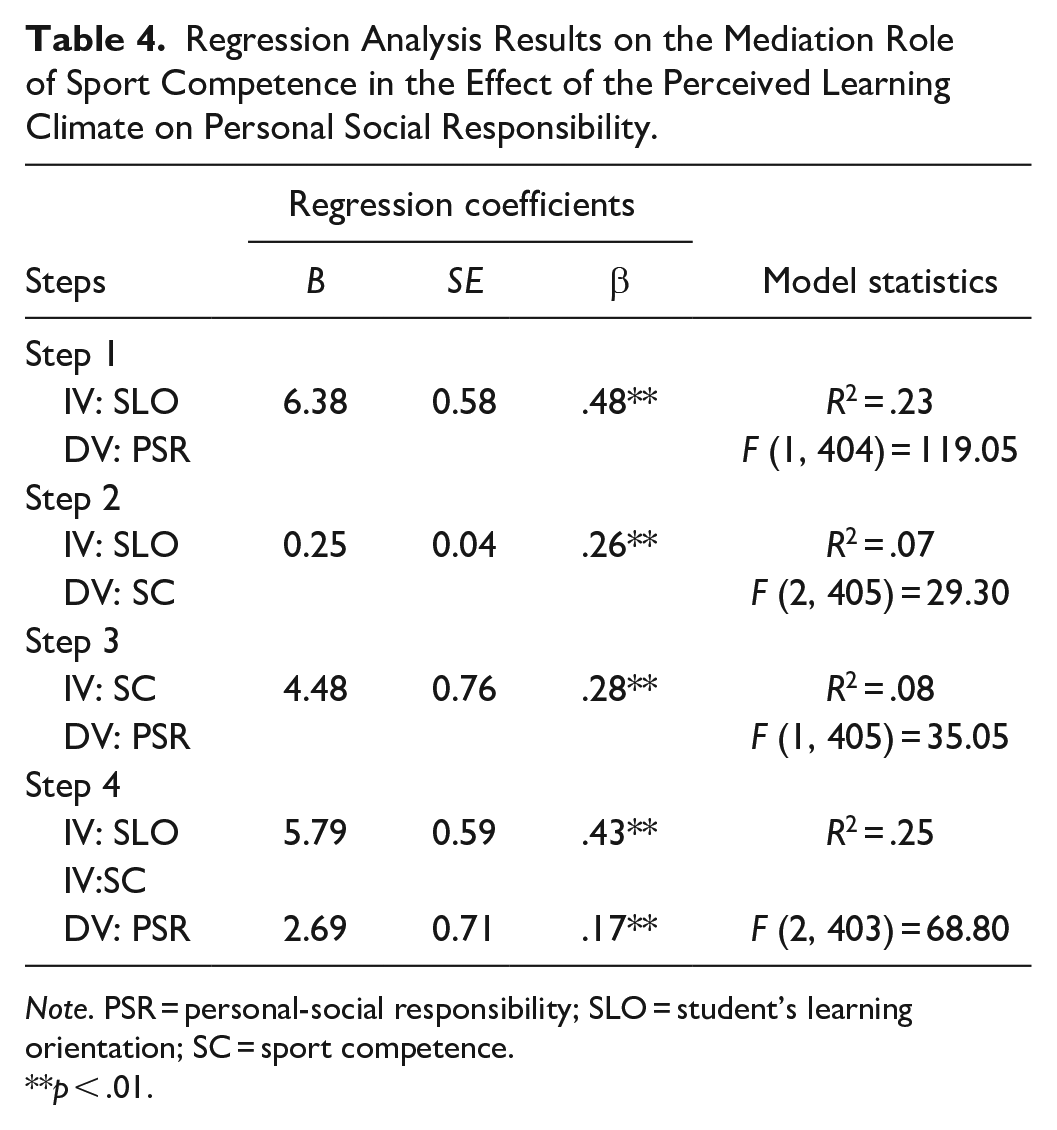
Note. PSR = personal-social responsibility; SLO = student’s learning orientation; SC = sport competence.
p < .01.
In the fourth step, when the effects of student learning orientation and sport competence on personal-social responsibility are analyzed, it was seen that the positive and significant effect of student learning orientation (β = .43, p < .01) and sport competence (β = .17, p < .01) continued. In other words, sport competence (mediating variable) maintained its significant effect on student learning orientation (independent variable) and personal-social responsibility (dependent variable). In light of these findings, it can be said that sport competence has no mediating role in the relationship between student learning orientation and personal social responsibility.
Discussion
The present study separately investigated the mediator role of two different variables (physical condition and sport competence) in the relationship between perceived motivational climate and personal-social responsibility. Physical condition and sport competence were dimensions of self-perception. We found that neither physical condition nor sport competence mediated the relationship between perceived motivational climate and personal-social responsibility. This means that the relationship between perceived motivational climate and personal-social responsibility is being affected by different variables. It has emerged that teachers must be profoundly focused on their class climate deeply regardless of self-perception about physical condition and sport competence. This level of attention will bring the other desirable outcomes, such as positive self-perception, desirable values, and positive character. Personal-social responsibility was positively related to learning climate and mediator (physical condition and sport competence) variables. In addition, regression analysis results showed that student learning orientation was the most effective variable among other variables. This result is consistent with the literature. Studies have generally shown that a learning climate is associated with outcomes related to helping and respecting others (Leo et al., 2015; Stanger et al., 2018). However, an interesting result in this study was the fact that there was no relationship between performance climate and personal-social responsibility. According to this result, it was determined that the performance climate (Newton et al., 2000), which focuses on winning, scoring or skill differences, does not affect on personal-social responsibility, as coincided with the work of Hellison (1995). Hellison (1995) reported that the climate created and the character of the educator have an impact on personal and social responsibility.
Literature has focused on understanding the direct relationship between motivational climate and outcomes. The current findings report that the student learning climate is the most important factor in the effect on personal and social responsibility. Students’ perceived sport competence and physical condition did not appear as a determining factor at this point. Thus, the importance of physical education lessons for the holistic development of the individual has been revealed once again because of physical movement is an essential part of the child’s overall physical and cognitive development (Biddle et al., 2019). The current findings emphasized the effect of a motivational climate on responsibility. Similarly, Manzano-Sánchez et al. (2021) found that responsibilities were positively related to school climate and prosocial behaviors and negatively related to antisocial behaviors and violence. The researchers (Biddle et al., 2019) indicate that if the experience and context of physical activity are positive, the outputs will be positive (e.g., self-esteem).
One of the aims of physical education is for students to learn healthy habits (Baena-Extremera et al., 2014) which are physical, mental, and emotional. Therefore, both motivational climate and TPSR frameworks could be determinative for healthy development. There are extensive research results about positive outputs in motivational climate surroundings. Generally, the literature supports that the learning/task climate is associated with more positive outputs like lower stress levels (Castro-Sánchez et al., 2019) higher self-esteem (Orth et al., 2018), and lower anxiety levels (Atkins et al., 2015). These seem to be basic characteristics of healthy people that teachers want to have in their classrooms and future generations. One of the important goals in education is to comprehend the importance of certain values and keep them alive. Teachers and schools lead the students. Being a responsible person is a very important value that must be learned. In family, school, and society, much of what we do and say reflects our values (Hellison, 2011). The TPSR program is concerned with enhancing personal effort and self-direction and fostering social well-being by focusing on respecting others, valuing others, and caring for others (Newton et al., 2006). The present study also presents a series of limitations that should be considered for future research. A more extensive and well-designed methodological approach is needed to obtain the data homogeneity and more generalizable results. There is still a need to find out what factors affect class climate and student participants in the PE lesson. More importantly, there is a need for more extensive research in terms of our culture and social construct.
Footnotes
Declaration of Conflicting Interests
The author(s) declared no potential conflicts of interest with respect to the research, authorship, and/or publication of this article.
Funding
The author(s) received no financial support for the research, authorship, and/or publication of this article.
