




Abstract
The present study endeavors to understand tech-based Strategic Human Resource Development Practices (tech-based SHRDP), specifically aiming to explore whether tech-based SHRDP has any relation with employee engagement and study whether the attitude of employees toward tech-based SHRDP moderates the relation between HRD practices and employee engagement. Data was collected from 375 IT professionals. Hierarchical-regression analysis and correlation were used to address the research questions. The study found tech-based SHRDP were associated with employee engagement and the attitude of employees toward tech-based SHRDP moderates the relation between HRD practices and employee engagement. The paper is an original empirical work that focuses on tech-based SHRDP and comes with findings that would assist the organizations and human resource professionals to plan their HRD practices aiming toward sustainability of the workforce.
Introduction
Modern workplaces are marked by up-skilling and re-skilling strategies. The ardent need to up-skill and develop potentials among the workforce has gained momentum (Abe et al., 2021) in terms of Strategic Human Resource Management (SHRM). Every employee wants to be engaged in learning, working and participating in the digital world. Employees are even improving their digital skills to accomplish their work and learning on digital platforms in communities (Wahab et al., 2021). Organizations’ efforts in training their staff members are visible in various learning modalities. With digitalization becoming prevalent across the globe, training platforms are changing (Oduma et al., 2019). Though people come with appropriate and commendable educational backgrounds; yet the larger question remains: are acquired skills and capabilities being applied on the current job? Hence the focus is on finding the right kind of HRD practices that would lead to strategic talent management (Shuck et al., 2015). The challenge is that traditional approaches to employee development to meet organizational or individual needs are not adequate anymore. In the gig economy, employees are looking for appropriate learning opportunities from their respective employers. Due to a shortage of digital skills in the gig sector, if an employer fails to provide employees what they need, they will lose them in no time. Schramm (2006) documents that technology is transforming the role of HR and leading to more measurable HR metrics which will impact the bottom-line results. Thus to remain competitive by developing and upskilling the human capital, the organizations need to be more strategic, and technology embedded in nature (Crook et al., 2011; Mahoney and Kor, 2015).
Modern HRM has been evolved more like a system than a group of HR managers doing the transactional activities. The automated HRM Systems or Human capital management platforms are really making a significant difference in the organizational effectiveness and improving its productivity (Ulrich, 1997). Organizations provide universal access to HR services through technology and web-based platforms, radically widening the spectrum of human resource management. Contemporary HRD practices accept that technology is a main part of the learning and development process and that regular connectedness through technology gives us opportunities to choose the platforms of learning. In the global and competitive market, knowledgeable employees can give the best prospect to propel high-end results, and bottom-line impact. Herein comes the importance of tech-based Strategic Human Resource Development Practices (SHRDP) that enhance employees’ perception. When employees feel that they are working in organizations that would help them in enhancing their existing competencies, their commitment increases, and the culture also becomes very positive. HRD practices need to be always improved and implemented so that there is a remarkable improvement in HR effectiveness. In a study by Jain and Premkumar (2011), the authors emphasize the role of HRD subsystems’ improvisation to develop human resources effectiveness. It is important for any organization that management must enhance the thorough review of HRD practices and have timely implementation, so that the policies and practices are functional at a pragmatic level. Research reveal that the two concepts, HRD and organizational performance are interlinked (Dhir & Shukla, 2019). Now, linking organizational performance, a study found that positive organizational performance is triggered by EE and that employees go an extra mile if they are engaged (Markos & Sridevi, 2010). In another study, Chakraborty and Ganguly (2019) assert that culture of EE is indispensible for developing a positive culture and sustained workforce. In a study conducted by Shuck et al. (2014), it was indicated that EE partially mediated the association between HRD practices and employees’ turnover intention. Performance management has also been linked with EE. Gruman and Saks (2011) presented a model that talks about EE and posits that it is pertinent to manage EE in order to attain greater heights of performance.
Employees seek better HRD practices, among many other factors of employee engagement, to stay back in a job. Factors like mindfulness, employee morale (Pattnaik & Jena, 2021) are important for employee engagement. However, the concern for the day is to understand the right and sustainable HRM process and practices (Aydoğan & Arslan, 2021), the role of superior quality life (Fanggidae et al., 2020; Cascio, 2006), and organizational identification (Srivastava & Singh, 2020). It is important to understand the HRD practices that would link with employee engagement and employee sustainability. Furthermore, to develop employees’ competitive advantage and to engage them at work, organizations are making substantial investments (De Beer et al., 2016). There is a need for organizations to work on tech based strategic HR practices through hiring strategies, employer branding strategies, development strategies, performance management systems, merit based transparent incentive systems, and career and succession planning strategies (Chhabra and Sharma, 2014). Maheshwari et al. (2017) suggest in their studies that employer branding should encompass both HRM and marketing strategies while Chakraborty et al. (2020), and Chakraborty and Ganguly (2019) suggest that the role of a positive work environment is paramount, so that employees with superior potential are acquired and retained for a longer time. These all take into account SHRDP toward better employee sustainability.
Tech-based SHRDPs are gaining impetus with the emergence of technology at workplace and is capable of creating an ocean of untapped talent and enhance their potential in organizations. Organizations are trying to bring in effective HRD practices as they realize the importance of these in retaining and growing talent. With technological development and newer HRD practices emerging, it is asserted that tech-based SHRM not only automates and make the process more transparent but also develops a quality data set which helps the organizations to get the true insights about the workforce. This not only helps the organizations to serve the internal customers but also engages them effectively and augments better human resource service quality (Verma et al., 2021). Digitalization is giving rise to newer ways of handing HR issues. HRM 4.0 revolutions have also witnessed changes in terms of employer branding initiatives which not only helps them to attract the right talent for organizations but also keep them engaged throughout their journey (Thomas et al., 2020). HRD practices adopted in organizations should target organizational sustainability and involve engaged employees with right beliefs, positive attitude, and optimistic behavior. To implement tech-based SHRDP, it is essential to bring in technology-based practices in everyday HR, customized strategies to the company needs, inculcating a vision to explore tech-based SHRDP, and instigating organizational changes wherever necessary.
Strategic Human resource development has been studied by scholars at different times and in different ways. It has been studied through the lens of resource based view (Collins, 2021), employee retention (Fahim, 2018), competitive advantage and sustainability (Hamadamin and Atan (2019), etc. There is a clear gap in literature about the role of tech-based practices in human resource development and its impact on employee engagement.
Among the various outsourcing locations across the globe, India is considered among a top few places (Kuruvilla & Ranganathan, 2010). Every year, the number of IT professionals produced by academic institutions is increasing across India. However, employees’ turnover has been a major concern in Indian IT and ITES industry (Budhwar et al., 2009). IT professionals are changing their jobs at higher rates as compared to employees of other sectors (Morris, 2019). Due to this reason, the major concern is loss of highly skilled employees whom the organization must have developed through their Learning and Development (L&D) initiatives. This can be extremely expensive and simultaneously disruptive for firms which eventually impacts organizational sustainability. Losing highly skilled employees results in substantial costs. Hence it is very important for organizations to fine tune their HRD practices with employee aspirations.
Studying the extant literature and linking the various antecedents and precedents of employee sustainability, the authors of the present paper identify a clear research gap of tech-based SHRDP and its relation with employee engagement. There has been no earlier attempt to study the strategies that the organizations are employing, and how the attitude of employees toward tech-based SHRDP helps in shaping the relation between HRD practices and employee engagement. The present study endeavors to understand the SHRDP adopted by IT firms, explore whether tech-based SHRDP have any relation with employee engagement and finally study the attitude of employees on impacting the relation between tech-based SHRDP and employee engagement (EE).
The novel contributions of the study are that how the attitude of employees will interact with tech based strategic HRD practices and will impact employee engagement.
Literature Review
After studying the extant literature on tech based SHRDP, authors have compiled the following snapshot of the literature. The major findings relate to human resource practices that link to the researchers’ understanding of the gap in this area and the need for understanding the linkage of tech-based SHRDP with employee engagement. HRD benchmarking is a difficult job as the challenge of determining what to measure remains to encumber HRD benchmarking (Ford, 1993). This necessitates the study of HRD practices for a sustainable organization. HRD practices, tech-based SHRD practices or strategies are not an entirely new concept. Though there is a necessity to bring changes in the strategic human resource development practices, it does not demand a complete change in the parameters or ways of doing things. Leavy (2005) affirmed that novel strategies, under the tech-based SHRD strategies framework, are pertinent to all kinds of industries from normal consumer goods to enterprise to market. So, those strategies can be novel from any standpoint, but in a nutshell, they should bring something new, away from conventional practices in the strategy. Daft and Marcic (2006) mention that leadership is a vital demand in every corporation and is an integral part of formulating as well as implementing the strategies (F. J. Wang et al., 2010). Hassan et al. (2006) in their study found that organizations that have higher levels of HRD practices, and organizations that reward and recognize their employees were found to endorse a healthy human resource development climate. Thus, HR strategies should aim at better human resource development climate. Tseng and McLean (2008) assert learning happens better through organizations’ well-planned HRD practices. Organizations that absorb and develop their SHRDP, acquire and assimilate the HRD consequences in the process of learning.
Critically speaking, there will always be reluctance for any change and that might come from different stakeholders in the organizations while implementing strategic HR changes.
Kocolowski (2010) found that the rate of changes in today’s business environment has additionally made management end up with increasingly more crucial changes. The study focuses that organizations must try to implement a shared leadership attitude to incorporate changes smoothly. Implementing strategic changes in HR is not an easy job altogether (Haymes, 2008). Sharma et al. (2010) in their study on rural markets in India asserted that, for economic development, emphasis has to be given to tech-based SHRD practices; implying the role of first-mover advantage. Shuck and Reio (2011) mention that engaged employees are likely to outperform their disengaged counterparts. So, the need is to implement strategic human resource practices that maintain or enhance employee engagement. Low and Ang (2012) emphasized that enforcing tech-based SHRD practices can build in and communicate out of the box thoughts for companies and can provide competitive advantages to its stakeholders. Providing better services is possible through tech based SHRD practices. Borgianni et al. (2012) state that their study takes a new approach and shows primary directions to support thinking about products and services in a different way, in order to bring better business. Now shifting our attention to information technology and its use in strategic human resource practices, we claim that Information technology has not only had widespread effects on many aspects of our society but has also made remarkable footmarks in human resource management practices (Johnson et al., 2016). Despite the invasive impact of technology on HR practices, there has been a relative dearth of research that examines its efficacy (Gueutal & Stone, 2005; Olivas-Lujan et al., 2007; Parry & Tyson, 2011).
Moreover Edwards (2004) have also investigated the role of new work and management practices and posited that only technology adaptation and innovations cannot give competitive success. Strategic Flexibility Framework has also been reported to determine effectiveness at workplace (Yawson, 2020). Another study talks about SHRD model developed based on 23 factors instrumental to HR managers in achieving HRD functions and outcomes (Sthapit, 2020). Further, Malhotra and Seth (2014) mention that strategic leadership needs to be revamped and reconsidered, as businesses need to focus on more result-oriented areas. As result-orientation is the need of the hour, it is important to understand the role of adopted HRD practices in creating the desired outcomes. Engaged employees are expected to exhibit discretionary efforts translated into better performance (Anaza & Rutherford, 2012). However, we still lack the evidence whether tech-based strategic HR practices are successful at creating employee engagement and the interaction of employee attitude with tech based SHRDP to employee engagement. But none of these studies have focused on employee engagement as a result of SHRDP. While Duan et al. (2023) state that though Leadership factors were found to be associated with emotional intelligence; yet there was no work on tech-based strategic human resource development practices on employee engagement. There have been a lot of changes over the past years. Employees have re-evaluated what achievement means to them and are enthusiastically looking for control of their lives and careers. This active involvement in career demands employee engagement. As this junction, it is important to close the gap in research as shown in Table 1 with respect to the role of tech based SHRD practices in impacting employee engagement and attitude of employees.
Interview Data on SHRDP in IT Firms.

On the basis of the constructs identified from the literature review on HRD, the following hypotheses have been formulated. There are 11 hypotheses, which try to address the research gap in the area of HRD practices, employee attitudes and employee engagement.
Theoretical Background
We rely on Theory of Connectivism in our study. The theory of Connectivism (Siemens, 2005) postulates that individuals learn from various kinds of environments (Mallon, 2013). The learning environment is facilitated by digital platforms. Individuals rely on digital platforms to a great extent in order to gather knowledge and skills (Corbett & Spinello, 2020). The crux of this learning theory is that it believes that individuals connect with various channels of information, views and explore the learning resources that leads to knowledge gain (Kotzee & Palermos, 2021). In the same process individuals do make use of their social connections to make best use of information. We posit that in the tech-based SHRDP employees engage in knowledge sharing, they use blended learning platforms, involve in gamification in learning and development, get associated with right subject matter experts and receive feedback about performance. These are the variables that the current study would like to investigate in terms of tech-based SHRDP. All these lay the foundation of Connectivism in employees’ tech-based SHRDP that the extant literature has explored that connectivism in organizations use technologies and make use of organization’s knowledge management practices (Rosa Yeh & Singhateh, 2013). In another study based on connectivism approach instructions based on information literacy suggests that organizations and individuals adopt pedagogical practices that reflect connectivism (Dunaway, 2011). Thus, we argue in this paper that today employees are seeking more of tech-based SHRDP and when the organizations engage in such tech-based practices, EE becomes higher.
Based on the above discussion, we hypothesize that tech based strategic HRD practices will positively be related to employee engagement with the moderating role of employee attitude as shown in Figure 1. The employee-owned development budget as a tech based SHRDP will help the employee to spend the resources in the most appropriate manner for their own development. The autonomy and ownership will be translated into a responsible behavior and employees will be more engaged. Hence, we hypothesize that

Proposed model.
H1: Employee-Owned Development Budget as a tech-based SHRDP will be positively related to Employee Engagement.
Similarly, the knowledge sharing as tech-based SHRDP will help the employees to disseminate the necessary knowledge among employees. The tacit knowledge sharing not only helps to boost employee’s confidence but also helps the other employees to put their best efforts and reduce the overlap. Hence, we hypothesize that
H2: Knowledge Sharing as tech-based SHRDP will be positively related to Employee Engagement.
Furthermore, using various apps for learning and development facilitates will help the employees to fill the gaps in for the desired competencies which will get translated into the discretionary efforts put by them in their work. Moreover, the digital support always provides necessary flexibility to the employees which in turn engages them more effectively. Hence, we hypothesize that
H3: Use of L & D Apps as tech-based SHRDP will be positively related to Employee Engagement…
Tech-based strategic HRD practices have been booming in organizations. In order to achieve organizational goals, organizations have adopted technology to ease the HR Functions (CedarCrestone, 2014). Technology has also been used to train employees through various simulations and gamifications (Brown, 2001). Besides, scholars have tried to identify if technology in training improves performance at work (Abbas et al., 2014). Hence, we hypothesize that
H4: Stimulating Employee Training Strategy as tech-based SHRDP will be positively related to Employee Engagement.
H5: Gamification as a tech based SHRDP will be positively related to Employee Engagement.
Moving ahead, the feedback mechanism using tech based platforms have really been very helpful for employees to get the necessary guidance to complete their tasks. The tech-based feedback helps the employees to understand that where have they gone wrong and how can they improve further in the continuous manner. Hence, we hypothesize that
H6: High Feedback Environment as a tech-based SHRDP will be positively related to Employee Engagement.
The technology has given us multiple options to cater the needs of various types of learners. The individual employee may choose the learning tool as per their orientation and maximize their learning experience. Hence the blended learning platforms provide employees a nice forum to leverage their learning preferences. Hence, we hypothesize that
H7: Blended Learning as a tech based SHRDP will be positively related to Employee Engagement.
Similarly, microlearning as a tech based SHRDP helps the employees to plan the small modules of learning. The microlearning not only motivates employees to explore it with given constraints of work life and apply the gained experience in the work. Therefore, we hypothesize that
H8: Microlearning as a tech-based SHRDP will be positively related to Employee Engagement.
Employees do need recognitions and rewards in exchange of their efforts. Technology has increased the reach of various activities through excellent communication channels. Also, competitive tech-based reward system has provided a fair and transparent system to employees and has created a more equitable distribution of incentives. Hence, we hypothesize that
H9: Competitive Reward System as a tech based SHRDP will be positively related to Employee Engagement.
Subject matter experts’ guidance in terms of content or process helps the employees to get the customized advice. Subject Matter Expert (SME) not only guides employees in their L & D but also assists designers of training programs to design and deliver the training effectively and gets translated into their engagement with the organization. Hence, we hypothesize that
H10: SME Guidance as tech-based SHRDP will be positively related to Employee Engagement.
The organizational resources in terms of tech based SHRDP really enhances employee engagement and in turn their performance. However, employees attitude plays a very important role to exercise the given resources with the right intent and spirit. Hence, we hypothesize that
H11: The attitude of employees toward tech-based SHRDP moderate the relation between SHRDP and EE.
Methodology
Based on the literature review, the study has been designed to follow the quantitative methods to test the hypotheses. On the basis of the constructs identified from the literature review on SHRDP, the study has attempted to test the hypothesis using Structural equation modeling using AMOS.
Sample Demographics
The participants of the study are employees of IT and ITES industry, drawn from major cities in India. Based on the available literature, a pool of constructs was created and online survey forms were circulated to 800 employees in IT and ITES related organizations. The respondents had to have at least 3 years of work experience in the sampled organizations. It was pretested that the entire sample was a part of the companies’ HRD processes. Out of 800 survey forms sent across, finally 375 workable responses were received back and used for analysis (46.87%). In order to avoid any potential CMV bias we collected measures for different constructs from different sources and at different time intervals with an interval of 10 days in between.
Measures
With all the selected variables a questionnaire was designed on tech-based SHRDP (50 indicator items) (Kandula, 2004), employee engagement (nine indicator items) by Schaufeli et al. (2006) and attitude of employees toward tech-based SHRDP (Edgar & Geare, 2005) in the organization. In all, there were 64 questions. Table 2 shows the reliability for all the constructs used in the study. All the values are well within the acceptable limits. Also table 3 has shown mean, staandard devoiation and the correlations among the constructs.
Constructs, Scale Names, Tools Used and Reliability of the Scales.

Descriptive Statistics and Correlation Estimates.

Note. The result is significant at p < .01***. The result is significant at p < .05**. The result is significant at p < .10*.
Results
This section of the paper will discuss the major findings from the study. Before going into the discussion of the tests of the hypotheses, we would like to present the demographic information about the participants. The present study was conducted on IT professionals. There were total obtained responses from 375 respondents. The sample had 200 males (53.33%) and 175 females (46.67%) who were in their present job for last 2 years from the date of data collection. All the respondents were already in the HRD processes of the organization. The respondents were of 27 to 44 years and with graduation as minimum educational degree.
Coming to descriptive statistics of the variables studied in the paper, the following graph (Figure 2) is presented to describe the mean and standard deviations of the variables through graphical representation.

Graph showing the various constructs on a 5 point scale.
The descriptive statistics and the graph above shows that, among the variables studied, microlearning (M = 3.7) has got the highest mean score, followed by employee attitude (M = 3.6), competitive reward system (M = 3.6), employee engagement (M = 3.5), employee owned development budget (M = 3.5), blended learning (M = 3.4), high feedback environment (M = 3.2), use of L & D apps (M = 3). Gamification is not much used has an HRD practice, receiving a mean score of M = 2.5. Thus, among all the HRD practices studied, microlearning and competitive reward systems are mostly used strategies followed by other strategies.
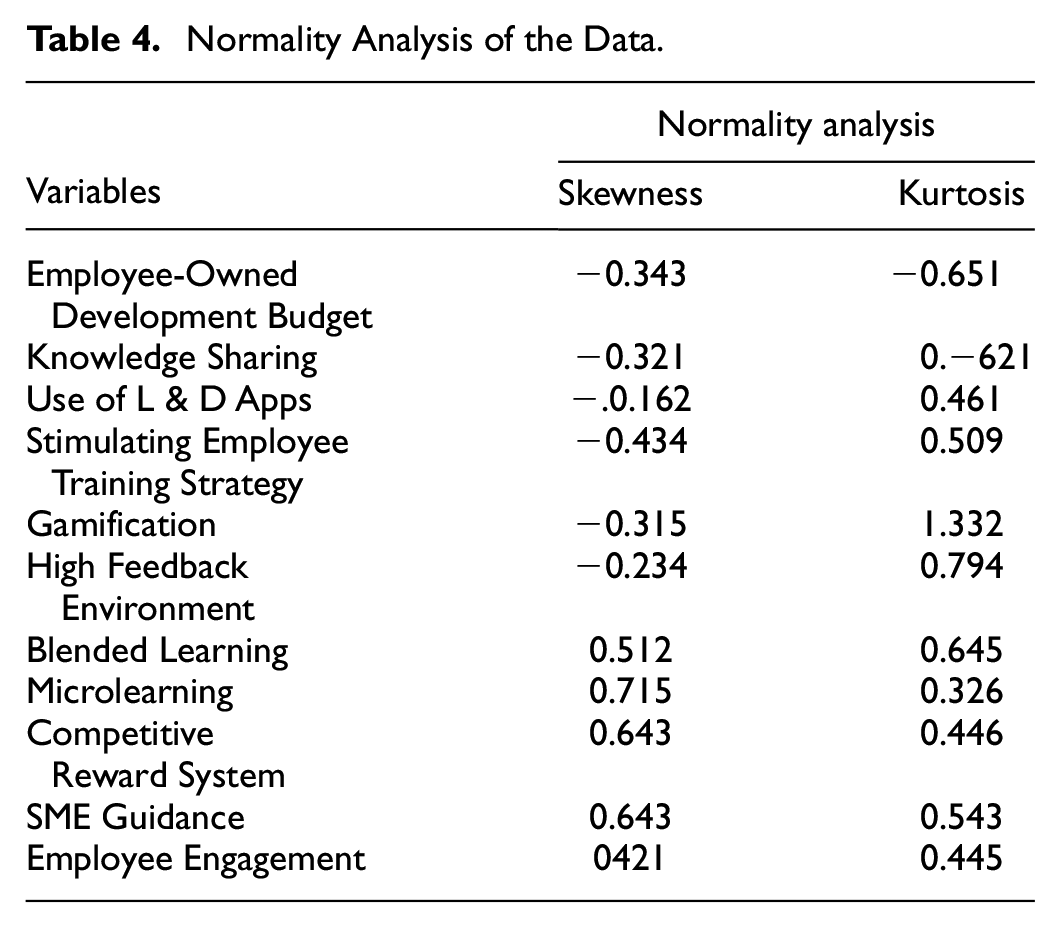
Normality Test (Table 4) and reliability test (Table 5) for the data were conducted, with satisfactory results obtained thereof. Later a Confirmatory Factor Analysis was run (Table 5)
Normality Analysis of the Data.
Results of CFA—The Measurement Model for the Study.

Hypothesis Test Results
Table 6 depicts the model fit results for the study.
Regression Results of the Predictor Variables on Employee Engagement.

Note. Model 1 fit: cmin/df = 4.435 (met the condition); CFI = 916 (Good fit), RMSEA = 0.071 (Good fit). Model 2 fit: cmin/df = 4.435 (met the condition); CFI = 916 (Good fit), RMSEA = 0.071 (Good fit). *** denotes significance at .001 level. ** denotes significance at .05 level. ns denotes estimates not significant at .05 level.
For further analysis, for testing the hypotheses, SEM was applied, and it was found that the proposed model has an acceptable statistical fit. With respect to hypothesis 1, that is, employee-owned development budget has a positive relation with EE, in model 1, it has been found that (β = .067, p < .001), there is a robust relationship between Employee owned development budget and EE. Therefore, we can say that hypothesis 1 has been supported. For hypothesis 2, that is, knowledge sharing has been found to have a positive relation with EE, in model 1, it has been found that (β = .050, p < .001), there is a strong relationship between knowledge sharing and EE. Therefore, we can say that hypothesis 2 was supported. With respect to hypothesis 3, that is, use of L & D apps has a positive relation with EE, in model 1, it has been found that (β = .072, p < .001), there is a robust relationship between use of L & D apps and EE. Therefore, we can say that hypothesis 3 was supported. Similarly, for H4 we found that (β = .058, p < .001), there is a relationship between use of stimulating employee training strategy and EE. Therefore, we can say that hypothesis 4 has been supported. For H5, that is, gamification has a positive relation with EE, in model 1, it has been found to establish (β = .061, p < .001) a positive relationship between gamification and EE. Therefore, we can say that hypothesis 5 was supported. Analysis reveals H6, that is, high feedback environment has a positive relation with EE, in model 1, it has been found that (β = .063, p < .001), it has been supported. H7, that is, blended learning has a positive relation with EE, in model 1, it has been found (β = .064, p < .001), to be supported. With respect to hypothesis 8, that is, microlearning has a positive relation with EE, in model 1, it has been found that (β = .064, p < .001) hypothesis 8 was supported. With respect to hypothesis 9, that is, competitive reward system has a positive relation with EE, in model 1, it has been found that (β = .071, p < .001), there is a robust relationship between competitive reward system and EE. With respect to hypothesis 10, that is, SME guidance has a positive relation with EE, in model 1, it has been found that (β = .072, p < .001), obtained results support the hypothesis. With respect to hypothesis 11, the authors attempted to predict any moderating role of employees’ attitude toward tech-based strategic human resource development practices on employee engagement. The regression results show (β = .088, p < .001) there is a moderating effect found in the study.
Discussion
Looking into the various aspects of the tech-based SHRDP, in the present study, we find that employee owned development budget has been found to be associated with EE. In the present day, organizations have budget for training and development of employees; and there are situations where employees themselves are required to volunteer, establish justification as to why they should be entitled to certain training programs. When employees own their developmental path, they create a stimulating and favorable work environment. Owning training budget, engages employees and besides having a reduced employee turnover, there is a boost in productivity. As HRD policies and those practices are found to be positively impacting EE, and organizational leaders engage in EE, attention is shifted now to improve and support approaches that enable engagement-encouraging organizations (Vance, 2006). It has always been a matter of challenge for HRD practitioners as to how to utilize and incorporate positive circumstances for EE (Shuck & Rose, 2013). In a study by Fairlie (2011), it has been emphasized that meaningful work, adds value to human resource development (HRD) practices concerning EE in any organization. Thus, owning the budget for employee development, by the employee himself in a tech-based platform has been recommended as a predictor of EE.
One of the important drivers of engagement is rewards; human beings thrive well and feel more engaged in cases of contextual rewards. Kahn (2010) says that meaning at work has association with reward. Though not surprising, employee rewards and recognition programs leads to employee happiness; besides provision of right equipment and growth, rewards are indicators of employee satisfaction and sustainability. The role of tech based SHRDP strengthens this fundamental need and besides financial remuneration, it augments employees’ needs for self-fulfillment. A right blend of HRD practices which clearly help employees to perceive his career growth on a tech-based platform, enhances EE and performance. Though monetary incentives are fruitful, recognition and rewards help a sustained employee stay and help employees realize their needs of self-actualization.
In the present day workforce context, gamification employs various mechanisms of game and engages people to be motivated and enhance learning that they engage in through training sessions (Kapp, 2012), and when used in learning purposes, it focuses on acquisition more, and less on the game (Wu et al., 2012). Similar is the case with mobile learning apps. Engagement makes an individual more involved in what he does (Reeve et al., 2004). Guo and Ro (2008) assert that because of a flow-experience in gamification, learners get more engaged in learning and get favorable outcomes. As players have higher level of motivation (Raphael et al., 2012), their learning is higher. The present study has found that employment of gamification in L & D in a tech-based platform has positive impact on EE.
The more the trainings can stimulate the employees’ thought processes, their behavior and their performances, the more is the effectiveness of the training and that it would lead to more satisfaction of the trainees with respect to their work. The committed worker is an engaged worker. The present study also found that stimulating training strategies lead to engaged learning and engaged learning leads to EE. Colquitt et al. (2000) posits that training motivation is a mediator of the relationships between an independent variable like characteristic of the trainee and effectiveness of training. A stimulating training strategy comes under training program characteristics. Kontoghiorghes (2004) states that training program characteristics impact training effectiveness. Cannon-Bowers et al. (1995) assert that training program characteristics has the potential to stimulate the motivation of individuals to learn, and as a result upsurge learning performance. In another study Bell and Ford (2007) states that the content of training can stimulate the motivation to acquire and, consequently, impact training performance; in the same line Tsai and Tai (2003) states that perceived importance of the attended training also impacts training effectiveness. Thus, it is highly pertinent to this discussion that training should be made stimulating to engage learners. The present study has in the same line found that, as a part of tech-based SHRDP, stimulating training strategies impact EE.
With respect to sustainability and engagement of employees, it is important that employees get to know timely, what their peers and superiors think about their work. Feedback can be provided formally or informally, but employees should never be kept in the dark about how their performances have been. On the basis of the feedback that they receive, employees can rectify their errors, set right and achievable goals for themselves, pace up their work with respect to time, and in a nutshell, become more enthusiastic and engaged in the job. A study found that employees who receive negative feedback from their bosses are likely to be more engaged than those who do not receive any feedback at all. The same study also adds that managers who tend to focus on employees’ positive qualities are 30 times more engaged workers when they are compared to those who tend to refuse feedback; and managers who provide little or no feedback to their subordinates, result in 40% disengaged team members (Gallup, 2009). Feedback seeking boosts a sense of control, especially when an employee enters a new job role or has to adjust to new work environments (Ashford & Black, 1996). A developmental feedback creates an organizational culture of engagement, and organizational learning. Cyert and March (1963) laid down their work on the basis of Feedback Theory, and states that organizations have a tendency to respond to performance measures. In general, human beings are information-seeking in nature and they want to know how they are performing, even if the feedback is negative (Ashford et al., 2003). In a study, Wanberg and Kammeyer-Mueller (2000) found that when employees encounter the need for higher skill level, they tend to seek increased feedback. Feedback renders an informational worth that aids them meet up their objectives and manipulate the performance and their behavior (Ashford, 1986; Ashford & Tsui, 1991). From an Ego Defense and Enhancement point of view, because feedback brings information about oneself, the employee is emotionally charged with respect to feedback. Individuals generally seek positive feedback and that is why individuals with lesser capabilities at work ask for fewer feedbacks than those with greater prospects. When engaged in defensive impression management (Tuckey et al., 2002), employees seek reduced feedback. The gleaning message from this is that, tech-based SHRDP, tend to incorporate feedback systems in right place, as employees for various reasons seek feedback; and this feedback augments the path for EE. Thus the present study strives to assert the feedback systems in tech-based SHRDP, are essential for EE and sustained workforce.
Among the various human resource practices, job design is a very imperative practice (Lawler et al., 1973), because it relates to employee motivation. Knowledge sharing is an imperative fragment of creating knowledge-based competitive organizational advantage (Argote & Ingram, 2000), and current organizations implement knowledge sharing as a part of job design. As a knowledge sharing practice, the expression, whether it is individual knowledge sharing or group knowledge sharing, it is ultimately engrained in the employee behaviors and their related drivers. Knowledge sharing fosters knowledge dissemination and knowledge acquisition. When organizations nurture knowledge sharing practice as a HRD practice, employee motivation to do the same increases. Further, when knowledge sharing is linked to some reward mechanisms, employees engage in knowledge sharing more. In terms of social psychology, employees are proactive and get engaged in behaviors in which they find their personal growth (Deci & Ryan, 2000). If knowledge sharing helps an individual to gain more knowledge, or receive organizational rewards, it is expected that individuals will have the motivation to have positive perception on knowledge sharing, and they would engage in knowledge sharing more frequently. As organizations’ tech-based SHRDP involve rewarding knowledge sharing, employees share knowledge. Besides this, employees get motivated toward knowledge sharing because they see some valued external contingency drives the knowledge sharing initiatives (organizational reward). The present study found when organizations follow knowledge sharing as an HRD practice, they are characterized by a more engaged workforce. Intrinsic motivation triggers an individual’s motivation to share knowledge, but if organizational policies can create a knowledge sharing culture, it becomes more evident and an increase in EE is to be expected.
Micro learning as a practice comprises of a well-designed, well-segmented, bite-sized lumps of data on some topic. Generally lasting 5 min, knowledge is delivered through individual mobile devices and can be accessed by users at any time or location. Organizations that adopt Microlearning for HRD practices, propel learning practices outside popular traditional techniques. As the practice of Microlearning is volunteered by the individual at time and place of his choice, it helps attaining higher levels of EE that has an immediate impact on business results. The present study has found that microlearning as a HRD practice, fosters EE. One study suggests that on an average, employees who engage in micro learning gather 85% of the required knowledge more than when they first started their operations.Generally microlearning is employed in the training areas of safety, customer services, product related knowledge, sales training and company culture (Basumallik, 2018). EE in microlearning has resulted from the fact that there is an increasing demand for e-learning alternatives that target to convey better retention rates among learners, in not only less time, but also at a time of choice and at a reduced cost. Microlearning is perfect when it relates to the daily activities, emphasizes on key learning facts that drive business outcomes; as it uses cognitive science to propel rapid memory and retaining, learners are more engaged in this strategy. More importantly, individuals learn best when they are present in the moment—they seek something immediately, and if they do not know it, they would not make any attempt to use it. When it comes to the gig economy and the workforce is multigenerational, HRD practices are becoming apt at modifying their practices in order to obtain an engaged workforce and workforce sustainability.
Besides microlearning, HRD and instructional technology literature indicate that blended learning is also a new learning paradigm. In case of computer mediated instructions, HRD professionals are employing e-learning in the workplace. Organizations that engage in blended learning try to find an appropriate blend or combination of face-to-face and technology-based learning. Blended learning in tech-based SHRDP should be characterized by best practices in blending learning environments (Christensen, 2003), deciding the aspects of the job that should be delivered by each method (Stubbs et al., 2006). With blended learning in practice, the roles of the trainee alter. Blended learning makes learners engaged because, there is a wide range of available learner options and learners can customize required content by dynamically choosing the preferred choices in which they want to engage. As learning is more engaged, employees tend to acquire more. The performance improves as a result. The present study associates blended learning with EE.
Finally, the study also found that guidance from subject matter experts (SME guidance) impacting the employee engagement. In order to deliver an effective training program, training designers need to design training programs covering various subject domains, and they have to realize that they are not knowledgeable in all types of training content (Keppell, 1997). The major role of SMEs lies in this. The SMEs in the organizations contribute insights and understanding about the content that could not possibly be learned by the training designer alone. Thus engaging SME in HRD practices adds greater value to the L & D initiatives, rendering the training programs more meaningful. Effectiveness of training increases and the employees feel more connected to their jobs and as a result HRD practices that engage SMEs are more fruitful than otherwise. For training and development initiatives to be successful, therefore it is recognized that if concerned SME has a training recommendation that should be considered for implementation.
In the second phase of the study, Focus Group Discussions (FGD) were conducted. With the respondents of the present study, four sets of FGD were conducted to have a qualitative view on their attitude toward the tech-based SHRDP of the firm and develop an insight into the respondents’ stance on workforce sustainability (Noordiana et al., 2016). The results are tabulated below (Table 7).
FGD/Semi-Structured Interview Responses on Attitude toward Blue Ocean Practices of the Firm.

Theoretical Contributions
The current study contributes in understanding the role of various mode of learning in a technology based environment. It strengthens the theoretical foundation of Theory of Connectivism and shows that learning results in employee engagement if learners can utilize a variety of learning platforms based on technology. Years before learners could have benefited from traditional modes of learning; but today these foundational principles have been changed. The study reinforces that learner will move into a variety of diverse platforms to gain knowledge, over the course of their career. Technology is altering our mindsets and we are more tuned to timely and effective connected strategies of learning. The tools we use to define and shape our thinking are changing with time and technology revolution. Earlier theories of learning like those of cognitive information processing, behaviorism and constructivism etc. can now be off-loaded to a great extent and be supported by, technology.
Practical Implications
This paper offers practical understanding of innovative HRD practices with respect to IT firms and provides an insight on the same for organizational sustainability and helps to connect it to employees’ attitude. The study implies that (a) organizations should employ SHRDP on tech-based platforms, (b) employee engagement is impacted by SHRDP and that these are beneficial for organizational effectiveness (c) The paper assists to realize the prospective antecedents and precedents that inspire sustainable HRD practices in organizations, thereby it helps to diagnose the probable outcomes of the tech-based SHRDP, and envisage the future strides toward obtaining a sustainable workforce. (d) The insight into this study would drive collective efficiency, greater learning and involvement and long-term sustainability through a sustained trust on the organizational climate and culture. Thus, providing tech-based SHRDP contributes in innovative ways in engaging employees and benefits in keeping high performers motivated and productive.
Limitations and Directions for Future Research
The present study has been able to take a maiden approach to understand the novel and robust conceptual frameworks to meet workforce sustainability, still the limitations remain that the study has been conducted only in IT sector. Future research should cater to understand tech-based strategic human resource development practices across the various other variables relevant to employee outcomes. It can cover other industries covering a wider sample; with a longitudinal approach, with an HR analytic approach to study retention and turnover with respect to tech-based strategic human resource development practices to be directed for future. To add, this kind of study can also be undertaken at a cross cultural level.
Conclusion
This paper offers practical understanding of tech-based SHRDP with respect to IT firms and provides an insight on the same for organizational sustainability and helps to connect it to employees’ attitude. The paper assists to realize the prospective antecedents and precedents that inspire tech-based SHRDP in organizations, thereby it helps to diagnose the probable outcomes of the tech-based strategic human resource development practices and envisage the future strides toward obtaining a sustainable workforce. The insights from this study would drive collective efficiency, greater learning and involvement and long-term sustainability through a sustained trust on the organizational climate and culture and emphasize the need to introduce tech-based SHRDP in organizations.
Footnotes
Authors’ Note
This research was conducted while Prof. Tanusree Chakraborty was at Rajalakshmi School of Business .She is now at [Administrative staff College of India, Hyderabad and may be contacted at [new institution email address].
Declaration of Conflicting Interests
The author(s) declared no potential conflicts of interest with respect to the research, authorship, and/or publication of this article.
Funding
The author(s) received no financial support for the research, authorship, and/or publication of this article.
