



Abstract
This study aims to address a gap in research by examining the relationship between leadership styles, innovative work behavior, and innovative performance among academic staff at public universities. Specifically, the study seeks to identify the extent to which inclusive and ambidextrous leadership styles can facilitate innovative performance, examine whether innovative work behavior enhances innovative performance, and discover whether innovative work behavior mediates the relationship between inclusive and ambidextrous leadership styles and innovative performance among academic staff at public universities. A critical survey was conducted using a questionnaire among academic staff at two public universities located on the east coast of Peninsular Malaysia, generating 300 responses. The study used SPSS 27.0 and SEM with AMOS 24.0 to analyze the results. The findings of this study show that inclusive and ambidextrous leadership are positively associated with innovative work behavior. The study also found that innovative work behavior facilitates innovative performance. The study highlights the mediating effect of innovative work behavior on the relationship between leadership styles and academic staff’s innovative performance, offering important insights into how public universities can improve their academic staff’s innovative performance through effective leadership and work behavior strategies.
Plain Language Summary
This study looked at how leadership styles and innovative work behavior can affect the innovative performance of academic staff at public universities. The researchers wanted to know if inclusive and ambidextrous leadership styles could lead to better innovative performance, if innovative work behavior plays a role in this, and if innovative work behavior mediates the relationship between leadership styles and innovative performance. They surveyed 300 academic staff from two public universities in Peninsular Malaysia and analyzed the results using statistical tools. The study found that inclusive and ambidextrous leadership styles have a positive impact on innovative work behavior and that innovative work behavior is important in facilitating innovative performance. The study also showed that innovative work behavior acts as a mediator between leadership styles and innovative performance. This study provides insights into how public universities can improve their academic staff’s innovative performance through effective leadership and innovative work behavior strategies.
Keywords
Introduction
In the past decade, institutions across various industries have faced challenges related to globalization, including higher expectations of performance (Mohd Rasdi et al., 2022). This is especially true in the higher education sector, as governments worldwide prioritize education at the university level (Chankseliani et al., 2021). Universities are part of the broader academic delivery system that performs fundamental functions of research and education (Janib et al., 2021). As scientific and academic organizations driving social and economic advancement, they play a dynamic and essential role in national growth (Bayuo et al., 2020).
To meet current market demands, universities must secure a competitive advantage and build resilience, which makes human capital management crucial. In this regard, innovative performance is considered a key area of effective staff management (Fiorito et al., 2007; Mohd Rasdi et al., 2022). Staff innovation in the workplace is the foundation of any high-performing organization (Riaz et al., 2018), as it denotes how staff generate new ideas to meet their work and organizational objectives. Staff’s achievement of their goals through innovation is known as innovative performance (Sarwar et al., 2022). Such performance is particularly crucial in the higher education sector, where innovation is imperative for creating and disseminating knowledge (Oke & Fernandes, 2020).
The success and development of a university largely rely on the innovative performance of its academic staff (Brekke, 2021). Public university academic staff, in particular, are required to carry out multifaceted duties, including teaching, supervising, publishing, conducting competitive research, applying for research funding, and performing administrative duties (Janib et al., 2021). They are also primarily involved in the design and implementation of creative pedagogy (Cremin & Chappell, 2019). Their innovation is therefore necessary for the introduction of new and imaginative insights, techniques, devices, tools, and procedures in the classroom, which would benefit students, colleagues, the university, and the wider community (Coman et al., 2020). Consequently, higher levels of innovative performance among academic staff can lead to enhanced performance for a university as a whole (Phan, 2019). However, the majority of prior research on innovative performance has focused on staffs of business organizations, while limited research has investigated this concept among university academics (Ghabban et al., 2018; Jameel & Ahmad, 2019; Muda et al., 2017).
Scholars have been interested in discovering the factors that affect staffs’ innovative performance, and they have identified various leadership styles that have a significant impact on this performance, including inclusive and ambidextrous leadership (Jing et al., 2022; Saythongkeo et al., 2022). Inclusive superiors demonstrate skills in managing their subordinates, such as showing appreciation, admiration, patience, attention, acknowledgment, and support, thereby motivating them to engage in innovative work and enhance their innovative performance (Fang et al., 2019; Qi et al., 2019). On the other hand, ambidextrous superiors encourage staff to explore and exploit new ideas, which results in improved innovative performance (Awan et al., 2018; Liu et al., 2019). Despite the importance of inclusive and ambidextrous leadership styles in predicting innovative performance, they have not received much attention (Duc et al., 2020; Lopez-Cabrales et al., 2017; Qi et al., 2019). In the academic arena, scholars have long theorized that leadership styles can influence the degree to which innovation is fostered within academic environments (O’Shea, 2021). Although there is a theoretical understanding, there is a dearth of empirical research to validate these assertions.
The success of organizations relies on innovation and identifying the factors that affect staffs’ innovative performance is crucial for organizational growth (Riaz et al., 2018). One such factor is innovative work behavior, which refers to the activities that individuals engage in to generate new ideas and create knowledge that can improve their performance (Xu & Suntrayuth, 2022). It has been well-established in the literature that innovative work behavior is a strong predictor of staff’s innovative performance (Botha & Steyn, 2022; Choi et al., 2021). Moreover, leadership has been identified as a key influencing factor of innovative work behavior (Coun et al., 2021). Specifically, inclusive and ambidextrous leadership styles have been found to enhance staff’s innovative performance by promoting their innovative work behavior (Alghamdi, 2018; T. Li & Tang, 2022; Qi et al., 2019; Tang & Wei, 2022). Inclusive superiors demonstrate skills in managing their subordinates, such as showing appreciation, admiration, patience, attention, acknowledgment, and support, thereby motivating them to engage in innovative work and enhance their innovative performance (T. Li & Tang, 2022; Qi et al., 2019). On the other hand, ambidextrous superiors encourage staff to explore and exploit new ideas, which results in improved innovative performance (Alghamdi, 2018; Tang & Wei, 2022). However, despite these potential linkages, there is a lack of empirical evidence on the mediating role of innovative work behavior in the relationship between inclusive and ambidextrous leadership styles and innovative performance.
Therefore, this study seeks to address the following research questions: (1) Does inclusive and ambidextrous leadership styles influence academic staff’s innovative work behavior? (2) Do inclusive and ambidextrous leadership styles affect academic staff’s innovative performance? (3) How does innovative work behavior affect staff performance in public institutions of higher education, and (4) To what extent does innovative work behavior mediate the relationship between inclusive and ambidextrous leadership styles and academic staff’s innovative performance? By incorporating and testing these relationships in its research framework, this study aims to shed light on how innovative work behavior acts as an underlying mechanism through which inclusive and ambidextrous leadership influence academic staff’s innovative performance in universities, making a noteworthy contribution to the literature.
Literature Review
Inclusive Leadership
Inclusive leadership is described as the words and actions demonstrated by superiors that imply encouragement and gratitude for their staff’s contributions (Fang et al., 2019; Nembhard & Edmondson, 2006). Specifically, inclusive leadership has been theorized as efforts by superiors to involve their subordinates in discussions and decisions, especially where their staff’s opinions and viewpoints might otherwise be lacking (Randel et al., 2017). The primary emphasis of this leadership is to cultivate a collaborative relationship between superiors and subordinates through the former’s heightened awareness in identifying and suitably resolving the latter’s difficulties (Guo et al., 2023). In other words, inclusive leadership focuses on acknowledging subordinates for who they are, allowing them to provide their exceptional skills and viewpoints, and urging them to engage in organizational endeavors (Qi et al., 2019). Through this approach, an amiable connection is fostered that boosts the participation of subordinates in workplace activities with better efficiency, sincerity, and accessibility (Carmeli et al., 2010; Guo et al., 2023).
Ambidextrous Leadership
Ambidextrous leadership encompasses the capability of superiors to encourage explorative and exploitative behaviors among their subordinates by triggering behavioral changes and passive transfers between various behaviors (Alghamdi, 2018). This approach is believed to enhance organizational performance by balancing the need for exploration and exploitation, which are both important for organizational success. In ambidextrous leadership, explorative behaviors refer to activities focused on searching for new opportunities, experimenting with new approaches, and generating new knowledge. Exploitative behaviors refer to activities focused on refining existing processes, improving efficiency, and maximizing current resources. In summary, explorative and exploitative behaviors are key concepts in ambidextrous leadership, and they are critical for achieving long-term organizational success.
Ambidextrous leadership has two components—opening leader behaviors to encourage exploration and closing leader behaviors to encourage exploitation (Rosing et al., 2011; Zacher & Rosing, 2015). Opening behavior involves giving staff the freedom to accomplish specific tasks and discover new methods of doing things (Rosing et al., 2011). By requiring staff to identify prospects and think of new procedures, this behavior strengthens staff’s opportunity exploration as well as the innovative behaviors of idea generation, idea promotion, and idea realization (Akıncı et al., 2022). Thus, giving autonomy to staff increases their implementation behavior.
On the contrary, closing behavior specifies that the leader achieves staff’s implementation behavior by setting goals and monitoring staff to boost idea promotion and realization (Alghamdi, 2018). Like opening behavior, closing leadership behavior also nurtures opportunity exploration and idea generation, as superiors’ encouragement and supervision are positively linked to creativity and idea generation (Mascareño et al., 2021). Therefore, ambidextrous leaders understand how to encourage exploration and/or exploitation among their staff as required (Alghamdi, 2018).
Innovative Work Behavior
Innovative work behavior is characterized as the creation and execution of innovative ideas by staff in their work to increase task performance, group performance, or organizational performance (H. Li et al., 2019). Scholars have emphasized that innovative work behavior is a multiphase process which includes idea generation, idea promotion, and idea realization (Choi et al., 2021). In the initial stage of idea generation, staff identify existing prospects or conflicts in the workplace that require resolution (Gkontelos et al., 2022). They then actively apply their valuable knowledge toward devising processes and approaches to leverage those opportunities. In the stage of idea promotion, staff utilize their expertise to persuade others to adopt their innovative viewpoints (Coun et al., 2021), seeking encouragement and forming relationships to convince co-workers to believe in their ideas. The final stage is idea realization, where efforts are made to turn ideas into reality (Gkontelos et al., 2022) by creating practical ideas that can be utilized, analyzed, and evaluated by others for implementation in the workplace. In the higher education sector, innovative work behavior among academic staff is crucial as their tasks involve both academic and administrative duties. Academics must focus on academic tasks to creatively and innovatively bring diversity to their respective fields (Khan, 2020).
Academic Staff’s Innovative Performance
Innovation is a crucial process that involves generating and applying novel ideas to enhance job performance and meet organizational goals, which is commonly known as innovative job performance (Sarwar et al., 2022). To be innovative, an individual must possess the ability to identify problems and provide unique solutions while also having the competence to implement those solutions (Mira-Solves et al., 2021; Rivo-López et al., 2022).
Innovation is an indispensable aspect of staff performance in any organization, but its importance is even more significant in universities due to their critical role in educating future generations (Barba-Sánchez et al., 2022). Academic staff, who perform the fundamental duties of teaching, research, and consultation (Madugu & Manaf, 2018), have a significant societal responsibility to enhance the effectiveness of universities and society through their teaching and research (Jameel & Ahmad, 2019). As the foundation of academia, academic staff plays a crucial role in shaping the academic well-being of students by providing quality education and conducting impactful research (Gamage et al., 2021).
It is noteworthy that the innovative performance of academic staff is strategic in enhancing institutional productivity (Mohd Rasdi et al., 2022). This is because the quality of teaching and research directly affects the education provided to students, which ultimately impacts the productivity of the university. Therefore, the innovative performance of academic staff is crucial in improving both the academic well-being of students and the productivity of universities.
Theoretical Background and Hypotheses Development
The main tenet of this study is that inclusive and ambidextrous leadership styles influence innovative work behavior, which consequently enhances innovative performance (Akram et al., 2017). Four major theories govern this theoretical framework, namely the organizational support theory, social learning theory, social exchange theory, and ambidextrous leadership theory.
According to the organizational support theory, staffs’ job outcomes depend on the level of organizational support they receive (Eisenberger & Stinglhamber, 1986; Qi et al., 2019). Consistent with this theory, the practice of inclusive leadership promotes an inclusive culture within organizations, where staffs receive robust support and encouragement from their superiors (Javed et al., 2019; Qasim et al., 2022). Inclusive superiors focus on inspiring and appreciating the diverse perspectives of their team members during team interactions (Mitchell et al., 2015). When staff is supported by their superiors, they gain more independence and self-determination to engage in innovative work behavior. Moreover, inclusive leadership encourages staff’s innovative work behavior by allowing them to participate in decision-making and work processes (Javed et al., 2019).
Additionally, social exchange theory posits that the more staff trusts their superiors, the more effort and energy they put into accomplishing their work in an innovative manner (Yu et al., 2018). Therefore, a good and trusting relationship with superiors can stimulate staff’s optimism to execute innovative tasks (Guo et al., 2023). This reveals that the distinctive characteristics of inclusive leadership can reshape university academic staff’s perceptions of support and boost their innovative work behavior. Accordingly, it is hypothesized that:
Hypothesis 1 (H1): Inclusive leadership portrayed by superiors is positively related to academic staff’s innovative work behaviors in universities.
Bandura’s (1977) social learning theory suggests that staffs learn expected behaviors in their job by observing their work environment and superiors because individuals tend to learn by watching others and imitating their behavior (Horsburgh & Ippolito, 2018). For instance, if a staff member observes their superior engaging in innovative work behavior, they are more likely to adopt such behavior, perceiving it as an expectation of their role. Ambidextrous superiors are expected to serve as role models by actively participating in both exploratory and exploitative behaviors (Wang et al., 2020), which can stimulate the creative processes of their subordinates, allowing them to develop their thinking and adopt innovative work behaviors (Yi et al., 2019). Thus, staffs under an ambidextrous leader are likely to have a more positive attitude toward innovation and are more likely to adopt innovative work behaviors.
Previous research has also suggested that ambidextrous leadership can enhance subordinates’ creativity and their ability to handle complex tasks (Rosing et al., 2011; Tang & Wei, 2022). By actively engaging in both exploratory and exploitative behaviors, ambidextrous superiors can foster a more creative and innovative environment within their teams (Akıncı et al., 2022; Alghamdi, 2018). This, in turn, can help staff members develop their innovative skills and perform better in their job. Therefore, in a university setting, it is expected that ambidextrous leadership exhibited by superiors will have a positive effect on the innovative work behaviors of academic staff. Academic staff members are likely to observe their superiors and imitate their behaviors, particularly when it comes to adopting innovative work practices. This suggests the following hypothesis:
Hypothesis 2 (H2): Ambidextrous leadership portrayed by superiors is positively related to academic staff’s innovative work behaviors in universities.
In the education industry, it is crucial for academic staff to exhibit innovative work behavior to keep up with the dynamic changes and advancements in the field (Oke & Fernandes, 2020). Innovative work behavior can take various forms, such as adopting new technologies, implementing novel teaching methods, and creating innovative research projects (Kim et al., 2019). It involves continuously seeking new knowledge, exploring unconventional ideas, and experimenting with different approaches (Musneh Ambad & Roslin, 2021). This behavior is fundamental to the growth and development of the institution and the entire education system (Hosseini & Haghighi Shirazi, 2021).
According to organizational support theory, providing staffs with the resources and support they need to be successful can lead to increased innovative performance (Gkontelos et al., 2022). When staffs have access to the tools, information, and resources they need to be innovative, they are more likely to come up with new ideas and solutions that can improve organizational performance (Jun & Lee, 2023). Therefore, cultivating innovative work behavior as part of academic staff’s professional development is crucial to enhancing their innovative performance. This underscores the importance of fostering innovative work behavior in the professional growth of academic staff and its significant role in driving innovation within the education industry. Therefore, the following hypothesis is proposed:
Hypothesis 3 (H3): Academic staff who exhibit innovative work behavior are more likely to achieve higher levels of innovative performance.
According to the social exchange theory, when superiors provide relevant resources to their subordinates, they create an emotional exchange relationship that motivates subordinates to reciprocate and return the favor (Blau, 1964; H. Li et al., 2019). Thus, it can be argued that superiors who exhibit inclusive leadership, offering their staff a sense of belonging and individuality, bestow various psychological resources that help staff work more effectively (H. Li et al., 2019). Consequently, staff will repay their superiors by becoming active members of the workplace and enhancing their creative thinking (Javed et al., 2019). This ability to generate new ideas is part of innovative work behavior, which then leads to greater innovative performance (Mansoor et al., 2021). Indeed, it has been suggested that the cooperation and support of superiors, seen in inclusive leadership, can enhance innovative work behavior among subordinates, thereby increasing innovative performance (To et al., 2015).
The ambidextrous leadership theory proposes that superiors display and expect both explorative behaviors (i.e., seeking out, ascertaining, generating, experimenting, meeting difficult expectations, and trying out unfamiliar prospects) and exploitative behaviors (i.e., choosing, executing, cultivating, following standards, preventing risks, concentrating on goal attainment, and filtering prevailing certainties) from their staff (Alghamdi, 2018; Liu et al., 2019). Various studies have indicated that ambidextrous leadership enhances staffs’ innovative work behavior, which, in turn, enhances their innovative performance (Usman et al., 2022; Zacher & Rosing, 2015). Notably, innovative performance is at its peak when both exploration and exploitation behaviors are high (Alghamdi, 2018). These arguments suggest that ambidextrous leadership can increase academic staff’s innovative performance through innovative work behavior. Therefore, the following hypotheses are proposed:
Hypothesis 4 (H4): Innovative work behavior mediates the relationship between inclusive leadership and academic staff’s innovative performance.
Hypothesis 5 (H5): Innovative work behavior mediates the relationship between ambidextrous leadership and academic staff’s innovative performance.
Methodology
Participants and Procedure
This study targeted academic staff from two public universities located on the east coast of Peninsular Malaysia. The researchers employed a stratified random sampling approach to select academic staff who had been employed for up to 7 years at the research university. Stratified sampling involves dividing the population into subgroups based on a particular characteristic or variable and then selecting a random sample from each group to ensure representation and increase precision (Sekaran & Bougie, 2016). The participants were categorized based on their job titles, which included lecturers, senior lecturers, associate professors, and professors, and a random sample was selected from each category. To distribute and collect questionnaires, the researchers used the “drop-and-pick later” method, which allowed participants to complete the questionnaires at their convenience. The researchers informed all participants about the research objectives, and their involvement was voluntary and anonymous, with the option to withdraw at any time. Written consent was obtained from all respondents and documented. The study aimed to ensure a representative sample of academic staff from the two public universities, and the stratified random sampling method and “drop-and-pick later” approach offered convenience and flexibility to the participants. The sample size of 300 was considered adequate for structural equation modeling (SEM) analysis.
Measures
The study questionnaire consisted of items that were rated on a five-point Likert scale, where the lowest value represented “strongly disagree,” and the highest value represented “strongly agree.” The measurement scales for the variables were adopted from existing literature and adapted to fit the context of this study.
Inclusive Leadership
Inclusive leadership was evaluated using a nine-item scale developed by Carmeli et al. (2010). The scale assesses three dimensions of inclusive leadership: openness, availability, and accessibility. Participants were asked to rate their direct superiors on the items. Sample items include “My superior is receptive to new ideas” for openness, “My superior encourages me to approach them with emerging issues” for accessibility, and “My superior is willing to listen to my requests” for availability.
Ambidextrous Leadership
Staff were asked to rate their superiors’ ambidextrous leadership using a scale developed by Rosing et al. (2011). The scale contained 14 items measuring two dimensions: exploration leadership behavior (seven items) and exploitation leadership behavior (seven items). A sample item from the exploration behavior subscale is “My superior allows for different ways of achieving a task,” while a sample item from the exploitation behavior subscale is “My superior supervises and control’s goal achievement.”
Innovative Work Behavior
Innovative work behavior was measured using a nine-item scale created by Janssen and Van Yperen (2004), encompassing three dimensions (idea generation, idea promotion, and idea realization) with three items each. Sample items include “I intend to create new ideas for difficult issues” for the idea generation subscale, “I intend to acquire approval for innovative ideas” for the idea promotion subscale, and “I intend to transform innovative ideas into useful applications” for the idea realization subscale.
Innovative Performance
Innovative performance was assessed using a nine-item scale generated by Janssen (2000). Sample items include “I can always manage to solve difficult problems if I try hard enough” and “I can remain calm when facing difficulties because I can rely on my coping abilities.”
Profile of Respondents
The Table 1 presents the demographic profile of the respondents. Slightly more than half of the respondents were male (52%), which is consistent with the fact that the academic population in universities tends to be male dominated. Most of them hold a PhD (95%), are between 31 and 50 years old (73%), have 6 to 10 years of experience (42%), and are senior lecturers (31%) or associate professors (28%). This suggests that the academics who participated in this study are highly qualified and experienced.
Demographic Profile of Respondents.

Data Analysis Results
Descriptive analysis and reliability testing of the research constructs were conducted using SPSS 27.0. Subsequently, SEM analysis was performed using AMOS 24.0 to examine the proposed model and hypothesized associations (Anderson & Gerbing, 1988). Initially, the measurement model was evaluated via confirmatory factor analysis (CFA), followed by structural model assessment for the purpose of model evaluation and hypothesis testing.
Testing for Normality
The normality of the collected data was assessed by examining the skewness and kurtosis values. According to Mertler and Vannatta (2005), a skewness and kurtosis range of ±1 indicates that the data is normally distributed. A review of Table 2 shows that the skewness and kurtosis values for all constructs were approximately close to zero. Therefore, it can be concluded that all constructs are normally distributed.
Testing for Normality Using Skewness and Kurtosis.

Common Method Variance
The data were based on the self-reports of the staff, and therefore, it was necessary to check for common method bias (Podsakoff et al., 2003). Harman’s single-factor test was used to test for common method variance through principal component factor analysis (Podsakoff & Organ, 1986). Common method variance is considered to exist if a common factor explains more than 50% of the covariance among the measures (Podsakoff et al., 2003). Based on the results, common method bias was not an issue in this study, as the first factor explained only 22.72% of the variance.
Measurement Model Assessment
The measurement model demonstrated a satisfactory fit with the data. As presented in Table 3, standardized factor loadings ranged from 0.55 to 0.89, indicating that all items effectively measured their corresponding constructs. Moreover, all constructs’ Cronbach’s alpha coefficients and composite reliability values were above the minimum threshold of 0.7, confirming their internal consistency reliability (Awang, 2013; Hair et al., 2009). Similarly, the constructs’ average variance extracted (AVE) values exceeded the minimum requirement of 0.5 (Bagozzi & Yi, 1988), establishing their convergent validity. Discriminant validity was also satisfied, as Table 4 indicates that all constructs’ square root of AVE values were greater than the correlation between constructs. Additionally, the fit indices strongly supported the measurement model, with RMSEA being 0.059, CFI being 0.959, TLI being 0.950, and ChiSq/df being 2.033 (Awang, 2013).
Reliability and Convergent Validity Results.

Discriminant Validity Results.
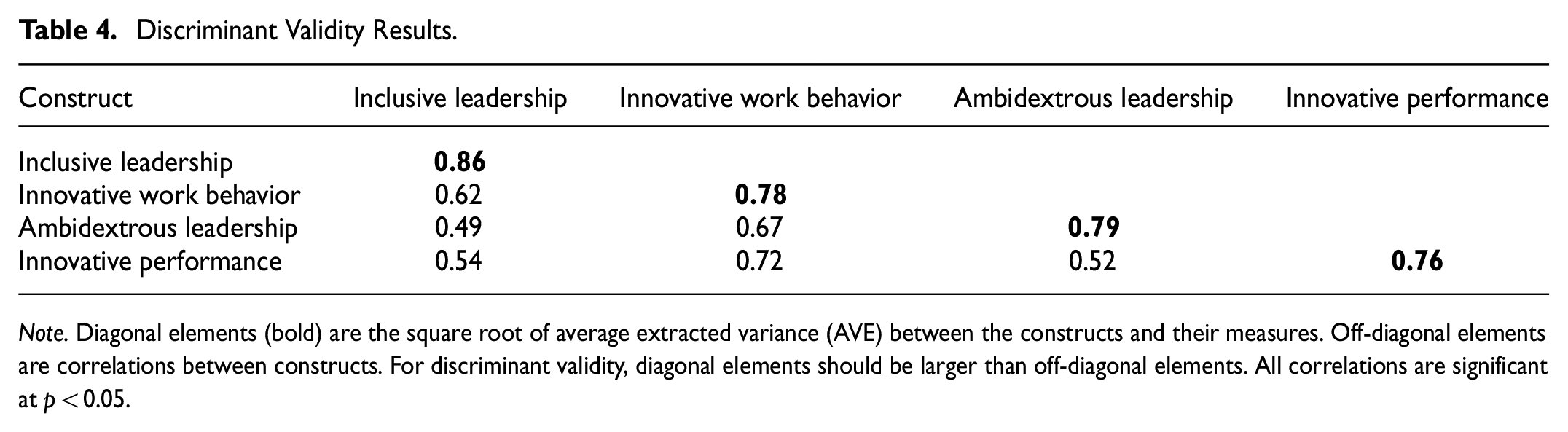
Note. Diagonal elements (bold) are the square root of average extracted variance (AVE) between the constructs and their measures. Off-diagonal elements are correlations between constructs. For discriminant validity, diagonal elements should be larger than off-diagonal elements. All correlations are significant at p < 0.05.
Structural Model Assessment
After assessing the measurement model, the structural model was evaluated to test the hypotheses. As shown in Table 5, there was a significant and positive relationship between inclusive leadership and innovative work behavior (β = .256, p = .001) as well as between ambidextrous leadership and innovative work behavior (β = .378, p = .001). Hence, Hypothesis 1 and 2 were supported. Furthermore, innovative work behavior was found to be positively related to innovative performance (β = .732, p = 0.001), thereby supporting Hypothesis 3.
Hypothesis Testing Results.

Note. SE = standard error; CR = critical ratio.
***p < .001.
Mediation Assessment
Before testing mediation effects, it is necessary to first ensure that the direct effect of the independent variable on the dependent variable is significant (Awang, 2013). Once the significance of the direct effect is confirmed, the mediator is included in the model. If the significant direct effect is reduced but still significant upon inclusion of the mediator, partial mediation is considered to have occurred. However, if the direct effect is no longer significant, full mediation has occurred (Awang, 2013). As shown in Table 6, the effects of inclusive leadership (β = .305, p = .001) and ambidextrous leadership (β = .326, p = .001) on innovative performance were both significant. This satisfied the first criterion for mediation and warranted testing the mediating effect.
Direct Effects.

Note. SE = standard error; CR = critical ratio.
***p < .001.
In accordance with the suggestions given by Awang (2013), the mediation tests for Hypothesis 4 and 5 were carried out through a statistical technique called Maximum Likelihood Estimator bootstrapping analysis. This analysis involved using 1,000 bootstrap samples and setting a confidence interval of 95%. In addition, a 95% bias-corrected confidence interval was also used during the mediation tests. By employing these methods, the results obtained from the mediation tests were expected to be reliable and accurate. The bootstrapping technique is known to provide more accurate and robust results than traditional mediation methods, as it helps to address issues related to non-normality and nonlinearity in the data. It is a powerful statistical tool that can estimate the indirect effects of the mediators on the outcome variable by generating a large number of samples from the original data and using them to calculate the standard errors and confidence intervals of the indirect effects.
The findings of the study, as demonstrated in Table 7, have revealed that the indirect effect of inclusive leadership on innovative performance, which was measured through innovative work behavior, was not significant (β = .111, p > .05). The statistical analysis indicates that the observed effect size is not large enough to be considered significant at a 95% confidence level. As a result, it can be inferred that the association between inclusive leadership and innovative performance is entirely explained by the mediating role of innovative work behavior. These findings align with the research hypothesis proposed, which postulated that innovative work behavior mediates the relationship between inclusive leadership and innovative performance. Thus, it can be concluded that the data support Hypothesis 4, suggesting that the relationship between inclusive leadership and innovative performance is fully mediated by innovative work behavior.
Mediation Analysis Results of Innovative Work Behavior Between Inclusive Leadership and Innovative Performance.

Note. Bootstrapping results, n = 300, sample = 1,000. CI = confident interval; IL = inclusive leadership; IWB = innovative work behavior; IP = innovative performance.
***p < .001.
Table 8 presents the results of the mediation analysis for Hypothesis 5. The data revealed that the indirect effect of ambidextrous leadership on innovative performance through innovative work behavior was not statistically significant (β = .048, p > .05). This suggests that the effect of ambidextrous leadership on innovative performance is fully explained by the mediating variable, innovative work behavior. Therefore, it can be concluded that the relationship between ambidextrous leadership and innovative performance is fully mediated by innovative work behavior, confirming Hypothesis 5. These results support the notion that ambidextrous leadership, which involves the ability to balance exploitation and exploration, promotes innovative work behavior, which in turn enhances innovative performance.
Mediation Analysis Results of Innovative Work Behavior Between Ambidextrous Leadership and Innovative Performance.
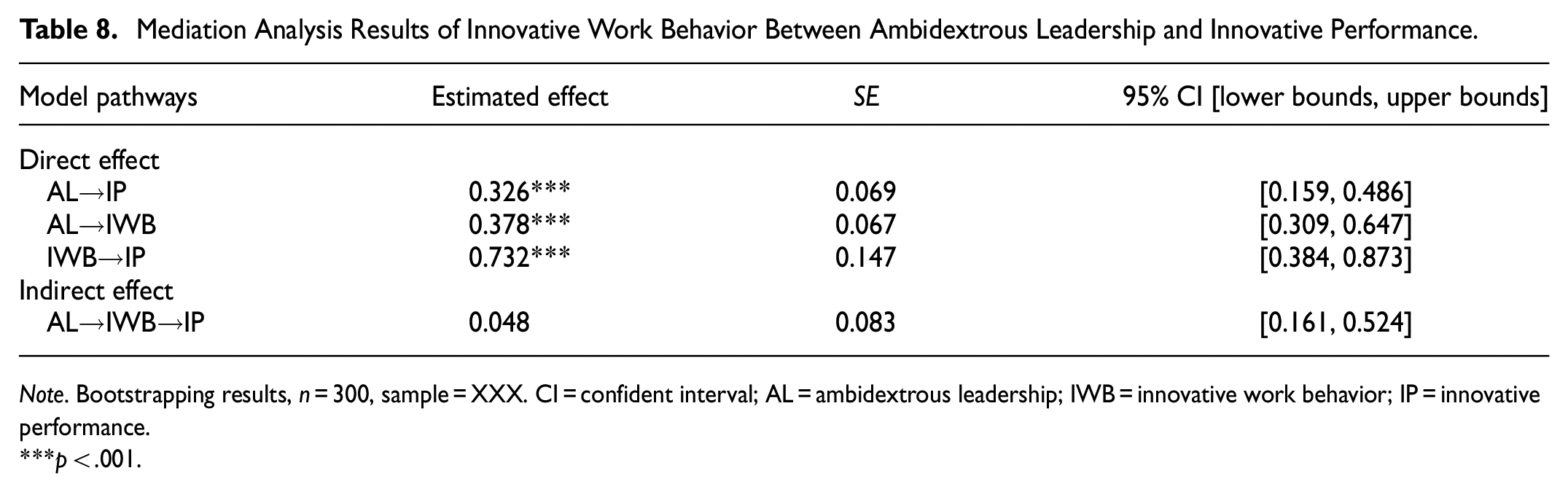
Note. Bootstrapping results, n = 300, sample = XXX. CI = confident interval; AL = ambidextrous leadership; IWB = innovative work behavior; IP = innovative performance.
***p < .001.
The empirical results obtained in this study are further elaborated in the final research model depicted in Figure 1.
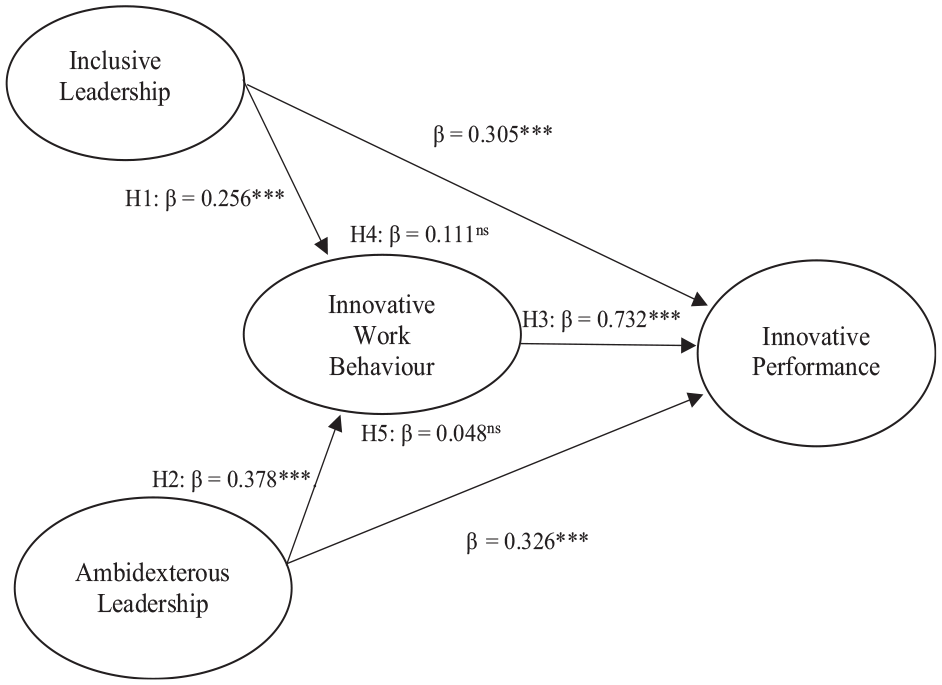
Final model.
Discussion
The purpose of this study was to discover how inclusive and ambidextrous leadership styles influence university academic staff’s innovative performance through the mediating role of innovative work behavior. The results demonstrate that both inclusive and ambidextrous leadership styles have a significant positive impact on staff’s innovative work behavior, which is consistent with prior conceptualized research (Akıncı et al., 2022; Fang et al., 2019; Javed et al., 2019; Liu et al., 2019). This suggests that inclusive leadership behaviors such as openness, accessibility, and availability foster academic staff’s engagement in innovative work behavior (Javed et al., 2019). Furthermore, since innovation is complex and non-linear, staff must challenge the status quo and express new ideas (Sartori et al., 2018). A coordinated and complementary leadership approach such as ambidextrous leadership helps academics to address this challenge and enhance their innovative work behavior (Zacher & Rosing, 2015). Moreover, the study’s finding that innovative work behavior has a positive influence on innovative performance confirms the significant conceptual and empirical evidence (Shanker et al., 2017). This outcome emphasizes that academic staff’s innovative work behavior results in the development of ideas and the necessary actions to execute them, ultimately leading to innovative performance (Gkontelos et al., 2022).
Notably, the findings of the study suggest that innovative work behavior fully mediates the relationship between inclusive and ambidextrous leadership styles and innovative performance. This result supports previous conceptual research and highlights that staff behavior is critical for leadership to enhance performance in the context of university innovation (Alghamdi, 2018; Bataineh et al., 2022; Shanker et al., 2017). According to Bataineh et al. (2022), inclusive leadership enhances staffs’ openness to change, enabling them to embrace new ideas and innovative solutions. Therefore, inclusive leadership motivates academic staff to engage in innovative work behavior, which contributes to universities’ innovation outcomes.
On the other hand, ambidextrous leadership encourages subordinates to seek change, approach tasks differently, and try new things, which gives them the opportunity for independent thinking and action through exploration. Additionally, ambidextrous superiors take corrective action, provide precise instructions, and monitor goal attainment to reduce staff’s behavioral variance and increase their exploitation behaviors (Rosing et al., 2011). Together, the exploration and exploitation behaviors of academic staff lead to their innovative work behavior (Caniëls & Veld, 2019) and subsequent innovative performance. In this manner, ambidextrous leadership reinforces innovative behavior in the work of academic staff, promoting their innovative performance in universities (Alghamdi, 2018).
The plausible explanation for these findings is that the majority of the respondents are young and energetic university academic staff aged between 31 and 50 years old, with 1 to 10 years of experience. Young and experienced staff are often viewed as active and energetic in the academic sphere (Abbas, 2020). In recent years, particularly in Malaysia, university academic staff have been widely encouraged to improve their academic contributions (Saleem et al., 2023). This situation necessitates that they take more initiative when it comes to academic publications, such as books, journals, and articles, which requires a great deal of innovativeness from those involved. Ultimately, good superiors who exhibit ambidextrous and inclusive leadership possess the capability to inspire their subordinates toward new ideas and innovations. These strong innovative working behaviors among academic staff will eventually spread among peers in the workplace, thus stimulating innovative performance.
Theoretical Implications
The implication of the study is that universities can better understand and promote innovative work behavior and performance among academic staff by integrating four established theories: organizational support theory, social exchange theory, social learning theory, and ambidextrous leadership theory.
Organizational support theory and social exchange theory were used to understand the relationship between inclusive leadership and innovative work behavior. The study found that inclusive leadership can create a culture of inclusivity, leading to increased independence, self-determination, participation in decision-making and work processes, which, in turn, stimulates optimism and effort to execute innovative tasks.
Bandura’s social learning theory highlighted the importance of role models and observational learning processes in shaping staffs’ expected behaviors in their job. The study found that having ambidextrous superiors as role models who actively engage in both exploratory and exploitative behaviors can positively impact academic staff’s attitudes toward innovation and encourage them to adopt innovative work behaviors.
Organizational support theory suggests that providing staffs with necessary resources can enhance innovative performance. Access to tools, information, and resources improves innovative ideas, leading to better organizational performance. This study found that fostering innovative work behavior in academic staff’s professional development enhances innovative performance.
The study also found that superiors who exhibit inclusive leadership and provide relevant resources to their subordinates can enhance innovative work behavior and performance among subordinates, as per the social exchange theory. Finally, the ambidextrous leadership theory proposes that superiors display and expect both exploratory and exploitative behaviors from their staff to increase academic staff’s innovative performance through innovative work behavior.
Practical Implications
The practical implications of this research are significant for universities and academics. This study finds that inclusive leadership plays a crucial role in creating an open communication platform that supports innovation. By sharing critical knowledge, inclusive superiors help staff generate, validate, and implement valuable ideas that lead to innovative work behavior. These superiors also support different viewpoints and promote intellectual stimulation, thereby creating an environment that strengthens innovation opportunities. Staff can then approach problematic areas with novel and innovative approaches, leading to improved individual and university performance. Creating an inclusive culture that offers high levels of support is therefore essential for fostering innovative work behavior among academic staff (Shanker et al., 2017). Therefore, superiors should focus on encouraging, recognizing, respecting, including, and treating staff fairly. By doing so, superiors can foster the innovative potential and professionalism of academic staff. Leadership training programs in universities should also equip superiors with the skills and understanding necessary to create inclusiveness, openness, and support for their academic subordinates.
To cultivate innovative work behavior and enhance performance among academic staff, one approach is to apply ambidextrous leadership practices. According to Akıncı et al. (2022), university superiors can support their staff in breaking routines and thinking creatively by implementing structured guidelines, intervening when necessary, and establishing schedules. Superiors should also create an environment that welcomes experimentation, allows for errors, and encourages novel viewpoints. To effectively promote ambidextrous leadership in universities, leadership training programs should incorporate these behaviors, focusing on both exploration and exploitation. Ambidextrous superiors can leverage the high exploitative behavior of their staff and vice versa, creating a mutually beneficial relationship. Therefore, universities should consider adopting recruitment and professional development strategies that emphasize ambidextrous leadership practices and promote innovative work behavior and performance among their academic staff.
Finally, given the importance of academic staff’s innovative work behavior as a determinant and mediator of innovation performance in universities, it is essential to promote staff innovation within these institutions. For example, academic staff should be given access to educational programs, knowledge development platforms, and problem-solving training that cultivate their innovative behaviors. Academic staff should also be awarded freedom and autonomy to foster the belief that they are capable of making innovative improvements to their work, leading to innovative performance (Shanker et al., 2017).
Limitations and Future Research Directions
The limitations of this study must be taken into account when interpreting the findings. Firstly, the study data was cross-sectional in nature, which means that it was collected at a single point in time. As a result, the study cannot establish causal relationships or detect developmental changes over time. Therefore, future research should consider using longitudinal data to establish causality and detect changes in leadership styles and innovation outcomes over time.
Secondly, the study sample was limited to university academics from public institutions, which may limit the generalizability of the findings to other institutional settings or populations. Private institutions, for instance, may have different contextual factors that affect the associations between leadership styles and innovation outcomes. Therefore, future studies should consider incorporating various institutional types and settings to examine the relationship between inclusive and ambidextrous leadership and innovative work behavior and performance.
Thirdly, this study focused on the individual level of analysis and did not examine the impact of leadership styles and innovation outcomes at the team or organizational level. Future research could discover the relationship between leadership styles and innovation outcomes at these higher levels of analysis to gain a better understanding of how these constructs operate in group contexts. For example, a future study could examine the extent to which leadership style diversity within teams influences innovation outcomes. Moreover, the study of leadership styles and innovation outcomes at the organizational level could shed light on how leadership can facilitate innovation across different units or departments within public institutions of higher education. Therefore, future research could benefit from exploring the impact of leadership styles on innovation outcomes at multiple levels of analysis to gain a more comprehensive understanding of this relationship.
Furthermore, it is also possible that other factors not measured in this study, such as individual differences in personality or organizational culture, may also play a role in influencing the relationship between leadership styles and innovation outcomes. Therefore, future research should consider incorporating these factors in the analysis to gain a more comprehensive understanding of the relationship between leadership and innovation in public institutions of higher education.
Conclusion
In conclusion, this study underscores the critical role of inclusive and ambidextrous leadership styles in promoting innovative work behavior and enhancing innovative performance among academic staff in public universities. The results suggest that these leadership styles have a positive impact on innovative work behavior, thus mediating the relationship between leadership styles and academic staff’s performance in innovation-related outcomes.
The study’s findings offer important insights into how public universities can enhance their academic staff’s innovative performance through effective leadership and work behavior strategies. The mediating effect of innovative work behavior on the relationship between leadership styles and academic staff’s innovative performance underscores the importance of academic superiors in creating an innovative culture among their staff.
Overall, this study adds to the existing literature on leadership and innovation in public universities by highlighting the significance of inclusive and ambidextrous leadership styles in enhancing academic staff’s work behavior and performance. The practical implications suggest that academic superiors should adopt innovative strategies to promote an innovative culture and improve their staff’s performance in innovation-related outcomes.
Footnotes
Declaration of Conflicting Interests
The author(s) declared no potential conflicts of interest with respect to the research, authorship, and/or publication of this article.
Funding

Data Availability Statement
The dataset generated during and/or analyzed during the current study is not publicly available due to data privacy and confidentiality but is available from the corresponding author on reasonable request.