




Abstract
In order to build consistent service quality, managers should encourage salespeople to deal with customers and improve service errors for their overall benefit. Our study seeks to understand the role of ambidextrous leadership in promoting service innovation capability and service recovery performance (SRP) under a business-to-business (B2B) selling environment. The study evaluates 286 responses from pharmaceutical salespeople by using structural equation modeling. The results report a significant association between opening leader behavior and service recovery performance, whereas closing leader behavior is not significantly related to service recovery performance. In addition, opening and closing leader behaviors have a positive and significant impact on service innovation capability. Consequently, service innovation capability is positively and significantly related to value-based selling, adaptive selling, and service recovery performance. Finally, our results contribute to the previous research that has explored the significant mediation effect of service innovation capability between opening leader behavior and service recovery performance linkage.
Keywords
Introduction
Salespeople’s service performance is an integral component of business-to-business organizations’ competitive achievements, as it allows differentiation of one organization over its competitors. Salespeople are also obliged to have SRP in charge of delivering quality services, overcoming a service failure to compensate a customer, and meeting customer needs (Babakus et al., 2003; Guchait et al., 2014). In the previous services literature, customer handling has been described as a strategic concern (Ali et al., 2021; Irfan, Elavarasan, et al., 2021). The definition includes “actions taken by a service provider to make adjustment in service failures” (Ashill et al., 2004; Bitner, 1990). Because well-organized customer handling is critical for the sustainability of a service organization, previous literature has explored factors that can strengthen the SRP.
Prior literature has unexplored the relation between ambidextrous leadership and SRP in the B2B selling context. The significance of this relationship could be explained by the fact that this leadership style consists of two conflicting behaviors that describe the ambidexterity of leaders, including opening and closing leader behavior (Zacher & Rosing, 2015). Because of its conflicting nature, leader closing behavior is recommended to predict salespeople’s control attitudes, which is the opposite of the leader opening behavior. Therefore, in the case of service recovery, sometimes salespeople are restricted from consuming their potential skills and unable to manage service recovery encounters that lead to customer disappointments and reduce overall performance.
Ambidextrous leadership is a leadership style in which the manager encourages salespeople through the innovation process, responds intelligently, and keeps moving smoothly in facilitating the innovation implementations (Rosing et al., 2011). In previous research, the linkage between ambidextrous leadership and team innovation was analyzed by Zacher and Rosing (2015). However, as per our clear understanding, ambidextrous leadership’s direct or indirect effect on SRP through service innovation capability in the B2B selling context is still missing in the prior literature. Further, the salesperson innovation process begins with assessing problems and the foundation of solutions or alternatives. Previous findings have discussed the significance of innovation processes in facilitating and enhancing service quality and performance (Cheng & Krumwiede, 2012), and salespersons’ selling strategies play a serious part in the execution of the innovation process. Therefore, the present research also examined the impact of service innovation capability on both value-based selling and adaptive selling strategies, which can contribute to the progress of SRP.
The existing study provides many valuable contributions to the body of literature. Firstly, our study gives a fresh perspective on the dynamic practices transforming ambidextrous leadership into SRP. Prior literature discusses ambidextrous leadership as a predictor of service-related outcomes in various domains (Luu et al., 2019; Qammar & Abidin, 2020). However, literature has failed to explore the influence of ambidextrous leadership behavior on SRP in the B2B selling context so far. Consequently, we attempt to discuss this crucial gap in this study. Secondly, the research significantly contributes to the conservation of resources (COR) theory by defining the role of ambidextrous leadership in supporting service innovation capability and SRP. In parallel with the COR perspective, employees are extremely desired to retain new resources and secure loss of resources (Halbesleben et al., 2014). These significant resource gains through innovation capability can enhance salespeople’s productivity in improving SRP. Thirdly, the mediation process of service innovation capability among the linkage of ambidextrous leadership and SRP can help to address why previous research has not identified a valid indirect impact of ambidextrous leadership on SRP. Finally, we contribute to the B2B sales literature by defining the significant effect of value-based selling and adaptive selling strategies on SRP, which former scholars have ignored. The present research differentiates itself by extending prior work while introducing this concept in the B2B environment.
In this study, we aim to identify how ambidextrous leadership (e.g., opening and closing leader behaviors) influence salespeople’s service innovation capability. It is also necessary to measure three effects: (i) To what degree service innovation capability leads to value-based selling and adaptive selling? (ii) To what extent do specific selling strategies by salespeople influence SRP in the B2B context? (iii) To what extent do service innovation capabilities mediate among the relationship of ambidextrous leadership and SRP?
The remaining paper is divided into five sections. The next section addresses the “theoretical background and research hypotheses,” which includes conservation of resources theory. The research design is covered in the section “research methods.” The validation of hypotheses is described in the section “data analysis and findings.” The “discussion” section describes the study’s findings and contributions. Furthermore, the last section highlights research limitations and future research directions, followed by the conclusion.
Theoretical Background
The Conservation of Resource (COR) Theory
Researchers have proposed different theories in different contexts (Irfan & Ahmad, 2022; Irfan, Hao, et al., 2021; Irfan et al., 2020; Jinru et al., 2021); however, the conservation of resources (COR) theory has been given extensive consideration in the recent marketing literature (Anser et al., 2020; Luu, 2020). In accordance with COR theory (Hobfoll et al., 2018, p. 101), “individuals possess, retain, conserve, invest, and adopt essential resources such as social protection, commodities, circumstances, psychological strength, and personal characteristics that assist them in dealing with stressful events and challenges.” In our research context, the COR theory (Hobfoll, 1989) is fully aligned with the latest research on ambidextrous leadership (e.g., Luu et al., 2019) to put more emphasis on how ambidextrous leadership can affect salespeople in terms of service innovation capabilities and SRP. In circumstances where managers have a significant amount of ambidextrous leadership, salespeople are likely to perceive available managerial resources through this leadership, making salespeople more confident and optimistic about their jobs and participating in service-related performance outcomes.
Furthermore, salespeople who lost resources may become so exhausted that they are unable to strengthen their innovation capabilities. As applied to the concept of the innovation dilemma and ambidextrous leadership, we propose that in seeking the conflicting needs of innovation, individual leaders would face increased role conflict and, as a result of this conflict, a loss of resources. The challenging task of merging ambidextrous activities for innovation and the conflicting behavior can cause leaders stress and frustration (Panagopoulos et al., 2019). Based on COR theory (Kiazad et al., 2014), we believe that salespeople with higher innovation capabilities are more concerned with efficiently solving their customers’ problems. This results in more adaptive and values-based selling behaviors because of investing more resources into the learning process. While applying a resource-based approach, our results can frame ambidextrous leadership as a distinct leadership style for a salesperson’s service-related performance, which is a well-studied leadership technique in the field of service (Luu et al., 2019; Yu et al., 2013).
Ambidextrous Leadership
Several studies have shown that ambidexterity in companies is inevitable (He & Wong, 2004; Mueller et al., 2020). As a matter of fact, what is typically intended to be further evident at the firm or group level shows itself as individual ambidexterity (Zacher & Rosing, 2015), particularly for leaders. This resulted in a new style of leadership, which is known as ambidextrous leadership (Rosing et al., 2011). As per the literature, B2B marketing emphases on maintaining customer relations (Keränen & Jalkala, 2013). However, ambidextrous leadership is essential in strengthening salespeople’s abilities to simultaneously execute explorative (customer service) and exploitative (selling orientation) activities to develop B2B relationships. This concept has been utilized to investigate the benefits that firms achieve by combining exploitation and exploration simultaneously in B2B marketing (Giovannetti et al., 2020; O’Cass et al., 2014). In the competitive era, ambidextrous salespeople must be multi-talented and provide selling orientation and service provision simultaneously to succeed.
Furthermore, opening and closing leader behavior are the two contradictory behaviors that define leader ambidexterity (Rosing et al., 2011; Zacher & Rosing, 2015). Opening leader behavior enhances follower variation, such as fostering innovation and efforts to change existing approaches or creating resources for independent thinking. Whereas, closing leader behavior seeks to reduce follower variation by controlling the progress of goals, taking disciplinary steps, or setting strict guidelines (Alghamdi, 2018). Ambidextrous leadership could be an alternate resource because managers inspire and support salespeople to properly develop new learning resources through the opening and closing behaviors and encourage them to use established resources efficiently to satisfy customers (Bouwmans et al., 2019). They deliver salespeople with customer-oriented motivation and provide them with available resources such as useful information and expertise to build quality service.
Opening Leader Behavior, Closing Leader Behavior, and Service Recovery Performance
Customer recovery is an essential service sector component; since a service failure is an unavoidable truth, frontline service staff must ensure customer involvement and loyalty after a service disappointment. SRP relates directly to the perceptions of service employees’ competencies and behaviors to find and resolve service failure, which leads to customer satisfaction (B. Ahmad & Akbar, 2021; Van Vaerenbergh & Orsingher, 2016). Empirical studies repeatedly suggest that frontline sales employees should change their actions to handle accurately and resolve consumer complaints (Spreng et al., 1995). Under opening leadership, salespeople always seem to be motivated and encouraged by their existing relationships to attain more customer information and service expertise. Such competencies empower frontline salespeople to handle their recovery encounters effectively and strengthen their relationships with customers. Rosing et al. (2011) opined that opening leader behavior allows salespeople to “search beyond the safe ground for solutions” and support them to conserve and gain resources. These behaviors could provide a healthy environment in which strategic thinking and planning independently are encouraged when salespeople are expected to deal with customer complaints or service recovery encounters (Hao et al., 2021).
Additionally, despite a significant body of literature addressing the upside possibilities of multifaceted incidents in B2B relationship (Edvardsson, 1988), the interactions between leadership styles and SRP in B2B selling environment is still under-investigated, particularly in comparing with the studies focused on leadership styles and service recovery in consumer markets (Hübner et al., 2018). The present investigation aims to resolve this gap to further expand the study on B2B service recovery. Hence, in light of the preceding argument, we proposed this hypothesis.
In contrast, managers utilize closing leadership behaviors as they attempt to reduce the variation in the behaviors of followers. This involves implementing corrective methods to reduce unacceptable risk-taking, establishing specific structured guidelines to be followed, and actively controlling their followers’ success (Alghamdi, 2018). Leader closing behaviors are theorized as predictors of follower control behaviors (e.g., participating in uninteresting or regular tasks, trying to adapt existing job skills to the given task), thus reducing variation in follower performance (Zacher & Rosing, 2015). Allowing salespeople to make self-made decisions make them stronger and happier toward their jobs (Bowen & Lawler, 1992). More independence, such as the freedom to work without obstruction and the right to support customers, would benefit SRP and enable them to review other organizational concerns (Yavas et al., 2003). However, freedom is vital; the power to deal with service-related issues is very little given to salespeople with tight restrictions by the leaders/managers on the functions and regulations of decision-making (Bowen & Lawler, 1992). In this situation, salespeople are restricted to utilize their potential skills and unable to handle service recovery encounters, which leads to customer dissatisfaction. Thus, in light of the preceding argument, we suggest this hypothesis.
Opening Leader Behavior, Closing Leader Behavior, and Service Innovation Capability
Ambidextrous leadership has already been described for the development of innovative actions. It has benefits over conventional leadership theories in terms of innovation improvement (Rosing et al., 2011). In parallel with this, we hypothesize that opening leader behavior seems to positively impact salesperson service innovation capability as it involves creativity parameters (Zacher & Rosing, 2015). Empowering salespeople to do their tasks independently and engaging with innovative strategies improves the diverse thinking of sales employees, which allows them to effectively deal with the challenges of innovation throughout the innovation process (Gilhooly et al., 2007; Miron-Spektor & Erez, 2017). In addition, integrating and redesigning current knowledge will boost the generation of ideas; this is often promoted by opening leader behavior. The behavior of the opening leader further inspires salespeople to take a risk and encourages them to challenge the current methods (Rosing et al., 2011). This creates a socially reasonable atmosphere in which salespeople can discuss criteria for innovation without fear of adverse implications (Baer & Frese, 2003; Hunter et al., 2007). We, therefore, suggest the following hypothesis.
It is the implementation of strategies and guidelines, the verification that appropriate steps have been pursued, and the quality resources that are taken into consideration (Razzaq et al., 2021). This formulates the practice and encourages salespeople to pay attention to the accuracy of the results. Managers use closing leadership behavior with the aim to minimize the variance of salesperson’s behaviors. Furthermore, we theorize that closing leader behavior is positively connected to salesperson service innovation capability because it describes the innovation process deployment criteria (Rosing et al., 2011). In addition, closing leader behavior requires concentration on effectiveness that closely aligns with error prevention and also relies on execution guidelines. This is facilitated by closing leader behavior as the leader applies disciplinary actions to adopt innovation and ensures consistency with specific criteria (Miron et al., 2004; Rosing et al., 2011). To succeed in innovation capability, salespeople need to be able to function in a challenging environment (Gerlach et al., 2020). Hence, our hypothesis is as follows:
Service Innovation Capability and Value-Based Selling Strategy
Value-based selling is known as “the extent to which the salesperson works with the customer to create a value proposition in such a way that advantages are converted into financial profits for customers” (Terho et al., 2012). Möller and Törrönen (2003) found that the possible positioning of customer value co-creation involves functionalities related to advanced interpersonal flexibility and innovative skills that the salespeople follow. Quality positioning is particularly important for value-based selling because VBS also depends on continuing relationship value, which is unpredictable, risky, and can require new and dynamic adjustments in tasks. There are cases under which the value creation technique by salespeople is more innovative, progressive, and unique than the existing customer perceived strategy. Maria Stock et al. (2017) stated that achieving customer value does not only enhances customer engagement but also motivates frontline salespeople to indulge in innovative behaviors (Maria Stock et al., 2017).
Numerous studies propose that organizations typically invest more resources in their salespeople to be innovative at work (Ahearne et al., 2010; Chen et al., 2015). So, to support their customers for value co-creation, they can often provide more innovative solutions. In this context, the innovation capabilities of salespeople may serve as the source of resources to design value-based selling strategies more effectively. Thus, focusing on the COR theory (Hobfoll, 1989) with the concept of resources loss, individuals are strongly inspired to gain new resources to secure the loss of resources (Halbesleben et al., 2014; Razzaq et al., 2021). In the selling environment, the substantial resource gain through innovation could improve the effectiveness of salespeople to produce customer perceived values, and therefore we suggest this hypothesis.
Service Innovation Capability and Adaptive Selling Strategy
As the B2B environment becomes highly challenging, sales organizations must invest in salespeople’s innovative capabilities to generate profit (Lin et al., 2020), particularly in the pharmaceutical sector. Salespeople are motivated to participate in innovative problem-solving activities as a result of the dynamic environment (Sundbo et al., 2015). Salespeople can look for information effectively and promptly if it is easily accessible. Doctors and pharmacists interact with a number of salespersons from various pharmaceutical companies. As a result, salespeople must be capable of providing innovative solutions to doctors and pharmacists in a responsible way. Physicians and pharmacists will be more satisfied if they have access to innovative knowledge that salespeople quickly provide. Indeed, it is widely acknowledged that innovative firms have significant market advantages over their competitors (Maria Stock et al., 2017).
Adaptive selling strategy refers to “the adjustments in selling behaviors during customer interactions or across customer communications based on subjective information regarding the nature of the selling situation” (Weitz et al., 1986). Adaptive selling strategy reflects the willingness of salespeople to change their sales strategies and sales interactions to be synchronized with different customers (Spiro & Weitz, 1990). According to Wang and Netemeyer (2004), adaptive selling could be seen as a process of innovation because it requires selecting the best sales presentation approach from individuals’ current knowledge based on particular sales situations. If adaptive selling is crucial to sales progress, innovation capabilities could be even more so in a competitive environment. Acknowledging its significance, scholars also describe innovation as a core aspect of excellent salespeople and sales managers (Lassk & Shepherd, 2013). Additionally, previous research has established a positive relationship between salesperson innovativeness and his or her practice of adaptive selling behavior (Aghazadeh & Zandi, 2021). As such, our research question lies in how ambidextrous leadership enforces innovative salesperson capabilities that enable adaptive selling in the B2B selling environment. Therefore, in light of this argument, we posit the following hypothesis.
Value-Based Selling Strategy and Service Recovery Performance
In today’s competitive marketplace, highly demanding customers expect their organizations to provide the quickest value-based services at a lower price (Slater, 1997). Value-based selling is strongly associated with value co-creation theory, which demonstrates the significance of customer and salesperson collaboration for successful value co-creation (Terho et al., 2015). Value-based salespeople focus on strategically developing and executing customer solutions that possess a strong possibility for delivering value to the end customers through cost savings and performance improvements (Keränen & Jalkala, 2013; Moorman et al., 2019).
In terms of service recovery, value co-creation in the selling context benefits both customers and salespeople (Roggeveen et al., 2012). Throughout the value co-creation process for a successful recovery, the connection between the two parties is transformed into a mutual collaboration with the purpose of bringing the recovery together to achieve greater value for the consumers (Roggeveen et al., 2012). These aspects have been defined as important parts of effective salesperson behavior in business marketing and sales literature (B. Ahmad et al., 2021; Rutherford et al., 2011). We postulate a positive link between value-based selling and SRP. Value-based salespeople emphasize effectively resolving customer complaints and promoting customer offerings that have a strong possibility of bringing value to the customer’s end through cost reductions and/or performance improvements (Terho et al., 2012; Tuan & Thao, 2017). When a successful service recovery offers a customer a significant value opportunity, the consumer will strongly be motivated to purchase the high-value product, even if it comes at a high price (Slater, 1997). Consequently, based on the above-mentioned argument, we suggest that a value-based selling strategy predominantly contributes to SRP and suggest the following hypothesis.
Service Innovation Capability and Service Recovery Performance
In the individual context, innovation and creativity are often used synonymously (Scott & Bruce, 1994). Innovative behavior has been described as an effort of employees to implement new methods, new products, new opportunities, or configurations of these into the organization (Amo & Kolveried, 2005). The recognition of complexities and the development of ideas or remedies start with human creativity. Recent studies have addressed the value of innovative processes in fostering and improving service consistency and service performance (Cheng & Krumwiede, 2012). For example, service providers should organize the service process carefully to minimize the chance of service disaster.
The method of complaints handling is very critical once a service breakdown has occurred. Frontline salespeople in pharmaceutical companies contact directly with B2B customers (e.g., physicians or pharmaceutical distributors) and perform a variety of selling activities (Luu, 2020), including receiving orders and delivering related services to fulfill such demands. When dealing with difficult situations such as customer criticism, they are also effective in customer relations, such as service recovery. They can deal with service failures in terms of pharmaceutical order description, quantities, and distribution. Salespeople could recover such breakdowns for their B2B customers, such as institutions or pharmaceutical dealers, by leasing inventory from other pharmaceutical companies to fulfill the order and providing extra amounts if prices go up. Before implementing an innovation process, the salespeople have to evaluate the potential risks from the customers’ perspective and develop appropriate assistance to minimize those risks and thereby increase customer acceptance (Lee, 2012). The innovation capability by the salespeople may influence customers’ responses to service recovery. Specifically, consumers will also be less satisfied with service recovery encounters with more negative innovation capabilities aimed at sustainable failures. Salespeople could develop service recovery or cost reduction programs to reduce market uncertainty, leading to consumer acceptance for service innovation. Previous literature shows that frontline salespeople may offer a valuable contribution when engaging with customers throughout the service experiences (Bitner, 1990; Karlsson & Skålén, 2015). Thus, they could play a decisive role in service innovation. As a result, we offer the below hypothesis.
Adaptive Selling Strategy and Service Recovery Performance
A salesperson’s behavior is adjusted in response to their perceptions of facts concerning a situation’s complexity during a service encounter (Spiro & Weitz, 1990). In prior research, adaptive selling behaviors have been shown to enable salespeople to maximize sales and service performance (Akbar et al., 2020; Limbu et al., 2016). A range of adaptive selling behaviors are demonstrated by salespeople when they use multiple selling approaches during customer encounters. As a result of scientific research, they change sales techniques (Spiro & Weitz, 1990). To be productive, salespeople should be able to operate adaptively and have confidence in their ability to do otherwise. The adaptive salesperson evaluates the circumstances and, therefore, can customize a presentation to the customer’s specific demands in both attitude and behavior.
A number of studies have indicated that adaptive selling enables salespeople to provide customers with the best level of customer service and develop their personal understanding of growth and performance (Jaramillo et al., 2007; Román & Iacobucci, 2010). Therefore, flexible and adaptive sales representatives are needed to enable quick recovery from failures in customer service. In fact, an adaptive selling approach is necessary in order to recover services (Wong et al., 2015). A salesperson who is adaptive, adopts novel ideas, and enthusiastically engages in discussions and feedback from customers (Franke & Park, 2006; Spiro &Weitz, 1990). Many researchers have documented the adaptive behavior of salespeople in the selling environment (Spiro & Weitz, 1990). As a consequence, there is great significance to the behavioral adaptability of the salesperson in the context of a relational encounter among salespeople and customers (Bitner, 1990). However, the above discussion allows us to propose this hypothesis.
The Mediating Role of Service Innovation Capability
While we anticipate a favorable connection between ambidextrous leadership and salespersons’ service innovation capabilities, we also predict negative outcomes as the leader switches between opening leader behavior and closing leader behavior. Particularly, due to the complexities of ambidextrous leadership, we expect these behaviors to have unexpected indirect consequences on SRP.
According to the COR theory, “individuals have the specific motive to maintain, protect and create resources that they value” (Hobfoll, 2001). The leader is an absolute resource for salespeople in the workplace, someone to whom they pay a great deal of attention (Boekhorst, 2015). The interaction they have with their manager is the reason for an employee’s psychological connection with their company (Hon et al., 2013). By focusing on the understanding of ambidexterity role in the innovation process, Rosing et al. (2011) recommend ambidextrous leadership theory, indicating that to enhance salespersons’ innovativeness, managers need to display and efficiently movement between opening and closing leader behavior, aiming toward rising and declining variation on salespersons’ behaviors.
In addition, previous findings have discussed the importance of innovative processes in facilitating and enhancing the quality and consistency of service (Cheng & Krumwiede, 2012). For instance, service providers should properly plan customer services to resolve the uncertainty of service failure. Specifically, customers would often be less satisfied with service recovery with more adverse innovation capabilities adapted for operational failures. As we mentioned above, opening and closing leader behavior is linked with salesperson service innovation capability, and service innovation capability has a connection with SRP (see Figure 1). Therefore, the following paths suggest mediation, and we suggest the following hypotheses.

Conceptual model.
Methods
Sampling and Data Collection
The research sample was taken from large pharmaceutical companies based in Pakistan (see Appendix A). Our study focuses on the pharmaceutical industry since different pharmaceutical businesses have switched to service-oriented marketing strategies. Whereas the number of salespeople is undefined and making a random selection is difficult, we employed convenience sampling. The B2B sales organization was chosen for this study to evaluate salesperson service behaviors. The chosen sales organizations had a classified hierarchy, and the current study’s goal was to target such firms where salespersons reported to their sales supervisors.
Initially, we requested approval and assistance from the human resource department of each pharmaceutical company for data collection. Forty-six pharmaceutical firms were showed their willingness to engage in our survey. We distributed our survey questionnaires to salespeople with the consent of their respective sales department heads. We administered 20 thoroughly qualitative interviews with frontline salespeople before collecting the data to ensure the authenticity of the survey material. The information was gathered over 4 months, from January to March 2021. We sent an online survey link to 456 frontline salespeople. We received 305 responses at the end; however, we removed 19 responses due to inadequate and unengaged answers. The final sample of 286 (62.71%) salespeople was used for analysis purposes. Out of 286 accepted respondents, 264 (92.3%) were male, and 22 (7.7%) were female. The standard age of the respondents was 30.4 years, and the average sales experience that they had was 8.2 years.
Measures
We designed a survey instrument based on previous studies and adapted it to the current situation (B. Ahmad et al., 2022; M. Ahmad et al., 2020; Irfan, Akhtar, et al., 2021; Irfan, Salem, et al., 2022; Irfan, Shahid, et al., 2022; Irfan, Zhao, et al., 2021). The survey instrument was divided into three sections: the first contained a research explanation, the second had questions on the constructs in the conceptual model, and the third contained demographics and control variables. The measuring factors have been modified from the prior studies. Furthermore, a marketing professor examined the survey questionnaire’s face and content validity, and suggestions were included with further feedback. A 5-point Likert scale was utilized to evaluate the measurement items including “1 = strongly disagree” to “5 = strongly agree.” For Ambidextrous leadership, we employed 14 items scales measuring two dimensions (opening leader behavior and closing leader behavior) from prior works by Rosing et al. (2011). Here is an example for opening leadership behavior is “My manager allows different ways of accomplishing a task.” Similarly, a sample item for closing leadership behavior is “My manager takes controlling actions.” Service innovation capability was adapted from previous literature by Susanne G. Scott and Bruce (1994), and the assessment was based on six items. Here is an example “While working in the field, I seek new service techniques or methods.” Value-based selling strategy scale was employed from the research of Terho et al. (2015). A 6-item scale was used to assess the responses. Here is an example “I work with my customers to find out what is needed to improve their performance.” Adaptive selling strategy was also adapted from the previous study of Spiro and Weitz (1990) and analyzed on a 5-point scale. Here is an example “I like to experiment with different sales approaches.” SRP is utilized from the studies of Boshoff and Allen (2000) and measured on 5-item scale. A sample item is “I do not mind dealing with complaining customers.”
Results
A partial least square structural equation model was applied to the dataset using software packages SPSS version 25.0 and SmartPLS version 3.2.8. An analysis of the relational dimensions of the study is carried out using the component-focused method (Urbach & Ahlemann, 2010). Researchers chose PLS-SEM because it allows them to evaluate results and model structures accurately. It is also possible to use PLS-SEM in this study due to the limited sample size and the ability to integrate the different measurement scales (Urbach & Ahlemann, 2010; Wold, 2006).
Common Method Bias
Common Method Bias (CMB) may be a concern for influencing the present study’s findings because a cross-sectional survey has been used for this research. Therefore, the study uses three techniques for CBM analysis: Harman’s one-factor test (Harman, 1976), variance inflation factor (Kock, 2015), and unmeasured latent method construct (Podsakoff et al., 2003). According to Harman’s single factor approach, CMV affects the results if an individual factor exceeds 50% of the overall variance. The results show that the individual largest factor accounts for 29.89% to the total, which is lower than the 50% threshold level, suggesting no CMV. Kock (2015) also suggested a technique to assess CMV in SmartPLS 3. This technique detects common method variance if the variance of VIF is greater than 3.3. The findings suggest a value of 3.3 for the factor level VIF (see Table 1), given that the research model is removed from the variance associated with a common method.
Mean, SD, and CR of Measurements Model.

Note. N = 286; CR = composite reliability, SD = standard deviation; VIF = variance inflation factor. Items are measured on 5-point Likert scale, where 1 = strongly disagree and 5 = strongly agree.
Reliability and Validity
A Cronbach’s alpha (α) value above .70 indicates that all constructs are reliable (Tanveer et al., 2021). The Composite Reliability (CR) of all constructs was above .70, ranging from .810 to .911 (Hair et al., 2006). A Heterotrait-Monotrait Ratio (HTMT) was used to test the construct’s discriminant validity. A HTMT value of less than 0.90 is required to achieve discriminant validity using the HTMT method (Gold et al., 2015). The correlation coefficients for all constructs were smaller than .90, which indicates that it is discriminant (see Table 2).
Heterotrait-Monotrait Ratio (HTMT).

Note. N = 286; SD = standard deviation; OLB = open leader behavior; CLB = closing leader behavior; SRP = service recovery performance; SIC = service innovation capability; VBS = value based selling; ASS = adaptive selling strategy.
Model Fitness Indices
First, based on Becker et al. (2012), the SRMR score is 0.077, meeting the recommended criterion of 0.08 (Hu & Bentler, 1998). In addition, the Normalized-Fit Index (NFI) is 0.585 (Bentler, 1990) which is in-between the standard values 0 and 1. Also, the RMS_theta matrix assesses how closely the outer model residuals correlate with the inner model residuals (Lohmöller, 1989). If RMS_theta scores less than .12, the model is deemed to be well fitted, while RMS_theta scores over the cutoff suggest model instability (Henseler et al., 2014). In our study, the RMS-theta value is .10, which is below the suggested cutoff .12 (Irfan & Ahmad, 2021).
Coefficient of Determination (R2)
Based on the analysis, the independent variables account for 73% (R2 = .730) of the SRP. Furthermore, service innovation capability describes 56.7% of the value-based selling strategy (R2 = .567) and 61.5% of adaptive selling strategy (R2 = .615). Thereafter, opening leader behavior and closing leader behavior explain a 75.7% variance of the service innovation capability (R2 = .757).
The Predictive Power of the Model (Q2)
To assess the predictive usefulness of our structural model, we used a blindfolded Stone and Geisser test on SmartPLS. A model is predictive if the Q2 value of all dependent factors in the conceptual model is greater than zero (>0; Hair et al., 2016). As a result, all of the dependent variables in the path model have a Q2 greater than zero (see Table 3).
Blindfolding Statistics for Predictive Relevance (Q2) for the General Model.

Note. N = 286; SSO = sum of the square of observation; SSE = sum of the square of prediction error.
Hypotheses Testing
We evaluated the research hypotheses using structural equation modeling using SmartPLS. To evaluate the relevance of relational hypotheses in our model, we conducted bootstrapping with 5,000 resamples. Table 4 summarizes the experiential results of the study. The outcomes by using partial least square (PLS) reveal that opening leadership behavior has a positive influence on SRP (β = .163, t = 1.350, p = .010), while closing leadership behavior is negatively associated with SRP (β = -.24, t = 0.247, p = .796). Hence, only H1a supports the study. For H2a, we found a positive association among opening leadership behavior and service innovation capability (β = .670, t = 3.366, p = .000), and for H2b, closing leadership behavior has a positive influence on service innovation capability (β = .232, t = 2.809, p = .005), supporting H2a and H2b. In addition, service innovation capability is positively and significantly linked with value-based selling strategy (β = .753, t = 5.125, p = .000), and adaptive selling strategy (β = .784, t = 5.334, p = .000), supporting H3 and H4. Similarly, service innovation capability has a positive relation with SRP (β = .198, t = 2.715, p = .007). Further, we found positive and significant influence of value-based selling strategy (β = .295, t = 2.890, p = .000) and adaptive selling strategy (β = .261, t = 2.601, p = .010) on SRP. Thus, H5 and H7 supported the study. We additionally checked the indirect effect of ambidextrous leadership on SRP through service innovation capability. We only found H8a (opening leader behavior → Innovation capability → SRP) as significant indirect path in our model (β = .132, t = 2.774, p = .006). Hence, H8a supported the study. The results of hypotheses testing along with specific indirect effects are provided in Table 4, while Figure 2 shows the conceptual model with simplified coefficients scores.
Hypotheses Testing and Specific Indirect Effects.
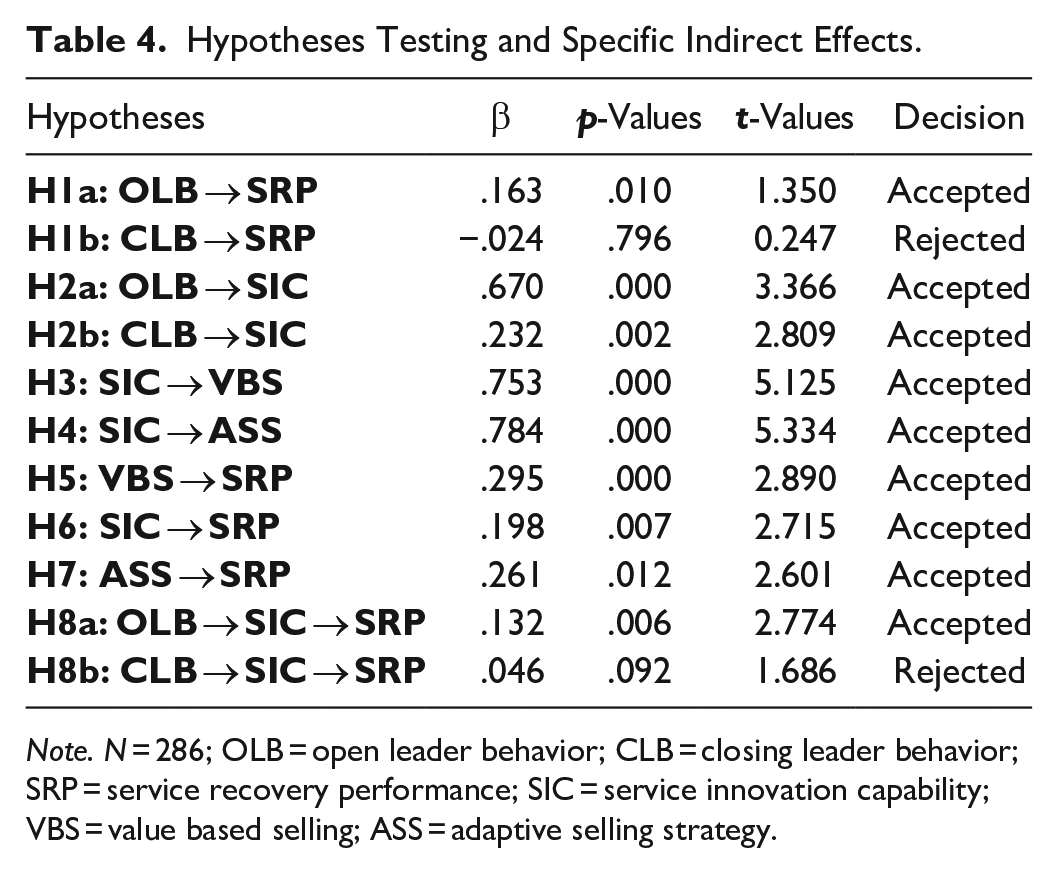
Note. N = 286; OLB = open leader behavior; CLB = closing leader behavior; SRP = service recovery performance; SIC = service innovation capability; VBS = value based selling; ASS = adaptive selling strategy.

Results of hypotheses.
Discussion
The ongoing study investigates the effect of ambidextrous leadership in improving salespersons’ SRP by observing its direct and indirect effects through service innovation capability in the B2B selling context. Our research also suggests that three effects should be measured: (i) How much service innovation capability contributes to value-based selling and adaptive selling? (ii) To what extent do specific selling strategies by salespeople influence SRP in B2B context? (iii) To what extent do service innovation capabilities mediate among the association of ambidextrous leadership and SRP?
The outcomes of this study make a significant scientific contribution to the field of research as the prior literature is still missing to explore the link between ambidextrous leadership and SRP. This study is the first to investigate the role of ambidextrous leadership behavior in the B2B selling context. As we have previously discussed that ambidextrous leadership consists of two behavioral dimensions (i.e., opening leader behavior and closing leader behavior), thus our findings suggest that managers who are engaged in opening leader behavior significantly influence SRP, and these outcomes are aligned with the study of Qammar and Abidin (2020), who found a significant association between opening leader behavior and service-related outcomes. These findings are also in accordance with the COR, which claim that ambidextrous leadership has a significant impact. From the COR perspective, the findings suggest that managers who concentrate on ambidextrous leadership should provide help to encourage their subordinates and explore new potential resources for service recovery encounters (Luu, 2017). On the contrary, the influence of closing leader behavior was inconsistent with previous research findings, which was positively and significantly inter-linked with service-related outcomes (Alghamdi, 2018). The insignificant findings concerning the relationship of closing leader behavior and SRP may be clarified by the fact that closing leader behavior leads to subordinates control behaviors (Zacher & Rosing, 2015), and sometimes the situation where salespeople are restricted or controlled to utilize their potential skills are unable to handle service recovery encounters which leads to customer dissatisfaction. This proves that closing leader behavior may not always guarantee SRP.
The study also found a positive and significant impact of ambidextrous leadership (opening and closing leadership behaviors) on service innovation capability. These findings support the existing literature that has shown a significant impact of opening and closing leadership behaviors on service innovation (Zacher & Rosing, 2015). In other words, leaders who can engage in ambidextrous leadership behaviors must be more effective in inspiring their subordinates to be innovative at work. Previous research indicates that employee innovation was highest when both opening and closing leadership behaviors were high; however individual innovation was lowest when either one of these leadership behaviors was high or when both were low (Zacher & Rosing, 2015). These results suggest that team leaders must engage in both opening and closing behaviors to achieve high levels of work innovation. These outcomes are aligned to the theoretical underpinning of COR theory. According to COR, when managers display a higher level of ambidextrous leadership, salespeople are more likely to perceive available managerial resources through this leadership, making them optimistic about their jobs and encouraging them to participate in innovative and service recovery actions.
In addition, our findings also revealed that service innovation capability has a significant and positive impact on value-based selling and adaptive selling strategy. Consistent with the COR perspective, individuals are strongly enthusiastic about gaining new resources to secure a loss of resources (Halbesleben et al., 2014), and these substantial resource gains through innovation could improve the effectiveness of salespeople to produce adaptive selling behaviors and customer perceived values during salesperson-customer interactions. Therefore, if strategic selling is crucial to sales progress, innovation capabilities could be much more so in a competitive environment. Moreover, the research findings also suggest that service innovation capability is significantly and positively linked with SRP. Prior studies have discussed the importance of innovative processes in supporting and enhancing the quality of services and service recovery (Cheng & Krumwiede, 2012). Therefore, our findings align with previous research. Salespeople might establish successful service recovery or cost-reduction strategies to minimize market uncertainty, resulting in customer acceptance of service innovation. Previous research indicates that frontline salespeople may provide a meaningful contribution when engaging with customers throughout the service interaction (Bitner, 1990; Karlsson & Skålén, 2015), and so they can play a critical role in service innovation.
The empirical findings also contribute, as authors took this initiative to explore the strategic selling behaviors of salespeople within the service recovery domain, which has been ignored in previous literature. The findings agree with the outcomes of Terho et al. (2015) and Singh and Das (2013), who have been observed that value-based selling and adaptive selling strategies have a major influence on work outcomes. If an offer gives a buyer a significant value incentive, the customer must have a clear desire to purchase the high-value product, often at a high price. However, in the case of service recovery, the value co-creation in the selling context benefits both customers and salespeople (Roggeveen et al., 2012), and therefore, an adaptive salesperson should add more value to the delivery of effective services by initiating a qualified recovery from service failure.
Finally, the indirect effect of ambidextrous leadership further advances the theoretical contribution, as the findings helped assess under what circumstances opening and closing leadership behaviors could support SRP. In the existing research, service innovation capability significantly mediates the relationship between opening leader behavior and SRP. In contrast, it did not mediate between the closing leader behavior and SRP relationship. This indicates that opening leader behavior can be crucial in developing service innovation capability that contributes to better SRP.
Theoretical Implications
Our findings have ramifications for various disciplines, comprising ambidexterity, behavioral science, and sales leadership. Firstly, the paper emphasizes the importance of ambidextrous leadership in B2B context. The fundamental goal of this research is to discover a research gap in the service recovery literature. Our research examines how opening and closing leader behaviors affect SRP in the B2B selling context. Several studies have investigated supervisory styles in ambidextrous literature (Chang et al., 2019). However, the impact of ambidextrous leadership style on SRP has been consistently overlooked in previous studies. In particular, this is one of the first studies to look into the role of ambidextrous leadership style in the context of B2B selling.
Secondly, the study contributes to the sales management literature by investigating the positive impact of service innovation capabilities on value-based and adaptive selling strategies. Innovation capabilities have received much attention in the management literature (Lee, 2012), due to their favorable effect on salespeople selling strategies and performance outcomes. Despite growing interest in the subject, little is known about the impact of salesperson service innovation on value-based selling and adaptive selling strategies in the B2B context. Finally, the current study provides conjectural understanding into the relationship between ambidextrous leadership and SRP through the mediation mechanism of service innovation capabilities. Numerous studies in the SRP literature have used leadership styles as a mediation mechanism (Luu, 2020; Tuan & Thao, 2017); nevertheless, the field of ambidextrous leadership in this context is still under research and requires additional study.
Managerial Implications
The outcomes of this research provide leaders with a variety of implications. The findings are in accordance with the ambidexterity theory of leadership for innovation (Rosing et al., 2011), which states that public and private healthcare managers should engage in opening and closing leadership behaviors to encourage exploratory exploitative activities between their employees and encourage team innovation. Organizations should first encourage frontline sales managers to exercise ambidextrous leadership, and then managers may improve salespeople’s work abilities by helping them define their job responsibilities. For example, leaders could provide more innovative coaching, set an example by providing followers with unique policies and procedures, and encourage them to generate new ideas and actively engage in innovative behaviors. Our findings also show that salespeople are more likely to depend on the ambidexterity of their sales leaders as a source of resources to establish service behavior that goes beyond the basic requirements. In the pharmaceutical sector, adopting ambidextrous leadership to inspire sales employees to become ambidextrous salespeople enables sales managers to achieve greater service performance levels. This investigation showed that opening leader behavior gives salespeople more opportunities to learn innovative functions in the pharmaceutical profession and, thus, encourages their innovative actions in service recovery interactions and restoration of service failures.
Furthermore, our findings indicate that value-based selling is an effective and valuable salesperson selling approach in service industries. Our results demonstrate that selling strategies play a critical role in supporting salespeople and transforming their wider customer orientation into specific and effective customer-specific selling approaches. The value-based selling approach is not only related to SRP but it also promotes customer-oriented salespeople to effectively transform their customer orientation into overall sales performance. As a result, sales managers should spend their energy building a customer-oriented sales force and developing appropriate selling strategies to improve the benefits of a customer-oriented sales force. Furthermore, managers should assist their salespeople in understanding the complexity of adaptive selling and provide advice on how to handle specific customers more effectively.
Limitations and Future Research
Based on our research observations, a variety of new opportunities for future studies are identified. The current study investigates the consequence of ambidextrous leadership on service innovation capability and SRP. In the future, researchers could amplify the model by replacing another leadership style within the service context (i.e., service leadership or servant leadership). The present research examined the separate effects of opening leadership and closing leadership behaviors on SRP. Future researchers could estimate the interaction effects of both leadership styles on SRP in a single framework that will improve the theoretical understanding of the research.
For the existing research, we collected the data from individual salespersons; however, tn the future, data may be collected using a two-way process, such as matching salespersons and managers responses. The approach may improve overall effectiveness of the model. In addition, future scholars can also analyze the existing model by using a multi-level modeling approach (Stewart et al., 2005). For instance, salespeople’s responses to their managers’ ambidextrous leadership behavior can be aggregated into the team-level construct and assess the overall perception about the managers’ leadership behavior that could be exciting at the end.
However, this study was compiled using a single-point sampling technique. So, longitudinal data might be of interest to researchers in order to assess long-term trends. Last but not least, this study has not used any moderators; researchers can conduct further research by adding moderator constructs, that is, competitive intelligence or experience level moderators.
Footnotes
Appendix
Likert Scale Questionnaire Used for the Empirical Analysis.

| Factors | Items | Strongly disagree | Disagree | Neutral | Agree | Strongly agree |
|---|---|---|---|---|---|---|
|
|
OLB1: My manager allows different ways of accomplishing a task | |||||
| OLB2: My manager encourages experimentation with different ideas | ||||||
| OLB3: My manager encourages risk taking | ||||||
| OLB4: My manager gives possibilities for independent thinking and acting | ||||||
| OLB5: My manager gives room for my own ideas | ||||||
| OLB6: My manager allows for errors | ||||||
| OLB7: My manager encourages learning from errors | ||||||
|
|
CLB1: My manager monitors and control’s goal attainment | |||||
| CLB2: My manager establishes routines | ||||||
| CLB3: My manager takes controlling actions | ||||||
| CLB4: My manager sticks to existing plans | ||||||
| CLB5: My manager pays attention to the uniform accomplishment of task | ||||||
| CLB6: My manager gives sanctions for errors | ||||||
| CLB7: My manager insists that rules be followed | ||||||
|
|
SIC1: While working in the field, I come up with innovative and creative notions. | |||||
| SIC2: While working in the field, I try to propose my own creative ideas and convince customers. | ||||||
| SIC3: While working in the field, I seek new service techniques or methods. | ||||||
| SIC4: While working in the field, I provide a suitable innovative plan to the customers | ||||||
| SIC5: While working in the field, I try to secure the funding and resources needed to implement innovations. | ||||||
| SIC6: Overall, I consider myself a creative member of my team in this department. | ||||||
|
|
VBS1: I work with my customers to find out what is needed to improve their performance. | |||||
| VBS2: I actively demonstrate to my customers the financial impact of working with us. | ||||||
| VBS3: I focus on proactively improving my customers’ business performance. | ||||||
| VBS4: I use a value-based selling approach. | ||||||
| VBS5: Based on a profound knowledge of my customers’ business, I show how our products/services will improve their company’s performance. | ||||||
| VBS6: I focus on identifying opportunities to improve customers’ business profits. | ||||||
|
|
AS1: When I feel that my sales approach is not working, I can easily change to another approach. | |||||
| AS2: I like to experiment with different sales approaches. | ||||||
| AS3: I am very flexible in the selling approach I use. | ||||||
| AS4: I can easily use a wide range of selling approaches. | ||||||
| AS5: I try to understand how one customer differs from another. | ||||||
|
|
SRP1: Considering all the things I do, I handle dissatisfied customers quite well. | |||||
| SRP2: I do not mind dealing with complaining customers. | ||||||
| SRP3: No customer I deal with leaves with problems unresolved. | ||||||
| SRP4: Satisfying complaining customers is a great thrill to me. | ||||||
| SRP5: Complaining customers, I have dealt with in the past are among today’s most loyal customers. |
Declaration of Conflicting Interests
The author(s) declared no potential conflicts of interest with respect to the research, authorship, and/or publication of this article.
Funding
The author(s) received no financial support for the research, authorship, and/or publication of this article.
Informed Consent
All respondents provided informed consent.
