



Abstract
This study aims to explore the benefits of servant leadership on job performance among frontline employees, focusing on the mediating roles of work-life balance and innovative work behavior. Additionally, the moderating role of mindfulness will be examined. Survey data were collected from 486 frontline employees working in commercial banks in Vietnam. Results from the partial least squares structural equation modeling (PLS-SEM) analysis using SmartPLS 4.0 software indicated that servant leadership positively correlated with job performance. Furthermore, this relationship was partially mediated by work-life balance and innovative work behavior. The impact of servant leadership on work-life balance, innovative work behavior, and job performance was found to be stronger among highly mindful employees. Finally, the study offered implications for bank managers to enhance the job performance of frontline employees, ultimately leading to improved organizational performance for the banks.
Keywords
Introduction
Contemporary organizations acknowledge that human capital is central to performance and innovation. To achieve strategic goals and ensure long-term success, it is imperative that they place the right people in the right roles at the right times (Trullen et al., 2024). The caliber of employees directly influences an organization’s performance across all sectors. Consequently, managers must prioritize their human resources with a focused strategy. By adopting robust personnel practices, they can unlock the full potential of their workforce (Boulet, 2025). Organizations equipped with high-quality human resources are not only more intelligent and adaptable but also significantly more competitive in today’s dynamic market.
Today, consumers increasingly consider factors such as purchase value, experience, and social status when choosing brands or products and services. In a competitive market where customers can easily switch to other options, the behavior and attitudes of frontline employees play a crucial role in influencing purchase decisions and customer satisfaction (Sutikno et al., 2024). Frontline employees, who directly interact with customers, are essential in connecting organizations with their clientele and fostering long-term relationships. Therefore, it is vital for these employees to understand customers’ needs and interests to provide them with the most suitable products and services (Wang et al., 2023).
In the fast-paced and unpredictable landscape of banking, savvy managers recognize that the attitudes and behaviors of frontline employees are pivotal to the institution’s overall success. These employees are essential in addressing consumer needs (Zahoor & Khan, 2022). Customers turn to banking services to manage financial matters, gain insights into new products and services, and engage with knowledgeable staff. As many banking products are often similar in function and quality at competitive prices, the ability of consumers to access a wealth of information has transformed the market. With technological advancements, consumers can effortlessly compare product features, prices, and customer experiences across different institutions. This access equips them with the power to negotiate effectively and make informed choices, ensuring they find the best value tailored to their needs. Empirical studies reveal that frontline employees who demonstrate higher levels of empathy are particularly adept at adjusting their attitudes and behaviors to meet consumer expectations (Raza et al., 2023). Clearly, these employees serve as a crucial bridge between the organization and the customer, committed to fulfilling customer needs and offering fair and practical solutions to their challenges while advocating for enhancements in service delivery. By investing in developing empathetic frontline staff, banks can significantly enhance customer satisfaction and loyalty, driving lasting success in a competitive marketplace.
In recent years, the merger of several banks and the restructuring of services in Vietnam have significantly enhanced the overall value these banks offer. This growth and restructuring present remarkable opportunities for banks to expand their business activities and broaden their customer base. Consequently, many banks are crafting innovative strategies to harness this vast growth potential. A central focus of these strategies is enhancing frontline employees’ job performance, as they are instrumental in delivering exceptional service to customers. Developing effective strategies to elevate the job performance of frontline employees is not just important; it is imperative for the future success of these institutions. Job performance is a critical concept in organizational studies, defined as the degree to which an employee meets the responsibilities outlined in their job description (Corbeanu et al., 2023). Within the banking sector, the job performance of frontline employees holds particular significance, given the industry’s pivotal role in fostering economic stability and growth (Alaloul et al., 2021). High performance standards amongst bank staff directly influence the effectiveness of financial operations, customer satisfaction, and the ability to adapt to technological changes and advancements (Bahl et al., 2022). Research by Kül and Sönmez (2021) highlights that inadequate job performance in banking can result in substantial operational risks, including financial losses, diminished customer trust, and compliance violations. Therefore, banks must prioritize and ensure a high level of employee performance. In this competitive landscape, the role of leadership, especially that of direct supervisors, proves instrumental in enhancing employee performance. Direct leaders possess the unique advantage of understanding the specific service requirements, enabling them to fulfill those needs better. Moreover, strong relationships between leaders and staff can effectively influence employees’ attitudes and commitment to their work (Duan et al., 2022). Thus, through suitable leadership, managers can significantly shape and enhance employees’ work behaviors. Research on the impact of leadership on frontline employees’ job performance is expanding rapidly, underscoring the critical nature of this relationship for organizational success (Asghar et al., 2024). It is clear that investing in leadership development and employee performance is not merely beneficial; it is essential for navigating the challenges of today’s banking landscape.
Bank leaders face formidable challenges in the banking industry, where the pressure to balance employee well-being with organizational efficiency is paramount (Janssen et al., 2020). Frontline employees, often enduring long hours in demanding roles, are particularly vulnerable to stress and burnout, which can severely undermine their job performance. In this high-stakes environment, contemporary leadership styles frequently emphasize organizational goals at the expense of employee needs, failing to create a supportive atmosphere conducive to success. To effectively navigate these challenges, leaders within the banking sector must embrace a leadership style that harmonizes task orientation with a profound commitment to employee welfare. Servant leadership emerges as a powerful solution, prioritizing the needs of employees while simultaneously driving organizational performance. This approach not only fosters a culture of service but also cultivates an environment where employees feel valued and empowered (Peng et al., 2023). This study advocates for servant leadership for several compelling reasons. First, it fundamentally shifts the focus from rigid organizational objectives to staff’s holistic well-being, creating a more engaged and motivated workforce. This is particularly pivotal in the banking sector, where frontline employees often face high levels of work pressure. Second, it ensures employees access to essential resources and opportunities for personal and professional growth. Third, servant leaders offer unwavering support, equipping frontline employees with the tools to overcome challenges and excel in their roles. Moreover, while there is a burgeoning body of research illustrating the effectiveness of servant leadership across various service sectors, such as hospitality (Javed et al., 2024), higher education (Dami et al., 2025), the healthcare sector (Du et al., 2024), information technology (Ghayas et al., 2024), and the public sector (Vuong, 2023), its potential in the banking industry remains largely untapped. To date, no comprehensive studies have examined the critical link between servant leadership and the job performance of frontline employees within the banking sector. By exploring this connection, we can unlock new pathways to success for employees and organizations.
While several previous studies have demonstrated the relationship between servant leadership and frontline employees’ job performance through various mediating mechanisms under specific boundary conditions, the overall understanding of this relationship remains incomplete. Previous research has mainly focused on mediators such as psychological empowerment (Zada et al., 2022), job satisfaction, employee engagement (Ozturk et al., 2021), and public service motivation (Mishra & Hassen, 2023). To address this gap, this study introduces two new mediating mechanisms that are particularly relevant for frontline employees in the banking industry: work-life balance (WLB) and innovative work behavior (IWB). The choice of these two mediators is supported by two solid theoretical frameworks: Hobfoll’s (1989) Conservation of Resources Theory (COR) and Blau’s (1964) Social Exchange Theory (SET). According to COR, employees strive to protect and maintain personal resources, including time, energy, and emotions, to meet work demands effectively. Servant leaders, who are characterized by their comprehensive attention and support, can help employees maintain or restore these resources by fostering an environment that balances work and personal life. Achieving this balance is crucial for sustaining job performance over the long term.
Meanwhile, SET posits that when employees receive support, trust, and respect from their leaders, they develop a sense of obligation and are more inclined to engage in positive behaviors that benefit the organization. One such behavior is innovative work behavior (IWB), which reflects employees’ initiative, creativity, and commitment to organizational development goals. IWB not only serves as a manifestation of gratitude but also plays a critical role in enhancing job performance in dynamic service environments like the banking industry. Although both WLB and IWB are recognized as critical factors in today’s work environment, particularly in high-pressure service industries, they have not yet been systematically integrated into theoretical models of servant leadership. This study aims to contribute to the advancement of the current theoretical framework and provide new empirical evidence within the specific context of the banking industry, where servant leadership plays an essential role in resource maintenance and fostering innovation, significantly influencing organizational performance.
Despite the significant strides made in leadership research, many studies continue to overlook crucial moderating factors that could profoundly impact the relationship between servant leadership and positive employee outcomes. Previous investigations have demonstrated that key elements, such as demographic variables, can substantially alter the connection between servant leadership and job performance (Xue et al., 2022). However, there remains a substantial gap in exploring the personal psychological mechanisms contributing to this positive influence. Mindfulness, defined as a conscious, non-judgmental, and unbiased awareness (Brown & Ryan, 2003), is a powerful component of positive psychology that embodies an individual’s internal psychological resources (Luthans & Youssef-Morgan, 2017). Elevated levels of mindfulness enhance well-being and serve as a buffer against workplace frustrations that can lead to negative outcomes (Searle & Barbuto, 2011). While mindfulness has increasingly captured the attention of researchers, its application within fields beyond psychology, such as management science, remains in its infancy (Wu et al., 2024). For example, limited research has investigated how mindfulness may moderate the effects of servant leadership on mission-critical outcomes, including work-life balance, innovative work behavior, and job performance. Consequently, this study aims to illuminate the moderating role of mindfulness, thereby enriching current leadership theories and providing compelling insights for practitioners and scholars alike.
Therefore, this study rigorously investigates the relationship between servant leadership and job performance among frontline employees. Additionally, it delves into the significant roles of two mediators (work-life balance and innovative work behavior) on this relationship through the lens of social exchange theory (Blau, 1964) and conservation of resources theory (Hobfoll, 1989). Moreover, this research enhances contemporary management theory by examining the vital moderating influence of mindfulness. Ultimately, the findings aim to empower bank administrators with strategic insights, enabling them to effectively implement servant leadership practices that significantly boost job performance among their frontline employees.
Theoretical Background
Social Exchange Theory
The social exchange theory (SET), articulated by Blau (1964), delineates essential exchange principles that the parties involved, such as employers and employees, should adhere to. When employees benefit from their organization, they naturally feel compelled to reciprocate positively. At its essence, social exchange fosters a relationship characterized by mutual benefit. The foremost challenge lies in establishing reliability, with trust as a cornerstone of this dynamic. Trust embodies an individual’s confidence in consistently fulfilling promises and integrity. This foundation of trust cultivates a robust and loyal relationship between employers and employees, anchored in a shared belief in the social exchange process. In this study, we leverage SET to examine the interconnections between servant leadership, work-life balance, innovative work behavior, and job performance, underscoring the key principles of balance and fairness that underpin this influential theory.
Conservation of Resources Theory
The conservation of resources (COR) theory, developed by Hobfoll (1989), posits that individuals strive to protect and enhance their valuable resources due to the potential loss or threats to these resources, which can negatively impact outcomes. According to this theory, tension arises when people are at risk of losing actual resources or are unable to acquire essential additional resources, leading to a detrimental cycle of resource depletion that affects employee performance. Additionally, the COR theory introduces the concept of spirals. When employees lack resources, they are more likely to feel depleted. Conversely, when they are able to obtain additional resources in a timely manner, their capacity to gather further resources in the future is increased. Therefore, organizations must implement timely interventions aimed at adding resources to achieve positive outcomes in the workplace. Resources encompass valuable objects, statuses, or conditions that help achieve goals. These include organizational-level resources (such as policies, managerial support, and effective leadership styles), personal resources (like positive psychological capital and mindfulness), and other valuable assets that contribute to positive employee outcomes, including work-life balance, innovative work behavior, and overall job performance.
Hypotheses Development
Servant Leadership
Leaders play a critical role in determining an organization’s success or failure (Phillips & Phillips, 2025). Effective leadership is not just about directing others but also about influencing their understanding and commitment to achieving shared goals (Yukl & Gardner, 2019). According to Robbins and Judge (2022), leadership inspires individuals within a group to unite and strive toward a shared vision. Servant leadership, a transformative concept introduced by Greenleaf (1970), has garnered significant acclaim and recognition among leading theorists (Slack et al., 2020). Unlike traditional leadership models emphasizing actions and authority, servant leadership centers on the leader’s character and profound commitment to serving others (Parris & Peachey, 2013). In this approach, the leader prioritizes the needs of their subordinates, fostering a culture of collaboration and mutual respect. Greenleaf (1970) describes a servant leader as someone who starts with a genuine desire to serve. This intrinsic motivation evolves into a deliberate choice to lead, setting servant leaders apart from traditional authority figures. They focus on the well-being and development of their team, placing the interests of others above their own (Su et al., 2020). Numerous theorists have built upon Greenleaf’s foundational ideas, crafting servant leadership models that resonate in today’s dynamic environment. For example, Ehrhart (2004) identified seven essential characteristics of servant leadership: cultivating strong relationships with subordinates, empowering them to take the initiative, nurturing their growth and success, exhibiting ethical behavior, demonstrating conceptual skills, prioritizing the needs of others, and creating substantial value for stakeholders outside the organization. These principles highlight the impact of servant leadership in fostering a thriving and engaged workforce that drives organizational excellence.
Job Performance
Job performance is a key indicator of an organization’s success (Campbell, 1990). It refers to the output or results of completing a job, evaluated against accepted standards and goals. High job performance provides benefits and opportunities for individuals and contributes to the organization’s overall success. Employees who perform well can help the company achieve its goals and enhance its competitive advantage (Sonnentag & Frese, 2002). Job performance encompasses an individual’s ability to execute official activities recognized as part of their role, fulfilling the responsibilities outlined in job descriptions (Prentice & Thaichon, 2019). Shields et al. (2020) emphasize that job performance should be assessed based on the level of completion for assigned work, considering quality, quantity, and time requirements. Additionally, Tarigan et al. (2021) define job performance as employees’ actions that align with organizational goals. It is primarily measured by the effectiveness of tasks, which assesses how successfully individuals perform their job-related tasks.
Service leadership is a holistic approach that engages subordinates across various dimensions, including relationships, ethics, emotions, and motivation, empowering them to reach their full potential (Eva et al., 2019). This approach, which emphasizes both professional and personal development, is particularly beneficial in service sectors characterized by challenging working conditions, such as long hours and high pressure. Servant leaders prioritize the personal development of their subordinates, fostering a supportive environment that promotes employee growth (Khan et al., 2022). Valuing individuals as whole persons is essential for enhancing subordinates’ job performance. According to Blau’s (1964) SET theory, servant leaders believe that when they treat employees with respect and humility while demonstrating empathy and moral integrity, employees will recognize the significance of their work. This acknowledgment encourages employees to respond positively and take greater responsibility for their job performance. Previous studies (Mishra & Hassen, 2023; Vuong, 2023) indicated a positive relationship between servant leadership and job performance. Therefore, we propose the following hypothesis:
Work-Life Balance
In recent decades, work-life balance has attracted considerable attention, particularly as the lines between work and personal life have increasingly blurred in many cultures (Lamprinou et al., 2021). According to Campo et al. (2021), work-life balance encapsulates how employees perceive the interplay between their professional responsibilities and other vital aspects of their lives, such as family commitments, community involvement, leisure pursuits, and personal growth. The diminishing boundaries between work and personal life can significantly undermine both organizational objectives and individual aspirations, often leading to a decline in job performance and adverse effects on family dynamics. However, by strategically reorganizing work practices to harmonize professional and personal commitments, organizations can unlock a range of positive outcomes that benefit all stakeholders. Research by Talukder et al. (2018) compellingly demonstrates that when employees successfully sustain the balance between work and family life, allocating time for their careers, family, leisure, post-work activities, and social engagements, the result is enhanced job performance and overall satisfaction. This balance is beneficial and essential for fostering a thriving workforce and achieving organizational success.
Work-life balance is not just a luxury; it is a critical component of a thriving work environment and a clear indicator of an organization’s commitment to its workforce. As organizations strive to meet the diverse needs of their employees, achieving this balance becomes essential for maximizing performance and enhancing overall well-being. Research indicates that when individuals feel their resources, such as time and energy, are depleted in juggling work and personal responsibilities, they experience heightened stress. Hobfoll’s (1989) COR theory highlights that people are driven to leverage their existing resources to acquire new ones, creating a potential upward spiral of resource enhancement. In this context, servant leadership emerges as a transformative force. Servant leaders significantly mitigate the negative psychological impacts associated with stress by empowering employees to accumulate the necessary resources. In the service industry, where frontline employees frequently navigate demanding situations, such as resolving customer complaints, the risk of emotional exhaustion is substantial (Chen & Fellenz, 2020). Thus, the role of a supportive manager becomes indispensable. When leaders actively understand their employees’ challenges, provide essential resources, and offer emotional support, they alleviate the strain caused by work-life conflicts. Servant leaders genuinely care for their subordinates and ensure they have access to both internal and external resources that promote well-being. This leadership approach fosters resilience and empowers employees to achieve a harmonious balance between their professional and personal lives (Dorta-Afonso et al., 2025). In light of this compelling evidence, we put forth the following hypothesis:
Research increasingly highlights that employees prioritize work-life balance, driven in part by the growing trend of couples working within the same organization. In service industries, high job demands can drastically reduce family interaction, heighten marital conflict, and lead to a lack of understanding of children’s experiences, reduced participation in household chores, and less time available for child care. As a result, employees actively seek to spend more quality time with family and friends and to engage in fulfilling activities Talukder et al. (2018). Therefore, achieving work-life balance is essential in mitigating family conflicts and tensions, ultimately enhancing overall quality of life. Blau’s (1964) SET theory underscores the essential role of organizational support in this context. Employees who recognize that their organization genuinely values their well-being through formal and informal support mechanisms, such as childcare services and flexible work arrangements, are better equipped to attain work-life balance. This positive perception of a supportive work environment not only fosters job satisfaction but also boosts work efficiency and productivity. Extensive research consistently affirms the positive correlation between work-life balance and job performance (S. X. Duan et al., 2023). In light of this evidence, we assert the following hypothesis:
According to Hobfoll’s (1989) COR theory, servant leaders emerge as critical sources of social support and invaluable resources that significantly enhance the work-life balance of their subordinates. WLB is a crucial resource that empowers employees to adeptly balance their professional and personal lives while safeguarding their resources, ultimately driving superior job performance. When managers embody the principles of servant leadership, the WLB of their staff markedly improves (Dorta-Afonso et al., 2025), leading to a corresponding enhancement in their job performance (S. X. Duan et al., 2023). Thus, we assert the following hypothesis:
Innovative Work Behavior
West and Farr (1989) define innovative work behavior (IWB) as the creativity, initiation, and application of intentional new ideas in a workplace, team, or organization to enhance performance and drive success. Similarly, Kmieciak (2020) emphasizes that IWB encompasses an individual’s proactive efforts to introduce and implement novel and valuable ideas, processes, or products. In today’s fast-paced and technologically advanced business landscape, innovation is not merely beneficial; it is imperative for organizations striving to secure a competitive advantage. To truly ignite innovation in their workforce, organizations must adopt strategic policies that encourage and support creative thinking among employees. Servant leadership emerges as a powerful catalyst in this regard. Khan et al. (2025) argue that this leadership style cultivates an environment where employee creativity thrives while prioritizing their development and learning. Servant leaders empower staff by providing abundant opportunities and resources, which not only enhance their cognitive skills but also inspire the generation of groundbreaking ideas. By placing employees and their relationships at the center of organizational culture, servant leadership fosters deep trust and a strong commitment to employee welfare. This perspective is reinforced by Blau’s (1964) SET theory, which argues that employees feel motivated to respond positively and constructively due to the genuine support and value they receive from servant leaders. In light of this compelling evidence, we propose the following hypothesis:
Creative employees are adept at absorbing knowledge and leveraging it to generate innovative ideas that significantly enhance existing processes (Al Wali et al., 2023). They actively seek new concepts and cultivate creative solutions to tackle pressing challenges, expanding their work capacity. This proactive approach leads directly to enhanced job performance. According to Blau’s (1964) SET theory, when employees feel recognized and valued for their innovative contributions, they are more likely to embrace responsibility for their tasks. This approach not only drives superior performance but also fosters a sense of worth and appreciation. Numerous studies have corroborated this positive correlation (Vuong et al., 2023). Therefore, we assert the following hypothesis:
A creative workforce is a powerful opportunity for organizations to enhance their competitiveness significantly (Bai et al., 2024). However, cultivating innovative work behavior can be difficult if employees do not feel secure in their roles. Servant leaders play a pivotal role by fostering a safe environment, building trust, and empowering employees to express their ideas and implement new strategies without fear of negative repercussions (Vuong, 2023). Employees who achieve a healthy work-life balance are better positioned to improve their performance by generating innovative ideas and optimized processes (Al Wali et al., 2023). This outcome illustrates that innovative work behavior serves as a critical mediator in the relationship between servant leadership and job performance. Thus, we propose the following hypothesis:
Mindfulness
Mindfulness embodies a profound awareness of one’s experiences in the present moment, encompassing thoughts, emotions, and physical sensations, all without judgment (De Allicon, 2020). It invites individuals to immerse themselves fully in the “here and now” (Charoensukmongkol & Pandey, 2021). Mindfulness practitioners attentively observe their external environments while tuning into their internal landscape of thoughts and feelings (Bishop et al., 2004). Individuals displaying higher levels of mindfulness are less likely to ruminate on past discomforts or anticipate future worries, which in turn reduces stress, depression, and fatigue (Marzuq & Drach-Zahavy, 2012).
According to the COR Theory, Hobfoll (1989), effective organizations are characterized by their ability to provide invaluable resources, such as servant leadership, that foster employees’ personal and professional growth. This approach inspires transformative work outcomes, including enhanced work-life balance, innovative behaviors, and exceptional job performance. With their selfless and supportive approach, servant leaders are pivotal in creating an environment that facilitates accessibility to key resources. They play a critical role in preserving valuable resources while promoting the development of personal assets necessary for overcoming workplace challenges and maintaining peak efficiency. Employees leverage their existing resources, like mindfulness, to acquire additional strengths, fueling a powerful cycle of resource enhancement. Mindfulness equips individuals to manage their resources deftly, empowering them to confront potential challenges with composure and resilience (Murtaza et al., 2024). Thus, individuals with elevated levels of mindfulness often exhibit clarity of thought and heightened awareness. This correlation between mindfulness and positive outcomes is not merely coincidental; it is a fundamental aspect of effective personal and organizational dynamics. In this context, mindfulness emerges as a crucial personal resource that synergistically interacts with servant leadership, a key organizational resource. Together, they create a robust framework that enhances work-life balance, stimulates innovative work behavior, and propels job performance to new heights. The potential of mindfulness to elevate these critical work outcomes is profound. Therefore, we propose the following hypotheses (Figure 1):

The conceptual model.
Research Methods
This research model drew on established studies to define its constructs. Frontline employees were consulted for their insights through a carefully designed 5-point Likert scale, with responses ranging from 1 (completely disagree) to 5 (completely agree). Servant leadership was assessed using 14 items across 7 dimensions, as outlined by Ehrhart (2004). These dimensions included: (1) Forming relationships with subordinates (2 items), (2) Empowering subordinates (2 items), (3) Helping subordinates grow and succeed (2 items), (4) Behaving ethically (2 items), (5) Having conceptual skills (2 items), (6) Putting subordinates first (2 items), (7) Creating value for those outside the organization (2 items). Work-life balance was measured using five items developed by Carlson et al. (2009). Innovative work behavior was assessed using five items from De Jong and Den Hartog (2010). Job performance, following Hamzah et al. (2020), consisted of 6 items. Mindfulness was evaluated using 15 items based on the work of Brown and Ryan (2003). For this construct, respondents answered according to a 5-point Likert scale, where 1 means “always,” 2 means “often,” 3 means “sometimes,” 4 means “rarely,” and 5 means “never.”
The scales were meticulously developed in English, and to ensure the highest level of accuracy, a rigorous back-translation process was executed following the guidelines set out by Brislin (1970). First, an English language lecturer translated the original scale into Vietnamese. Next, a second lecturer performed a back-translation into English, ensuring subtle nuances were retained. Finally, a third lecturer compared the original and back-translated versions to verify accuracy.
The findings revealed that the meanings were fully equivalent, attesting to the integrity and robustness of the translation process.
This study strategically integrates both quantitative and qualitative research methods to ensure comprehensive results. The qualitative phase involved a focus group of 10 frontline employees from commercial banks in Vietnam, designed to evaluate their understanding and responsiveness to specific observation variables. The focus group convened online through Google Meet on July 13, 2024, was selected for its convenience and ability to harness diverse perspectives from various locations. The insights gathered revealed that the participants understood the survey questions well and provided valuable feedback. Specific terms were revised to resonate more effectively within the banking sector. Following this refinement, the authors conducted a preliminary survey targeting 50 frontline employees from commercial banks in Vietnam between July 15 and July 31, 2024. The results were compelling, showing that Cronbach’s alpha coefficients for the constructs ranged from .744 to .890 (refer to Table 1). These values comfortably surpassed the widely accepted threshold of .70 (Hair et al., 2019), thereby confirming the robustness and reliability of the constructs. This rigorous approach lays a solid foundation for conducting an official survey, enhancing the credibility of our findings.
Preliminary Survey Results of 50 Frontline Employees.

The authors compiled a list of 31 commercial banks in Vietnam for an official survey. They then contacted the HR directors of these banks to request permission to collect data and clearly explained the topic and purpose of the survey. Out of the 31 banks, 10 permitted the authors to gather data. According to Nunnally (1978), the minimum sample size should be 10 times the number of measured items. In this study, 45 items were used to assess 5 variables, resulting in a minimum sample size of 45 × 10 = 450. Additionally, Kline (2016) suggests that a sample size of 100 to 200 is sufficient for performing PLS-SEM model analysis. However, the authors opted for a minimum sample size of 450 to ensure compliance with the recommendations from previous studies. To account for potential data loss from unsatisfactory survey responses, the authors increased the minimum sample size by 10%. Therefore, approximately 500 questionnaires were distributed for this study.
The survey targeted frontline employees, including traders, credit staff, appraisal staff, customer service representatives, and fraud investigators, working at 10 joint-stock commercial banks in Vietnam. We aimed to collect 50 responses from each bank. When distributing the survey questionnaires, we emphasized the purpose of the research, ensuring participants that their participation was voluntary and that their responses would remain completely anonymous. All responses would be kept confidential. We offered a US$2 incentive for each completed survey to encourage participation.
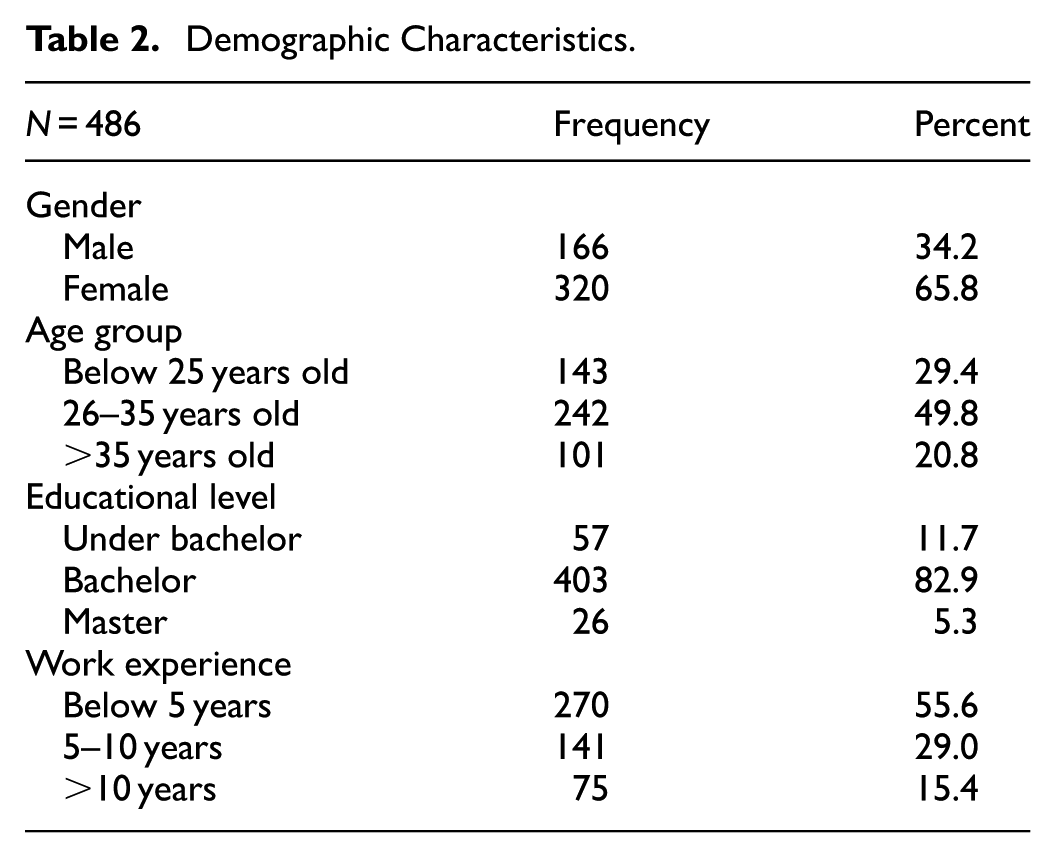
The final revised survey was designed and conducted using a non-probability sampling approach, specifically snowball sampling. This practical approach enabled researchers to maximize outreach by initially engaging a targeted group relevant to the research and encouraging them to refer additional participants who met the survey criteria. As a result, hard copies of the survey were strategically distributed to several key representatives from commercial banks. Data was collected over 3 months, from August 2024 to November 2024. Five hundred surveys were successfully collected; however, 14 were identified as invalid due to incomplete answers. The detailed characteristics of the participants are presented in Table 2, providing valuable insights into the demographics involved in this study.
Demographic Characteristics.
The primary data for this study were gathered through well-structured questionnaires and subjected to rigorous inferential statistical analysis. We employed SPSS 26 for descriptive statistics, while SmartPLS 4.0 was utilized for a comprehensive assessment of the measurement and structural models. We chose the Partial Least Squares Structural Equation Modeling (PLS-SEM) technique due to its robust capacity to handle non-normally distributed data, making it an ideal choice for analyzing high-deviation datasets (Hair et al., 2019). To mitigate potential risks associated with common method bias, we conducted Harman’s single-factor test using the factor analysis tool in SPSS. The findings revealed that no single factor explained more than 50% of the variance in the measures, effectively demonstrating that common method bias is not a significant concern in our analysis (Podsakoff et al., 2003). These rigorous methodologies bolstered the reliability and validity of the findings, reinforcing the integrity of our research conclusions.
Results
To rigorously evaluate the quality of the measurement model, we conducted comprehensive tests on the validity and reliability of the scale. Convergent validity was assessed through the outer loading coefficient and the average variance extracted (AVE). According to the authoritative guidelines from Hair et al. (2019), both metrics must exceed .5 to confirm robust convergent validity. Our findings, presented in Figure 2 and Table 2, reveal that every variable achieved impressive outer loading values, with a minimum of .565 and an AVE of .514, clearly surpassing the critical threshold.

The measurement model.
We further established discriminant validity by comparing the square root of the AVE for each variable to its correlation coefficients with other variables across both rows and columns, following the criteria set forth by Fornell and Larcker (1981). The data in Table 3 show that all variables meet and exceed the requirements for discriminant validity. Notably, the AVE for the MFN variable stands at a significant .717, exceeding the values in both its row (.639 and .604) and its column (.614 and .668). In addition, we turned to the Heterotrait–Monotrait ratio (HTMT) as an additional gauge for discriminant validity. With a maximum HTMT value of .737 (as shown in Table 3), well below the critical benchmark of .9 proposed by Hair et al. (2019), we further substantiated our findings of strong discriminant validity.
Discriminant Validity and Collinearity Statistics.

Note. Square roots of AVE of latent constructs were shown in parentheses.
Finally, we evaluated the scale’s reliability through composite reliability (CR) and Cronbach’s alpha coefficients. The results in Table 4 highlight that all variables exceeded the .7 threshold (Nunnally, 1978), underlining the scale’s strong reliability. In conclusion, the variables exhibit robust reliability and validity, establishing a firm foundation for further analyses.
Reliability and Convergent Validity.

Note. CA = Cronbach’s alpha; CR = composite reliability; AVE = average variance extracted; MOL = minimum of outer loading.
Hypotheses H1, H2, and H5 highlight the significant impact of servant leadership on job performance, work-life balance, and innovative work behavior. The results show strong positive relationships (β1 = .209, β2 = .356, and β5 = .284) that are statistically significant at the 5% level (p-values < .05 for all; Table 5). This finding underscores the crucial role that direct managers play in enhancing employee outcomes. When frontline employees perceive their managers as exemplifying servant leadership, they tend to exhibit higher job performance, improved work-life balance, and greater innovative work behavior. Therefore, hypotheses H1, H2, and H5 are strongly supported. These findings are consistent with the research conducted by Mishra and Hassen (2023), Vuong (2023), Dorta-Afonso et al. (2025), and Khan et al. (2025).
Results of Hypothesis Testing.

Hypotheses H3 and H6 indicate that work-life balance and innovative work behavior significantly enhance job performance. The results show positive path coefficients (β3 = .144 and β6 = .271), both statistically significant at the 5% level (p-values < .05 for all; Table 5). Essentially, higher levels of work-life balance and innovative work behavior lead to better job performance among frontline employees. Consequently, hypotheses H3 and H6 are also strongly supported. This finding aligns with the research of Duan et al. (2023) and Vuong et al. (2023).
Hypotheses H4 and H7 confirm that work-life balance and innovative work behavior mediate the relationship between servant leadership and job performance, with regression coefficients of .051 and .077, respectively, and p-values exceeding .05 (Table 6). This supports the mediating role with a significance level of 5%. Thus, hypotheses H4 and H7 are accepted. Furthermore, the direct relationship between servant leadership and job performance has also been confirmed (hypothesis H1). These results indicate that work-life balance and innovative work behavior partially mediate the positive relationship between servant leadership and job performance. Overall, the total effect of servant leadership on job performance is .337. This study provides evidence that work-life balance and innovative work behavior are two critical mediators in the relationship between servant leadership and job performance.
Results of the Mediating Roles of Work-Life Balance and Innovative Work Behavior.

p < .001. **p < .01.
Hypothesis H8: Mindfulness moderates the relationship between Servant Leadership (SL) and Work-Life Balance (WLB). The analysis results indicate that the interaction effect of servant leadership and mindfulness (SL * MFN) on WLB is .115, with a p-value of .000 (see Table 5). Consequently, the H8 hypothesis is accepted at a significance level of 5%. This indicates that frontline employees exhibiting higher levels of mindfulness experience a markedly stronger positive connection between SL and WLB (refer to Figure 3). Specifically, at low levels of mindfulness (red line, −1 SD), the positive relationship between servant leadership and work-life balance is relatively weak. Even when leaders demonstrate servant-like behaviors, employees with low mindfulness may struggle to internalize support or maintain personal boundaries, limiting gains in work-life balance. At the average level of mindfulness (blue line), the relationship becomes stronger, indicating that moderately mindful employees are better able to perceive and benefit from servant leadership. Notably, at high levels of mindfulness (green line, +1 SD), the relationship is strongest.
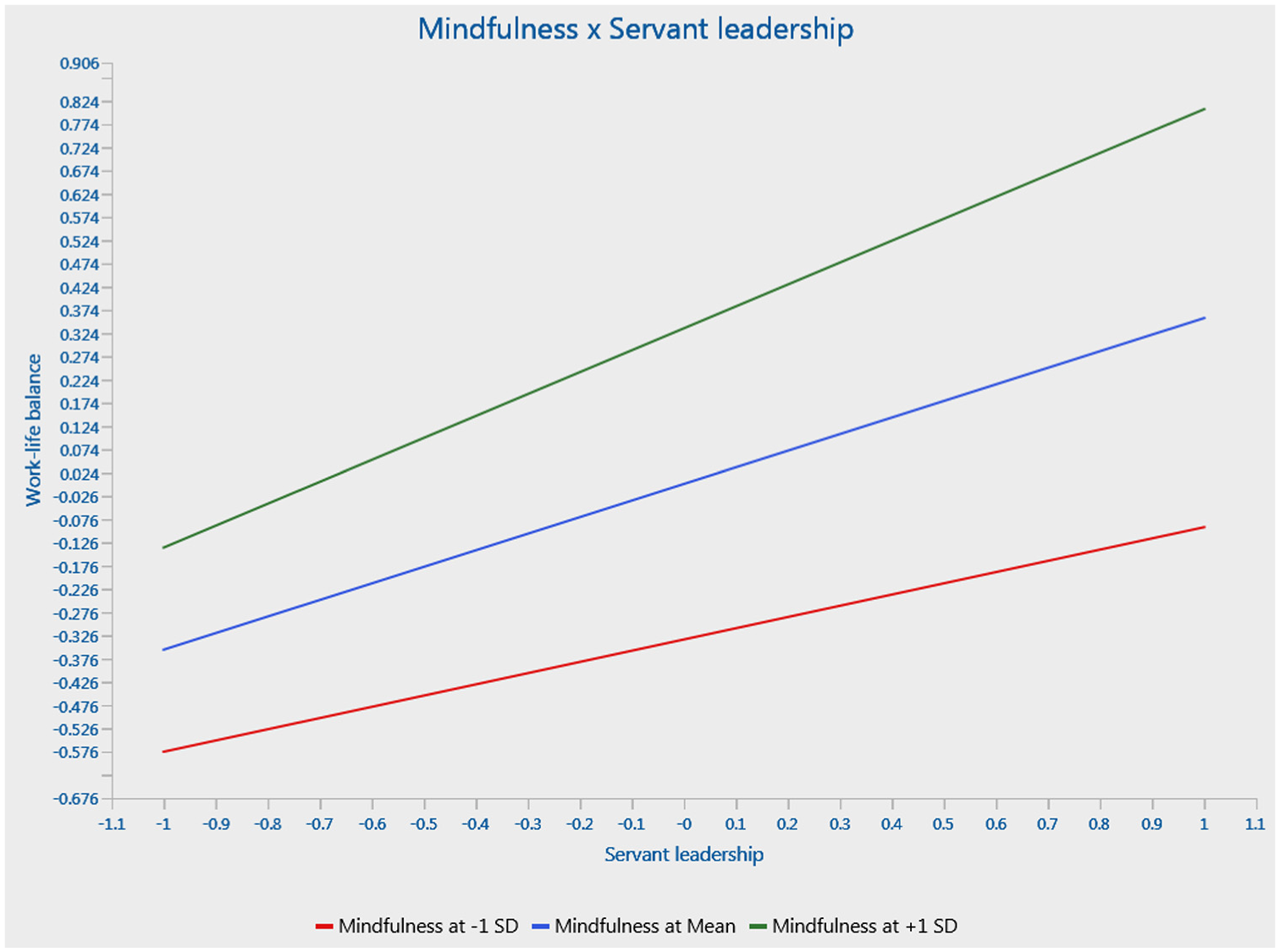
The moderating role of mindfulness on the relationship between SL and WLB.
Hypothesis H9: Mindfulness moderates the relationship between SL and Innovative Work Behavior (IWB). The analysis shows that the interaction effect of servant leadership and mindfulness (SL * MFN) on IWB is .072, with a p-value of .001 (see Table 5). Therefore, the H9 hypothesis is accepted at a significance level of 5%. This means that the positive relationship between SL and IWB is strengthened among frontline employees who exhibit higher levels of mindfulness (refer to Figure 4). Specifically, at low levels of mindfulness (represented by the red line, −1 SD), the positive connection between servant leadership and innovative work behavior remains relatively weak. Even when leaders actively engage in servant leadership behaviors, employees with low mindfulness may struggle to harness this guidance effectively, lacking the awareness, focus, or psychological openness necessary to translate leadership into innovative and proactive actions.

The moderating role of mindfulness on the relationship between SL and WLB.
In contrast, at an average level of mindfulness (illustrated by the blue line), the relationship becomes notably stronger. This result indicates that employees with moderate mindfulness are increasingly adept at channeling support from servant leaders into impactful, innovative efforts. Most compellingly, at high levels of mindfulness (depicted by the green line, +1 SD), the relationship reaches its peak strength, demonstrating the profound impact that heightened mindfulness can have on transforming servant leadership into tangible innovation.
Hypothesis H10: Mindfulness moderates the relationship between SL and Job Performance (JP). The analysis reveals that the interaction effect of servant leadership and mindfulness (SL * MFN) on JP is .105, with a p-value of .000 (see Table 5). Thus, the H10 hypothesis is accepted at a significance level of 5%. This underscores that frontline employees who cultivate higher mindfulness levels achieve an enhanced positive relationship between SL and JP (refer to Figure 5).
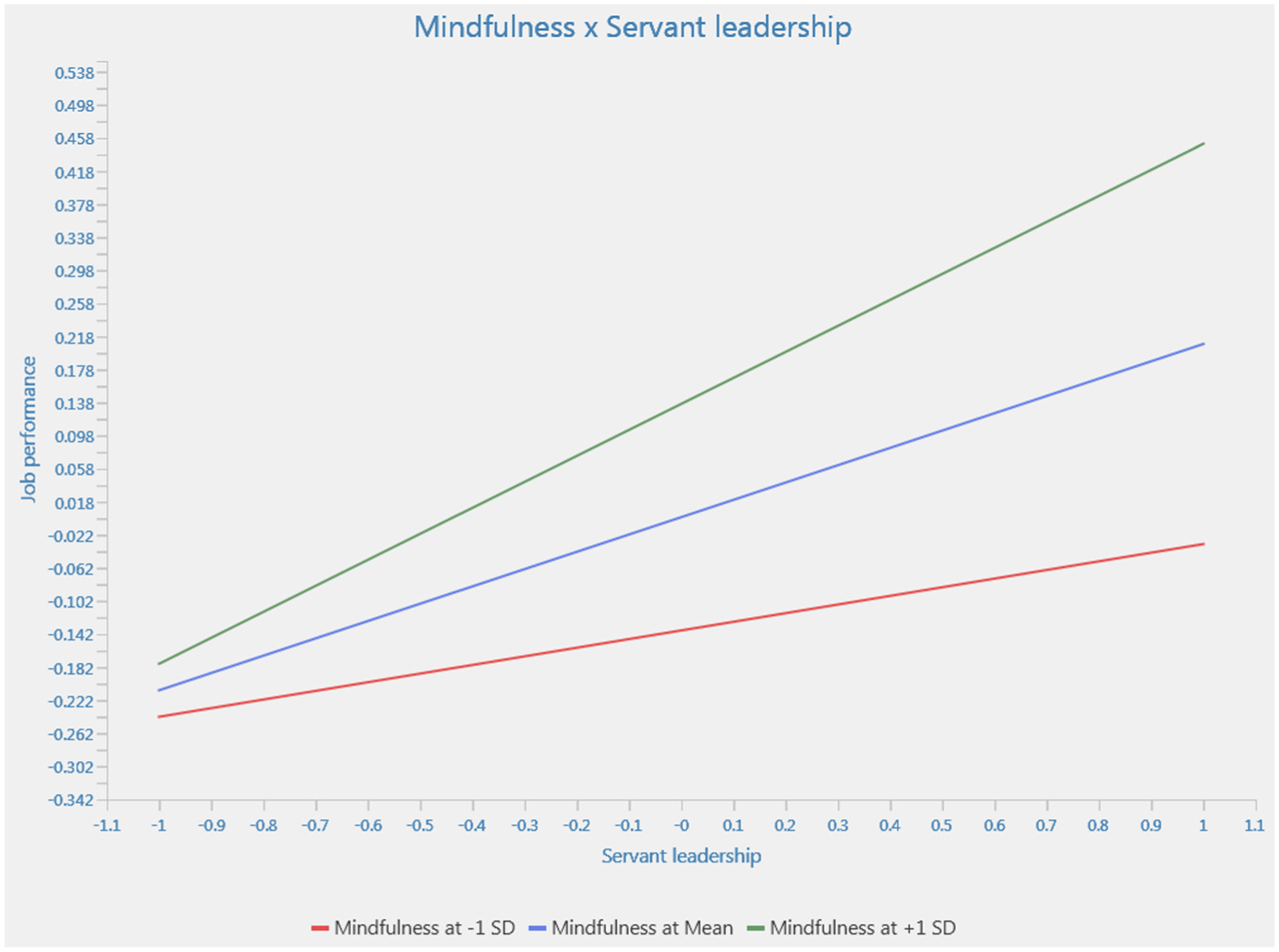
The moderating role of mindfulness on the relationship between SL and WLB.
The R2 value for JP is .472, indicating that SL, WLB, and IWB can explain 47.2% of the variation in JP. Additionally, SL accounts for 48.6% of the variation in WLB and 42.6% of the variation in IWB (see Figure 3). Furthermore, Wetzels et al. (2009) stated that an R2 value greater than .26 represents a highly suitable model in the social sciences. In this study, all R2 values for the latent variables exceeded .26, confirming that our model is appropriate and highly practical for application in the field.
Conclusion
Discussion
Based on the SET theory and the COR theory, the authors developed a research model to clarify how servant leadership impacts the job performance of frontline employees at commercial banks in Vietnam. This relationship is mediated by two factors: work-life balance and innovative work behavior, with mindfulness playing a moderating role. The findings indicated that servant leaders significantly positively influence job performance. This finding aligns with the SET theory, which suggests that when employees receive attention and support from their superiors, they tend to respond with greater dedication and effort. This is particularly relevant in the banking sector, where employees often face pressure from customers and business targets.
Furthermore, work-life balance and innovative work behavior also positively affect job performance. The COR theory explains that when leaders help employees maintain a work-life balance and encourage innovation, these employees accumulate more psychological resources, enhancing their effectiveness at work. These factors are crucial in the competitive and ever-changing banking environment. Importantly, mindfulness plays a significant role in this dynamic. The relationship between servant leadership and positive outcomes is stronger among employees who are highly mindful. These individuals are better at managing emotions, maintaining focus, and effectively utilizing organizational support. Overall, the research provides empirical evidence of the importance of servant leadership and personal factors in enhancing the work performance of bank staff.
Theoretical Implications
This research makes a significant contribution to the field of service management, particularly within the context of joint-stock commercial banks in Vietnam. Firstly, Saleem et al. (2020) highlighted that many leadership studies rooted in Western contexts often lack experimental investigations applicable to a global audience. This study effectively addresses this gap by exploring the concept of servant leadership in an Asian context, specifically within Vietnam. While existing literature has primarily focused on servant leadership in public organizations, there is a notable deficiency of empirical evidence regarding its effectiveness in the private sector service industry. By focusing on frontline employees in the Vietnamese banking industry, a context where servant leadership remains underexplored, this study demonstrates its relevance for enhancing joint-stock commercial bank operations and provides valuable insights for management strategies.
Secondly, a plethora of studies have examined various leadership styles, including transactional and transformational leadership, in relation to employee job performance. However, there has been a decisive shift toward examining servant leadership as a fundamental component for fostering employees’ personal development. This study establishes servant leadership as a fundamental premise for investigating employee performance, thereby effectively filling a critical research gap. The robust experimental evidence presented confirms a strong positive relationship between servant leadership and job performance among frontline employees, a relationship that has been inadequately explored within the banking sector. The findings, grounded in robust experimental design and statistical analysis, reinforce the validity and impact of this research.
Thirdly, although prior studies have developed a scale for measuring servant leadership in public organizations, it is imperative to validate this scale across diverse contexts. The findings of this study affirm the high reliability and validity of the seven characteristics of servant leadership within the banking industry in Vietnam. Furthermore, introducing scales for work-life balance, innovative work behavior, and job performance tailored to the Vietnamese banking context enriches the academic discourse. The results indicate that all scales utilized in this research demonstrate reliability (Cronbach’s alpha > .7), making them suitable for further scholarly inquiry.
Fourthly, this study posits that work-life balance and innovative work behavior serve as critical mediators in the relationship between servant leadership and job performance of frontline employees. By integrating servant leadership, work-life balance, innovative work behavior, and job performance into a singular, cohesive framework, this research offers a comprehensive understanding of the factors influencing employee performance. The findings reveal that servant leadership significantly and positively impacts frontline employees’ job performance, both directly and indirectly. Additionally, this study introduces novel insights by highlighting that work-life balance and innovative work behavior partially mediate this positive relationship, expanding our understanding of the underlying mechanisms at play.
Fifth, this research examines mindfulness as a valuable personal resource that moderates the effects of servant leadership on work-life balance, innovative work behavior, and job performance. The study provides compelling experimental evidence that underscores the moderating influence of employee mindfulness, illustrating how it can either amplify or diminish these relationships.
Finally, the study reaffirms the validity of SET theory and COR theory in elucidating the interplay among servant leadership, work-life balance, innovative work behavior, job performance, and mindfulness. When organizations empower employees with additional resources, both at the organizational level (through servant leadership) and the individual level (through mindfulness), it catalyzes enhanced job performance. These findings align with the COR theory’s spiral effect, demonstrating that the provision of organizational resources fosters the accumulation of personal resources (such as work-life balance and innovative work behavior), ultimately culminating in improved outcomes like elevated job performance.
Practical Implications
The insights obtained from this study are transformative for managers operating within the banking sector. The research underscores the critical role that servant leadership plays in enhancing employees’ work-life balance, fostering innovative behavior, and ultimately elevating the job performance of frontline staff. To harness these benefits, it is paramount for commercial banks to implement robust policies that promote servant leadership among their direct managers. This strategy entails prioritizing the advancement of managers who embody servant leadership qualities and establishing comprehensive training programs that cultivate essential leadership skills such as empathy, active listening, and relationship management. Additionally, leveraging the experience of seasoned leaders to mentor emerging leaders can serve as an effective, informal training mechanism. Therefore, banks should strategically enhance leadership quality via training initiatives, seminars, and reward systems that consistently recognize and incentivize these leadership behaviors.
The research validates that improved work-life balance directly correlates with heightened employee performance. Consequently, commercial banks should empower their workforce with greater autonomy over their schedules by offering flexible work arrangements, including remote work options. This flexibility enables employees to effectively manage personal obligations, fostering a healthier equilibrium between their professional and personal lives, which in turn catalyzes superior work performance. In the fast-paced, high-stress landscape of banking, cultivating a culture that prioritizes employees’ physical and mental well-being is essential. Implementing comprehensive healthcare programs can significantly enhance overall employee satisfaction and productivity. Moreover, fostering an environment that encourages innovative work behavior is imperative. Employees should be empowered to embrace opportunities and showcase their potential and readiness to innovate. This approach nurtures a positive work culture where individuals are granted the freedom and flexibility to pursue creative solutions and drive meaningful change.
Lastly, mindfulness emerges as an indispensable psychological resource that organizations can leverage to amplify the positive impacts of servant leadership on work-life balance, innovative behavior, and overall job performance. Banks should prioritize recruiting and selecting frontline employees who exhibit high levels of mindfulness. Furthermore, organizations can implement tailored training programs on mindfulness meditation, equipping employees with the tools to cultivate and apply mindfulness effectively in their roles.
Limitations and Future Research Directions
While this study successfully met its objectives, it is essential to acknowledge limitations that may affect the applicability of the findings. Firstly, the use of a convenience sampling method limited the research to frontline employees working in joint stock commercial banks in Vietnam. Consequently, the results may not accurately reflect the experiences of the broader workforce within the banking sector. To enhance the generalizability of future research, it is essential to adopt a probability sampling technique and broaden the sampling frame. Secondly, this study did not account for critical demographic variables such as gender, age, and education level, which can significantly influence job performance. Future researchers are strongly encouraged to explore the effects of these variables when examining the performance of frontline employees, as doing so will provide a more comprehensive understanding of the factors that drive success in this crucial area of the banking industry.
Footnotes
Authors Note
This study adhered to institutional, national, and international ethical standards, and all procedures involving human participants, data, and samples were conducted in accordance with relevant guidelines and regulations. Prior to participation, all respondents provided informed consent after being fully informed about the purpose of the study, the voluntary nature of their involvement, and their right to withdraw at any time without any consequences. They were assured that their anonymity and confidentiality would be strictly protected, and that their data would be securely stored and used exclusively for research purposes. Potential risks associated with participation were also clearly communicated. During the distribution of the survey questionnaires, these ethical principles were reiterated. Participation was entirely voluntary, and all responses were treated as completely anonymous and confidential. To encourage participation, each completed survey was compensated with a US$2 incentive.

Funding
The authors received no financial support for the research, authorship, and/or publication of this article.
Declaration of Conflicting Interests
The authors declared no potential conflicts of interest with respect to the research, authorship, and/or publication of this article.
Data Availability Statement
Data are available upon reasonable request from readers.