




Abstract
Despite the numerous contributions from farm entrepreneurship to economic development, including food security and rural poverty alleviation, most farm enterprises often fail due to institutional challenges in developing countries. Based on this perspective, the study investigates the effect of different institutional contexts, such as regulatory, normative, and cognitive institutions, on the performance of farm enterprises. The study further evaluates the mediating role of farm Entrepreneurial Orientation (EO) in the Institution-Venture performance relationship. We employ the PLS-SEM technique to analyze data collected from 371 farm enterprises in Ghana. The findings from the study emphasize that Regulatory, Normative, and Cognitive institutions have positive and significant indirect effects on farm business performance through the partial mediating role of EO. While regulatory and normative institutions have a negative direct effect on farm venture performance, the results show that cognitive institutions have positive and significant effects on farm business performance. The study confirms the positive and significant impacts of institutions on farm-level EO. The findings imply that farm entrepreneurship can be improved by strengthening regulatory, normative, and cognitive institutions to offer conducive support for farm businesses in developing countries.
Keywords
Introduction
The agriculture sector remains the backbone of Africa’s Economy. As a result, farm entrepreneurship has been described as a chief source of economic growth and a catalyst for rural revitalization in Africa. Farm entrepreneurs pursue business opportunities as dynamic business operators who apply critical entrepreneurial principles and management skills to create market value in the agriculture value chain. Farm entrepreneurs consistently embrace innovation and advanced technology while contributing to technological progress and diversification of farm production activities (Morris et al., 2017; Wales et al., 2019). Entrepreneurial practices and skills such as risk management, financial management, and branding strategies play a focal role in farm entrepreneurship. More importantly, farm entrepreneurial ventures offer an avenue to maximize farmers’ income levels and alleviate rural poverty (Kostova, 1997). Moreover, entrepreneurial farm ventures represent critical pathways for rural employment creation (Magbondé et al., 2023) and hold food security potential in developing African countries (Adobor, 2020).
However, despite the contributions from farm entrepreneurship, most farm enterprises in Ghana often fail due to high transaction costs, low profitability, and poor venture growth (Adobor, 2020; Putsenteilo et al., 2020). These challenges are perceived as the outcome of weak institutional support. Institutions encompass a spectrum of formal and informal institutional arrangements such as government policy initiatives, legal systems, market mechanisms, and societal and cultural norms that shape the behavior of businesses and individuals. A conducive institutional environment fosters the ability of entrepreneurs to discover business opportunities. Traditional beliefs constrain effective entrepreneurial behaviors and activities in countries with weak institutions, such as government policy uncertainties, corruption, and societal trust. Formal institutional organizations like banks and NGOs may also guarantee financial and non-financial assistance to the farmers. Access to credit and farming implements offers financial freedom for farm entrepreneurs. Informal institutions such as farm cooperatives and community leadership recognize and promote farm entrepreneurial businesses in the communities.
Hence, this study aims to investigate the alternative processes and mechanisms through different institutional environments that directly and indirectly contribute to farm entrepreneurial performance, with Entrepreneurial Orientation (EO) acting as a mediating factor. Institutions are essential, serving as sources of leverage to improve entrepreneurial Orientation (EO) and the performance of businesses. EO is described as the configuration, processes, and practices to create mindset, actions, and decisions in pursuit of new ventures and entrepreneurial activities (Lumpkin & Dess, 1996; Naminse & Zhuang, 2018). EO is characterized by innovativeness, risk-taking, and proactiveness, as Miller (2011) suggested. Urban (2019) further explains that EO, as a strategic capability of entrepreneurial firms, is highly dependent on institutional arrangements such as regulatory, normative, and cognitive institutional environments. Hence, promoting the EO of farm businesses strengthens farm business competitiveness through innovation, risk-taking, and opportunity identification, further enhancing farm venture performance.
Although several previous studies have focused on the relationship between institutions and agricultural entrepreneurship, a literature gap still exists since previous scholars have not fully established the critical processes and mechanisms through which different institutional environments influence farm-level EO, and business performance of farm-based MSMEs in developing countries such as Ghana (Fitz-Koch et al., 2018; Nti & Osei, 2022; Urban, 2019). It is worth noting that most of the previous scholars have focused on generic analyses of institutional barriers to agriculture entrepreneurship (Ataei et al., 2020; Smidt & Jokonya, 2022) and the direct impact of formal and informal institutions on farm entrepreneurship (Martínez Serna et al., 2017; Satola et al., 2018). Other studies also examined the influence of government policies on farming activities (Loizou et al., 2019) in developing countries. These studies do not offer full knowledge of the direct and indirect processes and pathways through which different institutional environments may support farm entrepreneurship decisions and performance growth in developing countries such as Ghana. The outcome of the previous studies does not allow the development of comprehensive government policies and interventions that may foster sustainable agriculture innovations and farm entrepreneurship growth in developing African countries, such as Ghana.
The present study fills the literature gap by alternatively analyzing and comparing the direct and indirect pathways and mechanisms through which different institutional environments support entrepreneurial farm venture performance. Our contribution to this study is three-fold. First, this study adds empirical evidence to the discussions on the institution-entrepreneurship relationship. We employ the institutional theory (North, 1990) and test the hypotheses relating to how the three critical institutional environments highlighted by House et al. (2004), regulatory, normative, and cognitive institutions, contribute to entrepreneurial farm venture performance. Regulatory institutions comprise more formal structured laws, regulations, government policies, and programs in a society country. Normative institutions are the more informal institutional environments that constitute societal norms, beliefs, values, and cultural practices.
On the other hand, cognitive institutions refer to the mental model, previous knowledge, experience, informal education, and prevalent training within a society. These institutional arrangements notably significantly influence an entrepreneurial venture’s performance (Busenitz et al., 2000; Scott, 2010 & Urban, 2019). We conclude that regulatory, normative, and cognitive institutional environments uniquely influence farm entrepreneurship behavior, decision-making, EO, and venture growth.
Secondly, we test hypotheses on the indirect effect of regulatory, normative, and cognitive institutional environments on the performance of entrepreneurial farm ventures through EO as a mediating factor. Conducive institutions promote EO (innovativeness, risk-taking proactiveness) of entrepreneurial farm ventures toward new product and service development and product and service diversification. Subsequently, through effective EO, the farm ventures may improve their competitiveness, including financial and non-financial performance. We conjecture that EO may serve as a mechanism and critical pathway through which institutions may improve entrepreneurial farm venture performance. Finally, the findings from the study concerning how to improve EO and entrepreneurial performance of farm ventures based on different institutional environments enrich the knowledge and information required developing polices to improve the sustainability of the rural agribusiness sector in the developing countries. Developing rural agribusiness sector is more importantly critical to improving rural livelihood, poverty alleviation and food security (Osei & Zhuang, 2020). Such policies may contribute to the resilience of food supply systems and food security in developing countries particularly in African. The remaining sections of this paper are structured into four parts. Section two presents the theoretical background and hypothesis development of the study. Section three further discusses the sample and methods employed in the study, while section four also presents the results and discussions from the study. Finally, section five discusses the conclusions, policy implications, and recommendations for further study.
Theory and Hypothesis Development
Institutional Theory
The institutional theory provides an insightful foundation for this paper. Institutions are rules in society that govern how people and firms should interact and behave (North, 1990). North refers to institutions as the “rules of the game. ’The institutional arrangements establish the basis for production and exchange in the country. They play a focal role in the extent to which firms manage and allocate resources for production and rewards. Therefore, institutions reflect how boundaries are set for business firms and individual behaviors (Scott, 2010; Welter et al., 2018). The institutional theory argues that individuals”’ and firms’ decisions to start a business are determined by the prevailing social, economic, and cultural environments (Bruton et al., 2010). Based on these perspectives, several scholars have applied institutional theory to explain entrepreneurship’s level, types, and performance (Baumol, 1990; Bruton et al., 2010). In this paper, we apply the three critical institutional pillars House et al. (2004) categorized as regulatory, normative, and cognitive institutions. The regulatory institutional burdens consist of more formal laws, rules, government policies, programs, and projects, which may either promote or constrain the performance of entrepreneurial activities. The normative institutional burdens also comprise the accepted social norms, values, culture, and social beliefs of the people in a particular society. The cognitive institutions refer to the mental models that involve perceived information, shared standards, formal and informal education, and problem-solving skills that foster decision-making processes. The cognitive component of institutions relates more to how business opportunities are perceived and exploited and how risk-taking and innovation are interpreted.
Previous scholars maintain that regulatory, normative, and cognitive institutions have a solid potential to influence Entrepreneurial Orientation (Urban, 2019), and Agriculture entrepreneurial activities (Fitz-Koch et al., 2018), and subsequently, entrepreneurial performance (Busenitz et al., 2000; Welter & Smallbone, 2011). Regulatory institutions such as favorable agricultural policies, farm inputs subsidies, and land-use rights help farm entrepreneurs strengthen their capacities, minimize transaction costs, and maximize their productivity. Cultural norms and beliefs influence the EO of business firms. According to Nara et al. (2020), if uncertainty avoidance is part of the culture of a particular society, individuals and entrepreneurs work to avoid uncertainty and risky ventures. They mostly rely on established norms and business practices with less tendency to engage in innovation, risk-taking, and proactive business ventures. On the other hand, Supportive cultural beliefs and norms may improve the entrepreneurial Orientation of business ventures, leading to venture performance (Roxas & Chadee, 2013; Urban, 2019). Based on this background, the conceptual model in Figure 1 has been developed to test the direct and indirect influence of regulatory, normative, and cognitive institutions on entrepreneurial farm venture performance through EO acting as a mechanism

Conceptual model.
Linking Institutions and Business Performance
Entrepreneurial performance encompasses the financial and non-financial dimensions. The financial performance relates to the venture’s profitability, return on investment, sales volumes, and market revenues. At the same time, the non-financial dimension refers to venture employment growth, innovation and technological progress, and management abilities. Farm entrepreneurial performance describes the ability of the farm entrepreneurs to productively allocate farm resources and effectively manage factors of production to create market value and achieve business success and growth (Klyver & Arenius, 2022). This involves entrepreneurial practices and skills to identify business opportunities within the farming landscape to improve farm outputs. Anríquez et al. (2020), Vozarova and Kotulic (2016) suggest that farm entrepreneurs who received government-subsidized inputs and support were able to improve their sales volumes, revenues, and profitability comparatively. Government subsidies offered to farmers have been found to minimize farm production costs and increase the profit margin of farm enterprises. Nonetheless, government regulatory policies, legal systems, property holdings that are not favorable and conducive to farm entrepreneurship could negatively affect the productivity and survival of farm enterprises, particularly in developing countries (Anríquez et al., 2020; Fan et al., 2012). Subsequently, Anríquez et al. (2020) and Vozarova and Kotulic (2016) agree that farmer entrepreneurs who received government-subsidized imputes and credit facilities were able to improve their incomes and profitability significantly. Similarly, Money (2014) argues that prudent government policies on credit facilities, property rights, and subsidies for agriculture entrepreneurs contribute positively to their productivity and performance. However, Ntiamoah et al. (2016) found that poor economic policies and legal systems that limit farmers’ access to credit, loans, and land holdings negatively affect farm venture performance since they deny farms access to resources and other business opportunities.
Based on the institutional theory perspectives, cultural normative institutions play a crucial role in entrepreneurial behavior and business decision-making. Studies by Satola et al. (2018) found that supportive institutions, societal values, customs and norms encourage farm business growth aspirations. Societal customs such as land tenure systems and land rights determine the control of productive land resources for farming activities. In traditional societies with equitable land rights, farm enterprises tend to have access to land to expand their farming business. This may enhance farm production growth and venture performance. An increase in farm income and profitability mainly depends on farm size; farmers’ access to enough land is likely to increase returns from farm business. Land rights include accessing, using and controlling resources through sociocultural and customary arrangements. However, weak land rights negatively impact farm business expansions and agricultural development. For instance, in Ghana, Nchanji et al. (2021) found that the existing land rights inequalities discourage farm business expansions and negatively influence business growth. Gellynck et al. (2015) argue that some societies classify some farming activities as illegitimate based on their religious, socio-cultural rules and standards. Consequently farm entrepreneurs are not motivated to pursue venture growth activities when their farm business activities are perceived as illegitimate by in the context traditional customs or religious beliefs (Capelleras et al., 2019).
The cognitive institutions relate to the perceived feasibility, capability, and propensity to engage in entrepreneurial activities. From the cognitive institutional perspective, a more significant premium is placed on skills training, human capital development, and educational attainments, though entrepreneurial mindset and initiatives are promoted. Formal and informal education of farmer entrepreneurs significantly impacts the development of entrepreneurial skills and knowledge (Esiobu & Ibe, 2015; Pliakoura et al., 2020). Well-educated farm entrepreneurs can take calculated risks and manage farm ventures’ strategic Orientation toward venture development (Almahry et al., 2018; Olaniran & Mncube, 2018; Sousa, 2018). Empirical evidence from Abubakari et al. (2022) similarly recognizes that entrepreneurs who receive enough training through workshops and entrepreneurial capacity building can improve their performance compared to those who do not. Based on the above, the following hypotheses are put forward:
Hypothesis 1a: Regulatory institutions have significant effect on performance of farm enterprises
Hypothesis 1b: Normative institutions have significant effect on performance of farm enterprises
Hypothesis 1c: Cognitive institutions have a significant effect on performance of farm enterprises.
Institutions and Entrepreneurial Orientation
Results from previous studies suggest that institutions have a significant influence on the EO of entrepreneurial firms (Urban, 2019). Dai and Si (2018) posit that institutions are critical in improving a firm’s entrepreneurial Orientation. Previous scholars argue that regulatory and institutional supports such as government, political, legal, and financial systems could impact the entrepreneurial Orientation of farm businesses. Anisa et al. (2021) found that a conducive government policy positively encourages farm entrepreneurs’ entrepreneurial Orientation. Anisa et al. (2021) emphasized that the government supports farmers with agricultural tools, machines, and irrigation facilities to improve entrepreneurial competitiveness.
The desire for firms to undertake innovations and high-risk investments is shaped by normative institutional contexts such as beliefs, values, and societal acceptable norms and cultural embeddedness (Muralidharan & Pathak, 2017; Pathak & Muralidharan, 2016). In this context, before individuals and firms undertake entrepreneurial-oriented activities, references are made to existing social customs, norms and values of social groups for their acceptance and approval of a particular venture. Therefore, the success of the entrepreneurial orientation posture of individuals and farm enterprises in society depends on the quality of normative institutional arrangements. Firms’ entrepreneurial Orientation is also based on legitimate, accepted, and socially approved values, norms, and cherished cultural beliefs (Jamal Khan & Siddiqui, 2020). However, according to Lencucha et al. (2020), some cultural norms and beliefs promote risk aversion, negatively affecting a firm’s EO development. Some cultural norms discourage risk-taking, preventing innovation and application of new technologies to improve venture performance.
The cognitive dimension of institutions describe the knowledge and skills possessed by the people in the society needed to set up new business and engage in entrepreneurial activities. On the other hand, in a society where entrepreneurship education and training are available, the systems tend to improve the EO of firms. Education and training systems enhance firms’ skills and knowledge to recognize business opportunities and engage in innovation activities to improve their EO. According to Bao et al. (2016), cognitive institutions are the shared perception that describes the nature of reality and the lenses through which meaning is interpreted, such as the people’s worldview. They enhance the capacities of firms to discover business opportunities and take proactive decisions ahead of their competitors, thereby improving their strategic Orientation. Cognitive instructional structures determine how the knowledge and experience of firms are explored to create new product value and improve their EO posture (Bao et al., 2016). Hence, supportive cognitive institutions positively influence the entrepreneurial Orientation of entrepreneurial farm ventures. Based on the above discussion, it is hypothesized that:
Hypothesis 2a: Regulatory institutions have significant effect on Entrepreneurial Orientation of farm enterprises.
Hypothesis 2b: Normative institutions have significant effect on Entrepreneurial Orientation of farm enterprises.
Hypothesis 2c: Cognitive institutions have significant effect on Entrepreneurial Orientation of farm enterprises.
Linking Entrepreneurial Orientation and Business Performance
The farm-level entrepreneurial Orientation has been evaluated based on the farm’s ability to innovate, take risks, remain proactive, and directly impact farm entrepreneurial performance (Barzola Iza & Dentoni, 2020). Barzola Iza and Dentoni's (2020) results further confirm that EO drives farmers in innovation potential, leading to farm growth and profitability. Further, it is established that there is a strong relationship between EO and agribusiness performance (Miller, 1983). Strengthening agribusiness firms’ EO posture fosters their ability to explore new market opportunities, increase value creation, and promote ventures’ financial performance. Similar studies have concluded that entrepreneurial Orientation significantly contributes positively to business performance (Gao et al., 2018; Mason et al., 2015). Entrepreneurial Orientation has been assessed as a significant antecedent of farm business performance (Barzola Iza & Dentoni, 2020; Klyver & Arenius, 2022). Practically, a firm’s ability to innovate means that the firm can create and develop new products or develop new services to achieve high growth performance. Strategically, firms that adopt new technology and explore new opportunities with unknown outcomes can take risky investments, leading to high performance.
Moreover, proactiveness means that firms can identify new demands, products, and opportunities ahead of the competitors to maintain their competitive advantage. Previous scholars conclude that Entrepreneurial Orientation has a robust positive relationship with the performance of firms (Covin & Lumpkin, 2011). Based on this background, it is worth noting that farm business performance can be improved in the presence of a robust farm venture’s entrepreneurial Orientation. Hence, it is hypothesized that:
Hypothesis 3: Entrepreneurial Orientation has a significant effect on performance of farm enterprises.
Mediating Effects of Entrepreneurial Orientation
Entrepreneurial farm ventures exploit institutional supports such as farm inputs subsidies, financial assistance, extension training, and conducive cultural attitudes toward farm entrepreneurship to increase their entrepreneurial Orientation (Anisa et al., 2021; Urban, 2019) as a strategic process which also contributes to farm business growth and performance (Klyver & Arenius, 2022). Hence, Barzola Iza and Dentoni (2020) confirm that EO may mediate the relationship between institutional support and farm business performance. For instance, regulatory institutions such as government policies on subsidies, landholder rights, and trade restrictions help farm ventures to minimize risk, reduce transaction cost, and maximize their innovative abilities, which subsequently contribute to an increase in farm output, sales, market revenue, profitability, and growth performance (Genc et al., 2019; Khan et al., 2021; Urban, 2019). It is further observed that entrepreneurial farm ventures that receive government policy support are motivated to expand their farm business sizes and engage in advanced technologies to develop absorptive internal capability for innovation, risk-taking, and competitiveness. To improve a firm’s business success, scholars such as Ahsan et al. (2021) and Roxas and Chadee (2013) further agree that the prevailing institutional environments need to be conducive and must support EO of the business venture in operation. Previous studies reveal that socially supportive cultural values and norms within a community determine the entrepreneurial Orientation of firms and individual entrepreneurs, particularly in agriculture farmer enterprises. A supportive normative institution encourages farmers to engage in intensive innovation by exploring new business opportunities and improving their venture performance and vice versa. Lotz and Van der Merwe (2013) observed that improving agriculture requires opportunity identification, discovering new sources of market value, and product and process innovation activities leading to improved farm business performance. Scholars such as (Pathak & Muralidharan, 2016; Williams & Vorley, 2015) argue that societal norms and values or cultures that promote high innovativeness and creativity correlate with generating high entrepreneurial business ventures. The normative dimension of the institutional environment, which represents societal value orientations, is more related to the admiration of entrepreneurial behaviors and skills (Urban, 2019).
In some cultures, entrepreneurs may be highly admired for their creativity and proactiveness in some countries (Stenholm et al., 2013). The normative environment for entrepreneurship “influences the relative societal desirability of entrepreneurship as an occupational choice” (Stenholm et al., 2013). Findings from (Pliakoura et al., 2020; Sandhu & Hussain, 2021) highlight that those who received adequate training and education can innovate and create more value to increase their productivity and income levels. Cognitive institution further contribute to EO leading to improvement in business performance. Some educational training promotes farm entrepreneurial initiatives, innovation, and creative skills, leading to farm profitability and general growth (Rezai et al., 2011). Therefore, a perceived higher institutional support makes it possible for farm ventures to improve their EO posture, subsequently improving farm business profitability, growth, and general performance. Based on the above context, it is hypothesized that:
Hypothesis 4a: Entrepreneurial Orientation mediates the relationship between regulatory institutions and the performance of farm enterprises.
Hypothesis 4b: Entrepreneurial Orientation mediates the relationship between normative institutions and performance of farm enterprises.
Hypothesis 4c: Entrepreneurial Orientation mediates the relationship between cognitive institutions and the performance of farm enterprise.
Methodology
Research Design and Data Collection
The cross-sectional survey was conducted to investigate how the various institutional environments influence Entrepreneurial orientation and business performance of farm-based Micro, Small, and Medium Enterprises (MSMEs) in developing countries. The population for the study consisted of farm-based Micro, Small, and Medium Enterprises (MSMEs) in the Ejura Sekyedumase and Mampong Municipalities of the Ashanti Region in Ghana. In this study, we adopted the definition of MSMEs confirmed by Asare et al. (2015), who examined the characteristics of Micro, small, and medium enterprises in Ghana. According to Asare et al. (2015), MSMEs are described based on the number of permanent employees such that enterprises with permanent employees less than six were described as Micro scale enterprises, with 6 to 29 permanent employees (Small scale) and 30 to 99 permanent employees (Medium scale). The two survey locations, namely, Ejura Sekyedumase and Mampong Municipalities, were selected based on the data from the Ministry of Food and Agriculture (MoFA) that described the locations as municipalities with a more significant number of farming enterprises in the Ashanti Region. A total population of 2,350 officially recognized and registered farm-based MSMEs under MoFA, comprising 1,500 and 850 from Ejura Sekyedumase and Mampong municipalities, respectively, were considered for the study. Given the total population, a sample size of 470 was estimated based on the recommendation by previous scholars such as Gay et al. (2012), who proposed that choosing 20% of the population above 500 but less than 5,000 as a sample size for a study is considered adequate. Moreover, a sub-sample size of 300 farm-based MSMEs was established from the Ejura Sekyedumase municipal while 170 were selected from Mampong municipal. The sub-samples comprised 20% of each study location’s registered farm-based MSMEs.
Considering the homogeneity among the farming ventures in the survey locations, the simple random sampling technique was used to select the final farm-based MSMEs for the studies. A sampling frame was first developed based on the list of registered farm-based MSMEs from the MoFA departments, and specific farm-based MSMEs were randomly sampled. During the data collection, farm business owners or managers, depending on who was available, answered the questionnaires. Farm business owners or managers were considered since they had sufficient knowledge of the performance of the entrepreneurial orientation, institutional supports, and farm business performance compared to other farm employees. Even though 470 questionnaires were administered to respondents, only 371 valid responses were returned, accounting for a 78.9% response rate.
Measurement of Constructs
The structured questionnaire was employed as a critical instrument for the data collection. The study examines how the dimensions of the institutional environment contribute to the performance of farm-based MSMEs through entrepreneurial orientation as a mediator. All the constructs used in the study were measured as latent variables, and they are explained in the ensuing section.
Dependent Variable
Entrepreneurial Performance
The Entrepreneurial Performance construct was measured based on four items adapted and modified from Raymond et al. (2013). The Participants used a 5-point Likert scale response ranging from 1-(strongly disagree) to 5-(Strongly agree) to rate the extent of improvement in their farm enterprise performance, such as improvement in the sales volume, profit share, farm’s general development, returns on sales and investment for the last 2 years compared to their competitors. These items comprised both the financial and non-financial performance indicators.
Independent Variables
Institutions
The constructs for the institutional environments, regulatory, normative, and cognitive dimensions were utilized as independent variables and were measured based on measuring indicators proposed by Busenitz et al. (2000); Urban (2019); Welter and Smallbone (2011)). A 5-point Likert scale ranging from 1 (strongly disagree) to 5 (strongly agree) was used to evaluate each question in the structured questionnaire. We adapted and modified three from previous studies: Busenitz et al. (2000), Urban (2019), and Welter and Smallbone (2011) to measure Regulatory Institutions. Items used included: “Government has special support such as input subsidies for expanding our farm enterprise.”“Government organizations assist in starting our farm enterprise,” and “government sponsors organizations that help our farm enterprises to develop.”
Again, the Normative Institutions (NORM) were evaluated based on three items adapted and modified from Muralidharan and Pathak (2017) and Urban (2019). The items included: “turning new ideas into this kind of farming enterprise is accepted by the community as a career path,” starting this kind of farming enterprise was greatly accepted based on the social norms and customs in this community,’ and the farm Entrepreneurs in this farm enterprise are respected in this community’.
Finally, the cognitive institution’s construct was measured with items adapted and modified from previous studies by Busenitz et al. (2000), Urban (2019), and Welter and Smallbone (2011). The items used included: “In this Farm enterprise there are adequate skilled workers”, In this farm enterprise we know where to find information about markets for our products’, and our farm enterprise receives skills training from training institutions regularly.
Mediating Variable
Entrepreneurial Orientation (EO)
Moreover, the components of Entrepreneurial Orientation constructs (innovativeness, Proactiveness, and risk-taking) were measured from the firm-level EO items developed by Covin and Lumpkin (2011). Risk-taking constructs were also measured with three items based on the 5-Point Likert scale ranging from 1-strongly disagree to 5-strongly agree. The items explored included: “The farm enterprise establishes and implements risk management strategies for coping with environmental changes,”“we encourage people in our farm enterprise to take risks with new ideas,” to make effective changes to our offering, we are willing to accept at least a moderate level of risk of significant losses’.
Further, innovativeness was measured using three items based on the 5-Point Likert scale ranging from 1-strongly disagree to 5-strongly agree. The items included: “With our farm enterprise, we actively introduce improvements and innovations in our businesses, our farm enterprise is creative in its methods of operation,” and “our farm enterprise seeks out for new ways to farming activities.”
Finally, Proactiveness was measured using three items adapted and modified from Covin and Lumpkin (2011). The items included: “we consistently look for new business opportunities for our farm enterprise,” we work to find new business or markets to target for the farm enterprise’, and “our farm enterprise continuously try to discover additional needs of our customers of which they are unaware ahead of our competitors.”
Control Variable
The estimating measurement model included two key control variables: farm size and farm age. The size of the farm-based venture was measured based on the size of the farm venture’s employees, while the farm’s age was measured in the years for which a farm enterprise has been in operation.
Assessment of Common Method Bias
In a cross-sectional survey where responses are based on self-report, there is the tendency of the occurrence of common method variance which could minimize the quality results in this study. Hence several approaches were jointly applied to ensure that, the risk effect of common method bias is completely minimized. Firstly, the order of the questionnaires items were mixed such that the respondents may not be able to perceive the full content of each of the constructs. According to Chang et al. (2010) counterbalancing the questionnaire items order of the various constructs and scales could be effective to reduce the common method bias. Again, during the questionnaire administration, confidentiality and anonymity of the respondent were ensured. According to Podsakoff et al. (2003) ensuring the anonymity and confidentiality of the respondents helps to reduce the kind of evaluation apprehension of the respondents. Further, the questionnaire items were unambiguously constructed to facilitate the understanding of the respondents. Moreover, in this study, correlation matrix table was used to check the extent of correlation among the constructs. Extremely correlated constructs implies the risk of common method bias. This approach helped to contain the measurement error particularly where multiple indicators were used to measure the latent variables.
Data Analysis
The study specifically utilized the Partial Least Square-Structural Equation Modeling (PLS-SEM) approach for data analysis due to its advantage in testing theory and hypothesis (Hair et al., 2019; Manley et al., 2021). The PLS-SEM allows for a simultaneous analysis of complex regression models. The PLS-SEM can estimate regression models with latent variables while exploring the reliability and validity of the constructs simultaneously. Further, the PLS-SEM approach to structural equation modeling can handle both exploratory and confirmatory studies and produce accurate results (Manley et al., 2021). The PLS-SEM approach relies on the use of variance and permits using a small sample size, unlike other approaches, such as the covariance-based techniques, which do not permit a small sample size (Manley et al., 2021). To ensure that the measuring items constructs used are reliable and Valid for the path analysis with PLS-SEM, previous scholars such as Manley et al. (2021); Sarstedt et al. (2020) have proposed an assessment of measurement model based on factor loadings, composite reliability, Cronbach’s alpha, Average variance extracted (AVE). The construct reliability measures the extent of the internal consistency of the construct items evaluated through factor loadings and Cronbach’s alpha. According to Hair et al. (2019); Manley et al. (2021); Sarstedt et al. (2020), it is recommended that the acceptable loadings of the observed indicators should be greater than 0.5 while each of the Composite reliability and Cronbach’s alpha values should be higher than .7.
The structural model was evaluated through R-squared, t-statistics, p-values, path coefficient estimates, and effect size (f2) (Hair et al., 2017, 2019; Manley et al., 2021). The bootstrapping approach at 5000 resampling was employed to estimate the statistical significance of the direct and indirect path coefficients (Manley et al., 2021). The method is preferred to test the hypothesis based on the path coefficient estimates and t-statistic when the data is not normally distributed. Since PLS-SEM does not have a normal distribution assumption, the bootstrapping resampling approach becomes appropriate to estimate the direct path coefficients in the hypothesis testing (Manley et al., 2021). The bootstrap resampling approach of the PLS-SEM was applied to simulate the unknown distribution of the data. This method transforms the original small sample data into a larger sample with minimized standard error. The approach presents consistent and accurate path coefficient estimates even when the data is not normally distributed. The goodness of fit index was further estimated based on the guidelines proposed by Tenenhaus et al. (2005) using the PLS–SEM. To estimate the goodness of fit index, Tenenhaus et al. (2005) proposed an equation given as:

From Equation 1, GoF denotes goodness of fit index, AVE represented the average score of the AVE for all the constructs and the R2 represent the average R-square values obtained. Based on the value of the GoF obtained, the fitness of the structural model could be described as small (GoF = 0.1), medium (GoF = 0.25) or large (GoF = 0.36).
Results and Discussion
The selected farm-based enterprises sampled for the study comprised micro-scale enterprises with fewer permanent employees than six, representing the majority of the selected farms, representing 51.752%, and small-scale enterprises with permanent employees between six and 29, representing 33.207%. Medium-scale enterprises with permanent employees between 30 and 99 also constituted 15.041%. Regarding the ownership of the farm-based MSMEs sampled, Sole proprietorship type of ownership constituted 56.065%, Family farm business (24.259%), and partnership (19.677%). Further, the results revealed that farm enterprises engaged in Livestock production constitute 32.615%, while those in crop production and Fishing accounted for 63.612% and 3.774%, respectively. Again, the results show that some of these farming enterprises have operated for over 10 years representing (44.474%), 7 to 10 years(27.224%), and 4 to 6 years(21.024%), while the very young farm enterprises have been in operation for 2 to 3yeras ( 7.278%). Moreover, the study considered either the farm managers or farm owners as the key respondents based on who was available to answer the questionnaires administered. Hence, the results show that, respondents who answered the questionnaires included farm owners (76.549%) and Farm managers (23.450%), while female respondents constituted 26.952% and males represented 76.549%.
Measurement Model
Table 1 further reveals that Cronbach’s alpha values, which indicate the internal consistency test of the measurement constructs for all the latent variables, are above .7, showing a robust internal consistency and reliability of indicators that combine to measure the constructs. The highest Cronbach’s Alpha value (α) for the latent variable constructs was .831, while the lowest was .714. Similarly, the composite reliability values for all the latent variable constructs are above the 0.7 minimum threshold, indicating sufficient reliability (see Table 1). The results from Table 1 show that the AVE values of all the constructs are above the minimum threshold of 0.5, showing that the constructs are sufficiently valid.
Construct Reliability and Validity.

The results from the Confirmatory factor analysis (CFA) show that, all the individual observed indicators of the constructs explored in the analysis had items loadings above 0.5 which satisfies the recommended minimum thresholds (see Figure 2). The measurement model in Figure 2 was evaluated based on the constructs reliability and validity results from the Confirmatory factor analysis (CFA) associated with the PLS-SEM. The results from the measurement model demonstrates the quality of the indicators and constructs used in the multivariate factor analysis and multiple regressions.

Measurement model.
Discriminant Validity (Fornell & Larcker Criterion)
Discriminant validity evaluates the degree to which a particular measurement item connects to what is intended to be measured guided by a fundamental theory (Manley et al., 2021). The Discriminant validity of the measurement model was evaluated through AVE, Fornell & Larcker Discriminant Validity Criterion, and heterotrait-monotrait ratio (HTMT). The results from Table 2 show that the AVE values of all the constructs are above the minimum threshold of 0.5. In contrast, the square root of the AVE values of the constructs have loadings higher than their corresponding correlation with other constructs, as shown in Table 2. The results show that the measurement model is logically valid and supports further analysis by PLS-SEM.
AVE and Discriminant Validity.

The study additionally tested the discriminant validity of the constructs using the Heterotrait-monotrait ratio (HTMT). According to (Sarstedt et al., 2020), to meet the acceptance threshold for discriminant validity, the values of HTMT must be less than 0.85. Based on this, results from Table 3 indicate that all the values of the heterotrait-monotrait ratio (HTMT) are less than 0.85; hence, the results satisfy the conditions of discriminant validity (see Table 3).
Heterotrait-Monotrait Ratio (HTMT).

Structural Model
The statistical significance of the structural path estimates were performance through Bootstrapping at 5,000 re-sampling. The significance of the path coefficients is determined using the t-statistics and the P-values. According to Wong (2013), the coefficient of the path is significant when the t-statistic is higher than 1.96 based on a two-tailed test and at a 5% level of significance. The results from Figure 2 predict R-square values of 0.721 and 0.501 for Entrepreneurial performance (EP) and Entrepreneurial orientation (EO) endogenous variables, respectively. The results imply that about 72.1% of the farm enterprises’ variations in Entrepreneurial Performance (EP) were explained by the Regulatory, normative, and cognitive institutions, Entrepreneurial orientation, and control variables. The results mean that the structural model’s predictive power is substantial (Cohen, 1988). Similarly, the results show that the model explains about 50.1% of the variations in the EO. The structural model is presented in Figure 3, which demonstrates the t-statistics of the path effects obtained through Bootstrapping by the 5,000 re-sampling approach.
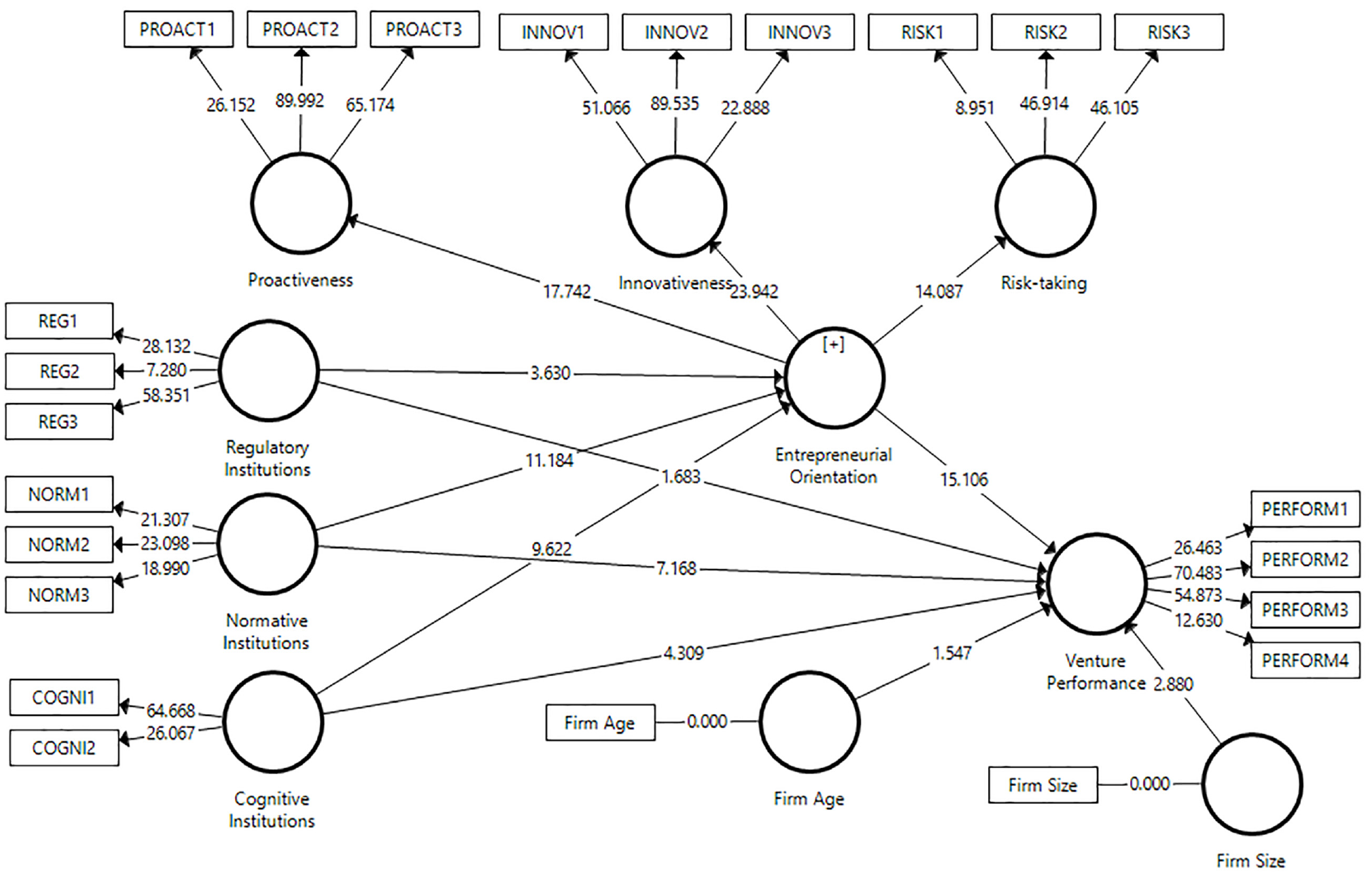
Structural model.
Effect Size
The effect sizes of the explanatory variables are measured based on f2 values of 0.02, 0.15, and 0.35, which denote weak, moderate, and strong effect sizes respectively (Hair et al., 2019; Manley et al., 2021). The results from Table 4 present the effect size of the explanatory variables denoted by a, b, and c which imply weak, moderate, and strong effect sizes respectively.
Effects Size (f2).

The results from Table 4 show that normative institutions have strong effect sizes on EO and entrepreneurial venture performance. Similarly, the results suggest that cognitive institutions have a strong effect size on EO but a weak effect size on entrepreneurial venture performance (Table 4).
Further, the findings show that regulatory institutions have weak effect sizes on EO and entrepreneurial venture performance (Table 4). The entrepreneurial Orientation’s construct has a very strong effect size on entrepreneurial venture performance, as shown in Table 4. Finally, the control variables (farm size and farm age) have weak effect size on entrepreneurial venture performance.
Model Fit Index
The results show the estimated Standardized Root Mean Square Residual (SRMR = 0.036) and Normed Fit Index (NFI = 0.943), which implies an acceptable goodness of fit of the model estimated. The study further estimated the goodness fit of the model based on the guidelines proposed by Tenenhaus et al. (2005).
Table 5 demonstrates the goodness of fit index estimated based on the guidelines proposed by Tenenhaus et al. (2005) in estimating the goodness of fit index in PLS–SEM. The results from Table 5 show that the structural equation model presented is essentially worth goodness of fit index of 0.693. This implies that the GoF index is large. Hence, the appropriateness of the structural equation model estimates.
Model Fitness for Structural Model.

Direct Path Effects of Institutions on EO and Venture Performance
The study examined the direct effects of different institutional arrangements on farm business performance. Results from the analysis have been presented in Table 6. The findings indicate that Regulatory institutions (β = −.062, p < .10) have a negative and significant effects on farm venture performance (EP) at a 10% level of significance. The results, therefore, show that hypothesis H1a was verified. The second hypothesis, H1b, was further tested on the direct path effects of normative institutions ((β = −.327, p < .01) on venture performance. It was discovered that normative institutions also have a negative and significant direct effect on farm venture performance. Hence, H1b was supported. Based on the result in Table 6, cognitive institutions (β=.194, p < .01) positively and significantly influence farm venture performance, thus supporting H1c. The outcome of the hypotheses tests supports previous studies indicating the direct effect of regulatory, normative and cognitive institutions on farm business success. The study reveals that changes in regulatory institutional support negatively influence farm business performance, such as profitability, sales returns and sales volumes. Several studies highlight the predominance of inconsistent and unreliable government agricultural policies in developing countries, which eventually lead to high transaction costs and reduction in farm business profitability and sales return (Nyarku & Oduro, 2018; Putsenteilo et al., 2020). Ntiamoah et al. (2016) contend that formal regulatory institutions negatively influence agricultural business opportunities and venture performance in a country with poor economic policies and legal systems. The results further specify that changes in normative institutions also lead to a negative impact on farm venture performance. Previous studies have similarly concluded that unsupportive sociocultural norms and beliefs limit entrepreneurial behavior and decision-making (Lencucha et al., 2020). High social cohesions and cultural conformity make rural farm entrepreneurs remain traditional and conservative as they obey rigid cultural rules (Lencucha et al., 2020). Again, in most rural areas in developing countries, such as Ghana, weak and inequalities in terms of land rights and land tenure systems tend to limit farms access to land which subsequently have negative impact on farm size expansion and business performance (Anaafo, 2015; Nchanji et al., 2021). Meanwhile, for farm business to expand their retunes and profitability, increasing access to enough farm lands is critical.
Direct Path Effects of Institutions on EO and Farm Venture Performance.

, and * denote 1%, and 10% levels of significance respectively.
According to the results, cognitive institutions have positive and significant effect on farm business performance. The results are consistent with previous studies, such as Urban (2019) and Welter and Smallbone (2011), who observed that cognitive institutions play a crucial role in improving entrepreneurial activities and business performance. Previous experience, skills, and knowledge, critical aspects of cognitive institutions, may also drive the farm business profitability, return on sales and sales volume. It is reported that farm ventures operated by hilly skilled and well-educated employees most likely to improve business growth. Therefore informal training support from agriculture extension officers on adopting newly improved farming methods, applying new machinery, or developing new marketing strategies contributes positively to farm business performance (Abubakari et al., 2022; Esiobu & Ibe, 2015).
Moreover, the results confirm the positive and significant effects of regulatory institutions (β = .157, p < .1), Normative Institutions (β = .453, p < .01), and cognitive institutions (β = .414, p < .01) on farm-level EO. The findings support hypotheses H2a, H2b and H2c respectively. On the other hand, Table 6 shows that EO (β = .825, p < .01) has a positive and significant relationship with business performance, and hence, H3 is supported. The results are consistent with several previous studies that conclude that regulatory institutions such as government policies and programs farm strategic orientation and competitive advantage (Anisa et al., 2021). Regulatory institutional supports involve capacity building and farming management strategies, training on adopting new technologies, and exploiting new farm opportunities. Results from the study showed that farm entrepreneurs develop their innovative abilities and strategies to explore market opportunities.
The results show that the more farm ventures EO improve, the more it contributes to increasing entrepreneurial venture performance such as profit and market shares (Gao et al., 2018; Wannamakok & Chang, 2020). The implication is that the farm enterprise’s ability to innovate, take some calculated risks, and remain proactive has a direct positive link with the farm enterprise’s performance growth. Wannamakok and Chang (2020) contends that supportive normative institutions positively influence entrepreneurial orientation activities. The results suggest that improvement in the cognitive institutional structures successively improves the entrepreneurial orientation posture of the farm enterprises. To some extent, the results mean that the farms’ EO depends on cognitive dimensions such as previous knowledge, skills, and training the farm workers and owners received. The finding suggests that cognitive arrangements in society, which include the knowledge, skills, experience, and general education of the individuals in the communities, are required to drive the farm enterprises’ innovation, risk-taking abilities, and proactiveness.
The findings are consistent with previous studies, such as Urban (2019), who found that cognitive institutions positively and significantly influence entrepreneurial Orientation. Our results confirm that of several previous Authors, such as (Covin & Lumpkin, 2011), who concluded a positive association between EO and firm performance. Entrepreneurial Orientation has been reported to have a strong positive and significant influence on farm business performance (Barzola Iza & Dentoni, 2020; Klyver & Arenius, 2022). Results from the control variables also indicate that farm age has a negative but statistically insignificant impact on farm performance. The older the farm, the more significant the decline in the performance of the farm enterprise. Farm size was found to have a statistically positive influence on the performance of the farm enterprise considered in the study. The results support the already established literature, which opines that increasing the farm size results in a corresponding increment in performance (see Table 6).
Mediating Role of EO
The key findings from the mediation analysis are presented in Table 7. It was discovered that regulatory institutions (β = .129, p < .05), normative institutions (β = .374, p < .05) and cognitive institutions (β = 0. 0.341, p < .05) have positive and significant indirect impact on farm venture performance through of EO as a “channel.” Based on the results, hypotheses H4a, H4b and H4c are supported correspondently. The results imply that EO has a partial mediation effect in the relationship between the institutional environments considered in the study and farm venture performance. Consistent with findings from previous studies, our study concludes that EO significantly partially serves as a mechanism through which regulatory institutions contribute to entrepreneurship performance (Genc et al., 2019; Khan et al., 2021; Roxas & Chadee, 2013). For instance, government agricultural intervention policies, programs, regulations, and support for farm ventures improve their EO, leading to business success (Urban, 2019). Regulatory, institutional support that helps farm entrepreneurs take high-risk investments tends to improve their strategic orientation and competitive advantage over their competitors, significantly improving farm profitability and sales growth. The results confirm findings from previous scholars such as Muralidharan and Pathak (2017), Pathak and Muralidharan (2016), and Williams and Vorley (2015), who found supportive social ties, trust, societal norms and cultural beliefs that promote high innovativeness and creativity toward entrepreneurial business performance.
Mediating Mechanism of EO.

denotes 1%, level of significance.
Finally, the results from Table 7 show that EO has a significant positive partial mediation effect in the relationship between cognitive institutions and venture performance. In this context, the institutional theory explains that adequate training, skills, and knowledge contribute to the development of strategic orientation of the enterprises, which ultimately improves entrepreneurial activities such as the adoption of improved technology exploration of new market opportunities (Ahsan et al., 2021; Wannamakok & Chang, 2020; Welter & Smallbone, 2011). Hence, developing EO contributes significantly to venture performance.
Conclusions and Policy Implications
The present study investigates the effect of different institutional pillars, such as regulatory, normative, and cognitive institutions, on farm business performance of Farm-based Micro, Small, and Medium Enterprises (MSMEs) in developing countries. The study further evaluates EO as a mechanism through which different institutional burdens influence the farm venture performance. The study employed the PLS-SEM technique using the cross-sectional data from 371 farm-based MSMEs in Ghana. The study was anchored in the institutional theory, which provided the theoretical lens to test the hypothesized relationships between institution environments, EO, and farm business performance.
Based on the findings, the farm-level EO partially mediates the effect of institutional environments (regulatory, normative, and cognitive institutions) on farm business success. Thus, regulatory, normative, and cognitive institutions positively affected farm business performance through EO as a mediator. Further, all the institutional burdens have a positive and significant effect on EO, implying that improvement in the institution’s support would enhance the entrepreneurial orientation of the farm ventures. The results confirm the strong positive relationship between EO and farm business performance, implying that improvement in EO can boost farm business performance. However, it is noted from the study that regulatory and normative institutions have a negative direct influence on farm business performance. Thus, the findings from the study enrich the current contextual and theoretical understanding of how the institutions contribute to farm entrepreneurship performance in the context of a developing country’s perspectives. Further, the findings from the study point out that institutions strongly influence farm-level entrepreneurial orientation and entrepreneurial performance of farm-based MSMEs in rural settings in developing countries such as Ghana.
The study has practical implications for management and policymakers. Regarding practical implications for management, the study shows that regulatory, normative, and cognitive situations positively influence EO. Hence, farm entrepreneurs can utilize institutional environments such as government policies, programs, and societal norms to develop their entrepreneurial orientation and strategically improve their business performance. Farm entrepreneurial orientation has a more substantial positive impact on farm performance, profitability, sales returns, investment returns, and general growth. Hence, pursuing farm EO can help farm-based MSMEs achieve business growth aspirations. Farm enterprises must prioritize innovation, risk-taking, and proactiveness as focal entrepreneurial activities to increase their productivity, competitive advantage, and profitability.
The study further emphasizes the significance of cognitive institutions in developing farm entrepreneurial orientation while improving farm business performance. Entrepreneurial skills training and education have been noted to play a critical role in EO’s decision-making. Farm managers should invest in offering entrepreneurial skills for employees on risk management, innovation, marketing strategies, and technology applications. These activities improved the technological savvy of farm entrepreneurs toward developing EO and venture performance.
Regarding policy, regulatory institutions such as government policies and agricultural intervention programs should consistently focus on eliminating market failures, minimizing transaction costs, and providing a supportive entrepreneurial ecosystem for farmers. These support systems will help farm businesses undertake high-risk investments, innovate, and discover business opportunities ahead of their competitors, thereby developing their entrepreneurial orientation and boosting venture performance. Formal and informal financial institutions should support farmers with access to credit at reasonable interest rates. Access to credit helps to expand their farming activities and increase productivity. Formal and informal institutions regulating land-use rights, use, and access can help farm entrepreneurs access enough land to expand their production activities. Land rights systems that appear discriminatory may limit access and land use by farm entrepreneurs. Therefore, the study offers information to support food security policies and rural poverty alleviation in developing countries like Ghana. Food insecurity has become a significant development challenge in most developing countries, mainly rural areas. This study sheds light on how the government can support farm entrepreneurship to improve venture performance, which has the potential to improve food security and inform farm entrepreneurs in natural areas.
The study, however, has the following limitations. Firstly, the study focused on only micro, small, and medium-scale farm-based enterprises without consideration of large-scale farm-based ventures. However, large-scale farm enterprises should be considered to gain a deeper understanding of the full implications of the influence of institutions on EO and the performance of the farm enterpriser. Secondly, in this study, we measure EO as an aggregate variable based on the sub-components of risk-taking, innovation, and proactiveness based on Miller’s conceptual definition (1983). Future studies may focus on examining the effect of the regulatory, normative institutions on the individual five dimensions of EO as conceptualized by Lumpkin and Dess, (1996). This implies that individual dimensions, including autonomy and competitive aggressiveness, should be considered to deepen understanding of the relationship between institutions and farm business. The model may add new variables such as farmers’ social capital, farmer cooperatives, networking abilities, and technology adoption to test their influence on venture performance as informal institution dimensions.
Footnotes
Declaration of Conflicting Interests
The author(s) declared no potential conflicts of interest with respect to the research, authorship, and/or publication of this article.
Funding
The author(s) received no financial support for the research, authorship, and/or publication of this article.

Data Availability
The data sets analyzed during the current study are available from the corresponding author upon reasonable request.