




Abstract
This study contributes to the limited literature on the personal branding of knowledge workers by revealing that a culture that incorporates knowledge, learning, and collaboration supports (explicit and tacit) knowledge sharing among employees and that sharing matters for knowledge workers’ self-perceived personal brand equity. Analysis of 2,168 cases from the United States and Poland using structural equation modeling (SEM) showed that this knowledge-sharing mechanism differs by country and gender. Findings revealed that in the United States, the knowledge culture and collaboration culture are highly correlated and dominate the learning culture. In both countries, the mistake acceptance component of the learning culture is not supported by knowledge culture as strongly as is the climate component. These findings reveal a bias concerning the acceptance of mistakes as a potential source of learning observed if the culture of knowledge dominates. Moreover, this study uncovers some significant gender differences that might be caused by the gender stereotypes existing in STEM (science, technology, engineering, mathematics). Finally, the study confirms that knowledge workers’ personal branding is a potent motive to smoothen and increase the knowledge-sharing flow in knowledge-driven organizations.
Plain language summary
This study contributes to the limited literature on the personal branding of knowledge workers by revealing that a culture that incorporates knowledge, learning, and collaboration supports (explicit and tacit) knowledge sharing among employees and that sharing matters for knowledge workers’ self-perceived personal brand equity. Analysis of 2,168 cases from the United States and Poland using structural equation modeling (SEM) showed that this knowledge-sharing mechanism differs by country and gender. Findings revealed that in the United States, the knowledge culture and collaboration culture are highly correlated and dominate the learning culture. In both countries, the mistake acceptance component of the learning culture is not supported by knowledge culture as strongly as is the climate component. These findings reveal a bias concerning the acceptance of mistakes as a potential source of learning observed if the culture of knowledge dominates. Moreover, this study uncovers some significant gender differences that might be caused by the gender stereotypes existing in STEM (science, technology, engineering, mathematics). Finally, the study confirms that knowledge workers’ personal branding is a potent motive to smoothen and increase the knowledge-sharing flow in knowledge-driven organizations.
Keywords
Introduction
Innovation, relationships, cooperation, and knowledge determine competitive advantage in the current networked, knowledge-driven global economy (Powell & Grodal, 2005). Knowledge workers are a sophisticated group whose work input and output are knowledge. That is, they not only use professional knowledge to perform at work but also transform the existing (explicit) knowledge into a new (tacit) one through their intelligence (Kucharska, 2022b; Mládková, 2015; Turriago-Hoyos et al., 2016). In summary, they are knowledge creators, and since knowledge is a key company asset in the knowledge-driven economy, their importance—in particular, in knowledge-driven organizations—increases. Given that a knowledge-driven organization is a smoothly cooperating network of brilliant minds, knowledge workers are its key actors. Consequently, their personal brands in such a reality also become increasingly critical assets, in addition to their intelligence and professional skills, which determine their professional career.
In a knowledge-driven, networked economy, self-branding actions are not a matter of choice but rather a necessity. The personal brand determines employability in the networked reality (Gander, 2014; Gorbatov et al., 2019; Khedher, 2019; Peter & Gomez, 2019), and knowledge workers are increasingly aware of the significance of personal brand as an asset and personal branding as a process supporting this asset (Chtioui et al., 2023; Duffy & Chan, 2019; Duffy & Sawey, 2022; Kucharska, 2022; McCarthy, 2015; Meisner & Ledbetter, 2022; Saad & Yacob, 2021; Staniszewska & Gorska, 2021; Vallas & Christin, 2018). In light of this, knowledge sharing by those who want to be branded as “knowledgeable persons” seems accurate. Knowledge is a value nowadays, especially in knowledge-driven organizations.
Moreover, organizations have also noticed that the stronger the personal brands of their employees, the better they, and the organization, perform (Kucharska, 2022; Onken-Menke et al., 2022; Yuan et al., 2022). In this regard, empirical studies have shown that this mutual dependency between the corporate and personal brands of knowledge workers has broadened empirically for chief executive officers (Bendisch et al., 2013; Delgado-Garcia et al., 2015; Fetscherin, 2015; Górska & Mazurek, 2021) and also for managers and specialists (Ilies, 2018; Kucharska, 2022; Sutherland et al., 2002). This phenomenon raises a question about the company culture conditions that support knowledge workers’ personal brand equity, which is important to ensure further productive co-branding between the employer and employee brands. Thus, this study aims to determine how a knowledge-driven company culture supports the personal brands of its knowledge workers by company culture. The understanding gained through this study matters in the broader co-branding context discussed thus far. If indeed, personal branding is a knowledge management tool, as suggested by Alonso-Gonzalez et al. (2019), then it is essential to find out if the culture of knowledge-driven organizations supports personal brands of their knowledge workers and, if so—how?
The current priority of knowledge-driven organizations is to adapt to the hyperdynamic reality smoothly to remain competitive. Therefore, to support the company’s strategy, its culture must comprise many functional types of culture that support organizational functions critical to the company’s sustainable development, that is, knowledge, learning, and collaboration (KLC). The KLC cultures coexist within the broadly adopted taxonomies proposed by Cameron and Quinn (2006) and Boisot (2010). For knowledge-driven organizations, the KLC cultures approach represents the synergy of the key functional subcultures of knowledge, learning, and collaboration, which is more likely to occur in clans/adhocracies (Boisot, 2010; Cameron & Quinn, 2006; Samhran et al., 2023). For these organizations, this synergy (i.e., the KLC approach) is currently perceived to be vital to their sustainable development. In addition, the three subcultures are not as influential separately as they are when combined (Kucharska & Bedford, 2023).
Accordingly, if its KLC approach focused on knowledge, learning, and collaboration is a crucial driver of a company’s knowledge-driven performance, as Kucharska and Bedford (2023) stated, and the aforementioned knowledge worker—knowledge company co-branding supports performance (Alonso-Gonzalez et al., 2019; Kucharska, 2019; Potgieter & Doubell, 2020), then a performance-oriented company culture should also influence knowledge-based personal branding activities, such as knowledge sharing among coworkers (Kucharska & Dabrowski, 2016; Sood, 2018). If so, the company is strengthening a recognition of knowledge in this way. Considering that smooth knowledge flows among employees is vital to knowledge-driven organizations (Mabey & Zhao, 2017; Singh et al., 2021), such a knowledge-based personal branding activity is then doubly beneficial to these organizations. The first benefit is a knowledge flow that supports performance (Alonso-Gonzalez et al., 2019). The second benefit relates to the expected co-branding that supports the employer brand, and the key to this co-branding is the strong personal brands of knowledge workers. If these are weak, they cannot support their employers. If the personal brands of knowledge workers are strong—it is a company benefit.
In considering this logical connection, this study focuses on the personal brands of knowledge workers. It aims to verify empirically their perceptions of the relationship between the KLC-driven culture that affects knowledge flows within a knowledge-driven organization and their self-perceived personal brand equity. Since perception affects actions and motivations, the self-reporting method was selected for this study. Thanks to this, the study explores the hypothesized chain of connections from the employees’ point of view.
Explicit (formal and codified) knowledge sharing can be forced by organizational policies and procedures, whereas tacit (informal and yet to be codified) knowledge sharing is based on personal abilities and motivations only (Asher & Popper, 2019; Kucharska & Erickson, 2023; Nonaka, 1994; Olaisen & Revang, 2018; Polanyi, 1966). Thus, this study aims to determine whether the KLC culture approach affects knowledge workers’ self-perceived personal brand equity and motivates them to share knowledge to support their personal brands. If so, indeed, the personal brands of knowledge workers are knowledge management tools, as suggested above.
Revealing such knowledge matters for two reasons. First, if indeed knowledge workers observe their personal brand equity increasing owing to their knowledge-sharing behaviors, then their motivation to share knowledge would be high (Kucharska & Dabrowski, 2016). If this is the case, to ensure constant organizational performance improvement, it is crucial to reveal how the company culture facilitates such improvements. Second, this study aims to expose precisely how tacit and explicit knowledge sharing is supported by the KLC approach to company culture and how employees evaluate this sharing efficacy as their personal branding tool, which is an unexplored topic to date. Thus, this study’s expected findings would contribute to filling the identified research gap.
To summarize, this study aims to explore how a knowledge-driven company culture rooted in KLC supports knowledge sharing among employees (explicit and tacit) and how these behaviors support the personal brands of those who share. Its findings would increase the motivation of organizations to develop a KLC-driven culture by exposing its influence on knowledge workers’ (self-perceived) personal brand equity that fosters knowledge sharing.
Conceptual Framework
This study is rooted in organizational knowledge creation theory, which is understood as an endless and sequential process of tacit knowledge acquisition and its continuous transformation into the explicit form owing to intensive social interactions (Nonaka, 1994). The phenomenon that constitutes social interactions in an organization is its culture. Therefore, an organization’s culture is vital to its success because it reflects a shared mindset revealed in shared values, beliefs, attitudes, behaviors, and the organization’s self-identity and vision (Kucharska & Bedford, 2023). Organizational culture can be seen as an adapted standard model of the set of underlying, shared assumptions and beliefs of employees of a particular organization, which operate often unconsciously and define how the organization views itself and its entire environment (Schein & Schein, 2017). This culture is then visible as a unique pattern of employee attitudes and behaviors. The more common among employees this pattern is, the stronger their adherence to the company culture. In other words, the more common the shared mindset and vision of the company’s self-identity among its employees, the most effective their cooperation with each other, which affects company performance. For this reason, company culture, which determines behavioral standards, affects organizational capabilities strongly (Kucharska & Bedford, 2023). Therefore, to secure dynamic, systematic knowledge processes within an organization, a shared attitude that understands high-quality knowledge to be a fundamental value is needed. The understanding in the knowledge culture that knowledge is a resource leads to higher levels of professional management of knowledge resources and to the constant, formal development of knowledge processes, such as identifying, gaining, organizing, creating, storing, and distributing (sharing) knowledge across the organization’s members (Kucharska & Bedford, 2023). The knowledge culture directly supports these knowledge management-related processes (Intezari et al., 2017), and it is more effective if supported by a culture of collaboration.
The collaborative culture involves a set of shared values and beliefs regarding an organization’s open communication and its encouragement of respect, trust, teamwork, adaptability, risk-taking, and diversity (Barczak et al., 2010; Pinjani & Palvia, 2013). Therefore, this culture creates a favorable climate for knowledge dissemination, critical thinking, reflection, smooth interactions, and communications, which foster knowledge sharing. According to Rothberg and Erickson (2017)“culture is the key ingredient in shifting an organization from knowledge to intelligence” (p. 283). Therefore, the collaborative culture determines the efficiency of shifting from the individual to the collective level. Therefore, this culture is vital to knowledge dissemination and transformation (Su & Vanhaverbeke, 2019). Furthermore, knowledge-centered, collaborative cultures support knowledge sharing (Lei et al., 2019, 2021). In turn, the organizational culture of knowledge supports collaboration. A collaborative culture supports the culture of knowledge in knowledge-driven organizations because knowledge is their lifeblood, and it is the collaborative culture that makes an organization the organization. An organization is a group of people established to achieve aims together that are impossible for any of its members to accomplish alone (Kucharska & Bedford, 2023). Therefore, without collaboration, every organization loses its capability. Thus, the collaborative culture and knowledge culture support each another in a knowledge-driven organization’s reality. Accordingly, the first hypothesis is as follows:
H1: The collaborative culture and knowledge culture are correlated.
KLC: Knowledge, Learning, and Collaborative Culture Approach
Kucharska and Bedford (2023) recently introduced the KLC approach to the cultures of knowledge-driven organizations as a solution that fosters these organizations’ development. The KLC approach creates perfect conditions to take full advantage of knowledge assets, starting from the existing knowledge, to creating favorable conditions for producing new knowledge from constant learning and collaboration among employees. The knowledge culture creates knowledge appreciation that is fundamental for knowledge-driven organizations. It creates an understanding of knowledge needs and leads to an increase in knowledge. However, the knowledge culture may lead to an exorbitant focus on explicit knowledge, revealed in its passive, repeated usage and understood as an application of verified solutions, without taking any risk to create new knowledge and new solutions (Kucharska & Bedford, 2023). The presence of only the knowledge culture can lead to the overcontrol of the status quo and excessive importance assigned to maintaining this status quo. The consequent side effect may be the total rejection of new knowledge, which is rationalized by risk avoidance. Risks always subserve novel knowledge revelation, acquisition, and application (Kucharska & Erickson, 2023). Therefore, some organizations with particular attention avoid such risks and prefer to “keep things as they are,” which is the aforementioned passive knowledge exploitation. Thus, such concentration on exploitation might block organizational development.
In contrast, a learning culture efficiently leads to constant, dynamic knowledge discovery and acquisition provoked by “intelligence in action” (Erickson & Rothberg, 2012), which occurs owing to the learning climate and mistake acceptance vital to learning because of the equally important critical thinking ability and risk-taking attitude (Kucharska & Bedford, 2020, 2023). Employees “are ready to be wrong” in organizations with a developed learning culture (Senge, 2006). It means that their open-minded attitude enables them to notice and admit if they are wrong because their learning attitude makes them open to changing their perceptions through constant critical thinking and constant questioning of the existing status quo. Thus, the constant learning culture does not promote a free-spirited approach to making mistakes but rather, strongly encourages the acceptance of the fact that mistakes may occur even under full diligence. A culture that accepts that mistakes can be seen not only as adverse events but also as opportunities for reflectivity and improvements serves the company better than a toxic culture of “blame and shame” (Ferguson, 2017). In addition, the openness to admitting that one is wrong is fully justified in the current hyperdynamic business conditions. The hyperdynamic reality results in many innovative actions being close to experimental in nature. Therefore, making mistakes in such situations can be a part of a “new normal.” Innovations are inherently risky. Moreover, these innovations are introduced in hyperdynamic new contexts. Therefore, when first engaging in something risky, especially in a dynamic context, one should be aware that mistakes can occur. Such events of mistake occurrence are a potential source of learning that should be managed for the company’s sake.
Therefore, employees exposed to a learning culture are not afraid to constantly optimize, break existing rules, create new ones, redesign processes and procedures, and experiment to find new solutions tailored to new contexts. Knowledge workers employed by learning organizations openly discuss mistakes to unlearn, learn, and relearn successfully. Given these aspects, a learning culture appears fundamental for knowledge-driven organizational development. Nevertheless, its effectiveness is going down without the efficient implementation of a knowledge-centered culture that provides the motive for any learning in the organization, which, without the collaborative culture, cannot achieve any goals. For this reason, knowledge-driven organizations must adopt the KLC approach in order to take full advantage of the power of this culture to support adaptability to change, such as the changes following the successful implementation of any new strategy (Kucharska & Bedford, 2023; Rass et al., 2023)
Collaborative Culture
A collaborative culture supports the creation of a relational component of intellectual capital that enhances the growth of the organizational competitive advantage and, as a result, also performance (Chowdhury et al., 2019). It is because the learning at work usually happens thanks to human interactions; employees learn better when they experience an intellectual challenge together, discuss it with each other, and arrive at a solution together. Following Julien-Chinn and Lietz (2019), decision-making at work is often supported through group dialog. Moreover, new ideas generation, collaboration, and shared decision-making are congruent with a learning culture, according to them. So, undoubtedly the collaboration significantly broadens cognitive abilities and helps to understand something deeper by enabling a precious and desired shift in the individual’s mindset and sharing this shift with workmates (Senge, 2006). Collaboration fosters learning and changes organizational attitudes, goals, and behaviors (Garvin et al., 2008). Moreover, a collaborative culture supports organizational learning (Nugroho, 2018). Since Kucharska and Bedford (2020) divided collaborative culture into two key components: climate and mistake acceptance. Therefore, hypotheses based on the above are proposed as follows:
H2a: The collaborative culture positively influences the climate component of the learning culture.
H2b: The collaborative culture positively influences the mistake acceptance component of the learning culture.
Knowledge Culture
The knowledge culture clears the way for the creation and distribution of knowledge across the organization (Aramburu et al., 2015). It shapes a positive attitude among employees toward (tacit and explicit) knowledge that fosters the smooth flow of all knowledge management-related processes across an organization. Following Islam et al. (2015), a knowledge culture is seen as a set of norms and practices that secures the conditions supporting this flow (Islam et al., 2015). Collaborative knowledge sharing enhances organizational learning (Connelly & Kevin Kelloway, 2003; Sita Nirmala Kumaraswamy & Chitale, 2012). Kucharska and Bedford (2020, 2023) empirically proved that a knowledge culture supports a learning culture. Therefore, the following hypotheses are proposed:
H3a: The knowledge culture positively influences the climate component of the learning culture.
H3b: The knowledge culture positively influences the mistake acceptance component of the learning culture.
Moreover, knowledge is considered the “lifeblood of most organizations today” (Mabey & Zhao, 2017, p. 39). A knowledge culture facilitates knowledge sharing (Intezari et al., 2017). It shapes a positive attitude among employees toward (tacit and explicit) knowledge (Borges et al., 2019; Jamshed & Majeed, 2019). In addition, Anand and Dumazert (2022), Miklosik et al. (2019), and J. Mueller (2014, J. C. Y. Mueller 2018) noticed the importance of a knowledge culture in organizational knowledge sharing and learning. In line with this discussion, the following hypotheses are developed:
H4: The knowledge culture positively influences tacit knowledge sharing.
H5: The knowledge culture positively influences explicit knowledge sharing.
Learning Culture
Similarly to the knowledge culture, the learning culture also supports a smooth flow of (tacit and explicit) knowledge through an organization (Alshamsi et al., 2017; Huang & Chin, 2018; Kucharska & Rebelo, 2022; Meher et al., 2024; T. M. Rebelo & Duarte Gomes, 2011; T. Rebelo & Gomes, 2017). Watkins and Marsick (1996), who defined a learning organization, stressed that “a learning organization must capture, share, and use knowledge so its members can work together to change the way the organization responds to challenges. People must question the old, socially constructed, and maintained ways of thinking. And the process must be continuous because becoming a learning organization is a never-ending journey” (p. 4).
In light of the above-given definition, a learning culture is understood as a mix of the “learning climate” component and the “mistake acceptance” components. The “learning climate” is visible in the staff’s shared positive attitude toward learning, shared high motivation, and disposition to breaking intellectual boundaries, and therefore, also reflected in organizational encouragement for collectively seeking new solutions and new ideas implementation. The “mistake acceptance” component is regarded as the staff being ready to accept the possibility of being wrong, and in such a case of being wrong, learn from mistakes and then be ready to unlearn, learn, and relearn, if necessary (Kucharska & Bedford, 2020). Therefore, the following set of hypotheses is proposed on the impact of a learning culture, composed of the learning climate and mistake acceptance, on tacit and explicit knowledge sharing:
H6: The climate component of the learning culture positively influences tacit knowledge sharing.
H7: The climate component of the learning culture positively influences explicit knowledge sharing.
H8: The mistake acceptance component of the learning culture positively influences tacit knowledge sharing.
H9: The mistake acceptance component of the learning culture positively influences explicit knowledge sharing.
Tacit and Explicit Knowledge Relationship
Tacit and explicit knowledge both require a different approach that emerges from the individual’s mindset. In this regard, tacit knowledge is seen as new organizational knowledge on a greater level, given its vital contribution to innovations creation (Saint-Onge, 1996). Tacit knowledge is strictly personal and comprises intuition, beliefs, assumptions, attitudes, values, and overall experiences at the individual level. Crane and Bontis (2014) defined tacit knowledge as “acquired unconsciously and automatically, but capable of influencing action” (p. 1136). In contrast to its explicit form expressed in words and data and codified into many easy-to-share forms (e.g., books, reports, documents, and databases), tacit knowledge is not codified; it is context-specific, stored in the human mind, personal, and therefore, undoubtedly, hardly possible to formalize (Polanyi, 1966).
Moreover, the above characteristics determine that the most tacit knowledge processes occur unconsciously in the human mind, except when revealed and shared, such as when knowledge workers interact, observe one another, share opinions, ideas, and experiences, solve problems collectively, and discuss and put some effort to understand different perceptions and to collaborate actively (Asher & Popper, 2019; Kucharska & Bedford, 2023; Olaisen & Revang, 2018). On the basis of this discussion, the following hypothesis is presented:
H10: Tacit knowledge sharing positively influences explicit knowledge sharing.
Personal Brand Equity
The core effect of personal branding activities oriented to personal brand creation is its equity. Personal brand equity is an intangible asset resulting from a set of impressions, beliefs, attitudes, and behaviors tied with the particular real name, or nickname, combined with all the notions intended to identify and differentiate this individual from others owing to a particular personal brand perceived authenticity (Kucharska, 2022, p. 67). Kucharska and Dabrowski (2016) employed Ajzen’s (1991) theory of planned behavior to prove empirically that tacit knowledge sharing by knowledge workers has positive effects on their personal branding actions. Moreover, they suggested that knowledge workers know that their intellectual abilities determine their reputation in the workplace, and they prove their professional skills and abilities among workmates by sharing their knowledge and supporting others. Consequently, the following hypotheses are proposed:
H11: Tacit knowledge sharing positively influences the (self-perceived) personal brand equity of knowledge workers.
H12: Explicit knowledge sharing positively influences the (self-perceived) personal brand equity of knowledge workers.
Figure 1 illustrates the presented theoretical relationships.

Conceptual framework.
Cross-Country Study by Gender
Cross-country analysis always sheds more light on the explored phenomenon because it enables things to be observed from different perspectives. Therefore, the current study examines the personal brand equity of knowledge workers from the perspectives of such individuals in Poland and the United States (US). These countries were selected because they significantly differ in terms of their cultural context, which influences the entire enterprise and social systems and may influence knowledge sharing and personal branding activities (Vos & Boonstra, 2022). Furthermore, Vallas and Cummins (2015) suggested that the discourse of personal branding gains traction globally, and it is interesting what variations are likely to emerge across national lines. This study responds to this suggestion.
Moreover, gender is a significant factor in personal brand shaping (Chiu et al., 2021; Duffy, 2016; Staniszewska & Gorska, 2021; Thompson-Whiteside et al., 2018), and this factor was also included in the current study to explore the focal phenomenon in greater depth.
Method
Samples
The sample sizes and structures are given in Table 1. The sampling quota was designed according to the statistics on the labor market in Poland (Statistics Poland, 2017). Simple random sampling would have been challenging, given the population size (in Poland and the US) and dispersion. Therefore, the Polish quota served as a pattern enabling the creation of two comparable samples composed intentionally only from knowledge workers. Hence, the sampling quota was designed equally for each industry (information technology (IT), construction, and healthcare) to avoid the impact of respondents’ positions on particular industry findings. Moreover, all samples are described by gender balance for the same reasons. Sampling process was provided online and executed by professional entities, Qualtrics (the US) and ASM-research solutions agency (Poland). Survey execution took 2 months (January to February 2020). The survey procedure was simple, the core questionnaire was preceded by a short introduction that provided an overview of the study purpose, including the definitions of key terms, such as for example, tacit knowledge. Next, qualification questions were displayed to establish that the respondents had the status of a “knowledge worker” (their key input and output at work is knowledge) and a minimum of 1 year of experience working in a knowledge-driven company. The survey’s core questions, excluding classification items, used a 7-point Likert scale to assess the intensity of the agreement to statements. Data management was straightforward; questionnaires with missing data were excluded. Table 1 presents the sample structure, and Table 2 shows the sample quality.
Samples Structure.

Note. Poland/US.
Samples Quality.

Data Quality Assessment
Since this study aims to analyze findings through the cross-country perspective, the sample quality assessment started with invariance, followed by the Kaiser–Meyer–Olkin (KMO) test. Summarizing this KMO sample adequacy test results, they were 0.857 for women and 0.888 for men (Poland) and 0.946 for women and 0.936 for men (the US), which confirmed that the samples were adequate (Hair et al., 2010). The total variance explained is 76%/69% (women/men) for the US and 76%/75% (women/men) for Poland. Next, the common method bias (CMB) by the common latent factor (CMBclf) test was run (Fuller et al., 2016).
Common method bias (CMB) is a systematic error variance shared among variables measured with the same method or the same data source, or both (Jakobsen & Jensen, 2015; Richardson et al., 2009). If measures are affected by CMB, the intercorrelations among them can be inflated or even deflated. Therefore, controlling how strongly CMB affects the particular CFA model is critical for further structural model results. One of the most popular methods of CMB testing is the common latent factor test. However, this test, like many other methods has its prompts and cons broadly discussed in the literature (Gorrell et al., 2011; Hulland et al., 2018; Podsakoff et al., 2012; Richardson et al., 2009; Yetton et al., 2011). The key conclusion from this discussion is that CMB is a natural part of social science research. The critical point is first, to minimize the influence of measurement method biases by the careful designing procedure of the study. The second point is to be aware of how strong this bias is and how significantly it affects the variables’ measurement and as a result the particular model findings. The questionnaire design (Appendix 1) and data collection procedure described above focused on statements clarity to qualified respondents who were selected carefully to secure they possessed the knowledge needed to respond smoothly to all statements given. To control CMB, this study applied the common latent factor method (Fuller et al., 2016; Jakobsen & Jensen, 2015). Both samples (Poland/US) achieved acceptable results—23%/38% (CMBclf) and 30%/32% (women/men) for Poland and 48%/43% (CMBclf) and 45%/37% (women/men) for the US—confirming that the quality of all samples was satisfactory (below 50%), which enabled further analysis (Babin et al., 2016).
Furthermore, since the samples of interest were collected from two countries, invariance tests of adequacy were run first to verify if the measurement instrument operated properly across different populations: Poland and the US (Tables 3–5). Thus, it was confirmed whether the measurement tool (the questionnaire) composed of the scales presented in Appendix 1 measured the constructs correctly in both samples, first, through the cross-loadings matrix analysis (Appendix 2) and, next, the mentioned invariance and gender multigroup analysis (Tables 3–5). To measure invariance (Table 3), a multigroup confirmatory factor analysis was run (Byrne, 2016). Since both the analyzed sample sizes n > 1,000, the liberal alternative of models’ global fit indices was applied, that is, the comparative fit index (CFI) and root mean square error of approximation (RMSEA; Chen, 2007). As a result, the measured change (Δ) in model fits was about 0.01 or less for the Tucker–Lewis index (TLI) and CFI and 0.015 or less for RMSEA. Thus, based on the results presented in Tables 3 to 5, the measurement model can be regarded as nationally invariant based on the ΔTLI and ΔCFI measurement model (acceptable metric fit result and not acceptable poor scalar fit result) and excellent ΔRMSEA result for both: the measurement and structural models (Byrne, 2016; Chen, 2007; Raudenská, 2020). Tables 3 to 5 present the invariance and gender multigroup assessment details, indicating that the applied measurement tool is rather nationally invariant on the basis of ΔRMSEA and that the gender groups analyzed separately for nations are also invariant.
Invariance Measurement.

Multigroup Analysis: Poland (Women n = 522/Men n = 528).

Multigroup Analysis: The US (Women = 554/Men = 564).

The internal consistency of the constructs was assessed using the following reference values: Cronbach’s alpha > .7 (Francis, 2001) and average variance extracted (AVE) > .5 (Byrne, 2016; Hair et al., 2010). Further, composite reliability > .7 (Byrne, 2016; Hair et al., 2010) was utilized to justify the reliability of the scales.
Next, discriminant validity was checked following the positive assessment of the statistical power of the chosen items (de Vellis, 2017). Precisely, similar and theoretically related constructs measured in the survey were verified to ensure they did not supercharge one another (the Fornell–Larcker criterion). It was noticed that, the obtained square root of the AVE was larger than the correlation observed between the constructs for all the samples except the sample of US men, where such constructs as: tacit knowledge sharing, knowledge culture, learning culture, and collaborative culture were correlated, causing a slight bias. Tables 6 to 9 present details of the basic statistics and correlations obtained between the measured constructs for Poland (Tables 6 and 7) and the US (Tables 8 and 9).
Basic Statistics and Square Root of the AVE Poland, Women.

The square root of AVE is shown as bold at diagonal.
Basic Statistics and Square Root of the AVE Poland, Men.

The square root of AVE is shown as bold at diagonal.
Basic Statistics and Square Root of the AVE USA, Women.

The square root of AVE is shown as bold at diagonal.
Basic Statistics and Square Root of the AVE USA, Men.

Bias.
Note. Poland: n = 1,050; US: n = 1,118; KC = knowledge culture; TKS = tacit knowledge sharing; CC = collaborative culture; LCc = learning culture (atmosphere/climate); LCm = learning culture (mistake acceptance); EKS = explicit knowledge sharing; PBE = (self-perceived) personal brand equity. Software used: SPSS Amos 26, technique: CB-SEM.
The square root of AVE is shown as bold at diagonal.
Results
This study aimed to verify empirically whether knowledge workers observe the connection between a KLC-driven culture and their self-perceived personal brand equity owing to the tacit and explicit knowledge flows within a knowledge-driven organization. The relationships between KLC culture, knowledge flow, and personal brand equity (self-perceived) were examined by gender for two samples of knowledge workers from Poland and the US. The results showed that all KLC-related constructs (knowledge, learning, and collaboration cultures) indeed support one another (H1:H3), but the observed correlation between knowledge culture and collaborative culture (H1) in the US is significantly higher (β = .80***/.81***) than that observed for Poland (β = .47***/60***) for women and men. Moreover, for Poland, the influence of collaborative culture on learning culture is stronger for the learning climate component (β = .43***/.48***) than for the mistake acceptance component (β = .26***/.23***). For the US, the opposite is true: The support of the collaborative culture is stronger for the mistake acceptance component (H2b) than for the climate component (H2a). Further, for both countries, the results showed that the knowledge culture supports the learning climate component (H3a). This support is visible for both countries and genders. However, no significant influence was observed for women in Poland and the US for the mistake acceptance component of the learning culture (H3b). For men, the influence is weak (*p < .05) but significant; it is negative (β = −.27*) for the US and positive (β = .16*) for Poland. This influence is weak or not significant because, in principle, the knowledge culture promotes excellence. Hence, “the acceptance of mistakes as a source of learning” can sound controversial for those who espouse a very strong knowledge culture. Further, mistakes are in opposition to excellence and, therefore, may still be regarded negatively, even as a source of learning. It can be a side effect of the double bias of mistakes elaborated by Kucharska and Bedford (2023).
Kucharska and Bedford (2023) implied that double bias of mistakes comes from the paradoxical co-existence of the positive attitudes and beliefs toward learning and the negative attitudes and beliefs toward accompanying mistakes. This situation is confusing and leads to bias because there is no learning without mistakes, and at the same time, mistakes are not accepted. Accepting constant learning, we must accept accompanying errors. Meanwhile, errors often are seen as indicators of negligence or lack of intelligence (Mangels et al., 2006). This negative attitude toward errors might be a result of the strong culture of knowledge—people who have knowledge do not make mistakes -it is commonly believed. Furthermore, one of the motivations to possess knowledge is precisely avoiding mistakes. So, these perceptual contradictions altogether cause a cognitive bias. This bias is doubled by the common belief that bosses never make mistakes. So, the fear of being seen by others as incompetent might lead to counterproductive behaviors of managers (Kucharska et al., 2023). Leaders’ counterproductive behaviors harm trust among organization and society members that next block organizational collaboration and learning capabilities. Recently, Zhang et al. (2024) exposed that leaders’ mistakes admitting, and sharing are positively related to the entire error management climate in the company. So, the double bias of mistakes might significantly harm learning processes: individual and organizational.
Considering the double bias of mistakes effects related to H3b through the lens of gender and accepting that a strong knowledge culture reflects a strong call for excellence, the results for men in the US (β = −.27*) indicate the highest pressure on excellence or the biggest double bias of mistakes (or both simultaneously), which may lead to the “zero acceptance of mistakes” approach—likely to be another exciting area for further research. Furthermore, the effect revealed for the Polish sample composed of men is positive but weak. It means that the excellence pressure or the bias of mistakes (or both) are not as high as those visible for the sample composed of US men. Consequently, the connections between the excellence pressure, the bias of mistakes, and the ability to learn from mistakes are formulated as a post-hoc hypothesis, and it should be verified further to arrive at a complete understanding of this topic.
Owing to these differences, the US and Polish empirical models both reveal that the influence of the KLC culture on the organizational knowledge flow differs by gender. In the Polish sample composed of women, the influence of the KLC culture on tacit and explicit knowledge is positive (H4:H8), except for the mistake acceptance component of the learning culture that influences explicit knowledge sharing, which is perceived negatively by women in Poland (H9). Hence, Polish women are more likely to share the knowledge gained from mistakes informally rather than formally. Since β = −.14* (H9), it can be assumed that this knowledge is hidden. That is, Polish women are rather ashamed about making mistakes. Probably, this is the effect of the fact that they are less self-confident than men, likely because of the gender inequality in some professions (Kwak, 2022; Mickey, 2022). In such conditions, women must perform much better than men at work to be regarded equally and, hence, the bias of mistakes may harm them more than men—which is why they hide their mistakes.
In the Polish sample composed of men, the effects of the knowledge culture (H5) and the mistake acceptance component of a learning culture (H9) are not significant for explicit knowledge sharing, whereas the climate component of the learning culture positively influences the sharing of knowledge: both tacit (H6) and explicit (H7). In addition, the effect of knowledge culture on the informal sharing of knowledge (H4) is significant and positive for men. Thus, as regards the aforementioned assumption that in some professions, men are more self-confident at work than women in Poland, it can be claimed that these results confirm this assumption, especially since this study is based on samples from the IT, construction, and healthcare sectors and only the healthcare sector is not regarded as a male-dominated one.
For the US, for both women and men, the influence of the KLC culture on tacit and explicit knowledge flow is positive; similarly to the Polish samples, an exception is also observed for the mistake acceptance component of learning culture, which is perceived as negative for women and not significant for men in the case of tacit knowledge sharing. The reason for this might also be the aforementioned gender inequality issue. The stereotypes about the science, technology, engineering, and mathematics (STEM) disciplines undermine women’s position at work, an issue that has been broadly discussed in connection with the science discipline (Diez et al., 2023; Kuchynka et al., 2022; Santos et al., 2022). In addition, the transformation of tacit knowledge into explicit knowledge (H10) is observed to be stronger for US women (β = .22***) than for US men (not significant) and for Polish men (β = .20***) than for Polish women (β = .09*). For Poland, this result can be attributed to the aforementioned lack of confidence caused by the stereotypes in STEM. For the US, it can be caused by the knowledge culture bias observed for the sample of men, which is reported in Table 9.
The general difference observed between Poland and the US regarding the KLC culture approach is that the power of the influence of the knowledge culture on the learning and collaboration culture among knowledge workers is stronger in the US than in Poland. Regarding the bias reported for the sample of US men (Table 9), it can be the effect of the strong influence of knowledge culture.
Last, the results revealed the positive influence of knowledge flows on self-perceived personal brand equity for both men and women in Poland and the US, but it is more significant for the US than for Poland. Generally, the results revealed that the entire explored relationship structure is more significant for the US than for Poland (R2=.63/.09). It means that for Polish knowledge workers, issues other than those related to knowledge sharing included in this model matter for their (self-perceived) personal brand equity. Table 10 presents details of these results (Figure 2) and visualizes them.
Hypotheses Verification.

Note. CFI referenced values greater than 0.90 are considered as good, and greater than 0.95 as excellent; RMSEA is considered correct in the range of 0.05 to 0.08 (Hair et al., 2010; Hooper et al., 2008; Kline, 2016). ML = standardized results; ns = not significant.
p < .001. **p < .01. *p < .05
Direct/indirect/total effect (two-tailed significance effects).
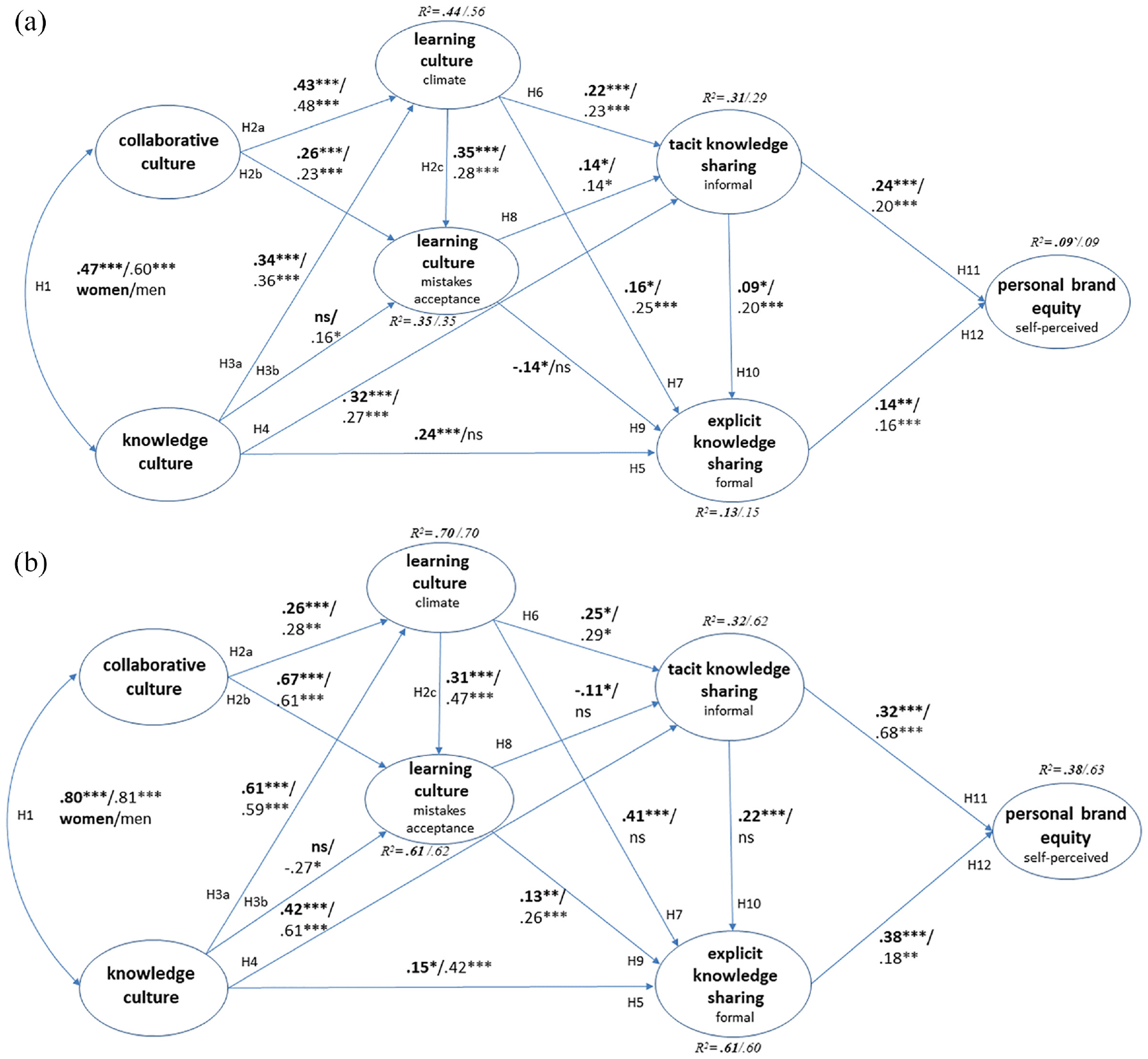
Structural Model Results for: (a) Poland and (b) the US. Note. Poland: n = 1,050 (522/528) women/men; χ2 = 676.68(214)/ 567.36(214); CMIN/df = 3.16/2.65; ML = standardized results; RMSEA = 0.064/0.056; CFI = 0.936/0.950; TLI = 0.925/0.941; ***p < .001, **p < .01, *p < .05. US: n = 1,118 (552/566) women/men; χ2 = 582.83(215)/597.13(215); CMIN/df = 2.71/2.77; ML = standardized results; RMSEA = 0.056/0.056; CFI = 0.955/0.934; TLI = 0.947/0.923; ***p < .001, **p < .01, *p < .05.
To sum up all the results presented in this section, this empirical study revealed that the KLC culture approach not only stimulates knowledge flow in the organization but also shapes the self-perceived personal brand equity of those knowledge workers who share knowledge. Moreover, tacit knowledge sharing is a stronger influencer of personal brand equity (self-perceived) than is explicit knowledge sharing. It is probably because this knowledge is quite unique, as Polanyi (1966), Nonaka (1994), Olaisen and Revang (2018), Asher and Popper (2019), and Kucharska (2021a, 2021b, 2022) have emphasized.
Discussion
The focal finding of this research is that the KLC company culture approach supports tacit and explicit knowledge sharing, both of which matter for personal brand equity building by knowledge workers. Two important aspects that might strengthen the understanding about this finding are gender and cross-country analyses, which are discussed in more depth next.
Cross-Country Analysis
The presented results showed that the general difference observed between Poland and the US regarding the KLC approach is that the power of the influence of the knowledge culture on the learning and collaboration cultures among knowledge workers is stronger in the US than in Poland. Moreover, the collaborative culture is stronger in the US than in Poland and supports the mistake acceptance component of the learning culture, whereas the support for the climate component is stronger in Poland than in the US. Given the positive influence of the climate on the mistake acceptance component of the learning culture, it is expected that the climate component probably serves as a mediator between the collaborative culture and the mistake acceptance component of the learning culture, as observed by Kucharska (2021a, 2021b, 2022). A key finding is that the collaborative culture is crucial for favorable conditions for learning from mistakes in the US, whereas in Poland, it is the assumed mediated effect of the climate component of the learning culture.
The mistake acceptance component of the learning culture particularly matters for tacit knowledge sharing in Poland, but it does not in the US. The mistake acceptance component of the learning culture in the US strongly supports explicit knowledge sharing, but it does not in Poland. Thus, the observed pattern is then quite the opposite in both countries. That is expected to be the effect of the double bias of mistakes, which is as strong as the knowledge culture. The “zero mistakes” approach is characterized by the organization or its divisions in which repeated actions dominate (e.g., the production departments) and also by the mature, bureaucratic organization in which policies, rules, procedures, and control secure any uncertainty avoidance—such that there is no space for mistakes for there is limited space for creativity and innovations, as stated by Kucharska and Bedford (2023).
Further, as regards the influence of knowledge sharing (tacit and explicit) on personal brand equity, tacit (novel) knowledge sharing is better than explicit knowledge sharing at supporting the knowledge worker’s personal brand equity. Tacit knowledge undoubtedly is a fantastic source of innovation (Ganguly et al., 2019). However, tacit knowledge sharing is problematic because no organizational rule or procedure can force it (Ganguly et al., 2019; Kucharska & Dabrowski, 2016; Polanyi, 1966; Sheng, 2019) because it is a voluntary act of knowledge workers. Therefore, as the findings of this study show, supporting this act by establishing an appropriate company culture and recognizing the personal brands of those who share their knowledge is an effective approach that organizations can adopt to support tacit knowledge sharing. Providing such support matters for knowledge-driven organizations that want to stay competitive because, to do so, they need innovations (Kucharska, 2021a, 2021b, 2022a). Thus, the KLC culture development and the organizational support for the personal brands of knowledge workers can lead to smoother knowledge sharing among employees, which is a benefit for knowledge-driven organizations given the positive effects on innovativeness and overall organizational performance.
Gender Analysis
The obtained results clearly revealed the gender inequality problem observed in STEM; that is, women must perform much better than men at work to be considered equally. In such situations, the bias of mistakes may harm them more than men, as uncovered by the present study. In this context, the mistake acceptance component of the learning culture is assumed to be quite controversial for personal branding. Indeed, women do not consider that the knowledge culture significantly improves the tacit knowledge flow in Poland and the explicit knowledge flow in the US. For men in the US, the mistake acceptance component of the learning culture is negatively related to the knowledge culture but positively to the collaborative culture. Conversely, in Poland, men view this component positively. Women with a high knowledge culture do not perceive any support for mistakes or acceptance of the learning culture in their organizations, but interestingly, men see it. Polish men view it positively, and the US men negatively. Thus, the presented findings confirm that the mistake acceptance component of the learning culture remains controversial, and it is viewed differently across genders and nations (Kucharska & Bedford, 2023). This situation also reveals the difference between the knowledge and learning cultures. If the former dominates learning, then there is no room for mistake acceptance (knowledgeable people do not make mistakes), which is in significant opposition to the focal learning attitude reported by Senge (2006) that everyone who wants to learn should be ready to be wrong—if not, learning can be problematic. For this reason, mistake acceptance is so controversial and cognitively biased. Mistakes are not appreciated, but simultaneously, there is no learning without mistakes. In line with this view, it is worth noting that according to Polish women, mistake acceptance in the learning culture positively supports tacit knowledge sharing and negatively supports explicit knowledge sharing.
Precisely the opposite result is observed for women in the US, where the positive influence of the mistake acceptance component of the learning culture is noted only for explicit knowledge sharing (negative for tacit). The pattern is the same for men, but instead of negative, a non-significant effect is noted for tacit knowledge sharing in the US and for explicit knowledge sharing in Poland. Therefore, gender matters for the perception of the mistake acceptance component of the learning culture for knowledge flows. In Poland, women see it as supportive but informally (tacit knowledge sharing); in the US, the opposite is true, and women share knowledge gained from mistakes more openly. It might be an effect of the entire aforementioned bias of mistakes and also the management’s maturity in the particular country or organization (Bell & Kozlowski, 2011; Fischer et al., 2018; Horvath et al., 2021), or the aforementioned gender self-confidence at work issue. Guillén et al. (2018) noted that women are usually less self-confident at work than men, and this is particularly visible in STEM areas (Diez et al., 2023; Kuchynka et al., 2022; Santos et al., 2022).
Summing up, the presented study showed that women perceive the mistake acceptance component of the learning culture as more problematic than do men. This difference can be caused by the general organizational maturity in error management or by gender inequality observed in STEM disciplines and represented in these sectors. However, this study did not verify any of these hypothetical reasons. It rather revealed that the KLC culture stimulates knowledge flow in the organization, which in the knowledge-driven business environment also shapes the self-perceived personal brand equity that differs by gender and country. For theoretical and practical reasons, further studies are needed to determine the underlying reasons for these differences.
Practical Implications
The main finding of this research is that the KLC company culture approach supports tacit and explicit knowledge sharing, both of which matter for knowledge workers’ personal brand equity building. Analyzing this finding in the broader, but vital, context of employee–employer co-branding outlined in the introduction section, the practical conclusion extracted from this study is that indeed, as conjectured in the introduction section, knowledge-driven organizations can gain doubly when they care about the implementation of the subcultures that comprise the KLC culture approach that essence is the synergy of knowledge, learning, and collaboration. The first benefit is the smooth knowledge flow that supports knowledge-driven strategies and, as a result, the ultimate organizational performance. The second benefit precisely concerns employee–employer co-branding. The KLC culture that supports the employees’ brand simultaneously supports the employer’s brand. This key practical implication is formulated from a synthesis of this study’s findings and those of the earlier studies presented in the introduction and discussion sections. Nevertheless, any practical guidelines must include a broader scientific context to be useful.
Cross-Country Issues
Overall, the findings revealed that the entire explored relationship structure is more significant for the US than for Poland (R2=.63/.09). Accordingly, the key practical implication on comparing the national models is that although in Poland knowledge shared can be regarded as indicators of knowledge workers’ professional competencies (i.e., to share knowledge, you must have it first), this effect is not observed to be as strong as it is for the US. Thus, these indicators are not as solid a base for personal brand equity prediction in Poland as they are in the US. Probably, other skills—such as environmental or social skills—matter more in Poland, but this aspect requires verification. If so, the KLC culture approach implemented in knowledge-driven organizations will not be as strongly and doubly beneficial in Poland as it will be in the US. To sum up, the assumed mechanism of employer–employee co-branding based on brand equity rooted in mutual, strong knowledge may be more problematic to achieve in Poland than in the US.
Gender Issues
Notably, the findings suggest that the negative attitude among women to accepting mistakes may result from their lower self-confidence than men at work. From a practical viewpoint, if this indeed is a self-confidence issue, senior management should pay more attention to building a more diversity-friendly organization in order to increase smooth knowledge sharing among knowledge workers regardless of their gender. The smooth circulation and transformation of knowledge among knowledge workers is a base for organizational innovativeness and performance improvement (Zhou & Li, 2012). If knowledge workers indeed view their personal brands as an outcome of their knowledge sharing, as this study has revealed, supporting these brands—both of female and male employees—is crucial for fair individual knowledge sharing outcomes in knowledge-driven organizations, as suggested by Kucharska and Dabrowski (2016) and Kucharska (2022).
Limitations and Further Research Directions
As explained in the method section, the main study limitations concern the US sample that showed a little bias rooted in the high correlation between the following constructs: tacit knowledge sharing, knowledge culture, learning culture, and collaborative culture. However, the test for CMB did not reveal serious problems. Moreover, the invariance analysis results detected acceptable metric fit and not acceptable poor scalar fit based on ΔCFI and ΔTLI, and excellent ΔRMSEA results for both models, measurement and structural. These results suggest that for men in the US, the constructs—tacit knowledge sharing, knowledge, learning, and collaborative cultures—are strongly correlated and then co-found each other.
Another limitation is that important variables, such as the age, position, risk-taking/critical thinking attitudes of knowledge workers; and the size, maturity level, culture type, and ownership type (i.e., public or private) of organizations were not considered in this study, but the inclusion of these in the analysis could improve the understanding of the presented relationships.
Moreover, as mentioned in the results section, the hypothesized double bias of mistakes is a reason that the knowledge culture does not support the mistake acceptance component of the learning culture as strongly as it does its climate component. This influence is hypothesized to be weak or not significant because, in principle, the knowledge culture promotes excellence. Thus, “acceptance of mistakes as a source of learning” can sound controversial to those who advocate for a very strong knowledge culture, especially since, logically, mistakes are in opposition to excellence. Therefore, mistakes can still be perceived negatively, even if a source of learning, which can make the entire process of learning from mistakes problematic. As stated, it can be a side effect of the double bias of mistakes elaborated by Kucharska and Bedford (2023), and certainly should be verified.
Similarly, the hypothesized dependence is that a strong knowledge culture reflects a strong call for excellence. The highest pressure for excellence -the biggest double bias of mistakes that may lead to the “zero mistake acceptance” attitude. This should also be an exciting area for further research. Further, the effect revealed for the sample composed of Polish men is positive but weak. It means that the pressure for excellence or the bias of mistakes (or both) is not as high as it is for the sample composed of US men. Nevertheless, the relationship between the pressure for excellence, the bias of mistakes, and the ability to learn from mistakes is formulated as a hypothesis post-hoc, which should be verified further to arrive at a complete understanding of this relationship. Thus, the double bias of mistakes can be an interesting topic for further research. Last, both mediation and moderation were not analyzed in this study. There probably may be some focal variables (personal and organizational) that can significantly moderate the given results, such as gender, age, family status, life satisfaction, self-confidence or managerial position, sector, the leadership style (Kucharska & Rebelo, 2022; Samhran et al., 2023), which can be considered in future studies.
Conclusion
This study contributes to the limited literature on the personal branding of knowledge workers by demonstrating that the KLC organizational culture that facilitates knowledge, learning, and collaboration among employees supports (explicit and tacit) knowledge sharing. Knowledge sharing matters for knowledge workers’ personal brand equity building. Specifically, the more they expose their expertise through knowledge sharing, the better is their personal brand reputation. Revealing this mechanism enables us to conclude that by supporting the personal brands of knowledge workers, their employers support organizational knowledge sharing—a vital process that contributes to the performance of knowledge-driven organizations.
The focal finding of this research is that the KLC culture approach supports tacit and explicit knowledge sharing, both of which matter for the personal brand equity building by knowledge workers. Considering the presented findings in the broad context of employee–employer co-branding outlined in the introduction section, this study asserts that knowledge-driven organizations can win doubly when they care about the implementation of the subcultures that comprise the KLC approach. The first benefit is the smooth knowledge flow that supports knowledge-driven strategies and, as a result, performance. The second expected benefit concerns employee–employer co-branding. The KLC culture that supports employee brands simultaneously supports the employer brand. The key to obtaining these benefits is the strong personal brand equity of knowledge workers—if their personal brands equity is weak, they cannot support their employers. Thus, in light of the presented findings, the synergy of knowledge, learning, and collaboration cultures brought about by the KLC approach yields double benefits to knowledge-driven organizations and proves that, indeed, personal branding of knowledge workers can be seen as a knowledge management tool as suggested by Vallas and Cummins (2015). This study empirically proved that knowledge workers see knowledge sharing (tacit and explicit) as activities influencing their personal brand equity, which organizations can note as a profound motivation to share knowledge.
Footnotes
Appendix
(d) USA, Men.

| Factor | |||||||
|---|---|---|---|---|---|---|---|
| 1 | 2 | 3 | 4 | 5 | 6 | 7 | |
| TKS1 | −.110 | 0.131 |
|
||||
| TKS2 | −.118 |
|
|||||
| TKS3 | 0.189 | 0.106 |
|
||||
| EKS1 | 0.272 |
|
−.109 | ||||
| EKS2 |
|
||||||
| EKS3 |
|
0.135 | |||||
| KC1 | −.113 | 0.211 |
|
0.119 | 0.132 | ||
| KC2 |
|
0.167 | 0.113 | ||||
| KC3 | −.127 |
|
0.147 | ||||
| CC1 | 0.174 | 0.136 |
|
−.222 | |||
| CC2 | 0.252 | 0.133 |
|
||||
| CC3 | 0.128 | 0.168 | −.145 |
|
|||
| LCc1 | 0.172 |
|
0.172 | ||||
| LCc2 |
|
||||||
| LCc3 | 0.108 | 0.108 | −.132 |
|
|||
| LCc4 | 0.335 |
|
|||||
| LCM1 |
|
||||||
| LCM2 |
|
||||||
| LCM3 |
|
−.105 | 0.101 | 0.150 | |||
| LCM4 |
|
0.117 | |||||
| PBE1 |
|
0.110 | |||||
| PBE2 |
|
0.100 | |||||
| PBE3 |
|
0.122 | 0.106 | ||||
Note. Loadings extraction method: maximum reliability. Rotation method: Promax with Kaiser normalization. Rotation converged in seven iterations. Extracted for the particular construct’s loadings are presented as bolded.
Declaration of Conflicting Interests
The author(s) declared no potential conflicts of interest with respect to the research, authorship, and/or publication of this article.
Funding
The author disclosed receipt of the following financial support for the research, authorship, and/or publication of this article: The research presented in this paper was created as a result of the research project entitled “The Influence of Tacit Knowledge Sharing on Innovativeness: A Sector Analysis” NCN UMO-2018/31/D/HS4/02623 financed by the National Science Center of Poland (NCN).

Data Availability Statement
Research data is available if requested.