




Abstract
The role of social capital in predicting knowledge sharing has received considerable attention in research. However, very limited research has investigated the mechanisms mediating this relationship. To address this important gap in knowledge, the purpose of this study was to examine employee vigor as a psychological mechanism mediating the effect of social capital on tacit knowledge-sharing intention. Data collected from 209 employees in multiple industries in China were empirically tested by using structural equation modeling analysis. The results show that social capital positively affects emotional energy, which then positively influences the intention to share tacit knowledge. However, neither physical strength nor cognitive liveliness mediates the path through which social capital impacts tacit knowledge-sharing intention. Our research findings unpack the impact mechanism of social capital on tacit knowledge-sharing intention, and provide practical insights into how to use social capital to facilitate employees to share tacit knowledge in organizations.
Introduction
Knowledge is the foundation of a firm’s competitive advantage and the primary driver of a firm’s value (Grant, 1996). Effectively encouraging employees to share useful knowledge across the organization can increase and sustain a firm’s competitive advantages (Grant, 1996; Liu & Phillips, 2011). However, more than 70% of employees hide their knowledge from colleagues (Connelly et al., 2012). To prevent knowledge hoarding, many knowledge-intensive organizations have invested in tools and policies to enhance knowledge sharing and application to tackle sharing barriers.
Knowledge shared among employees can be classified as either tacit or explicit (Bolisani & Bratianu, 2018; Nonaka, 1994). Explicit knowledge refers to objective knowledge that can be articulated, codified, and easily expressed in formal language and documents, while tacit knowledge is subjective know-how that is much more challenging to formalize, articulate, and communicate to others (Nonaka, 1994; Nonaka et al., 2000). Compared with explicit knowledge, tacit knowledge is difficult to imitate or share (Coff et al., 2006; van den Berg, 2013), and it is not easy for a competitor to steal or copy it; therefore, it constitutes the core competitiveness of enterprises and forms the true source of sustainable competitive advantage of an organization (Koskinen & Vanharanta, 2002; Wipawayangkool & Teng, 2016). Because tacit knowledge is highly personal and hard to formalize (Cairó Battistutti & Bork, 2017; Lin, 2007), the effective transformation and dissemination of tacit knowledge has become a challenge (Agyemang et al., 2016). While explicit knowledge sharing can be facilitated by information technology, tacit knowledge sharing is subject to social interaction (Nonaka, 1994). As a product of regular and recurrent social interaction (Coleman, 1988), social capital has been identified as one of the critical drivers of tacit knowledge sharing (Hau et al., 2013; Yu et al., 2013).
Although it is a widely held belief that social capital facilitates knowledge sharing among individuals (Hau et al., 2013; X. Zhang et al., 2017), there is little research that has investigated the potential mediating mechanism between the two constructs. Our study is a step toward addressing the research gap. Given that social capital enhances vigor (Carmeli et al., 2009), representing the positive affective response to one’s ongoing interaction with significant elements in one’s job and work environment, the current study treated employee vigor as a mediator and explores the relationship of social capital, employee vigor, and tacit knowledge-sharing intention.
Our research has both theoretical and practical importance. From a theoretical perspective, our research contributes to literature on social capital and knowledge sharing in important and meaningful ways. First, we investigate whether social capital can serve as an important predictor of employees’ tacit knowledge-sharing intentions. Second, it explains the formation mechanism of tacit knowledge-sharing intention in organization through introducing employee vigor. This finding extends earlier work (e.g., Hau et al., 2013; S. C. Yang & Farn, 2009) that merely focused on the direct relationship between social capital and tacit knowledge sharing. We advance earlier studies that provide limited insights into the underlying psychological processes of social capital on tacit knowledge sharing by identifying employee vigor as mediator of this effect. For practice, this study provides new insights for managers to understand how to promote the generation of tacit knowledge-sharing intention of employees.
Literature Review
Tacit Knowledge Sharing
Nonaka (1994) addresses two types of knowledge within organizations: explicit and tacit. Explicit knowledge is formally articulated, fixed, codified, and well documented (McInerney, 2002). However, tacit knowledge refers to the expertise and assumptions that individuals develop, which is context specific and subjective, and this type of knowledge essentially resides in the minds of the individuals and is expressed in the form of human actions such as attitude, commitment, and motivation (Nonaka & von Krogh, 2009). That is to say, tacit knowledge is the knowledge that we draw on in use, but is difficult to have consciousness of, or to express in language (Hadjimichael & Tsoukas, 2019). This type of knowledge may play an important role in strategic planning performance of managers and professional staff (Brockmann & Anthony, 1998). In this study, tacit knowledge-sharing intention refers to the extent to which an individual would like to share experiences and know-how with his or her coworkers (S. C. Yang & Farn, 2010).
Researchers have identified many factors that influence tacit knowledge sharing under the context of organizations. Based on the framework of Wang and Noe (2010), this article summarizes the factors that influence tacit knowledge sharing in organizations into three categories: individual characteristics, environmental, and motivational factors.
Individual characteristics
Existing literature has studied individual factors influencing individuals’ knowledge sharing from the perspectives of individual characteristics (Zeraati et al., 2019). Sharing knowledge is affected by employees’ personality traits and self-efficacy. A study by Matzler et al. (2008) found that agreeableness, conscientiousness, and openness influence knowledge sharing. Extroverted individuals have the tendency to drive conversations, and because of this, they may be less receptive to new ideas (Borges, 2013). The meta-analysis of main and moderating effects of knowledge-sharing research by Nguyen et al. (2019) suggested age and gender moderated the motivation and knowledge-sharing relationship. Specifically, if women have a sense of self-efficacy, they are more likely to share knowledge than men, while men tend to be more active in sharing knowledge if they have self-enjoyment when considering knowledge sharing as an enjoyable activity. In addition, individuals’ age might moderate the relationship between reciprocity and knowledge-sharing behavior. Specifically, the effect of reciprocity was stronger for younger participants (Nguyen et al., 2019).
Motivational factors
Tacit knowledge sharing can be facilitated by intrinsic motivation, such as sociability and friendship (Osterloh & Frey, 2000), enjoyment (Hau et al., 2013), and self-efficacy (S. C. Yang & Farn, 2010; L. Zhang & He, 2016). Chennamaneni et al. (2012) found that individuals contribute to their knowledge because they feel good about helping others. However, a lack of self-efficacy was found to have negative impacts on tacit knowledge sharing because people who lack self-efficacy fear that they may mislead others or provide useless information (L. Zhang & He, 2016).
Extrinsically motivated employees are driven by the benefits and rewards derived from sharing their knowledge (Wang & Noe, 2010). Although organizational rewards have a positive influence on employees’ explicit knowledge-sharing intentions, their effects on tacit knowledge-sharing intention are negative (Hau et al., 2013). This finding was later confirmed by Hau et al. (2016); they found that anticipated extrinsic rewards have a negative effect on employees’ tacit knowledge sharing.
Among types of trust, affect-based trust has been proven to be effective in facilitating tacit knowledge sharing (Q. Huang et al., 2011; Rutten et al., 2016). However, research seems inconclusive on the effect of cognition-based trust on tacit knowledge sharing. The paradoxical findings may be due to the fact that these studies did not distinguish between tacit knowledge sharing and use. Holste and Fields (2010) found that affect-based trust has a significantly greater effect on the willingness to share tacit knowledge, while cognition-based trust plays a greater role in willingness to use tacit knowledge. Recently, Vasin et al. (2019) found that the willingness to share tacit knowledge is more influenced by affect-based trust between individuals, while cognition-based trust is more significant in explaining the willingness to share explicit knowledge.
Environmental factors
Empirical studies found that tacit knowledge-sharing behavior is not only influenced by psychological motivations but also influenced by environmental factors, such as national culture (Borges et al., 2019; Tong et al., 2009), leadership characteristics (Shao et al., 2016), and social networks (Chow & Chan, 2008).
Research conducted by Suppiah and Sandhu (2011) showed that organizational culture types influence tacit knowledge-sharing behavior and that such influences may be positive or negative depending on the culture type. Researchers have used social exchange theory to examine how justice, a key component in interpersonal relationships, relates to knowledge sharing. Using part-time business administration students in Taiwan, Lin (2007) found that both distributive and procedural justice had positive indirect effects on tacit knowledge sharing via organizational commitment. In addition, leadership styles may affect employees’ willingness to share tacit knowledge (Chen et al., 2018; Shao et al., 2016). For example, research by Shao et al. (2016) found that charismatic leadership has a strong influence on psychological safety climate, which in turn has a positive impact on individuals’ tacit knowledge-sharing behavior.
Prior studies suggest that the existence of network connections and the associated social capital can facilitate tacit knowledge sharing (Nahapiet & Ghoshal, 1998; S. C. Yang & Farn, 2010). Individually held social capital supplies the necessary motives for team members to engage in tacit knowledge sharing within teams (Yu et al., 2013). Relational social capital such as affect-based trust and shared value are associated with tacit knowledge-sharing intention among organizational members (S. C. Yang & Farn, 2009). In addition, socio-cultural factors such as guanxi orientation and face (Q. Huang et al., 2011) have a positive effect on intention to share tacit knowledge.
Social Capital
Social capital refers to the features of social organizations, such as networks, norms, and trust, that facilitate action and cooperation for mutual benefit (Putnam et al., 1994). Nahapiet and Ghoshal (1998) viewed social capital as the resource that individuals obtain from their relational networks. A higher level of social capital has been associated with a level of job satisfaction (L. V. Huang & Liu, 2017), emotional support (Kikuchi & Coleman, 2012), the effectiveness of workgroups (Oh et al., 2004), creation of intellectual capital and dissemination of knowledge within an organization (Nahapiet & Ghoshal, 1998), firm innovativeness (Weerakoon et al., 2020), and a low level of employee-exit rates (Jensen et al., 2019). However, Pillai et al. (2017) suggested that there are possible negative effects of social capital such as dilution of the dialectical process and nonrational escalation of commitment.
Social capital, as a set of resources rooted in networking relationships, can be decomposed into three distinct facets: structural capital, relationship capital, and cognitive capital (Nahapiet & Ghoshal, 1998). Structural capital refers to the general structure of social connections among individuals. Relational social capital includes the assets created and leveraged through ongoing relationships that influence social actors’ behavior. Besides, Nahapiet and Ghoshal (1998) regard cognitive capital as the common understanding among social actors through shared language and narratives. These dimensions that promote interactions among individuals (Coleman, 1988) supply motives for individuals to act collectively and share knowledge (Yu et al., 2013).
Employee Vigor
Employee vigor is defined as a positive affective response to one’s ongoing interaction with significant elements in one’s job and work environment that comprises the interconnected feelings of physical strength, emotional energy, and cognitive liveliness (Shirom & Melamed, 2006). Physical strength refers to feelings regarding one’s physical abilities, and the exertion of physical energy in the workplace. Emotional energy refers to the interpersonal feelings evoked in the expression of sympathy, empathy, and emotional support to others, while cognitive liveliness deals with one’s sense of mental agility, cognitive awareness, and one’s feeling of flow in thought (Wefald et al., 2017). The view of vigor is derived from Hobfoll’s (1989) conservation of resources theory which states that people have a basic motivation to obtain, retain, and protect that which they value. Resources are the things that people value, such as material, social, and energetic resources. The three types of energetic resources, namely, physical, emotional, and cognitive energies, are individually owned, closely interrelated, and socially embedded in that emotional energy always concerns significant others in one’s social milieu (Shirom, 2007).
Shirom (2007) suggested that vigor was impacted by organizational resources, group-level resources, job-related resources, and individual resources. From the organizational perspective, participation in decision-making (Luthans et al., 2007) and incentive-based reward practices (Shraga & Shirom, 2009) are primary facilitators of vigor. When evaluated at the group-level resources, meaningful interactions with others (Shraga & Shirom, 2009) and group cohesion (Terry et al., 2000) were found to predict vigor. Apropos of job-related resources, coping with challenging situations and achieving success on a project are critical to encouraging vigor (Shraga & Shirom, 2009). Finally, at the individual level, leadership style and expertise power are likely to have an effect on vigor. For example, based on a sample of salespeople, Gao et al. (2020) found that transformational leadership has a positive effect on employee vigor.
Job satisfaction, physical and mental health, job performance, and organizational effectiveness are the five main consequences of vigor (Shirom, 2011). Literature largely supports association between vigor and self-rated health (Shirom et al., 2008). For example, Shirom et al. (2010) found that feeling vigorous at work protected the participants from diabetes and reduced their risk of mortality. In addition, personality, genetic, and physiological factors may moderate the relationship between vigor and its plausible consequences (Shirom, 2011).
Hypothesis Development
Social Capital and Tacit Knowledge-Sharing Intention
Social capital encompasses many aspects of a social context, such as social ties, trusting relations, and value systems, that facilitate actions of individuals located within that context (Tsai & Ghoshal, 1998). Previous studies identified social capital as a salient factor in facilitating tacit knowledge sharing (e.g., Ganguly et al., 2019; Göksel & Aydıntan, 2017; Hau et al., 2016). S. C. Yang and Farn (2009) employed perspectives of social capital to investigate employees’ tacit knowledge-sharing behavior within a work group. In addition, Göksel and Aydıntan (2017) found that social capital and its basic structural, cognitive, and relational dimensions tend to increase tacit knowledge-sharing intention, which gradually turns into behavior. Recently, the significant role of structural and cognitive social capital played in the successful sharing of tacit knowledge has been confirmed by Ganguly et al. (2019). Trust is an important dimension of Leana and Van Buren’s (1999) conceptualization of social capital. Research shows that affect- and cognition-based trust both influence willingness to share and use tacit knowledge (Holste & Fields, 2005). Similarly, the quality of relationship between knowledge sharers and knowledge receivers (Holste & Fields, 2010) is the important factor affecting tacit knowledge sharing among individuals. Thus, this study’s research model considers social capital an important antecedent to employees’ tacit knowledge-sharing intentions, generating the following hypothesis.
Mediating Role of Employee Vigor
Previous studies have only explored the direct effects of social capital on knowledge sharing (e.g., Hau et al., 2013; Wasko & Faraj, 2005), but have neglected the existence of mediators. A potential mediator between employees’ social capital and their performance is vigor, which appears to be highly important for motivation and engagement (Saks, 2006; Schaufeli & Bakker, 2004).
Social capital may be a protective factor for some physical health conditions (Rodgers et al., 2019). Workers reporting individual-level mistrust and lack of reciprocity had approximately double the odds of poor health even controlling for sex, age, occupation, educational attainment, smoking, alcohol use, physical activity, body mass index, and chronic diseases (Suzuki et al., 2010). Prior research suggested that positive relationships at work create immediate and enduring consequences for an individual’s health (Fritz et al., 2011). Therefore, we posit a positive effect of social capital giving on physical strength.
The transfer of tacit knowledge is often dependent on informal interactions among individuals and organizations (Hadjimichael & Tsoukas, 2019). This kind of informal communication increases employees’ energy at work, which, in turn, has a considerably positive effect on their extra role behavior (Alparslan & Kılınç, 2015). To the extent that employees have physical resources available to them, they should feel more engaged in their job. Illness not only comes with limitations of diminished physical effort, it can also come with an extra burden for the individual. When health is hindered, the individual will reprioritize their efforts to address the more relevant task of managing pain, illness, or even the basic tasks that their job requires (Ford et al., 2015). This would then result in an increase in disengagement from sharing tacit knowledge. Thus, the following hypothesis is proposed:
Employees who have high-quality interpersonal relationships or high levels of social capital can obtain more emotional support (Ben Hador, 2016; Oh et al., 2004) and energy (Shraga & Shirom, 2009) from the organization, and tend to increase their willingness to cooperate with colleagues (Welbourne et al., 2005). All these can further motivate employees to energetically fulfill the tasks given by the organization. According to the broaden-and-build theory (Fredrickson & Losada, 2005), positive emotions can increase individual cognitive and action ability (Spreitzer et al., 2005) and thought flexibility (Isen & Daubman, 1984). These abilities are the prerequisites for the externalization of tacit knowledge. Thus, positive emotions provide a necessary psychological premise for the effectively flowing of tacit knowledge in the organization. However, when employees feel psychologically exhausted and burned out at work, they may engage in knowledge hiding behaviors (Ali et al., 2020). Lee et al. (2018) argued that emotionally exhausted employees try to minimize resource loss and regain control of their situation by decreasing discretionary contextual performance such as knowledge-sharing behaviors. Thus, the following hypothesis is proposed:
The status of the individual in society, and his or her social relationships and social network are important to ensure conditions of influence and accentuate social differences, which are associated with personal characteristics including professional experience, level of knowledge, and cognitive capabilities (Felício et al., 2014). Similarly, Salanova et al. (2006) suggested that organizational resources including social support climate and clear goals facilitate work-related flow such as work absorption, work enjoyment, and intrinsic work motivation. Therefore, we posit a positive effect of social capital giving on cognitive liveliness.
Individual tacit knowledge is viewed as the knowledge that is stored in the individual’s cognitive schemata and is hard to express (Hadjimichael & Tsoukas, 2019). Mental agility, which is related to one’s ability to face complexity and ambiguity and explain thoughts to others (Cassidy & Cassidy, 2019), has the potential to modify organizational practices and develop innovative solutions for problems (Ordóñez de Pablos, 2004). Thus, cognitive liveliness may facilitate the sharing of tacit knowledge. The above analysis leads to the following hypothesis:
The research model is shown in Figure 1:

Research model.
Method
Data Collection
In this study, a survey of 260 employees in multiple industries in China was conducted. All these employees were invited to fill out online surveys through Wenjuanxing (http://www.sojump.com/), a professional questionnaire distribution platform in China. Participation in the survey was voluntary, and participants were assured that data would be treated confidentially and anonymously. We received 218 questionnaires, and the return rate was 83.85%. To ensure the validity of our data, we removed the questionnaires where data are incomplete (such as with more than five unanswered items), or too many chosen answers are uncertain (such as more than 10 items). Finally, 209 returned questionnaires are selected as valid, and the effective return rate is thus 80.38%. The return rate of this study is similar to that of other studies in psychology (e.g., Blanco-Donoso et al., 2017) and management (e.g., Lee et al., 2018).
Demographic data reveal that the age of the participants is 31 years on average, and the standard deviation is 6.73. Of those 209 respondents, 50.72% are male and 49.28% female. A total of 48.33% of the respondents are general employees, 33.49% professional technicians, and 18.18% managers. In terms of the nature of the enterprise, 29.19% of the respondents work in information technology, 21.59% in manufacturing industries, 9.09% in education, 6.7% in retail, 5.26% in government, 4.78% in health care, 3.35% in banking, 2.87% in transportation, 1.44% in real estate, and 15.79% in other industries. In terms of organizational tenure, 12.92% of the respondents have less than 1 year of work experience, 20.57% have 2 to 3 years, 21.53% have 4 to 5 years, 22.01% have 6 to 9 years, and 22.01% have more than 10 years of organizational tenure.
Measurement
Social capital was measured by nine items adapted from the work of Chow and Chan (2008). The items are rated on a Likert-type 7-point scale (1 = strongly disagree, 7 = strongly agree). A sample item is “My organizational members and I always share the same ambitions and vision at work.”
Employee vigor was measured by the Shirom-Melamed Vigor Measure (SMVM) (Shirom, 2003), which includes a five-item subscale of physical strength, a four-item subscale of emotional energy, and a three-item subscale of cognitive liveliness. A sample item for physical strength is “I feel full of pep.” A sample item for emotional energy is “I feel able to be sensitive to the needs of coworkers and customers.” A sample item for cognitive liveliness is “I feel I am able to contribute new ideas.” All items are scored on a Likert-type 7-point scale, ranging from 1 = never or almost never to 7 = always or almost always.
Tacit knowledge-sharing intention was measured by the three-item scale developed by Bock et al. (2005). A sample item is “I intend to share my work experience or know-how from work with other organizational members more frequently in the future.” The items are rated on a Likert-type 7-point scale (1 = strongly disagree, 7 = strongly agree). The Appendix lists all the survey items.
Data Processing and Analysis
First, we conducted a confirmatory factor analysis (CFA) using Amos 21.0 to test the measurement model, and the acceptability of the measurement model was judged according to model fit indices.
Second, the bootstrapping method was used to further evaluate the structural model by checking the significance of the path coefficient. The coefficient is significant when the confidence interval does not include zero. In this study, we tested the indirect effect with 2,000 bootstrapped samples.
Finally, the significance of each path coefficient and indirect effect was combined to determine whether the hypotheses were supported.
Results
Correlation Matrix of Variables
Pearson correlation analysis was performed and the results are shown in Table 1.
Descriptive Statistics and Correlation Matrix (n = 209).

Note. TKSI = tacit knowledge-sharing intention.
p < .05. **p < .01. ***p < .001.
Convergent Validity
The indicator factor loadings are significant and exceed the acceptable value of 0.6 on their corresponding constructs. The average variance extracted (AVE) for constructs is larger than 0.5, indicating good convergent validity. All Cronbach’s alpha values are between .7 and .9, which is in the commonly acceptable range. Composite reliability (CR) is above .8, indicating acceptable internal consistency reliability. The specific results are shown in Table 2.
Result Summary for Measurement Models.
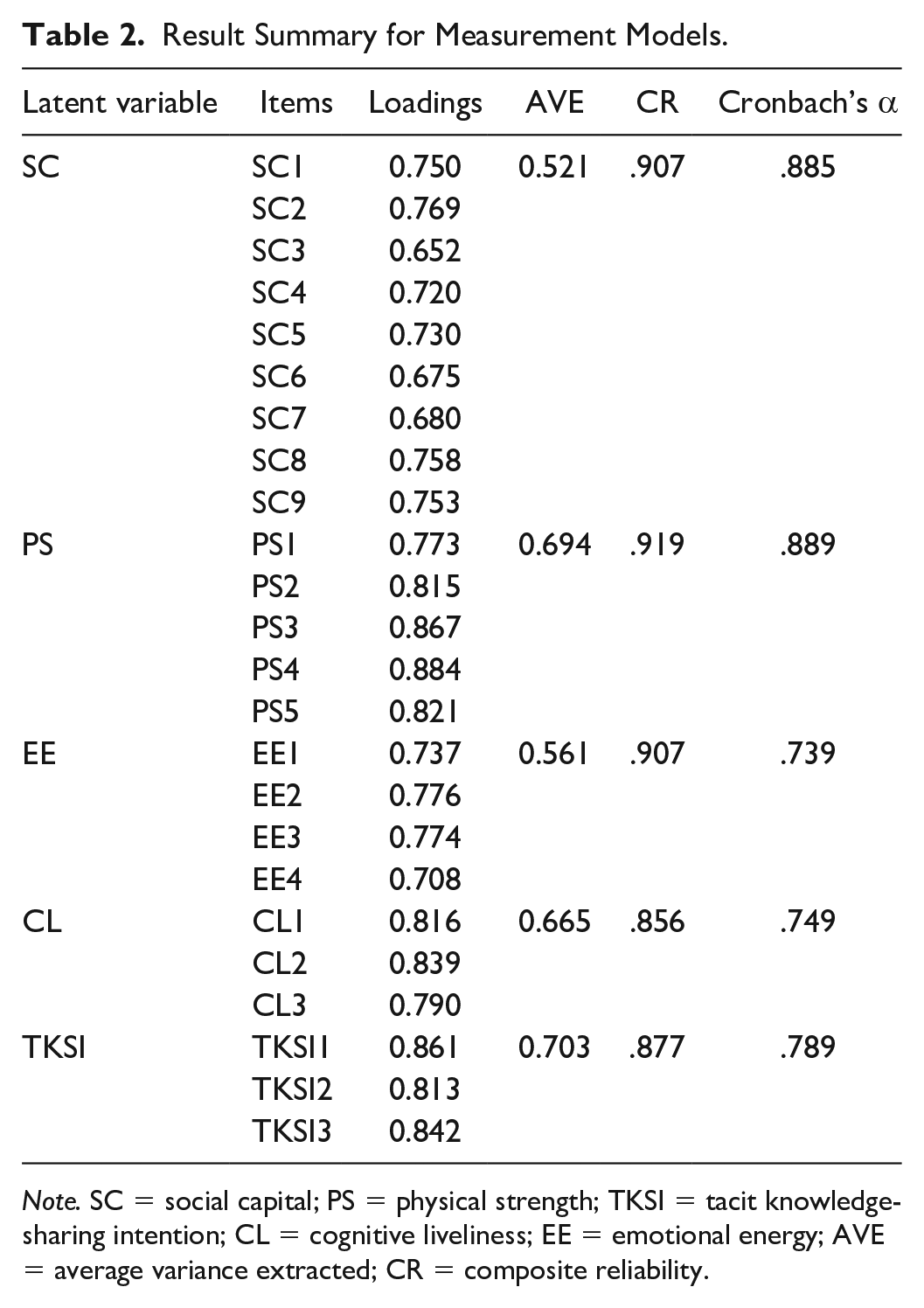
Note. SC = social capital; PS = physical strength; TKSI = tacit knowledge-sharing intention; CL = cognitive liveliness; EE = emotional energy; AVE = average variance extracted; CR = composite reliability.
Discriminant Validity
This study adopts a competition model to test the validity of the variables involved in the research. All the variables were integrated into one factor (social capital + physical strength + emotional energy + cognitive liveliness + tacit knowledge-sharing intention), two factors (social capital + physical strength + emotional energy + cognitive liveliness, tacit knowledge-sharing intention), three factors (social capital + physical strength + emotional energy, cognitive liveliness, tacit knowledge-sharing intention), four factors (social capital + physical strength, emotional energy, cognitive liveliness, tacit knowledge-sharing intention), or five independent factors (social capital, physical strength, emotional energy, cognitive liveliness, tacit knowledge-sharing intention). As we can see from Table 3, by comparing the model fit indices of the competition model to determine the discriminant validity, the results showed that the model fit of the five-factor model was the best (root mean square error of approximation [RMSEA] = 0.06, comparative fit index [CFI] = 0.92, normed fit index [NFI] = 0.85, goodness of fit index [GFI] = 0.92), which confirms the discriminant validity.
Competitive Model Fit.

Note. RMSEA = root mean square error of approximation; CFI = comparative fit index; NFI = normed fit index; GFI = goodness of fit index.
Hypothesis Testing
The hypothesis model presents a good fit (χ2/df = 1.862, RMSEA = 0.064, CFI = 0.908, NFI = 0.822, incremental fit index [IFI] = 0.909), indicating that the model is acceptable.
There is insufficient evidence to support H1, as social capital is not significantly related to tacit knowledge-sharing intention (β = −.015, p > .05). Furthermore, social capital positively affects all dimensions of employee vigor (physical strength, β = .778, p < .001; emotional energy, β = .938, p <.001; cognitive liveliness, β = .744, p < .001). Finally, emotional energy positively influences tacit knowledge-sharing intention (β = .984; p < .05). However, physical strength (β = −.116, p > .05) and cognitive liveliness (β = .160, p > .05) are not significantly related to tacit knowledge-sharing intention. The results of the structural model analysis are displayed in Figure 2.
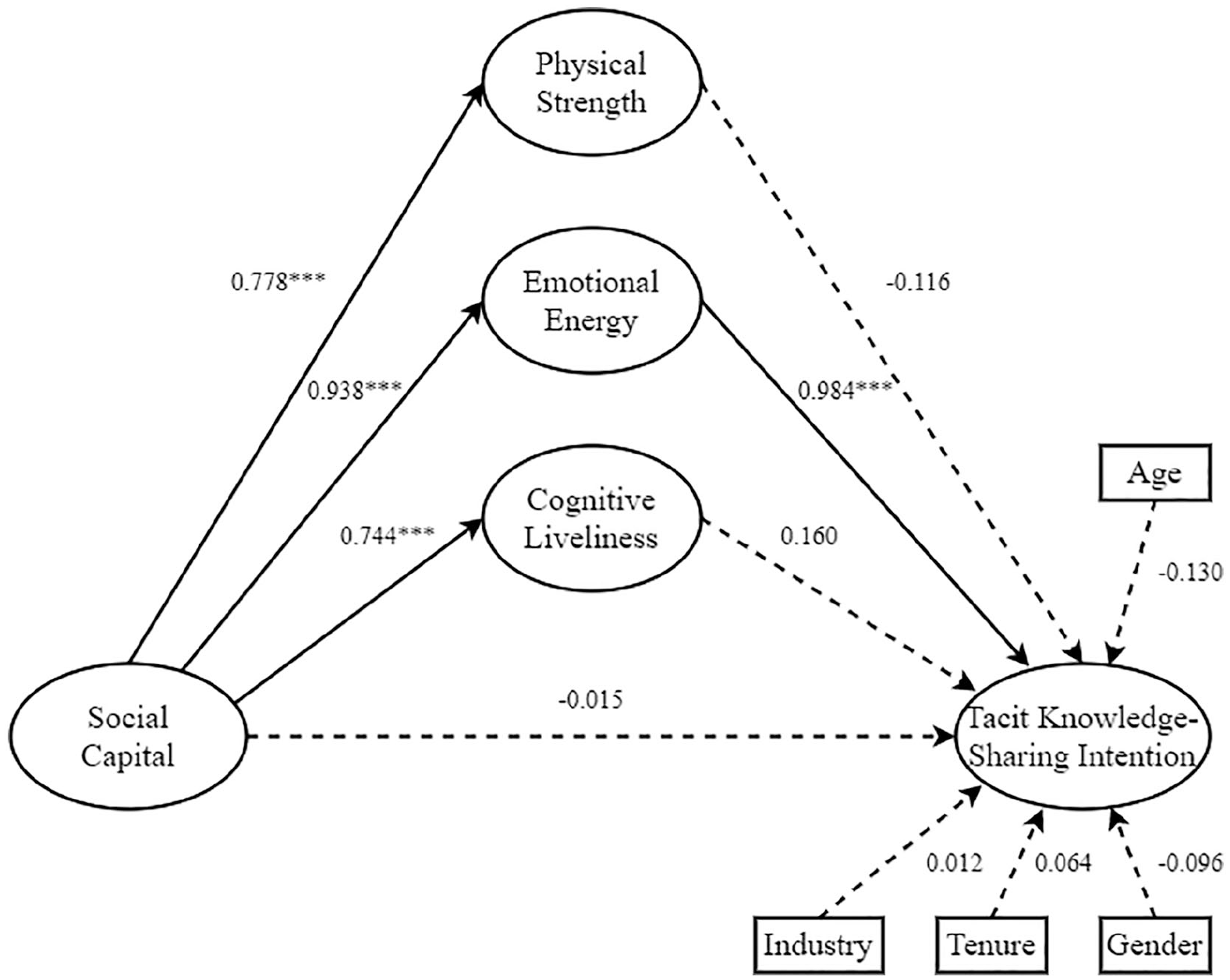
Results of structural model.
The bootstrapping method was used to examine the mediation effects. As shown in Table 4, the standardized indirect effect of social capital on tacit knowledge-sharing intention through physical strength was −0.03, with [−0.535, 0.233] of 95% bias-corrected confidence interval. The standardized indirect effect of social capital on tacit knowledge-sharing intention through cognitive liveliness was 0.162, with [−0.183, 0.621] of 95% bias-corrected confidence interval. The bootstrapping mediation test demonstrated that neither physical strength nor cognitive liveliness mediates the path through which social capital impacts tacit knowledge-sharing intention. Thus, H2a and H2c are not supported. The standardized indirect effect of social capital on tacit knowledge-sharing intention through emotional energy was 0.842, with [0.802, 8.340] of 95% bias-corrected confidence interval, which indicated that emotional energy mediates the path whereby social capital impacts tacit knowledge-sharing intention. Thus, H2b is supported.
Mediation Analysis.
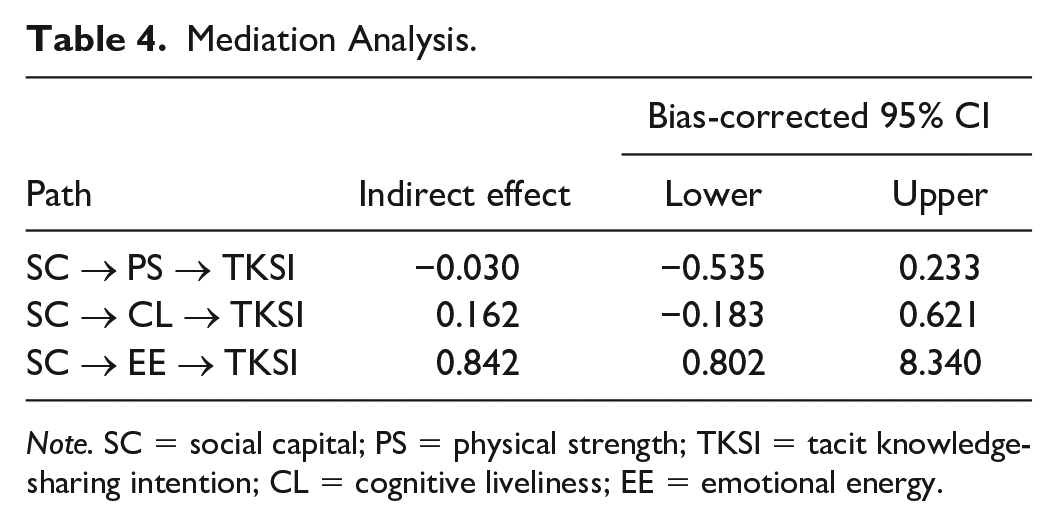
Note. SC = social capital; PS = physical strength; TKSI = tacit knowledge-sharing intention; CL = cognitive liveliness; EE = emotional energy.
Discussion
First, in contrast to previous findings (e.g., Hau et al., 2013), the results from this article indicated that social capital is not significantly related to tacit knowledge-sharing intention. Extant research is reexamined here to include a potentially important but previously unexplored mediator—employee vigor—as affective experiences. When disregarding employee vigor, social capital is positively associated with tacit knowledge-sharing intention (β = .699, p < .001), as found in previous studies. However, social capital is not directly associated with tacit knowledge-sharing intention when considering the emotional energy. Thus, emotional energy intervenes in the association between social capital and tacit knowledge-sharing intention. Omitting emotional energy will result in inaccurate conclusions about the nature of the social capital–tacit knowledge-sharing intention relationship.
Second, this study showed that social capital positively predicted physical strength, emotional energy, and cognitive liveliness, which is consistent with the findings of previous research (e.g., Carmeli et al., 2009). Employees with high levels of social capital not only feel more emotional support from the organization (Oh et al., 2004) but also feel more energetic at work (Carmeli & Spreitzer, 2009; Spreitzer et al., 2005) and experience more vigor (Shraga & Shirom, 2009). In addition, a good working atmosphere which is a form of social capital in organizations can enhance employees’ performance at work (Bakker & Xanthopoulou, 2009). And this positive impact on employee vigor can naturally be derived from the whole social capital level. Recent studies have found that high-quality social capital can stimulate employees’ work vigor and affect their daily lives and work (Ben Hador, 2016), which provides evidence for the results of our current study.
Third, this study showed that emotional energy has a significant positive relationship with tacit knowledge-sharing intention. Employee with higher emotional energy can establish good interpersonal relationships with colleagues in the company, thus creating a good interpersonal atmosphere for tacit knowledge sharing (Heaphy & Dutton, 2008). Furthermore, employees with high emotional energy can recover more quickly from heavy work or frustration (Sonnentag & Fritz, 2007) and better concentrate on work, thereby increasing more opportunities for sharing tacit knowledge. However, other dimensions of employee vigor (physical strength and cognitive liveliness) did not exert any significant influence on tacit knowledge-sharing intention. The following are plausible reasons why these two dimensions might not facilitate tacit knowledge-sharing intention. First, emotional states can be transferred directly from one individual to another via mimicry and the copying of emotionally relevant bodily actions like facial expressions (Zajonc, 1985), whereas physical strength and cognitive liveliness are more like an individual trait (Sanz-Vergel et al., 2011). Second, physical strength and cognitive liveliness may be distal variables affecting tacit knowledge-sharing intention. For example, vigor, happiness, and positive energy shown by energetic employees can create a good working atmosphere (Shirom, 2003, 2011), which creates a good precondition for sharing tacit knowledge. Third, flow in thought is more about personal experience, while the process of tacit knowledge sharing is full of interaction with others. There might be some trigger mechanism to turn this individual experience into social interaction.
Finally, results from this article indicated that employee’s emotional energy fully explains the relation between social capital and tacit knowledge-sharing intention, that is, this is a fully mediated relationship. As an individual relationship resource, social capital is helpful for creating a positive, harmonious, and optimistic organizational climate in an employee’s work environment, which can effectively stimulate the emotional energy of employees. Employees with a high level of social capital put a great deal of energy into the emotional construction at work and take their tacit knowledge as main output and cost of emotional construction, thus promoting the effective sharing of tacit knowledge in the organization. Furthermore, this positive organizational climate created by social capital increases the emotional trust and sharing spirit among employees, which can promote their tacit knowledge-sharing intention. Employees’ social capital can help create a good organizational climate (Carrasco & Bilal, 2016; Saks, 2006), and employees do not worry about sharing their tacit knowledge leading to the decline of their organizational status in such climate ( H. L.Yang & Wu, 2008). It can be seen that employees’ social capital and emotional energy complement each other, which is an important driving force for sharing tacit knowledge.
Implications and Limitations
With these findings, our study makes several contributions to existing literature in social capital and tacit knowledge sharing in organizations. The first contribution is to social capital–tacit knowledge-sharing intention relationship research. This study introduces important theoretical insights by revealing that employees’ emotional energy can bridge their social capital and tacit knowledge-sharing intention. Given that employees’ tacit knowledge-sharing intention may be influenced by their vigor and their social interactions with others, integrating vigor and social capital theories is necessary. Although previous studies have investigated the relationship between social capital and tacit knowledge sharing (e.g., Hau et al., 2013; Yu et al., 2013), the mechanism between the two constructs is often ignored. Given that social capital can enhance individual vigor (Carmeli et al., 2009), this study examines the effect of social capital on tacit knowledge-sharing intention via employee vigor. The results empirically reveal the full mediating effects of employees’ emotional energy on their intention to share tacit knowledge. Hence, the social capital acquired by employees is not directly associated with their tacit knowledge-sharing intention.
This study offers several practical insights into the improvement of tacit knowledge sharing in organizations. The results suggested that employees’ emotional energy can be promoted through managing and constructing employees’ social capital, thereby stimulating employees’ tacit knowledge-sharing intention. Therefore, managers need to focus on macroscopic and strategic issues, such as balancing job competition and employee relations, as well as organization regulations and employee vigor, so that employees have both a competitive side and an interdependent side, which enabling enterprises to operate in a well-organized manner.
The contributions discussed above should be interpreted in light of this study’s limitations. First, cross-sectional research design we used, however, limited our ability to determine causality. Therefore, we recommend future studies that use longitudinal designs and multilevel models to explore the mechanism of the effect of social capital on tacit knowledge sharing at the team level and individual level.
Conclusion
This research was conducted to explore the underlying relationship linking social capital to tacit knowledge-sharing intention. The findings emphasized the importance of social capital as a resource that positively affects the way employees perceive their emotional energy. Such positive perceptions ultimately contribute to employees’ tacit knowledge-sharing intention. Our results extend theory surrounding tacit knowledge sharing by showing that emotional energy plays a full mediating role in the relationship between social capital and tacit knowledge-sharing intention. The critical role played by employee vigor suggests that the enterprise manages the need to provide the employees with adequate and suitable social activities and to stimulate employees’ emotional energy to tacit knowledge exchange.
Footnotes
Appendix
Author Contributions
Y.C. and X.X. conceived of the study, participated in its design and coordination, and performed the statistical analysis and drafted the manuscript; Y.S. performed the measurement and participated in the interpretation of the data; and W.S. participated in its design and provided critical feedback and helped shape the research, analysis, and manuscript. All authors read and approved the final manuscript.
Declaration of Conflicting Interests
The author(s) declared no potential conflicts of interest with respect to the research, authorship, and/or publication of this article.
Funding
The author(s) received no financial support for the research, authorship, and/or publication of this article.
