




Abstract
This study empirically tested that emotional intelligence as an important antecedent in tacit knowledge sharing through the mediating role of professional commitment as well as the moderating effect of perceived organizational support. A self-administrated questionnaire was employed to collect relevant data from employees working in knowledge-intensive and challenging industries such as IT, semiconductors, electronics, medicine, chemistry and biochemistry. The survey yielded a total of 278 effective responses, PROCESS package developed by Hayes was utilized to evaluate the hypotheses. Consistent with theoretical perspective gained from social exchange theory and self-determination theory, the results indicated that employees with higher level of emotional intelligence tend to have higher professional commitment toward the organization, which further fosters tacit knowledge sharing behavior. Prior research predominantly focused on team and organizational motivations and outcomes, relatively little knowledge is known about the link between individual characteristics and tacit knowledge sharing. The current study aims to contribute to knowledge management literature by addressing such research gap. Theoretical and practical implications were discussed in the last part.
Plain language summary
This study looked at how emotional intelligence (the ability to understand and manage emotions) affects employees’ intentions to share their personal, experience-based knowledge with others. It found that people with higher emotional intelligence are more committed to their jobs, which makes them more likely to share tacit knowledge. The current research gathered data from 278 employees in industries like IT, electronics, medicine, and chemistry using a survey. The empirical analysis showed that support from the organization also played a role in this process. Unlike earlier studies that focused mostly on how teams or organizations affect knowledge sharing, this study highlights the importance of individual traits. The findings could be useful for both researchers and businesses in improving knowledge-sharing practices.
Keywords
Introduction
In recent years, there has been an increasing consensus among academics and executives that knowledge serves as a critical strategic resource for organizations (Yang & Wu, 2008). Sharing of tacit and explicit knowledge improves task efficiency and organizational performance by enhancing innovative thinking and creativity (Chaithanapat et al., 2022; Mesmer-Magnus & Dechurch, 2009; Obrenovic et al., 2015; Shahzad et al., 2020). In particular, tacit knowledge sharing behavior plays a vital role in organizations’ competitiveness, as it contains critical information that is not easily transferable through explicit means (Ferreira & Teixeira, 2019; Nonaka & Takeuchi, 2007).
By sharing tacit knowledge, individuals can draw upon their own experiences and perspectives and leverage those of others to generate new ideas, approaches, and solutions (Jonsson & Kalling, 2007). Tacit knowledge sharing can help organizations and individuals to identify and solve complex problems more effectively (Yi, 2009). Access to diverse perspectives and experiences can provide unique insights that complement and augment individual expertise, resulting in more effective problem-solving within organizations. By sharing tacit knowledge, organizations and individuals can improve work efficiency, reduce duplication of effort, and accelerate tasks completion. This is especially true for tasks that involve complex, non-routine, or unexpected situations (Davenport & Prusak, 1998). However, despite the advantages for organizations and individuals, sharing tacit knowledge is not easy to achieve and employees are reluctant to share (Suppiah & Singh Sandhu, 2011) due to risks such as loss of competitive advantage over peers (Leonard & Sensiper, 1998; Stenmark, 2002). Therefore, finding ways to incentivize tacit knowledge sharing is essential for organizations and individuals to succeed.
How to promote tacit knowledge sharing behavior among workplace employees under the existence of sharing dilemma? To address this issue, extensive research has shed light on the critical role of team and organizational factors in fostering knowledge sharing intentions (Subramaniam & Venkatraman, 2001), but another rising trend for knowledge management has suggested that the nature of tacit knowledge is highly personal and difficult to reduce (Nonaka & Konno, 1998), therefore tacit knowledge sharing is closely associated with personal experiences, thoughts, values and beliefs (Alavi & Leidner, 2001). For example, de Vries et al. (2006) found that extraversion and agreeableness are positively associated with the desire to share knowledge. Lucas (2005) suggested that reputation of co-workers had effects on employee experiences in transferring knowledge within organizations. The research finding of Obrenovic et al. (2020) implied that the personality trait of altruism has a positive impact on tacit knowledge sharing behavior. Similarly, knowledge sharing self-efficacy and enjoyment in helping others are also considered determining factors of knowledge sharing behavior (Mustika et al., 2022). Although it has been acknowledged that tacit knowledge sharing is closely linked to individual characteristics in previous studies (Matzler et al., 2008), what kind of individual factors in particular, and in which way, remain largely unexplored.
Building upon the current body of research, this study centers on an imperative personal characteristic that bears significant relevance to employee professional aptitudes and workplace performance: emotional intelligence, and its consequential effect on knowledge sharing behaviors (Tang et al., 2020). Defined by Salovey and Mayer (1990) as the capacity to recognize, understand, and manage one’s emotions, thereby facilitating enhanced cognitive processing and emotional regulation, emotional intelligence is a paramount individual ability. The role of emotional intelligence, as it pertains to influences on workplace performance, has captivated scholarly attention for numerous decades, engendering extensive inquiry within the realm of organizational behavior literature.
Possessing the capability to forge robust interpersonal connections, to communicate with efficacy, and to surmount obstacles is quintessential in nurturing an environment conducive to the exchange of tacit knowledge. Prior investigations have posited that elevated levels of emotional intelligence bolster the cultivation of supportive relational networks, inevitably generating an augmented sense of duty to reciprocate benevolent gestures (Jordan et al., 2002). Nevertheless, the intricacies of the mechanisms and contextual determinants that govern the relationship between emotional intelligence and tacit knowledge sharing have yet to be thoroughly elucidated. An analytical exploration into this issue stands to enrich our comprehension of the underlying rationale that orchestrates knowledge management behaviors. Accordingly, this study endeavors to delineate the subtleties of these dynamics, thereby contributing to the broader discourse on the intersection of emotional capabilities and organizational knowledge processes.
Drawing on the powerful insights of social exchange theory and self-determination theory, our groundbreaking study delves into an intriguing research gap: the impact of emotional intelligence on tacit knowledge sharing in the workplace. Although there is research about emotional intelligence of managers is considered a trigger event that affects the mood of employees, which in turn affect employees’ innovative behavior and job performance (Tang et al., 2020), the research of employees’ emotional intelligence and their working outcomes is relatively scarce. We propose a captivating link between employees’ emotional intelligence and their perception of reciprocity within the organization, ultimately leading to a profound commitment to the collective goals and objectives of the company. What sets our study apart is the nuanced role that perceived organizational support plays in this equation. We argue that when employees feel strongly supported by their organization, the positive effects of emotional intelligence on commitment and knowledge sharing become even more pronounced. By unraveling this dynamic relationship, we shed light on the underlying motivations and circumstances that drive the sharing of tacit knowledge among employees. Our integrated model not only deepens scholarly understanding but also offers practical insights for managers and employers striving to enhance their business operations.
This paper is structured as follows: the succeeding section delves into the theoretical framework and the formulation of hypotheses. Subsequently, Section 3 outlines the research method employed in this study, while Section 4 presents the obtained results. Section 5 integrates these findings with past research and provides a comprehensive discussion. Lastly, limitations and potential avenues for future research are presented in the concluding section of this paper.
Theoretical Development and Hypotheses
Emotional Intelligence and Tacit Knowledge Sharing
Salovey and Mayer (1990) provided a definition of emotional intelligence that involves the recognition, regulation, and understanding of emotions in oneself and others. They categorized emotional intelligence into three types of abilities: evaluating and expressing emotions, using emotions to solve problems, and understanding and regulating emotions. Another perspective, put forth by Goleman (2001), combines personality and ability to define emotional intelligence as the recognition of one’s own and others’ emotions, motivation, emotional management, and interpersonal relationships. Both of these understandings, in a broad sense, highlight the affective domain’s contribution to the understanding of complex human behavior. This study adheres to a conceptual understanding that encompasses these broader definitions.
Managing emotions is a crucial skill required by employees in the workplace. Research indicates that individuals with higher levels of emotional intelligence are more likely to experience positive outcomes in their work, such as job performance and job satisfaction. For example, a meta-analysis conducted by Joseph and Newman (2010) found a positive relationship between emotional intelligence and job performance. Furthermore, several studies have shown a positive correlation between emotional intelligence and job satisfaction (Parker et al., 2004; Seyed Javadein, 2013). Employees with high emotional intelligence demonstrate better adjustment, self-management, interpersonal effectiveness, and negotiation skills during discussions, making their presence essential for organizational development (Wen et al., 2019).
The resource-based view (RBV) highlights the importance of employee knowledge sharing behavior in promoting innovation and sustainable development within enterprises (Ganguly et al., 2019). In terms of knowledge characteristics, knowledge can be categorized into explicit and tacit knowledge (Holste & Fields, 2010; Lin, 2007). Tacit knowledge is characterized by its ambiguity, confidentiality, complexity, and intent (Suppiah & Singh Sandhu, 2011). This type of knowledge is typically acquired through long-term employee experience and is more challenging to express and transmit through language, text, and data. For knowledge contributors, various factors such as experience, comprehension, expression, coding ability, and cognitive structure can affect the effectiveness of knowledge sharing (Nonaka & Takeuchi, 2007).
Despite the undeniable benefits of knowledge sharing in fostering creativity and innovation within enterprises, employees often face complex motivations due to the inherent dilemma of knowledge sharing, making successful knowledge sharing, especially tacit knowledge sharing, challenging to accomplish. Scholars have recognized multiple levels of motivations for knowledge sharing, and the human factor has increasingly emerged as a crucial factor. In particular, there has been growing academic interest in studying the relationship between emotional intelligence and tacit knowledge sharing. Existing literature suggests that emotional intelligence serves as a personal trait that influences knowledge sharing, acting as a moderator (Prentice et al., 2023). Moreover, studies have suggested that emotional intelligence impacts employees’ motivation and intention to participate in knowledge sharing (Jung & Yoon, 2016; Mura et al., 2021). Individuals with high emotional intelligence are more in touch with their own feelings and experiences and are adept at transmitting and sharing these experiences with others (Ansari & Malik, 2017). Shariq et al. (2019) linked knowledge sharing to emotional intelligence by suggesting that employees with high emotional intelligence are capable of addressing knowledge sharing challenges and promoting it. Similarly, Zsigmond and Mura (2023) explored the influence of emotional intelligence on knowledge sharing willingness and found that individuals with higher EQ scores were more open to sharing knowledge in the workplace.
Mediating Role of Professional Commitment
Professional commitment is a widely studied concept in academic research, with many studies exploring the antecedents and its influence on job-related outcomes. Meyer and Allen (1991) proposed a three-component model of professional commitment, including affective commitment, continuance commitment, and normative commitment. This model has been widely used to investigate professional commitment among scholars (Khojasteh et al., 2017; Koh et al., 2017). Previous research has examined the antecedents including personal and job-related factors in predicting professional commitment. For example, Mowday et al. (2013) found that job satisfaction was positively related to affective commitment, while organizational size and tenure were positively related to normative commitment. Similarly, Tett and Meyer (1993) found that job characteristics, such as autonomy and task variety, were positively related to affective commitment, while job stress was negatively related to all three components of professional commitment.
Past studies have also investigated the impact of professional commitment on work-related outcomes. A growing body of research indicates that professional commitment is linked to heightened job satisfaction (Dorenkamp & Ruhle, 2019; Kim & Lee, 2015), enhanced professional competence (Chang et al., 2021), improved team performance (Mitchell et al., 2019), reduced turnover intention (Kleier et al., 2022), and organizational citizenship behavior (Ding et al., 2024). Individuals who are dedicated to their professions exhibit a strong work ethic (Chen & Kao, 2012). Work ethic embodies the intrinsic value of work and empowers employees to perceive work itself as fulfilling (Meriac & Gorman, 2017). Within organizations, when employees consider extra-role behaviors as in-role behaviors, they are more inclined to engage in such behavior (Chiaburu & Byrne, 2009). This implies that employees with a high work ethic are more inclined to undertake more extra-role behaviors, such as sharing tacit knowledge by expanding their role scope (Meriac & Gorman, 2017).
In this study, we propose the mediating role of professional commitment with a one-dimensional variable rather than dividing it into multiple dimensions. Social exchange theory and self-determination theory are the theoretical underpinnings of this argument. Social exchange theory proposes that individuals engage in voluntary behaviors based on reciprocity, whereby they expect to receive benefits for the actions they take (Cropanzano & Mitchell, 2005). In the context of organizations, employees who feel committed to their organization are more likely to engage in positive altruistic behavior such as knowledge sharing, partly because they perceive it as beneficial to not only themselves but also the organization. This is in line with the research finding suggesting higher level of emotional intelligence facilitate development of supportive relationships, which in turn increase the sense of obligation to reciprocate positive actions (Jordan et al., 2002).
From the perspective of self-determination theory, individuals have innated psychological needs, such as autonomy, relatedness, and competence, which when satisfied, promote intrinsic motivation and optimal functioning (Deci et al., 2017). Employees with higher emotional intelligence may have better developed interpersonal skills, which enable them to establish positive relationships with colleagues and superiors, leading to greater perceptions of relatedness and therefore a desire to contribute to the collective goals of the organization. By fulfilling this need, employees may demonstrate knowledge-sharing behavior, which reflect their sense of competence and autonomy (Karkoulian et al., 2010; Naz et al., 2019).
Drawing on theoretical perspective gained from social exchange theory, it is hypothesized that individuals with a greater degree of emotional intelligence will exhibit heightened levels of professional commitment toward the organization. In turn, consistent with self-determination theory, the heightened level of professional commitment will subsequently facilitate increased knowledge sharing behavior among employees.
Moderating Role of Perceived Organizational Support
Perceived organizational support has been a prominent subject of research in the field of organizational behavior for several decades. It refers to employees’ perception of how much their organization values their contributions and cares about their well-being (Eisenberger et al., 2020). Studies have found that perceived organizational support has a significant positive impact on various work-related outcomes such as job satisfaction, organizational commitment, job performance, and reduced turnover intention (Eisenberger et al., 2002; Wen et al., 2019). One area of interest in the literature is the moderating effect of perceived organizational support on the relationship between other job-related factors and work-related outcomes. Research has shown that the relationship between various job-related factors, such as job demands and job resources, and work-related outcomes can be moderated by perceived organizational support (Eisenberger et al., 2002; Lai et al., 2022). Specifically, when employees perceive high levels of organizational support, the negative impact of high job demands is reduced, and the positive impact of job resources is increased (Rhoades & Eisenberger, 2002).
Recent research has also revealed that perceived organizational support moderates the relationship between employee well-being and work outcomes. For instance, Grandey et al. (2012) found that the relationship between emotional labor and job satisfaction was stronger for employees with low perceived organizational support compared to those with high perceived organizational support. In line with this work, Duke et al. (2009) also suggested that perceived organizational support contributes to attenuate the negative effect of emotional labor on job satisfaction. Moreover, perceived organizational support has been found to moderate the relationship between job insecurity and work-related outcomes such as job satisfaction and turnover intention (Halbesleben & Buckley, 2004). Employees who perceived high levels of organizational support reported lower levels of turnover intention and higher job satisfaction, even when they experienced high levels of job insecurity.
In sum, existing literature demonstrates that perceived organizational support works as a crucial factor that moderates the relationship between individual characteristics factors and job-related outcomes in organizational settings. Consistent with theoretical arguments from organizational support theory and literature mentioned above, the present research suggests that employees with higher emotional intelligence are more likely to feel engaged and committed toward their work, and this effect works even stronger if they also feel supported by their organizations.
Based on the hypotheses discussed above, Figure 1 shows the proposed conceptual model of this study.

Conceptual model.
Research Method
Procedure and Participants
Tacit knowledge sharing behavior normally occurs in knowledge-intensive and challenging industries, therefore our target population was employees working in such area. Therefore, in line with earlier research (Obrenovic et al., 2020), the current study utilized purposive sampling technique which allows us to intentionally select participants that best represent the characteristics or qualities we are interested in studying. By purposefully selecting participants based on specific criteria, we can ensure that the sample collected is more relevant to research objectives and can provide more meaningful data for analysis.
The researchers used their contacts, such as colleagues and students working in technology enterprises, mainly on IT, semiconductors, electronics, medicine, chemistry and biochemistry, and distributed self-administrated questionnaire through an online survey platform Credamo, in cooperation with HR department of enterprises located in Northern city of China. The participants of the study were requested to submit filled questionnaires online within 2 weeks, in exchange of a small monetary reward after successful submission. In total, 400 questionnaires were distributed and 294 questionnaires were submitted by participants. Two hundred seventy-eight effective responses were proved usable for subsequent data analysis after eliminating 16 responses with missing values and errors, with a response rate of 69.5%, which is acceptable (Pitafi et al., 2018). Power analysis, sampling formulas, and practical considerations are the sample size technique we used for determining the appropriate sample size. Table 1 shows the demographic information of the sample.
Demographic Information of the Sample.

Measures
The measures of four constructs, namely emotional intelligence, professional commitment, perceived organizational support and tacit knowledge sharing, were adapted and validated from existing research. Specifically, the scale to measure emotional intelligence come from Law et al. (2004), which developed from Wong and Law (2002). We extracted four questions to represent four aspects—self emotional appraisal, others’ emotional appraisal, regulation of emotion, and use of emotion. The scale to measure professional commitment consisting of four items (for instance, “I am proud to tell my friends that I chose this profession”) was proposed by Suddaby et al. (2009), refined from Mowday et al. (1979) to assess the professional commitment of target respondents. The scale to measure perceived organizational support was validated from Shen and Benson (2016), consisting of three items (Example item include “my organization cares about my opinions”). For tacit knowledge sharing, we modified the items to make the assessment consistent with knowledge sharing under individual level context, used items include sharing and collecting the individuals’ experience, know-where, and know-who expertise and lessons learned. Therefore, four items about knowledge sharing (Example item is “I told my coworker exactly what he/she needed to know”) were extracted from 12-item knowledge management scale developed by Rhee and Choi (2017).
All the scales were developed on a five-point Likert scale with range from one to five, where one shows response as “strongly disagree” while five depicts “strongly agree.” All the measurement items were firstly constructed based on previous literature in English. We developed Chinese versions for the use of the questionnaire because the data was collected in China, following the back-translation method recommendation by Brislin (1980).
Research Results
Preliminary Analyses
Prior to hypothesis testing, we first verified and reported the results of descriptive and correlation statistics among variables. As can be seen in Table 2, results indicated a positive and significant relationship among variables, which allows for further analytical study.
Descriptive Statistics and Correlation Analysis.
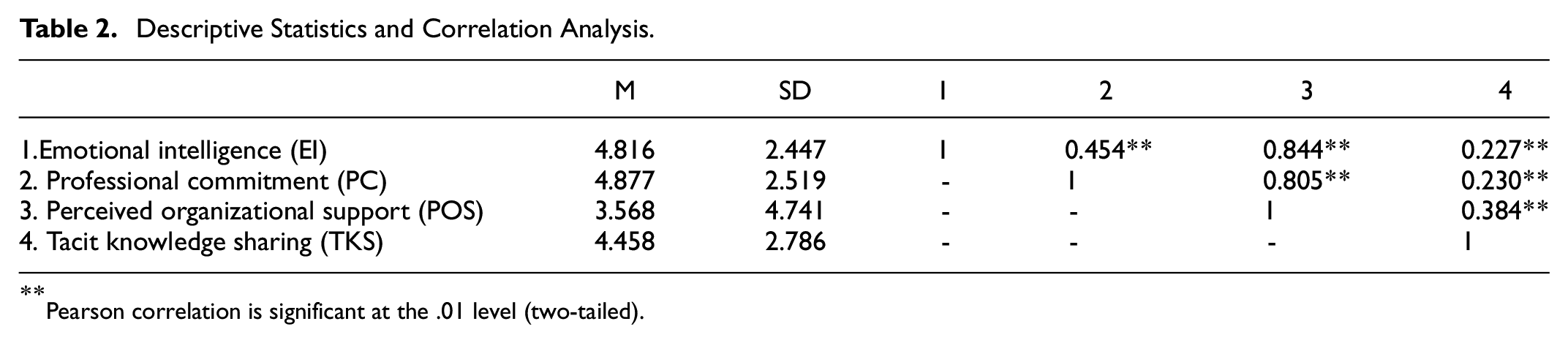
Pearson correlation is significant at the .01 level (two-tailed).
In addition, computation of internal consistency coefficients indicated that the measures exhibit adequate levels of homogeneity, validating the utilization of a singular score for each measure in subsequent statistical analyses. The Cronbach’s Alpha values for emotional intelligence, perceived organizational support, professional commitment, and tacit knowledge sharing were .978, .896, .912 and .953, respectively, indicating a good internal consistency for each construct (see Table 3). The results of confirmatory factor analyses with Mplus 6 indicated that the tested measurement model composed of four constructs produced very good adjustment indices (Chi-square = 78.0003; df = 41; Chi-square/df = 1.90; CFI = 0.98; TLI = 0.97; RMSEA = 0.057: 95% CI = [0.037 0.075]), and is better than the fit of more constrained models significantly. For convergence validity, the standardized factor loading, composite reliability (CR), and average variance extracted (AVE) were evaluated (Hair et al., 2009). After testing, the standardized factor loadings in each item were above 0.7, the CR of each dimension were over 0.8 and the AVE were over 0.5, which all indicate that convergence validity was acceptable (see Table 3).
Reliability and Convergent Validity.
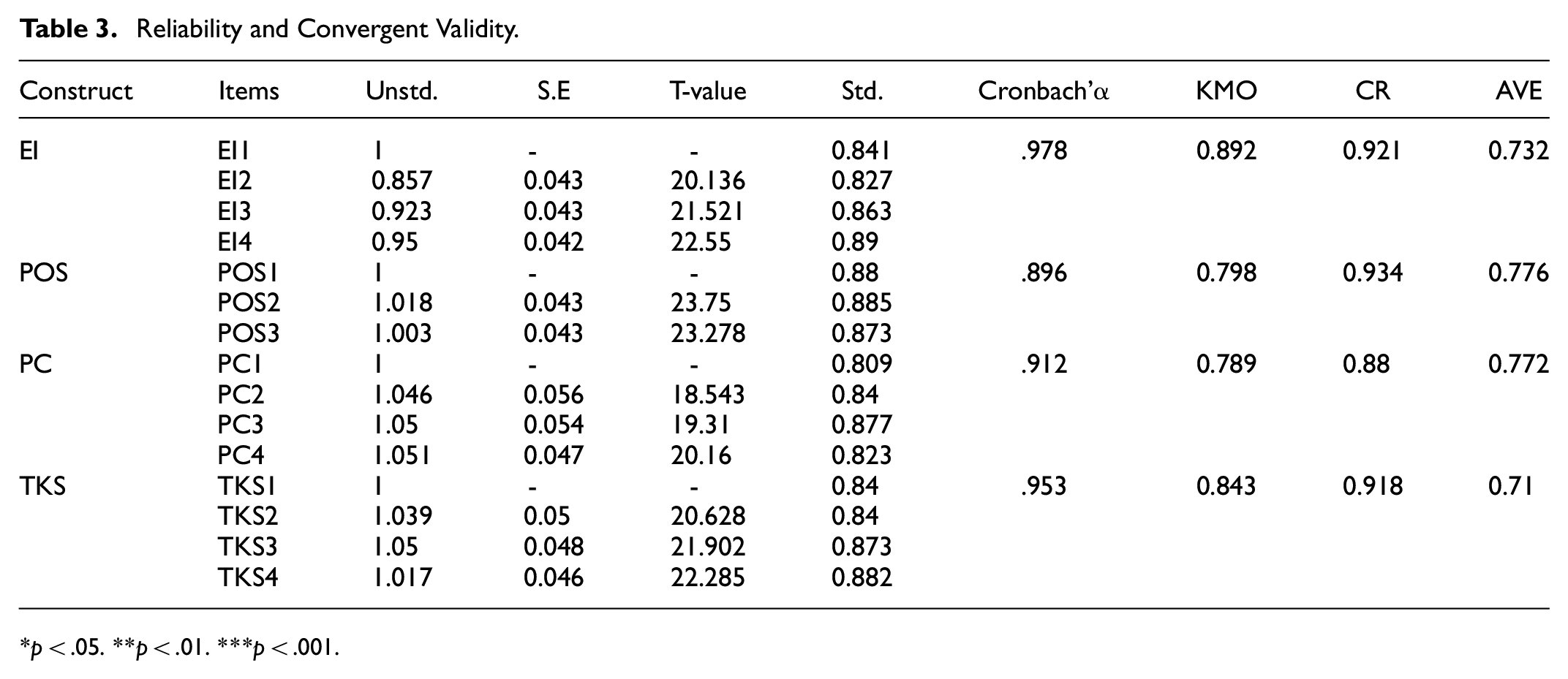
p < .05. **p < .01. ***p < .001.
Furthermore, Fornell and Larcker (1981) presented the criteria to ascertain the discriminant validity. The discriminant validity can be assured by comparing the correlation between constructs and the square root of AVE. If the square root value of AVE is higher than the correlation between constructs, then the result presented the discriminant validity of the study, as shown in Table 4.
Discriminate Validity.
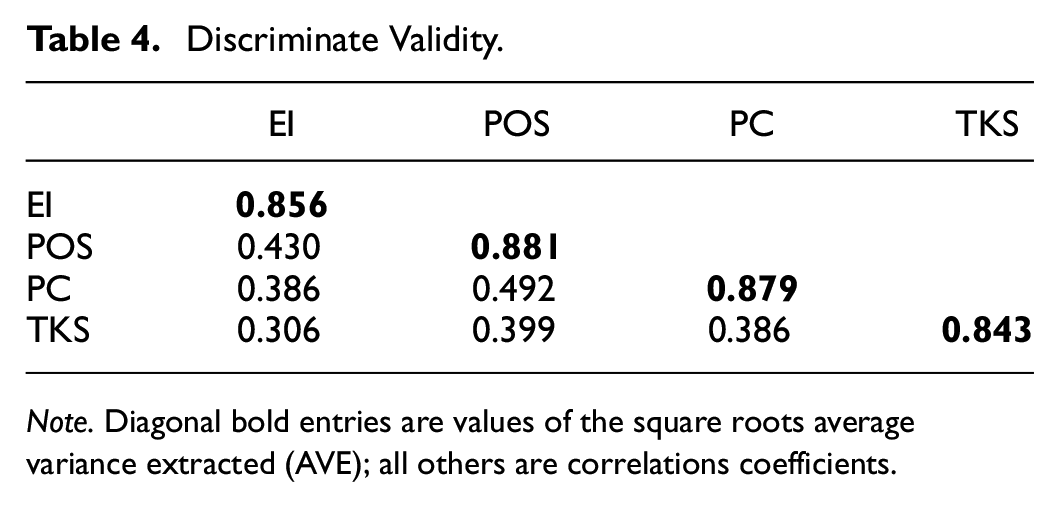
Note. Diagonal bold entries are values of the square roots average variance extracted (AVE); all others are correlations coefficients.
The entire questionnaire’s items were subjected to the Harman’s one factor test in order to rule out common method bias (Podsakoff & Organ, 1986). When a single factor emerges from the analyses and/or when the variation explained by the first factor is greater than 50%, a substantial influence of the error variance can be taken into consideration. In this study, only 39% of the variance was explained by the first factor, indicating that this study better controls the homology bias problem. The results above have provided preliminary support to the hypotheses of our study.
Hypotheses Testing
The current study proposes that professional commitment mediates the relationship between emotional intelligence and tacit knowledge sharing. To examine this hypothesis, this study followed four-step procedure (MacKinnon, 2008) to test the mediating effect, which demands (a) a significant relation between emotional intelligence and tacit knowledge sharing; (b) a significant relation between emotional intelligence and professional commitment; (c) a significant relation between professional commitment and tacit knowledge sharing while controlling for emotional intelligence; (d) a significant coefficient for the indirect path between the emotional intelligence and tacit knowledge sharing via professional commitment. The bias-corrected percentile bootstrap method determines whether the last condition is satisfied. Following Preacher et al. (2007), we first used a bootstrap procedure in PROCESS macro for SPSS (sampling times: 5,000, confidence interval 95%, Model 4) to verify the mediating effect (Hayes, 2017). The results showed that the confidence interval does not contain 0, which means that professional commitment plays a mediating role. To estimate the proposed hypotheses in the research model, we utilized PROCESS macro for SPSS (sampling times: 5,000, confidence interval 95%, Model 7). According to recommendations by Aiken et al. (1991), all the continuous measures were mean-centered before analyses. The results summarized in Table 5 are consistent with our primary assumption as emotional intelligence show positive association of tacit knowledge sharing (β = .154, t = 2.361, p < .001) and professional commitment (β = .752, t = 15.912, p < .001), giving support to Hypothesis 1 and 2. Similarly, tacit knowledge sharing was positively affected by professional commitment (β = .160, t = 2.460, p < .001), Hypothesis 3 was supported. Furthermore, professional commitment was affected positively by the interaction between emotional intelligence and perceived organizational support (β = .192, t = 3.206, p < .001), suggesting a significance of buffering effect of perceived organizational support on the link between emotional intelligence and professional commitment. Hypothesis 5 was supported. Results obtained from the empirical analysis proved the significance of direct effect of emotional intelligence on tacit knowledge sharing (direct effect = 0.154, t = 2.361, p < .001, 95% CI [0.026, 0.282]), suggesting that professional commitment partially mediated the effect of emotional intelligence on tacit knowledge sharing. Hypothesis 4 was supported.
Results of Hypothesis Testing.

Note. X indicates emotional intelligence; M indicates professional commitment; W indicates perceived organizational support; Y indicates tacit knowledge sharing.
Regarding the moderating effect of perceived organizational support, we further calculated the conditional indirect effects of emotional intelligence on tacit knowledge sharing via professional commitment across low and high levels (at −1 SD and +1 SD) of perceived organizational support. As depicted in Table 5, we evaluated the conditional indirect effects of emotional intelligence on tacit knowledge sharing via professional commitment is stronger (indirect effect = 0.131, 95% CI [0.038, 0.262]) when perceived organizational support is higher (M + 1 SD) than when it is lower (M − 1 SD) (indirect effect = 0.110, 95% CI [0.033, 0.238]). The index of the moderated mediation model was significant (Effect = 0.019; 95% CI [0.036, 0.251]), suggesting that perceived organizational support moderated the effect of antecedent (emotional intelligence) on the mediator (professional commitment), and subsequently on the dependent variable (tacit knowledge sharing).
To further examine this significant interaction, we formally probed this interaction effect following the Johnson–Neyman technique by conducting a simple slope analysis that considers the variance of covariates and multilevel unique effects (Bauer & Curran, 2005; Hayes & Matthes, 2009). Figure 2 demonstrates the pattern that the positive effect of emotional intelligence on professional commitment is more salient for employees with higher level of perceived organizational support.
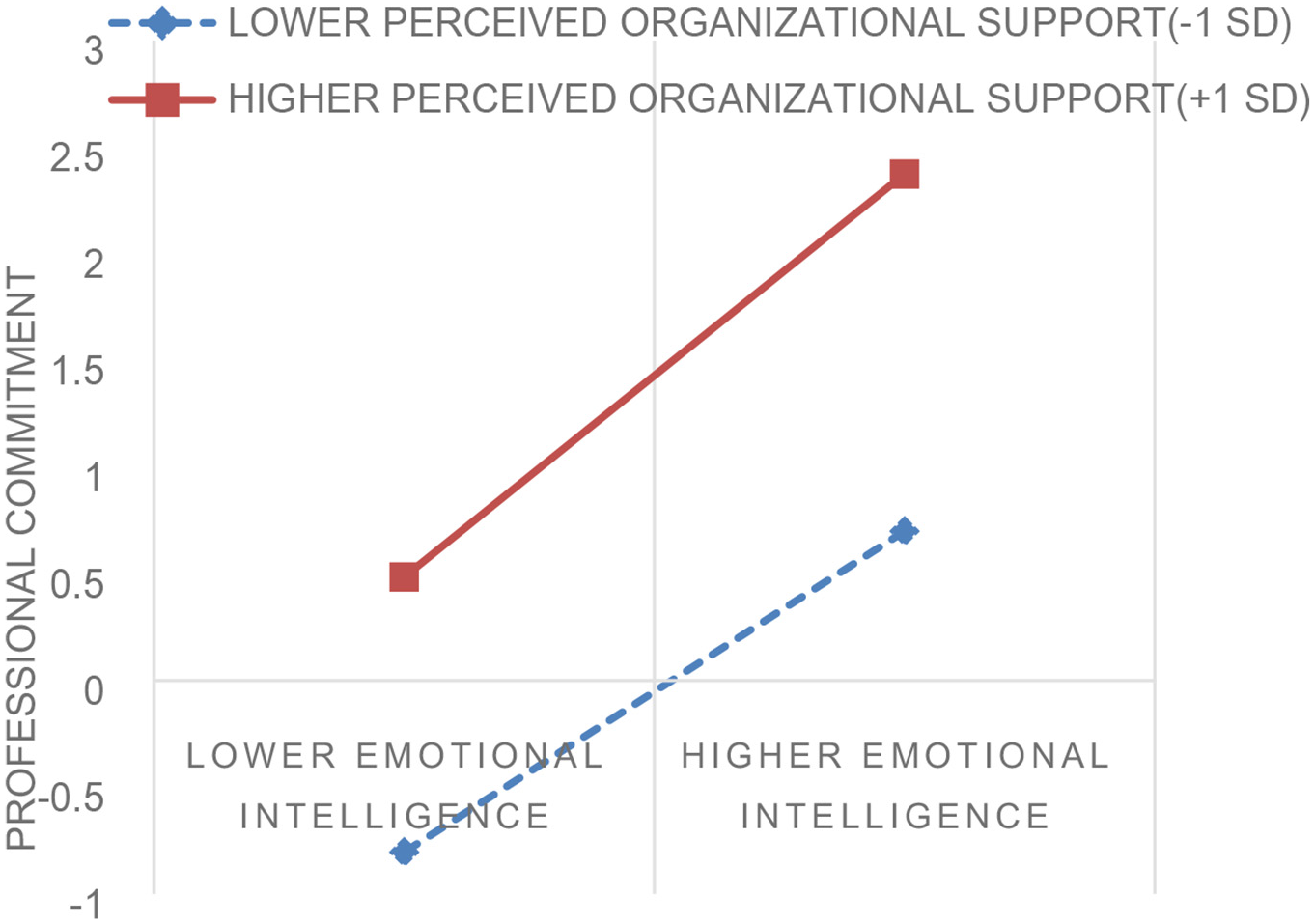
Moderating effect of perceived organizational support.
Discussion
Drawing upon social exchange theory and self-determination theory, this study has developed a comprehensive framework to examine the interplay between emotional intelligence, professional commitment, perceived organizational support, and tacit knowledge sharing within the context of knowledge-intensive industries in China. The findings of this research demonstrate that individuals with higher levels of emotional intelligence are more likely to display stronger professional commitment to their respective organizations. In turn, the heightened level of professional commitment will subsequently facilitate increased tacit knowledge sharing behavior among employees. Moreover, the results are consistent with our pre-registered predictions, indicating that perceived organizational support serves as a mitigating factor in the relationship between emotional intelligence and professional commitment. Hence, this paper establishes the psychological mechanisms and defines the boundary conditions for understanding tacit knowledge sharing through the lens of emotional intelligence.
Theoretical Contributions
Establishing the necessary conditions to facilitate knowledge sharing, especially tacit knowledge transfer, can be quite challenging, as it requires implementing effective measures that strengthen collaborative efforts. These measures are rooted in a profound comprehension of essential factors that govern the sharing process, notably the intrinsic traits of individuals. From a theoretical vantage point, this research endeavors to contribute valuable insights to the field.
First, this study has made an effort to ascertain the impact of emotional intelligence on tacit knowledge sharing in the academic sector by tapping the missing link, the current study built a theoretical framework to understand how individual differences in emotional intelligence influence the willingness of employees to share their tacit knowledge, which aligns with the empirical work by Zsigmond and Mura (2023) suggesting the importance of emotional intelligence in connection to knowledge transfer. This finding extends our knowledge of how entrepreneurs foster knowledge sharing behavior. The vast majority of literature have explored knowledge sharing behavior from team and organizational antecedents (Subramaniam & Venkatraman, 2001). In prior studies, organizational culture (Suppiah & Singh Sandhu, 2011), social ties (Lin, 2007) and trust are used to explain knowledge sharing by investigating willingness to share (Holste & Fields, 2010; Le & Lei, 2019). Although personal traits as antecedent to knowledge sharing have started to draw academic attention (e.g., altruism, Obrenovic et al., 2020), to the best of our knowledge, many individual factors such as emotional intelligence remain largely underexplored. Given the significant role of individual characteristics play in organizations and the explanatory power in explaining prosocial behavior under workplace dynamic (Matzler & Mueller, 2011), emotional intelligence has been introduced as a novel antecedent of tacit knowledge sharing in current research, its underlying mechanism and boundary condition are further examined.
Second, by anticipating the future call of Obrenovic et al. (2022), this work contributes to our understanding of the underlying mechanisms through which emotional intelligence influences tacit knowledge sharing by empirically testing the mediating role of professional commitment. This study supports other studies that demonstrated professional commitment as an underlying mechanism to explain a variety of employee behaviors, including but not limited to motivation, job performance, satisfaction, and retention (Donkor et al., 2021; Naz et al., 2020). Professional commitment is an important employee variable because a highly devoted employee consistently identifies with the organization’s goals and values, craves association with the organization, and is willing to go beyond their required job tasks (Ramshida & Manikandan, 2013). In light of this, we proposed and validated the mediating role of professional commitment to explain employee’s tacit knowledge sharing behavior. To date, the present study is the first to report such findings in this area. These findings confirm the further applicability of social exchange theory suggesting that individuals engage in voluntary behaviors based on reciprocity (Cropanzano & Mitchell, 2005). The practice of knowledge sharing among employees is a key driver of business innovation. Previous studies have shown that employees typically do not actively engage in extra-role actions like knowledge sharing unless they are psychologically committed to the firm (Ng & Feldman, 2011). Employees who feel committed to their organization are more likely to engage in positive altruistic behavior such as knowledge sharing, partially because they see it as advantageous not only to themselves but also to the organization. According to research findings (Jordan et al., 2002), those with greater levels of emotional intelligence are better able to form supportive relationships and feel more obligated to return favors.
Third, this paper highlighted the moderating effect of perceived organizational support in the relationship between emotional intelligence and professional commitment. The results showed that perceived organizational support moderated the path between emotional intelligence and professional commitment. As the social support buffering hypothesis (Cohen & Wills, 1985) suggests, perceived social support may buffer individuals from the influences of adverse situations. Under the context of organization, the association between job insecurity and work-related outcomes, such as job satisfaction and turnover intention, has been found to be moderated by perceived organizational support (Halbesleben & Buckley, 2004). The current study’s findings are in line with the organizational support theory (Eisenberger et al., 1986), which contends that an employee’s positive intentions toward the organization may be influenced by how much the organization values and cares for them. This theory does not solely rely on an individual’s motives to describe such intentions (Eisenberger et al., 2020). Perceived organizational support is a crucial organizational resource that empowers employees to perform their duties with dedication and commitment. This could be explained by the notion that employees who receive strong organizational support become more motivated both internally and externally (Akgunduz et al., 2018; Rhoades & Eisenberger, 2002). When employees get a high level of organizational support, their responsibility to work, commitment and organizational efficiency increases (Eisenberger et al., 1986). Based on the notion that perceived organizational support develops a feeling of obligation to pay back the organization (Shore & Wayne, 1993; Zhang et al., 2016), our findings support that employees with high levels of emotional intelligence are more committed toward their professions when they feel supported, cared for, and valued by their organizations (Lavelle et al., 2007; Zhang et al., 2016).
Practical Implications
This research provides practical insights for entrepreneurs and knowledge-intensive organization managers. Our findings show that emotional intelligence and tacit knowledge sharing are positively associated. Indeed, emotional intelligence should be regarded as a crucial consideration during the employee selection process. The study highlights that emotional intelligence has a beneficial impact on tacit knowledge sharing, which is particularly important for organizations that value knowledge-sharing. Consequently, organizations should emphasize the development of emotional intelligence competencies in their employees through appropriate training initiatives. The results indicate that individuals who exhibit higher levels of emotional intelligence are more prone to engaging in tacit knowledge sharing. Investing in training programs that enhance employees’ emotional intelligence can ultimately facilitate increased knowledge sharing within organizations.
Second, the findings emphasize the significance of professional commitment at work as it acts as a crucial mediator between emotional intelligence and tacit knowledge sharing. Enhancing professional commitment among employees requires a combination of organizational strategies and individual interventions. To foster professional commitment, organizations can adopt various strategies. Firstly, they can provide ample opportunities for growth and development through training programs, mentorship initiatives, and pathways for career advancement. By investing in employees’ skill enhancement and career progression, organizations communicate their recognition of their employees’ professional development, thus cultivating a greater sense of commitment (Mitchell et al., 2019). In addition, empowering employees and encouraging autonomy can be effective. Granting employees the freedom to make decisions, take ownership of their work, and contribute their ideas nurtures a sense of responsibility and dedication. Organizations that foster an environment of ownership promote accountability and commitment among employees. By prioritizing employee growth, well-being, and recognition, organizations foster a culture of loyalty and dedication. This, in turn, leads to improved performance and overall organizational success.
Third, it was found in this study that perceived organizational support plays a vital role in determining the relationship between emotional intelligence and professional commitment. It is recommended that efforts be made to enhance perceived organizational support, with previous research indicating that factors such as transformational leadership (C. J. Wang, 2022) and creation of a harmonious work climate (Kao et al., 2023) can help in achieving this. Managers are advised to concentrate on enhancing these aspects while not overlooking the influence of cultural and economic factors, as perceived organizational support is essentially an individual’s perception on the support they receive from the organization.
Finally, the study provides a framework for organizations to identify the factors that inhibit or facilitate knowledge sharing behavior. Particularly for technology-driven enterprises that heavily rely on employees’ tacit knowledge, the importance of tacit knowledge sharing must be addressed (Shi & Xie, 2024). By utilizing the model presented in the study, such organizations can assess their current knowledge-sharing practices and pinpoint areas that require improvement. This may help them maintain competitive advantages in this dynamic business environment.
Study Limitations and Future Research Directions
While this study carries numerous theoretical and practical implications, it is important to acknowledge its limitations. First, the current study considers tacit knowledge sharing from the perspective of emotional intelligence, future research is encouraged to explore other individual differences as potential antecedents of tacit knowledge sharing. Second, the simultaneous collection and evaluation of our study responses prevent the determination of causal relationships among these variables. To address this, future research could employ a longitudinal panel design or controlled laboratory experiments to clarify the causal sequence and eliminate the possibility of reverse causality. Longitudinal studies offer a fresh perspective for exploring critical theoretical queries. Third, although the current study highlights perceived organizational support as a moderator, further investigations could delve into alternative boundary conditions like risk factors. Lastly, this research establishes a positive linear link between emotional intelligence and tacit knowledge sharing, however, future studies could explore the existence of nonlinear relationships (e.g., inverted U curve) to deepen our understanding of this connection.
Conclusion
There is an extensive academic research history focusing on the growing significance of knowledge and the motivational dilemma of knowledge exchange within organizations (Connelly et al., 2012). The study results contribute to the current knowledge management and organizational behavior theories. This research empirically examined emotional intelligence, the essential professional skill related to perceiving, expressing, understanding, and managing emotions, is significantly associated to tacit knowledge sharing in the workplace. Professional commitment which was taken as mediating factor in this work has been established to be partially mediating the link between emotional intelligence and tacit knowledge sharing of employees. Furthermore, perceived organizational support was identified as a moderating role in the positive relationship between emotional intelligence and professional commitment.
Footnotes
Acknowledgements
The authors would like to acknowledge all the reviewers who provided insightful suggestions and comments on improving the quality of this manuscript.
Declaration of Conflicting Interests
The author(s) declared no potential conflicts of interest with respect to the research, authorship, and/or publication of this article.
Funding
The author(s) disclosed receipt of the following financial support for the research, authorship, and/or publication of this article: This work was supported by Shandong Province Social Science Planning Project of China [Grant No. 23CLYJ20].
Ethical Statement
The authors of this paper have carefully studied the international research ethics, and this paper does not involve animal and human studies. All the participants of the study attended voluntarily and they may choose not to participate.

Data Availability Statement
Data sharing not applicable to this article as no datasets were generated or analyzed during the current study.