




Abstract
This study aims to develop, examine, and test organizational and individual predictors of knowledge sharing behavior of teachers in the higher education sector in Pakistan. The study examined the direct and indirect effects of organizational factors on knowledge sharing behavior (KSB) through individual factors. The social capital theory has been utilized to explain the premise of this research. This study uses a survey design. Data has been collected from 269 university teachers in Pakistan. A Structural equation modeling has been used to test the hypotheses using SPSS and Amos. The Data supported the hypotheses. This Study concludes that organizational and individual are important for enhancing KSB as organizational factors work through individual factors to influence the KSB of faculty members.
Keywords
Introduction
Knowledge sharing (KS) is a fundamental process of knowledge management (KM) that involves the transfer of knowledge, experience, and skills (Nguyen, 2021). Information that can be accessed easily, categorized, structured, and organized becomes knowledge. De Clercq and Pereira (2020) define knowledge sharing behavior (KSB) as sharing suggestions, ideas, opinions, and information among members. An Interaction between organizational members is a source of the exchange of knowledge (Razzaque, 2020). The Importance of KS for an organization cannot be denied (Son et al., 2020), particularly for knowledge-based organizations, like in universities (Bibi & Ali, 2017); but most employees are hesitant to share their knowledge. In such a case, it is difficult to turn individual knowledge into organizational knowledge (Son et al., 2020). Organizations need mechanisms, structures, and cultures that facilitate KS (Blouch et al., 2021).
Contemporary managers are facing a challenge of inter-employee knowledge sharing (Serenko & Bontis, 2016). Growing pressures are encouraging companies to exploit their employees’ critical knowledge (Cavaliere et al., 2015). Individual knowledge is an asset, if managed effectively can lead to better organizational performance (Son et al., 2020) and competitive advantage (Akhavan et al., 2015; Cavaliere et al., 2015). Knowledge sharing (KS) is a building block for success and a survival strategy (Tangaraja et al., 2015).
In South Asia, higher education institutions (HEIs) have grown enormously over the recent decades. This sector is structured in almost similar fashion in Asian countries like Pakistan, India, Bangladesh, Sri Lanka where centralized governing body such as Higher Education Commission (HEC) in Pakistan and University Grants Commission (UGC) is the licensee, policy advisor and regulator for HEIs (Kanwal et al., 2019).
Knowledge governance mechanism (Huang et al., 2013), motivation, opportunity, ability (Turner & Pennington, 2015), social capital (Lartey et al., 2021), trust and innovative work behavior (Kmieciak, 2020), absorptive capacity (Zhang et al., 2021) have been examined concerning KSB in different countries and contexts like India, Poland, Hong Kong, United Kingdom, and China. Studies done in the Pakistani and Asian contexts have found that individuals who possess knowledge have a tendency to hide it (Asrar-ul-Haq & Anwar, 2016). The factors that determine the willingness of knowledge holders to share it were studied. The Cultural aspects focusing on openness to change (Bibi & Ali, 2017), communication and social relations (Zhang et al., 2021), employee efficiency, psychological contract, and organizational support were found to have an association with KSB in Pakistan.
The Intentions predict certain behavior, but people do not necessarily act according to their intentions. There are many other factors including contextual ones that determine a behavior (Nguyen, 2021). Social capital theory (SCT) relates to social structures and relations. According to SCT, social capital exists between people and their relations, norms, networks, and structures that work together for social, economic, and psychological benefits (Gannon & Roberts, 2020; Woolcock, 1998).
A recent study examined that there is an obvious gap with respect to knowledge sharing practices in Pakistan (Asrar-ul-Haq & Anwar, 2016). There is little research on KSB in HEIs in developing countries like Pakistan (Blouch et al., 2021). Limited studies are examining individual and organizational factors (Lo & Tian, 2020), especially the processes and mechanisms that facilitate KSB through individual factors (Huang et al., 2013). Furthermore, only a few recent studies analyzed the KSB of teachers in HEIs (Bibi & Ali, 2017). Thus, practices and behaviors are far more complex in Pakistani organizations than they have been traditionally acknowledged (Blouch et al., 2021). Most of these studies are uni-level that studied only the individual factors or the organizational factors in relation to KS (Amayah, 2013; Rathi & Given, 2017). As limited knowledge is available on the relationship between organizational culture, knowledge governance mechanisms, and individual factors with KSB in HEIs, this article aims to present findings on these mechanisms in HEIs in Pakistan9
Given the need to foster inter-organizational KSB, this study attempts to answer these research questions.
What is the impact of hierarchical and COC on the KSB of teachers in Pakistani HEIs?
What is the impact of informal and formal knowledge governance mechanisms (FKGM) on the KSB of teachers in Pakistani HEIs?
What are the impact of KMO, KSO, and KSA on the KSB of teachers in Pakistani HEIs?
What are the relationships among various factors (OC, KGM, KMO, KSO, and KSA) which affect the KSB of teachers in Pakistani HEIs?
Literature Review and Hypothesis
Social Capital Theory and Ability, Motivation, Opportunity (AMO) Framework
According to SCT, organizational networks are helpful in developing and maintaining relationships, encourage members to participate in mutually beneficial activities, and provide opportunities to develop collective capital (Birasnav et al., 2019). This study combines the social capital perspective with individual variables, that is, ability, motivation, and opportunity from the AMO framework developed by Appelbaum et al. (2001) to examine how the organizational and individual factors work together to influence the KSB of teachers in HEIs. Pakistan has a collectivistic culture (Hofstede, 1984). Pakistanis believe in developing strong ties and close relationships that develop into social networks (Bibi & Ali, 2017). Executives and top management develop close ties with members they trust. They rely on strong ties rather than weak ties (Zhang et al., 2021). As a reciprocal activity, employees in the organizational network are involved in desirable behavior more often (Blouch et al., 2021). The Organizational networks and structures are a source of motivation for people and provide opportunities for bringing people together. In a strong network, people interact and share their experience, skills, and knowledge, in formal and informal ways (Razzaque, 2020).
Organizational Culture, Top Management Support, and Knowledge Governance Mechanisms
This study utilizes Cameron and Quinn (1999) Competing Values Framework (CVF) to define OC. This framework has four dimensions, hierarchy, clan, adhocracy, and market. The Study has utilized only the first two dimensions because Turner and Pennington (2015) suggested that HOC focuses on formal mechanisms and clan organizational culture (COC) focuses on informal mechanisms. COC has an internal orientation and it emphasizes informal governance (Abbasi et al., 2021). Informal mechanisms create a friendly and cooperative environment to work. HOC focuses on planning and goal setting, policies, rules, regulations, and rights of control (Foss, 2009). Rode (2016) suggests that formalization and control foster formal mechanisms. FKGMs are contractual in nature and IFKGMs are based on trust and loyalty. Huang et al. (2013) recommend that both types of KGMs should be emphasized to enhance the quality and quantity of knowledge shared. Hence, it is hypothesized that shown in figure 1.
H1: HOC has a positive impact on FKGM.
H2: COC has a positive impact on IFKGM.
The values of executive managers are influenced by workplace culture. OC is found to affect the values of decision-makers that further influence organizational policies and practices, that is, part of the governance mechanism (Abbasi et al., 2021). Thus formal rules and policies become the basis for a norm to share knowledge.
COC is a family like culture and emphasizes doing things together. Managers in COC foster a supportive environment. Leaders are facilitators rather than controllers. Participative decision making, trust, and collaboration are shared values. COC has an internal orientation and it emphasizes informal governance mechanisms. It creates a sociable and supportive place to work (Amayah, 2013). Employee commitment, high morale, and loyalty are key characteristics of employees (Blouch et al., 2021). Participation in decision-making and human resource development are key functions of work design (Kanwal et al., 2019). Thus, both clan and hierarchy organizational culture (HOC) influence the values of leaders and top managers in an organization.
H3: Hierarchy organizational culture has a positive impact on top management support.
H4: COC has a positive impact on top management support.
Top Management Support and Formal Knowledge Governance Mechanisms
Knowledge sources are identified and located by top management by utilizing numerous mechanisms like a focus group, video conferencing, and various information and software systems (Huang et al., 2013). The structure of the transferable knowledge and the resources needed for the transfer is provided by top management (Abbasi et al., 2021). Barriers to share knowledge like time and distance are overcome by formal mechanisms (Rode, 2016). TMS helps decrease the social and other constraints (Rathi & Given, 2017) are arising due to the different geographical locations of the individuals who intend to share knowledge (Son et al., 2020). In absence of TMS, exploring, sharing, and using knowledge becomes a challenge. Hence, it is proposed
H5: Top management support has a positive impact on FKGM
Knowledge Governance Mechanisms and Knowledge Sharing Motivation
Management style, communication channels, trust, and flow of information are informal mechanisms that provide interactional opportunities (Foss, 2009). Social interactions are motivational in nature and determine individuals’ willingness to share knowledge (Huang et al., 2013). Informal mechanisms set social interaction norms. Individuals are encouraged to share knowledge (Abbasi et al., 2021). Being a social exchange behavior, individuals holding knowledge evaluate the value of KS, for example, recognition, power, affiliation. Individuals set KS as a goal. It increases their willingness to share knowledge (Kang & Kim, 2017).
The Informal knowledge governance mechanisms (IFKGM) through communication channels increase the pace to share information. It reduces barriers, builds trust, and makes a positive impression. As familiarity between members increases, the willingness to share knowledge increases (Huang et al., 2013; Paro & Gerolamo, 2017). Ties get stronger among individuals and they are more willing to share (Zhang et al., 2021). Hence, it is proposed
H6: IFKGM has a positive impact on KSIM.
Knowledge would not be effectively shared by demotivated employees (Kanwal et al., 2019). Organizational structures, rewards, costs, values exchanged motivate individuals (Huang et al., 2013). Knowledge can be used to acquire status, power, identification, and rewards. The extent to which a person would be willing to share knowledge also depends on one’s nature (Foss, 2009). People who share knowledge in expectation of some tangible reward are extrinsically motivated to share knowledge (Kang & Kim, 2017). Similarly, people who set more specific mastery goals are also extrinsically motivated (Birasnav et al., 2019). Both intrinsic and extrinsic motivation is important to share knowledge and enhance the willingness for intra-organizational knowledge transfer (Serenko & Bontis, 2016).
For self-interested individuals, transactional rewards provide maximum payoffs (Foss, 2009). A Formal governance mechanism provides more extrinsic rewards to transfer knowledge (Huang et al., 2013). Thus, it is proposed
H7: FKGM has a positive impact on KSIM
H8: FKGM has a positive impact on KSEM
Knowledge Governance Mechanisms and Knowledge Sharing Ability
Knowledge sharing ability (KSA) to do something would lead to the desired knowledge outcome (Rathi & Given, 2017). The formal mechanisms provide time and resource capabilities. Proper resource utilization, can help individuals to access organizational networks. They will be involved in work, building KSA (Abbasi et al., 2021).
Acquisition, creation, sharing, and utilization of knowledge are core requirements. Individuals have limited cognitive abilities. They have to focus on multiple tasks consecutively and bounded rationality comes into play. Abilities have to be utilized optimally to gain an advantage (Yang, 2011). Despite opportunities and motivation, in absence of KS skills, knowledge transfer would not take place (Kang & Kim, 2017; Turner & Pennington, 2015).
KS is a result of interaction among individuals. Informal governance mechanisms like communication flow, channels, and mutual trust are built as a result of social interaction. It facilitates the sharing of knowledge (Paro & Gerolamo, 2017). It is found that Socially active people are preferred by organizations. Informal mechanisms enhance KSA and skills through socialization efforts (Kang & Kim, 2017). Thus, it is proposed that
H9: IFKGMs have a positive impact on KSA.
H10: FKGMs have a positive impact on KSA.
Formal Knowledge Governance Mechanism, Top Management Support, and Knowledge Sharing Opportunity
FKGMs provide opportunities to share knowledge in three ways, that is, compensation and reward system, performance appraisals, and team-building communication (Huang et al., 2013). Formal events such as conferences, seminars, management forums, and intranet are a good source to share knowledge. The Psychological and physical barriers are reduced for those located at different geographical locations through focus groups, video conferencing, and panels of experts (Wang & Noe, 2010). Experienced employees act as a mentor for less experienced ones and expatriates may share expertise with employees in multi-national organizations, providing an example of formal mechanisms for KS (Grimsdottir & Edvardsson, 2018).
Top management devises strategies and plans to include knowledge sharing as a norm of behavior. Values are influenced by OC and KS becomes a norm (Amayah, 2013). Different tools are utilized by top management include pay for performance, training, incentives and rewards, promotion, a bonus that promote knowledge sharing in organizations (Kmieciak, 2020). Thus, it is proposed
H11: FKGMs have a positive impact on KSO.
H12: Top management support has a positive impact on KSO.
Knowledge Sharing Ability, Motivation, Opportunity, and Knowledge Sharing Behavior
AMO framework is increasing in importance to study workplace behaviors (Siemsen et al., 2008) including KSB (Grimsdottir & Edvardsson, 2018). Studies used its components in the context of knowledge sharing (Huang et al., 2013; Turner & Pennington, 2015). Motivation and opportunity play complementary roles in inducing behaviors (Abbasi et al., 2021; Huang et al., 2013). In absence of ability or opportunity, motivation should not lead to KSB (Huang et al., 2013; Razzaque, 2020).
Factors that motivate people to provide KSO are significantly associated with KSB (Kang & Kim, 2017). Huang et al. (2013) found that KSA has no significant association with KSB of expatriates. Kmieciak (2020) found that there is a marginal relationship between KSA and KSB of employees at the workplace. Intrinsic motivation is more effective in inducing a behavior than extrinsic motivation (Rathi & Given, 2017). SCT suggests that individuals are involved in the desired behavior if resources are enough (Birasnav et al., 2019). Intrinsically motivated to seek approval, respect, identification, status, and social rewards (Charband & Jafari Navimipour, 2018).
Seminars, conferences, research journals, central research repositories are facilities provided by universities to share knowledge (Abbasi et al., 2021). Interactional opportunities enhance KS (Kmieciak, 2020). For a behavior to take place, an individual must be motivated (Nguyen, 2021). According to Rathi and Given (2017), whether motivation would translate into desired behavior depends upon opportunities available for doing so. Hence, the following hypotheses are developed.
H13: KSO has a positive impact on KSB.
H14: KSEM has a positive impact on KSB.
H15: KSIM has a positive impact on KSB.
H16: KSA has an impact on KSB.
In light of the above literature, the following mediation hypothesis is proposed.
H17: FKGM mediates the relationship between top management support and KSEM
H18: FKGM mediates the relationship between top management support and KSIM
H19: KSO mediates the relationship between top management support and KSB
H20: IFKGM mediates the relationship between COC and KSB
H21: FKGM mediates the relationship between hierarchy organizational culture and KSA
H22: FKGM mediates the relationship between HOC and KSB.
H23: KSO mediates the relationship between HOC and KSB.
H24: KSEM mediates the relationship between HOC and KSB
Methodology
The research philosophy of this study is positivism and the research approach is deductive. A research strategy is survey-based, to collect cross-sectional data. There were 45 items in the instrument that measured nine variables. The instrument was developed from existing scales available in the literature whose validity and reliability have been established by researchers and studies (Bock et al., 2005; D’Netto et al., 2008; Huang et al., 2013; Ryan & Deci, 2000). There was no change in the number of items after the pilot study because the reason that authors used reliable and valid scales to measure variables. However, the results of the pilot study indicated that the direction of a relationship between variables is the same as hypothesized. SPSS version 22 and Amos 24 was used to analyze the data. Structural and measurement models were tested using Amos graphics.
Measures
Self-reported instruments were used to measure all latent constructs. However, data were collected at two points to avoid and reduce common method bias in data. Data for organizational variables were collected at time T1, whereas, data for individual variables and KSB was collected after two months at time T2. All questionnaires were coded to segregate data collected at two different times. Harman’s one-factor test was also used to confirm that there was no issue of common method variance in data. Variables were measured using seven points Likert scale with “1” for strongly disagree to “7” for strongly agree. Chronbach alpha values in previous studies for these scales are above .7 conforming reliability of scales.
Knowledge sharing behavior
KSB was used to measure the seven-item scale adopted from Bock et al. (2005). Scale items included, I share know-how from work experiences with others.
Knowledge governance mechanisms
The scale developed by Huang et al. (2013) was used to measure FKGM and IFKGM having three items each. Scale item for FKGM is, there are organizational newsletters or journals to encourage knowledge sharing. The scale item for IFKGM is, there are birthday parties and other similar activities for colleagues to make friendship.
AMO framework
Scale by Siemsen et al. (2008) was used to measure KSO and KSA, whereas (Ryan & Deci, 2000) scale was used to measure KSIM and KSEM.
Scale items for KSIM include for example, I share knowledge because I find it personally satisfying. The item for KSEM is, I share knowledge because I may get a reward. Scale items for KSO are, I have the opportunity to share information in my organization. Similarly, the scale item for KSA is, I am capable of sharing important information.
Top management support
Top management support was measured by D’Netto et al. (2008) scale. Items included were, top management provides adequate resources needed to enable knowledge sharing function to operate effectively.
Organizational culture
This study uses an Organizational Culture Assessment Instrument (OCAI) survey by Cameron and Quinn (1999) to measure OC. Scale items to measure COC included, my organization is like an extended family. HOC was measured by items like my organization is a very controlled and structured place.
Disproportionate random sampling was used to draw a sample from a population. According to the Pakistan Education Statistics report (2017–2018), 80% of teachers are serving in the public sector and 20% in private sector. According to Sekaran and Bougie (2013), to make a stratified sample more representative, a disproportionate sample may be drawn from the population. Data for the study were randomly selected from two strata, public and private, choosing randomly seven universities from the public and three universities from the private sector. Data was collected through a structured survey from faculty members of universities and HEIs working in Islamabad/Rawalpindi. Although data was collected from only two cities, the sample was drawn through disproportionate random sampling. This technique is recommended by Hair et al. (2010). Its use increases the reliability and validity of the results. Universities from this region were selected because they provide a good mix of both public and private sector universities. The population of the city represents the people from all areas of Pakistan. One of the best universities in the country is located in these cities. It makes the sample a good representative of the population. Total survey forms distributed were 450. 291 were collected. The size of a usable survey after adjusting for outliers and missing data was 269. The response rate was 60%. Data was collected from all levels of teachers.
Sample characteristics
About 68% of the sample consisted of male teachers. About 65% of respondents were between ages 26 and 35. 43% were lecturers, 67% were from the public sector, and 60% had a master’s degree, with most of them pursuing a Ph.D. in relevant fields. About 29% had a teaching experience of 5 to 10 years.
Results
Table 1 shows means, standard deviations (SD), Cronbach alpha (α) and correlations among latent constructs.
Mean, Standard Deviation, and Correlations.

Correlation is significant at .01 level (2-tailed), n = 269.
Mean values are above midpoint 3.5 which indicates that data points cluster around mean values. SD below 2 indicates that data points are not dispersed away from mean values. α values are above .7 indicating the reliability of scales. Correlation coefficients are significant at p < .01. Variance inflation factor (VIF) test was carried out. Values were less than .5. This indicates that no issue of multi-collinearity was detected.
Table 2 gives the structural equation coefficients, standard error, and “t” values for the structural model. Most of the coefficients are significant and are in the hypothesized direction. Knowledge sharing ability has insignificant effects on KSB. Knowledge sharing ability as in previous studies has been found to have no relationship with KSB, thus conforming to previous findings (Huang et al., 2013; Turner & Pennington, 2015).
Structural Equation Coefficients, Standard Error, and “t” Values for the Structural Model.
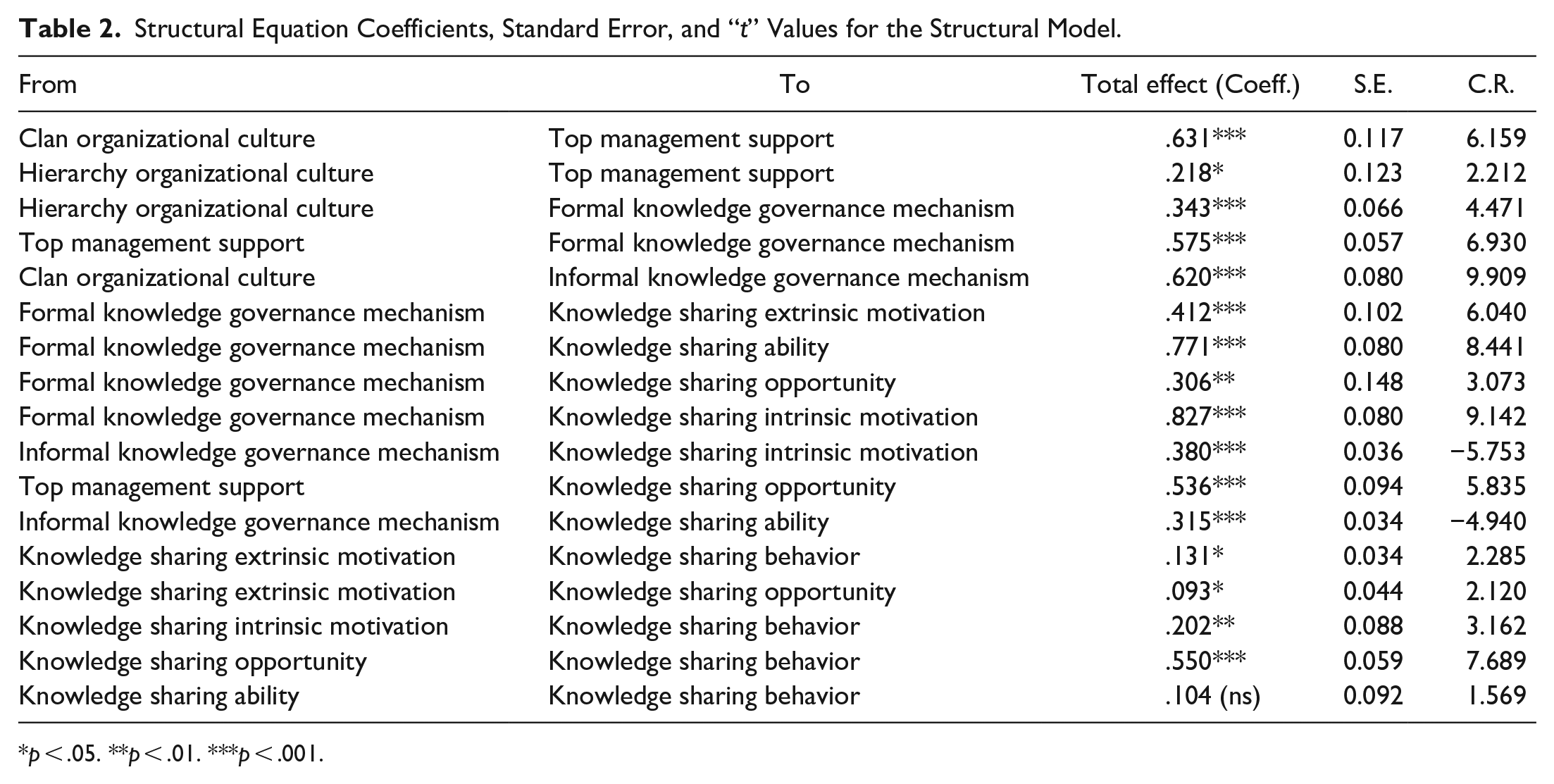
p < .05. **p < .01. ***p < .001.
Measurement Model
Table 3 gives the convergent and discriminant validity measures of the variables. The critical ratio must be greater than 0.7 and Average Variance Extracted (AVE) should be greater than 0.5 for convergent validity to establish. Maximum Shared Variance (MSV) and Average Shared Variance (ASV) should be less than AVE for discriminant validity. All values are in an acceptable range. This explains that all the variables are distinct from each other.
Convergent and Discriminant Validity Measures.

Figure 2 shows a measurement model of study. All factor loadings are above 0.4. t-values are significant. The goodness of the measurement model is assessed by Hair et al. (2010) criteria. Threshold values as suggested by Hair et al. (2010) for χ2/df is 3.00 whereas χ2/df ratio for the measurement model was 2.063. Values above 0.9 indicate a perfect fit, above 0.8 a good fit, and above 0.7 provide a marginal fit. RMSEA should be less than or equal to 0.07. Fit indices indicate that GFI = 0.80, NFI = 0.90, IFI = 0.92, RFI = 0.90, CFI = 0.93, NNFI = 0.92, and RMSEA = 0.06. Thus, fit indices supported a perfect to good fit to data.

Theoretical framework.

Measurement model.
Structural Model
Figure 3 shows a structural model of this study that indicates regression coefficients between different latent constructs. All hypothesized relationships are significant, except that KSA has a non-significant relationship with KSB.
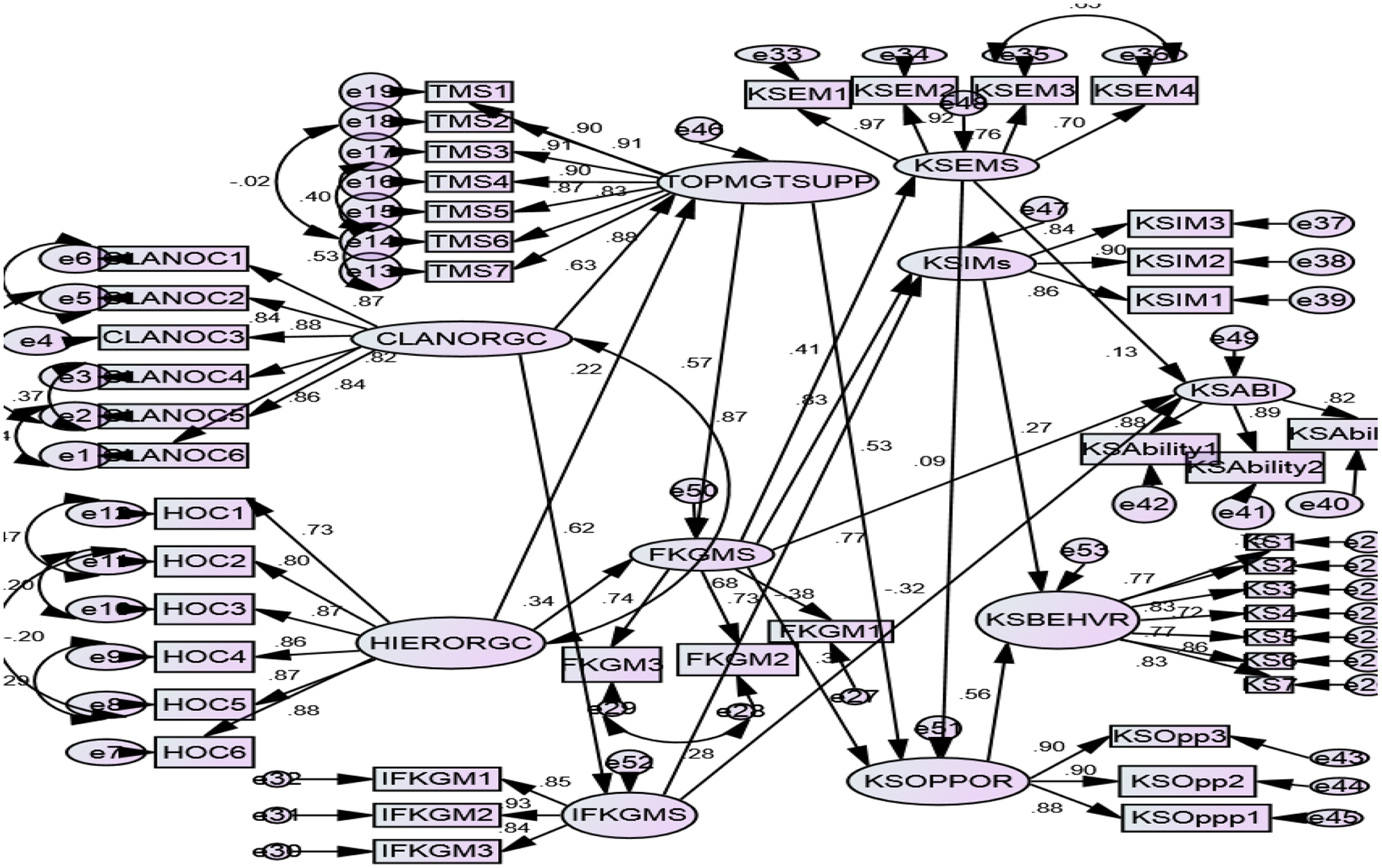
Structural model.
χ2 /df ratio for the structural model was 2.43 which is smaller than the threshold value of 3. Fit indices indicate that NFI = 0.80, IFI = 0.90, RFI = 0.82, CFI = 0.90, NNFI = 0.90, and RMSEA = 0.07. Thus, fit indices supported a perfect to good fit to data according to recommended values by Hair et al. (2010).
Two competing models were also tested. Paths were added from HOC, COC, and TMS to KSB in model 1. In model 2, paths were added from TMS to KSA, from HOC to IFKGMs, and from COC to FKGMs. Paths were found to be insignificant. According to Hair et al. (2010), if there were no improved fits by adding paths, the proposed model provides the best fit to data and is accepted as a final model.
Mediation Analysis
There were several mediation paths in the theoretical model. Each of these mediation effects was separately examined to see the impact of different variables on KSB.
Table 4 gives the results of direct, indirect, and total effects for mediation analysis. The above table reveals that COC influences KSB through KSO, KSIM, and IFKGMs. COC also influences KSIM through IFKGMs. TMS influences KSIM and KSEM through IFKGMs and FKGMs, respectively. Similarly, formal and informal KGMs influence KSB through KSEM and KSIM respectively. HOC has an impact on KSA through FKGMs. HOC also has an impact on KSB through KSO and FKGMs. Hence, there are different organizational and individual level variables through which OC influences KSB of university teachers.
Results of Mediation Analysis.

p < 0.05. **p < 0.01. ***p < 0.001.
Discussion
The first objective of the study was to assess the impact of OC on KSB. Direct effects of COC through IFKGMs on KSB are significant, that is, β = .31, p < .001. COC influences KSIM through IFKGMs. Direct effects are significant with β = .43, p < .001. COC shapes informal mechanisms to develop social ties. Direct effects of COC on KSB are significant through KSIM, β = .31, p < .001 and KSO, β = .32, p < .001. Thus, COC provides opportunities and intrinsically. H2, H6, H15, H13 are supported. Findings are in line with Turner and Pennington (2015). Individual variables have a positive relationship with the outcome, KSB. HOC influences KSB through FKGMs, KSEM, and KSO. Both direct and total effects are significant. Organizational factors influence individual factors to enhance KSB. The second objective was to examine the impact of FKGMs and IFKGMs on KSB. KGMs enhance KSB through motivation. KSEM facilitates sharing of knowledge in case of FKGMs, β = 0.63, p < .01 and KSIM enhances KSB in context of IFKGMs, β = .51, p < .05. Results are in line with Huang et al. (2013), however, Huang et al. (2013) used motivation as a uni-dimensional construct. Formal and informal KGMs are positively associated with KSA, with β = .77, p < .001 and β = .31, p < .001 for FKGM and IFKGM, respectively. FKGM is significantly and positively associated with KSEM, β = .41, p < .001 and KSIM, β = .38, p < .001. Thus, H5, H7, H8, H9, H10, H11, and H12 are supported. TMS has a significant and positive relationship with FKGM, β = .57, p < .001. FKGM has an intervening effect between TMS and KSIM, β = .29, p < .01. Direct effects were insignificant through FKGMs, so TMS no longer influences motivation in presence of formal mechanisms. H18 is supported.
However, the indirect effect of TMS on KSEM was examined through FKGMS. Direct effects were significant, β = .15, p < .01. It indicates that TMS and FKGMs, both are important in influencing KSEM of teachers. Hence, H17 is also supported.
The third objective of the study was to assess the impact of KSIM, KSEM, KSO, and KSA on KSB. KSIM, KSEM, KSO were significantly and positively associated with KSB. Regression coefficients were β = .20, p < .01, β = .13, p < .05 and β = .55, p < .001, respectively supporting H13, H14, H15. KSA has an insignificant relationship with KSB, and hence, H16 was unsupported. Results conform to previous studies. Huang et al. (2013) found that KSO and knowledge sharing motivation (KSM) are positively associated with KSB. KSA was not associated with KSB. Turner and Pennington (2015) found a significant and positive relationship between KSO and KSM with KSB. Only a marginal relationship between KSA and KSB was found by Turner and Pennington (2015). Hence, KSO and KSIM, and KSEM are important for enhancing KSB. if an individual has KSA is not motivated for sharing knowledge or has lesser opportunities for sharing, then KSA alone would not improve KSB.
Hence, it is concluded that OC enhances KSB through different individual and organizational factors. Individual factors are also important as organizational factors influence them to enhance the KSB of teachers in universities. Results of mediation analysis show that organizational factors influence the KSB of university teachers through individual variables. Thus, H19, H20, H21, H22, H23, and H24 are supported.
Findings
Empirical findings reveal that in the Pakistani Higher Education sector, teachers share their knowledge but still, there must be some individual and organizational factors that should enhance this behavior (Asrar-ul-Haq & Anwar, 2016). The mean score of TMS shows that top management does not provide enough support to share knowledge, there is a lack of both opportunities and motivation. This contributes to the theoretical gap in identifying factors that can contribute positively to KSB. In developing countries, KSB is not at a satisfactory level and organizations must introduce systems and methods to improve it (Bibi & Ali, 2017). Informal knowledge governance mechanisms are less developed or recognized in Pakistani organizations and there is less than required supportive behavior, positive feedback, and financial resources as a source of motivation from top management. So, it might be the reason that relationship of informal knowledge governance mechanism with motivation, ability, and opportunity is weak as opposed to previous studies (Huang et al., 2013). Findings are in line with Kanwal et al. (2019) that HEIs need to develop KM policies for effective KS.
FKGMs are well recognized in HOC. HEIs in Pakistan have hierarchical structures. Therefore, the results of the study are more supportive and have a stronger significant relationship with other predictors of KSB proposed in the model as compared to COC. These findings are in line with what was examined by Huang et al. (2013) and Amayah (2013). It reveals that formal knowledge governance mechanism in Pakistani higher education organizations not only provides knowledge-sharing opportunities to the teachers and faculty members but they also improve their intrinsic and extrinsic motivation to share knowledge. Faculty members are willing to share knowledge, they can share knowledge and are intrinsically and extrinsically motivated to do so.
This study confirms the previous findings of Huang et al. (2013), where the study utilized knowledge sharing opportunity and motivation-driven perspective. This study has gone beyond previous findings by not establishing the relationship between knowledge governance mechanisms, knowledge-sharing opportunity, motivation, and behavior but also adding the organizational culture and top management perspective in the model.
Theoretical and Managerial Implications
This study contributes to the literature by highlighting the importance of individual and organizational processes that integrate and disseminate knowledge in organizations. The knowledge governance approach seems to have a deeper connection with organizational behavior literature, as it relies on individual factors like KSO, KSIM, and KSEM. However, these behavioral foundations must involve a link of individual behavior to a higher level, that is, organizational factors as antecedents of individual-level behavior. HOC is not necessarily a barrier. If an appropriate mix of factors is adopted, HOC can enhance KSB. Top management should utilize formal mechanisms for opportunities and motivation. Higher education sector should effectively exploit their knowledge-based sources. Vast and diverse knowledge can be effectively transferred to recipients if organizational culture and supporting mechanisms are conducive and advance knowledge cycle to distinguish an institution in the academic market place.
Limitations and Future Research
This study presents some limitations that provide an opportunity for future research. It is of considerable interest for future research to understand the differences in the two types of governance mechanisms. Due to a rigorous research design, the findings of the study apply to other developing countries having similar organizational structures and mechanisms in practice. However, this research has a limited foundation of data collected from the higher education sector in Pakistan, we recommend extending future research to other sectors, like IT or telecom to capture complex aspects of organizational culture, knowledge governance mechanisms, and KSB. Paying attention to cultural variations could be of particular interest. It would be interesting comparison to study and compare these factors in other countries.
This study utilized self-report measures. Future studies may consider research design involving multi-source data. Common method bias was treated by taking procedural and statistical measures. Future studies may utilize advanced techniques like common latent factors. No boundary conditions were specified in this study. In the future, researchers may test the effect of contextual variables like personality and natural barriers. Cultural dimensions like market and adhocracy culture may be included in the model in future studies.
Footnotes
Declaration of Conflicting Interests
The author(s) declared no potential conflicts of interest with respect to the research, authorship, and/or publication of this article.
Funding
The author(s) received no financial support for the research, authorship, and/or publication of this article.
