




Abstract
In this globally competitive environment, ethics has become the major area of concern for organizations to eliminate the issues that arise in knowledge sharing. Knowledge is considered to provide a competitive edge to individuals and organizations. This is especially true for industries engaged in the Information and Technology sector. In accordance with the above notion, the current study aims at assessing the role of ethics as a catalyst in affecting knowledge sharing in Indian IT organizations. For this purpose, the study adopted a self-developed questionnaire that was addressed to employees engaged in the IT sector of India. The study utilized SPSS and AMOS to outline the relationship between Ethics and Knowledge Sharing. The findings of the study revealed that the PRIMES model has a direct impact on knowledge creation culture, knowledge-sharing culture, and knowledge storage and knowledge application culture. Moreover, it was also revealed that ethical issues have a negative impact on the three constructs of knowledge sharing that is, knowledge creation culture; knowledge sharing culture; and knowledge storage and knowledge application culture. Personality traits and other constructs of the PRIMES model cannot be controlled by the organization. However, ethical issues can be curbed to enhance the knowledge sharing culture. Prior research has not empirically tested the role of PRIMES model and ethics on knowledge sharing culture.
Keywords
Introduction
In this globally competitive environment, ethics has become the priority of organizations to eliminate the issues that arise in knowledge sharing. The inclination and practices of the employees to hoard knowledge for their own vested interest affects the organizational performance on an overall basis (Mursaleen et al., 2015). Knowledge provides a competitive edge to both the individual and the organization as a whole. According to Ma et al. (2008), knowledge workers are more reluctant to share the tacit knowledge with other individuals as it acts as a beneficial element for them. However, this hoarding of knowledge showcases as a barrier to knowledge sharing. The increase in unethical practices has resulted in a quest to serve self-interest and thereby, hampered the productivity of the organization. As a result, there is a dire need to recognize the importance of ethics in the workplace. Ethics emphasize the importance of values and morality in society. Human laws too are based on ethics. Moreover, ethics extend beyond laws and thereby, where even laws cannot serve to guide behavior. The ethics perceived by humans helps in providing eminent direction to take the right decision in controlling one’s behavior when faced with different situations and obstacles.
Knowledge management is often articulated as the management of corporate knowledge for improving organizational performance on several grounds. It may lead to development of organizations that are quick in decision making and often referred to as “intelligent acting” and “innovative”. It is also considered as a tool for handling information. KM is instrumental in dealing with knowledge creation, knowledge management, knowledge sharing, and exploitation of knowledge. The first step in the process of knowledge management involves acquiring information. The second step refers to the storing and organizing of the acquired information in a logical manner. The next step is to make the acquired and stored information available to all the employees of the organization. The final step consists of utilization. It involves sharing of knowledge by people among themselves and socializing and exchanging information in various forms. Lastly, knowledge management is a strategic management tool that will help the organization in unveiling benefits of better performance, productivity, competitive advantage, better decision making, decreasing any cost incurred on research, and thereby, attaining better innovation (Evans & McKinley, 2011). Hence, it can be highlighted that outlining the factors affecting knowledge sharing becomes critical for ensuring the seamless growth of the IT organizations in India.
Based on this notion, the current study aims at assessing the role of ethics as a catalyst in affecting knowledge sharing in the Indian IT organizations. The primary aim of the current study is to analyze the concatenation between ethics and knowledge sharing in the organizations of the Indian IT sector. In order to accomplish the above aim, the study will focus on addressing the following objectives:
To study the ethical norms and codes prevailing in organizations.
To study the knowledge sharing culture prevailing in organizations.
To study the impact of ethics on the Knowledge culture of organizations.
Research Questions
Based on the above-formulated objectives, the study will focus on providing answers to the research queries below:
What are the ethical norms and codes followed and practiced in organizations?
What is the knowledge sharing culture in the organizations?
Is the knowledge culture of organizations positively related to ethical norms and codes prevailing in organizations?
The ethical inclination of an organization nurtures its culture with trust, honesty, commitment, responsibility, affability, data privacy, secrecy, confidentiality. There are several unethical issues which an organization deal with while practicing knowledge culture. The unethical practices like corruption, leaking trade secrets, exploitation, unfair and unjust behavior, cheating have negative impact on individual and organization (Sims & Brinkmann, 2009). Studying prevailing ethical norms and codes in organizations is important as practicing ethics in organizations have long term positive outcomes including better good will of the company (Turgut & Sökmen, 2018).
Value of knowledge gets augmented through sharing and dissemination in contrast to other resources which gets exhausted after usage. Knowledge sharing is ascribed by several traits prevailing in culture like trust, flexibility, collaboration, employee interaction, open communication experience sharing by senior employees etc. Knowledge sharing is vital for any organization as it encourages the optimum application of knowledge by the people who require it to maximize the return from that knowledge. Thus it is important to explore the components that foster employee’s motivation to share knowledge. Also organizations grow when members are open to share their knowledge with colleagues and team members (Toulkeridis et al., 2018).
The strength of knowledge to perceive, learn and interpret is accredited more to values and ethics then information processing and storage infrastructure (Mas et al., 2004). It is essential to establish ethical framework and policy guidelines specifically in IT sector for data privacy and confidentiality as these firms are dealing with big data. Thus it is important to focus on this area of ethics and study its impact on knowledge culture of an organization.
Literature Review
Outlining Ethics, PRIMES Model and the Ethical Issues
Ethics are not just a product of humankind. Rather they are a result of distinct characteristics of human nature that comprises the essential framework of laws. As a consequence, human laws follow ethics. Tseng and Fan (2011), in their study outline, that the concept of ethics is discussed as well as utilized to analyze an individual’s moral lives, strategies adopted for understanding decisions, everyday life behavior in taking pertinent responsibility and accountability of action in some specific situations. It is not a mere abstract philosophical theory. On the contrary, it acts as a guiding tool for personal or collective practices (Kuenzi et al., 2020). According to Akhavan et al. (2014), ethics is composed of good and bad attributes, conducts and intentions. Therefore, ethics are concerned and accompanied by two extreme counterparts of life, that is, good or bad. It is a branch of philosophy that is referred to as a norm-based science. This is because it plays a guiding role that directs human behavior. In this context, ethics can be broadly distinguished from mainstream sciences like mathematics, or natural sciences like chemistry and physics.
There also exists a conflict of interest among the employee and organization in concern to the ownership of the knowledge. The employees perceive knowledge as a notion that is subjective to them. While on the other hand, the organization perceives that knowledge is an asset that is developed by the provision of adequate resources to its employees in the form of finance, technology, infrastructure, and reward. According to Gaur and Gupta (2018), ethical issues can be categorized into varied categories like technical, socio-economic, and legalistic. The technical team is basically responsible for designing and implementing knowledge management and thereby, may be encountered with several unethical aspects. In such circumstances, the members of the technical team can resort to act as a whistleblower and inform the management about the unethical aspects. Moreover, such a hidden agenda for the implementation of knowledge management in an organization outlines the socio-economic issue in ethical practices. This notion accounts for the fact that the major motive behind the implementation of the knowledge sharing process might be to reduce the human resource cost by capturing employee’s knowledge. Finally, legalistic ethical issues are particularly concerned with conflict over knowledge ownership rights between employees and organizations.
The PRIMES model plays an essential role in determining how an individual’s moral or ethical behavior is shaped. The model views that moral actions depend on relatively stable personality characteristics. These personality characteristics guide an individual’s moral action based on their integration of morality (IM) into their self-system. In addition to this, the individual’s moral behavior is also driven by the skills and knowledge possessed by them. As per C. Huff (2010), the PRIMES model is an integrated model that is inclusive of varied ethical parameters that may concern both individuals and their surrounding perspectives. The major elements of this model include personality, integration of morality, moral ecology, and skills. These elements also make up for the abbreviation PRIMES. The element of personality concerns personality traits. These traits play a vital role in depicting the preference of people toward work and the path they will choose to accomplish the same. Integration of morality can be considered as the moral commitment of individuals that guides their actions in different types of circumstances as well as situations. Moral ecology is the environment that is present in surrounding an individual. The environment in terms of varied conditions may affect the way in which an individual will undertake a certain type of action. Lastly, moral skills and knowledge is awareness or knowledge that is possessed by an individual with regard to different moral actions and content.
Zyngier and Nagpal (2015), in their study, outlined that knowledge sharing is subject to many unethical practices. These practices act as a barrier to an individual’s ethical behavior which disrupts the knowledge management in an organization. Such unethical behavior of an individual may also arise when they refrain to share knowledge or manipulate the same to achieve any personal interest or gain. Hoarding of knowledge, plagiarism, manipulation of information, purposeful misappropriation of knowledge, conflicts pertaining to property or privacy rights is some of the hurdles faced to the ethical behavior of an individual. Tacit knowledge is subjective in nature which makes it largely confined to the individual that possesses it. Thus, it depends upon the owner of such knowledge whether they are willing to share it with other members or not. This results in unbalanced distribution of knowledge within an organization (Sik-wah Fong & Chu, 2006) (Table 1).
Ethics.

Source. Compiled by Authors.
Understanding the Concept and Importance of Knowledge Culture
Knowledge can be recognized as a core competency that serves as a prerequisite for attaining competitive advantage and value creation for organizations around the globe (Liu et al., 2019). An individual’s actions, behavior, and experiences are all a part and parcel of deep-rooted knowledge possessed by them. This accentuates that employees’ behavior pertaining to knowledge are highly determined by cultural aspects. These cultural aspects comprise their values, norms, and rules. Sunarsi (2020) in this regard outlines that the culture of a group is nothing but a set of shared basic assumptions about external adaptation and internal integration. In accordance with this, organizational culture can be comprehended as a set of underlying values and beliefs that plays an eminent role in shaping the way in which organizations perceive as well as react to their environment. Thus, organizational culture has a pertinent impact on governing the cognitive aspects of members within the organization which further shapes the way in which these members express themselves (Intezari et al., 2017). According to knowledge theory, knowledge is recognized as an intellectual asset that serves as a major source of power and guarantees competitive advantage. Knowledge creation, knowledge storage and application, knowledge sharing, and knowledge capture are the essential requirements for driving innovation and enhancing organizational performance (Rutten et al., 2016).
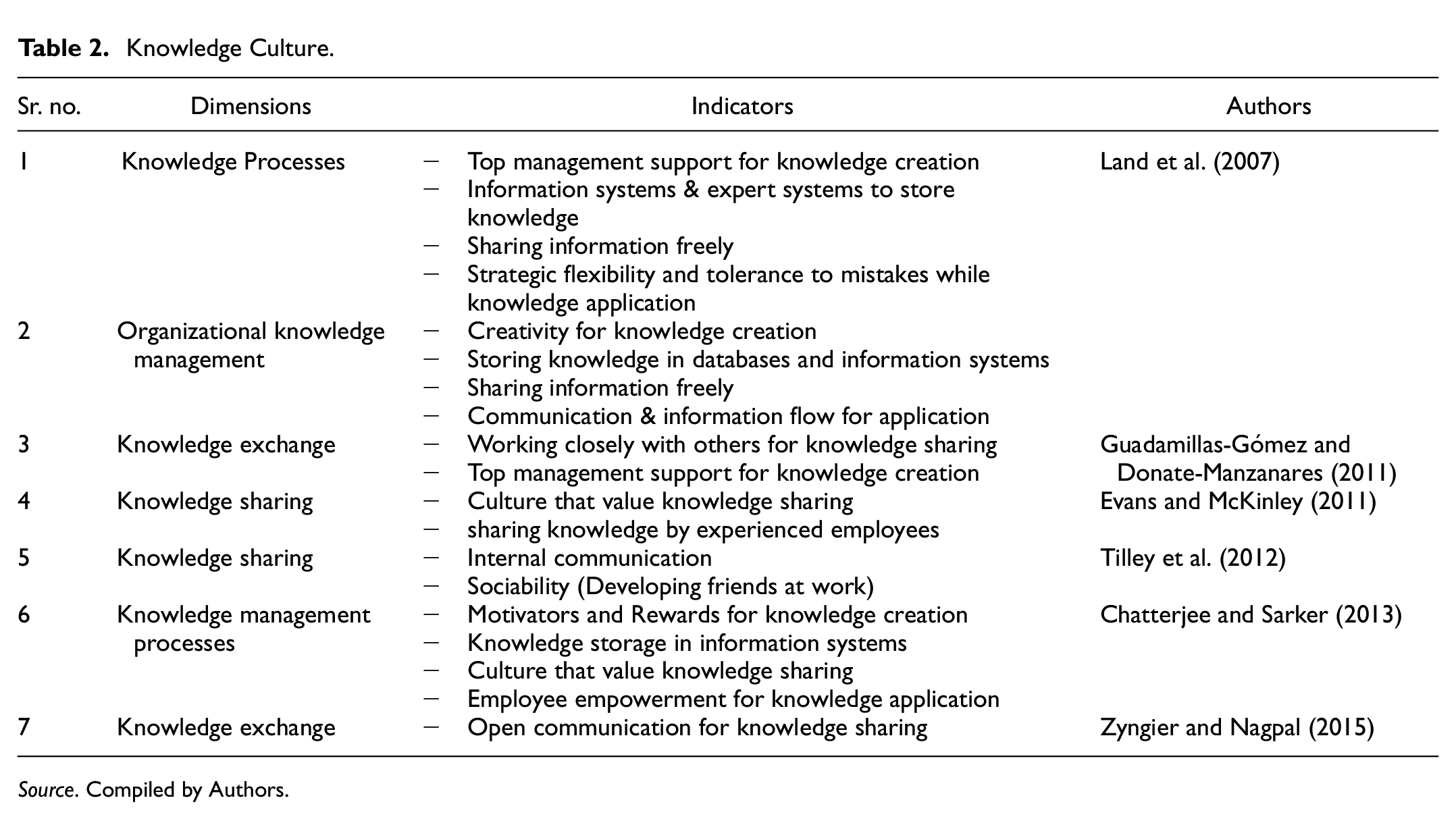
Better knowledge management in an organization is a key to unlock benefits like creativity for knowledge creation and storing knowledge in databases and information systems. However, knowledge management in organizations is facilitated only when there prevails a viable environment that enables employees to share information freely. As a result, if there is a lack of provision to communicate with the top management pertaining to the issues that may be faced by the firm if the prevailing practices are continued, the individual or group concerned might never resort to explain their views. This might result in hampering the organization’s productivity in the long run. Moreover, exchange of knowledge or transfer of knowledge is acquired by working closely with others and by the support of the top management for new knowledge creation. Employees will presume knowledge sharing practices to be viable for both self and organizational growth, only when they are truly encouraged to share their ideas and views about a phenomenon. Nonetheless, discouragement from the top management will result in holding tacit knowledge of high strategic value. Such knowledge is only shared or applied when they find any rewards or compensation in exchange for the same (Guadamillas-Gómez & Donate-Manzanares, 2011). In addition to this, it is essential that the top management is flexible and tolerant to honest mistakes of the employees (Land et al., 2007).
Evans and McKinley (2011) in their study highlights that sharing employees’ expertise as well as skills is conducive for providing opportunities for mutual learning. In addition to this, it significantly contributes to the organization’s innovative capabilities. Thereby, it becomes crucial to comprehend as to how individuals are involved in sharing knowledge within their group and across organizational departments or hierarchical structures. Tilley et al. (2012) highlights that knowledge sharing majorly depends upon the level of internal communication that prevails in an organization. It is observed that sociability that is, the extent to which the employees have friends at workplace outline that manner in which knowledge will be shared. Moreover, there are other factors that depict the extent to which knowledge management processes will be successful. For instance, motivators like rewards and compensation play a significantly vital role in enabling knowledge sharing and creation. Furthermore, it is eminent to store knowledge shared for future use. An organizational culture that values knowledge sharing and empowers knowledge application is crucial for the success of knowledge management processes (Chatterjee & Sarker, 2013). Lastly, it is observed that open communication is the key to attain knowledge sharing (Zyngier & Nagpal, 2015) (Table 2).
Knowledge Culture.
Source. Compiled by Authors.
Accentuating the Linkage Between Ethics and Knowledge Culture
To prevent individuals from indulging in unethical practices, it is essential to develop a Knowledge Culture that is based on the core pillars of ethics. This will not only help the individuals to strongly participate in the process of knowledge sharing but also allow the organizations to reap the benefits of the same. Studies proclaim that organizations that shift their focus on developing a better knowledge sharing culture are more productive in comparison to those organizations that suffer from knowledge hoarding issues (Andolšek, 2011; Haas & Hansen, 2007; Muqadas et al., 2016). A great number of funds are spent by organizations each year on the recruitment, up-gradation, training and development of employees (Muqadas et al., 2016; Smith et al., 2006). Nonetheless, employees often leave their job whenever they find a better and attractive job opportunity. This results in wasting the time and resources invested by the employers in enhancing their capabilities. Especially in the public sector, it has been observed that the employees prefer to hoard their knowledge to serve their own vested interest, garb promotional opportunities, secure powers, authorities, or influence their superior at work. Such retention of knowledge is detrimental to the growth of other employees and thereby, affects the productivity of the organization as a whole (Muqadas et al., 2017).
According to Tseng and Fan (2011), an ethical organizational climate is significant for facilitating the seamless flow of knowledge processes. The ethical approach to knowledge sharing culture enables an organization to engage its employees in the process of knowledge sharing. This helps to create a database that can both store and apply the knowledge retained by them. As Pee and Min (2017), compensating employees in the form of rewards for their knowledge contributes can foster a better knowledge sharing culture in the organization. Such rewards not only help the employees to take active participation in sharing their beneficial knowledge with other employees but also helps them to be more motivated and committed toward their organization. It is essential that the knowledge sharing culture is fair and unbiased in any organization. This is because an employee may possess tacit knowledge which may act as an intellectual asset for the organization. Organizations that may refrain from sharing such knowledge may hinder their own growth. Thus, an organizational culture where individuals feel free to provide their input is more prone to promote, share, create, and process knowledge (Table 3).
Ethics and Knowledge Culture.

Source. Compiled by Authors.
Research Gap
Knowledge sharing is an activity through which knowledge is exchanged among employees either within or between organizations. Knowledge Sharing helps in several ways beginning from acquiring better decision making ability to stimulating innovation and growth within the organization. However, there are many hindrances that impact such knowledge sharing between the employees at different levels in an organization. It is essential to understand which factors hinder and enable knowledge sharing culture in the organization as their ultimate performance depends upon the extent to which the organization is innovative and competitive. This is particularly essential for organizations where knowledge transfer plays a key role. For instance, academic institutions, IT sector, AI based organizations, and others. Here, it can be observed that the performance of the employees and organization is together shaped through the knowledge transferred and acquired by the employees over time. However, it can be highlighted that there is limited information available pertaining to the aspects of knowledge, culture and ethics. Moreover, there is no empirical research priorly conducted to analyze the role of ethics in promoting knowledge culture. As the IT sector is one such industry where KM and knowledge sharing are important attributes for better organizational productivity, the current study is driven in the same direction. The current study, therefore, aims at analyzing the nexus between ethics and knowledge sharing in the organizations of the Indian IT sector.
Hypotheses of the Study and Conceptual Framework
The study will seek to test the following hypotheses of the study:
The knowledge during acquisition and creation is manipulated, misappropriated, suppressed, amplified and distorted for personal and organizational gain. Personality of an individual, commitment toward morality and content of morality in organization is responsible for activities in which individuals indulge themselves while carrying out day to day activities and also non routine activities (John & Srivastava, 1999).
Knowledge sharing faces stress full environment when there is need of knowledge by one employee and other employee who possess knowledge is keen to hoard knowledge. The personality of an individual, persistence toward continuing moral behavior, moral behavior in surrounding ecology is determinant of individual behavior (C. W. Huff & Barnard, 2009). This behavior may have direct impact on knowledge sharing in teams and organization as whole. Knowledge storage is feasible when the knowledge owner allows the team to store his knowledge in repositories, databases and expert systems.
The knowledge creation in domain of ethics provide the guidelines to the individuals to behave in appropriate ways whereas in contrary unethical behavior prohibits knowledge creation through knowledge hoarding and knowledge loafing behavior (Rechberg, 2018).
While sharing the knowledge, it should be taken at top priority that secret and confidential information should not be shared with third party users (Sabaa-Ayoun, 2021). Knowledge sharing should be carried out in accordance with ethical regulations and code of conduct.
Storage of data at integrated cloud database platform may also give access to several unauthorized users if ethical issues are not addressed (Belinda et al., 2018).
From the above conceptual framework (Figure 1), it can be delineated that ethics is the independent variable and knowledge sharing is the dependent variable. ethics further constitutes of two main sub-variables that is, PRIMES and ethical issues. on the other side, knowledge sharing includes three sub-variables that is, culture for knowledge creation, culture for knowledge sharing, and culture for knowledge storage and knowledge application. the study aims at testing the impact of PRIMES on culture for knowledge creation, culture for knowledge sharing, and culture for knowledge storage and knowledge application. additionally, it seeks to understand the impact of ethical issues on culture for knowledge creation, culture for knowledge sharing, and culture for knowledge storage and knowledge application. this will help in comprehending how ethics play a significant role in embedding knowledge sharing culture in the organization.

Conceptual framework.
Research Methodology
Depending upon the objectives of the current study, it aims at utilizing a primary data collection method. For this purpose, the study will utilize a self-developed questionnaire. The scale was developed on the basis of the literature reviewed in the prior sections. The major variables were accentuated on the basis of the same and to test each variable empirically, the questionnaire has strategically incorporated each variable. This self-developed questionnaire is administered to the employees working in the Indian IT sector. This is because the IT industry is the major sector that requires a seamless flow of information and thereby, a good KM culture. For this purpose, the study will utilize a probability sampling procedure wherein a stratified sampling technique will be implemented to acquire data. Stratified sampling method is utilized as the study acquires data from different IT organizations and employees at both middle and top levels in their organizations. Data is collected from Delhi-NCR region. The study had acquired data from IT organizations present in four stratas of Delhi, Ghaziabad, Gurgaon and Faridabad. From each of these regions, a total of 50 employees were considered. The sample size of the current study is 200 employees. As the sector adopts a quantitative research approach, the data acquired will be numerical in nature. Thus, the study will utilize the SPSS and AMOS software for analyzing the results of the study.
Data Analysis Procedure
As the sector adopts a quantitative research approach, the data acquired will be numerical in nature. Thus, the study will utilize the SPSS and AMOS software for analyzing the results of the study.
Questionnaire Development
As the study seeks to address a research aim that has not been previously addressed, there is a lack of availability of a standardized tool that can be used. In accordance with this, the current study has developed a survey instrument that can be used for addressing the goals of the study. Based on the objectives of the study and the literature reviewed, the items were developed based on two variables that is, Ethics and knowledge culture. The variable of ethics was further broken down into two dimensions of the PRIMES model and ethical issues. On the other hand, the variable of knowledge culture into three dimensions of knowledge creation, knowledge sharing, and knowledge storage & knowledge application. In alignment with this, the Scale of Ethics and Knowledge Culture was developed. The questionnaire used a 5-point Likert scale wherein 1 to 7 ranged from Strongly Agree to Strongly Disagree respectively (1 = Strongly Disagree, 2 = Disagree, 3 = Somewhat Disagree, 4 = Neutral, 5 = Somewhat Agree, 6 = Agree, and 7 = Strongly Agree).
The dimension of PRIMES consists of 4 items that represented each of the variables in the model that is, Personality Traits, Integration of Morality, Moral Ecology, and Skills as outlined by C. Huff (2010). Further, the dimension of Ethical issues comprised 5 items that represented the several attributes outlined by Gaur and Gupta (2018), Zyngier and Nagpal (2015), and Sik-wah Fong and Chu (2006). Furthermore, the dimensions of Culture for Knowledge Creation consist of 4 items, Culture for Knowledge Sharing of 5 items and Culture for Knowledge Storage and Knowledge Application of 5 items. Thus, a total of 23 items were finalized for the current study. After multiple checks and modifications, the study conducted the final pilot study wherein the following reliability statistics were acquired (Table 4).
Reliability Statistics.

The reliability in statistics is determined by using Cronbach’s alpha (α). The Cronbach’s alpha in this research ranged from .629 to .794 indicates that it is deemed to be good. All the items were considered for further analysis.
Results and Discussion
Demographic Information
From Table 5, it can be observed that the majority of the respondents accounting for 65.5% are males while 34.5% of them are females. Further, these participants were inquired to outline the age-group to which they belong. In this concern, it was identified that the majority of the respondents belonged to the eldest age group of 56 years and above. Followed by this, 31.0% of the respondents belong to the second eldest age group of 46 to 55 years. Moreover, 24.0% and 12.5% of the respondents belonged to the age groups of 36 to 45 and 25 to 35 years respectively. With respect to the experience in the IT industry as a whole, it was found that the majority of the respondents had an experience of 6 to 8 years, accounting for 43.5%. Followed by this, 18.5% of the respondents had an experience of 3 to 5 years and 21.0% of the respondents had an experience of 9 to 11 years. There were only 10.5% of the respondents that had the least experience of 0 to 2 years while 6.5% of the respondents had the highest experience of 12 years and above.
Demographic Analysis.

Further, the respondents were asked to outline the tenure that they completed in their current organization. In accordance with this, it was found that the majority of the respondents accounting for 35.0% of them had completed 6 to 7 years of tenure. Further, 23.5% of the respondents had completed 4 to 5 years of tenure. 21.0% of the respondents had completed 2 to 3 years in their organization and 9.5% of the respondents had completed only 0 to 1 year. Lastly, there were 11.0% of the respondents that had completed 8 years and above in the organization. Finally, the respondents were inquired about their designation in the organization. In this concern respondents highlighted 43.0% of them were at Executive level, 45.0% of them were at Managerial level and the remaining 12.0% of them were at the Senior level.
Factor Analysis
When all the items were forced to form a single factor, the factor analysis was able to extract four components with a variance of 51.525%. All items had factor loadings of more than 0.4 and were considered for further analysis.
Preliminary Model
The path diagram for the preliminary model which is used for confirmatory factor analysis was as follows (Figure 2).

Path diagram for preliminary model.
Model Fit Indices
The values of different indices were as follows,
Table 6 shows that the Chi Square value was 440.019, DF was 224 and the CMIN/DF was 1.964 indicating a good fit model. The CFI was 0.838 which is close to 0.9 and RMSEA was 0.07 indicating a good fit. Additionally, the value of NFI is 0.723 which is close to 0.9 indicating a good fit. Thus, it can be concluded that the above model is a good fit.
Indices for Model Fit.

Validity
The principal component analysis was carried out to reduce a large set of data to obtain a meaningful smaller set of constructs. Each variable used in the analysis was measured by multi-item constructs by factor analysis with varimax rotation to check the unidimensionality among the items. The constructs included in the confirmatory factor analysis had Cronbach’s alpha of more than .8. The Cronbach’s alpha indicated the internal consistency between the constructs and it is deemed to be good. All the items included in the analysis had factor loadings of 0.4. Hence this indicated the assessment and validation by using the discriminant and convergent validity. The convergent validity was also assessed by using the factor loadings of latent constructs which had a significant p value of less than .001. This test supported that the constructs had convergent validity.
The discriminant validity indicated by correlation matrix where majority of the constructs had a correlation coefficient of less than .85 and also by using the path analysis where the correlations among the latent constructs were less than 1.
Confirmatory Factor Analysis
A preliminary model was set for confirmatory factor analysis by using AMOS. The preliminary model allowed the researcher for its best fit as per parsimony and substantive meaningfulness. The model fit indices indicated how the underlying structure fits the data. The model was evaluated by using the model fit indices including Chi Square statistic, Degrees of Freedom (DF), CMIN/DF, CFI, and RMSEA.
Measurement Model

Path diagram for measurement model.
Model Fit Indices
Table 7 shows that the chi square value was 261.578 DF was 220 and the CMIN/DF was 1.189 indicating a good fit model. The CFI was 0.969 which is close to 0.9 and RMSEA was 0.031 indicating a good fit. However, the values of NFI were close to 0.9 indicating a good fit.
Model Fit Indices.

Hypothesis Testing
From the measurement model, the beta coefficient for the association between PRIMES and Knowledge creation was .358 and its corresponding p value was .000 < .05. Since the p value was less than .05, the study can conclude that PRIMES has a direct impact on the knowledge creation culture (Table 8).
Covariances: (Group Number 1 - Default model).
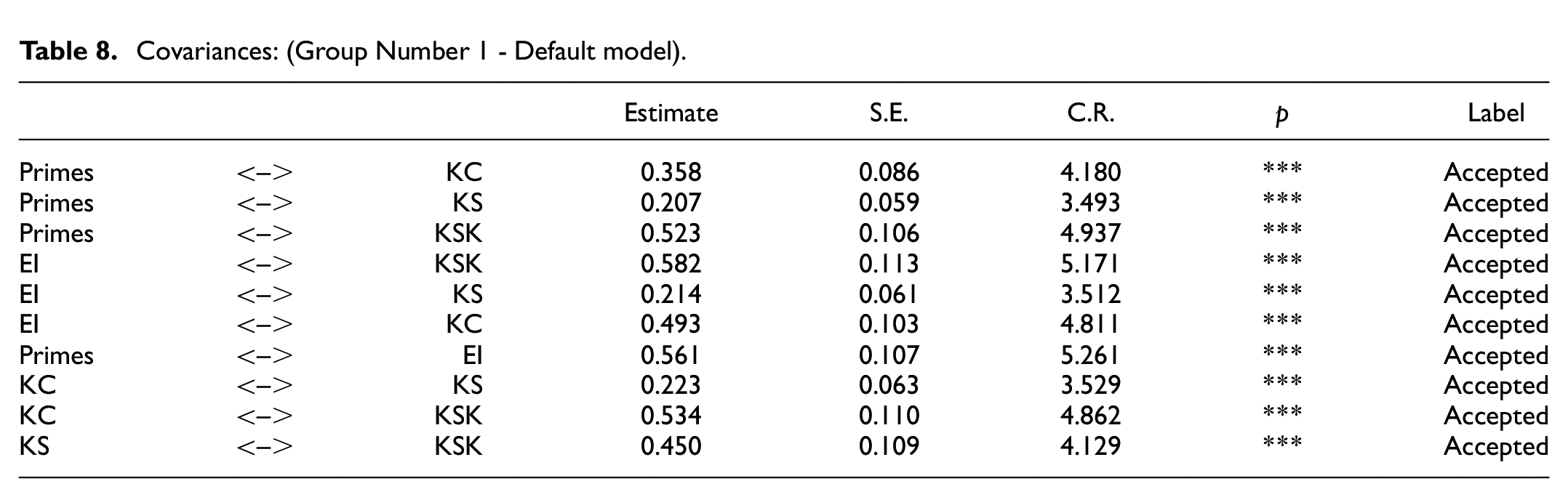
From the measurement model, the beta coefficient for the association between PRIMES and Knowledge sharing culture was .207 and its corresponding p value was .000 < .05. Since the p value was less than .05, the study can conclude that PRIMES has a direct impact on the knowledge sharing culture.
From the measurement model, the beta coefficient for the association between PRIMES and Knowledge sharing and knowledge application culture was .523 and its corresponding p value was .000 < .05. Since the p value was less than .05, the study can conclude that PRIMES has a direct impact on the knowledge sharing and knowledge application culture.
From the measurement model, the beta coefficient for the association between Ethical issues and Knowledge creation culture was .493 and its corresponding p value was .000 < .05. Since the p value was less than .05, the study can conclude that Ethical issues has a direct impact on the knowledge creation culture.
From the measurement model, the beta coefficient for the association between Ethical issues and Knowledge sharing culture was .214 and its corresponding p value was .000 < .05. Since the p value was less than .05, the study can conclude that Ethical issues has a direct impact on the knowledge sharing culture.
From the measurement model, the beta coefficient for the association between Ethical issues and Knowledge sharing and knowledge application culture was .582 and its corresponding p value was .000 < .05. Since the p value was less than .05, the study can conclude that Ethical issues has a direct impact on the knowledge sharing and knowledge application culture.
Discussion
It was found that the employees’ personality traits had an impact on their ethical behavior. Further, the ethical behavior of the employees was also determined by the skills and knowledge they possessed. In addition to this, it was revealed that the moral actions of the employees were influenced by their colleagues also. Moreover, it was accentuated that the inclination of the employees toward doing moral good also tends to affect their ethical behavior. Thus, it can be stated that the PRIMES is instrumental in predicting the ethical behavior of the employees in the firm. Further, findings of the study revealed that PRIMES model have a direct impact on the knowledge creation culture. In a study conducted by Ayub et al. (2019), similar findings were traced when they outlined that the big-five personality traits have a direct impact on knowledge creation culture. Moreover, it was also unleashed that transformational leadership can mediate the relationship between personality traits and big-five personality traits. Thus, the current study recommends that IT organizations in India should aim at practicing transformational leadership to enhance the knowledge creation culture. Moreover, as outlined by C. Huff (2010), that moral ecology is the environment that surrounds an individual that eventually shapes their decisions. It is suggested that organizations must practice more transparency so that the employees’ moral behavior is strategically guided. Further, the study outlined that the PRIMES model has a direct impact on knowledge sharing culture. This finding was in alignment with the study conducted by Agyemang et al. (2016). They depicted that personality traits have a significant impact on influencing knowledge sharing. However, the study outlined that the conscientiousness trait did not have any impact on knowledge sharing. Statistics acquired also suggested that PRIMES has a direct impact on the knowledge storage and knowledge application culture. Thus, it is recommended that organizations must strive to develop a culture and environment of transparency to promote knowledge sharing culture as hoarding of knowledge will detrimentally impact the organizations innovative capacity.
It was also uncovered that ethical issues have a negative impact on the three constructs of knowledge sharing. Further, the ethical issues of the employees were also gauged. In this regard, responses of the employees were found to highlight that their colleagues do not alter their information or knowledge due to vested interest. Additionally, employees highlight that even if the colleagues may hoard knowledge, the designing and implementation of knowledge sharing in the organization is instrumental to act as a whistle blower. On the contrary, they outlined that at times they may hoard knowledge and refrain from sharing it due to personal interest. Moreover, the majority of the employees agreed that at times colleagues might manipulate a piece of given information or share misappropriate information. In alignment with this, colleagues may not provide accurate information to maintain their privacy. Hence, it can be stated that either the knowledge sharing approach in the firm is not upto the mark to upheaval the ethical issues. In concern to this, it can be stated that there is a need to develop a framework for knowledge management in the organization. Failure to develop an appropriate framework to promote knowledge sharing culture will consequently result in socio-economic and technical issues. In addition to this, it will also lead to hoarding of tacit knowledge by the employees, manipulation and misappropriation of knowledge and conflicts with regard to property and privacy rights. Such issues will not affect the overall organizational culture but will eventually impact employees’ productivity and performance.
With regard to knowledge creation culture, it was revealed that employees agreed that propensity to experiment with ideas has a direct impact on the creativity level of employees and hence, knowledge creation. Further, it was found that employees affirmed that motivators and rewards enhance the knowledge creation culture in the organization. Also, openness to change among employees also affects knowledge creation culture. Finally, support from Top management is crucial in determining knowledge creation culture. With regard to the culture for knowledge sharing, the employees outlined that the presence of a free knowledge sharing environment also impacts the knowledge sharing culture of a firm. Further, open communication enhances the culture for knowledge sharing. Additionally, working closely with colleagues also enriches knowledge sharing culture as experienced employees share their knowledge. In accordance with culture for knowledge storage and its application, employees revealed that the information system and expert system for knowledge storage, retrieval and dissemination practices of the organization affect knowledge storage. Thus, it can be stated that the information system and expert system for knowledge must be well-structured. In this regard, communication and free flow of information also plays a vital role. In addition to this, empowerment of employees is crucial for enabling a culture for knowledge application. Also, employees outlined that their confidence is withhold when the top management is tolerant to their honest mistakes. Lastly, the employees agreed that the climate of organization for innovation affects knowledge application.
The high end application of knowledge leading to development and implementation of artificial intelligence and internet of things is leading to information privacy and security issues (Malik et al., 2022). Also there is impact on job security, employee physical health and employee psyche. Artificial intelligence digitizes human resource management systems for better performance (Votto et al., 2021). The various human resource functions are now accomplished through use of artificial intelligence. Artificial intelligence and machine learning contributes toward achieving sustainable goals of organization (Kar et al., 2022). Knowledge management in form of digitization is essential for business growth, survival and accomplishment of strategic objectives of the firm (Gupta et al., 2023). The other perspective of implementing artificial intelligence, digitization is that companies implement knowledge based applications to adopt downsizing by capturing employees implicit knowledge which depicts rise in ethical concern (Bryant, 2006).
Conclusion
Depending upon the findings of the study, it can be stated that constructs of PRIMES that is, Personality traits, Moral Ecology, and Skills have a significant impact on the knowledge sharing culture. Moreover, Ethical issues also have a negative impact on the knowledge sharing culture in the IT sector of India. Thus, pertinent measures need to be taken to improve the current scenario in these organizations. Based on the findings of the study, it is suggested that for promoting a culture for knowledge creation, organizations should engage in providing motivation and rewards to the employees for their creativity. This will not only boost their morale but leave no hidden areas of self-interest for which they are likely to hoard knowledge. Further, there must be a seamless communication flow between the top, middle, and lower hierarchy of employees. This will strategically portray the message that the organizations are willing to support and understand employees’ viewpoints. Thus, facilitating employees to release any tacit knowledge that might contribute to the organization’s productivity. Further, it is recommended that organizations should conduct brain-storming sessions which help to develop bonds between the employees and allow them to work closely with one another. Moreover, experienced employees must be called upon to provide training and knowledge to junior employees. Additionally, in concern to knowledge storage and knowledge application, the study recommends that with free flow of information and communication, organizations should also seek to empower their employees. As a result of this, employees will not hesitate to share knowledge and even indulge in whistle blowing that might reduce any sort of ethical issues. Furthermore, it is recommended that for promoting culture for knowledge storage and knowledge application, along with creation of a viable organizational environment, top management should have tolerance to honest mistakes of the employees. Taking strict actions against honest mistakes of the employees worsens the perception of other employees toward the organizations and reduces their commitment level toward the organizations. Finally, there is also a need to have an information and expert system in place for facilitating knowledge storage, retrieval, and dissemination activities.
Research Implications
The findings of the current study are strategically helpful to the IT sector in India and other knowledge driven organizations and industries. Findings of the study delineate that Personality traits have a significant impact on an individual’s knowledge sharing behavior in the IT sector of India. As a result, it can be stated that a deeper insight should be taken to understand which personality traits are among individuals and how they can potentially impact their knowledge sharing behavior. Moreover, it was revealed that ethical issues have a negative impact on the knowledge sharing culture in these organizations. Thus, it is essential to note that the organizations must have a positive and interactive work environment to reduce such unethical practices. Thus, it can be stated that the findings of the current study have significantly contributed theoretically to the prevailing literature that has outlined insufficient empirical information regarding the role and impact of PRIMES and ethics on knowledge sharing culture.
Practical Implications
The current study has practically contributed to all the knowledge driven institutions like organizations engaged in academic field, IT sector, AI, and other such organizations wherein knowledge plays a vital role in enhancing employee performance and thereby, organizational productivity. On the other hand, organizations should have a mechanism in place for the employees to discuss any issues or events that might seem to be peculiar. Moreover, pertinent actions must be taken against such issues and events, so that employees feel free to act as a whistleblower in such situations.
Limitations and Future Research Scope
There are many limitations that are faced by the current study. Firstly, the current study acquired data through primary sources wherein a quantitative survey method was used. As a result, it might happen that the responses gained would be biased. Thus, affecting the results of the current study. Additionally, it can be stated that although the quantitative survey method reduces some amount of bias that prevails if data is acquired qualitative means. However, qualitative data helps in acquiring in-depth information about an issue or phenomenon. This is particularly useful to explore trends, issues, and relationships that are not priorly examined. In this regard, the current study suggests the current study should be replicated in the IT sector and replaced with a qualitative data collection method. This will help in understanding why ethical issues prevail in the first place and how they affect knowledge sharing culture in organizations. Secondly, the study is restricted to IT organizations in India. In accordance with this, it can be outlined that the results acquired may not be valid or reliable across different knowledge-driven organizations. Moreover, there is also a possibility that the results might not be valid across different geographical boundaries. This is mainly because moral values and personality is also a function of the environment one is a part of. In this regard, future research can be conducted to understand the implications of the PRIMES model and ethics on knowledge sharing culture in IT organizations in other country or in other organizations in India.
Footnotes
Declaration of Conflicting Interests
The author(s) declared no potential conflicts of interest with respect to the research, authorship, and/or publication of this article.
Funding
The author(s) received no financial support for the research, authorship, and/or publication of this article.
