




Abstract
The main goal of the current paper was to determine the effects of perceived school climate dimensions (leadership, relationships, professional learning-teaching climate, safety, and physical environment) on students’ learning performance in upper primary schools. Correlational design consisted of structural equation modeling with mediation analysis was applied. Three hundred twenty-eight randomly chosen teachers and pupils from upper primary schools of Injibara and Chagni, Awi zone of Ethiopia participated. The 16-item school climate scale that was employed had an internal consistency score of 0.91 according to Cronbach’s alpha. To create a well-fitting measurement model, as well as to ascertain the convergent and discriminant validities and the composite reliability of school climate domains, confirmatory factor analysis was carried out. Together, the five school climate factors explained 19% variation on student academic performance. Academic achievement of students was directly and significantly influenced by school leadership and the professional learning-teaching environment. Pupils’ academic success was significantly and favorably directly impacted by the overall perceived favorable school climate. Positive professional learning-teaching environment fully mediated effect of physical setting and safety on learning achievement, even though it partially mediated the effect of leadership practice of school. Contribution of positive school climate elements to student’s learning achievement should also be further investigated using longitudinal multilevel structural equation models.
Plain language summary
The main goal of the current paper was to determine the effects of perceived school climate dimensions (leadership, relationships, professional learning-teaching climate, safety, and physical environment) on students' learning performance in upper primary schools. Correlational design consisted of structural equation modeling with mediation analysis was applied. 328 randomly chosen teachers and pupils from upper primary schools of Injibara and Chagni, Awi zone of Ethiopia participated. The 16-item school climate scale that was employed had an internal consistency score of 0.91 according to Cronbach's alpha. To create a well-fitting measurement model, as well as to ascertain the convergent and discriminant validities and the composite reliability of school climate domains, confirmatory factor analysis was carried out. Together, the five school climate factors explained 19% variation on student academic performance. Academic achievement of students was directly and significantly influenced by school leadership and the professional learning-teaching environment. Pupils' academic success was significantly and favorably directly impacted by the overall perceived favorable school climate. Positive professional learning-teaching environment fully mediated effect of physical setting and safety on learning achievement, even though it partially mediated the effect of leadership practice of school. Contribution of positive school climate elements to student s learning achievement should also be further investigated using longitudinal multilevel structural equation models.
Introduction
The schools have been struggling to raise pupils’ academic achievement as quality education becomes the global focus for the 21st century. As current students have diverse racial, ethnic, language, and cultural backgrounds, schools must provide an environment that is conducive to students’ learning and that maximizes their academic performance (Darling-Hammond & Cook-Harvey, 2018). In regard to this, a sizable body of empirical and theoretical data has emphasized the importance of promoting a healthy school atmosphere to promote students’ academic attainment (e.g., Becerra, 2016; Cornell et al., 2016; Daily et al., 2019; Gemnafle et al., 2018). Schools must have a positive and encouraging climate for students to study well and improve their academic performance (Organization for Economic Co-operation and Development [OECD], 2016). Since school climate has been a significant factor in enhancing the educational quality and student accomplishment for more than a century (Duraku & Hoxha, 2021; Martin, 2020; Nilsen et al., 2022; Shindler et al., 2016; Tomaszewski et al., 2023), creating an excellent and positive school climate should be a priority for schools all over the world (Becerra, 2016; Darling-Hammond & Cook-Harvey, 2018).
The students’ low learning achievement has remained critical challenge in Ethiopian primary schools (World Bank, 2020). According to data from grade four and eight students’ National Learning Assessments (NLA), it has been difficult to improve learning outcomes in Ethiopian primary schools (World Bank, 2020) because of different factors associated with school climate. These school climate related variables include lack of learning-teaching facilities and resources, large class sizes, lack of clean, separate facilities for boys and girls, and subpar physical conditions (Ahmed, 2017; Dagnew, 2017; Ministry of Education [MoE], 2018; Tadesse, 2015). Such a negative climate is linked with declining students’ learning achievement (Nilsen et al., 2022; Ramazan et al., 2023). Studies which examined influence of institutional climate on learning achievement have showed a substantial connection between climate and academic success (Becerra, 2016; Cornell et al., 2016; Dernowska, 2017; Geleta, 2017; Greenway, 2017; Magen-Nagar & Azuly, 2016; OECD, 2016; Reynolds et al., 2017).
For two key reasons, the evidence from past studies’ findings about the connection between student learning achievement and school atmosphere is still inconclusive. First, because of the various definitions and hazy components that have been noted in literature and research, conception of climate in school setting has remained blurry (Cohen et al., 2009; Payne, 2018; Thapa et al., 2013), which results in inconclusive evidence about how the perceived school climate affects student’s academic achievement. For instance, earlier studies mainly emphasized on bullying and school climate (Cohen & Freiberg, 2013; Zohar, 2014), teacher-student interactions (Alansari, 2015; Wentzel, 2015; Wilcken & Roseth, 2015), and contribution of school climate to students’ learning (Konold et al., 2018; Magen-Nagar & Azuly, 2016; Maxwell et al., 2017; Read et al., 2015; Scherer & Nilsen, 2016).
Second, the majority of prior studies (e.g., Dagnew, 2017; Dulay & Karadağ, 2017; Geleta, 2017; Gemnafle et al., 2018; King’oina et al., 2017; Magen-Nagar & Azuly, 2016; Ramazan et al., 2023; Reynolds et al., 2017) used climate in school setting as an observed variable and looked at its relationship with student achievement using either bivariate correlation or regression analysis, even though the school climate is latent construct with multiple indicators (Cohen et al., 2009; NSCC, 2015; Thapa et al., 2013). In response, school climate literature has suggested a need to assess school climate using thorough inventory (Becerra, 2016; Payne, 2018) devised by National School Climate Center (NSCC, 2015). In connection to this, Sintayehu et al.’s (2021) study has entirely used the NSCC’s (2015) comprehensive inventory and determined professional learning-teaching climate, relationships, leadership, safety, and physical setting as indicators of climate in school. Through exploratory and confirmatory factor analyses, the study has identified these aspects of school climate. We conceptualized school climate in this work as an integrated function of the aforementioned five interconnected aspects, which should be examined using a structural equation modeling approach. The prime goal of this work was to invigorate influence of school climate dimensions (professional learning-teaching climate, relationships, leadership, safety, and physical setting) on students’ academic achievement using structural equation modeling and mediation analysis, respectively.
Conceptual Framework of the Study
The Bandura’s (2002) social cognitive theory was undergirding theory that laid the foundation for conceptual framework of the study. According to Bandura’s theory, in any organizational settings of the schools, human behavior, cognition, and environmental factors all function as interacting determinants that have a reciprocal impact on each other (Bandura, 2002). Supporting this notion, evidence has showed that schools with positive organizational climate are able to improve students’ achievement and produce quality graduates (Gemnafle et al., 2018). One of the key principles of social cognitive theory, according to Bandura (2002), Miles (2012), and Schunk (2012), is that people learn best in social contexts, such as those seen in school organizations with active intra- and inter-personal networks. This demonstrates how crucial relationships are for improving student learning outcomes. Darling-Hammond and Cook-Harvey (2018) further explained positive association between teacher-student relationships and pupil academic achievement. The authors pinpointed that students with risk of poor learning outcomes can benefit from supportive, trustful, culturally sensitive and responsive nurturing relationships with teachers and other students.
According to the conceptual framework of the current study, which was based on Bandura’s (2002) social cognitive theory, the school climate—a combination of professional learning-teaching climate, relationships, leadership, safety, and physical setting—would have a positive impact on learner academic achievement (Cohen et al., 2009; NSCC, 2015; Sintayehu et al., 2021; Thapa et al., 2013). Backed up by Darling-Hammond and Cook-Harvey (2018), school climate dimensions outlined by NSCC (2015) cover all facets of the learning environment in a school setting, including sense of belonging, relationships, engagement, feeling physically safe and emotional safety, which may have a big impact on pupil academic achievement. Figure 1 illustrates a hypothesized first-order SEM that shows direct effects from the indicators of school climate to student academic achievement.

Model of first-order structure hypothesis.
Second-order structural model proposed in Figure 2 further demonstrates how the school climate (as a second-order variable) directly influences student academic achievement.

Hypothesized second-order structural model.
Hypotheses
Constituents of school climate (relationships, physical environment, leadership, and school safety) have direct influence on student learning achievement.
Professional learning-teaching climate is significantly and directly influenced by school leadership, safety, relationships, and the physical surroundings of the school.
Professional learning-teaching climate mediates the association between the four constituents of school climate—relationships, physical environment, leadership, and school safety—and pupil academic achievement.
Methodology
Research Design
The prime goal of this work was to invigorate influence of school climate constituents (professional learning-teaching climate, relationships, leadership, safety, and physical setting) on pupil academic achievement using structural equation modeling and mediation analysis. We used a correlational quantitative study design for this research goal.
Participants and Sampling Procedure
Of the initial sample, 328 subjects completed and returned the questionnaire and the response rate was 98%. Of this sample 164 were teachers, while 164 were students. The sample was chosen using a simple random sampling technique in order to choose a sample that is representative of the population and that can produce data that can be extrapolated to a larger population. This sampling technique gives every member of the population a nonzero probability of being chosen as a sample unit. The sample was drawn at random from upper primary (Grades 5 to 8) schools in Injibara and Chagni, two of the four city administrations in the Awi administrative zone. Of the sample, 170 (51.8%) males and 158 (48.2%) females made up the participants’ gender. Regarding educational background, 13 teachers (7.9%) had first degree, while 151 teachers (92.1%) had diploma as their highest level of education. Sample teachers and students were notified that the information would be kept private and used solely for academic purposes before they freely consented to participate in the study.
Measurement Scale
We used a scale psychometrically tested by Sintayehu et al. (2021) called Teacher’s Perception of School environment (TPSC) to assess the perceived constituents of school climate. This scale was selected because it is a psychometrically sound assessment scale, and constructs validity and reliability of five constituents of school climate have been verified using rigorous statistical processes. Measurement scale included five elements: 1) relationships in school (3 items, α = .75, e.g., “School teachers feel that their colleagues treat them with empathy.”); (2) physical setting (3 items, α = .82, e.g., “School buildings including laboratory rooms, libraries, and classrooms are clean.”) (3) safety (3 items, α = .99, e.g., “School teachers fairly enforce rules against physical and verbal harassment.”); (4) climate for professional learning-teaching (3 items, α = .76, e.g., “School heads and teachers discuss issues that help teachers think about how to be a good professional.”); and (5) leadership (4 items, α = .84, e.g., “School principal collaborates with teachers to solve classroom discipline problems.”). With 16 items used to assess the general climate of the school, the Cronbach’s alpha (α) coefficient was 0.91, indicating a high level of internal consistency (see Table 1). This instrument used a 5-point Likert scale, with 1 denoting “strongly disagree” and 5 denoting “strongly agree.” Moreover, Grade eight students’ academic achievement in English, Amharic, mathematics, civics, geography, history, physics, chemistry, and biology subjects from the standardized Regional exam was used to measure student’s academic achievement as variable. The standardized exam was chosen with assumption that it would have relatively better validity and reliability compared to teacher-made classroom exam results.
Results of Internal Consistency Reliability Testing for Dimensions of School Climate.

Results and Analysis
Confirmatory Factor Analysis Findings
Confirmatory factor analysis for the five-component model was carried out using the Analysis of Moment Structure (AMOS) version 23 statistical program through maximum likelihood estimation approach. Regression coefficients of the error terms over the endogenous variables were fixed to 1 in order to achieve model identification. Several goodness-of-fit statistics were used in the CFA to assess if the proposed statistical model fits the real data set. Accordingly, we applied the following goodness-of-fit assessment criteria: Tucker-Lewis Index (TLI) and Comparative Fit Index (CFI) ≥ 0.90, Root Mean Square Error of Approximation (RMSEA) and Standardized Root Mean Square Residual (SRMR) ≤ 0.08, and relative chi-square test (χ2/df ≤ 5), (Collier, 2020; Hu & Bentler, 1999).
To establish construct validity, we modified the original measurement model (Model 1) by eliminating observed indicators with tiny factor loadings less than 0.70 and devised Model 2. Accordingly, five observed indicators, namely PLTC1 (0.63), PLTC2 (0.68), PLTC3 (0.54), PLTC7 (0.69), and PLTC8 (0.69) were excluded to determine convergent validity of professional learning-teaching climate as latent construct. In addition, the item Relationship2 (0.65) was also eliminated to establish convergent validity for the construct of relationship as school climate construct. The findings of the modified CFA model (Model 2), which produced the RMSEA (0.042), TLI (0.982), CFI (0.986), SRMR (0.038), chi-square value (χ2) = 148.483, df (94), p < .001, and relative chi-square (χ2/df) = 1.58 demonstrated that the measurement model fitted the data well. Furthermore, the upper bond value was less than 0.08 at p = .843 according to the RMSEA value of 0.042 with a 90% confidence range ranging from 0.029 to 0.055. This further suggests that Model 2 provided a good fit for the data and supports adoption of the respecified model. The updated model (Model 2) was therefore found to be a comparatively better measurement model that correctly suited the data (see Table 2).
Results for Goodness-of-Fit of Original Model and Modified Measurement Model.

We evaluated changes in chi-square values (Δχ2), degrees of freedom (df), relative chi-square (χ2/df), RMSEA, and SRMR as well as an increase in TLI and CFI coefficients to determine the degree to which the respecified measurement model (Model 2) exhibits an improvement in fit over its predecessor model (Model 1). Consequently, Model 2 results showed that the values of chi-square (χ2), degrees of freedom (df), relative chi-square (χ2/df), RMSEA, and SRMR were decreased by 454.813, 195, 0.508, 0.016, and 0.007, respectively. This suggested a statistically significant improvement of model fit indices at p < .001. Additionally, the TLI and CFI estimations rose by 0.037 and 0.035, respectively. Moreover, the smaller ECVI value of Model 2 (0.711) compared to Model 1’s ECVI value (2.224) indicated that Model 2 was more replicable. In conclusion, the aforementioned evidence indicated that Model 2 was both a good fit for the data and a near approximation of the population.
The CFA results showed that the indicators’ correlations with their proposed latent components ranged from moderate to strong (R2 = 0.43–0.98), implying medium to large effect sizes. Accordingly, the range of effect size estimates revealed that, depending on the indicator, the five constituents of climate in the school ranged from 43 to 98%. Similarly, all freely estimated parameters had unstandardized (B) estimates ranging from 0.72 to 0.97 and standardized coefficients (β) were ranging from 0.66 to 0.99, all of which were statistically significant at p < .001. The critical ratios (C.R.) were between 9.65 and 74.33, while the standard error estimates (SE) ranged from 0.013 to 0.099 (see Table 3).
Results Generated from Confirmatory Factor Analysis.

The measurement model (CFA) contained 94 degrees of freedom (136–42) since the separate sample moments were 136 and distinct estimated parameters were 42, as shown by the AMOS results. The measurement model for school climate was over-identified since there is more freedom than zero. The model has 63 total parameters, of which 21 were fixed and 42 were unlabeled or free. There were total of 37 variables in the model, including 16 observable and 21 unobserved variables (see Figure 3). The CFA findings with standardized factor loadings are shown in Figure 3 for the school climate measuring model.

Model 2—final measurement model with standardized coefficients.
Construct Reliability and Validity Evaluation
Based on CFA results, we evaluate composite reliability (CR, hereinafter), convergent validity and discriminant validity of constructs of study. In addition to internal consistency reliability as measured by Cronbach’s alpha analysis, CR—also referred to as Raykov’s Rho (r) or component rho coefficient—is a popular way for assessing construct reliability (Collier, 2020; Kline, 2016). Similar to Cronbach’s alpha for internal consistency reliability, CR has the same range and cutoff value for an acceptable level of reliability, that is, >0.70 (Collier, 2020). As indicated in Table 4, the CR coefficients ranged from 0.76 for relationships within school and professional learning-teaching climate to 0.99 for institutional safety, suggesting acceptable composite reliability.
Results of Intercorrelation, Composite Reliability, and Construct validity.

Note. MaxR(H) = Maximum Construct Reliability.
The average variance extracted (AVE, henceforth) must be more than 0.50 to determine the convergent validity of the latent variables (Collier, 2020). Accordingly, the values of AVE for all constituents of school climate ranged from 0.52 for observed variables of relationships and professional learning-teaching climate to 0.97 for the indicators of school institutional safety, indicating acceptable convergent validity across constructs (see Table 4).
To establish discriminant validity of each construct, the value of maximum shared variance (MSV, henceforth) should be lower than the value of AVE to signify acceptable discriminant validity (Collier, 2020; Fornell & Larcker, 1981). Accordingly, results showed that all values of AVE that ranged between 0.52 for the indicators of relationships inside school and observed variables of professional learning-teaching climate and 0.97 for observed variables of school institutional safety were greater than the values of MSV that were ranging from 0.30 for school institutional safety to 0.49 for school leadership and relationships inside schools, which suggested an acceptable discriminant validity of constructs.
Findings From SEM Analysis
To determine how the constituents of climate in school (professional learning-teaching climate, relationships, leadership, safety, and physical setting) contribute to enhancing student academic attainment, we conducted structural model analysis in AMOS. As a result, the findings demonstrated that the perceived climate for professional learning-teaching has a significant and directly positive impact on student academic achievement (β = .22, C.R. = 2.08, p = .038). This finding suggests that higher student academic achievement would be associated with a more favorable view of climate for professional learning-teaching in school. Similarly, results from SEM analysis revealed significant direct influence of perceived school leadership on student academic achievement (β = .28, C.R. = 2.64, p = .008). However, there was no statistically significant direct influence on student academic achievement by school institutional safety (β = −.12, C.R. = −1.75, p = .08), relationships inside the school (β = −.06, C.R. = −.48, p = .631), and physical environment of the school (β = .09, C.R. = 1.07, p = .285). The squared multiple correlations coefficient (R2) value was 0.19, indicating that the favorable perceptions of school climate aspects were responsible for 19% of the variance in students’ academic achievement. As indicated in Table 5, goodness-of-fit indices showed that adequate fit of structural equation model to the data.
Regression Coefficients Generated from First-Order SEM Analyses.

Figure 4 portrays the first-order structural model comprising the standardized regression coefficients indicating direct effect of constituents of climate in school (professional learning-teaching climate, relationships, leadership, safety, and physical setting) on student’s academic achievement.

First-order SEM with standardized regression coefficients.
Additionally, we performed second-order SEM analysis in AMOS (version 23) to assess the direct impact of school climate as second-order latent variable on student’s academic achievement. Hence, students’ academic achievement is significantly and positively influenced by perceived climate in the school (β = .40, p < .001). In other words, this research demonstrated a correlation between a one standard deviation difference in the perceived school atmosphere and a 0.40 standard deviation difference in student academic attainment (see Figure 5). Overall goodness-of-fit scores showed that the second-order structural equation model fit the data well: CFI (0.981), TLI (0.977), RMSEA (0.045) at 90% CI. [0.033, 0.056, PCLOSE = 0.766], SRMR (0.047), χ2 = 189.017, df = 114, χ2/df = 1.658, p < .001.

Second-order SEM with standardized regression coefficients.
Findings From a Bootstrapped Mediation Analysis
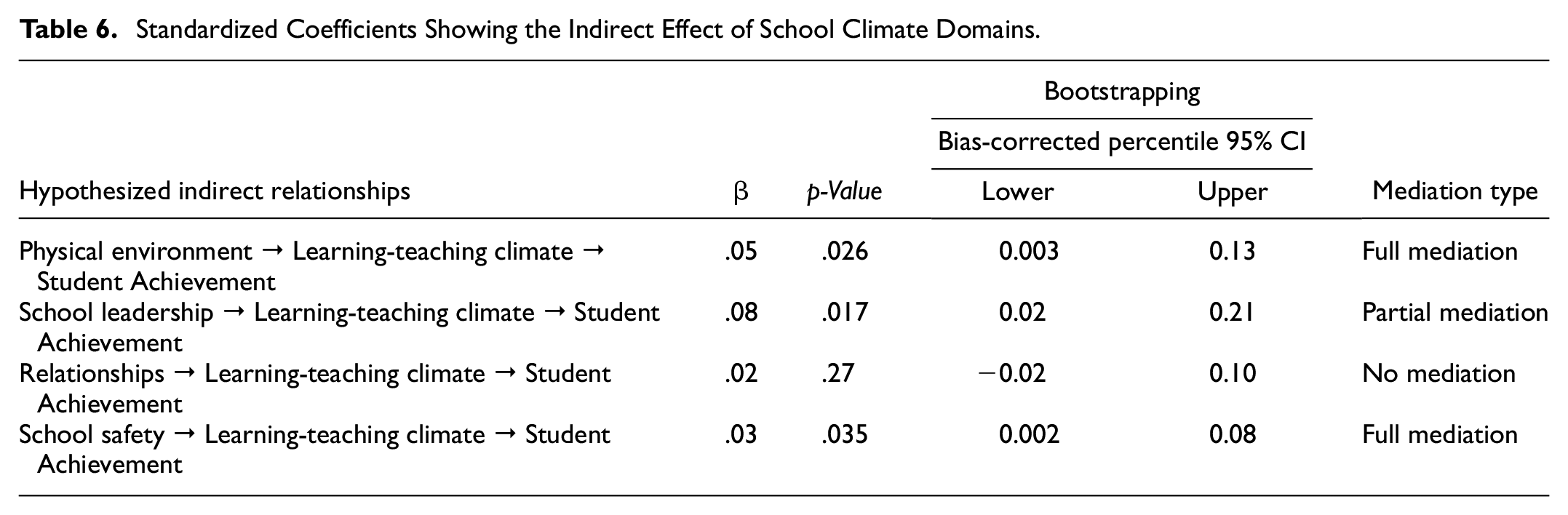
In the language of science, the lack of a statistically significant direct influence does not exclude the possibility that an independent variable could have an impact on the variance of the dependent variable. In other words, through mediators, any independent variable can indirectly affect the dependent variable. To ascertain mediating effect of perceived climate for professional learning-teaching on the relationships between four constituents of school climate (relationships in school, school physical environment, leadership, and school institutional safety) and student’s academic achievement in the upper primary schools, mediation analysis with bootstrapping at 95% bias-corrected confidence interval was conducted. According to the findings of the mediation analysis, the influence of the physical environment of the school (β = .05, p = .026) and the safety of the school (β = .03, p = .035) on student’s academic achievement were mediated by the perception of the professional learning-teaching climate. In other words, safe and healthy physical environment of the school has an indirect impact on student’s academic achievement through positive climate for professional learning-teaching, indicating full mediation. The influence of school leadership on students’ academic progress was also partially mediated (β = .08, p = .017) by perceptions of the professional learning-teaching climate. In this regard, it was discovered that school leadership significantly influenced student academic progress in upper primary schools both directly and indirectly through a favorable climate for professional learning-teaching. However, influence of relationships in school on student academic achievement was not substantially mediated by the perceived professional learning-teaching atmosphere (β = .02, p = .27; see Table 6).
Standardized Coefficients Showing the Indirect Effect of School Climate Domains.
Discussion
In this study, we modeled the relationships among five constituents of climate in school (professional learning-teaching climate, relationships, leadership, safety, and physical setting) and students’ academic achievement. The factor analysis attested the hypothesized factor pattern and the SEM tests fit the data well. Our finding corroborates the previous studies (Daily et al., 2019; Duraku & Hoxha, 2021; Martin, 2020; Nilsen et al., 2022; Ramazan et al., 2023; Tomaszewski et al., 2023) which found school climate dimensions as key predictors of improvement in students’ academic achievement. The finding is also in complete agreement with previous results (Becerra, 2016; Cornell et al., 2016; Dernowska, 2017; Geleta, 2017; Greenway, 2017; Maxwell et al., 2017; OECD, 2016; Shindler et al., 2016) which revealed a strong connection between positive school climate and learning achievement of the students.
As this study shows, supportive and collegial leadership in school has a significant effect (both direct and indirect) on students’ academic performance, which is consistent with previous empirical and theoretical evidence (Brett, 2018; Cardillo, 2013; Cohen & Brown, 2013; Darling-Hammond & Cook-Harvey, 2018; Dary & Pickeral, 2013; Gemnafle et al., 2018; Hughes & Pickeral, 2013). School principal characterized by such an effective leadership practice fairly distributes resources, provides teachers with opportunities to collaborate and values their work and incorporates teachers’ input into decision-making in a way that could improve students’ learning performance.
Moreover, our findings lend support to previous studies which found significant impact of safe school environment (Duraku & Hoxha, 2021; Nilsen et al., 2022; Voight & Hanson, 2017), academic support and disciplinary climate (Martin, 2020, Ramazan et al., 2023; Voight & Hanson, 2017), and school physical environment (Darling-Hammond & Cook-Harvey, 2018; Martin, 2020) on learning performance of students.
This study may offer empirical data that precisely outlines the components of school climate to principals and other decision-makers. The use of structural equation modeling (SEM) as a research method to examine effect of constituents of school climate, a complex educational phenomenon, on students’ academic achievement, was a strength of this study as SEM provides explicit estimates of error variance parameters, which leads to sound conclusions. Despite this, our study was constrained by not taking into account student-level variables that affect learning achievement. As a result, three key recommendations are forwarded. First, student-level variables like self-efficacy, goal orientation, motivation to learn, and other factors delineated by theory and earlier research must be considered in structural models. Second, rather than relying on school-level averages, multilevel structural equation models should be used to determine the cross-level association between school climate characteristics and learners’ academic attainment. Assessing school-level characteristics through non-nested approach is inefficient since the perspectives of students and teachers from one school are probably more different than those of students and teachers from another. For the current study, a multi-level analysis was not practical due to the small number of participating schools. A non-nested design, however, has been assumed to increase the risk of underestimating the regression estimates at the school level. Longitudinal structural equation models should also be used to develop a more precise and reliable model to examine the predictive impact of constituents of climate in school on pupil’s academic achievement.
Conclusion
The current study provides important information about influence (direct and indirect) of constituents of school climate (professional learning-teaching climate, relationships, leadership, safety, and physical setting) on pupil’s academic achievement. The results confirm the importance of school climate in general and its components in particular for raising students’ academic performance. This study used a rigorous structural equation model and mediation with bootstrapping analysis to overcome important methodological flaws in previous studies. The school principal’s main objective should be to regularly examine the climate of the school using reliable tools to improve student learning and academic success since the constituents of climate have a substantial positive influence on student’s overall learning progress and academic performance. Overall, this study provided compelling evidence and empirical support for the notion that the constituents of climate in school, including climate for professional learning-teaching, relationships, leadership, safety, and physical setting) are critical elements that have the potential to enhance student academic achievement.
Footnotes
Declaration of Conflicting Interests
The author(s) declared no potential conflicts of interest with respect to the research, authorship, and/or publication of this article.
Funding
The author(s) received no financial support for the research, authorship, and/or publication of this article.

Data Availability Statement
Data sharing not applicable to this article as no datasets were generated or analyzed during the current study.