




Abstract
Major switching is a common occurrence in higher education institutions worldwide, with over one-third of students changing their academic focus at least once during their undergraduate studies. However, there is limited understanding of the extent to which switching majors influences academic performance and how this process unfolds within a learning-situated context. In this study, a theoretical framework comprising four factors of the new learning context encountered by students on switching majors—curriculum design, teaching pattern, learning initiative, and peer effect—was constructed. The study objective was to examine the interplay between these four factors in order to identify the conditions under which switching majors could be either beneficial or unfavorable for students. A questionnaire survey was conducted at a Chinese university and valid responses were obtained from 224 students who had switched majors. Confirmatory factor analysis validated the four-factor theoretical model, while structural equation modeling revealed that major switching improves students’ academic ranking when teaching pattern and curriculum design of the new major are more appealing and well-structured. In contrast, increased learning initiative and improved peer effect do not contribute positively to academic performance. These findings provide valuable insights for undergraduates in making informed decisions about major switching and offer guidance for university administrators to refine policies and procedures related to the major-switching process.
Introduction
The choice of academic major is a pivotal decision in an undergraduate student’s educational journey, profoundly influencing career opportunities, long-term earning potential, and personal fulfillment (Astorne-Figari & Speer, 2019; Hamermesh & Donald, 2008; Stinebrickner & Stinebrickner, 2014). Students typically select their majors after considering a range of factors, including expected earnings, compatibility with personal interests and abilities, and preferred work environment and lifestyle (Arcidiacono et al., 2012; Beffy et al., 2012; Blom et al., 2021). However, despite the gravity of this decision, major switching is common in higher education institutions worldwide, with over one-third of students changing their academic focus at least once during their undergraduate studies (Astorne-Figari & Speer, 2019; Chen, 2013; Meyer et al., 2022). The high rate of major change can, in part, be attributed to students’ evolving expectations, shifting perceptions, and developing personalities (Stinebrickner & Stinebrickner, 2014). When students realize that their initial expectations of their major do not correspond with their professional aspirations, they often feel overwhelmed by the extensive array of courses and career options available to them (Rosenbaum et al., 2007). In addition, academic specializations available in universities frequently fail to keep pace with rapid changes in the external world, prompting students to reconsider their choices as they acquire new insights into career opportunities and emerging industries (Arcidiacono, 2004; Wiswall & Zafar, 2015).
Research on major switching has explored the characteristics of students who are most prone to switching academic fields. Studies have indicated that factors such as gender, socioeconomic background, and academic preparedness play significant roles in predicting major switching behaviors. For instance, women are more inclined to leave science, technology, engineering, or math (STEM) fields (Denice, 2021). Research focusing on open higher education systems, such as those in the United States, has found that students from low socioeconomic status (SES) backgrounds or those with weaker academic performance tend to switch from their original majors to less competitive and demanding fields (Astorne-Figari & Speer, 2019; Kugler et al., 2021). In contrast, studies on more restrictive major-choice systems, such as in Germany, suggest that high-achieving students are more likely to change their majors (Meyer et al., 2022).
The impact of switching majors on academic outcome has also been the focus of research. Some studies suggest that switching can delay graduation, increase dropout rates, and elevate overall educational costs, because it generally requires additional coursework (Wolter et al., 2014). Conversely, other studies highlight potential benefits, such as improved academic performance, higher graduation rates compared to students who persist in their initially chosen major, and better alignment with career goals (Liu et al., 2021; Yue & Fu, 2017). However, the outcome of switching majors remains a debatable topic, with some researchers arguing that it may depend on the timing and extent of the switch. For instance, switches occurring after the second year of study are associated with lower graduation rates (Foraker, 2012; Liu et al., 2021). When students transition between broad academic categories (e.g., from history to STEM fields), the cost of human capital investment tends to be higher as students may need to build new competencies from scratch (Astorne-Figari & Speer, 2019; Meyer et al., 2022).
Existing literature has made significant progress in understanding the reasons, processes, and outcomes associated with major switching behaviors. While some studies emphasize that major switching should be understood as a process, and highlight the influence of the academic environment or culture of the major on switching decisions and outcomes (Arcidiacono, 2004; Astorne-Figari & Speer, 2019; Feldman et al., 1999), there is limited research explaining how the changed learning context resulting from major switching affects students’ academic performance. This gap is particularly notable, given that the learning context is widely recognized as a crucial factor shaping students’ learning processes and outcomes (Trigwell & Prosser, 1991; Vermeulen & Schmidt, 2008).
To address this gap, this study explored how switching majors influences students’ academic achievement by examining changes in the learning context after transitioning to a new major. We develop a theoretical framework grounded in constructivism, categorizing the learning context into four factors: curriculum design, teaching pattern, learning initiative, and peer effects. Using structural equation modeling (SEM), we evaluate how students’ academic performance is affected by the combined effect of these four factors. Data is collected from a Chinese university, providing new evidence of major switching within a restrictive system characteristic of many Asian countries. The novelty of this study lies in applying this four-factor framework and SEM within such a system. The findings offer practical implications for both students and university administrators. Students can better understand how major switching affects their learning processes and make more informed decisions, whereas university faculty and staff can develop strategies to mitigate the potential negative effects of switching majors and enhance the support systems for students undergoing this transition.
The remainder of this paper is organized as follows. Section 2 establishes the conceptual framework and formulates hypotheses. Section 3 presents the research design. Section 4 presents the main findings. The results are discussed in Section 5. Finally, Section 6 concludes the paper.
Theoretical Framework and Hypotheses
Learning Context
Individuals continually strive to align their interests with their surrounding environment (Holland, 1997). The learning context plays a critical role in major-switching decisions, as students are more likely to change their majors when they perceive that the current learning environment does not align with their occupational interests (Meyer et al., 2022). Additionally, students tend to transfer to majors in which the learning context fosters a sense of belonging, gravitating toward fields with demographic compositions similar to their own. For instance, female students gravitate toward female-dominated majors, and black students tend to prefer majors with a higher representation of black individuals (Astorne-Figari & Speer, 2019).
After switching majors, students find themselves in a new learning context. Constructivism identifies three core elements of a learning environment: curriculum, teaching, and learning (Fernando & Marikar, 2017; Loyens & Gijbels, 2008). Within this framework, learners construct their understanding of concepts and ideas through interactions with their environment (Sjøberg, 2010). The curriculum serves as a dynamic and adaptable structure that provides opportunities for meaningful learning. Well-designed curricula play a significant role in fostering understanding and knowledge retention (Roth, 2007). Teachers act as facilitators, guiding students’ learning by scaffolding their experiences and offering the necessary support (Shah, 2019). They create environments that promote inquiry, critical thinking, and problem-solving, empowering students to take ownership of their learning and construct knowledge through exploration and dialog (Zajda, 2021). Learners actively shape their knowledge-acquisition processes, determining both the methods and extent of their learning (Howe & Berv, 2000). Furthermore, they influence their peers’ knowledge construction, contributing reciprocally to the learning dynamics within their classrooms or academic communities (Wolniak & Ballerini, 2020; Zimmerman, 2003).
In this study, we break down the learning context into four elements: curriculum design, teaching pattern, learning initiative, and peer effects. These four elements are interconnected and mutually influence one another, collectively shaping academic achievement. A well-structured curriculum provides a framework that supports effective teaching pattern and fosters student learning initiative (Schunk, 2012). Similarly, a teaching pattern that encourages active participation can enhance students’ engagement with the curriculum and promote peer collaboration, further reinforcing learning outcomes (Loyens & Gijbels, 2008). Peer effect plays a significant role in shaping learning initiative, as interactions with motivated peers can inspire greater effort and engagement (Griffith & Rask, 2014). The interactions among these core elements and their impact on academic performance are illustrated in Figure 1. In the following sections, we explain these relationships in detail and propose the corresponding hypotheses.
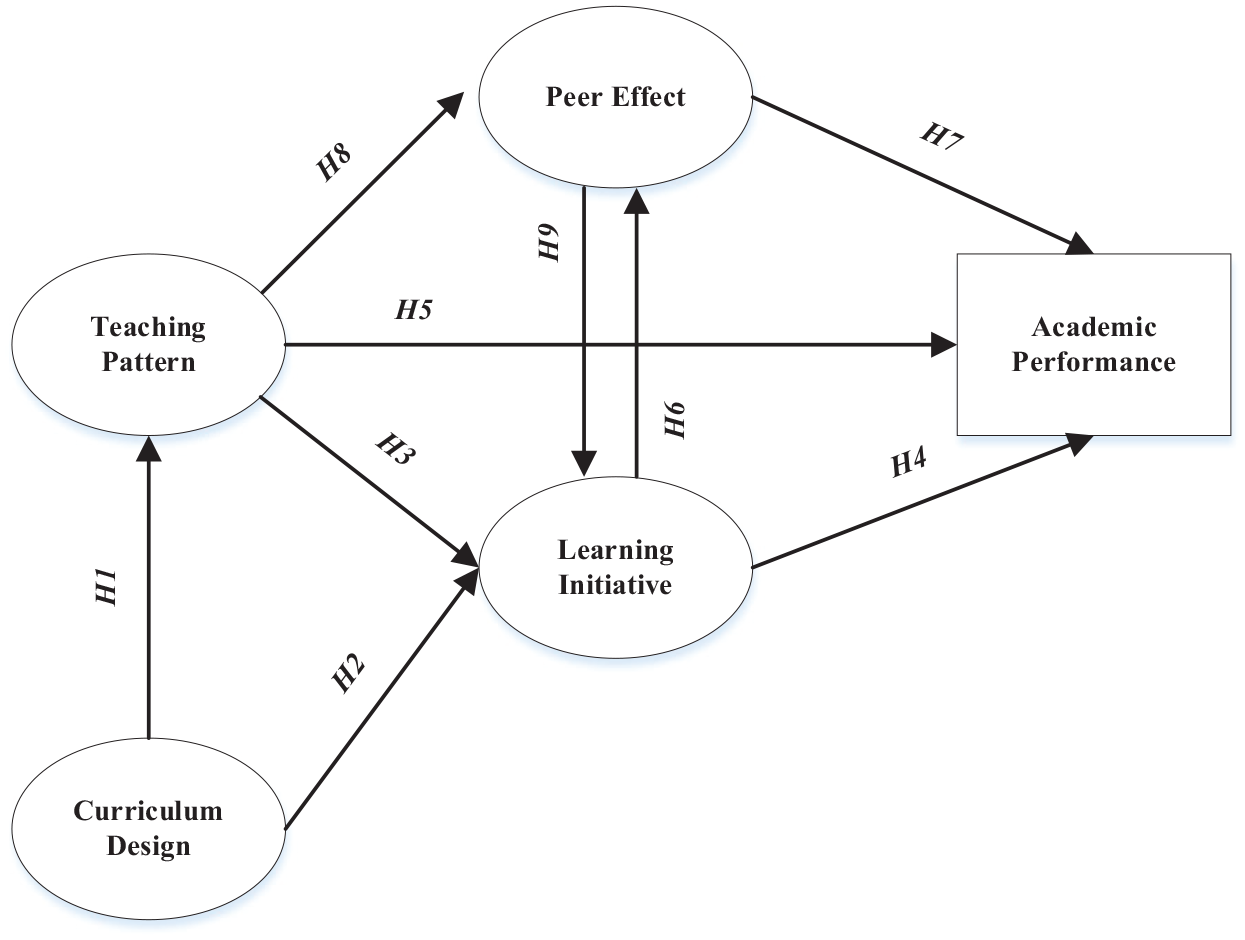
Theoretical framework and hypotheses of core concepts.
Curriculum Design
Before implementing a curriculum, a detailed lesson plan or schedule must be prepared (Nagro et al., 2019). In higher education, teachers have autonomy in designing curriculums, allowing them to independently make decisions regarding learning objectives, course content, organization, teaching methods, and evaluation strategies before delivering the course (Shieh & Reynolds, 2021). The design process typically begins with the establishment and formulation of major learning objectives. Students usually transfer to majors whose goals they perceive as more compatible with their own personal and professional aspirations, suggesting that switching majors can match individual learners with curriculums that suit their preferences.
When curriculum design aligns closely with students’ learning needs, teachers can more effectively engage with their students and guide them through the course. This alignment helps educators better understand students’ learning habits and ability levels, enabling timely adjustments to teaching strategies, and improving teaching effectiveness (Ali, 2018). Furthermore, when students participate in classes that meet their expectations, they are more likely to actively engage in classroom interactions. Such interactions positively impact the teacher-student relationship, which is a vital component of an effective teaching pattern (Thornberg et al., 2022). Based on these insights, we propose the following hypothesis.
As discussed earlier, individuals strive to align their interests with the environment, and switching majors can facilitate this by providing a curriculum better suited to their preferences and goals. When students perceive the new major’s learning objectives as more relevant to their aspirations, their interest in and identification with it are enhanced. Both factors positively impact learning initiative. Learning interest is considered a crucial predictor of learning initiative as it influences students’ affective responses, enhances their persistence, and fosters sustained engagement in specific activities, subjects, and learning experiences. (Ainley et al., 2002; Jiang et al., 2021; Walkington, 2013). As for the correlation between major identification and learning initiative, students who strongly identify with their major experience deeper emotional engagement and exhibit more intentional learning behaviors, which further intensify their learning initiative (Kahu & Nelson, 2018). Based on these insights, we propose the following hypothesis.
Teaching and Learning
The Achievement Orientation Model suggests that students demonstrate engagement and motivation toward academic success when they have the necessary skills to complete tasks (self-efficacy), perceive these tasks as meaningful and valuable (goal/task valuation), and view their environment as supportive (environmental perception; McCoach & Siegle, 2003). When these factors are present, students self-regulate to accomplish their learning goals (Ritchotte et al., 2014). Teachers can positively influence the components of the Achievement-Oriented Model by fostering personal growth to enhance self-efficacy, connecting course content with students through meaningful task evaluations, and creating learning environments that promote positive perceptions (Siegle et al., 2014). When students exhibit learning initiative, their academic achievement, as well as abilities such as task persistence, are positively impacted (Avcı, 2022; Lei et al., 2024). Intrinsic motivation plays a crucial role in this process as it empowers students to engage in activities driven by genuine interest, leading to personal growth and development (Ryan & Deci, 2000). Based on these insights, we propose the following hypothesis.
Pedagogical approaches, such as the establishment of teacher expectations and the promotion of student ownership of learning, highlight how teachers influence the classroom environment (Siegle et al., 2014). Teachers can significantly influence students’ academic achievement through their pedagogical practices. Research suggests that the expectations of one individual can shape the behavior of another, increasing the likelihood that the latter will perform as anticipated (Trusz, 2020). In this context, teachers’ expectations play an important role in encouraging students to strive for academic success consistent with those expectations (Gentrup et al., 2020). Another essential pedagogical practice is to foster students’ capacity for self-determined learning, emphasizing the need for autonomy (Siegle et al., 2014). Students with a higher level of autonomy are more likely to complete their education, achieve better academic results, experience enhanced mental well-being, and enjoy greater job satisfaction (Chirkov et al., 2003). Based on these insights, we propose the following hypothesis.
Peer Effect and Learning Achievement
There is broad agreement that peers significantly influence students’ cognitive and non-cognitive development (Kimbrough et al., 2022; Sacerdote, 2011). This phenomenon, referred to as the peer effect, operates through various pathways, including (1) peer-to-peer assistance and mentoring, (2) the influence of students’ innate abilities, (3) the impact of students’ behavior on their peers, (4) the role of family background, and (5) feedback from teachers and school administrators (Hoxby, 2000). Peer groups are widely acknowledged as critical factors in fostering motivation and inspiration for learning by transmitting attitudes, values, and cognitive and behavioral pattern among students (Schneeweis & Winter-Ebmer, 2007; Schunk & DiBenedetto, 2020). Numerous studies have examined the impact of peer groups on student academic achievement, with some demonstrating statistical and economic correlations between peer effects across diverse educational settings (Dicke et al., 2018; Gallardo et al., 2016; Poldin et al., 2016). Furthermore, causal inference research has confirmed that students tend to perform better academically when their peers exhibit higher levels of achievement (Gong et al., 2021; Gu, 2023; Zimmerman, 2003). Based on these findings, we propose the following hypothesis.
Teachers play a significant role in creating an environment conducive to positive peer effects (Farmer et al., 2011). According to an OECD report, student-centered and structured teaching practices are essential for establishing motivational and effective learning environments (OECD, 2009). In these environments, teachers act as an “invisible hand,” subtly shaping how peers perceive and interact with each other (Brey & Pauker, 2019; Endedijk et al., 2022; Huber et al., 2018). Moreover, peer effects can be moderated by students’ learning initiative, which serves as an important attitude that enables peer influence to take place. The similarity–attraction effect suggests that students with comparable attitudes and values are more likely to form friendships (Giletta et al., 2021; Smirnov & Thurner, 2017). This implies that students with higher levels of learning initiative generate more positive peer effects. From this discussion, we propose the following hypothesis.
Research Design
The Instrument
To test the proposed hypotheses, this study employed structural equation modeling (SEM) to investigate the collective influence of multiple variables and the complex pathways linking learning contexts to academic achievement, as outlined in the theoretical framework. SEM is particularly well-suited for this analysis because it allows for the incorporation of latent variables, such as the four factors (curriculum design, teaching pattern, learning initiative, and peer effects) derived from the learning context, that cannot be directly observed or measured.
A questionnaire was developed to measure these four core factors by capturing the students’ perceptions before and after switching majors. Thirteen items were distributed across the four latent variables, as shown in Table 1. Specifically, items 1 to 3 measure curriculum design, items 4 to 7 assess teaching pattern, items 8 to 10 focus on learning initiative, and items 11 to 13 evaluate the peer effect. Respondents rated each item on a five-point Likert scale (1 = completely disagree to 5 = completely agree), providing insights into how changes in the learning context are perceived across these dimensions. Academic performance, treated as an observable variable, was measured using the respondents’ GPA (Grade Point Average) rank proportion to ensure comparability across different majors. The change in academic performance was calculated as the difference between the inverse GPA rank proportion after and before switching majors (item 14–15), offering a reliable measure of how academic performance was influenced by changes in the learning context.
Questionnaire Design.

Target Population
This study focuses on students in Chinese higher education institutions. China has the world’s largest higher education system, with a gross enrollment ratio of 60.2% and total enrollment of 47.63 million students as of 2023 (Ministry of Education of the People’s Republic of China, 2024). However, research on the phenomenon of major switching in higher education in China remains limited. Examining this population offers a valuable opportunity to enhance the literature on major switching and its academic implications.
In contrast to open higher education systems (e.g., the US), the Chinese higher education system is more restrictive for major choices. On admission, university candidates in China submit their preferred schools and majors based on their college entrance examination scores. Each major admits students in descending order of their scores until the enrollment quota is reached. If candidates are not admitted to their preferred major and have opted to “accept a major adjustment,” they are assigned majors with unfilled quotas to avoid rejection from all programs. Most candidates choose the “accept a major adjustment” option to secure enrollment in their desired university. Consequently, a significant proportion of students are initially enrolled in majors that were not their first choice. Switching majors after enrollment is also subject to strict conditions, requiring students to meet academic performance standards in their original major and pass assessments for the desired major. Owing to the complexity of the major-switching process in Chinese higher education, undergraduate students typically switch majors at most once. This is advantageous for our study because it enhances the reliability of the data and simplifies the analysis.
Because of the challenges associated with data collection, this study focused on a medium-sized public university located in central China to conduct the survey. In 2023, the university enrolled 28,800 undergraduate students across 87 different majors, with 30% of the students assigned to majors that they did not initially apply for. The university’s major-switching policies stipulate that the switching process be initiated annually during the fall semester. Undergraduate students who pass the entrance exam for their desired major are eligible to successfully switch. Each major is required to allocate at least 10% of its total student capacity as vacancies for transfer applications. According to data provided by the relevant university faculty, approximately 12% of undergraduates apply to change their major each year, with 36% of these applicants ultimately succeeding in their transfers.
The target population for this study consisted of undergraduate students at the selected university who had successfully changed majors. All participants in the sample are currently enrolled in higher education and eligible to change majors, eliminating the need to account for dropout cases. Given the diversity of the academic disciplines involved and the complexity of the research items, an online questionnaire was selected as the survey instrument. This approach made it possible to reach the largest possible number of respondents cost-effectively and efficiently.
Sample and Data
A sample size of at least 15 observations per variable can ensure robust analysis (Hair et al., 2019). In this study, 13 items were used to measure four latent variables along with one observable variable, requiring a minimum sample size of 210 respondents (15 × 14). To meet this criterion, 300 students were randomly invited to complete an online questionnaire. Ultimately, 224 valid responses were collected, which exceeded the minimum sample size requirement and ensured the adequacy of the data for analysis.
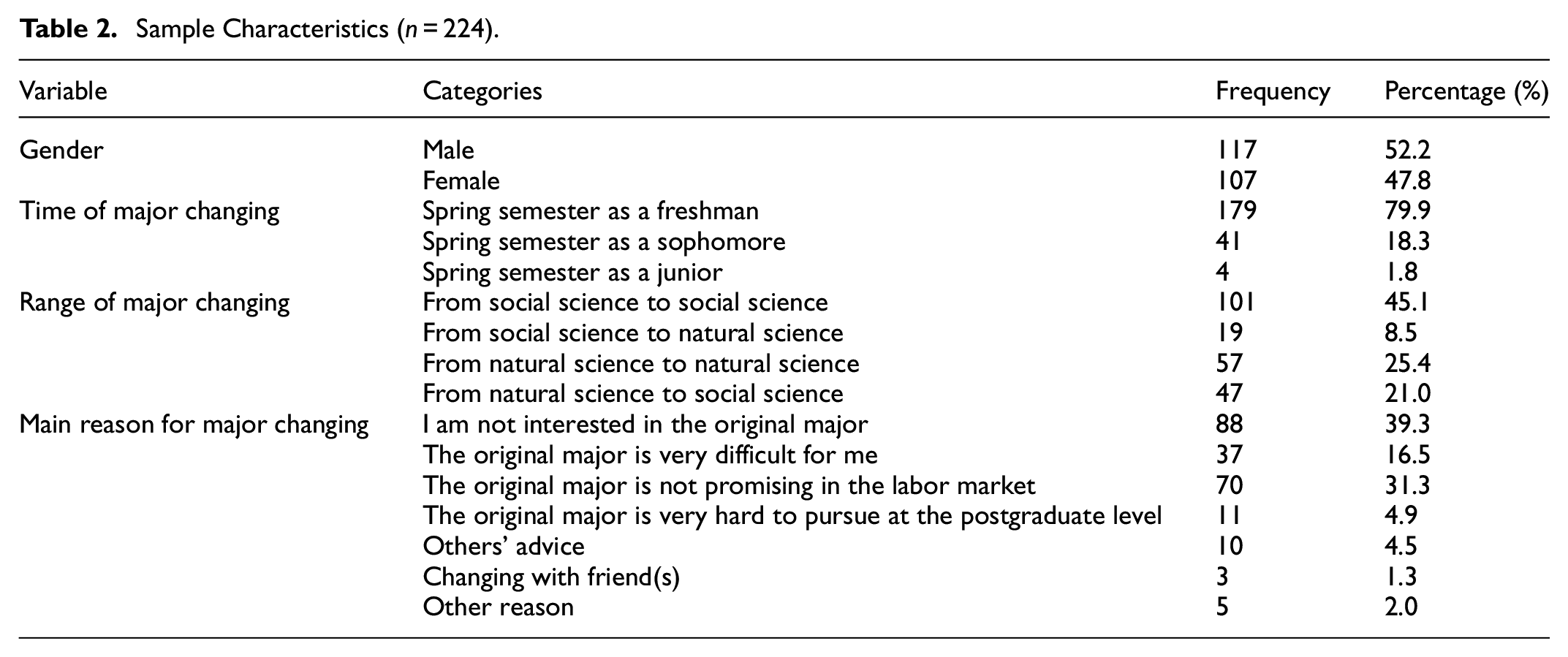
Table 2 presents the demographic characteristics of the 224 respondents. Based on statistical analysis, we can identify the characteristics of students who switch majors in Chinese universities and compare them with those in other higher education systems. Several key observations can be made: (1) Regarding gender differences, male students are slightly more likely to switch majors than their female counterparts. In Chinese culture, women are often culturally inclined to conform to their environment rather than seeking significant changes. (2) Regarding the timing of switching, approximately 80% of students switched majors during their first year, while less than 2% did so after their second year. This pattern reflects the constraints of China’s restrictive major-switching policies. Switching majors after the second year typically involves considerable challenges, such as requiring approval from the original major’s administrators and passing entrance exams for the desired major. (3) Regarding switching directions, nearly half of the students switched majors within social sciences. Unlike prior research emphasizing students leaving STEM fields, only 21% of the respondents moved from the natural sciences to the social sciences. This trend reflects higher societal recognition and career benefits associated with natural science degrees in China. (4) As for switching motivations, the primary reasons for switching majors include alignment with personal interests and concerns about the low competitiveness of the original major in the job market. This finding is consistent with those of previous studies. However, 16.5% of the respondents reported switching from a more challenging major to an easier one, which is a lower proportion compared to previous research.
Sample Characteristics (n = 224).
The second part of the questionnaire consisted of 15 items designed to measure changes in learning context and academic achievement following a major switch. Table 3 presents the descriptive statistics of these items and variables. For the items measuring learning context (Item 1–13), the means ranged from 3.66 (Item 13) to 4.03 (Item 8), indicating a generally positive perception of the new learning context. The standard deviations (SD) ranged from 0.96 (Item 8) to 1.14 (Item 12), reflecting varying levels of agreement among respondents. The mean inverse GPA rank proportion before switching majors was 77.96% (SD = 18.75), which increased to 81.37% (SD = 16.56) after switching. The mean value of the variable “Change in Academic Performance” demonstrated that respondents’ academic achievement rank improved by an average of 3.41% within their class cohort after changing majors.
Descriptive Statistics of Measurements (n = 224).

Analysis and Results
After collecting questionnaire data, we conducted a series of analyses to test the proposed hypotheses. Before estimating the structural equation model (SEM) to examine the pathways through which the four factors of the learning context—curriculum design, teaching pattern, learning initiative, and peer effects—collectively influence academic performance, we first calculated Cronbach’s α to assess the reliability of the data and ensure internal consistency across the four factors. Additionally, we performed confirmatory factor analysis (CFA) to validate whether the 13 items effectively measured the four constructs of learning context.
Scale Reliability
Calculating Cronbach’s α is essential to ensure the reliability of the scale. High Cronbach’s α values indicate that the scale will provide accurate and reliable results. In this study, 13 items were designed to measure the four factors of the learning context. To confirm the reliability of the questionnaire responses, we first calculated the overall Cronbach’s α for all 13 items. Then, to evaluate the internal consistency of the items within each construct, we separately calculated Cronbach’s α for the four factors. Using SPSS 26.0, the overall Cronbach’s α exceeded 0.9, demonstrating excellent reliability of the entire questionnaire. Additionally, as shown in Table 4, the Cronbach’s α values for each of the four factors were all above 0.8, indicating strong internal consistency for each construct.
Reliability and Convergent Validity.

p < .001.
Validity of Measurement Model
Furthermore, we conducted confirmatory factor analysis (CFA) to evaluate the validity of the 13 items in measuring the four learning context factors. CFA ensures that the items are not only reliable, but also valid for capturing the constructs they are intended to measure, thereby providing a robust foundation for further structural equation modeling. Using AMOS 26.0, CFA was performed with maximum likelihood estimation. The results indicated an excellent model fit, with all goodness-of-fitness indices meeting acceptable thresholds and some reaching ideal levels (
The statistics in Table 4 demonstrate the strong convergent validity of the measurement model. All factor loadings (Column 4) are significant and exceed 0.7, which is well above the acceptable threshold of 0.5 (Bagozzi et al., 1991). The average variance extracted (AVE) values for all constructs are greater than 0.6, surpassing the recommended minimum of 0.5 (Fornell & Larcker, 1981; Ruvio et al., 2008). Additionally, all composite reliability values are above 0.8, exceeding the acceptable benchmark of 0.7 (Hair et al., 2019). To assess discriminant validity, we employed the methodology proposed by Fornell and Larcker (1981), which involves comparing the square root of the AVE (
Discriminatory Validity.

Note. Bolded diagonal values refer to
p < .001 (two tails).
Testing a Structural Model
After confirming that the questionnaire items and data adequately support the theoretical framework of the four-factor learning context, we used the data to perform the structural equation modeling. The results of SEM can test the proposed hypotheses that interpret the complex pathways through which the four factors of learning context impact academic achievement. The goodness-of-fit statistics for the SEM indicate a good fit, with all indices exceeding the acceptable thresholds:
Table 6 presents the SEM estimation results. While hypotheses 4, 6, and 9 are not supported, the remaining hypotheses are confirmed. The findings reveal that curriculum design (CD) has a significant positive effect on teaching pattern (TP;
Standardized Estimation Results of the Structural Model.
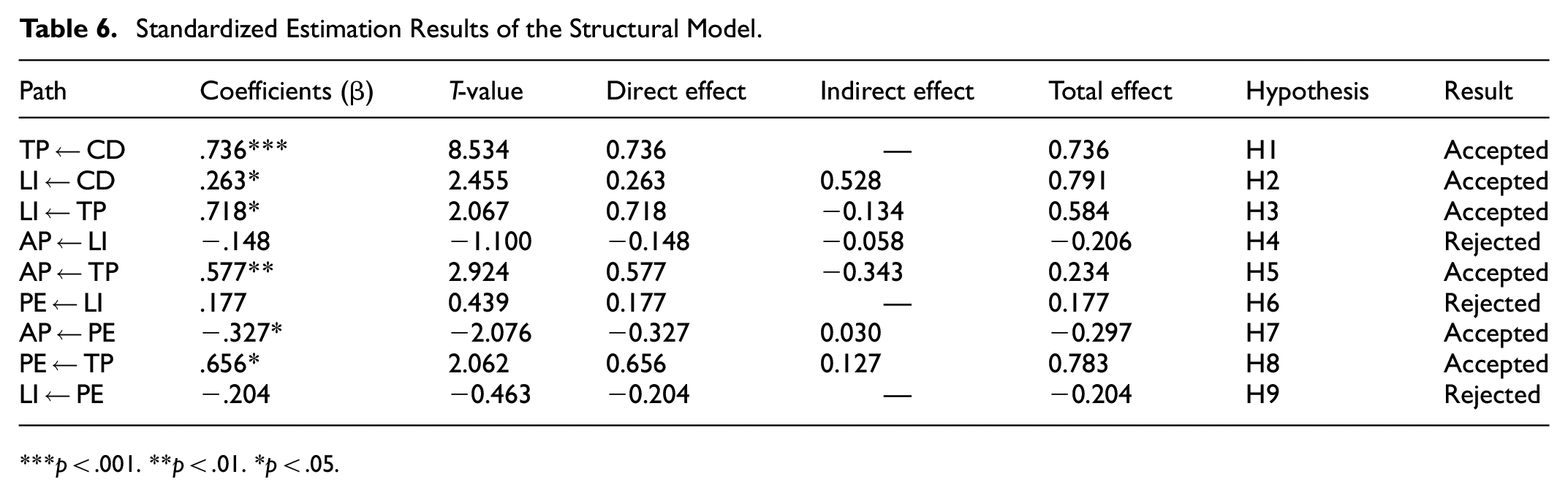
p < .001. **p < .01. *p < .05.
The standardized estimates of the SEM are presented in Figure 2, with item abbreviations corresponding to those listed in Table 1. From the observed pathways among the core constructs, it can be inferred that switching majors positively influences students’ academic performance, particularly when the teaching pattern and curriculum design of the new major are more appealing and well-structured. Students may change their majors owing to personal interests or a desire to leave their original social networks, which can enhance their enthusiasm for learning. However, the results revealed that increased learning initiative did not significantly improve students’ academic performance within the new major class cohort. Moreover, while a better peer environment in the new major may be expected to foster academic success, the results suggest that it may lead to a decrease in academic performance. These insights highlight the nuanced and multifaceted impact of major changes on academic achievement.

Structural model.
Discussion
In this study, a structural equation model was constructed using data collected through a questionnaire survey to test nine hypotheses. The findings reveal the relationship between switching majors and academic achievement as well as how academic achievement is influenced by changes in the learning context.
Our results indicate that when the curriculum design and teaching pattern of the new major are well structured and appealing, switching majors can significantly enhance academic achievement within the class cohort. These findings are consistent with those of previous studies. A well-designed curriculum allows teachers to connect with students more effectively, guide them through course content, foster classroom interaction, and adapt teaching strategies to meet students’ needs (Ali, 2018). Furthermore, effective teaching pattern can positively influence students both academically and personally. In the classroom, teachers can boost students’ enthusiasm for a subject, set high expectations for success, and demonstrate the practical application of knowledge (Sadoughi & Hejazi, 2023). Outside the classroom, teachers who listen to and respect students’ perspectives, care about their well-being, and build strong teacher-student relationships further facilitate academic success (Ibrahim & El Zaatari, 2020).
However, contrary to earlier studies (Avcı, 2022; Lei et al., 2024; Zimmerman, 2003), our findings show that learning initiative and positive peer effect do not improve students’ academic performance. Surprisingly, they are associated with reduced academic performance. While it is widely accepted that learning initiative positively influences academic achievement (Zeng et al., 2023), this conclusion is often drawn in scenarios where students with high initiative are compared to those with low learning initiative in the same learning context. Students who switch majors may have a high learning initiative as they have the opportunity to learn a subject that is more interesting to them. However, the changed learning context introduces challenges, requiring them to expend additional effort to bridge knowledge gaps with their new classmates, which may nullify the benefits of their learning initiative. As for peer effects, numerous studies have emphasized the importance of peer relationships in fostering students’ social and academic development (Endedijk et al., 2022; Ladd, 2006; Morris et al., 2013). However, in Chinese universities, a unique dynamic must be considered. A significant proportion of undergraduates often deprioritize academics because: (1) they view campus life as a reward for surviving the high-stakes college entrance exam (Fang et al., 2023); (2) they perceive college courses as having limited relevance to their future careers (Ma & Bennett, 2021); (3) graduating and obtaining a degree is not particularly difficult (Sun et al., 2022); and (4) extracurricular activities such as university- or student-organized clubs take up a substantial part of their time (Sun et al., 2022). Consequently, students with strong peer relationships may spend more time socializing or participating in group activities, thereby dedicating less time to academics. Conversely, students who are less socially engaged or who do not have friends may devote more time to studying, resulting in better academic outcomes.
Based on the findings of this study, we offer several recommendations for undergraduates who are considering or have already switched majors as well as for university administration departments.
For students: (1) Avoid switching majors based solely on personal interests or the pursuit of better peer relationships because these factors alone do not guarantee improved academic achievement. While interest can boost learning initiative, transferred students often need to put in additional effort to catch up with their new classmates because of missed foundational courses and experiences. Similarly, although positive peer relationships can enhance happiness, they may also reduce study time. (2) Before deciding to switch majors, ensure that the curriculum and teaching methods for the target major are appealing and aligned with your learning preferences. An engaging and suitable curriculum can facilitate the understanding and assimilation of new knowledge, thereby minimizing the risks associated with switching majors.
For university administration: (1) Enhance major-related education to strengthen students’ understanding and identity with their original major before initiating the switching process. Many students lack interest in or motivation for their current majors because of a limited understanding of what the program entails and its potential benefits (Yin & Wang, 2016). In such cases, switching majors might not be a cost-benefit decision, often resulting from information asymmetry. This issue can be mitigated through appropriate major education programs. (2) Provide opportunities for potential switching students to gather detailed information about their desired majors. A lack of information regarding a new major can lead to ill-informed decisions. In our survey, the respondents suggested that additional insights such as graduate school admission policies and employment prospects related to the targeted major could help students avoid making decisions based on limited personal knowledge. (3) Establish a feedback system to support students transitioning into a new major. This system should monitor how well switched students are adapting to the new learning environment, identify the reasons for any difficulties, and offer tailored learning strategies to ease their adjustment process.
Conclusion
This study investigates how switching majors, which triggers changes in the learning context, influences students’ academic achievement. Specifically, we proposed a four-factor learning context framework comprising curriculum design, teaching pattern, learning initiative, and peer effect, and developed nine hypotheses to explain how these factors interact and collectively impact academic performance. Using a dataset of 224 samples collected from a Chinese university, a confirmatory factor analysis validated the four-factor framework. The results of structural equation modeling supported hypotheses 1, 2, 3, 5, 7, and 8, while rejecting hypotheses 4, 6, and 9. The findings indicate that when the curriculum design and teaching pattern of the new majors are more appropriate and engaging for students who switched majors, their academic performance improves. However, despite demonstrating higher learning initiative and forming better peer relationships in their new classes, these factors did not have a positive impact on academic achievement. The beneficial effect of learning initiative was nullified by the knowledge gaps that switching students needed to address, whereas stronger peer relationships resulted in increased group activities, which reduced the time allocated for academic study.
This study makes two key contributions to the literature. Theoretically, it provides an innovative perspective on the relationship between major switching and academic performance by examining the impact of a changed learning context. It proposes a four-factor learning context framework to explore how changes in curriculum design, teaching pattern, learning initiative, and peer effect influence students’ academic performance after switching majors. Practically, these findings can guide undergraduates in making informed decisions about switching majors to reduce potential risks. In addition, the results provide valuable insights for university administrators to refine policies and procedures related to major switching.
However, this study also has certain limitations. First, it focuses on a single university, which restricts the generalizability of the findings. The data were collected from a medium-tier Chinese public university, and the results can, at best, be generalized to similar types of universities in China. Second, owing to the limited sample size, the structural equation model analysis did not account for potential heterogeneity by grouping students based on sex, grade level, or the direction and distance of their major change. These factors are important, as they can shape students’ learning experiences and influence their ability to adapt to a changed learning context. For example, the direction and extent of a major change can indicate the degree to which the learning context shifts, whereas gender and grade level may affect students’ responses to these changes. Incorporating such heterogeneity into future analyses could provide more nuanced insights and advice tailored for different student groups. Future research could address these limitations by leveraging advanced technologies such as machine learning to predict students’ academic and social outcomes. By analyzing students’ background information, personal characteristics, and learning trajectories, such an approach could provide more effective support for students in deciding whether and how to switch majors.
Footnotes
Acknowledgements
We express our sincere gratitude to the participants who facilitated and supported the data collection process.

Ethical Considerations
This study did not involve any humans or animals for experimental purposes and is based on a survey-based opinion.
Funding
The author(s) disclosed receipt of the following financial support for the research, authorship, and/or publication of this article: This research was funded by Anhui Provincial Department of Education Humanities and Social Science Research Project, grant number SK2021ZD0021.
Declaration of Conflicting Interests
The author(s) declared no potential conflicts of interest with respect to the research, authorship, and/or publication of this article.
Data Availability Statement
The datasets generated during and/or analyzed during the current study are available from the corresponding author on reasonable request.