




Abstract
This work considers the impact of the different job quality dimensions on Eurozone job satisfaction through the European Working Conditions Survey-2015. The econometric analysis, using a probit model (marginal effects), reveals that dimensions associated with Social environment, Skills and discretion, Prospects, and Earnings have a positive and significant impact on job satisfaction. The impact of Work intensity is negative and those related to Physical environment and Working time quality do not have a significant impact on job satisfaction. Regarding the differential impact of the different dimensions on the public and private sectors, both Prospects and Social environment are notably higher in the private sector. The greater impact of the first index is not justified, as is the case with the Social environment, by a lower index but, probably, by the greater variability of the index in the private sector. Our work emphasizes the relevance of studying variables associated to job quality when identifying the causes of job satisfaction. Greater understanding of these dimensions in the private sector would improve the situation in the public sector (and vice versa) and, therefore, workers’ job satisfaction. Of special interest are the possible improvements in the field of Social environment in the public sector, specifically in relationships between workers and their immediate bosses and in the distribution of work tasks.
Plain Language Summary
This study analyses the impact of the different job quality dimensions on Eurozone job satisfaction. The dimensions “Social environment”, “Skills and discretion”, “Prospects” and “Earnings” have a positive and significant impact on job satisfaction”. The impact of both Prospects and Social environment are notably higher in the private sector.
Introduction
Job quality has become one of the central policy concerns in Europe in recent years, both as an instrument to boost economic growth and to address the demographic challenge and the threats to the welfare systems (Eurofound, 2017). Economic literature has also pointed out the impact of job quality as a key determinant of workers’ health and well-being (Bannai &Tamakoshi, 2014; Esenaliev & Ferguson, 2019; Fishta & Backé, 2015; Kivimäki et al., 2015; Picatoste et al., 2021; and Theorell et al., 2015, among others).
The concept of job quality is, however, somewhat diffuse, since it includes, among other aspects, the characteristics of the workplace, the position, the activity carried out by the worker, as well as the environment in which he or she operates, the remuneration, and career prospects (Bericat & Cascales-Mira, 2019). Since 2012, Eurofound has produced a series of indices reflecting the multidimensional nature and overall state of the concept of job quality in Europe. Specifically, it defines seven dimensions of job quality: Physical environment, Work intensity, Working time quality, Social environment, Skills and discretion, Prospects, and Earnings. The Eurofound also reports the impact of these indices on subjective well-being, working conditions, and work-life balance, among other indicators. Their reports do not differentiate, however, the differential impact of these indices on aggregate job satisfaction, nor do they consider the distinction between workers in the public and private sectors.
Most studies agree the content and nature of the activities carried out by public and private sector workers differ considerably, as do the factors that determine job satisfaction: remuneration, promotion policy and time schedule, among others (Sánchez-Sánchez & Fernández Puente, 2021). These differences could lead to differences in job satisfaction between public and private-sector workers. The number of possible indicators that differentiate both sectors is, in any case, excessively high and their joint consideration could cause problems of collinearity in the estimates. In this sense, the Eurofound indices enables us to study the existence of differences between the public and private sectors in the different dimensions of job quality, as well as their impact on job satisfaction, in an integral and comprehensive way. The study also allows us to establish a series of policy recommendations at an aggregate and country level to improve job quality and, where appropriate, increase job satisfaction.
The perception of working conditions could also differ among countries as different social, political and economics contexts are considered (Giorgi et al., 2015; Li, 2017). That is why the comparisons between workers in the public and private sectors, especially those related to job satisfaction, will probably differ in different regional contexts. For this reason, a disaggregated analysis considering the different dimensions of job quality by country is also necessary.
The present work aims specifically to respond to this need by focusing on the 2015 European Working Condition Survey (EWCS) of European Monetary Union countries. The objectives are as follows: (a) to observe the differential impact of the different job quality dimensions on job satisfaction of public and private-sector workers; (b) to observe the differences in job satisfaction between public and private-sector employees; (c) to study whether significant differences exist in the different dimensions of job quality in the public and the private-sector on aggregate, and between the different countries; and (d) propose possible areas for improvement in the different dimensions of job quality.
The work is structured as follows. In the second section, we present a brief review of the literature focused on the differences between public and private sector job satisfaction. The third section includes the sources, the theoretical model we estimate and the econometric procedure. The fourth section presents the descriptive and econometric results together with policy recommendations. Finally, in the fifth section we present the conclusions, and comment on the limitations of our analysis and possible future research.
Literature
Economic literature, in recent decades, has highlighted the importance of job satisfaction as a determinant of individual worker and organizational well-being and performance. Numerous investigations have studied the differences in job satisfaction in different areas, between sectors and groups of workers, and the possible causes for these differences. The difference in job satisfaction between public and private-sector workers has been one of the issues of greatest interest. Most studies agree that worker’s job satisfaction determinants differ considerably among public and private organizations, mainly remuneration, promotion policy and the work schedule (working hours and breaks at work, holidays and flexibility to reconcile family and work life), but also the content and nature of the activities carried out by workers (Johnson et al., 2017; Kjeldsen & Hansen, 2018). It is not clear, however, if these differences lead to greater job satisfaction of private-sector employees, or vice versa (Baarspul & Wilderom, 2011).
From the perspective of objectives, public sector workers could have goals that satisfy more altruistic, less materialistic needs, and therefore be more motivated than private sector workers (Gans-Morse et al., 2022). In any case, the structure of public sector organizations, often more bureaucratic than in the private sector, may impede the fulfilment of these purposes (Nyadera & Islam, 2020; Steijn & Van der Voet, 2019). Likewise, less clarity in the definition of organizational objectives could reduce job satisfaction in the public sector (Kjeldsen & Hansen, 2018).
Additionally, public sector workers are often supposed to work in highly politicized environments, subject to public scrutiny and strict accountability mechanisms (Taylor & Westover, 2011). This framework could reduce the possibility to define new challenges, the variety of activities, the flexibility to carry them out and, consequently, the autonomy of the worker will be reduced. All these elements are key determinants of job satisfaction, since they shape self-esteem and self-actualization needs (Shirk, 2022).
Finally, wages in the private sector tend to adapt more quickly to changes in worker productivity (Blackaby et al., 2017; Murphy et al., 2020; Suzuki & Hur, 2022) which could increase job satisfaction, since remuneration, or perceived access to higher remuneration, could be higher (Sánchez-Sánchez & Fernández Puente, 2021; Sławińska, 2021; Suzuki & Hur, 2022).
Even though the differences are obvious, there is no clear consensus if these differences lead to greater job satisfaction of public-sector employees, or vice versa. On a macro scale, Steel and Warner (1990) and Sánchez-Sánchez and Fernández Puente (2021) confirm that job satisfaction of private-sector employees is lower than that of the public-sector employees. However, Emmert and Taher (1992) and Gabris and Simo (1995) do not find significant differences.
Improvements in job quality are linked to a reduction in sickness absences and, consequently, to higher productivity (Chen & Mehdi, 2019; Eurofound, 2014; Goetzel et al., 2004; and Leitão et al., 2019). Moreover, “job quality contributes to organisational commitment and motivation among workers, as well as shaping a climate supportive of creativity and innovation” (Eurofound, 2017). Economic research has also highlighted the impact of job quality as a key determinant of worker health and well-being (Bannai & Tamakoshi, 2014; Fishta & Backé, 2015; Kivimäki et al., 2015; Martin et al., 2022; Theorell et al., 2015, among others), and more important than factors such as working hours (Wang et al., 2020).
However, as far as we know, the differential impact of job quality on job satisfaction in the public and private sectors has not been studied in a comprehensive manner. The availability of the job quality indicators prepared by Eurofound allows for an integral study of the impact of the different job quality dimensions on job satisfaction and to formulate a proposal for possible public-sector improvements using the private sector as a reference (or vice versa).
Sources and Theoretical Model
Our study used the data corresponding to the sixth European Working Conditions Survey (EWCS), prepared in 2015 by the Eurofound (2015). This survey is elaborated every 5 years since 1990 by the European Foundation for the Improvement of Living and Working Conditions.
This last survey interviewed nearly 44,000 workers in 35 countries. Employees are randomly selected by Eurofound’s survey partners from a statistical sample, comprising a cross-section of society. Country size and national arrangements condition the size of the sample (from 1,000 to 3,300 people per country). The interviews cover a list of questions regarding working conditions and were carried out face-to-face in peoples’ homes. The last survey provides, among other information, seven indices that capture the different dimensions of job quality: Physical environment, Work ntensity, Working time quality, Social environment, Skills and discretion, Prospects, and Earnings. The indices reflect job resources (physical, psychological, social, or organizational aspects) and job demands, or the processes than influences these. In addition, they cover job features captured from an objective perspective, which facilitate analysis and allow for study of the impact on other more subjective indicators such as job satisfaction. Table 1 shows the different indicators included in each quality index.
Overview of Job Quality Indices and Their Indicators.

All job quality indices are defined on a scale of 0 to 100, except for the one corresponding to Earnings, which is measured in euros. With the exception of Work intensity, the higher the index score, the higher the quality. In our estimates these variables have been taken in logarithms since our variable is dichotomous.
As regards countries, the survey includes 35 countries, though we have considered the 19 European Monetary Union countries in our estimates, as we did not want to introduce excessive heterogeneity into the analysis. The total number of observations in the survey is 31,570. We have removed from our estimates those individuals that were unemployed or inactive. We have also excluded those individuals who did not answer the question related to our dependent variable. Therefore, the number of observations is 29,471.
The EWCS includes different questions to capture worker job satisfaction. We have chosen the following: “How often do you feel this way—I am enthusiastic about my job?” This question has five possible response categories ranging from “always” (value 1) to “never” (value 5). The responses are based entirely on individuals’ own perception and ordered qualitatively.
We have adopted the terms used by Clark and Oswald (1996) to define the individual work utility function for each worker:

where x includes those variables related to the worker’s individual characteristics and j those related to the job characteristics. As individual characteristic, we have considered gender, age range, and educational level, as well as variables related to the family environment (having a partner and children). We have also included the facility to balance life and work, and whether the individual is an immigrant. These variables appear to be insufficient to explain the variations in total job satisfaction, as pointed out by Ellickson (2002) and Steijn (2004), hence the inclusion of other variables related to job characteristics (it will also be possible that personal characteristics may be interacting with some of the job characteristics). In this work, we have included the occupation of the worker, the size of the company, and the seven indices of job quality proposed by the Eurofound study.
In the aggregate estimate we have included a variable that reflects whether the individual is working in the public sector. This variable is obtained through a question from the survey itself asking whether the worker is employed in the public or private-sector. Selecting this question resolves many problems surrounding the definition of public sector, which may differ from country to country.
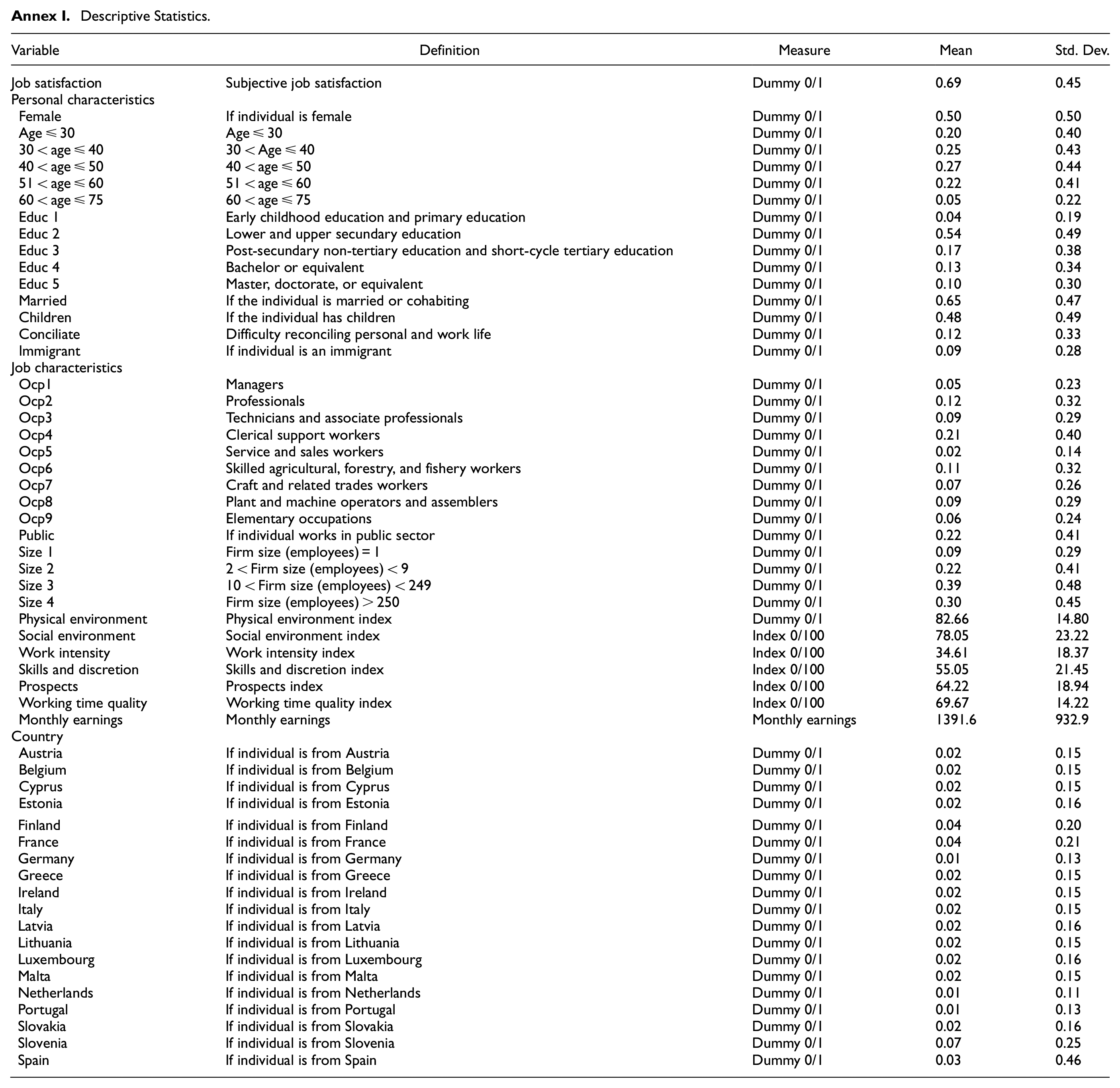
Subsequently, and using this same variable, the sample has been divided considering workers in the public and private sectors. We did not want to include more indicators since these indices are comprehensive and the inclusion of others elements could cause collinearity problems. Annex I shows the different variables chosen, their definition, the mean, and the standard deviation.
Job satisfaction is used as a proxy of individual work utility to estimate the following model:

Job satisfaction will be a latent variable that reflects the probability of an individual to be satisfied at work. As it is not observable, we consider for measurement the ordinal assessment made by the individual himself. The relationship between both job satisfaction and the latent variables is expressed as follows:
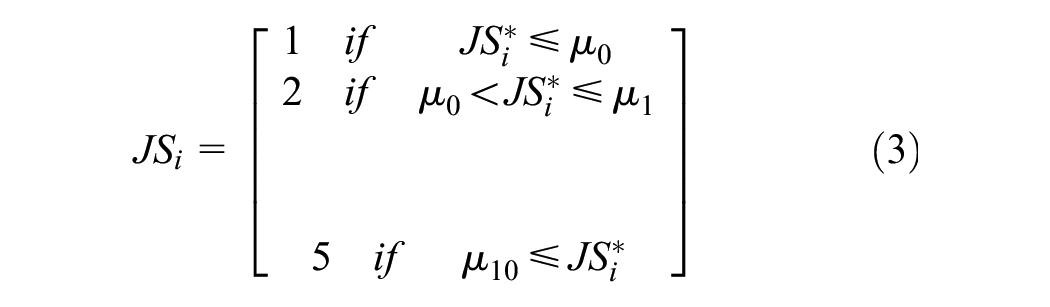
Where μ are the values of latent job satisfaction and define the observed job satisfaction intervals. It is assumed
As mentioned, our dependent variable, job satisfaction, reflects five different values. Economic literature offers different econometric techniques to reach the estimates: (a) Ordinary least squares. This technique uses rating scales in the variable that can be linearized; (b) Ordered probit. This technique considers all the values of the scale offered by the variable; and (c) Probit. The responses are rescaled and the job satisfaction variable is transformed into a binary variable (see Hauret & Williams, 2017).
In this article we use a probit model for two reasons. On the one hand, as mentioned, the responses are based entirely on individuals’ own perception. The question asked is not concrete in terms of comparison groups or in the description of each category of satisfaction levels, therefore leaving room for interpretation of heterogeneity across interviewees. Grouping values eliminate part of the individual’s subjectivity when assigning a specific value to their job satisfaction. On the other hand, the results will be easier to interpret than in case of ordered probit, focusing on higher level of job satisfaction. A well-known problem of ordered probit models is that coefficients give only qualitative information about the impact of any given characteristic on the observable satisfaction variable. To analyze the quantitative effects, it is necessary to report the marginal effects of the variables on satisfaction probabilities. The problem in this case is that both the predicted probabilities and the marginal effects depend on the values where they are evaluated, so we would have a marginal effect for each value of the ordered variable. This makes it difficult to interpret the results, and cannot handle points in the scale with few observations (this problem is greater at the extremes of the job satisfaction variable).
The five possible answers offered by the respondents have been divided into two groups: satisfied (values 1 and 2) and not satisfied (values 3, 4, and 5). As job satisfaction could be sensitive to specific cut-off points, we have rerun our analysis contrasting “rarely” and “never” satisfied to more satisfied (not shown) and our results were robust.
We then proceeded to estimate using a probit model (the estimates in tables show the marginal effects). Data are weighted using sample weights. The cross-national weights make an adjustment for post-stratification weights to ensure that each country is represented in proportion to the size of its in-work population. Population size adjustments are based on the most recent Eurostat population figures or the local statistical office (6th European Working Conditions Survey Weighting report, Eurofound, 2015).
Results
Our study begins with the impact of each of the job quality indices on job satisfaction, differentiating between public and private sector workers. Subsequently, an attempt is made to justify these differences through the means contrast of each of these indices in both sectors. Finally, it examines those indices in which either a significant impact on job satisfaction has been observed, or the difference in public and private sector job satisfaction impact is high.
Table 2 show the estimates using marginal effects and include job satisfaction as a dependent variable and job quality indices, among others, as the independent variables. In those non-dichotomous variables, the coefficients have to be interpreted with respect to the reference variable. If they are positive and statistically significant, the influence of that variable on probability of the result, in our case being satisfied, will be higher than that of the reference variable (vice versa if it is negative).
Estimation Results on Job Satisfaction in the Public and the Private Sector.

Before discussing the impact of the variables related to job quality, we will focus our attention on other interesting results. The impact of the variable female is positive and statistically significant, which implies that women are more likely to experience greater job satisfaction than men. In the whole sample, women have a 4% higher probability of being satisfied at work than their male colleagues. This result is somewhat paradoxical as women’s working conditions are often inferior to those of their male counterparts, especially in terms of job segregation and salary. In any case, this result is not surprising in economic literature (Clark, 1997; Fernández Puente & Sánchez-Sánchez, 2021; Grönlund & Öun, 2018; Long, 2005; Perugini & Vladisavljevíc, 2019; Sousa-Poza & Sousa-Poza, 2007). It is noteworthy that this coefficient is higher in the public sector, as pointed out by Sánchez-Sánchez and Fernández Puente (2021). This result could be intuitively justified by women traditionally bearing a greater burden of care for the home and dependents. The public sector would allow for greater possibilities to balance work with personal life and, therefore, leads to higher job satisfaction (Sánchez-Sánchez & Fernández Puente, 2019).
Regarding age, none of the cohorts considered is significant, except that of the workers over 65 years of age corresponding to the public sector. For this group, the degree of choice over working is feasibly higher and, therefore, their job satisfaction is higher. In fact, the percentage of workers in this age range of the total is lower in the public sector than in the private sector (6.4% vs. 10.3%). Educational level does not appear to affect job satisfaction. We should bear in mind that they are partially captured by other variables related to occupation despite being used as control variables in this type of studies.
Likewise, variables associated with marital status or having children have no impact on job satisfaction. In this case, it is feasible that they lose significance when including a variable such as conciliate, which reflects the difficulties in reconciling personal and work life. As might be expected, the impact of this variable is negative and significant. More recently, immigrants exhibit a higher probability of job satisfaction, but only in the private sector. In the public sector the variable is not statistically significant probably because the percentage of immigrants in the survey is low in relation to the working population. Additionally, the variable does not capture the nationality of the immigrant or their contract conditions. The diversity of migrant experiences, some positive other negatives, could justify the lack of significance of the variable.
With regards occupations, elementary occupations and clerical support workers are less likely to be satisfied. It should also be noted that the coefficients corresponding to countries are statistically significant, with the exception of those corresponding to Italy, Latvia, Portugal, Spain, and to a lesser extent Cyprus, which means that additional information regarding job satisfaction in these countries is not included in the information of our dependent variables (the significance of the coefficients of Slovakia and Latvia is not too high either).
Our main variable under study—working in the public sector—has a positive and significant influence on job satisfaction, as pointed out by Demoussis and Giannakopoulos (2007), Steel and Warner (1990), Sánchez-Sánchez and Fernández Puente (2021). All the indicators associated with job quality, with the exception of Work intensity, are positive.
The result corresponding to Work intensity index is fairly intuitive. This index measures the level of physical and emotional work demands in the job. If the workload is very high, requires too much mental and physical energy, or juggling various demands, it becomes difficult to perform tasks in the most effective way and, consequently, the worker will be less satisfied.
The degree of statistical significance of the different indices is high with the exception of Physical environment and Working time. Aspects related to posture (ergonomic), the environment (vibration, noises, temperature) and biological and chemical risks, which have a direct effect on health do not have a significant impact on job satisfaction. Nor does the duration of work, atypical working hours, the working time arrangements, and flexibility. In any case, these indices include a wide variety of indicators and their impacts, sometimes negative and sometimes positive, which could offset each other. The statistical significance of the Working time quality index is also possibly low as many of its qualitative aspects, mainly whether work hours affect job quality, will be captured in the index corresponding to Work intensity. In fact, works such as that of Zheng et al. (2023) point out the negative impact of working hours on job satisfaction.
Regarding the magnitude of the impact, Prospects is the dimension that clearly has the greatest impact on job satisfaction, followed by Skills and discretion and Social environment. We must not forget that the Prospects index combines the indicators of employment status (self-employed or employee), type of contract, the prospects for career advancement as perceived by the worker, perceived likelihood of losing one’s job and experience of downsizing in the organization. These subjective perceptions have a clear impact on job satisfaction. On the other hand, the Skills and discretion index considers opportunities workers may have to understand and influence how work is performed, together with opportunities to develop their job-related skills through training.
Finally, the Social environment index measures the extent to which workers experience positive supportive social relationships or negative adverse social behavior such as bullying/harassment and workplace violence. As far as we know, there are no studies directly linking this index to job satisfaction. In any case, numerous studies highlight the impact of bullying on worker’s effective commitment (Steele et al., 2020), on stress and health (Wood et al., 2016; Yoo & Lee, 2018), and individual well-being (Hershcovis & Barling, 2010), so the positive impact of this index is not surprising.
Regarding the differential impact of the different job quality dimensions in the public and private sectors, the differences are not remarkable, other than in Prospects and Social environment where the impact on job satisfaction is higher among private-sector than public-sector workers. The Eurofound report includes the differential impact of these indicators by occupation and professional category, though it does not refer to differences between the public and private sectors. For this reason, Table 3 analyzes these indices in the public and private sectors through a contrast of means to try to explain these differences. We will only focus our attention on those indices in which either the differences between public and private-sectors or the differential impact on job satisfaction are very high. Previously, a test for equality of variances has been carried out. The objective is to observe the variability of each index in the public and private-sector. In this sense, if an index were very stable in one sector, despite having a higher value than the other sector, it could have a smaller impact on the dependent variable. With the exception of Work intensity, the equality of variances has been ruled out in all the indices.
Two Sample Test with Unequal Variances.

The test does not reject that the variances between the public and private sectors are different.
The first index, Physical environment, measures the absence of physical risk, with higher scores for reduced risk. As can be observed, the public sector scores more highly than the private sector. This could be explained by sector activity conditioning physical environment. As we know, workers in the public sector are partially concentrated in sector as health, education, and defence while the private sector includes sectors such as construction, industry, or transport in which exposure to vibration, noise, low and high temperatures are more common. It would seem reasonable to expect lower scores in this index for the private sector. In any case, the impact of this index on job satisfaction is not statistically significant.
Regarding the Work intensity index, differences between the public and private sectors are slight, both in the comparison of means and in the coefficients associated with impact on job satisfaction. Given the similarity of the values between both sectors, we do not examine in detail the different domains included. Something similar occurs with Skills and discretion, and Monthly earnings indices.
In the case of Working time quality, the index does not have a significant impact on job satisfaction and differences between the public and private sectors are not significant.
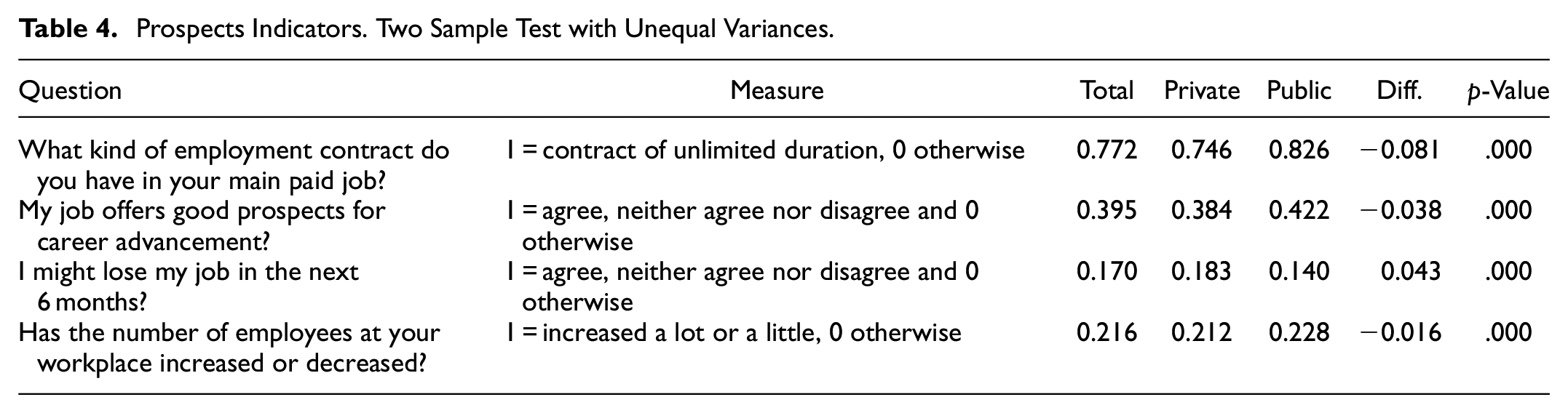
Regarding the Prospect index, it is interesting to note that its value is higher for the public sector, but its influence over job satisfaction is lower in this sector. For this reason, Table 4 introduces the different items included in this index. As can be observed, the situation in the public sector is better than the private sector in all indicators. The prospects for career advancement are greater, the possibilities of job loss lower, and the number of employees has increased to a greater extent than in the private sector. The higher impact on the private sector could be explained by the greater variability of this index in this sector, as shown by the variance difference test. In the case of the public sector, greater stability could be taken for granted and, therefore, have a smaller impact on job satisfaction. In fact, after economic adjustments the variability in private-sector wages and employment often considerably higher than in the public sector (Adam, 2020).
Prospects Indicators. Two Sample Test with Unequal Variances.
Finally, in the Social environment index, the situation in the public sector is less favorable and the impact on job satisfaction is higher in the private sector. In this sense, as can be observed in Table 5, the index can be separated into four different dimensions: support provided by colleagues and managers, quality of management, industrial relations, and adverse social behavior.
Social Environment Indicators. Two Sample Test with Unequal Variances.

The first dimension considers the support from colleagues and supervisors. In general, the share of employees who report that work colleagues and bosses are helpful is higher in the public than in the private sector. It could be possible that competition between public-sector colleagues is lower since promotion is normally the result of entrance exams and seniority (Khan & Azam, 1992). These factors could lead to climate of greater companionship.
The second dimension focuses on managers. Public sector workers rate them lower than private sector workers on the following issues: (a) Is successful in getting people to work together; (b) Is helpful in getting the job done; (c) Provides useful feedback on your work; and (d) Encourages and supports your development. Also, noteworthy, in the private sector the percentage of workers who consider work distribution and conflict resolution to be fair is higher than in the public sector. This dimension constitutes, therefore, an area of improvement for the public sector that could take the private sector as a reference. In this sense, the role of managers in increasing public-sector employee motivation should be emphasized as it would affect job satisfaction and, additionally, the quality of public services (Levitats & Vigoda-Gadot, 2020).
The third dimension refers to the workers’voice within the company either through unions, committees, or individually. Employment and industrial relations in this area are conditioned by the national institutional framework and labour market regulations. In any case, in aggregate terms, public-sector workers’ representation is higher than that of private-sector workers.
Finally, the fourth dimension measures adverse social behavior at work, including verbal, physical, or sexual abuse. In general, adverse social behavior is more frequently reported in the public sector than in the private sector. Though there are two possible explanations for this, either the incidence is higher or the reporting rate is higher. It is reasonable to expect public-sector employees to be more inclined to report this behavior as job security is greater. Nevertheless, El Ghaziri et al. (2021) observes that public sector employees are at greater risk of work-place bullying globally compared to their private sector counterparts, in part due to specific sectoral factors such as being service oriented and highly bureaucratic, undervalued by the public, comprising a large and diverse workforce, and also a higher unionization rate than the private sector.
Finally, one might wonder whether characteristics observed in the aggregate data are uniform across the countries of the Monetary Union. For this reason, the same procedure has been followed in each of the countries to observe if there were significant differences in each of the dimensions (see Annex II). In this sense, the homogeneity in some dimensions is striking, especially in the indices corresponding to Physical environment, Skills and discretion, Earnings, and Prospects where the public sector fares considerably better than the private sector in most countries. In the case of Social environment, in which the public sector was lower than the private sector at the aggregate level, we also observe to be lower in Austria, Belgium, Cyprus, Germany, Ireland, Malta, Netherlands, Portugal, Slovenia, and Spain. Countries in which the private sector fares worse than the public sector coincide with the former Soviet republics and Greece. This improved situation may be associated with the idiosyncrasy of labour relations and the structure of the labour market. Former communist countries (Slovenia is an exception) are characterized by low trade union density, great difficulties in collective bargaining and restrictions on the right to strike (Eurofound). However, when the dimension associated with labour relations is observed, the situation of the public sector is better than in the private sector. Future research should be then focused on the other dimensions.
These results, along with those from Table 3, define a policy recommendation framework for identifying situations in which the public sector can benefit from the experience of the private sector (and vice versa) to improve job quality and therefore increase job satisfaction. In this sense, the only dimension in which the public sector can benefit from private-sector experience is regarding social environment. In fact, this dimension, together with skills and discretion and prospects have the greatest impact on public-sector worker the job satisfaction of. In the rest of the cases, the public sector must be taken as a reference to improve job quality.
Human resource management in public-sector institutions should possibly be focus more on the psycho-sociological profile of the public-sector employee. Higher motivation and, consequently, higher performance could be achieved by establishing a social exchange relationship between managers and members of their teams. A supportive work environment will positively impact public employees’ performance, self-efficacy, and job satisfaction, even though other intrinsic motivators exist (Ciobanu et al., 2019).
Conclusions
This study analyzes the impact of the different job quality dimensions (Physical environment, Social environment, Work intensity, Skills and discretion, Prospects, Working time quality, and Earnings) on Eurozone job satisfaction through analysis of the EWCS-2015 published by Eurofound (2016). The differential impacts of each job quality dimension is analyzed separated in the private and the public sector.
The analysis begins with study of the different dimensions of job quality and differences between the public and the private sector. Subsequently, the econometric analysis is carried out using a probit model (marginal effects), to identify the impact of the different job quality dimensions on job satisfaction.
The means analysis reveals the situation of the public sector to be better than that of the private sector in different dimensions of job quality, except that corresponding to Social environment. This dimension includes indicators associated with adverse social behavior, such as verbal abuse, unwanted sexual attention, exposure to threats and humiliating behaviors, as well as management quality and social support from colleagues and managers. In the remaining dimensions, either the situation of the public sector is better than that of the private sector or, as with Working time quality, there are no significant differences.
The econometric analysis reveals that dimensions associated with Social environment, Skills and discretion, Prospects, and Earnings have a positive and significant impact on job satisfaction. The impact of the Work intensity dimension is negative (in contrast with other indicators, the higher the index, the worse the job quality) and the dimensions related to Physical environment and Working time quality do not have a significant impact on job satisfaction.
Regarding the differential impact of the different dimensions on the public and private sectors, both Prospects and Social environment are notably higher in the private sector. The greater impact of the Prospects index is not justified, as is the case with the Social environment, by a lower index. It is possible, however, that the greater variability of the index in the private sector will cause the greatest impact.
As regards policy implications, our analysis reveals the importance of studying variables related to job quality when identifying the causes of job satisfaction, especially those related to Prospects, Skills and discretions, and Social environment. Greater understanding of these dimensions in the private sector would improve the situation in the public sector (and vice versa) and, therefore, workers’ job satisfaction. Of special interest are the possible improvements in the field of Social environment, specifically in relationships between workers and their immediate bosses and in the distribution of work tasks.
Our analysis is focused on the public sector taking the private sector as a reference, though future research could work in the other direction. Future research should also focus on analyzing and justifying the differences in job quality dimensions between countries.
Finally, and regarding the limitations of the analysis, the survey does not allow for studying fixed individual effects as it is not a panel. Likewise, we are aware that we are working with aggregate indicators. Their independence, when acting on job satisfaction, has been demonstrated, however they collect multiple aspects of job quality that could have a differential impact, sometimes positive sometimes negative, on job satisfaction. The study of these multiple items included in each index will be of interest.
Descriptive Statistics.
Two Sample Test with Unequal Variances (Difference Mean: Private-Public).

Footnotes
Declaration of Conflicting Interests
The author(s) declared no potential conflicts of interest with respect to the research, authorship, and/or publication of this article.
Funding
The author(s) received no financial support for the research, authorship, and/or publication of this article.
Informed Consent
None.
