




Abstract
This study aims to test and analyze the effect of proactive personality on organizational citizenship behavior, both directly and indirectly, through job satisfaction and affective commitment in correctional institutions in Indonesia. The sample of this study was 211 frontline officers in correctional institutions throughout Indonesia. Furthermore, the data were evaluated and analyzed with partial least square structural equation modeling (PLS-SEM) analysis to determine the acceptance or rejection of the hypothesis. Based on the test results, it was found that the direct effect of proactive personality on organizational citizenship behavior was not significant. However, this study shows that job satisfaction and affective commitment function as variables mediating proactive personality’s full influence on organizational citizenship behavior. This research has proved the role of job satisfaction and affective commitment mediation on the influence of proactive personality on organizational citizenship behavior. These results expand the knowledge expressed by previous research on the effect of personality on organizational citizenship behavior with job satisfaction and affective commitment mediation.
Plain language summary
The goal of this study is to test and examine how a proactive personality affects organizational citizenship behavior, both directly and indirectly, through job satisfaction and affective commitment in Indonesian correctional institutions. The group for this study was made up of 211 frontline service officers. Also, the data were reviewed and analyzed with PLS-SEM analysis to decide whether or not the theory was true. Based on the test results, it was found that a person’s proactive personality did not have a big effect on how they act as a member of a group. But this study shows that the full effect of a proactive personality on organizational citizenship behavior is mediated by job satisfaction and affective commitment. This study has shown that job satisfaction and affective commitment play a role in how a person’s proactive personality affects their behavior as a member of an organization. These data add to what we already know about how personality affects organizational citizenship behavior through job satisfaction and affective commitment.
Keywords
Introduction
Organizational Citizenship Behavior (OCB) is the most widely studied research topic in organizational behavior (Gyekye & Haybatollahi, 2015). It is not surprising because every organization wants its members to always strive for the organization’s benefit. The effort covers both the main tasks and extra tasks. The actions of members of the organization exceed their main duties, that can be said to be OCB. Furthermore, OCB is defined as individual discretionary behavior, not accommodated by formal compensation and is carried out to support organizational functionality (Organ, 1997). Through this definition, it can be known that the OCB conducted by members of the organization aims to support the functionality of their organization, both in normal and abnormal situations. The normal situation in question is the absence of things that have the potential to hinder the organization from conducting its functions. However, it is undeniable that each organization has diverse dynamics, including being in situations that hinder its functionality.
One of the organizations that is experiencing an abnormal situation is the correctional institution in Indonesia. From 2012 to 2020, the average capacity of inmates in correctional institutions in Indonesia reaches 152%. That is, there was an overcapacity of 52% throughout the period. The number of prisoners, as many as 206.410, is not comparable to the maximum capacity of correctional institutions in Indonesia, which only reaches 135.561 (Directorate General of Corrections, 2021). Even in 2020, correctional institutions in Indonesia are overcapacity by up to 84%. Apart from capacity, another abnormal situation that is a problem in correctional institutions in Indonesia is that the number of officers is far not proportional to the number of prisoners. In 2020, the number of correctional institution officers in Indonesia was 33,745, while the number of prisoners reached 249.139. Therefore, one officer must guard seven inmates. The situation is worse than that of the correctional institution in the United States, where one officer guards three inmates (Minton & Zeng, 2021).
With the situation that has been described, correctional institutions in Indonesia require personnel willing to take actions that exceed their main duties for the functionality of the correctional institution, in this case, the OCB. However, OCB is not necessarily done casually. Several studies have examined the antecedents of OCB in the context of correctional institutions in Indonesia. Sridadi et al. (2022) uncovered the role of transformational leadership, psychological capital, and work engagement as OCB drivers among correctional staff. Yuwono et al. (2023) also conducted research demonstrating the contribution of affective commitment, job self-efficacy, and job satisfaction to OCB. The findings of these two studies emphasize the influence of leadership style on individual attitudes as a determinant of OCB.
On the other hand, it is unknown how officers’ dispositional conditions contribute to their discretionary behavior at work. Previous research shows that factors in individuals, namely proactive personality, can trigger them to do OCB (Alessa et al., 2021). A proactive personality can influence or change the situation (Bateman & Crant, 1993). In this case, a proactive personality is an important thing that individuals in correctional institutions need to have because of the work conditions that require them always to be vigilant and proactively address problems that have the potential to occur or that have occurred.
In addition, another factor that has been proven to be able to encourage individuals to do OCB is job satisfaction. In this case, individuals who feel satisfaction in their work will be encouraged to do things that voluntarily exceed their main job to help the organization (Gyekye & Haybatollahi, 2015). Furthermore, previous research has also suggested that affective commitment significantly impacts individual OCB (Grego-Planer, 2019). Individuals with affective commitment will feel to be an integral part of the organization. Therefore, individuals will not hesitate to help their organization even if it is not part of the main task. The existence of job satisfaction and affective commitment in encouraging OCB personnel in correctional institutions in Indonesia is important and interesting to be studied further. It is due to the correctional institution being perceived as a dangerous workplace and is often associated with low job satisfaction and high stress (May et al., 2020). With a workplace that is considered dangerous, only some people want to work in a correctional institution. It requires personnel with a strong emotional attachment to the correctional institution to survive in their work.
Based on the presentation, this study aims to test and analyze the direct effect of proactive personality on OCB and the role of job satisfaction and affective commitment mediation in this effect. It is important to do because there is little, if any, empirical research that tests and analyzes the role of job satisfaction and affective commitment mediation on the effect of proactive personality on OCB in a single model. Although Ariani (2014) and Herminingsih and Kasuri (2018) have examined the role of job satisfaction and affective commitment mediation, the two studies did not specifically examine the effect of proactive personality on OCB but on other personalities. Therefore, there is still a gap in the literature regarding the impact of a proactive personality on OCB with job satisfaction and affective commitment mediation. In addition, previous research on OCB has not been done much in the public security sector (de Geus et al., 2020), especially in correctional institutions. Thus, this research becomes increasingly important to conduct to make a real contribution to correctional institutions in Indonesia to deal with situations that do not support its functionality.
Based on this explanation, online questionnaires were used to collect data for this quantitative study. The questionnaires were distributed to the respondents, which consisted of frontline officers in Indonesian correctional institutions. The officers are responsible for supervising the entry and exit of people in correctional units. Therefore, it is necessary to be careful in monitoring someone’s movements and proactively responding to a problem. However, it is possible that the frontline officers also perform actions beyond their main duties and functions to assist colleagues and the correctional institution in general.
The collected data were then analyzed using the PLS-SEM method. The data assessment results were used as a basis for discussion, from which conclusions were drawn. In addition, this study generated theoretical and managerial implications that can inform the formulation of correctional policies.
Literature Review
Proactive Personality
Bateman and Crant (1993) define proactive personality as an individual personality that is not limited by circumstances but can influence or change the circumstances around it. Individuals with proactive personalities can observe existing opportunities, show initiative, take action, and persist until they can achieve what is expected despite changing the environment around them. In contrast, individuals who do not have proactive personalities only react, adapt, and are shaped by the environment around them. Passive individuals are reluctant to change the existing circumstances and choose to follow the circumstances that are happening.
Furthermore, a proactive personality can be observed when individuals have a view and steps that will be taken forward to achieve their desired goals (Presbitero, 2015). Therefore, individuals with a proactive personality can act and implement plans that have been made to ensure that their goals will be achieved. In addition, individuals with a proactive personality tend to anticipate and pursue existing changes or opportunities (Suseno et al., 2020). In this case, individuals with a proactive personality see opportunities as something to be noticed. In addition, a proactive personality also encourages individuals to be sensitive to possible changes in the environment so that they can anticipate or even take advantage of them according to what is desired.
Concerning the environment, individuals with proactive personalities try to take control of the environment around them (Parker & Collins, 2010). Control over the environment is the key to changing the environment itself. Thus, individuals with proactive personalities can ensure that nothing will prevent them from achieving their desired goals. It is in line with Song and Lee (2020), who state that individuals with proactive personalities tend to shape and influence the environment to achieve their goals. Therefore, an important characteristic in individuals with proactive personalities is the initiative to take action rather than being passive by waiting for things to change (Hidayat et al., 2023). In other words, individuals with proactive personalities feel a strong urge to change the environment when the environment is not supportive or not in line with what is expected.
Thus, a proactive personality is characterized by sensitivity, initiative, and activeness in seeing opportunities and anticipating things that prevent them from achieving goals, even if they have to change their environment or circumstances. In other words, individuals with proactive personalities show determination, endurance, and a strong desire to get what they want. Not stopping there, individuals with proactive personalities also try to control the environment around them to ensure that the plan or path to achieving the goal is supported.
Job Satisfaction
Locke (1969) defined job satisfaction as a positive and pleasant emotional state resulting from individuals’ work achievement. Individuals who perceive themselves as successful in achieving a task or job will feel job satisfaction and vice versa. In line with this, Judge et al. (2017) stated that job satisfaction is an evaluation of individuals’ liking for their job, which is in the negative to positive range. In addition, job satisfaction is also described as the result of an individual’s observations and emotional experiences of various aspects of their job (McShane & Von Glinow, 2018). In other words, job satisfaction arises from an individual’s assessment of what has been done on the job. In this case, the assessment is not only limited to job achievements but also includes other things, such as the work environment (Gordon (2011)
Furthermore, Yuen et al. (2018) explained job satisfaction as balancing what individuals give and receive from their work. In this case, individuals will feel job satisfaction when the organization provides compensation, bonuses, benefits, and security commensurate as a return on the ability, effort, and loyalty individuals devote to the organization. By feeling high job satisfaction, individuals tend to show good attitudes and feelings in the workplace (Firdaus et al., 2022).
Based on these explanations, job satisfaction is emotional and refers to one’s positive response to the work conditions. In other words, job satisfaction can also be an individual’s response to what is achieved and obtained from their work.
Affective Commitment
Affective commitment is one of the three dimensions of organizational commitment (Meyer & Allen, 1991). Affective commitment refers to an individual’s emotional attachment, identification, and organizational involvement. Therefore, individuals with strong affective commitment will always be in the organization according to their expectations. Moreover, this attachment can be prompted by an individual’s desire to participate in organizational activities that are deemed significant and beneficial (Meyer & Herscovitch, 2001). In this instance, individuals believe the organization’s work is valuable, so they must stand for it. In other words, affective commitment can also be defined as a person’s desire to remain a part of the organization (Meyer & Maltin, 2010).
Meanwhile, McShane and Von Glinow (2018) define affective commitment as an individual’s psychological attachment and identification with the organization. This attachment encourages individuals to be dedicated and responsible for the organization. In this case, individuals with strong affective commitment will be highly loyal to the organization because they believe they are part of it. Tang and Vandenberghe (2020) stated that affective commitment is based on the similarity of values between individuals and their organizations. This similarity encourages individuals to stay and work hard in the organization to fight for the same values. Furthermore, Tang and Vandenberghe explained the cause of psychological attachment and the desire of individuals to stay and contribute to the organization.
Thus, affective commitment is an individual’s psychological attachment and self-identification with the organization. This attachment results from individuals’ strong desire to join organizations that share similar values. Individual attachment can be a sense of belonging, dedication, responsibility, and exertion to pursue the organization’s objectives.
Organizational Citizenship Behavior
The term OCB first appeared in the research of Smith et al. (1983). Later, Organ (1997) defined OCB as discretionary behavior not accommodated by the formal compensation system and carried out to support organizational functionality’s effectiveness. In this case, there are three important components in OCB according to Organ, namely voluntary behavior, no formal compensation, and aims for organizational functionality. Individuals who perform OCB are expected to be able to contribute to the functionality of the organization even though it is not part of their main duties and does not get rewarded. In addition, OCB is done voluntarily, which means it requires initiative and awareness from the individual as a member of the organization.
Furthermore, Williams and Anderson (1991) categorized OCB into two, namely OCB-Individual (OCBI) and OCB-Organization (OCBO). OCBI refers to OCB performed by individuals towards other individuals in the organization. Therefore, OCBI provides direct influence or benefits to individuals and indirectly to the organization. An example of OCBI is helping a colleague absent from the office. Meanwhile, OCBO refers to OCB that individuals do towards their organization. In this case, individuals provide direct influence or benefits to the organization for their behavior—an example of OCBO, such as complying with the organization’s informal rules to maintain order.
Over time, the definition of OCB has evolved and given rise to new terms that overlap with OCB (Lepine et al., 2002). Brief and Motowidlo (1986) used extra-role prosocial behavior, part of prosocial organizational behavior, to explain individual positive social actions unofficially part of their job roles and activities. Although called positive social actions, they can be functional or dysfunctional to the organization. Functional actions may include cooperating with other individuals, protecting the organization from harm, and making suggestions to improve the organization. Thus, the functional action is good and does not harm the organization. In contrast, dysfunctional actions may take the form of helping other individuals or clients that provide personal benefits to them, but the organization has to bear many costs. In other words, the dysfunctional action is bad or detrimental to the organization.
Meanwhile, George and Brief (1992) use the term organizational spontaneity (OS), which refers to the behavior of individuals outside their roles to contribute to organizational effectiveness voluntarily. In this case, OS emphasizes individual initiatives in making valuable contributions to the organization even though it is not their main role. In addition, in this definition, there is no emphasis on compensation. It differs from Organ’s (1997) definition of OCB, which states that individual voluntary actions will not be compensated. Thus, the main difference between OCB and OS lies in the presence or absence of compensation given to individuals who have behaved and acted outside the role and bring benefits to the organization.
Furthermore, Van Dyne et al. (1995) used the term extra-role behavior (ERB) to explain OCB. ERB refers to individual behavior that is beneficial and intended to provide benefits to the organization voluntarily, as well as more than the expected role. In this definition, four important things are emphasized, namely voluntary, intentional, positive, and beneficial behavior to the organization. Although it is similar to the definition of OCB proposed by Organ (1997), Organ rejected Van Dyne et al.’s idea (Organ, 1997). The reason is that the term “role” refers to the expectations or hopes of the role-giver. However, such expectations may vary, being higher or lower than specified. Thus, it is difficult to determine whether behavior can be said to be “more than role expected” or not.
Based on the definitions above, this study is guided by Organ (1997), which emphasizes OCB as individual behavior carried out selflessly for the good or benefit of the organization, more than their main duties. In other words, the individual’s behavior is functional solely for the organization’s benefit.
Hypothesis Development
Proactive Personality and Organizational Citizenship Behavior
Individuals with a proactive personality tend to observe opportunities and risks, demonstrate initiative, act, and persevere until the objective is attained despite adapting to changing circumstances. In addition, individuals with a proactive personality actively anticipate potential problems (Farooq et al., 2020). In this instance, the individual is attuned to the possibility of events that impede the ability to achieve the objective. With this sensitivity, individuals can plan effective measures for performing a task. It is supported by Jafri et al. (2016), who emphasized proactive personality as an individual trait that motivates a person to constantly take the initiative to develop new ideas and methods for achieving objectives at work. The individual’s efforts in accomplishing objectives are not limited to the primary task. It is supported by the findings of Hsiao and Wang (2020), who found that individuals with proactive personalities tend to engage in OCB. It is explicable through Trait Activation Theory (TAT).
TAT emphasizes personality tendencies as determining an individual’s response to personality-relevant situations. These circumstances are categorized as task, social, and organizational (Tasoula & Galanakis, 2023; Tett et al., 2021). Task situation refers to the conditions under which everyday work is performed. In addition, the social situation pertains to the social relationships between individuals, co-workers, leaders, and groups within the organization. In the meantime, organizational situation influences culture, climate, and policies. In relation to the research context, the dispositional state of a proactive officer is pertinent to three situations in correctional institutions.
The task situation in correctional institutions is related to the role of officers as security personnel who prioritize preventive actions. It is consistent with the traits of a personality that strives to prevent problems and is thus proactive. In addition, the social situation is intricately linked to the relationship between officers and their leaders. This relationship permits officers to demonstrate initiative in their work, so long as it is coordinated with the leader. The organizational situation in correctional institutions is characterized by a culture of solidarity and cooperation, which encourages officers to assist their co-workers proactively. With these three situations, officers will demonstrate their proactive nature at work, even if it transcends their primary responsibilities (i.e., OCB). The OCB is individual discretionary behavior not accounted for by a formal compensation system and is performed to support the organization’s functionality. Individual correctional officers with a proactive personality go above and beyond their duties to support achieving their objectives. Individual officers with a proactive personality will do their best to ensure their work environment is conducive to their career advancement. It is consistent with Alessa et al. (2021), who proposed that individuals with proactive personalities strive to create long-term opportunities by establishing a supportive work environment. The efforts of such individuals extend beyond the primary responsibilities of the job. For instance, they assisted co-workers experiencing difficulties at work, avoiding conflicts with co-workers, and surviving unsettling work situations.
In other words, a proactive personality can motivate people to engage in OCB. Previous research has demonstrated that a proactive personality is a significant factor in determining extra-individual behavior at work (Bergeron et al., 2014; Hsiao & Wang, 2020). However, other studies have failed to demonstrate a direct relationship between proactive personality and OCB (Li et al., 2010). The first hypothesis of the study can therefore be stated as follows.
H1: Proactive personality has a significant effect on OCB.
Proactive Personality and Job Satisfaction
Locke (1969) stated that job satisfaction is a positive emotional state or a result of one’s assessment of the work, such as the achievements that have been achieved. In this case, one who perceives success in achieving a task or job will feel job satisfaction and vice versa. Therefore, individuals with proactive personalities will feel satisfied working because they strive to improve their work and help their organization (Yan et al., 2019). The efforts made by the individual can be floating of new ideas or ways and even influence the surrounding environment to achieve workplace success. It is also supported by Kuo et al. (2019), who suggested that a proactive personality encourages individuals to create situations that support the achievement of their work to make themselves feel job satisfaction. Theoretically, it can be explained by TAT.
Based on TAT, the proactive personality of correctional staff will be realized because it is supported by relevant tasks and social situations (Tett et al., 2021). In this case, officers try proactively preventing problems that hinder correctional activities, such as riots. The social environment (such as leaders) supports officers’ proactive actions in prisons because it aims to prevent problems from arising. The occurrence of problems will harm the functionality of the correctional units and especially the officer’s career. Conversely, conducive correctional units will support the career path of officers. Therefore, officers with a proactive personality will take advantage of opportunities and anticipate things that risk disrupting work. As a result, work can be carried out successfully so officers can feel job satisfaction.
Empirically various studies have found that a proactive personality significantly affects job satisfaction. Nonetheless, the role of a proactive personality as a determinant of job satisfaction in the context of correctional officers still needs to be determined. Li et al. (2017) examined the effect of a proactive personality on job satisfaction in the context of school teachers. In addition, Premchandran and Priyadarshi (2019) discussed the effect of a proactive personality on job satisfaction in the context of work-family employees. Furthermore, Kuo et al. (2019) conducted research in the context of changes in employee job satisfaction. Then, Yan et al. (2019) examined the effect of a proactive personality on job satisfaction from a nurse’s perspective. Likewise, Wang and Lei (2021) discussed the effect of a proactive personality on job satisfaction from the perspective of miners. With this, hypothesis 2a in this study is as follows.
H2a: Proactive personality has a significant effect on job satisfaction.
Job Satisfaction and Organizational Citizenship Behavior
Job satisfaction is also widely known to impact individuals and organizations, including OCB. The effect of job satisfaction on OCB can be understood by the Reciprocity Rules, which are included in the scope of Social Exchange Theory (Cropanzano & Mitchell, 2005). The basic assumption in the Reciprocity Rules is the interdependence between two parties in influencing something. In this study, job satisfaction is conceptualized as an individual’s assessment of his or her job. Job satisfaction depends on two things: the individual who evaluates and the job (organization) that is assessed. When the assessment of working conditions is good, individuals will perceive that the organization cares about them. This concern creates a sense of individual responsibility to repay the organization’s kindness through pro-organizational actions, such as OCB.
Previous research showed that individuals who feel job satisfaction tend to do OCB as a form of repayment for the positive things felt in their work (Gyekye & Haybatollahi, 2015). The results of this study are supported by Ingrams (2020), who stated that job satisfaction is a central factor that acts as an antecedent of OCB. In this regard, Ingrams also proved that job satisfaction impacts encouraging individuals to do OCB. It is done in return for what the individual receives in the work that satisfies oneself. Therefore, individuals are responsive to help the organization and its members, even though it is not part of the main task. Similar research findings were also produced by Alkhadher et al. (2020) and Urbini et al. (2020), proving that job satisfaction significantly contributes to OCB. Thus, hypothesis 2b in this study is as follows:
H2b: Job satisfaction has a significant effect on OCB.
Mediating Role of Job Satisfaction
Given the direct effect of proactive personality on job satisfaction and job satisfaction on OCB, it is reasonable to presume that job satisfaction mediates the effect of proactive personality on OCB. The Reciprocity Rules explicate the role of job satisfaction as a mediator. Due to the individual’s satisfaction with the organization’s treatment, OCB is assumed to be a form of exchange from the individual to the organization. Individuals may receive treatment in the form of a supportive social environment (colleagues and leaders) and organizational recognition. Individuals with proactive personalities can improve their social environment and reputation through their proactive actions. Thus, job satisfaction is expected to be a link between a proactive personality and extra-individual behavior at work. Herminingsih and Kasuri (2018) and Ilies et al. (2009) demonstrated that job satisfaction significantly mediates the influence of other personality traits on organizational citizenship behavior (OCB). Thus, this study’s 2c hypothesis is as follows (Figure 1):
H2c: Job satisfaction significantly mediates the effect of proactive personality on OCB.

Research framework.
Proactive Personality and Affective Commitment
Meyer and Allen (1991) defined affective commitment as the emotional attachment, identification, and self-involvement of individuals in organizations. As a result, individuals with strong affective commitment will always be in the organization according to what they expect. The strong emotional bond between individuals and organizations triggered by a proactive personality can be explained through TAT. In this case, one of the situations that is relevant in exposing personality is the organizational situation. With the support of organizational situations, namely culture, individual proactive personality will strengthen organizational values (Tett et al., 2021). These values help individuals to strengthen their inner bond with the organization.
When related to the context of this research, officers uphold the values of brotherhood and cooperation culture in correctional institutions. This culture is important because officers work in places where their safety is at risk. On the other hand, the small number of officers compared to detainees led to dependence on one another to maintain safety. From there, a proactive personality is important in encouraging officers to help each other. Apart from helping to ensure the safety of co-workers, the proactivity of officers is also useful in ensuring that there are no problems that hinder the correctional institution’s functioning. As a result, this creates an affective commitment to officers, which is characterized by a sense of kinship, belonging, and attachment to the organization. Apart from being contextual, the contribution of a proactive personality to affective commitment is also proven empirically.
Referring to Liao’s (2015) research results, proactive personalities can make individuals feel a strong emotional attachment to their organization. In this case, the individual who proactively conditions the work environment that supports his work will feel part of the organization. It is in line with Yousaf et al. (2013), who also showed that individuals with proactive personalities have strong affective commitment because they feel comfortable with where they work. Such comfort is the result of the individual’s efforts to create ideal environmental conditions. Similar findings were also shown by other studies that proved the impact of a proactive personality on affective commitment (Seo & Choi, 2019; Ullah et al., 2020). Thus, hypothesis 3a in this study is as follows:
H3a: Proactive personality has a significant effect on affective commitment.
Affective Commitment and Organizational Citizenship Behavior
A systematic literature review by de Geus et al. (2020) found that organizational commitment, especially affective commitment, is an antecedent that tends to strengthen OCB consistently. Theoretically, the effect of affective commitment on OCB can be explained by Reciprocity Rules. The Reciprocity Rules emphasize the interdependence between two parties to influence something (Cropanzano & Mitchell, 2005). In this study, affective commitment is an individual’s perception of his emotional attachment to the organization. There are two parties involved in affective commitment, namely individuals and organizations. The organization acts as a facilitator for individuals to achieve goals and meet similar people. As a result, values are created in the organization that is followed, and a strong bond between members. It becomes a trigger for individual affective commitment. Furthermore, individuals who feel affectively attached consider the organization a family that must be supported. This support is in the form of actions that exceed the main task as a reciprocal of what is received by individuals in the organization.
In addition, affective commitment is also known to contribute to OCB. Apart from being theoretical, the contribution of affective commitment to OCB has also been proven empirically. In this case, individuals with affective commitment tend to do OCB because they feel their goals and needs have been fulfilled (Grego-Planer, 2019). Individuals will be encouraged to do OCB because they feel they are an inseparable part of the organization, so individuals do not hesitate to help the organization or its members. It is also successfully proven by the research results by Alshaabani et al. (2021), which showed that proactive personality affective commitment has a real impact in encouraging individuals to do OCB. Similar findings were also produced by previous research by Imer et al. (2014), which examined affective commitment and OCB in the context of engineers and teachers. These results align with the research by Vázquez-Rodríguez et al. (2020), which states that one of the reasons for the absence of OCB is the lack of affective commitment by members to the organization. In other words, individuals tend to be reluctant to do OCB if they do not have affective commitment. Thus, hypothesis 3b in this study is as follows:
H3b: Affective commitment has a significant effect on OCB.
Mediating Role of Affective Commitment
With the direct influence of proactive personality on affective commitment and affective commitment on OCB, affective commitment plays a role as a variable that mediates the influence of proactive personality on OCB. Referring to TAT, culture is a form of organizational situation that supports the implementation of individual personality (Tett et al., 2021). This culture allows officers to take advantage of their proactive personality to create extra attachment and behavior toward their organization. In this case, the strong organizational culture in correctional institutions is companionship and cooperation, allowing officers to do something beyond their main job to support the organization’s functionality. Meanwhile, affective commitment in this study is assumed to be a factor rooted in that culture. Affective commitment is expected to become an element that strengthens the influence of a proactive personality on OCB because of the feeling of belonging and caring for each other. Although the role of proactive personality has not been empirically revealed, there are previous studies that have succeeded in proving that affective commitment significantly mediates the effect of other personalities on OCB (Ariani, 2014; Purba et al., 2015). Thus, hypothesis 3c in this study is as follows (Figure 1):
H3c: Affective commitment significantly mediates the effect of proactive personality on OCB.
Research Methods
Data Collection
This study collected data through online questionnaires. The population of this study is all correctional officers in Indonesia. The samples in this study were 211 correctional institutions frontline officers in Indonesia who were determined by purposive sampling techniques. The criteria were (1) acting as frontline officers; (2) having worked in the correctional institution for >2 years. Officers who have worked at the correctional institution for >2 years are expected to have a strong commitment. It is in line with the findings of Allen and Meyer (1993), which show that individuals with a length of work of 2 to 10 have a stronger commitment and are even stronger than individuals with a length of work < 2 years. Before completing the survey, all respondents had agreed to the consent form. Respondents were aware that completing the questionnaire was voluntary and that there were no consequences if they chose not to do so. The demographic distribution of this study sample was dominated by men, namely 157 people (74.41%); who have worked for >8 years, as many as 145 people (68.72%); aged 21 to 30 years, as many as 75 people (35.54%); and married 169 people (80.09%). In detail, the demographic distribution of respondents can be seen in Table 1.
Demographic of Respondent.

Measurement
This study used a Scale of Likert 1 (strongly disagree) to 5 (strongly agree) to measure each variable measurement item studied. Furthermore, proactive personality is measured by 10 items adopted from Seibert et al. (1999), such as “I excel at identifying opportunities.” Job satisfaction is measured by 10 items adopted from Jaiswal et al. (2016), such as “I feel comfortable with this job.” Affective commitment is measured by eight items adopted from Allen and Meyer (1990), such as “I would love to spend the rest of my career in the correctional institution.” OCB is measured by 15 items adopted from Kumar and Shah (2015), such as “I am happy to help co-workers when they have work-related issues.” The complete instrument is in the Appendix. All measurement items of each variable were originally in English and were translated into Indonesian. The measurement items of each variable were translated back to English to ensure no difference in meaning when translated. In addition, content validity was also carried out by experts in the field of corrections from the Directorate General of Corrections, Ministry of Law and Human Rights of the Republic of Indonesia. The instrument’s content validity aims to ensure that the respondents can properly understand the sentences of the instrument. Furthermore, Table 2 shows the operational definition of each variable studied.
Variable Operational Definition.

Data Analysis Techniques
Partial Least Square–Structural Equation Modelling (PLS-SEM) with SmartPLS 3 software was used to analyze the data in this study. PLS-SEM is a variant-based SEM statistical method that simultaneously evaluates measurement models and structural model testing (Hair et al., 2017). In addition, PLS-SEM is designed to solve SEM problems when specific things happen to the data, such as small research sample sizes, missing values, and not meeting assumptions. In a simple sense, PLS-SEM provides precise and efficient estimation techniques for a series of equations (measurement and structural) that are estimated simultaneously. There are two basic components in PLS-SEM, namely (1) the measurement model (outer model) and (2) the structural model (inner model). The outer model allows researchers to assess the contribution of each item in measuring variables (validity) and how reliable the measurement scale is in measuring variables (reliability). In contrast, the inner models allow researchers to analyze the path of influence of independent variables on dependent variables (Hair et al., 2017). Hypothesis testing is conducted by bootstrapping to determine the significance of the influence of independent variables on dependent variables, either directly or indirectly, through mediation variables.
Findings and Discussion
Outer Models Test
Outer model testing determines the feasibility of measurement items in measuring the variables studied. In this case, the measurement item must be valid and reliable for further analysis of the results. The validity of measurements is determined in two ways, namely convergent validity and discriminant validity (Hair et al., 2017). Convergent validity refers to the outer loading value of each item that must be >0.70, and the Average Variance Extracted measurement of the variable that must be >0.50. After that, a discriminant validity test was carried out by reviewing the Fornell-Larcker Criterion. In this case, a variable’s AVE square root value must be greater than its correlation value with other variables (Hair et al., 2017). Meanwhile, reliability testing is conducted through internal consistency, which refers to the composite reliability value. The measurement is reliable if it has a composite reliability value of >60. The results of convergent validity and internal consistency tests are shown in Table 3.
Outer Model Test Results.

The first outer model test showed that multiple items in each variable had an outer loading value of <.70 (invalid), so it should be omitted. Next, a second outer model test is performed to ensure no more invalid items. Based on Table 1, all items have an outer loading value of .70 and AVE > .50, so they can be declared valid. Meanwhile, Table 4 shows that each variable’s AVE square root value is greater than the correlation value with other variables. Therefore, the measurement meets the standard of discriminant validity. In addition, all variable measurements have a composite reliability value of >.60, so they can be declared valid. Thus, out of 43 measurement items, the study used 37 valid and reliable items for further analysis.
Fornell-Larcker Criterion.

Inner Model Test
In structural testing, it is necessary to analyze the fit model in advance. It is done to see whether the model built on this study is in accordance or not with empirical data. The fit model testing refers to standardized Root Mean Square Residual (SRMR) values. SRMR is the degree of difference between the model and the data and a small value close to the expected zero. The SRMR value in this study was 0.11 is less than 0.12 signifies the model is still within acceptable limits (marginal fit) (Hair et al., 2017). Furthermore, collinearity testing was conducted based on the values of inner Variance Inflation Factor (VIF), R square (R2), effect size (f2), and predictive relevance (Q2), whose results can be seen in Table 2.
Table 5 shows that the entire inner VIF < 5 so that it can be declared free of collinearity. The R2 values of job satisfaction and affective commitment are .25 to .75, so the contribution of proactive personality to both variables is included in the moderate category. In contrast, the value of R2 OCB > .75 is included in the high category. Meanwhile, the value of f2 affective commitment contributes the most directly to the change in the OCB value, which is .42. Furthermore, Q2 testing showed that proactive personality has great predictive relevance (>.35) to affective commitment and OCB, whereas affective commitment has great predictive relevance (>.35) to OCB.
Inner Model Test Results.

Hypothesis Testing
Hypothesis testing is conducted by bootstrapping to determine the magnitude of the coefficient of influence of proactive personality on OCB, directly or indirectly, through job satisfaction and AC. The influence between variables is said to be significant if it has a path coefficient of >0 and a p-value < .05 or a t-value > 1.96 (Hair et al., 2017). Furthermore, the results of hypothesis testing can be observed in Table 6.
Hypothesis Testing Results.
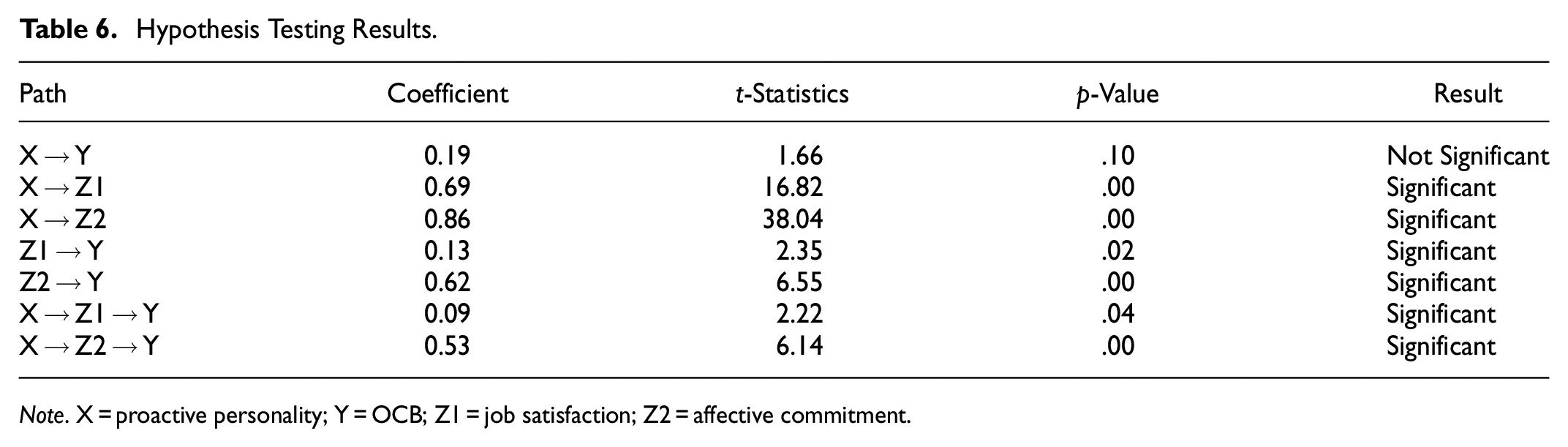
Note. X = proactive personality; Y = OCB; Z1 = job satisfaction; Z2 = affective commitment.
The hypothesis testing results in Table 6 and Figure 2 show that the direct effect of proactive personality on OCB is insignificant, so H1 is rejected. On the other hand, the direct effect of a proactive personality on job satisfaction and affective commitment proved significant with a p-value of <.05, so H2a and H3a were accepted. Furthermore, each direct effect of job satisfaction and affective commitment on OCB proved significant with a p-value of <.05 so that H2b and H3b are accepted. Thus, job satisfaction and affective commitment could function as variables that bridge the effect of proactive personality on OCB (H2c and H3c are accepted). The nature of job satisfaction and affective commitment mediation is full mediation because the direct effect of proactive personality on OCB is insignificant.
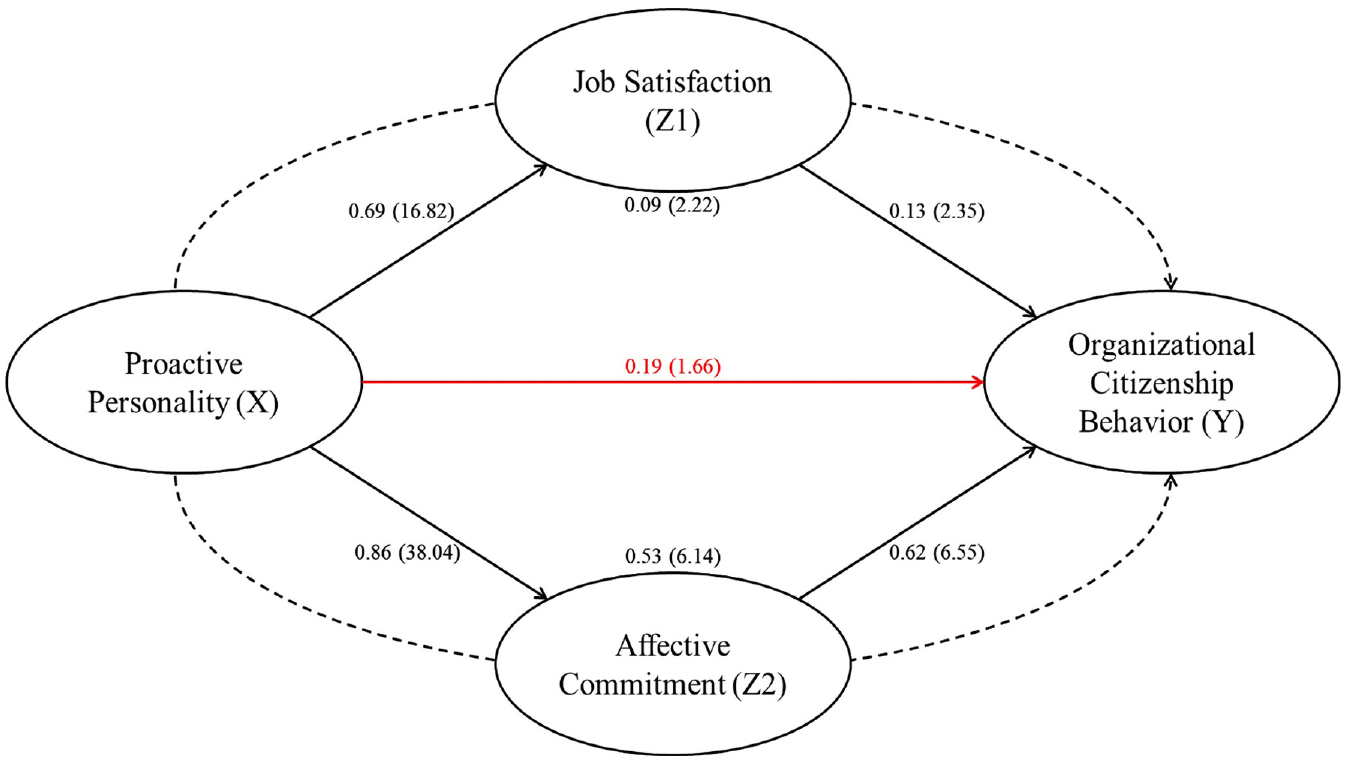
Path diagram.
Discussion
This study produced a distinctive finding that proactive personality did not affect OCB directly. Although these results align with the research of Li et al. (2010), the results of this study contradicted previous studies that have succeeded in showing the real impact of proactive personality on OCB (Alessa et al., 2021; Hsiao & Wang, 2020). The proactive personality inability to foster officers to behave more than their primary duties voluntarily for the good of the correctional institution can be explained contextually. Although correctional institution officers with strong proactive personalities tend to be aware of opportunities or threats, take the initiative, and be active in their actions, they can only do some things freely due to regulations that may restrict them. Therefore, the proactive personality of officers is more beneficial to support the implementation of the main task alone.
Although it did not contribute to the OCB, the proactive personality of the officers proved to foster job satisfaction. Officers are always sensitive to issues, take the initiative to think about prevention efforts, and act proactively to address potential issues. As a result, the situation in the correctional institution becomes conducive and ideal for the officer to conduct his work successfully. A conducive work environment that supports job success causes officers to feel satisfied with their work. Thus, this research supports previous research that suggests that a proactive personality contributes to the job satisfaction felt by individuals in organizations (Kuo et al., 2019; Yan et al., 2019).
In addition to job satisfaction, the results of this study also show that a proactive personality can have a substantial impact on the affective commitment of correctional institution officers. These results align with previous research that proves that a proactive personality can make individuals feel emotionally attached to their organization (Liao, 2021; Yousaf et al., 2013). In this context, officers with proactive personalities tried their best to keep the situation of the correctional institution safe and orderly despite facing the problem of overcapacity and lack of personnel. In other words, the officers’ proactive personalities make them feel integrated with the correctional institution. Therefore, a proactive personality strengthens officers’ emotional attachment and sense of belonging.
On the other hand, the study found that job satisfaction of officers was able to encourage them to behave beyond the main duties voluntarily for the sake of the functionality of the correctional institution. The result of this study are directly proportional to previous studies, which showed that OCB could be influenced by individual job satisfaction (Gyekye & Haybatollahi, 2015; Ingrams, 2020). The correctional institution officer will not hesitate to take actions outside the main duties for the sake of the functionality of the correctional institution as a form of reciprocity for the things he obtains in the organization so that the officer is satisfied.
Just like job satisfaction, the emotional attachment and perception that officers are integral to the correctional institution also encouraged them to do OCB. In this case, officers view the correctional institution as not just a place to work and fulfill responsibilities, but feel that it owns the correctional institution. Therefore, the threat or problem in the correctional institution is the officers’ problem, so they would take the necessary actions to ensure that the institution is running as it should. Such actions are conducted as part of the main task and exceed what should be done, even voluntarily. The result of this study is in line with previous studies that show the contribution of affective commitment to OCB (Alshaabani et al., 2021; Grego-Planer, 2019).
With the proven direct influence of proactive personality on job satisfaction and affective commitment and both on OCB, it can be ascertained that job satisfaction and affective commitment function as full mediators of proactive personality effect on OCB. That is, the proactive personality alone is insufficient in encouraging officers to perform actions beyond their main duties voluntarily for the good of the correctional institution. Another thing is the feeling of satisfaction with the work and the officers’ strong emotional attachment to the correctional institution so that they are willing to do OCB. Although the correctional institution is a regulatory institution, OCB can still be conducted with certain considerations, such as the existence of an emergency, and coordinated with interested parties in the correctional institution. Thus, this study expands the results of previous studies that suggest the role of job satisfaction (Herminingsih & Kasuri, 2018) and affective commitment (Ariani, 2014) as mediators in the influence of personality on OCB.
Conclusion
This study proves that a proactive personality, as an individual’s dispositional state, cannot strengthen OCB. It happens because individuals are limited by organizational situations that have strict rules. As a result, individual proactivity cannot be directly realized by OCB. Nonetheless, this study reveals the important role of affective commitment and job satisfaction as factors that bridge proactive personality towards OCB. In this case, affective commitment contributes most to extra-individual behavior with a proactive personality. These results also strengthen the position of affective commitment as an antecedent and consistent mediator in promoting OCB. On the other hand, job satisfaction also plays an important role as a facilitator of a proactive personality towards OCB. Although not as big as affective commitment, job satisfaction still significantly impacts.
Theoretical Implications
This study focuses on testing and analyzing individual disposition toward OCB through job satisfaction and affective commitment. The results of hypothesis testing showed that the effect of proactive personality on OCB was not shown to be significant. It is an unusual finding given that most previous studies have proven the direct effect of proactive personality on OCB. However, this research became a successful pioneer in proving that job satisfaction and affective commitment play a full mediation role that bridges the influence of proactive personality on OCB. Thus, the results of this study are not in line with the TAT, which emphasizes the relationship between individual personality and behavior. On the other hand, personality has proven capable of determining individual attitudes at work. These results develop previous studies that have also successfully shown that the influence of personality on OCB is significantly mediated by job satisfaction and affective commitment. In this regard, the affective commitment made the greatest contribution in encouraging correctional institution officers to conduct OCB.
Managerial Implications
The results of this study can be used as a basis for formulating general organizational policies regarding OCB, which are indirectly driven by proactive personality through job satisfaction and affective commitment. Organizations, especially correctional institutions in Indonesia, need to encourage their personnel to conduct OCB to maintain the institution’s functionality during unfavorable situations. To do so, the correctional institution first prioritized strengthening the affective commitment of personnel as it proved to have the most influence on the OCB. Strengthening the officer’s affective commitment should be initiated when new officers enter correctional institutions. In this situation, correctional units can implement programs to internalize organizational values, especially cooperation. These values become the foundation for officers to interact with their work environment and foster emotional attachment to prisons. After that, the correctional institution can move on to improving job satisfaction while maintaining affective commitment. The proactive personality owned by correctional institution personnel also needs to be optimized to support the main task of personnel. Although it does not directly encourage OCB, a proactive personality has proven to make personnel feel job satisfaction and a strong attachment to the correctional institution by conditioning an ideal work environment that supports success at work. Therefore, a proactive personality is still an important variable that needs to be managed effectively. An action that can be taken by correctional institutions is incorporating proactive personality traits into the selection process. It is beneficial for obtaining personnel compatible with organizational conditions and strengthening internal ties.
Limitations and Suggestions
In data collection, this study measured each variable based solely on respondents’ assessment. As a result, there is a possibility of common method bias. Nonetheless, this study’s discriminant validity and collinearity assessment (VIF) still met the specified standards. In addition, this study took a long time due to the Covid-19 pandemic. In this case, obtaining data from correctional institution officers takes work.
Based on the limitations that have been stated, this study recommends subsequent studies to measure the variables from a dyadic point of view to gain better accuracy. Future studies need to collect data at intervals to avoid common method bias. In addition, further research needs to examine other variables that can encourage individuals to do OCB, such as the work environment, organizational factors, job demand, and job resources.
Footnotes
Appendix

| Organizational citizenship behavior (Kumar & Shah, 2015) | |
|---|---|
| OCB1 | Saya dengan senang hati membantu sesama rekan kerja ketika mereka memiliki masalah terkait pekerjaan. |
| OCB2 | Saya selalu ingin menolong petugas baru dalam masa orientasi pekerjaan. |
| OCB3 | Saya siap mengulurkan tangan untuk menolong orang-orang di sekitar saya. |
| OCB4 | Saya menuruti aturan Lapas walaupun tidak ada yang mengawasi. |
| OCB5 | Saya tidak mengulur waktu untuk istirahat selama bertugas. |
| OCB6 | Niat kerja saya melebihi batas normal. |
| OCB7 | Saya selalu memerlukan beberapa motivasi agar menyelesaikan pekerjaan (R). |
| OCB8 | Saya sering mengamati kesalahan yang dilakukan Lapas (R). |
| OCB9 | Saya sering fokus pada situasi permasalahan yang terjadi ketimbang sisi positif situasi tersebut (R). |
| OCB10 | Saya selalu menjaga diri agar siap mengikuti perubahan di Lapas. |
| OCB11 | Saya selalu memperhatikan pengumuman dan catatan dari Lapas. |
| OCB12 | Saya bersedia menghadiri rapat yang tidak wajib tetapi tetap membantu bagian regu pengamanan. |
| OCB13 | Saya selalu menghindari masalah dengan sesama rekan kerja. |
| OCB14 | Saya memikirkan dampak perilaku saya terhadap pekerjaan rekan kerja. |
| OCB15 | Saya tidak pernah melanggar hak dari orang lain. |
Authors’ Note
The author(s) confirm that this work is original and has not been published elsewhere, nor it is currently under consideration for publication elsewhere.
Declaration of Conflicting Interests
The author(s) declared no potential conflicts of interest with respect to the research, authorship, and/or publication of this article.
Funding
This study was supported by a grant from Universitas Airlangga through the Penelitian Unggulan Airlangga (Airlangga Excellence Research) scheme, as part of the Airlangga Research Fund 2024, under grant number 363/UN3.LPPM/PT.01.03/2024, awarded to Ahmad Rizki Sridadi. The funding organization had no role in the study’s design, data collection and analysis, decision to publish, or manuscript preparation.
Ethical Approval
This is a non-interventional study. The Research Ethics Committee from Universitas Airlangga: Institute for Innovation, Journal Development, Publishing, and Intellectual Property Rights (LIPJIPHKI) has confirmed that no ethical approval is required.
Informed Consent
Written informed consent has been obtained from the Directorate General of Corrections, Ministry of Law and Human Rights of the Republic of Indonesia. In addition, written informed consent was also obtained from the respondents before they completed the questionnaire. Institute for Innovation, Journal Development, Publishing, and Intellectual Property Rights (LIPJIPHKI) from Universitas Airlangga has approved for the written consent.

Data Availability Statement
The datasets generated during and/or analyzed during the current study are available from the corresponding author on reasonable request.