




Abstract
In conformity with the job demands and resources theory, this study provides a comprehensive understanding of the impact of Pakistani hotel employees’ proactive personality and their professional identity on employee engagement and the mediating role of self-efficacy. The study was carried out by utilizing the empirical information collected from 360 hotel employees from different 4-star and 5-star hotels in Pakistan. This study employs structural equation modeling to better assess the employee engagement phenomenon. Research shows that a proactive personality and professional identity positively affects self-efficacy and employee engagement. The findings also confirm that self-efficacy is an important aspect that promotes the relationship between proactive personality and professional identity and employee engagement. In addition, this study shows that managers need to foster employees’ professional practices, improve training delivery, and encourage job flexibility in order to increase their engagement.
Plain Language Summary
In conformity with the job demands and resources theory, this study provides a comprehensive understanding of the impact of Pakistani hotel employees’ proactive personality and their professional identity on employee engagement and the mediating role of self-efficacy. The study was carried out by utilizing the empirical information collected from 360 hotel employees from different 4-star and 5-star hotels in Pakistan. This study employs structural equation modeling to better assess the employee engagement phenomenon. Research shows that a proactive personality and professional identity positively affects self-efficacy and employee engagement. The findings also confirm that self-efficacy is an important aspect that promotes the relationship between proactive personality and professional identity and employee engagement. In addition, this study shows that managers need to foster employees’ professional practices, improve training delivery, and encourage job flexibility in order to increase their engagement.
Introduction
Since the growing worldwide business rivalry has increased the expectations of organizational employees, the enhancement of employee engagement is now considered a critical approach for the success of the organization (Popli & Rizvi, 2016). Attaining the engagement of excellent employees has always been challenging for human resource managers because of the changing dynamics of employees job-related traits (Jha et al., 2019; Markos & Sridevi, 2010). The report shows only 15% of employees are currently engaged and, “two-thirds are not engaged” globally (Gallup, 2017). They are not mentally attached to the tasks because their desires for engagement remain unfulfilled, and they are spending their time but are not passionate about their work-related activities (Gallup, 2017).
In accordance with the JD-R model, personal resources that undermine the engagement of employees are employees’ passive behavior at the organization, weak professional identity, and less self-efficacy (James, 2012; C. Wang et al., 2020; J. Yang et al., 2011). In conformity with this model, Individuals have to fulfill the job requirements by utilizing their resources. However, job demands may be turned into job stressors when it requires an individual to exert an elevated level of effort to meet these requirements (Schaufeli & Bakker, 2004). Consequently, associated with pessimistic results such as nervousness and depression eventually influenced the engagement of employees at work (Demerouti et al., 2001). Following the personal means of employees, studies show that a lower level of proactive personality could be a pretext for one’s deviant behavior which hinders the employees’ psychological association at work. Additionally, personality is undermined due to the organizational conventional values allied with workers’ behavior (Z. Wang et al., 2017; J. Yang et al., 2011). Whereas, the grounds of the weak professional image are lacking professional knowledge and communication of an individual, different opinions because of the cultural distances between the organizations, professional inconsistency, and demographical features in the sense of stereotypes in accomplishing a particular task lead to disengagement at work (Y. He et al., 2011; Hobfoll, 2011; Molinero, 2015). Furthermore, employees’ detachments are also triggered by the workers’ lower self-efficacy towards work that is their lacked confidence over competencies, lack of motivation, particular aversions, adverse physiological reactions, and social persuasion where employees’ sense of conviction and ability to succeed is obstructed. This leads the mental stress because of having higher job requirements. For instance high work pressure, psychological, emotive, and physical commands (Bakker & Demerouti, 2008; Jafri, 2020; Panatik et al., 2011).
Studies have investigated the attributes related to the employees that contributed to employee engagement. For instance, research showed that personality and job-related resources help in reducing the level of stress and improve the employees’ psychological association with their work (Albrecht & Marty, 2020). Similarly, Jafri (2020) found that an elevated level of self-efficacy helps in overcoming the employee’s disengagement. However, limited studies have distinctively explained the impact of proactive personality, professional identity, and self-efficacy on the engagement of employees (Albrecht & Marty, 2020; Bakker et al., 2012; Buil et al., 2019; Butakor et al., 2021; Carter et al., 2018; C. Wang et al., 2020; Z. Wang et al., 2017; Yongxing et al., 2017). Evidence pertaining that the engagement of employees has not yet been clarified with the joint impact of individual attributes such as employees’ proactive personality, and their belongingness to the profession on employee engagement (Albrecht & Marty, 2020; Brady, 2020). Furthermore, self-efficacy has proven to be generally applicable in diversified fields such as well-being, enterprises, learning, and curative settings. Aggregately, this heuristic base has upheld the hypothetical prediction that self-efficacy is a vital inspirational aspect (Schunk & DiBenedetto, 2021). Therefore, the present study aspires to measure the impact of both proactive personality and professional identity on the engagement of employees with the mediating effects of self-efficacy. To comprehensively understand the inspirational role of self-efficacy.
Based on the above discussion, this study highlights the potential contributions; Firstly, it examines the relationship between hotel employees’ proactive personality, their professional identity, and their self-efficacy on employee engagement. Secondly, evaluates how much individual self-efficacy is crucial in accomplishing tasks effectively. Besides they are proactive and have an exceptional level of professional image. And how much it is ultimately upshot in maximizing employee engagement by playing the mediating role between proactive personality and employee engagement as well as between professional identity and employee engagement. Moreover, the study also contributes to the existing body of knowledge by narrating the embracement of an individual’s professional identity in JD-R theory as previously less evidence is provided to this extent. Furthermore, it contributes by foraging the modus operandi that how proactive traits, professional identity, and sense of confidence can be developed or enhanced.
Literature Review and Derivationof Hypotheses
Functioning of the Hotel Industry in Pakistan
The hotel industry is globally rumbling in most parts of developing economies (C. Wang et al., 2020). In FY19, the growth of the serving area was approximately 3.8% showed moderate development whereas in FY20, showed pessimistic progress of about 0.6% because of COVID-19. Despite that, the general economy showed critical development post-COVID-19 lockdown and is predicted to develop at speed of about 4% in FY21 (Tauseef et al., 2021). In 2021, the compound annual growth rate is >3% (Chakraborty, 2021). The hotel industry of Pakistan is acting as stimulation for its economic progress. Additionally, playing a role in the advancement of tourism and modifying the circumstances as well as setting new hotels (Chakraborty, 2021). In the Pakistan hotel industry, the major players are Pearl Continental, Marriott Hotels, Avari Hotels, Serena Hotels, Nishat Hotels, and Mövenpick Hotels (Chakraborty, 2021). These hotels are offering miscellaneous packages attracting patrons for the competitive edge. There is no doubt that nimble extension in respect of competitiveness, requires a notable demand for the hospitality crew who are skillful and have recognition with the profession as well as confidence (C. Wang et al., 2020). But in the absence of these aspects hotel employees develop a negative association at work and are more likely to make a mind of leaving their job. That is why, this industry is deemed as a high staff turnover industry (Seal et al., 2020).
Furthermore, the hotel industry has departments to accomplish their tasks such as operational and functional departments. The operational departments are the housekeeping department, food, and beverage service department, food production department, and front office department to serve their guests in the best way. Besides, the hotel industry has also functioning departments, for example, HR department, marketing department, finance department, and purchase department. The HR department is responsible for making any investments such as hiring, selecting, training, coaching, etc. in the employees, driving the improvements in the business performance (Seal et al., 2020). In addition to this, engaged employees lead to high achievements of organizational plans (Seal et al., 2020).
Job Demand and Resources Model (J-DR)
In compliance with JD-R, the executing state of the employees can be classified into two, the one in job demand and another one in job resources that are contrastingly identified with various results (Demerouti et al., 2001). Demands are requirements that an individual has to perform at work (Schaufeli & Bakker, 2004). Job demands relate to the job’s physical, job’s societal, and job’s directorial factors that oblige constant psychological and physical exertions eventually, related to physical and emotional costs such as fatigue (Demerouti et al., 2001). In contrast, job resources are related to those job’s physical, job’s societal, and job’s directorial factors which are operative in accomplishing employment-related tasks, lessen the requirements that are required by the job, and the costs that are related to the physical and emotional as well as encourage self-actualization, improvement, and encyclopedism (Schaufeli & Bakker, 2004). In terms of this model, an individual’s proactive personality and self-efficacy can be deemed as the personal means corresponding to the work (Dikkers et al., 2010). Moreover, the JD-R model could also involve a psychological base of an individual which is professional identity (Bermejo-Toro et al., 2016; Hobfoll & London, 1986; Xia, 2021). Because it correlates the work with self-centeredness entailing competencies, abilities, ethics, fascination about a profession (Hirschi, 2012). Besides JD-R continue in broadening the individuality means from extrinsic means to intrinsic means involving expertise (Bermejo-Toro et al., 2016). Because of these resources, the JD-R model has been employed to forecast job exhaustion (Bakker et al., 2005, 2008; Demerouti et al., 2001), organizational commitment, work satisfaction (Bakker et al., 2010), and employee engagement (Bakker et al., 2007).
Application of JD-R Model in Hotels
In the Pakistan hotel industry, the job requirements contain taking reservations, shiftwork, maintaining the building, high working pressure while planning and organizing parties and events, working overtime, physical, emotional, and mental demands, etc. (Tripathi et al., 2021). The elongated exposures of these requirements drive exhaustion in the conduct of hotel employees and being cognitively detached from tasks. As a result, may experience a sense of burnout (Bakker & de Vries, 2021) and absenteeism (Bakker et al., 2007). To manage these requirements job resources or individuals’ means are important (Hobfoll, 2002). These job resources such as social assistance, independence, feedback, and instructions from the hotel managers assist in lowering the burden of their job requirements (Bakker et al., 2007). Besides, employees may utilize personal means to eliminate this burden. Therefore, these means are accounted for as distinctive and substantial assets besides higher-priced speculations for the hotel industry (Brien, 2010). These personal means of employees entail their self-confidence over abilities, flexibility, encouragement, proactive personality, skills, knowledge, and stronger identification with the profession (Bakker & de Vries, 2021; Dikkers et al., 2010; Xia, 2021). On that account, the JD-R model explains when hotel employee utilizes their resources, they are more likely to experience a sense of inspiration eventually leading to improving their performances. As they become more passionate and ambitious in performing every role because of their motivational aspects (Schaufeli & Bakker, 2004).
Proactive Personality and Employee Engagement
Proactive personality is referred to as the comparatively persistent tendency to have an impact on environmental variations, by alternative means, it signifies a temperamental propensity to be immersed in the behavior of proactiveness (Batemen & Crant, 1993). Whereas employee engagement is stated by Kahn (1990) that in the assertion of commitment, individuals employ and verbalize their selves psychologically, intellectually as well as sentimentally. Drawing from the JD-R model, employee engagement could be intensified by the individual job-related means that potentially deemed as proactive personality because of its utilization it is highly possible for them to deal with the requirements of their job thus lead the employee engagement (Dikkers et al., 2010; Xanthopoulou et al., 2007). For the concern of ascertaining the work attribute prompting employee’s proactive behavior under Trait Activation Theory, Drown (2013) found that when a proactive workforce is satisfied with the necessities they are more inclined to be involved in their work. Christian et al. (2011) have done a meta-analysis grounded on the concept model of Macey and Schneider (2008), constructed the precedents of employee engagement. They supposed a proactive personality is an attribute that could be associated with employee engagement which is due to the workers having proactive personalities being more prone to imply determination besides initiatives that drive their involvement in the employment and enhance the level of engagement. The personality of proactivity could be acknowledged as the means of engagement of employees through the basic propensity of extremely proactive individuals to originate or direct their work territory to meet their necessities (Dikkers et al., 2010). From the perspective of Grant and Ashford (2008); Parker and Collins (2010) proactive work conduct could be forecasted by proactive personality and this work conducts include making a move to address predictable circumstances at work in gaining control and affecting change in the workplace. Thus, could be reflected as an essential element in the interest of examining the involvement of employees (Kong & Li, 2018).
Professional Identity and Employee Engagement
Professional identity is described as the entry of an individual into the professional principles, recognition of an individual’s career and emotionally integrating with that career (Trede et al., 2012). Prior studies, demonstrated the association between professional identity and worker metrics such as employee engagement, and most of the empirical studies were conducted in light of health care industries and the education sector (Butakor et al., 2021; C. Wang et al., 2020). Although many studies have been conducted in this regard, researchers are unable to find the casual directions of preceding and following among these aspects (H. He et al., 2014; Kumar & Pansari, 2014; C. Wang et al., 2020). For the concern of combining high job requirements and means in the light of JD-R theory, Hakanen et al. (2005) concluded that versatility in professional competencies of Finnish dentists escalates the involvement when they are required to accomplish qualitative tasks at hand. Drawing from the conservation of resources theory, individuals with highly professional identities get to know their importance in the organization; thus they seek, acquire, sustain and retain those that are vital for them (Hobfoll, 2011; Neveu, 2007). Eventually, accounting for strengthening their means and inhibiting the means deduction could help them in engagement (C. Wang et al., 2020). Zhang et al. (2018) conducted a study on health inspectors in China found that having pessimistic professional identification, inspectors are more likely to get a sense of satisfaction under the working circumstances, avoiding the hazards in their way and strive to be engaged even in the adverse labor conditions. Brien et al. (2017) concluded that workers having a high level of professional identity evade continuous lessening in their ambitions. Moreover, it is disclosed by Bothma and Roodt (2012) that professional identity plays a constructive critical role in the engagement of employees. Furthermore, Bradshaw et al. (2011) examined and concluded that reinforcement of the professional identity of the assistant teachers by the means of training, facilitates them in recognizing their tasks effectively. In the end, gain an elevated degree of engagement.
Proactive Personality and Self-Efficacy
Self-efficacy is described as the thoughts of personal about their competencies to perform and execute courses of action that are needed to achieve objectives (Niu, 2010). Researchers such as Ali Yang (2019); Frese et al. (2007) and Lin et al. (2014) reported that an association may exist between the highest level of an individual’s proactive personality and their prominent level of self-efficacy. In compliance with Frese et al. (2007), an association exists between the highest level of proactive personality and a prominent level of self-efficacy. To seek out the work, people having a higher level of proactive personalities would have to be more confident about their competencies for the task’s accomplishment. Nevertheless, employees are less prone to take initiative (Zikic & Saks, 2009). From the perspective of Hirschi et al. (2013), a proactive personality could be anticipated by self-efficacy. It is continuously demonstrated by the organizational studies that proactive personality is a comparatively constant tendency also a substantial precedent of self-efficacy that assists in developing a proactive behavior of workers consequently beneficial for both workers and the organizations (Lin et al., 2014). Researchers (such as Griffin et al., 2007; Parker & Collins, 2010) indicated that people having proactive personalities have the attributes such as taking initiative on their own, future centered beside drivers of the change. Comparatively, they are unrestricted by the conservational aspects and make endeavors in identifying the ways to enhance their performances as compared to those individuals who are idle or inactive. Such optimistic attributes of proactive individuals possibly prompt the strongest feeling of self-efficacy and self-assurance and in the end, assist in leading the optimistic consequences (Hsieh & Huang, 2014; Parker & Collins, 2010). Parker et al. (2006) indicated that vigorously participation in the conduct involves taking steps that activities might be successful and includes the evaluation of abilities of an individual to immerse in this sort of manner which is self-efficacy.
Professional Identity and Self-Efficacy
Studies have demonstrated that identity can be anticipated as well as associated with self-efficacy (Kerpelman et al., 2008; Komarraju & Dial, 2014; Moslemi & Habibi, 2019). Studies have demonstrated that identity can be anticipated as well as associated with self-efficacy (Kerpelman et al., 2008; Komarraju & Dial, 2014). When Individuals are confident about their identities and the activities that they perform are relevant to their identity then they potentially take complex undertakings and also have the sense of these undertakings (Oyserman & Destin, 2010). Theoretically, professional identity assists individuals in navigating their careers. Furthermore, stimulate them to reinforce their competency level to deal with the impediments as well as letting them take those workstreams that demonstrate their preferences, purposes, and interest (Schwartz et al., 2011). By measuring the relationship between social support, professional identity, and academic self-efficacy among the preservice special education mentors Chen et al. (2020) said that such mentors have optimistic feelings about professional identity because of this, having the right temperament towards getting the professional knowledge, tackle all the obstacles come in their ways and perceive the higher level feeling of achievements in getting the knowledge of professional training. Furthermore said that an individual’s belonging to his or her professional potentially helps in encouraging as well as building up their confidence in taking endeavors effectively (Chen et al., 2020). Guo et al. (2017) designed a quasi-randomized controlled trial to explore the status of professional identity and professional self-efficacy for the students of nursing in China. They indicated that in the case of having a pessimistic personal identity, an individual perceives task pressure and a bad atmosphere as vital aspects while thinking about their future workplace. And in this way, they think that they are not capable of dealing with the obstacles that will come in their professional learnings ultimately having a lower level of career self-efficacy.
Self-Efficacy and Employee Engagement
Self-efficacy is a crucial forecaster of influential approaches related to the behaviors along with the level of individual’s utilization who use these approaches to tackle complex undertakings (Raghuram et al., 2003; Yakın & Erdil, 2012). As an inspirational state, employee engagement could be correlated with self-efficacy as its emphasis on the people’s psychological convictions concerning authoritative objectives (Carter et al., 2018). Despite that, as a psychological state, apparent capabilities, and incapability to exhibit an ideal personality or accomplish a condition of satisfaction at work. Which is the involvement varies from convictions about one’s trust in their abilities and subsequently their proficiencies to accomplish undertakings (Carter et al., 2018). Mäkikangas et al. (2013) said through the lens of JD-R theory that highly self-efficacious employees peculiarly deal with things. For instance, expecting things to work out in a good way, acknowledging mishaps and collapses as ordinary, not as expressive of their absence of value, building a sort of self-achievement prophecy, and they will generally consider life to be something that can be impacted and followed upon. With the concern of assessing the relationship between a principal’s self-efficacy and employee engagement, Federici and Skaalvik (2011) reported that self-efficacy is a crucial aspect in piquing the principal’s engagement and strongly believed that the model is unable to assess whether self-efficacy yields or emulates principals engagement. Considering the service industry of Lebanon, Dagher et al. (2015) said that when workers trust their skills for the accomplishment of job-related activities, put their efforts into the work that encourage their persistence, in the end, increase their work involvement. Employees’ self-efficacy has a great impact on their partaking at work because they feel capable of doing work-related activities along with taking these activities as a challenge then enabling themselves to be emotionally attached to work (Albrecht & Marty, 2020; Jafri, 2020).
Mediation Effect of Self-Efficacy
Self-efficacy is the sort of personality attribute that is relatively flexible that facilitates individuals with the self-assertive mechanism and mobilizes efforts to be immersed in work-related activities (Vera et al., 2014; Xanthopoulou et al., 2009). However, it is more rationale to view the mediating relationship of self-efficacy among individual aspects and employees’ behavior. Although existing research provided lesser centralization on the employee’s proactiveness and their involvement at work (M. Li et al., 2017). However, researchers said this association should be existed (Batemen & Crant, 1993, Parker & Collins, 2010). Thus, there is an abundance of evidence pertaining that a proactive personality has the potential in developing a sense of confidence, in turn, are willing to acquire valued upshots through persistence that could foster their partaking in the work (Bakker et al., 2012; Frese & Fay, 2001; M. Li et al., 2017).
In a similar vein, Chen et al. (2020) states that self-efficacy is a fundamental element that facilities an employee’s perception in a way that they are competent to be effectively immersed in specific conduct, in the end, it is expected that an individual having a higher level of self-efficacy ought to be higher in his professional identity. However pessimistic professional identification helps an individual to be motivated in getting more professional knowledge, this enhances their level of skills, in the end, increases their self-assurance so that can be able to perform the target task effectively (Chen et al., 2020). Therefore, we expect that self-efficacy should provide the strength between the individual professional identity and their engagement at work.
Theoretical Framework
Prior research framework seeks to explore the association between the individual aspects and their consequences. For instance, the research model of Albrecht and Marty (2020) study is formed by considering the essential aspects of an individual that are personality, confidence over the proficiencies to accomplish tasks (i.e., self-efficacy), job-relevant means, and the impact on the engagement of employees and an effective level of commitment and on the intentions of employees turnover.
Therefore, in light of the hypothetical background and above discussion for theory development, this research proposes a novel framework for a better understanding of individual aspects and their consequences. Taking into consideration the personal means, professional identity, and self-efficacy from the perspective of JD-R theory, this study seeks to contemplate the association between these aspects and the engagement of employees. In order words, proactive personality and professional identity are the predictors of employee engagement (criterion variable) while self-efficacy is playing the role of mediator. Figure 1 shows a connection between proactive personality, professional identity, and employee engagement alongside self-efficacy as a mediator.

Theoretical framework of employee engagement.
Methodology
This study adopted a quantitative research approach for the accomplishment of the objectives of the research. Explicitly, primary data is collected by the ways of a cross-sectional survey for the prediction of the relationship existing between proactive personality and professional identity, self-efficacy, and employee engagement. The cross-sectional survey makes the study more comprehensive as it is reflecting the current circumstances of the hotel employees from miscellaneous hotels that have similar peculiarities.
Sampling
Although industries focus on getting and keeping a competitive edge by maximizing their employee engagement at work that is needed to be in a competitive position in the market. But, the importance of employee engagement for the hospitality industry is peculiar. The rise and fall in hotels are based on their customer’s evaluations, and those evaluations are allied simultaneously with the customer’s experience with hotel employees either dealing directly or indirectly. Therefore, the employees are considered as the major stakeholders who can make a customer happy or unhappy. For making customers happy, employees must be engaged. For the engaged employees’ aspects such as proactiveness, self-efficacious, and high professional identity could be beneficial. That is why the study is choosing hotels for the data collection.
The target population is 4 and 5-star hotels located in the central-east of Pakistan. Employees from different functional departments are the responders to the study such as the HR, finance, and sales department, etc., and work in many places such as interns, ordinary staff, department managers, etc.
As the study employed PLS-SEM therefore, Hair et al. (2011) implicate for the application of more than 300 samples to be exerted in the analysis. However, distributed 390 questionnaires out of which 360 is returned with full information and 10 questionnaires are lacking in information and values. As the data screaming is done to ensure the lacking values, multivariate outliers, and unengaged responses before further proceedings of testing the theorized relationships. Therefore, excluded those 10 questionnaires. The sample comprises 226 (62.8%) male and 134 (37.2%) female respondents. Around half of the respondents of (49.2%) are aged between 18 and 24 years old. Most of the respondents (33.9%) are graduated. A total of 150 respondents have work experience of less than 1 year. See Table 1 summarizing the respondents’ demographic profiles.
Summary Statistics of Respondents.

Survey Development
The questionnaire contains two sections. One section includes the biographical profile of age groups, marital status, education, designation, and experiences, and information about employees’ jobs whereas the second part comprises the survey of the hotel employee’s proactive personality, professional identity, self-efficacy, and employee engagement.
Proactive Personality: The measurement of proactive personality is based on the 4-items of the proactive personality scale (PPS) of Batemen and Crant (1993) as suggested by C. Yang et al. (2020). A sample item is “I am good at turning obstacles into opportunities.” Professional Identity: The professional identity is constructed on the Mancini et al. (2015) scale as endorsed by C. Wang et al. (2020). It includes five dimensions of professional identity: “Affirmation, In-depth exploration, Practices, Identification with commitment, and Reconsideration of commitment.” Each subdimensions has 4-items, 2-items, 3-items, 4-items, and 4-items respectively. It measures the mental procedures in the development of professional identity (C. Wang et al., 2020). Self-Efficacy: The measuring of self-efficacy is based on the 7-item scale that is called the New General Self-Efficacy Scale (NGSE) proposed by Gilad et al. (2001) as endorsed by C. Wang et al. (2020). A sample item is “I will be able to achieve most of the goals that I have set for myself.” Employee Engagement: The measuring of employee engagement is based on the 7-items that are drawn from the Work and Well-Being Survey (UWES) (Schaufeli et al., 2006). Vigor, dedication, and absorption are the fundamental dimensions of employee engagement (Bakker et al., 2011). However, each dimension has been measured with 2-items, 3-items, and 2-items respectively. A sample item is “I am passionate about my job.” The respondent’s consensus level is rated by using a Likert scale ranging from 1 (strongly disagree) to 5 (strongly agree).
Data Collection Procedure
To acquire the data with a comfort sampling methodology the nine 4 to 5-star hotels in the central east of Pakistan. The research has adopted a convenience sampling technique and information for analysis is typically obtained by visiting the hotels. Researchers have visited the hotels and clarified the research purpose to them, emphasizing the importance of their participation.
Then the questionnaire is distributed among them to record their responses. The survey has required the respondent’s name and e-mail address for which the researchers have to ensure the hotel’s employees that this will be kept confidential as this is purely for academic purposes. They are also required to give demographic information including gender, age, marital status, qualification, employment time, position, and experience. The data collection took more or less 1 month to be completed.
Data Analysis and Results
In an investigation of hypothetical connections, Anderson and Gerbing 1988 demonstrated a two-step modeling methodology incorporating “confirmatory factor analysis” (CFA) as well as “structural equation modeling” (SEM). To validate the convergent validity and discriminating validity of the scales, partial least squares (PLS) software is utilized.
Reliability and Validity
To evaluate the internal uniformity, the alpha values of Cronbach and composite reliability (CR) are examined. The values of Cronbach alpha and CR (>.70) suggest sufficient dependability of the scale. In addition to the CR of each of the components, item loadings of the corresponding variables are higher than .70 indicating appropriate CR levels (Hair et al., 2011).
The convergent validity (CV) is gauged by analyzing the average variance extracted (AVE). The values of the construct’s factor loadings, Cronbach, rho_A, CR, and AVE are reflected in Table 2. The AVE values over 0.50 have shown an acceptable degree of CV (Hair et al., 2011). The discriminant validity (DV) has been evaluated by the association between the square root of each AVE construction (Hair et al., 2011). The inter-construction value for each building is lower than the squared root of each AVE, therefore demonstrating an acceptable DV (Hair et al., 2011). The DV of variables is reflected in Table 3. Figure 2 reflects the measurement model of employee engagement showing the loadings of constructs.
Factors Analysis and Constructs Reliability and Validity.

Note.α, CR, AVE stands for Cronbach’s alpha, composite reliability, and average variance extracted respectively.
Discriminant Validity of Variables.

Note. Bold figures represent the square root of AVE. EE = employee engagement; PI = professional identity; PP = proactive personality;SE = self-efficacy.

Measurement model of employee engagement.
Structure Model Results
The model is well suited to the data, reflecting the values of the X2 = 6791.809, SRMR = 0.073, NFI = 0.602. Besides, Model-independent latent variables influence self-efficacy and employee engagement the value of the R-square for the self-efficacy is R2 = 0.550 and for the employee engagement is R2 = 0.641 which can be interpreted that self-efficacy and employee engagement constructs variability conceivably be explicated by the variability of proactive personality and professional identity by 55.0% and 64.1% respectively while 45.0% and 35.9% respectively are explained by other variables outside studied.
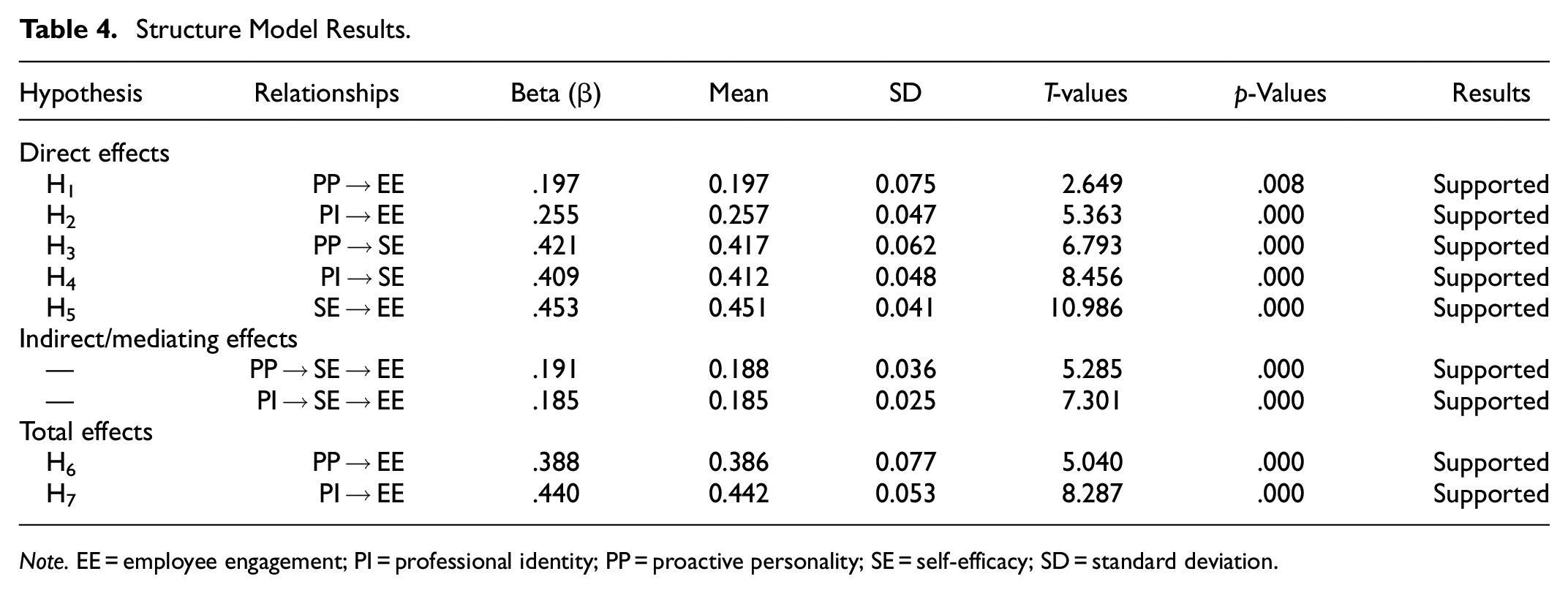
Concerning testing hypotheses, the bootstrapping approach with 5,000 resamples of PLS-SEM is operated for yielding the β-value, t-value, and p-values for the statistical consequences. The PLS-SEM findings show that proactive personality have favorable effects on employee engagement (β = .197, t = 2.649, p = .008), professional identity has an optimistic and significant impact on employee engagement (β = .255, t = 5.363, p = .000), thus supporting H1 and H2 respectively. Proactive personality positively affects self-efficacy (β = .421, t = 6.793, p = .000) and professional identity also optimistically affect self-efficacy (β = .409, t = 8.456, p = .000). The research further reveals that self-efficacy optimistically affects employee engagement (β = .453, t = 10.986, p = .000), thereby supporting H3, H4, and H5. For all the findings, the significance level is less than .05 exhibiting more fidelity in their path coefficient. Table 4 which is reflecting the structure model results of the study. Figure 3 reflects the structural model of employee engagement showing the t-values.
Structure Model Results.
Note. EE = employee engagement; PI = professional identity; PP = proactive personality; SE = self-efficacy; SD = standard deviation.
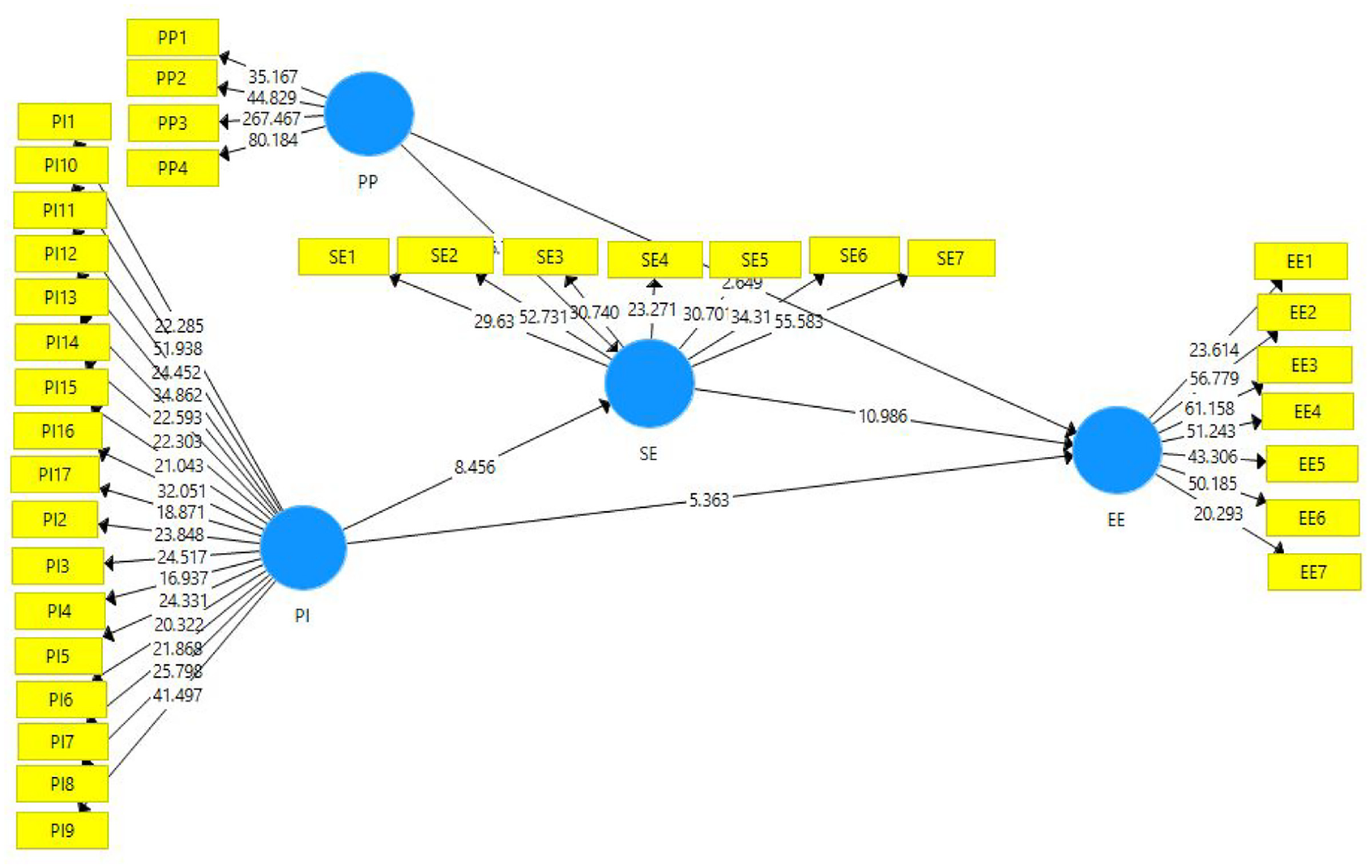
Structural model of employee engagement.
Mediating Effect of Self-Efficacy
In the association between proactive individuality and employee engagement and in the link between professional identity and engagement of employees, it has involved the approach to examine the mediating effects either in full or in part (Baron & Kenny 1986). Have used bootstrapping which is advised by Zhao et al. (2010). In the whole mediation, the direct effects are insignificant whereas indirect effects are significant and all effects are passing through the mediator. In order words, the impacts of proactive personality and professional identity over employee engagement are insignificant but their impacts are significant only by the mediator variable (self-efficacy). On the contrary, in partial mediation, the predictors that are proactive personality and professional identity affect the criterium variable (employee engagement) directly, along with indirectly through its effect on the mediator variable (Self-Efficacy) (Baron & Kenny 1986). The research outcomes, therefore, indicate the direct optimistic effects of proactive personality on employee engagement (β = .197, p = .008) besides an indirect influence through self-efficacy (β = .191, p = .000), and full effects indicating the such values (β = .388, p = .000). Whereas, the direct optimistic effects of professional identity on employee engagement (β = .255, p = .000) as well as an indirect influence through self-efficacy (β = .185, p = .000), and full effects indicating the such values (β = .440, p = .000). Such outcomes show that self-efficacy is partially mediated by the influence of a proactive personality and professional identity on employee engagement and hence supports H6 and H7.
Key Findings and Discussions
This study examines the involvement of Pakistan’s hotel employees to overcome the gap in the research of employee engagement. The impact of proactive personality, professional identity on it while considering self-efficacy as the mediator among them are explored. The PLS-SEM results indicate that proactive personality and professional identity have a major beneficial influence on employee self-efficacy and engagement. However, the findings of H1 exhibit that the proactive personality of hotel employees has substantial optimistic effects on their engagement (β = .197, t = 2.649, p = .008). The study of Kong and Li (2018) has also exhibited the p < .1 reflecting the optimistic association between them. Proactive personality is the characteristic that is helpful for conscious endeavors of imagination, which assist hotel employees in accomplishing execution. Eventually, they enjoy the work and increase their level of engagement. Moreover, hotel employees have personal resources such as skills and abilities, etc. besides they are innovative, generate new opportunities, intrinsically motivated so these aid in accomplishing job-related activities and enable them to deal with complex tasks and look for suitable ways to obtain the results effectively and efficiently.
Likewise, the findings of H2 demonstrate the significant positive association between hotel employees’ professional identity and their engagement (β = .255, t = 5.363, p = .000). However, the result is consistent with the previous study of C. Wang et al. (2020). Professional identity is characterized as one’s expert self-idea dependent on attributes, convictions, potentials, thought processes, and practices that help the hotel employees in indulging in the work and enhance their involvement. Being an expert in a profession means that an individual has a critical piece of knowledge about his or her profession such as values and principles etc. that facilitates higher involvement.
Furthermore, the findings of H3 and H4 indicate the optimistic association between hotel employee’s proactive personality and their self-efficacy (β = .421, t = 6.793, p =.000) providing supports to the previous study of Ali Yang (2019), and between hotel employee’s professional identity and their self-efficacy (β = .409, t = 8.456, p = .000). Thus, the results are consistent with the research of Moslemi and Habibi (2019). The findings of H5 exhibit the optimistic relationship between hotel employee’s self-efficacy and their engagement (β = .453, t = 10.986, p = .000). However, the results are consistent with the previous study of Albrecht and Marty (2020). Hotel employees having a proactive trait and being an expert in a profession helps them to be more confident about the activities that they have to perform. Moreover, they do not look for assistance but potentially perform activities to get endeavors, in the end, enhances the level of performance and increases participation at work. In order words, having a higher level of proactive personality and professional identity alleviates in increasing the level of self-confidence of hotel employees. A higher degree of their confidence over the proficiencies leads to a higher level of involvement of employees.
Additionally, the study shows that self-efficacy which is a mediator partially mediates the effects between the predictor variables which are proactive personality and professional identity, and the dependent variable which is employee engagement. Partially mediation reflects that some of the effects of proactive personality and professional identity are passing through the employee’s self-efficacy and increase the impact of engagement. For instance, the value of beta for mediation effect of self-efficacy among proactive personality and employee engagement is β = .191, and the total effect including mediation effect and direct effect are β = .388 which is showing that when an individual has proactive traits besides confident it enhances the degree of engagement. Likewise, the value of beta in the mediation effect of self-efficacy among professional identity and employee engagement β = .185, and the total effect including mediation effect and direct effect are β = .440 demonstrating that having a higher level of professional identity increases engagement but when self-efficacy mediates among professional identity and employee engagement it fosters the engagement of employees. The findings of this study have vital implications that are given below.
Contribution To Theory
First, this study measures the various effects of proactive personality and professional identity such as both direct and indirect, and provided an insight that why these are optimistically related to the engagement of the employees. Having a personality that does not wait for assistance but puts efforts to make things happen and get involved in the tasks so can say that a proactive personality utilizes resources to influence the employment conditions to get the work done and thus increases the job-related involvement (Dikkers et al., 2010). They are more into challenging their current situations, insensitive to the environmental fluctuations, reevaluating their functions in the organization, socializing behavior, and feedback seekers, which upshots in high involvement, performance, and successful career (Crant, 2000; L. Li et al., 2014). A meta-analysis conducted by Fuller and Marler (2009) provided a shred of evidence that it is optimistically related to the four big five traits’ aspects such as extraversion, openness to the experience, conscientiousness, and neuroticism. JD-R theory demonstrates that personal means (i.e., proactive personality, professional identity, and self-efficacy) give confidence and make an individual an active personality enabling them to undertake complex tasks (Bakker & de Vries, 2021). This study has examined the professional identity from the employee’s perspective and probes the core process for its development. Besides having a piece of knowledge regarding the profession including the ethics, values, and principles, an individual is more likely to perform very well which assists in intensifying the involvement (Brien et al., 2017). Furthermore are responsible for shaping their behavior and cognitive actions, minimizing hesitancy, and maximizing their self-enhancement (Caza & Creary, 2016). In the same vein, through the employee’s engagement investigation in the hotel of Pakistan, this present study implies that being self-efficacious means having an elevated level of self-confidence in coping with challenging tasks and dealing with obstacles that come while performing job-related activities (Dagher et al., 2015). Besides having a greater level of eagerness in setting out their goals and impacting their surroundings and tend to scrutinize the matters of interest (James, 2012).
Finally, this fosters the development of literature for employee engagement by investigating the mechanism of the proposed model. Previous researchers hardly examined the mediating function of self-efficacy experimentally. The study shows that self-efficacy is an important way to associate proactive personality and professional identity with employee engagement. In order words, the study support and confirms that self-efficacy has a partial mediation influence over the association between proactive personality and employee engagement as well as between professional identity and employee engagement. Moreover, exhibiting that if employees are proactive and have a stronger professional identity besides self-assured over competencies deemed as useful resources for performing difficult jobs and eventually have lower work pressure, reduction of vagueness, and a greater degree of involvement.
Contribution To Practice
Since the outcomes of this study shows the optimistic association between proactive personality, professional identity, and employee engagement so hotel managers need to focus on the recruitment of highly proactive hotel employees by assessing their traits, and in case of having a lower level of proactive personality, the employers need to involve them into day-to-day tasks, group assignments, encourage work flexibility that could empower them to complete their tasks whenever they wanted to complete. Consequently, help in increasing their productiveness. Recognizing and praising their work and giving them honest feedback can help them to be more proactive eventually to be more immersed in their work thereby assisting the company in gaining a competitive edge. On the contrary, employers have to increase their level of identity with their profession by fostering the employee’s career practices and providing interpersonal skills training that will assist them in gaining more knowledge of their profession and effectively handling functions. Employers also need to look at the exogenous factors impacting employees’ identity and improve their cognitive skills.
Having a belief in capabilities can serve a hotel employee a sense of satisfaction because they perceive difficult issues as challenges to be mastered and create a deeper interest in the things they engage in. Higher self-efficacy means a higher possibility of performing difficult tasks. So, hotel managers should look into the ways such as the hiring of highly efficacious individuals, by revamping the training, leadership, and coaching implementations to enhance self-efficacy. It provides them with a sense of motivation and the ability to be successful in tasks. Furthermore, employee engagement is very important to achieve a competitive edge. Being engaged in the work means they are passionate about the work and are more productive eventually takes the organization to another level so the practitioners need to recruit proactive individuality, have a higher professional identity, and those who are confident about their capabilities so that can get a higher level of the psychological association at the work.
Third, Employee engagement is very important to achieve a competitive edge. Being engaged in the work means they are passionate about the work and are more productive. Eventually, takes the organization to another level so the practitioners need to recruit proactive personalities, employees with higher professional identity, and self-efficacious employees so that their psychological association with the work can be increased.
Conclusions
This work contributes empirically to the literature on employee engagement and the JD-R model by exploring the different individual aspects which help in fostering the engagement of employees. In this study, a questionnaire is designed to test the hypothesized relations, and the data is collected from the 360 hotel employees in Pakistan. Employees from 4 and 5-star hotels are asked to record their responses so hypothesized relations can be tested. PLS-SEM is applied to test the hypotheses. Direct, indirect, and total effects are yielded to gauge the path model. The study reveals a significant pessimistic association among the individual aspects. Besides reveals the partial mediation effect of hotel employees’ self-efficacy between their proactive personality and engagement as well as between their professional identity and engagement at work which is the main contribution of the study.
Since the concept of engagement has arisen as an incredible driver of optimistic behavior and perspectives that individuals have towards their organizations to acquire a competitive edge. This study suggests that hotel managers would realize the need to recruit employees who are self-starters besides highly professionally recognized. Such as, these aspects are vital in enhancing the hotel employee’s engagement. However, it demonstrates the belongingness of one to his or her profession and belief in the proficiencies for the task completion respectively. These aspects are the antecedents of the engagement of employees and employers need to recruit the employees with these elements also training should be given for the improvement of these elements. The foremost aspect is the self-confidence about abilities that the hotel employees have to achieve endeavors. In the absence of confidence, employees are more likely to perform in an ineffectual way even they have a strong identification with their career or are proactive.
Limitation and Future Research
There are certain limitations to this present study that should be notified. First, the current study used the sample comprised of the 4-star and 5-star hotels based in the central east of Pakistan by employing the convenience methodology. Secondly, cross-sectional studies only gauge a specific phenomenon at a certain period. Thereby yielding verdicts of potentially limited generalizability. To be able to generalize the results, the current study might include 3-star hotels and can also adopt a longitudinal study by using a more comprehensive sampling method. In addition, future research may employ self-efficacy and proactive personality as predictors while taking employee engagement and turnover intentions (C. Wang et al., 2020) as mediator and outcome variables respectively.
Footnotes
Declaration of Conflicting Interests
The author(s) declared no potential conflicts of interest with respect to the research, authorship, and/or publication of this article.
Funding
The author(s) disclosed receipt of the following financial support for the research, authorship, and/or publication of this article: This paper is financially supported by the project 6/2022 determinants of cognitive processes impacting the work performance granted by the Department of Management, Faculty of Informatics and Management, the University of Hradec Králové and the International Mobilities for Research Activities at the University of Hradec Králové, Czech Republic (Grant No. CZ.02.2.69/0.0/0.O/18_O53/0017841).

Data Availability Statement
Data sharing not applicable to this article as no datasets were generated or analyzed during the current study.