




Abstract
Employee engagement has garnered a great deal of interest because of its positive effect on employee performance, but the interest has not resulted in in-depth studies on how variables such as participative leadership determine employee engagement. In this study, the role of participative leadership on the three dimensions of engagement experienced by agricultural extension officers is examined. Data from a cross-sectional survey of 189 agricultural extension officers from four provinces in South Africa are analyzed using regression analysis. As hypothesized, results show that participative leadership influences the three dimensions of engagement. The implications of the results are discussed, emphasizing possible ways participative leadership practices could be used to facilitate the engagement of agricultural extension officers.
Keywords
Introduction
Agricultural extension officers, like employees in general, need to be motivated and committed to achieve their work objectives. Unfortunately, their working conditions, which are usually in the rural areas, are poor with inadequate transport, housing problems, and poor health services (Asayehegn et al., 2012; Gebru et al., 2012). Research has revealed that employees’ work conditions and their leaders’ behaviors are related to the levels of engagement they feel with their work (Mester et al., 2003; Shuck & Reio, 2011). Hence, scholars have suggested that organizations should make effort to understand their employee workplace experiences and respond with appropriate management practices (Brown, 2014). Employee engagement, defined as a positive enduring work-related state of mind (Schaufeli & Bakker, 2003), is a consequence of employee’s workplace experiences, and it is gaining increasing importance, with research findings indicating a strong relationship between it and less turnover (Harter et al., 2002) productive employees (Saks, 2006) and perceptions of customer delight and psychological capital (Barnes et al., 2014). It is essential therefore that the predictors of employee engagement are understood, especially with respect to agricultural extension officers who are fundamental in the drive to boost rural food security in South Africa.
Research has shown that a positive relationship exists between transactional and transformational leadership behaviors and employee engagement within a Kuwaiti services organization (Nelson & Shraim, 2014). Likewise, with respect to nurses, a study has found that perceived organizational support was positively related to nurses’ engagement in Australia and the United States and leader-member exchange positively related to nurse engagement in Australia (Brunetto et al., 2013). From a psychological contract perspective, research reveals that greater levels of employee contract fulfillment, including expected work-related resources, result in higher levels of engagement (Bal, De Cooman, & Mol, 2013; Bal, Kooij, & De Jong, 2013). Other studies showed a convincing positive association between the social support offered by immediate superiors and the engagement of employees (Bakker et al., 2004; Haq et al., 2010; Wiley, 2010). Enough evidence therefore exists to show that employee engagement has a positive relationship with organizational success and multiple positive workplace outcomes (Popli & Rizvi, 2016), but none of this evidence has been demonstrated with respect to agricultural extension officers’ engagement.
Given that one of employees’ key workplace relationships is with his or her immediate leader or supervisor (Q. E. Usadolo, 2016; S. E. Usadolo & Usadolo, 2019), it is posited in this study that a leader’s relationship with his or her subordinates that is participatory in nature will predict agricultural extension engagement. This has been confirmed by extant literature that participatory management is needed for effective performance (Kim, 2002), and Kahn (1990), May et al. (2004), Saks (2006) stated that employees showed better levels of engagement when their supervisors display more relationship-oriented and helpful behaviors. Thus, it could be argued that managers or supervisors play a critical role in ensuring high levels of employee engagement. They do this by offering work-related resources such as autonomy, social support, and feedback (See Breevaart et al., 2015; Xanthopoulou et al., 2008).
The aim of the present study is to examine the influence of participative leadership on agricultural extension officers’ engagement. The research responds to the calls by Iyer and Israel (2012) for a greater understanding of employee engagement and its antecedents.
The structure of the article is as follows. It begins with a discussion of the context of the study followed by the existing literature on participative leadership and employee engagement. Discussion of participative leadership and engagement is foregrounded with a theoretical framework known as social exchange theory (SET). This discussion will include the hypotheses developed in relation to how participative leadership and employee engagement are likely to be related. In addition, the data, method used for the study, and the results of the study are described and the study’s results and their implications for practice discussed. The final section of the article provides an overview of the study’s limitations and areas for future research.
Context of the Study
The participants in this study are agricultural extension officers from four provinces (Eastern Cape, Limpopo, Mpumalanga, and Free State) in South Africa. These provinces have significant populations in rural areas. On account of illiteracy, most of the populations in these areas are unable to understand technological innovations and other types of modern farm science and methods that are published mainly in English. As such, a significant percentage of the provinces’ rural populations rely on public agricultural extension officers from their provincial Departments of Agriculture to transfer information and modern technologies, often developed and explained to them in English, to achieve sustainable rural agriculture.
The agricultural extension officers in the field in rural areas are supervised by Deputy Directors or Managers from the provincial Departments of Agriculture. As the immediate supervisors to the agricultural extension officers, they are positioned within the provincial Departments of Agriculture to support the agricultural extension officers by way of direct supervision so that agricultural extension officers are able to carry out their work effectively in line with their departments’ objectives. The Deputy Directors play an important role as communication bridges to upper management and the agricultural extension officers in the field. With respect to workplace relationships, they (the Deputy Directors) are supervisors with direct working relationships with the agricultural extension officers, who are their subordinates.
Both the agricultural extension officers and their supervisors play pivotal roles with respect to food security, improved rural livelihoods, and natural resource management (Van Niekerk et al., 2011) in the four provinces studied. In the South African rural agricultural environment, the agricultural extension offers are important channels for facilitating and linking the agricultural innovation system to farmers so that they acquire new strategies and capacities to perform their farming activities (Sulaiman & Davis, 2012). The preferred agricultural extension approaches in this regard are participative practices such as participatory rural appraisal, participatory extension approach, and participatory development approach (Zwane, 2009). Any of these approaches, as explained by Zwane (2009), will enable the agricultural extension officers to achieve their organizations’ objectives such as agriculture and rural development, land reform, poverty alleviation, livestock production, and animal health, among others. In this light, a sustained improved agricultural extension service is needed, but this cannot happen without good leadership practices that are necessary to cause engaged agricultural extension officers.
Several scholars have referred to the importance of engaged employees in the workplace, but to our knowledge, this has not resulted in research in the domain of agricultural extension service. In this study, it is posited that a participative leadership approach in the relationship between the agriculture extension supervisors and the agricultural extension officers will be one of many organizational phenomena that will result in agricultural extension officers’ engagement. Research has shown consistent links between behaviors at this level of leadership and subordinate’s job satisfaction, retention (see S. E. Usadolo & Usadolo, 2019; S. E. Usadolo et al., 2020) and employee engagement (Brunetto et al., 2013). However, there is still limited knowledge of how agricultural extension leadership influences subordinates’ positive workplace outcomes within the Department of Agriculture.
Participative Leadership
There is no in-depth literature on the influence of participative leadership on employee engagement, unlike other workplace outcomes such as job satisfaction, commitment, and performance that have received widespread attention in the extant literature. For this reason, the study of participative leadership is important especially in the context of agricultural extension management. Participative leadership can generally be defined as a process in which a leader shares his or her authority with employees who are hierarchically unequal (Probst, 2005; Russ, 2011; Steel & Mento, 1987) by way of involving them in the decision-making process and consultation for their views. It also refers to a manager or supervisor who gives a fair degree of opportunity to his or her subordinates to participate in decision-making about their work and well-being in the organization.
SET offers a perspective for understanding the positive effects of employees’ participation in decision making. SET’s norms of reciprocity (Gouldner, 1960) state that due to social norms, individuals want to reciprocate in kind for positive things done for them. The implication is, according to norms of reciprocity, that when a participative leader gives the agricultural extension officers significant opportunities to participate in the decision-making that affects them or their jobs, they are likely to reciprocate by displaying positive workplace behaviors.
Some of the positive workplace behaviors are that participative leadership increases employees’ participation and development (Sarti, 2014), and employees’ voices are recognized as they are consulted before decisions are made related to their work (Madsen, 2018). As such, employees develop a feeling of being heard and valued for their contributions by their supervisors and managers in the organization (Yoerger et al., 2015). Agricultural extension officers’ work activities in the field involve meeting farmers from different backgrounds, and this requires that they understand what the nature of their work involves. It also means that agricultural extension officers’ supervisors understand the daily or different challenges encountered in the field. It is therefore necessary for a leadership approach that focuses on opening dialogue in which there is continuous interaction, constructive thinking about the situation, identification of problems and solutions, and decisions about what is needed to improve the situation, as well as acting upon those decisions (Kent & Theunissen, 2016; Nair & White, 1993) as mutually agreed.
The consultative and interactive elements that define participative leadership provide a platform for employees to be closer to their supervisors and their own work. The closeness enhances employees’ problem-solving abilities and understanding of work-related problems when they follow enough and more up-to-date sources of information (Knight et al., 2017; Rodgers & Hunter, 1993) that participative leadership affords them. Moreover, the nature of participative leadership means that employees are involved in planning and offering likely solutions to work-related problems, and this gives employees a proper understanding of the implementation of such solutions (Lam et al., 2015; Ritchie & Miles, 1970).
Participation in the workplace is regarded as a marked shift from top-down and individualistic perspective of leadership toward a leadership model that empowers employees to identify with the objectives of their work. From an agricultural extension management perspective, the chief motivation for an agricultural extension leader or manager to implement participation programs is the potential for converging disparate views around common objectives (S. E. Usadolo & Caldwell, 2016). Some agriculture extension theorists have suggested that this is achieved by the replacement of top-down leadership approach by one that is horizontal and supportive to achieve mutual responsibility (Nair & White, 1993; S. E. Usadolo, 2012).
Several studies have shown that participation in decision making, which participative leadership offers, increases employee positive workplace outcomes (Benoliel & Somech, 2014; Knight et al., 2017) because employees who can influence decisions affecting them are more likely to show positive organizational behaviors and attitudes, which will, in turn, strengthen their engagement. Some of the specific workplace outcomes of employees’ participation in decision making are job satisfaction (Van der Westhuizen et al., 2012), job performance (Holman & Axtell, 2016) self-esteem and efficacy (Knight et al., 2017), and employee commitment and trust in management (Steven et al., 2013).
Participatory leaders are important in the workplace exchange relationship (Zhang et al., 2008) because their leadership approach in the form of involvement in decision making, two-way dialogue, and consultation of employees give employees the desire to reciprocate with effort, commitment, and loyalty, which are precursors of engagement. It also increases the feelings of a balanced social exchange relationship, resulting in more involvement and engagement in work by employees. This resonates with SET, in so much as social exchange is a balanced or reciprocal relationship between two individuals (Rousseau, 2001) because considered from the perspective of participative leadership, it means it is an exchange in the workplace that is cooperative in the relationship between employees and the organization or between employees and their supervisors (Q. E. Usadolo, 2016).
The positive relationship between participative leadership and engagement is confirmed as past studies support the assertion that leadership is the single biggest factor affecting employee perceptions and workforce engagement in the workplace (Walumbwa et al., 2008). In addition, Xu and Thomas (2011) investigated the evidence for a link between leadership behaviors (supports team, performs effectively, and displays integrity) and employee engagement. Their analysis showed that supports team behavior of the leaders was the strongest predictor of engagement. Past studies have suggested that employees are more likely to become psychologically engaged when their supervisors provide an environment that allows them to express their thoughts, feelings, and beliefs without fear of punishment (Kahn, 1990), and Hinkel and Allen (2013) found that participatory practices are related to employee engagement.
Given the foregoing, it is likely that the agricultural extension officers who are participants in this study will feel supported to the extent of having positive attitudes and behaviors, which includes employees’ engagement, under a participative leadership. In the current study, whether this is the case is examined, especially in the light of a recommendation by Carasco-Saul et al. (2014) that there is a need for empirical research to validate the frameworks of leadership–employee engagement and the call to examine the leadership–engagement relationship from the perspectives of many leadership styles.
Employee Engagement
Studies have shown that engaged employees have high levels of energy and are enthusiastic about doing their jobs (Schaufeli et al., 2002). Employee engagement as a concept refers to a “positive, fulfilling, work-related state of mind that is characterised by vigour, dedication and absorption” (Salanova & Schaufeli, 2008, p. 74), and it is used to describe the level to which employees bring everything about themselves to serve the interests of their organizations (Cowardin-Lee & Soyalp, 2011; Kahn, 1990).
There are three dimensions of employee engagement, namely, vigor, dedication, and absorption (Schaufeli & Bakker, 2003). Vigor is used to describe employees’ strong energy for work, persistence, and resilience. Employees working in hospital environments and in organizations that require high degrees of scheduling, and resilience are said to be driven by the vigor element of employee engagement (Rutter, 1987). This applies to agricultural extension officers’ job because tenacity and flexibility are required to deal with the challenges that occur. Dedication as a dimension of employee engagement occurs when employees feel that their work is motivating and challenging and instills feelings of pride that strengthens commitment. The absorption dimension of employee engagement refers to employees’ immersion in their work activities in a way that their work becomes somewhat inseparable from their overall identity (Schaufeli & Bakker, 2003) such as that experienced by firefighters (J. A. Allen et al., 2010). All three dimensions of engagement are fundamental in the consideration of the role of agricultural extension officers as the dimensions are pivotal to the attainment of related workplace outcomes such as commitment, pride, and motivation and the job identification required for the work activities of agricultural extension to be successful.
Several organizational factors predict employee engagement across different types of organizations. Some of such predictors are psychological capital (Gupta & Shaheen, 2017), and leader-member exchange (Breevaart et al., 2015) because when employees perceive favorable support from factors within the organization, they are likely to become engaged. Other studies found a positive relationship between job resources (coaching, performance feedback, and social support) and employee engagement among four independent occupational samples (Schaufeli & Bakker, 2004). Likewise, positive correlations were found between job resources (control, supervisor support, climate, information, innovativeness, and appreciation) and employee engagement in a sample of teachers (Bakker et al., 2007).
Although employee engagement is treated as a dependent variable in the findings reported above, research using it as an independent variable has shown that it influences several workplace outcomes. For instance, the existence of greater degrees of employee engagement decreases turnover intention (Shuck et al., 2011; Wollard & Shuck, 2011). Likewise, employee engagement is also thought to predict job performance, task performance, organizational citizenship behavior (Wollard & Shuck, 2011), organizational commitment, and low turnover intentions for police officers (Brunetto et al., 2012).
From the foregoing, it is necessary to examine whether participative leadership is a predictor of agricultural extension officers’ engagement. Studies have shown that supportive working conditions and organizational climate are associated with engagement (Bakker & Demerouti, 2007; Mauno et al., 2010). Work conditions and organizational climate are indicative of the way the management relates to employees. In this respect, Madsen (2018) stated that when a leader’s practice gives the employees opportunities to voice their opinions, it allows the employees to make their grievances explicit and this, in turn, leads to their engagement. This, therefore, emphasizes the role of organization leaders in the consideration of employee engagement because the way organizational support is felt in the employee–management relationship mostly resides in the leadership approach used by managers.
Thus, it is argued that employee engagement is related to participative leaders’ practices, such as making it possible for employee involvement in decision-making. The argument is based on research that states that a supervisor’s participatory practices, such as providing employees with opportunities to participate and be heard in the decision-making in the workplace, are positively related to employee engagement and viewed positively by employees (D. G. Allen et al., 2003; Hinkel & Allen, 2013; Wayne et al., 1997). It means that when employees are thereafter motivated to enhance their performance and engagement, which is a precursor of this, it results in reciprocation in their workplace relationship with their supervisors. This argument is in line with Johansson’s (2015) assertion that manager-led participatory practices are aimed at building employee engagement or encouraging their reciprocation in the form of engagement.
Similarly, previous studies have confirmed that employee engagement is a reciprocal behavior that is very important in the workplace (see Breevaart et al., 2015; Harter et al., 2002), and as such, scholars have used SET, which holds that reciprocity provides further insights into their findings. De Clercq et al. (2009) define SET as an exchange relationship based on shared understanding and the norm of reciprocity. Shared understanding is an outcome of dialogic communication that involves co-creation of meaning among participants in a communicative encounter (Kent & Theunissen, 2016; Paquette et al., 2015). Thus, SET acknowledges social interactions that are mutually dependent, and responses are generated by the actions of the other person in the exchange. In the context of this study, such responses as generated by participative leaders are likely to lead agricultural extension officers to respond in the form of engagement if they view the actions of the participative leader positively.
Discussion of employee engagement thus far has shown that employee engagement is a result of employee social exchange relationships in the organization. Participative leadership as characterized would embody positive social exchange relationships that are likely to be reciprocated by employee engagement. Hence, Q. E. Usadolo (2016) notes that SET is used to describe social exchange relationships between organizational leaders and employees. The emphasis of SET is that employees develop behaviors that can be positive or negative to the organization. In this light, research using SET (e.g., Alfes et al., 2013; Q. E. Usadolo, 2016; see also Eisenberger et al., 2001) has pointed out that the outcomes of social relationships in the workplace are reciprocal, and Saks (2006) in particular has noted that employee engagement is due to positive outcomes that develop through a model of social exchange.
From the perspective of perceived organizational support, studies reveal that employees who feel valued by their organizations are likely to engage (e.g., Rich et al., 2010). Participative leadership practices are direct organizational policies; hence, they can be categorized as organizational supports to employees. Thus, employee engagement that is “influenced by various aspects of an employee’s treatment by the organisation . . .” (Eisenberger et al., 1986, p. 501) fits the characterization of participative leadership and employee engagement.
Though inferences could be drawn that participative leadership would result in positive social exchange relationships that are likely to produce employee workplace outcomes such as engagement, there are no in-depth studies in which SET has been used as a lens in the study that examines the relationship between participative leadership and engagement, especially with regard to agricultural officers’ engagement. Drawing from the premise that one of the key social exchange relationships employees have at work is with the immediate supervisor (Masterson et al., 2000; Q. E. Usadolo, 2016), SET is therefore an appropriate theoretical lens with which to examine the mechanism by which participative leadership as a leader characteristic would promote employee engagement with respect to agricultural extension officers.
The identification of some leaders’ characteristics that lead to engagement (Batista-Taran et al., 2009), such as being supportive and the provision of a clear vision, are indicators of participative leadership practices. Engagement as a concept refers to organizational efforts to encourage stakeholders to participate in its activities and decisions (Verčič & Vokić, 2017) because when employees take part in the decision-making in their organizations as well as have a chance to be heard by the supervisors, the level of employee engagement is likely to increase (Jose & Mampilly, 2014), and in the context of SET, they are likely to reciprocate with engagement. In addition, participative leadership elements such as clear job descriptions and promotion of participation in interactions about job activities result in more employee engagement in the workplace (Gebauer et al., 2008; Jena et al., 2016). Similarly, Kassa and Raju (2015) argued that employees will reciprocate by showing vigor, absorption, and dedication dimensions of engagement when there is appropriate leadership or management support. The discussion so far provided about participative leadership confirms its appropriateness in relation to a myriad of positive workplace outcomes. To this end, the following hypotheses are proposed, as based on the model developed in Figure 1:

Model indicating proposed relationships.
Method
In the following sections, data gathering procedure, participants, and the measurements used are discussed.
Procedure and Participants
This study is a field study because it involved the collection of data from agricultural extension officers in the Department of Agricultural in four provinces in South Africa. Data were only collected from the full-time agricultural extension workers who had worked for at least 3 years because of the consideration that engagement of an employee takes place mostly due to factors within the organization that have been experienced consistently for a reasonable number of years. Because data were collected from each of the agricultural extension officers, the unit of analysis is individual (Sekaran & Bougie, 2009; Q. E. Usadolo, 2016). The collection of data took place for a period of 2 months, from September 1, to October 30, 2018.
Participation in the study was voluntary and confidential. The word supervisor or the persons referred to as participants’ supervisors in the context of this study was explained to the participants. The participants were told that their responses were anonymous and would be used solely for the purpose of the research. A total of 360 questionnaires were distributed to agricultural extension officers through a self-administered survey (cross-sectional research design), and 200 questionnaires (a response rate of 56%) were returned to the research team. Responses from 189 participants who provided complete data on the relevant constructs were used to test the hypothesized model.
Research assistants who were themselves agricultural extension officers were recruited to help distribute and collect the questionnaires from their colleagues. The research assistants did not take part in the study as participants, and their involvement was voluntary. Apart from meetings in which the guidelines to be followed in the distribution of questionnaires were discussed with the research assistants, the researcher did not have any personal encounters with the participants who took part in the study.
Measures
Previously validated scales were adapted and used to measure all the constructs examined in the study. Participative leadership was operationalzed for this study to refer to an organizational leader whose leadership and management practices fall under what has been described in the section about participative leadership above. All variable items (except the demographics) were measured on 6-point Likert-type scales, ranging from 1 = “strongly disagree,” to 6 = “strongly agree,” where 3 is “slightly disagree” and 4 is “slightly agree.”
Participative leadership was operationalized using five items adapted from past studies that measured the degree to which employees felt involved in decisions related to their work (Steel & Mento, 1987), and a sample item was, “My supervisor allows people most affected by decisions within my work group to frequently participate in making decisions.” The Cronbach’s alpha for the five items used had a reliability score of .893.
Employee engagement was measured with an adapted 17-item instrument using scales that reflect the fundamentals of engagement (vigor, dedication, and absorption) developed by Schaufeli et al. (2002). A sample of item for vigor was, “When I get up in the morning, I feel like going to work.” A sample of an item for dedication was, “I am enthusiastic about my job,” while a sample of an item for absorption was, “It is difficult to detach myself from my job.” The Cronbach’s alpha for vigor was .931, for dedication was .946, and for absorption was .933.
Data Analysis
Statistical Package for Social Science (SPSS 21) software was used to analyze and interpret the quantitative data. Descriptive statistics were used for the calculation of means and standard deviations of the data. Correlation and regression analysis were employed to test the hypotheses. In line with Howell’s (2002) recommendation, all the variables were centralized by calculating the mean of each of the variables to reduce the potential effects of multicollinearity. The centered values were then used to do calculations.
A factor analysis of all the items using a significant cut-off factor criterion of .5 with a principal component analysis rotated with Varimax, gives a total of 20 items, which loaded onto four latent factors of eigenvalue values greater than 1. The total cumulative variance explained by the factors was 76.483%. The sampling adequacy (KMO) and the Bartlett’s test of sphericity values were .860 and 3506.476, with p < .000, respectively. Both values suggest that a factor analysis can be performed with the number of variables. In addition, the internal consistency of the items was supported with Cronbach’s alpha reliability coefficients above the minimum level (.70), recommended by Nunnally and Bernstein (1994).
A bivariate correlation of the variables shows a significant relationship between independent and dependent variables. A positive correlation was found between participative leadership and all dimensions of employee engagement. The correlations among the variables were above the recommended minimum of .03, and none was above .9. Hence, the question of multicollinearity was not an issue. Table 2 shows the relationship among the variables along with the means and standard deviations.
Correlation Matrix, Means and Standard Deviations.

Correlation is significant at the 0.05 level (2-tailed). **Correlation is significant at the 0.01 level.
Regression Analysis Detailing the Relationship Between Participative Leadership Practices and Agricultural Extension Officers’ Engagement (Vigor).

Note. N = 189.
Correlation is significant < .005 level. **Correlation is significant < .001 level.
Control Variables
An analysis was undertaken to see if any demographic variables in this study had a significant effect on the independent variables (vigor, dedication, and absorption dimensions of employee engagement). It was taken into consideration that the engagement of an employee takes place mostly due to individual and factors within the organization. For this reason, demographic variables were analyzed, especially for the fact that different studies have shown that different demographic variables such age (see Lam et al., 2015), gender (Shaheen et al., 2018), tenure (Benoliel & Somech, 2014; Yukl, 2002), and so on., were statistically significant in similar studies. The regression analysis undertaken showed that only tenure was significant, and as such, this was the only demographic variable included in all other analyses.
Results
Regression Analysis Detailing the Relationship Between Participative Leadership Practices and Agricultural Extension Officers’ Engagement (Dedication).

Note. N = 189.
Correlation is significant < .005 level. **Correlation is significant < .001 level.
Regression Analysis Detailing the Relationship Between Participative Leadership Practices and Agricultural Extension Officers’ Engagement (Absorption).
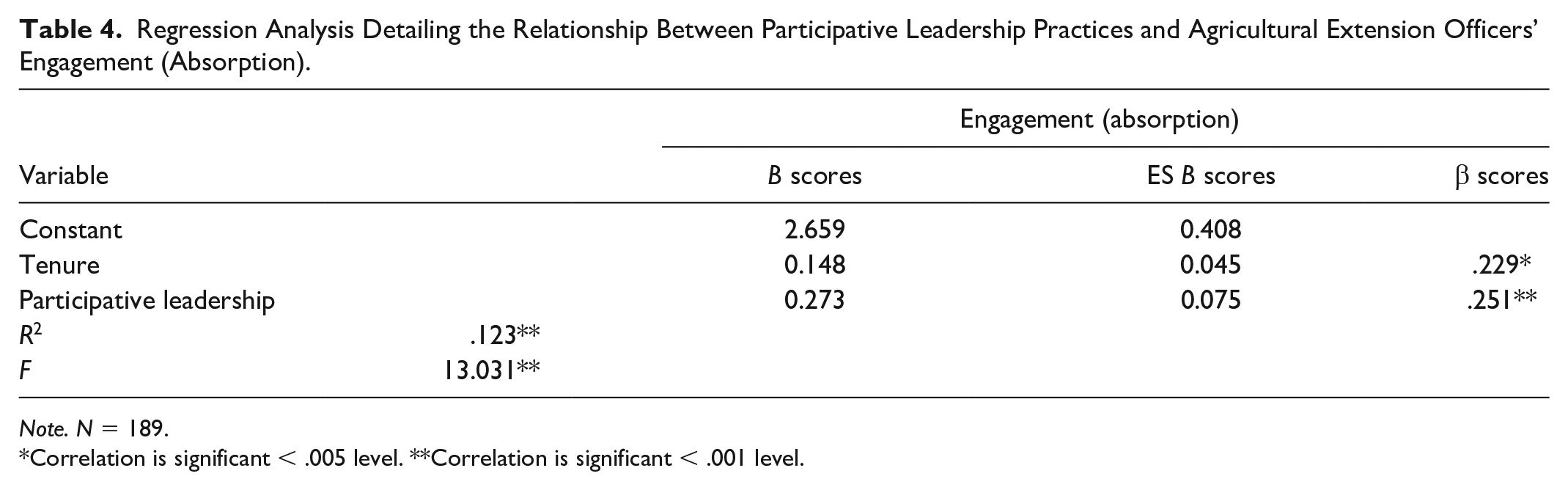
Note. N = 189.
Correlation is significant < .005 level. **Correlation is significant < .001 level.
Discussion
The aims of this study were to examine the influence of participative leadership on agricultural extension officers’ employee engagement (vigor, dedication, and absorption). In line with the hypotheses, the relationship between participative leadership and the three dimensions of employee engagement (vigor, dedication, and absorption) were positive when controlled for tenure.
The support for the Hypotheses 1 provides empirical evidence linking participative leadership to the vigor dimension of employee engagement. The finding means that the agricultural extension officers investigated in this study are characterized by high levels of energy and mental resilience in their job activities and are willing to reciprocate efforts while being persistent even in the face of difficulties in their work (Kassa & Raju, 2015). Support for Hypothesis 1 is aligned with reciprocity as a guiding norm of social exchange relationships in the workplace because participative leadership is consultative and interactive with a fair degree of employee involvement in decision-making. Thus, the resulting cooperation between agricultural extension officers and their participative leaders over time will be mutual understanding in the workplace under circumstances where issues and challenges are clearly dealt with in order to achieve stated work objectives (Q. E. Usadolo, 2016). This is possible because of the supportive relationship made possible by the participative leader in relationship to the agricultural extension officers.
This finding is consistent with the findings of Shuck and Reio (2013, p. 423) whose participants responded that they were engaged with, “‘When I work, I really push myself beyond what is expected of me’ and ‘I work harder than is expected to help my organisation to be successful.’” Likewise, Sarti’s (2014) examination of employees in human service organizations in Italy found that participative leadership practices are statistically significant and positively correlated with the vigor dimensions of employee engagement.
The support for Hypothesis 2 provides solid evidence linking participative leadership to the dedication dimension of employee engagement, confirming that the agricultural extension officers investigated are strongly involved in their job activities and have a sense of enthusiasm, inspiration, and pride (Kassa & Raju, 2015) in what they do as a result of the participative leadership they experience. Participative leadership is cooperative in its approach; hence, it results in the mutual understanding emphasized in the SET as an element of a balanced relationship. This is because of the dialogic communication component of participative leadership that facilitates understanding in a social exchange relationship between employees and their leaders. In this regard, communication enables the parties in a social exchange relationship to obtain a clearer picture of each other’s obligations (Rousseau, 2001), and because the employees are involved in planning activities that define their work relationships, they own up to the decisions taken in discharging their duties with pride.
The findings are in line with Kassa and Raju’s (2015) study. They found a significant relationship between management or leadership support and the dedication dimension of employee engagement in Ethiopian manufacturing companies. The management supports enumerated in their study align with the participative leadership elements discussed in this study. Similarly, Sarti (2014) found that the participative leadership style shows a significant and positive correlation with the dedication dimension of employee engagement in human service organization in Italy. This study has demonstrated the importance of participative leadership on employee engagement, and it supports Xu and Thomas’s (2011) assertion that leadership is the antecedent of many workplace outcomes such as employee engagement.
The support for Hypothesis 3 confirms the quality of participative leadership as a driver of engagement in terms of the absorption dimension of employee engagement. It means that agricultural extension officers are completely focused and willingly engrossed in their job activities, to an extent that time passes quickly, and they have difficulties detaching themselves from their job activities (Schaufeli et al., 2002). Previous findings are consistent with the findings confirmed by Hypothesis 3; Kassa and Raju (2015) found that management supports in the form of joint decision-making, consultation, provision of required of information, and so on, predicted the absorption dimension of employee engagement in Ethiopian manufacturing companies. Current and earlier findings with respect to joint decision-making, consultation, and provision of required information are consistent with SET. In line with SET, Q. E. Usadolo (2016) argued that communication facilitates the social exchange process because it ensures the availability of the required information at the individual social exchange level. Hence, S. E. Usadolo and Usadolo (2019) and Rubin (1993) stated that if employees find communication processes supportive, they develop positive working relationships. This is important because studies have consistently linked various internal communication elements such as open channels of communication or transparency, regular feedback, and information sharing to engagement (Caesens et al., 2014). The present study is also consistent with Sarti’s (2014) finding that a participative leadership style shows a significant and positive correlation with the absorption dimension of employee engagement in human service organizations in Italy.
Regarding the control variable (tenure), the findings are that the three dimensions of engagement are statistically significant, meaning tenure plays a role in the relationship between participative leadership and the three dimensions of employee engagement tested. The findings are consistent with previous literature on participative management on workplace outcomes. For example, Kim (2002) found tenure or years employment to be statistically significant in the relationship between participative management and job satisfaction. Likewise, previous studies showed that employee tenure is related to supervisors’ willingness to engage their subordinates in the decision-making process (Yukl, 2002).
The findings of this study are in alignment with other findings in health care settings. These studies have also noted the importance of participative leadership practices, such as making it possible for participation in decision-making, training, trust in a manager, and authentic leadership as drivers of employee engagement (Shantz et al., 2016; Wong et al., 2010). The emphasis of the findings of the study means that in order for employees to become engaged, they must develop a strong belief that their work activities and their general workplace experiences reflect their inputs in the decision process of their organization. One of the ways this is achieved is through the participatory practices of their leaders, which in the context of this study, is the agricultural extension officers’ perceptions of being listened to and heard and that their input matters for the outcomes obtained.
Participatory practices such as the perception of being listened to and heard are key positive factors in social exchange relationships in organizations. Q. E. Usadolo (2016) remarked that that the outcome of such social exchange relationships between employees and their leaders is high-quality relationships because of the associated feelings of trust, obligation, and commitment, and these have been noted to lead to employee engagement. Participatory practices are essentially support from managers or supervisors to their subordinates. The supports are leaders’ supports in the social exchange relationships in organizations (Zhang et al., 2008) that are consistent with SET in that the response to supportive efforts provided by leaders is positively related to employee engagement (Holland et al., 2017).
The findings reinforce fundamental principles of SET, specifically the norm of reciprocity, such that when employees feel they are receiving good treatment, they develop a sense of obligation toward other members of the organization (Dal Corso et al., 2019), which in the context of this study, is obligation to engage in line with the explanation provided about the three dimensions of engagement.
The findings presented may enrich organizational behavior literature by providing original evidence about the relationship between participative leadership practices and the three dimensions of employee engagement. The outcome of the current study would suggest that human resources practices targeting agricultural extension service develop participative leadership practices in response to the need to increase employee engagement.
This research is unique in that it is the first empirical attempt to investigate the relationship between participative leadership and agricultural extension officers’ employee engagement. In the context of this study, agricultural extension officers are more likely to be focused on meeting the objectives of their work activities in their organization if their supervisors or managers are supporting them with participative leadership elements such as consultation and co-opting employees in decision-making. In other words, this finding provides critical insight about how to positively influence employee reciprocal behavior in the form of employee engagement with their leaders by involving them in decision-making.
Implications for Practice
This study has several implications for managers and supervisors in the agricultural extension services in that the employee engagement literature has consistently pointed to the important role managers play in influencing workplace factors (see Holland et al., 2017; Shuck & Herd, 2012), which has bearing on employee engagement. For example, Seijts and Crim (2006) suggested that organizational leaders should identify why employees in their organizations are not fully engaged and strive to reduce or eradicate their source of disengagement by putting strategies in place to improve engagement. One of the implementing strategies this study recommends in response to Seijts and Crim’s (2006) suggestion is to ensure that the leadership approach is participatory because participatory practices are beneficial and reciprocal due to the transactional nature that defines the exchange relationship between employees and their immediate supervisors or managers.
Given the results analyzed, organizational leaders might demonstrate a willingness to allow employees to influence decisions with their input and contributions to influence employee engagement (Ogbonna & Harris, 2000). As the findings have revealed, it is imperative that organizational leaders take decisive steps to facilitate the development of effective participative leadership practices in the form of information sharing among employees and two-way communication with their employees, such that employees have all the information required to enhance their horizontal knowledge, group cohesion, and mutual work relationships with their leaders. By implementing these suggestions, organizations may help to promote sustained, positive employee workplace behavior such as employee engagement.
Limitations of the Study
The findings presented in this study are about one type of leadership which is participative leadership in terms of their influence on the three dimensions of employee engagement. This is in no way discounting the influence of other types of leadership such as transformational and transactional leadership on employee engagement. As stated above, the focus is in line with provincial departments of agriculture emphasis on participative practices such as participatory rural appraisal, participatory extension approach, and participatory development approach as the preferred agricultural extension approaches. The findings, therefore, should be seen in the context of the scope of leadership covered.
This study is a cross-sectional study; hence, the study is not without limitations. Bowen and Wiersema’s (1999) observation that the use of a cross-sectional design, which is a collection of data at one specific time, may not be appropriate for the examination of causal relationships applies and affects the Generalizability of this study. A longitudinal approach is suggested because it would provide an opportunity to thoroughly examine the causal relationships and allow data to be collected more than once. However, the study conducted offers important findings that can be generalized to other public sectors such as health departments because they also use extension officers to reach the rural population.
In addition, the data analyzed in this study were generated from self-reports of agricultural extension officers. This raises concerns about possible self-serving biases because employees are reporting on their own behavior (Gruman & Saks, 2011). Concern can also be raised about common method bias. However, the findings are valid because all constructs were measured with established scales that address the challenge of measurement error and reduce common method bias (Spector, 1987).
In this study, Cronbach’s alpha was used to verify the reliability of the scales used. However, this is not to discount the views in the literature that there are alternatives, such as composite reliability, that may provide a reliability of scale that have higher bounds (Peterson & Kim, 2013). Besides composite reliability, it is also recognized that there are several alternative estimators of reliability such as the beta coefficient (Revelle & Zinbarg, 2009) and stratified alpha coefficient (Cronbach et al., 1965), and so on. Despite this concern, the question of reliability of the scales used was not considered a problem as the lowest reliability value was above the recommended minimum value of .50 and the findings are important because the questionnaire used included valid and reliable tools that have been used previously. In addition, all constructs were measured with established scales to mitigate measurement error and reduce common method bias (Spector, 1987).
A strong point of the study is that the factor analysis results showed that items loaded strongly onto the four factors used in the analysis. Moreover, there was excellent internal reliability of the scales for each of the constructs as demonstrated by their Cronbach alphas. Added to this, the fact that the findings are consistent with others’ findings in the literature also suggests some degree of reliability and validity. Hence, the study warrants consideration in future research aimed at examining the engagement of rural agricultural extension officers and public sector employees.
Conclusion
A disengaged agricultural extension officer will be detrimental to rural food security. Hence, the findings presented in this study are important: They highlight how participative leadership practices influence the engagement of agricultural extension officers. The discussion of the literature and findings have provided a perspective of how participative leadership influence employee engagement. Given that employee engagement predicts many workplace outcomes such as job performance, it is important for the management of agricultural extension services to recognise the findings provided in this study for better employee-leader/manager relationships. The message for managers of agricultural extension officers, therefore, is to encourage and foster participative leadership practices in the way the supervisor or manager relates with their agricultural extension officers by facilitating their participation in decision making, which has been shown to improve their workplace outcome of engagement.
Footnotes
Declaration of Conflicting Interests
The author(s) declared no potential conflicts of interest with respect to the research, authorship, and/or publication of this article.
Funding
The author(s) received no financial support for the research, authorship, and/or publication of this article.
