



Abstract
The fundamental of prioritizing employees’ career satisfaction is an essential agenda of an organization. Referring to the concept of career satisfaction in Malaysia, employees who are satisfied with their careers can influence organizational success and contribute to effective organizational performance. Thus, considering the aim of the present research, this study examines the mediation effect of psychological empowerment on the relationship between perceived organizational support and career satisfaction among operators at one manufacturing company in Johor. A cross-sectional survey was conducted by distributing questionnaires to 248 respondents, with only 202 returned. Later, the collected feedback was loaded into SPSS software for descriptive statistical analysis. Next, SmartPLS software was utilized to evaluate the inferential statistic to test the projected hypotheses. The result indicated that psychological empowerment could mediate the relationship between perceived organizational support on career satisfaction. Several recommendations were enclosed to the respective organization and future researchers to cater to the studied problems.
Operator’s Career Satisfaction in Manufacturing Sector
This study examines the mediation effect of psychological empowerment on the relationship between perceived organisational support and career satisfaction among operators at one manufacturing company in Johor. A cross-sectional survey was conducted by distributing questionnaires to 248 respondents, with only 202 returned. Later, the collected feedback was loaded into SPSS software for descriptive statistical analysis. Next, SmartPLS software was utilised to evaluate the inferential statistic to test the projected hypotheses. The result indicated that psychological empowerment could mediate the relationship between perceived organisational support and career satisfaction. This study was able to fill the gap of the study due to less research focusing on career satisfaction in Johor. The limitation was that this study was conducted among operators in the manufacturing sector, which limited the possibility of generalising its results to other positions. Also, there was only one organisation that participated in this research. The population size can be increased by involving various sectors so that the result can be generalised for a region
Keywords
Introduction
The manufacturing sector has rapidly evolved in recent decades (Chellam, 2019). From mass production through the use of an intensive labor force in production lines to the use of robotics to increase efficiency, the manufacturing industry is constantly evolving with more infusion of automation (Ministry of International Trade and Industry, 2018). When dealing with the most recent development in the manufacturing system, smart factories, manufacturing systems and industry 4.0 are essential keywords (Longo et al., 2017). All organizations must take possession of the change as it is essential to sustain a competitive advantage in the global market. The trend has brought about challenges for organizations to succeed (Longo et al., 2017) and to overcome these, utilizing their human resources is one of the solutions (Joo & Jo, 2017). Furthermore, human resources play an essential role in the survival and development of organizations (Prasetio et al., 2020). Stanley (2016) confirmed that employees who are satisfied with their careers can contribute to and influence organizational success. In such a way, an organization should practice appropriate action to enhance the level of employees’ career satisfaction, which will benefit organizational success in the long run (Saraih et al., 2019).
Based on Armstrong-Stassen and Ursel (2009), career satisfaction can be defined as an employee’s satisfaction or dissatisfaction with their entire career. It refers to the positive psychological achievements obtained by employees from the intrinsic and extrinsic facets of their careers, including salary, promotion, feelings of pride, and developmental chances (Armstrong-Stassen & Ursel, 2009). Hence, the career satisfaction of employees is essential as it can be reflected by the feelings of the employees about their work environment and the extent of their achievements (Van der Weijden et al., 2016), which leads to the determination of whether or not they will stay in the career (Nie et al., 2018). Also, career satisfaction will positively affect employees’ attitudes and behaviors in their working life (Türe & Akkoç, 2020). These employees will also become productive and have greater readiness to give more than they should to contribute to their organization’s survival (Obeidat et al., 2018). Career satisfaction is a complex phenomenon that can be variably interpreted. It is the absence of pain, oppressiveness, intolerance, and enjoyment of work (Adegboye et al., 2021). Thus, good managerial practice should enforce the relevant factors to increase the level of employees’ career satisfaction, which may benefit organizational success in the long run.
According to the career test conducted by the Career Explorer website (Table 1), manufacturing and processing have the lowest career satisfaction compared to others (CareerExplorer, 2020). Understandably, working in the manufacturing environment can often be repetitive, with the level of stress related to mental and physical health problems leading to employee dissatisfaction, which is easily affected (Lawler, 2012). In addition, among 1,003 working Malaysians, about a third of them felt pressured to find a career that they feel satisfied with because of work overload, mismatched skills with work requirements, less management support from co-workers, working condition, as well as a leader and higher management (Yusliza, 2018). Another aspect that influences career satisfaction is work-life balance (Heslev, 2005). In 2017, 29% of employees in Malaysia were recorded to suffer from stress, anxiety, and depression, with the cause of emotional problems being having less work-life balance (Thye, 2019). Nevertheless, organizational support can affect work-life balance (Maszura & Novliadi, 2020). Individuals who feel much support emotionally and psychologically will cope better with daily stress and reduce their perceived stress assessments (Thakur & Kumar, 2015).
Satisfaction by Career Category by Career Explore (2020).

In such a way, an organization should practice appropriate action to enhance the level of employees’ career satisfaction (Saraih et al., 2019) by providing support to employees (McCarthy et al., 2016). In Jordan, an organization lacking organizational support resulted in employees having less involvement in doing their job together, causing an organization loss of $450 to $550 billion in productivity (Karatepe & Aga, 2016). Referring to Malaysia’s Healthiest Workplace by AIA Vitality 2019 survey involving 230 organizations, 17,595 employees suffered mentally and physically. For example, a lack of organizational or colleague support may be linked to mental and physical health deterioration in healthcare workers (Shanafelt et al., 2020). Moreover, 45% of respondents mentioned that their organization was less aware of offering any mental health program, while 16% claimed to receive a low level of encouragement to perform well (Ram, 2019). Suppose a supportive work environment is practiced in an organization. In that case, employees will be less likely to develop mental health problems (Kang et al., 2020) and indirectly encouraged to contribute optimally (Prasetio et al., 2020).
Kay (2020) reported that 46% of Malaysians stated their reward was not worth their contribution, and 35% of employees felt dissatisfied with the management environment. Besides, 26% of employees received less organizational support to develop and have a training program (Kay, 2020). Also, Daft (2015) stated that the success of an organization is a contribution of positive relationships with all people in the organization. Logically, support for employees in whatever form is usually responded with high-performance work attitudes, employee’s loyalty, commitment, and discretionary behaviors with positive consequences on organizational outputs and productivity (Arasanmi & Krishna, 2019). According to Muse and Stamper (2007), perceived organizational support is a level of employees’ perception toward their organization’s action of valuing their commitment to care for their well-being. Thus, the level of perceived organizational support is determined by employees’ impression of the organization’s effort in providing a supportive environment.
Furthermore, career satisfaction can be obtained with various support, including empowerment provided to human resources (Türe & Akkoç, 2020). Thus, supporting employees’ well-being and providing empowering activity is vital in human resources management (Yildiz et al., 2017). Empowerment through a psychological approach will exist if the organization develops a supportive environment (Kimpah et al., 2017). As defined by Yagil (2006), psychological empowerment is a motivational process by which individual experiences a sense of enablement in implementing a particular task assigned by an employer. However, Aida et al. (2018) argued that Malaysia is a country with a high-power distance index among Asian countries and is also known for its traditional culture. It means that only the higher-level management has the right to decide on any particular decisions (Aida et al., 2018). Thus, one of the strategies to remove high power distance is empowerment, enabling a much more open and faster decision-making process (Sergio & Rylova, 2018).
A survey by Bennet (2020) on 1,350 participants across 19 markets in the United Kingdom and Ireland indicated that 68.0% of employees prefer to have choices and flexibility to work in the office. Besides, empowering employees has been estimated to add 21% more profit and 20% higher sales to the organization (Abhishek, 2023). According to Abhishek et al. (2023), unfortunate circumstances for the US economy showing $450 billion and $550 billion loss in productivity per year, were due to less disempowerment. Referring to Talat et al. (2016), psychological empowerment is classified as a method to increase career satisfaction and improve employees’ self-efficacy and encourage them to stay committed to the organization. Annum et al. (2020) added that to be connected and concerned for employees’ well-being, there is a role of empowerment that is essential to facilitate the organization to support employees’ careers. Any activity that encourages and allows employees to participate in organization productivity is assumed the value of support from the organization for the employees to grow (Türe & Akkoç, 2020).
According to a previous study, a variable of organization support (Robaee et al., 2018) and psychological empowerment (Menon, 2001) has been observed to have a positive effect on career satisfaction (Türe & Akkoç, 2020). Also, Meng et al. (2016) mentioned that many studies have used empowering as their mediating variable (Annum et al., 2020; Meng et al., 2016; Sehresh & Maryam, 2015). This relationship has motivated this study to examine the mediation effect of psychological empowerment on the relationship between perceived organizational support and career satisfaction in the manufacturing sector of Johor. The following discussion reviews the literature that leads to research hypotheses. A detailed specification of the research methodology immediately follows this. After that, the empirical result is presented and discussed. The final part of this paper presents the discussions based on the research findings, offers some directions for the organization and future researchers, and ends with a conclusion.
Literature Review
Perceived Organizational Support
Perceived organizational support is an existing culture to explore the relationship between employees and organization, which has been created for so long as the idea of an exchange between employees and organization (Kirkland, 2017). Bohle et al. (2018) pointed out that the attitude and behavior shown by employees are determined by the level of organizational support they receive. Workers who receive more support, help, and a sense of belonging from the organization will probably stay longer, show more robust engagement with the organization and add value to its goals (Ye et al., 2017). Furthermore, perceived organizational support is often associated with the employees’ feelings about recognition through attractive salaries, respect for their rights, understanding of their needs, a good environment, equality, and respect for their contributions (Prasetio et al., 2020). Besides, perceptions of organizational support can be developed when the employees think they have a clear career path, attractive compensation, great leaders, provision of work facilities and equipment, and a safe and comfortable work environment (Prasetio et al., 2020). So, if the employees are confident and have strong support, they will develop positive perceptions.
Perceived organizational support is derived from the Organizational Support Theory (OST) (Eisenberger et al., 1986). According to OST, perceived organizational support is based upon employees’ increasing efforts to assist the organization in attaining its goals should they perceive that the organization is willing and capable of giving a high level of support. OST proposes that pay rise and opportunities for developmental training will build up perceived organizational support, making employees feel obliged to struggle to pay back their employing organization (Eisenberger & Stinglhamber, 2011). Therefore, OST suggests that when employees feel valued by the organization, higher levels of perceived organizational support are achieved, which also has positive implications for acting in the organization’s best interest (Rhoades & Eisenberger, 2002). Based on this theory, Rhoades and Eisenberger (2002) developed an instrument to measure perceived organizational support, which was used in this study. The following discussion is about psychological empowerment; according to Mohammed et al. (2018), adequate organizational support should consider implementing an empowering environment. This process creates bonds between employees and employers to contribute to having a sense of being supported to achieve common goals.
Psychological Empowerment
Aiyer et al. (2015) stated that empowerment comes from the idea that is giving staff the skills, resources, authority, opportunity, and motivation, as well as holding them responsible and accountable for the outcomes of their actions, will contribute to employee satisfaction. The essence of empowerment includes enabling employees to implement their own decisions by increasing their motivation related to task accomplishment via fostering their sense of self-efficacy (Xue et al., 2011). They need to feel that they are following valuable and magnificent occupational responsibilities. Moreover, Berry (2011) stated that psychological empowerment is the perception that one has the knowledge, capabilities, and authority to be an active agent in their own life. An individual should be able to conquer his or her life or work using all skills and abilities without any barriers from another party. For instance, empowerment begins when the organization encourages employees to participate in discussion and decision-making.
Psychological empowerment is obtained from the Self-efficacy Theory by Bandura (1977), supporting the statement by Lee and Koh (2001) whereby employees are confident about their performance at work. According to the Self-Efficacy Theory, empowerment involves creating any situation or outcome likely or possible for employees, which contributes to a positive environment in the workplace (Spreitzer, 1995). Thus, it encourages employees to accomplish their tasks efficiently (Thomas & Velthouse, 1990). People who perceive the environment as unmodifiable may decrease their efforts and feel powerless (Buehler & Maas, 2018). Further research by Spreitzer (1995) claimed that this approach is associated with Self-Efficacy by Bandura (1977), as a belief, individual profession or effort-performance expectancy. Spreitzer (1995) created a dimension for measuring psychological empowerment based on the Self-efficacy Theory by Bandura (1977), as used in this study. The findings from Spreitzer (1995) demonstrated that each dimension contributed to an overall construct of psychological empowerment. Despite this, psychological empowerment is associated with career satisfaction and can increase career satisfaction positively and significantly, which is consistent with the finding by Türe and Akkoç (2020). Thus, the following discussion will explain in detail career satisfaction.
Career Satisfaction
Judge et al. (1995) refer to career satisfaction as the impression of employees toward their success in their careers and the future. Individuals will tend to find possibilities of having better career performance (Nauta et al., 2009). In exploring careers by Akkermans et al. (2013) using essential human desires, the respondents were worried about their careers and set some objectives for their careers. Career satisfaction contributes to the meaning of their life (Steger et al., 2012) and constructs their expertise to develop career identity (Aytekin et al., 2016). Significant predictors of career satisfaction include goal-specific environmental support and resource, which provide social and material support for an employee’s personal goals (Barnett & Bradley, 2007). Career satisfaction is derived from the subjective career success model proposed by Judge et al. (1995). Their model distinguishes between objective and subjective career success, as objective career success is quantified by salary, promotions, or pay, while an individual’s sense of accomplishment determines subjective career success. However, achieving objective career success does not necessarily mean people are satisfied with their careers (Hall, 2002). An increasingly large percentage of employees defined their career success in terms of subjective indicators rather than objective indicators like salary and frequency of promotions (Eith et al., 2011).
Furthermore, according to Türe and Akkoç (2020), career satisfaction is more important in predicting working attitudes, behaviors of employees, and organizational outcomes when compared to the objective criteria of career success. In defining subjective career success, Heslev (2005) refers to the individuals’ satisfaction with their career achievement, which includes perceived opportunities for promotion, self-identity, and fulfilment of goals. This study preferred the Career Success Model as this model is related to the measurement Career Satisfaction Scale by Greenhaus et al. (1990), which uses a broad one-dimensional construct of subjective career success, which has been utilized in this study. As for Career Success Model by Sturges (1999), she pointed out four categories related to how managers describe career success, as shown in Figure 1. First are the climbers, which include hierarchical position, promotion, and reward criteria. Second are experts, which achieve a high level of commitment (Sturges, 1999). Third is self-realizers who use personal achievement to reflect the conclusions of what individuals want from their careers. Lastly are the influencers, whose career success is referred to as being able to do things at work that positively affect the organization they work for, regardless of the hierarchical position they occupy.

Career success categories
Research Framework
Figure 2 illustrates the proposed research framework examined in this study. The current research framework predicted that employees perceived organizational support would affect psychological empowerment as a strategy to enhance their career satisfaction. Employees who receive encouragement to act independently and be responsible for decision-making in their daily work will have a high perceived organizational support and indirectly increase psychological empowerment. Those improvement perceptions will respond positively to the level of career satisfaction. Thus, based on a comprehensive review of previous studies, a concept was proposed to understand the relationships presented in Figure 2.
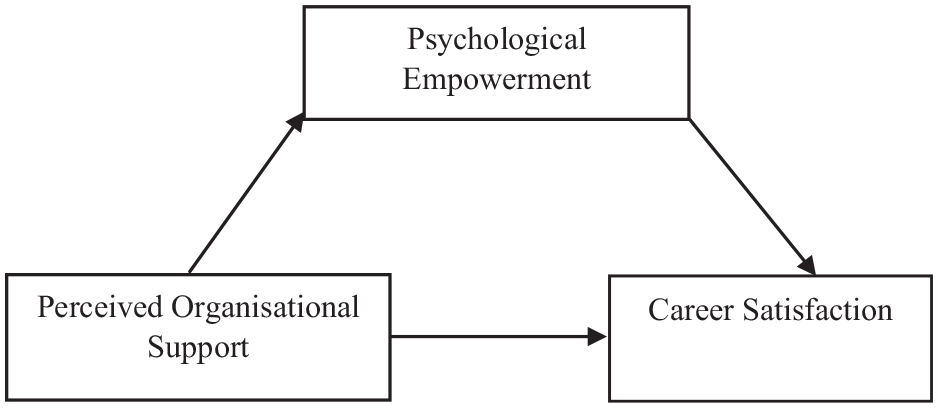
Research framework of the relationship between perceived organizational support, psychological empowerment, and career satisfaction.
The Relationship Between Perceived Organizational Support and Career Satisfaction
Prior research has investigated the correlation between perceived organizational support and career satisfaction. The research conducted by Khawaja and Sher (2012) demonstrated a strong correlation between perceived organizational support and employees’ career satisfaction. Access to support attempts are positively correlated with organizational career development and the facilitation of personal objectives, proactive behavior, and job and career satisfaction (Xie et al., 2017). In a study on nurses, Liu et al. (2015) found a favorable correlation between perceived organizational support and career achievement. According to Türe and Akkoç (2020), career satisfaction is a crucial factor in determining the attitudes and actions of employees, as well as the overall outcomes of an organization. It holds more significance in this regard than the objective criteria of career success. Hence, organizational support is a crucial indicator of the working environment.
Other empirical studies support the hypothesis (Armstrong-Stassen & Ursel, 2009; Babakus et al., 2003; Kong et al., 2016). Employees with adequate organizational support in terms of advancement, achievement of career goals, and the opportunity to develop new skills in their current jobs will be satisfied with their careers (Karatepe, 2012). This is because the support is adequate for their needs, such as sufficient income to live their life and capabilities to upgrade their employment. Similar to the recent study by Bhaskar and Mishra (2019), it was noted that programs such as team-building workshops, career services, and supervisory support influenced career satisfaction at the workplace. Ahmed (2017) identified that recognition by the organization is given to show appreciation for outstanding commitment. Employees tend to be loyal and committed to their careers because the organization can satisfy their career needs.
Organizational support refers to the extent to which an organization places importance on its employees and enhances their well-being (Eisenberger et al., 1986). Based on Judge et al. (1995), career satisfaction pertains to the level of happiness an individual derives from internal and external factors related to their career. Piening et al. (2013) found a direct correlation between employees’ perceptions of their careers and their attitudes and behaviors (Piening et al., 2013). In addition, the study conducted by Kossek et al. (2011) asserted that the assistance offered to employees by their superiors or organizations would enhance levels of job-life balance. The study conducted by Kirkbesoglu and Ozder (2015) found that perceived organizational support has an impact on career happiness within organizations. This is because employees perceive that the organization has a long-term plan and job security (Türe & Akkoç, 2020).
The Mediating Effect of Psychological Empowerment on the Relationship Between Perceived Organizational Support and Career Satisfaction
A study by Ahmad, Motahari and Loghman (2014) concluded that perceived organizational support influences psychological empowerment by providing aid for employees to access valuable resources and utilize their skill, ability, and authority in making decisions to complete their tasks. As supported by Mohammed et al. (2018), adequate organizational support should implement an effective empowerment policy and promote an empowering environment in the workplace. This process is one of the strategies to enhance relationships among co-workers, supervisors, and workers besides creating bonds where they can contribute to having a sense of being supported by each other to achieve common goals. Based on Singh and Singh (2019), one of the dimensions of perceived organizational support is justice in the organization, which is a guide to promoting the development of psychological empowerment. The employees have an equal opportunity to expose themselves and be part of the organization through a fair distribution of responsibilities, resources, and merits.
On the other hand, some studies have explored the relationship between empowerment and career satisfaction. A study by Joo and Lim (2013) explored that empowering employees by enabling them to implement their responsibilities and capabilities of decision-making can increase career satisfaction. Empowerment promotes employee participation in good idea generation and execution, whereby it has been argued that empowerment serves as a guideline that fosters productivity and employee satisfaction (Vu, 2020). Joo and Nam (2019) stated that the empowerment condition and process for employees would influence employees’ satisfaction with their career progress. Kong et al. (2016) found that employees prefer autonomy and believe in themselves for doing their tasks via empowerment instead of being controlled like traditional management. It is one of the strategies of the organization to promote individual career development to increase career satisfaction in the employees’ life. Hence, Direnzo and Greenhaus (2011) mentioned that organizations must expend more effort to identify how to improve the career satisfaction of their employees.
Integrating organizational support attempts into career-related human resource practices helps employees gain the career opportunities to successfully manage their careers (Akkermans et al., 2015). Empowering as a contributor to career success not only benefits the employees’ career satisfaction but also has additional benefits for the organization, including better performance. Organizations that support them by appreciating their contribution, giving them the freedom to complete their job, and rewarding them have made them feel more confident about their abilities, skills, and capabilities to perform better (Pare & Tremblay, 2007). Hence, M. Kim and Beehr (2017) proposed that empowering leaders play a vital role in the career satisfaction of their subordinates via psychological empowerment. To enhance career satisfaction as well as the growth and development of subordinates, organizations should encourage managers to engage in empowering behavior. Thus, based on the literature mentioned above, Hypothesis 1 was developed, assuming that psychological empowerment would have a mediating role.
H1: Psychological empowerment mediates the relationship between perceived organizational support and career satisfaction.
Methodology
Research Design
This study aimed to examine the effect of the mediation variable through the research hypothesis. A cross-sectional and descriptive correlational design was used in this study. The data were collected from the target respondents in a natural setting without any interference from the researcher. The total population of this study involved 466,000 employees in the manufacturing sector located in Johor (Dosm, 2017). Based on the Federation of Malaysian Manufacturers (2021), there are 7787 manufacturing companies in Johor. As a cross-sectional study, the questionnaire was used to collect the data, produced in two languages, English and Malay. The questionnaire was originally in English and translated into Malay utilizing the Brislin method for translation developed by Brislin (1970). Since the study is interested in generalizing the findings to the entire population, the appropriate design for this study is probability sampling. Survey data are collected using a simple random sampling technique.
The total sample size was 248; from this sample size, the respondents were selected randomly from manufacturing in Johor. As for the data collection process, the researcher manageable to receive cooperation from the manufacturing company to distribute the questionnaire. Through the human resource department’s help, the record of employees’ email addresses and phone numbers in the database eased the process of reaching employees. The distribution process was done through email and a message that contained an invitation link to answer the survey via a google form. Meanwhile, the sample is an operator only who performs work not only with robots but also as a machine assistant (Romero et al., 2017). Therefore, management must empower operators to handle technology and encourage collaboration with other operators, machines, and software systems (Romero et al., 2016). This study explores whether or not operators have received any support and empowerment practice, leading to increased career satisfaction. However, out of the 248 questionnaires, 202 were returned and used in the data analysis with a 47.40% response rate.
Measurement
Three measurements were adopted from different studies. Perceived organizational support was measured by eight items of the Survey of Perceived Organizational Support (SPOS) (Rhoades & Eisenberger, 2002). The scale’s alpha reliability in this study was 0.904, which was considered excellent. Psychological empowerment was measured using the instrument Psychological Empowerment Scale by Spreitzer (1995), consisting of 12 items with an overall reliability of 0.878, which was considered very good. The career satisfaction was measured by five items of the Career Satisfaction Scale (CSS) developed by Greenhaus et al. (1990), showing overall reliability of 0.950, which was excellent. The reliability test for this present research was conducted using the Alpha Cronbach test.
Results
Demographic
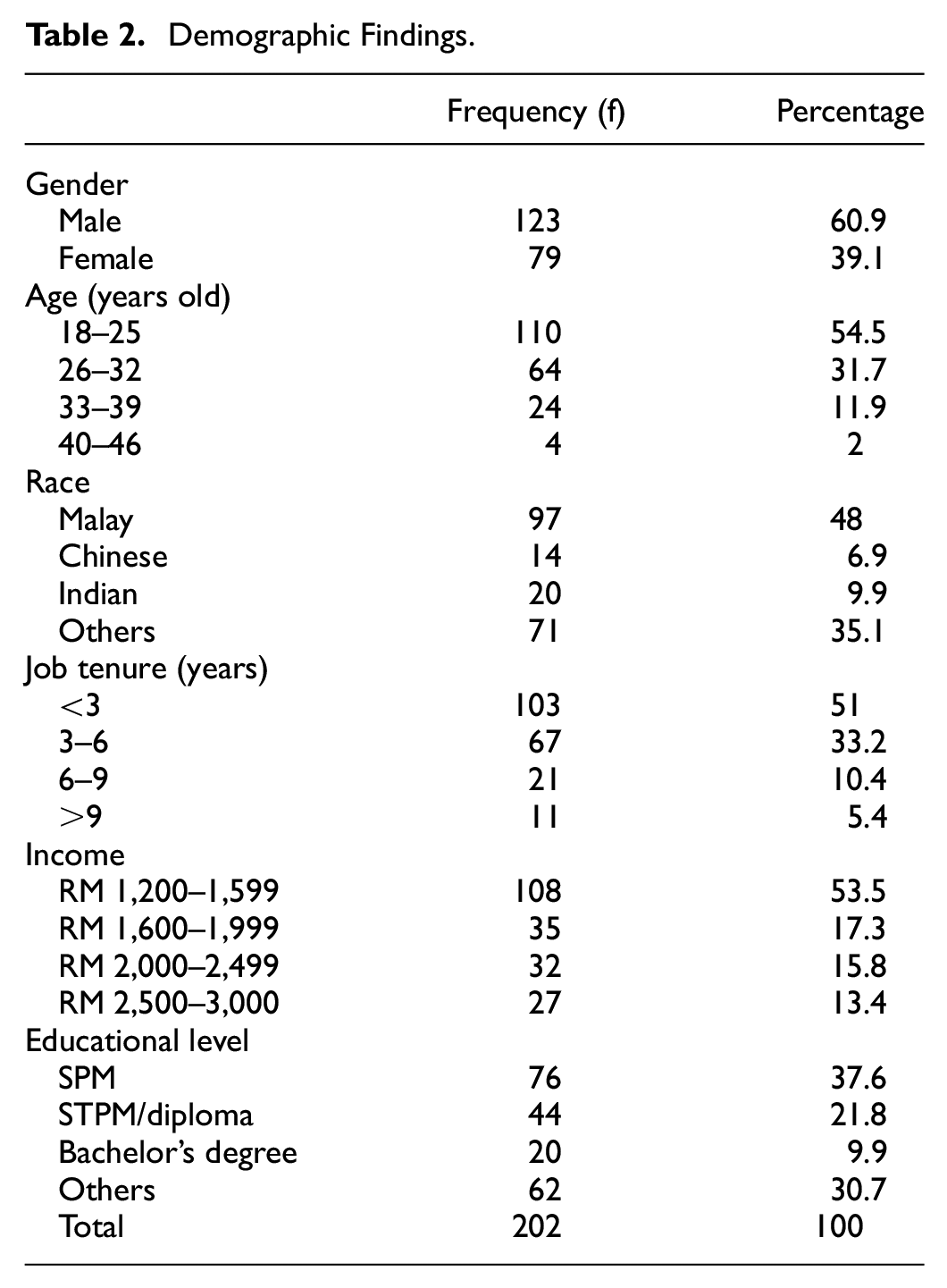
The demographic characteristics of participants included gender, age, race, job tenure, income, and educational level, as shown in Table 2. There were 60.9% male participants, with 39.1% females. In addition, 54.5% of respondents were between the age of 18 and 25 years old, whereas 31.7% had age between 26 and 32 years old, 11.9% were between the age of 33 and 39 years, and only 2% of the total respondents were more than 40 years of age. Besides, Malay was the dominant race, represented by 48%, followed by other races with 35.1% and 9.9% for Indians. The least respondents were Chinese, with 6.9%. Most respondents were classified in the 3 years and below category 51%, while the minority were in the more than 9 years category with 5.4%. The highest frequency of respondents who received between RM 1,200 to RM 1,599 income per month was 53.5%, and only a few of them were in RM 2,500 to RM 3,000 category with 13.4%. Regarding education level, 37.6% of participants were SPM holders, while the lowest was 9.9% of respondents who were university degree holders.
Demographic Findings.
Measurement Model Analysis
Subsequently, the results and quality criteria of measurement models were verified through SmartPLS 3.3.2 to analyze factor loadings (λ), convergent validity, internal consistency and discriminant validity.
Factor Loadings and Convergent Validity
According to J. F. Hair et al. (2006), factor loadings of 0.30 are considered to meet the minimal level of factor loading; loadings of 0.40 are considered more important; and if loadings are 0.50 or greater, they are considered practically significant. Hence, loading below 0.30 should be deleted (Shyu et al., 2013). The elimination was conducted one by one, starting with the lowest factor loading, and it must not be more than 20% of the total indicator (Ramayah et al., 2018). AVE is equal to the cut-off value of .5, as suggested by Bagozzi and Yi (1988). Nevertheless, an AVE value lower than .5 can be accepted if only the composite reliability is higher than .6 (Fornell & Larcker, 1981). In that case, an AVE value of .4 with composite reliability above .6 is considered acceptable, as supported by Huang et al. (2013). After three items, namely POS8, PE1, and PE2, were eliminated, Table 3 indicates that all factor loadings and AVE values have met the requirements for the construct measures’ convergent validity, which was above the acceptability value. After fulfilling the factor loading and convergent validity test, testing the quality of the research instrument continued with internal consistency.
Loadings Summaries for Each Variable.

Internal Consistency
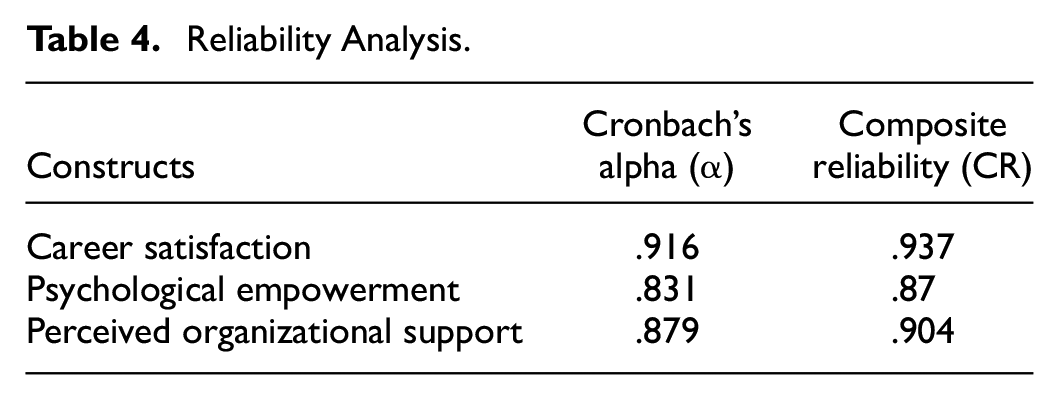
The internal consistency of items in this study was analyzed via two indicators; Cronbach’s alpha (CA) and composite reliability (CR). CA recommended value is more significant than 0.7 (H. F. Hair et al., 1998). Table 4 shows that all alpha reliabilities were above .8, indicating appropriate internal consistency among items and have fulfilled the requirement where the values of α should be above .7 to be acceptable, as Field (2013) suggested. CR should be .7 or higher to indicate adequate internal consistency, according to H. F. Hair et al. (1998). Hence, Table 4 indicates that all the variables had CR greater than .80, thus ascertaining their reliabilities. Therefore, CA and CR suggested a satisfactory level of construct reliability.
Reliability Analysis.
Discriminant Validity
Subsequently, the discriminant validity was assessed using cross-loadings, Fornell-Larcker’s criterion and heterotrait-monotrait (HTMT) correlation ratio. These three criteria are presented in Tables 5 to 7, respectively. Table 5 displays the item of two or more factors having a loading value greater than 0.1, which suggests the significance of cross-loading according to the rule of thumb (Ngah et al., 2018). This indicates that all indicators loaded on the construct were higher than any others, supporting that the constructs were distinct. After that, Fornell-Larcker’s criterion was utilized in which the AVE value should be greater than all related correlations (Fornell & Larcker, 1981). Table 6 indicates a more excellent value of AVE than other associated correlations. The final evaluation, Table 7, shows all HTMT values followed the maximum threshold value of 0.9, indicating the establishment of discriminant validity. Thus, all findings have met the requirement for discriminant validity.
Cross Loading.
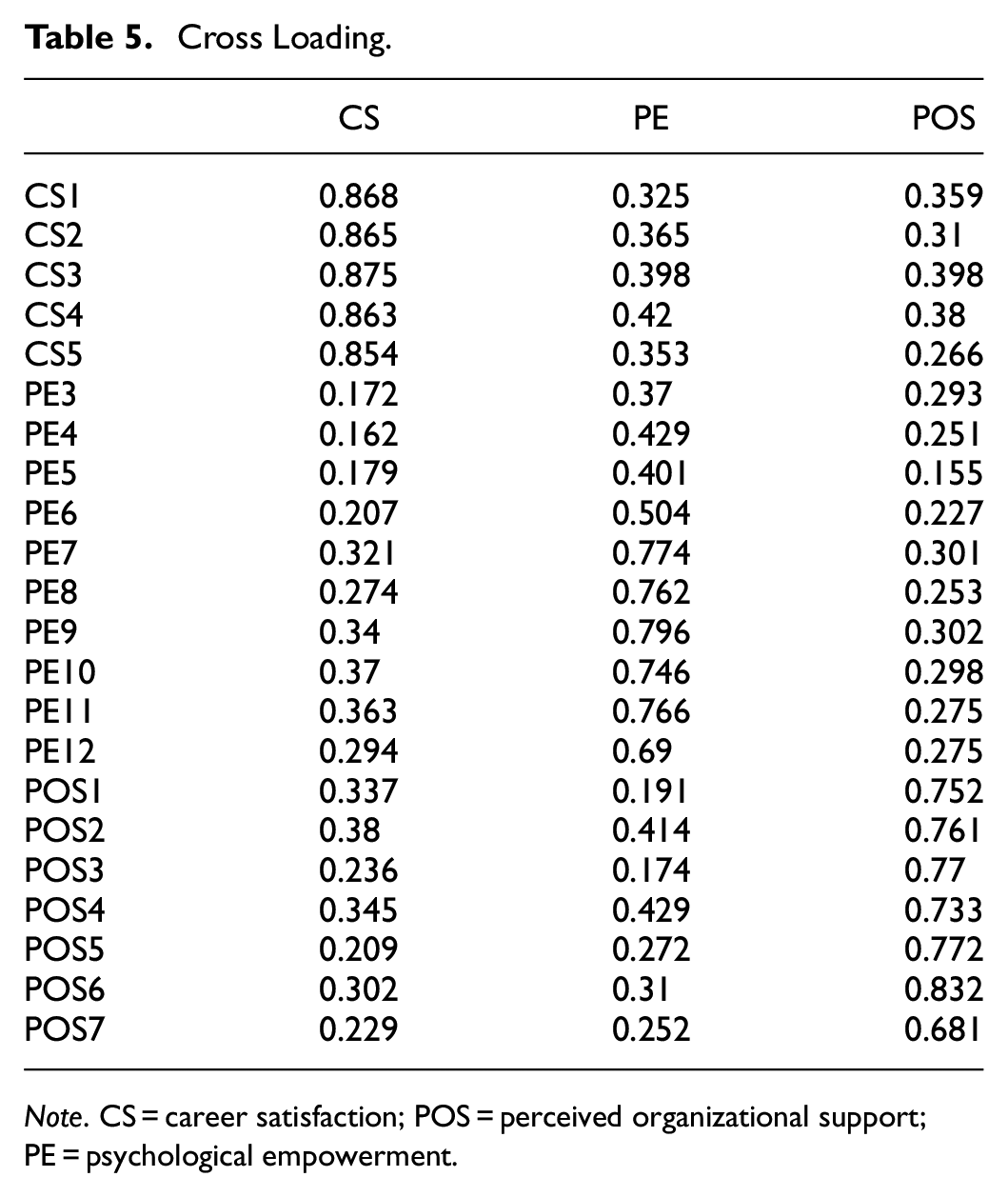
Note. CS = career satisfaction; POS = perceived organizational support; PE = psychological empowerment.
Fornell-Larcker’s Criterion.

Note. The diagonal figures (in bold) represent the square root of the AVE, while the off-diagonals represent the correlations among the variables.
HTMT.85 Criterion.

Structural Model Analysis
Structural models were developed using the computed latent variables with their retained items in the final confirmatory factor analysis (CFA) (measurement) model. The structural model was assessed for collinearity issues, the significance of path coefficients (β), effect size (f2), coefficient of determination (R2), and predictive relevance (Q2; J. F. H. Hair et al., 2013). Based on the threshold value below 5.0, as J. F. H. Hair et al. (2013) suggested, Table 8 shows no existence of collinearity as the variance inflation factor (VIF) values for all the exogenous or predictor constructs were much below the threshold of 5.0. Subsequently, path analysis was conducted through the bootstrapping procedure with 5,000 resamplings to test the path coefficients’ significance in this study (Hayes, 2009). The path coefficients have standardized values between −1 and +1. The estimated path coefficients close to +1 represent a strong positive linear relationship and vice versa for negative values (J. F. H. Hair et al., 2013). Additionally, to identify the significance, the p-value must be lower than .05, while the t-value must be more than 1.96 (Hair, Hult et al., 2017). Beta-values in Table 9 represent the path coefficient, mean, standard deviation, t-values, and p-values for each variable.
Collinearity Assessment via VIF.

Path Analysis.

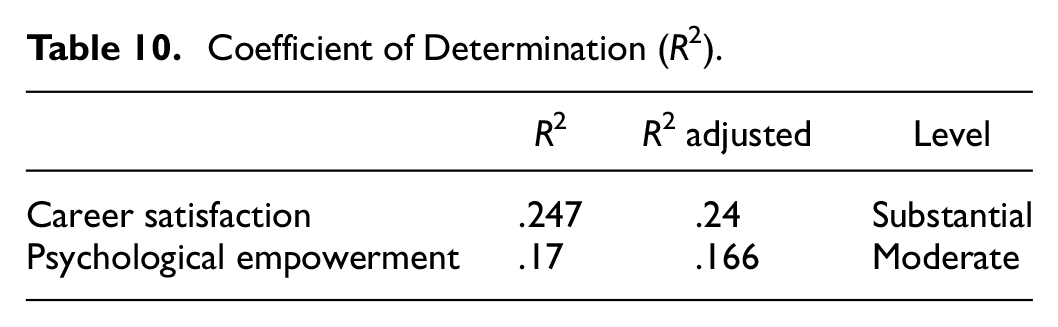
Regarding the coefficient of determination (R2), Falk and Miller (1992) recommended that R2 values be equal to or greater than .10 for the variance explained by a particular endogenous construct to be deemed adequate. The cut-off rate for this study, R2, was based on that proposed by Cohen (1988). Hence, the R2 values of .26, .13, or .02 were classified as substantial, moderate, and weak, respectively. Table 10 shows the result for the R2 value of career satisfaction (.247), considered substantial, whereas psychological empowerment (.17) was considered moderate.
Coefficient of Determination (R2).
Another criterion that must be assessed is the effect size (f2). For this study’s purpose, Cohen (1988) suggested that the f2 values of 0.02 to 0.14, 0.15 to 0.34, and more excellent than 0.35 are considered small, moderate, and large effects, respectively. The relationship between perceived organizational support and career satisfaction was obtained with a small effect size of 0.079 to produce a substantial level of invariance in career satisfaction (R2 = .247). Apart from these, the finding indicated that perceived organizational support possessed a moderate effect size (f2 = 0.205) to the moderate R2 of psychological empowerment, which was .17. Also, the relationship between psychological empowerment and career satisfaction was obtained with a small effect size of .115 to produce a substantial level of invariance in career satisfaction (R2 = .247). Table 11 presents the value of f2 for each variable.
Effect Size (f2).

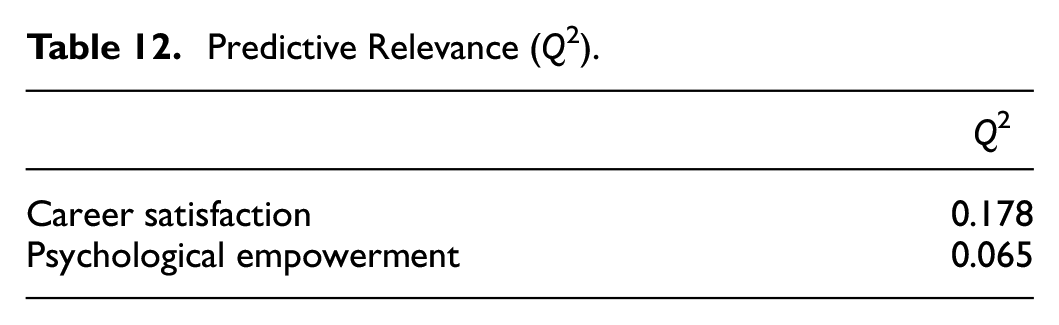
Besides looking at the magnitude of R2, predictive relevance (Q2) predicts the relevance of the endogenous variables (J. F. Hair, Hollingsworth, et al., 2011). The Q2 value larger than zero indicates that the exogenous constructs have a predictive relevance for endogenous constructs (J. F. Hair et al., 2011). A blindfolding procedure with an omission distance of seven was conducted to generate the Q2 value (Hair et al., 2017). Table 12 shows that the Q2 value for Career satisfaction, which was 0.178, was sufficient to justify that the model has sufficient predictive relevance as the value was more significant than zero. The finding also shows that the Q2 values for psychological empowerment were more remarkable than zero (Q2 = 0.065), supporting the exogenous latent variables with predictive relevance. As a whole, the model determines a good fit and high predictive relevance. As a result, evaluating all the criteria for structural model analysis indirectly answered the research objective of examining the relationship between perceived organizational support, psychological empowerment, and career. Therefore, mediation analysis was elaborated in the following sub-topics.
Predictive Relevance (Q2).
Mediation Analysis
The bootstrapping method was used to conduct mediation analysis to examine the significance of the indirect effects. According to Preacher and Hayes (2008), there is a mediation effect between two variables if the indirect path is statistically significant. Table 13 presents a bootstrapping analysis with the indirect effect β-coefficient of .133, which was statistically significant with a t-value of 2.83. Moreover, as indicated by Preacher and Hayes (2008), the indirect effect of 0.133, 95% Boot CI [0.064, 0.245] does not straddle a 0 in between, indicating the presence of mediation. In conclusion, the finding demonstrated that psychological empowerment mediated the relationship between perceived organizational support and career satisfaction, thus accepting Hypothesis 1. Table 13 presents the result of the mediation analysis.
Indirect Effect (SmartPLS Output).

Discussion
This research was conducted in the manufacturing sector of Johor. This paper has explored the mediation effect of psychological empowerment on the relationship between perceived organizational support and career satisfaction. There is little to know about the research that focuses on perceived organizational support and psychological empowerment and positively contributes to employees’ career satisfaction except in the study by Türe and Akkoç (2020), which involved social support as a mediating variable in the relationship between perceived organizational support, psychological empowerment, and career satisfaction. Surprisingly, this present study has proved that the mediation effect of psychological empowerment on the relationship between perceived organizational support and career satisfaction led to the acceptance of the hypothesis. In light of these, the organization applying a support system to allow all employees to feel powerful in terms of authority and responsibility will create a sense of empowerment and consequently leads to enhanced career satisfaction among employees. Furthermore, based on the Self-Efficacy Theory by Bandura (1977), an individual who seems to the environment to be unchangeable may have a sense of powerlessness and less commitment to accomplishing a task (Buehler & Maas, 2018). Without self-efficacy, individual most likely to have low career satisfaction.
Previous authors, including Barnett and Bradley (2007), provided consistent evidence to support the present study’s findings. Barnett and Bradley (2007) revealed that career satisfaction predictors include goal-specific environmental support and resources. Organization provides support and empowering practices, such as allowing employees to manage their working hours, flexible work arrangements, and professional development. Hence, it will influence employees’ satisfaction with their career progress. Besides, employees who experience organizational support by collaborating with other employees, including cross-departmental collaboration in the workplace, will receive psychological empowerment, promoting a sense of career satisfaction in themselves. Therefore, providing social and material support is vital for employees to achieve organizational and personal goals. Therefore, providing social and material support is essential for an employee to achieve organizational and personal goals. Also, based on Liu’s (2018) Organizational Support Theory, it was emphasized that organizations should identify the needs of their employees and do their best to meet them.
Furthermore, previous research by Laschinger (2012) supported the mediation effect, which discovered that work conditions such as support practices that empower employees are fundamental for creating a positive environment that can increase employees’ satisfaction with their careers. Consistent with the Organizational Support Theory proposition, research revealed that employees aware of organizational support are more committed and more satisfied with their jobs (Rhoades & Eisenberger, 2002). These effects would lead employees to work and dedicate themselves to their job and organization. This way, they can use their creativity and problem-solving skills with the accessibility of empowerment, which would further affect their career satisfaction. This is reinforced by research conducted by Sturges (1999) regarding Career Success Model, which identifies employees who can create something new at work as a success factor. It appeared that employee empowerment substantially influences employee satisfaction in an organization that is perceived to support its employees. Thus, it is likely that such a significant connection exists between the chosen independent, dependent, and mediating variables.
Recommendations
Recommendations for Organization
The findings have described several conditions that organizations could improve. One is to emphasize vital sources of career satisfaction for increasing perceived organization support through psychological empowerment. For instance, if employees did not have control over what happens in their work area, the consequence would lead to an individual sense of less empowerment. It can cause a feeling of frustration or failure in oneself. Thus, organizations should provide more freedom and choices to support the employees in handling any situations in their work instead of restricting their tasks. For instance, they provided employees with the choice of how they wished to implement the task and what should be done first to ease the progress. Thus, providing operators with easy access to all relevant and most up-to-date standard operating procedures, form, and the technical document will create a work environment that makes employees feel psychologically empowered.
Besides, any circumstance that makes employees perceive little influence over their organization will cause low-level engagement and poor performance. Hence, to prevent negative performance, organizations should motivate employees to make a decision and allow them to express their opinions about the field they are experts in through a connected worker platform allowing operators to suggest improvements. Further, organizations must encourage employees to participate in a discussion by asking their opinions, potentially leading to new ideas and making them feel respected and valued. In addition, cross-departmental collaboration in the workplace is encouraged to build a sense of support for each other as it reinforces a culture of teamwork in the organization. Ultimately, organizations need to make an effort to improve perceived organizational support via psychological empowerment when aiming to enhance career satisfaction.
Recommendations for Future Research
As for recommendations, it is suggested that future researchers conduct future research in a mixed-method approach to allow future researchers to compare the quantitative method’s findings with qualitative results to expand or validate the quantitative data (Cropanzano et al., 2017). The mixed method will stimulate future researchers to create innovative methods and present new approaches to capture and balance a problem with conventional data-collection methods. In short, a combination of quantitative and qualitative research methods might produce new information. Subsequently, a study should be conducted in a larger population involving employees from different sectors in Malaysia to produce more representative results to generalize findings in other sectors. A combination of organizations may increase the impact of the study. In this regard, findings will be more generalized into particular regions than a single organization, which only applies to that particular organization.
In addition, the finding will be helpful for future researchers to identify comparisons between other organizations, which may foster benchmarking among organizations. Although involving various organizations will be time-consuming, it can still enhance the reliability of the generated result to represent a particular region. Future investigations should involve different levels of employees, such as senior, intermediate, and associate. The present study only involved one position, which was the operator. Different levels of employees possess different responsibilities, which leads to the distinction of their perception of the empowerment provided and organizational support toward career satisfaction. In short, the analysis of findings based on different levels of employees should be considered to obtain more valid and reliable results.
Limitation
The first limitation is that this study was conducted among operators in the manufacturing sector, which limited the possibility of generalizing its results to other positions. Also, there was only one organization that participated in this research. The population size can be increased by involving various sectors so that the result can be generalized for a region. Besides, the cross-sectional design utilized in this study did not provide insight into the variables’ causal relationships or long-term effects. To address this limitation, it is suggested that future researchers replicate this study using a longitudinal design and collect data at multiple points, as the perception of employees toward an organization may change with time. Besides, every respondent has different backgrounds, environments, and perceptions, which significantly affected the answers given in the questionnaire. Also, certain respondents might need clarification on a specific point; the researcher needed to be on hand to clarify. In addition, the present study utilized a quantitative approach, which minimized the information obtained. Thus, using mixed methods involving the interview method could allow for more in-depth information. However, the present study utilizing the cross-sectional quantitative design could minimize response bias, be relatively inexpensive to perform and not require much time.
Conclusion
In summary, the outcomes verified a significant positive effect of perceived organizational support on career satisfaction through the intercession of psychological empowerment, which illustrates the organization’s responsibility to build a supportive environment that stimulates empowerment to facilitate employees’ career satisfaction. Additionally, an organization that seeks to improve performance should consider the benefit of employee career satisfaction, which leads to enhanced organizational performance in an era of a borderless world.
Footnotes
Declaration of Conflicting Interests
The author(s) declared no potential conflicts of interest with respect to the research, authorship, and/or publication of this article.
Funding
The author(s) received no financial support for the research, authorship, and/or publication of this article.

Data Availability Statement
Data sharing not applicable to this article as no datasets were generated or analyzed during the current study.