




Abstract
The main objective of this study is to examine the effect of self-sacrificial leadership on organizational citizenship behavior within the health sector through a moderated mediation approach. The study has been conducted on nurses working in public hospitals in Sargodha, Pakistan, and data have been collected through a questionnaire survey method. In this study, psychological empowerment is used as a moderator, and psychological wellbeing is used as a mediator between self-sacrificial leadership on organizational citizenship behavior based on the fundamental premise of Conservation of Resource (COR) theory. The data have been analyzed through Partial Least Square Structural Equation Model (PLS-SEM) to examine the hypotheses. Empirical results demonstrated that psychological well-being plays a significant and positive mediating role in the relationship between self-sacrificial leadership and organizational citizenship behavior. The results further explain that nurses’ psychological empowerment moderates the mediating effect of psychological well-being between self-sacrificial leadership and organizational citizenship behavior. This study adds to a better understanding of the role of self-sacrificial leadership in encouraging organizational citizenship behavior.
Keywords
Introduction
The notion of self-sacrifice is built on the basic principle of ethics, and in leadership it denotes the commitment of a leader to collective interests. It is when the leader forgoes personal benefits and interests for the benefit of organization and his followers. Being a follower-centric style, it is linked with positive employee outcomes (Matteson & Irving, 2006). A self-sacrificial leader envisages superior outcomes as compared to other leadership styles (Mostafa & Bottomley, 2020).
According to Chen et al. (2008), this informal altruism manifests in organizational citizenship behavior (OCB). The OCB exhibited by an employee includes overt behaviors that are not formally rewarded by the organization (Pieterse et al., 2010). The OCB of employees shapes an efficient work environment that may further improve organizational performance across a broad range of areas (Yang et al., 2020). Employee behavior constitutes a potential factor that explicitly differentiates one organization from another (De Cremer et al., 2009).
As it would be valuable for an organization to have its employees actively engaged in OCB, the next important question is: how can an organization nurture these OCB? The overarching mechanism, which may result in OCB, will be robust enough to influence organizational performance (Ingrams, 2020). Therefore, organizational leadership should postulate strategies to motivate and inspire employees to go beyond the call of duty to enhance their job attitudes (Piatak & Holt, 2020), improve performance (Göncü Köse & Metin, 2018), and decrease counterproductive work behaviors (Eva et al., 2020).
A positive leadership style may enhance positive OCB among employees (Ingrams, 2020). Employees with a high level of OCB are more committed and devoted toward their organization (Göncü Köse & Metin, 2018). Therefore, leaders of the organization should be aware of their leadership style in the workplace and how it stimulates employee OCB. The study of Ingrams (2020) explicitly posits that superior leadership style and employee OCB are cohesively interdependent. Similarly, unfavorable leadership styles may trigger adverse effects which might further lead to organizational dysfunctions such as high turnover, absenteeism, and reduced work performance (Groves, 2020). Thus, the asymmetry might precipitate a disruptive vicious cycle that the organization will want to avoid and therefore, leaders should focus on improving their style and outcomes more robustly (Sendjaya et al., 2019).
Research has also shown that effective leaders demonstrate the ability to use different tactics to influence their followers. Consistent with this notion, effective leadership styles are essential to provoke employee OCB. A significant category of antecedents for followers of OCB is leadership behavior (Cheung et al., 2018). Existing literature posits that leadership styles may vigorously uplift employee OCB. Contemporary leadership research contains various styles such as charismatic or transformational leadership, democratic leadership, servant leadership autocratic leadership, and transactional leadership remain dominant (Estiri et al., 2018). However, recently the self-sacrificial leadership has received much attention in influencing the followers’ prosocial behavior (Göncü Köse et al., 2018). Recent strides in research have proposed self-sacrificial leadership in particular as a potential antecedent to employees’ prosocial behavior. Self-sacrificial leadership is a type of leadership that comprises “an abandonment or postponement of personal interests and privileges for the collective welfare” (Cheung et al., 2018).
The concept of self-sacrificial leadership assumes that the leader sacrifices personal interest in the well-being of the organization to serve its goals and mission effectively (Sendjaya et al., 2019). This study has used conservation of resources (COR) theory to examine the consequences of self-sacrificial leadership. This theory deals with the factors of stress, motivation, and resources (Hobfoll, 1989). Each individual aims to retain and expand the material, psychological, and social resources (Hobfoll et al., 2003).
Self-sacrificial leaders offer ample support and resources for their subordinates to go beyond the call of duty and engage in OCB (He et al., 2018). Though the role of leadership as a potential precursor of OCB has been well documented, however, the way in which self-sacrificial leadership determines employees’ OCB and its underlying mechanism remain unclear (Lanaj et al., 2021; Peng et al., 2019; Yang et al., 2020). Self-sacrificial leadership is a source of valuable employees’ resources that uplift employee psychological well-being, which in turn determine their level of affiliation toward an organization. Such leadership has a stronger impact on well-being and OCBs when employees are psychologically empowered (Chen et al., 2008). Generally, in the context of the health care system and particularly in the context of developing countries like Pakistan. Therefore, this study aims to extend and validate the COR theory by estimating a moderated mediation model with psychological empowerment as moderator and psychological well-being as the mediator between self-sacrificial leadership and OCB. This study contributes by taking the prudent role of self-sacrificial leadership in determining the emergence of OCB in followers. Besides, examining the direct impact, we examined indirect impact through a moderated mediation model with psychological empowerment as moderator and psychological wellbeing as a mediator between self-sacrificial leadership and OCB from resource perspective.
The rest of paper details the literature review and hypotheses development. The research design, sampling technique, operationalization of variables, and measurement model are explained in the methodology section. The outcome of the statistical analysis is depicted in the hypotheses testing section. The paper concludes with the discussion of results and recommendations for theory and practice.
Literature Review
The last two decades have witnessed a significant surge in research on charismatic and transformational leadership theories. The effective leader remains transactional and has the characteristics to identify, manage, and meet the expectations of their followers (Göncü Köse et al., 2018). Literature based on leadership characteristics contains several charismatic leadership theories. Groves (2020) agree on the notion that an effective leader might reflect self-sacrificial behaviors to build trust, loyalty, and organizational commitment. Self-sacrificial leadership is advocated as exemplary and inspirational behavior that becomes requisite when the employee’s commitment is exceptional for effective organizational performance (He et al., 2018).
Past studies expounded in literature posit different views about self-sacrificial leadership. However, dominantly there are two perspectives: trait perspective and behavioral perspective. The trait perspective of self-sacrificial leadership holds the view that self-sacrificial leadership is a tendency to take a high level of risk and loss of self-sacrifice (Lanaj et al., 2021). Accordingly, the behavioral perspective holds the presumption that self-sacrificing behavior is the willingness to forego self-interest for the sake of employees or the organization. (He et al., 2018). We have taken the behavioral approach to self-sacrificial leadership that is referred as a leadership behavior that incorporates “an abandonment or postponement of personal interests and privileges for the collective welfare” (Choi & Yoon, 2005, p. 52).
The traits of self-sacrifice are positively perceived as influential and charismatic by their followers. Accordingly, self-sacrificial leaders tend to motivate followers to display desirable behaviors which in turn enhance organizational effectiveness (Lanaj et al., 2021). Past studies proclaim that self-sacrificial leaders not only stimulate followers’ behavior but also adds in their commitment and affiliation toward the organization (Cheng et al., 2021). Recent research has found that self-sacrificial leaders enable positive work outcomes for followers and OCBs are one of them (Mostafa & Bottomley, 2020). OCBs are discretionary behaviors which are not obligatory, however, they are required to improve the effectiveness of the organization (Wang et al., 2021). These behaviors include interpersonal helping, compliance with organizational rules, refraining from complaints, and engaging actively in organizational affairs (Organ, 1988). In this regard, we have taken conservation of resources (COR) perspective to investigate the potential outcomes of self-sacrificial leadership. COR perspective entails the factors of stress, motivation, and resources (Hobfoll, 1989). Each individual seeks to retain and expand the material, psychological, and social resources (Hobfoll et al., 2003). It holds that “environmental conditions that support, foster, enrich, and protect the resources of individuals,” helps to reap positive psychological and work outcomes (Hobfoll, 2011, p. 118). In this premise, certain leadership styles render work-related and psychological resources (Perry et al., 2010; Rousseau et al., 2014). Individuals require adequate resources to have “positive gain spirals” and prevent “negative loss spirals” to perform their job duties (Hobfoll, 1989, p. 517). As leaders are a critical source of significant resources, it is therefore proclaimed that self-sacrificial leaders will offer privileges for followers’ welfare and take steps to meet their personal needs (Li et al., 2016). This behavior will result in a positive resource gain that will yield higher OCBs. Accordingly, based on the COR theory, it is hypothesized that:
H1: Self-sacrificial leadership has a positive effect on employees’ organizational citizenship behavior.
There has been an emerging interest in unlocking the mechanisms via which the self-sacrificial leadership influence OCBs (Mostafa & Bottomley, 2020). Again, referring to the COR (Hobfoll, 1989), resource gain leads to improved well-being in employees (Salanova et al., 2005). The research based on employee well-being and occupational health posits that leadership style remains central to predict employee well-being (Chaudhary et al., 2021). The working environment, organizational support, and leadership remain the oblivious antecedents of employees’ psychological well-being (Cheung et al., 2018). Transformational leadership, charismatic leadership, democratic leadership, and servant leadership most notably are associated with positive employee engagement and a high level of subjective well-being (Islam et al., 2021). Self-sacrificial leadership involves forgoing self-interest and bear the personal cost for the well-being of others (He et al., 2018) and reflect leaders’ commitment to the collective interest. It has been found that self-sacrificial leaders are also concerned for the fulfilment of followers’ needs and group concerns. Thus, it fosters positive leadership perceptions in followers (Lanaj et al., 2021). As per COR, resources enhance an employees’ wellbeing (i.e., life satisfaction, job satisfaction, and positive affect) therefore, we posit that the work-related and psychological resources gained through self-sacrificial leadership will improve employee well-being (Ali et al., 2021). In addition, the incremental variance in the employees’ well-being accounts for positive job outcomes and organizational citizenship behavior (Pieterse et al., 2010). As such, the followers of a self-sacrificial leader will have more resources as their individual needs are cared for and met which will enhance their psychological wellbeing (Islam et al., 2020). Engaging in tasks that are beyond formal job duties requires adequate resources (Shin & Hur, 2019). It is proposed that employee that have a high level of psychological well-being have positive emotional states, are satisfied with their work and personal lives and have ample resources to engage in OCBs (Belwalkar et al., 2018; Lavy, 2019). The following hypothesis is formulated,
H2: Employees’ psychological well-being mediates the relationship between self-sacrificial leadership and organizational citizenship behavior.
The impacts of self-sacrificial leadership on employee outcomes vary as per certain followers-related factors (Mostafa & Bottomley, 2020). In this regard, one of important factor is followers’ psychological empowerment, which is found to amplify leadership and employee outcomes (Iqbal et al., 2020). Psychological empowerment is a motivational construct which fosters employees to initiate and regulate the tasks involved in their job (Wang et al., 2021). Psychological empowerment is an employee’s perception of the control they have in respect of meaningful work, ability to skilfully perform work, and having a considerable impact and it is regarded as an important resource (Quiñones et al., 2013). The resources provided by self-sacrificial leader behavior combined with psychological empowerment enhance the positive resource spiral (Ahmad et al., 2021). Building on the COR premise, the impact of self-sacrificial leadership on psychological well-being is higher for the followers’ who are more psychologically empowered. Thus, it is postulated,
H3: Self-sacrificial leadership and employees’ psychological well-being relationship is amplified by an employees’ psychological empowerment.
Extending this notion, it is argued that employees’ psychological empowerment will also moderate the mediated relation of self-sacrificial leadership and OCBs (Wang et al., 2021). On the whole, past studies make exaggerated claims regarding the tendency of empowerment to revitalize an organization (Peng et al., 2019; Yang et al., 2020). The impact of empowerment is an enabling process that affects the initiation and the consistency of followers’ task-oriented behaviors (Huang et al., 2006). Following COR theory, empowerment results in increased OCBs as a result of self-sacrificial leadership and subsequent employees’ well-being. Hence, the following hypothesis is proposed:
H4: The indirect self-sacrificial leadership and OCBs relationship is amplified by an employee’s psychological empowerment.
In short, we hypothesize that self-sacrificial leadership leads to organizational citizenship behavior through the mediating mechanism of psychological well-being. Furthermore, we are interested to see if psychological empowerment moderates the indirect effect of self-sacrificial leadership on OCB through psychological well-being. Figure 1 illustrate the research model of present study.

Research model: Hypothesized relationships among self-sacrificial leadership, psychological empowerment, psychological well-being, and organizational citizenship behavior.
Methodology
Data was collected through a cross-sectional and self-reported survey design. We have employed a five-point Likert scale to measure all variable from strongly disagree = 1 to strongly agree = 5. The data related self-sacrificial leadership, psychological empowerment, psychological wellbeing, organizational citizenship behavior was collected from the nurses, while in the case of organizational citizenship behavior nurses’ supervisors were asked to rate each of the nurses. The distributed questionnaires were in English language, as it is a medium of instructions in higher education institutes of Pakistan and all educated people understand English very well (Murtaza et al., 2016). Therefore, all respondents understood the questionnaire very well. A cover letter was attached with the questionnaire to assure the respondents about anonymity and confidentiality of their responses. The data collection was conducted through personally administered questionnaires and a convenient sampling was used to select the nurses. The data collection was done from October 2019 to February 2020. Roughly 700 questionnaires were distributed based on criteria of item-response theory as employed by Islam et al. (2020), which suggests twenty responses for each of used items (i.e., 32 items × 20). Nevertheless, only 282 questionnaires were finally retained for the final analysis. The survey data was analyzed through Partial Least Square Structural Equation Modeling (PLS-SEM). The overall sample was comprised of 17% male and 83% females. Majority of the respondents were aged between 26 and 35, comprising 43% of the entire sample.
To examine possible issue of common method variance, we employed Harman’s single factor test (Podsakoff et al., 2003). The results indicates that first component explains approximately 32% of the total variance, which is lower than threshold value of 50%. Based on these results, we can conclude that the there is no issue of common method variance in the data.
Operationalization of Variables
Self-sacrificial leadership was measured using five items adopted from De Cremer and Van Knippenberg (2004). A sample item is “My supervisor is always among the first to sacrifice free time, privileges, or comfort if that is important for the team’s mission.” A 12-items scale from Spreitzer (1995) was employed to measure psychological empowerment. The sample item is “I have considerable opportunity for independence and freedom in how I do my job.” Psychological well-being was measured using eight items developed by Diener et al. (2010). The sample item is “I am engaged and interested in my daily activities.” Organizational citizenship behavior was measured using a 7-item scale developed by Williams and Anderson’s (1991). The sample item is “Takes time to listen to co-workers’ problems and worries.”
Results
Measurement Model
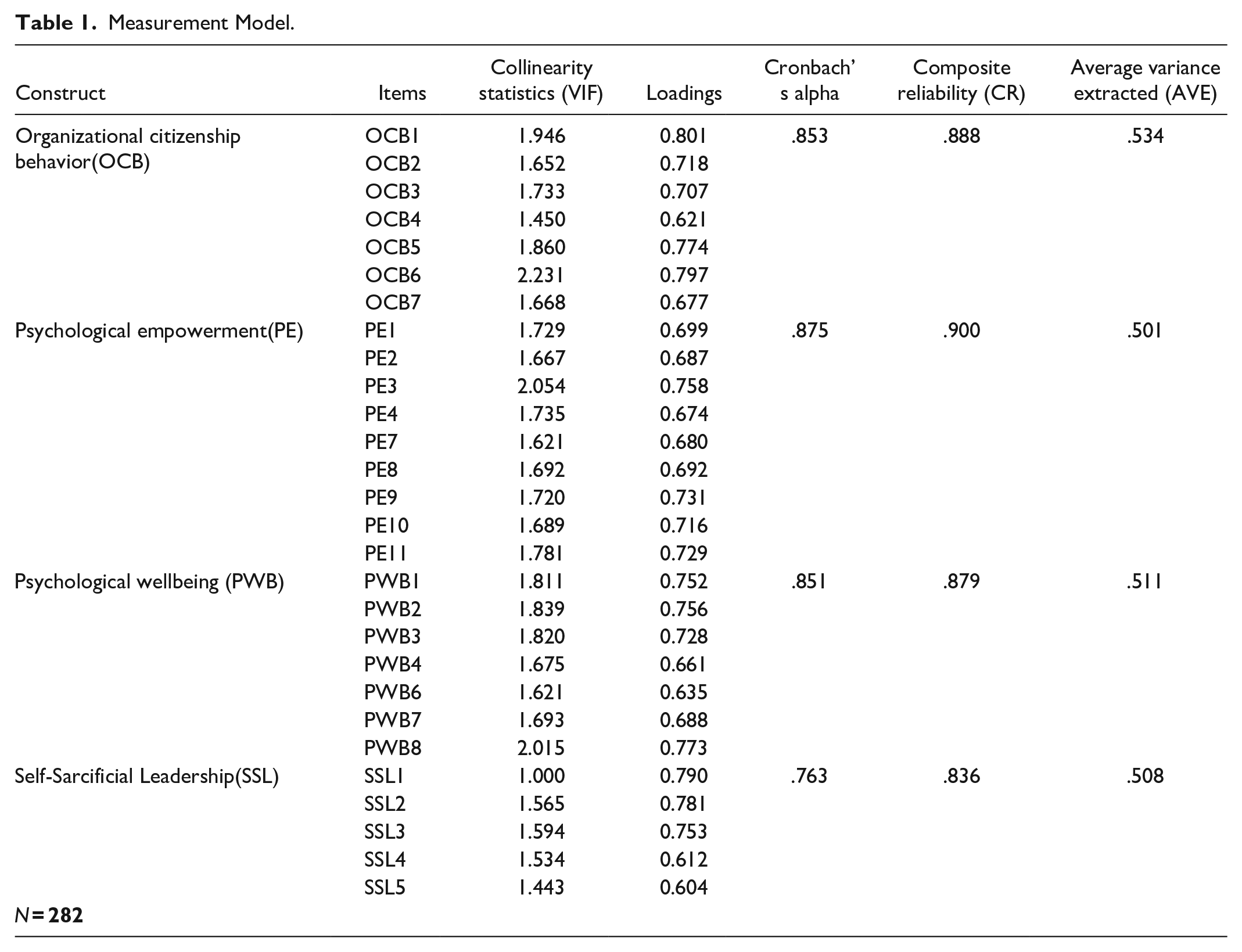
First of all, a confirmatory factor analysis was performed to assess the convergent validity and discriminant validity (see Figure 2). Convergent validity was examined by assessing the factor loading of each item, the reliability, and average variance extracted (AVE) of each construct in the measurement model. First of all, the factor loadings of all items is exceeding 0.50 (Hair et al., 2017). The Cronbach α value and composite reliability of all four constructs are above the threshold value of .70 (Sekaran and Bougie, 2019). Composite reliability is considered as an alternative option to Cronbach’s alpha to examine convergent validity. In the last, AVE values were assessed, AVE value greater than 0.5 are considered as acceptable (Chin, 1998). The results reveal that the AVE values of all the construct are greater than 0.50. Therefore, these results demonstrate convergent validity. Table 1 shows the summary of construct statistics.

Evaluation of measurement model.
Measurement Model.
Discriminant validity was examined using the Fornell–Larker Criterion, Heterotrait-Monotrait ratio (HTMT ratios) and cross-loadings. The Fornell–Larker Criterion suggests that the square root of AVE for each variable must be greater than the correlations of the constructs (Rouf & Akhtaruddin, 2018). Table 2 determines that all values meet these recommendations. HTMT values are also less than the threshold of 0.90 (Gold et al., 2001). Moreover, the cross-loadings of all items indicate that they load the highest on their respective construct (see Table 1). Hence, based on these results, discriminant validity has been established (Table 3).
Discriminant Validity Based on Fornell–Larker Criterion and Heterotrait-Monotrait Ratio.

The off-diagonal values are correlations between the construct, diagonals (shown in {} and bold are square values of AVEs, and values above diagonal are HTMT ratios.
Discriminant Validity Based on Cross-Loading Criterion.

OCB = organizational citizenship behavior; PE = psychological empowerment; PWB = psychological well-being; SSL = self-sacrificial leadership.
Bold value represents all item of specific construct.
Hypothesis Testing
Table 4 reveals a positive relationship between self-sacrificial leadership and employee well-being (β = .193; p < .01). The results further reveal that psychological well-being significantly influences organizational citizenship behavior (β = .315; p < .01). In next step, the relationship between self-sacrificial leadership and organizational citizenship behavior was assessed, which was found to be positive (β = .470; p < .01). Thus, hypothesis H1 has been supported. The indirect effect of self-sacrificial leadership on organizational citizenship behavior through psychological well-being is statistically significant (β = .061; p < .01), which supports hypothesis H2.
Results of Hypothesis.
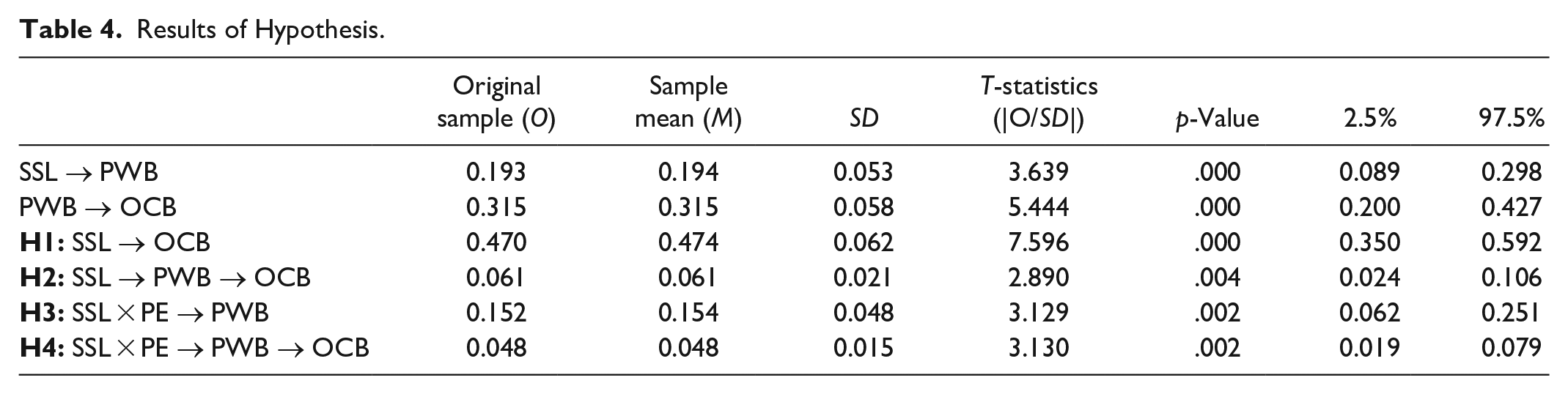
Moreover, the results indicate the moderating role of psychological empowerment between the relationship of self-sacrificial leadership and psychological well-being (β = .152; p < .01). Hence, hypothesis H3 is supported. The graph (see Figure 3) indicates that in the presence of high psychological empowerment, the relationship between self-sacrificial leadership, and psychological wellbeing is stronger. Finally, H4 predicts that the indirect effect of self-sacrificial leadership on OCB through psychological well-being is moderated by psychological empowerment. The results clearly reveal that the interaction term of self-sacrificial leadership and psychological empowerment has a significant influence on Nurses’ OCB through the mediation of psychological well-being (β = .048; p < .01). Thus, hypotheses H4 is also supported.

Simple slope analysis.
Discussion
The present study adopts a theoretical framework to examine the indirect effect of self-sacrificial leadership on organizational citizenship behaviors through a moderated mediation model. The psychological empowerment as moderator and psychological well-being as a mediator has been tested between self-sacrificial leadership on organizational citizenship behaviors.
Based on a substantive literature review, it was deduced that self-sacrificial leadership would result into positive organizational behavior. The results of the study confirm that self-sacrificial leadership result into nurses’ organizational citizenship behavior. Studies expounded in past literature exhibit that self-sacrificial leadership remain robust to determine the social relationships among employees of an organization, in turn, positively uplift employee’s organizational citizenship behavior. The result remains aligned with the study conducted by Mostafa and Bottomley (2020) which, also posits that self-sacrificial leadership remains robust in predicting the quality of the relationship and improving employees’ organizational citizenship behavior. Improved organizational citizenship behavior remains vital because it shapes the organizational, psychological, and social contexts which stimulate both activities and process.
Self-sacrificial leadership goes beyond the exchange relationship and triggers employees’ motivation to effectively achieve organizational goals. Most of the studies expounded in past literature posit that leadership affect employee well-being. Literature-based on leadership is well documented in term of the role of different leadership styles such as transformational leadership, charismatic leadership, and democratic leadership in determining positive prosocial relationship. However, the potential for self-sacrificial leadership to drive employee well-being is being overlooked (Pahlevan Sharif et al., 2018). Therefore, this study aims to target this by using the perspective of social exchange theory to examine the impact of self-sacrificial leadership on employees’ perceived well-being. The result of this study suggests that self-sacrificial leadership significantly determines nurses perceived financial well-being. The findings of this study are in accordance with past literature which largely indicates that different leadership styles remains conducive to uplifting their followers’ wellbeing (Estiri et al., 2018; Göncü Köse et al., 2018). The result of this study is novel because past studies have been focused on other styles of leadership and well-being, whereas evidence regarding the self-sacrificial leadership has been missing. The result of our investigation fills this gap and establish a link between self-sacrificial leadership and employees perceived well-being.
Psychological wellbeing is promoted through the development and interplay of resources at the group, leadership, and organizational level (Liu & Xu, 2018). Besides organizational support, the role of leadership remains indispensable to foster the employee’s psychological well-being. Past studies posit a positive causal link between employee psychological well-being and improved job outcomes (De Cremer et al., 2009). The working environment, organizational support, and leadership remain oblivious antecedents of employee psychological well-being (Cheung et al., 2018). Prosocial behavior of self-sacrificial leadership uplifts the well-being of followers. Exchanges between a leader and members result in affective responses such as well-being and a higher level of citizenship behavior. The result of this study confirms that psychological well-being uplifts the employees’ OCB. The result of this study aligns with past studies, such as that of Liu and Xu (2018), which confirms that psychological well-being remains cohesive with OCB. Similarly, the study of Estiri et al. (2018) also adhere to this notion and holds the view that employee psychological well-being fosters their OCB, which significantly affects the achievement of positive organizational outcomes.
Self-sacrificial leadership facilitates superior organizational outcomes. The prosocial behavior of leadership has always been attributed with psychological well-being and OCB, however, yet the underlying mechanism remains unclear. Past studies remain divergent concerning the interconnectedness between self-sacrificial leadership and OCB. The inconsistent results and divergent contextual settings offer mixed result about outcomes of self-sacrificial leadership. Therefore, based on the COR theory, we have examined the intervening impact of psychological well-being between self-sacrificial leadership and employees’ OCB. Besides the direct impact, the indirect impact of psychological well-being also significant. The mediating results of this study confirm that psychological well-being mediates the relationship between self-sacrificial leadership and employee’s OCB. Our findings contribute to the underlying mechanism of leader member exchange relationship and explain how prosocial behavioral originates and result into affective responses. Literature based on leadership and followers’ well-being remains implicit, and evidence regarding the interlinkage of psychological well-being between self-sacrificial leadership and employees’ OCB remain limited. Therefore, this study fills this gap and confirm the mediating role of psychological well-being between self-sacrificial leadership and employees’ OCB.
The limited evidence directly relevant to the linkage between self-sacrificial leadership and follower prosocial behavior makes it valuable in extending the body of available evidence. Effective leadership is a dynamic process, but self-sacrificial leadership and its emotive responses are static. As such, an emphasis on limiting the influence of leadership is consistent with the contingency approach to leadership, which established the groundwork for proof of self-sacrificial leadership’s success as being contingent on other conditions. Therefore, one robust explanation of the mixed results of this study could be the existence of moderator variables. Undeniably, there is limited evidence regarding the impact of moderator variables in the effects of self-sacrificial leadership on followers’ prosocial behavior.
Consequently, we propose that a straightforward, direct impact of self-sacrificial leadership on followers’ behavior in fact is quite unlikely. Extending this notion, we propose that increased psychological empowerment interacts with self-sacrificial leadership and determines higher level of employees perceived wellbeing. The results of this study confirm that combine effect of self-sacrificial leadership and psychological empowerment strengthen the relationship. Results of this study confirm that psychological empowerment influences Self-sacrificial leadership and follower behavior association, with the relationship remain positive with a high level of psychological empowerment and becoming weaker with a low level of psychological empowerment, as found in previous research. The moderation result remains aligned with past studies such as Pieterse et al. (2010).
The findings of this study establish a boundary condition to the effectiveness of self-sacrificial leadership in engendering followers’ prosocial behavior. While this study supports the idea that self-sacrificial leadership leads to increased followers’ perceived well-being and OCB behavior, it also shows that psychological empowerment is crucial in deciding whether or not this positive association occurs. Self-sacrificial leadership has been found to be associated with higher degrees of psychological empowerment and prosocial conduct. The results of this study indicate that self-sacrificial leadership seem to not only be directly influential but also robust with a high level of psychological empowerment. The interaction effect of self-sacrificial leadership and psychological empowerment predict follower, perceived well-being, and OCB behavior. The underlying mechanism which has been identified is more robust and indicates that self-sacrificial leadership alone does not tend to effectively influence the employee’s wellbeing and OCB behavior.
Implication
Theoretical implications
This study has made a theoretical contribution to ethical leadership literature as self-sacrificial leadership, as compared to other leadership styles, is a relatively new ethical approach to leadership. Moreover, it requires the examination of underlying mechanisms (Mostafa & Bottomley, 2020). Therefore, we have extended this research stream by clarifying the mechanisms via which self-sacrificial leadership results in OCBs through the mediating role of psychological well-being.
In addition, the prior studies on self-sacrificial leadership and its outcomes have built only on the explanatory mechanisms (Liang & Fan, 2020; Mostafa & Bottomley, 2020; Zhang et al., 2020) and fail to adequately explain the boundary conditions. Lanaj et al. (2021) introduced the moderating role of leaders’ work addiction in this regard but how the employee-focused moderators shape the self-sacrificial leadership and employee outcomes relationship has remained under-researched. Hereby, the current study has added in this aspect by introducing the moderating role of psychological empowerment. Such that, self-sacrificial leadership coupled with psychologically empowered employees has an amplifying impact on employees’ psychological wellbeing as well as on their OCBs. By doing so, we have illuminated the factors that strengthen the impact of self-sacrificial leadership on employees’ outcomes.
We have moved beyond the theoretical lens of social exchange theory to explain when and how self-sacrificial renders positive employees’ behaviors. Thus, we have introduced a resource-based theoretical underpinning to self-sacrificial leadership and its outcomes and showed that this leadership style and psychological empowerment of followers are important sources for offering psychological resources to employees that are needed to engage in OCBs.
Practical implications
Moreover, the study has practical implications too. This study has suggested that leadership style plays a significant role in boosting and nurturing employees’ workplace attitudes and behaviors. That is why organizations and, especially, hospitals’ management should adopt a self-sacrificial leadership style to inculcate extra-role behaviors in their staff. If leaders exhibit self-sacrificial behaviors toward their employees, therefore, we posit that the work-related and psychological resources gained through self-sacrificial leadership will improve employee well-being. For this purpose, organizations should offer leadership training programs for fostering self-sacrificial leadership behavior and to teach the leaders that greater goal attainment is important than personal interest. This kind of training program can stress the importance of being an ethical role model and setting leadership aspirations that are not limited to self-interest. In this regard, the leaders can sacrifice their personal free time, privileges, and authority if it benefits the teams’ interests. As noted by Mostafa and Bottomley (2020), however, leaders should be taught to exercise an optimal level of self-sacrifice as an excessive display of this leadership style may cost leaders’ comfort and result in exhaustion. Moreover, our research has shown that psychological empowerment strengthens the impact of self-sacrificial leadership on positive outcomes. In order to reap full benefit from the self-sacrificial leaders, the followers must be given empowerment in terms of offering them meaningful work as per their competence level and they should be allowed to decide the way how to best perform their job.
Limitations and Future Direction
Although this study has contributed to existing literature on self-sacrificial leadership and employee organizational citizenship behaviors, but still, this study has few limitations too. First, the data has been collected from nurses’ staff of health sector only. Future studies should test the study’s model in the different work setting to confirm the results. Second, the data was collected from Pakistan which is a developing country. Future studies may be conducted in developed economies, as economic factors do play role in the motivation of individuals and examining the model in a developed country will enhance finding’s generalizability. Finally, future studies might extend the model by adding some other variables that might influence the impact of self-sacrificial leadership on extra-role behaviors. For instance, personality (Organ & Lingl, 1995) is expected to influence employee’s extra-role behavior. So, personality could be added as a moderating variable in future studies.
Footnotes
Declaration of Conflicting Interests
The author(s) declared no potential conflicts of interest with respect to the research, authorship, and/or publication of this article.
Funding
The author(s) received no financial support for the research, authorship, and/or publication of this article.
