




Abstract
Higher education organizations are increasingly playing a key role in promoting Sustainable Development within society by disclosing information about applied strategies and achieved sustainable performance via social media. Consequently, platforms like Twitter have evolved into decisive tools for fostering accountability, establishing legitimacy, and displaying engagement to environmental sustainability. First, this paper aims to analyze the impact of published sustainable content on Twitter on the stakeholders’ online engagement level within British green universities ranked by the People & Planet University League. Second, the study intends to investigate the influencing factors that enhance online interactions. To attain the purpose a theoretical framework was established and a text mining analysis of 145,941 tweets was conducted to construct both a sustainable and a general online engagement index. Finally, a multivariate regression analysis was employed to create two models based on content type. The results reveal a heightened interest in engaging with sustainable content shared on the official Twitter profiles of the sampled universities in comparison to general information tweets. Furthermore, the findings indicate that organizational attributes, reputational factors, and considerations related to strategy design and implementation of sustainable policies, along with the sentiment polarity of the disseminated content, contribute to elucidating the attained level of online engagement. These factors work together to involve stakeholders in the pursuit of sustainable development goals within Green Universities.
Plain Language Summary
The objective of this study is analysing the reaction of stakeholders to the dissemination of sustainable information, identifying the key generators of engagement that allow Higher Education Institutions. theoretical and conceptual framework was carried out, together with a text mining analysis of a sample of 145.941 tweets and a double regression model. Organizational and reputational attributes and factors related to the design of strategies and implementation of sustainable policies, as well as the polarity of the content transmitted, help to explain the engagement achieved
Keywords
Introduction
In the context of climate change, environmental degradation, social inequality, and excessive exploitation of natural resources, Sustainable Development (SD) offers a path toward a more equitable, resilient, and prosperous future. By integrating economic, social, and environmental aspects (Steurer et al., 2005), this approach implies ensuring “the needs of current generations without compromising the ability of future generations to meet their needs and aspirations” (World Commission on Environment and Development, 1987). The enactment of sustainable strategies and approaches on local, national, and global scales encourages the preservation of biodiversity, the efficient use of natural resources, the decrease of greenhouse gas emissions, and the advancement of an equitable and inclusive society. Hence, SD stands as a moral and strategic imperative to safeguard our planet and secure a prosperous future for generations to come.
Higher Education Institutions (HEIs) assume a significant role in accomplishing SD, a recognition underscored by the United Nations, which designates universities as the most fitting vehicles for propagating the principles of sustainability (Lukman & Glavič, 2007). As knowledge generators, Higher Education Institutions (HEIs) have the capacity to exert influence on society and to educate future generations of professionals dedicated the ideals of sustainability. According to Leal Filho et al. (2020), HEIs have developed an institutional leadership role in promoting sustainability, reorienting their actions to integrate environmental awareness in higher education from different perspectives: education, research, public engagement, and campus management and administration.
Therefore, HEIs contribute significantly to a holistic vision, identifying themselves as models for SD and even becoming sustainable organizations (Lozano et al., 2013) or, in other terms, “Sustainable Universities” or “Green Universities” (GUs). According to Ragazzi et al. (2017), multiple definitions of Sustainable Universities exist, emphasizing all that Gus have to safeguard the environment, ensure social justice, and support economic growth. Thus, GUs are institutions deeply dedicated to sustainability across all levels, with the objective of serving as paragon models and instigators for the transition toward a more sustainable future. Alongside their pursuit of sustainable practices within university campuses, the evaluation, measurement, and reporting of sustainable outcomes hold significant importance. As a result, the rankings that assess and categorize university performance in terms of sustainability have gained extensive traction within the higher education sector in recent decades, evolving into a global phenomenon (Atici et al., 2021).
Sustainability rankings offer a mechanism to identify GUs leading toward a more sustainable future. Such rankings motivate universities to enhance their sustainable practices and policies, as being acknowledged as a sustainable institution holds considerable prestige within the academic arena, thus potentially elevating the university’s standing. Among the various organizations engaged in this evaluative initiative, the People & Planet University League stands out for its assessment and ranking of universities in the United Kingdom based on their commitment to environmental and social sustainability.
It is not enough to sign statements on sustainability, commit to international policies (Nejati & Nejati, 2013), or make some efforts in transparency and accountability through the presentation of sustainability reporting to truly become a GU (Fissi et al., 2020). The dissemination of sustainable performance is a beneficial tool to communicate to society the efforts of universities in sustainable development (Alonso-Almeida et al., 2015). University sustainability rankings undoubtedly play a role in addressing this matter (Atici et al., 2021). However, universities should also actively foster sustainable awareness among their stakeholders (Hassan et al., 2019). To achieve this, they require communication channels that are both widely accepted and extensively utilized by stakeholders, such as internet-based platforms.
In this context, social media has contributed to advancing “green sustainability.” Its integration into GUs has fundamentally transformed the communication paradigm related to sustainability, transiting from a unidirectional approach to a more interactive two-way communication model (Lodhia et al., 2020). Social media platforms facilitate continuous real-time engagement and actively encourage participation of stakeholders, enabling meaningful dialogue about their legitimate concerns, and empowering anyone within the organization to initiate conversation (Gómez-Carrasco et al., 2021). As a result, social media platforms like Twitter play a necessary role in establishing a competitive advantage tied to an informed public capable of discerning between genuinely “green” initiatives and those that are not (Williams et al., 2014).
Concerns about sustainable development have significantly influenced the scholarly landscape of sustainability within the higher education sector. Nevertheless, the research on social media performance as an instrument at the service of HEIs sustainable development is still in an incipient stage, despite its potential to enhance awareness of environmental sustainability (Hamid et al., 2017).
Related to other sectors, different authors have contributed to the literature in this respect, revealing two fundamental aspects of communication through social media: the level of online engagement achieved by various organizations and the key factors to achieve it (Alonso-Cañadas et al., 2020; Gálvez-Rodríguez et al., 2020; Haro de Rosario et al., 2016). Likewise, a content analysis of social media enables the identification of key topics that potentially engage stakeholders to interact with the organization and enhance their commitment (Can & Alatas, 2019). Both issues have not been sufficiently addressed, particularly concerning their contributions to HEIs’ sustainable development. Thus, in the current technological context, marked by the pervasive growth of social media and considering the significance of fostering awareness regarding SD, it becomes imperative to undertake content analysis of the information disclosed by HEIs through these platforms. This approach aligns with Ladislav et al. (2019), as it aids in fostering a democratic debate and engaging stakeholders within the organization concerning its sustainability efforts.
Taking into account the above, this paper presents two main objectives. First, to analyze the effect of sustainable performance-related content (sustainable online engagement) on stakeholder engagement on HEIs’ Twitter versus general information published (general online engagement). Second, to explain the level of sustainable online engagement achieved by identifying organizational characteristics, sustainability policies and strategies, and attributes of the posts that might play a significant role in achieving sustainable engagement from stakeholders toward HEIs, that transcends beyond the general involvement they may have with the institution. All this could be summarized in the following research questions:
Does sustainable content contribute more to a higher level of online engagement with GUs via Twitter than general content?
What are the determinants of both, sustainable and general online engagement with GUs via Twitter?
To accomplish with the established goals, this study is based on legitimacy and stakeholders theories, which note that Gus disclose information about their sustainable performance to change stakeholders’ perceptions (Gómez-Carrasco et al., 2021). Additionally, they use social media to disseminate sustainability information to increase legitimacy and enhance their public image and reputation (Fernando & Lawrence, 2014). Furthermore, this study focuses on British universities ranked by People & Planet University League because of the importance of United Kingdom in terms of high education sustainability (Grindsted, 2011). Likewise, the analysis of sustainable commitment is based on the communications made on Twitter due to the relevance that this platform has obtained for the dissemination of sustainable performance (Gómez-Carrasco et al., 2021).
It is worth noting that in order to carry out this study, a comprehensive analysis of tweets content has been performed, distinguishing between tweets containing information about SD and tweets with general institutional information. This has been possible through the development of a data extraction and analysis program designed ad hoc for this investigation.
Therefore, the present study intends to advance in identifying trends and gaps on sustainable online engagement in HEIs from two perspectives. At a theoretical level, the literature is expanded by providing results framed under a set of theories that help to understand the use of social media by users and the institutions, as well as the emerged dialogue through it. From a practical point of view, the main topic of the tweet that engages the HEIs’ stakeholders is identified.
Hence, the objective is to address the gap identified in previous literature regarding the role played by social media in HEIs. This entails showcasing how social media can profoundly advantage both individuals and organizations committed to advocating environmental causes, contingent upon their proper and rigorous utilization (Williams et al., 2014).
Literature Review
Green Universities and Social Media
Universities have quickly oriented their efforts toward an ambitious goal: to incorporate sustainability and make SD an integral part of their institutional framework (Lozano et al., 2013). As argued by Ragazzi and Ghidini (2017), academic institutions confront a dual imperative to embrace sustainability. On one hand, universities function as “small cities,” yielding significant environmental impacts due to their diverse activities and campus transportation. This underscores the necessity of addressing the campuses’ externalities that affect environmental integrity. On the other hand, HEIs play a fundamental societal role in determining future generations and preparing professionals for a sustainable transition. This underscores the necessity for them to not only adopt but also actively promote sustainability principles.
Although the concept of sustainability traditionally relies on the triple-bottom-line theory, which emphasizes the balance among three spheres: social, economic, and environmental, HEIs have focused on the environmental aspects as the first step to truly become a GUs (Katiliūtė et al., 2017). In this process of “greening,” it is essential to get the involvement of stakeholders, both internal (students, professors, researchers, and administrative and service staff) and external (local organizations and communities, professional associations and colleges, businesses, government representatives, and legislators, and society at large) ones (Lipschutz et al., 2017). Internal and external stakeholders are invaluable for the success and growth of the educational institution, as well as for securing financial support and maintaining ongoing relevance in the educative and social environment. Thus, GUs have to share their environmental values and publicize their sustainable actions among all their stakeholders, for which it is more efficient to use online communication tools instead of traditional means (Hassan et al., 2019).
Information technologies have allowed the development of social media that provide the opportunity to develop online communities and to create and share different content (Kim et al., 2010). Social media like Twitter are internet-based channels that offer unique interactive features where stakeholder-initiated communication happens outside the company’s control but remains fully visible to it, as users mention the organization through their tweets (Gómez-Carrasco et al., 2021). While the impacts of social media are not fully understood it has a wide-reaching scope, where two key points are clear. On the one hand, communication regarding sustainability with stakeholders is necessary for ensuring the organization’s survival (Morsing & Schultz, 2006; Vasi & King, 2012). On the other hand, this new context demands the immediacy of communication to prevent reputational damage (Jansen et al., 2009; Kaplan & Haenlein, 2010).
Although the literature is not abundant in this respect, according to Ladislav et al. (2019), some of the authors, especially in the business sector, have studied the use of social media to disclose sustainability and integrated reports (Lodhia & Stone, 2017; Reilly & Katherine, 2014). Furthermore, Manetti and Bellucci (2016) have analyzed the suitability of social media for an effective stakeholder engagement mechanism to define the contents of social, environmental, or sustainability reporting. However, as far as higher education is concerned, the main topics are related to the incorporation of SD in the study plans or how to educate applying ecological values or green practices. Moreover, most universities adopt Twitter as a one-way communication channel primarily directed toward institutional information disclosure. This approach inadvertently overlooks the potential inherent in the dialogic capabilities of social media, which could otherwise be harnessed to inclusively engage the entire “university community” in the effort to foster organizational sustainability and eco-friendly practices. In this sense, Hamid et al. (2017) concluded the opportunity that social technology gives to GUs to transmit their university campus-greening policies.
Similarly, the factors contributing to the optimal utilization of social media for achieving stakeholder engagement in the context of GUs remain insufficiently clarified. This stands in contrast to other sectors such as local government corporations (Bonsón et al., 2015; Haro de Rosario et al., 2016), public management entities (Gálvez-Rodríguez et al., 2020; Mariani et al., 2016), or non-governmental organizations (Gálvez-Rodríguez et al., 2016).
Furthermore, there exists a consensus regarding the significance of the content disseminated through social media platforms (Ladislav et al., 2019). Consequently, content analysis proves instrumental in comprehending the key components of a dialogue, elucidating primary themes, and potential stakeholders, and encouraging individual participants to engage in conversations. This is achieved through the identification of keywords, facilitated by techniques commonly rooted in frequency and distribution analyses (Celardo & Everett, 2020). A specific area within content analysis pertains to sentiment analysis, which is focused on users’ feelings identification. However, the present state of this field is constrained by its limited ability to categorize data, rendering the identification of nuanced emotions such as irony and sarcasm notably challenging (Araque et al., 2019).
Given the scarcity of relevant literature in this domain, it is interesting to fill this gap with the empirical support of quantitative theories and methods. Such an approach could advance the knowledge of the extent to which GUs attain commitment levels through their utilization of social media. Likewise, it is relevant to identify the key engagement drivers that maximize these levels, paying close attention to the content disclosed, which is of utmost importance in the case of GUs since the commitment of staff, students, public agencies, and society to the organization ensures that environmental sustainability initiatives are updated, progress, and contribute to SD. Therefore, its analysis could provide a fruitful contribution to the existing literature related to social media and GUs.
Theoretical Framework and Hypothesis
The growing popularity of social media presents a unique opportunity to gain insights into public perceptions of environmental issues and sustainability (Ladislav et al., 2019). Specifically, GUs are urged to capitalize fully on the presence of social media platforms. These communication strategies are expanding the scope of stakeholders’ perspectives on environmental sustainability and enhancing their engagement in order to become full-fledged GUs (Hamid et al., 2017).
GUs, like all institutions, disclose information on sustainability to legitimize their role in society and their behavior toward their stakeholders (Gómez-Carrasco et al., 2021). Hence, the role played by social media in the field of GUs can be framed under a set of theoretical foundations derived from different theories. On the one hand, Legitimacy Theory states that organizations can only ensure their existence if they are perceived to operate within the values and norms of society (Gray et al., 1996). Thus, this theory suggests that GUs would be interested in contributing to SD for two main reasons. First, the satisfaction of their stakeholders’ interests. Second, the obtention of competitive advantage while being recognized as a responsible and sustainability-oriented institution. In this sense, the GUs will undertake activities aimed at their social and environmental performance to legitimize their subsistence (Fernando & Lawrence, 2014).
On the other hand, Stakeholder Theory helps to understand the importance of considering the interests of all stakeholders on sustainable performance (Fernando & Lawrence, 2014). As different stakeholders have varying attitudes, beliefs, and expectations these entities seeks to exert influence in different ways, acting formally or informally, individually or collectively (Gómez-Carrasco, et al. 2021). Nonetheless, the realm of online communication carries inherent potential threats to an organization’s legitimacy. Consequently, the underlying premise is that GUs, through the voluntary dissemination of sustainability-related information, hold the capacity to determine stakeholders’ perceptions. In this context, social media assumes a key role in facilitating these disclosure practices (Gómez-Carrasco et al., 2021).
Finally, the Emotional Contagion Theory (Hatfield et al., 1993) justifies how conversations about sustainability on social media could be positive or negative according to the concept published (Ballestar et al., 2020). Consequently, sentiments expressed in posts are key drivers of online engagement (Lalicic et al., 2020). Emotional contagion could have the effect of creating emotional resonance among stakeholders. Thus, the research on the contagious effects of emotions suggests that the presence of negative content of messages on social media has the potential to trigger emotional contagion, causing stakeholders to quickly spread negative information (Ferrara & Yang, 2015; Yin et al., 2022).
Furthermore, a set of organizational and social media-related variables have been analyzed according to the established objectives and in line with Gálvez-Rodríguez et al. (2020), Ladislav et al. (2019), or Mariani et al. (2016) among others.
Organizational size
Organizational size is a commonly considered factor in previous research on the implementation of strategies of any nature. Whether in the public sector (Bonsón et al., 2015) or in the private sector (Zhang et al., 2018), large organizations exhibit the greatest ability for survival and growth due to their greater access to the required resources.
Larger organizations also have a greater capacity to use technologies strategically to build close relationships with their main stakeholders (Alonso-Cañadas et al., 2020; Haro de Rosario et al., 2016). However, smaller organizations have powerful mechanisms for reaching and keeping in touch with a large number of stakeholders, thus guaranteeing an interactive dialogue with them at low costs (Gálvez-Rodríguez et al., 2016; Manetti & Bellucci, 2016).
In view of these findings, the following hypothesis is posed:
Hypothesis 1 (H1). Organizational size positively affects a higher level of online engagement through the official GUs Twitter profiles.
Organizational reputation
A good reputation is an undoubted source of persistent competitive advantages that increase the chances of success and survival of organizations, and previous literature has shown that their environmental and social behavior constitutes a fundamental variable (Alvarado Herrera, 2008).
In the education sector, one of the main motivations to contribute to sustainable development is its contribution to reputation (González-Gaudiano et al., 2015). Likewise, university international rankings constitute a reputational benchmarking for the various stakeholders (Albornoz & Osorio, 2017). In fact, GUs have been participating in these reputational rankings, as in different certification systems, evaluating efforts more than results in a sustainable development context (Ragazzi & Ghidini, 2017). The universities that appear in the first positions of these rankings have a higher reputation; that is, they are widely known as first-class universities and, therefore, more likely to achieve society’s commitment to the organization (McCoy et al., 2017).
Considering the previous literature, the following hypothesis is posed:
Hypothesis 2 (H2). Planet & People University League score positively affects a higher level of online engagement through the official GUs Twitter profiles.
Sustainability strategies
According to Veiga Ávila et al. (2017), the participation of the academic community is crucial to overcoming the barriers to sustainability in a higher education institution, so it is essential to promote the awareness and commitment of staff and students. Likewise, Adams et al. (2018) affirm that the created environment, that is, the infrastructure and the set of sustainable actions carried out, allow students to act in a more sustainable way, thus committing to sustainability and hence with the GUs.
Lozano et al. (2015) point out that GUs have a marked and clear strategy in terms of sustainability, which makes them become more involved in the implementation of sustainable development, essential for the collaboration of stakeholders from two standpoints: first, through active policies that involve the university community in its sustainable project, and second, promoting sustainable environments through concrete actions. In this way, those GUs that act proactively to achieve the participation of students and staff will be able to make continuous improvements in SD in a more fluid, economic, and rapid way and will generate commitment from the university community with the Green University initiative (Dagiliūtė et al., 2018).
Thus, the following hypotheses state as follows:
Hypothesis 3a (H3a). A higher online activity positively affects a higher level of online engagement through the official GUs Twitter profiles.
Hypothesis 3b (H3b). A higher online activity related to sustainable environmental issues positively affects a higher level of online engagement through the official GUs Twitter profiles.
Sustainability performance
Waste recycling actions are a predominant issue in SD, while very few initiatives are aimed at green transportation, and water and energy conservation (Abubakar et al., 2016). These are fundamental aspects of achieving a sustainable and well-valued campus for stakeholders (such as students and staff), who with small gestures and without excessive effort, can participate in the construction of a sustainable campus (Cotton et al., 2015; Hamid et al., 2017).
According to Hancock and Nuttman (2014), students often exhibit a preference for utilizing cars to travel to the university, while Sukor and Zulkifly (2017) noted that enhancing cycling infrastructure and fostering a cycling culture through well-defined policies and practices have the potential to instill a greater sense of sustainability among students. This transformation necessitates the provision of appropriate facilities (Krizek et al., 2007). Likewise, Barata et al. (2011) found that these practices also help to decongest the traffic from neighborhoods next to the campus and its negative impact.
Based on the above, the following hypotheses are proposed:
Hypothesis 4a (H4a). A lower resources conservation negatively affects a level of online engagement through the official GUs Twitter profiles.
Hypothesis 4b (H4b). Powering a green transportation positively affects a higher level of online engagement through the official GUs Twitter profiles.
Sentiment polarity
Sentiments are an important factor in the information exchange process and in the interactions between stakeholders and organizations (Peters et al., 2009). Emotional states could influence the desire to actively seek, process, and share information (Dardenne et al., 2011), as well as stimulate online engagement with stakeholders (Lalicic et al., 2020). Tweets with a positive or negative sentiment could foster content virality (Stieglitz & Dang-Xuan, 2013). In addition, Dardenne et al. (2011) observed that positive emotions on social media are more likely to trigger interactions than neutral states, while Hughes et al. (2012) confirm that there is a significant relationship in the case of communications where negative sentiment predominates. Gálvez-Rodríguez et al. (2020) recommend that organizations publish messages that clearly convey positive sentiments if they wish to encourage stakeholders’ online interactions.
Kimmons et al. (2017) infer from their results that institutions of higher education tend to express neutral or positive feelings in their tweets, avoiding tweets with negative sentiments. Regarding the conversations about sustainability on Twitter, Ballestar et al. (2020) observe that it occurs in a positive or neutral context most of the time and provide an overview of the different topics to which the concept of “sustainability” is linked nowadays when generating both positive and negative sentiment.
Hence, the following hypotheses are proposed:
Hypothesis 5a (H5a). Tweets with a positive sentiment enhance a level of online engagement through the official GUs Twitter profiles.
Hypothesis 5b (H5b). Tweets with a negative sentiment decrease a level of online engagement through the official GUs Twitter profiles.
Hypothesis 5c (H5c). Tweets with a neutral sentiment are considered influential factor of the level of online engagement through the official GUs Twitter profiles.
Social media interactivity
Research has shown that levels of interactivity through social media are low (Manetti & Bellucci, 2016). In the case of social media such as Twitter, retweeting is a key mechanism for information diffusion (Suh et al., 2010). It is a simple action to participate and interact in “a conversation” (Moll de Alba Mendoza, 2015).
Active organizations on social media are more aware of the need to increase interactive participation and improve two-way communication with their stakeholders (Sáez-Martín et al., 2019). In this sense, the number of messages sent by an organization (i.e., its publications) or the level of activity is significant (Bortree & Seltzer, 2009), but what truly sustains online participation are the interactive experiences of stakeholders (Boyd et al., 2010).
Accordingly, the following hypothesis is proposed:
Hypothesis 6 (H6). Social media interactivity positively affects a higher level of online engagement through the official GUs Twitter profiles.
Methodology
In this paper, a content analysis of the British GUs tweets was applied to separate between general and sustainable tweets in order to find if there are differences in Twitter users’ online engagement levels. In addition, a quantitative approach was employed applying descriptive statistics and the Kruskal-Wallis test. Finally, a multivariate regression analysis of the factors influencing the oscillations in stakeholders’ online engagement with the sustainable and general information disseminated on the official Twitter accounts of the GUs was carried out. The sampling technique used was mixed on non-probability convenience and judgment sampling (Ben-Shlomo et al., 2013).
Data Collection and Sample
As green awareness increases, universities’ sustainability compliance is also gaining greater importance for stakeholders’ scrutiny about social and environmental issues in higher education system. It should be noted that the United Kingdom is one of the most important research countries in terms of high education sustainability, since most sustainable declarations are signed by British universities (Grindsted, 2011).
People & Planet, the largest student network in the UK, campaigning for social and environmental justice has developed one of the most outstanding green rankings “People & Planet University League.” This ranking is focusing on a broader measure of environmental and ethical performance, were universities are ranked annually, considering the main sustainable issues (Cotton et al., 2018). According to People & Planet (2019), the rating system is based on 13 dimensions compiled with the information from official university website and Higher Education Statistics Agency (HESA) Estates Management Record (EMR) (see Figure 1).

Sustainability and transparency policies average rates achieved by GUs ranked by People & Planet League (2019)
The methodology, used by People & Planet, to assess universities is divided into two groups. First, information related to performance sections (Energy Sources, Carbon Reduction, Waste and Recycling and Water Reduction) that was taken directly form the Higher Education Statistics Agency Estates Management Record (HESA EMR). Second, policy related sections data (Environmental Policy and Strategy, Environmental Auditing and Management Systems, Managing Carbon, Sustainable Food, Ethical Investment and Banking, Ethical Careers and Recruitment, Staff and HR, Workers’s Rights, Staff and Student Engagement and Education form Sustainable Development) are based on information made public by the university itself, such as policy documents and webpages. Online information disclosure or information released through HESA helps to increase ranking positions. Based on this methodology this ranking divides universities into four classes: First Class Universities, Second: 1 Class Universities, Second: 2 Class Universities, and Third Class Universities and Failed Universities.
In accordance with the established objectives, Twitter has been used to study the online engagement of stakeholders. One of the main advantages of this platform is the character limit, which greatly simplifies the identification and analysis of the content of tweets, and the public nature of the content by default, which makes it possible to reach by more users of these platforms (Gómez-Carrasco et al., 2021).
Due to the large amount of data involved and different analysis required to accomplish with the established objectives, the specific software architecture was needed. This design resulted in four modules (see Figure 2). The data extraction module is the specific one to retrieve the data available from Twitter pages. The aggregation module, for unite different data source, developed a star analytic model for the multidimensional exploitation of the information obtained, addressing each of the items defined for the study. The data analysis module uses R programming language for statistic computing and data analysis and consists of three stages. First, all content ran via text mining pipeline to clear all data and remove not relevant one for the next steps. Second, R Syuzhet package, which is a wrapper for Stanford core NLP natural language processor, was used for sentiments analysis. In addition, the polarity of each tweet was obtained. Third, as well as literature sources, the relevant words repetitions were counted by R script, to determine sustainable vocabulary. Using obtained words, the topic analysis was realized, dividing tweets into two categories: general and sustainable. Moreover, to check the correctness sustainable proving words were assigned for each tweet. In addition, the sentiments and topic results were grouped by each university. Finally, the data visualization module uses Microsoft Power View technology to create a graphical representation of the results, thus facilitating dynamic analysis.

Data collection and analysis design.
Therefore, this study includes 151 UK’s universities official Twitter profiles from the People & Planet University League. Due to the lack of the necessary data to carry out the explanatory analysis, the final sample consists of 131 universities for a General Model and 127 for the Sustainable Model. The study period covers the year 2019 to analyze the latest trends on social media communication of GUs. The data analysis was performed during the September–November of 2020, where the official Twitter profile pages’ identification number for each university was collected and used to download all the necessary content. Subsequently, using the software described above the obtained data resulted in 145,941 tweets, reaching the general content tweets 75% and sustainable tweets 25%.
Descriptive and Comparative Analyses of GUs Stakeholders’ Online Engagement Level on Twitter
To achieve the first objective, an index of online engagement was constructed in line with the proposed one by (Haro de Rosario et al., 2016), considering both types of content: sustainable and general. The index measures the stakeholders’ online engagement through following interactions: numbers of likes and number of retweets, which encompasses the main dimensions of the indicator (popularity and virality) (see Table 1).
Engagement Metrics for Twitter.
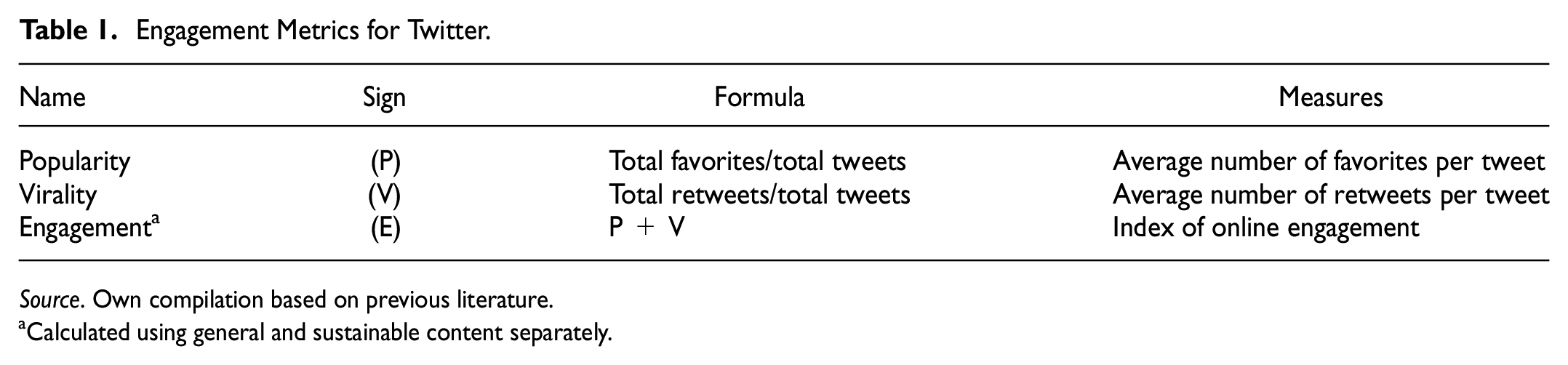
Source. Own compilation based on previous literature.
Calculated using general and sustainable content separately.
In addition, Kruskal-Wallis test was applied to determine whether there were significant differences in terms of sustainable online engagement between the four classes established based on the score of the University League. This test is considered to be the nonparametric equivalent of the one-way Anova in the case of more than two samples with the ordinal contrast variable and is the extension of the Mann–Whitney U-test (Sheskin, 2011). To analyze which groups in the “Class” category differ from each other the pairwise Mann–Whitney U-test has been performed using the Bonferroni adjustment (Agresti & Finlay, 1997).
Explanatory Analysis of GUs Stakeholders’ Online Engagement Level on Twitter
The next phase, corresponding to the second objective, led to the identification of the causal relationship between general and sustainable online engagement level obtained by the GUs and selected factors. Assuming linearity in the relationships between the variables studied and, in line with previous literature, the multiple regression analysis was performed (Blasco et al., 2019; Stone & Can, 2021). Specifically, two multivariate linear regression models were proposed: General and Sustainable. This is an appropriate technique to identify whether certain independent variables explain a continuous dependent variable (Gartchie & Gameli, 2016). Particularly, if certain organizational factors have explicative power on the level of online engagement achieved by universities. The dependent variables
Independent Variables and Study Hypotheses.

Source. Own compilation.
Taking all of this into consideration, the proposed models for the dependent variable are the following:
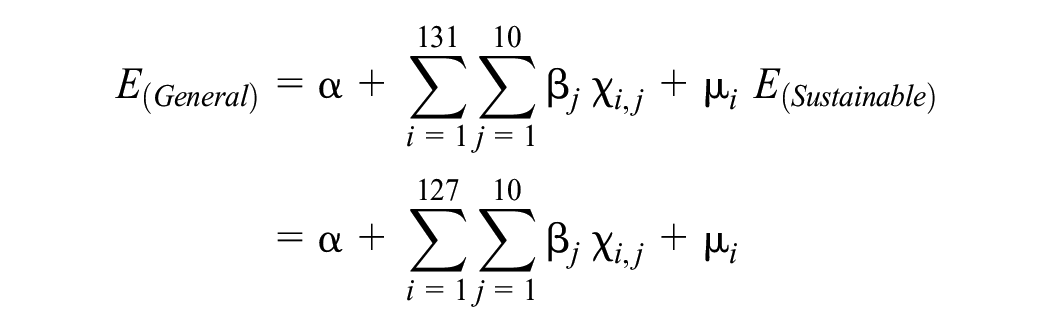
where α is the constant term,
Results and Discussion
GUs Stakeholders’ Online Engagement Level on Twitter: Descriptive Statistics of Sustainable and General Content
In order to achieve the first objective and test whether content on sustainability issues contributes more to the level of online engagement than general content, the totality of tweets will be analyzed. This will allow grouping all the content into general and sustainable.
Delving further into the 145.941 tweets analyzed, it turned out that British Green universities disclose more general versus sustainable information (see Table 3) on their public Twitter accounts (771.47 tweets vs. 191.59, respectively). However, the engagement on sustainable content is higher than that calculated for general content, despite greater activity in relation to the latter (see Figure 3).
Descriptive Interactions and Content Statistics.

Source. Own compilation.

Stakeholders’ online engagement level, considering tweet content type.
Moreover, the dot plot (Figure 4) indicates that most of the observations are between 40 and 20 score of the People & Planet University League. Likewise, this plot shows the greatest commitment to sustainable information. These results show that the best-ranked universities do not necessarily make a greater effort in social media to involve their stakeholders. Possibly the first category universities direct their efforts to maintain or enhance their positions in the international rankings, being aware of the reputational benchmarking that they represent (Albornoz & Osorio, 2017). However, being higher-ranked does not seem to be reflected in a greater online engagement by stakeholders.

Stakeholders’ engagement level based on the position in the People & Planet University League.
It is worth noting that in both cases the number of favorites is much greater than the number of retweets (see Table 3). On one hand, about 8.9 thousand versus 2.7 thousand for general tweets and on the other hand 2.8 versus 945 for the sustainable content. These results confirm the outcomes of previous literature: the engagement level is quiet low in terms of the effort made (Gálvez-Rodríguez et al., 2020; Sáez-Martín et al., 2019).
Regarding the polarity of the tweets, it could be highlighted that positive sentiment tweets outweigh the negative and neutral in the general topics. The trend is similar in sustainable content tweets, with universities prioritizing messages in a positive and neutral way. It seems like universities tend to spread more positive and neutral messages to their stakeholders both related to general and sustainable issues in line with Ballestar et al. (2020) and Kimmons et al. (2017).
GUs Stakeholders’ Sustainable Online Engagement Index through Twitter: Comparative Statistics Adapting People & Planet University League Classification Approach
After performing Kruskal-Wallis test, the results for all groups show that there are significant differences between the measures of engagement in the tweets of sustainable content by class (
Stakeholders’ Sustainable Online Engagement Comparative Statistics, Considering the Classification Used by People and Planet University League.

Source. Own compilation. (0—failed universities, 1—first class universities, 2—second class universities, and 3—third class universities).
Significant at *p < .1. **p < .05. ***p < .01.
On the one hand, according to the engagement dimensions (see Table 5), it is observed that the popularity on Twitter, measured by the number of “favorites” per sustainable tweet, attains the highest scores. The second-class universities obtained an average of 15.36, reaching a maximum of 110.35 “favorites” per tweet. On the other hand, the virality, measured by the number of retweets received per tweet of sustainable content, scores down. In this case, the second and third-class universities leads with a mean of 5.17 and 4.10 retweets, respectively.
Stakeholders’ Sustainable Online Engagement Descriptive Statistics, Considering the Classification Used by People and Planet University League.

Source. Own compilation.
These results are in line with those obtained by Sáez-Martín et al. (2019) and Gálvez-Rodríguez et al. (2020) who affirm that the content offered by the organizations on social media is considered interesting and useful, but not enough to retweet (share) it, showing a low level of commitment for the effort made.
Taking into account the above, a graphical view of the engagement metrics reached according to the score obtained in the People & Planet University League is provided in Figure 5.

Stakeholders’ sustainable online engagement level, considering the classification used by People and Planet University League.
GUs Stakeholders’ General and Sustainable Online Engagement Level on Twitter: Explanatory Analysis
Two multivariate regression analysis were performed, in order to study the influence of specific factors on the level of online engagement on universities’ Twitter. This analysis will enable the achievement of the second objective. The resulting models were statistically significant (F = 37.15*** and F = 20.19***). After post hoc analysis, the compliance of initial hypothesis was confirmed. In line with Lu and Abeysekera (2014) and Gálvez-Rodríguez et al. (2016) a White’s robust estimator adjustment was proceeded when the homoscedasticity failed in the Sustainable model. The General Model’s explanatory capacity, measured by adjusted R2 was 73.55% and Sustainable Model was explained by the independent factors in 70.50% by using R2.
Next, according to Blasco et al. (2019) a Pearson correlations analysis was conducted (see Tables 6 and 7). This test revealed the correlations between the independent factors. It may be due to the classifications of polarity into positive, negative, and neutral tweets. Some of the tweets have both positive and negative sentiments and according to the used artificial intelligence algorithm, they were classified into one or another polarity group. However, the significant correlation found was lower than 0.8 to provoke problems of multicollinearity in these models (Neter et al., 1996). Nevertheless, and according to the previous literature in social science, to ensure that the increase of the variance of an estimated regression coefficient does not cause the multicollinearity problems if the explanatory variables are correlated, the variance inflator factor (VIF) was quantified (Gálvez-Rodríguez et al., 2020). According to Cohen et al. (2013) and Neter et al. (1996), the models do not present multicollinearity problems since the VIF values found were under ten (see Tables 8 and 9).
Pearson Correlations for General Model.

Source. Own compilation.
p < .1. **p < .05. ***p < .01.
Pearson Correlations for Sustainable Model.
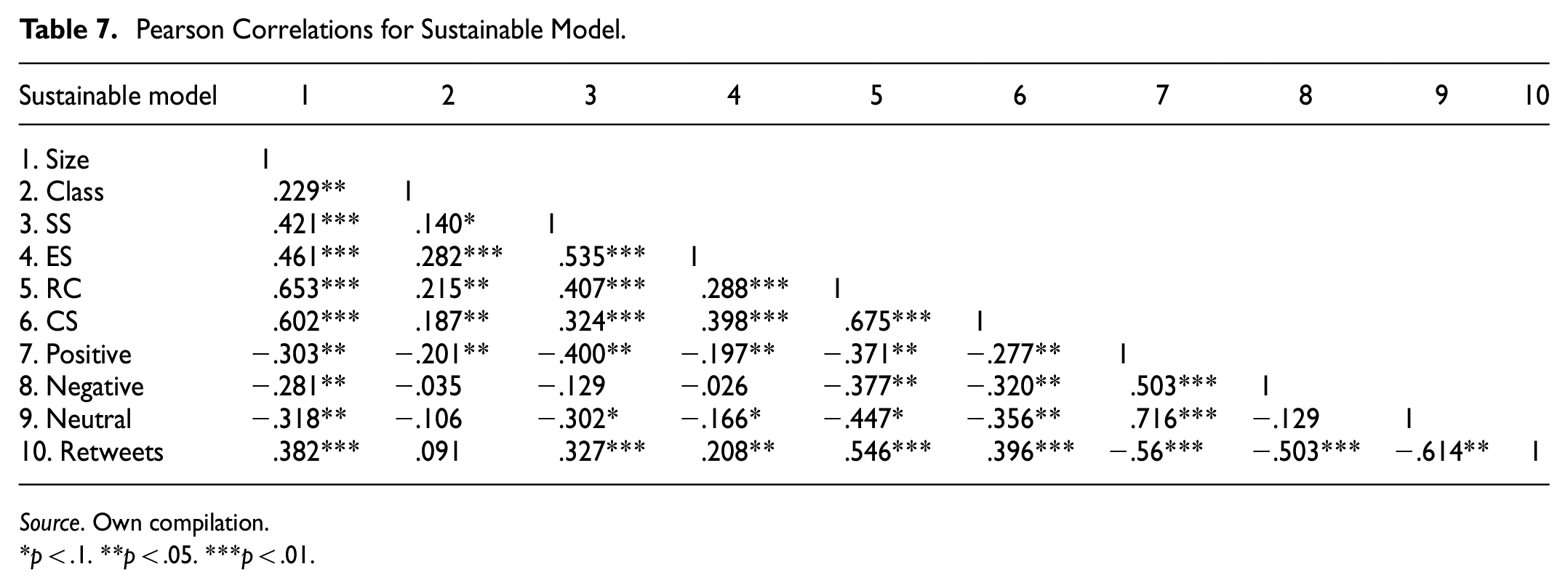
Source. Own compilation.
p < .1. **p < .05. ***p < .01.
Regression Results for the General Model.
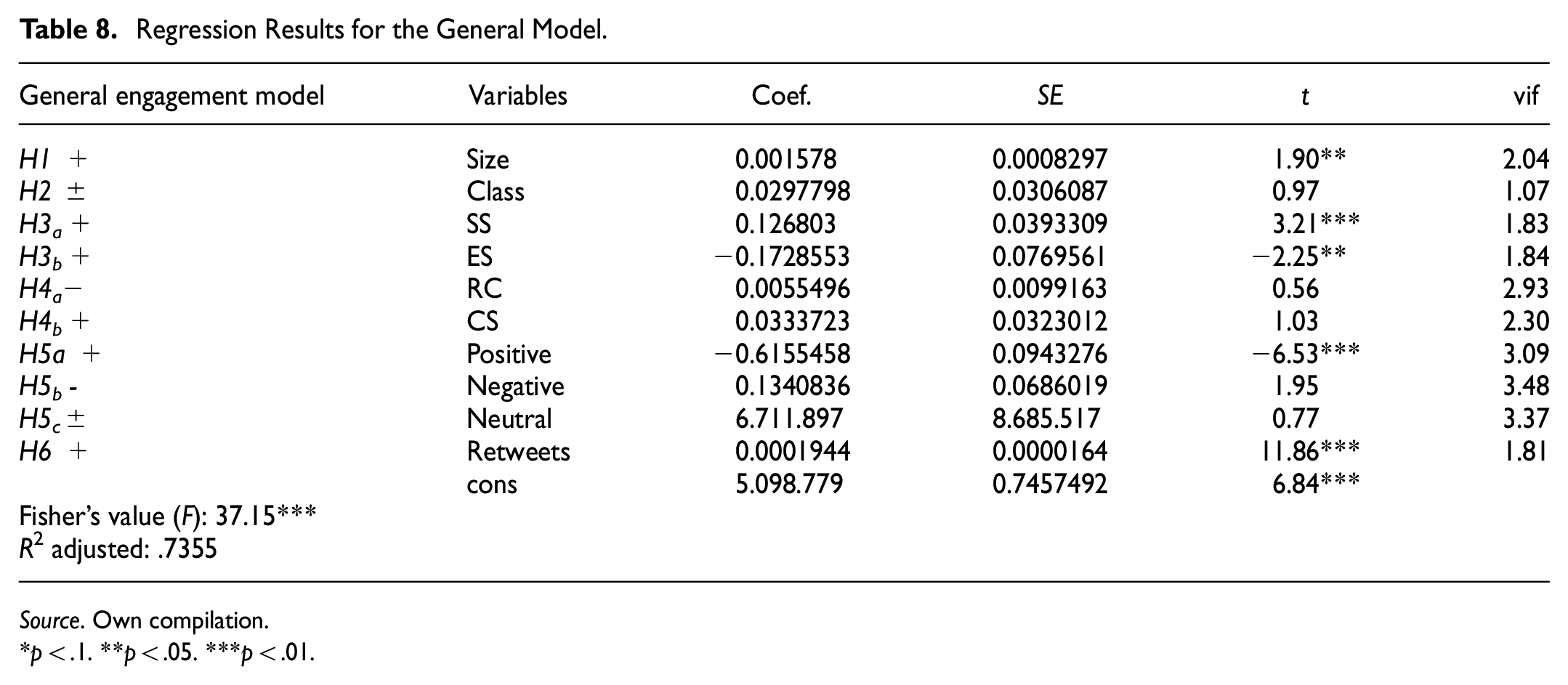
Source. Own compilation.
p < .1. **p < .05. ***p < .01.
Regression Results for the Sustainable Model.

Source. Own compilation.
Note. Fisher’s value (F): 20.19***. R2: .7050.
p < .1. **p < .05. ***p < .01.
Regarding the hypothesis set out in this study (see Tables 8 and 9), three of them were confirmed in General Model and seven in the Sustainable one (with six and eight factors found to be significant, respectively).
Pertaining to H1, the influence of organizational size was positive both for general and sustainable information online engagement. This outcome is in accordance with the established hypothesis and previous studies that evidence the positive effect of this factor in greater online engagement in line with Haro de Rosario et al. (2016) and Alonso-Cañadas et al. (2020). Therefore, the larger the university’s student population, the greater the need for interactions with those universities. It could be because they have greater exposure to public scrutiny, which leads to more public attention and reactions to published information on their social media. Likewise, as students are a collective very keen on using social media (Davis et al., 2012; Sutherland et al., 2018), there is a greater probability of obtaining significant interactions on the universities’ social media.
With respect to the second hypothesis, the classification of universities based on the People & Planet University League seems to have no significant impact on the commitment with the general content. These outcomes do not provide sufficient evidence to support H2 within the General Model. Nevertheless, this classification has been a relevant factor for the participation of stakeholders in the universities’ Twitter accounts related to sustainable content. Despite the initial findings suggesting that universities with higher rankings do not necessarily experience heightened engagement levels, the explanatory analysis presents a different perspective.
Particularly, the analysis indicates that lower engagement levels seem to be influenced by the general content dissemination. However, when the GUs make the information related to sustainable performance open, the organizational reputation affects stakeholder engagement with the institution. These results are in line with McCoy et al. (2017) who noted that GUs classified as the first-class universities having a better reputation in sustainable issues achieve a higher level of commitment from their stakeholders.
The H3 set finds partial support in both models under consideration. The results confirm that implementing active policies aimed at involving the university community in the sustainable management system leads to greater online engagement (H3a).Therefore, and in line with Veiga Ávila et al. (2017) it could be argued that the participation of the university community is a key factor in achieving sustainable development by GUs. However, when considering the sustainable environment, it appears that the implementation of numerous actions on this matter leads to the stakeholders’ rejection (H3b). This could be attributed to stakeholders perceiving such actions as unrealistic rendering them unattainable or non-sustainable over time in terms of implementation of a multitude of sustainable development actions or measures. Consequently, in contrast to Adams et al. (2018), the significant effort made by GUs in the implementation of sustainable environmental policies is not reflected by a higher level of commitment from their stakeholders.
The resource consumption (H4a) showed a statistically significant and negative expected effect on sustainable online engagement level. Consequently, these results suggest that universities implementing effective policies to reduce energy or water consumption and subsequently sharing these practices on social media are the ones that get more support from their online stakeholders (Hamid et al., 2017). Therefore, it is confirmed that the initiatives focused on water and energy conservation have an impact on a heightened stakeholders’ commitment (students and staff). These findings are in line with the previous literature that underscore the positive assessment stakeholders accord to energy conservation initiatives within university campuses (Aleixo et al., 2018; Cotton et al., 2015).
The provision of an adequate number of bicycle spaces has emerged as another influential factor affecting online engagement. This outcome affirms the established hypothesis (H4b) for the Sustainable Model. Thus, it can be assumed that stakeholders aware of sustainable problems give their full support to universities with these green practices. In this regard, the presence of more bicycle spaces not only promotes their usage but also aligns with the green paradigms advocated by UNESCO, aiming to alleviate traffic congestion in neighborhoods adjoining campuses and mitigate its adverse repercussions (Barata et al., 2011). Nonetheless, these findings diverge from the conclusions drawn by Hancock & Nuttman (2014), who discovered that students display a preference for using cars when commuting to and from the university.
Concerning H5 hypothesis set, the positive sentiment polarity (H5a) turns to be significant in the proposed models in line with Lalicic et al. (2020). Although GUs prioritize the use of positive and neutral language in their tweets (Kimmons et al., 2017), this results in the opposite of the desired effect on stakeholders’ online engagement in the case of general information disclosure. These results are in line with those stated by Dardenne et al. (2011) and Gálvez-Rodríguez et al. (2020), suggesting that positive messages lead to fewer interactions from stakeholders.
In relation to the Sustainable Model, the results found confirm that the majority of tweets are framed within a positive or neutral context echoing the observations of Ballestar et al. (2020). However, in this case, the tweets published by GUs generate interactions with stakeholders that can significantly influence their online engagement with the organization. Therefore, in the case of the sustainable performance content dissemination, the relevance of positive tweet tone to achieve a true dialogic engagement is supported (Gálvez-Rodríguez et al., 2020; Stieglitz & Dang-Xuan, 2013).
If negative sentiment polarity is analyzed (H5b), the inverse relation to that expected with the General Model’s engagement was observed and no influence in Sustainable Model. These results indicate that universities may not necessarily refrain from using negative general content tweets to engage stakeholders, as the latter tend to react more significantly and with greater commitment to negative tweets, as posited by Hughes et al. (2012).
As for tweets with neutral sentiment polarity, the results do not comply with the expected influence (H5c).
Finally, in relation to retweets number, a statistically significant and positive relationship with online engagement was observed, thereby confirming H6 in both models. This is consistent with the findings of Suh et al. (2010), who assert that retweeting is a key mechanism to boost online participation on social media when the relevant information is disclosed. Furthermore, these results confirm that this uncomplicated act of retweet is the way to initiate and sustain dialogues with the stakeholders (Moll de Alba Mendoza, 2015). In this way, GUs could enhance the interactive experiences in order to generate more online engagement for both general and sustainable performance communication.
Conclusions
The awareness of sustainable development is currently a globally debated topic. Higher education plays a crucial role in fostering a culture of sustainability. Additionally, Twitter, one of the most widely used social media platforms, serves as a valuable tool for raising public awareness about environmental sustainability among students, staff, management, and society at large within green universities.
In this context, the main aim of this paper addresses the analysis of GUs stakeholders’ reactions to the disclosure of information related organization’s sustainable performance. Accordingly, the analysis involves content published over a year via the official Twitter profiles of GUs ranked by the British People & Planet University League.
Employing text mining techniques, tweets are categorized into general content issues including management and administration, among others, as well as those related to sustainable topics. The outcomes of this content analysis contribute to achieving the established objectives. On the one hand, to explore the behavior of stakeholders on Twitter in relation to general and sustainable content in order to measure online engagement. On the other hand, to analyze the possible online engagement’s influential factors.
First and according to the results, it could be noted that there are differences in the level of online engagement between sustainability-related content and general content, with the former achieving higher values in terms of popularity and virality. This suggests that stakeholders are more engaged with the issues concerning sustainable policies and actions compared to general content. Therefore, GUs concerned to become a “real Green University” may use social media not only to be more transparent and accountable, but also to foster and cultivate sustainable public awareness while involving all stakeholders in pursuit of sustainable development.
Second, it could be observed a set of determinants that directly and positively influences stakeholders to participate on GUs’ Twitter.
In particular, larger GUs are effectively using social media not only to engage stakeholders with their sustainable contents, but with the institution as whole. Furthermore, those tweets with more retweets achieve higher levels of online engagement, as the retweet invites others to participate in the universities’ issues even if the message is not directly addressed to them.
However, HEIs that claim to be a “real Green University” should keep in mind that the orientation of their sustainability strategies has an impact on online engagement. That is, efforts to involve certain stakeholders (e.g., students or university staff) in the design of a sustainable management system are rewarded as they become more involved and committed to the organization. However, attention must be paid to the environmental strategies to be implemented by the GUs. In this regard, it should be taking into account that implementing a greater number of actions or measures for creating a sustainable environment does not mean greater engagement with the organization. In fact, simple actions that can be carried out by the university’s community achieve a higher level of involvement. This is the case, for example, of energy saving policies promoted on green campuses. Sustainability practices, such as reducing electricity and water consumption or facilitating access to green transport, help to achieve the stakeholders’ sustainable engagement. Thus, for GUs, social media could be used to convey sustainable development strategies and performance, contributing to their quest to become fully-fledged green universities and to raise environmental public awareness.
Likewise, the best-ranked GUs are those that have the greatest support from their stakeholders through social media. As benchmarks for sustainable development, society shows a high level of commitment to these organizations, especially when they communicate their actions to society. Therefore, GUs should maintain or improve their reputational standards, since they are a reference for environmental awareness. Finally, it is observed that messages on the sustainable development should be disclosed to stakeholders in a positive language. The results indicate that this is the way to encourage stakeholders to interact and actively participate to build a bidirectional conversation. This kind of two-way communication will provide a long-term commitment with the organization.
Moreover, the outcomes serve to evidence the utility of theories used to analyze the explanatory power of social media in terms of sustainability. The dissemination of information by HEIs through social media is explained under the framework of the Stakeholder and Legitimacy Theories. At this respect, the organizational long-term survival will be guaranteed and legitimized by their actions and commitment they are able to generate throughout society. Moreover, based on Emotional Contagion Theory, previous authors posit that social media content is able to spread information with an emotional communication chosen that could affect the behavior of individuals. The obtained results support that GUs should use messages with clearly positive sentiments if they want stakeholders voluntarily participate in their social media.
Despite the findings, this study presents some limitations such as the selection of higher education organizations of British origin; the restriction of the analysis to Twitter pages, and the period studied limited to one year. However, we suggest that this time limit does not invalidate the findings, as it would be sufficient to establish a pattern of behavior.
For further research, it would be interesting to analyze this topic in other geographical areas and based on other reputational rankings that delimit the GUs at the European level, and even at the global level. Similarly, future research should examine other factors, in addition to those considered in this paper.
Footnotes
Declaration of Conflicting Interests
The author(s) declared no potential conflicts of interest with respect to the research, authorship, and/or publication of this article.
Funding
The author(s) received no financial support for the research, authorship, and/or publication of this article.

Data Availability Statement
Data sharing not applicable to this article as no datasets were generated or analyzed during the current study.