




Abstract
Despite growing efforts to integrate research and teaching in education, a persistent gap remains, raising uncertainties about the sustainability of the research-teaching nexus. This study reports on an initiative by a leading university in Saudi Arabia to establish a Scientific Research Committee for English Language Teachers, aimed at promoting the research-teaching nexus within the department. The study aims to explore teachers’ involvement in the initiative, their self-assessment of research literacies, and their perceptions of the impact of research on teaching. This leads to the identification of the contributors and barriers to nurturing a sustainable research-teaching ecology. A mixed-methods approach was employed, with purposive sampling of English Language teachers across five groups: (1) most active, (2) less active, (3) new staff, (4) PhDs, and (5) Master’s degree holders. This study provides a multidimensional view of teachers’ perceptions of the research-teaching nexus, employing a research literacy questionnaire, scenario evaluations, and a SWOT analysis to identify factors that enhance effectiveness and address barriers to sustainable research integration for English teachers. Results revealed significant variations based on teachers’ qualifications and engagement levels. More qualified and engaged participants strongly supported the research-teaching nexus, with institutional support, professional development, and career advancement, and adequate resources cited as key benefits, though procedural, psychological, and contextual barriers must be addressed for sustainable integration. Finally, in alignment with Klein and Gwaltney’s model, a bidirectional dissemination plan, comprising dissemination, facilitation, and implementation, is proposed as essential for establishing and sustaining a robust research-teaching ecosystem.
Keywords
Introduction
Saudi Vision 2030 views higher education and research as strategic pillars for socioeconomic development, innovation, and knowledge creation, aligning closely with the UN sustainable development goals (SDGs) and OECD (2019) priorities for quality education and sustainable development (Abouammoh, 2018; Allmnakrah & Evers, 2020; OECD, 2019). Supporting this view, the Ministry urges Saudi universities to prioritize scientific research, promoting research-driven approaches to improve teaching quality and research capacity to meet national and international benchmarks (Borg & Alshumaimeri, 2012; Elyas & Picard, 2013). One response to this call from HE is the increased attention to a stronger need for faculty research engagement, the integration of research into professional development, and the establishment of Research Excellence Centres to boost international visibility (F. M. Ghabban et al., 2016; F. Ghabban et al., 2019).
Despite these efforts, most initiatives focus on science and technology (Al Fraidan & Alaliwi, 2024; Al Fraidan & Olaywi, 2024), resulting in a limited understanding of how university-based teacher educators, particularly English language educators, respond to emerging research requirements within their disciplines. Existing studies provide limited insight into how Saudi higher education academics conceptualize research (Al-Subaie, 2024; Mohiuddin et al., 2023). This study specifically addresses this gap by examining how English language educators at Saudi universities perceive the integration of research into their teaching and identifies strategies to sustain their engagement through effective dissemination, aiming to inform national education policy and goals.
To address this, in line with national policies promoting research integration in teaching-oriented departments, the current study reviews an initiative by a leading Saudi university that established the Scientific Research Committee (SRC) in 2021 at its English Language Skills Department to encourage teacher-led research initiatives and strengthen the link between teaching and research. Aligning with Klein and Gwaltney’s (1991) dissemination model (spread, choice, exchange, and implementation), the SRC supports a research-driven culture by encouraging all faculty to participate, regardless of experience. By examining staff research literacy, relevance to teaching, and context, and conducting a SWOT analysis across diverse backgrounds (including those of Master’s and PhD holders), this study aims to explore faculty research skills and their views on research engagement, guiding sustainable research practices across the department and advancing national academic goals.
Literature Review
The discussion of “teachers as researchers” dates back to the 1970s, with Lawrence Stenhouse’s movement paving the way for numerous influential studies in TESOL (McKinley, 2019). Since then, various terms have emerged to advocate for this concept, including, link, interface, nexus, engagement, and unity of teaching, research, and action research (Borg & Alshumaimeri, 2012; Burns et al., 2022; Neumann, 1992, 1996).
Research and Teaching Divide
Teachers and researchers are often characterized as facing each other across a “gap” that separates them (Beycioglu et al., 2010; Broekkamp & van Hout-Wolters, 2007; De Costa et al., 2022; Hemsley-Brown & Sharp, 2003; Vanderlinde & van Braak, 2010). This could be due to the fact that institutions that are teaching-oriented tend to recruit teachers for their pedagogical proficiency rather than for research competence, and many teachers lack recent research potential (Willemse et al., 2016). According to Hammersley (2013), this divide between them can be attributed to the differing focuses, with researchers often prioritizing theory and teachers focusing on practice. This gap, according to Robinson (2003), highlights the ongoing difficulties in reconciling these separate roles, which can hinder effective integration of research into teaching practices. David (2002) and Borg (2009) found that many teachers perceive research as not related to their teaching practices. However, an emerging perspective recognizes teachers’ role not merely as passive technicians who consume others’ proposed theories, but as active practitioners who theorize from their own practices and methodologies (Kutlay, 2013).
Research-Teaching Nexus
A quality international literature distinguishes engagement with research (reading, interpreting, and applying research) from engagement in research (inquiry alone or in groups; Bell et al., 2010; Borg, 2006, 2007, 2009, 2010). Supporting this view, Macfarlane (2011) accentuates that the core of academia lies on balancing “teaching-informed research and research-informed teaching” (McKinley, 2019, p. 2), with an emphasis on the need for a successful implementation of “knowledge to action” flow combining evidence-based practice (top-down) with practice-based evidence (bottom-up) approaches, supported by leadership and system changes (Fixsen & Ogden, 2015; Groothuijsen et al., 2023).
A course of literature has advocated the benefits of teachers’ engagement in research and its impact on their holistic professional development, pedagogical practices and experiences (Alenezi, 2021; Anwaruddin, 2015; Borg, 2009; Borg & Alshumaimeri, 2012; Burns & Westmacott, 2018; Consoli & Dikilitaş, 2021; Leat et al., 2015; W. Liu & Wang, 2018; Sato & Loewen, 2022; Tavakoli, 2015; Wyatt & Dikilitas, 2016). Some view that teachers’ active engagement in research makes them more confident and independent in critically evaluating and assessing their teaching practices (Yang, 2009).This reflective process boosts teachers’ self-awareness and autonomy (Burns & Westmacott, 2018; Hong & Lawrence, 2011; Li & Xu, 2024; Y. Liu & Borg, 2014), strengthening their theoretical knowledge, and improving decision-making in education (Alenezi, 2021; Alharbi & Aslan, 2024; Hargreaves, 2009; Rahimi & Weisi, 2018; Sato & Loewen, 2022).
Barriers to Research-Teaching Nexus
Several barriers are reported in the existing literature, impacting the research-teaching nexus. Most notably, time constraints and heavy teaching loads are identified as key factors limiting teachers’ ability to participate in research (Benegas, 2018, 2019; Beycioglu et al., 2010). A qualitative case study from Myanmar compared two teacher education colleges to explore variations in teacher educators’ research engagement (Kyaw, 2021). Conducting semi-structured interviews with principals and educators, the study identified that research engagement is shaped by a combination of personal, institutional, policy-related, and system-level factors.
Similarly, rigid curricula, large class sizes, administrative pressures, and other duties hinder the teachers’ involvement in the contexts of Chinese (Y. Hu et al., 2019) and Vietnamese universities (Hiep, 2006). Haile’s (2013) study in the Ethiopian context revealed that inadequate institutional support, the absence of structured research training programs, and limited access to research materials, funding, and professional development opportunities were common barriers in their findings. Borg (2006, 2007, 2009) surveyed over 2,900 language teaching professionals globally and found that limited access to research materials, coupled with insufficient training, made research activities seem unfeasible for many teachers.
Insufficient support and financial incentives were also frequently noted as obstacles to research engagement (Alhassan & Ali, 2020; De Costa et al., 2022; Ulla, 2018). Borg and Alshumaimeri (2012) emphasized the gap between institutional expectations regarding research engagement and the actual support provided to teachers (Banegas, 2018; Beycioglu et al., 2010), resulting in a lack of research engagement. This is also related to the lack of collaborative culture, which emerged as another barrier impacting the need for knowledge exchange and joint research efforts (Allison & Carey, 2007; Atay, 2008; Borg, 2006; Cain, 2015). Teachers’ own attitudes, beliefs, and motivation about research also represent significant personal barriers to research engagement. A study in Saudi Arabia (Borg & Alshumaimeri, 2012) found that, despite institutional expectations, faculty members often limit their research involvement because they perceive the environment as unsupportive of their research. This suggests that institutional encouragement alone is insufficient and universities need to go beyond mere encouragement and take practical steps to initiate better support systems, thereby creating a more conducive environment for research.
Research Integration Initiatives
The existing literature reports several initiatives aimed at establishing the nexus between research and practice. For example, Abbot and Lee (2022) reported using professional reading groups in adult second language programs to bridge the gap and foster collaboration between researchers and practitioners. This longitudinal study led to the development of autonomous communities of practice that applied research findings to enhance educational practices. Ni and Wu (2023) examined the cognitive transformation of a Chinese college English teacher over a 4-years period, focusing on the integration of teaching and research through sociocultural theory. The findings show that the teacher’s perception of this nexus evolved through active participation in a supportive environment, leading to professional growth in both teaching and research.
Similarly, Guerrero-Hernández and Fernández-Ugalde’s (2020) research conducted, over 5 years in the Chilean context showed that professional learning communities (PLCs) supported by researchers were successful in meeting teachers’ professional development needs, but their long-term effectiveness depended on the contextual support and commitment from both participants and institutions. These studies highlight the importance of community-based learning environments that encourage sustained collaboration among teachers, researchers, and institutional stakeholders. The importance of fostering a research-conscious teaching community is reflected in another study of 67 tertiary EFL teachers in Cantho, Vietnam (Uyen & Vien, 2021), which also showed positive views on the benefits of research and high levels of engagement, despite challenges related to time, resources, and professional development.
Even though, several efforts and initiatives have been employed to disseminate educational research to teachers and establish research-teaching nexus (Groothuijsen et al., 2023; Kyaw, 2021; Levin, 2014; Ping et al., 2018; Smith et al., 2019), empirical studies reveal that this divide remains persistent, especially in ELT contexts where university teachers are not traditionally engaged in research and make limited use of research in their practice (McKinley, 2019).
This persistent gap in the current literature (Alhassan & Ali, 2020; Borg & Alshumaimeri, 2010; Consoli & Dikilitaş, 2021; Li & Xu, 2024; Rahimi & Weisi, 2018) encourages universities to gather data on faculty research attitudes, broaden faculty understanding of research methodologies, and offer more comprehensive support, while fostering a collaborative, self-reflective research culture.
Effective Dissemination for Sustainable Research Practices
Some recent research dissemination efforts are summarized by Agbenyega et al. (2023), such as those by the Centre for the Use of Research and Evidence in Education (CUREE) in the UK, the Elementary Teachers’ Federation of Ontario (ETFO), and the Ontario Education Research Exchange (OERE), which all aim to make research findings more accessible and useful for educators. These organizations provide research summaries, either in written form (text-based PDFs) or audio (podcasts), to help teachers make informed decisions about effective teaching practices. As these initiatives follow a “producer-push” model of knowledge mobilization (KM), where research is simplified and disseminated to practitioners to improve their practices with a one-way flow of information from researchers to teachers, portraying teachers as passive recipients of research findings (Hargreaves, 2009). This one-way dissemination of knowledge has faced significant critique for overlooking the bidirectional flow of knowledge between researchers and teachers (Alenezi, 2021; Cao et al., 2023; Rose, 2019), and disregarding the potential benefits of teachers’ active engagement with research and collaborative dialogue between researchers and practitioners in second language (L2) education (Kincheloe, 2012; Sato & Loewen, 2022).
Effective Dissemination could be the key factor in bridging the divide between teachers and researchers. As Freire (1970) emphasized, the need for a shift from a vertical relationship between researchers and teachers to a more collaborative model, where teachers become active participants in research, co-creating new knowledge. By breaking the barrier between teachers and researchers, researchers can create a more sustainable research-teaching nexus. Similarly, a sociocultural ecological perspective (Bronfenbrenner, 2013; Vygotsky, 2011) also conceptualizes teacher development as an interactive process shaped by multiple interrelated systems. At the microsystem level, teacher growth is shaped by the immediate context of the classroom, where inquiry and reflection intersect with daily practice. The mesosystem encompasses institutional structures such as networks of collaboration, professional development programs, and research support mechanisms that mediate and extend individual practice. The macrosystem refers to the broader influences of national education policies, cultural expectations, and strategic priorities, such as those embedded in Saudi Vision 2030.
Klein and Gwaltney’s (1991) dissemination model aligns closely with the sociocultural ecological perspective, which also reinforces sustainability by ensuring that teacher research is not treated as an isolated effort but as part of a systemic, multilevel process of professional development. Klein and Gwaltney’s proposed a dissemination model (spread, choice, exchange, and implementation) as a framework to understand how research can be effectively integrated into teaching practices.
In the current context, the SRC employs a similar dissemination process to enhance the impact of faculty research. The “spread” function refers to the proactive distribution of research knowledge, ensuring that faculty have broad access to relevant resources and information that builds awareness of the research culture. The “choice” function is more responsive, providing platforms and opportunities such as training sessions and research resources that allow teachers to select the options most relevant to their needs. The “exchange” function emphasizes two-way active collaboration, creating interactive spaces, such as forums, reading circles, research days, and consultations, where teachers and researchers share experiences, and engage actively in research related activities. Finally, the “implementation” function focuses on applying research in practice by encouraging new research projects, offering technical support, and enabling teachers to integrate evidence-based knowledge into their classrooms. Through this multi-layered dissemination model, the committee fosters both the wide distribution of knowledge and active engagement with research, creating a dynamic environment for sustained teacher development and research-informed teaching.
Significance of the Study
The significance of this study lies in its contribution to understanding teachers’ research literacies, their perspectives on how research affects teaching practice, and the main contributors and barriers to research engagement. Referring to the initiative of establishing a research-oriented committee as an example, it examines the effectiveness of the SWOT framework for tracking research engagement efforts and guiding implementation with a bidirectional dissemination plan. This plan is operationalized through the spread, choice, exchange, and implementation of knowledge to ensure it is effectively shared, adapted, and applied (AlMarwani, 2020; Mohiuddin et al., 2023; Nasreen & Afzal, 2020). The findings offer a replicable approach for departments to develop and evaluate a research culture, supporting institutional improvement and educational reform.
First, the study aims to explore how English language teachers in Saudi Arabia, with varying qualifications and levels of research engagement (less active, most active, new staff, PhD, Master’s level), perceive their research literacies and their impact on teaching practices, while also identifying differences across groups. Secondly, it further examines how these teacher groups evaluate classroom-based scenarios in terms of their research relevance and how these evaluations reflect or extend the perceptions expressed through their self-reflections. Finally, the study investigates the strengths, weaknesses, opportunities, and threats (SWOT) identified by these teacher groups regarding institutional initiatives for fostering research engagement and considers how these insights can inform sustainable strategies with effective dissemination for integrating research into teaching practice and institutional culture.
Methodology
Study Design
Employing a mixed-methods design (Creswell et al., 2003), the study collects data from both quantitative and qualitative measures to gain a comprehensive understanding of teachers’ perceptions of their research literacies, their evaluation of research relevance to teaching, and internal and external factors influencing their engagement. This triangulated design provided both breadth and depth of insight into teacher research engagement and its sustainability within the institutional context.
Data Collection Procedure and Tools
Data collection followed a systematic approach to ensure validity, consisting of three complementary tools that targeted different dimensions of teacher research engagement.
The First Tool was a 20-item self-assessment scale (Rahimi & Weisi, 2018), which enabled teachers to rate their research literacies and their impact on teaching and learning. The second tool involved 15 scenarios (10 from Borg, 2009, and 5 developed and validated through piloting), designed to test teachers’ perceptions of research relevance to teaching. Together, this approach aligned with Borg’s (2009) iceberg theory, which emphasizes that teachers’ research engagement is shaped by hidden beliefs, experiences, and contextual factors (Y. Hu et al., 2019). The scale captured perceived competencies, while the scenarios contextualized and validated these perceptions, thereby strengthening the credibility of the findings. Finally, the third approach, a SWOT analysis, was chosen for its adaptability to educational contexts and relevance for the strategic planning of similar initiatives in higher education (AlMarwani, 2020; Fahim et al., 2021). Its structured categories enabled the systematic evaluation of internal strengths/weaknesses and external opportunities/threats, offering critical insights into the key contributors and barriers to the sustainability of research engagement initiatives.
All tools were piloted with 30 English teachers to ensure clarity and contextual relevance. Two PhD Expert validations confirmed the suitability of the scenarios and alignment with Borg’s scenarios, leading to minor revisions. Pilot testing further demonstrated the clarity of the scale, applicability of scenarios, and effectiveness of SWOT sessions. Collectively, these tools allowed for the triangulation of individual self-perceptions and group-based strategic insights, ensuring robust, contextually grounded findings.
Participants Selection Criteria and Process
A total of 161 English language teachers from a Saudi university participated in this study. At the time of data collection, the English Language Skills Department employed 331 staff members representing 21 nationalities (e.g., Saudi Arabia, Britain, South Africa, Canada, Egypt, United States) and holding diverse academic and professional qualifications, including PhDs, Master’s degrees, and teaching certifications such as CELTA. Since the establishment of the SRC, staff engagement has varied considerably: some teachers remained consistently active despite workload demands, while others participated minimally due to limited research experience or competing responsibilities. This variation made the department a suitable context for examining differentiated perceptions of research engagement and identifying conditions for sustainability.
Through a purposive sampling strategy, participants were selected to represent a range of qualifications, experiences, and activity levels and divided into five focus groups: (1) Most Active in research-related initiatives, (2) Less Active, (3) New Staff (joined in 2023–2024), (4) PhD Holders, and (5) Master’s Degree Holders. This grouping allowed for meaningful comparisons across both engagement levels and academic qualifications, aligning with the study’s aim of identifying sustainable practices through effective dissemination strategies with an inclusive approach.
The grouping process followed explicit criteria. Each participant was assigned to only one group to avoid overlap. Teachers were first classified by academic qualification, with 30 participants selected from each category. The remaining staff were categorized by engagement level using SRC activity records, attendance logs, and the annual staff achievement repository. Most Active teachers were defined as those who, in the past 2 years, had participated in at least four or more SRC activities annually, produced research outputs (e.g., publications, presentations, reading circles, collaborations), or contributed through mentoring and committee work. Less Active teachers were those with minimal involvement, typically limited to one or two activities annually without research outputs. To mitigate potential non-response or non-participation, a larger number (41) were recruited from the Less Active group (see Table 1).
Study Sample: Categories and Sample Selection.

Participation was voluntary, and invitations were sent via email with clear information about the study’s purpose. Informed consent was obtained, and participants were assured of anonymity and confidentiality throughout the process.
Demographics of Participants
The demographic information (see Table 2) reveals that nearly half of the participants (49%) have over 10 years of teaching experience, while only 15% have less than 5 years of experience. For teaching experience in Saudi Arabia, 35% have taught there for over a decade, and 33% for 6 years or more. Participants also assessed their research skills as inexperienced, novice, competent, or expert. Approximately half lack research skills, with 23% having no experience and 34% identifying as novice researchers. The remaining 43% are competent or expert researchers. This diversity further verifies the rationale for grouping to explore participants’ unique literacies, research engagement, and insights.
Demographics of Study Sample.

Analysis and Results
Part One: Participants’ Self-Assessment of Research Literacy and Its Impact on Teaching
To explore the first area of research, a 20-item scale was used, which was first tested for reliability. The Cronbach’s alpha score of .972 proved its internal consistency and high reliability. The 20 items were rated on a 5-point Likert scale, ranging from “not at all” to “a great deal.”
A general descriptive statistical analysis of the 20 items (see Table A1) revealed an overall mean score of 3.76 (SD = 0.85). This reports respondents’ abilities across various aspects of the research process. The narrow score ranges within categories prove consistent self-assessment across different research competencies and impacts. Among the research skills, participants’ responses ranged from M = 3.44 to M = 3.09. This reflects their good understanding in some specific areas including: research ethics (M = 3.44), critical stance/biases (M = 3.40), data collection (M = 3.38), research reports (M = 3.35), researchable issues (M = 3.34), research implications (M = 3.28), research questions (M = 3.25), data analysis (M = 3.23), research methods (M = 3.20), literature review (M = 3.10), and research instruments (M = 3.09). Items measuring respondents’ views on the influence of research on teaching scored between M = 3.52 and M = 3.23. Research was viewed as beneficial for understanding learners’ needs (M = 3.52), improving learner outcomes (M = 3.50), enhancing teachers’ confidence and autonomy (M = 3.45), and facilitating professional collaboration (M = 3.25). Engagement in research activities (M = 3.37) and research reading influence on teaching (M = 3.23) were rated positively, though actual research reading was infrequent, receiving the lowest score (M = 2.92).
The above analysis demonstrates good research skills, positive views on research integration, and collaboration and support as meaningful contributors to the research-teaching nexus and its sustainable ecology. However, overall descriptive statistics alone don’t capture group variations. For this purpose, group responses were compared to highlight specific differences, identifying vulnerable groups that could be targeted for the effective integration of research, ensuring sustainability.
Descriptive Statistical Analysis of Group Responses
A statistical descriptive analysis was conducted on the 20-item scale to understand group-level variations. The SD values (see Table 3) show that Master’s degree holders (G5) exhibit the highest variability in responses (SD = 0.96), revealing internal inconsistencies within the group, while PhD holders (G4) show the least variability (SD = 0.61), reflecting greater consistency among their responses.
Descriptive Statistical Analysis of All Groups Research Literacies and Their Impacts on Teaching.

Group mean scores highlighted clear differences. PhD holders (G4) appear to be more confident in their research skills and the perceived benefits of teaching, as evidenced by the highest score (M = 4.16), suggesting a correlation between higher education and performance. Most Active Teachers (G2) also reported relatively high scores (M = 3.49), indicating stronger engagement with research, whereas New Staff (G3) showed moderate awareness (M = 3.21). Notably, Less Active Teachers (G1) and Master’s degree holders (G5) reported similarly low mean scores (M = 2.98 and M = 2.72, respectively), highlighting the need to examine factors contributing to limited literacy and interest.
Analysis of Variance of Groups
A one-way ANOVA confirmed statistically significant differences among the five groups (p = .000), showing that engagement levels and qualifications strongly influenced teachers’ perceptions (see Table 4).
Participants Groups ANOVA Analysis.

Posthoc comparisons (see Table B1) clarified these differences. PhD holders (G4) scored significantly higher than all other groups (p < .001), confirming their advanced research knowledge and positive attitudes toward research-teaching integration. Most Active Teachers (G2) also outperformed Less Active Teachers (G1) (mean difference = −0.50), highlighting the impact of active participation on improved research literacy. However, New Staff (G3) and Master’s degree holders (G5) did not significantly differ from the Less Active group (G1), suggesting that both groups remain at relatively early stages of research engagement.
The general and group comparisons in the first part provided valuable insights into teachers’ research skills and their perceived positive impact on teaching. These findings establish a clear hierarchy of research literacy across groups and set the stage for scenario-based evaluations to further test how teachers apply research in practice.
Part Two: Evaluation of Scenarios Across Five Groups
The second area of exploration builds on part one by further comparing and validating its responses. To do this, participants were presented with 15 scenarios to determine whether they considered them research based. The scenario evaluation provides several key insights into how teachers from various groups perceive the relevance of teaching scenarios to research, highlighting variations based on their qualifications and engagement in research activities. The scenarios were evaluated based on four items: (1) Definitely not research, (2) Probably not research, (3) Probably research, and (4) Definitely research. The internal consistency of all 15 items was assessed, scoring a Cronbach’s alpha of .796, which indicates a strong underlying construct and acceptable reliability.
Scenarios Categorization
A general descriptive statistical analysis of the 15 scenarios across 5 groups was conducted, with the scenarios categorized from the lowest (definitely not-research) to the highest (definitely research) mean scores (see Table 5 and Table C1). Table 5 displays the condensed version of the original scenario statements, retaining the key idea of each scenario.
Categorization of Scenarios According to Their Mean Score (Least to Highest).

The scenarios created by the pilot group (S11–S15) scored the lowest mean, aligning more with routine teaching than research. The scenarios involving basic classroom management activities received lower mean scores, suggesting that these routine tasks do not require advanced research skills. For example, managing a class as a cover teacher (M = 1.39), adjusting seating arrangements (M = 1.91), and managing class time (M = 1.99) were rated lowest. In contrast, tasks that involve deeper levels of analysis and critical thinking, such as conducting research interviews (M = 2.58) and writing a literature review (M = 2.87), received moderately higher ratings. Further along the scale, tasks demanding a greater level of intellectual engagement and application of research principles, including article writing (M = 3.05), comparative analysis (M = 3.19), trialing a new teaching method (M = 3.30), and systematic data collection and analysis (M = 3.68) were rated highest. These findings demonstrate a clear progression from routine to research-based tasks along the mean score scale, also showing a good understanding of what constitutes research and what does not.
Groups and Scenario-Based Evaluation of Research Relevance
The scenario analysis provided a detailed understanding of how different teacher groups evaluated classroom practices in terms of their research relevance and how these evaluations reflected or extended their self-reported perceptions of research literacy.
Clear distinctions emerged among the groups.PhD staff (G4) demonstrated the strongest research orientation, producing the highest mean scores across more than half of the scenarios (e.g., S1, S4, S6, S7, S8, S9, S10). They were most likely to identify systematic, data-driven, or reflective activities as research-relevant, reflecting the influence of advanced training in research design and inquiry. Their responses also aligned with the 20-item self-cognition scale, indicating a strong correlation between self-perception and recognition.
The Most Active group (G2) followed closely, also assigning relatively high ratings in scenarios that emphasized structured or collaborative elements (e.g., S2, S4, S5, S6, S13). While not as consistent as the PhD group, their applied judgments show how active engagement in research compensates for the absence of doctoral-level training, fostering stronger practical literacy.
By contrast, Less Active staff (G1) and New Staff (G3) displayed more conservative evaluations, tending to downplay the research potential of reflective or collaborative tasks, as evidenced by low ratings in S7, S8, S11, and S12. New Staff, emerging as the most cautious, had the lowest mean scores in multiple scenarios, which likely reflects limited exposure to institutional research culture and underdeveloped confidence in identifying research-teaching connections.
Master’s level staff (G5) also leaned toward caution, often assigning lower ratings to practice-oriented scenarios (e.g., S2, S3, S5, S12). However, this group showed interesting variation: in S9 and S10, they aligned closely with staff who held PhDs, and in S14 and S15, they rated higher than any other group. This suggests that, while their overall orientation was conservative, their recognition of research relevance was not as distant from that of other groups as their self-perceptions initially indicated.
Across all groups, S4 and S6 stood out with the highest scores, demonstrating a strong relationship with research. However, S12, S14, and S15 consistently received lower scores, possibly due to a perceived lack of empirical approaches and a weaker link to teaching.
Differences Measurement by Kruskal–Wallis H
To determine and verify the statistically significant differences among five groups, the Kruskal–Wallis H test was performed (See Table D1). The test results revealed varying perceptions across different teaching scenarios, with some showing significant differences among groups based on their level of participation and educational backgrounds. For the scenarios of S1 and S2, a non-significant result (S1: H = 5.402, p = .369; S2: H = 6.115, p = .295) indicated no substantial differences among the groups. However, five other scenarios, namely S3, S7, S10, S12, and S13, revealed significant differences in group responses, with S3 showing a significant H-value of 17.691 (p = .003), S7 (p = .028), S10 (p = .045), S12 (p = .017), and S13 (p = .049). These results indicate that participants’ perceptions of the research-teaching nexus varied depending on their participation levels and educational backgrounds in specific teaching scenarios.
While the comparison of these two tools helps identify variations in confidence and perceived relevance, it does not fully explain the reasons behind these patterns. To address this, the third focus (instrument) of the study examines the internal and external factors, identified by teacher groups, as strengths, weaknesses, opportunities, and threats (SWOT) regarding institutional initiatives for research engagement. The SWOT framework is particularly useful in this context because it allows for a systematic exploration of both internal factors (e.g., teachers’ research skills, confidence, and attitudes) and external factors (e.g., institutional support, resources, and professional development opportunities) that influence engagement (Keban et al., 2019; Morrison, 2018; Orr, 2013). By mapping the observed nuances from Tools 1 and 2 onto the SWOT categories, the study can identify why some groups demonstrate confidence and high scenario ratings while others remain cautious, highlighting structural, procedural, and psychological factors that shape research engagement and need to be considered for effective research dissemination and sustainable research culture.
Part Three: SWOT Analysis
The third area of exploration employed a qualitative approach, utilizing a SWOT model to examine how teacher groups (Less Active, Most Active, New Staff, PhD, and Master’s) perceived the strengths, weaknesses, opportunities, and threats associated with the department initiative in fostering research participation. Each group met at a designated point and was divided into smaller, randomly assigned subgroups to facilitate more focused discussions, as managing 30 to 40 participants simultaneously proved impractical. Using a SWOT matrix on chart paper, subgroups brainstormed, organized, and classified ideas. Afterward, participants submitted written reflections (both individual and group) via Microsoft Forms, indicating their assigned group number (G1–G5).
Thematic content analysis (TCA) was then applied. Initial color-coding identified recurring themes within and across groups, which were subsequently grouped into higher-level categories. To ensure rigor, these codes were cross-checked through peer debriefing and consultation with a PhD-level qualitative expert. This multi-layered analysis yielded prominent themes within each SWOT dimension, providing a comprehensive account of the factors influencing the research-teaching nexus (see Figure 1).

Emerged themes on research-teaching nexus under SWOT framework.
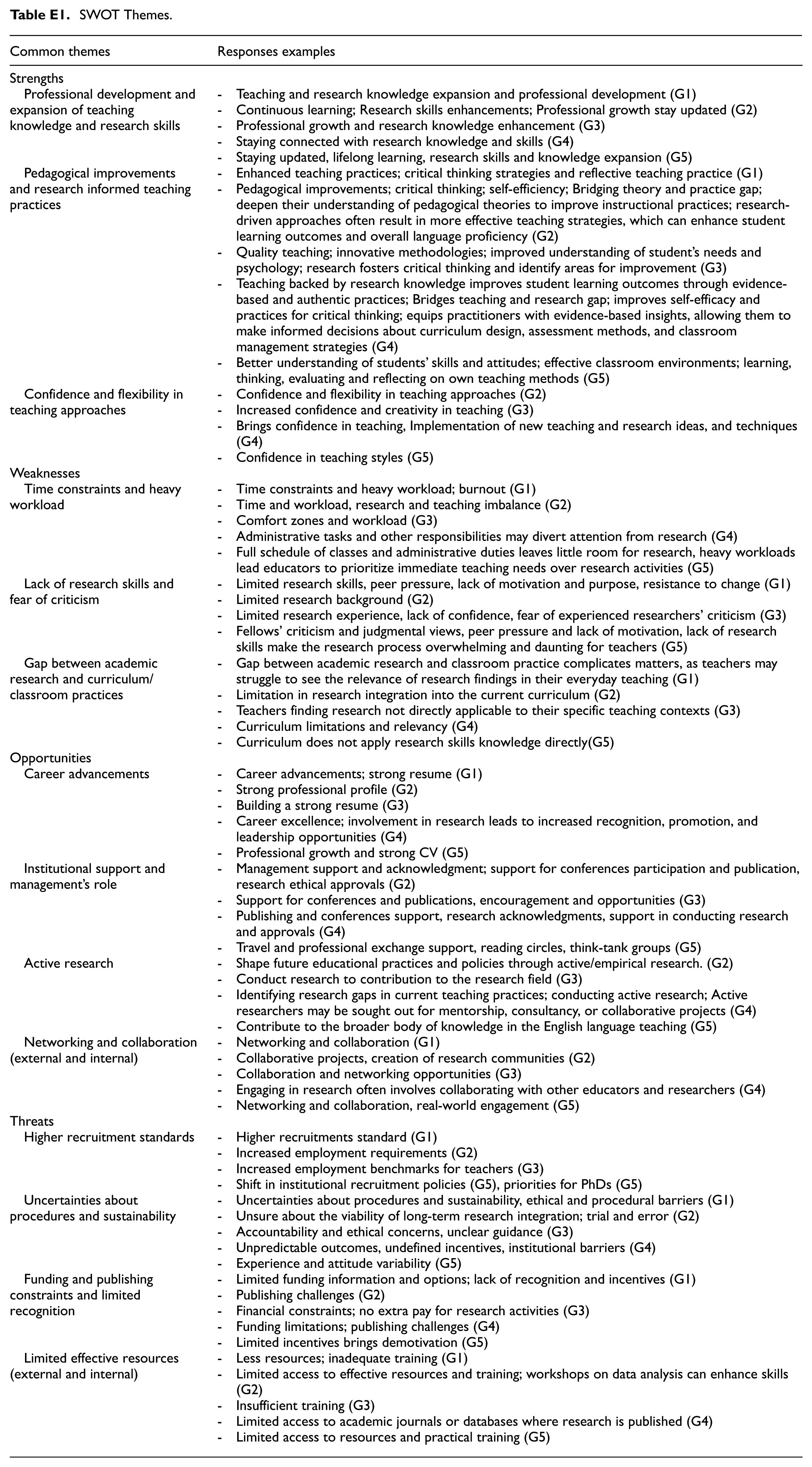
The following section presents these main contributors and barriers in detail, presenting participant responses in the form of strengths, weaknesses, opportunities, and threats (SWOT), differentiated by education background and degree of research experience (see Figure 1 and Table E1).
Strengths
The first common theme that emerged under strengths (see Table E1) is Professional Development and the Expansion of Teaching Knowledge and Research Skills, which reflects how teachers’ engagement in research provides them with an opportunity to stay connected with research knowledge and skills (G4), thereby fostering a culture of continuous professional development (G1). This promotes lifelong learning (G5) that keeps staff updated (G2) with the latest developments in the field of research and teaching. Secondly, all groups perceived research as an effective means to bring Pedagogical Improvements, leading to Research-informed Teaching Practices, which foster critical thinking (G3), and improve student learning outcomes through evidence-based and authentic practices (G4). Similarly, all groups perceived that research knowledge and involvement promoted Confident and Flexible mindsets for the implementation of new teaching and research ideas (G4). This overall boosts teachers’ morale and ensures creativity (G3) and confidence in their teaching styles (G5).
Weaknesses
Among the shared weaknesses, Time Constraints and Heavy Workloads were consistently cited by all groups, indicating their struggle with a research and teaching imbalance (G2), despite their initial acknowledgments of research benefits. Teachers shared concerns over a full schedule of classes and administrative duties (G4, G5), leading educators to prioritize teaching needs over research activities (G5). Another significant weakness reported by teachers as a major obstacle is the Lack of Research Skills and Fear of Criticism among staff. Except for the PhDs (G4), all other groups echoed the same sentiments that limited research skills (G1) and experience (G3) cause a lack of confidence, fellows’ criticism and judgmental views and peer pressure (G5) exposing their psychological barriers and hinting toward Less, Active (G1), New staff (G3), Masters’ (G5) their participation level. Moreover, all groups pointed out the Gap Between Academic Research and Classroom Practices as another significant concern affecting staff participation. The Less Active group (G1) and New staff (G3) explicitly articulated the concerns about the inapplicability of research to their specific teaching contexts, stating that the gap between academic research and classroom practice complicates matters, as teachers may struggle to see the relevance of research findings in their everyday teaching (G1).
Opportunities
Participants’ responses across all groups highlighted potential opportunities for career advancement, such as a strong professional profile (G1), a strong resume (G2), career excellence, increased recognition, promotion, and leadership opportunities (G4). Secondly, Institutional Support and Management’s Role emerged as another major contributor in shaping staff’s views. This support made staff more aware of contextual opportunities, both external and internal, and subsequently enhanced their participation in research. For example, all groups except the Less Active staff (G1) identified management’s acknowledgment (G2), encouragement (G3), and support for participation in conferences and publications (G3, G4, G5) as indicative of a supportive institutional framework aimed at promoting scholarly activities, such as research ethical approvals (G2), support with data collection (G2), reading circles, and think tank groups (G5). A consensus among participants identified active research as another significant opportunity for teachers to contribute to the field (G3) of English language teaching (G5) to broaden the educational landscape and shape future educational practices and policies through active/empirical research (G2). Lastly, the opportunities for Networking and Collaboration stood out as another theme reflecting a strong appreciation for the interactive aspects of professional development, with the creation of research communities (G2) and the initiation of collaborative projects (G4) for enhancing research engagement.
Threats
Many threats were discussed and documented by all groups; however, the concern about Higher Recruitment Standards in the academic world was strongly voiced by all groups except the PhDs. Participants noted that research engagement and its potential benefits may lead to increased recruitment standards, policies, and higher employment benchmarks for teachers (G1, G2, G3), prioritizing those with PhDs, given the perceived benefits of research. Beyond competitive recruitment challenges, Uncertainties about Procedures and the Sustainability of the research-teaching nexus were highlighted as another major concern by all groups. Specifically, Unclear guidance (G3), Unpredictable outcomes (G4), and Undefined incentive (G4) appeared to contribute to uncertainties, demanding more transparent and sustainable roadmaps for the research-teaching nexus. Furthermore, administrative ambiguities, such as issues of accountability (G3), ethical and procedural barriers (G1), institutional barriers (G4), and attitude variability (G5), were identified as hindrances to research engagement. Most Active group (G2) believes that achieving research sustainability may require considerable time and planning, as new changes often involve a process of trial and error (G2). Moreover, Funding and Publishing Constraints were frequently mentioned as critical barriers, with participants citing limited funding information and options (G1) and publishing challenges (G2, G4), which deterred interested practitioners from pursuing research opportunities. Participants also reported that without sufficient financial support (G3), and recognition and incentives (G3, G5), research can become increasingly challenging and demotivating. Lastly, Limited Effective Resources were also cited as another obstacle for many potential researchers as PhDs (G4) staff reported limited access to academic journals and databases (G4), inadequate training (G1), and limited access to effective resources and training (G2, G5), as some action points to be addressed for effective implementation and integration of research-teaching nexus and its sustainability.
Group-Specific Thematic Distinctions
While several contributors and barriers were commonly noted across groups, discussions on some themes were more prevalent in certain groups, emphasizing particular concerns more strongly, reflecting their distinctive interests and concerns. For instance, Less Active Staff (G1) reported lower confidence, fear of being judged, and limited skills, stressing the need for scaffolding and mentorship. In contrast, Active researchers (G2), though highly motivated, highlighted risks of overload and the challenge of balancing teaching with research. Likewise, New Staff (G3) emphasized the importance of structured support and clarity on research policies in building confidence and improving participation. PhD holders (G4) demonstrated leadership potential through their emphasis on evidence-based practices and their ability to mentor. Meanwhile, Master-level teachers (G5) expressed concerns related to their status and a sense of vulnerability in light of rising recruitment standards. Collectively, these findings reveal varying levels of research-related preferences and concerns, highlighting the need for differentiated institutional strategies tailored to diverse staff profiles, thereby ensuring the sustainability of research efforts.
Discussion
The present study examined the research-teaching nexus among university English teachers in Saudi Arabia, employing a sequential exploratory mixed-methods design. This design integrated three tools: a 20-item self-assessment scale, scenario-based evaluations, and a SWOT-based qualitative analysis (Alhassan & Ali, 2024; AlMarwani, 2020; Borg, 2006, 2007, 2009; Borg & Alshumaimeri, 2012; Borg et al., 2018; Chusniyah & Akhmad, 2023; Y. Liu & Borg, 2014; Waisi & Rahimi, 2020). Each tool was sequenced to build on the previous one: the survey quantified research literacy and perceptions; scenario-based evaluations examined applied understanding in teaching contexts; and a SWOT analysis contextualized the findings within institutional factors and barriers, offering actionable insights for sustainable implementation. This sequence enabled the study to capture both conceptual understanding and practical application, while revealing the procedural, psychological, and contextual/structural factors that influence engagement. The initiative of a newly established research-oriented committee (SRC) served as a case example, categorizing staff into five groups based on qualifications and participation levels, allowing for differentiated views to be captured. Finally, the study evaluated the effectiveness of the SWOT framework for monitoring research engagement and guiding implementation with a bidirectional dissemination plan (AlMarwani, 2020; Mohiuddin et al., 2023; Nasreen & Afzal, 2020).
The first research question examined teachers’ research literacies and their perceptions of the research impact on teaching, using a 20-item scale adapted from Waisi and Rahimi’s (2020) version. The survey revealed relatively consistent levels of research literacy across participants, with mean scores clustering narrowly (M = 3.09–3.44). Teachers expressed the strongest confidence in ethical research practices. This aligns with Borg’s (2009) assertion that teachers’ cognitions about research are shaped by both professional experiences and hidden layers of beliefs, which may privilege ethical awareness over technical skill. Importantly, most research skills—such as formulating research questions, analyzing data, and reviewing literature—scored above the midpoint, suggesting a fair degree of competence and awareness (Wyatt & Dikilitaş, 2016). Participants also viewed research as valuable for pedagogy, particularly in understanding learners’ needs (M = 3.52) and enhancing their teaching confidence (M = 3.37). These findings align with those of Burns et al. (2022), who argue that research engagement fosters reflective practice and strengthens teacher identity. Yet, reading research itself was noted as infrequent (M = 2.92), echoing Borg and Alshumaimeri’s (2012) findings that teachers in Saudi contexts often struggle to access and engage with published research.
Group comparisons revealed a clear hierarchy of research literacy. PhD holders (G4) were most confident (M = 4.16), suggesting advanced qualifications correlate with research competence (F. Ghabban et al., 2019). Active teachers (G2) demonstrated strong, practice-based confidence (M = 3.49), while new staff (G3) showed an emerging awareness (M = 3.21). In contrast, Master’s degree holders (G5) and less active teachers (G1) lagged behind (M = 2.72 and 2.98), exhibiting lower self-reported literacy, which echoes findings by Borg (2009) and Chen and Tsai (2012) that limited research training reduces confidence. These disparities align with Hu et al. (2015), who noted that variability in teachers’ experiences influences engagement with research. The survey found notable differences in research literacy across participant groups (Table 3).
The second question, scenario-based evaluations, showed more complex and sometimes contradictory patterns than the literacy scale. Several scenarios—experimenting with a new teaching approach (S4) and controlled vocabulary comparison (S6)—had strong agreement across groups. Everyone clearly saw their research value. In contrast, scenarios like reflective narrative (S12), informal classroom observation (S14), and small-scale adjustments (S15) received low ratings from all groups. This suggests a narrow, traditional view of what “counts” as research. Past studies (Benegas, 2018) also found that teachers often undervalue reflective or practitioner-based inquiry compared to formal methods.
Group differences became clear in the ANOVA and Kruskal–Wallis results. There was significant variation in structured, data-driven tasks (S2, S9, S10; p < .01). PhDs rated these scenarios higher and easily recognized empirical inquiry in the classroom. Reflective or applied scenarios (S8, S11, S13, S14) also showed big group differences. PhDs and the most active staff rated them higher, while Master’s students and new staff remained cautious. Less active staff were inconsistent: they scored some structured scenarios (S2, S4) high but dismissed reflective ones (S12, S13).
A key inconsistency appeared for people with Master’s degrees. Although they reported low confidence in their own literacy (M = 2.72), they rated some scenarios (S9, S10) almost as highly as PhDs. This suggests that they can recognize the value of research in structured inquiry, even when they feel uncertain about it. They also gave the highest ratings for informal scenarios (S14, S15), suggesting that practice familiarity, not just formal training, shapes their recognition. Despite lower literacy, Master’s holders and less active staff still valued research-informed practices. This indicates that teachers can recognize the research value beyond their self-assessed skills (Borg, 2009; Hu et al., 2019). New staff members had moderate literacy and provided cautious ratings for the scenarios. They may grow more confident if they get institutional support, mentorship, and structured professional development (Alshahrani, 2017; Hiep, 2006).
The SWOT analysis further illuminates both enabling and constraining factors (see Figure 2). Teachers across groups recognized institutional support mechanisms, such as encouragement to publish or attend conferences (noted by active staff, new staff, and PhD groups), consistent with international findings that institutional frameworks and leadership play a decisive role in fostering research cultures (Borg & Alshumaimeri, 2012; Kelly et al., 2020). However, less active staff and Master-level teachers identified peer pressure, fear of criticism, and lack of contextual applicability as significant threats, echoing findings from Bughio (2015) and James and Augustin (2018) about the challenges of conducting research in constrained institutional settings. These affective barriers reinforce earlier arguments that emotional and cultural factors are as influential as technical competence in shaping research engagement (Anwaruddin, 2015; Wyatt & Dikilitaş, 2016).

Research-teaching nexus implementation: contributors and barriers.
Another critical finding concerns uncertainties in procedures and sustainability, particularly regarding unclear guidance, unpredictable outcomes, and undefined incentives. These concerns parallel those of Dyssegaard et al. (2017), who conducted a systematic review identifying institutional opacity and a lack of structured incentives as key obstacles to embedding research-informed practice in schools. In the Saudi context, similar critiques have been voiced by Elyas and Picard (2013) and F. Ghabban et al. (2019), who argue that without transparent structures and reward systems, research engagement often remains fragmented and unsustainable.
Despite these systemic concerns, participants widely acknowledged the professional and pedagogical value of research, particularly in enhancing reflective practice, teaching strategies, and learner outcomes. This aligns with international evidence that research-informed practice strengthens teacher autonomy, confidence, and pedagogical innovation (Agbenyega et al., 2023; Atay, 2008; Burns & Westmacott, 2018). Our findings also support McKinley’s (2019) call for an evolving TESOL research-teaching nexus, suggesting that while research awareness is growing, its institutionalization remains uneven across staff groups.
Extending this point, it is also important to note that this study contributes to the literature by revealing a hierarchical pattern of research literacy and engagement: PhDs are at the top, followed by active teachers who emphasize practice-based applications, new staff showing moderate awareness, and less active/Master’s teachers consistently lagging behind. This stratification aligns with earlier comparative studies (Cao et al., 2023; Hu et al., 2019) and raises concerns about equity in the distribution of opportunities for professional development. In particular, Abbott and Lee’s (2022) work on communities of practice suggests that building sustained, collaborative research networks could help bridge these gaps, fostering inclusion and long-term engagement across teacher groups.
In summary, the results underscore the dual nature of the teaching–research nexus: while teachers recognize its benefits for professional and student development, systemic, cultural, and procedural challenges hinder consistent engagement. Addressing these requires institutional transparency, supportive leadership, and structured opportunities for collaborative inquiry (Burns et al., 2022; Consoli & Dikilitaş, 2021).
Recommendations for Effective Dissemination for Sustainability
Building a sustainable research ecology in English language education requires a systematic implementation process that transcends short-term efforts and isolated projects. As Ogden and Fixsen (2014) assert, implementation is a structured process designed to identify and sustain practices that support effective, evidence-based integration of teaching and research. This study provides actionable recommendations for developing this approach in Saudi universities, particularly by leveraging the discussion sessions, dissemination channels, and policy-backed structures identified in the data.
Addressing this gap requires a comprehensive approach that aligns institutional leadership, workload allocation, and professional development programs to explicitly promote the integration of research and teaching. Effective dissemination is essential to ensure research engagement is both meaningful and enduring. Klein and Gwaltney’s (1991) framework outlines four key processes that are particularly applicable in the Saudi context, as demonstrated by their use in the departmental initiative. The “Spread” (proactive sharing of information) can be enhanced through monthly research bulletins, clear policies, institutional announcements, and invitations to national and international conferences. “Choice” (responsive dissemination) emphasizes giving teachers the autonomy to pursue pathways that align with their professional objectives, whether through classroom-based inquiry, local workshops, or peer-reviewed publications. “Exchange” (interactive dissemination) encourages collaboration, as evident in the SWOT-based group discussions that fostered collegial dialogue around the research-teaching nexus. Finally, “Implementation” ensures that research insights are practically applied, such as incorporating research-informed strategies into curriculum design and adopting teaching innovations.
Actionable Recommendations
This study provides actionable strategies for promoting the integration of sustainable research and teaching in Saudi universities (Figure 2). Building on previous frameworks that emphasize leadership, professional development, support systems, and sustainability (Alharbi & Aslan, 2024; Chusniyah & Akhmad, 2023; Dyssegaard et al., 2017; Fahim et al., 2021), this proposal presents a structured, context-sensitive approach that utilizes a SWOT analysis to guide collaboration between teachers and researchers.
Sustainable engagement requires transitioning from isolated projects to collective, department-level initiatives where dissemination and facilitation are integrated into daily practice. Despite assumptions of inherent research engagement, many English language faculty perceive research as distant from teaching. Initiatives by the Scientific Research Committee—such as discussion sessions, reading circles, research days, skills presentations, and collaborative groups—offer practical pathways for embedding research into academic routines, reflecting Freire’s (1970) vision of dialogic, co-constructed knowledge.
Operational strategies include embedding research in role expectations, expanding institutional research support (Alharbi & Aslan, 2024; Kyaw, 2021; Li & Xu, 2024; OECD, 2019), providing structured professional development linked to teaching (Willemse et al., 2016), promoting collaborative communities of practice (Abbott & Lee, 2022; Groothuijsen et al., 2023; Guerrero-Hernández & Fernández-Ugalde, 2020), and aligning all efforts with Saudi Vision 2030 objectives (Alshahrani, 2017).
Conclusions
This study examined the engagement of English language teachers with research within the context of a Saudi university initiative aimed at strengthening the research-teaching nexus and fostering a sustainable research culture. To achieve a comprehensive, multidimensional understanding of the factors shaping research involvement and its implications at individual, institutional, and national levels, the study combined teachers’ self-assessed research literacy (measured by a 20-item scale), scenario-based evaluations, and perceptions on SWOT. These methods enabled the identification of key contributors to, and barriers for, research engagement across five distinct groups: Less Active, Most Active, New Staff, PhDs, and Master’s degree holders. The groups categorization based on varying levels of participation and qualification and integrating quantitative assessments with qualitative insights, the study bridges gaps in existing literature and demonstrates that the SWOT framework is an effective tool for educational initiatives, capturing both the perceived value of research and the procedural, structural, psychological, and contextual realities that influence engagement.
Importantly, the group’s responses analysis demonstrates that research engagement does not solely depend on participation level or qualifications. Even less active teachers and those with lower self-reported literacy recognized the relevance of research when presented in contextualized scenarios, indicating that structural and procedural barriers, rather than a lack of interest, may limit their engagement. New staff displayed cautious optimism, highlighting the potential of mentorship and professional development to foster engagement. These insights challenge deficit-oriented assumptions about less experienced or less active teachers, highlighting the need for institutional strategies that support all staff in developing research literacy and integrating research into their teaching.
The SWOT analysis identified both contributors and obstacles to research engagement. Key contributors included institutional backing through clear policies and recognition, targeted professional development, mentorship, collaborative frameworks, and resource allocation, all of which reinforced the value of a supportive research-teaching ecosystem. In contrast, obstacles included procedural, psychological, contextual, and structural issues, such as excessive workloads, time constraints, vague policies, low confidence, apprehension about criticism, and limited resources.
In conclusion, this study shows that teachers’ engagement with research is shaped by personal, institutional, and contextual factors. It demonstrates the value of combining quantitative and qualitative methods to capture teachers’ beliefs and practical use of research. It also supports the SWOT framework as a suitable tool for assessing perceptions of educational initiatives and identifying factors influencing their sustainability. Finally, it is found that a bidirectional dissemination plan, similar to Klein and Gwantley’s (1991) model, which involves dissemination, facilitation, and implementation, is most effective in increasing participation and outcomes. By addressing barriers, leveraging key contributors, and implementing effective dissemination strategies, higher education institutions can cultivate a sustainable research-teaching culture. Ultimately, empowering teachers as knowledge creators, strengthening pedagogical practices, and advancing institutional and national objectives can bridge the gap between research and teaching, yielding meaningful and long-term impact. This approach operationalizes knowledge spread, choice, exchange, and implementation to ensure research is effectively shared, adapted, and applied, supporting a sustainable research culture. The findings offer a replicable model for departments to develop and evaluate a research culture, contributing to institutional improvement, educational reform, and alignment with broader national and international policy frameworks, including Saudi Vision 2030, OECD recommendations, and SDG4 for quality education.
Limitations
This study has several limitations that should be acknowledged. First, the sample was drawn from EFL teachers at a single university, which may limit the generalizability of the findings to other institutions or educational contexts within Saudi Arabia and beyond. Second, although the mixed-methods approach provided a multi-layered perspective, self-reported measures may have been influenced by modesty bias or a lack of confidence. Scenario evaluations may also not fully reflect actual research practice, as pilot group scenarios with lower ratings might have been intentionally less representative of the research. Third, the categorization of participants by qualifications and research activity, while useful for identifying patterns, was not entirely discrete; some Master’s holders were less active, and the status of new staff is likely to evolve over time, potentially affecting engagement. Since the SRC is still in its early stages, staff concerns and barriers may diminish, improving participation, awareness, and implementation. Internal consistencies among Master’s level staff were more prevalent than in other groups, marking an area for further research. Future research should expand the sample across multiple universities, disciplines, and educational contexts to validate these findings. Longitudinal and in-depth qualitative studies could track changes and reveal factors that enable or constrain teacher research engagement.
Footnotes
Appendices
SWOT Themes.
| Common themes | Responses examples |
|---|---|
| Strengths | |
| Professional development and expansion of teaching knowledge and research skills | - Teaching and research knowledge expansion and professional development (G1) - Continuous learning; Research skills enhancements; Professional growth stay updated (G2) - Professional growth and research knowledge enhancement (G3) - Staying connected with research knowledge and skills (G4) - Staying updated, lifelong learning, research skills and knowledge expansion (G5) |
| Pedagogical improvements and research informed teaching practices | - Enhanced teaching practices; critical thinking strategies and reflective teaching practice (G1) - Pedagogical improvements; critical thinking; self-efficiency; Bridging theory and practice gap; deepen their understanding of pedagogical theories to improve instructional practices; research-driven approaches often result in more effective teaching strategies, which can enhance student learning outcomes and overall language proficiency (G2) - Quality teaching; innovative methodologies; improved understanding of student’s needs and psychology; research fosters critical thinking and identify areas for improvement (G3) - Teaching backed by research knowledge improves student learning outcomes through evidence-based and authentic practices; Bridges teaching and research gap; improves self-efficacy and practices for critical thinking; equips practitioners with evidence-based insights, allowing them to make informed decisions about curriculum design, assessment methods, and classroom management strategies (G4) - Better understanding of students’ skills and attitudes; effective classroom environments; learning, thinking, evaluating and reflecting on own teaching methods (G5) |
| Confidence and flexibility in teaching approaches | - Confidence and flexibility in teaching approaches (G2) - Increased confidence and creativity in teaching (G3) - Brings confidence in teaching, Implementation of new teaching and research ideas, and techniques (G4) - Confidence in teaching styles (G5) |
| Weaknesses | |
| Time constraints and heavy workload | - Time constraints and heavy workload; burnout (G1) - Time and workload, research and teaching imbalance (G2) - Comfort zones and workload (G3) - Administrative tasks and other responsibilities may divert attention from research (G4) - Full schedule of classes and administrative duties leaves little room for research, heavy workloads lead educators to prioritize immediate teaching needs over research activities (G5) |
| Lack of research skills and fear of criticism | - Limited research skills, peer pressure, lack of motivation and purpose, resistance to change (G1) - Limited research background (G2) - Limited research experience, lack of confidence, fear of experienced researchers’ criticism (G3) - Fellows’ criticism and judgmental views, peer pressure and lack of motivation, lack of research skills make the research process overwhelming and daunting for teachers (G5) |
| Gap between academic research and curriculum/classroom practices | - Gap between academic research and classroom practice complicates matters, as teachers may struggle to see the relevance of research findings in their everyday teaching (G1) - Limitation in research integration into the current curriculum (G2) - Teachers finding research not directly applicable to their specific teaching contexts (G3) - Curriculum limitations and relevancy (G4) - Curriculum does not apply research skills knowledge directly(G5) |
| Opportunities | |
| Career advancements | - Career advancements; strong resume (G1) - Strong professional profile (G2) - Building a strong resume (G3) - Career excellence; involvement in research leads to increased recognition, promotion, and leadership opportunities (G4) - Professional growth and strong CV (G5) |
| Institutional support and management’s role | - Management support and acknowledgment; support for conferences participation and publication, research ethical approvals (G2) - Support for conferences and publications, encouragement and opportunities (G3) - Publishing and conferences support, research acknowledgments, support in conducting research and approvals (G4) - Travel and professional exchange support, reading circles, think-tank groups (G5) |
| Active research | - Shape future educational practices and policies through active/empirical research. (G2) - Conduct research to contribution to the research field (G3) - Identifying research gaps in current teaching practices; conducting active research; Active researchers may be sought out for mentorship, consultancy, or collaborative projects (G4) - Contribute to the broader body of knowledge in the English language teaching (G5) |
| Networking and collaboration (external and internal) | - Networking and collaboration (G1) - Collaborative projects, creation of research communities (G2) - Collaboration and networking opportunities (G3) - Engaging in research often involves collaborating with other educators and researchers (G4) - Networking and collaboration, real-world engagement (G5) |
| Threats | |
| Higher recruitment standards | - Higher recruitments standard (G1) - Increased employment requirements (G2) - Increased employment benchmarks for teachers (G3) - Shift in institutional recruitment policies (G5), priorities for PhDs (G5) |
| Uncertainties about procedures and sustainability | - Uncertainties about procedures and sustainability, ethical and procedural barriers (G1) - Unsure about the viability of long-term research integration; trial and error (G2) - Accountability and ethical concerns, unclear guidance (G3) - Unpredictable outcomes, undefined incentives, institutional barriers (G4) - Experience and attitude variability (G5) |
| Funding and publishing constraints and limited recognition | - Limited funding information and options; lack of recognition and incentives (G1) - Publishing challenges (G2) - Financial constraints; no extra pay for research activities (G3) - Funding limitations; publishing challenges (G4) - Limited incentives brings demotivation (G5) |
| Limited effective resources (external and internal) | - Less resources; inadequate training (G1) - Limited access to effective resources and training; workshops on data analysis can enhance skills (G2) - Insufficient training (G3) - Limited access to academic journals or databases where research is published (G4) - Limited access to resources and practical training (G5) |
Acknowledgements
The authors wish to acknowledge the active participation of the five groups of teachers from the English Language Skills Department at King Saud University. We are also grateful for the logistical support provided by the Scientific Research Committee, which facilitated the formation of the groups and the dissemination of information regarding the initiative of the research committee at the department. Also, we would like to thank the valuable contributions of the volunteer who thoroughly cross-checked the themes and offered insightful feedback.

Ethical Considerations
The authors confirm receiving approval from the Scientific Research committee at King Saud University (Ref No: KSU-HE-23-1247).
Funding
The authors received no financial support for the research, authorship, and/or publication of this article.
Declaration of Conflicting Interests
The authors declared no potential conflicts of interest with respect to the research, authorship, and/or publication of this article.
Data Availability Statement
Data sharing not applicable to this article as no datasets were generated or analyzed during the current study.