




Abstract
Research on the concept of cognitive distortion has increased from year to year, especially in the areas of mental health and emotional disorders such as depression, anxiety disorder, stress disorder, and others. Therefore, it is necessary to understand the topic of interest and establish a network of cooperation to expand research toward integrated efforts. Bibliometric analysis was performed using Bibliometrix and Biblioshiny software packages on academic articles indexed on the Scopus and Web of Science (WoS) databases. Search criteria were applied, initially resulting in a total of 1,834 articles published between 1950 and 2021. The study pattern focuses on publication output, affiliated countries, co-authors, and the occurrence of author keywords. The findings of this study provide an overview of notable topics in cognitive distortion analytics through a quantitative analysis featuring tables, graphs, and maps. It also identifies the key performance indicators to produce articles and their citations. Studies show an increase in this field globally, especially since 2008 onwards. The data reveals that publications from the United States, United Kingdom, and Canada accounted for more than 50% of total number of publications in this field. This study indicates a global research pattern related to cognitive distortion, which may be useful for researchers, individuals, or policymakers to harness the existing potential and create opportunities for future research development.
Plain Language Summary
This bibliometric study aims to indicates a global research pattern related to cognitive distortion that focuses on publication output, affiliated countries, co-authors and the occurrence of author keywords. Bibliometric analysis was performed using Bibliometrix and Biblioshiny software packages on academic articles from 1950 to 2021 indexed on the Scopus and Web of Science (WoS) databases. 1834 articles were discovered, and research findings showed that rapid publishing growth has occurred especially since 2008 onwards and is expected to continue to increase. It was revealed that Psychology, Psychiatry, Medicine, Social Sciences, Arts and Humanities, Social Criminology, Substance abuse and Neuroscience were categories or areas that frequently featured in articles regarding cognitive distortion. The data reveals that publications from the United States, United Kingdom, and Canada accounted for more than 50% of total number of publications in this field. This study reveals a worldwide research trend on cognitive distortion, which may be useful for researchers, individuals, or policymakers to harness the existing potential and create opportunities for future research development. In addition to the contributions, this study does have some limitations. First, the only databases used to generate data were Scopus and WoS. Second, the researchers did not use keywords related to the dimensions or types of cognitive distortion. Third, the researchers did not use keywords that have the same meaning as cognitive distortion such as cognitive error or cognitive bias and fourth, only studies published in the form of journal articles were included in this study.
Keywords
Introduction
Errors in an individual’s thought caused by biased (wrong) or incorrect information processing are the most common definition of cognitive distortion (J. S. Beck, 1996; Clark et al., 1999; Yurica & DiTomasso, 2005). However, according to Beck’s initial definition, cognitive distortion refers to distorted or unrealistic concepts in idiosyncratic thinking (A. T. Beck, 1963). Cognitive theory states that cognitive distortion is a common factor that causes emotional disorders (A. T. Beck, 1967); this distortion represents the way a person modifies and interprets his or her daily experiences. Interpretation of one’s experience may influence one’s emotional and behavioral responses (Kendall, 1991). For example, a person who has been involved in an accident that caused someone’s death will constantly blame himself. The emotional upheavals he experiences may include feeling guilty, defining himself as a failure, or feeling disappointed with himself. Following that, those feelings will have an impact on behavior such as fear of driving again, a lack of confidence in interacting with other individuals, and so forth. According to Briere (2001), cognitive distortion can contribute to maladaptive behavior.
The concept of cognitive distortion has been adopted from the literature on cognitive therapy and depression (Maruna & Mann, 2006). According to A. T. Beck (1967), cognitive distortion results from erroneous ways of thinking when processing information. Basic beliefs (schemas) about oneself are formed because of one’s assessment of early life, and these beliefs underlie the concept of cognitive therapy (A. T. Beck, 1976). To support the initial scheme formed, secondary beliefs are subsequently transformed into assumptions or rules about self and the world. A person’s personal value is determined by these beliefs, which also influence one’s emotions and way of thinking (A. T. Beck et al., 1979). A person’s way of thinking supports underlying beliefs and assumptions by distorting internal and external stimuli, thereby creating cognitive distortion. Beck explains six types of thinking errors through his research with patients with depression: overgeneralization, arbitrary inference, magnification and minimization, dichotomous thinking, personalization, and selective abstraction. A few years later, Burns (1980) further expanded Beck’s concept of cognitive distortion to 10 types: all-or-nothing thinking, personalization and blame, overgeneralization, discounting the positive, mental filter, jumping to conclusions, should statements, emotional reasoning, magnification, and labelling. Next, the concept evolved further, including comparison, externalization of self-worth, and perfectionism (Freeman & DeWolf, 1992; Freeman & Oster, 1999). Not only that, Gilson and Freeman (1999) have also identified eight other types of cognitive distortion in the form of fallacies, namely, fallacies of change, fairness, worrying, being right, ignoring, control, attachment, and heaven’s reward. Depending on the field researchers, several terms can have the same meaning. Dichotomous thinking, for instance, is also known as All-or-Nothing thinking or Black-or-White thinking, which refers to categorise all experiences into either positive or negative categories, thus when someone’s performance is inadequate, they see themselves as complete failures (Roberts, 2015).
Other researchers have also given specific terms to disorder-specific cognitive distortions that may manifest in certain disorders. For example, in PTSD patients: preoccupation with danger and self-blame (Briere, 2001); in incarcerated teenagers: self-serving and self-debasing distortions (Barriga et al., 2000), and in pathological gamblers: reframed losses and the illusion of control over luck, (Toneatto, 1999). Besides, Najavits et al. (2004) proposed a series of distortions specifically related to substance use disorders, including, but not limited to: (i) The escape: Inability to tolerate feelings or solve problems. The only escape appears to be drugs, self-cutting, sleep, food, etc. (ii) Dangerous permission: Patients give themselves permission for self-destructive behavior. (iii) Time warp: It feels as if negative feelings will go on forever. (iv) Short-term thinking: Focus on the short-term only, how one feels for a few minutes and (v) The good old days: Remembering only the wonderful highs from a drug or an abusive relationship.
Cognitive distortion has been identified to play an important role in maintaining emotional disorders. This is evidenced by the study of the role of cognitive distortion on the aspects of depression (Kube et al., 2019; Schluter et al., 2019; Yüksel et al., 2019), anxiety disorder (Kaplan et al., 2017; Kuru et al., 2018), stress disorder (Iacoviello & Charney, 2020; LoSavio et al., 2017), and other emotional disorder issues (Seager & Barry, 2019; Urbańska et al., 2019). Studies on the concept of cognitive distortion are critical and relevant. The concept of cognitive distortion is not only related to mental disorders, but studies also prove that cognitive distortion plays an important role in psychosocial treatment such as adult attention-deficit/hyperactivity disorder (ADHD) (Ramsay, 2017), decision-making (Abatecola et al., 2018), and gambling problems (Lévesque et al., 2018). Thus, an understanding of the concept and the role of cognitive distortion is seen to be helpful in managing a variety of individual problems. Although interest in the concept of cognitive distortion has recently increased, very few studies involving bibliometric techniques have been used to plot the research literature in the arena of cognitive distortion such as the study on the influence of cognitive bias on behavioral finance (Abdulrasool & Othman, 2020), the use of personality inventory in pain studies (Piotrowski, 2018), and study on the status of bipolar disorder (Clement et al.,2003). Nevertheless, the analysis of scientific publications from a global perspective in relation to cognitive distortion has not yet been found in any specific studies.
Thus, the objectives of this paper are: (i) to analyze the publication output and growth of cognitive distortion research area; (ii) to validate the top productive journals on cognitive distortion research area; (iii) to identify the leading countries, the most productive academic institutions and international collaborations that contribute to the publication of cognitive distortion; (iv) to identify the most prolific authors in the field and determine the author keywords used in the publication. The research questions for this study are the following:
RQ1: What are the trends and patterns in the growth of publications related to cognitive distortion?
RQ2: Which publication publishes the most articles on cognitive distortions, including the ones that are most frequently cited?
RQ3: Which countries have produced the highest number of publications and what are the most productive academic institutions in terms of publications related to cognitive distortion?
RQ4: How prevalent are international collaborations in the field of cognitive distortion research?
RQ5: Who are the most prolific authors and what are the common author keywords used in publications related to cognitive distortion?
The answer to this research questions derived from the results obtained together with the discussion and the most relevant conclusions support the theorization presented in this paper. This new study seeks to give rise to and suggest new ideas for continued increasing research on this subject matter. This study uses bibliometric methods to describe research patterns related to cognitive distortion that the previous researchers had explored. Bibliometrics is a method of statistical analysis for published studies, with the primary objective of understanding publication patterns, journal ranking, frequency of citations or co-citations, keyword occurrence, and collaboration between authors or between countries (Hung, 2012; Hung & Zhang, 2012; Zupic & Cater, 2015). Moreover, the bibliometric analysis also opens opportunities for scholars in the same field to collaborate and share their findings (Zupic & Cater, 2015). Besides, information was gathered during the data gathering stage from the Scopus and Web of Science (WoS) databases. This study is helpful for individuals, researchers, as well as policymakers, to understand research patterns related to cognitive distortion as well as to identify opportunities and potential future research.
Literature Review
The concept of cognitive distortions has been broadly accepted in both clinical and non-clinical practice and has received significant empirical research validation (e.g., Najavitis et al., 2004; Roberts, 2015; Yurica, 2005). The concept of cognitive distortion was thought of earlier than expected. According to Kelly’s Personal Construct Theory from 1955, persons form anticipatory cognitive attitudes as a result of prior experience Kelly (1955). Schemas, according to Kelly’s theory, are mental groups of knowledge created from prior experience that are used to categorize new events, are a part of this cognitive organization. Schemas make it easier to record new occurrences, help people become familiar with novel events, indicate where to go for more information, and offer default data to fill in perception and interpretation gaps. These constructs direct, filter, encode, and evaluate new experience. Additionally, Kendall’s cognitive taxonomy model (Kendall, 1992) aims to explain how people receive information and engage in cognitive activities that influence every aspect of behavior and emotion. According to Kendall’s theory, human cognition consists of the following four essential components: (a) Cognitive content or product, (b) Cognitive processes, (c) Cognitive structures, and (d) Cognitive products. Kendall (1992) distinguished between active cognitive distortion and cognitive inadequacies, the latter of which is thought to be the outcome of deficits in cognitive functioning. The paradigm postulates that cognitive distortions, which result from maladaptive cognitive processing, are a predictable effect of dysfunctional cognition.
In addition, the concept of cognitive distortion has also been discussed through Schema Therapy. According to Young et al. (2003), Schema Therapy’s main goal is to recognize and treat early maladaptive schemas, which are ingrained beliefs that can cause emotional and cognitive distortions that developed during childhood. Through a combination of cognitive, behavioral, and experiential strategies, schema therapy attempts to change these embedded patterns (Young et al., 2003). Schema therapy is a psychological intervention whose goal is to identify a person’s primary emotional needs and support them in figuring out realistic strategies to address them (Rafaeli et al., 2011).
Nevertheless, Cognitive Behavioral Theory (CBT), which derived the concept of cognitive distortion from Beck’s study on his depressed patients, offers the most thorough and comprehensive explanation of the concept to date. Based on CBT, cognitive distortions are common factors that cause emotional disturbances, and these distortions represent the way a person modifies and interprets his daily experiences (A. T. Beck, 1967). A. T. Beck (1967) explains that core beliefs or schemas depend on cognitive distortions. Because schemas are formed during early childhood, the thought processes that support schemas may reflect early errors in reasoning. Cognitive distortion occurs when information is processed inaccurately or ineffectively. Individuals with high levels of cognitive distortion tend to consider the events that happened in his life as a pressure. Maladaptive schemas are a product of thinking that may have been adapted in childhood but has become more problematic as an adult. These automatic thinking-generated schemas are frequently applied by individuals without questioning their validity or logic (Fromme, 2011). Errors in individual thinking caused by mistakes during information processing are called cognitive distortions (Yurica & DiTomasso, 2005).
Apart from cognitive distortion, the phrase “cognitive error” or “cognitive bias” are frequently employed particularly in the clinical setting. A systematic pattern of judgmental divergence from the norm or from rationality is referred to cognitive bias (Haselton et al., 2005). “Heuristics,” commonly referred to cognitive biases, are mental shortcuts that help one’s made decisions. A heuristic is a cognitive “rule of thumb” or cognitive guideline that is subconsciously used in a complex situation to facilitate and improve decision making (Detmer et al., 1978). The terms “cognitive bias” and “cognitive distortion” are often used interchangeably, but there are some important distinctions between them. A cognitive bias is a systematic error in thinking that can lead to erroneous judgments and decisions. A cognitive distortion is a specific form of cognitive bias that occurs when our mind systematically distort reality to justify our limited beliefs or worldview. Nevertheless, the researchers narrowed the search to just include terms related to cognitive distortion to obtain more focused results.
Cognitive distortions which are not managed well can lead to various psychological disorders such as depression, anxiety, obsessive-compulsive, paranoia, stress, and others (J. S. Beck, 2011; Fromme, 2011). According to Roberts (2015), it is possible that the cognitive distortions can be adjusted, which will then lower stress levels, if particular types of cognitive distortions can be discovered first so that effective treatment can be delivered. Based on past studies, psychotherapy approaches have shown effectiveness in reducing symptoms of cognitive distortion. These has been proven by the effectiveness of Cognitive Behavioral Therapy (CBT) on adolescents with oppositional defiant disorder (Sammehr et al., 2022), patients diagnosed with depression (Kürümlüoğlugil & Tanrıverdi, 2022), high school students suffer with bulimia nervosa (Shirkhanzadeh et al., 2022), and adolescents with social anxiety disorder (Goodarzi et al., 2021). In addition, the symptoms of cognitive distortion can also be controlled with the Schema Therapy approach as demonstrated by Navidi Poshtiri et al. (2022) on nursing and midwifery students with health anxiety, Malik et al. (2021) on young adults with borderline personality features and Pourpashang and Mousavi (2021) on clients under substance dependence treatment. Besides, there are also studies that show the effectiveness of Mindfulness-Based Cognitive Therapy (MBCT) in treating cognitive distortions such as studies on emotional exhaustion in women with multiple sclerosis (Dizaj et al., 2022), MBCT intervention as a population-level strategy for anxiety and depression (Burgess et al., 2021), and also on reducing gambling-related craving (Melero Ventola et al., 2020)
The concept of cognitive distortion has long been explored and adopted; although it was originally used in the framework of cognitive therapy in mental health issues (Ciccarelli et.al., 2020; Younesi et.al., 2015), it has now been applied in various forms such as general antisocial behavior (Chabrol et al., 2014; Demeter & Rad, 2020; Wallinius et al., 2011), criminal behavior such as drug use (Kirisci et al., 2004) and sexual offences (Paquette et al., 2020; Pornari et al., 2021; Soldino et al., 2020; Szumski et al., 2018), health areas such as hearing and speech problems (Colucci, 2016), alcohol consumption (O’Leary-Barrett et al., 2017; Tobias-Webb et al., 2020), psychological trauma (Chung & Shakra, 2022; Vallath et al., 2020), and eating disorders (Mehak & Racine, 2020; Moreno et al., 2014; Powers et al., 1999). Not only that, the concept of cognitive distortion also appeals to researchers on the ground of economic and finance (Boldizzoni, 2013; Kuljamina et al., 2018).
Although there has been a recent rise in interest in the idea of cognitive distortion, very few studies have employed bibliometric methods to map the amount of literature in the field. This can be seen in the following studies, in which, Abdulrasool and Othman (2020) conducted a bibliometric study on the influence of cognitive bias on behavioral finance, Piotrowski (2018) examined the use of MMPI (Minnesota Multifaceted Personality Inventory) in pain studies, and Clement et al. (2003) conducted a bibliometric study on the status of bipolar disorder. However, researchers have not found specific research to analyze scientific publications from a global perspective related to cognitive distortion. As a result, it is anticipated that this study utilizing bibliometric analysis would offer a more comprehensive viewpoint or review of earlier studies that have been conducted for more than 70 years about cognitive distortion.
Methodology
Advancements in the field of information and documentation science have given rise to numerous readily available databases. However, it has been shown that the volume of data these hold is unmanageable, requiring the employment of additional methods in order to handle all the data (Lizano-Mora et al., 2021). Therefore, a bibliometric analysis was conducted using R as the statistical program in the Bibliometrix package created by Aria and Cuccurullo (2017) that implements this scientometric methodology. Based on the output from the academic literature database, universal research patterns in a particular field can be identified through bibliometric analysis. This approach distinguishes bibliometric analysis from other research to discuss progress, challenges, and future instructions for specific topics (Md Khudzari et al., 2018).
This bibliometric study aims to analyze the publication output and growth of cognitive distortion research area globally. Through the data obtained, the researchers will get comprehensive information on several matters including the latest publication trends that raise important issues or topics related to cognitive distortion. Researchers will also be presented with a list of journals, authors, articles, academic institutions, and countries that are most active in discussing the issue of cognitive distortion. Next, the information will be presented in the form of tables, charts, and maps that are more interesting and easier to understand.
Data analysis was performed using the scientometric methodology for the bibliometric analysis of science maps using the Bibliometric software. This can be performed via the Biblioshiny web interface, which was created by Aria and Cuccurullo (2017) and is made available by the Comprehensive R Archive Network (CRAN). In R-studio, the "library(bibliometrix)" command must be executed to install and load the Bibliometrix R package (R Core Team, 2021). Next, the " biblioshiny()" command is executed and loaded the Biblioshiny web interface, which offers a graphic visualization of data and statistics corresponding to cognitive distortion.
Data excavating was conducted on 5 April 2022 using two electronic databases, Scopus and Web of Science (WoS) databases. The Elsevier company’s Scopus database contains bibliographical citations and references as well as peer-reviewed literature and high-quality web material. Web of Science (WoS), for its part, is a platform for scientific information from Clarivate Analytics that allows users to browse databases from the Institute for Scientific Information (ISI) and has analysis tools that let users evaluate the scientific quality of publications (Mora-Cruz & Palos-Sanchez, 2023). By using these databases, researchers were able to locate a significant amount of cognitive distortion literature on digital platforms.
The search string used in these two databases is shown in Table 1. The previous research articles are used as references in this bibliometric analysis based on the inclusion criteria. First, the publications with “cognitive distortion” in the title and the abstract were selected. Second, the document type included was only article and third, only the studies with the year publication from earliest publication which is 1950 to 2021 were retrieved. This excludes papers other than articles, those from sources other than journals, publications on literature reviews, and articles that were published after 2021. In order to preserve the consistency of the various data sources, the findings from the Scopus and Web of Science (WoS) databases were exported as plain text files in BibTeX format. Then, a single file was created from these files (Patashnik, 1988).
Articles Retrieved from Searches in the Databases.

The query resulted is 1,322 articles in Scopus and 1,312 in Web of Science (WoS). However, the number of articles that are able to be used in RStudio is only 1,309 for Scopus due to the inaccessibility of citation references. The process eliminated 787 duplicate articles in RStudio, arriving at a final total of 1,834 articles. The final results of records were then processed using the Biblioshiny application. The search strategy summary of data retrieval of cognitive distortion articles is summarised in Figure 1.

Search strategy summary.
Results and Discussion
Publication Output and Growth of Cognitive Distortion Research Area
The general summary of the main information of the cognitive distortion research area is presented in Table 2. The exclusion of duplicates resulted in the identification of 1,834 articles during the course of the 71-year period that was studied. These articles arose from 774 different sources with an average publication of 2.89 articles per year and an average number 26.43 of citations. Data shows that 4,200 keywords from 256 different authors have been referenced. This shows how strong the cognitive distortion field of study is and how it interacts with other topics. Additionally, these points illustrate how the study of cognitive distortion is an emerging discipline and how it sustains or stimulates interactions with other subjects.
Main Information.

A 1,834 articles related to cognitive distortion have been published over the last 71 years, as shown in Figure 2. The first publication was in 1950 on the relationship between cognitive distortion and ego-involvement concerning college students (Levitt, 1950). After that, no more publications were recorded until 1963, an article on idiosyncratic and cognitive distortions by A. T. Beck (1963). Annual publications in this field were also less encouraging as no more than 50 articles were published annually until 2012. However, publications on this topic are seen to grow well since 1988. In recent years, the concept of cognitive distortion has been widely explored and developed, particularly from 2008 onwards. This positive development is expected to continue for years to come and thus answers the first research question.
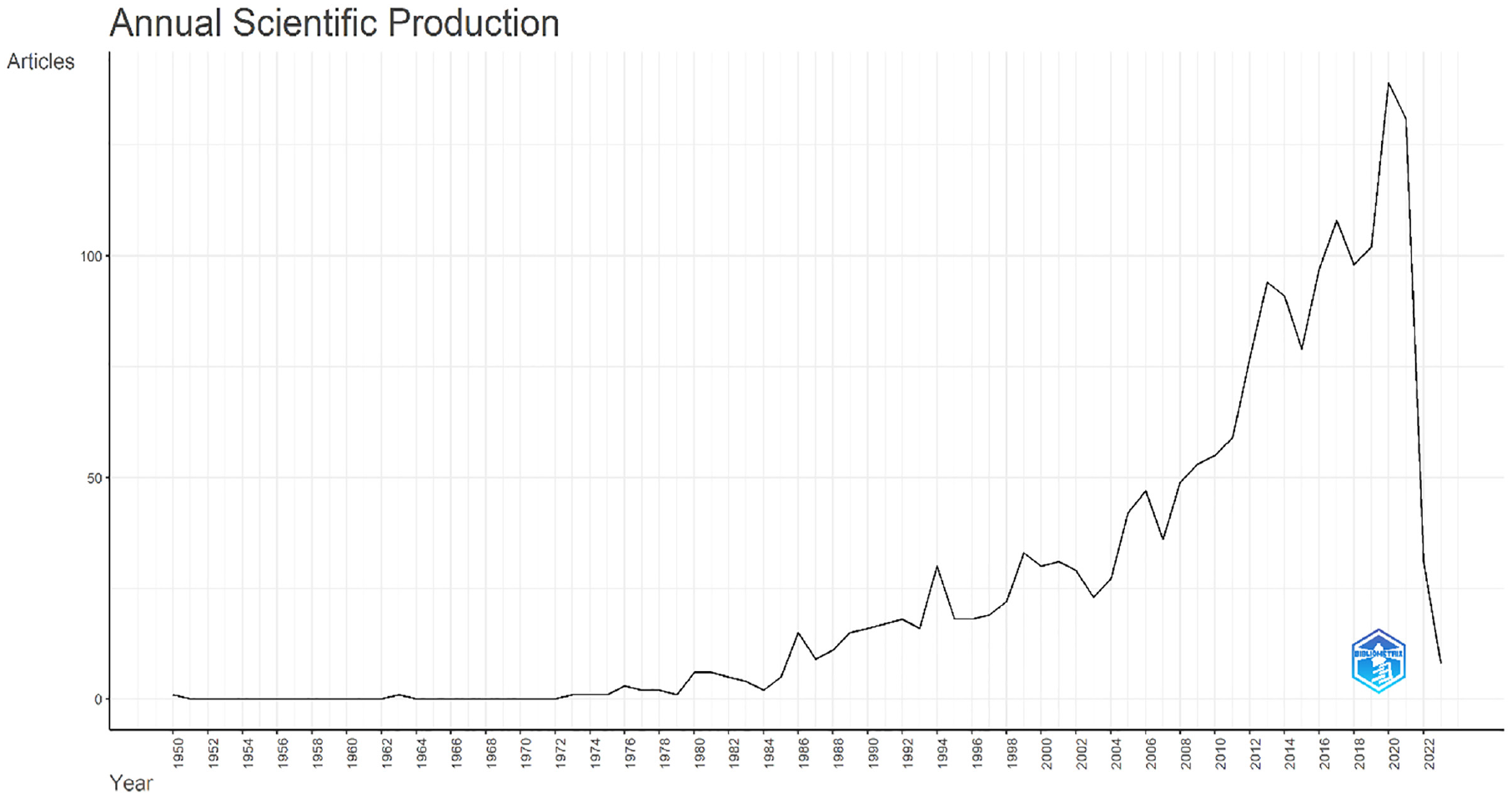
The annual and cumulative numbers of research articles on cognitive distortion from 1950 to 2021.
The highest average number of citations per year presented in Figure 3 was in 1963 with 12.8 citations per year by A. T. Beck (1963) entitled “Thinking and depression I: Idiosyncratic content and cognitive distortions,” followed by the article of “Childhood sexual abuse: Long-term sequelae and implications for psychological assessment” by Briere and Runtz (1993) with 5.3 citations in 1993 and 3.8 citations in 1981 by Cooper (1981) entitled “Ubiquitous halo.” The fact that these three articles are still being cited in 2018 indicates that they are the main sources for the field of cognitive distortion research. For the recent years, there was only 1.6 citations in 2018 continuing with lower averages until 2021 with 1.3 citations. The findings of A. T. Beck’s (1963) study, which remains the primary source of information in the field of cognitive distortion, demonstrate that issues related to cognitive and emotional disturbances continue to make the concept of cognitive distortions important and relevant as the term of “cognitive distortion” was first used in Beck’s original study on cognitive therapy and depression (Maruna & Mann, 2006).

The average annual citations of research articles on cognitive distortion from 1950 to 2021.
Cognitive distortion research area is widespread, and research groups worldwide are actively involved in this field. In this study, the researchers make an effort to identify the topic or area of study that dominates articles on cognitive distortion. The study discovered that there is a slight difference in the subject area of publications of cognitive distortions for both the Scopus and Web of Science (WoS) databases. The following are the subject areas, along with the number of their respective publications generated from the Scopus database: Psychology (745 articles), Medicine (630 articles), Social Sciences (235 articles), Arts and Humanities (104 articles), and Neuroscience (91 articles). Undeniably, cognitive distortion is a multidisciplinary area with 25 publications categorised under Business, Management and Accounting subject areas. In addition, there are also seven articles categorised under Mathematics subject areas and seven articles in Engineering subject areas.
Results from publications in the Scopus database also show that articles in this field are written and published in 17 different languages. Leading the list is the publication in English of 1,048 articles (89.80%). The second-largest publication is in French with 31 articles (2.66%), followed by Spanish with 30 articles (2.57%) and German with 18 articles (1.54%). Fifty-nine (5.06%) of other articles were published in various other languages such as Japanese, Italian, Polish, Turkish, Hungarian, Portuguese, Russian, Chinese, Persian, Greek, Czech, Dutch, and Ukrainian, with each language published less than 10 articles.
Other than that, with a slight difference compared to the Scopus database, the following are the subject areas, obtained from the Web of Science (WoS) database: Psychology (812 articles), Psychiatry (317 articles), Social Criminology Penology (242 articles), Substance Abuse (151 articles), and Neurosciences Neurology (81 articles). Studies also show that articles of cognitive distortion in WoS are also written and published in 12 different languages. Leading the list is the publication in English of 1,221 articles (93.06%). The second-largest publication is in Spanish with 28 articles (2.13%), followed by French with 18 articles (1.37%), German with 17 articles (1.30%), and Russian with 11 articles (0.84%). Eighteen (1.13%) of other articles were published in various other languages such as Turkish, Czech, Portuguese, Dutch, Korean, Malay, and Polish, with each language published less than 10 articles.
Although the data generated from both Scopus and Web of Science (WoS) database is slightly different in terms of subject area, but overall, analysis in this field shows that mental health issues are the major focus in the study of cognitive distortion. Additionally, in terms of the language used in publications, it is found that if articles in foreign languages were to be indexed in both databases, English-language titles and abstracts should be included.
Top Productive Journals
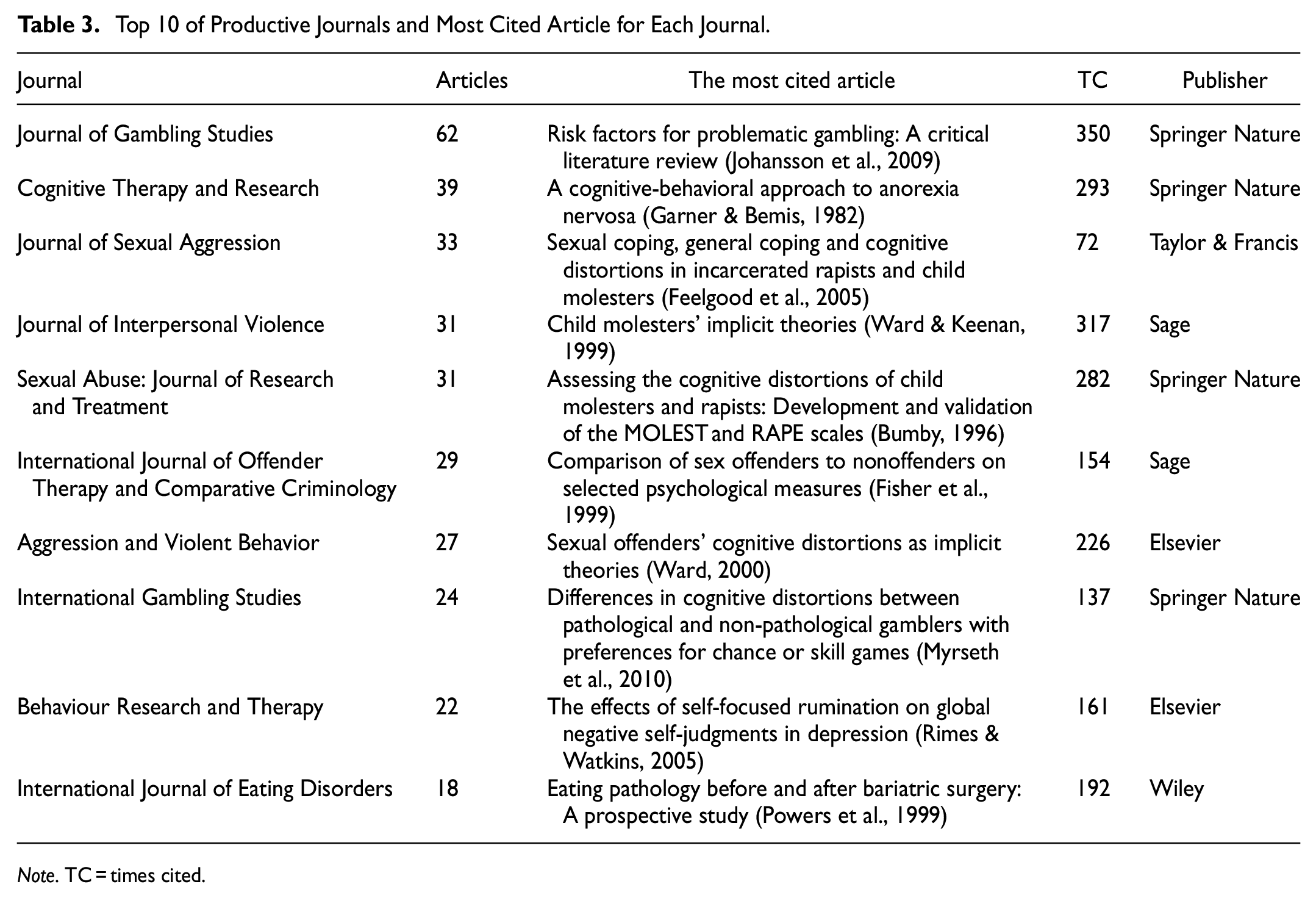
Next, in order to respond to the second research question, Table 3 shows the top 10 of productive journals by the number of articles published on cognitive distortions following with the most cited article for each journal with the times cited (TC). Five different publishers published the top 10 journals, namely Springer Nature with four journals followed by Elsevier and SAGE, each with two journals, followed by Wiley and Taylor & Francis, each with one journal. Journal of Gambling Studies was the most productive journal with 62 publications of cognitive distortions, followed by 39 publications from Cognitive Therapy and Research and 33 publications from Journal of Sexual Aggression. Journal of Gambling Studies not only ranked first on the list, in fact, one of its articles published by Johansson et al. (2009) entitled “Risk factors for problematic gambling: A critical literature review” with 350 citations was the most widely referenced and cited article by other researchers.
Top 10 of Productive Journals and Most Cited Article for Each Journal.
Note. TC = times cited.
Additionally, although the Journal of Interpersonal Violence ranked fourth with 31 publications, one of its articles entitled “Child Molesters’ Implicit Theories” authored by Ward and Keenan (1999) has been cited more than 300 times, exceeding those published in the two journals ahead of it. Furthermore, with 226 citations, another Ward’s article published in year 2000 entitled “Sexual offenders’ cognitive distortions as implicit theories,” were included as the seventh most cited article in the ranking. Ward’s accomplishment will be further discussed in point 4.4 of this study, which is about the most prolific authors in the area of cognitive distortion.
From the observations, it is found that 50% of the most cited articles revolved around sexual crime topics such as pedophilic or sex offences, child molesters, and rape crime, followed by studies in the field of eating disorders, gambling, and cognitive distortions treatment in clinical settings. This shows that cognitive distortion affects a person’s emotions and behavior resulting in actions that endanger themselves and those around them. Besides, Bradford’s law (Brookes, 1985) can be used to determine the most significant journals on the subject of cognitive distortions or as Bradford called them “core sources,” as shown in Figure 4. The primary journals can be identified in Zone 1, the shaded area that comprises the following journals: the Journal of Gambling Studies, Cognitive Therapy and Research, and Journal of Sexual Aggression. These journals include the most up-to-date research on the issue and are at the primary (Desai et al., 2018) of cognitive distortions, therefore they should be given special consideration when producing publications on the topic.

Core sources.
Leading Countries, the Most Productive Academic Institutions, and International Collaboration
The growth of research activity on cognitive distortion involving the 10 most productive countries can be seen in Table 4. The data demonstrate that the United States leads all other countries in the number of publications in cognitive distortions with 314 articles. United Kingdom and Canada are next, with 163 and 151 articles published in each country respectively, while eight other countries recorded less than 100 publications. However, United Kingdom exhibits the highest rate of collaboration with the multiple country publications (MCP) of 14. The data shows that Western researchers pioneered, and developed studies related to cognitive distortion, especially in the United States. These findings align with previous bibliometric studies in different fields, proving that the United States has the highest activity in producing scientific research and has a good international cooperation network (Hernández-Torrano, 2020; Moosa & Shareefa, 2020; Zyoud et al., 2018).
Scientific Production by Country.

Note. Freq = frequency; MCP = multiple country publications; MCP ratio = multiple country publications ratio; SCP = single country publications.
The data shows that only one Asian country (Turkey) is included in the ten most productive countries with 59 articles. Studies in cognitive distortion are growing rapidly, and researchers from Asian countries should take this opportunity to produce quality articles collaboratively and contribute to productivity in this field. It is important to consider the situation’s causes from a several perspectives. According to Kortabarria (2020) and Aliukonis et al. (2020), academics are under an abundance of pressure to publish in the current higher education environment for both professional and institutional reasons. Currently, most of researchers have shifted to Open Access (OA) publishing in an effort to increase the accessibility of written articles or papers. Unfortunately, Article Publishing Charges (APCs) are costly and burdensome (José & Serpa, 2020), and funding for this purpose is limited and even insufficient (Click & Borchardt, 2019), particularly for countries with currency value that are significantly less than the US dollar. Consequently, this might also have limited the publication of articles, especially those from developing countries. The authorities need to pay attention to this issue, as per mentioned by Cantrell and Swanson (2020), as more researchers and publications from diverse disciplines choose to publish in Open Access, funding mechanisms should be routinely reevaluated and diversified.
In a similar trend, Table 5 shows that the United States continues to have the highest number of article citations per country, with 10,357 representing an average of 33% of citations. United Kingdom comes in second with 8,079 citations, followed by the Canada with 3,814 and the Netherlands with 1,692 citations. However, Norway had the highest average number of article citations per country which is contributed by the most cited article globally entitled “Risk factors for problematic gambling: A critical literature review” by Johansson et al. (2009). In the listed leading countries, there are 29,978 article citations per country associated with cognitive distortions publications.
Average Number of Article Citations per Country.

Note. AAC = average number of article citations; TC = times cited.
Figure 5 illustrates the collaboration world map between countries, where the lines indicating the authors and their countries on the world map for the field of cognitive distortions. The most frequent collaborations of co-authors between countries in cognitive distortions field was between the similar continents of America. Particularly, authors from the United States and Canada who collaborate with one another are shown to have these links more frequently. Furthermore, these countries are followed by other European countries, where the United Kingdom and Italy collaborate as co-authors.

Countries’ collaboration world map.
Table 6 lists the academic institutions to which the authors are affiliated. University of Amsterdam, University of British Columbia, and University of Toronto have 22 articles each, followed by University of Birmingham and University of Cambridge with 20 articles each. Meanwhile, the remaining academic institutions below presented 19 articles each. Therefore, this section has also addressed the third and fourth research objectives, which requested information on countries and academic institutions that are active in publishing articles on cognitive distortion as well as on the prevalent of international collaboration. The results of this study can also serve as an overview and a guide for authors who are interested in writing in the area of cognitive distortion or collaborate with institutions or nations that have a track record of successfully doing so.
Affiliation of the Authors.

Leading Authors
Next, in order to answer the fifth research question, Table 7 presents a list of the 10 most prolific authors in the cognitive distortion area that were active from 1995 to 2014. As shown in the table, the most prolific authors, T. Ward topped the list with a record of 26 publications since 1995 and total of 2,243 citations, make him one of the authors who has written the most about cognitive distortions. Additionally, one of the articles is the most cited article entitled “Child molesters’ implicit theories” in 1999 with 317 citations (Ward & Keenan, 1999). With the h-index of 21, the author T. Ward had the highest impact factor of all cognitive distortion authors. In the same list, the first and third top authors, T. Ward and T. Gannon, were affiliated with Victoria University of Wellington. Besides, T. Ward from New Zealand and W. Marshall (ranked tenth) from Canada co-authored an article in 1995 entitled “Cognitive aberrations and affective deficits in sex offenders: Cognitive deconstructionist interpretations” that has been the most cited article for both authors, a total of 137 times.
Relevant Authors.

Note. NP = number of publications; PY start = publication start year; TC = times cited.
The author in the second place, L. Clark from Canada is also an outstanding author in the field of cognitive distortion because although he started active in the field of writing only by 10 years ago, during that period, he managed to publish papers every year (except in 2012, 2016, and 2019) with two to three papers a year. L. Clark from Canada set a record of 22 publications since 2010, a 14 h-index, and 846 citations. T. Gannon who were ranked third had published 22 articles since 2004, with 16 h-index, and 720 citations followed by A. Beech with a record of 18 publications since 1999, a 16 h-index, and 1,019 citations. In addition to Beech, who achieved a total citation record of more than 1,000 times, Marshall, who was ranked tenth, also had an impressive total citation record of 1,030, which was a very respectable amount. Also deserving of credit are writers M. Cosenza, M. Griffiths, and G. Nigro who, in just 7 years, have managed to rank among the top 10 authors in terms of research published in the subject area of cognitive distortion.
The collaboration network, illustrated in Figure 6, represents the analysis performed by the network of co-authors to identify the connections between the authors in the field of cognitive distortions. It should be emphasised here that the author’s name appearing in Table 7 may also appear in Figure 6, and it is also possible that the author’s name appears only in one of the two. Only researchers who successfully published articles productively will be recorded in both informations. And in publications related to cognitive distortions topic, authors who are ranked first to ninth in Table 7 meets those characteristics. In this context, the clusters that stand out are the first cluster composed of M. Consenza, G. Nigro, and M. Griffiths and the second cluster composed of T. Ward, T. Gannon, A. Beech, and E. Echeburua. These signify for the authors and clusters that collaborated the most throughout the time period analyzed.

Collaboration network.
Author keywords
Keywords cover the entire content of the research article. Since the keywords are high-level summaries, they represent information that is pertinent to the subject of study. By analyzing the keywords, it is possible to determine the direction of the research, identify any gaps, and indicate potential research areas. In the top 10 positions, Table 8 shows the authors keywords co-occurrence in the field of cognitive distortion research obtained not only in the title and abstract but also in the overall content of the published article. The words are linked to the terms contained in the search string. At the top of the list, the word “male” was identified 893 times in the total number of keywords used by the authors, followed by the word “female” with 859 times occurrences, “human” with 835 times occurrences, and “adult” with 795 times occurrences. The rest of the keywords indicate the relationship between the various topics with cognitive distortion.
Most Frequent Keywords.

The co-occurrence network illustrated in Figure 7 helps in understanding the knowledge structures and research trends. The size of the nodes represents the number of documents, while the line between the two nodes represents the co-occurrence between the two keywords. The most stand out cluster is the blue color consisting of “male,”“female,”“human,” and “adult,” showing the most linked and repeated keywords in the articles.

Co-occurrence network.
Under the subtopic “Publication output and growth of cognitive distortion research area” in point 4.1 previously, it was discovered that the publication of articles related to cognitive distortion revolved around the subject of Psychology, Psychiatry, Medicine, Social Sciences, Arts and Humanities, Social Criminology, Substance Abuse, and Neuroscience. Next, in the particular subject area, it is evident that the publication as a whole is dominated by themes relating to sexual offenders, gambling, psychological disorders, and the treatment of cognitive distortion as indicated in point 4.2. The fact that “male” is the word that occurs the most frequently in the research of cognitive distortion is supported by certain studies that focus on the “male” group and have dominated publications in recent years such as studies on male sexual offenders by D’Urso et al. (2019, 2021) and Marshall (2021) as well as studies on gambling by Granero et al. (2020), Mathieu et al. (2020), and Orlowski et al. (2020). However, other keywords are equally important, particularly those that appear in the top six positions and are connected to one another as illustrated in Figure 7.
Based on the Table 8 and Figure 7, the keyword “depression” is also widely used in articles related to cognitive distortion and has been repeated more than 300 times. This highlights the significance of knowledge regarding cognitive distortion, which is frequently discussed in relation to the problem of depression. The assertion is consistent with the idea brought forth by A. T. Beck (1967), who was the first to recognize the significance of cognitive distortion in his patients’ depressive symptoms. This has been shown by numerous research, including those by Jaffri et al. (2021), Naci and Koletsi (2021), also Thomas and Larkin (2020), which found a strong connection between depression and cognitive distortion. The keywords shown in Figure 7 serve as a guide for researchers who want to explore and expand the concept of cognitive distortion into other areas such as sports and entertainment.
Limitation of the studies
In addition to the contributions, this study does have some limitations. First, Scopus and Web of Science (WoS), the databases of choice, has a limited number of articles despite being the most important bibliographic databases in the world. The findings of various articles related to cognitive distortion, whether written in English or other languages, are likely to be obtained through various database sources and make the study more convincing. Second, the researchers did not use keywords related to the dimensions found in the concept of cognitive distortion (e.g., All-or-nothing thinking, Selective abstraction, Catastrophizing, Overgeneralization) because they assume that by restricting the search of “*cognitive* distort*” will represent the concept of cognitive distortion itself. Therefore, by limiting searches in titles, abstracts and keywords, search results may not include all studies related to cognitive distortion found in Scopus and WoS. Third, the researchers did not use keywords that have the same meaning as cognitive distortion such as “cognitive error” or “cognitive bias” because the main focus of this study is cognitive distortion itself. Fourth, only studies published in the form of journal articles were included in this study. This does not include other scholarly publications such as books, conference proceedings, etc. that are also used to disseminate knowledge on this topic.
Conclusion
A review of the research patterns of cognitive distortion since the beginning of this idea was explored, i.e., 71 years ago, has been conducted by this study. A 1,834 articles were discovered by data mining utilizing the Scopus and Web of Science (WoS) databases. Then, bibliometric analysis was conducted using the software packages Bibliometrix and Biblioshiny to discover broad research trends in cognitive distortion, particularly to address the study’s objectives and research questions. The research findings showed that rapid publishing growth has occurred over the last 30 years and is expected to continue to increase. It was revealed that Psychology, Psychiatry, Medicine, Social Sciences, Arts and Humanities, Social Criminology, Substance Abuse, and Neuroscience were categories or areas that frequently featured in articles regarding cognitive distortion. Therefore, researchers should take advantage of this chance to investigate and further explore the concept of cognitive distortion in other contexts, such as the workplace, sports, and entertainment.
From the observations, it is found that the most cited articles revolved around sexual crime topics such as pedophilic or sex offences, child molesters abuse, and rape crime, followed by gambling and eating disorders studies, then the studies on cognitive distortion treatments. This shows that cognitive distortion affects a person’s emotions and behavior resulting in actions that endanger themselves and those around them. Cognitive distortions that are inadequately dealt with will affect emotions and behavior in turn causing various psychological effects. The issues that arise because of cognitive distortion should be regarded seriously, and they require the attention of numerous parties, including the implementation of programs for social prevention and rehabilitation.
Research also found that the academic institutions or the countries such as the United States, United Kingdom, and Canada, which has a large number of publications, also has strong international collaborations. This provides opportunities for researchers from other countries to broaden their research collaborations especially researchers from the East and other developing countries. This is due to the fact that there aren’t many publications about cognitive distortion from researchers outside of the West, and it was discovered that the only Eastern or Asian nation included in the list of countries that publish the most articles in this area is Turkey. Publishing in high-impact journals is indeed costly. This matter is quite burdensome especially for developing countries and this may be a factor that limits the publication of articles by countries other than the West. Therefore, authoritative parties such as the publishing journals, higher education institutions, and funding organizations should pay attention to the matter so that this issue can be solved holistically and encourage researchers to publish high-quality articles especially in the area of cognitive distortion.
The present study sheds more light on how cognitive distortion research is advancing. This study provides some valuable information for researchers, policymakers, and funders who wish to study more broadly the field of cognitive distortion. Its purpose is to increase the visibility of this topic’s study by highlighting current characteristics and giving a retrospective and comprehensive assessment of publications. Some intriguing findings were discovered as a result of the search and bibliometric analysis, which may guide and assist scholars in future cognitive distortion research. Finally, this study shows that bibliometric analysis is an excellent methodological tool to map the literature and, in turn, can identify research gaps in the subject.
Footnotes
Acknowledgements
We thank the anonymous reviewers for their insightful suggestions and constructive feedback. We sincerely appreciate the editors for their patient work on our manuscript.
Author Contributions
FZ: Conceptualization, methodology, resources, data curation, formal analysis, writing—original draft. MM: Conceptualization, investigation, supervision, funding acquisition. AAS: Project administration, investigation. FMF: Resources, writing—review and editing.
Declaration of Conflicting Interests
The author(s) declared no potential conflicts of interest with respect to the research, authorship, and/or publication of this article.
Funding
The author(s) disclosed receipt of the following financial support for the research, authorship, and/or publication of this article: The author acknowledges the Fundamental Research Grants Scheme (FRGS), grant number FRGS/1/2021/SS0/UTM/02/10 funded by the Ministry of Higher Education (MOHE), Malaysia.
Ethics Statement
We declare that this manuscript is original, has not been published in any language before and is not being considered concurrently for publication elsewhere. We are confirming that the research reported in the manuscript was conducted in accordance with general ethical guidelines in psychology.

Data Availability Statement
Data sharing not applicable to this article as no datasets were generated or analyzed during the current study.