




Abstract
Over the last two decades, researchers have put significant efforts into exploring knowledge in the area of organizational citizenship behavior (OCB). This study aimed to investigate the global research trends in the OCB field based on publication outputs. The analysis focused on the top authors, journals, institutions, and countries. Using the Scopus database, a total of 4,324 publications from 2000 to 2019 were retrieved. A series of bibliometric indicators such as h-index, citations, and productivity were used to conduct the performance analysis. Moreover, the VOS viewer was employed to visualize the scientific landscapes. The graphical analysis used bibliographic co-authorship coupling among affiliated countries and author keywords from the bibliographic coupling of co-occurrence. The result indicated that there had been a dramatically increasing trend of study on OCB. In addition, the United States ranked first in terms of production, journals, citation impact, co-authorship, institutions, and authors in this subject. Furthermore, OCB has mainly been associated with the topics of job satisfaction and leadership. Apart from that, some other themes linked with OCB in recent studies were also found out. Our research plays an informative and complementary role as it provided most of the key aspects of OCB.
Keywords
Introduction
In the era of rapidly changing organizational business environments and the unstable labor market, which brings challenges for researchers and organizational leaders, both individual behaviors and social interactions occurring in the workplace context need to be better realized and understood (Gong et al., 2021; Metallo et al., 2021). It is necessary to pay close attention to organizational members’ spontaneous and cooperative behavior, known as organizational citizenship behaviors (OCB) since that might be a key factor in gaining competitive advantage (Mackenzie et al., 2011). Coldwell and Callaghan (2014) noted that organizational citizenship behavior plays a vital role in the development and success of organizations by initiating various workplace dynamics, promoting social connections in organizations, and influencing employees’ behaviors regarding organizational functions and outcomes.
Katz (1964) proposed the significance of a class of spontaneous and discretionary behaviors that are required for organizational efficiency despite the absence of unambiguous position criteria over five decades ago. Furthermore, Smith et al. (1983) reported in empirical research on the antecedents and nature of such behaviors, conceptualized those contributions as “organizational citizenship behavior” (OCB). A few years later, based on the concept of extra-role behavior from Katz (1964). Organ (1988) has defined the OCBs as individual behaviors that are discretionary, not directly or explicitly recognized by an official formal reward system. In the aggregate, it facilitates the organizational efficient functioning and outcomes. In subsequent studies, a few related concepts of OCB have been pointed out and determined, including prosocial behavior (Brief & Motowidlo, 1986); civic citizenship (Graham, 1991; Van Dyne et al., 1994); organizational spontaneity (George & Brief, 1992) and extra-role behavior (Van Dyne & LePine, 1998; Van Dyne et al., 1995). Scholars from around the world have paid OCB considerable attention to talk about significant predictors of employees’ OCB in terms of individual differences, job characteristics, attitudinal variables, and leadership factors (Dai et al., 2020; Salas-Vallina et al., 2017).
Estivalete et al. (2014) conducted a bibliometric investigation of disparities in OCB between Brazilian and international scientific output from 2002 to 2012 in the literature. The research comprised 165 papers in total, including 148 international articles in Psychology and Management and 17 Brazilian papers in management. The authors mentioned that the study was based on Verchai and Laner, who first looked into OCB publications in Brazil from 1983 to 2008, taking the Journal of Applied Psychology (JAP) as the database, and also aimed at expanding the discussions of Estivalete and others previous study which was an overview of the international literature on OCB. Moreover, Yaylaci (2016) presented an overall evaluation of studies on the OCBs in Turkey in the last decade (2000–2015). A total of 468 studies, including articles, master’s thesis, and doctoral dissertations on the OCBs, were determined. Those studies were obtained on the Turkish Academic Network and Information Center (ULAKBİM), the Google Academic, EBSCOhost database, and Web of Science All Database. In addition, the recent study of de Geus et al. (2020) conducted a systematic literature review of OCB in the Public Sector.
Moreover, researchers have an interest in studying OCB (Azmi et al., 2016; Ocampo et al., 2018; Tambe & Meera, 2014). As stated by Majeed and Jamshed (2021), OCB for organizational employees is gradually becoming indispensable and ending up continuously fundamental. Hence, a focal issue of inquiry is understanding how OCB functions in organizations (Kim & Park, 2019). According to Carpenter et al. (2014), there are significant studies on increasingly popular OCBs and their other associated structures. However, we found that very few studies were dedicated to measuring and analyzing the scientific publications on OCB from a global perspective. The information and knowledge of an organized and systematic review on the OCB are scattered through numerous publications. The existing works of literature focused on either one particular country or sector (de Geus et al., 2020; Estivalete et al., 2014; Yaylaci, 2016). Hence, to grasp emerging developments and research attention devoted to select issues in the OCB field, a systematic review and analysis of the literature from a global perspective seems in order.
Reviewing the actual knowledge in the specific field allows us to understand the themes, main theoretical approaches and identify the gaps and key opportunities for further advancement. As we have shown, there are still limited bibliometric research in the OCB field. By offering an objective appraisal of the field, the bibliometric review helps cover the research gap. Thus, this study was aimed to fill the gap by using quantitative and visualized bibliometric analysis.
Furthermore, bibliometric research was carried out by using the Scopus database from 2000 to 2019. The compelling reason to choose Scopus as the primary source of bibliometric records for this study is that Scopus is recognized as the largest abstract and citation database of peer-reviewed literature covering wide-ranging disciplines. Also, it is considered one of the complete databases in the social sciences (Mongeon & Paul-Hus, 2016). Even though the Web of Science (WoS) has been used traditionally as the major source of scientific evaluation. Scopus has been considered a very good alternative to the WoS since it has been designed for literature search and citation analysis (Meho & Yang, 2007; Vieira & Gomes, 2009). Moreover, as Mongeon and Paul-Hus (2016) noted, Scopus includes most of the journals indexed in the WoS and has a greater number of premier journals than the WoS.
Bibliometric mapping is an important methodology in the bibliometric study since the intellectual connections within a discipline of dynamically changing bibliographic information can be analyzed. Therefore, VOS viewer software was applied in this study as the tool of the bibliometric analysis. The software includes VOSViewer (van Eck & Waltman, 2010); Bibexcel (Persson et al., 2009); CiteSpace II (Chen, 2006); IN-SPIRE (Wise, 1999), which use different indicators to extract and represent networks within a field of study. These include co-citation (Small, 1973), bibliographic coupling (Kessler, 1963), co-words or co-occurrence of keywords (Callon et al., 1983), and co-authorship (Peters & Van Raan, 1991). VOSviewer is seen as the most outstanding tool designed as computer software and utilized for visualizing the bibliometric data (van Eck & Waltman, 2010, 2014a, 2014b, 2017).
Methods
The purpose of this study is to offer structure and clarity to a scattered and extensive body of literature on OCB from the last two decades. A bibliometric analysis is used in this study, because bibliometric analysis is a well-established and reliable method of providing a full picture of research trends in the literature. Bibliometrics involves applying various approaches to identify the quantitative and qualitative changes in a theme of scientific research, establishing the profile of publications on a particular topic, and determining trends and structural aspects within a subject (Rey-Martí et al., 2016). Bjork et al. (2014) proposed that the advantage of bibliometric analysis lies in gaining of a general overview of a specific research field. The bibliometric studies that have been so popular in natural sciences are also becoming popular in social sciences. There are numerous examples in the literature (Diem & Wolter, 2013; Nederhof et al., 1989; Zou et al., 2015). Besides, bibliometric methods also have been employed productively in various forms over the past 50 years, apart from the Social Sciences (Nederhof, 2006; Schui & Krampen, 2010) and across business fields such as Management (Fernandez-Alles & Ramos-Rodríguez, 2009; Podsakoff et al., 2008) and Industrial / Organizational Psychology (Carlson & Millard, 1984; Meltzer & Nord, 1973; Piotrowski, 2012).
We complied with PRISMA (Preferred Reporting Items for Systematic Reviews and Meta-Analyses) guidelines and procedures (Moher et al., 2009). The researchers retrieved the data on the Scopus database from 2000 to 2019 to examine all the publications on organizational citizenship behavior. Once the search process and data screening had been completed, the eligible records were subjected to bibliometric analysis. The bibliometric analysis uses some descriptive and evaluative approaches to analyze the characteristics of publications quantitatively (McBurney & Novak, 2002). The main classifications of information analyzed for bibliometrics are the journals, authors, institutions, countries, keywords, references, and the trends in a particular theme (Abramo et al., 2011).
To carry out this bibliometric analysis quantitively and qualitatively, as we mentioned, the Scopus database was used. As Scopus has built-in analyzer features (Choudhri et al., 2015), most descriptive analysis was done using these features. Additionally, VOS Viewer software was applied to quantitatively and visually analyze various features of publications on OCB, such as analysis of citations, co-occurrences, countries, and keywords analysis. The bibliometric researchers made extensive use of the software “VOS Viewer” (Costa et al., 2019; Ferreira et al., 2015; Pinheiro et al., 2018; Zhao et al., 2015).
Literature Search
The search process in Scopus was limited to research that was published between 2000 and 18th December 2019. The search terms utilized the following keywords: “organizational citizenship behavior,” “citizenship behavior,” “organizational citizenship,” “organizational civic virtue,” and “extra-role behavior,” which were also used in the study of the prior research (Estivalete et al., 2014).
The search centered on mapping existing OCB literature across all domains. To avoid omissions, the study included research articles from various journals, books, book chapters, conference papers, conference proceedings, and trade magazines; however, review papers were excluded.
PRISMA specified the procedures required to report the identification of the documents in a systematic review of the study (shown in Figure 1). Our search was aimed at identifying all studies on OCB. The Scopus database was utilized for searching, and the parameters are set as follows:
Inclusion: Dates: 2000 to the present (18th December 2019).
Inclusion: Searching key words: “organizational citizenship behavior,” “citizenship behavior,” “organizational citizenship,” “organizational civic virtue” and “extra-role behavior.”
Inclusion: Document Type: articles, books, book chapters, conference papers, conference proceedings, and trade publications.
Exclusion: Document Type: reviews.

Flow diagram of the study.
A total of 4,660 entries were found by searching the Scopus database for OCB titles, abstracts, and author keywords. Then, based on eligibility, the publications before the year 2000 and reviewed papers were not included in the search, so that 336 irrelevant documents were excluded via Scopus filters. Finally, the 4,324 eligible records were left for this bibliometric analysis (See Figure 1).
Analysis of Results
Publication Growth of Research Interest
Figure 2 shows the gradual growth of OCB publications from 2000 to 2019 (20 years). As of the 2000s, there was a significant surge in publication output and research interest on OCB. It was discovered that the Scopus Database has 4,324 studies on the OCB from 2000 to 2019. It is shown that there was a gradual increase in publications on OCB started from 2000 to 2007. The annual publication was less than 100. However, from 2007 to 2012 the number of publications showed accelerated growth. A total of 1,231 OCB research papers had been published within 6 years. Then it remained almost the same in the next 2 years. And again, started in 2014, it went up steeply. Especially notes that since 2018, the research interest in OCB has turned dramatically fast-growing. It could be anticipated that the interest will be continuously rising in the future.
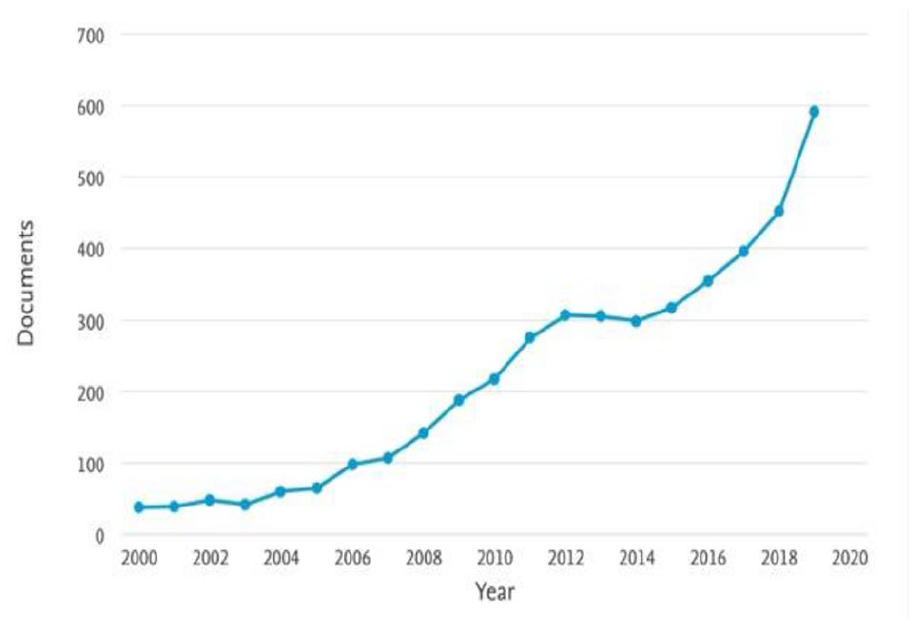
Publications on OCB from 2000 to 2019.
Leading Authors, Top Journals, Institutions, and Countries
Table 1 lists the ten most prolific authors in OCB, affiliated to four countries such as the United States (five authors), Canada (two authors), Israel (two authors), and Australia (one author). Those ten scholars author the 175 articles, and the first publications ranged between the years 2000 to 2009. The authors’ areas show that OCB research was within the business, management, and accounting fields; psychology, social sciences, economics, econometrics, and finance. According to Scopus, the most prolific OCB authors are Johnson, Russell Eric, and Chiaburu, Dan S. from the United States. Both have published 22 articles, 15 h-index, 905 citations, and 11 h-index and 539 citations, respectively. Bolino, Mark C., Somech, Anit and Paillé, Pascal, published 19 papers. It is noted that the 4th and 10th top authors are Somech, Anit, and Cohen from Israel, who are both affiliated with the University of Haifa. In addition, Van Dyne, Linn ranked 7th has higher citations (1,810 times) relatively for 14 articles. However, the author with the most citations is Bachrach, Daniel G., with 15 h-index and 2,989 citations of 17 publications.
The Top 10 Most Prolific Authors in the OCB Research Area.

Table 2 presents the top 10 journals that published the most articles on OCB in the last two decades. Almost 15% (a total of 658 articles published out of 4324) of the existing articles on OCB have been published by those top 10 journals. Accordingly, the most productive journal on OCB was the Journal of Applied Psychology, with 142 articles covering 3% of the total publications. It had 21,411 times citations, which was the highest among the top 10 journals followed by the Journal of Business Ethics (97, 2%), International Journal of Human Resource Management (76, 2%), and Journal of Organizational Behavior (67, 2%). The results also indicated that the top 10 most productive journals are owned by seven different publishers (Table 2). APA published the top journal. The top 2 and top 6 journals were both published through Springer Nature. The other two pairs of journals, the top 4 and 10, and the top 7 and 8, are owned by Wiley-Blackwell and Elsevier. The rest three journals’ publishers are Taylor & Francis, SAGE, and Emerald.
The Top 10 Most Productive Journals on OCB Research With Their Most Cited Article.

TP = Total of Publications produced by the Journal.
Furthermore, CiteScore, the Elsevier-Scopus alternative to the Clarivate Analytics Impact Factor, is a metric for measuring journal impact based on citation data from the Scopus database. The citation score indicates the influence of the journal. According to the CiteScore 2018 report, five journals had a CiteScore of 5 and above. Journals of the highest and the second-highest CiteScore belonged to the Journal of Management (10.96) and Journal of Applied Psychology (6.86). Journal of Managerial Psychology received the lowest Cite Score, which was 2.05. Moreover, while it is clear that the CiteScore of journals can be a significant criterion for certain authors when deciding which journal to publish their works in, it should be noted that it is not the sole criterion. Besides that, whether the journal can deliver the work to the right audience and contribute to the progress of the field should also be considered by authors. This section provides a general view that scholars from a specific classification are more suitable for OCB investigations and guides new researchers to better article submission choices.
The university with the highest number of publications in the OCB field was Michigan State University, with 73 publications. It is worth mentioning earlier we found that the most prolific author Johnson, Russell Eric, who has contributed 22 publications, was affiliated with Michigan State University (as shown in Table 1). Moreover, Hong Kong Polytechnic University ranked second with 47 publications. The third university with the most publications on the OCBs was Haifa, with 44 publications. The Chinese University of Hong Kong followed these universities with 42 publications and the University of Georgia with 41 publications (See Figure 3).

The top 10 most productive institutions in OCB research.
In total, 60 nations and territories contributed to the 4,324 publications in the OCB research, with the top 10 most productive countries and territories owning 84.36% (3,648 publications) of all publications. The United States was the main or most influential country in the OCB field. It has contributed the most, which accounted for one-third (1,435 publications) of the total publications, and has received the highest citations, which were 68,592. This is followed by China and the United Kingdom, which have produced 469 publications with 5,109 citations and 312 publications with 9,141 citations, respectively. As we speculated that English-speaking countries might be possible to obtain more citations. For example, ranking 4th Canada (232 documents, 5,721 Citations) and ranking 5th Australia (256 documents, 12,494 citations) had higher citations compared to China (

The top 10 most productive countries in OCB research.
Most Influential Countries/Territories and Their Co-Authorships
The distribution of countries/territories per region is shown in Figure 5. The closer the two countries are located to each other in VOSviewer, the stronger their relatedness, and the stronger the link between the two countries, the thicker the line. The OCB field has been rapidly growing in the recent two decades, and evidence of the phenomena is connected with the OCB wideworld. Figure 5 shows the most productive countries of OCB, using a bibliographic coupling analysis. The results are consistent with those observed in Figure 4. The USA was dominating the OCB field with the highest number of publications. Moreover, the findings of co-authorship showed that the USA was the most affiliated country, linked to 51 countries/territories. The list was followed by the UK with 51 links and China with 47 links. Note that those countries were positioned in the center of Figure 5 and were strongly associated with the rest of the countries/territories. It was observed that there were a strong presence and connection between European countries.
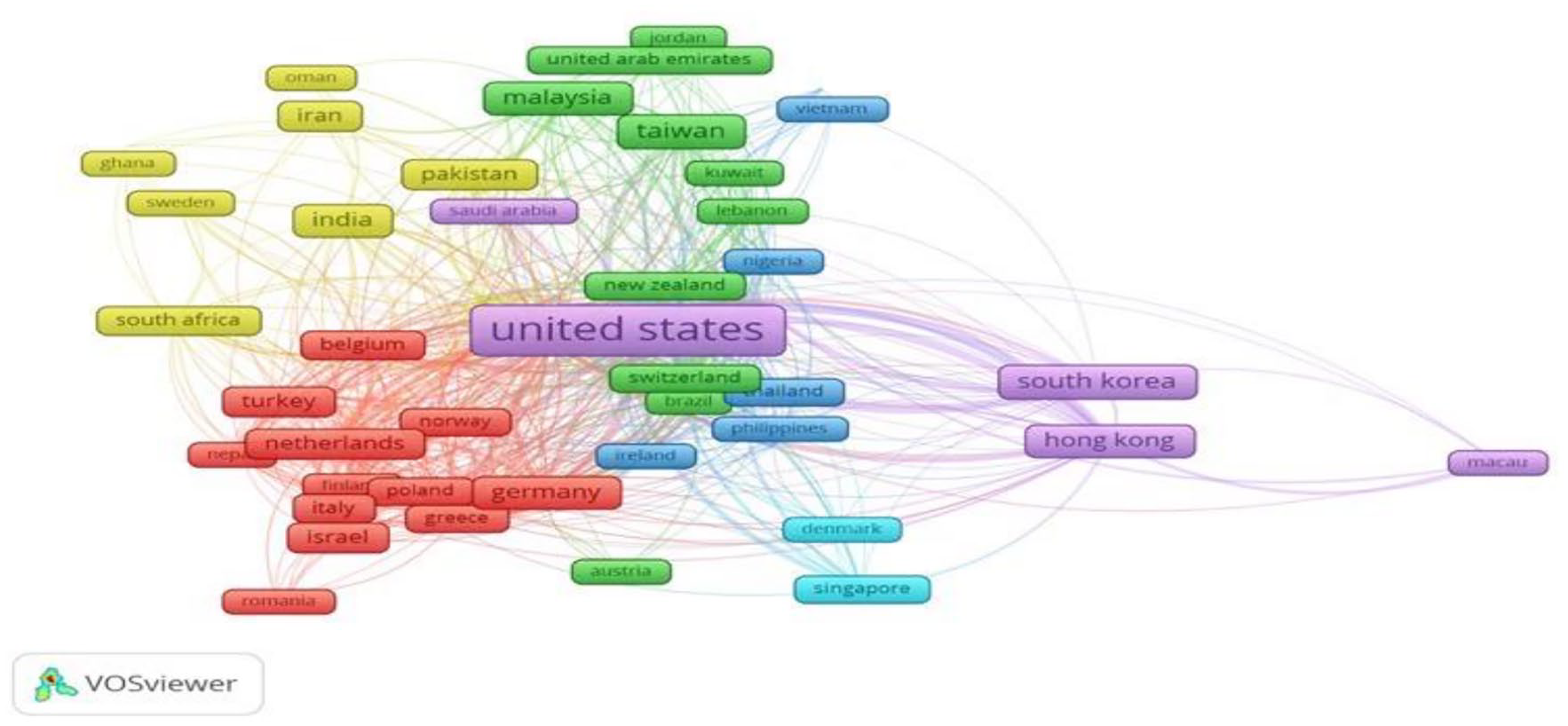
A screenshot of the bibliometric map created based on co-authorships with network visualization mode.
Author Keywords
The author keywords were re-labeled by creating a thesaurus file before processing the analysis. After modifying the comprehensive keywords information, 460 author keywords (with a minimum of five occurrences) were generated in the analysis.
Concept and Terminology
As shown in Figure 6, the author keywords co-occurrences analysis revealed that “OCB” was the most commonly used keywords in previous studies, with 2001 occurrences and 435 links to other keywords. Besides, several keywords were used in conceptualizing the OCB, for instance, “citizenship” (58 occurrences), “extra-role behavior” (44 occurrences), “conscientiousness” (30 occurrences), “altruism” (28 occurrences), “prosocial behavior” (20 occurrences), “helping behavior” (17 occurrences), “civic virtue” (17 occurrences). “courtesy” (10 occurrences), and “sportsmanship” (15 occurrences). In addition, the concept of OCB was connected to the few theories, such as “social exchange theory” (110 occurrences), “leader-member exchange theory” (70 occurrences), “social identity theory” (20 occurrences), “self-determination theory” (15 occurrences), “conservation of resources theory” (11 occurrences), and “affective events theory” (seven occurrences).

A screenshot of the bibliometric map created based on author keywords co-occurrence with overlay visualization mode.
Topics of Interest
From Figure 6, it indicated that the keywords such as job satisfaction (occurrences: 279; links: 225), leadership (occurrences: 275; links: 221), organizational commitment (occurrences: 201; links: 164), organizational support (occurrences: 130; links: 133), organizational justice (occurrences: 122; links: 129), organizational trust (occurrences: 118; links: 131), job performance (occurrences: 113; links: 140), social exchange theory (occurrences: 110; links: 113), transformational leadership (occurrences: 107; links: 109), and organizational identification (occurrences: 78; links: 85) that appeared strongly connected to the OCB, representing the different theoretical frameworks that are generally used in the OCB literature to explain the phenomena associated with this interesting field of research. Besides, it also implied that those keywords have a crucial and central role in the field since, from the beginning, research OCB has emphasized. The findings of author keywords demonstrated that most of the top ten author keywords were antecedents of OCB. This means that past studies have focused on the antecedents of OCB compared to the outcomes of OCB.
Likewise, this analysis found that OCB was closely related to leadership. Among the different leadership styles, transformational leadership (107 occurrences, 109 links) had the highest number of co-occurrence in the OCB study, followed by empowering leadership (14 occurrences, 28 links), and spiritual leadership (12 occurrences, 17 links). In addition to these, we believe that the researchers discussed other types of leadership, as general “leadership” (occurrences: 275; link: 221) had very high occurrences in the OCB research.
Moreover, it was noticed that social exchange theory (occurrences: 113; links: 110), was the most common and popular theory which the researchers have frequently used to support their studies in the area of OCB. Because social exchange theory (SET) is among the most influential conceptual paradigms for understanding workplace behavior (Cropanzano & Mitchell, 2005). OCB gets analytical support for its assertions through the social exchange theory (Emerson, 1976). In addition, Zellars and Tepper (2003) demonstrated the pervasiveness of SET in OCB models, and they stated that social exchange is the key driver of employees’ OCB. In addition, Cohen et al. (2012) also paid attention to the emphasis on SET that dominates extant OCB theory and research. Social Exchange Theory (SET) constitutes the main theoretical framework of OCB research (López-Cabarcos et al., 2020; Tamunomiebi & Onah, 2019). Besides, the current result displayed that quantitative (occurrences: 29; links: 56) research design has been utilized the most in OCB studies. Additionally, the most studies on OCB have been conducted from nurses (occurrences: 15; links: 34), teachers (occurrences: 33; links: 53), e-governments (occurrences: 16; links: 11), such public sectors (occurrences: 11; links: 18).
Furthermore, the different color in Figure 6 indicates the average publication year of the articles in which a keyword occurs. The lighter the color, the more recent it is, so that it can be seen that the keywords “corporate social responsibility, organization-based self-esteem, psychological empowerment, role overload, substantiality, self-determination theory, perceived values, OCB for the environment (OCBE), internal branding, branding experience, responsible leadership, job engagement with OCB have become the emerging research interests. According to the current analysis, some crucial subjects such as workplace bullying, workplace ostracism, and abusive supervision have been identified as worthy and relevant areas of OCB investigation.
The Summary of the Most Cited Publications
Table 3 is shown the ten most influential publications of the OCB field which had the highest citations. The article “Affective, continuance, and normative commitment to the organization: A meta-analysis of antecedents, correlates, and consequences” had been cited the most with 2,644 times citations, followed by “Organizational citizenship behaviors: A critical review of the theoretical and empirical literature and suggestions for future research” which also had higher citations (2,265 times). As we noticed that the last three articles among the top 10 belong to the Journal of Applied Psychology, this was consistent with the results shown in Table 2 that the most productive and influential journal on OCB was the Journal of Applied Psychology. Moreover, half of the most cited publications is meta-analysis study. It could also be observed that organizational commitment, job engagement, job performance, justice, emotional intelligence, and trustworthiness are closely related to OCB.
The Top 10 Most Cited Publications.

TC = Total Citations.
Discussion and Conclusion
The purpose of this paper was to find and analyze OCB publications. Scopus database was searched from 2000 to 2019 for this purpose through the bibliometric analysis method. Based on 4,324 publications published from 2000 to 2019, VOS Viewer software was performed to analyze and visualize various features of publications; a systematic review and analysis of the literature on OCB from a global perspective was presented. As shown in the tables and figures above, involving the most influential authors, journals, countries, institutions, and co-occurrence authors, keywords, have been identified.
Firstly, the findings revealed a 20-year trend of increasing publication outputs and research interest in OCB (from 2000 to 2019). It’s safe to assume that interest will continue to rise in the future. The finding was similar to the results in Yaylaci (2016) bibliometric analysis, which examined an overall evaluation of the course of studies on the OCB in Turkey from 2000 to 2015. Yaylaci (2016) found out that there had been a growth in the total number of researches on the OCB started in 2004. The increasing trend of studies on OCB was steadily turning the OCBs into a theme studied the most. Furthermore, Podsakoff et al. (2014) revealed that the attention that had been paid to the OCB has dramatically risen since the OCB had been comprised of the body of literature 30 years ago. OCB has acquired the quality of a fruitful work area in various countries and all over the world. Indeed, our finding was supported by Gan and Yusof’s (2020) analysis; that is, the number of OCB publications increased steadily and significantly from 1995 to 2019.
Moreover, it found that the most prolific OCB authors were Johnson, Russell Eric, and Chiaburu, Dan S. from the United States. Still, the most influential author was Bachrach, Daniel G., who had the highest citations of his publications. In addition, the most critical institution was Michigan State University which has employed the most prolific author Johnson, Russell Eric. Cui et al. (2018), Gan and Yusof (2020) also demonstrated that Michigan State University was the most fruitful institution. Johnson, Russell Eric, and the other researchers in the top ten most prolific OCB authors mostly focused on how positive affectivity, work satisfaction, role stressors, and role overload influenced OCB (Eatough et al., 2011; Johnson et al., 2010; Rosen et al., 2016). Chiaburu, Dan S., and his colleagues examined that the five-factor model of personality traits, manager trustworthiness, organizational support were fundamental determinants of OCB (Chiaburu & Lim, 2008; Chiaburu et al., 2011, 2015). It was noticed that, unlike most OCB researchers who focus on positive OCB, Bolino et al. (2013) highlighted the dark side of citizenship behavior. They thought that OCBs would result in personal expenses, darker agendas, and undesirable organizational outcomes. His findings indicated that individual initiative as one specific type of OCB leads to individuals’ role overload, job stress, and work-family conflict (Bolino & Turnley, 2005). Besides, citizenship fatigue was negatively associated with subsequent OCB acts (Bolino et al., 2015). Moreover, Somech, Anit emphasized the importance of teachers’ OCB in the education system (Bogler & Somech, 2004; Somech & Ron, 2007; Vigoda-Gadot et al., 2007). And Paillé (2013) explored OCB for environment (OCBE)(Boiral & Paillé, 2012).
Furthermore, Bachrach, Daniel G. was interested in studying how ethical leadership (Kacmar et al., 2011), supervisor trust (Kacmar et al., 2012) influenced OCB and how OCB affected job performances (Bachrach et al., 2006, 2007; Rapp et al., 2013). Van Dyne and several researchers investigated the construct redefinition, measurement, and validation of OCB (Van Dyne et al., 1994). Besides that, organizational justice, job satisfaction, performance were found predictors of OCB (Ang et al., 2003). Restubog discussed the relationship between abusive supervisors (Rafferty & Restubog, 2011; Hobman et al., 2009) psychological contract breach with OCB (Restubog & Bordia, 2006; Restubog et al., 2006, 2007). In addition, Tremblay, Michel emphasized linking OCB with organizational commitment, organizational justice, and organizational support (Morin et al., 2011; Paré & Tremblay, 2007). Cohen paid more attention to the relationship between individuals’ values, in-role performance, and OCB (Cohen, 2007; Cohen & Keren, 2008; Cohen & Liu, 2011). Considering the relationship between OCB and the various aspects that the top productive authors focused on, it can be noticed that OCB is often discussed in the management and business fields, this was in line with (Anjala & Sandamali, 2019; Gan & Yusof, 2020; Ocampo et al., 2018). Additionally, job satisfaction, organizational support, trust, organizational justice, performance, organization commitment, justice, leadership, role overload, job stress, and personality traits are all themes that could be investigated more in the future.
Likewise, among the 10 journals (shown in Table 3), the top 5 journals were in line with the finding of Gan and Yusof (2020). In addition, our results indicated that the most productive and influential journal on OCB was the Journal of Applied Psychology (JAP), while the Journal of Management had the highest CiteScore. The findings were also consistent with the study of Gan and Yusof (2020). However, JAP was the most influential journal in the OCB studies and the organizational psychology field (Romeo et al., 2017). Besides, de Geus et al. (2020) uncovered that the Journal of Human Resource Management and Journal of Applied Psychology was in the top 10 most prolific journals list of OCB studies with the Public Sector. This section explains why scholars from specific classifications are more suited for OCB study and points new researchers in the right direction for article submission.
Also, the findings demonstrated that the USA was the most productive country and the most affiliated country. Gan and Yusof (2020) concluded that the United States was the leading country in promoting OCB globally, and it had the most affiliations. Furthermore, the findings were consistent with those in other research fields (Md Khudzari et al., 2018; Zoucas & Cunha, 2016). According to Cui et al. (2018), the United States contributed the most as the country of origin. In addition, Baier-Fuentes et al. (2019) found that the United States was the clear leader with the best production and influence metrics, as the United States dominated scientific research in other disciplines in general. The United States is thought to be at the forefront of OCB research since it houses the most significant institutions and researchers in the field. Other factors, such as international collaboration, enough research funding, and a supportive climate at research institutes, may also play a role in this development.
Besides, the most studied concepts in relationships with OCB were: job satisfaction, leadership, organizational commitment, organizational support, organizational justice, organizational trust, and job performance. The results were similar to the findings of Estivalete et al. (2014), Gan and Yusof (2020), Yaylaci (2016). Moreover, it corresponded with de Geus et al. (2020). They concluded that job satisfaction, trust, leadership, organizational commitment, organizational justice were the most prevalent concepts connected with OCB study in the public sector. In addition, Gan and Yusof (2020) analyzed that OCB has also been studied with more commonly used management concepts such as commitment, job satisfaction, organizational justice, perceived organizational support, job engagement, organizational trust, leadership.
Our study found that the keywords corporate social responsibility (CSR), job engagement, organization-based self-esteem, psychological empowerment, internal branding, responsible leadership, and ethical leadership have shed some interesting insights into the field of OCB exploration in recent years because the high level of such factors creates a positive impression on employees, who in turn will reciprocate by demonstrating OCB to the organization. (Khaskheli et al., 2020; Ng et al., 2021; Shareef & Atan, 2019). The review showed that the variables selected to study the antecedents of OCB have overwhelmingly positive attributes for OCB, this was supported by de Geus et al. (2020). However, our findings also uncovered some critical issues as workplace bullying, workplace ostracism, role overload, and abusive supervision that have recently garnered wide professional attention because such factors negatively affect OCB in organizations (Kim et al., 2020; López-Cabarcos et al., 2020; Song & Kim, 2021).
Furthermore, the findings revealed an imbalance in the literature, with most previous studies focusing on antecedent-OCB relationships. However, the consequences of OCB were neglected. The limited research on OCB consequences and the lack of trends or vital areas of interest in OCB consequences also suggest that this is a particularly understudied area that needs to be explored more. In addition, the bibliometric analysis of the authors’ keywords revealed that most research on OCB had been conducted in hospitals, educational institutions, government, and public organizations. Nevertheless, studies on OCB in the private sector are limited. Therefore, we encourage the exploration of OCB in the private sector. Meanwhile, the findings showed that OCB was most often studied through quantitative surveys, so there was a shortage of qualitative and mixed methods. It is suggested that researchers could attempt different methodologies in the future.
Implications
The current study provides a deeper understanding of how organizational citizenship behavior research is progressing. Its goal is to raise the visibility of research on this topic by presenting current characteristics and providing a retrospective and comprehensive review of publications. Some intriguing findings were discovered as a result of the search and bibliometric analysis, which may guide and assist scholars in future OCB research.
Limitation and Future Recommendations
Some of the limitations of this study, like those of other studies, should be addressed. To begin with, the material presented in this study was both instructive and complementary. Its purpose was to provide general direction and assistance to the most prolific and impactful studies in the OCB field. Second, we conducted this analysis based on Scopus data, which covers comprehensive information on research from the social sciences (Mongeon & Paul-Hus, 2016). However, we can not assure that our search strategy contains all significant journal articles since some important information might have been omitted through the occurrence of “stray citations.” Some important information might have been omitted, endemic to all bibliometric databases (Jacsó, 2008).
Nonetheless, given our general knowledge of the OCB sector, the information acquired from Scopus has undoubtedly offered a thorough set of the most related research that OCB has generated to date. It should be noted that the information was exhibited in the current study might be changed over time depending on the thematic tendencies which researchers consider.
Even though our sample accurately represented the OCB area, future researchers suggest trying other databases (e.g., Science Direct) to obtain the bibliometric data on OCB. Furthermore, master’s or doctorate dissertations should be explored to gain a broader viewpoint, as ground-breaking opinions may emerge from unexpected sources.
Footnotes
Acknowledgements
We are grateful to the anonymous reviewers for their insightful suggestions and constructive comments. We deeply thank the editors for their patient work on our manuscript.
Declaration of Conflicting Interests
The author(s) declared no potential conflicts of interest with respect to the research, authorship, and/or publication of this article.
Funding
The author(s) disclosed receipt of the following financial support for the research, authorship, and/or publication of this article: Funder by the Ministry of Higher Education under FRGS, Registration Proposal No: R.J130000.7853.5F172.
