




Abstract
This study addresses the impacts of high-speed rail (HSR) on the employment rate on the periphery of HSR-connected cities. Using the Chinese municipal-level data sets of 2001 to 2017s, we have found that HSR could improve the average employment in peripheral cities on the route. However, HSR negatively affects employment in small and medium-sized peripheral cities while the large-sized peripheral cities benefit from its operation. Our evidence shows that the “siphon effect” on employment of large-sized peripheral cities on smaller neighbors happened specifically in the manufacturing sectors. This study provides important policy implications for HSR cities with different sizes and characteristics. Small- and medium-sized periphery HSR cities could appropriately response to HSR operation by readjusting the structure of manufacturing sectors, in order to avoiding employment loss.
Plain Language Summary
This study aims to fill the research gap related to the impact of HSR on employment in peripheral cities. Using the Chinese municipal-level data sets of 2001 to 2017s and a difference-in-difference (DID) model, we found that the Beijing–Shanghai HSR line has positively contributed to the overall employment level in the peripheral cities along the route, which we attribute to the siphon effect of large-scale peripheral cities on smaller neighboring cities after the opening of the HSR. Additionally, improved accessibility has accelerated the spillover effect of the core cities on less developed cities. Due to the heterogeneity of different industries’ dependence on the transportation of goods and people, the Beijing–Shanghai HSR line mainly promotes the employment levels of secondary and tertiary sectors in peripheral cities along the route. Beyond that, according to our findings, when analyzed separately by city size, the HSR has a significantly negative overall employment level (−0.250) for small and medium-sized peripheral cities compared to that of large-scale peripheral cities and specifically has the most significant negative impact on the secondary sector. A possible explanation for this finding is that peripheral cities with small and medium-sized markets are more vulnerable to the negative distributional effects of the HSR. This study provides important policy implications for HSR cities with different sizes and characteristics: Small- and medium-sized periphery HSR cities could appropriately response to HSR operation by readjusting the structure of manufacturing sectors, in order to avoiding employment loss. However, the data source of this study may also be limited in some terms. This study uses the tracking data of some peripheral cities along the Beijing-Shanghai HSR, which means the results may not apply to all regions and countries. It is better to use richer data for further research.
Introduction
High-speed rail (HSR) reduces travel time and increases line capacity (Givoni, 2006). In 1964, the first HSR Shinkansen began its operation in Japan. China has been planning HSR development since 2004 and finally opened the first HSR—Beijing-Tianjin Intercity Railway in 2008. By the end of 2018, the operating mileage of HSR in China exceeded 29,000 km, which was more than two-thirds of the world’s total HSR mileage. This also means that the goal to outreach 30,000 km of HSR operation in 2020 set by the Medium and Long-term Railway Network Plan has been fulfilled ahead of schedule. The benefits of HSR investment in China have been confirmed by empirical studies, which report that HSR strengthens intercity commuting frequency (Hou et al., 2011), enhances urban employment (Y. M. Dong & Zhu, 2016), and has a significant impact on urban economic growth (Y. Li et al., 2020). Local governments demand HSR lines to be placed through their city, hoping for copious economic dividends in its wake. While the positive impact on the economy and employment in developed cities along the HSR routes is evident (Luo et al., 2004; Wu et al., 2013), it is still debatable whether it is also beneficial to less-developed areas along the routes.
The emergence of HSR has significantly reduced the spatial and temporal distance between cities, leading to the formation of HSR corridors. Cities with HSR continue to benefit from improved internal accessibility and reduced face-to-face communication costs (Blum et al., 1997). Many studies have concluded that HSR may lead to employment growth (Guirao et al., 2018; Sobieralski, 2021; Tsai et al., 2020; Y. S. Yang et al., 2018). However, eliminating trade barriers may also result in job losses in specific industries exposed to market competition and a significant drain of quality resources and talent from these regions (Button, 1998). Improved regional connectivity also facilitates the supply of goods from rich to poor regions, discouraging industrialization in poor regions (Puga, 2000). Thus, it is crucial to investigate the net effect of the operation of HSR on cities along the line. In addition, compared to most studies that focus on the apparent positive effects of HSR on economic development (Ahlfeldt & Feddersen, 2018; Jin et al., 2017), there has been limited research on its effects on employment in cities, especially in peripheral cities along the routes. The employment rate is a crucial indicator of population agglomeration and city development. Therefore, given China’s massive HSR investment, it is important to study the HSR employment impact from the perspective of periphery cities along the HSR routes. That is why, in this study, we propose to explore if the HSR network has benefited the periphery cities as the local authority expected. Specifically, we define “periphery cities” as any cities except the centers of the main metropolitan city regions. The centers of the main metropolitan city regions include the nationally administered municipalities, the provincial capitals, sub-provincial level cities, and other cities in the list of top 10 GDP ranking. Overall, there are 32 core cities and 251 periphery cities in China. Our study aims to fill the research gap related to the impact of HSR on employment in peripheral cities.
The remaining part of this paper is organized as follows: We do a literature review in section 2 and put forward the hypotheses in section 3. Section 4 presents the sample selection, the empirical contribution model, and the data for analysis of the employment effects of the Beijing-Shanghai HSR line. Our experimental results and a detailed discussion are presented in Section 5. We conclude with closing remarks and policy recommendations for future urban planning in Section 6.
Literature Review
HSR reduces the traveling time, makes a space-time compression, and improves the accessibility level of areas along the line (Jiang et al., 2016). Also, as the construction of HSR reduces the cost of commuting, it will increase commuting in both directions and accelerate labor mobility (Haynes, 1997). There is also a spatial correlation between the economic indicators of different regions (Anselin, 1998). With improved accessibility, HSR can promote regional interaction and affect spatial correlation (Tian et al., 2019). Furthermore, it is considered that such spatial correlation will cause subsequent spatial spillover and siphon effects (Tian et al., 2019).
Economic activities in surrounding areas triggered by HSR are regarded as the spatial spillover effect (Zheng et al., 2019). Through the spillover effect, HSR promotes the transfer of regional factors from the core to the periphery and enhances the development of the peripheral cities (Tian et al., 2019). The main impact of HSR is concentrated in the regions located around railway stations (Adler et al., 2010). By improving accessibility, HSR can change the spatial distribution of peripheral cities related to central cities (Huang et al., 2021). Moreover, better accessibility attracts more investment opportunities for cities, thus helping the economy of small cities to develop relatively faster (Huang et al., 2021; Ureña et al., 2009). Existing research has demonstrated the positive impact of HSR on population, employment, and industrial density in surrounding cities along the line (Hiramatsu, 2018). In their research on real estate, Wang and Lu (2021) have already investigated the retail and tourism indicators in 250 surrounding cities in China from 2000 to 2018. Wang and Lu (2021) found that HSR positively impacts the above-mentioned industries in peripheral cities, but this impact gradually weakens as the distance between peripheral and major cities increases. In the research on the New Silk Road Economic Belt and Iran, H. Li et al. (2016), Shabani and Safaie (2018) also confirmed a positive spillover effect caused by the development of the transportation system. Notably, scholars have already investigated the relationship between the development of HSR and employment from an empirical point of view, and many of them have confirmed the positive impact of HSR corridors on the employment of surrounding cities and believe that HSR can boost the employment level of cities along the line through factors agglomeration (Guirao et al., 2018; Lynch et al., 1997; Ryder, 2012). Furthermore, some scholars state that the diffusion effect of HSR will eventually exceed the agglomeration effect and promote employment in peripheral cities (Heuermann & Schmieder, 2019; Kim, 2000).
The siphon effect brought by HSR accelerates the transfer of factors from peripheral cities to core cities, thus preventing the development of peripheral cities (Tian et al., 2019). Huang et al. (2021) believe that the construction of HSR will lead to the resource flow from small cities to big metropolitan areas and further concentration of economic activities in big cities, confirming the siphon effect. Generally, the existing literature argues that the development of transportation infrastructure has made the siphon effect more explicit, making it easier for resources to flow from surrounding cities to core cities and destroying the balance of the regional economy while widening the economic gap between regions (Albalate & Bel, 2012; Baum-Snow et al., 2020; Faber, 2014). The research of Hu et al. (2020) shows that the redistribution brought by the HSR network will lead to the siphon of production factors in the peripheral cities, although the transfer of labor and industry may help improve labor productivity. Sasaki et al.’s (1997) study of Japan found that Shinkansen exacerbated the population and economic gap between Japanese cities. Ureña et al. (2009) believe that compared with periphery cities, HSR magnifies the role of core cities along the line as regional centers. Deng et al.’s (2019) research also reached a similar conclusion that HSR does not necessarily bring growth opportunities to peripheral cities.
Questionnaires and Research Hypothesis
This study investigates the following questions: (1) How does the employment level change in the connected peripheral cities after the HSR operation? (2) Does HSR have a distinct impact on the employment level in different industries of peripheral cities? (3) Is there a difference in the employment effect of HSR in peripheral cities of different sizes?
The siphon and spillover effects of HSR coexist with the process of economic development. The siphon effect causes production factors to flow to developed areas, and the spillover effect promotes the flow of advanced systems, technology, and human resources to peripheral areas. The combined direction of the siphon and spillover effects determines whether the impact of HSR on employment is promoted or suppressed. The spatial correlation is positive when the spillover effect exceeds the siphon effect; otherwise—it is negative. (Tian et al., 2019). Although the spillover effect and siphon effects of HSR have been confirmed by research, most empirical studies that examine developed cities do not consider the heterogeneity of employment in different types of cities. For the Beijing-Shanghai HSR, we believe that HSR has restrained the employment growth of the peripheral cities. Importantly, there is evidence that the connection of HSR sacrifices the interests of surrounding areas, which will only benefit the development of big cities and exacerbate the imbalance of regional development. In his research, Faber (2014) outlines that the large-scale construction of inter-regional transportation infrastructure will slow down the growth rate of total industrial output in the surrounding peripheral areas rather than spread production activities from core cities to peripheral cities. Moreover, Hu et al.’s (2020) research proves that the distributional effect of the HSR network on core cities and peripheral cities is different, especially since it will transfer the labor force of skill-intensive industries from the periphery to the core.
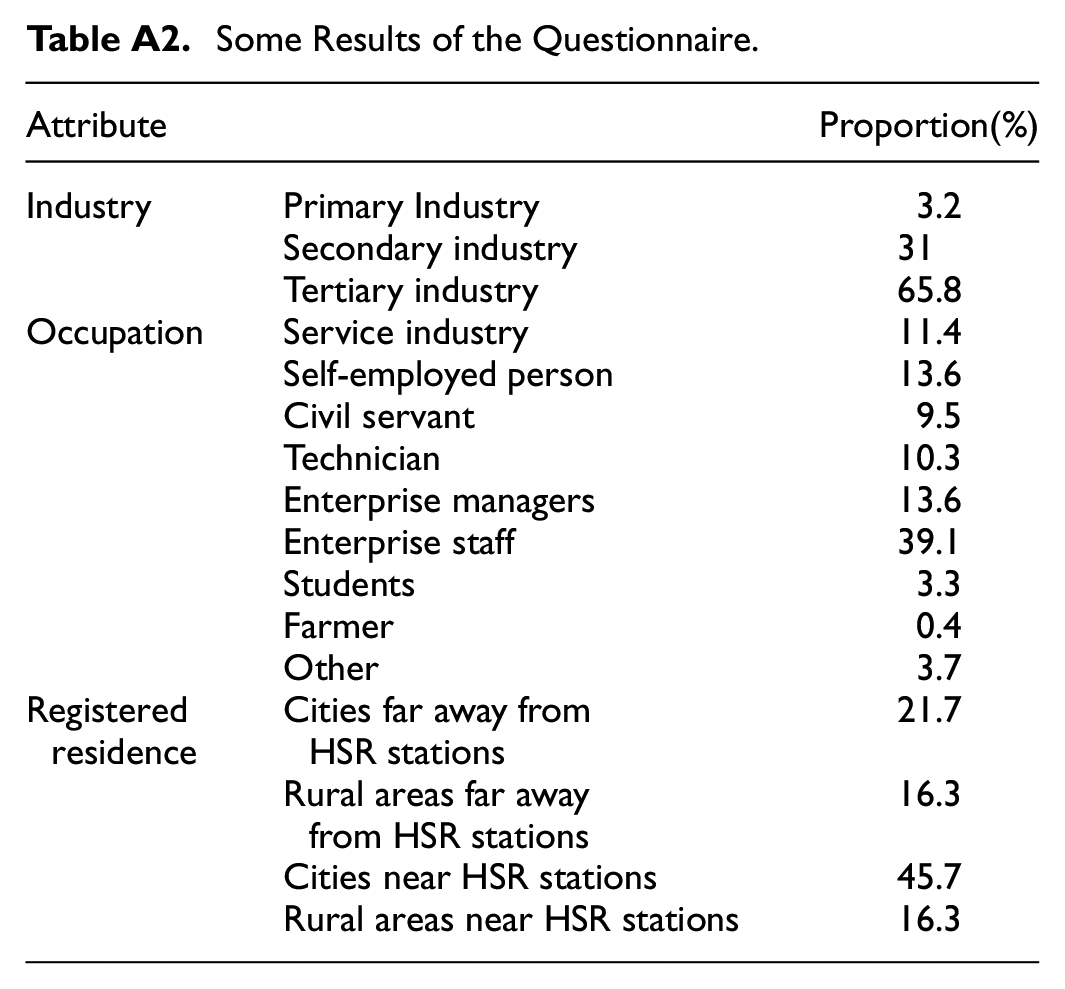
To support our hypothesis, we have selected some peripheral city stations along the Beijing-Shanghai HSR for a random sampling survey. We distributed a total of 220 questionnaires at HSR stations in Langfang, Cangzhou, Tai’an, and other cities, of which 184 were valid, with an effective rate of 83.6%. The contents of the questionnaire include the basic information of the interviewees, traffic behavior characteristics of HSR travel, and the impact of HSR on the interviewees’ employment place and employment type. The questionnaire results are represented in the appendix. The reliability test of 184 valid questionnaires shows Cronbach’s α of 0.912, with good reliability; The Sig value of variance test is 0.002, which proves that the questionnaire has an excellent significant correlation.
The sample survey results support our theoretical hypothesis. According to our survey results, the employment outflow of residents from periphery cities to developed areas along the Beijing-Shanghai HSR is substantial. The labor force tends to find employment opportunities in economically developed cities such as Beijing, Tianjin, and Shanghai (in the statistics of the drop-off locations, the flow direction of people in periphery cities along the Beijing-Shanghai HSR is mainly divided into two sections: Jinan-Tianjin-Beijing, Suzhou-Kunshan-Shanghai). Therefore, we hypothesize that the increase in the employment level in the mega-cities like Beijing and Shanghai is performed at the cost of the employment decrease in connected non-core cities. Thus the net employment effect for periphery cities along the HSR line appears to be negative, and we propose the following hypothesis:
Different cities show different development potentials when facing the space-time contraction effect of HSR. Also, due to the different nature of various industries, the employment effect brought by HSR has a diverse impact on them (Evers et al., 1987; Willigers & van Wee, 2011). In his research, X. Dong (2018) found that Chinese cities along the HSR line experience a significant increase in the employment of the retail/wholesale and hotel/food industries, while no measurable impact was found in other sectors. Latest works, such as L. L. Yang et al. (2021), investigate the different agglomeration effects of the HSR on various service industries, and the result shows that only the producer service industry is affected by the HSR, while the agglomeration effect of the HSR on consumer and public service industries are insignificant. Nakamura and Ueda (1989), in his study of the Shinkansen in Japan, states that HSR can drive the development of the commercial service industry and has a significant impact on the education sector and product development industry. Similar conclusions were also outlined in the study of C. L. Chen and Hall (2011). Our sampling questionnaire achieved similar results as the C. L. Chen and Hall (2011) research. Specifically, our questionnaire results show that among the respondents who choose to take the HSR, the tertiary industry is a dominant occupation, while the respondents in the tertiary industry accounted for 65.8% of the total number of respondents. The tertiary industry seems to be more sensitive to the HSR operation. Therefore, we propose the hypothesis 2:
H 2: There are differences in the employment effects of HSR on various industries in peripheral cities along the line. HSR can promote the employment of tertiary industries in peripheral cities, and the employment effects of HSR will be stronger in the tertiary industries than in first and second-level industries.
There are differences in average wage levels in cities of different sizes. This is an essential factor that affects the labor supply between different regions (Spilimbergo, 1999). The existing economic theories have proved that the larger the urban population, the higher the wage level. The relationship between wages and population is monotonically increasing. Each percentage point in wages means additional 100 thousand in population over the full range of metropolitan areas (Baum-Snow & Pavan, 2012; Glaeser & Maré, 2001). At the same time, an efficient commuting network could be beneficial to people who work in highly productive cities and conveniently live in peripheral cities (X. Dong et al., 2020). In other words, the workers living in the peripheral cities can more easily enter the highly productive labor markets without paying high living costs and avoiding other barriers connected to changing their place of residence (Z. Chen et al., 2016). The increase in urban wage supplement and accessibility attracts labor to accumulate in large cities. Compared with the large-sized cities along the HSR, it is difficult for small and medium-sized cities to show obvious advantages and strong development momentum in this competition. Small and medium-sized cities’ labor force will also seek employment opportunities in larger cities. Therefore, we believe that HSR has urban heterogeneity for employment in peripheral cities of different city sizes along the line, so the following hypothesis is proposed:
Research Methodology
Sample Selection
We have chosen the Beijing-Shanghai HSR line as the example and adopted the panel data sets of cities along this route from the 2001 to 2017 period for analysis. The Beijing-Shanghai HSR line, one of the main channels of the “eight vertical and eight horizontal” HSR in the Medium and Long-term Railway Network Plan of 2016, was commenced in June 2011 and received a total investment of about 220.9 billion yuan. With a total length of 1,318 km, the Beijing-Shanghai HSR has 24 stations and traverses 19 prefecture-level cities. It connects the two metropolitan groups, Beijing-Tianjin-Hebei and the Yangtze River Delta, and covers 6.5% of China’s land area. After the opening of the Beijing-Shanghai HSR, the G7 train from Beijing to Shanghai takes only 4 hr and 24 min. The combination of all these factors makes the Beijing-Shanghai HSR a busy passenger transportation line with high growth potential, so we have selected this line as the research sample. The samples in this study include 10 prefecture-level peripheral cities, which have 12 stations along the HSR and have the lowest per capita GDP from 2015 to 2017. (Beijing, Tianjin, Jinan, Nanjing, Wuxi, Changzhou, Shanghai, Suzhou, and Zhenjiang are excluded).
Variable Selection and Measurement
The employment effects of the Beijing–Shanghai HSR line in the peripheral cities along the route mainly include the “time effect” and the “policy treatment effect.” In order to separate the time effect from the policy treatment effect of the HSR construction and ensure unbiased estimation, this study relies on a difference-in-difference (DID) model to assess the impact of the construction and operation of the Beijing–Shanghai HSR line on employment in peripheral cities along the route. The cities with and without HSR connectivity are considered as the treatment and control groups, as shown in Table 1. The control group member cities are selected from the same provinces or among the neighboring cities as far as possible (see Figure 1), and the changes in the two groups after the opening of the HSR are analyzed.
City Selection of Treatment Group and Control Group.


The geographical location of sample cities.
Dependent Variable
Employment Agglomeration Index (
)
We use the employment agglomeration index (
Control Variables
Fixed Asset Investment (fix)
As the essential element of expanding social production, increasing investment in fixed assets can promote regional employment.
Level of Economic Development (gdp)
GDP represents the economic level of a region. Economic growth and employment are two closely related aspects of economic development. Economic development will increase the labor market demand, so the higher the GDP of a region, the higher the employment level.
Degree of Openness to the Outside World (fdi)
Foreign direct investment determines the demand for labor and the ability to absorb employment. Therefore, we use foreign direct investment (the actual amount of foreign investment flowing into cities each year, converted into RMB value at the current year’s exchange rate) to measure the degree of opening up.
Number of Firms (Firm)
The more enterprises there are, the more jobs can be provided for workers, effectively solving the contradiction between the massive number of labor and the limited number of jobs.
Human Capital (Edu)
This paper uses the government’s education expenditure to measure human capital. Human capital mainly refers to the total economic expenditure spent on employee professional skills training. The size of investment in human capital determines the quality of current workers, represents the technical level of enterprise workers, and plays a vital role in employment growth.
Wage Level (Wag)
The level of wages reflects the supply and demand relationship of the labor market in a region. Wages are the most direct means to affect the labor market and the fundamental driving force to promote labor flow, which impacts the employment level.
Industrial Structure (Ind)
There is a close relationship between industrial structure and employment level. According to the 2016 Statistical Bulletin on the Development of Human Resources and Social Security, the tertiary industry accounted for 43.5% of the national employment in 2016, which means the tertiary industry has become the leading force in absorbing employment. Therefore, the proportion of the tertiary industry output value to GDP is used as one of the control variables in this paper.
Model Construction
We set the following empirical model, which is also the econometric model used in this study to solve for

where
In order to examine the heterogeneity of employment effects in peripheral cities of different sizes, this study determines the sizes of peripheral cities in the treatment and control groups according to the 2014 State Council-adjusted city size classification criteria. To test the urban heterogeneity brought by the opening of the HSR on employment in cities of different sizes, we propose the following equation as the econometric model to solve the

Data Collection
The data for this study are mainly gathered from the China Urban Statistical Yearbook of 2001–2017. Considering the large gap between the ordinary HSR, with an average speed of 200 to 250 km/hr, and high-speed passenger lines, with an average speed of 350 km/hr, we study the changes in people’s employment behavior characteristics based on national train operations by selecting the HSRs with the speed over 300 km/hr and assessing the impact of G–C series trains on employment in prefecture-level cities. Based on the official data released by the Ministry of Railways on the opening of the HSR in cities till 2017, we manually compiled the specific times of the opening of the HSR in the sample cities between 2000 and 2016. Considering the time lag in the opening of the HSR in our dataset, if the HSR is opened in the first half of the year (before June 30), it is defined as being opened in the current year; otherwise, it is deemed to have opened in the following year.
Results and Discussion
The primary purpose of this study is to analyze the impact of the Beijing–Shanghai HSR line on the employment decisions of residents in less developed areas along the route. The results illustrate how overall employment levels in peripheral cities change as labor market accessibility improves and how HSR implementation produces different results depending on the size of the city and types of business.
The Overall Employment Effect of the Beijing–Shanghai HSR Line in Peripheral Cities
Test for the Parallel Trend Assumption
In order to have a more accurate assessment of the employment effects generated by the HSR in the peripheral cities along the route, this study uses the propensity score matching (PSM) method combined with the DID model to estimate the model coefficients using the matched treatment and control groups. Prior to the empirical analysis, the matchings of the treatment and control group samples must be verified to satisfy the DID model requirements that the groups have the same growth trend. In this study, the matching results are verified mainly by one-to-many matching. The other methods employed led to similar results.
As shown by the results in Figure 2, most study objects are within the range of common values (on support). Performing PSM leads to the allowable loss of just a few sample observations.

Common range of propensity scores.
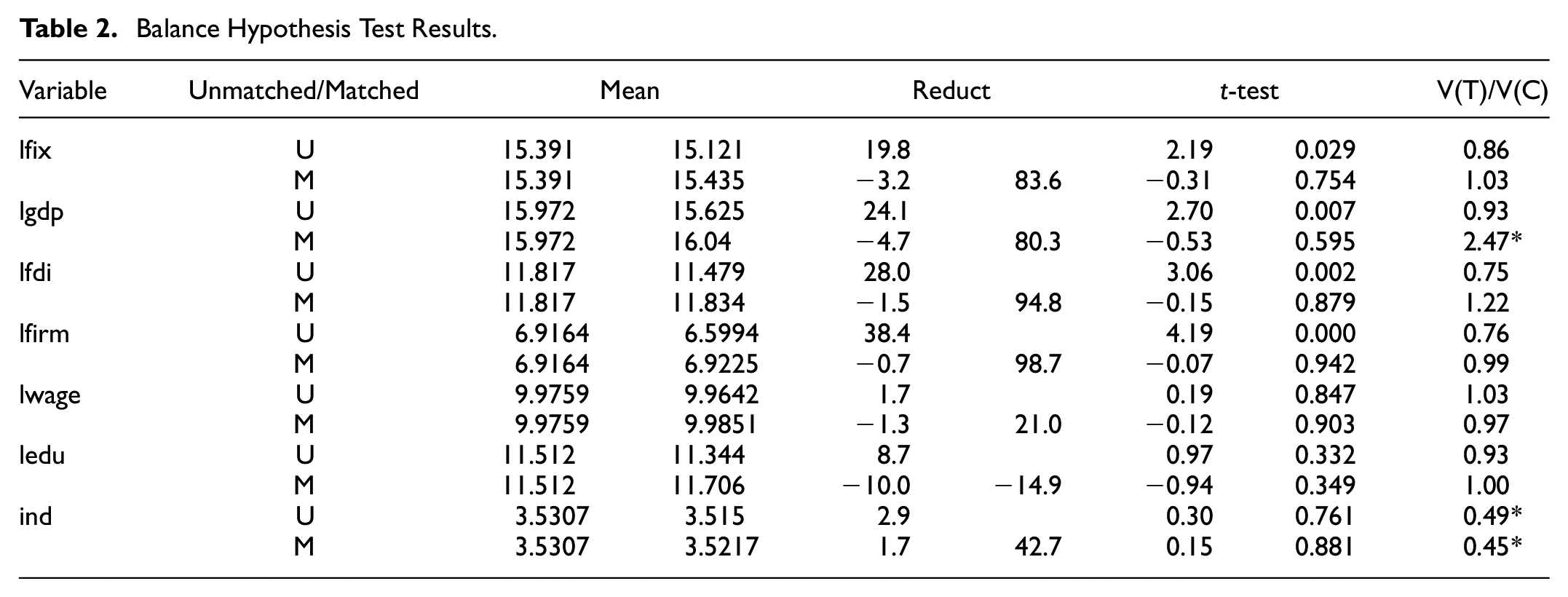
Table 2 shows that the maximum standard deviation (%bias) for most of the variables after matching (matched) is 10%, and the absolute value of the standard deviation for each of the remaining selected control variables is significantly less than 10%. Additionally, most t-test results do not reject the original hypothesis of no systematic difference between the treatment and control groups. Compared to the pre-matching (unmatched) results, the standard deviations of most variables are significantly reduced, with a maximum reduction of 98.1%. Therefore, the analysis of the results in Table 2 can prove that the treatment and control groups satisfy the parallel assumption, which confirms the appropriateness of the variables selected for this study.
Balance Hypothesis Test Results.
Overall Employment Effect in Peripheral Cities
Table 3 shows the regression results of the analysis of overall employment in peripheral cities. In terms of the effect generated after the opening of the HSR, the coefficient of the HSR effect is positive and significant at the 10% level. The results are robust, regardless of whether only dummy variables (Result 1) or other control variables (Result 2–8) are included. This indicates that the positive effect of the HSR on employment in less developed cities along the route exceeds the adverse effect, which is inconsistent with
Analysis of Overall Employment in Periphery Cities.

, **, * and * are significant at the level of 1%, 5% and 10%, respectively.
In terms of control variables—the coefficients of foreign direct investment, the number of enterprises, and wage level are positive and significant. Foreign direct investment can promote industrial development, create employment opportunities, and reduce unemployment. The greater the number of enterprises, the stronger the ability to absorb labor, so the impact on the employment level is also positive. The wage level results from the interaction between labor supply and demand. When the wage level rises, the cost of leisure time rises, which promotes more labor to enter the labor market and improves the employment level.
An interesting finding of our study is that the regional effects (the coefficients of treated) are always significantly positive regardless of whether control variables are included. This shows that the employment agglomeration index of periphery cities along the Beijing–Shanghai HSR line is generally higher than that of the peripheral cities in our selected control group without the opening of the HSR, which indicates that China prefers cities with higher employment agglomeration indices when building HSRs, especially while selecting less developed cities as stations along the HSR line. Additionally, the coefficient of the time effect t is always significantly positive. Therefore, the results are robust during the validation process, which indicates that employment agglomeration in periphery cities with stations along the Beijing–Shanghai HSR line generally exhibits an increasing trend over time.
The analysis mentioned above shows that the construction and operation of HSR raise the employment levels of peripheral cities along the routes and widen the employment gap between peripheral cities with and without HSR connectivity. Nevertheless, the economic effects produced by the Beijing–Shanghai HSR line are significant for developed cities along the route, such as Beijing, Tianjin, Shanghai, Suzhou, and Nanjing, making the HSR a belt-like economic corridor in China. The analysis of the coefficients and significance results of the employment effects produced by the Beijing–Shanghai HSR line for the peripheral cities along the route reveals that these cities indeed experience a horizontal growth effect in employment. However, it should also be noted that this HSR employment effect is not tremendous and, therefore, not comparable to a pulling effect or growth effect.
Table 4 shows the test results for the industrial heterogeneity of employment in peripheral cities. This study focuses on the HSR effect, and according to the regression results, the coefficients of hsr for Result 1 and 2 are not significant, while the coefficients of hsr for Result 3–6 are positive and significant at the 5% level. The Beijing–Shanghai HSR line has little impact on the employment level of the primary sector in the relatively less developed cities along the route but can significantly increase the employment rate of the secondary and tertiary sectors in such cities. The results are similar to our sample survey. Of our respondents, 96.8% are engaged in the secondary or tertiary industry. It shows that compared with the primary industry, practitioners in the secondary and tertiary industries tend to travel by high-speed rail. Among them, the coefficient of HSR employment is 0.126 for the secondary sector and 0.039 for the tertiary sector, which proves that the opening of the HSR has a more significant impact on the employment level of the secondary sector. These results are reasonable as China’s HSR mainly aims at transporting passengers, aiming to reduce the transportation cost of people rather than goods (X. Dong, 2018). Therefore, there is heterogeneity in the impact of HSR on employment in these three sectors. All sectors are heterogeneously dependent on the transportation of goods and people. Compared to other sectors, the primary sector relies more on the cost of transporting materials than on the cost of transporting people, so the impact of HSR on employment in this sector is not significant. Nevertheless, all the HSR lines increase the route capacity and reduce travel time (Givoni, 2006). The labor factor converges toward the cities along the route with the help of the HSR network and further promotes the innovation of manufacturing firms along the route (Sun & Zhang, 2020). Relevant literature in agglomeration economics shows that as knowledge flows between cities, the labor pool expands, and the growth rate of the manufacturing industry improves (X. Dong, 2018). Additionally, as the HSR mainly provides services to passengers, its direct impact on the service industry in the tertiary sector is significant. Unlike traditional manufacturing products, which need storage and long-distance transportation, the production and consumption of services are consistent across time and space (W. Li & Tan, 2008). Therefore, HSR can help cities to connect to a broader range of markets and industrial supply chains, which can also, to some extent, alleviate the service sector deficit. Our findings are in line with those of previous research in the field. While studying the mechanism of the impact of the HSR on employment in different industries, Y. M. Dong and Zhu (2016) found that the HSR can significantly promote employment growth in secondary and tertiary industrial sectors in cities along the route and show a suppressive effect on employment growth in the primary sector. Similar results were obtained in the studies of X. Dong (2018), Z. Li and Xu (2018), Tian et al. (2019), and others.
Industry Heterogeneity of Overall Employment in Peripheral Cities.
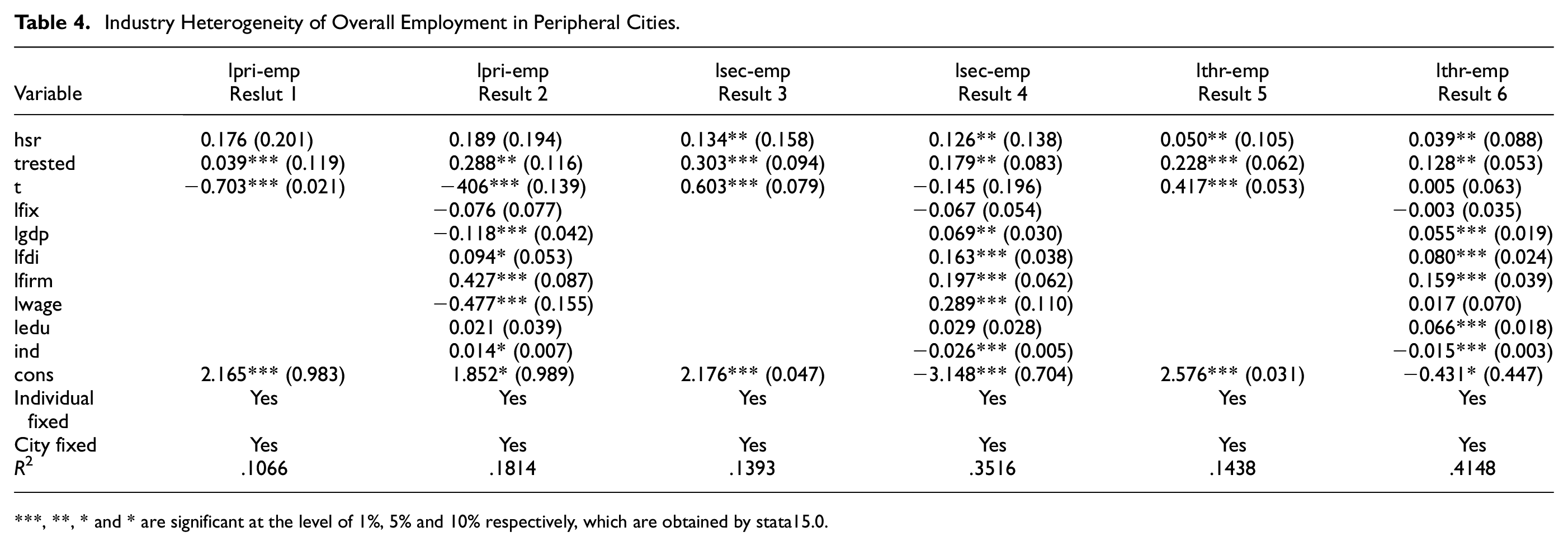
, **, * and * are significant at the level of 1%, 5% and 10% respectively, which are obtained by stata15.0.
Counterfactual Test (Placebo Effect)
In order to exclude a possible placebo effect in the treatment group, we refer to Hung and Wang’s (2014) counterfactual test. We chose a 2000–2010 dataset, with no HSR, as our study period and took 2008 and 2009 as the two hypothetical HSR opening times, respectively, performing the exact econometric estimation. The test results in Table 5 show no significant change in the coefficient of the HSR effect hsr, regardless of whether 2008 or 2009 is used as the supposed point of HSR opening. This verifies that the results of the earlier analysis are produced by the changes generated by the HSR policy and not because of a placebo effect that occurs over time.
Counterfactual Test Results.

City Size Heterogeneity Analysis
Following new economic geography, some scholars argue that it cannot be determined a priori whether improved accessibility will lead to convergence (or divergence) of regional economies and that the impact of transportation infrastructure improvements on regional economies is not automatic or universal but rather heterogeneous (Cheng et al., 2015; Willigers & van Wee, 2011). Therefore, in this subsection, we examine the heterogeneity of the Beijing–Shanghai HSR line in terms of employment in peripheral cities of different sizes along the route to assess the impact of the HSR on employment in those cities.
To analyze and verify the impact of the opening of the Beijing–Shanghai HSR line on employment in peripheral cities of different sizes along the route, we classify the sample cities into small and medium-sized ones (with a year-end urban population below one million) and large ones (with a year-end urban population between one and three million). We also set a dummy variable
Heterogeneity Test in Periphery Cities.
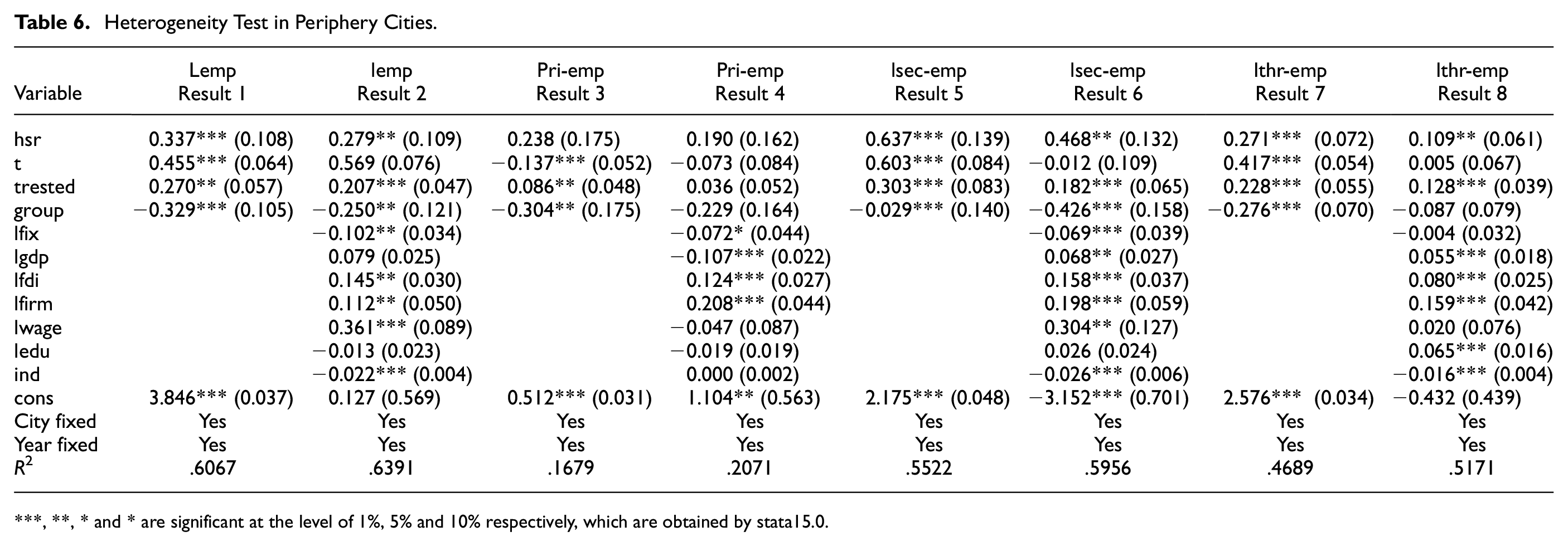
, **, * and * are significant at the level of 1%, 5% and 10% respectively, which are obtained by stata15.0.
Firstly, for the analysis of the overall employment differences, the coefficient of the group is negative and significant at the 1% level in both Results 1 and 2, implying that the overall HSR employment effect of the Beijing–Shanghai HSR line on small and medium-sized peripheral cities is significantly negative compared to larger peripheral cities. This corresponds to the results of previous studies, which have demonstrated that larger cities benefit more from the construction of the HSR, whereas smaller cities along the route perform poorly (Ureña et al., 2009; Vickerman, 2015). Indeed, the ability of an HSR construction to attract labor is influenced by the region’s share in the total regional economic potential, the regional industrial complex, and the level of regional economic development (Evers et al., 1987), and such advantages are present in cities with larger economies. Small and medium-sized less-developed cities also have particular economic strengths. However, they are less likely to exhibit obvious advantages or stronger development momentum when competing with adjacent larger but less developed cities, which benefit more from the change in transportation location. Simultaneously, due to the better resource endowment and economic efficiency of large cities, their siphon effect on the factors of their small and medium-sized counterparts also leads to a negative HSR effect. When regional accessibility improves because of the improved transportation network, small and medium-sized cities are more likely to be affected by the “siphon effect” and “passageway effect” exerted by non-core large-scale cities along the HSR line. Meanwhile, the large-sized peripheral cities can attract the labor force from the surrounding small and medium-sized peripheral cities, eventually inducing the outflow of their labor force. This is also consistent with the findings of Meng et al. (2018) that the larger the market size of the surrounding cities, the smaller the resource reconfiguration effect of the HSR, and vice versa.
Additionally, in terms of industrial employment differences, the Beijing–Shanghai HSR line has a negative or inhibitory effect on employment in the secondary sector in small and medium-sized cities along the route, with a coefficient of −0.426 which is significant at the 1% level. On the other hand, the railway also has a negative or inhibitory effect on employment in these cities’ primary and tertiary sectors, but the significance level is relatively lower. In other words, compared to the industrial sectors in less developed cities of larger sizes, the HSR has the most significant inhibiting effect on small and medium-sized cities’ secondary sectors along the route. Although previous studies have concluded that there is a positive impact of the HSR on employment in secondary and tertiary sectors in cities along the route (X. Dong, 2018; Y. M. Dong & Zhu, 2016; Z. Li & Xu, 2018), they have not focused on the issue of employment heterogeneity linked to city size. For small and medium-sized peripheral cities along the route, the opening of the HSR leads to an exodus of their labor force (for the previously mentioned reasons). However, it is noteworthy that although the opening of the HSR stations has a siphon effect on small and medium-sized peripheral cities, it still brings development opportunities for the service industry.
A great example is the research of Deng et al. (2021). His research showed that if we compare with the ordinary stations, HSR could attract more tourists through enhanced network effect and promote urban tourism development. Consequently, the suppressive effect of the HSR on the tertiary sector in such cities is not significant. Additionally, the primary sector is more constrained by resources and more sensitive to the transportation costs of materials (rather than the reduction in the transportation costs of labor and passengers produced by the opening of the HSR), so the impact of the Beijing–Shanghai HSR line on the primary sector in small and medium-sized peripheral cities along the route is likewise not significant.
Conclusions
In China, HSR construction has contributed to the economic growth of cities with HSR connectivity. However, the possible siphon effect on peripheral cities along the routes is often overlooked. From an employment perspective, this study selects peripheral cities along the Beijing–Shanghai HSR line as the research object to explore the HSR opening impact mechanism on employment in peripheral cities along the route. Using the panel datasets of 2001 to 2017, we analyze the impact of the Beijing–Shanghai HSR line on the overall employment in peripheral cities along the route and the impact differences on cities of different sizes and their industrial heterogeneity. A key finding of our study is that the Beijing–Shanghai HSR line has positively contributed to the overall employment level in the peripheral cities along the route, which we attribute to the siphon effect of large-scale peripheral cities on smaller neighboring cities after the opening of the HSR. Additionally, improved accessibility has accelerated the spillover effect of the core cities on less developed cities. Due to the heterogeneity of different industries’ dependence on the transportation of goods and people, the Beijing–Shanghai HSR line mainly promotes the employment levels of secondary and tertiary sectors in peripheral cities along the route. Beyond that, according to our findings, when analyzed separately by city size, the HSR has a significantly negative overall employment level (−0.250) for small and medium-sized peripheral cities compared to that of large-scale peripheral cities and specifically has the most significant negative impact on the secondary sector. A possible explanation for this finding is that peripheral cities with small and medium-sized markets are more vulnerable to the negative distributional effects of the HSR.
The study results could provide a few important policy recommendations for local governments. Firstly, the HSR itself has a limited impact on the employment level of less developed cities along its routes. Therefore, only when it is associated with the employment level and industry type of the cities it supplies, it positively affects employment in less developed areas. Given the opportunities offered by the Beijing–Shanghai HSR line, the less developed cities could utilize their respective strengths, position themselves appropriately in the context of overall regional development, augment their respective industrial characteristics to be advantageous for them, and optimize the allocation of industries to improve employment levels. For example, less developed cities could first subdivide industries with greater market demand to develop their manufacturing industries and negate homogeneous competition by choosing weaker sectors in neighboring cities. Secondly, the less developed small and medium-sized cities along the Beijing–Shanghai HSR route should be alert to the talent siphon effect of the larger cities along the route. The less developed cities along the HSR routes should increase their urban influence and attractiveness, attract talents according to their needs, prioritize domestic candidates and their training, and exploit the expansion of the commuting radius of the HSR to reverse the siphon effect of developed cities on the talent pool of less developed cities. Undoubtedly, such a strategy may be crucial for catching up with the overall development pace.
However, this study also had certain limitations. First, this study uses the tracking data of some peripheral cities along the Beijing-Shanghai HSR. Although it is represented as one of the main channels of the “eight vertical and eight horizontal” HSR, this data source may also be limited in some terms. Considering the large sample size of the national data, it is better to use richer data for further research. In addition, the impact of HSR on urban employment may vary depending on the location. This paper mainly analyzes the impact of Beijing-Shanghai HSR on the employment of peripheral cities along the line. The results may not apply to all regions and countries. These problems may become the focus of follow-up research in the future.
Footnotes
Appendices
Some Results of the Questionnaire.
| Attribute | Proportion(%) | |
|---|---|---|
| Industry | Primary Industry | 3.2 |
| Secondary industry | 31 | |
| Tertiary industry | 65.8 | |
| Occupation | Service industry | 11.4 |
| Self-employed person | 13.6 | |
| Civil servant | 9.5 | |
| Technician | 10.3 | |
| Enterprise managers | 13.6 | |
| Enterprise staff | 39.1 | |
| Students | 3.3 | |
| Farmer | 0.4 | |
| Other | 3.7 | |
| Registeredresidence | Cities far away fromHSR stations | 21.7 |
| Rural areas far awayfrom HSR stations | 16.3 | |
| Cities near HSR stations | 45.7 | |
| Rural areas near HSR stations | 16.3 | |
Declaration of Conflicting Interests
The author(s) declared no potential conflicts of interest with respect to the research, authorship, and/or publication of this article.
Funding
The author(s) disclosed receipt of the following financial support for the research, authorship, and/or publication of this article: This work was supported by National Natural Science Foundation of China [grant number 71874041]. Ministry of Science and Technology of the People’s Republic of China [grant number 2017YFC1601903].

Data Availability Statement
Data available on request from the authors.