




Abstract
The outflow of college graduates will damage the accumulation of regional human capital and affect regional economic and social development. This article uses the administrative data of the employment monitoring system for college graduates in a province in central China in 2018 and establishes a multivariate logit model based on the Todaro model, opportunity inequality theory, and the relative poverty hypothesis to analyze first employment place preferences and group differences of college graduates. The study found that college graduates tend to peer flow (returning to urban employment at the same level as the city of origin), and family background will promote peer flow. Also, graduates are more willing to work in large and medium cities with higher economic levels, and this employment ratio shows obvious differences in majors, college types, gender, and educational levels. Finally, college graduates from relatively low family status are more likely to experience upward or downward flow.
Introduction
As a key factor of production, human capital not only plays a great role in promoting regional economic growth (Lucas, 1988; Romer, 1987) but also is an important way to narrow the regional gap and promote balanced economic development (Acemoglu & Autor, 2012). Higher Education, as an important way of regional human capital accumulation, the choice of the place of employment of college graduates will lead to the cross-regional flow of human capital (Abramovsky et al., 2007; Faggian & McCann, 2009; Zhao, 2016). It also has the potential to change the distribution pattern of human capital among regions which will have an impact on regional economic growth (Ha et al., 2016; Suzuki & Suzuki, 2016). A large-scale outflow of graduates will lead to brain drain in regions, especially those with less developed economies (Wilson, 1992), making it ineffective for these regions to try to catch up with the regional economy by increasing the input level of higher education. An in-depth analysis of the law of interregional flow of college graduates is the key to the game of interregional human capital flow, and it is also an important basis for formulating relevant employment policies and regional talent policies (Zhao et al., 2016).
China is one of the countries with the biggest differences in physical geography, population resources, economy, and society in the world. There is a significant gap in economic development between the eastern, central, and western regions, between provinces and even between cities. For example, the per capita gross domestic product (GDP) of Shenzhen (US$25,790) in Guangdong Province is seven times that of Meizhou (US$3,626) located in the same Province. Under the background of uneven regional development, college graduates will have to deliberate on these factors in terms of their employment; how to choose the place of employment for the first time? What city preferences do they have? Do they exhibit certain group characteristics? Using the administrative data of the employment monitoring system for college graduates in 2018 in a central Chinese Province, this article makes an in-depth discussion on college graduates’ preference for first employment, to provide reference and basis for regional education and talent policies and the promotion of coordinated development of the regional economy. We further divided the cities into five levels, that is, first-tier, second-tier, third-tier, fourth-tier, and fifth-tier cities according to the 2019 Commercial Charm List of Chinese Cities; we can explore the place of employment preference and group characteristics of the college graduates. Also, through classifying the origin city-employment, the city-class changes into four types, that is, upward flow, peer flow, downward flow, and back to original, and we have a chance to further understand the pattern of college graduates’ first employment city selection and its influencing factors.
Research and Theories on Migration of College Graduates
With autonomous employment seeking becoming the mainstream way of employment, the choice of the place of employment for Chinese college graduates has undergone significant changes. In 2005, about 88% of college students chose to work in a place where they study (Liu et al., 2017). In 2009, this proportion dropped to 60.2%, and more than 90% of college graduates in Eastern and Coastal regions chose to work locally. The proportion of college graduates in the central and western regions was only 55.8% and 62.0%, respectively (Liping & Kunfeng, 2014). Since then, Yue and Li (2016), based on data from the 2015 national survey on the employment situation of college graduates, found that the proportion of college graduates who stayed in their localities for employment in 2015 was 67.9% in Beijing, Tianjin, and Shanghai, 91.9% in the East, 63.3% in the Central region, and 88.3% in the West. According to the 2017 sample survey data, the proportions of graduates from colleges in the east, central, and western regions were 43.2%, 36.8%, and 20.0%, respectively. And the proportions of employment were 51.8%, 27.5%, and 20.7%, respectively. The proportion of the loss of graduates in the central region was the highest (Yue & Bai, 2018). Based on the 2015 survey data on the employment situation of 28 university graduates from 17 provinces, Yue and Li (2016) found that the proportion of graduates choosing to work in large and medium cities exceeded 80%.
The choice of the place of employment of college graduates has certain group characteristics. For example, the view that female workers are more likely to stay in the provinces and cities where they graduated from has been accepted by most scholars (Yue, 2014; Yue & Li, 2016; Zhang & Gu, 2018; Zhang & Zhou, 2018). But at the same time, the influence of graduated colleges, disciplines, and majors, and academic levels on the choice of graduate employment areas have not reached a consistent conclusion. For example, Kodrzycki (2001), Gottlieb and Joseph (2006), and Yue and Li (2016) pointed out that higher education and school level have a positive effect on mobility behavior, but Li and Wang (2017) found that higher vocational colleges and ordinary undergraduate colleges are higher elite colleges and universities, and the cross-provincial mobility of elite college graduates is less than that of nonelite school graduates (Liu, 2013). Li and Wang (2017) found that the cross-provincial employment of graduates from professional skills–oriented disciplines (engineering, science) is lower than that of disciplines that focus on the development of universal capabilities (humanities, social sciences). Zhang and Gu (2018) believed that the cross-provincial employment of natural science graduates is more serious than that of social sciences. Yue and Li (2016) and Zhao (2016) found that the mobility of college graduates is positively correlated with the level of academic qualifications, while Li and Wang (2017) found that the cross-provincial employment of junior college and college graduate is higher than that of masters and doctoral students. Zhang and Gu (2018) found that the cross-provincial employment rate of masters and college graduates is the highest, followed by doctoral students and the lowest for junior college students.
On the whole, existing studies have conducted a more in-depth analysis of the choice of the place of employment of college graduates through the analysis of employment location selection, and have drawn some useful conclusions, but there are still some shortcomings: First, the analysis of employment destinations mostly stays at the regional level but fails to reach the layer of cities. As the obvious differences between cities in each region, it is still difficult to reflect the regularity. Second, there are more descriptions of phenomena and less analysis of behavioral decision-making mechanisms, less analysis of decision-making mechanisms for employment location selection. Third, using sample survey data or data from individual universities, it is difficult to fully and accurately reflect the characteristics of the overall employment flow of graduates, resulting in large differences in research conclusions in terms of the academic level, disciplines and majors, and employment choices of graduate schools.
The Choice of Employment Place for College Graduates
We used the administrative data of the employment monitoring system for college graduates in a province in the central region of China in 2018. The data covers the employment information of graduates from 98 colleges in 11 cities in the province. The variables of data include the employment destination, employment industry, name of the company, location of company, nature of the company, job position, college, department, major, ID number, gender, educational background, political outlook, training method, ethnicity, time of enrollment, time of graduation, type of students with difficulties, location of student origin, location of the registered card, and so on. After excluding unemployed and incomplete samples, the effective sample size is 256,455.
To better depict the selection outline of employment places for college graduates, the employment places are divided into first-tier cities, second-tier cities, third-tier cities, fourth-tier cities, and fifth-tier cities according to the 2019 Ranking List of Commercial Charm of Chinese Cities. Among them, the first-tier cities include Beijing, Shanghai, Guangzhou, and Shenzhen, as well as 15 new first-tier cities such as Chengdu, Hangzhou, Wuhan, and Tianjin. The second-tier cities include 30 cities such as Fuzhou, Hefei, and Zhengzhou. The third-tier cities include Lanzhou, Guilin, Sanya, and other 70 cities. The fourth-tier cities include 90 cities such as Shaoguan, Changde, and Lu’an. The fifth-tier cities include prefecture-level districts (cities) in the country except the 209 cities mentioned above. The selection of employment cities for college graduates is shown in Table 1.
Overall Situation of Employment City Selection and Group Characteristics (Unit: %).

Summary (Explanation) of Table 1
College graduates tend to find jobs in large and medium cities with higher economic levels. More than 60% of employed college graduates choose to find jobs in first-tier and second-tier cities, whereas only 5.4% goes to fifth-tier cities. Among them, the second-tier cities have the highest proportion of employment, followed by first-tier, third-tier, fourth-tier, and fifth-tier cities, and the overall employment ratio decreases with the decline of city class. These characteristics are reflected in graduates of different educational background and gender;
From the educational background, compared with undergraduates and junior college students, the proportion of graduates with postgraduate qualifications who stay in second-tier cities for employment is higher, reaching 42%, and that of fifth-tier cities is lower, with only 2.3%;
By gender, the proportion of male graduates in first-tier and second-tier cities for employment is 32.4% and 35.2%, respectively, both higher than female graduates;
In terms of the type of college, the proportion of graduates from agricultural and forestry, finance and economics, art, science, and engineering colleges going to first-tier cities for employment is above 30%, whereas the proportion of graduates from political science and law colleges, medicine and pharmacology colleges, and normal colleges is only 15%. The proportion of first- and second-tier employment in financial and economic colleges exceeds 70%, whereas the proportion of graduates from medicine and pharmacology and normal colleges is less than 50%;
From the perspective of disciplines and majors, the proportion of engineering, economics, and management majors’ graduates going to the first-tier cities for employment is higher than 30%; the proportion of graduates from philosophy, history, education, law, and medicine is less than 20%. The proportion of engineering and economics to the first-tier and second-tier employment is more than 70%. The proportion of history, law, and medicine is less than 50%. The proportion of graduates from the junior of information and textile food majors to the first-tier cities is higher than 40%. The proportion of graduates from the majors such as public security, water conservancy, culture, medicine, and health is no more than 15%; the proportion of graduates from the textile food major to the first-tier and second-tier cities is more than 80%, whereas that of culture and education is only about 30%.
In addition, by constructing the matrix of the city class of the student origin and the city class of employment matrix, the following can be found: (a) The proportion of the peer flow (diagonal line in the table) is the highest, and the proportion of graduates from the first- and second-tier cities is much higher than that from the third- and fifth-tier cities. For example, the proportion of first-tier students returning to first-tier cities is as high as 73.2%, whereas the proportion of fifth-tier students returning to employment in fifth-tier cities is only 31.9%. This means that most college graduates are employed in the places of origin or same-tier cities, and the higher the level of origin, the higher the proportion of peer flow. (b) Upward flow (the lower left area in the table) is higher than downward flow (the area in the upper right corner of the table). For example, the proportions of third-tier graduates who went to first-tier and second-tier cities for employment are 28.3% and 27.8%, respectively, which are much higher than 5.1% for fourth-tier employment and 1.2% for fifth-tier employment. (c) The first-tier and second-tier cities are the choice of most college graduates, and the proportion of college graduates in third- and fifth-tier cities is relatively small.
Empirical Analysis of the Choice of Employment City for College Graduates
Employment Place Selection Model
The labor mobility model provides a theoretical framework for analyzing the employment place choice of college graduates. The typical ones are the Todaro model, opportunity inequality theory, and the relative poverty hypothesis, which explain labor mobility from the perspectives of expected income, family background, and relative status, respectively.
Todaro (1969) believes that the motivation of rural-to-urban migration is largely determined by the differences in expected income between urban and rural areas and that the increase in rural-to-urban migration is accompanied by a widening of the expected income gap between urban and rural areas. Todaro believes that what promotes labor mobility is not the actual urban income level but the expected income level multiplied by the actual urban income times the urban employment probability. The labor migration will only occur when the expected income level of the urban sector is higher than that of the rural area.
Ferreira and Gignoux (2014) found that inequality of opportunity based on family background accounted for as much as 35% of the difference in educational achievement. According to J. Roemer’s (1998) opportunity inequality theory, inequality is the result of both an individual’s uncontrollable “environmental factors” and an individual’s controllable “effort.” It has also been found that fathers can provide useful network connections for their children in job-hunting to lead them into their industry, and the social network resources provided by fathers can increase the probability of their sons’ employment by one third (Magruder, 2010).
Stark and Taylor (1991) believed that the migration of family members is not necessarily to increase the absolute income of the family but to improve the status of the family relative to a specific reference group, that is, the relative poverty. Stark and Taylor (1991) showed that relative poverty increases the possibility of family members migrating from rural Mexico to the United States. Based on Polish regional data, Stark et al. (2009) proved that immigration from a region is positively correlated with the overall relative poverty of the region. Valencia (2008) used data collected from two communities in Western Colombia to identify relative poverty as one of the reasons for immigration.
To further understand the pattern of college graduates’ first employment city selection and its influencing factors, this article adopts the multivariate logit regression model, according to the combination of college graduates’ first employment place and their source place as the grouping basis of dependent variables, Values 1 to 4 (Table 2), and the fourth group as a control group, compared with other types of college graduates’ first place of employment.
Dependent Variable Classification Table.

Based on the Todaro model, opportunity inequality theory, and the relative poverty hypothesis, this article incorporates expected income, family background, relative status, and human capital of college graduates into the graduate employment selection framework, while taking into account the fixed effects of gender, major, and school. The theoretical model is as follows:

where EI is the expected income, FB is the parental background, RD is the relative status, H is the graduate human capital, X is the other influencing factor, and i is the flow type in Table 2. The main variables’ definitions and descriptions are shown in Tables 3 and 4, respectively.
Variable Definition.
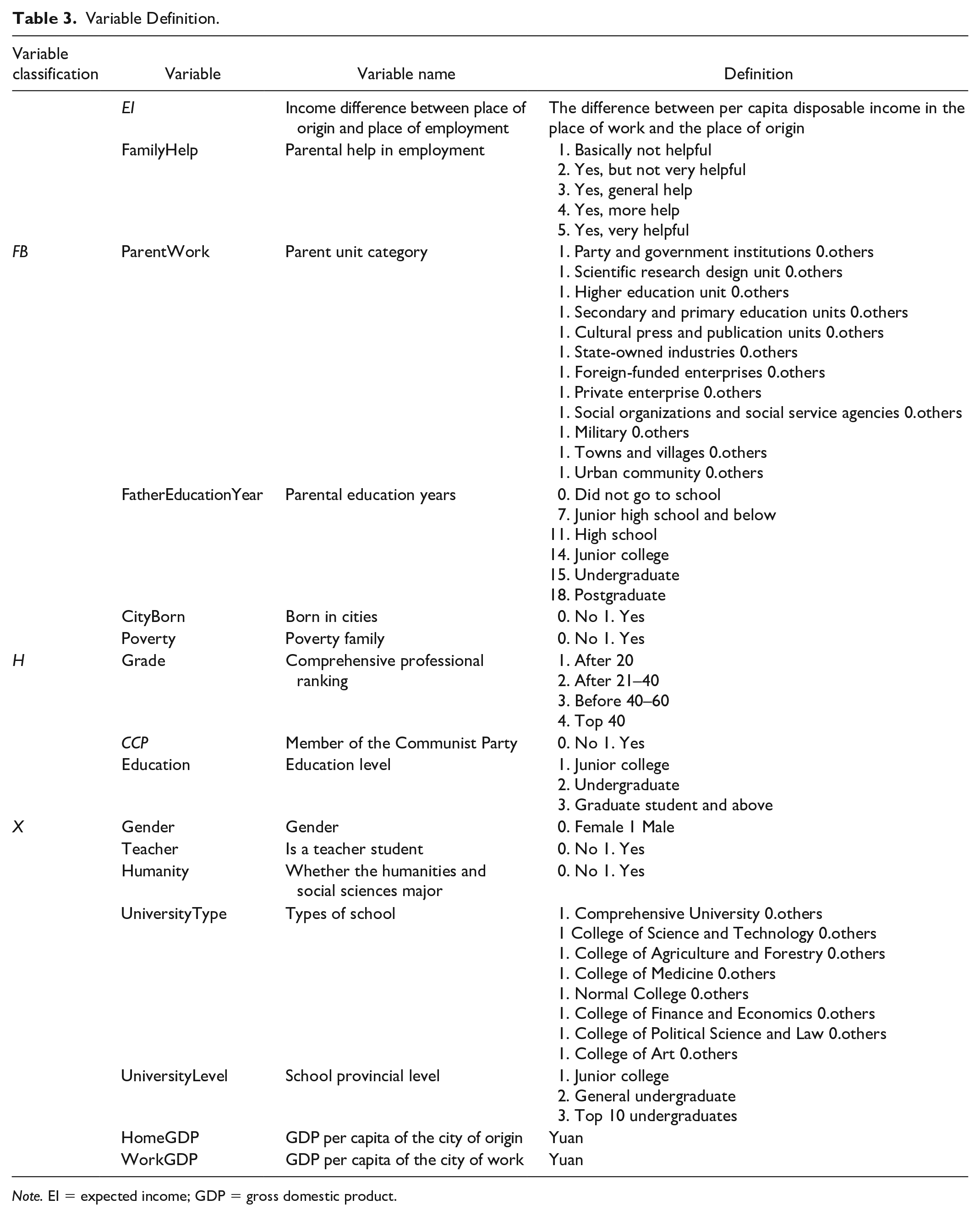
Note. EI = expected income; GDP = gross domestic product.
Variable Descriptive Statistics (M).
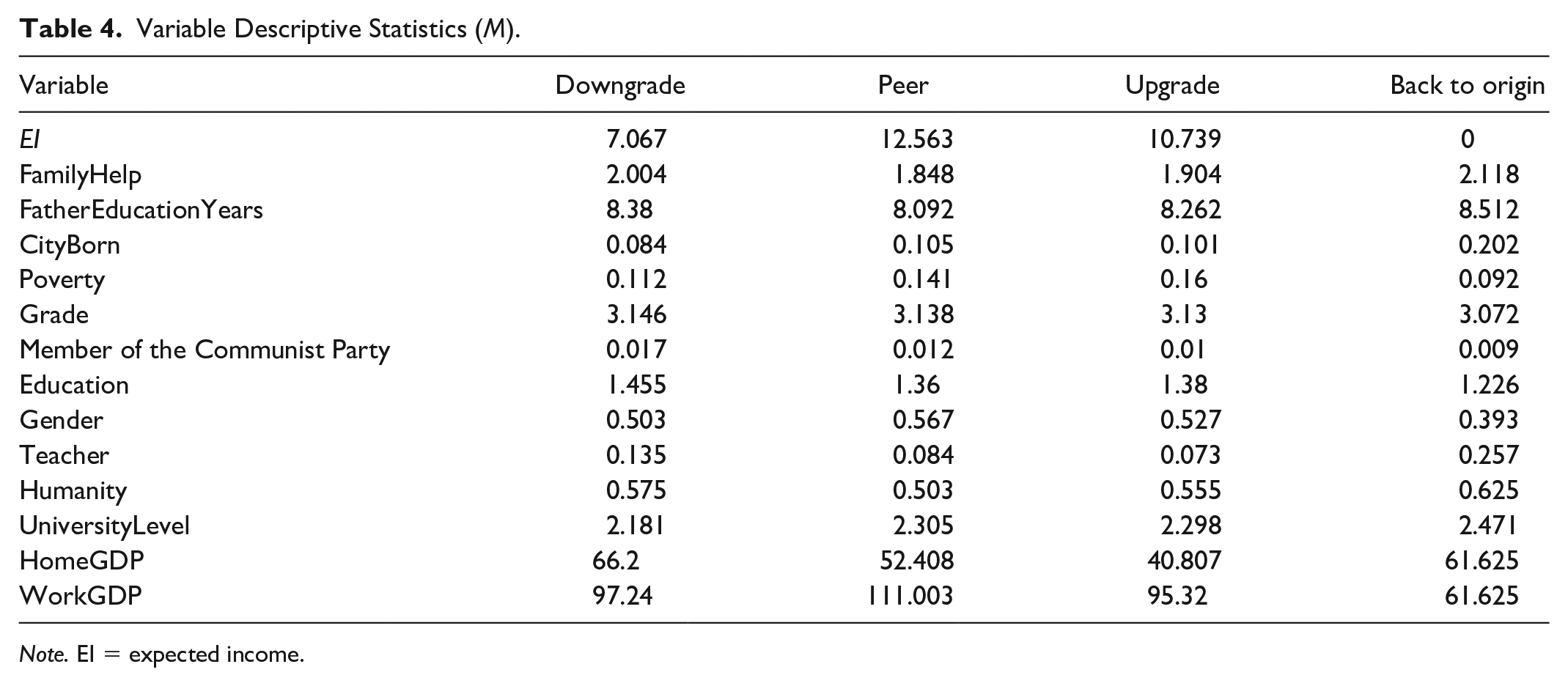
Note. EI = expected income.
Empirical Results
In the following part, according to the regression model (1), this article makes a quantitative regression analysis on the influencing factors of college graduates’ choice of the first place of employment. The regression results are shown in Table 5.
Influencing Factors of College Graduates’ Choice of First Employment Place.

Note. The values in parentheses are robust standard error. EI = expected income.
p < .1. **p < .05. ***p < .01.
First of all, from the perspective of expected income, the choice of the first employment place for college graduates is very significant for the pursuit of economic returns. Compared with returning to the city of origin for employment, the larger the expected income between the place of employment and the place of origin, the college graduates are more inclined to go to the city of nonorigin for first employment, including upgrading flow and peer flow, which conforms to the hypothesis of the Todaro model. The hypothesis of the Todaro model in terms of the degree of help from the family background of college graduates, the greater the degree of family background help, the more likely it is to return to the place of origin for the first employment of college graduates. In terms of family status, that is, relative poverty level, compared with returning to the place of origin for employment, the lower the family level is, the more likely the college graduates are to leave the city of their origin for the first time, no matter whether it is the upward mobility, the same mobility, or the downward mobility. Therefore, it can be found that the mobility of college graduates with lower family status is to change or improve their relative family status in the city of their origin.
Second, from the perspective of the human capital of college graduates, the higher the major ranking is, the more likely it is to downgrade the flow compared with returning to the place of origin for employment. Party members or not have no significant influence on the choice of employment place for college graduates. However, college graduates with the experience of participating in school clubs and higher education levels are more likely to work out of the place of origin for the first time.
Finally, from the perspective of control variables, compared with the flow back to the place of origin, males are more likely to have flowed, including degraded flows, peer flows, and upgraded flows. Compared with nonnormal university students, normal university students are more likely to stay in the city where they come from and not flow. Also, compared with college graduates majoring in science and engineering, college graduates majoring in humanities and social sciences are also more likely to choose the place of origin as the place of first employment.
Then, we put the GDP of each city in accordance with the sample data from small to large, order and reference to Chinese urban commercial charm list before put it on average five categories of the classification method, according to the downgrade, at the same level, upgrade and return flow from four types of multivariate logit regression, the empirical before the reference returned students as benchmark group, upgrade their relegation, at the same level, flow respectively and compared them to return to students, with GDP ranking list for China instead of China’s urban commercial charm city hierarchies of robustness test.The results are shown in Table 6.
Influencing Factors of College Graduates’ Choice of First Employment Place.

Note. The values in parentheses are robust standard error. EI = expected income.
p < .1. **p < .05. ***p < .01.
According to the empirical results in Table 6, we can find that the expected income gap and the degree of help from family background have a significant impact on college graduates’ choice of cities in different employment places.For variables related to family background and human capital, they are similar to the previous empirical results, so the empirical results are credible.
Research Conclusions and Policy Recommendations
Based on the employment administrative data of college graduates and graduate employment survey data in a province in the central region of China in 2018, this article uses descriptive statistics and multivariate logit regression measurement methods to describe the current situation of college graduates’ place of origin and their first employment place. Besides, a regression analysis was carried out on the influencing factors of college graduates’ first employment place. The main research conclusions are as follows:
First, according to the Todaro model, opportunity inequality theory, and the relative poverty hypothesis, expected income, family background, and change of the relative poverty level are important factors affecting the choice of first employment place of college graduates. The choice of the first employment place for college graduates follows the economic motivation for high expectations of income and tends to flow to first-tier cities and second-tier cities because first-tier and second-tier cities have rapid economic development; the degree of help from the family background will affect the choice of the first place of employment of college graduates more inclined to the city of origin. The employment rate of college graduates from low-level cities to high-level cities generally increases with the decline of family status, that is, the worse the family status is, the more likely it will lead to upgrading in the mobility. In demoted mobility, the proportion of students from high-level cities going to low-level cities increases with the decline of family status, that is, the worse the family status is, the more likely the demoted mobility will occur. It shows that the choice of the first place of employment for college graduates takes into account employment in the place of origin to change the relative family status.
Second, college graduates will be affected by individual factors, school factors, and family factors when they choose their first employment place. Males are more likely to be mobile than females. Compared with high-achieving graduates, low-achieving students are more likely to stay in the city of origin and not to flow, and college graduates majoring in humanities and social sciences are more likely to have demoted mobility and same-level mobility than those majoring in science and engineering. College graduates with better education and experience in community organizations are more likely to work out of the place of origin and college graduates who are normal university students are more likely to stay in the place of origin for employment.
Based on the above research results, the policy recommendations are as follows: First, according to the Todaro model and empirical results, the expected income is an important factor in the selection of the first employment place for college graduates. Therefore, cities with higher economic development are becoming more and more attractive to college graduates. First-tier and second-tier cities are the first choice places for college graduates to find their first jobs. Third-tier, fourth-tier, and fifth-tier cities, as net outflow locations, will cause unequal flow of human resources among regions. So it is necessary to make good use of the labor market mechanism to ensure an orderly and reasonable flow of college graduates among all tier cities
Second, for individual college graduates, striving to improve their human capital is an important guarantee for promoting the orderly flow of college graduates. College graduates should also make good use of the family’s help in employment and combine their knowledge with their abilities and majors to better serve society.
Footnotes
Declaration of Conflicting Interests
The author(s) declared no potential conflicts of interest with respect to the research, authorship, and/or publication of this article.
Funding
The author(s) disclosed receipt of the following financial support for the research, authorship, and/or publication of this article: This paper is the periodical results of Humanities and Social Science Research and Planning Fund of Ministry of Education (16YJC880087), Basic Research Program of Science and Technology Program of Jiangxi Provincial Science and Technology Department (20181BAA208005), Key Project of Jiangxi Provincial Education Planning in 2017 (17ZD027), and Jiangxi Provincial Education Planning Project (17YB094).
