




Abstract
Although the impact of high-speed railway (HSR) on economic development has received extensive attention, few studies explore how HSR influences individuals’ daily life. Using the pooled cross-section data from China Labor-force Dynamic Survey (CLDS), we examine the relationship between HSR services and subjective well-being (SWB). The baseline result indicates that HSR project bring a significant and positive improvement on individuals’ SWB in the cities it serves. Evidence from a variety of identification strategies suggests that the relationship is robust. Mechanism analysis shows that HSR services increase residents’ SWB by improving household income, inducing tourism, and promoting health status. Moreover, our evidence finds urban residents, young residents, and high-income residents benefit more from HSR services. Our study reveals the potential value of HSR services from the perspective of SWB, which is growingly concerned in the policymakers concerning route planning and cost-benefit analysis of HSR projects.
Introduction
Can the development of HSR improve local people’s well-being? At the national level HSR investment is valued as an important step in boosting economic development (Adak, 2019; Berechman et al., 2006; Bhatta & Drennan, 2003; H. Kim et al., 2018; Lin, 2020; Pereira & Andraz, 2005; Rokicki & Stępniak, 2018). At the firm level, HSR services can help lower trade costs, optimize production networks, reduce inventory, and improve capacity utilization and performance (Ahlfeldt & Feddersen, 2018; Bernard et al., 2019; Cheng et al., 2015; Cui & Li, 2019). In spite of a large literature on the role of HSR on socio-economic outcomes, there is almost no evidence on how HSR affects human well-being.
Policymakers and scholars have come to realize the ultimate goal of social development is improving the wellbeing, happiness and quality of life of its citizens, rather than merely maximize the country’s wealth (Chongvilaivan & Kim, 2016; Delbosc, 2012). Thus, promoting the well-being indicators of its citizens, such as SWB, have been growing to be one key goal for many economies and have gained prominence in the policy agenda in the past decades. SWB is a construct that reflects an individual’s overall evaluation of her or his quality of life (Diener, 1984; Verhofstadt et al., 2016), which emphasizes the way that such an evaluation is carried out by considering the perspective of the person whose life is being evaluated. An established strand of literature shows that SWB are closely associated with a range of positive outcomes, most notably good physical and mental health, better social relationships and job performance, strong work engagement, and lower risks of mortality (Awaworyi Churchill & Smyth, 2019; Diener et al., 2017). The rapid development of HSR does not always lead to increased welfare for people. On the contrary, the operation and construction of HSR projects may exacerbate within-country inequality, result in resource plunder, induce fierce competition in job markets, and cause environmental pollution, all of which have the potential to harm people’s well-being. Considering that the high-speed rail (HSR) system has been regarded as the future of cross-regional passenger transportation, and many countries, particularly developing economies, are planning to upgrade their cross-regional transport infrastructure to HSR systems, empirical evidence on HSR from the perspective of SWB is crucial for policymakers to evaluate their HSR projects.
The present study aims to address the following research questions in the context of China: (1) whether and to what extent do high-speed rail (HSR) projects affect local residents’ SWB? (2) What are the potential mechanisms underlying the effects of HSR projects on SWB?
The case of China provides a particular good setting to answer the above questions. First of all, HSR projects in China have brought radical changes to peoples’ life. China is among the countries with the fastest development of HSR networks, which HSR network was proposed the first time in 2004. From 2011 to 2015, China has invested around 300 billion US Dollars in the HSR system construction (Diao, 2018; Ke et al., 2017). By the end of 2016, China’s HSR operating coverage reached more than 22,000 km, 155 out of 292 Chinese cities (prefecture-level cities and above) were connected to the HSR network (Meng et al., 2018). These HSR lines have formed a big network with four vertical and four horizontal corridors linking major cities and several regional cross-city routes. The Chinese HSR network is currently the largest passenger-dedicated system worldwide and operates over 2,600 pairs of high-speed trains each day. Over 10 years, the China Rail High-speed (CRH) trains service carried over 7 billion passengers, second only to the 11 billion carried by Japan’s Shinkansen in the past 50 years. And Chinese HSR passenger volumes will continue to grow at over 20% per year soon (Lawrence et al., 2019). Many studies show that cross-city passenger traffic between cities in China increases significantly after the introduction of HSR services. The passenger onboard surveys reveal that the increase in overall trip-making with HSR services comes from a combination of increased frequency of trips by existing travelers and completely new travelers, and surveys say that half of the total trips are for business travel and the other half are for leisure travel (Lawrence et al., 2019).
Secondly, the recent upsurge in HSR projects in China provides a good empirical setting to examine the spatial-temporal changes in people’s quality of life. China is one of the most populous countries in the world, with cities spread throughout the country, providing researchers with a large and diverse sample size. Its culture and social background are different from those of western countries, which can provide different perspectives to understand the life of people in developing world and East Asia. And the extensive HSR network in China offer researchers a wealth of data for leveraging the variation in the rollout of HSR service and the cross-sectional variation in people’s SWB (see Figure 1).

The HSR network before 2017 in China.
This paper first theoretically analyzes the relationship between HSR project and people’s SWB, as well as the potential mechanisms underlying this relationship. We then investigate whether exposure to HSR projects affects local residents’ SWB using longitudinal microdata from the China Labor-force Dynamic Survey from 2012 to 2016. Specifically, multiple models are employed to evaluate the effect of HSR projects with self-reported happiness and life satisfaction levels as measures of SWB. To increase the reliability of our estimates, we then discuss various sources of endogeneities and further address each endogeneity using multiple strategies, including instrument variable regressions, dynamic analysis, assessment of the potential bias from unobservable factors, alternative matching methods. After establishing that HSR project positively affected SWB, we turn to the task of examining three channels behind the relationship. Considering that HSR services may exacerbate SWB inequality among different groups, we investigate the heterogeneity of HSR effects across income, age, and urban and rural areas. To further understand the monetary value of the increased SWB by HSR projects, we finally use the life satisfaction approach (LSA) to do a back-of-the-envelope calculation of residents’ average willingness to pay (WTP) for the introduction of the HSR services (see the Followed Research Framework in Figure A1 in Appendix).
The empirical results indicate that HSR project significantly improves the SWB levels of respondents in the cities it serves. The finding is robust to alternative measures of SWB, alternative estimation models, and multiple methodologies to address potential biases caused by various endogeneities. Specifically, the Ordinary Least Squares (OLS) estimates suggest that HSR services increase residents’ happiness level and life satisfaction level by 0.041 and 0.044 on a scale of 1 to 5, accounting for 1.07% and 1.19% of the mean of life happiness level and life satisfaction level, respectively. In terms of the implied market value of the HSR project’s effect on SWB, the calculation of the LSA suggests that the average Willingness To Pay (WTP) for HSR services is CNY 11,567.07, which equals 40% of the average household income. In other words, each family is willing to pay CNY 11,567.07 for the introduction of HSR services. Furthermore, the study finds that HSR projects can increase household income, induce tourism, and improve health status, which further enhances individual SWB. The heterogeneity tests show that HSR projects have greater effects on high-income populations, urban residents, and people under the age of 60. The reasons behind this might be that these people are more accustomed to HSR services or have more time or wealth to make full use of HSR services.
This study has several potential contributions to the literature. This study is naturally related to the literature on the influencing factors of well-being. While many studies have linked well-being to public transportation, they have focused primarily on intracity commuting due to the importance of commuting within a city. In fact, some people choose to live and work in different cities, as they can commute between these cities with convenient HSR services. And HSR projects have significant impacts on various dimension of people’s life, such as job markets, real estate markets, accessibility to medical treatment in different places, tourism demand, and the environment, etc. Therefore, given the large-scale HSR investments and its transformative role in daily life, it is indispensable to explore the influence of HSR projects on well-being.
Second, the present study enriches the micro-individual research mechanism of HSR and further help to understand how cross-region high-speed transportation coverage affect people’s life quality. Some studies concentrate on the microscopic impact of HSR projects, and they also provide some references and evidences on the relationship between HSR projects and resident well-being. However, those materials are indirect and sometime controversial, so the effect of HSR on well-being and its mechanism is far from conclusive.
The paper is directly relevant to a large literature on the effects of transportation infrastructure, especially HSR projects, on socio-economic development. This area of research mainly concentrates on the impact of HSR on the macroeconomy, few scholars pay attention to the microscopic impact of HSR. However, prior studies present abundant but mixed evidence on HSR’s role on economic growth, industries agglomeration, accessibility, tourism sector, and aggregate welfare effects. Our study uses micro data and gives new findings that HSR can promote well-being. These findings do not definitely assert that the advantages of HSR outweigh the disadvantages, but we support HSR projects produce positive socio-economic outcomes from the well-being perspective.
We examine the impact of the largest HSR investments on people’s life quality in one of the world’s largest developing economies, providing new evidence for HSR projects evaluation. As Chester and Ryerson (2014) point out, HSR projects should not only be evaluated for their economic value but also for their sustainable values such as the environment, human welfare, and climate change. The beneficial effects on people’s well-being can potentially offset the massive cost of HSR projects, making them essential components of HSR route planning and cost-benefit analysis of HSR projects. The estimates also provide some insights relevant to policy debates about whether to upgrade transportation systems to HSR networks for the developing world.
The rest of the paper is organized as follows. Section 2 reviews the related literature, explore the mechanisms and proposes the research hypotheses. Section 3 describes the data, variables, and models. Section 4 presents the results and analyses. Section 5 analyzes the underlying mechanism. Section 6 closes the conclusions.
Literature Review
Subjective Well-Being
SWB refers to individual’s appraisals and evaluations of their own lives (Diener et al., 2018). It is a holistic assessment of how people evaluate various dimensions of their lives, and generally encompasses a cognitive component and an affective component (Diener et al., 1999). Therefore, SWB could serve as an efficient indicator of personal and societal quality of life (Diener et al., 2015). Scholars are committed to utilizing SWB measures to help improve societal development and human welfare. Since the beginning of the 21st century, scholars have proposed the establishment of National Accounts of well-being as a complement to existing economic and social indicators that assess the quality of life in nations. These SWB accounts serve as valuable tools for policymakers, allowing them to evaluate policies that extend beyond mere economic development. Notably, reputable scientific and international institutions have been promoting the concept of establishing SWB national accounts, and over 40 nations adopting SWB indicators in some form (Diener et al., 2015). Moreover, the growing literature highlights the critical role of SWB in shaping effective policy decisions (Awaworyi Churchill & Smyth, 2019; Delbosc, 2012; Diener, 2006; Knight et al., 2009).
Individuals with lower SWB may be more preoccupied with their own worries and personal concerns, potentially leading them to be less engaged in addressing societal issues (Diener et al., 2018). Extensive research also indicates that positive SWB has significant benefits across various domains, including health, longevity, social relationships, civic engagement, work performance, and resilience (Awaworyi Churchill & Smyth, 2019; Diener et al., 2017). Drawing from a review by Diener et al. (2018), SWB is influenced by two clusters of factors. First, genetics play a critical role. SWB-related meta-analyses indicate that a significant portion of individual variance in SWB can be partly ascribed to genetic factors, accounting for approximately 30% to 40%. More importantly, about 60% to 70% of SWB is attributable to environmental effects, suggesting many factors of SWB are likely controllable. For instance, scholars find SWB is sensitive to personal traits, experience, and circumstances, such as income, marriage status, education, occupational status, religiosity and health, social relationships, natural environment, and transportation (see e.g., Awaworyi Churchill & Smyth, 2019; Diener et al., 2015; Yakovlev & Leguizamon, 2012).
Challenges related to transportation access and affordability have been associated with various adverse life outcomes (Mattioli et al., 2017). Previous research has demonstrated a connection between these challenges and lower SWB (Dolan et al., 2008). For instance, difficulties in accessing transportation have been linked to lower participation in higher education and training, reduced access to health services, higher unemployment rates, less engagement in social activities, and feelings of isolation (Awaworyi Churchill & Smyth, 2019; Chongvilaivan & Kim, 2016; Delbosc, 2012). Despite many studies have linked well-being to intracity public transportation, little attention has been devoted to examining the relationship between cross-region transportation infrastructure and SWB.
High-Speed Rail
HSR is a development strategy at the national level, the layout, route, and station selection of HSR should be considered comprehensively. It is therefore not surprising that the explosion of research on HSR is usually at the macroeconomic level (Huang & Zong, 2020; Jia et al., 2017; Meng et al., 2018; Vickerman, 2015). For example, pieces of evidence suggest that HRS plays an important role in GDP growth (Ahlfeldt & Feddersen, 2018; Graham & Melo, 2011; Zhou & Zhang, 2021), economics integration (Cheng et al., 2015; Garmendia et al., 2012), industrial location (Han et al., 2012; Willigers & van Wee, 2011), innovation (Gao & Zheng, 2020), and tourism development (Albalate & Fageda, 2016; Kurihara & Wu, 2016).
The impact of HSR on the macroeconomy has also been well documented, notwithstanding, few scholars pay attention to the microscopic impact of HSR. Ren et al. (2020) investigate 4,924 passengers in China and find that that different groups of people have different acceptance of HSR, for example, passengers with higher education and income are more likely to welcome HSR. L. Wang et al. (2020) explore the relationship between HSR and people’s mental and physical health. However, to the best of our knowledge, no work has focused on the relationship between HSR and resident well-being. Cao (2013) explores the impact of light rail transit in the Twin Cities, US on residents’ life satisfaction, and proves light rail plays a positive role in residents’ happiness. However, there are significant differences between light rail transit and high-speed rail, both in terms of speed and mileage. Furthermore, other studies have explored the relationship between high-speed rail and society’s overall welfare (Bracaglia et al., 2020; D’Alfonso et al., 2015; W. Wang et al., 2020).
The Relationship Between HSR and SWB
Can HSR service make Chinese people feel more satisfied with their lives? If so, what are the mechanisms through which HSR services improve people’s SWB? HSR services provide many livelihood benefits to the general public but whether it is quite enough to improve the quality of life is debatable. Although few studies directly examine the impact of HSR on resident welfare, we can take some leads from studies on the relationship between HSR and other factors.
The existing literature have extensively examined the role of HSR projects in economic growth, primarily from the lens of economic geography. For instance, Heuermann and Schmieder (2019), G. Chen and Silva (2015), Z. Chen and Haynes (2017), and Cascetta et al. (2020) demonstrate that the development of HSR networks promotes economies in Germany, Spain, China, and Italy, respectively. Based on employment forecasts in California, a single HSR project has the potential to create up to 450,000 jobs. Dong (2018) discover that cities linked to the HSR network witnessed significant job expansion in the retail/wholesale and hotel/food sectors. Furthermore, Liu and Yang (2023) find that the introduction of new HSR stations not only significantly boosted income through employment effects but also stimulated private capital investments in financial markets. These findings are echoed by Diao (2018), who also argues that cities with HSR receive more investment opportunities than those without in the context of China. In summary of the aforementioned studies, we posit that HSR can increase residents’ income (through multiple channels, including increased employment opportunities, overall economic environment enhancement, improving investment), which further improve residents’ SWB.
Beyond its impact on income, HSR is also likely to induce tourism and sightseeing opportunities for residents. In Lancaster’s 1966 groundbreaking theory, a traveler’s utility stems from their stay in a specific destination. By dwelling in that place, the traveler consumes its attributes, such as a pleasant climate or scenic beauty, which contribute to their overall utility. With a holiday-time budget, individuals allocate time to pure tourism activities within the destination and factor in travel time. Thus, an improvement in transportation infrastructure leads to a reduction in travel time, and thus allow tourist, all things being equal, to maximize their time at the destination, explore more destinations, and optimize their utility. There is also literature on the positive impact of HSR on tourism (Kurihara & Wu, 2016; Liu & Shi, 2019), therefore it may become easier for residents to travel, enriching the recreational life of residents. Moreover, taking a HSR is an enjoyable travel experience in itself. Compared to traditional railways, bullet trains not only have fast speed but also have a better hedonistic experience, such as restaurants and wi-fi connections (Cartenì et al., 2017). However, some researchers argue that there is no consistent evidence to support a positive relationship between HSR and tourism outcomes (Albalate & Fageda, 2016). Masson and Petiot (2009) acknowledge that HSR projects generally foster business tourism and urban tourism, but these effects are context-dependent and influenced by existing tourism resources. Overall, we posit that the increased tourism and sightseeing opportunities may serve as a secondary channel through which HSR enhances residents’ SWB.
Accessibility, or the availability of transportation, is a critical factor influencing the utilization of healthcare services (Andersen et al., 2011). Reports from the UK government estimate that approximately 1.4 million people every year either miss, refuse, or do not seek healthcare due to transport difficulties. This predicament is even more pronounced in developing countries, where the distribution of medical resources is uneven. According to Andersen’s Behavioral Model of Health Service Use, patient access to healthcare involves two critical elements: “utilization of health-care services” and the “medium that either facilitates or obstructs health-care service use” (Andersen et al., 2011). The physical environment’s characteristics, such as accessibility and travel time, significantly impact the lives of patients diagnosed with chronic or acute illnesses who seek health-care services or choose medical institutions for treatment (Heller, 1982). In recent years, HSR’s role on a large array of health outcomes has attracted a lot of academic attention in recent years (Choi et al., 2019; Song et al., 2021; L. Wang et al., 2020). In recent years, there is a growing interest in exploring HSR’s role on a wide range of patient health outcomes. For instance, Choi et al. (2019) observe that since the introduction of the Korean HSR service, the number of patients utilizing outpatient services has consistently increased over time. Song et al. (2021) demonstrate that the introduction of HSR systems can significantly enhance the healthcare environment. Notably, this effect varies across regions with differing levels of economic development. Furthermore, Chen et al. (2021) find that improved HSR accessibility positively impacts the health of local residents and increases the likelihood of purchasing medical insurance. Therefore, we suppose the extensive HSR network could help residents access high-tech medical equipment and health-care services in national or regional hubs, which further improve residents’ SWB.
Drawing upon the abovementioned literature, evidence, and theories, we propose three mechanisms through which HSR projects impact SWB (see Figure 2). These mechanisms encompass income effects, tourism impact, and health outcomes. While mainstream literature generally supports the positive effects of HSR on income, tourism, and health, some studies suggest that the relationships between HSR and these factors are multifaceted (Albalate & Fageda, 2016; Kong et al., 2021; Sun & Mansury, 2016; L. Wang et al., 2020). In fact, beyond the effects previously discussed, there may be other effects that impact individuals’ SWB. For instance, a study by Levinson et al. (1997) highlighted that noise and vibration costs along HSR routes would be quite significant, which might harm residents’ well-being. Furthermore, some studies indicate that residents in European countries feel worried about possible environmental damage resulting from HSR construction (de Bortoli et al., 2020; Marincioni & Appiotti, 2009). It’s also found that HSR projects positively impact various aspects of people’s lives, including educational attainment, social inclusion, and professional development (L. Wang et al., 2020). However, a transportation project may benefit to one group of people while disadvantaging another (Delbosc, 2012). Theoretically, HSR projects should play an important role in residents’ SWB, but additional evidence is needed to substantiate this and uncover the underlying mechanisms.

Mechanisms of SWB impact of HSR.
Data
China Labor-Force Dynamic Survey (CLDS)
CLDS is a nationally representative, longitudinal labor force questionnaire survey covering 29 provinces/cities/autonomous regions in China excluding Hong Kong, Macao, Taiwan, Hainan Province, and Tibet Autonomous Region. This project focuses on the current state and changes in China’s labor force, collecting individual, family, and community-related information covering a wealth of topics such as health, education, work experiences, social engagement, migration, and grassroots organizations. The Center for Social Survey at Sun Yat-Sen University conducted three waves of the CLDS (2012, 2014, and 2016) through face-to-face interviews using four core questionnaires. The CLDS used probability-proportional-to-size sampling, with population size, administrative units, and socioeconomic status as key stratification variables. To date, three waves of CLDS are open to the public, including 16,253, 23,594, and 20,186 respondents in 2012, 2014, and 2016 survey, respectively. We pool these three wave survey data to obtain more precise estimations.
Subjective Well-Being
Following existing literature (Awaworyi Churchill & Smyth, 2019; Knight et al., 2009), the main measure of SWB comes from the answers in CLDS to a question that captures respondents’ self-reported happiness level. Specifically, this question is: “how happy are you with your life as a whole.” Respondents pick a score in the list ranging from 1 to 5, where 1 is “very unhappy” and 5 is “very happy.” People’s self-report judgments on overall life happiness are reliable and valid to measure SWB (Awaworyi Churchill & Smyth, 2019; Diener et al., 1999). Apart from self-reported happiness level, we use self-rated satisfaction level to measure SWB. Respondents pick a score in the list ranging from 1 to 5 to answer the question “how satisfied were you with your life as a whole,” where 1 is “the lowest degree of satisfaction” and 5 is “the highest degree of satisfaction.”
HSR Connection
The explanatory variable of this study is HSR connection, a dummy variable, which equals one if the region where a respondent lives have at least one HSR station before the survey and equals to zero otherwise. In consideration that the role of HSR services in people’s lives takes time, we lag 1 year for this variable. In our data, 51 regions (prefecture-level cities and above) have been connected to the HSR network before 2012. Subsequently, 22 and 30 regions opened HSR services for the first time before 2014 and 2016, respectively. HSR data is derived from China High-Speed Rail Route and Airline Database which is managed by the Chinese Research Data Services (CNRDS). This database contains detailed information about China’s HSR routes, such as the opening time of HSR stations, the name of HSR routes, the name of stations, etc.
Control Variables
Building on extant SWB literature, we incorporate three classes of covariate that are closely associated with people’s life satisfaction in all models, which are individual-, family-, and community-related information. To control for the impact of other major transport infrastructures, we include two important transport dummy variables: airport and highway. The statistics on the variables used throughout this paper are summarized in Table A1 in the Appendix.
Empirical Strategy
Our baseline model is derived from an individual’s utility function:

where the

where the function

where
One potential source of endogeneity is the non-random HSR stations placement. It’s a concern that cities are politically important and economically prosperous, or with other unobservable features, are more likely to be connected by the HSR routes (Dong, 2018; Zheng & Kahn, 2013). These factors could influence both HSR routes placements and residents’ SWB, leading to the omitted variable bias. Our main identification strategy is to instrument for HSR connection using historical railway data. Thus, the literature on Chinese HSR usually use China’s historical railway network in 1961 as instrument variable (IV) to alleviate non-random placement endogeneity (Dong, 2018; Niu et al., 2020; Zheng & Kahn, 2013). The current HSR network is an upgraded version of the historical railway network in China, which was designed to transport agricultural and industrial products (see Figure A1 in the Appendix). Thus, the 1961 railway network is closely correlated with current HSR network. China’s economic landscape, industrial layout and cross-region transportation facilities in the 1960s were very different from those of today. It is therefore unlikely that the 1961 railway network can directly affect the dynamics of SWB of the current residents. Therefore, this IV is valid as it meets the following criteria: (a) being closely correlated with the HSR construction, and (b) only affecting residents’ SWB through the HSR projects.
Based on 1961 railway network, we construct a dummy IV Rail_1961, which is an indicator of whether a city has a railway station in 1961. Since this IV is time-invariant, referring to Dong (2018), we interact the IV with national construction rate to make them suitable for panel data analysis. The national construction rate is the ratio of the number of HSR-connected cities to the total number of cities.
The validity of this IV may be invalid while both HSR projects and residents’ SWB are tied with regional time-invariant features. For instance, residents in some regions locate along HSR routes might persistently report higher SWB than residents in other places. We conduct a dynamic analysis to alleviate this concern by comparing residents’ SWB in cities that have HSR services (HSR cities) with those in cities that have not HSR services (non-HSR cities) before and after the introduction of HSR services.
The IV might be invalid if other unobservable factor that are correlated with HSR connection opportunity and subsequent residents’ SWB. To alleviate this concern, we follow the strategy proposed by Altonji et al. (2005), which uses the selection of observables to assess the potential bias from unobservable factors. This strategy is to calculate the ratio which implies how much greater the influence of unobservable factors would need to be, relative to observable factors, to completely explain away the relationship between the HSR projects and residents’ SWB. This measure can be computed with two regressions: one with a restricted set of control variables and another with a full set of controls. Let
There is also a concern that the endogeneity is caused by the selection of samples. This concern means the respondents of CLDS might not be representative of the population in a city so that the estimates might be biased. Sample selection bias could occur if there is an error in the procedure of selecting subjects or specific groups of people are more likely to be recruited into surveys than others. To correct the potential bias, we use One-to-one Matching, Mahalanobis Matching, and Coarsened Exact Matching to balance the sample on covariate variables. Then the matched sample is regressed with the baseline model.
Resort to the mediating effect analysis, we explore the potential channels via which HSR services affect individuals’ SWB: (1) increasing household income, (2) inducing tourism, and (3) improving health. The mechanism analysis employs the classic causal steps approach to examine how two variables are related by considering mediators to explain the relationship between an independent and a dependent variable (Baron & Kenny, 1986; Judd & Kenny, 1981; MacKinnon & Luecken, 2008).
It should be noted that that the effects of HSR projects on SWB may be heterogeneous because of certain differences between different groups of people. And the heterogeneity would aggravate the wellbeing inequalities between different groups. To this end, we examine the heterogeneity of HSR effects across income, age, and urban and rural areas. Considering the heterogeneity of HSR effects is conducive to the government’s policy adjustment.
To further understand the monetary value of the increased SWB by HSR projects, we next adopt the life satisfaction approach (LSA) to do the back-of-the-envelope calculation of residents’ average willingness to pay (WTP) for the introduction of the HSR services. LSA is a highly credible methodology for capturing the monetary value of public goods and the cost of public bads (Ferrer-i-Carbonell & Frijters, 2004; Luechinger & Raschky, 2006), such as green space (Tsurumi & Managi, 2019), terrorism (von Möllendorff & Hirschfeld, 2016), transport poverty (Awaworyi Churchill & Smyth, 2019), etc.
Empirical Results
Baseline Regressions
Table 1 presents baseline results concerning the relationship between HSR services and people’s SWB. Columns (1), (2), and (3) show the ordered probit (OPROBIT), OLS, and ordered logit (OLOGIT) estimates, respectively, for the relationship between HSR services and self-reported happiness level. Columns (4), (5), and (6) present corresponding estimates for the relationship between HSR services and self-reported satisfaction level.
The Relationship Between HSR Services and SWB (Baseline Results).

Note. Comm_Pop and Comm_Firms are controlled for using natural logarithm of 1 plus population size and number of companies, respectively. To address the concern that the stochastic error term might be heteroskedastic, we apply heteroskedasticity-robust estimators in all estimations in this paper. T values are presented in parentheses.
p-value < .1; **p-value < .05; ***p-value < .01.
Overall, the results of Table 1 suggest that HSR has a positive impact on respondents’ SWB. In Columns (1) to (6), the coefficients on HSR dummies are positive with effect sizes between 0.052 and 0.115 and all significant at .01 level. These results show HSR projects promotes the residents’ SWB. For instance, the coefficient of HSR variable in column (2) is 0.041, and that suggest that the introduction of the HSR services increase residents’ happiness level by 0.041, accounting for 1.07% of the mean of happiness level. The coefficient of HSR variable in column (5) is 0.044, and that suggest that HSR services improve residents’ self-reported life satisfaction level by 0.044, accounting for 1.19% of the mean of life satisfaction level. Following the previous researches exploring the impacts of policy on SWB (Herbst, 2013; S. Kim & Koh, 2022), we assess the magnitude of the treatment effect by comparing the HSR coefficients to the standard deviation of the life satisfaction index and happiness index. Our results indicate that the impact of HSR projects is equivalent to approximately 4.3% of a standard deviation (0.041/0.96) in residents’ life satisfaction and 4.7% of a standard deviation in residents’ happiness index (0.44/0.93). The magnitudes of the treatment effects are equivalent to those in S. Kim and Koh (2022) and Herbst (2013).
Table 1 also indicates that the effect of HSR projects on SWB is robust to alternative measures of SWB and alternative estimation models. The coefficients of other controls in Table 1 are generally in line with results in extant SWB literature and what one would expect (see, Awaworyi Churchill & Smyth, 2019), which lend much confidence to our findings. For instance, females have higher SWB scores than males. Educational attainment and harmonious family relations have a significant and positive effect on SWB. Residents who are more closely connected to their neighbors and have a non-agricultural hukou tend to have higher SWB scores. Family size and marital status are also positively associated with personal SWB, but we don’t observe religion belief plays a significant role in SWB level.
Instrument Variable Regressions
Table 2 presents the results of 2SLS regressions. Column (1) presents the first-stage results, which indicates that the instrument is highly correlated with the HSR dummy. The F-value of first-stage regression is greater than 10, which suggesting this instrument is not weak. The results are consistent with prior studies (Niu et al., 2020; Zheng & Kahn, 2013) that suggest the 1961 railway network is a good predictor of the HSR network. Column (2) reports the second-stage results with self-reported happiness level as the dependent variable, while column (3) reports the second-stage results using self-reported satisfaction level as the dependent variable. The coefficients of HSR dummies are all positive and significant at the 1% level. The second-stage estimates shows that the effect of HSR services on residents’ subjective wellbeing is positive and highly significant. The IV results suggest our baseline results are not biased by the endogeneity of the HSR stations placement issue.
HSR and Subjective Wellbeing (IV Results).

Note. All models control for the full set of covariates as in baseline regressions.
p-value < .01.
Dynamic Analysis
The setting of the dynamic analysis is as follows. We first remove the observation of respondents in cities which were connected to the HSR network before 2012 because we have their SWB data before the introduction of HSR services. Next, we divide the samples into four groups: (1) samples in cities that were connected to the HSR network during 2012 to 2014; (2) samples in cities that were not connected to the HSR network during 2012 to 2014. (3) samples in cities that were connected to the HSR network during 2014 to 2016; (4) samples in cities that were not connected to the HSR network during 2014 to 2016. We introduce two dummies,
Columns (1) and(2) of Table 3 include: (1) samples in cities that were connected to the HSR network during 2012 to 2014; (2) samples in cities that were connected to the HSR network during 2012 to 2014. The cities where these respondents live have no HSR services in 2012, but part of them was connected to the HSR network between 2012 and 2014. Thus, 2012 is the first period for these respondents which is denoted as “before the introduction of HSR services,” and 2014 and 2016 in the second period denoted as “after the introduction of HSR services.” Columns (3) through (6) include: (1) samples in cities that were connected to the HSR network during 2014 to 2016; (2) samples in cities that were not connected to the HSR network during 2014 to 2016. For these respondents, 2012 and 2014 is the first period—“before the introduction of HSR services,” and 2016 is the second period—“after the introduction of HSR services.”
Addressing the Bias From Regional Time-Invariant Features.

Note. All models control for the full set of covariates as in baseline regressions.
p-value < .1; ***p-value < .01.
The coefficients of HSR dummies in columns (1), (3), and (5) of Table 3 are not significant. This result indicates that before the introduction of HSR services in these cities, there was no significant difference in SWB levels between respondents in HSR cities and those in non-HSR cities. More importantly, this suggests that our baseline results are unlikely biased by regional time-invariant features as the HSR effect does not exist before the birth of HSR services. The coefficients of HSR dummies in columns (2), (4), and (6) are significant at least on .1 level, which indicates that after the introduction of HSR services in these cities, respondents in HSR cities reported higher SWB levels than those in non-HSR cities. The change in the difference in respondents’ SWB level before and after the introduction of HSR services consolidates the causality between HSR services and SWB level.
Addressing the Endogeneity Caused by Unobservable Factors
Following the setting of Nunn and Wantchekon (2011), we use four sets of covariates to calculate the ratios which measure the strength of the possible bias arising from unobservable factors. There are four combinations of regression including: (1) no controls; (2) a whole set of individual-level controls; (3) family-level controls; (4) community-level controls and transport infrastructure variables.
The ratios, for both measures of SWB, are reported in Table 4. These ratios range from 3.6 to 29, with a median ratio of 11.9. Therefore, it could be interpreted that the influence of unobservable factors needs to be between 3.6 and 11.9 times greater than observable factors to attribute the entire estimate to selection effects. Therefore, it is unlikely that our estimates can be the estimated effect of HSR is highly unlikely to be driven by unobservable factors.
Using Selection on Observables to Assess the Bias From Unobservable Factors.

Note. Each cell of the table reports ratios based on the coefficient for HSR dummies from the OPROBIT estimates with the “restricted set” of control variables in column (1) and the “full set” of controls in column (2). See Table 2 for the full set of controls from the baseline regressions.
Addressing the Endogeneity Caused by Selection on Samples
Table 5 reports the empirical results using samples processed by One-to-one Matching, Mahalanobis Matching, and Coarsened Exact Matching. The coefficients of HSR dummies in all models are positive and significant at least on a 5% level. Besides, these coefficients are close to those in the baseline results. That suggests the selection on samples don’t impair the validity of the baseline results.
Estimated Treatment Effect Results With Different Matching Methods.

Note. All models control for the full set of covariates as in baseline regressions.
p-value < .05; ***p-value < .01.
Mechanisms Analysis
Table 6 presents the empirical results of HSR services on SWB based on the causal steps approach. Panel A and B present the results using happiness level and satisfaction level proxy for SWB. Column (1) presents the total effect of HSR services on SWB. The results in columns (2), (4), and (6) suggest that HSR has a positive and significant effect on household income, household tourism expenditure, and health status, respectively. Combine with the estimates of HSR dummies in columns (3), (5), and (7), we find the inclusion of these mediators into the benchmark model reduces the magnitude of HSR dummies’ coefficients. The results in Table 6 indicate these channels significantly mediated the influences of HSR on respondents’ SWB. In the terms of the magnitudes of mediation effects, the health channel is most prominent, which highlights the importance of increased accessibility in China where the distribution of medical services is very uneven.
Empirical Results of the Mediating Effect.

Note. All models control for the full set of covariates as in baseline regressions. Income and Tourism are controlled for using natural logarithm of 1 plus household income and Household expenditure on tourism, respectively.
p-value < .05; ***p-value < .01.
Heterogeneity of Results by Respondent Characteristics
The results of heterogeneity tests are reported in Table 7. Columns (1) and (2) present the results of regressions with the sample limited to the subsets of respondents whose incomes are above and below the annual average income level respectively. Relative to low-income respondents, high-income respondents seemingly acquire more welfare from HSR services. Columns (3) and (4) show the results of regressions with the subsample whose age is above and below 60. The last two columns use samples consisted of urban and rural respondents. By comparing the coefficients of the HSR dummy, we could conclude that HSR projects have a bigger effect on three subsets of samples: respondents with high income, urban respondents, and respondents whose age is below 60. This is consistent with what we expect, residents with high income are more likely to use HSR as a common transport mode to travel or access medical resources in other cities. Moreover, low-income residents possibly benefit from the increased job opportunities or agglomeration economy caused by HSR opportunities. Relative to the older people, young residents are more likely to use bullet trains to travel, work or commute. Thus, young residents would benefit more from HSR services. On average, urban residents have a higher income than rural residents, and they live much closer to HSR stations than rural residents. As a result, urban residents could make full use of HSR services, so their wellbeing could be greatly improved.
Heterogeneity Tests for the Effect of HSR.
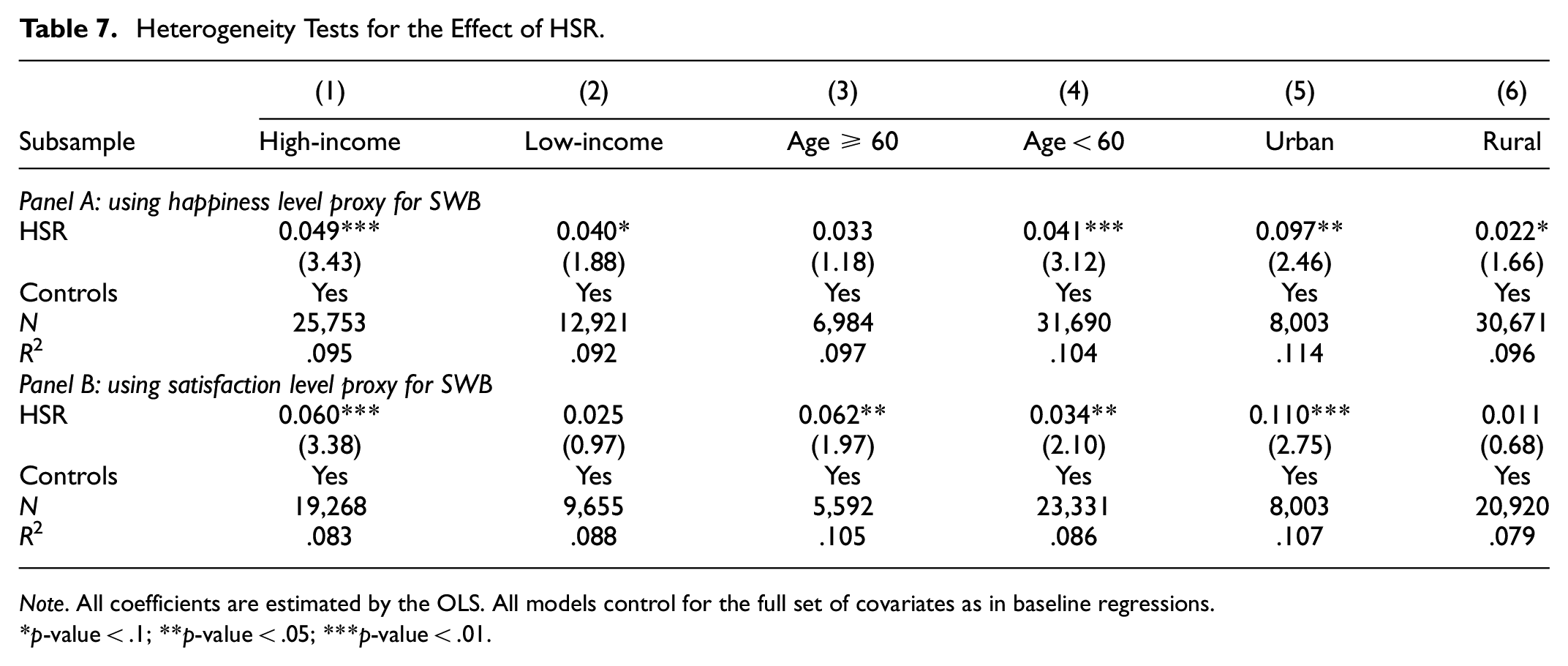
Note. All coefficients are estimated by the OLS. All models control for the full set of covariates as in baseline regressions.
p-value < .1; **p-value < .05; ***p-value < .01.
Discussion
Although research on transportation and SWB is still in its early stages (De Vos et al., 2013), scholars have suggested that transport accessibility and affordability play a crucial role in people’s quality of life (Awaworyi Churchill & Smyth, 2019). Our empirical results are consistent with this view. Large-scale transportation infrastructure may have negative impacts, such as reducing natural resources used for fishing, hunting, leading to resource extraction, increasing within-country inequality (F. Chen et al., 2021), cause environmental pollution (Levinson et al., 1997). Prior studies also present abundant but mixed evidence on the socio-economic outcomes of HSR project. However, our study shows that HSR project exerts a positive impact on residents’ lives, including increasing income, promoting tourism, and improving health, which further enhances residents’ SWB. Overall, this study supports the positive impact of HSR projects on SWB outweighing the negative impact. OLS estimates of the HSR variable show that the introduction of HSR services increased residents’ hedonic happiness and life satisfaction level by 0.041 and 0.044, respectively, accounting for 1.07% and 1.19% of the average levels of happiness and life satisfaction. This main finding is robust to alternative ways of measuring SWB, alternative estimation methods, multiple approaches to addressing various endogeneities, which reveal a direct and consistent relationship between HSR project and SWB. Notwithstanding, we find that HSR projects would widen the gap in SWB between different groups. High-income groups, young people, and urban residents benefit more from the HSR project than low-income groups, the elderly, and rural residents because they can better access and utilize HSR services.
To further understand the magnitude of HSR projects’ role on SWB, we adopt the life satisfaction approach (LSA) to do a back-of-the-envelope calculation of the monetary value of the increased SWB by HSR projects. The LSA assumes that life satisfaction is an empirical measure of individuals’ utility, and that rational individuals pursue utility maximization. In this way, life satisfaction is directly comparable across the population. It has been well documented in the literature that life satisfaction is positively associated with household annual income (Awaworyi Churchill & Smyth, 2019; Diener et al., 2015; Yakovlev & Leguizamon, 2012), and this study shows that life satisfaction is also positively affected by HSR projects. In LSA, there is a tradeoff between the introduction of HSR services and increased household income. That is, the increase in the utility brought about by the introduction of HSR services should be equal to the utility increase brought about by income. The willingness to pay (
In LSA, the relation between life satisfaction and its determinants is estimated by the following equation:

where
To calculate the average marginal rate of substitution between household income and the introduction of HSR services, we impose the condition

where
Based on the estimates in column 3 of Table 6,
Conclusion
HSR project nowadays is among major policy tools to push toward development. And the effects of HSR on various aspects of the macro economy are controversial, which suggests the relationship between HSR and residents’ wellbeing is also uncertain, and lack of econometric research. Considering the high cost of construction and maintenance of HSR projects, investigating the role of HSR on residents’ wellbeing is of great importance for governments around the world.
This paper examines the relation between HSR services and individuals’ SWB using a national longitudinal social survey targeted at the labor force in China. The baseline results indicate that HSR services have a significant and positive impact on individuals’ SWB. After addressing the endogeneity of HSR dummy (using external instruments, heteroskedasticity-based identification approach), and addressing potential bias caused by selection bias with multiple matching methods, and addressing potential bias caused by unobserved variables and regional time-invariant features, we consistently reveal a causality between HSR services and subjective wellbeing. Furthermore, we find HSR services improve individuals’ SWB through (1) increasing income, (2) improving health, and (3) inducing tourism. Through a back-of-the-envelope calculation using LSA, we estimated that households’ average willing to pay for the introduction of HSR services is about CNY 11,567.07, which can be interpreted as the monetary value of the happiness benefit of HSR.
This study could make a good reference for many countries which are planning to upgrade cross-region transport infrastructure to HSR systems, especially for many developing economies. Although the links between HSR and a wide array of macro-level development outcomes are controversial in the literature, our results provide microscopic evidence of the positive socio-economic influence of HSR projects. For instance, the analysis of the mediating effect suggests HSR services have a positive and significant impact on people’s income, which reflects that HSR connection is associated with local economy enhancement. In the context of China, policies aiming at increasing accessibility appear to be an effective tool to improve people’s wellbeing as the distribution of economic development, medical services, and tourist resource are very uneven across regions. Besides, it is confirmed that HSR services have essentially changed people’s routine life, hence the central government should be cautious on the HSR routes placements to take into account the well-being of people who live in the less-developed areas.
Importantly, the paper could enlighten policy-makers to readjust spending priorities on the ground of wellbeing. It has been increasingly recognized that improving wellbeing, rather than focusing solely on traditional economic indicators, should be a prior policy objective (Diener, 2006; Kahn & Juster, 2002). At present, the HSR project’s evaluation applied around the world only calculates the user value of HSR services from the monetized value of time. As recorded in the World Bank Report, the value of time for business travel has been assumed equal to the wage rate with that for nonbusiness travel taken as one-third of the wage rate. However, the user value of HSR services is widely thought to be undervalued. In the future, it could be recalibrated by adding the implied market values of HSR services on subjective wellbeing.
Like all studies, there are some insufficiencies and limitations of this paper. Subjective wellbeing is only measured by one-time self-report scales of life satisfaction and happiness. This self-report SWB level has been found to have adequate reliability and validity (Diener et al., 1999), but more confidence will be placed in the conclusion if we include other types of SWB measurement. Moreover, there might be some omitted variables, such as unobservable socioeconomic factors (hometown connections, location preferences, culture) and demographic characteristics (people’s ability to adapt to new conditions, willingness to migrate). And more detailed data on individual’ travel across cities are needed to reveal how transport improvement affects people’s lives. Due to limited data availability, we cannot fully address these concerns. Future research could investigate the nuances of the relationship between HSR and subjective wellbeing by addressing these issues more critically.
Footnotes
Appendix
Summary of Statistics.

| Variables | Descriptions | Mean | SD |
|---|---|---|---|
| Happiness | Self-rated happiness level, on a scale of 1 to 5, where 1 = very unhappy and 5 = very happy | 3.82 | 0.96 |
| Satisfaction | Delf-rated satisfaction level, on a scale of 1 to 5, where 1 = totally unsatisfied and 5 = totally satisfied. | 3.69 | 0.93 |
| HSR | Dummy variable, =1, one year after the region where participants live is connected by HSR routes; =0 otherwise. | 0.61 | 0.49 |
| Edu | Participants’ educational level, 1 = uneducated, 2 = elementary school, 3 = junior high school, 4 = high school, 5 = university, 6 = master or doctorate | 3.07 | 1.45 |
| Age | Participant’s age | 43.96 | 14.52 |
| Gender | 1 = male, 0 = female | 0.48 | 0.50 |
| Religion | 1 = have religion beliefs, 0 = otherwise | 0.13 | 0.33 |
| Marry | 1 = married, 0 = otherwise | 0.81 | 0.39 |
| Hukou | Household registration, 1 = non-agricultural, 0 = agricultural | 0.29 | 0.45 |
| Social | Familiarity with the neighbors and other residents in this community, on a scale of 1 to 5, where 1 = very unfamiliar, 5 = very familiar | 3.74 | 1.02 |
| Dad_Edu | Father’s education level, 1 = uneducated, 2 = elementary school, 3 = junior high school, 4 = high school, 5 = university, 6 = master or doctorate | 2.48 | 1.57 |
| Mom_Edu | Mother’s education level, 1 = uneducated, 2 = elementary school, 3 = junior high school, 4 = high school, 5 = university, 6 = master or doctorate | 1.68 | 0.93 |
| Fmy_Size | The number of family members | 3.82 | 1.79 |
| Fmy_Relation | Third-party’s assessment of the relationship between family members, on a scale of 1 to 10, where 1 = very cold, 10 = very intimate | 7.22 | 1.62 |
| Comm_Pop | Total population living in this community | 5,885.02 | 9,613.65 |
| Comm_Firms | The number of enterprises in this community | 24.05 | 89.92 |
| Rail_1961 | 1 = have a railway station at 1961, 0 = otherwise. | 0.66 | 0.48 |
| Income | Household income (Yuan) | 28,917.68 | 65,619.83 |
| Health | Self-rated level of health status, on a scale of 1 to 10, where 1 = very unhealthy,5=very healthy | 3.63 | 0.99 |
| Tourism | Household expenditure on tourism (Yuan) | 1,105.37 | 7,207.83 |
| Urban | 0 = rural participant, 1 = urban participant | 0.37 | 0.48 |
| Airport | Dummy variable, =1, one year after the region where participants live have at least one airport; =0, otherwise. | 0.60 | 0.49 |
| Highway | Dummy variable, =1, one year after the region where participants live is connected to highway network; =0, otherwise. | 0.99 | 0.12 |
Acknowledgements
All authors are very grateful to the Center for Social Science Survey at Sun Yat-sen University who provides the data.
Declaration of Conflicting Interests
The author(s) declared no potential conflicts of interest with respect to the research, authorship, and/or publication of this article.
Funding
The author(s) disclosed receipt of the following financial support for the research, authorship, and/or publication of this article: This work was supported by the Social Science Planning Project of Chongqing Municipality (2023BS028); The National Social Science Fund of China (24XJL007); the Humanities and Social Science Research Youth Foundation of Ministry of Education (22YJCZH169); the Project of Science and Technology Research Program of Chongqing Education Commission of China (KJQN202302); Chongqing Technology and Business University (CYB240269); Guizhou University (GDZD2024008).

Data Availability Statement
Data sharing not applicable to this article as no datasets were generated or analyzed during the current study.