




Abstract
The intensifying competition for talent among Chinese cities has encouraged local governments to implement proactive talent policies as a strategic priority. Unlike their metropolitan counterparts, medium-sized cities face heightened challenges in talent acquisition and retention. Nonetheless, a conspicuous gap persists in understanding the tangible ramifications of talent policy implementation and the underlying drivers of talent attraction. This research focuses on Yantai City, a coastal urban center in eastern China, as a specific case study to investigate how talent policies in medium-sized cities on the intention of college students to remain in their educational locales, using push-pull theory. In collaboration with university student affairs departments, we used stratified sampling to conduct an online survey of graduates from five major undergraduate institutions in Yantai City, obtaining 1,872 valid responses. Using regression analysis and fuzzy-set qualitative comparative analysis (fsQCA), our study reveals that talent policies do not exert a significant effect on the students’ intention to stay in the city, failing to achieve desired outcomes. Conversely, emotional support mechanisms and the overall quality of urban life demonstrate a positive association with the inclination to stay. Notably, insufficient emotional support diminishes the efficacy of talent policies to a certain degree. This study offers valuable insights into the multifaceted determinants shaping the post-graduation decisions of college students, thereby informing the refinement of talent policies.
Plain Language Summary
This study explores how talent policies in medium-sized Chinese cities affect college students’ decisions to stay in their educational cities after graduation. Using Yantai City as a case study, we surveyed graduates from five major universities to understand their intentions, preferences, and evaluations of the city. Despite proactive talent policies implemented by municipal governments, our findings indicate that these policies have limited impact on students’ inclination to stay. Instead, emotional support mechanisms and the overall quality of urban life play significant roles in influencing their decisions. The study highlights the importance of considering multiple factors in optimizing talent policies to retain graduates in medium-sized cities.
Introduction
Talent is a key factor affecting urban innovation and development. Talent mobility reflects a region’s attractiveness and growth potential. With negative population growth in China, regional talent competition has become increasingly important and strategic. Local governments have actively revised their talent policies and strategies, particularly strengthening talent subsidies, to address challenges from talent shortages and demographic decline. This has engendered a “war for talent” (Kapur & McHale, 2005) persistently unfolding across different Chinese cities. While the “siphon effect” of developed cities has waned, the enduringly potent “policy to attract talents” dynamic poses a formidable obstacle to the recruitment of talent in regional medium-sized cities.
According to the “2020 China Campus Recruitment Report” released by the Chinese university job platform Wutongguo, major cities not only maintain a retention rate of over 50% among university graduates, but also attract substantial numbers of students from other cities. In contrast, the retention rate of university graduates in medium-sized cities is generally below 30%, with a trend of gradual decline (Wutongguo, 2020). These city governments aspire to attract external talent through proactive policies while also retaining locally educated graduates, thereby gaining a competitive advantage in the ongoing “war for talent” (Chen, Sun, & Wang, 2023; Yang & Pan, 2020). This article examines the impact of talent policies in medium-sized cities on college students’ intentions to remain in their study city, using Yantai City, an open coastal city in eastern China, as a specific case study.
Located on the eastern coast of Shandong province in China, Yantai City is one of the initial fourteen coastal open cities in China. In 2022, it had a resident population of 7.06 million and achieved a GDP of 138.5 bilion dollars (Bureau of Statistics of Yantai, 2023), ranking 26th among Chinese cities. Since 2020, Yantai’s government has significantly enhanced its talent policy targeting three groups: young talents, leading talents, and top talents. This initiative has resulted in over 40 policy documents, creating a comprehensive talent policy framework.
Currently, Yantai’s talent policy system encompasses seven key dimensions: key talent projects, young talents recruitment, housing support, talent evaluation incentives, talent-centric infrastructure, ensuring talent services, and employer support. This framework essentially covers every facet of talent policy. It stands out for its comprehensive coverage, robust systematic foundation, and substantial support. The policy intensity notably exceeds that of neighboring cities.
Furthermore, since 2021, Yantai’s government has enhanced subsidies and public services under its talent policy. It has implemented comprehensive series of initiatives targeting entrepreneurship and youth employment. Moreover, specific measures, such as the “100-day campaign,” were introduced to disseminate information regarding the policy for young talents, resulting in significantly increased policy awareness among young talents.
Viewed from the perspective of college students, talent policy is an exogenous variable influencing their employment city selection and their intention to remain in the city where they study. College students’ intention to stay in a city and subsequent actions are influenced by multiple factors, including individual values, familial support, and the city’s overall attractiveness. These outcomes directly affect policy effectiveness. Medium-sized cities that rely too heavily on policies, particularly those related to talent subsidies, without strengthening their inherent allure are unlikely to achieve the desired results.
Different scholars have extensively researched the factors influencing college students’ selection of employment cities. He and Zhai (2015) utilized a multinomial logit model to discern the primary characteristics rendering first-tier cities appealing to students: career prospects, social resources, public services, and income levels. Liu (2016 ) employed the utility maximization theory and multivariate analysis, revealing that graduates’ decisions regarding their employment cities are intricately shaped by an array of factors, including regional development, job prospects, and urban environment. Chen and Qi (2018) found that the majority of students weigh regional economic development (82.89%) and are swayed by emotional considerations (75%), such as family and peer influences, when electing a place of employment. Ma and Jiang (2018) underscored that a high cost of living, encompassing prices and housing expenses, exerts an adverse influence on employment attractiveness. Chen (2018) established a set of indicators for appraising talent attractiveness and examined the substantial impacts of career platforms and economic development on urban talent appeal. Several other studies have probed into the influence of household registration policies and natural disaster factors on the city selection of Chinese college graduates for employment (Cao, 2022; L. Ma & Dong, 2015).
Despite growing interest in talent policies, relatively few studies have examined China’s talent policies and their impacts. Existing research primarily focuses on content analysis of policy text evolution across regions (Wang, 2014; Liu, 2019; Su & Liao, 2019; H. Zhang et al., 2019), the effects of talent policies on talent mobility (Jiang, 2021; Yue et al., 2020), the application of governmental talent policy tools, and the influence of talent policies on urban innovation capacity and competitiveness (Dai et al., 2018; Y. Zhang et al., 2023). However, Current studies predominantly employ qualitative policy text analysis or quantitative assessments from a macro perspective. Few empirical studies investigated how talent policies affect individual retention intentions at the micro level (Song & Wang, 2023), leaving the underlying mechanisms unclear. Moreover, no studies have effectively evaluated talent policy implementation in medium-sized cities for retaining college graduates. This study aims to address this research gap.
From a theoretical perspective, this study adopts the migration determinants framework, particularly the push-pull model (Tran et al., 2021), as the foundational theory to explore the intentions of college graduates in medium-sized cities to stay in their current cities. Originally used to analyze migration patterns (Lee, 1966), the push-pull model explains this willingness to stay as a response to various push and pull factors in the urban environment (Chang et al., 2014). This study utilized the push-pull framework to identify specific factors that encourage graduates to remain in their study cities after graduation, as well as factors that may drive them to leave, with particular emphasis on local talent retention policies. Our research questions are:
This study employs quantitative and qualitative methods to explore the determinants of college student retention in medium-sized cities, with particular focus on talent policy effects. The research aims to enhance understanding of graduate retention by examining how local talent policies influence students’ decisions to remain in their study cities. Using the push-pull theoretical framework, this study identifies specific factors that encourage or discourage retention in a representative medium-sized city. Through comprehensive analysis of variables affecting students’ stay-or-leave decisions, this research contributes to the evaluation of talent policy effectiveness in China’s medium-sized urban centers.
Furthermore, this study employs two complementary analytical approaches: regression models and fuzzy-set qualitative comparative analysis (fsQCA). Grounded in push-pull theory, the research treats talent policies as key pull factors and examines determinants of college students’ retention intentions from both push and pull perspectives. The analysis particularly focuses on talent policy impacts and the moderating effect of family emotional support.
Literature Review
The development of population migration theory has provided a valuable theoretical foundation for exploring the choice of employment location for college graduates. Specifically, the Push-Pull Theory is one of the classic models for explaining population mobility, widely used in analyzing migration motives across various groups (Ravenstein, 1885). Based on Lee’s (1966) development of the Push-Pull Theory, population migration results from the combined effects of “push factors” at the origin, “pull factors” at the destination, intermediate barriers, and individual factors (Bean & Brown, 2014). Applying the Push-Pull Theory to college graduates’ employment city choices provides deeper insights into the various factors influencing their decisions. The theory suggests that whether college graduates remain in their study cities after graduation depends on both push factors that encourage departure and pull factors that attract them to stay. Additionally, barrier factors and individual characteristics play important roles in this decision-making process.
Push Factors
Economic factors serve as primary push factors influencing graduate retention in study cities. High living costs, limited employment opportunities, and low wages may drive college graduates to seek opportunities elsewhere. Extensive research confirms the dominance of economic considerations in graduate location decisions. Regional development studies demonstrate this pattern: Kodrzycki (2001) identified regional development levels as key determinants of talent migration, while C. Chen and Qi (2018) found that most students prioritize regional economic development when selecting employment locations. Career opportunity research further supports this finding: Chen (2018) developed a talent attraction index system showing significant impacts of career platforms and economic development on urban talent attraction, and Liu (2016) used utility maximization theory to reveal that regional development and employment prospects critically influence graduates’ city choices. Cost-related studies highlight specific economic barriers: Ma and Jiang (2018) demonstrated that high living costs, particularly housing expenses, negatively affect employment attractiveness. These findings establish economic factors as fundamental determinants in graduate retention decisions.
Beyond economic considerations, graduates’ location decisions are influenced by career development opportunities, quality of life factors, and housing accessibility—each serving as distinct push-pull mechanisms. Career advancement limitations create significant push factors when study cities lack growth prospects or industry diversity, driving graduates toward metropolitan areas with more dynamic job markets. He and Zhai (2015) confirmed this pattern through multiple logit models, identifying job opportunities, social resources, public services, and income levels as primary attractions of first-tier cities.
Quality of life factors constitute another critical dimension of location choice. Environmental conditions particularly influence graduate decisions, with severe pollution and poor air quality serving as strong push factors (Lai et al., 2021). Conversely, cities offering better ecological environments and living conditions create powerful pull factors (Cao, 2022). These environmental considerations reflect graduates’ increasingly holistic approach to career and lifestyle planning.
Housing affordability presents a complex dual mechanism in graduate retention. Jin et al. (2022) identified a critical threshold effect: initially, high housing costs may signal urban prosperity and attract graduates seeking better employment and public services. However, beyond a critical point, continuously rising housing prices become prohibitive push factors, gradually suppressing graduate influx. Hometown housing prices serve as important reference points in these calculations, suggesting that relative rather than absolute costs influence graduate decisions. These findings highlight the nuanced relationship between urban development and talent retention.
Pull Factors
Pull factors in graduate location decisions encompass economic opportunities, social capital advantages, quality of life benefits, and compensation incentives that attract graduates to specific destinations.
Economic opportunities represent the most fundamental pull factors, with abundant employment prospects and career advancement potential in metropolitan areas serving as primary attractions. Kodrzycki (2001) demonstrated that developed cities offer superior employment opportunities and professional development space that better align with graduate career aspirations, making them preferred employment destinations.
Social capital constitutes a significant but geographically variable pull factor. Family-based interpersonal networks create location-specific advantages, as social capital primarily derives from established family connections (Kong et al., 2017; C. Li, 2023). This factor operates differently across geographic contexts: while some graduates are drawn to cities where family networks provide career advantages, others may find their strongest social capital concentrated in their home regions, creating pull effects toward different locations depending on network distribution.
Quality of life factors in destination cities serve as increasingly important pull mechanisms. Comprehensive public service facilities and superior living conditions in developed urban areas attract graduates seeking enhanced life quality. Hao et al. (2020) confirmed that urban public resources significantly influence graduate retention intentions, using Peking University students as a case study. Environmental quality further strengthens these pull effects, with better ecological conditions enhancing graduates’ willingness to work in specific cities.
Economic incentives through compensation packages provide direct pull effects aligned with human capital investment theory. Higher salaries and comprehensive welfare benefits in developed cities create tangible attractions for graduates. This aligns with human capital theory’s prediction that labor mobility represents investment behavior, with mobility intentions varying across education levels (Arenas, 2021; Navarro & Zhou, 2024). Consequently, superior compensation packages become critical pull factors in graduate location decisions.
Policy Factors
Government talent policies serve as deliberate interventions that can either amplify existing pull factors or mitigate push factors, functioning as policy-mediated pull mechanisms in graduate location decisions. These policies operate across multiple dimensions to influence retention outcomes.
Institutional barrier removal represents a fundamental policy approach, with Hukou (household registration) reforms and public service access policies directly addressing systemic push factors. Talent attraction policies in developed cities, including streamlined registration procedures and enhanced service provision, reduce institutional barriers that traditionally drove graduates away (Huang & Zhou, 2016; Song & Wang, 2023). Conversely, persistent differences in registration systems and public service provision between cities continue to create concerns that influence graduate location choices (Chen, Sun, & Wang, 2023; He & Zhai, 2015; Y. Li, 2022; L. Ma & Dong, 2015).
Economic incentive policies demonstrate variable effectiveness depending on urban economic context. Song and Wang (2023) identified distinct policy effectiveness patterns: in lower-income cities, combined policies offering both relaxed Hukou requirements and substantial living subsidies effectively attract recent graduates, while policies providing only registration access without financial support yield poor retention outcomes. However, in higher-income cities, talent attraction policies show diminished effectiveness in improving graduate retention, suggesting that economic incentives become less decisive when base compensation levels are already competitive.
Contextual policy design emerges as critical for policy effectiveness, with different urban tiers requiring tailored approaches. For new first-tier cities, successful talent retention requires both competitive income levels and comprehensive policy support, indicating that policy effectiveness depends on broader urban competitiveness rather than policy design alone (Song & Wang, 2023). This finding suggests that policies function most effectively as complementary mechanisms rather than primary pull factors in graduate retention decisions.
Brief Evaluation
The push-pull theoretical framework provides a foundational lens for analyzing graduate location decisions, systematically categorizing factors that either repel individuals from origin locations or attract them to destinations (Dorigo & Tobler, 1983). However, this framework faces significant limitations when applied to contemporary graduate retention analysis, particularly in accounting for complex factor interactions and individual heterogeneity.
Theoretical limitations emerge from several sources. The traditional push-pull model struggles to capture the intricate interactions among migration factors, where push and pull forces operate simultaneously and interdependently rather than as independent variables (Skeldon, 1990). Additionally, the model’s assumption of rational, objective decision-making inadequately addresses the subjective cognitive processes that significantly influence graduate location choices. Research demonstrates that individual differences in information access and interpretation create substantial variation in how graduates perceive and respond to identical objective conditions (Farivar et al., 2019; He & Zhai, 2015; Van Hear et al., 2018).
Subjective factor dominance represents a critical theoretical consideration often underemphasized in traditional push-pull applications. Contemporary research reveals that subjective evaluations frequently outweigh objective attributes in graduate location decisions, with attitudes toward cities, perceived behavioral control, and personal interpretations of development prospects, employment benefits, and institutional constraints playing decisive roles (Jin et al., 2022; Lu, 1998; Wen et al., 2020). This finding suggests that push-pull factors operate through individual cognitive filters rather than as direct causal mechanisms.
Therefore, considering regional differences and individual heterogeneity, comprehensive analysis of graduate retention and mobility intentions requires examination from two complementary perspectives. First, research should focus on individual subjective evaluations, examining graduates’ perceptions of employment opportunities, quality of life, social capital, salary levels, ecological environment, and talent policies. This approach explores how individuals weigh these factors and examines personal preferences in location decision-making processes, with particular attention to talent policy impacts. Second, research should differentiate decision-making models based on variations in push-pull factors and policy contexts, analyzing how graduates from different backgrounds and circumstances make retention or mobility decisions while exploring universal decision-making patterns.
Hypotheses Development and Conceptual Framework
Based on the push-pull theoretical framework and integrating existing research findings, this study examines the factors influencing graduate retention intention from a subjective evaluation perspective to develop theoretical hypotheses. As a null hypothesis (H0), we posit that various push and pull factors will not influence college students’ employment intentions in their study locale. Subsequently, we formulate additional relevant hypotheses.
Impact Assessment of Pull Factors in the Educational Locale
Research findings indicate that graduates’ subjective evaluations of their study cities function as dual mechanisms, potentially creating both attraction and deterrent effects on local employment intentions (Imeraj et al., 2018; W. Li et al., 2019). Cities can strengthen their appeal to graduates through strategic improvements in youth-oriented cultural offerings, urban image enhancement, environmental quality upgrades, and employment opportunity expansion, thereby establishing stronger pull factors for talent retention.
Evaluation of entertainment and fashion. Contemporary young people prioritize lifestyle experiences and actively pursue entertainment activities and fashion trends during leisure time. Diverse entertainment options allow graduates to satisfy these preferences, thereby enhancing their overall quality of life. Furthermore, entertainment and fashion venues serve as effective media for social interaction, enabling young professionals to expand their networks and access career development opportunities. Cities offering abundant entertainment and fashion resources successfully attract graduates by providing vibrant, professionally supportive urban environments, making these factors critical determinants of talent retention.
Evaluation of city image. City image represents a critical factor in talent attraction and retention. A city’s reputation, cultural atmosphere, historical heritage, and innovation capacity collectively its brand identity. Cities with strong positive brand images demonstrate greater success in attracting graduates, as young professionals are drawn to locations perceived as successful, innovative, and dynamic cities.
Evaluation of quality of life. Quality of urban life constitutes a fundamental determinant of graduate employment decisions. Modern transportation systems, robust communication infrastructure, and convenient public services greatly enhance a city’s attractiveness. Additionally, environmental quality of a city, including air purity, water standards, waste disposal, and urban green spaces, directly influences graduates overall satisfaction with urban living and working environments.
Evaluation of job opportunities. Employment prospects serve as primary determinants in graduates’ location decisions, with candidates systematically evaluating multiple dimensions of local job markets. Key considerations include market breadth, industry diversification, career advancement pathways, corporate headquarters concentration, and entrepreneurial ecosystems. Graduates demonstrate strong preferences for urban centers that provide comprehensive career development opportunities and substantial potential for professional growth.
Based on this, the following hypotheses are proposed:
The Push-Pull Effect of Family Social Capital and Emotional Support
Family social capital and emotional support constitute significant determinants in graduates’ location decisions through distinct push-pull mechanisms. When graduates’ study locations align with their household registration areas, family social capital functions as a powerful retention force, encouraging local employment choices. Conversely, when household registration locations differ from study cities, family social capital serves as a compelling pull factor toward the family origin, with this attraction intensifying as geographical proximity between locations increases.
Family expectations, financial support, and emotional encouragement collectively influence graduates’ employment location decisions through complex mechanisms. These family factors create divergent motivational patterns: some graduates prioritize geographic proximity to maintain family connections and fulfill filial obligations, while others emphasize professional autonomy and career advancement in distant markets. Consequently, family emotional support demonstrates bidirectional effects on location choices, with outcomes varying significantly across individuals due to diverse family dynamics and personal value orientations.
Our hypotheses are as follows:
Drawing from the comprehensive analysis of location determinants presented above, this study develops an integrated conceptual framework examining graduates’ local employment retention decisions (Figure 1). This framework synthesizes multiple theoretical perspectives—including push-pull migration theory, quality of life considerations, and social capital dynamics—to provide a systematic understanding of the complex factors influencing graduates’ location choices.

Conceptual model of push-pull factors influencing college students’ retention intentions.
Data and Methods
Sample Selection and Data Collection
In 2022, China generated 12.06 million new employment positions, coinciding with 10.54 million graduate completions from higher education institutions (National Bureau of Statistics of China, 2023). Significantly, employment data reveals that graduates demonstrate strong tendencies toward local retention, particularly in medium-sized cities that balance career opportunities with manageable living costs. Given this spatial employment pattern and the concentrated distribution of graduates in medium-sized urban centers, this study employs a questionnaire-based approach targeting recent graduates in these strategically important locations.
For this study, a questionnaire entitled “Stay or Go? Survey on the Willingness of Yantai College Students to Stay in Yantai” was developed. This questionnaire primarily focused on academic and career preferences to ensure participant well-being while avoiding potentially sensitive personal topics that could cause psychological distress.
To ensure the diversity and representativeness of the survey sample, we adopted two measures.
University selection: There are a total of 18 universities in Yantai City, including 8 undergraduate institutions and 10 vocational colleges. When selecting universities to participate in the survey, we mainly considered the diversity of universities, including 4 public institutions: Shandong Technology and Business University, Ludong University, Yantai University, Binzhou Medical University, and one private university, Yantai Institute of Technology. Compared to vocational colleges, these universities have a wider range of student sources and different professional characteristics, including finance, education, comprehensive studies, medicine, and engineering. This diversity provides us with the ability to understand the factors influencing students’ decisions to stay or leave Yantai after graduation.
Participant recruitment: We used stratified sampling and collaborated with the student affairs departments of each university to ensure a diverse group of participants. Staff from the student affairs departments selected representative students from different majors based on the distribution of majors and student numbers in each university, aiming to capture the intentions of graduates from different majors at different universities in Yantai. This approach enables analysis of talent supply-demand alignment effects on local retention decisions.
Through collaboration with student affairs departments, stratified sampling was conducted among 2022 graduating cohorts from the five selected universities, including graduate students, final-year undergraduates, and pre-graduation students. All participants received comprehensive study information and provided informed consent prior to participation, with explicit acknowledgment of voluntary participation and withdrawal rights. Data collection utilized an anonymous online questionnaire administered over one month, ensuring complete privacy protection through the exclusion of personally identifiable information. The survey yielded 2,026 initial responses. Data screening involved multiple stages: removal of 108 non-graduating students, 4 incomplete responses, and 42 responses with extreme scoring patterns (consistent maximum ratings). This process resulted in 1,872 valid questionnaires, achieving a 92.6% validity rate.
The final sample demonstrated the following demographic distribution: gender composition of 28.5% male and 71.5% female participants; academic level representation of 94.0% undergraduates, 2.9% master’s students, and 3.2% specialist degree students. Regarding family structure, 37.9% were only children. Geographic distribution revealed 76.9% held Shandong Province household registration, with 7.7% specifically registered in Yantai City.
Measurement
Based on the conceptual framework examining graduates’ local retention intentions, this study developed a comprehensive urban attractiveness scale comprising 5 dimensions and 20 measurement items. We evaluated the internal consistency of the scale using Cronbach’s alpha. The overall consistency reliability was .96. The five latent factors are: (1) Entertainment Fashion (Cronbach’s α = .89) was gauged through four parameters (information accessibility, leisure and entertainment options, adherence to fashion trends, and culinary offerings); (2) City Image (Cronbach’s α = .91) was assessed by four parameters (urban prominence, presence of distinguished enterprises, cultural legacy, and transportation and accessibility); (3) Quality of Life (Cronbach’s α = .91) was appraised through five parameters (geographic positioning, climatic conditions, air quality, urban ambiance, and pace of life); (4) Career Opportunities (Cronbach’s α = .87) were evaluated through three parameters (price levels, wage scales, and employment pressures); and (5) Talent Policy (Cronbach’s α = .91) was ascertained through four parameters (employment policies, institutional advancements, talent retention initiatives, and talent-based subsidies).
To ensure measurement consistency across all items, each construct was operationalized through declarative statements requiring respondent evaluation. Responses were captured using a 5-point Likert scale ranging from 1 (strongly disagree) to 5 (strongly agree), providing standardized assessment metrics for all urban attractiveness dimensions.
This study operationalizes “Hukou” (household registration) as a proxy for local social capital availability. Household registration status represents formal residential ties that theoretically facilitate access to family-based social networks and local resources during job searching. Two categorical variables capture geographic proximity effects: Hukou_Shandong distinguishes between in-province versus out-of-province registration, while Hukou_Yantai specifically identifies local city registration. This dual-level classification enables analysis of social capital advantages at both provincial and municipal levels, with closer geographic ties hypothesized to provide stronger employment support networks.
In the questionnaire, individual characteristics such as gender, only child status, and undergraduate status were also investigated as control variables. Being an only child, typically receiving more attention and expectations from their parents, may influence their career choices. Research has shown that only children tend to prefer stable careers to meet their family’s expectations, while non-only children tend to have a more positive attitude and higher willingness to develop in first-tier cities (Jin et al., 2022). Whether someone is an only child may affect their choice of employment city.
Data Analysis
Existing research has primarily focused on linear relationships in terms of methodology, while overlooking non-linear relationships, such as those involved in qualitative comparative analysis (QCA). Regression models are based on linear relationships, considering the individual effects of predictor variables on the outcome variable without taking into account the probability of their possible combinations. In contrast, QCA models are based on Boolean logic, not only focusing on individual contributions but also analyzing the possible combinations or interactions of predictor variables in a given outcome, thus achieving what is known as equifinality (Eng & Woodside, 2012).
This study employs a multi-stage analytical approach to examine graduate retention decisions. Initial descriptive statistics provide sample characterization, followed by measurement validation and predictive modeling. Confirmatory Factor Analysis (CFA) assessed model fit between the hypothesized five-factor structure and observed data to validate the urban attractiveness measurement model. Common method bias testing ensured measurement validity across all constructs. Two complementary analytical approaches examined retention determinants: Ordered logit regression quantified the individual effects of urban attractiveness dimensions and demographic characteristics on retention intentions, while Fuzzy Set Qualitative Comparative Analysis (fsQCA) identified configurational pathways leading to high retention likelihood. CFA and bias testing utilized Mplus 8.3, regression analysis employed Stata 17.0, and fsQCA modeling was conducted using fsqca 4.1 (Ragin & Davey, 2022).
Results
Descriptive Statistics
Table 1 reveals that 18.1% of graduates express intentions to remain in Yantai, while 49.4% indicate plans to leave the city. The remaining 32.6% remain undecided regarding their post-graduation location selections. The observed willingness to stay aligns closely with Yantai’s actual 2022 graduate retention rates. Significant demographic differences emerge in retention preferences. Male graduates, only children, and those with Yantai household registration demonstrate higher retention rates, whereas bachelor’s degree holders show comparatively lower intention to remain locally.
Intention to Stay or Go By Individual Characteristics.

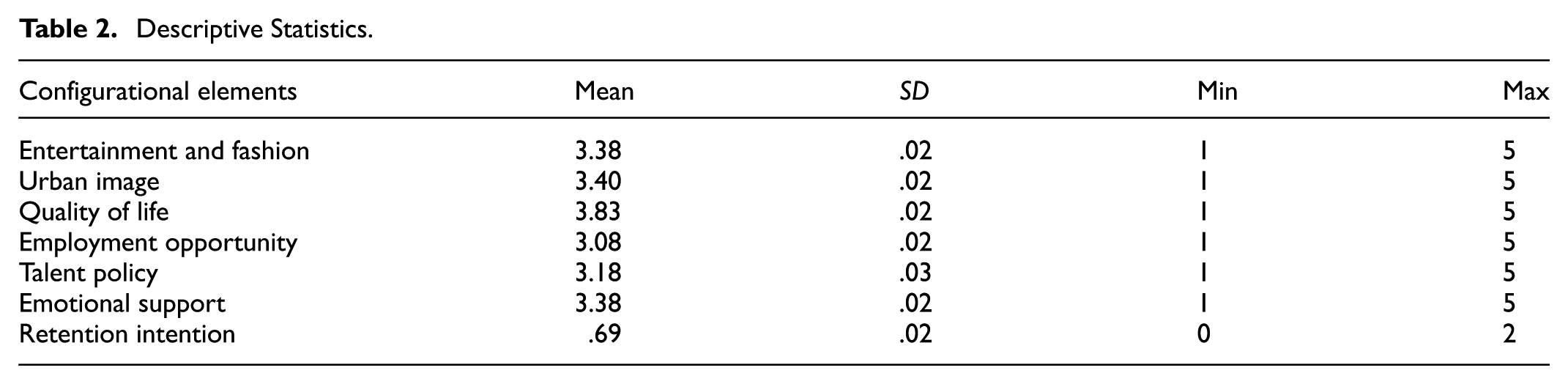
Table 2 displays the results of the descriptive statistics for the family emotional support and urban characteristics variables in the study. Quality of life exhibited the highest mean (M = 3.83, SD = .02), while employment opportunities demonstrated the lowest mean (M = 3.08, SD = .02). It is noteworthy that all variables surpassed a value of 3, signifying they are above the midpoint. Furthermore, the standard deviation for all cases was less than .05.
Descriptive Statistics.
In Table 3, a significant positive correlation was observed between all variables (p < .01). Specifically, the results highlight that Entertainment and Fashion displayed the strongest correlation with City Image, surpassing .8. Additionally, Talent Policy exhibited a correlation of over .7 with Employment Opportunities, City Image, and Emotional Support. On the other hand, Quality of Life demonstrated a relatively lower correlation with Emotional Support (.58).
Pearson’s Correlations.

p < .001.
Validation of Factor Analysis with Common Method Bias Test
Common method bias (CMB) frequently manifests in self-reported research employing questionnaires (Podsakoff et al., 2003). The questionnaire employed in this study garnered responses from multiple participants, and we drew upon the recommendations of Podsakoff et al. (2003) for pertinent insights. In our initial strategy, we sought to mitigate or circumvent CMB by deliberately selecting five distinct colleges and universities, characterized by a more dispersed distribution of majors. This approach aimed to attenuate any common background stemming from institutional or major affiliations. Respondents were afforded anonymity when completing the questionnaire to safeguard their privacy and foster candid expression of their opinions. Subsequently, we employed the Unmeasurable Latent Method Factor Effects Control Method (ULMC). In cases where the researcher cannot identify or measure the source of common method bias effectively, this bias can be treated as a latent variable. All variables are permitted to load onto this latent variable, and the goodness of fit between the model containing the latent common method bias and the model excluding it is compared. If the model incorporating the latent common method bias exhibits superior fit, it implies the presence of a common method bias effect (H. Zhou & Long, 2004).
As per scholars’ recommendations, we considered the discriminant validity of the test variables (scales) concurrently during the common method bias assessment. If the questions from two or more scales align with the model as if they were facets of a single factor and the fit indices do not show substantial deterioration (e.g., the CFI and TLI remain within a .03 decrement, and the RMSEA and SRMR do not increase by more than .01), it suggests that these variables possess low discriminant validity.
We assessed the discriminant validity of the five variables representing urban characteristics using Mplus 8.3. By contrasting various factor models, we established that the five-factor model outperformed alternative models. Notably, the CFI and TLI exceeded .9, while the RMSEA and SRMR approached .05, affirming the robust discriminant validity of these five variables. Building upon this foundation, we formulated a two-factor model to scrutinize common method bias, with the model fit indices detailed in Table 4. The findings indicated that the introduction of the common method factor into the five-factor framework did not result in significant enhancements in model fit. The CFI and TLI saw modest improvements of .037 and .038, respectively, while the RMSEA and SRMR witnessed marginal declines of .017 and .026. Consequently, it appears improbable that CMB constitutes the principal concern in our study.
Fit Metrics for Different Competing Models and Common Method Factor Models.

Note. EF = entertainment fashion; UI = urban image; QL = quality of life; EO = employment opportunities; TP = talent policy. One factor: EF + UI + QL + EO + TP; Two factors: EF + UI + QL + EO; TP; Three factors: EF + UI + QL; EO; TP; Four factors: EF + UI; QL; EO; TP; Five factors: EF; UI; QL; EO; TP.
Regression Analysis
Ordered logit regression analysis was conducted using Stata 17.0 with stepwise variable selection to examine factors influencing graduate retention intentions. Model diagnostics confirmed the appropriateness of the ordered logit specification, with the parallel lines assumption satisfied (Prob. > χ2 = .3314).
Table 5 presents the regression results. After controlling for individual characteristics, several urban attractiveness dimensions significantly influence retention decisions, rejecting the null hypothesis of no effects. City image and quality of life evaluations demonstrate consistent positive associations with retention likelihood. Conversely, career opportunity assessments show an unexpected negative relationship with retention intentions.
Stay or Go Ordered-Logit Regression Models.

Note. Standard errors in parentheses.
p < .01. **p < .05. *p < .1.
Table 5 presents the regression results. After controlling for individual characteristics, several urban attractiveness dimensions significantly influence retention decisions, rejecting the null hypothesis of no effects. City image and quality of life evaluations demonstrate consistent positive associations with retention likelihood. Conversely, career opportunity assessments show an unexpected negative relationship with retention intentions.
Talent policy evaluation exhibits a complex relationship with retention intentions. While initially significant in isolation, its effect becomes non-significant when other urban factors are included. However, a significant interaction emerges between talent policy and family emotional support: the positive influence of talent policy diminishes among graduates with stronger family emotional support, suggesting that emotional support moderates talent policy effectiveness.
Local household registration, representing family-based social capital, demonstrates a significant positive effect on retention intentions, confirming the importance of established local connections in location decisions. The empirical analysis provides mixed support for the theoretical framework. Hypotheses H2 (city image), H3 (quality of life), H6 (emotional support), and H7 (social capital) receive empirical support. However, H1 (talent policy) and H5 (interaction effects direction) are not supported. Notably, H4 (career opportunities) shows results contrary to theoretical predictions, with job opportunities negatively associated with retention.
To further scrutinize the robustness of talent policy’s impact on urban retention inclination, we conducted a heterogeneity and robustness test analysis based on gender and domicile. The outcomes are presented in Table 6. Due to the limited sample size of the model (3), the results exhibit instability and are consequently not factored into subsequent analyses. Even after accounting for the interaction effects of emotional support and talent policy, emotional support and quality of life consistently exhibit steadfast positive effects. Evaluations of job opportunities by female and non-Yantai Hukou graduates evince a negative impact on urban retention. City image exclusively exerts a significant positive effect on male college students’ intent to stay in the city, whereas its effect on females fails to attain significance. It merits attention that the only-child characteristic manifests a positive effect on graduates registered under Yantai City. The overall heterogeneity analysis outcomes align closely with those in Table 6, signifying greater resilience and diminished influence from other factors in the regression results.
Robustness Test.

Note. Standard errors in parentheses.
p < .01. **p < .05. *p < .1.
The foregoing results elucidate that the affirmative talent policy measures in Yantai City have not yielded the intended effect on urban retention, primarily due to the mitigating influence of familial emotional support.
Fuzzy Set Qualitative Comparative Analysis (fsQCA)
Regression analysis reveals that four of the five urban attractiveness dimensions significantly influence graduate retention intentions. Only entertainment and lifestyle factors show no significant effect on location decisions. Notably, family emotional support exhibits a consistently positive impact on retention intention. While the impact of individual, family, and urban characteristics on retention intention is discernible, it does not elucidate the mechanism through which each factor contributes to retention intention – that is, how these characteristics synergize to influence intention. The QCA method, traditionally employed for qualitative data analysis, is adept at handling larger-scale quantitative survey data as well. Consequently, in this study, we leverage the Fuzzy Set Qualitative Comparative Analysis method to delve into the intricate mechanisms of influencing factors and the diverse typologies of grouping patterns.
Data Calibration
In fsQCA, every variable is conceptualized as a fuzzy set, denoting varying degrees of association with the set (Ragin, 2000). Therefore, the initial step prior to conducting fsQCA analysis entails transforming each study variable into a fuzzy set, a process known as “calibration” (Mendel & Korjani, 2013; Ragin, 2008). Drawing on the approach outlined in (Ortiz de Guinea & Raymond, 2020), we utilized the highest quartile value as the benchmark for complete affiliation, the median as the point of intersection, and the lowest quartile value as the threshold for complete non-affiliation. Employing this criterion, the five facets of urban characteristics and the emotional support dimension were calibrated, yielding a total of six elements. The willingness to stay was categorized into three options: “to stay,”“to go” and “undecided”. In fsQCA, thresholds of .95 and .05 were adopted to denote full in and full out, respectively, with .5 serving as the point of intersection. Recognizing .5 as the upper limit of fuzzy affiliation, we adjusted the intersection point to .4 to mitigate potential multiple solutions. This adjustment signifies that “undecided” leans less toward remaining. The calibration thresholds are delineated in Table 7.
Calibrations Values.

Calibration thresholds: fully in = top quartile; crossover = median; fully out = bottom quartile.
Necessary Condition Analysis
Consistency is a key measure in fsQCA analysis, assessing the extent to which cases align with the outcome under specific conditions. When the consistency score surpasses .9, the condition is generally considered necessary for university students to choose urban retention (M. R. Schneider et al., 2010; C. Q. Schneider & Wagemann, 2012). However, as shown in Table 7, none of the six elements affecting retention intentions achieved a consistency score exceeding .9. This suggests that no single factor alone can lead university student to choose urban retention; rather, it requires a combination and interaction of multiple factors. Therefore, in fsQCA analysis, the consistency score serves as an initial benchmark, requiring further consideration of factors such as interactions and combinations between factors.
Sufficient Conditions Analysis
The histogram analysis commences with the creation of a truth table comprising 2 k rows, encompassing all conceivable configurations, where “k” represents the number of individual elements (Pappas et al., 2016, 2017). This truth table is then organized based on frequency and consistency. For this study, the sample size exceeded 1,800 cases, and in line with scholarly recommendations (Fiss, 2011; Ragin, 2008), a frequency threshold of five was adopted. Additionally, given that the consistency ranges from a minimum of .340 to a maximum of .857, a threshold of .8 was utilized to ascertain final consistency, surpassing the suggested threshold of .75 advocated by researchers (Y. Liu et al., 2017). We have acquired the truth tables, which are provided in Table S1 and Table S2 in the Online Appendix. Configurations with lower frequencies were subsequently excluded from further analysis. For configurations surpassing the consistency threshold, the outcome variable was assigned a value of 1, while all other configurations were designated as 0. The fsQCA software then computed three sets of solutions: complex, parsimonious, and intermediate solutions. Following the recommendation by Pappas et al. (2017), an amalgamation of parsimonious and intermediate solutions was employed to elucidate the fsQCA results (Pappas et al., 2017). This facilitated the identification of the conditions in parsimonious solutions for the intermediate solutions, culminating in the creation of a comprehensive solution table that incorporates core and edge elements pivotal in deciphering the resultant grouping outcomes.
Configurations for Intention to Stay
Table 8 presents the outcomes of the fsQCA analysis for the “willingness to stay” configuration. Adopting the table-solving notation introduced by Ragin (2008): black circles signify the presence of a condition, a circle with a cross denotes its absence, a large circle designates a core condition, a small circle denotes an peripheral condition, and a blank space indicates a non-essential condition—meaning that its presence or absence does not alter the results. This outcome provides a concise representation of the grouping configurations (Table 9).
Analysis of Necessary Conditions.

Causal Configurations for the Presence and Absence (~) of Intention to Stay.

Note. ● otpresence of a core condition; • = presence of a peripheral condition; ⊗ = absence of a core condition; ⨂ = absence of a peripheral condition; blank = don’t care.
Regarding the outcome of willingness to stay, the analysis produced two distinct configurations deemed sufficient conditions for choosing to remain. The raw coverage, or the proportion of cases accounted for by each configuration based on fuzzy affiliation values, ranged between .133 and .126. Additionally, the unique coverage, signifying the proportion of cases exclusively described by the configuration present in the solution set and not by any other configuration in that set, amounts to .054 and .06, respectively. The consistency value, representing the extent to which a given configuration suffices as a condition for the outcome, surpasses .8 for all configurations (Rihoux & Ragin, 2008). Notably, a consistency score below .75, as outlined by Ragin (2008), indicates notable inconsistency, which does not apply in this context. Finally, the overall solution exhibits a consistency of .790, with a coverage ratio of .187.
The first configuration (S1) indicates robust family emotional support, high recognition of the city’s quality of life, low evaluation of talent policies (core condition), and low appraisal of entertainment, fashion, city image, and career opportunities (peripheral condition). The second configuration (S2) shares the same core conditions and career opportunities (peripheral conditions) with the first configuration, but diverges in evaluations of entertainment, fashion, and city image. While the core conditions align with the results of the regression analysis, there are discrepancies in the peripheral conditions. These two configurations account for 12.6% and 13.3% of college students inclined to stay in the city, respectively. It is evident that robust family support, positive city evaluation, and lower assessment of talent policies do not meet the criteria for necessary conditions, yet they appear to be indispensable factors for the inclination to stay (Ragin, 2008).
For those unwilling to remain in the city or considering departure, the analysis yielded five distinct configurations. The first configuration (NS1) is characterized by feeble family support (core condition) and low evaluations of entertainment, fashion, city image, and talent policies (peripheral condition), without accounting for quality of life and career opportunities. The second configuration (NS2) closely resembles NS1, but with low evaluation of city life as a core condition, and talent policy and career opportunities as non-essential conditions. The third configuration (NS3) is characterized by feeble family support (core condition), but relatively high evaluations of entertainment, fashion, city image, and quality of life (peripheral condition). The fourth configuration (NS4) is characterized by a low evaluation of quality of life alongside feeble family support (core condition), and a low evaluation of talent policies and employment opportunities (peripheral condition). The fifth configuration (NS5) is characterized by a low evaluation of quality of life (core condition), along with relatively high evaluations of entertainment, fashion, city image, employment opportunities, talent policy, and family support (peripheral condition). These five configurations account for 39.3%, 38.7%, 15.5%, 10.4%, and 11.9% of the college students expressing reluctance to stay in the city or being ready to leave, respectively. The results of the diverse configuration analysis concerning the reluctance to stay or readiness to leave decision underscore its variability, which is marked by more intricate and diverse inherent mechanisms compared to the willingness to stay. In summary, feeble family support and low evaluation of the quality of life appear to be significant factors contributing to reluctance to stay, while the influence of talent policy on this reluctance is relatively modest.
Discussion and Policy Implications
Discussion
As competition for talent among Chinese cities intensifies, more cities have implemented talent policies with increasingly robust measures. Medium-sized cities may face a disadvantage when competing for talent with larger metropolitan areas. The effectiveness of talent policies in enhancing a city’s attractiveness involves multiple complex factors. This study distinguishes itself by employing both regression analysis and qualitative methods to examine how talent policies, emotional support, and other urban characteristics influence college graduates’ residential location choices. The research employs ordered regression modeling and fuzzy-set qualitative comparative analysis to explore these complex relationships.
Contrary to initial expectations, the findings reveal that college students’ perceptions of talent policies do not significantly influence their intention to remain in the city. This finding is consistent with results from a study examining talent policies in Tangshan City, a medium-sized coastal city in China (Su, 2024). This suggests that talent policies may not be achieving their intended goal of attracting talents. Therefore, Hypothesis 1 was not supported. Conversely, family emotional support and quality of life perceptions consistently influence students’ decisions to remain in the city. These factors partially offset the intended effects of talent policies on attracting graduates. For female students and those from outside Yantai, employment opportunities negatively affect their intention to remain in the city. City image has a significant positive impact on male students’ intention to stay, while this effect is not observed among female students. Additionally, being an only child has a positive effect on the retention intention of local Yantai students.
The subsequent fsQCA analysis confirms that emotional support and quality of life perceptions have the strongest influence on student’s willingness to stay, while talent policies show no significant impact. Regarding willingness to leave, the fsQCA analysis confirms the influence of emotional support and quality of life from the opposite perspective. Furthermore, the analysis reveals more complex configurations, suggesting that the mechanisms underlying willingness to leave are more intricate and varied than those for willingness to stay.
These findings demonstrate that the regression analysis and QCA analysis results, while yielding slightly different results, are clearly complementary, thus confirming Hypothesis 3. This conclusion aligns with findings from other research (Llorca-Pellicer, 2023). Both analytical approaches consistently demonstrate that parental emotional support plays a pivotal role in students’ willingness to remain in the city. Parental influence emerges as a decisive factor in graduates’ location decisions. Notably, many graduates choose to return to their hometowns for employment, a decision primarily driven by parental emotional support. This highlights the crucial role of family social capital in shaping graduates’ employment choices, particularly in face of the challenging employment landscape during the COVID-19 pandemic. This conclusion is consistent with previous research on factors influencing Chinese university graduates’ employment location choices (Huang & Zhou, 2016; C. Li, 2020).
Recent research indicates that Chinese university graduates now prioritize career development over mere employment opportunities (Tian, 2023). Career development opportunities have become increasingly important in graduates’ city selection decisions. The negative perception of career opportunities reflects a mismatch between key talents demand and localized supply structure in medium-sized cities. Yantai City is currently undergoing rapid industrial transformation and upgrading. According to the 2022 Yantai Talent Demand Catalog, talent demand centers around ten key industrial sectors including high-end chemicals, new materials, next-generation IT, automobiles, high-end equipment manufacturing, biomedicine, marine high-end equipment, energy conservation, environmental protection, new energy, aerospace, and digital economy. However, certain university disciplines and professional offered by Yantai’s universities are not well-aligned with the city’s industrial development needs. Consequently, a significant gap exists between talent supply from local universities and industry demand, making it difficult to meet employment needs locally. This supply-demand mismatch creates limited career opportunities for graduates, significantly reducing their willingness to remain in the city.
The COVID-19 pandemic has reshaped graduates’ career trajectories and diminished the effectiveness of talent policies in medium-sized cities. The pandemic prompted a fundamental shift in graduates’ career priorities. This shift prioritized job stability and security over personal growth opportunities and value alignment. Graduates increasingly prioritize job stability over other factors (R. Zhou, 2022), making geographic location a secondary consideration in employment decisions. Stable employment options, such as civil service positions, public institutions, and state-owned enterprises, have become increasingly attractive to graduates regardless of geographic location. This trend is reflected in the persistent popularity of civil service, public institution, teaching, and graduate school entrance examinations among Chinese students (C. Li, 2023). As a medium-sized city, Yantai has experienced reduced effectiveness of its talent policies due to these changing employment preferences among graduates.
The QCA results provide insights for developing targeted interventions that address different components of talent policies. This approach is important because students who are unwilling to remain in the city have diverse motivations, suggesting that multiple pathways can lead to similar retention outcomes. Diversifying talent policy measures enables flexible interventions that can compensate when some resources are unavailable by leveraging others, ultimately improving policy effectiveness (Chen, Sun, Zhou, et al., 2023).
Policy Implications
Multiple factors have undermined talent policy effectiveness in medium-sized cities. Graduates now prioritize job security over location-based incentives, while supply-demand mismatches between local universities and industry needs have reduced available opportunities. Additionally, family influence remains the dominant factor in location decisions. However, the importance of family emotional support and quality of life perceptions offers new insights for policy improvement.
First, it is imperative to reinforce collaboration and communication between universities and enterprises and institutions in Yantai. This requires expanding university-industry partnerships and integrating the city’s development narrative into recruitment, education, career services, and entrepreneurship programs. Interactive activities connecting employers with students should be established to enhance the city’s attractiveness.
Second, talent attraction efforts should target prospective students during the college application process. Universities should leverage annual entrance examinations as recruitment opportunities by incorporating the city’s image and talent policies into their marketing campaigns. Embedding positive urban development narrative in off-site enrollment promotion, college entrance examination counseling, and distribution of acceptance notices can significantly influence the parents of prospective students, strengthening the city’s appeal.
Lastly, talent policy information should be disseminated at the grassroots level to neighborhoods, communities, and villages. This strategy targets local students who might otherwise leave the city. Through community-based outreach, parents of graduates can learn about Yantai’s talent policies, application requirements, and available incentives. This approach fosters better understanding and emotionally engages families, encouraging local graduates to remain and attracting those from other cities to return for employment and entrepreneurship opportunities.
Limitations and Future Research Directions
This study has several limitations. First, the non-probability sampling method limits the generalizability of the findings. However, the large sample size provides adequate data for exploring this phenomenon. Second, the findings rely on self-reported questionnaire data, which may introduce subjective bias. Additionally, unmeasured factors may affect the relationship between stated intentions and actual behavior, potentially biasing the results. Future research should employ longitudinal studies to examine gaps between intentions and post-graduation behavior, while investigating the specific effects of different talent policy measures. Third, his study is limited to one city and lacks comparative analysis of talent policy effectiveness across different cities. This imitation may hinder the identification of necessary policy improvements. “Future research should address this limitation by including multiple medium-sized cities.”
Supplemental Material
sj-docx-1-sgo-10.1177_21582440251384765 – Supplemental material for Failure or Not? Talent Policies to Attract College Students in Medium-Sized Cities in China: A Case Study of Yantai
Supplemental material, sj-docx-1-sgo-10.1177_21582440251384765 for Failure or Not? Talent Policies to Attract College Students in Medium-Sized Cities in China: A Case Study of Yantai by Shaohong Liao and Chunling Song in SAGE Open
Footnotes
Acknowledgements
The authors appreciate the constructive comments and suggestions provided by the anonymous reviewers, which significantly improved the quality of this manuscript. Additionally, the authors would like to thank the heads of the student affairs departments at the five colleges for their strong support during the data collection process, which enabled the survey to be conducted smoothly.

Ethical Considerations
Institutional Review Board (IRB) approval was obtained prior to the commencement of this research study. The study protocol, including the research objectives, methodology, and participant recruitment procedures, was reviewed and approved by Shandong Technology and Business University ethics committee to ensure compliance with ethical standards and the protection of participants’ rights and welfare.
Consent to Participate
Informed consent was obtained from all participants included in this study. Participants were provided with detailed information about the study’s purpose, procedures, and potential risks and benefits. They were assured of the confidentiality of their responses and their right to withdraw from the study at any time without penalty. Participation was voluntary, and participants provided consent before participating in any study-related activities.
Author Contributions
This research represents a collaborative effort between both authors, with Shaohong Liao primarily responsible for conceptualization, study design, and methodological framework development, while Chunling Song focused on data collection, analysis, and interpretation. Both authors contributed equally to manuscript preparation, writing, and revision processes, and have approved the final version for publication.
Funding
The authors disclosed receipt of the following financial support for the research, authorship, and/or publication of this article: This research was funded by Humanities and Social Science Research Project of Ministry of Education in China, grant number 20YJAZH091, Social Science Planning Project of Shandong Province, China, grant number 18CCZJ20, and Research Project on Shared Prosperity at Shandong Technology and Business University, 2022.
Declaration of Conflicting Interests
The authors declared no potential conflicts of interest with respect to the research, authorship, and/or publication of this article.
Data Availability Statement
The data used in this study are part of a survey research project conducted with government support. As per confidentiality agreements, the data cannot be publicly shared at this time. For access to the data, please contact the authors.
Supplemental Material
Supplemental material for this article is available online.
References
Supplementary Material
Please find the following supplemental material available below.
For Open Access articles published under a Creative Commons License, all supplemental material carries the same license as the article it is associated with.
For non-Open Access articles published, all supplemental material carries a non-exclusive license, and permission requests for re-use of supplemental material or any part of supplemental material shall be sent directly to the copyright owner as specified in the copyright notice associated with the article.
