




Abstract
This paper presents a bibliometric analysis of educational research in the Social Science Citation Index (SSCI) from 2008 to 2017. Using GraphPad Prism and VOSviewer tools, we analyzed 3,484 articles from South Korea, Singapore, and Japan. The annual number of published articles from South Korea and Japan increased significantly. Singapore was in the first place in the most accumulated citations, average Times Cited count and 10 high-impact factor journals, because universities in Singapore have extremely stringent criteria about promotion of their faculty and their publication venues. South Korea had the most number of articles in the top 10 most popular journals, which could owing to many South Korea scholars concern nation and regional journals have relative higher acceptance rate. Japan and South Korea had the most common studies concerning educational research. The annual number of articles showed strong positive correlations with research and development (R&D) expenditures and R&D expenditures as a percentage of GDP in South Korea.
Plain Language Summary
In this study, the educational research performance of Singapore, Japan, and South Korea between 2008 and 2017 in SSCI was examined from a bibliometric perspective, which also has demonstrated the potential of using GraphPad Prism and VOSviewer tools together. A total of 110,241 education and educational research articles were published between 2008 and 2017 in SSCI, of which 3,484 (3.16%) were from Singapore, Japan, and South Korea. Among these, researchers from South Korea were the most prolific (1,493, 1.35%, 16th highest in the world), followed by Singapore (1,128, 1.02%, 22nd), and Japan (910, 0.83%, 23rd). The annual number of published articles from South Korea and Japan increased significantly (P < 0.05). However, R&D expenditures and R&D expenditures as a percentage of GDP showed strongly positive correlations with the annual number of publications just in South Korea. Singapore had the most accumulated and average Times Cited count. The most highly-cited article was cited 468 times. Of the ten most highly-cited articles, five were from Singapore. Of the 42 articles published in the top ten high-impact education and educational research journals in terms of the impact factors in 2017, 20 were from Singapore. South Korea, accounting for about half the publications, was ranked first from the perspective of the number of articles in the top ten most popular journals. Researchers from Japan and South Korea had the most common studies concerning education and educational research category, probably because Japan is close to South Korea geographically and more related historically.
Introduction
Bibliometric analysis is an approach that is used to research the publication data in countries or regions. While some researchers are pessimistic about its competence to assess the quality and importance of publications (Furlan & Fehlings, 2006), others are more optimistic about its potential advantages (Levitt & Thelwall, 2009; Ohba et al., 2007). Bibliometric analysis also extends to the education sector. Heradio et al. (2016) did a bibliometric analysis of virtual and remote labs in education. Agullo and Herrero (2019) conducted a bibliometric study of bilingual education research between 1968 and 2018. Ivanović and Ho (2019) analyzed highly cited articles in the education and educational research category in the Social Science Citation Index (SSCI) from 1900 to 2016. Esen et al. (2020) analyzed the evolution of leadership research in higher education during 1995 to 2014. Orbay et al. (2021) analyzed the journal impact factor and related bibliometric indicators in Education and Educational Research (E&ER) category, using Web of Science (SSCI) as the data source, which highlighted the main differences among journal quartiles.
However, a similar bibliometric analysis of education and educational research in SSCI of Singapore, Japan, and South Korea has not been published. We chose these countries for three reasons. First, all three countries are developed countries in Asia and an undifferentiated “Confucian” group, which attaches importance to education, expands educational objects and pays attention to the selection and training of talents. Second, of the three countries, English is one of the four official languages in Singapore, while Japan and South Korea use it as a foreign language, which could examine whether to take an effect of language as an official language or a foreign language to the productions in SSCI. Third, the more developed countries pay more attention to scientific research. Although Singapore, Japan and South Korea are at different levels of economic maturity, they are facing stiff competition in research and development (Chung & Park, 2014; Yoon et al., 2017).
Specifically, this study aims to investigate the SSCI publications in the education and educational research category from Singapore, Japan and South Korea between 2008 and 2017, and the following research questions are addressed:
Research Question 1: What is the research productivity and growth trend of the education literature published from 2008 to 2017?
Research Question 2: What is the relationship between publication activity and socioeconomic factors?
Research Question 3: Which country has the most accumulated and average Times Cited count during the 10-year period?
Research Question 4: What are the most cited articles of education & educational research articles from Singapore, Japan, and South Korea during 2008 to 2017?
Research Question 5: What publication venues received the greatest attention from Singapore, Japan, and South Korea education scholars between 2008 and 2017?
Research Question 6: What are co-occurrence keywords?
Literature Review
There are documents about the factor of mathematics achievement, research publications on educational leadership and management research, academic achievement, teacher professional development, preschool education systems and educational research in Singapore, Japan, and South Korea.
Shin et al. (2009) comparatively investigate student- and school-level factors affecting mathematics achievement of Korean and Japanese students. Hallinger and Bryant (2013) analyzed patterns of change in the publication of articles in West, South and East Asia (2000–2011) in eight core educational leadership journals, and proposed that South Korea and Japan “lagged far behind in the production of international research in educational leadership and management.” The influence of academic articles in Singapore, Japan, and South Korea has been evaluated by altmetrics, and Singapore has the most articles mentioned in the innovation space (Park & Park, 2018). Avazpour (2019) compared preschool education systems with a focus on South Korea, Japan, Singapore, and Iran. Kim and Lee (2020) proposed that Singapore, Japan, and South Korea have shown “relatively high levels of student academic achievement in international assessments” and “exhibited marked similarities in terms of teacher education systems.” Kim and Lee (2020) examined “the relationship between principal instructional leadership and teacher participation in multiple types of professional development” in Singapore, Japan, and South Korea. Barrot (2023) examined the educational research in Southeast Asia (1996–2019), and revealed that Singapore is the most productive (p = 3,559 or 26.31%) and the most cited country in the region with an h-index of 91, which has the highest R&D expenditures (2.17% of GDP) in the region that correlates strongly with their research performance. However, the correlation is obtained by Barrot (2023) who just has the statistic of research and development (R&D) expenditures in 2020. However, the significant correlation between the annual number of articles and R&D expenditures or R&D expenditures as a percentage of GDP needs more statistics.
Although international researchers have been interested in academic and education in Singapore, Japan and South Korea (e.g., Barrot, 2023; Hallinger & Bryant, 2013; Park & Park, 2018), there is little bibliometric analysis of educational research on three developed Asian countries. Current research hardly explains education-related journals from the SSCI publications in the three countries. There is a need to move research forward, the present study examines the 10-year research performance of the emerging Singapore, Japan, and South Korea from all education-related journals from the SSCI publications. Such a bibliometric analysis is beneficial to researchers and policymakers.
Method
The educational research performance of Singapore, Japan, and South Korea between 2008 and 2017 was examined from a bibliometric perspective. Through the integration of GraphPad Prism and VOSviewer software, a more comprehensive examination was made possible using this approach. Social Science Citation Index (SSCI) is one of sub-databases of Web of Science, which is a citation database that indexes scientific results and classifies them into several sub-databases, and there are hundreds of journals listed in education and educational research category. Also, SSCI has been used in many recent bibliometric studies to analyze different scientific domains (Ivanović & Ho, 2019; Lei & Liao, 2017; Liu et al., 2015).
Search Statement
Bibliometric articles on education and educational research were collected from the Web of Science Core Collection hosted on the Jinan University library portal on September 26, 2020, incorporating the SSCI. The Education and Educational Research is one of 57 subject categories included in the SSCI from WoS, more than two hundred journals were included in 2017 JCR in this category. The data set was performed through the following strategies: SU = Education and Educational Research Document type = Article Language = English Time span = 2008 to 2017 Citation Indexes: SSCI Countries/Regions: Singapore, Japan, and South Korea
A total of 3,484 articles were harvested after retrieval. Among them, 1,493 articles were from South Korea, 1,128 from Singapore, and 910 were from Japan.
There are four noteworthy points: First, why we use the data published from 2008 to 2017? Because “citation counts based on windows >2 years are better predictors of long-run citation counts than a combination of short-run citation counts and journal metrics,” for a wide variety of disciplines (Abramo & D’Angelo, 2016). Second, why is the sum of the total number of articles from the three countries not adding up to 3,484? The reason is that if an article is the product of a collaboration among multiple countries, it is identified as being from the institutional affiliations of all the collaborators listed with the author. Third, data for research and development (R&D) expenditures, and R&D expenditures as a percentage of the Gross Domestic Product (GDP), are obtained from the China Statistical Yearbook on Science and Technology (2019). Fourth, the Times Cited count of articles was obtained from the Web of Science. Fifth, the top ten high-impact factor education and educational research journals are obtained from the Journal Citation Reports (JCR) 2017.
Method
In this study, GraphPad Prism (Version 8) (2019) and VOSviewer (version 1.6.15) (2020) software were used as tools to identify differences between the three countries. Linear regression was performed to assess the correlations, and p < .05 was considered statistically significant.
GraphPad Prism (Version 8) (GraphPad Software, Inc.) is software designed and marketed specifically for scientific graphing and statistical analysis (GraphPad Prism User Guide 2020). The term analyze is used by Prism, which includes not only statistics and regression, but also for data manipulations, for instance, transforming, normalizing, and removing baselines. Moreover, data and analyses are linked. If the data is changed, the analysis results will update automatically as will any linked graphs. This works even though you have chained several analyses. However, you can stop the automatic updating by freezing the results sheet. GraphPad Prism has been used in many recent studies to analyze different scientific domains (Berkman et al., 2019; Lyu et al., 2017; Nair et al., 2021). VOSviewer (version 1.6.15) is a computer program for creating, visualizing, and exploring bibliometric maps of science (Waltman & van Eck, 2020), which has been used in many recent studies to analyze different scientific domains (Doleck & Lajoie, 2018; Estevão et al., 2017; Holman et al., 2018).
First, there were the overall description of the research productivity and the relationship between publication activity and socioeconomic factors by GraphPad Prism. And then, the most accumulated and average Times Cited count, the most cited articles, and popular journals were examined. Finally, a co-occurrence analysis on keywords was conducted by VOSViewer to further explore the popular topics of education and educational research in the three countries. The more comprehensive examination was made possibly to explains education-related journals from the SSCI publications in Singapore, Japan, and South Korea between 2008 and 2017.
Results and Discussions
In this section, we present the results of the study as well as discussions on the results.
Number of Publications
A total of 110,241 education and educational research articles were published between 2008 and 2017 in SSCI, of which 3,484 (3.16%) were from the three developed Asian countries. Among these, researchers from South Korea were the most prolific (1,493, 1.35%, 16th highest in the world), followed by Singapore (1,128, 1.02%, 22nd), and Japan (910, 0.83%, 23rd). As shown in Figure 1, the annual number of published articles increased 2.9 times in South Korea (56–218; R2 = 0.9663, F = 229.4, p < .0001) and 1.5 times (48–118; R2 = 0.7245, F = 21.04, p = .0018) in Japan, but by just 6.6% (73–121; R2 = 0.2688, F = 2.940, p = .1247) in Singapore during the same period. This shows that the annual number of publications by researchers from South Korea and Japan has increased significantly. The number of published articles from South Korea exceeded those from both Singapore and Japan from 2011 to 2017; but Japan exceeded Singapore only in 2016.

Number of articles in education and educational research by researchers from Singapore, Japan, and South Korea during 2008 to 2017.
Relationship Between Publication Activity and Socioeconomic Factors
As shown in Figure 2, the annual number of articles showed strong positive correlations in South Korea, with R&D expenditures (R2 = 0.9546, F = 168.3, p < .0001) and R&D expenditures as a percentage of GDP (R2 = 0.9177, F = 89.22, p < .0001). Nevertheless, there was no significant correlation between the annual number of articles and R&D expenditures or R&D expenditures as a percentage of GDP in Singapore and Japan.
In terms of GDP ranking from 2008 to 2017, Japan was the first among the three countries, followed by South Korea and Singapore (data for GDP were obtained from the World Bank database). However, during 2008 to 2017, the annual number of articles from South Korea exceeded those from Japan, and Singapore also exceeded Japan, except in 2016. Therefore, there is a reason to believe that GDP has no strong positive correlation with the annual number of publications, which is in agreement with Meo et al. (2013).
Notably, the annual number of articles from South Korea increased significantly from 2008 to 2017, but not those from Singapore and Japan. The reason for this pattern was the continuous increase in R&D expenditures and R&D expenditures as a percentage of GDP in South Korea. Expenditure on R&D increased by 128% from 2008 to 2017 in South Korea, but in Singapore and Japan, it increased by only 2.8% and 0.8%, respectively. R&D expenditures as a percentage of GDP increased in South Korea (3.12%–4.55%) during 2008 to 2017, but decreased in Singapore (2.62%–1.95%) and Japan (3.34%–3.21%). As shown in Figure 2, R&D expenditures and R&D expenditures as a percentage of GDP showed strongly positive correlations with the annual number of publications in South Korea. Other factors definitely stimulate research output (Meo et al., 2013; Wiysonge et al., 2013); for example, expenditure and number of researchers employed in R&D, and the number of universities.

Association of R&D expenditure and R&D expenditure as a percentage of GDP with publications during 2008 to 2017, R&D expenditure (billion of national currency), R&D expenditure as a percentage of GDP (billion of national currency, %).
Cited Times of Education and Educational Research Articles
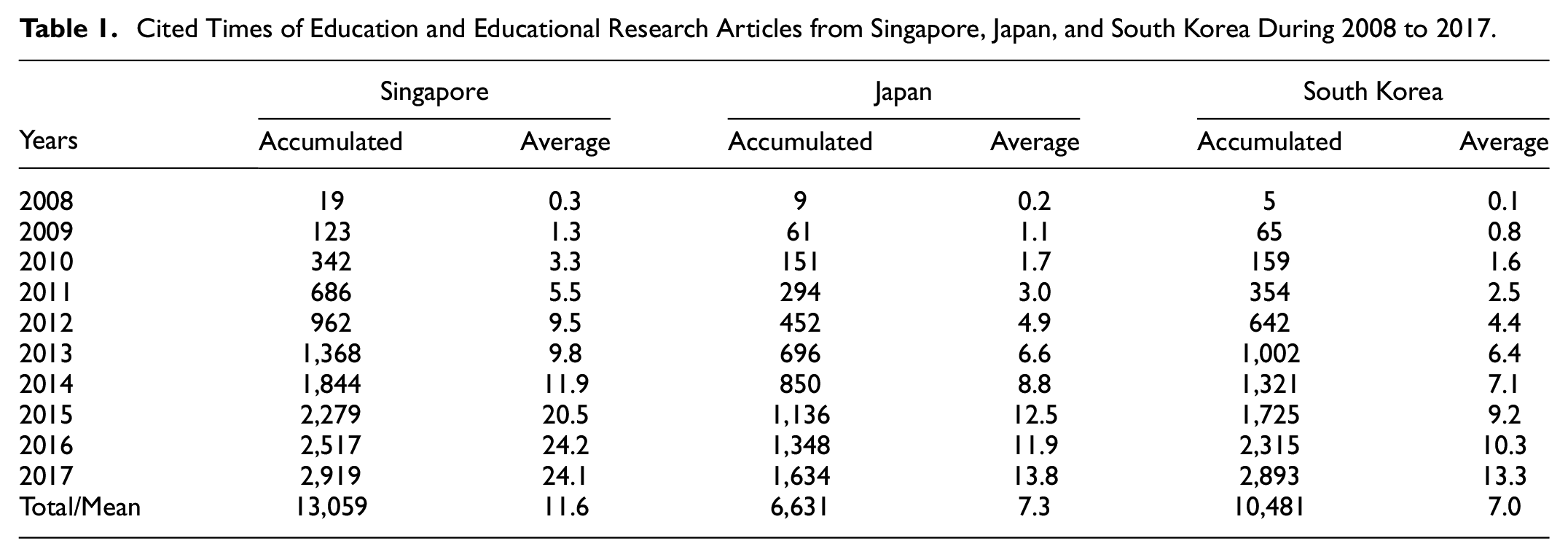
The Times Cited count of articles was computed to assess the quality to some degree. Although South Korea ranked first in terms of the total number of articles concerning education and educational research during 2008 to 2017, Singapore had the most accumulated and average Times Cited count (see Table 1).
Cited Times of Education and Educational Research Articles from Singapore, Japan, and South Korea During 2008 to 2017.
The statistics of the ten most highly cited articles in education and educational research during 2008 to 2017 are reported in Table 2 (data for Times Cited count was obtained from Web of Science on September 26, 2020). It has been observed that six of ten articles are in the international collaboration. The most highly-cited article was cited 468 times. Of the highly-cited ten articles, five were from Singapore, four from South Korea, and one from Japan. Computers and Education and British Journal of Educational Technology had three and two articles respectively, and the quartile in the category of both journals is Q1.
Most Cited Articles of Education and Educational Research Articles from Singapore, Japan, and South Korea During 2008 to 2017.

Two reasons could explain the phenomenon that Singapore has the most accumulated and average Times Cited count. There are two universities of Singapore in QS World University Top 20 (2022), National University of Singapore and Nanyang Technological University, neither South Korea or Japan. As for the metrics and weights of QS World University Rankings, academic reputation and citations per faculty account for 40% and 20% respectively. Another reason which can explain the findings is that both of National University of Singapore and Nanyang Technological University have extremely stringent criteria with regard to promotion of their faculty and their publication venues (Barrot, 2017).
High-Impact Education and Educational Research Journals
A total of 42 articles were published in the top ten high-impact education and educational research journals in terms of the impact factors in 2017 (see Table 3). Among them, 20 articles (47.62%) came from Singapore, 18 (42.86%) from South Korea, and 4 (9.52%) from Japan. Of these, 73.8% (31/42) were published in the two journals: Internet and Higher Education and Learning and Instruction. However, there were no publications in the Review of Educational Research, Educational Research Review, Computers and Education, and Computer-Supported Collaborative Learning. Although South Korea led in education and educational research in terms of total articles during 2008 to 2017, Singapore was in the first place in the 10 high-impact factor journals. The reasons are the same as “Singapore has the most accumulated and average Times Cited count.”
Articles Published in the 10 Highest-Impact-Factor Education and Educational Research Journals by Researchers from Singapore, Japan, and South Korea During 2008 to 2017.

Popular Education and Educational Research Journals
Popular education and educational research journals (Lei & Liao, 2017) refer to the journals in which researchers from the three countries published the largest number of articles. The statistics of the most popular education and educational research journals were reported (see Table 4) during 2008 to 2017. One article was the product of a collaboration among multiple nations, including more than one of the three developed Asian countries, which resulted in a mismatch between the total number (Singapore + Japan + South Korea) and the actual. So, the total column showed, “total number/actual number”; as, “193/190,” where “193” = Singapore + Japan + South Korea, and “190” was the actual number. Three articles were the product of collaboration among multiple nations, including more than one of the three developed Asian countries listed in the authors’ institutional affiliations.
Top 10 Most Popular Education and Educational Research Journals.
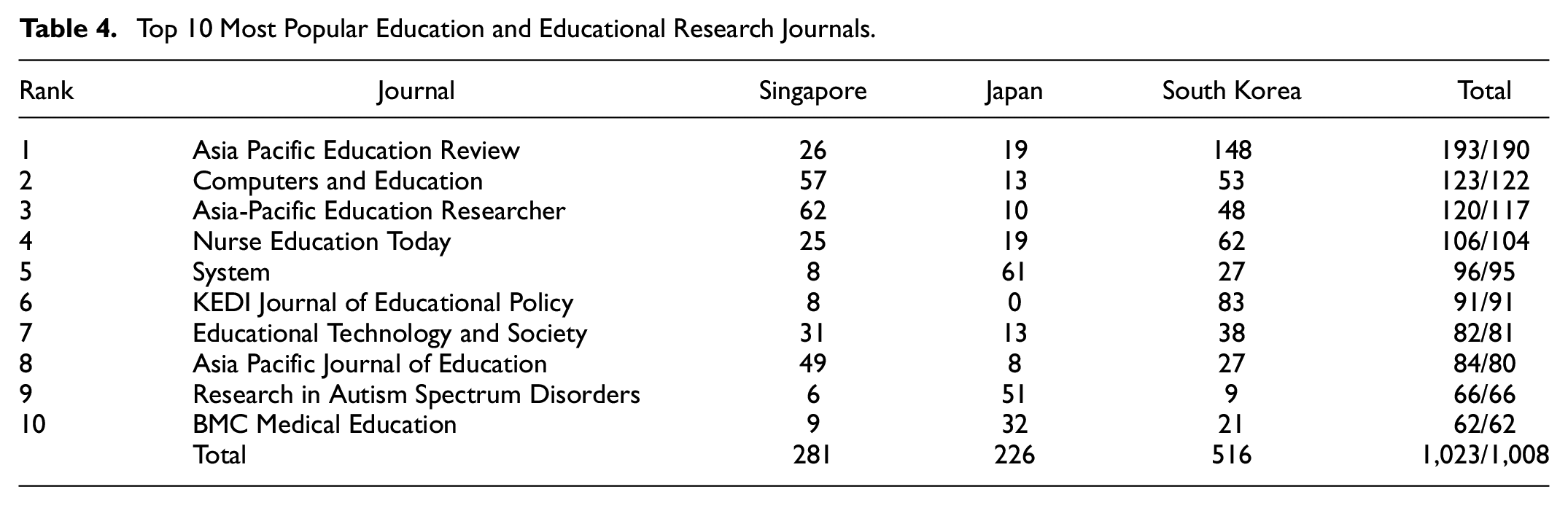
The Asia Pacific Education Review was the most popular journal, and the majority of its contributors were from South Korea, which had 148 articles, possibly because the journal is owned and operated by Seoul National University in South Korea. The second and third were Computers & Education and Asia-Pacific Education Researcher, which published articles mostly from Singapore and South Korea. The fourth journal was Nurse Education Today, which published articles mostly from South Korea, and the fifth was System featuring articles mostly from Japan. The sixth was the KEDI Journal of Educational Policy, sponsored by the Korean Educational Development Institute, which published 83 articles mostly from South Korea. The seventh to tenth were Educational Technology and Society, Asia Pacific Journal of Education, Research in Autism Spectrum Disorders, and BMC Medical Education.
South Korea ranked first from the perspective of the number of articles in the top ten most popular journals, accounting for about half the publications. This phenomenon could be explained by two reasons. First, many research papers written by South Korea scholars are of national concern, thus these studies are appropriately published in South Korea journals which have a geographically concentrated readership. Second, regional journals such as Asia Pacific Education Review and KEDI Journal of Educational Policy which made up almost half of the articles from South Korea (231/516) have higher acceptance rate compared to top international journals such as Review of Educational Research (Barrot, 2017).
Co-occurrence Analysis on Keywords
A co-occurrence analysis on keywords was conducted by VOSViewer to further explore the popular topics of education and educational research in the three countries during 2008 to 2017. The top 10 keywords are listed in Table 5. Researchers from Singapore, Japan and South Korea focused on “education,”“knowledge,” and “students,” which showed that the focus of attention were students and knowledge when studying education. In addition, Singapore and South Korea paid attention to “model” and “performance,” and Japan and South Korea concentrated on “children,”“motivation,” and “perceptions.”
Top 10 Keywords.
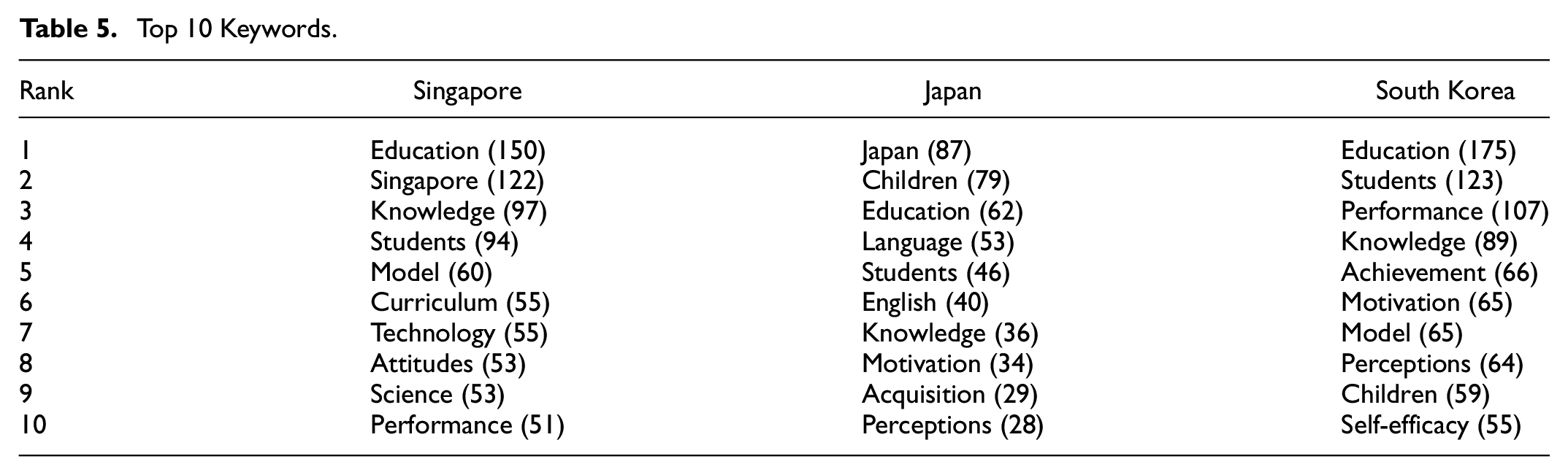
There were three common keywords for Singapore and Japan, and five for Singapore and South Korea. But Japan and South Korea had six common keywords. It demonstrated that researchers from Japan and South Korea had the most common studies concerning education and educational research, probably because the two countries are closer geographically and historically.
Conclusions
In this study, the educational research performance of Singapore, Japan, and South Korea between 2008 and 2017 in SSCI was examined from a bibliometric perspective, which also has demonstrated the potential of using GraphPad Prism and VOSviewer tools together.
A total of 110,241 education and educational research articles were published between 2008 and 2017 in SSCI, of which 3,484 (3.16%) were from Singapore, Japan, and South Korea. Among these, researchers from South Korea were the most prolific (1,493, 1.35%, 16th highest in the world), followed by Singapore (1,128, 1.02%, 22nd), and Japan (910, 0.83%, 23rd). The annual number of published articles from South Korea and Japan increased significantly (p < .05). However, R&D expenditures and R&D expenditures as a percentage of GDP showed strongly positive correlations with the annual number of publications just in South Korea. Since there are other factors (such as expenditure and number of researchers employed in R&D, and the number of universities) definitely stimulate research output (Meo et al., 2013; Oelrich et al. 2007; Wiysonge et al., 2013), future research can be performed on the weights of the indicators, for instance, R&D expenditures and R&D expenditures as a percentage of GDP, expenditure and number of researchers employed in R&D, and the number of universities.
Singapore had the most accumulated and average Times Cited count. The most highly-cited article was cited 468 times. Of the 10 most highly-cited articles, five were from Singapore. Of the 42 articles published in the top 10 high-impact education and educational research journals in terms of the impact factors in 2017, 20 were from Singapore. There are two reasons could explain the phenomena. First, National University of Singapore and Nanyang Technological University in QS World University Top 20 (2022). As for the metrics and weights of QS World University Rankings, academic reputation and citations per faculty accounts for 60%. Second, National University of Singapore and Nanyang Technological University have extremely stringent criteria with regard to promotion of their faculty and their publication venues (Barrot, 2017).
South Korea, accounting for about half the publications, was ranked first from the perspective of the number of articles in the top ten most popular journals. This phenomenon could be explained by two reasons. First, many South Korea scholars concern nation, thus these studies are appropriately published in South Korea journals which have a geographically concentrated readership. Second, regional journals such as Asia Pacific Education Review and KEDI Journal of Educational Policy have higher acceptance rate compared to top international journals such as Review of Educational Research (Barrot, 2017). Given this, future research can focus more on this crucial area to understand the metrics and weights that journals accept papers, which can improve the acceptance of papers and the efficiency of researchers.
Researchers from Japan and South Korea had the most common studies concerning education and educational research category, probably because Japan is close to South Korea geographically and more related historically.
Footnotes
Declaration of Conflicting Interests
The author(s) declared no potential conflicts of interest with respect to the research, authorship, and/or publication of this article.
Funding
The author(s) received no financial support for the research, authorship, and/or publication of this article.

Data Availability Statement
Data sharing not applicable to this article as no datasets were generated or analyzed during the current study.