




Abstract
Women LIS researchers in Pakistan have been publishing their research since 1977. This paper provides a bibliometric analysis of the 43 years (1977–2020) of their research. This study conducted a bibliometric analysis of the data collected from four data sources, the Web of Science Core Collection, Scopus, LISA, and LISTA, to include the maximum number of scholarly publications by women Pakistani LIS researchers working in Pakistan or abroad. The study findings highlighted an upward trend in publications since 1977. It appears to have gathered momentum after the year 2003. The University of the Punjab was the top-ranked organization in publishing research by woman LIS researchers, and the Department of Information Management at the University of the Punjab was identified as being the most prolific in this regard. The researchers had published over 40% of their research in national journals and the rest in international journals of good repute. Kanwal Ameen led the list of woman researchers with over 100 research publications to her name. The main areas of research were academic libraries, information literacy, and evolving trends in LIS. This is the first research paper highlighting the different dimensions of Pakistani LIS women researchers since they started publishing in 1977. The findings of the study would help future researchers to understand trends and various bibliometric aspects of publications originating from women LIS researchers in Pakistan. The findings could also help LIS researchers and funding organizations in promoting the profession.
Keywords
Introduction
Library and Information Science (LIS) education in Pakistan has a remarkable past. Asa Don Dickinson laid the foundation for LIS education in the region by writing “The Punjab library primer” in 1916. It was the first-ever textbook on LIS published outside the USA. The University of the Punjab, Lahore, published the book and made Lahore, Pakistan, the cradle of LIS education in the region. This instigated the subsequent development of library education throughout the British controlled areas. However, library education suffered a setback during the partition period of the Indo-Pak subcontinent. The region witnessed the suspension of all LIS educational activities between 1946 and 1948 (Haider, 2007; Haider & Mahmood, 2007; Mahmood, 1996; Naseer & Mahmood, 2009; Siddique et al., 2021).
The struggle for establishing LIS education, however, continued in the newly independent Pakistan. The country now has more than 12 universities with well-established LIS schools out of 233 universities recognized by the higher education commission of Pakistan, and five of them offer postgraduate degrees in LIS as well. These programs have been instrumental in increasing the LIS research productivity of the country. Pakistani LIS researchers have made steady contributions to the LIS literature (Haider & Mahmood, 2007; Sheikh & Jan, 2017; Siddique et al., 2021).
Pakistan is a developing country with a literacy rate of 71% in men and 49% in women. These statistics highlight the dismal state of literacy among Pakistani women. The situation is worse in rural areas, where only 65% of the men and 38% of the women are literate (Economic Adviser’s Wing, F. D. G. o. P, 2020). The overall literacy rate in Pakistan is lower than in the developed world, and the women literacy rate is still lower. As a result of the overall low women literacy rate, women researchers in LIS are a rare breed. Although the contributions of the women Pakistani LIS professionals in LIS research in Pakistan are much less as compared to their men counterparts, a recent study by Siddique et al. (2021) revealed that six women researchers were included in the top 20 most prolific LIS researchers in Pakistan. Notably, two of them were ranked second and third in the top 20 list, and three had publications in the top 10 highly cited research publications emerging from Pakistani LIS researchers.
A review of the literature revealed multiple studies that have been conducted globally on women research productivity in different disciplines. However, no such research has been conducted to highlight the contributions of Pakistani LIS women researchers. Despite a low women literacy rate, multiple hurdles in continuing their studies and research, the LIS women researchers have managed to play a prominent role in LIS research in Pakistan. This study intends to investigate the contributions of women Pakistani LIS researchers and fill the gap in the existing literature. Results of such a study will also help to encourage and motivate prospective women researchers in the field. Four internationally renowned databases were chosen for this study, and a bibliometric analysis was conducted on the data collected. The study intends to answer the following research questions.
Research Questions
What were the research trends of Pakistani women LIS authors during 1977 to 2020?
What were the most preferred journals of Pakistani women LIS researchers?
What were the most influential institutions?
What were the most influential LIS schools?
Who were the most influential women authors, and what were their co-authorship and collaboration networks?
What was the subject-wise distribution of publications contributed by women LIS researchers?
What were the most influential and trending articles contributed by Pakistani women LIS authors?
Literature Review
Research Productivity
There is extensive literature reporting on the research productivity of researchers from various disciplines. Studies have also investigated research productivity based on gender differences. The majority of the studies have revealed that women researchers have lower research productivity as compared to their men counterparts (Abramo et al., 2009; Garg & Kumar, 2014; Larivière et al., 2011; van Arensbergen et al., 2012). Only a few have reported that there was no difference in the research productivity of researchers based on gender (Borrego et al., 2010; Sotudeh & Khoshian, 2014; van Arensbergen et al., 2012).
Gender Disparity in Non-LIS Global Research
A rigorous search related to women contribution to the scientific literature yielded some studies that had investigated different scientific fields. Pashkova et al. (2013) conducted a bibliometric study of American anesthesiologists using the Scopus database to highlight the gender disparity in research. They reported that the men anesthesiologists were more productive than their women colleagues and had equal or even high productivity of mid-career women researchers. Prpić (2002) examined the gender differences in the scientific productivity of young scientists in Croatia. The study revealed that gender differences among young researchers had increased in recent years. The women scientists also appeared to be less productive than the men scientists. Abramo et al. (2009) conducted a bibliometric study of researchers working in scientific technologies in Italian universities. The study confirmed the results of previous studies that is, there were significant differences in the research performance of researchers based on gender. However, they did identify certain scientific sectors where women researchers had better performance. Barrios et al. (2013) identified gender inequalities in scholarly publications related to the field of Psychology in Spain. They found gender imbalance in the scientific output of the Spanish researchers. They also reported that men researchers appeared to be more active than women researchers in international collaborations.
Lone and Hussain (2017) conducted a comprehensive literature survey to investigate the gender disparity in the research productivity of researchers across various disciplines. They confirmed that women lagged behind men across various regions and disciplines but opined that this gap would shrink in the future. Mozaffarian and Jamali (2008) investigated the 2003 ISI journal publications retrieved from the Web of Science for gender differences. They found that the productivity of Iranian women authors (6%) was much lower than the men authors (94%). Nourmohammadi and Hodaei (2014) studied the research productivity of Iranian women in the field of science and technology and found that 99% of the research projects being conducted by women Iranian researchers were done jointly. They also had many international collaborations, with the majority being with American scientists.
Global Gender Disparity in LIS Research
The review of literature also yielded some studies related to gender disparity in LIS. In most cases, the men LIS researchers had more publications as compared to the women LIS professionals. Peñas and Willett (2006) investigated the five LIS departments ranked at the top globally. They retrieved the publication data for the departments from the Web of Knowledge database and found that the men LIS faculty had published more articles than the women faculty, despite the higher number of women in the LIS profession and academia. Franklin and Jaeger (2007) examined the dissertations authored by African Americans students in Library and Information Science Studies from 1993 to 2003. A study by Aina and Mooko (1999) related to the LIS productivity of African researchers revealed that the majority of the researchers (82.4%) were men, with only 17.6% being women. Baro et al. (2009) analyzed empirical data and revealed that men librarians had higher contributions than their women counterparts. The analysis of qualitative data identified greater family responsibilities as compared to the men as the main hindrance affecting the research performance by women librarians. Only one bibliometric study related to LIS research published in Sekitar Perpustakaan, one of the oldest LIS journals published by the National Library of Malaysia, reported that women LIS researchers (65.74% of publications) were publishing more than the men LIS researchers (34.26% of publications) (Tiew, 2006).
LIS Gender Research in South Asia
The literature review revealed only a few studies that highlighted the gender-wise contribution of LIS researchers in countries with a literacy rate similar to Pakistan and neighboring countries. Chakrabarti et al. (2020) conducted a study to analyze the trends of doctoral dissertations in Library and Information Science in West Bengal, India, between 1979 and 2018. They reported a significant disparity in the gender-wise contribution by the LIS researchers. The men researchers had contributed the majority of the dissertations (73.04%), and the women researchers had only contributed 26.96% of the dissertations. In another study on Indian research, Patel and Kumar Verma (2020) examined an Indian journal, SRELS Journal of Information Management, to highlight the gender variation. The study presented a bibliometric analysis of 464 publications by 877 authors during 2011 to 2018 and reported unsatisfactory performance by the women LIS researchers. The study reported 1.89 as the average author per article and only 0.54 as the average woman author per article.
Bisaria (2018) conducted a bibliometric study to elaborate on the gender differences in the LIS research published during 2008 to 2017 in the DESIDOC Journal of Library & Information Technology. The study revealed that the men researchers outperformed the women in LIS research published in the journal during the period. Gul et al. (2016) presented the effect of gender in LIS research published in “The Electronic Journal” between 2005 and 2014. They observed an increasing number of men authors and decreasing number of women authors over the years. The men faculty produced more research, whereas the women LIS professionals were either being LIS practitioners or pursuing their research degrees. Furthermore, the study did not find any significant difference in the number of men and women researchers in man-woman collaborative projects. Bt et al. (2018) analyzed research articles published in Emerald journals by Indian LIS researchers during 2007 to 2017. They revealed that men and women researchers have published 72.30% and only 27.69% of articles published, respectively. Kaw and Ahmad (2014) have reported the research output of women researchers from the University of Kashmir. The study reported a similar gender difference in the conflict zone but predicted that trends were changing and more women researchers were becoming keenly involved with the scientific world. Islam et al. (2018) analyzed 200 articles from 62 journals to investigate the research trends in LIS in Bangladesh. They reported fewer contributions of women LIS researchers (4.0%) than men researchers (79.5%). Only 16.5% of the publications were contributed by both genders.
LIS Gender Studies in Pakistan
There have been few studies related to gender issues in LIS in Pakistan. A. Khan et al. (2017) discussed the problems related to gender mainstreaming in the libraries of Pakistan. In another study, A. Khan and Du (2017) reported the professional development of women librarians in Pakistan through social networking software. Haider and Mahmood (2007) evaluated the MPhil and PhD. LIS research in Pakistan and Sheikh and Jan (2017) examined the MPhil and PhD theses produced by the LIS schools in Pakistan. A recent bibliometric analysis of LIS research in Pakistan by Siddique et al. (2021) reported that the men LIS researchers surpassed their women counterparts in research productivity. Naseer and Mahmood (2009) analyzed Pakistan Library and Information Science Journal publications from 1998 to 2007. They also reported the same. About 61% of the research contributions were from men LIS researchers compared to the 32.2% by women LIS researchers. The review of the literature also highlighted that the social norms and family commitments hindered the research productivity of women LIS professionals (Abramo et al., 2009; Baro et al., 2009; Bisaria, 2018; Hildrun et al., 2012; Prpić, 2002; Siddique et al., 2021).
The researchers were not able to find any study that had investigated the contributions of Pakistani women LIS researchers. There was a need to collect and analyze information regarding the most influential Pakistani women researchers, their co-authorship and collaboration patterns, preferred journals, subject-wise distribution of their publications, trending articles, and the productivity of LIS institutions in Pakistan. This study, therefore, is an attempt to address these questions and fill the gaps in the literature.
Methodology
The researchers selected the Web of Science Core Collection, Scopus, LISTA, and LISA for data collection. These four leading databases were chosen to obtain the maximum number of relevant scholarly publications by Pakistani women library professionals working in Pakistan or abroad. The search criteria for two leading LIS subject-specific databases, that is, LISA and LISTA included the advanced search keyword “Pakistan” anywhere or in all fields in all academic journals published between 1947 and 2020. LISA and LISTA are subject specific databases of Library and Information Science. The term “Pakistan” was only used in LISA and LISTA. Selecting the term “Pakistan” retrieved all the articles in the LIS field either written by Pakistani authors or about Pakistan. The retrieved records were individually scanned to find out the women authors. The bibliometric data search was carried out in all relevant publications originating from Pakistan from the beginning that is, from 1947 to 2020. However, it should be noted that the first publication by a woman author appeared in the year 1977.
Furthermore, two of the largest multidisciplinary databases of peer-reviewed literature that is, the WoS and Scopus were chosen for high recall and accuracy. The authors used “Pakistan” and “Library” as search keywords with the same criteria as above. The search yielded a total of 10,913 records obtained from all four databases (LISA = 2,585, LISTA = 1,435, WOS = 1,091, Scopus = 5,802). These were then imported into the Endnote Desktop software. The bibliographical information of each record was checked and reviewed twice to identify all relevant records contributed by Pakistani authors. The 1,254 duplicate records and 9,187 irrelevant records were then excluded. Studies were analyzed one by one to identify the gender of the authors. Furthermore, to ensure the gender, the complete profiles of the authors were also verified. Nine hundred fifty records excluded as they involved male authors only. The gender-based exclusion of records represented the male and female ratio of LIS faculty of LIS departments of different universities of Pakistan. There are 42 male faculty members working in LIS departments while the number of female faculty is 12. Title and abstract of each record was read carefully and irrelevant records were excluded from final selection. Papers with non-Pakistani authors and outside the LIS field were excluded. Papers with at least one female Pakistani authors were selected.
Finally, 472 documents were chosen for the bibliometric analysis (Figure 1). These included journal articles (447), conference papers (18), and book chapters/sections (7). Reports, editorials, technical news articles and correspondence were excluded from the study. The refined 472 records were exported to MS Access. Some additional fields were added by the authors, such as the name of the database, gender, author affiliation, and types of authorship. For data analysis, the authors used Microsoft Access, Microsoft Excel, VOSviewer, and Biblioshiny software.
The information regarding the name of female authors and their affiliation was also imported into the MS Access database for standardization. Each author’s name was checked twice for variant names, gender, correct affiliation, and spelling errors.

Data extraction and refining process.
Research Trend of Pakistani Female LIS Authors During 1977 to 2020
Figure 2 presents the chronological distribution of publications by Pakistani female authors between 1977 and 2020. It shows two different growth periods in the research productivity of the female LIS authors over the past 43 years. The year 1977 was used as the starting point as this was the first year any Pakistan female author published an article. Initially, only 26 publications were published between 1977 and 2003. After the year 2003, research output fluctuated till 2020. It can be seen in Figure 2 that the number of research publications increased significantly from 2004 to 2009, with 2009 being the most productive with 21 research publications.

Research trend of Pakistani female LIS authors during 1977 to 2020.
However, the last decade (2010–2020) was the most productive period. A total of 388 publications (82% of the total) were published during that period. The year 2010 had 33 publications, and the number of publications kept increasing with mild fluctuations till 2020. The years with the maximum number of publications were 2012, 2017, 2018. Overall, the most productive year was 2018 with 51 research publications.
Most Influential Institutes
Table 1 highlighted that the publications from the top 10 organizations accounted for 91% of all literature contributed by Pakistani female authors in LIS. The University of the Punjab had the highest number of publications (n = 189) accounting for 40% of all publications of Pakistani female authors in LIS. In the list of the top 10 institutes that the authors were affiliated with, eight were from Pakistan. The other two were from Saudi Arabia and China.
The analysis of the most productive organization showed that there were only two organizations with over 100 publications between 1977 and 2020. The University of the Punjab was the most productive organization in Pakistan with 187 publications, followed by the Islamia University of Bahawalpur with 132. Furthermore, in the initial period of research activity, 4 of the top 10 organizations did not contribute any publication. It is also evident from the results that the Pakistani female library professionals working overseas also continued to contribute. They published 11 publications while affiliated with the Imam Abdulrahman Bin Faisal University, Saudi Arabia, and 9 while at the Nanjing University, China.
Most Influential Institutes Publishing Pak LIS Research.

Most Influential LIS School on Pakistani Librarianship
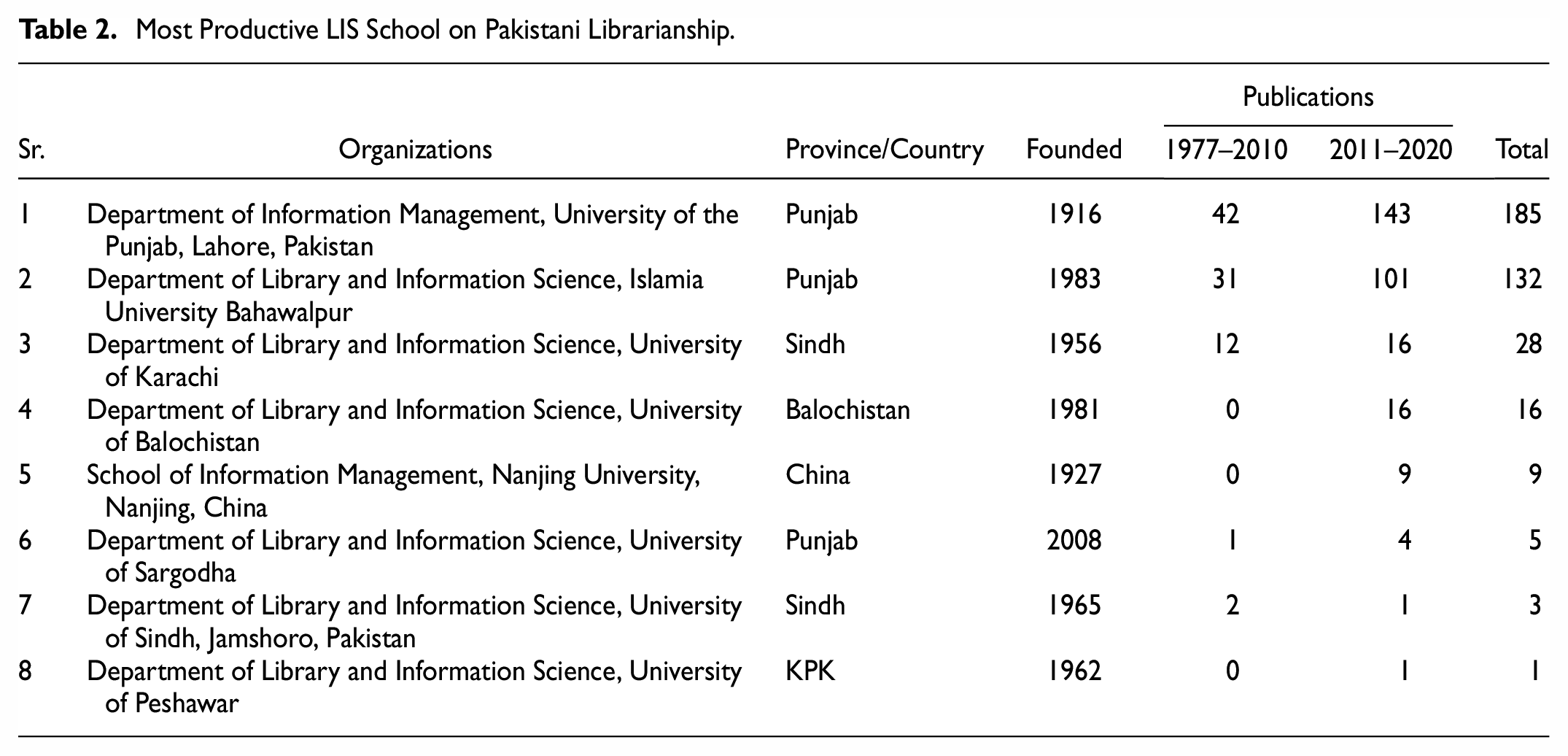
Table 2 presents the research productivity of female researchers affiliated with various LIS schools in Pakistan. The Department of Information Management, University of the Punjab (DoIM, PU), Lahore, and Department of Library and Information Science, Islamia University Bahawalpur (DLIS, IUB) emerged out the top two most influential LIS schools with a total of 185 and 132 publications respectively. The last decade (2010–2020) saw the maximum activity with 143 and 101 publications contributed by the DoIM, PU, and IUB, respectively. The contributions of the rest of the schools on the list were quite lackluster as compared to the above-mentioned institutes. The Department of Library and Information Science at the University of Karachi (DLIS KU) had 28 publications and the Department of Library and Information Science, the University of Baluchistan (DLIS BU), only had 16 publications. The School of Information Management, Nanjing University, Nanjing, China, ranked fifth on the list had nine publications. Table 2 shows that all LIS schools showed significant activity in the last period that is, from 2010 to 2020 except for the Department of Library and Information Science, University of Sindh, (DLIS US) Jamshoro.
Most Productive LIS School on Pakistani Librarianship.
Most Preferred Journals of Pakistani Female LIS Researchers
Table 3 highlights the journals most preferred by Pakistani LIS female researchers. Out of the total 59 journals these 20 most preferred journals collectively published 85% articles (N = 400). The results of the data analysis show that 42% of the total publications had been published in only two Pakistani journals. The Pakistan Library & Information Science Journal topped the list with 29% of the publication (n = 136 publications), trailed by the Pakistan Journal of Information Management and Libraries with 12% of the total publications. The most productive international journal in which Pakistani female researchers published was the Library Philosophy and Practice (N = 65, 13%), followed by the Global Knowledge Memory and Communication (N = 24, 5%). Most of the international journals in this list were either British or American. There was only one each from Germany and Malaysia.
Most Preferred Journals of Pakistani Female LIS Researchers.

Out of 472 total publications, 19% (N = 89) had been published in 34 impact factor journals.
Sixty-nine of these impact factor publications are included in Table 3 while remaining 24 are not listed in the Table. The data reveal that nine impact factor journals collectively published 14% of the articles (N = 65). The Electronic Library (IF = 0.95, 2019) published the most studies with 18 publications. There were nine articles in the Information Development (IF = 1.61, 2019) and Collection Building each, eight articles in Malaysian Journal of Library and Information Science (IF = 1.55, 2019), and seven articles in Libri (IF = 0.58, 2019). The ranges of impact factor scores of these journals were from 0.32 to 1.61.
Most Prolific Pakistani Female LIS Researchers
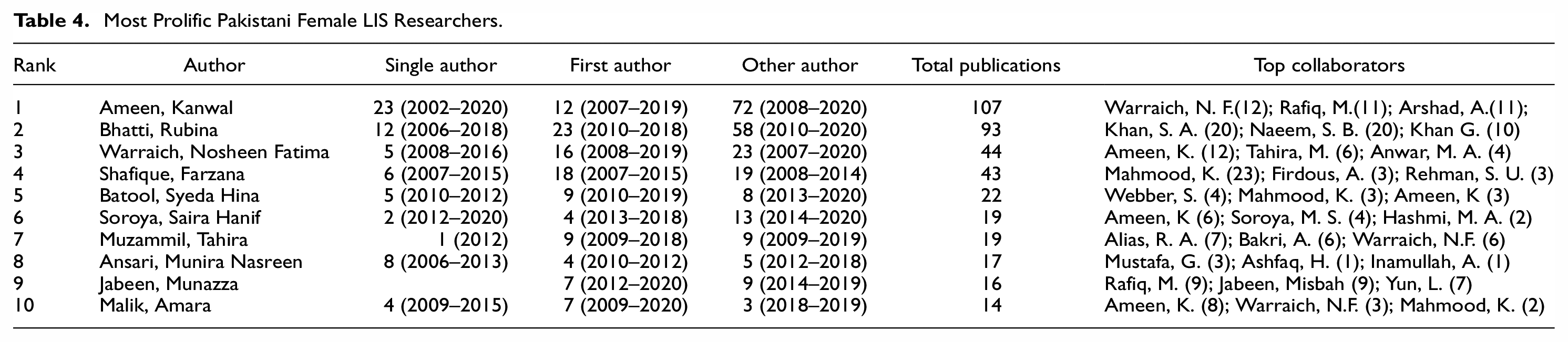
The list of top Pakistani LIS researchers is presented in Table 4. It can be seen that four female researchers had produced over 40 publications each. Kanwal Ameen was identified as the top Pakistani female LIS researcher with 107 publications to her credit. These included 23 publications as a single author, 12 as the first author, and 72 publications as the other author. The top three collaborators with Kanwal Ameen were Nosheen (12), Rafiq (11), and Alia (11). Rubina Bhatti was the second most prolific female author identified with 93 publications to her credit. These included 12 publications as a single author, 23 as the first author, and 58 as the other author. Likewise, Nosheen Fatima had 44 publications, followed by Farzana Shafiq with 43 publications, and Hina Batool with 22 publications. Lastly, Amara Malik was ranked 10th with 14 publications.
Most Prolific Pakistani Female LIS Researchers.
Research Contribution by Authorship Type
The female teaching faculty was the most productive in contributing to the LIS research in Pakistan (Table 5). Table 4 shows that national (Pakistani resident) female faculty had produced 386 publications, followed by the national female library professionals with 175 publications, and the national female research students with 84 publications. On the other hand, the Pakistani expatriate female library professionals had produced 15 publications, followed by the expatriate research students.
Research Contribution by Authorship Type.

Main Male and Female Collaborators
The top collaborators of Pakistani LIS women authors are their colleagues working in same or different LIS schools. Kanwal Ameen was the most frequent collaborator with 84 collaborative studies from the female side. Khalid Mahmood collaborated the most with Pakistani LIS authors in 46 studies from the male side (Table 6).
Main Male and Female Collaborators of LIS Women Authors of Pakistan.

International Collaborators
Table 7 presents the list of top foreign collaborators of Pakistani LIS women authors. Yun, L. collaborated the most in seven studies with Pakistani women LIS authors followed by Webber, S. who was the co-author in four studies. Rorissa, A., Aryati, Bakri, A., and Alias, R.A. each collaborated in three studies.
Top International Collaborators of LIS Women Authors of Pakistan.

Research Collaborative Among LIS Schools
Table 8 provides the pattern of the collaboration among Pakistani LIS schools. The study identified 357 collaborative publications. The DoIM-PU had the highest number of collaborative publications (N = 145, 40% of total) at the departmental, collegiate, and international levels. DoIM PU had the collaboration with all Pakistani library schools except for the LIS School in the University of Sindh. The top two highest collaborators of DoIM-PU were DLIS-IUB (n = 110), and DLIS-UOB (n = 35). The lowest collaborative schools were DLIS-Sindh (n = 3), DLIS-KKU (n = 6), and DLIS-KU (n = 11).
Collaborative Research Among LIS Schools.

The authors also explored the collaboration at the departmental (within the LIS department) and LIS School level. The top two highest collaborations within departments were observed in DoIM-PU and DLIS-IUB. The DLIS-Sindh had no collaborative publication either within the departments or at the international level.
Authorship Pattern of Pak LIS Researchers (Female)
The authorship pattern of Pakistani female LIS researchers was found to vary from single author to seven authors (see Figure 3). The publication analysis of 472 documents showed that the two-authors pattern was the most commonly used. This pattern was seen in 206 publications (43%), followed by a single author pattern in 115 publications (24%), and a three-authors pattern in 112 publications (24%). The authorship patterns with more than three authors had a very limited number of publications. Such patterns collectively produced only 39 publications (9%).

Authorship pattern of Pakistani female LIS researchers.
Frequently Used Keywords by Pakistani Female LIS Researchers
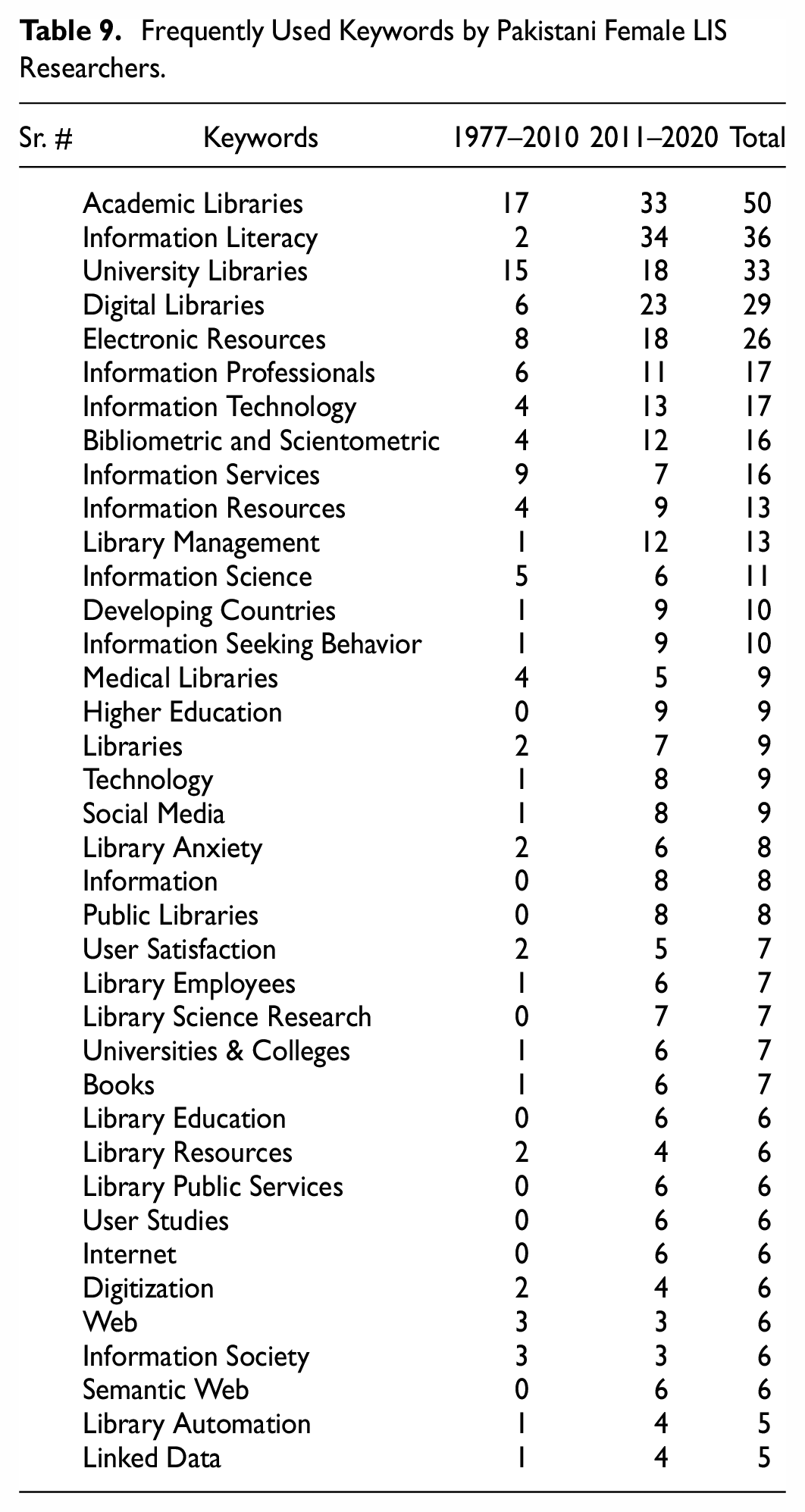
Table 9 presents the keywords that were used frequently by Pakistani female LIS researchers between 1977 and 2020. Total 1,506 keywords were used while producing 472 articles. Keywords with minimum occurrence of five were selected. Out of total 1,506 keywords, 38 met the criteria. “Academic libraries” was the most frequently used keyword (N = 50) by Pakistani female LIS professionals. It was first used in 1977 by the researchers who then continued to use it till 2020. “Information literacy” was the second most frequently used keyword found in 36 publications. “University libraries” and “digital libraries” were other keywords used in 33 and 29 publications, respectively. Notably, the Pakistani female LIS professionals have been frequently using the keywords “information literacy” and “digital libraries” in the 21st century. The least used keyword in the list was “Semantic web,”“library automation,” and “link data.”
Frequently Used Keywords by Pakistani Female LIS Researchers.
Three-Factor Analysis (Keywords, Authors, and Source)
A three-factor analysis was performed using Biblioshiny to identify key authors and title of journals associated with these most frequent keywords. Relationships between top 20 authors, 20 main keywords of research and 20 key journals in the published literature on LIS in Pakistan by female authors were summarized by a Sankey plot (three-fields plot) as shown in Figure 4. The analysis highlighted the top female authors engaged in library and information science research in Pakistan (PAK-LIS), their preferred source, and the sub-areas of their research. It was found that the top five female authors (Kanwal Ameen, Rubina Bhatti, Nosheen Fatima, Farzana Shafique, Hina Batool) and eight sub-areas (library professional, library services, library resources, academic libraries, ICT, information literacy, library electronic resources, library anxiety) had a strong relationship in Pak-LIS and preferred to publish in eight sources (Pakistan Library & Information Science Journal, library Philosophy and Practice, Pakistan Journal of Information Management & libraries, Global Knowledge Memory and Communication, Electronic libraries, library review, library management, library Hi-tech).
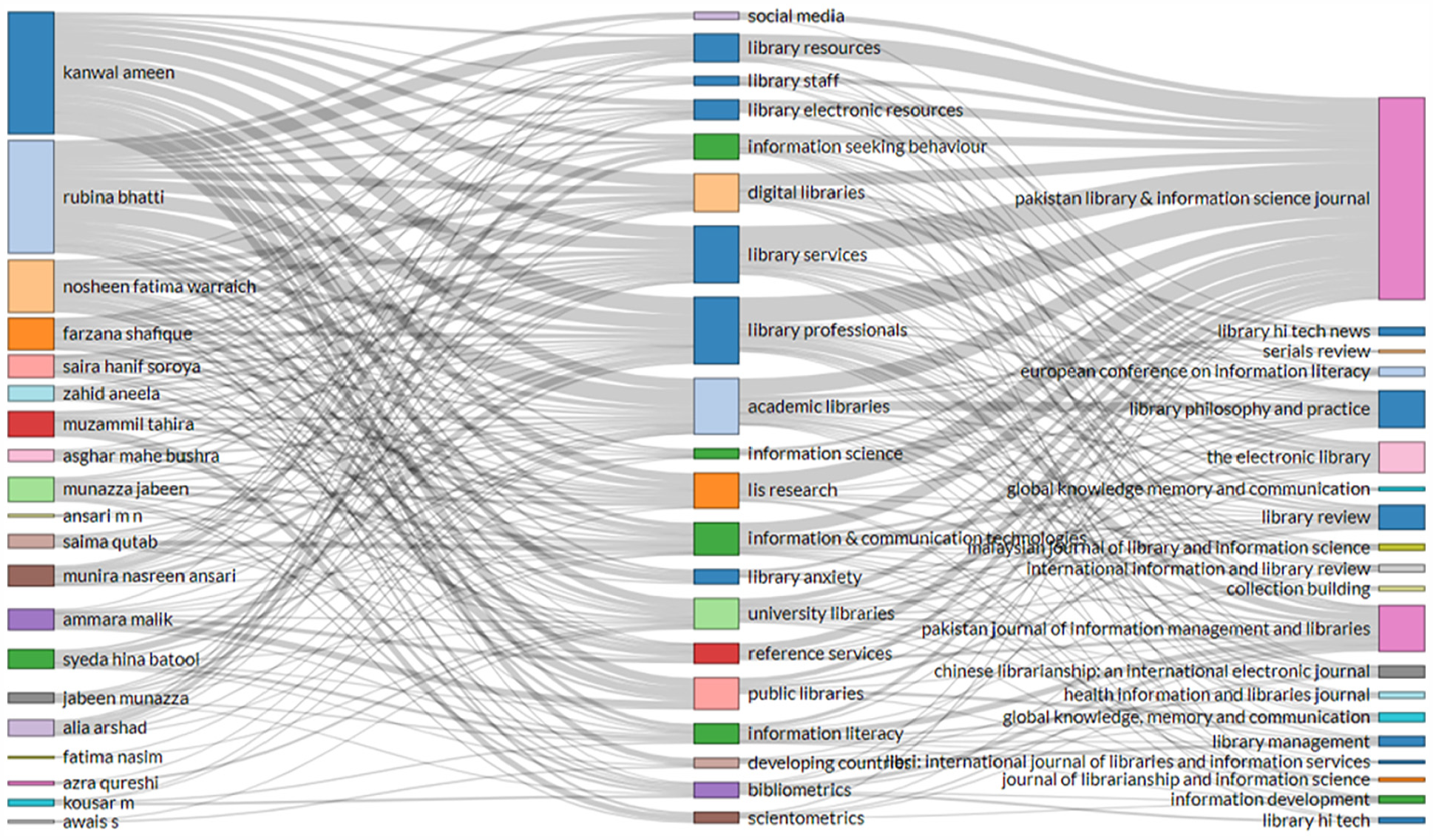
Three factor analysis (authors, keywords, sources).
Thematic Evolution Map of Author Keywords
Figure 5 shows the evolution of keywords that LIS authors have used over the period from 1977 to 2020. To explore the evolution, the period has been divided into three slices that is, from 1977 to 2010, 2011 to 2015, and 2016 to 2020. The figure shows the research focus of LIS female fraternity of Pakistan in different periods. The thematic evolution of keywords during the last four decades showed a clear shift in the Pak LIS research areas. Keywords such as library automation, cataloging, publishing, national libraries and related keywords were not used after 2010. On the other hand, academic libraries, library services, bibliometrics, information-seeking behavior, web 2.0., social media, collection development, and communication were the frequently used keywords between 2011 and 2015. The study results also showed that library anxiety, medical libraries, library resources were hot topics between 2016 and 2020.

Thematic evaluation map of Pakistani female publication on LIS.
Lastly, academic libraries, user training (information literacy), library professionals, and LIS research were important keywords used throughout the four decades.
Most Influential Articles Contributed by Pakistani Female Authors on LIS
The authors selected the top 10 papers with the most citations in the Scopus and the WOS databases from the publications included in the study. Out of total 472 publications 134 were indexed in WOS which received 735 citations while 16 publications received no citation. On the other hand, 270 publications were indexed in Scopus with 2,517 citations while 27 publications received no citation. Remaining 68 publication belonged to the two subject-specific databases that is, LISA and LISTA which did not provide any citation information. Table 10 shows these highly cited papers in terms of title, authors, journals, and citation numbers in Scopus and the WOS.
Top 10 Highly Cited Articles of Pakistani Female Authors.
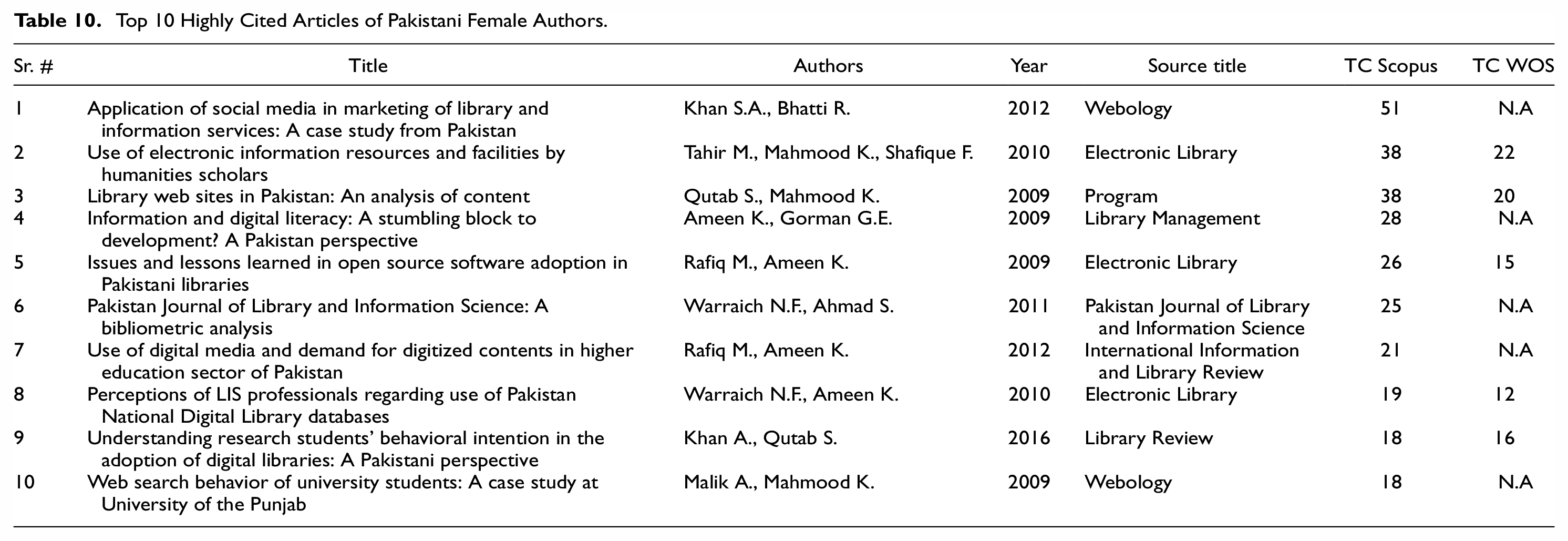
It can be seen that 9 out of 10 articles have been published collaboratively. Their number of citations ranged from a maximum of 51 to a minimum of 18. Four of the top 10 articles had received 28 or more citations. They were published between 2009 and 2016. However, the majority had been published between 2009 and 2012.
The article entitled “Application of social media in marketing of library and information services ” by Rubina Bhatti, published in 2012 in “Webology,” topped the list with 51 citations from Scopus, followed by an article entitled “Use of electronic information resources and facilities by humanities scholars (Scopus = 38, WOS = 22)” by Farzana Shafique published in 2010.
The article “Web search behavior of university students” written by Amara Malik, ranked 10th on the top 10 highly cited article list, had also managed to receive 18 citations (Scopus = 18, WOS = 0). Interestingly, Kanwal Ameen appeared as author in four, Nosheen Fatima in two, and Saima Qutab in two of the highly cited publications.
Funding Agencies
Higher Education Commission of Pakistan (HEC) provided funds to carry out four studies of Pakistani women LIS authors. Tow international funding bodies namely, Ministry of Higher Education, Malaysia, and National Science Foundation of China funded two studies each (Table 11).
Funding Agencies That Sponsored the Women LIS Authors of Pakistan.

Male/Female Authorship
Table 12 shows that 198 studies were carried out by only female authors while both genders were involved in conducting 274 studies. Women were the lead authors in 294 studies.
Male and Female Authorship.

Discussion
Bibliometric studies are beneficial in reviewing trends and progress in different fields of research. The current study reports various dimensions of LIS women research productivity in Pakistan during the 1977 to 2020 period. The data analysis marks the publication of the first article by a woman Pakistani LIS professional in 1977. However, after this landmark event, hardly one publication was published per year till 2003. Furthermore, during the 1977 to 2003 period, there were many years with no publications. Only the years 1982, 1993, and 2002 had two publications per year. After the year 2003, an upward trend was observed. The years 2012, 2017, and 2018 each produced over 40 publications. The year 2018 has been the most productive so far. A recent bibliometric study on LIS research in Pakistan by Siddique et al. (2021) reported significant progress in the LIS publications in Pakistan after the commencement of the MPhil and PhD programs in LIS schools between 2004 and 2009. These programs had a substantial impact on the Pakistani contributions to the LIS literature between 2010 and 2018. The current study also confirms the findings of Khurshid (2013), Siddique et al. (2021), and Naseer and Mahmood (2009). These studies had also stated that the growth in LIS publications by women researchers was a consequence of the various research programs established in different LIS schools in Pakistan.
The findings further highlighted the contribution of different organizations in enabling the LIS research by Pakistani women. The University of the Punjab (PU), which is one of the oldest universities in Pakistan, was the most successful in this regard. Interestingly, the Islamia University of Bahawalpur (IUB), which is a relatively young institution, was ranked second on the list of most productive institutes. The list of most productive organizations also includes two foreign universities, the Imam Abdulrahman Bin Faisal University, Saudi Arabia, ranked sixth, and the Nanjing University, China, ranked ninth. This may be because some Pakistani LIS women were either working in the Imam Abdulrahman Bin Faisal University or pursuing their PhDs in the Nanjing University. Siddique et al. (2021) have also ranked the University of the Punjab as the top university in producing LIS research but had reported IUB in the third position. Surprisingly, the University of Karachi (UoK) and the University of Sindh, established a few years after the creation of Pakistan, maintained the third and last positions, respectively.
The findings regarding the contributions of LIS schools ranked the Department of Information Management (DOIM), the University of the Punjab, which is considered the oldest LIS School in this region, at the top of the list. The Department of Library and Information Science, Islamia University Bahawalpur, a comparatively very young school, maintained the second-highest position, followed by the Department of Library and Information Science, University of Karachi. The Department of Library and Information Science, University of Peshawar, appeared at the bottom of the list with a total of only two publications and one publication in each study period. The findings are in line with those of Siddique et al. (2021) and Khurshid (2013) who had also reported the DOIM to be the most prolific in producing LIS research in Pakistan. However, the current study does contradict some of the findings of Siddique et al. (2021). They had ranked the Department of Library and Information Science, the University of Karachi, in the second position, while this study has ranked the Department of Library and Information Science, Islamia University Bahawalpur, second. This is most likely because IUB offers both Master and PhD programs that require research scholars to actively contribute toward LIS research.
The results regarding the preferred journals identified two Pakistani journals where the Pakistan LIS women researchers had chosen to publish. The Pakistan Library & Information Science Journal (formerly known as Pakistan Library Bulletin), one of the oldest and regular LIS journals, was the top preferred journal, followed by the Library Philosophy and Practice, a USA based journal that falls in the X category of Higher Education Commission (HEC) of Pakistan. The Pakistan Journal of Information Management and Libraries (formerly known as the Pakistan Journal of Library and Information Science) was the third-most preferred journal. It was observed that the researchers had published 41.43% of their research in Pakistani journals and the remaining 58.57% in well-reputed foreign journals. One possible reason for this high percentage of publications in foreign journals could be the unavailability of Pakistani LIS journals. In their study, Siddique et al. (2021) reported that the LIS researchers in Pakistan preferred to publish in their local journals. Khurshid (2013) argued that Pakistani researchers choose local journals not only to support them but also to take advantage of their relaxed criteria of acceptance. It is also interesting to note that only 13% of the total journals had an impact factor. Khurshid (2013), also shared concerns regarding the quality of research publications. Library Philosophy and Practice was the second favorite journal for the Pakistani women LIS researchers. In a bibliometric study conducted on the Library Philosophy and Practice Journal, Thanuskodi (2010) found a yearly rise in the number of publications from 2005 to 2009 with the diversity of the subjects. Siddique et al. (2021) argued the possible reasons for the choice of publishing in this journal could be its fast and lenient reviewing process with a high rate of acceptance.
The analysis regarding the most prolific women researchers revealed only one author who published over 100 publications. The data identified four women researchers who had contributed more than 40 research publications each. The further analysis ranked Kanwal Ameen as the most prolific author with over 100 publications, followed by Rubina Bhatti with nearly 100 publications. A bibliometric study conducted on the overall LIS research in Pakistan by Siddique et al. (2021), ranked Kanwal Ameen and Rubina Bhatti second and third, respectively, among all men and women Pakistani LIS researchers. It is interesting to note that Kanwal Ameen contributed 23 as a single author during the 2002 to 2020 period and 12 publications as the first author during the 2007 to 2019 period. On the other hand, Rubina Bhatti contributed 12 publications as a single author between 2006 and 2018, and 23 publications as the first author during the 2010 to 2018 period. Both researchers published a large majority of the publications as other authors. This reflects the growing trend of collaborative research in LIS. It also highlights their status as supervisors to a large number of research students. The study of the top collaborators of both authors also provides interesting insights. The data revealed that among the top three collaborators of Kanwal Ameen, two are also women LIS researchers. She had 12 collaborations with Nosheen Fatima Warraich and 11 with Aliya Arshad. Notably, Nosheen Fatima Warriach was also identified as a prolific researcher and was ranked third on the list of top women authors. Furthermore, all three top collaborators of Kanwal Ameen that is, Nosheen Fatima Warraich, M. Rafiq, and Aliya Arshad had completed their PhD under the supervision of Kanwal Ameen. Similarly, Rubina Bhatti’s top three men collaborators were authors who had completed their PhD under her supervision.
Further analysis showed that the majority of the LIS women research was contributed by the national LIS faculty, distantly followed by national library professionals and research students. The data also highlighted that the first-ever LIS woman publication was contributed by national woman library professional in 1977. Women LIS faculty started contributing their research after a 5-year gap that is, in the year 1982. Later on, the national women faculty took the lead and contributed more than double the number of publications compared to the women library professionals. These findings are in line with Siddique et al. (2021), who have also reported that LIS faculty topped the list in LIS research publications. Khurshid (2013) has discussed some primary reasons for higher research contributions by the LIS faculty. Firstly, LIS faculty have to self-promote themselves, a process that is dependent on the number of publications published and theses supervised by them. Secondly, they can extract papers from the various theses that they supervise. On the other hand, the library professionals have no such obligations to meet. So, they conduct research based on their interest and desire to contribute to the LIS research literature.
The LIS women researchers have focused on the area of academic libraries since they first started contributing to LIS literature. Information literacy remained the second most focused area. However, it did not get attention in the first period but gained more attention in the second period than the top-ranked academic libraries area. Other vital areas relevant to information and communications technologies, such as digital libraries, electronic resources, and information technology, were among the top-ranked areas, especially in the second period of active publishing from 2011 to 2020. Some other popular areas like digitization, library automation, and linked data could not get much attention. Siddique et al. (2021) have also reported academic libraries as the focus of Pakistani LIS researchers since the beginning of research in this region. The current study also confirms the findings of M. Khan and Samdani (1997) and Naseer and Mahmood (2014) but differs from the findings of Mahmood (1996).
The findings further reported the ranking of highly cited papers. Careful analysis revealed that out of the top 10 highly cited articles, nine were related to information and communication technologies such as social media applications in LIS, digitization, digital libraries, web technologies, and open-source library management systems. Only one paper on bibliometrics took place among the top 10 areas. It is encouraging that LIS women researchers were conducting research on the most current and required areas and generated the most impact and interest from contemporary researchers. Furthermore, all of the highly cited articles were the results of collaborative research. In the top 10 articles, nine followed the two-author pattern. One was a three-author article that validates the findings of Ivanović and Ho (2016), who reported that the highly cited papers were usually the product of collaborative research.
Limitations and Future Research Directions
The study has certain limitations. It was limited to the research publications by Pakistani women LIS researchers indexed in the WOS, Scopus, LISTA, and LISA databases, published until July 30, 2020. The publications indexed in other bibliometric databases such as Google Scholar, PubMed, etc., were not included in the study. Future researchers might explore the qualitative aspects of the literature produced by Pakistani women LIS authors using the Web of Science and Scopus databases. The publication of Pakistani women LIS researchers on non-LIS topics might have been omitted and can be explored in the future. Additionally, Google Scholar citations and their comparison with the Web of Science and Scopus citations might be explored in the future.
This study used the productivity of women library authors. Future research might use citations and an altmetrics approach to cross-validate the study findings. A qualitative study is further required to investigate the factors, reasons, and issues behind the low productivity of Pakistani women. A comparative study of the research productivity of Pakistani men and women authors would also be worthwhile.
Conclusion
Library and Information Science (LIS) literature review shows many bibliometric studies that have been conducted with a focus on the different aspects of the LIS profession. Some have focused on gender-related issues as well. However, only a few studies have been conducted in Pakistan related to LIS women and the various professional aspects related to their practice of the profession. The current study focused on the productivity of Pakistani LIS women professionals from the first publishing year 1977, till the year 2020. The study found that the research productivity of the women LIS researchers was initially very low. However, an upward trend was observed after the year 2003, which peaked in the year 2018. Furthermore, the University of Punjab (PU), one of the oldest universities in the region, was identified as the most prolific university in women LIS research. Similarly, the Department of Information Management, University of the Punjab (DoIM, PU), which is regarded as the oldest LIS school in the region, was also ranked as the top-performing LIS school in this regard. The women researchers published nearly half of their research in Pakistani journals and the remainder in foreign journals. Many of these foreign journals were impact factor (IF) journals with an IF in the range of 0.32 to 1.61. Kanwal Ameen was the only researcher who produced over 100 research documents and maintained the top position. The current study confirmed the findings of the previous research. It also found that faculty published more research than library professionals working in libraries. The women faculty published more than twice as much research as compared to the national library professionals.
The findings of the study could help explain the reason for the narrower coverage of LIS subject areas in the initial years. This may be due to the low contribution of women researchers at the time. It was two decades later that major women research contributions were witnessed. It can also be inferred that the women researchers of this era mainly focused their research interests on the latest issues rather than the traditional library topics. As a result, the women researchers remained in touch with the latest evolving trends and published in the most demanding areas. It was also reflected in the top 10 list of most cited articles, with nine articles related to the most popular and challenging issues.
The literature review has revealed the dominance of men researchers over women in almost all fields of studies, including LIS, the world over. The findings of this study paint a bleak picture of the women contribution to Pakistani LIS research that started after 20 years of independence with only one document. It reflects the low level of literacy among women at the time of independence. Unfortunately, and the situation still persists, as evident from the latest literacy rates. According to Siddique et al. (2021), there were two reasons for the limited contributions by women in the LIS profession. Firstly, social and cultural norms prevent women from opting for a professional career and continuing their education, especially after marriage. Secondly, there were very few opportunities for pursuing research degrees in Pakistan before 2005. However, the situation is not likely to stay the same. The findings of this study have revealed a significant growth after 2005 in research contribution from Pakistani LIS women. The LIS schools in Pakistan have been observing a consistent growth in women enrollment as well as completion of graduate and postgraduate degrees. In the Punjab province in Pakistan, the Higher Education Commission has recently announced over 200 new seats for women LIS graduates, attracting more women students in the LIS schools. Furthermore, the Higher Education Commission (HEC) in Pakistan has been continuously striving to add new higher education institutes (HEIs) and universities, especially women-only universities in the country. It is hoped that such steps would create more positions for women in leadership roles that would attract more women to this profession. The findings of this study would be helpful for all Pakistani library associations, national or provincial, and other professional groups to actively join in hands with all LIS schools for the capacity building of LIS professionals with a focus on encouraging women LIS professionals’ participation in research and publishing activities.
Footnotes
Declaration of Conflicting Interests
The author(s) declared no potential conflicts of interest with respect to the research, authorship, and/or publication of this article.
Funding
The author(s) disclosed receipt of the following financial support for the research, authorship, and/or publication of this article: The authors would like to acknowledge the support of Prince Sultan University for paying the Article Processing Charges (APC) of this publication.
ORCID iDs

Data Availability Statement
Data sharing not applicable to this article as no datasets were generated or analyzed during the current study.