




Abstract
SMEs’ internationalization research focused mainly on measuring their international performance, especially in IT-based and knowledge-intensive industries while little attention was paid to investigating the opportunity-based view of firm internationalization especially in the context of traditional SMES. The main objectives of the present study were twofold. First, building on the opportunity-based view of firm internationalization, this study investigated the international opportunity identification (IOI) and international opportunity exploitation (IOE) among Chinese traditional SMEs. Second, this research examined the direct influence of SMEs managers' adaptive marketing capabilities (AMCs), global mindset (GM), and collaborative intensity (CI) on IOI and IOE with emphasis on the potential moderating influence of environmental dynamism (ED). The initial phase of this research employed exploratory interviews with eight SMEs managers. Exploratory findings showed that Chinese SMEs adopt both entrepreneurial and non-entrepreneurial internationalization behaviors in identifying and exploiting international opportunities. Later, an empirical investigation using 327 valid responses from managers/founders of traditional internationalized SMEs in China showed that AMCs, GM, and CI had a significant positive influence on both IOI and IOE. Further, ED was found to play a significant moderating impact on the relationship between AMCs and IOI, GM and IOI, and CI and IOE. This paper ends with clarifying a set of theoretical and practical implications.
Keywords
Introduction
A remarkable research stream of firm internationalization views SMEs’ internationalization as a process of identification and exploitation of international opportunities (Lazaris & Freeman, 2018; Oyson & Whittaker, 2015; Peiris et al., 2012; Schweizer et al., 2010). In this regard, several researchers highlight the importance of managers’ abilities in driving their firms’ internationalization through identifying and exploiting international opportunities (Cavusgil & Knight, 2015).
Majority of SMEs’ internationalization studies focused mainly on IT-based and knowledge-intensive SMEs while little attention was paid to traditional SMEs. Researchers define traditional internationalized firms as late international or, non-born globals (Jones et al., 2011), mature or traditional firms (Masiello & Izzo, 2019), and mature exporters (Peiris et al., 2012) who manage to expand their operations to foreign market. International entrepreneurship field focuses mainly on studying the internationalization of born global and IT-based firms (Jones et al., 2011; Laurell et al., 2013; Pieterse et al., 2009). In this regard, many researchers called for more research investigating the internationalization of firms operating in traditional industries which require limited knowledge intensity and heavy reliance on low and medium technology (Peiris et al., 2012; Reuber et al., 2017). Therefore, the current study intends to respond to calls for conducting more research on understanding the internationalization of traditional SMEs using the opportunity-based view through examining the direct influence of AMC, GM, and CI on both IOI and IOE and the indirect impact of ED. In our research, we define traditional SMEs as those firms operating in a limited knowledge and depending on low and medium technology industries such as food and beverage, furniture, chemical, rubber, and plastic products.
Recognizing the severe global competition and availability of products with similar specifications and prices, managers of internationalized traditional SMEs need to maintain AMCs to respond and adapt to foreign customers’ needs. Day (2011) defined AMCs as the firm’s ability to proactively sense and act on market changes, learn from market experimentations, coordinate and integrate social media technologies to anticipate and adapt to emergent trends in their industries. According to Morgan et al. (2018), the strategic marketing perspective urges the importance of identifying suitable marketing capabilities in meeting foreign customers’ needs more than competitors. Further, open marketing capabilities allow firms to develop stable business relationships (Day, 2011). This study argues that AMCs are essential for enhancing traditional SMEs managers’ abilities to better identify and exploit international opportunities.
Given their dominant role in driving SMEs’ internationalization, managers/founders need to have GM to identify and exploit business opportunities in foreign markets. In conjunction with current literature (e.g., Felício et al., 2016; C. He et al., 2020; Miocevic & Crnjak-Karanovic, 2012; Torkkeli et al., 2018), our study advocates the importance of SME manager’s GM in identifying and exploiting international opportunities and adapting to international dynamic business environment.
Internationalized SMEs need to build collaborations with other partners to better identify and exploit international opportunities. The relationship between firm collaboration and internationalization is well established is SMEs’ internationalization literature (Sakhdari et al., 2023; Swoboda et al., 2011; Zahoor et al., 2023). This study argues that collaboration intensity allow managers of traditional SMEs to better capture and exploit exporting opportunities.
Recent paradigmatic shifts in our world such as international conflicts, trade wars, accelerated digitalization, and health crises have a significant influence on shaping the nature of competition among internationalized firms and their performance (Adomako et al., 2022; Ghauri et al., 2021). Hence, firms need to maintain quick and effective response to the complex and dynamic business environment to gain and sustain their competitive advantages. As a major dimension of environmental uncertainty, ED was defined as the degree of volatility, changes, and unpredictability in external business environment (Jansen et al., 2009). Sirmon et al. (2007) argued that ED results in a higher degree of uncertainty which eventually leads to a shortage of sufficient information to make sound and effective decisions. In this regard, González-Benito et al. (2012) argues that uncertainties caused by a highly dynamic environment may hinder organizations from successful response to current changes, foreseeing customers’ needs clearly, and developing a clear strategic direction. On the other hand, Ambrosini and Bowman (2009) underlined that ED may provide a great source of opportunity for strengthening current capabilities and/or developing new ones enabling organizations to respond effectively to external environmental change. However, González-Benito et al. (2012) indicated that, in the dynamic environment, uncertainties may prevent restrict organizations’ abilities to respond effectively to existing threats and opportunities in their respective markets. Traditional internationalized SMEs operating in international market face increasing uncertainty, bringing both opportunities and threats to survive and grow in these markets. Hence, they need to respond and adapt to changes in a timely manner. We argue that managers with AMCs, GM, and CI can respond successfully to change and figuring out new ways to face uncertainty.
This research contributes to existing SMEs’ internationalization literature in three ways. First, this study intends to extend current literature on the opportunity-based view of SMEs’ internationalization at the individual level. International entrepreneurship research focused mainly on examining identification and exploitation of international opportunities in relation to firm-level characteristics (Korhonen & Leppäaho, 2019) and lacks sufficient investigations on the individual manager/entrepreneur level (Jones & Coviello, 2005; Korhonen & Leppäaho, 2019). In this regard, Lazaris and Freeman (2018) called for more research on understanding the factors affecting IOI and IOE at the individual level. We argue that traditional SMEs managers with AMCs, GM, and CI can effectively identify and exploit international opportunities. Second, this study contributes to existing literature by presenting an internationalization model that reflects the applicability of AMCs, GM, and CI in IOI and IOE among Chinese traditional SMEs operating in a dynamic international business environment. This research goes in line with the idea that opportunity-based view presents a better explanation to SMEs’ internationalization (Hilmersson et al., 2020; Popaioannou, 2020). In Chinese context, the research on international opportunity development (IOI and IOE) is still limited (Romanello et al., 2022). Recognizing its relative newness in marketing literature, Reimann et al. (2021) called for more research on AMCs. Further, researchers highlighted the need for more research on the internationalization of traditional SMEs (Peiris et al., 2012; Reuber et al., 2017). Third, the use of mixed research method provides a comprehensive understanding of the IOI and IOE among traditional SMEs. Most scholars employed qualitative research methods when addressing the opportunity based of SME internationalization (Chandra et al., 2012; Zaefarian et al., 2016) while limited studies applied quantitative methods (Ellis, 2011; Galan & Torsein, 2021). Accordingly, there is a need for more empirical research on international opportunity identification (Chandra et al., 2012; Galan & Torsein, 2021). Our research contributes to empirical evidence related to explaining IOI and IOE within the context of traditional SMEs. Kuckertz et al. (2017) argued that recognition and exploitation of opportunities are two fundamental concepts in the entrepreneurial process.
Theoretical Framework and Hypothesis Development
A remarkable research stream of international entrepreneurship field focuses on explaining why some entrepreneurs are capable identifying and exploiting international opportunities more than others instead of explaining the decision-making logic of SMEs as a specific pattern (Evers, 2011; Hadjikhani et al., 2014). This study builds on the marketing adaptability view presented by Day (2011) and effectuation theory introduced by S. D. Sarasvathy (2001) to examine the applicability of AMCs, GM, and CI in explaining IOI and IOE among exporting SMEs operating in traditional industries. Day (2011) argued that traditional marketing capabilities are rather slow to enable firms adapt to market changes especially in highly dynamic business environment and the AMCs view to close this gap. Current literature have highlighted the importance of understanding the role of AMCs in understanding firms’ international performance (Guo et al., 2018; Reimann et al., 2021; Shen et al., 2020). According to Moorman and Day (2016), marketing adaptability view stresses the need for firm’s adaptation in case of encountering rapid changes in their operating markets. In this regard, Day (2014) has identified three sets of AMCs: vigilant market capabilities, adaptive market experimentation, and open marketing capabilities. Vigilant market capability involves the identification of market changes related to emergent technologies. Adaptive market experimentation focused mainly on the constant learning from market experiments and interactions. Open marketing capability refers to using emergent and current social media to build effective relationship with partners. Polat and Akgün (2017) called for more research on the outcomes of AMCs and argued that majority of studies addressing the adaptability of marketing are theoretically-based and lack sound operationalization. Internationalized SMEs need to recognize and exploit their potential export-specific advantages. This can be leveraged through collaborations with some individuals or firms. For example, SMEs may collaborate with local firms in their export destinations to gain access to the country-specific advantages and reduce the liabilities of foreignness (Brouthers et al., 2015).
Further, this study builds on the effectuation theory presented by S. D. Sarasvathy (2001) as an alternative to causation theory. This theory was introduced as an alternative perspective of explaining opportunity recognition and firm’s development. Causation theory is usually interpreted as a rational decision-making process while effectuation theory is described as a means-driven approach. However, S. D. Sarasvathy (2001) argued that both theories are characterized as behavioral and cognitive process that are applicable in international business based on market conditions. For instance, causal logic is mainly used under conditions of risk, while effectuation theory is used in uncertainty contexts. The current study assumes that internationalized Chinese SMEs are operating in uncertain market conditions. Research on the role of effectuation in firm internationalization undertaken by S. Sarasvathy et al. (2014) has opened the doors for undertaking several empirical studies to understand the applicability of effectual logic guiding individuals’ decision making in firm internationalization. Further, effectuation theory emphasizes the opportunity development and adaptability to take advantage of unexpected outcomes (Chetty et al., 2015). Our study predicts that founders/managers of traditional SMEs operating in a global dynamic business environment are capable of identifying international opportunities based on their AMCs, GM, and CI.
Opportunity-Based View of SMEs’ Internationalization: IOI and IOE
The opportunity-based view of firm internationalization focuses mainly on understanding motivations, mechanisms, and capabilities for seizing international opportunities. Research on the opportunity-based view divides firm internationalization into IOI and IOE (Chandra et al., 2012; Davidsson, 2015; Oyson & Whittaker, 2015; Peiris et al., 2012). This study argues that examining the IOI and IOE provides new insights to understanding SMEs’ internationalization. Mainela et al. (2018) argues that there is a lack of research on investigating why some entrepreneurs/founders are capable of identifying and exploiting international opportunities through their behavioral motivations and sense-making mechanisms. In our study, we argue that managers of traditional SMEs with AMCs, GM, and CI are capable of identifying and exploiting business opportunities in overseas markets those other managers who lack these capabilities. Alert individuals with specific knowledge pertaining to an opportunity are capable of discovering and capturing such opportunity in the foreign market (Mainela et al., 2014, 2018). Entrepreneurs/managers can discover international opportunities through pro-activeness as a response to a given environmental condition such as changing customers’ needs and preferences, and technological inventions (Davidsson, 2015). The focus of international entrepreneurship has shifted toward understanding the role of entrepreneurial cognition and behaviors in the identification, evaluating and exploiting international opportunities (Chandra et al., 2012; Oyson & Whittaker, 2015). In this respect, S. D. Sarasvathy and Dew (2005) argues that managers undertake several activities to exploit an international opportunity that begins with the identification of an existing opportunity.
In view of the international opportunity identification, Johanson and Vahlne (2009) criticized the exaggeration on discovering opportunities and argued it is mainly dependent to the relationships between customers and suppliers in the foreign market’s network, while Bingham et al. (2007) advocated the unique characteristics, timing demands and combination of attributes of each international opportunity. The current study suggested that AMCS, GM, and CI are essential to identify potential international customers and satisfy their needs. Our research goes in-line with Kuckertz et al. (2017) in considering IOI and IOE as a behavioral and activity-based process undertaken at the individual level. In this paper, we argue that the empirical examination of international opportunity identification and exploitation as two independent phases extends the current literature on international opportunity-based view of SMEs’ internationalization. Guided by this logic and in conjunction with Johanson and Vahlne (2009) view of international opportunity, the current study treats IOI and IOE as distinctive phases of SMEs’ internationalization. In this regard, this study predicts that managers’ with AMCs, GM, and CI are capable of identifying and exploiting international opportunities effectively.
For IOE, our research builds on the definition of opportunity exploitation presented by Andresen and Bergdolt (2016) as the development of a product or service guided by the perception of an entrepreneurial opportunity, understanding customers and markets, securing appropriate human resources, acquiring financial resources, and setting up the organization. Product or service development usually require creative destruction of existing products, testing and responding to feedback (Gartner et al., 2010). Understanding customers and markets involves determining exact customers’ needs, assessing customers’ acceptance of a product, and comparing the available opportunity with existing solution (Foss et al., 2013). Ensuring the availability of skilled human resources involves hiring employees and creating an entrepreneurial team to exploit an international opportunity (McGee et al., 2009). Gathering financial resources means leveraging on networks (government and social networks) to raise sufficient funds required to exploit an opportunity (Lassalle & McElwee, 2016). Finally, setting up the organization means setting the formal structures to ensure a smooth and effective workflow (Gartner et al., 2010). The opportunity-based view of firm internationalization makes no difference between traditional SMEs and born-globals when examining their internationalization process of (Chandra et al., 2012; Johanson & Vahlne, 2009; Schweizer et al., 2010).
Adaptive Marketing Capabilities and International Opportunity Identification and Exploitation
AMCs were proposed by Day (2011) to close the potential marketing gap between what customers really need and what marketing efforts are exerted by companies. AMCs allow firms to build effective market development and knowledge accumulation strategies through resource acquisition, learning and market experimentation (Day, 2014). Extant literature presents a great consensus on the positive association between AMCs and firms’ international performance (Guo et al., 2018; Shen et al., 2020). Guo et al. (2018) argued that AMCs had a significant positive influence on international market performance. The current study predicts that traditional internationalized SMEs’ managers with AMCs are able of identifying and exploiting international opportunities through being alert to market signals, collecting and sharing information using advanced technologies and stable networks, learning from different parties such as partners, competitors and channel partners; and collaborating with relevant partners to build a long-term partnership, resource integration and achieving synergies. Such skills will enhance managers’ abilities to identify and exploit potential international opportunities. Accordingly, the firs hypothesis is stated as follows:
Global Mindset and International Opportunity Identification and Exploitation
Despite the wide recognition of the influential role of GM in internationalization research as essential perquisite for SMEs’ internationalization, it was rarely employed to explain the opportunity-based view of firm internationalization (C. He et al., 2020). Research on global mindset focused mainly on multinational enterprises while a little research were undertaken in SMEs context (Felício et al., 2016). However, various studies have indicated that the vital role of GM in driving SMEs’ internationalization (Torkkeli et al., 2018), and enabling SMEs’ managers to seize and exploit international opportunities (Deng, 2012; Tang & Hull, 2012). Research presents a well-established positive relationship between possessing GM and SMEs’ internationalization through capturing and exploiting international opportunities (Felício et al., 2016; Miocevic & Crnjak-Karanovic, 2012; Nummela et al., 2009). Building on previous arguments, the second hypothesis is set as follows:
Collaborative Intensity and International Opportunity Identification and Exploitation
SMEs’ internationalization literature acknowledges the influential role of collaboration to access resources (Schmitt, 2018; Swoboda et al., 2011; Zahoor et al., 2023). However, majority of these studies focused mainly on firm-level collaborations only. Given the dominant role of SMEs’ managers in collaborative businesses and their capabilities in building alliance management portfolio of SMEs (O’Dwyer & Gilmore, 2018; Sakhdari et al., 2023), we examine their collaborative intensity at the individual level in relation to IOI and IOE. Zahoor et al. (2023) underlined that firm collaborations has a positive significant influence of accelerated internationalization of UAE SMEs. Several studies indicated that collaborative intensity enhances SMEs’ ability to benefit from internationalization and increase their international growth (Cesinger et al., 2016; Swoboda et al., 2011). Andres et al. (2022) showed that the internationalization process of Spanish SMEs is facilitated by collaboration with international partners. Similarly, Zahoor et al. (2020) underlined that the SMEs’ pace of entering foreign market, international growth, and international diversification depend mainly on their collaboration capabilities. In their systematic review on collaboration and internationalization of SMEs, Zahoor et al. (2020) categorized collaboration capabilities based on individual level, firm level, network level, and environmental level. This study focuses on managers/founders of SMEs due to their dominant role in driving their firms’ internationalization through identifying and exploiting international opportunities (Muzychenko & Liesch, 2015). In their research on the antecedents of internationalization of Taiwanese SMEs, Chen et al. (2023) stressed the importance of expanding foreign networks, adopting digital capabilities, while domestic industrial networks were negatively correlated to SMES’ internationalization. In their research on examining the international opportunity development and employing a qualitative case study, Romanello et al. (2022) indicate that home institutions play an influential, yet differential role on the international opportunity development processes of Chinese and Italian born global firms. While the Italian firms shape their opportunities mainly through product innovation, their Chinese counterparts develop opportunities primarily through networks embedded in their home institutional context. Guided by previous argumentations, the third hypothesis is stated as follows:
Moderating Role of Environmental Dynamism
Researchers emphasize the importance of responding and adapting to market dynamism (Cadogan & Cui, 2004; Cadogan et al., 2009; French & Cadogan, 2012; Mao et al., 2019; Schoemaker & Day, 2009). According to Elo et al. (2015), managers’ abilities to apply their individual competencies are influenced by the contextual settings of their industries. Moretta Tartaglione and Formisano (2018) argued that the adaptation, integration and reconfiguration of internal and external marketing capabilities allow SMEs to overcome their resources limitation and improve their international expansion. Various scholars stressed the need for firms’ adaptation to foreign country’s market characteristics to enhance their international performance (Johanson & Vahlne, 2009; Mainela et al., 2014). AMCs allow firms to enhance their innovativeness, accelerate their response to market changes; and achieve successful commercialization of their products and services (Polat & Akgün, 2017). Recent literature acknowledged the positive impact of AMCs on SMEs’ international performance (Reimann et al., 2021), and SMEs’ abilities to identify and exploit international opportunities and enhance their sustainable innovation performance (Shen et al., 2020).
In competitive and dynamic environments, firms with exploitative strategic agility are capable of improving their international performance through the amendment of existing products and services (Ahammad et al., 2021). Reeves and Deimler (2013) argued that AMCs are essential for firms in order to cope with uncertainty and dynamism of business environment. Recent studies underlined that adaptive marketing capabilities are more effective than their static counterparts (Day, 2014; Guo et al., 2018; Shen et al., 2020). For instance, Day (2014) argued that firms with adaptive marketing capabilities can accelerate their adaptability to changes in competitive environment through deep market observation, constant market learning, collaboration with partners, and cultivating market discrimination using marketing experiments.
Recognizing the proactive focus and outside-in perspective of AMCs (Day, 2011), managers’ with AMCs operating in a dynamic international business environment are likely to identify international opportunities effectively by anticipating and responding to foreign customers’ needs. Adaptive marketing capabilities are instrumental to market ambidexterity and positively related to radical and incremental product innovations (Ali et al., 2022). Adaptive marketing capabilities allow enterprises to detect market signals and changes especially when some potential opportunities and threats arise initially as ambiguous and weak (Day & Schoemaker, 2006). Traditional marketing management adopted the “meet and satisfy customer needs” perspective, which focused on reactive response to customer needs and ignored implicit and latent demand (Darroch et al., 2004). Reeves and Deimler (2013) argued that managers need to maintain adaptive marketing capabilities in order to respond and adapt to uncertain and dynamic business environment. Similarly, Moretta Tartaglione and Formisano (2018) proclaimed that the ability of SMEs’ to overcome resource limitation and enhance their export performance depend mainly on manager’s capabilities to integrate, adapt and reconfigure their internal and external marketing capabilities. This study predicts that ED has the potential to influence the direct influence of AMCs on both IOI and IOE. For example, internationalized SMEs’ managers with AMCs may effectively identify exporting opportunities in foreign markets in case of the occurrence of favorable changes in customs, increasing demand for a specific product. AMCs were defined as the organizational capabilities of achieving a successful future market development through being alert to the market, expecting possible opportunities, flexing firm’s strategy, and adapting proactively and in a timely manner market changes more than their competitors (Guo et al., 2018; Schoemaker & Day, 2009). Therefore, the fourth hypothesis is withdrawn as follows:
Managers with GM are capable of dealing with the complexity and uncertainty in of multicultural foreign business environment and identifying and reacting to changes in foreign markets in a timely manner (Andresen & Bergdolt, 2016), detecting and interpreting the business environmental signals and reconfigure their resources and capabilities seize and exploit emergent business opportunities (Eggers & Kaplan, 2013). Scholars highlighted the importance of possessing global mindset to identify emergent changes and adapt effectively to foreign market dynamism (Andresen & Bergdolt, 2016; Eggers & Kaplan, 2013). Zhou et al. (2007) highlighted the existing consensus among researchers on the capabilities of entrepreneurial SMEs to exploit international opportunities. Internationalized firm can enhance their growth and profitability when they detect and exploit unexpected events from the unpredictable foreign market and turn them into opportunities (Evers, 2011; Johanson & Vahlne, 2006; Jones & Coviello, 2005). S. He et al. (2016) found that Chinese SMEs were more proactive and entrepreneurial to identify and exploit international opportunities in turbulent institutional environment. This research argues that managers with GM are capable of detecting and acting upon the foreign market signs and changes to better identify and exploit potential exporting opportunities. Such argumentations leads to deriving the fifth hypothesis as follows:
Firm’s ability to set up collaborations depend on the surrounding business environment, specific features of operating industry, and firms’ characteristics. A prominent research stream suggests that firms may alleviate their limitations and challenges through collaborations (Brouthers et al., 2015; Chetty et al., 2015; Oviatt & McDougall, 1994; Swoboda et al., 2011). Collaborative linkages have a positive impact on allowing SMEs’ abilities to overcome their resource limitations and enter foreign markets at lower risks (Zhou et al., 2007); and develop new market knowledge to offset their limited knowledge of foreign markets (Cesinger et al., 2016). Accordingly, the sixth hypothesis is stated as follows:
Figure 1 visualizes proposed conceptual framework for this study. Bold arrows are used to reflect the direct hypothetical relationships while dashed arrows indicate the indirect effect of ED on the relationships between AMC, GM, CI, and IOI and IOE.

Proposed research framework.
Research Method
Exploratory Interviews
To gain an eye-bird view of IOI and IOE among Chinese traditional SMEs, and to ensure the relevance of AMCs, GM, and CI in explaining IOI and IOE, we have decided to undertake an exploratory study before undertaking our empirical investigation. In this respect, we have contacted 15 founders/managers of exporting SMEs located in Yiwu city, Zhejiang province. Yiwu international market is the largest commodity market in the world with many exporting SMEs’ branch managers and agents operating in different industries across China. We have visited managers at their offices and explained the nature of our study, and invited them for interview. Out of the 15 potential interviewees, 8 managers have accepted our interview invitation. We decided to use a focus group technique in interviewing our respondents. We have formed a WeChat group to further communicate with our research participants. We have invited our respondents to lunch in a well-known restaurant at 12 noon (the usual lunch time). After finishing our lunch, we embarked on directing our pre-determined interview questions.
Table 1 summarizes the findings of exploratory interviews. Findings of environmental dynamism were mixed. For instance, mangers were able to find and exploit international opportunities in new foreign markets such as Russian markets. On the other hand, they had to de-internationalize from some of their former export markets. Despite the political instability and economic challenges in some of our export markets, we still receive regular export orders.
Key Findings of Exploratory Interviews.

Source. Compiled by authors.
In explaining the opportunity based view of SMEs internationalization, our research stresses the need to look into both identification and exploitation of international opportunities. In this regard, we argue that managers of internationalizing SMEs employ their global mindsets, AMCs, and CIs in identifying and exploiting international opportunities.
In discussing the IOE, managers indicated that: We may fail to exploit some international opportunity especially when foreign customers have a large order”. This infers that, despite the recognition of an international opportunity, internationalized mature SMEs may fail to exploit it. Additionally, “We assist our foreign customers to prepare required documents and adhere to customs regulation.”
When discussing the ED perceived by SMEs’ managers, they acknowledged that: “We had to de-internationalize from some foreign markets due to deterioration of currency exchange and complexity of customs regulations in our export market destination.” In addition, “We don’t face a currency crisis due to the relative stability of our local currency, particularly in relation to USD.”
For the potential relationship between CI and IOI and IOE, managers claimed that: “In some circumstances, we may collaborate with our competitors in order to better exploit an international opportunity.” They mentioned that, collaborating with other competitor is essential especially when receiving large number of purchase orders beyond our production capacity.
“We have lost many of our talented employees and workers during the Covid-19 pandemic.”
“We have established high collaborative relationship with partners during the last decade.”
“We believe that maintaining strong collaborations with different partners (e.g., foreign customers, suppliers, governmental institutions, competitors, and international trade intermediary) are essential for capturing and exploiting internationalization opportunities.” Our collaboration networks involve: suppliers, manufacturers, and international trade intermediary, and marketing and sales.
“In considering the changing international market conditions, we intend to ensure the flexibility of our companies in adapting production processes and configuring our resources.”
“We are aware of our fundamental players in our industry such as local internationalized competitors, suppliers and international trade intermediary.”
“When capturing an international opportunity which is beyond our capacity, we share information with relevant collaborative network partners in order to exploit it effectively” in this respect, respondents indicated that equal distribution of profits is agreed upon between the SME and relevant partners. Similarly, we are usually collaborate with our local competitors when they are pursuing an exporting opportunity beyond their productive.
Three founders of SMEs claimed that “they act proactively to find international opportunities” while the other two have indicated that “they wait for international opportunity to appear.” Such findings indicate that the internationalization of Chinese SMEs combines both entrepreneurial and non-entrepreneurial behavior (Nummela et al., 2020). Our research findings go in-line with Popaioannou’s (2020) view who urges the need to differentiate between using either systematic search or improvisational logic to exploit international opportunities based on the attributes of the opportunity itself. Additionally, Popaioannou’s (2020) argued that both systematic search and improvisational logic are influenced by internal and external factors of the internationalized firm. We may argue that traditional internationalized SMEs operating in predictable circumstances of foreign markets abandon systematic searching and planning for potential opportunities, and instead react to potential opportunities when they emerge. On the contrary, they may follow intentional entrepreneurial behavior through following a systematic search, evaluation and development of potential opportunities and overlook serendipitous opportunities.
The extant literature of SMEs’ internationalization focused mainly on the strategic entrepreneurial internationalization behavior such as risk-taking and proactive (Kuivalainen et al., 2012). On the other hand, Bernini et al. (2016) proclaims that some SMEs’ internationalization is predominantly non-entrepreneurial: incremental, opportunistic, and sporadic.
Recognizing the fact that SMEs rely mainly on exporting to reach global markets, many scholars argued that exporting-related behaviors are not entrepreneurial in nature as SMEs may undertake international activities based on previously developed routines (Bernini et al., 2016). Therefore, many internationalized firms identify and exploit international opportunities in ways that do not require the highly innovative behavior and risk-taking attitudes” (Reuber et al., 2017). Similarly, SMEs may respond to international opportunities once they rise, instead of following a strategic entrepreneurial approach or planning in advance (Lazaris & Freeman, 2018).
Oviatt and McDougall (1994) argued that firm internationalization can be conceptualized as an entrepreneurial process involving exploring and exploiting international opportunities. In their research on identifying the typology of internationalization patterns for SMEs in developing countries, Aghazadeh and Zandi (2023) revealed that the majority of firms showed regional and incremental internationalizing behavior. Similarly, Nummela et al. (2020) argued that non-entrepreneurial SME’s internationalization may occur without maintaining a clearly defined internationalization strategy.
Target Population
The introduction of China economic reform in the early 1990s resulted in a gradual shifting from the heavy reliance on state-owned enterprises to private ones with emphasis on the fundamental role of SMEs in economic development. Chinese SMEs are actively expanding to global markets through exporting. For instance, the contribution of SMEs in China’s exports were 22.9% and 32.4% in 2012 and 2018 respectively (Hredzak, 2020).
Chinese manufacturing SMEs are divided into three categories: capital-intensive, labor-intensive, and technology-intensive (Hredzak, 2020). The labor-intensive SMEs are mainly involved in food processing from agricultural products, manufacturing of furniture, food, textile and apparel, footwear, leather, and accessories. The business activities of capital-intensive SMEs are confined mainly to manufacturing rubber and plastic products, metal products, paper and paper products, chemical materials, articles for culture, education, sport and entertainment activities, arts and crafts, and processing of petroleum. Finally, the technology-intensive SMEs focus on manufacturing of general and special purpose machinery, medicine, transportation (railway, ship, aerospace), computers, electrical machinery and apparatus. This study makes no distinction between these three categories and focuses mainly on exporting mature SMEs operating in mature industries. However, the current study excluded the IT-based and born global SMEs.
This study confined the empirical investigation to the traditional SMEs for numerous reasons. First, our study responds to several calls for paying more attention to mature/born local firms who managed to expand their operation to global markets (Dominguez & Mayrhofer, 2017). Second, the internationalization literature acknowledges the importance of addressing different industry sectors (Bruneel & De Cock, 2016) and highlighting the difference of dynamics encountered by high-tech and non-high-tech SMEs (Booltink & Saka-Helmhout, 2018). Therefore, we intends to employ a rigorous research design to respond to scholars’ calls in addressing the relevance of industry and provide sound contribution to the opportunity-based view in the context of traditional SMEs. We define traditional SMEs as internationalized mature small firms operating in industries with low-tech and low-knowledge intensity, more specifically such as food and beverage, food and beverage, textile and garment, chemical, rubber and plastic products, metal and machinery, and electrical products. Such industries were employed as the research scope for internationalization of traditional firms in different studies (Galan & Torsein, 2021; Laurell et al., 2013; Masiello & Izzo, 2019). Recognizing the well-known consensus on the importance of exporting in SMEs’ internationalization (Ferreras-Méndez et al., 2019; Kuivalainen et al., 2012), the sampling criteria used for selecting the valid sample involved selecting exporting SMEs operating in traditional industries as shown in Table 2 with headquarters in China.
SMEs’ Profile.

Survey Questionnaire
Data were collected during December 2022 till February 2023. Target participants involved SMEs’ managers, marketing managers, and production managers. Further, we informed our respondents that the survey was voluntarily and anonymous, and confirmed the data confidentiality and its usage for academic purpose only. Survey questions were translated from English into Chinese language. Based on discussion with some foreign businessmen, we ensured the simplicity and understandability of survey questions to gain accurate responses from our participants. Participants were given sufficient time to fill in survey (2–4 weeks on average). We have used Wechat messages or phone calls to communicate with our respondents. A total of 341 valid questionnaires were collected. We eliminated 14 questionnaires that were filled in a haphazard manner or had missing data. Hence, 327 valid questionnaires were used for data analysis.
Measures
This study has adopted a well-established measurement scales for measuring the constructs. In addition, the findings from exploratory interviews were considered in adapting the respective measures to the Chinese context. AMC was measured using the measurement scale developed by Guo et al. (2018). This scale was developed based on Day’s (2011) former categorization of AMCs. This scale has 12 items comprising three main dimensions: open marketing capabilities, market experimentation capability, and vigilant market capability. The sample item is “Our firm actively collects extensive marketing information through all social networks and media.” SME founder’s global mindset was measured using three item scale based on Augusto Felício et al. (2015) scale. The sample item is “I see the world as single, vast market.” Collaborative intensity was measured using four factors adapted from Kandemir (2006). This measurement scale is compatible with the nature of our study as it focuses on the individual level of collaborative intensity. Environmental dynamism was assessed using four items from the measurement scale developed by Jansen et al. (2006). Respondents were requested to rate perception of ED based on the change in customers’ preferences for new products, high intensity change in global market, continuity of changes in foreign market, d) accelerated and frequent changes in volumes of products demanded by foreign customers. A sample item is “Our foreign customers’ product preferences change quite a bit over time.” IOI was measured using three items adapted from Miocevic and Crnjak-Karanovic (2012) scale. A sample item is “Foreign market offers many opportunities that our firm can exploit.” Finally, Leaning on Kuckertz et al.’s (2017) study, IOE was measured using five measurement items. A sample item is “I have put together an entrepreneurial team to pursue a business opportunity I perceived.”Appendix 1 summarizes the survey questionnaire.
Findings
Table 2 illustrates the general information of internationalized SMEs. For firm size, approximately 48% of SMEs can be described as small sized firms followed by 39% as medium-sized firms distributed in three main industries food and beverage industry (26.4%), textile and garment (24.8%), chemical, rubber, and plastic products (21.4%). Majority of SMEs are aged between 11 and 15 years (37.5%) and 16 and 20 years (33.5%). Managers of internationalized SMEs had sufficient international experience ranging between 15 and 20 years (34.2%) and more than 20 years (41.3%). Finally, majority of internationalized SMEs are exporting to 10 to 20 countries (39.4) and more than 20 countries (44.4%) through the reliance of direct exporting and international trade intermediary (69.8%).
Data analysis was conducted using AMOS 24.0 and SPSS 25. Table 2 presents the SPSS outcomes for the descriptive statistics and correlation analysis. Guided by Podsakoff et al. (2012) study, we employed Herman’s one-way test to examine the potential common method bias. Given the self-reported nature of adopted measurement scales, common method variance and confirmatory factor analysis tests were conducted to ensure that the results are not contaminated by the common method effects.
Further, since our research model had two dependent variables, we employed structural equation modeling (SEM) to test research hypotheses. Therefore, the structural equation model was developed and tested using AMOS 24.0 version, in which AMC, GM, and CI were independent variables, ED was the moderating variable, and IOI and IOE were the dependent variables. Table 3 summarizes the mean scores, standard deviation and correlation results. Correlation analysis showed that AMC has a positive influence on IOI (r = .439, p < .001), and IOE (r = .216, p < .01). Additionally, GM was found to positively influence IOI (r = .328, p < .01), and IOE (r = .226, p < .01). Finally, CI had a positive impact on both IOI and IOE (r = .193, p < .05) and (r = .427, p < .01) respectively.
Descriptive and Correlations Results.

Note. N = 327. SMEA + SME age. SMES = SME size; IE = international experience; Ind = type of industry; EXP.Dst = no. of export destinations; AMC = adaptive marketing capabilities; GM = global mindset; CI = collaborative intensity; ED = environmental dynamism; IOI = international opportunity identification; IOE = international opportunity exploitation.
p < .05. **p < .01.
Confirmatory Factor Analysis
CFA was performed using AMOS 24.0 to examine the discriminant validity between constructs (AMC, GM, CI, ED, IOI, and IOE) and the corresponding measurement parameters of each construct. In this regard, the model fit between different models was compared using main fit indices such as RMSEA, IFI, TLI, and CFI (Jackson et al., 2009). The confirmatory factor analysis was conducted using Herman’s one-way test. Findings showed that the six factors had eigenvalues higher than 1 with a cumulative variance of 69.271%. In addition, the reported cumulative variance for the first factor was 29.825% which was lower the critical value of 40%. Thus, the common method bias is not existed in our study. The results of CFA shown in Table 4 indicated the six constructs are empirically distinct. Further, the findings of the five-factor model, in comparison with other models, provides a better fit to the data (X2 = 806.317, df = 335, RMSEA = 0.071, IFI = 0.923, TLI = 0.907, CFI = 0.920).
Results of Confirmatory Factor Analysis.

Hypothesis Testing
Research hypotheses were tested by undertaking path analysis using AMOS 24.0 version. Hypotheses H1a and H1b predicted that AMCs are positively related to IOI and IOE. The findings of SEM showed that AMCs had a significant positive impact on IOI (b = 0.262, p < .001), and IOE (b = 0.217, p < .001). Thus, Hypotheses H1a and H1b were accepted. Hypotheses 2a and 2b proposed a positive significant influence of GM on IOI and IOE. In support to these hypotheses, SEM results indicated that both IOI and IOE are positively associated with GM (b = 0.398, p < .001) and (b = 0.547, p < .001) respectively. The third hypothesis suggested that CI has a positive impact on IOI and IOE. The results in Table 5 show that CI had a significant positive effect on IOI () and IOE (b = 0.363, p < .001). Accordingly, H3a and 3b were supported.
Results of Testing the Hypotheses (Direct Effects).

Note. Unstandardized coefficients. SE = standard error; GM = global mindset; AMCs = adaptive marketing capabilities; IOI = international opportunity identification; IOE = international opportunity exploitation.
p < .05. **p < .01. ***p < .001.
Indirect path analysis was used to test the moderating impact of ED. Hypotheses 4a, 4b, and 4c proposed that the impacts of AMCs, GM, and CI on IOI are moderated by the level of ED. Finally, hypotheses 5a, 5b, and 5c predicted that the influences of AMC, GM, and CI on IOE are moderated by ED. The indirect effect of environmental dynamism on both IOI and IOE was tested based on Preacher et al. (2007) study. In this respect, using a random sample of 5,000 bootstraps, we have calculated 95% confidence intervals for estimating the indirect effects of ED.
The indirect effect of ED was significant only in case of H4a, H5a, and H6b as the reported confidence interval values have excluded zero. The results of moderating analysis showed that ED has a positive moderating influence on the relationship between GM and IOI (effect value = 0.228, with a 95% confidence interval of LLCI value 0.115 and ULCI 0.322). Similarly, the interaction between AMC and ED was found to positively influence the SMEs’ managers to identify internationalization opportunities (effect 0.351, with a 95% confidence interval of LLCI value 0.179 and ULCI value 0.406). Finally, the positive relationship between CI and IOE was found to be enhanced with the presence of ED (effect value = 0.237, with a 95% confidence interval of LLCI value 0.127 and ULCI 0.335). Taking these findings together, Hypotheses H4a, H5a2b, and H6b are adequately supported as summarized in Table 6.
Results of Testing the Hypotheses (Moderating Effects).

Discussion
This study intended to examine the direct influence of AMCs, GM, and CI on IOI and IOE among Chinese traditional SMEs with emphasis on the potential moderating effect of ED. Our empirical findings indicated that AMCs have a positive effect on both IOI and IOE. Such findings are consistent with relevant literature on the importance of AMCs in enhancing SMEs’ internationalization (Blesa & Ripollés, 2008; Morgan et al., 2012; Polat & Akgün, 2017; Shen et al., 2020; Tan & Sousa, 2015). Polat and Akgün (2017) proclaimed that firms with AMCs are capable of undertaking innovative activities, adapting promptly to market changes and ensuring commercial success with their customers. Ren et al. (2015) and Shen et al. (2020) argued that IOI and IOE are significantly influenced by internationalized firms’ AMCs and recommended the ongoing improvement of AMCs.
Additionally, The findings of our research indicated that managers’ with global mindset are capable of identifying and exploiting international opportunities. Such findings are compatible with extant literature (Felício et al., 2016; C. He et al., 2020; Kyvik et al., 2013; Torkkeli et al., 2018). C. He et al. (2020) argued that internalized Chinese SMEs manager’s GM facilitates IOI through enhancing his/her networks and international knowledge. Felício et al. (2016) stressed the importance of possessing GM to combat limited resources and foreign market complexity; and capture international opportunities effectively.
Further, the empirical findings showed that ED had a significant positive influence on the relationships between: AMCs and IOI, GM and IOI, and CI and IOE. Day (2011) emphasized the importance of firm’s learning and ongoing interactions with internal and external organizational environment. Similarly, Moorman and Day (2016) argued that firms need to possess AMCs in order to adapt quickly and keep up with the uncertain conditions in their operating markets.
Conclusion
This study explored the internationalization behavior of Chinese internationalized SMEs operating in traditional industries in identifying and exploiting international opportunities. Additionally, the current study examined the impact of AMCs, GM, and CI on IOI and IOE among Chinese traditional SMEs and the moderating effect of ED. The exploratory study revealed that Chinese traditional SMEs identify and exploit international opportunities based on entrepreneurial behaviors (systematic search for exporting opportunities), and non-entrepreneurial behaviors (reacting to the emergence of opportunities). The empirical findings revealed that AMCs, GM, and CI allow managers to better identify and exploit international opportunities. Further, the relationships between AMCs and IOI, GM and IOI, and CI and IOE were found to be positively moderated by the presence of ED.
Theoretical Implications
Our study extends the extant literature on opportunity- based view of SMEs internationalization. This study’s fundamental contributions pertain to the relevance and applicability of adaptability view (Day & Schoemaker, 2006) and effectuation theory (S. D. Sarasvathy, 2001) in extending the opportunity-based view of traditional SMEs’ internationalization by investigating the role of AMC, GM, and CI in IOI and IOE. Fernandes et al. (2023) argued that intrinsic characteristics of SMEs’ managers and SMES’ resources and capabilities are two fundamental theoretical approaches to explaining SMEs internationalization. This study concluded that AMCs, GM, and CI are essential for IOI and IOE among Chinese internationalized traditional SMEs. Aghazadeh and Zandi (2023) claimed that literature didn’t present a great consensus on true born globals, instead, it has introduced the emergence of early and fast internationalization patterns such as “global new venture,”“born international” and “born again regional.” In their systematic review on the internationalization of Chinese SMEs, Hänle et al. (2022) found that a growing internationalization research stream starting from 2013 and onward has focused on investigating the global expansion of SMEs with emphasis on the role of firm-level characteristics, sources of internal capabilities and social networks. Our study reported that the internal capabilities possessed by SMEs’ managers: AMCs, GM, and CI were closely related to effective identification and exploitation of international opportunities.
Practical Implications
The empirical findings of our study have some practical implications for SMEs’ managers, in relation to enhancing their knowledge of better IOI and IOE, and for policy makers, in relation to developing programs and policies to increase SMEs’ involvement in exporting. We argue that mangers of internationalized traditional SMEs can respond to environmental dynamism through employing their AMCs, GM, and CI to better identify and exploit international opportunities. This may involve modifying their products and services, adapting emergent technologies, and streamlining their distribution channels to meet foreign customers’ needs. Our study indicated that the identification and exploitation of international opportunities are driven by the adaptive marketing capabilities, global mindset, and collaborative intensity capabilities possessed by traditional SMEs’ managers.
The findings of our study contribute to understanding the internationalization of traditional SMEs from the opportunity view. We argue that dividing opportunity-based internationalization of SMEs into IOI and IOE provides new insights to understanding firm internationalization especially in the context of internationalized SMEs. Despite the favorable shift in Chinese government’s regulatory environment from public companies to SMEs, ongoing support is still required to boost SMEs’ involvement in global market. Chinese policymakers pay increased attention to encouraging non-exporters to enter international markets and increase the global expansion of current exporters through the introduction and implementation of the “Go Global policy” and “One Road Initiative” (Alon et al., 2013; Lattemann et al., 2017; Yan et al., 2018). According to Krammer et al. (2018), governments need to improve the local market so that companies can prosper nationally and expand to overseas markets smoothly.
When encountering unforeseen exogenous occurrences, the traditional internationalized SMEs must adjust as rapidly as possible, to limit the risk of becoming outdated, and to grasp chances from the new market circumstances. Extraordinary circumstances (i.e., the outbreak of a global pandemic, with swift changes to consumers’ behavior and restrictions imposed on international movement of goods and people) are rarely included in the strategic plans, nor the possible forecasts for firms; therefore, they make pre-defined strategies and routines obsolete. Similarly, when the firm has inadequate information about a certain situation that it faces, or the environment becomes complex, ambiguous, and unpredictable, the SME deviates from the strategic plans, to act correctly in the moment.
Limitations and Future Research
This research focused mainly on traditional internationalized SMEs operating in non-knowledge intensive and low-tech industries. Hence, the generalization of results can be confined to such industries only. Further research may focus on undertaking comparative studies of opportunity-based internationalization between traditional SMEs and international new ventures. Internationalization research underlines that small firms can adopt energetic internationalization approach to capture and exploit international opportunities in foreign niche markets and differentiates between the traditional SMEs and international new ventures and traditional SMEs (Dimitratos et al., 2010; Kahiya, 2013).
It deserves to mention that data collection was undertaken during the de-escalation of strict Covid-19 procedures and continuing war between Russia and Ukraine. In this context, respondents proclaimed that they have received more export orders from foreign customers and continue to negotiate for potential export opportunities. This may challenge the generalization of our findings. Finally, the current study didn’t examine the interrelation between IOI and IO. Instead, we have examined IOI and IOE as independent phases of traditional SMEs internationalization. Therefore, future research may employ qualitative methods to examine the interrelation between both IOI and IOE among traditional internationalized SMEs.
Footnotes
Appendix
Survey Questionnaire.
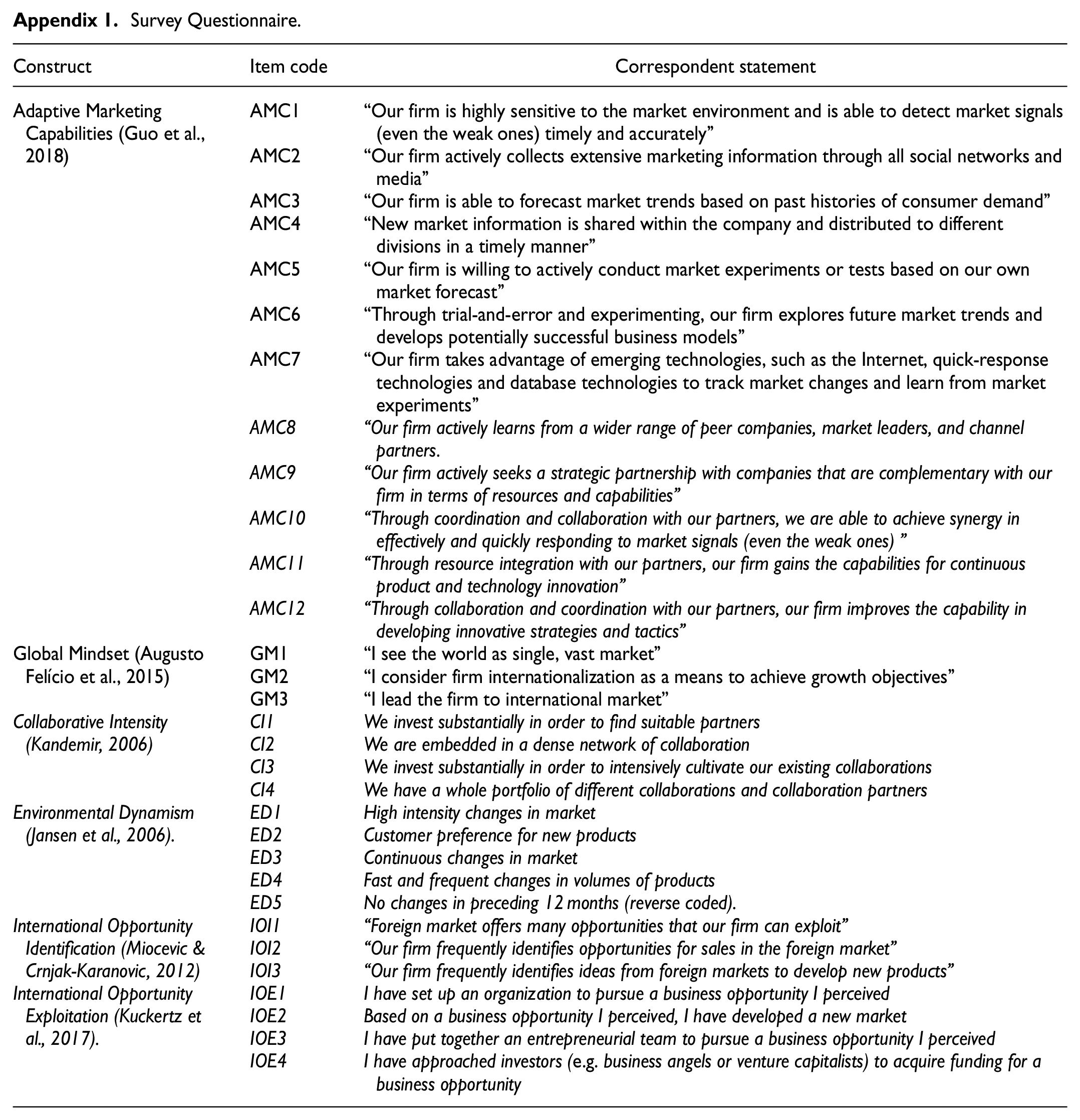
| Construct | Item code | Correspondent statement |
|---|---|---|
| Adaptive Marketing Capabilities (Guo et al., 2018) | AMC1 | “Our firm is highly sensitive to the market environment and is able to detect market signals (even the weak ones) timely and accurately” |
| AMC2 | “Our firm actively collects extensive marketing information through all social networks and media” | |
| AMC3 | “Our firm is able to forecast market trends based on past histories of consumer demand” | |
| AMC4 | “New market information is shared within the company and distributed to different divisions in a timely manner” | |
| AMC5 | “Our firm is willing to actively conduct market experiments or tests based on our own market forecast” | |
| AMC6 | “Through trial-and-error and experimenting, our firm explores future market trends and develops potentially successful business models” | |
| AMC7 | “Our firm takes advantage of emerging technologies, such as the Internet, quick-response technologies and database technologies to track market changes and learn from market experiments” | |
| AMC8 | “Our firm actively learns from a wider range of peer companies, market leaders, and channel partners. | |
| AMC9 | “Our firm actively seeks a strategic partnership with companies that are complementary with our firm in terms of resources and capabilities” | |
| AMC10 | “Through coordination and collaboration with our partners, we are able to achieve synergy in effectively and quickly responding to market signals (even the weak ones) ” | |
| AMC11 | “Through resource integration with our partners, our firm gains the capabilities for continuous product and technology innovation” | |
| AMC12 | “Through collaboration and coordination with our partners, our firm improves the capability in developing innovative strategies and tactics” | |
| Global Mindset (Augusto Felício et al., 2015) | GM1 | “I see the world as single, vast market” |
| GM2 | “I consider firm internationalization as a means to achieve growth objectives” | |
| GM3 | “I lead the firm to international market” | |
| Collaborative Intensity (Kandemir, 2006 ) | CI1 | We invest substantially in order to find suitable partners |
| CI2 | We are embedded in a dense network of collaboration | |
| CI3 | We invest substantially in order to intensively cultivate our existing collaborations | |
| CI4 | We have a whole portfolio of different collaborations and collaboration partners | |
| Environmental Dynamism (Jansen et al., 2006). | ED1 | High intensity changes in market |
| ED2 | Customer preference for new products | |
| ED3 | Continuous changes in market | |
| ED4 | Fast and frequent changes in volumes of products | |
| ED5 | No changes in preceding 12 months (reverse coded). | |
| International Opportunity Identification (Miocevic & Crnjak-Karanovic, 2012) | IOI1 | “Foreign market offers many opportunities that our firm can exploit” |
| IOI2 | “Our firm frequently identifies opportunities for sales in the foreign market” | |
| IOI3 | “Our firm frequently identifies ideas from foreign markets to develop new products” | |
| International Opportunity Exploitation (Kuckertz et al., 2017). | IOE1 | I have set up an organization to pursue a business opportunity I perceived |
| IOE2 | Based on a business opportunity I perceived, I have developed a new market | |
| IOE3 | I have put together an entrepreneurial team to pursue a business opportunity I perceived | |
| IOE4 | I have approached investors (e.g. business angels or venture capitalists) to acquire funding for a business opportunity |
Acknowledgements
We would like to thank the administration of Yiwu International Trade City (Yiwu Futian Market) for the assistance in facilitating communication with research participants and the data collection process.
Declaration of Conflicting Interests
The author(s) declared no potential conflicts of interest with respect to the research, authorship, and/or publication of this article.
Funding
The author(s) received no financial support for the research, authorship, and/or publication of this article.
Ethics Statement
This study was conducted according to the guidelines of the Declaration of Helsinki, and approved by the School of Economics and Management, Yiwu Industrial and Commercial College. The authors have gained the consent of informants.
