




Abstract
A logotype can have a considerable impact on the customers’ perception of a given business, generate experiences and become a basis for assigning specific associations to the brand (positive, negative, promotional). The aim of the present study is to verify the function of logotypes of selected agritourism establishments, especially in view of the rationale for placing them on home pages of websites, and the marketing function they fulfill. Homepages (the main web pages) of websites of 10 agritourism farms with the dimensions of 1,245 × 570 pixels (and 24 -bit color depth) were analyzed. The study involved 170 respondents (n = 170), whose task was to indicate a single element they perceive as positive, negative, and one that in their opinion best serves the promotional goal in each of the 10 homepages. Statistical analyses were performed using the R-CRAN software version 4.0.2. The study confirmed that there are both differences and similarities in the responses regarding logotypes of the agritourism farms studied. The perception of the logotype depends strongly on the education level and age of respondents. The analyses also confirmed that there is no linear relationship between the size of the logo and the frequency at which it is indicated as a promotional element. The use of a detailed factor analysis of logotypes (with the use of the click-tracking technique) on the websites of agritourism farms is an innovative approach and allows for a relatively comprehensive assessment of the perception of logotypes by potential consumers of offers available on the market.
Plain Language Summary
The aim of the present study is to verify the function of logotypes of selected agritourism establishments, especially in view of the rationale for placing them on home pages of websites, and the marketing function they fulfill. Homepages (the main web pages) of websites of 10 agritourism farms with the dimensions of 1,245 × 570 pixels (and 24 -bit color depth) were analyzed. The study involved 170 respondents (n = 170). The study confirmed that there are both differences and similarities in the responses regarding logotypes of the agritourism farms studied. The perception of the logotype depends strongly on the education level and age of respondents. The analyses also confirmed that there is no linear relationship between the size of the logo and the frequency at which it is indicated as a promotional element. Analyses presented in this article focused on the way consumers perceive logotypes of agritourism farms online. However, they pertained solely to Polish farms and Polish respondents. Limitation of this study is the fact that potential customers may react differently to logotypes that incorporate abstract word and/or graphic constructions. This is a rare practice in the case of agritourism farms operating in the Polish market, yet it cannot be excluded. Our study is limited to 10 agritourism farms. Future studies should include a larger sample, which would allow for drawing more precise conclusions. These, in turn, could provide a solid foundation for the practical use of the results by farmers who run agritourism businesses.
Introduction
The marketing communication environment in the digital era is rapidly evolving and websites are increasingly important for companies. Also in the tourist industry, the growing importance of this channel of distribution and promotion has not passed unnoticed (Fanelli & Romagnoli, 2020). To date, the research in this field has focused on the following issues:
− functionality and usability of websites related to tourism, including agritourism, from the perspective of consumers (Z. Lu et al., 2002; Ali, 2016; Król, 2019; Law et al., 2010; Standing et al., 2014);
− logotype design (name, symbol, language, color palette, gender), from the perspective of consumers and their purchasing decisions (Batra et al., 1993; Droulers, 2016; Lieven, 2014; Piko et al., 2017; Zhu et al., 2017);
− e-brand, websites, and visual communication strategies (Ibeh et al., 2005; Trynchuk, 2017; Zhu et al., 2017);
− logotype as a promotional tool (Wilson, 2021);
− modern technologies (including websites) in tourism (including agritourism) management and promotion (Król, 2019, 2021; Pierdicca et al., 2019).
A logotype is a representation of a brand and, at the same time, a tool for brand management (Erjansola et al., 2021). Visual features of logotypes such as their shape (Jiang et al., 2016), typeface (Henderson et al., 2003) or color (Torbarina et al., 2021) ensure brand recognition and affect brand image (Luffarelli et al., 2019). At the same time, these correlations foster strong loyalty bonds with the brand (Müller et al., 2013). Study results show that some brands benefit from communicating their image through a logo, while others do not use this potential (Hagtvedt, 2011). Nevertheless, few researchers analyze how logotypes of companies operating online are perceived by consumers (Jiang, 2019).
It needs to be emphasized that nowadays we are witnessing an increase not only in the frequency of using mobile devices for tourism product purchases, but also in the value of the transactions made (Kim et al., 2015; Kim & Lim, 2019). This is why the visual perception of logotypes on websites is becoming so important today.
The review of literature included in the Scopus, ProQuest, and Emerald databases leads to a conclusion that promotion using websites is an often discussed subject, also in relation to the tourist industry. However, there are no in-depth analyses of the importance of logotypes as a tool of marketing communication in agritourism in Poland, which constitutes a considerable research gap.
Therefore, the aim of the present study is to verify the role played by the logotypes of selected agritourism establishments, especially in view of the rationale for placing it on home pages of websites, the interest of potential consumers of tourist services attracted by the establishments’ graphic symbols and the marketing function that may be assigned to them.
The following research questions were formulated:
RQ1. Do logotypes used on websites of agritourism farms serve an important promotional function?
RQ2. What is the relation between the logo size and its promotional function?
RQ3. What similarities/differences can be found in responses provided by respondents regarding the logotypes of the agritourism farms studied?
The above-listed research problems may provide owners of agritourism farms with an interesting perspective on creating the brand and image of their respective enterprises. Even though these are complex and long-term processes, the research of this nature allows for minimizing the time required for building an image using a brand mark/logotype online.
Theoretical Framework
Logotype, the graphic representation of the product brand, trademark, and other symbols placed on the product packaging, in advertisements or on websites, created using letter typeface, size and color as well as their layout etc., should favorably differentiate a given company from others and produce associations with its activity, industry, products, and services (Droulers, 2016). Additionally, the logotype may influence the customers’ first impressions of the company, as people assign specific meanings to brands and associate specific feelings with them—either positive or negative (Chernatony et al., 2011; Foroudi, 2019). The logo is a gateway to creating a brand and using symbols is the fastest form of communication known to people (Wheeler, 2012).
Therefore, a well-designed logo should:
− attract attention,
− be easy to remember,
− communicate the positioning of the product,
− differentiate the company from its competitors.
The term logotype is the combination of the words “logo” (which means “language”) and “typography” (in reference to typeface, font size etc.). Thus, a logotype is a graphic, or more precisely typographic, representation of the company name and performs the function of its trademark (logo) (Altkorn, 2002). Even though the logotype is usually comprised of the company name and some kind of a symbol (e.g., Toyota), many of them only use the brand name (e.g., Coca-Cola, Google, Microsoft) or just the initial letters of the name (e.g., GE) (Droulers, 2016).
Consumers pay attention to brands and the meanings associated with them, which is expressed through their perception of quality, symbols, experience, and even identity. These issues are discussed in the literature in the context of semiotics marketing, where symbols play a particularly important role in creating a strategy for communicating with customers (Oswald, 2012). The logo of a brand can be seen as a source of the brand’s perceived personality (Batra et al., 1993). Some authors go as far as to discuss the gender of a brand, analyzing the features of a logotype, for example, narrow/delicate (vs. wide/bulky) or curvy/neat (vs. angular), which may emphasize its feminine or masculine character (Grohmann, 2009; Lieven, 2014; van Tilburg, 2014).
The basic tool for marketing communication (promotion) on the web is the company website, containing resources such as text, logo, images, audio, and video materials (Hou et al., 2021).
When it comes to using the logotype as a promotional tool there are currently two approaches. One focuses on its digitalization and its modern character, while the other is a more traditional approach focused on history. Naturally, the latter applies to companies which have already existed for a long time. German researchers suggest that such entities should use hidden references to their own history and discuss this approach within the framework of the history marketing concept. In the case of a logotype, such references may take the form of the company’s establishment date, for example, the company Dallmayr has the phrase “Since 1700” in their logo (Silberer & Triebel, 2012).
Lu, Lu and Zhang (2002) discuss how using online promotion methods increases the competitiveness of entities operating in the tourist market. Agritourism is an increasingly important part of this market that corresponds with sustainable development. It involves spending free time on a farm, where the natural environment and cultural heritage form the tourist attraction, and often offers a personalized experience (Phillip et al., 2010; Pröbstl-Haider et al., 2014). Thus, a website and the logotype it contains can have a positive impact on customer satisfaction and influence their purchasing decisions (Bai et al., 2008; Wang et al., 2015).
Websites of agritourism farms serve mainly an informational and marketing-related function (J. Lu & Lu, 2004; Stepaniuk, 2009), but they often provide historical context as well (Król, 2019, 2021). In the subject literature, websites belong to the discipline of e-marketing, which focuses on using the Internet in areas such as understanding consumer behavior online, formulating opinions on brands, or increasing the brand awareness online. The e-marketing effectiveness indicators that describe customer behavior are best studied using Internet analytics tools (Labanauskaitė et al., 2020).
In this study, we used the click-tracking technique to assess the perception of logotypes. The method is gaining in popularity in marketing, especially in the context of rapid progress of online analytics in the last two decades (Jayawardena et al., 2022). The technique is particularly useful in gathering information about marketing attributes of a company as well as the preferences of its customers (Huang & Van Mieghem, 2013). Hence, it also pertains to the field of brand creation and image.
Materials and Methods
Homepages (the main web pages) of websites of 10 agritourism farms with the dimensions of 1,245 × 570 pixels (and 24 -bit color depth) were analyzed. Each homepage was divided into two areas—logo and other. The proportion of each of the areas on the homepage was calculated (Figure 1). It was assumed that the logo is the element containing graphics, inscriptions or both, together with the field clearly belonging to this element, limited by easily discernible boundaries. In cases where it was impossible to limit the field in which the logo was located, the logo was defined as the graphic element together with a 20-pixel wide buffer around it.

Indication of the logo as a promotional element: (a) share of elements in the total website content, (b) share of indications of promotional elements in the total number of indications (n = 170), and (c) pp index value for the logo and other elements of the website.
The study involved 170 respondents (n = 170), whose task was to indicate a single element they perceive as positive, negative, and one that in their opinion best serves the promotional goal in each of the 10 homepages. The respondents were selected by the BioStat® company in line with the practice applied in social studies. BioStat® was tasked with the procedure of empirical data collection, as it provides representative respondent samples and offers professional services for scientific institutions (see: https://www.biostat.com.pl/index_en.php).
Therefore, the results collected should be considered dependent data. The total number of indications per website was 510 (3 * n). However, only the indications of promotional elements on each of the websites were used for in-depth analyses, that is, a total of 170 indications.
As the size of the homepage elements substantially differed, the
Statistical analyses were performed using the R-CRAN software version 4.0.2. The influence of the education level on the attention paid to the logos, as well as the impact of age on the declared importance of logotype elements, were analyzed using the Chi-squared test with the Benjamini-Hochberg correction (with the significance level 0.05 (Benjamini & Hochberg, 1995; Fife, 2014; Shaffer, 1995).
For multiple comparisons of clicks on the logos and other elements of the homepages, we used Cochran’s Q test (Lukke Sweet, 2020) with Dunn’s post-test (Dunn, 1961; Pohlert, 2014; Signorell, 2021) (with the significance level 0.05).
Results
We selected 10 popular agritourism farm websites from different regions of Poland. We used homepages bitmaps, that were diverse in type and size of logos (Figure 1).
The homepages analyzed had a different percentage of their total area covered by the logo. The logo covered the smallest area on the Leśne_Zacisze farm homepage (0.66%) and it comprised a graphic representation of the undertaking name (Figure 2a). In four of the homepages analyzed the logo covered not more than1.5% of the total homepage area. In the case of each of these homepages, the logo comprised a graphic symbol and the establishment name in Polish. In three of the websites analyzed the logo covered between 3.09% and 4.65% (Figure 2a) of the total homepage area, and similarly to the homepage mentioned above, the logo comprised a graphic element and the establishment name in Polish.
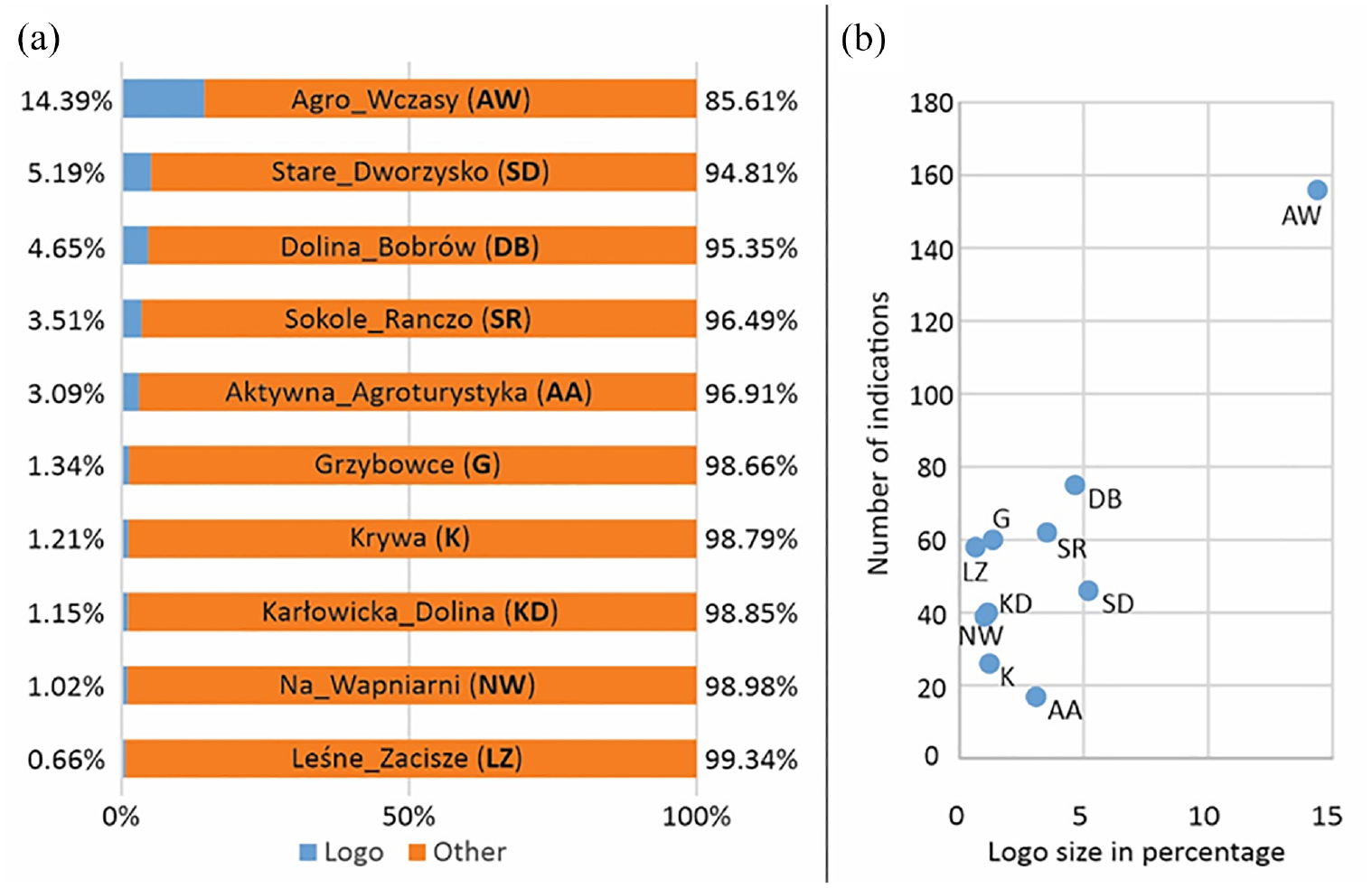
(a) Share of elements (logo, other) in the website area and (b) relationship between the number of indications of the logo (an indication means that the logo was selected as a positive element, a negative element or a neutral element of the website) and its size (agritourism farms’ names were encoded using acronyms specified in part a of Figure 1).
Interestingly, in the case of all logos belonging to this group, the graphic element was a representation of an animal. The only logo that was different and comprised just the establishment name (covering 5.19% of the total website area) was that of the Stare_Dworzysko farm. The area covered by the logo was the largest on the homepage of the Agro_Wczasy farm (it covered 14.39% of the total homepage area and comprised a graphic element and sentence, none of which made any reference to the name of the agritourism farm) (Figure 1).
When comparing the total number of logo indications with logo size (Figure 2b) an attempt was made to verify if any of these indications were accidental. Had this been the case, the size of the logo would directly translate into a greater number of clicks. The Pearson correlation coefficient value of .87 suggested a strong positive correlation between the number of clicks and the size of the logo. However, a large discrepancy between the other logos analyzed and the Agro_Wczasy farm logo suggested that the latter result was excessively high. As a result, the Agro_Wczasy farm was removed from the set and the calculations were repeated—this time the Pearson correlation coefficient value was .27. This suggests that the size of the logo was not related to the number of indications and thus it can be stated that the indications were not accidental.
Instead, the analysis focused strictly on the indications of the logo as a promotional element.
When analyzing just the promotional aspect of the logo, its size, the number of indications and the number of clicks per 1% of the element area (
In the case of the group with a logo covering up to 1.5% of the total homepage area, the number of indications of the logo as a promotional element is inversely proportional to the size of the logo. In this group, both the number of indications as well as the
As for the group with the logo covering more than 3% of the total homepage area, the number of indications tends to increase as the size of the logo increases. In this group, Dolina_Bobrów (8.8
The data analyzed did not allow for drawing convincing conclusions about the group of logos covering 1.5 to 3% of the total homepage area. However, this could be of key importance for establishing the point at which the relation between the size of the logo and the number of indications changes from inversely proportional to proportional.
The analyses conducted also verified whether the logo indicated by respondents as a promotional element of the homepage is seen as positive or negative (by the same respondents). It would be justified to assume that the logo which is perceived as a promotional element is also considered a positive element. The other combination might raise serious doubts (Figure 3).

Perception of the promotional function of the logo among respondents. The bars show indications of the logo as a promotional element and combine them with positive or negative indications applicable to each homepage. The category “Promotional and Positive” represents the percentage of respondents who selected the logo as a promotional element and at the same time selected the logo as an element they consider positive. The same applies to the category “Promotional and Negative.” The values in bars were standardized to 100%, the share value represents the actual number of indications of the logo as a promotional element.
The analysis results show that the logo was seen as both a promotional and negative element in the case of three agritourism farm homepages—Krywa (30%), Sokole_Ranczo (22%), and Agro_Wczasy (15%). In the case of Grzybowce, Karłowicka_Dolina, and Leśne_ Zacisze, these were single clicks, which may be considered accidental (the clicks were very close to the border of the logo area). As for the other homepages analyzed, such a combination of indications did not occur.
An important category was comprised by logos perceived as promotional and positive. With the standardized values, this tendency is best seen in the case of homepages with a low number of clicks on the logo (Krywa_Chata—40%, Aktywna_Agroturystyka—29%) but also those with a higher number of clicks on the logo (Agro_Wczasy—37%, Dolina_Bobrów—24%, Na_ Wapniarni—23%), as shown in Figure 3. In the case of the remaining homepages, such indications comprised fewer than 20%. The most prevailing result in the case of the majority of homepages was that the logo served a promotional purpose, but was not seen as either positive or negative. The exception were those homepages where the logo was mostly perceived as a negative and a promotional element.
The present study also verified a hypothesis that the respondents selecting the logo as a promotional element made the same indication in the case of all homepages (Cochran’s Q test). The test demonstrated a statistically significant difference among at least one pair of homepages (Q = 97.875, df = 9, p-value = 0). Next, the analysis was extended, and comparisons between individual pairs were performed using Dunn’s post-test. The obtained results demonstrated that Agro_Wczasy, Aktywna_Agroturystyka, Dolina_Bobrów, and Leśne_ Zacisze (Table 1) differ significantly from others. These results can be directly compared with the distribution of the number of clicks, concluding that the rejected homepages are those with the highest share of clicks on the logo (Agro_Wczasy, Dolina_Bobrów, and Leśne_Zacisze) and those with the lowest share of clicks on the logo (Aktywna_Agroturystyka) in the total number of clicks (Figure 1).
Multiple Comparisons of Clicks on the Logo and Other Elements of the Homepage Performed for the Cochran’s Q Test With Dunn’s Post-Test.
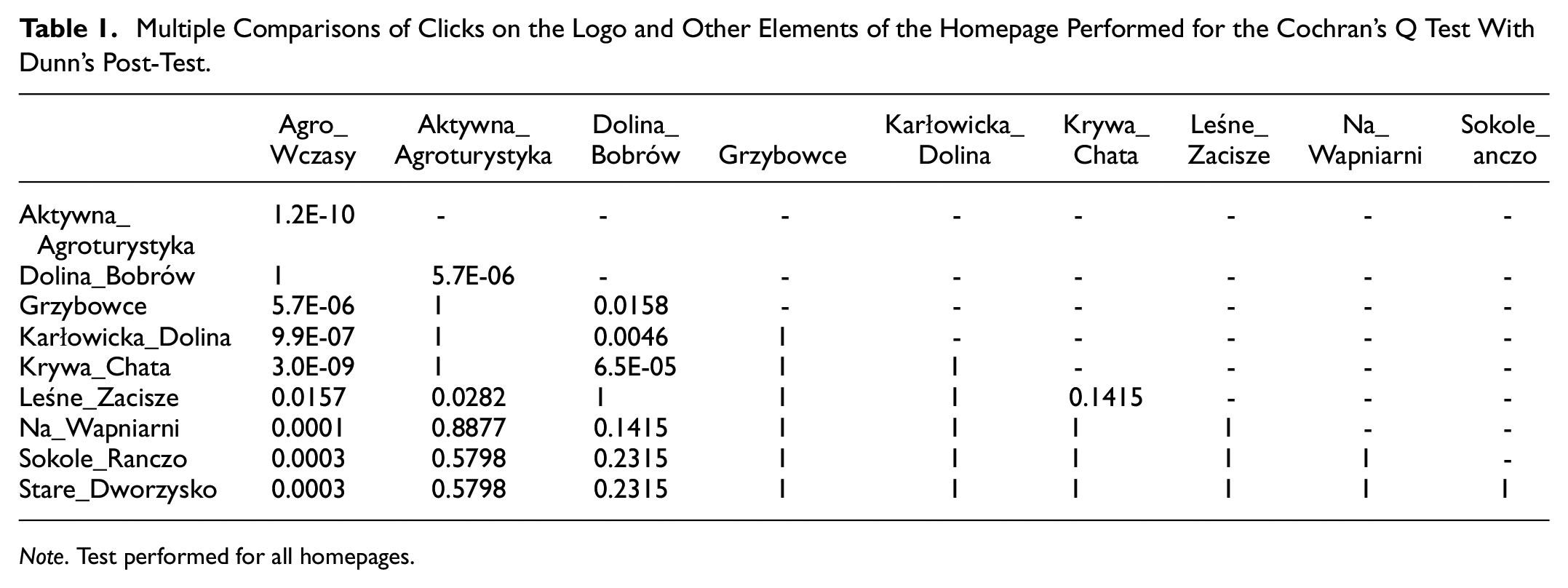
Note. Test performed for all homepages.
In the context of respondent characteristics, education level, and age were significant variables for the perception of the logotype.
The analysis using the Chi-squared test with the Benjamini-Hochberg procedure (X- squared = 21.728, df = 4, p value = .000226958) showed that depending on the respondents’ education level their declarations regarding the attention paid to the logo differed significantly in all the groups analyzed (Table 2).
Comparison Between Education Level Pairs Using the Chi-Squared Test With the Benjamini-Hochberg Procedure (BH) Regarding the Declared Attention Paid to the Logo.

The majority of respondents had secondary education (53.5%), a slightly smaller group had tertiary education (41.8%) and a very small group had primary education (4.7%). The groups considerably differed when it comes to paying attention to the logo. The respondents were asked whether they a) always pay attention to the logo b) sometimes pay attention to the logo or c) never pay attention to the logo when making purchasing decisions. Respondents from the largest group, that is, those with secondary education, most often declared that they sometimes pay attention to the logo. Similar results were found among respondents with tertiary education. Furthermore, a similar number of respondents from these two groups declared that they always pay attention to the logo. It is worth noting that the number of respondents who declared to never pay attention to the logo was the highest among those with secondary education. The number of respondents who never pay attention to the logo was considerably lower among those with tertiary education. It would be difficult to reliably analyze the respondents with primary education, as it was a very small group and the conclusions would be burdened with error. It is worth noting that when it comes to relative indications, this group differs from the others in the proportion of clicks. The only tendency that can be found among their responses is the high number of respondents declaring that they always pay attention to the logo (Figure 4).
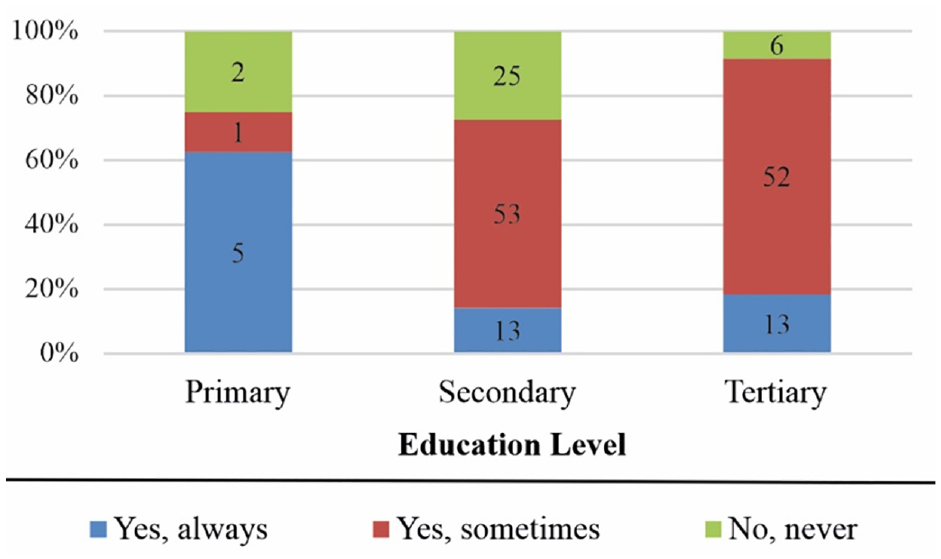
Education versus paying attention to the logo (n = 170).
Additionally, the relationship between the age of respondents and their declared interest in individual components of the logotype was analyzed. Respondents aged 18 to 29 declared that they pay attention to the graphic component and text in English considerably more frequently than the representatives of the other age groups. Respondents belonging to this group were the least frequent to declare that they do not pay attention to any component of the logotype. The distribution of responses was very similar among the other age groups. However, it is worth noting that in the 30 to 39 age group there was a high number of indications of the connotation component of the logo, while in the 40 to 49 age group the respondents frequently chose the graphic component and text in Polish. Respondents belonging to the 50 + age group were not interested in the combination of the graphic component and the text in English, which differentiates this group from the other ones (Figure 5). Based on the Chi-squared test conducted (X-squared = 18.158, df = 9, p value = 0.03338) it was found that there are differences in the perception of logos between at least one pair of groups studied. Since multiple comparisons were used, corrections were applied using the Benjamini-Hochberg procedure. The results obtained indicate that there are significant differences between the respondents aged 18 and 29 and respondents aged 50+ (Table 3). These results however borderline significant allow for the conclusion that the two groups mentioned above differ from each other. Younger respondents belong to a generation that has constant contact with the English language and consider using it as something natural. On the other hand, older respondents are less likely to notice English versions of the logo. Perhaps using the English language is more of a challenge for members of this generation and thus it is not used as frequently.

Impact of age on the declared importance of logotype elements. The values in bars were standardized to 100%. The diagram presents the actual number of indications next to the percentage share.
Comparison of Age Groups Regarding the Declared Importance of Logotype Components Performed Using the Chi-Squared Test.

Score obtained without the Benjamini-Hochberg procedure.
Discussion and Conclusions
The study results show that logotypes used on the websites of agritourism farms can fulfill an important promotional role. However, the exact interpretation of this phenomenon is a very complex problem. The fact that logotypes are noticed on websites, that they are perceived in a given way by consumers, seems to indicate that there are benefits of having a specific brand, also in the case of agritourism. Brand image combined with a logotype reflects the sum of experiences and connotations that customers store in their memory (Lien et al., 2015). Its additional benefit is building trust toward a company and creating positive incentives affecting purchasing decisions (Choi & Au, 2011).
As the experience of the customers grows, so does their brand awareness, which may be particularly important for agritourism farms. It must be noted that the current conditions in the tourism industry dictated by COVID-19 are conducive to finding isolated locations that allow for social distancing (mostly due to health reasons).
The Internet and websites are becoming increasingly popular tools for selecting services and their providers. This builds customer trust toward brands that are active online (Qin et al., 2014). It also influences the pace at which customers search for brands (logotypes) online. It is worth noting at this point that familiar elements (including graphic components and/or characteristic typeface) are processed quicker by perception mechanisms as compared to unfamiliar ones (Baek et al., 2010). However, as the present study has demonstrated, in the case of agritourism farms a linear relationship between the size of the logo and the frequency at which it is indicated as a promotional element cannot be confirmed. Further research should verify what factors may be affecting this perception (website color scheme, contrast, positions of individual elements, graphic design of the logotype—language, reference to a given destination, etc.).
The tendency to focus on logotypes may result from the search for the protection offered by a brand (Fajardo et al., 2016; Maurya & Mishra, 2012) and as a result, limit the risk related to making a purchase. Logotypes considerably increase the credibility of an offer. As the consumption of the agritourism offer in Poland is not particularly well established (especially in lowland regions with low tourist potential), the role of a logotype as an element improving credibility seems to be critical. This also applies to brands of institutions associating farmers who provide tourist services using the resources available on their farms, for example, Polish Federation of Agritourism—Hospitable Farms (in Polish: Polska Federacja Turystyki Wiejskiej—Gospodarstwa Gościnne).
The present study confirms that there are both differences and similarities in the responses regarding logotypes of the agritourism farms studied. The perception of the logotype depends strongly on the education level and age of respondents. The majority of respondents were individuals with secondary and tertiary education, who often pay attention to the logo, although respondents with tertiary education seem to have more interest in it. The small number of study participants with primary education may be explained by their insufficient awareness of the impact of research on the practicalities of market behavior.
As for the relationship between the age of respondents and their declared interest in individual components of the logotype in different age groups, the responses provided by individuals aged 18 to 29 differed from those observed in the other groups. Members of this group declared that they pay attention to graphic elements and text in English, which was not observed in the case of respondents aged 50+. This may stem from the fact that the younger generation is familiar with the English language and open to international models in modern marketing or international mobility.
The analytic procedure yielded the following conclusions:
studying logotypes of agritourism farms is not a common practice. However, due to the specific nature of this type of business activity (especially in the Polish market, where it is treated as a complementary form of business in rural areas), attempts at such analyses and the implementation of their results may improve the image of such farms and attract consumers (these services may become a financial alternative for farm owners, rather than just an additional source of small income);
Individual components of logotypes (graphics, names or size) may play an important role in effective recognition of agritourism farm brands online. Thus, it is worth placing particular focus on the logotype design stage. This process should be supported with scientific research and services of specialist Public Relations companies (which is not a common practice among owners of agritourism farms).
Our study confirmed the promotional role of logotypes, but understanding how consumers perceive them on the websites of agritourism farms is multifaceted. Customer segmentation features may constitute a very important source of differences in perceiving logotypes and should be a subject of further studies.
The obtained results broaden the spectrum of literature focusing on consumer behavior personalization in the sector of agritourism. At the same time, they may contribute to the improvement of marketing communication between agritourism farm owners and potential customers.
Limitations and Future Research
Tests and analyses presented in this article focused on the way consumers perceive logotypes of agritourism farms online. However, they pertained solely to Polish farms and Polish respondents. It is worth remembering that even though the tourism behavior culture of customers and market approach of producers often vary worldwide, customers play the role of direct quality controllers, particularly in the service sector (Al Shraah et al., 2022). This prompts extension of the research scope to include such comparisons, as they may yield interesting conclusions.
The present study focused only on logotypes that linguistically (and graphically) targeted Polish consumers. Thus, it seems valid to analyze logotypes of agritourism farms (which offer websites in different languages and have different versions of logotypes) that are adapted to servicing international guests. Customers’ approach to the countries visited may in this case be a valuable variable, which should be taken into account in future analyses.
Another limitation of this study is the fact that potential customers may react differently to logotypes that incorporate abstract word and/or graphic constructions. This is a rare practice in the case of agritourism farms operating in the Polish market, yet it cannot be excluded (it is worth searching online resources in a comprehensive way to diagnose this problem in future empirical analyses).
Our study is limited to 10 selected agritourism farms. Future studies should include a larger sample, which would allow for drawing more precise conclusions. These, in turn, could provide a solid foundation for the practical use of the results by farmers who run agritourism businesses.
Footnotes
Acknowledgements
The authors express their gratitude to BioStat®. The study was carried out with the use of tools and software from BioStat®, which participated in the process of data collection and quantification.
Declaration of Conflicting Interests
The author(s) declared no potential conflicts of interest with respect to the research, authorship, and/or publication of this article.
Funding
The author(s) disclosed receipt of the following financial support for the research, authorship, and/or publication of this article: The author(s) received financial support for the publication of this article from Adam Mickiewicz University in Poznan.

Data Availability Statement
Data sharing not applicable to this article as no datasets were generated or analyzed during the current study.