




Abstract
In the last decade, the relationship between sustainable luxury and consumer purchase intention has been gradually noticed by researchers. However, a systematic review of the literature on this topic has not been conducted. The purpose of this study was to collect literature and analyze the current state of research related to sustainable luxury and consumer purchase intention. Based on the Scopus and Web of Science database, this systematic review used a multistep process to ensure the traceability and reliability of the findings. A content analysis shows that sustainable luxury can be presented through four perspectives (raw materials, recycling and reproduction, social media and advertising (AD) strategies, and corporate social responsibility (CSR) and brand promise) in contrast with common luxury goods. In addition to consumer purchase intention, consumer attitude and word-of-mouth (WoM) advertisements were also evaluated as dependent variables. The relationship between the effect of sustainable luxury and consumer purchase intention is multifaceted, and five types of factors are summarized. The results of this review indicate that the related epistemology has been strongly advanced, and luxury brands should approach the topic of manufacturing and retail sustainability on a case-by-case basis and measure whether it translates into better purchasing behavior. The practical implications for luxury retail are discussed.
Plain Language Summary
We reviewed key research in marketing communications to explore whether and how luxury brands, focusing on environmental protection and social responsibility, influence people’s purchasing intentions. Our review indicates that research on the impact of sustainable luxury products and their relationship with consumer purchase intentions is rapidly growing. As an emerging field, current studies show that the paths and sources of influence are multifaceted. Luxury brands should approach the topic of manufacturing and retail sustainability on a case-by-case basis, measuring whether it translates into improved purchasing behavior. This is a key insight for luxury brands striving to balance exclusivity with sustainability. Essentially, our review highlights that luxury and responsibility can go hand-in-hand. The crucial point is how to demonstrate responsibility discreetly without it backfiring.
Introduction
Sustainability is a widely used concept with multiple contexts (Lankoski, 2016; Marshall & Toffel, 2005). The International Institute for Sustainable Development (IISD) (1992) defines sustainability as “the adoption of business strategies and activities that meet the needs of today’s businesses and their stakeholders while protecting, sustaining, and enhancing the human and natural resources that will be needed in the future.” In this manuscript, the context of sustainability referred to by the author is based on the theme of environmental and resource use ethics, and a range of interrelated topics (e.g., sustainability, consumption, energy use, and environmental impact). In terms of terminology, the relationship between sustainability and consumption encompasses the contradiction between the terms “sustainability” and “consumption.” However, in a growing number of consumer fields, commitment to sustainability has become an essential channel for influencing the brand image and consumer behavior (Millar et al., 2012; van Marrewijk, 2003).
The characteristics and values of luxury are perceived as diverse, and researchers have achieved a consensus that luxury means richness, superior quality, and good design (Berens, 2013; De Barnier & Valette-Florence, 2013), as well as some degree of wastefulness (Veblen & Galbraith, 1973; Vickers & Renand, 2003), in contrast to necessity goods. Thomas (2007) asserted that luxury goods offer “a history of tradition, superior quality, along with a pampered buying experience.” Assuming that sustainability represents a self-regulatory moral code, an intuitive view would suggest that “sustainable luxury” is an internally contradictory concept. However, as consumers become more publicly educated on the green topic, the market and administrators are challenging the sustainability metrics of the luxury industry (Gutsatz & Heine, 2018; Woodside & Fine, 2019). Gaining better reputation and financial performance through sustainable commitments and initiatives is also a daunting challenge for luxury brands. Bendell and Kleanthous (2007) first provided sustainable luxury as a separate term, and the debate has continued (Achabou & Dekhili, 2013). Moscardo and Benckendorff (2010) stated that sustainable luxury is “scarce, experiential, authentic and a reflection of consumer’s desire of having a quality experience which benefits others.” This description suggests that sustainable luxury has the potential to be embraced as a term. According to the recent public media reports (e.g., Paton, 2019; VOGUE Business, 2021), luxury brands such as Prada, Gucci, and Macartney have announced initiatives to focus on sustainability, such as using more environmentally friendly, ethically noncontroversial materials in their raw materials supply chain.
From approximately 2010 to 2021, the relationship between sustainable luxury and consumer purchase intentions (PI) has attracted much attention of researchers. The discussion has emerged based on two hypotheses: First, that the sustainability promise of luxury goods will weaken consumers’ perception of the value of luxury goods and thus reduce the PI; second, that the concern for sustainability expressed in the production and marketing of luxury goods will lead consumers who care about this indicator to raise their PI for luxury goods. The basis of the second hypothesis is that sustainable products may have the same “essential” characteristics as luxury products—an emphasis on extraordinary creativity and design, cutting-edge materials, and durability—and luxury products are expected to be viewed as timeless items that do not go out of fashion (Kapferer & Michaut, 2015). Although sustainable luxury is emerging as a new frontier in business and marketing, the relationship between sustainable luxury and consumer PI at the micro level has not been studied.
Therefore, the author’s research interest was to review the literature, examining whether sustainable luxury positively or negatively affected consumer PI and the main variables at play therein while considering demographic characteristics and a cross-country comparative analysis. This systematic literature review had two main research targets (also the research questions). The first was to obtain a descriptive view of the literature to reflect the year of publication and research field. The second was to examine the link between sustainable luxury and consumer PI, the factors influencing them, the stages, and the differences in outcomes due to external factors, including personality and cultural dimensions, to sustainable luxury and consumer PI to highlight directions that the related field has failed to focus on and the research topics that deserve further discussion. The rest of the manuscript describes the methodology for filtering the literature. This is followed by a systematic analysis of the selected literature. Finally, conclusions are drawn, and further suggestions are made, which is based on the steps of a systematic narrative review (Snilstveit et al., 2012). Notably, the literature review is not limited to quantitative studies that explicitly use PIs as the dependent variable, it comprises all the literature on both discussions, including qualitative studies and theoretical studies. The author posits that this study will facilitate the expansion of the horizon of this research topic.
Methodology
Systematic literature reviews are a methodology to collect literature and analyze data. Compared with other methodologies, systematic literature reviews have the advantage of controlling bias in the selection of research subjects (e.g., correcting for researchers’ subjective bias in reviewing the literature, based on a more scientific approach); therefore, they have the potential to yield more reliable and accurate conclusions (Greenhalgh, 2014). As Petticrew and Roberts (2006) propose that “it’s a way to make sense of a large amount of information.” Based on the literature (Booth et al., 2006; Denyer & Tranfield, 2009; Hart, 1998; Petticrew & Roberts, 2006) and drawing on the PRISMA statement (Moher et al., 2009), a systematic literature review is recommended to follow specific steps and targets to (1) define the research question; (2) identify the strategy including the selection of terms used to search for manuscripts; (3) screen the abstract, check the relevance, and filter the low-relevance search results; (4) extract the literature information after validity assessment; and (5) use and report the results.
Identification Phase
The purpose of this study was to review all the literature on sustainable luxury and consumer PIs, with a focus on examining the most recent literature from the last 5 years. The author used Scopus and the Web of Science (WoS) core collection including SSCI, SCIE, AHCI, and ESCI as the databases for literature searches, and both databases are comprehensive scholarly resources that collect a wide range of peer-reviewed journal articles. There is evidence that the content indexed in WoS and Scopus shows a high degree of overlap (Pranckutė, 2021), and Scopus may even provide a greater amount of unique sources than WoS (Aksnes & Sivertsen, 2019; Zhu & Liu, 2020), especially in the social sciences. However, the scope of content overlap between the two databases varies across disciplines (Mongeon & Paul-Hus, 2016). Thus, a better methodology is to integrate both databases that ensure the completeness of the review. The author entered the search terms in Scopus and WoS keywords or article abstracts: sustainable luxury OR sustainability luxury AND consumer OR purchase OR intention.
Screening Phase
The Scopus and WoS databases were independently screened by two authors. Articles were tracked from January 2000 until June 2021. Notably, the research in this field is relatively new and growing; therefore, the author believes that this period will cover all significant articles in the field. Further, book chapters, conference papers, and articles that were not peer-reviewed or could not be determined to be peer-reviewed were filtered out. In total, 120 articles on Scopus were obtained versus 10,297 articles on WoS (inspection revealed that the WoS adopted a fuzzy search strategy, and articles with a low rank at the results page had slight to no connection to our research purpose). After combining and deweighting the results from both the databases, two authors read all the abstract or full text, determined the context of each article, and filtered further. Disagreements were resolved through discussion and consensus (kappa score = 0.88).
The included studies met the following criteria:
Original peer-reviewed journal articles focused on sustainable luxury and consumer PI, and the articles were written in English.
The “sustainability” of interest included the concept of sustainability, as well as the raw material, production, and marketing dimensions.
Research on attitudes and WoM advertisements closely related to consumers’ PI was included.
Research design included surveys, experiments (randomized controlled trials, etc.), and interview methods.
Studies were excluded for the following reasons:
They were related to luxury hotels and luxury foods and limited the scope to luxury brands and related artifacts, as the hotels and foods are closer to services and experiences of nondurable use.
They were related to sustainable consumption and brand sustainability, which are not potentially related to luxury and consumer PI but are based on different contexts.
Eligibility Phase
Two authors followed by the Cochrane tool (Sterne et al., 2019) to assess the risk of bias in the included studies. Five domains were included: randomization process, deviation from the intended intervention, lack of outcome/data, outcome measures, and selection of reported outcomes. The risk for each domain was categorized as “low,”“some concerns,” or “high.” After aligning the results, the authors filtered out articles where the risk of bias was marked as “high".” After applying the criteria and eliminating duplicate items, 52 articles remained. Among them, 47 empirical studies and 5 theoretical articles analyzing the relationship between the two were considered.
The detailed review process is shown in Figure 1, in which the author explains the process of collecting literature and analyzing data for this manuscript.

Flow chart of the search process.
Results
Overview of Publications
Table 1 shows the distribution of research articles between 2000 and 2021. Notably, according to the author’s criteria, the first journal articles related to sustainable luxury and consumer PI appeared in 2013. Between 2000 and 2012, no peer-reviewed articles were found in the Scopus and WoS databases that focused on sustainable luxury and PI. However, from 2017 to 2021, 7, 3, 11, 16, and 11 research articles were published in the field. Thus, research on this topic has accelerated, indicating that the field is relatively new but growing.
Distribution of the Reviewed Articles by Year of Publication.

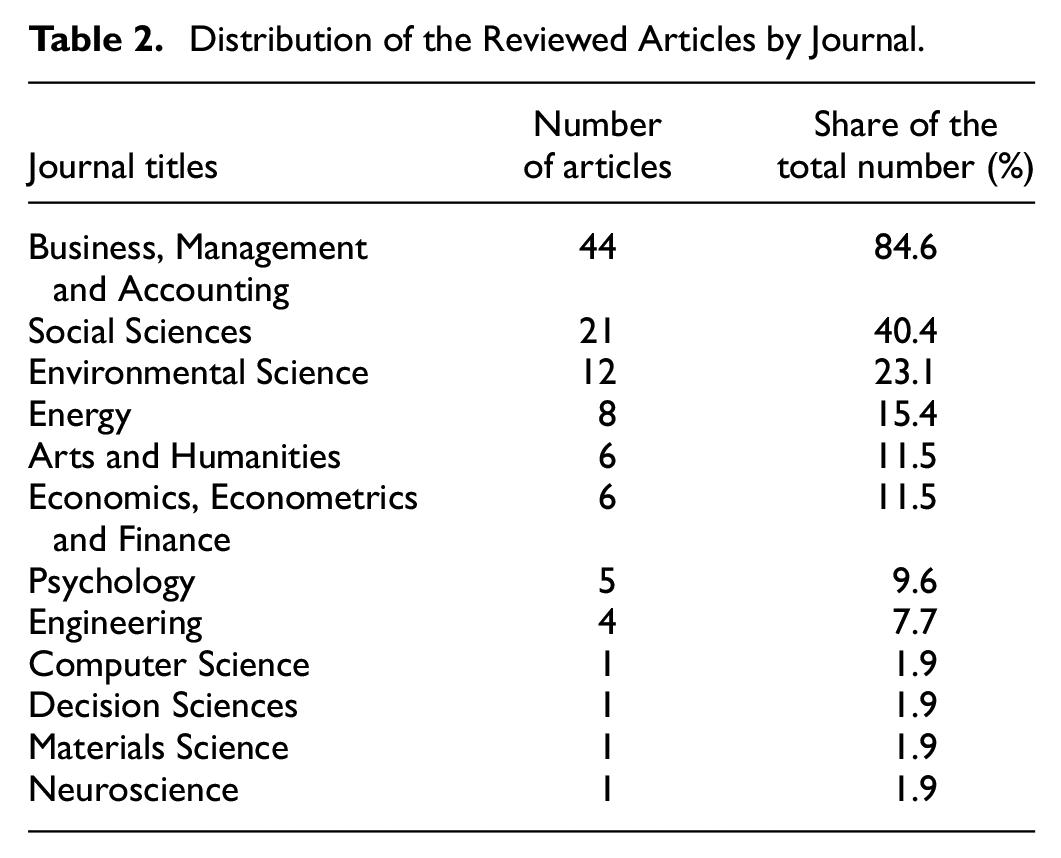
The results based on the disciplinary distribution of Scopus show that the research articles originated from 12 disciplines. The same research article may be given multiple disciplinary labels. The most important disciplinary sources are “Business, Management and Accounting,”“Social Sciences,” and “Environmental Science,” but cover disciplines such as “Psychology” and “Neuroscience” (Table 2). This finding indicates that the journals that published the included articles are in the areas of, for example, business, marketing, ethics, fashion, and psychology. Journals dedicated to luxury and marketing research are not the only journals exploring the relationship between consumer PI and sustainable luxury, facilitating the development of this research topic and being explored from multiple perspectives.
Distribution of the Reviewed Articles by Journal.
Content Analysis of the Reviewed Articles
In this study, the second target was to examine the link between sustainable luxury and consumer PI and the types and factors, including the differences in results due to external factors such as personality and cultural dimensions. We present the research themes of these manuscripts in three categories: (1) the types of sustainability as a stimulus for luxury (i.e., in what form the qualities of sustainability have been presented in the literature to examine the impact on the audience), (2) the perceived factors that influence consumer PI for sustainable luxury, and (3) the literature based on external factors (e.g., socioeconomic environment, cultural dimensions, and personality traits) that produce different results. Because some studies simultaneously examined two or three themes, counts and reviews on different perspectives of the same manuscript may appear in more than one theme.
Types of Sustainability as a Stimulus for Luxury
In this manuscript, the author’s first content analysis results aimed to point out which dimensions were presented in the research as the stimulus for sustainable luxury. We obtained the results based on four types: raw materials (n = 5, 9.6%) (Achabou, 2021; Aliyev et al., 2019; Amatulli, De Angelis, Pino, & Guido, 2020; Keech et al., 2020; Rolling & Sadachar, 2018), recycling and reproduction (n = 10, 19.2%) (Achabou & Dekhili, 2013; Adıgüzel & Donato, 2021; Amatulli, De Angelis, Pino, & Jain, 2020; Grazzini et al., 2021; Jain & Mishra, 2020; Kumagai, 2020; Kumagai & Nagasawa, 2020; Pantano & Stylos, 2020; Rolling & Sadachar, 2018; Tofighi et al., 2019), social media and AD strategies (n = 5, 9.6%) (Balconi et al., 2020; Dekhili et al., 2019; Minton & Geiger-Oneto, 2020; Septianto et al., 2021; Talukdar & Yu, 2020), CSR and brand promise (n = 15, 28.8%) (Amatulli et al., 2018; Balconi et al., 2019; Costa Pinto et al., 2019; Diallo et al., 2021; Dogan-Sudas et al., 2019; Gibson & Seibold, 2014; Hepner et al., 2020; Janssen et al., 2014; Jestratijevic et al., 2020; Kang & Sung, 2022; Noh & Johnson, 2019; Olšanová et al., 2022; Panigyrakis et al., 2020; Pencarelli et al., 2019; Sipilä et al., 2021). Other studies used a general concept of “sustainability” to conduct investigation (n = 12, 23.1%), or theoretical research (n = 5, 9.6%). Among them, raw materials, recycling and reproduction are product attributes; social media and AD strategy, CSR and brand promise are brand attributes. This result indicates that researchers often use CSR/brand promise as a brand attribute that luxury brands attempt to present to consumers in contrast with common luxury brands. However, these four dimensions are not juxtaposed. The abstraction concept or concretization of sustainability may lead to different effect paths, so they were deployed in different survey and experimental studies. For example, Adıgüzel and Donato (2021) advocated the use of “upcycling” instead of “recycling” as a sustainability promise of luxury brands in the use of used items. Their experimental results demonstrated that consumers are more willing to buy products that can be described as upcycled because of the perception of pride and novelty.
Perceived Factors of Consumer PI for Sustainable Luxury
Are luxury and sustainability compatible concepts? Initial research suggests that sustainable luxury is perceived as an oxymoron by consumers (Achabou & Dekhili, 2013; Arrington, 2017; Beard, 2008; De Angelis et al., 2017; Joy et al., 2012; Kapferer & Michaut-Denizeau, 2014). However, studies conducted from approximately 2018 to 2021 show the need to further test their complex heterogeneity. A content analysis of 52 relevant literature shows that there are different paths of influence between sustainable luxury and consumer PI based on different perceived paths.
The first path is that sustainable luxury may have a negative impact on consumer PI (n = 11, 21.6%): a decrease in perceived quality (Dekhili et al., 2019); a decrease in perceived functionality and perceived value (Achabou, 2021), reducing consumers’ willingness to premium price (WTPP) (Diallo et al., 2021); and inconsistency in brand attributes (Costa Pinto et al., 2019; Tofighi et al., 2019). For example, the adoption of animal fur, not consistent with the sustainable image promoted in the advertising strategy (Rolling et al., 2021), causes a negative impression of consumers and reduces PIs. The electroencephalogram (EEG) band results of Balconi et al. (2020) showed that the display of sustainability-related images in stores induced negative emotional effects. Specifically, this effect was higher in the non-sustainability oriented group. Indeed, in terms of research methodology, the monitoring of EEG cortical activity is a novel technique (Balconi et al., 2019). An argument is that at least in the field of luxury cars, it is necessary to return to the traditional view that luxury and environment and sustainability are inconsistent, contradictory concepts (Aliyev et al., 2019).
The second path is that sustainable luxury may have a positive impact on consumer PI (n = 29, 55.8%). Among them, a part of the research does not define the specific perceived factors but states that sustainable behavior and promise increase consumer attitudes, WoM, and potential PI of luxury brands (Amatulli et al., 2018; Dogan-Sudas et al., 2019; Han et al., 2017; Hepner et al., 2020; Janssen et al., 2014; Kumagai & Nagasawa, 2020; Noh & Johnson, 2019; Tascioglu et al., 2017). Some research points to validated perceptual factors, for example, perceived brand integrity and perceived warmth (Grazzini et al., 2021), perceived pride and gratitude (Septianto et al., 2021), perceived environmental protection provided by the leasing method (Jain & Mishra, 2020; Pantano & Stylos, 2020), and negative guilt perceptions toward unsustainable luxury products, affecting eWOM (Amatulli, De Angelis, Pino, & Guido, 2020; Amatulli, De Angelis, Pino, & Jain, 2020; Minton & Geiger-Oneto, 2020). For example, Grazzini et al. (2021) showed that consumers exhibit positive implicit attitudes toward sustainable luxury goods and that the perceived warmth of sustainable luxury positively moderates consumers’ purchase intentions. However, the dependent variables of the aforementioned research are consumer attitudes and WoM without explicitly testing the PI. Several studies tested PI (n = 14, 26.9%), such as perceived brand CSR awareness (Olšanová et al., 2022), perceived value and functionality (Aliyev et al., 2019; Sugimoto & Nagasawa, 2017; Talukdar & Yu, 2020), and perceived pride and novelty (Adıgüzel & Donato, 2021). Insight can be gained from these studies that explicitly evaluated sustainable luxury goods and consumer PI: Continuing the consistency of sustainable goods with the original brand tone of voice (e.g., keeping the design consistent with the original product line rather than designing it to look like a green product) and reducing the perceived value and perceived functionality of consumers can achieve moral satisfaction and novelty experiences for consumers and promote PI (Amatulli et al., 2018; De Angelis et al., 2017; Platania et al., 2019; Sugimoto & Nagasawa, 2017).
The remaining empirical studies reported mixed results (n = 7, 17.3%), with sustainable luxury goods likely to both enhance and reduce the PI, stemming from the choice of context, sampling, and variable relationships. For example, the results of Janssen et al. (2014), Tofighi et al. (2019) show that a luxury brand benefits from sustainability strategies only when their original attributes (durable jewelry, ethical designs, etc.) are aligned with the perceptions of consumers. Some results related to external factors were also reported. The authors will elaborate them in the next section.
Impact From the Socioeconomic Environment, Cultural Dimensions, and Personality
The relationship between sustainable luxury and consumer PI is influenced by external factors such as socioeconomic environment, cultural dimensions, and personality. This moderating effect was discussed in 18 of the 52 manuscripts (34.6%). For example, moral standards (Olšanová et al., 2018) and social class affected the relationship (Amatulli et al., 2018); sustainability awareness was stronger in the developed countries than in developing countries (Achabou, 2021; Henninger et al., 2017). Dekhili et al. (2019) asserted that although no significant effect was observed among the French respondents, if sustainability information is provided, Saudi consumers would lower their evaluation of luxury quality.
Therefore, researchers argued for integrating the marketing of sustainable luxury goods and the context of the market where the consumer is located to reflect the cultural differences. For example, hedonic needs drive consumers’ PI for consumers in China and the United Kingdom, but had opposite results in the impact of exclusive versus consistent demand for sustainable luxury on their PI (Wang et al., 2021). The impact of functional value of luxury on WTPP varies across countries, with high-context cultures being stronger than low-context cultures (Diallo et al., 2021). The author notes that further comparative studies of the emerging markets and the developed markets are necessary.
Many studies restricted the respondents to young individuals (aged 17–25 years) to compare the traditional consumer groups of luxury goods. For example, in millennial consumers (Jain & Mishra, 2020; Pencarelli et al., 2019; Rolling & Sadachar, 2018), findings largely confirmed their higher positive perceptions of sustainable luxury owing to the well-educated background and more social media exposure. The rising acceptance of faux fur is more likely to negatively affect unsustainable luxury goods (Wang et al., 2021). Thus, sustainable efforts to use recyclable materials in goods are preserved, but some studies suggested that millennials are not much different from older generations in their sensitivity to sustainability when purchasing luxury goods. Millennials still perceive luxury and sustainability as contradictory (Kapferer & Michaut-Denizeau, 2020), or more susceptible to social desirability factors, the commitment to care more about sustainability does not actually translate into purchasing behavior (Tascioglu et al., 2017).
Tests of cultural dimensions and personality trait factors included collectivism–individualism (Ali et al., 2019) and gender. The risk of NWoM (Negative Word of Mouth) proliferation may be higher in countries characterized by collectivism and female orientation than in countries characterized by individualism and male orientation (Amatulli, De Angelis, Pino, & Jain, 2020). There is also research on materialism (Keech et al., 2020; Talukdar & Yu, 2020; Tascioglu et al., 2017). Materialists tend to place a higher perceived functional value on sustainable (i.e., green) luxury goods. The conspicuousness of the product (i.e., publicly consumed vs. privately consumed luxury goods) moderates the impact of materialism on sustainable luxury goods over common luxury goods (Talukdar & Yu, 2020). Therefore, marketers should use specific appeals for different market segments based on values such as the level of materialism of consumers.
Conclusion and Discussion
The purpose of this study was to review the current state of research related to sustainable luxury and consumer PI (the content framework of the reviewed literature is shown in Figure 2). The results suggests that the related epistemology has been strongly advanced since 2017, from the early investigations that sustainable luxury and consumers must be contradictory to the current findings that positive influences exist, indicating that the prior relationship between sustainable luxury and consumers requires further elaboration, and also hints at the rise of consumer awareness of green products in years. Overall, consumers may be troubled by the sustainability attributes offered in luxury goods, causing a reduction in the perceived value, functionality, and other factors. However, when the luxury brand image is aligned with the communicated notion of social responsibility or the sustainable luxury appearance is aligned with the previous product line, consumers may be compensated by factors such as perceived pride, novelty, and durability, which brings PI. In particular, luxury sustainability strategies may be beneficial among the sustainable, nonmaterialistic, developed country, and millennial populations.

Content framework of reviewed articles.
The author claims that although some samples were selected in developed or developing countries, there is a deficiency of quality cross-country comparative analysis, especially in different cultural contexts, which is considered necessary. Additionally, the author notes that the dependent variables of most studies are consumer attitudes, WoM, and PIs; however, the evidence obtained from these studies’ is insufficient to confirm their translation into the purchase behavior and does not show that sustainable efforts and promise are profitable. “Consumers say they care, but they do not purchase like they care.” (Arrington, 2017). This means that at the level of guiding financial performance, these studies need to be revised in terms of the practical value they can provide.
This study provides certain practical insights into how luxury brand managers design their retail marketing strategies. Luxury brands are increasingly convinced that sustainability is the key to winning the hearts and minds of their customers (Deloitte, 2020). The author notes that the sustainability challenge should be addressed by focusing on consumer motivations and psychological needs, while suggesting activities that align with brand attributes rather than pure charity (Costa Pinto et al., 2019; Jaegler & Goessling, 2020). For example, business activities that reduce waste and raw material management align with consumer expectations and reinforce consumer affection and loyalty to the brand also trigger a demonstration effect of values. The author also agrees with Park et al. (2019) who proposed “value instantiation” as a solution. This includes celebrity value instantiation to encourage consumers to visualize themselves as concerned with social responsibility issues such as sustainability while pursuing luxury and to mitigate the value conflict between luxury and sustainability. Especially in the context of the global COVID-19 pandemic, long-term social production pressures offer the possibility for many luxury consumers to reassess their values (Connel, 2021).
Limitation
This study contributes to research on sustainable luxury by collecting and reviewing previous research results on the relationship between sustainable luxury and consumer PI. However, this study has some limitations. First, the author searched only for articles in Scopus and WoS databases. Although they both have extensive, peer-reviewed collection of research articles used by other systematic literature reviews, there is a potential risk of missing key literature given the considerable heterogeneity or lack of terminology used by authors and indexing services. Similarly, this article only selected articles from peer-reviewed journals for review. Thus, although this method is beneficial for maintaining uniformity in research quality, important research findings published in book chapters and conference papers must be reviewed and should be added in subsequent reviews. Finally, the author argues that meta-analysis and bibliometric analysis might contribute to further research in this field.
Footnotes
Author’s Note
All authors have agreed to the submission and that the article is not currently being considered for publication by any other print or electronic journal.
Declaration of Conflicting Interests
The author(s) declared no potential conflicts of interest with respect to the research, authorship, and/or publication of this article.
Funding
The author(s) received no financial support for the research, authorship, and/or publication of this article.
