



Abstract
The COVID-19 pandemic has impacted directly on sports competitions, redirecting strategies to adapt to changes and giving prominence to a new ally: social media. The objective of this research is to analyze how top-level sports organizations managed their social media in pre-pandemic (from April 1 to 14, 2019) and pandemic (from April 1 to 14, 2020) periods. This study is based on the design and implementation of an observation instrument, applied to Facebook, Instagram, and Twitter posts. A total of 5,512 posts from LaLiga (LL), ACB League (ACB), UEFA Champions League (UCL), Euroleague (EL), and NBA League (NBA) have been analyzed. The results show a slight decrease in the total frequency of posts between both periods, but with a more homogeneous distribution over the days. Sports organizations adopted different approaches while posting on social media during these two periods. At the beginning of the pandemic, they prioritized “Social initiatives” and “Engagement” categories while their format preferences have generally migrated from text and image to audio-visual resources during the pandemic.
Introduction
Sports organizations managing sports teams use social media to engage with their partners and fans, promote interactions and increase engagement with the sports product as well as the team in general (Parganas & Anagnostopoulos, 2015). According to Filo et al. (2015), social media is seen as a unique form of communication that transcends geographical and social boundaries through instant communication of information. However, communication is only one of the many goals of social media channels. Williams and Chinn, (2016) defined social networks as “tools, platforms and applications that enable consumers to connect, communicate and collaborate with others,” and they constitute a mass phenomenon (Vivar, 2009), due to their ability to transmit agile and interactive information in an era where immediacy is a constant.
The crisis of the COVID-19 pandemic requires to sports organizations to redirect their strategies, where digital channels were key. Due to the need of keeping active the audience, maintaining closeness with partners (sponsors, clubs, and athletes) and exploring new communication approaches, social media become a strategic and powerful ally for sports organizations.
The purpose of this study is, therefore, to analyze the social media use in the initial period of the pandemic from the perspective of local and international top sports organizations and make a comparison between a similar period of time in a non-pandemic scenario to visualize and study both periods.
In addressing of the research question, this study produces evidence that seeks to demonstrate the strategies adopted by sports organizations considering the geographic scope of the competition, the sports discipline, the post frequency of both periods and the stakeholders involved by making a comparison between the initial period of the pandemic (period most uncertain) and a pre-pandemic period. In doing so, we plan to contribute to the existing literature by developing an observation tool based on previous studies with original categories and variables of study to inform practitioners about the social media use by these sports organizations and to allow to open the scope for future studies in the field.
Literature Review
The COVID-19 Pandemic: The Beginning of a New Era in Sport Management
The COVID-19 pandemic caused an economic crisis due to a high level of uncertainty (Nicola et al., 2020) changes in digital communication (Nguyen et al., 2020), and brand strategies in different industries, which has also impacted the sporting arena.
At the onset of the pandemic alone, the sports industry was projecting a loss of USD 15 billion in terms of sponsorships, TV rights, and other revenue (Somoggi, 2020); USD 1.9 million in US Basketball franchises; over USD 2 billion in tourism related to the Tokyo Olympics; USD 5 billion from the US Olympic Games (Jaramillo, 2020), and EUR 5 billion in the European football business (KPMG, 2021). Governments applied a series of strategies focused on community mitigation measures (Ebrahim et al., 2020) such as the cancellation of on-site events for the high propagation potential; travel restrictions; the use of social distancing measures to reduce direct contact between people in the community; among others. Consequently, all group physical activities, face-to-face events and team sports were suddenly and indefinitely restricted in many countries (Hammami et al., 2022). With the COVID-19 pandemic and in the absence of competitions, sports organizations, with their events cancelled or postponed, had to redirect their strategies and reinvent themselves (Escamilla-Fajardo et al., 2021).
While the determination of the real impact of COVID-19 is still under ongoing study (McCloskey et al., 2020), previous studies show the importance of content generation, interaction with spectators, and the increase of resources on digital platforms for revenue generation and sponsorship activation.
In a pandemic context, sports organizations identified the power of social media to spread information even faster than the virus itself (Depoux et al., 2020). Furthermore, the content generated by sports organizations and athletes themselves has become more relevant, as well as an emerging social approach to generate closeness and empathize with the audience and the digital sports community. Sharpe et al., (2020) highlighted the relevance of athletes and sports organizations joining the fight against the pandemic through viral social media content, fundraising and online socializing.
Digital Communication in Sports Organizations
The differences that make the sports industry unique and particular are, among others: the immediate results and changes (Davis & Zutz Hilbert, 2013) in addition to the fact that every decision is “under the microscope” of the public (alluding to the complexity of fans, athletes, coaches, media, and other stakeholders). In this way, the interest of the spectator becomes key and increasingly demanding (Nisar et al., 2018).
Social media are a key tool for building and enhancing the reputation of a brand (Maderer et al., 2018), an ideal platform for publicizing and increasing brand visibility, for analyzing the actions of its fans and followers (Herrera-Torres et al., 2017) and to promote interaction between users and organizations, integrating different communication channels within the same network, so that information from customers and organization arrives more quickly than by conventional channels (Shilbury et al., 2014).
Additionally, social media have a direct and indirect impact at the moment of generating income and favor negotiation with sponsors due to their notoriety, visibility and reach (Parganas & Anagnostopoulos, 2015). Therefore, their application in the management of any sports organization, especially those involving spectators, is essential.
Furthermore, in the literature, we find authors such as González and Tortolero (2020), Leng and Phua (2022), and Piedra (2020) who showed the impact of COVID-19 on digital management in sports considering different stakeholders (athletes, institutions, or brands). Therefore, social media becomes a powerful ally in this period.
Sport Organizations and Social Media Studies
The management of social media and other digital platforms by sports organizations has been studied from different perspectives: from athletes (Hayes, 2020; Sharpe et al., 2020; Witkemper et al., 2012), teams, and sports clubs (Achen, 2019; Jordan et al., 2017; Machado et al., 2020; Parganas & Anagnostopoulos, 2015), to International Federations (Burson Cohn & Wolfe Sports, 2019; Ginesta, 2009; Vilanova, 2009; Winand et al., 2019).
Several authors have analyzed and classified the content posted on social media to observe the strategies followed by sports organizations and redefine the relevance in the global marketing strategy, for example as a tool for Integrated Communication Marketing (Rehman et al., 2022). Waters et al., (2009) examined social media content based on three dimensions: information dissemination, disclosure, and interactivity. The authors, rather than focusing on design principles, focused on the actual use of social media by organizations to determine how they communicated with audiences. These dimensions were then adapted by Josh and Maggie (2009) to measure communication style and engagement on Twitter. In turn, Hambrick et al. (2010) classified Twitter content into six categories: interactivity, fun, information sharing, content, fans, and promotional. In their research, Lovejoy and Saxton (2012) classified social network content based on three categories: information, community, and action. Blaszka et al. (2012) created categories based on the uses and gratifications approach to study sports communication on Twitter, which included interactivity, fun, information sharing, content, fan, promotion, and combinations. From the point of view of content analysis on Facebook, Tejedor et al. (2020) compared content and engagement interaction ratios. On the other hand, Winand et al. (2019) classified content into four dimensions: informative, marketing, personalization, and activations. We can see then, how the phenomenon of social media in sports organizations has been studied from different approaches, however, the potential of social media in the global strategy of the organization is still unexplored.
The categorization analysis and methods used in previous studies are relevant for this research as a starting point to explore perspectives considered in the past and to develop an evolving and adaptable framework for practitioners and academics from the sports organizations perspective.
Social Media as a Powerful Management Tool in Sports
As commercial and institutional objectives, several organizations and athletes took the opportunity to use social media during the COVID-19 pandemic to advocate and promote socially responsible behavior among their followers (Sharpe et al., 2020). Additionally, their application is increasingly more common in terms of construction and dissemination related to the area of social responsibility. In this way, they have also become a key tool to interact with fans, addressing a strengthened social approach and gaining commitment from athletes, sponsors, and authorities (Oviedo et al., 2014).
In a pandemic environment, approaches to content in the digital environment and in the absence of competitions (cancelled or postponed) became a challenge. During the initial stage of the pandemic, commercial agreements suffered from the effects of uncertainty, sports organizations sought to mitigate the impact in terms of audience, and the re-emergence of a social vision became imminent.
Based on the different methods and categorizations reviewed in the literature, the exploratory study by Parganas and Anagnostopoulos (2015) which takes a qualitative approach to the strategies used by sports managers, is used as a starting point guide to design the variables of social media goals, adapting the qualitative findings in four social media goal categories: from building links with fans, generating interaction, monetizing, and dealing with changes to social initiative, engagement, institutional, and commercial. Also, message format and stakeholder variables are incorporated in this research as are considered key in the previous studies.
The main objective of this research is to analyze the social media management by sports organizations during the initial period of pandemic and pre-pandemic periods by the categorization of content, format approaches, and stakeholders involved.
The aspects considered in this study, through the categorization designed, allow the analysis of strategies of social networks such as Facebook, Twitter, and Instagram, considering football and basketball sports organizations of different geographical scopes, as well as permitting the comparison and analysis of the digital communication management in two periods: the pandemic and pre-pandemic period.
The following research question guided this study: ¿how professional sports organizations managed social media in the initial period of the COVID-19 crisis? This study, which analyzes different sports competitions from a multi-platform perspective and, based on previous research, is motivated by extending the findings in this field of study. Is focused on the organizations sampled, the tools used and, above all, the fact that it considers different time periods in its analysis. Thus, the results obtained will give rise to future studies that take this one as a reference, and that help to understand how sports organizations manage social media in this unprecedented crisis.
Methodology
An exploratory and descriptive study was conducted using content analysis techniques through an observational method to answer the research question.
Content analysis, under different classification approaches, has been widely used in social media communication research, and more specifically in sports environments, as a way of interpreting the content of textual data through the process of systematic classification, coding, and identification of themes or patterns. This method consists of counting and comparison of content, followed by the interpretation of the underlying context (Hsieh & Shannon, 2005).
Following the literature review, a data collection instrument was developed, with feedback and validation from eight experts including academics and professionals in the areas of marketing and social media management. The current research differs from other studies given the intrinsic nature of the research question itself, and therefore allows linking social media posts to the current context of the COVID-19 pandemic, considering three main aspects: the categorization of the message used in this study, the type of format, and the stakeholders involved.
These considerations result in the variables and indicators in this study.
Similar to previous studies such as those carried out by Maderer et al. (2018), the application of the data collection tool in different time periods provides an analysis scenario that allows visualizing the differences and similarities between the time periods analyzed, as well as the influence of the pandemic on the management of digital platforms.
In subsequent data collection, the pandemic period variable is incorporated into the message category with the question: is the publication related to COVID-19?
It is considered and framed within this categorization when it meets one of two criteria: it contains the word COVID-19 in the content (text and image) or the content reflects a direct action as a consequence of the pandemic.
The following variables are considered as a complement to Table 1 for further comparison in the message category related to COVID-19: first communication concerning COVID-19; postponement; suspension; new date of competition; recommendations.
Proposal of Variables and Indicators Used for the Analysis of Social Media Observation Tool.

Sample
The authors selected the sample according to the different dimensions of the sports organizations (international and national) and to the format of each competition (regular league, playoffs, and group classification), as well as a multiple social media perspective in order to achieve an approach of two popular sports disciplines: football (soccer) and basketball.
Thus, non-probabilistic–judgmental– sampling was used. Consequently, the analysis was directed at the following sports organizations: Endesa League ACB—Spanish Basketball Clubs Association (ACB); Euroleague—Turkish Airlines Euroleague (EL); LaLiga Santander—Spanish First Division Football Championship (LL); NBA League—National Basketball Association (NBA); UEFA Champions League—European Champions League (UCL; Table 2).
Sports Organizations Analyzed and Competition Progress at the Time of the Study.
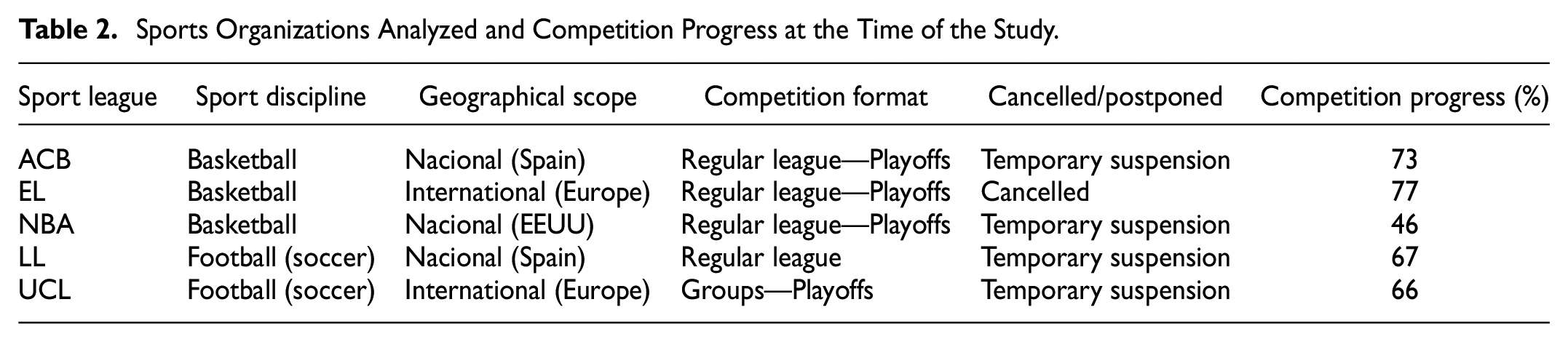
The final sample of this study is composed of 5,512 posts, collected from the official Facebook, Instagram, and Twitter accounts of the organizations considered in this study. The observed timeline considers two scenarios: a pre-pandemic period (from April 1 to April 14, 2019) and an initial pandemic period (from April 1 to April 15, 2020).
Coding and Data Collection Procedures
Data were manually extracted from the sample’s official social media accounts, observed, and then categorized. All information was transferred to an excel.xlxs file and then manually processed to create a database, which was used to calculate descriptive statistics. All publications in their different formats were analyzed manually.
Data analysis followed deductive reasoning using the coding method proposed by the authors and validated by experts in the field.
Inter-coder reliability was established before coding the entire dataset to ensure that all coders interpreted the variables and coded the dataset homogeneously. Thus, a random sample of 21 posts from the social networks under study was analyzed by the three authors. Inter-coder reliability was assessed using Cohen’s Kappa Coefficient, which was .518, described as a moderate level of agreement with the data (Landis & Koch, 1977). As this figure was below .61, coders participated in a session where discrepancies were discussed to ensure consistency of understanding and interpretation. The main problem lay in the understanding that a publication could be multi-factorial (in the category of the message and the stakeholders involved). Thus, it was decided that publications would be classified according to what was considered the main purpose the publication might pursue.
The three authors re-coded 21 more randomly selected publications, resulting in a very acceptable inter-coder reliability score of .669 (>.61; Landis & Koch, 1977).
Once inter-coder reliability was established, the sporting events were randomly distributed among the researchers. Data analysis was performed with SPSS v.27 software using descriptive statistical analysis (reporting frequencies and percentages for all variables). Frequencies were calculated for a single variable and for more than one variable at a time, with double-entry tables. In addition, a descriptive correspondence analysis was performed, a dimension reduction technique that allows the exploratory analysis of categorical variables to visualize a multidimensional point cloud in two dimensions, which provides an approximation of the relationship between the different variables that converge in the analysis.
Results and Analysis
This study allowed us to observe the strategies used at the digital level in two specific periods: a pre-pandemic period and an initial pandemic period. Out of the analyzed sports properties, Twitter ranks first as the preferred social network, followed by Instagram and Facebook (see Figure 1).

Distribution of publications by period and social media.
Concerning Twitter, a minor decrease in the percentage of publication frequency can be seen in both national and European football competitions (EL and ACB) and football competitions (UCL and LL). On the contrary, we can observe an increase in publication frequency on Instagram in the initial period of the pandemic in all competitions, except for the UCL, which maintains this frequency in both scenarios. The NBA, however, shows an inverse behavior, slightly increasing from 80% to 82% publication frequency on Twitter and decreasing by 3% on Instagram. As for Facebook, the publication frequency of the analyzed competitions in Spain and Europe has increased between 2% and 5% (Figure 2).

Frequency of daily publications pre-pandemic–pandemic.
In the pre-pandemic period, a heterogeneous distribution of the frequency of daily publications is observed, with peaks at weekends (days when matches are held), unlike the NBA, which shows an upward trend in publication frequency from Tuesday to Friday, with peaks on Thursdays (competition day according to the Anglo-Saxon calendar). At the beginning of the pandemic (the second period analyzed), however, different behavior is observed, where the daily frequency of total publications tends to remain homogeneous during the week, in the absence of official physical sports competitions. In terms of trend, we observe a similar number of publications throughout the week between both periods, with a more even distribution of the amount of daily content in the second period analyzed.
A relevant aspect of this study is the classification of content by categories according to each publication made on Twitter, Instagram, and Facebook of the sample analyzed.
In both periods, all basketball competitions have had zero social media action in the commercial aspect. However, LL used this approach in a pre-pandemic period.
From the engagement strategy point of view, the ACB (National) and EL (European) basketball competitions have opted to reduce their publications from 72% to 52%, and from 89% to 84%, respectively. In contrast, football competitions have opted to boost this strategy, increasing it drastically from 70% to 98% for LL and from 81% to 90% for UCL as shown in Table 3. The NBA, however, has remained almost unaffected, showing a reduction in this strategy by 2%.
Category of Publications by Type of Content.
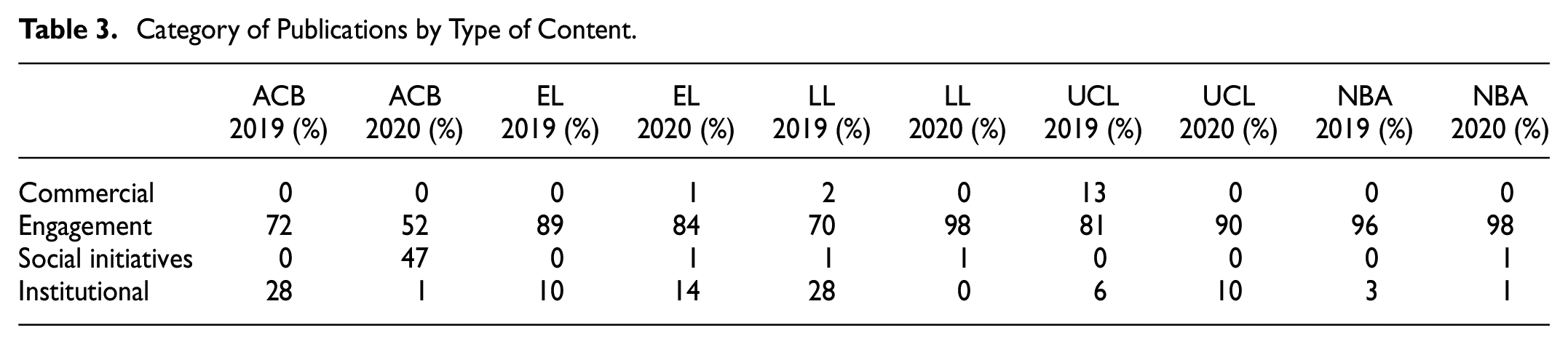
In the “Social initiatives” category, we can observe a significant increase by the ACB, which goes from having no publications with this approach in a pre-pandemic period to allocating 47% of its social social publications under this category. We also note that the “Institutional” approach goes through a reduction in its social networks publications from 28% to 1%, as does LL, which goes from 28% (pre-pandemic) to 0% in the pandemic period. The NBA, from a different geographical context, goes from 3% to 1%. On the other hand, continental competitions, such as EL and UCL, have chosen to increase this type of messaging during the start of the pandemic (Figure 3).

Relative difference in the formats used in pre-pandemic/pandemic publications.
Regarding publication format, irrespective of sports disciplines, scope, or geographical location, has migrated from the static image format to a more dynamic one with publications incorporating audio-visual content. However, beyond coinciding in the message categories, the format may vary according to the competition.
Nation-wide competitions in Spain such as ACB and LL increased their use of video format (+text+link) by 20.4% and 9.5% respectively, although under a different message category approach. Likewise, both competitions used the image (+text+link) format to a lesser extent in the pandemic period, although the ACB with a much larger relative margin of difference between periods. Finally, the text (+link) format has been used 14.2% more by the ACB in the pandemic period in comparison to the previous period and LL has decreased the use of this format by 10.2% in the pandemic period.
Concerning European competitions, both EL and UCL have used the Image (+link) format to a greater extent during the pandemic period, with 3.7% and 16.4% respectively. However, a reverse format use was observed between the two periods analyzed. EL focuses on audio-visual media in the pre-pandemic period (10.0% more) while UCL uses this format to a greater extent at the beginning of the pandemic period (9.6% more).
The NBA, on the other hand, migrates from a typical image format (+text+link) in a pre-pandemic period, to a more dynamic audio-visual format at the beginning of the pandemic, specifically 9.6% more in comparison to the previous period.
Due to the qualitative nature of the data collection tool, contingency analysis is used to observe the relationship between two or more variables. Through this multivariate analysis, we observed the relationship between the three areas covered in this study: message category, the format used, and stakeholders involved.
In 2019, a more homogeneous and similar behavior is observed in terms of the format used in social media posts and the focus of the message category (Figure 4).

Pre-pandemic/pandemic contingency analysis.
At the beginning of the pandemic, considering the period analyzed (April 2020), the figure shows different strategies for the same scenario. The ACB has opted for a more “social” strategy, with content linked to its website and messages referring to the COVID-19 pandemic. LL and UCL, however, have opted for a more engagement-oriented digital content strategy, seeking to connect and keep the audience active in a period with no current official competitions.
The NBA has decided to use survey formats (typical of the social network Twitter), as an element of interaction with the audience.
Discussion
Out of the five sports competitions analyzed, we have observed different strategies when dealing with social media management at the beginning of the COVID-19 pandemic. The ACB, for its part, has shown a strong inclination toward the social aspect, seeking interaction with fans through an altruistic approach. LL, however, has redirected its strategy to minimize the impact of (temporary) cancellations of sports competitions by generating engagement with fans, as a means of maintaining the interest and the link with the audience. Of the five established categories, we observed differences in key circumstances depending on the type of strategy used, the scope of the competition and sports discipline.
European-wide competitions, given the sudden pandemic situation and the prevailing uncertainty, coupled with the complexity of the stakeholders involved in the competition itself, forced the EL and UCL to make institutional publications through their social networks, to keep sponsors, athletes and fans updated on the future of the competition. Furthermore, the search for solutions between the parties became a key issue since the sponsorship assets committed could not be fulfilled as established.
In terms of publication frequency, Twitter ranks above in the number of publications made in both periods in all the sports competitions analyzed, corroborating, and in agreement with the studies by Herrera-Torres et al. (2017) and Winand et al. (2019).
We also observed a strong audio-visual focus in publication formats in a period during the pandemic, mainly due to the use of Instagram and the social focus and engagement strategies implemented. The statements made by Anagnostopoulos et al. (2018) reaffirm the relevance and elements of branding and fan loyalty to generate interaction with the audience by creating emotional content.
Conclusion
This research provides a comparison of differences and similarities in the management of social networks such as Facebook, Twitter, and Instagram in two specific periods (pre-pandemic and pandemic) by national and European football organizations (LL and UCL respectively), as well as national (ACB) and European (EL) basketball competitions, also contrasting with an external US basketball league(NBA), helping to understand this phenomenon from a model that differs from other models previously reviewed in the literature.
Regarding publication frequency, we have seen the predominance in the use of Twitter to other social networks analyzed. The number of posts per day is markedly different between pre-pandemic and pandemic periods. The frequency of posts is higher on competition days with a more homogeneous and linear behavior in the pandemic period due to the cancellation of competitions. However, despite this variable, the average number of publications was similar for both periods. As a result, we can conclude that competition organizers have chosen to redirect their strategies rather than decrease (or increase) the frequency of publications.
In terms of format, in general, posts with audio-visual content have been the fastest growing in the pandemic period due to their emotional charge combined with the need to connect with the audience despite the lack of official sporting activity.
Considering the descriptive and comparative analysis between specific pre-pandemic and pandemic periods, we conclude that the sports organizations analyzed opted for a different social media communication management strategy in terms of approach (although with similar objectives) and similar strategies in terms of the format.
In short, we can conclude that the research questions posed in this study have been answered, under the standards of scientific rigor and reliability.
Limitations and Future Research
Some of the limitations that should be considered are those inherent to the data collection techniques. The content analysis focused on analyzing the state of the debate in two specific time spectrums. In addition, the categories used in the present study, and the inter-coder reliability, could also become a limitation when categorizing the content analyzed. The initial pandemic period takes as a reference the state of alarm in Spain (March 2020). In different geographical regions, as is the case of other continents and governmental/political and health factors are susceptible to differences in terms of epidemiological timeline, being able to reach similar pandemic scenarios in different time periods.
Future research could consider the analysis of the impact on social networks of the different messages (analysis of quantitative interactions through “Like,”“Share,” and “Comment” quantifications, in their respective nomenclatures according to the social media). This type of study would be of interest to determine the differences over time and in terms of the type of content posted, as well as the comparative analysis of the content generated on social networks between entities and athletes.
Finally, this study is an original step in the development of a tool that differs from other existing proposals in the literature, mainly due to the need to incorporate modifications in the data collection table in order to respond to the unprecedented situation of a global health crisis. In the future, the proposal could serve to broaden and deepen other global studies by including data from other territorial and temporal scopes, variables, organizations, or even perform an analysis that achieves the objective of amalgamating different quantitative and qualitative research methods.
Footnotes
Acknowledgements
The authors would like to acknowledge the experts who contributed their excellent technical knowledge and valuable inputs to the development of this work.
The second author would like to acknowledge the support of the National Academic Excellence Scholarship Program “Carlos Antonio López” (BECAL), granted by the Government of Paraguay.
Declaration of Conflicting Interests
The author(s) declared no potential conflicts of interest with respect to the research, authorship, and/or publication of this article.
Funding
The author(s) received no financial support for the research, authorship, and/or publication of this article.
