




Abstract
This research examined the influence of the distance mode of teacher training on quality teacher performance at the pre-tertiary level of education in Ghana. The study used the quantitative approach involving 304 participants who completed teacher training through the distance education mode and taught at the Kindergarten, Primary School, Junior High School, and Senior High School. Data were sourced via a survey questionnaire and follow-up in-class observations. Analyses were made analyzed using descriptive statistics and ANOVA. The survey results revealed that, generally, the teachers engaged in quality classroom performance. Data from the in-class follow-up observations largely confirmed the teachers’ performance self-assessment as measured by the survey. It is hoped that the discussion stimulated by the findings will affect the general discourse on the impact of performance assessments on teacher learning and teaching practices at the pre-tertiary level in Ghana and beyond. Although this research is limited in generalizability because of its focus on only a Ghanaian context, it has some significant implications for teaching practices and the quality of teacher performance assessments across the globe.
Plain Language Summary
This study was conducted to find the influence of the distance mode of teacher training on quality teacher performance at the pre-tertiary level of education in Ghana. The study used 304 participants who completed teacher training through the distance education mode and taught at the Kindergarten, Primary School, Junior High School, and Senior High School. The participants completed a survey questionnaire and their lessons were observed. After analyzing the data, the survey results revealed that, generally, the teachers engaged in quality classroom performance. Data from the in-class follow-up observations largely confirmed the teachers’ performance self-assessment as measured by the survey. It is hoped that the discussion stimulated by the findings will affect the general discourse on the impact of performance assessments on teacher learning and teaching practices at the pre-tertiary level in Ghana and beyond.
Introduction
Quality teacher performance is crucial in national development because it leads to quality learning outcomes which are “centre stage to Sustainable Development Goal (SDG) 4 and supported by a general global commitment to improving quality in education” (The Commonwealth Education Hub, 2016, p. 1). Although several factors, including well-resourced learning environments, well-written self-contained study materials, effective monitoring, and delivery systems, have all been acknowledged as contributing to quality teacher performance (Larson & Owusu-Acheaw, 2016; Salifu, 2021), the influence of quality professional training on teacher performance is by far more impacting without which teachers cannot meet learners’ needs (Aslam et al., 2021; Colognesi et al., 2021; Owusu-Mensah et al., 2015). It has therefore been argued that quality professional training of teachers is a critical issue in every educational discourse because it offers potential teachers both practical and theoretical experiences needed to deliver quality performance in the classroom leading to desirable learning outcomes (Nessipbayeva, 2012; Ning et al., 2020).
From an educational perspective, the concept “quality” refers to the measurement of the extent of achievement of attitudes, behavior, competence, knowledge, and skills defined in a national curriculum (Asare & Nti, 2014; Barrett et al., 2006). As applied in this current research, the concept similarly refers to the measurement of the extent to which professional training of teachers by the distance mode in Ghana meets the standard set in the national curriculum for classroom performance at the pre-tertiary level of education (i.e., Kindergarten, Primary, Junior High School, and Senior High School).
According to Van Kemenade et al. (2008), measuring quality teacher performance is difficult without first setting the parameters of quality teaching. Doing so serves as the basis for assessing the quality of teacher performance. The framework for determining quality teaching has already been identified and classified broadly by Barrett et al. (2006) as effectiveness, efficiency, equality, relevance, and sustainability. However, because this research used the context of Ghana, we assessed quality teaching based on a framework specified by the country’s National Inspectorate Board of Education (NIBE) (n.d.). Elements of the framework were structuring and organizing lessons, creating a positive climate, providing a well-designed task, teaching interactively, assessing learning, engagement and attitudes, and attainment. Guided by the framework, a range of issues were examined in the research, some of which were stating objectives clearly, utilizing learners’ prior knowledge to introduce new concepts, and learner-centered teaching (see Appendixes “A” and “B”).
Teacher Training Context in Ghana
Teacher training in Ghana is offered in about 47 Colleges of Education and six universities. The training is done mainly by two modes, namely regular face-to-face and Distance Education (DE). While the face-to-face mode is offered through the traditional residential system and sandwich, the DE mode is done via learning centers across the country (Asare & Nti, 2014). This research was delimited to only an investigation on the DE mode because, as a new concept in the country’s teacher education sector, concerns were raised about its ability to meet the quality requirement of the national policy of transforming teacher education and learning (T-TEL) (Asare & Nti, 2014).
Research evidence suggests that the DE mode of teacher training has grown over the past two decades in many parts of the world (Carrillo & Flores, 2020; Essig, 2020; Salonen et al., 2021). However, in Ghana, it was introduced just a little over a decade ago by a few older universities, such as the University of Cape Coast, and the University of Education, Winneba. Before the period, teachers had their training to teach at the pre-tertiary level through only the traditional face-to-face mode. According to Larkai et al. (2016), since its inception in the country, the DE mode has witnessed an increased enrollment of students. An earlier study by The Ghana National Council for Tertiary Education (2015) on enrollment of tertiary students in the mode for 7 years (2008/2009–2014/2015) revealed that enrollment rose by 39.4% in the previous 2 years. This emerging trend has also become evident in the increase in study centers and the introduction of more teacher training programs (Armah, 2017; Larkai et al., 2016).
From the records above, it is clear that the DE mode of teacher training in Ghana has been churning out many teachers for pre-tertiary level teaching. However, what appears uncertain is whether the mode adequately prepares teachers for the standard set for quality teacher performance in the country based on the NIBE framework explained in the third paragraph of the previous section. It is this vagueness that informed the objective of the present study to examine the influence of the DE mode of teacher training on quality teacher performance at the pre-tertiary level of education in Ghana (i.e., Kindergarten, Primary, Junior High School, and Senior High School) taking into consideration the NIB framework. Consistent with our study objective, we posed the question: What is the influence of the DE mode of teacher training on quality teacher performance at the pre-tertiary level of education in Ghana?
Theorizing Distance Education
The practice of Distance Education (DE) is presumed to have started in Europe in the early part of 1800. It has since evolved, and currently, it only does not complement the traditional face-to-face campus-based tuition but also serves as a reliable alternative learning mode across the globe (Carrillo et al., 2020; Przymuszała et al., 2022; Semenets et al., 2020). According to Przymuszała et al. (2022), since the inception of DE, authorities have differed in its understanding, explanation, and usage, leading to persistent challenges in its conceptualization. However, the need for lifelong learning and the quest for unprecedented technological innovations in communication, coupled with fast societal changes, have made many authorities, such as Attah-Mensah et al. (2016), Badu-Nyarko (2013), Fojtík (2018), and Hong and Jung (2011), to theorize DE as an approach in the forefront of educational practice. Despite this consensus, opinions still vary on how to describe it as an approach. For instance, while some scholars such as Hong and Jung (2011) and Badu-Nyarko (2013) consider it purely from the angle of learner independence, other authorities such as Attah-Mensah et al. (2016) and Fojtík (2018) instead theorize it as a social interaction in which the learner is dependent on the teacher.
Despite the ideological differences, DE has commonly been theorized as a mode of education delivery dispensed mainly through virtual correspondence but sometimes with a provision made for occasional face-to-face interactions at designated learning centers (Badu-Nyarko, 2013). The evolution of DE appears to have given rise to the use of different terms to explain what it is. For instance, while in academia, the term “distance learning” is a preference for describing DE (Badu-Nyarko, 2013; Hong & Jung, 2011; Larson & Owusu-Acheaw, 2016), in the industry, the term “distance training” is instead commonly used (Essig, 2020; Semenets et al., 2020). The popularity of DE in recent times has mainly been attributed to its flexibility allowing instructors and students to interact remotely at their convenience (Essig, 2020).
Challenges Confronting the DE Mode of Teacher Training in Ghana
Owusu-Ansah et al. (2021) found that most universities offering instruction through the DE mode in Ghana were seriously affected by the absence of strategic supports, consistent policies, and dedicated funding for digital library initiatives. The study further revealed that, as of 2011, three decades after the initial implementation of the mode in Ghana, the country was yet to incorporate an effective plan to use Information and Communication Technology (ICT) into instructional delivery. According to the study, the worst affected sector was teacher education, which was yet to fully utilize the infrastructure for training teachers who were supposed to lead the way.
In another study in the country on students’ perception of the DE delivery mode, Oteng-Ababio, (2011) noted a negative attitude toward examination-related issues. The study also revealed challenges such as untimely delivery, poor editing of modules, and poor arrangement of examination schedules undermined the program structure. It further found that sustainable assessment procedures were also not in use.
For his part, Owusu-Mensah (2015) identified the lack of strategic human resource development policies concerning the training of technical, administrative, and other ancillary staff at the study centers. According to him, the situation was likely to reflect negatively on tutorials at the centers since the DE mode needed planning and administrative support. In the view of many researchers such as Attah-Mensah et al. (2016), Cobbold (2015), and Kumi-Yeboah et al. (2014), the DE mode of teacher training in Ghana is instructor-centered in which trainers view trainees as people in dire need of prescriptive advice and guidance about how to teach. This mentality does not consider whether the prescriptions are suitable for the learning contexts of trainees (Kumi-Yeboah et al., 2014). Again, the structure of the teacher training programs in the country also puts more emphasis on the theoretical acquisition of knowledge than practical teaching skills. In Kumi-Yeboah et al.’s view, this situation tends to affect the trainees’ ability to meet the complex demands of learners by drawing on and mobilizing psychosocial resources (including skills and attitudes) in a particular context when they become teachers. Outside Ghana, many researchers have also expressed a similar concern. For example, Donitsa-Schmidt and Ramot (2020), Fojtík (2018), Hong and Jung (2011), Nessipbayeva (2012), and Salonen et al. (2021) have argued that teacher preparation, in the 21st-century, should be done in terms of roles and competence to teach while emphasizing a collegial professional learning effort which requires a blend of efforts of lecturers, students, technology experts, and administrators and the institution’s actual contribution in policies and resource provision.
Methods
Design and Sample
We conducted this research using a quantitative cross-sectional survey and follow-up in-class teaching observations. We used the observation data to shed light on the initial survey data (Creswell, 2014). We used four techniques to arrive at our sample. First, we used the modal purposive sampling technique. In applying the technique, we considered the sizes of the institutions and the effectiveness of their teacher training programs. We chose two Ghanaian universities because they were more organized teacher training institutions and had a larger student population. We used the same modal purposive technique to select one of the 16 regions of the country as the study area, considering that it was the most populous region and had the highest concentration of schools and teachers (Ghana Statistical Service, 2021; Ministry of Education, 2018).
Because it was laborious to identify teachers in the selected region who had completed their teacher training via the distance mode at the two universities, we used the snowball method as a second technique through which we initially relied on 11 teachers from two schools to access many other qualified participants. After getting many participants through the technique, we used the non-proportional quota method as a third technique to select a uniform number of 155 participants who completed their teacher training in the two institutions, bringing the total to 310. However, we used 304 participants for the final analysis because six teachers inappropriately filled out their questionnaires, which we excluded. The sample size was deemed appropriate given that by Krejcie and Morgan’s (1970) procedure for sample size determination, the minimum sample size for the research should be 291 participants based on a 95% confidence level and a 5% margin of error.
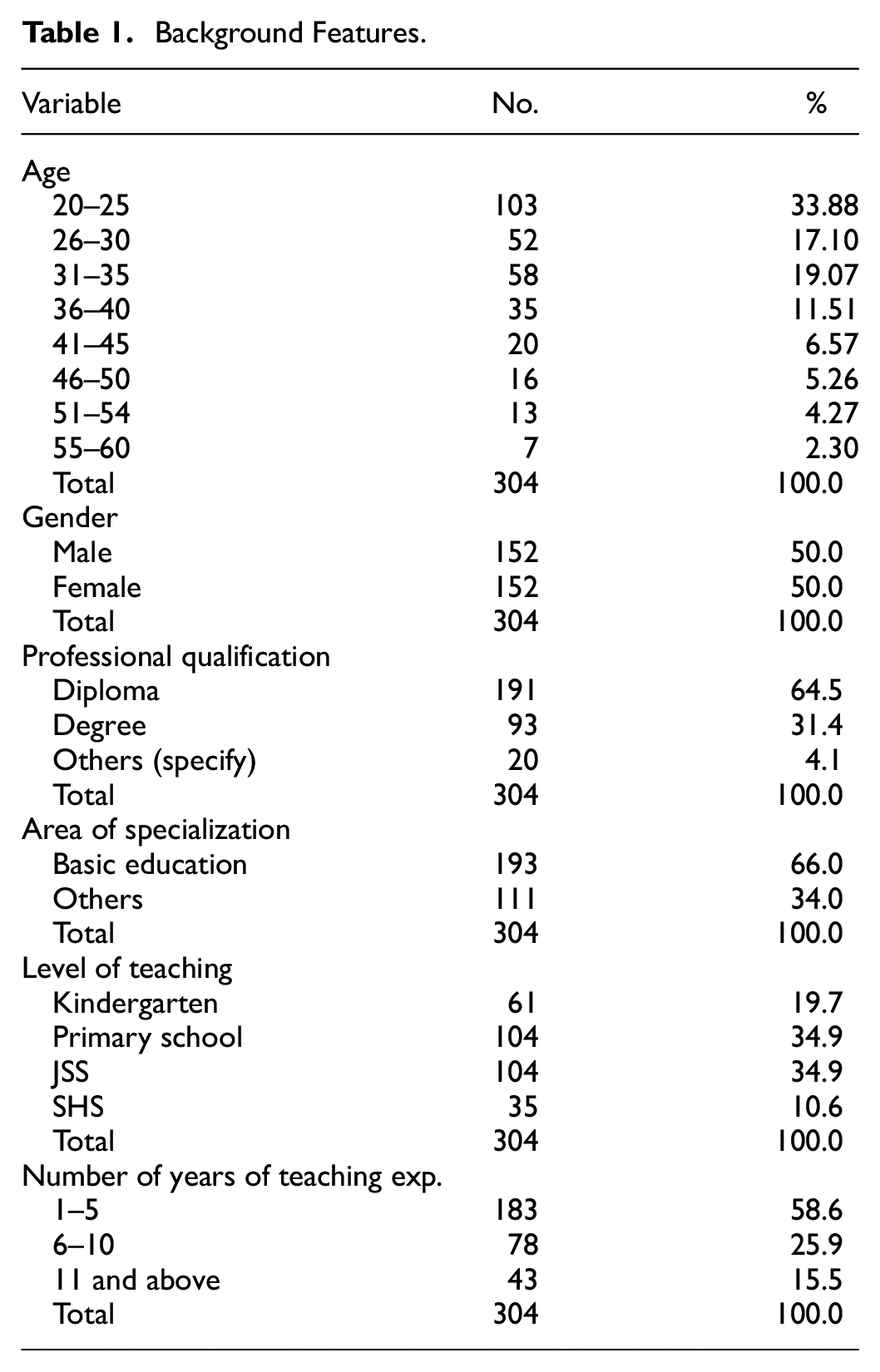
The fourth and final technique we used was the simple random sampling method. The list of participants used for the survey served as the sample frame from which we randomly selected 76 participants to take part in the follow-up in-class teaching observations. The number represented 25% of the 304 teachers who participated in the survey. Table 1 summarizes the background features of the sample in frequencies and percentages.
Background Features.
Setting
This research used two Ghanaian universities. The first university was established in 1962 as the first tertiary institution to train and award teacher-professional qualifications at certificate, diploma, bachelor’s, and master’s levels. The unit of the university in charge of its teacher training program in the distance mode is the College of Distance Education (CoDE). The College had 69 DE learning centers across the country (Asare & Nti, 2014) at the time of the study.
The university offered the following programs via the DE mode to give pre-service teachers professional training: 3-year Diploma in Early Childhood Education (DECE), a 3-year Diploma in Primary Education (DPE), a 3-year Diploma in Junior High School Education (DJHSE), 2-year Postgraduate Diploma in Education (PDE) for non-professional teachers who already have Bachelor Degrees, 5-year Bachelor of Education Programme in Early Childhood Education (B.Ed. Early Childhood), 5-year Bachelor of Education Programme in Primary Education (B.Ed. Primary Education), and 5-year Bachelor of Education Programme in Junior High School Education. These programs prepared pre-service teachers for general specializations to teach all subjects at the pre-tertiary level.
The programs designed to equip pre-service teachers with professional competence to teach specific subject areas included: 3-year Diploma in Mathematics Education (DME), 3-year Diploma in Science Education (DSE), 2-year Bachelor Degree in Educational Psychology, 2-year Bachelor Degree in Educational Foundations, 2-year Bachelor Degree in Mathematics Education for Diploma in Mathematics and Science Education Holders or its equivalent from recognized tertiary institutions, 2-year Bachelor Degree in Science Education for Diploma in Mathematics and Science Education Holders or its equivalent from recognized tertiary institutions, 3-year Bachelor Degree in Basic Education (3PDE) for holders of Specialist Certificates in Education or Diploma in subjects other than Education from recognized tertiary institutions, 3-year Bachelor Degree in Educational Psychology (3BEP) for holders of Specialist Certificates in Education or Diploma in subjects other than Education from recognized institutions, 5-year Bachelor of Education Programme in Accounting (B.Ed. Accounting), 5-year Bachelor of Education Programme in Management (B.Ed. Management), 5-year Bachelor of Education Programme in Social Studies (B.Ed. Social Studies), and 5-year Bachelor of Education Programme in Arts (B.Ed. Arts).
The second university was established in 1992 with the same mission of training professional teachers at the levels cited previously. The university ran its distance education programs through its academic unit called the Institute of Distance and E-learning (IDeL). The Institute had 40 learning centers across the country (Asare & Nti, 2014).
The university offered the following programs via the DE mode to give pre-service teachers professional training: 1-year Diploma in Education, 3-year Diploma in Basic Education, 3-year Diploma in Early Childhood Education, 2-Year Post Diploma (Bachelor of Education) in Basic Education, 2-Year Post Diploma (Bachelor of Education) in Early Childhood Education, 4-year B.Ed. in Basic Education, and 4-year B.Ed. in Early Childhood Education. These programs prepared pre-service teachers for general specializations to teach all subjects at the pre-tertiary level.
The programs designed to equip pre-service teachers with professional competence to teach specific subject areas included: 3-year Diploma in Accounting Studies, 3-year Diploma in Management Studies, 3-Year Post Diploma (Bachelor of Arts) in English Language Education, 3-Year Post Diploma (Bachelor of Arts) in Social Studies Education, 3-Year Post Diploma (Bachelor of Arts) in Social Studies Education, 3-Year Post Diploma (Bachelor of Science) in Mathematics Education, 4-year B.A. in English Language Education, 4-year B.Sc. in Mathematics Education, and 4-year B.A. in Social Studies Education.
In both universities, aside from coursework, practice teaching for practical skills was also a key component of the program structure. The practice teaching took the form of attachment or internship for one academic year, during which pre-service teachers learnt how to teach in assigned schools under the supervision of mentors. The mentors were also required to write a report on the trainees’ learning experiences. The mentors’ work was complemented by selected faculty members who paid periodic visits to the schools to assess the classroom performance of the trainees and offer suggestions for improvement (Asare & Nti, 2014).
Instruments
We used a self-constructed questionnaire (see Appendix “A”) and an in-class teaching observation guide (see Appendix “B”) as instruments for the research. The questionnaire had two sections of closed-ended items. The first section (“A”) had eight items asking participants to tick boxes to indicate their ages, genders, level of teaching professional qualification, the number of years since qualification was awarded, area of specialization, subject(s) taught, the level at which teaching was done, and the number of years of teaching experience. Section “B” had 17 items on the quality of classroom performance. We formulated all the questions in Section “B” according to views in the literature on the influence of the DE mode of teacher training on quality teacher performance by authors such as Donitsa-Schmidt and Ramot (2020), Fojtík (2018), Salonen et al. (2021). Attah-Mensah et al. (2016), Cobbold (2015), and Kumi-Yeboah et al. (2014),
We used the 5-point Likert scale (strongly agree-5; agree-4; unsure-3; disagree-2; and strongly disagree-1) to measure the responses to items in the second section. Before using the instrument, we conducted a pilot test to ascertain its validity and reliability. Our face validity test proved that the questionnaire met the research purpose. The reliability co-efficient test also provided Cronbach’s alpha of .78. To use the in-class teaching observation guide, we redesigned the questionnaire (see Appendix “B”), allowing the “Yes” or “No” option to be used against each of the 17 items in its second section.
Data Collection and Analysis
Using a self-administered questionnaire and a follow-up in-class observation guide, we collected primary data in a paper-and-pencil format. For ethical reasons, the researchers applied and obtained ethical clearance numbered ECH 101/20-21 from the University of Ghana Ethical Committee before commencing the research. We also had permission from the Regional Directorate of Education of the Ashanti region. We obtained informed verbal consent from the teachers and made them aware that their participation in the study was voluntary and had the free will to withdraw at any stage.
For the survey aspect of the research via the questionnaire, we used 47 days. We cleaned and entered returned questionnaires into the computer for analysis using SPSS version 25.0. We analyzed the group means and variance (ANOVA) to compare the different levels of influence of the distance mode of teacher training on teacher performance at the various levels of pre-tertiary education in the study areas.
The follow-up observations took 38 days. Before the observations, the 76 selected teachers voluntarily agreed to be observed teaching in class. All four of us simultaneously observed one lesson for each participant, lasting for an average of 35 min. We used the opportunity to independently tick the “Yes” or “No” option against each of the 17 items in the in-class teaching observation guide. Through this action, we aimed to assess classroom performance quality. After the observations, we compared data, put them together, and analyzed them using frequencies, percentages, means, and standard deviations.
Results and Discussion
This research mainly investigated the influence of the DE mode of teacher training in Ghana on quality teacher performance at the pre-tertiary level of education (i.e., Kindergarten-KG, Primary-PS, Junior High School-JSS, and Senior High School-SHS), taking into consideration the NIBE framework described in the introductory section of this paper. Table 2 presents the results of the preliminary fieldwork in which participants indicated their levels of agreement or disagreement with 17 key indicators of quality teacher performance. From the table, while all the teachers in JHS (4.57), SHS (4.87), KG, and PS (3.98) averagely had self-efficacy in their ability to deliver lessons that were “measurable, achievable, realistic and time-bound,” the results of the ANOVA test show there were differences in the extent to which JHS and SHS perceived their self-efficacy compared to their counterparts at the KG and PS levels (F = 10.376, p < .01). Also, there were significant differences in how teachers who taught in SHS (4.92), JHS (4.69), KG (4.29), and PS (4.14) reviewed learners’ previous knowledge to introduce new concepts (F = 7.52, p < .01). While all the teachers in JHS (4.69), SHS (4.93), KG (4.14), and PS (4.27) actively involved learners in instructional activities, the results of the ANOVA test indicate that there were significant differences (F = 9.465, p < .01). The results in the table further show that there were significant differences in how SHS (4.93), JHS (4.30), PS (4.24), and KG (3.86) teachers trained by the distance mode used technological tools to make lesson delivery easier and interesting (F = 7.594, p < .01). For example, compared to KG teachers, the majority of SHS teachers were more likely to use technological tools to make lesson delivery easier and interesting.
ANOVA.
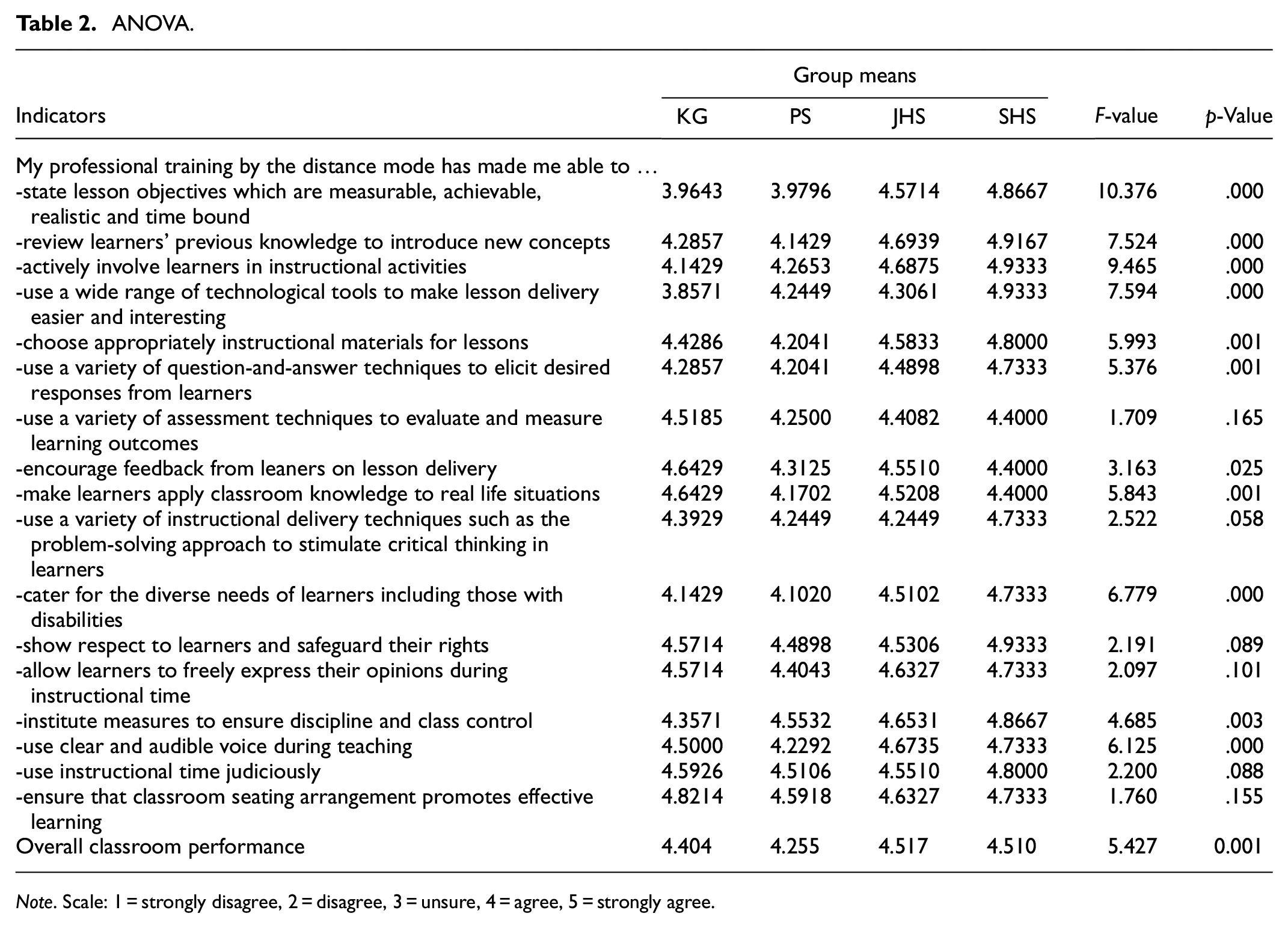
Note. Scale: 1 = strongly disagree, 2 = disagree, 3 = unsure, 4 = agree, 5 = strongly agree.
Evidence in the literature suggests that accountability in teaching has surged globally because of the increasing quest to hold teachers responsible for their performance (Aslam et al., 2021; Attah-Mensah et al., 2016; Donitsa-Schmidt & Ramot, 2020). This development appears buttressed by the present research indicating that the teachers were generally accountable for their performance and taught responsibly by engaging in many activities which manifested quality teaching—a revelation that underscores the positive influence of the DE mode on teacher classroom performance. As Kumi-Yeboah et al. (2014) observed, the structure of many programs offered in the DE mode of teacher training in Ghana puts a premium on the theoretical acquisition of knowledge while relegating to the background practical teaching competence. This situation could affect pre-service teachers’ ability to meet the complex demands of learners when they become full-fledged teachers. Research shows that teacher performance quality accounts for at least 7.5% of student achievement differences (Nketia, 2023).
In our considered opinion, the DE mode of teacher training in Ghana should do more to improve the quality of teacher performance to engender development in the country’s education system. We make this assertion because teacher training has a direct relationship with teacher performance, and the success or failure of the latter is directly dependent on the former. Therefore, the setbacks in teacher performance at the lower level of education in the country could be due to an ineffective teacher training system. For DE mode teacher training institutions in Ghana to effectively train professionals for quality classroom teaching, the curriculum needs to be well-planned to emphasize the use of an independent and social approach to learning with adequate current technological assistance (Kumi-Yeboah et al., 2014; Semenets et al., 2020).
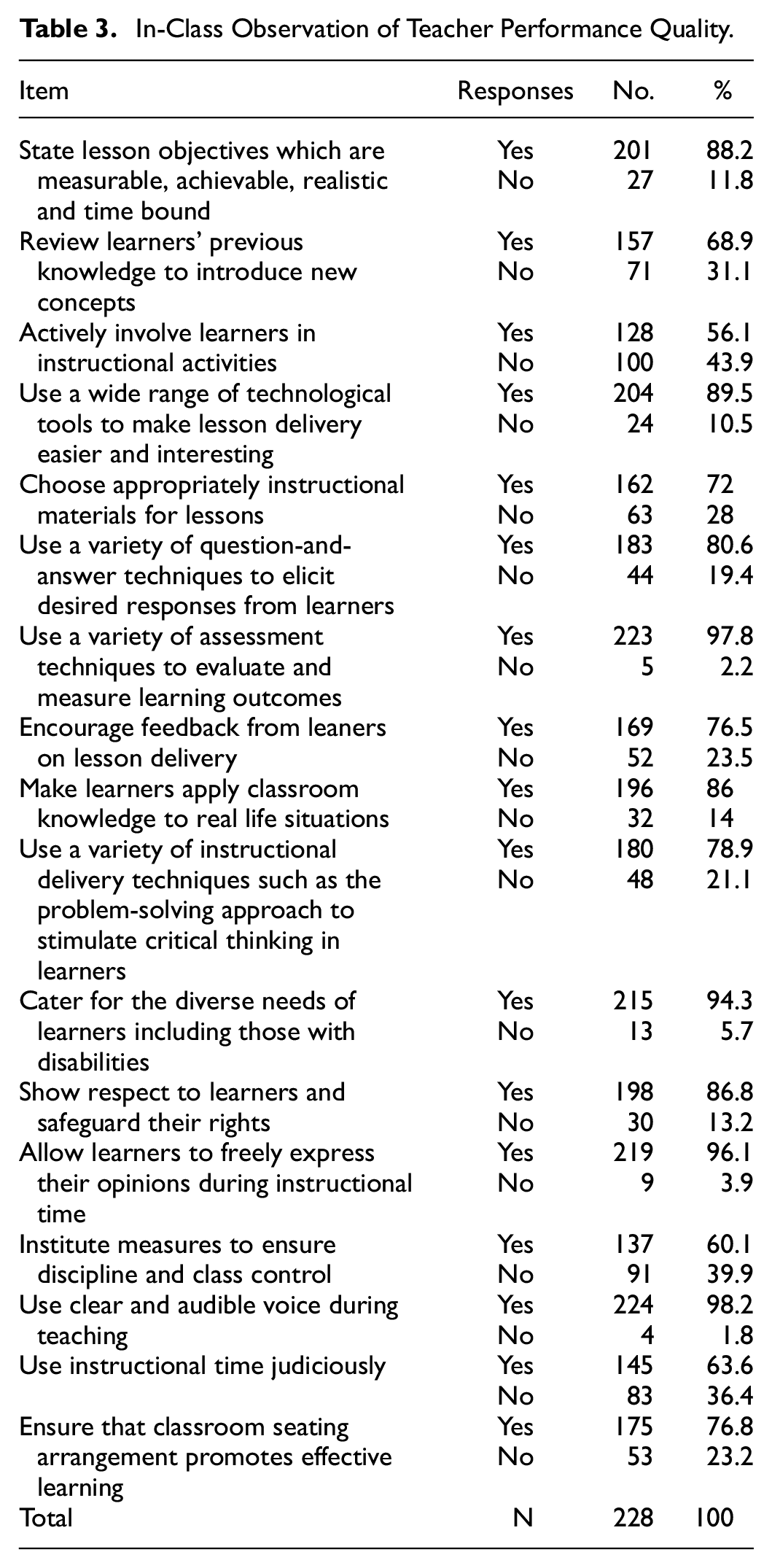
To confirm the results obtained from the preliminary fieldwork in which the teachers indicated their levels of agreement or disagreement with key indicators of quality teacher performance, all four of us made in-class follow-up observational visits to each of the 76 selected teachers giving a total of 228 observations (i.e., 3 × 76) (see the last paragraph of “Data collection and analysis”). Data from the in-class observations largely confirmed the teachers’ performance self-assessments as measured by the survey. From Table 3, the four observers’ objective assessments of the presence or otherwise of the 17 indicators of quality teacher performance revealed some insightful outcomes. To comment on the most significant and curious aspects of the results, it is worthy of note that while 43.9% of the observations showed that the teachers did not actively involve learners in instructional activities, 39.9% revealed that the teachers did not institute measures to ensure discipline and class control, and 36.4% showed that teachers did not use instructional time judiciously. These results contradict the positive feedback the teachers, especially those at the JHS, SHS, KG, and PS levels, gave on their efficacy in many classroom performance areas, including these.
In-Class Observation of Teacher Performance Quality.
Clearly, the data invite us to reconsider the unidimensional modes of teacher quality performance assessment commonly practiced today. While generally similar, the differences revealed between the assessments of the four observers and the responses given by the teachers on the questionnaire cannot be ignored. Assessing the quality of teacher performance may lose value when it is done only from the self-assessment scores of the teacher (Luskova & Hudakova, 2013; Chung, 2008). To ensure such assessments are objective, there is the need to compare them with those of independent observational data. In our view, it is only when multiple observations are made with a single standardized instrument that one can be sure of a balanced performance assessment. This approach has been found in previous research to be effective in providing objective teacher performance assessments (Chung, 2008; Colognesi et al., 2021; Donitsa-Schmidt & Ramot, 2020). In Chung’s (2008) research, for instance, the corroboration of “teacher self-report with observational data and evidence from lesson debriefs” (p. 8) provided some validity for the Performance Assessment for California Teachers (PACT) portfolio. That said, the outcome of this study also reveals, to some extent, that the potential subjective interpretations of the measures of teacher quality performance, even by independent observers, may lend themselves to discrepancies.
Conclusion
As with every research, this current study has some limitations. The first is the non-probability sampling techniques used in the selection process, particularly the choice of one out of the 16 regions of the country. This weakness means the findings cannot be generalized for the entire teacher population in the country who had their professional training via the DE mode. A further study across more regions is, therefore, necessary to further validate the findings of this research.
Again, the internal validity of the causal interpretations in this research may also be a weakness because of the cross-sectional survey design employed. On this account, we recommend a longitudinal experimental study that will provide researchers with sufficient time for long-term observations of teacher classroom performance. Despite its limitations, this research is timely and significant given that the Government of Ghana has recently introduced a free secondary education policy, implying that second-cycle schools would be churning out students, many of whom would seek admissions into tertiary institutions. The assumption is that infrastructural constraints may make it difficult for tertiary institutions to provide enough classroom spaces for the anticipated high number of potential applicants to pursue studies via only the face-to-face mode. The distance mode could play complementary role in education provision, particularly within a hybrid learning environment. Although the present study focused only on teacher training using the distance mode, the findings could have implications for all forms of learning via the distance mode. On the international scene, the objective follow-up observations made in the research have improved the reliability of the data set, thereby contribution to the global debate on how to achieve the United Nations’ Sustainable Development Goal 4, which emphasizes a global commitment to improving quality in education.
Footnotes
Appendix
Acknowledgements
The researchers acknowledge the immense contributions of colleagues who provided the needed feedback for an improvement of the research.
Declaration of Conflicting Interests
The author(s) declared no potential conflicts of interest with respect to the research, authorship, and/or publication of this article.
Funding
The author(s) received no financial support for the research, authorship, and/or publication of this article.

Data Availability Statement
Data sharing not applicable to this article as no datasets were generated or analyzed during the current study.