



Abstract
Professional development (PD) programs are considered as essential for improving the teacher quality and performance in schools. Despite introducing several PD programs, the teachers’ quality in the public schools is a matter of concern for Pakistan. It has become a challenge for policymakers and school leaders to design PD programs which can be effective for all teachers. PD programs in Pakistan normally undertakes a standard approach without considering the strengths and weaknesses of different groups of teachers which may not address the specific needs of these groups. There is a need of structuring PD programs to make these learning opportunities more effective for teachers. Therefore, the current study evaluates the teacher competencies of different groups of teachers in Pakistan’s public schools. For that purpose, the study first identifies three key themes of teacher competencies required in 21st century from extant review of recent literature. Interview guide then is designed based on these key teacher competencies to solicit information from seven principals of public schools. The public schools were selected using the criteria of size of school and principal working experience in that school. Structured interviews been used as a medium for collecting data from the principals. All interviews were recorded and transcribed verbatim. The deductive content analysis approach was used in analyzing the data. The analytical tool used for the coding of themes was the MAXQDA software. The results highlighted certain differences in teacher competencies varying from gender to age. Female teachers and teachers who are younger in general are found to have more competencies compared to male teachers and senior teachers. The results of this study offer vital information for planning and tailoring TPD programs for teachers. These specially designed learning opportunities can be more effective for the professional development of teachers and can foster teachers’ competence.
Plain Language Summary
Despite introducing several PD programs, the teachers’ quality in the public schools is a matter of concern for Pakistan. It has become a challenge for policymakers and school leaders to design PD programs which can be effective for all teachers. PD programs in Pakistan normally undertakes a standard approach without considering the strengths and weaknesses of different groups of teachers which may not address the specific needs of these groups. There is a need of structuring PD programs to make these learning opportunities more effective for teachers. Therefore, the current study evaluates the teacher competencies of different groups of teachers in Pakistan’s public schools. For that purpose, the study first identifies three key themes of teacher competencies required in 21st century from extant review of recent literature. Interview guide then is designed based on these key teacher competencies to solicit information from seven principals of public schools. The public schools were selected using the criteria of size of school and principal working experience in that school. Structured interviews been used as a medium for collecting data from the principals. All interviews were recorded and transcribed verbatim. The deductive content analysis approach was used in analyzing the data. The analytical tool used for the coding of themes was the MAXQDA software. The results highlighted certain differences in teacher competencies varying from gender to age. Female teachers and teachers who are younger in general are found to have more competencies compared to male teachers and senior teachers. The results of this study offer vital information for planning and tailoring TPD programs for teachers. These specially designed learning opportunities can be more effective for the professional development of teachers and can foster teachers’ competence.
Keywords
Introduction
Background of the Study
Public school performance has been a matter of concern for Pakistan (Parveen et al., 2021). The public schools’ performance has declined over time, providing the space for the private sector, which enrolled one-third of all students (Tahira et al., 2020). The government is taking many initiatives to improve the performance of public schools (Mahmood et al., 2021). Some researchers in the country concluded that the lack of resources available in public schools led to the poor performance of schools (Ahmed et al., 2022; Gillani, 2021). Teachers, however, have a direct responsibility to shape a student’s academic achievement and are considered as the key factor in the school environment (Bassey et al., 2019; Marlina et al., 2021; Tahirsylaj, 2019).
Teacher individual characteristics predominantly affects the students’ performance in schools (Sirait, 2016). Many studies highlighted that teacher characteristics such as education background, experience, perseverance, teacher evaluation score, preparedness of course work are the variables for improving student performance (Darling-Hammond, 2000; Dobbie, 2011; Kane et al., 2008; Milanowski, 2004; Rockoff, 2004). Teacher characteristics create an environment in the classroom that leads to students performing positively or negatively (Khalilzadeh & Khodi, 2021; Nguyen et al., 2022). Some characteristics of teachers foster classes to exhibit friendliness and cooperation, while other characteristics create an environment of jealousy, unhealthy competition, or hostility (C. J. Ferguson & Johnson, 2010). The favorable characteristics and behaviors that contribute positively to the school environment are defined as teacher competencies in the school (Ali & Haider, 2017; Kawuryan et al., 2021).
To polish the teacher competencies, various teacher training programs are needed for a variety of teachers working in schools (Siddiqui, 2019). Teacher differs in qualities on the basis of gender (Ahmad et al., 2020). The authors of that study further stated that female teachers provide better delivery during theory classes, whereas male teachers’ performance is better in laboratory-based classes. Teachers also evolve during in service experience and develop different qualities as a result of “learning by doing” effect (Rice, 2003). As various teachers differ in performances, it has become a challenge for policymakers and school leaders to design PD programs to help all their teachers become as effective as the best teachers (Sims et al., 2021). Several training programs were initiated and executed across Pakistan but failed to achieve the desired outcome (Siddiqui et al., 2021). There is a need of systematizing professional training programs and their continuation (Arif et al., 2022). Therefore, this study seeks to understand the qualities presents in public school teachers and their differences based on gender and experience. That provides valuable information for the policymakers to design the teachers’ training programs by keeping in mind the actual state of teachers’ qualities.
Research Problem and Purpose of Research
A developing country like Pakistan needs to improve the teaching standards and overall quality of education. The public-school performances have been a matter of concern for Pakistan since long time. The government is introducing different professional development opportunities for the teachers to improve the performance of teachers and schools. Despite increased focus on teacher professional development (TPD), very little work has been done on understanding the individual characteristics and competencies of teachers working in public schools (Ahmad et al., 2020). Because of lack of research on this area, training programs are less effective as they are not designed by keeping in mind the individual characteristics of teachers (Arif et al., 2022). Therefore, this study tries to understand the qualities of teachers in the public schools of Pakistan. The research also highlights the core difference in the competencies of teachers across gender and experience. The study analyzes the difference in key teacher competencies as perceived by principal in schools. Principal as the primary stakeholder of school have much information about the individual strengths and weaknesses of teachers working under him/her. This approach of measuring teacher competencies also provides a guiding framework of not just exploring teacher competencies in general but also assess the individual differences among different groups in school environment. Furthermore, professional development programs centered on teachers’ core competencies has proven to be more effective for improving teachers’ competencies than the traditional cascade approach for training. This research establishes a framework for assessing teacher competencies which can be used as a guiding framework for PD programs of teachers in other contexts as well. The framework consists of key modern-day competencies required to be an effective teacher in the 21st century. It has been developed through extant review of recent literature in the field of teacher knowledge. Therefore, it can be used as a modern-day guiding criterion in other context for assessing teacher competencies in school environment. The study also paved a pathway for policy makers in Pakistan to design the training programs for school teachers which can foster their competence as required in the 21st century.
Literature Review
Teacher Knowledge
It is challenging to describe teacher knowledge with a universal definition (Hopkins & Stern, 1996). The dynamic nature of teaching makes it hard to summarize different aspects of teaching attributes into one single definition (Wiens et al., 2013). For some researchers, teacher knowledge relies primarily on content knowledge and “verbal ability” (Ballou & Podgursky, 2000; Hess, 2004; Tatto & Senk, 2011). Another set of researchers stated that quality teaching could be achieved by acquiring specialized knowledge and methods (Cochran-Smith, 2004; Darling-Hammond & Bransford, 2007). Wiens et al. (2013) described quality teaching as providing continuous emotional and social support to students to develop them cognitively. Despite differences, there is consensus in researchers that having positive characters can be defined as teacher knowledge.
Some researchers in the past have defined teacher knowledge by combing two aspects of teacher knowledge: knowledge of general pedagogical principles and skills and knowledge of the subject matter to be taught. (Ben-Peretz, 2011; Goodwin, 2021; Kawuryan et al., 2021). Many researchers associate different attributes, that is, sense of humor, punctuality, emotional intelligence, content knowledge, curriculum knowledge as good teaching qualities. (Arnon & Reichel, 2007; Cain, 2001; Klette & Hammerness, 2016). Shulman (1986a) however, has been the founding father of this area by first acknowledging the need of combining subject matter knowledge with successful teaching methods in order to maximize student learning experience. Shulman (1986b) also stated that few important things were missing in teaching methods: “the knowledge about what to teach, how to teach it, how to engage students and how to deal with students’ learning difficulties” (p. 8).
According to Shulman (1987), pedagogical content knowledge (PCK) consists of various strategies which addresses students’ misconceptions. In addition, the author has listed several other aspects of knowledge that is, propositional knowledge, norms of teaching; case knowledge, practical knowledge which falls under the umbrella of pedagogical content knowledge. One year later, Shulman (1987) suggested that the quality teaching is transforming knowledge into material that students can easily understand. To achieve this, the author lists several other knowledge bases that teachers must possess (Figure 1).

Teacher professional knowledge according to Shulman (1987).
The Figure 1 above illustrates seven aspects of teachers’ knowledge which constitutes teachers’ professional knowledge. Shulman (1987) emphasized the need of having all these aspects in teachers’ knowledge to have quality teaching in classroom settings. The author also stated that pedagogical content knowledge (PCK) separates a teacher from a content specialist. Only a teacher with good PCK can understand the need of tailoring a good lecture so to set up a domain which can be presented for instruction and tailored to learners’ interests and skills.
With time, many more researchers have introduced different frameworks which defines teacher knowledge and how these individual qualities of teachers have an overall impact on the students’ performance. Gess-Newsome (2015) gave a comprehensive knowledge framework which encompasses teachers knowledge on one end and also highlight how this knowledge is related to classroom and student performance (Figure 2).
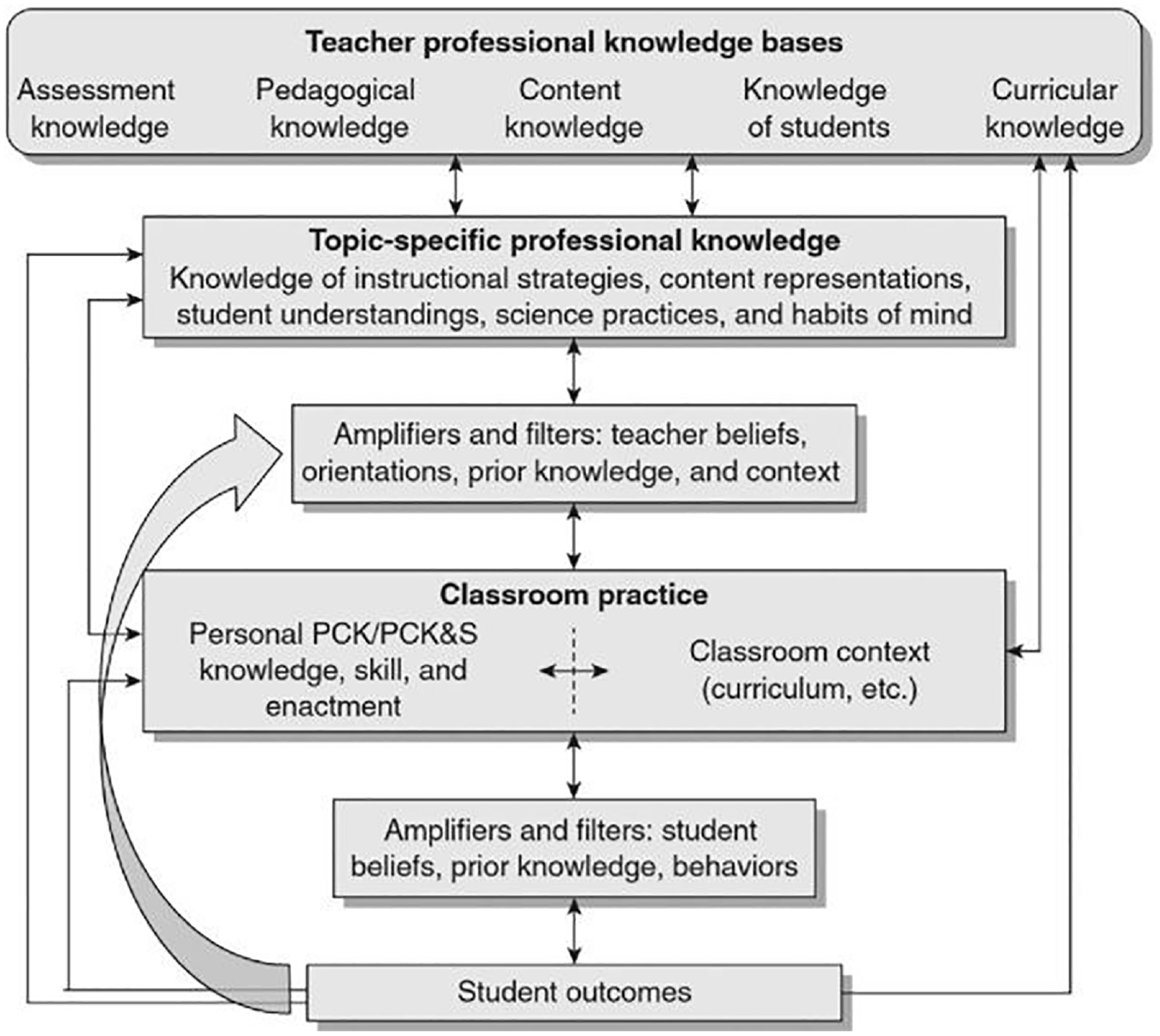
Teacher knowledge framework Gess-Newsome (2015).
With growing interest in the field of education and continuous demands of 21st century requires more from a teacher to be considered as effective teacher (Klette & Hammerness, 2016). Those competencies are required from teachers which can ready 21st century learners. Though these above discussed frameworks include a variety of teacher knowledge aspects which covers a variety of individual competencies requires to be an effective teacher, these frameworks still miss some individual competencies which are considered as essential in the current era of education (Stronge, 2018). The 21st century has various other challenges for teachers and they require additional qualities and competencies to be effective in this era. Teaching strategies need to change to empower 21st-century learners (Caena & Redecker, 2019).
Ali and Haider (2017) highlighted teachers core competencies can be categorized into three categories; Instructional, Professional, Personal. Each sub category consists of various competencies which are needed in this era of education to prepare 21st-century learners. The below paragraphs highlight the key competencies highlighted in the world literature in these three dimensions (Instructional, Personal, Professional) of core teacher competencies.
Instructional Competencies
Instructional qualities are considered part of teachers’ professional competence (Kunter et al., 2013). Different competencies that is, pedagogical content knowledge, curriculum knowledge, encouraging students inside classroom, timely evaluation and positive feedback to students has been termed as the key instructional competencies of teacher (Blazar, 2015; Hill & Chin, 2018; Kaiser et al., 2017). Studies in the past have provided evidence that teacher’s instructional quality strongly linked with student performance (Depaepe & König, 2018; König & Pflanzl, 2016; Voss et al., 2011). This quality can also be used as a basis for measuring teacher effectiveness in school (Grossman et al., 2013). König et al. (2021) concluded that teacher instructional competencies serve as a significant predictor of quality-oriented mathematical teaching and learning processes and contribute to students’ mathematical progress.
According to Holzberger et al., (2021), different factors, that is, effects of social composition, leadership, teacher collaboration, and school climate, determine the school’s instructional quality. Stovner et al. (2021) concluded that procedural feedback from teachers in the classroom proved to be more effective for students’ understanding and behavior. According to the authors, teachers’ instructional competencies helped students build conceptual understanding of mathematics lessons. Student evaluation and timely feedback are very important for their success (Faulconer et al., 2022). Providing feedback through students’ evaluation enhance their active learning progress (Owen, 2016). It is considered as one of the essential approach from teachers to facilitate students’ development (P. Ferguson, 2011).
Personal Competencies
Personal competencies such as understanding the feelings of students, clear communication and a sense of humor, significantly affect student morals and performance in the classroom (Shoaib & Ullah, 2021). Teacher sense of humor affects students’ attitudes in building their confidence and making them feel less anxious in the classroom (Tunnisa et al., 2019). Students learn quickly when feeling happy and amused (Binti Rusbadrol et al., 2015). It also enables positive interactions between teachers and students, which contributes to building a positive environment in the classroom (Banks, 2016). Koutsoulis (2003) concluded in his study that students highly ranked the teachers’ ability to show understanding and teacher friendliness. This quality enables teachers to communicate effectively with students to improve and maintain teacher-student relations. Teacher friendliness also contributes to the affective learning in the classroom (Rimland, 2013).
Binti Rusbadrol et al. (2015) defines personality as, morals, attitudes, character, skills, self-confidence, intellect, inspiration, behaviors and so on. Mkpanang (2015) illustrates that personality refers to external and observable characteristics. Arbabisarjou et al. (2015) characterized personality as a compound and a set of fixed and stable competencies of an individual which distinguishes him from others. Teacher personality greatly affects the teacher-student relationship (Raufelder et al., 2016). A positive teacher-student relationship would increase the students’ motivation to learn and improve their academic achievement (Joe et al., 2017). In their study, Noreen et al. (2019) also stated that teachers’ personality plays a significant role in accomplishing students’ educational achievement. According to the authors, the teachers’ openness to the students positively affects their achievement. Khalilzadeh and Khodi (2021) analyzed the relationship between five personal traits (extraversion, neuroticism, conscientiousness, agreeableness and openness to experiences) and student learning motivation. The researchers concluded that teacher personality significantly affects student achievement. Teachers’ conscientiousness personality trait positively affected students, while the teachers’ extraversion personality trait harmed students’ motivation to learn. These studies confirm that teacher personality affects student performance either positively or negatively. Hence making teacher personality a significant contributor for the school success.
Professional Competencies
Professional competencies are those attributes of a teacher which are not necessarily related to the subject knowledge or technical competence (Massingham, 2019). These attributes are normally linked with how a teacher works in a school’s general educational environment. The professional competencies of a teacher play a key role in fostering students’ learning (Schleicher, 2016). These competencies help teachers establish relationships in the school environment and demonstrate positive values, attitudes and behavior (Goepel, 2012). Teacher punctuality is considered as one of the key professional competencies of an effective teacher (Sahito et al., 2016). According to the authors, teacher punctuality positively affects students’ performance. Through punctuality, a teacher could enhance his/her performance which eventually affects student performance (Amadhila & Guest, 2022). In support of this view, Abrami (2001) said this: “A good lecturer is prepared in such a way that he or she comes on time” (P4: 28:28)
Kunter et al. (2013) described teacher professional competencies as professional beliefs, work-related motivation, and self-regulation. The authors concluded in their study that teachers’ enthusiasm for teaching and self-regulatory skills on instructional quality affected student outcomes. Holzberger and Schiepe-Tiska (2021) stated in their study that the social composition of the principals’ leadership creates a school climate that determines the teacher’s professional competencies. As per the authors, the school-related context affects teachers’ professional competencies.
For developing countries, teachers’ continual professional development is critical in improving student achievement in schools (Yangambi, 2021). In his research, Bubb (2004) stated that rapid change in the educational landscape and increasing standard of pedagogy raised the bar for high-quality education and the need for more PD programs. PD has been found to be effective in enhancing teacher knowledge and skills (Macià & García, 2016; Sancar et al., 2021). A few studies in the past have also provided evidence that improvement in teachers competencies through PD programs affects the teacher’s instructional quality, which is linked with student performance (Depaepe & König, 2018; König & Pflanzl, 2016; Voss et al., 2011).
From the discussion above, it is clear that the professional competencies of a teacher, either described as teacher knowledge, professional beliefs, work-related motivation, and self-regulation, impact the teacher’s performance in school which is directly linked with student performance. Table 1 below further describes the teacher competencies and the subsequent literature in which these competencies has been highlighted.
Core Teacher Competencies Highlighted in the Recent Past.
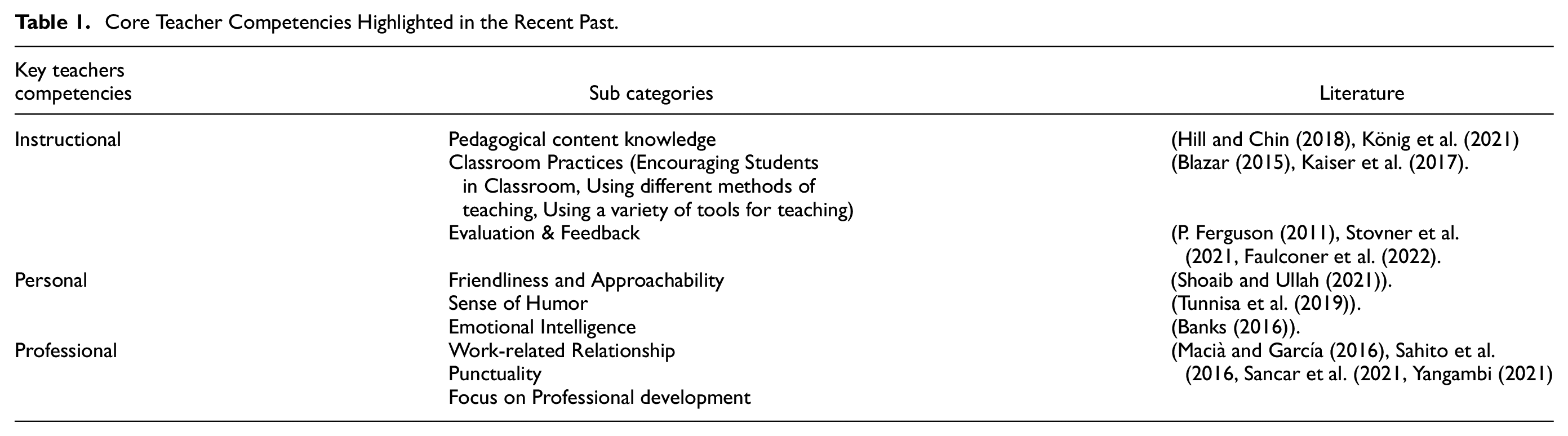
Based on extant review of literature, researchers have designed a framework consists of key competencies highlighted in recent literature in education. These competencies are strong indicators of teachers’ individual performance and also acts as a predictor for school performance. The framework is given in Figure 3 below:

Key teacher competencies highlighted in recent literature.
Research Method
The study adopted a qualitative method to explore the perceptions of principals about the difference in teachers’ competencies. The central phenomenon of this research is the teachers teaching competencies which are explored by qualitative inquiry. The key teaching competencies have been identified through extant review of literature. These teacher qualitative themes then used as a guiding framework in developing questions for qualitative inquiry. The qualitative inquiry provides more detailed information regarding the subject of interest (Levitt et al., 2018).
Interview Protocols and Qualitative Procedures
Structured interviews were used as a medium for collecting data from the principals as interviews allow to probe and get an in-depth meaning of participants’ perceptions (Gaffas, 2019). The themes and sub-themes of the phenomenon were based on the framework derived from the extant literature. The three subsections below present the accounts of the themes and sub-themes derived from the extant literature (Table 2).
Themes and Sub-Themes of Interview.

The sub-themes of the central phenomenon were used a guiding framework for tailoring interview guide for this study. A set of structured and open-ended questions were derived in the interview guide to take responses from the participants. Firstly, the public schools were selected using the criteria of size of school and principal working experience in that school. Permission was asked from the principals by explaining the purpose of this research. After the consent, interviews were scheduled on different dates from the principals. All interviews were conducted in English by directly interacting with the principals. The duration of the interview ranged from 20 to 30 min.
Population and Sampling
The public schools of Rawalpindi district formed the target population of this study. Public schools are divided into three main categories; primary, middle, and high school level. A total of 1,804 public schools are there in the seven sub-divisions of district Rawalpindi (Punjab Bureau of Statistics, 2023). The information related to the population is given in the Table 3 below:
Total Number of Schools in District Rawalpindi.

Though there are many schools in different sub-divisions of Rawalpindi district, the key schools which holds maximum number of teachers and students are high-level schools. The details of High schools in Rawalpindi district are given below (Table 4):
High-Level Schools in District Rawalpindi.

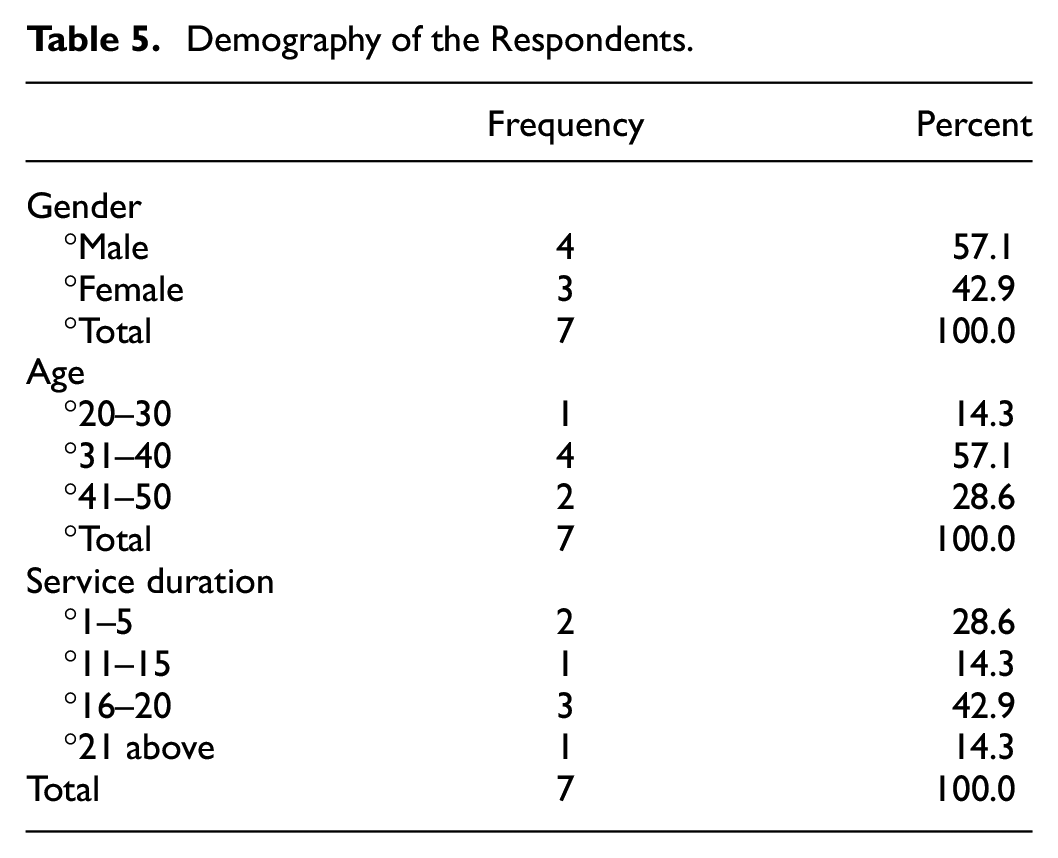
The study uses a purposeful sampling technique to choose one high level school from every sub division of Rawalpindi district to represent every sub-division in the sample. This is to better infer about the overall population. Purposeful sampling help to identify and select information-rich cases related to the phenomenon of interest (Palinkas et al., 2015). The data about the participants’ demography is given in Table 5 below:
Demography of the Respondents.
Data Collection and Analysis Procedures
All interviews were recorded and transcribed verbatim. The interviews data was recorded and later was sent back to principals before performing the main analysis of the study. This is to ensure the credibility and authenticity of research as any minor errors are highlighted before the analysis (Guba & Lincoln, 1989). As the structure of this study was much operationalized based on previous knowledge in the field of teacher knowledge and teacher competencies so the deductive content analysis approach was used in analyzing the data. Advantage of using deductive content analysis is that it systematically categorizes textual data in order to make sense of it (Miles & Huberman, 1994). Interview responses were coded together based on already established themes using line analysis to organize the interviews according to research questions (Chenail, 2015). MAXQDA software was used as the analytical tool for analyzing the qualitative data.
Results and Discussion
The study main objective is to assess the competencies of teachers. The researcher categorized the teachers into two sub categories based on gender and experience. The heads gave their feedback about the individual competencies of teachers through the means of a structured interview. The heads feedback highlights key difference in the teachers’ competencies across gender and experience.
Instructional Competencies
Teacher pedagogical content knowledge and teaching practices inside the classroom can be termed as instructional competencies (Blazar, 2015). Instructional competencies are considered part of teachers’ professional competence (Kunter et al., 2013). This quality can also be used to measure teacher effectiveness in school (Grossman et al., 2013). Stovner et al. (2021) concluded that procedural feedback from teachers in the classroom proved to be more effective for students’ understanding and behavior.
Pedagogical Knowledge
A few studies in the past have provided evidence that teacher pedagogical knowledge affects the teacher’s instructional quality, which is linked with student performance (Depaepe & König, 2018; König & Pflanzl, 2016; Voss et al., 2011). Instructional competencies are considered part of teachers’ professional competence (Kunter et al., 2013). This quality can also be used to measure teacher effectiveness in school (Grossman et al., 2013).
Male Teachers
Most principals say that their school teachers do have the pedagogical knowledge needed for teaching. After going through a screening process, the teachers join the school education department in which their qualifications and other skills were considered the basis for selection. However, the teachers may lack the modern pedagogical knowledge currently being applied in the world. “Teachers are good as they have the right qualification for teaching and before joining they go through a compulsory training program especially design for improving pedagogical competencies in teachers” [Principal 3].
Another principal said that: “Teachers are competent with respect to their subject knowledge, but many teachers are missing the recent pedagogical approaches used in the modern times around the world. Teachers uses the old ways of teaching as they are now comfortable and established a teaching style like that.” [Principal. 1]
Female Teachers
Female teachers are found to be good in terms of pedagogical knowledge they have. Most principals perceive them as more competent and dedicated when it comes to teaching. “Our female teachers are very good in pedagogy and do have a wide range of knowledge regarding different pedagogical aspects.” [Principal 3]
Also, they shows more interest in learning new pedagogical techniques in the training programs as one principal added this: “During training programs, female teachers grasp more quickly and apply more knowledge they learn in those training programs.” [Principal 6]
Classroom Practices
Learning environment largely affects the student performance in the school (Shamaki, 2015). Teachers in the classroom dictate the tone of their class and builds a warm classroom environment for their students (Oyeniyi & Seminary, 2019). This is considered as one of the leadership competencies of teachers to create a positive learning atmosphere for students to make them feel welcome in the classroom.
Male Teachers
Most of the teachers use real-life examples in the classroom to explain things. They do not normally use a variety of different materials in the classroom to give lectures. The thing most of the teachers lack is encouraging students to ask questions in the classroom. “The teachers can only use materials which has been available to them. Teachers usually rely on blackboard as a tool for instruction. Though some young teachers encourages students to ask question in the classroom, most of the teachers don’t. The classroom environment is more formal and respectful in which students feel relaxed” [Principal 2]. “The teachers sometimes use different materials in the classroom to give lectures. The young teachers are more friendly and welcoming to the students compare to the senior teachers. The teachers do encourage good questioning in the classrooms” [Principal 3].
Female Teachers
Teachers’ use conventional methods to give lectures as the resources provided to teachers only allow them to do this. For encouraging students, school offers different school prizes based on their results, but on class level its teacher’s responsibility to encourage students. The young teachers were found to be more encouraging than senior teachers. As one of the principal said this:
“Senior teachers shows less interest in encouraging students for active participation in their class while young teachers shows more interest of students’ participation and allow them to ask questions.”
When the question was asked about whether teachers use different methods of teaching in the classroom. The principal replied: “Now a days it becomes important to use different kind of methods for teaching but mostly they use old methods of teaching. Some young teachers use Students learning outcome (Slo’s) based methods in their classroom.” [Principal 3].
Also teachers in schools missing the advanced tools for teaching as one of the principal said this: “No they don’t use any kinds of advanced tools for teaching in their classroom. It’s due to the lack of sufficient budget and lack of teachers’ interest in adopting advanced tools. Teachers usually use same tools like white boards, cardboards etc.” [Principal 7].
Students Evaluation & Feedback
Student evaluation and providing timely feedback is very important for their success (Faulconer et al., 2022). Providing feedback through students evaluation enhance their active learning progress (Owen, 2016). It is considered as one of the essential approach from teachers to facilitate students’ development (P. Ferguson, 2011).
Male Teachers
All the principals gave positive responses related to evaluation of students from teachers. In all the schools, teachers regularly evaluates students’ performance using different tests and exams conducted within the schools. They provide feedback in terms of students marks obtained. “In our school, the teacher evaluates students by using different test and giving them homework. The teachers regularly gave homework and evaluates the students’ performance. They always provide feedback to the students related to their performance in school tests and homework assignments” [Principal 6].
About the frequency of student evaluation one principal said this “The teachers evaluate every student based on their daily homework assignments and school tests and give positive feedback to the students” [Principal 3].
Female Teachers
Teachers frequently evaluates students’ performance through classroom test and terms etc. They provide timely feedback about students’ performance. “In our school, this culture is set that our teacher continuously evaluates students and give them feedback based on their performance” [Principal 4].
One of the principal gave her opinion that continuous evaluation is kind of compulsory because of official requirements from the government. She said that: “There is government requirement from the top management to evaluate the students regularly and record their performance based on the scores. So, teachers have to continuously evaluate the students” [Principal 1].
Personal Competencies
Personal competencies such as understanding feelings of students, clear communication and a sense of humor, greatly affect student morals and performance in the classroom (Stronge, 2018). Teacher personality greatly affects the teacher-student relationship (Raufelder et al., 2016). A good positive teacher-student relationship would increase the students’ motivation to learn and improve their academic achievement (Bouras & Keskes, 2014; Joe et al., 2017; Lamb, 2017). Noreen et al. (2019) also stated in their study that teachers’ personality plays a significant role in accomplishing students’ educational achievement.
Friendliness and Approachability
Koutsoulis (2003) concluded in his study that students highly ranked the teachers ability to show understanding and teacher friendliness. This quality enables teachers to communicate effectively with students to improve and maintain the teacher-student relations. Teacher friendliness also contribute to the affective learning in the classroom (Rimland, 2013).
Male Teachers
And most of the teachers are responsible and have a good personality. The teachers dress properly and communicate clearly in the classrooms. They work in a graceful manner with students and having a respectful relationship with students. “The teachers normally do not allow students to freely talk with them as they it may leads to the teachers losing their respect in the eyes of students. They maintain a very formal relationship with the students” [Principal 2].
Female Teachers
Female teachers are found to be friendlier with students’, especially young teachers. They talk more often with the students during the class timing and outside class timing. Moreover, they have personal relationship with the students’ and students feels comfortable reaching them if they encounter any problem. “Young teachers are friendlier with their students as compared to senior teachers. Students find it easy to approach young teachers if they encounter any kind of problem” [Principal 7].
Sense of Humor
Teacher sense of humor affects students’ attitudes in terms of building their confidence and making them feel less anxious in the classroom (Tunnisa et al., 2019). Students learn quickly when they are feeling happy and amused (Martin, 2007). It also enables positive interactions between teachers and students, which contributes to building a positive environment in the classroom (Banks, 2016; Luz, 2015).
Male Teachers
Teachers in school normally interact in a more formal way. Using jokes in the classroom while teaching is not common among the male teachers. One principal commented on this: “Teachers in my school lack this quality. They think that amusing students in the classroom might change their respectful relationship with the students.” [Principal 4]. “Teachers some time shared jokes and funny stories with the students. This practice is more common in the young teachers. The senior teachers are more formal in the classrooms.” [Principal 3].
Female Teachers
Teachers have a good sense of humor in schools, but the use of sense of humor in the classrooms is limited. In school culture, amusing student might be considered as unethical and not appropriate from the teacher’s point of view. As one of the principal was being asked this question that whether teachers use jokes and funny stories to amuse and relax the students in the classroom? The principal responded: “Very rarely teachers express sense of humor in classroom. They avoid using jokes and amusing students in the classrooms.” [Principal 5].
Emotional Intelligence
Personal competencies such as understanding the feelings of students, clear communication and a sense of humor, greatly affect student morals and performance in the classroom (Shoaib & Ullah, 2021). Emotional intelligence helps to know emotions which helps in understanding the students’ behavior and make good relationship with them (Abiodullah & Aslam, 2020). A good positive teacher-student relationship would increase the students’ motivation to learn and improve their academic achievement (Joe et al., 2017).
Male Teachers
It is not very common attributes found among the male teachers in schools. Mostly teachers do not really try to understand the students feelings and emotions while teaching them. “No, teachers normally do not give too much attention t the feelings of students. They only care if someone is sick or showing some physical problems but not to phycology problems.” [Principal 4].
Female Teachers
Female teachers are good in understanding the feelings and emotions of teachers. They give proper attention if they see someone is having some problem and that is why they are having more stronger relationship with the students as compared to the male teachers. “Female teachers are good in understanding the feelings and emotions of the students. If some students are not behaving well, teachers are quick to respond to it. Our female teachers understand students way better than male teachers.” [Principal 3].
Professional Competencies
Professional competencies are those attributes of a teacher which are not necessarily related with the subject knowledge or technical competence (Massingham, 2019). The professional competencies of teacher plays a key role in fostering students’ learning (Schleicher, 2016). These competencies helps teachers establish relationships in the school environment and demonstrate positive values, attitudes and behavior (Goepel, 2012).
Work-Related Relationship
Work related relationships are those attributes normally linked with how a teacher works in a school’s general educational environment (Massingham, 2019). These attributes help teachers establish relationships in the school environment and demonstrate positive values, attitudes and behavior (Goepel, 2012). The good relationship helps in getting more frequent peer-assessment feedback and could help promote deep learning (Lynch et al., 2012).
Male Teachers
As per the principal feedback, mostly teachers lacks active participation in school activities. Try to maintain a strict discipline in the classroom, and teachers lack in the working relationship with other teachers. “The teachers normally have relationship groups in our school. That means that their relationship is limited to certain individuals and they don’t work in a general harmonious environment. There is group politics because of that and some groups don’t get along with the administration. Some teachers have their personal relationship with parents but mostly don’t like to interact with the parents. The relationship between teachers and students is of formal nature.” [Principal 5].
Another Principal said this: “Teachers normally don’t talk to the parents of the students, and we don’t have regular teacher parents meetings in our school. The teachers obeys the rules and regulations set by the administration and works in a professional manner in schools. The teacher has a formal relationship with the other colleagues but they don’t share or exchange ideas about teaching and learning in the school. The relationship with students is good.” [Principal 6].
Female Teachers
As per principal feedback, mostly female teachers maintains good relationship with parents. Also, teacher having a respectable relationship with students. But the interrelation between colleagues and relationship with administration is not good.
One principal gave his feedback: “The teachers don’t have a good relationship with the administrations. The teachers are government employees, and principal do not have the authority to sack or punish the teachers in hard ways. So, the teachers do not worry too much about what principal says”[Principal 7].
Also there is internal politics for power among teachers. As one principal gave her feedback: “There is lot of internal politics between several group of teachers and the relationship between colleagues is not ideal. The teachers have relationship with some parents based on their personal relationship.” [Principal 1].
Punctuality
Teacher punctuality is considered as one of the key competencies of an effective teacher (Abrami, 2001). Teacher punctuality positively affects students performance (Sahito et al., 2016). Through punctuality, a teacher could enhance his/her performance which eventually affects student performance (Amadhila & Guest, 2022). In support of this view Abrami (2001) said this: “A good lecturer is prepared in such a way that he or she comes on time” (P4: 28:28)
Male Teachers
According to the principals, most of the teachers are very punctual in performing their duties. They come at the right time and leave the school at the right time. They follow the school schedule fully. “Our teachers follows the time requirement set by the school. Teachers come on time and give lectures as per the schedule time.” [Principal 3].
One of the principal said that new government regulations encouraged teachers to be more punctual. He said this: “In my view, the new government rules also encourages school teachers to be more punctual in school. Now a days attendance is been strictly noted and disciplinary actions is taken if teachers found to be not following the rules.” [Principal 2].
Female Teachers
The female school teachers are also good in this regard. They come on time and leave the school on time. Also, the schools designed the lecture schedule at the beginning and the teachers follows this schedule very punctually. “The teachers are very punctual, especially in the recent times due to the newly implemented monitoring systems.” [Principal 7].
Focus on Professional Development
For developing countries, teacher continual professional development is very important in improving student achievement in schools (Yangambi, 2021). Bubb (2004) stated in his book that rapid change in the educational landscape, increasing standard of pedagogy raised the bar for high-quality education and need for more PD programs. PD has found to be effective in enhancing teacher knowledge and skills (Macià & García, 2016; Sancar et al., 2021). A few studies in the past have also provided the evidence that teacher knowledge affects the instructional quality of teacher which is linked with the student performance (Depaepe & König, 2018; König & Pflanzl, 2016; Voss et al., 2011).
Male Teachers
For teachers, the government organize different training programs throughout the year. Normally, all the teachers attend these training programs as these programs are compulsory to attend. But teachers are not really motivated to attend these training programs. They try to escape the day by making some excuses or don’t take interest in the training classes. One of the principal commented: “The teachers of our schools has shown very little interest in the professional development programs. The training programs normally come on vacation days so teachers think of these as wastage of their free times.” [Principal 5].
Another said this: “Most of the senior teachers take very little interest in the training programs. The young teachers are the ones who has shown some interest in the professional development programs” [Principal 3].
Female Teachers
Female teachers are also reluctant when in comes to PD programs, especially senior teachers. It is difficult to convince the senior staff of the schools to take part in the training practice. Lack of motivation in senior teachers is very common as one of the principal gave her feedback: “Very little, teachers shows less interest in any kind of professional development trainings etc. At their age, they think they already have enough knowledge and skills to teach” [Principal 1].
Discussion
The research highlighted key differences in teachers competencies based on gender and age. In general, the female teachers found to possess more teaching competencies as compare to the male teachers. These results are in line with by Ahmad et al. (2020) research in which authors concluded that female teachers perform better than male teachers in school environment. Islahi and Nasreen (2013) also concluded that female teachers have proven to be more effective for student performance. Additional differences were highlighted by school’s principals based on teachers age and seniority level. Senior younger teachers, whether male or female, found to possess more teaching competencies than senior teachers. These results are in contrast with the studies of Rice (2003), Podolsky et al. (2019) conclusions that experience leads to increase in teacher competencies and effectiveness. This is the overall picture of the teacher-quality assessment of this research. In the later paragraphs the researcher further breaks down the analysis part into more specific details.
From the instructional competencies side, all of the teachers were found to be good in pedagogical knowledge as they have the right qualification for teaching and before joining, the teachers go through a compulsory training program. These pre-service training programs are especially designed for improving pedagogical competencies in teachers (Nawab, 2017). With regards to classroom practices, mostly teachers, whether male or female, uses old methods of teaching due to the lack of availability of new resources. This is highlighted by Rehman and Khan (2011) that use of old methods in classroom is due to the lack of proper modern training and poor finance. Some young teachers however are applying different methods and tools in teaching. In terms encouraging students and giving positive feedback to them, mostly female and young teachers encourage their students to ask questions in the classroom. Though, evaluating students is common and frequent in public schools, mostly male teachers fail to provide positive feedback to the students. This is also highlighted by Ali and Haider (2017) that female teachers have better ability to understand the emotions of students, Ahmad et al. (2020) and provide more timely and positive response to students in the classroom.
From the personal competencies point of view, female teachers are found to be friendlier with students’, especially young teachers. They talk more often with the students during the class timing and outside class timing. Moreover, they have personal relationship with the students’ and students feels comfortable reaching them if they encounter any problem. In addition, the sense of humor of female teachers is also comparatively better than the male teachers. In terms of emotional intelligence, female teachers are also good in understanding the feelings and emotions of the students. While most principals think that male teachers do not try to understand the emotions and feelings of students. These results are supported by various studies (Ahmad et al., 2020; Ali & Haider, 2017; Islahi & Nasreen, 2013) who concluded that female personality is more effective and suitable for school teaching.
From the professional competencies side, female teachers found to have better personal relationship with the peers than the male teachers. Female teachers discuss about the work-related activities with their colleagues more often than male teachers. Furthermore, all the teachers, despite the difference in gender or age group are very punctual. The heads of schools believe that government regulations are the factor behind the punctuality of teachers. According to them, the new government rules also encourage school teachers to be more punctual in school as attendance is been strictly noted and disciplinary actions is taken if teachers are found to be not following the rules. As supported by Habib (2013) that strong check and balance from government leads to less absenteeism from teachers. Finally, the teachers show minimum interest in taking the professional development programs. The principal perceives that lack of financial benefits and courses timing could be factors behind lack of motivation from the teachers. This is also concluded in the study of Aslam (2014) that less benefits and work life balance of teachers are primary cause of lack of motivation for teachers to focus on professional development.
The Table 6 sums up all the main points highlighted in the interviews to present an overall picture of the teacher-competency assessment:
Summary of the Teacher-Competencies assessment

Conclusion
The research is carried out to explore the teacher competencies in public schools of Pakistan. Normally, teacher performance measured through school performance as a whole and very less consideration is been given to the individual strengths and weaknesses of teachers. This research shed light on the individual competencies differences among teachers by investigating the competencies of teachers as perceived by the principals. The results highlight varying competencies in teachers based on gender and experience level. The young teachers, whether male or female, are found to possess more teaching competencies as compared to senior teachers. These findings are in contrast with Rice (2003), Podolsky et al. (2019) conclusions that experience leads to increase in teacher competencies and effectiveness. The study concluded that some of the competencies that is, focus on professional development, sense of humor and friendliness and approachability becomes less and less in senior teachers. The results also highlighted that female teacher possess more teaching competencies as compared to male teachers. This is in line with the studies of Ahmad et al. (2020), Islahi and Nasreen (2013), that female school teachers possess more competencies and perform better in school settings.
This research not just only highlighted the gender and age-based differences in teaching competencies but also provided a detailed analysis framework (see Table 6). This table can serve as a criteria to understand the individual strengths and weaknesses of teachers. PD programs can be developed using this as a criteria to first measure the strengths and weaknesses of teachers. The professional development programs are normally designed based on general basis to treat every teacher with same stick. Therefore, there is need to adopt a different approach for teacher training. As Islahi and Nasreen (2013) recommended that PD programs should undertake the individual indifferences among teachers. The especially designed PD programs can be more productive for enhancing the teachers’ capabilities (Sims et al., 2021). Moreover, the research also highlights that some competencies like punctuality can also be improved through proper governance of schools and some aspects needs proper training programs to polish the teacher competence.
Recommendation
Information like that provides vital information to the government to design teachers’ professional development programs by keeping in mind the strengths and weaknesses of individual teachers. These specially designed learning opportunities can be more effective for TPD of teachers. Through tailored training programs professional development of teachers can reach its goals more effectively and efficiently than relying on a standard base approach for TPD. Furthermore, these types of information highlighting individual facets of teachers’ competence provides more insights for TPD programs than comparing general performance of schools and making TPD programs for enhancing teachers performance.
Limitation and Recommendation for Further Research
Due to the time constraints and extraordinary environment of COVID-19, the researchers can only reach seven principals. The sample is very small and limited to one particular area schools. Furthermore, the study only focused on the principal perspective and did not considers teachers point of view for training programs. By including their perspective, the effectiveness of training programs can be enhanced further.
Footnotes
Declaration of Conflicting Interests
The author(s) declared no potential conflicts of interest with respect to the research, authorship, and/or publication of this article.
Funding
The author(s) received no financial support for the research, authorship, and/or publication of this article.
Ethics Approval
Not applicable
Consent to Participate
Participants were Heads of the public schools and were verbally asked
Consent for Publication
The participants of this study are ok with it

Data Availability Statement
Data sharing not applicable to this article as no datasets were generated or analyzed during the current study.