




Abstract
The increasing advancement of communication technology has led to a rise in the prevalence of work connectivity behavior after-hours, which offers employees greater flexibility in their work schedules but also has certain drawbacks. In this paper, 308 retail employees in Shanghai were selected as the research participants. The effort-recovery model and work-family boundary theory were applied to investigate the effect of work connectivity behavior after-hours on emotional exhaustion. The results show that work connectivity behavior after-hours positively affects emotional exhaustion. Psychological detachment mediates work connectivity behavior after-hours and emotional exhaustion. Work-family segmentation preference moderates work connectivity behavior after-hours and psychological detachment, and when work-family segmentation preference is higher, the negative effect of work connectivity behavior after-hours on psychological detachment is stronger. Given that work connectivity behavior after-hours is a relatively new work phenomenon, this study explores the mechanism of its impact on the emotional exhaustion of employees in the retail industry and provides some practical implications for human resource management in the retail industry.
Keywords
Introduction
With the continuous advancement of technology, mobile communication devices (such as cell phones, ipads, laptops) are becoming increasingly popular, bringing convenience to people’s work and lives (Baumeister et al., 2021). At the same time, individuals’ working hours, workplaces, and work styles are fundamentally changed (Boswell & Olson-Buchanan, 2007). Employees can communicate with others anytime and anywhere without being confined to specific times and spaces (Boswell & Olson-Buchanan, 2007). However, there are certain new challenges in the everyday job of employees due to the extensive usage of communication tools (Wang et al., 2023). For example, employees may be needed to answer leadership calls outside of regular working hours and respond to company emails during weekends. This phenomenon can be described as “work connectivity behavior after-hours (WCBA)” (K. Richardson & Benbunan-Fich, 2011). Although WCBA enhances employees’ flexibility, it also means that employees must devote greater energy and time to their work (Butts et al., 2015). WCBA has been demonstrated in numerous research to have a negative effect on workers’ lives and jobs. Excessive WCBA can deplete employees’ psychological resources and reduce work well-being (K. M. Richardson & Thompson, 2012), cause work-family conflict (K. Richardson & Benbunan-Fich, 2011), and cause emotional exhaustion (Derks & Bakker, 2014).
Employees play a critical role in business operations and burnout occurs when they invest many resources over time but lack the resources to replenish them (Demerouti et al., 2001). Job burnout is a long-standing social problem (Schaufeli et al., 2009) and has gradually spread to various industries, including retail. Emotional exhaustion has garnered significant research interest as a crucial aspect of job burnout (Wright & Cropanzano, 1998). Psychological detachment is a key link between WCBA and emotional exhaustion. In accordance with the effort-recovery model (Meijman & Mulder, 1998), retail employees can relax themselves by participating in various recovery activities during non-working hours. However, when WCBA occurs, retail employees are unable to break away from their work for resource recovery (Etzion et al., 1998), which is one of the important causes of emotional exhaustion (Fritz et al., 2010). In addition, some studies have found that the degree of difficulty in detachment from the job and the employees’ own willingness and tendency to detach are important factors influencing employees’ psychological detachment (Zhang et al., 2013). The work-family boundary theory holds that work and family are two separate domains, and when retail employees deal with work-related matters during non-work hours, it causes them to hover between work and family, and that they usually need to cross the boundary in order to fulfill their different roles (Clark, 2000). However, since the willingness of employees to set boundaries depends on themselves (Kreiner, 2006), the impact of WCBA on the psychological detachment of retail employees will be influenced by their work-family segmentation preference (WFSP). Therefore, WFSP is introduced to target the willingness and tendency of employees to withdraw from their jobs during non-working hours.
The retail sector in China has experienced rapid development. According to data, in 2021, the total number of retail enterprise stores in China is projected to reach 292,383, contributing to the employment of 2.217 million people (National Bureau of Statistics of China, 2022). Shanghai is at the forefront of retail development in China as one of the regions with the greatest level of economic development. In 2021, the total sales of goods in Shanghai reached 462.8 billion yuan, ranking first and holding a representative position in the retail industry. Hence, this study employs the effort-recovery model and work-family boundary theory to examine the relationships between WCBA, psychological detachment, emotional exhaustion, and WFSP.
In summary, this study presents the following three research questions: (1) Does WCBA have an impact on employees’ emotional exhaustion in the context of the retail industry? (2) Does WCBA and emotional exhaustion have a link that is mediated by psychological detachment? (3) Does WFSP act as a moderator in the association between psychological detachment and WCBA?
Theoretical Background and Hypothesis Development
Effort-Recovery Model
The effort-recovery model is primarily utilized to explain how people deal with exhaustion and stress at work, and the theory emphasizes that employees recover by supplementing their personal resources during non-work activities (Wu et al., 2020). The theory proposes that the resources and efforts expended at work produce stress as well as mental exhaustion (Meijman & Mulder, 1998). Normally, these negative responses are reversible, mainly in the sense that off-time breaks as well as shorter work hours can return individuals to pre-response levels of performance (Meijman & Mulder, 1998). Nevertheless, without sufficient recovery, an individual’s resources are constantly depleted and neither the body nor the mind can be optimized. As the load response increases it can lead to emotional exhaustion, chronic health problems and more (ten Brummelhuis et al., 2011). According to this theory, when employees do not receive psychological detachment in non-working hours, work-related matters will continue to consume resources (Sonnentag et al., 2010b). Prolonged resource consumption does not restore the stress and emotions accumulated by the demands of work (Etzion et al., 1998), and in this case, employees are extremely exhausted physically and mentally, and stress cannot be released, thus triggering emotional exhaustion (Fritz et al., 2010). Therefore, how to reduce the emotional exhaustion of retail employees when they face WCBA occurrences is a key concern for human resource management in the retail industry.
Work-Family Boundary Theory
According to the work-family boundary theory, work and family are two different domains, and the border serves as the dividing line between the domains (Clark, 2000). People constantly move between their work and family lives, bridging psychological, temporal, and physical boundaries to fulfill various role transitions (Clark, 2000). Two characteristics that influence role transitions are boundary permeability and flexibility (Ashforth et al., 2000). Permeability is the extent to which the demands of an individual’s certain role are allowed into other roles (Eagle et al., 1997). Flexibility is the degree to which an individual is malleable in time and space (Hall & Richter, 1988). When flexibility and permeability are high, work-family boundaries are “blended” and the boundaries are blurred (Clark, 2000). Individuals seek a balance between work and family by managing different boundary conditions (Ma et al., 2021), which plays an important role in the individual’s realization of psychological detachment (Wang et al., 2023) as well as well-being (Desrochers & Sargent, 2004). With the widespread use of ICT in the workplace, WCBA is occurring with increasing frequency, and the reactions of individuals with high segmentation preferences tend to be strong, largely because their need for such segmentation is not being met. Conversely, people with low segmentation preferences will respond in a more subdued manner (Wang et al., 2023). Currently, it is unclear the role played by retail employees’ WFSP play in WCBA and psychological detachment. Therefore, this study is of great significance in enriching the practical application of work-family boundary theory.
Work Connectivity Behavior After-Hours
In the current Internet era, computers, cell phones, and other mobile electronic devices have penetrated people’s daily lives, and more and more work can be done through telecommuting or working from home. This new form of work has attracted the attention of many scholars, who have described it as after-hours teleworking (Duxbury et al., 1992), communication technology usage after hours (Boswell & Olson-Buchanan, 2007), etc. K. Richardson and Benbunan-Fich (2011) introduced the concept of WCBA and defined it as the use of cell phones, laptops, and other convenient mobile electronic devices to communicate and contact colleagues at work during non-work hours (outside of work hours). WCBA as a new behavioral model (K. Richardson & Benbunan-Fich, 2011), to some extent, breaks the traditional spatial constraints and increases the flexibility of work (Boswell & Olson-Buchanan, 2007). However, it also has negative effects in some aspects. For example, during non-working hours, there is no clear boundary (K. M. Richardson & Thompson, 2012); it is difficult to mentally separate from work. Employees’ emotional and physical well-being will be impacted (Arlinghaus & Nachreiner, 2014), which cannot be recovered in time, and the cumulative consumption of resources will be greatly increased (Chen & Karahanna, 2018), which will produce emotional exhaustion.
Hypothesis Development
Work Connectivity Behavior After-Hours and Emotional Exhaustion
Emotional exhaustion is a way of coping with work overload, reflecting the exhaustion state produced in individuals after excessive consumption of physical and mental resources (Maslach et al., 2001). Emotional exhaustion, as the key component of job burnout (Maslach et al., 2001), has been studied by many scholars. According to studies, emotional exhaustion among employees makes them more likely to quit (Azharudeen & Arulrajah, 2018), reduces organizational performance (Janssen et al., 2010), and causes adverse effects such as work-family conflict (Greenbaum et al., 2014).
According to the job demand-resource model, when employees spend limited resources to respond to job demands, when the job demands remain high and are not made up of work resources, the energy will be constantly depleted in the process of work, and eventually, emotional exhaustion may occur (Demerouti et al., 2001). WCBA as a job requirement (K. M. Richardson & Thompson, 2012) consumes considerable energy from employees (Chen & Casterella, 2018) and emotional exhaustion occurs when the negative effects accumulate more (Derks & Bakker, 2014). Specifically, within the retail industry, employees receive calls and messages from their supervisors during their off-duty hours. Frequent communication leads to employees losing the time they should have for rest and relaxation, resulting in feelings of dissatisfaction and ultimately leading to emotional exhaustion. Research has shown that WCBA positively affects emotional exhaustion (Derks & Bakker, 2014; Fan et al., 2021; Xie et al., 2018). In summary, we indicate up the following research hypothesis.
The Mediating Role of Psychological Detachment
Detachment is a feeling of individuals, which is generated after being far away from the work situation, and employees can recover physically and mentally by detaching from work during non-work hours (Etzion et al., 1998). Detachment means minimizing contact with work (Etzion et al., 1998), yet with changes in communication methods and the advent of tools such as cell phones and email, it has become more difficult to stay away from work. People gradually realize that physical disengagement is far from enough, and how to mentally disengage from work is the most important (Sonnentag & Bayer, 2005). Sonnentag and Bayer (2005) further extend the term “detachment” by defining psychological detachment as “an individual who not only leaves the workplace spatially but also requires a real detachment from work on a psychological level.”
Work-related factors are important factors influencing employees’ psychological detachment (Sonnentag et al., 2010a). Job requirements are the psychological, physiological, organizational, and other requirements of work on individuals, which require individuals to pay corresponding efforts or costs to complete the factors (Demerouti et al., 2001). One study found that Emotional disorders at work (Sonnentag et al., 2010b), time pressure (Sonnentag et al., 2014), high workload (Smit & Barber, 2016) may affect the psychological detachment of employees after work, thus enhancing their emotional exhaustion (Fritz et al., 2010).
According to the effort-recovery model, when retail industry employees remain constantly connected during their non-working hours, they are unable to access the psychological detachment needed for resource recovery. Prolonged deprivation of resources in this state can lead to an increase in the level of emotional exhaustion among employees. Based on this, this study proposes the following three hypotheses.
The Moderating Effect of WFSP
WFSP describes how much people want to distinguish between the work and family spheres, with integration being the antithesis of segmentation (Kreiner, 2006). Instead of employing a dichotomy, the difference between segmentation and integration is defined as a continuum of unity (Desrochers & Sargent, 2004). The degree to which each person separates or integrates their roles in work and family varies (Nippert-Eng, 1996). According to the work-family boundary theory, when WCBA occurs, higher WFSP retail industry workers typically keep work and family separate, that reduces their focus on work. Consequently, WCBA has a relatively minor negative impact on psychological detachment. Conversely, employees with lower WFSP tend to integrate work and family and are willing to put more time and energy into their job. Therefore, WCBA has a greater impact on psychological detachment. In summary, the following research hypotheses are proposed.
In summary, the research model of this paper is shown in Figure 1.

Study model diagram.
Research Methodology
Research Sample and Procedures
This study collected data using the online survey platform Questionnaire Star (https://www.wjx.cn). Questionnaire Star is a professional platform for online surveys, assessments, and polls, and it is also one of China’s largest online data collection platforms (Shen et al., 2022). In order to verify the validity of the answers provided, participants were required to use their true names on the questionnaire. Before this, we informed all participants that the collected information would only be used for research purposes and would not involve personal privacy. Questionnaire Star can also filter out invalid responses that are completed too quickly, ensuring the reliability of the survey. Online surveys not only allow for a broader sample size but also elicit more positive responses from participants (Huang et al., 2016). Previous research has also confirmed the good reliability and validity of online surveys (Y. Lu et al., 2023). According to the China Statistical Yearbook, in 2021, the number of employees in the retail industry in Shanghai ranked among the highest in the country, reaching 239,000 people (National Bureau of Statistics of China, 2022). In 2021, the retail sales of goods in Shanghai amounted to 462.8 billion yuan, ranking first among central cities (National Bureau of Statistics of China, 2022). Therefore, this study selected employees from the retail industry in Shanghai as research participants, ensuring a certain degree of representativeness.
The questionnaire is divided into two sections. The first part contains four scales of WCBA, psychological detachment, emotional exhaustion, and WFSP, and the second part contains information about the respondents of the questionnaire. To avoid translation biases, the English questionnaire for this study was translated into Chinese first, and then back into English. The Chinese and English versions of the questionnaire were then sent to two management professors for validation. To further validate the content of the questionnaire, we conducted a preliminary offline test with 50 samples. Every participant reported being able to easily comprehend and finish the questionnaire, and as a result, no further modifications were made to the questionnaire. In this study, 350 questionnaires were distributed, and after excluding invalid questionnaires, 308 remained, with a valid return rate of 88%. There were 83 (26.9%) males and 225 (73.1%) females. This is similar to previous research on retail employees (Chang, 2021) with females being the majority. Among them, 112 (36.4%) were aged 26 to 35 years old, 225 (73.1%) were married, 146 (47.4%) were educated to high school or junior college level or below, 135 (43.8%) were working for more than 8 years, and there are 160 regular employees (51.9%). Table 1 shows the demographics of the respondents.
Demographic Characteristics (N = 308).

Measures
Work Connectivity Behavior After-Hours
We adopted the scale developed by Schieman and Young (2013), which consisted of three items. An example is “During non-working hours, how often do you receive work-related phone calls?” The Likert five-point scale was utilized in the questionnaire (1 = never, 5 = very often). Higher scores represent more frequent WCBA. Cronbach’s alpha was (α = .837).
Psychological Detachment
We used the psychological detachment subscale of the Recovery Experience Questionnaire developed by Sonnentag and Fritz (2007). The scale consists of four items, an example is “During non-working hours, I don’t think about work at all.” The Likert five-point Likert scale was used in the questionnaire (1 = strongly disagree, 5 = strongly agree). Higher scores indicated higher levels of psychological detachment. Cronbach’s alpha was (α = .895).
Emotional Exhaustion
We employed the MBI scale’s emotional exhaustion subscale, which was created by Maslach and Jackson (1981).The scale consists of nine items, an example of which is “Working with people directly puts too much stress on me.” The questionnaire was based on a five-point Likert scale (1 = strongly disagree, 5 = strongly agree), with higher scores indicating higher levels of emotional exhaustion. Cronbach’s alpha was (α = .928).
Work-Family Segmentation Preference
We used the WFSP scale developed by Kreiner (2006). The scale consists of four items, an example being “I don’t like to have to think about work while I’m at home.” The questionnaire was based on a five-point Likert scale (1 = strongly disagree, 5 = strongly agree), with higher scores indicating a higher degree of WFSP. Cronbach’s alpha was (α = .837).
Analysis Method
Smart PLS is a software for structural equation modeling based on the partial least squares method. Compared to traditional data analysis software (e.g., CB-SEM), on the one hand, PLS-SEM does not require a normal distribution of the data; on the other hand, this study is more concerned with prediction analyses than with theory comparisons (Hair et al., 2017). In this study, Smart PLS V.3.9.9 was used to analyze the factor loading coefficients, CR (construct reliability), and AVE (average variance extracted) of the external model and bootstrapping validation of the internal model.
Research Results
Common Method Variance
To control for common method variance (CMV), this study mainly used the following methods. First, the study informed the respondents about the research objectives in the introduction section of the questionnaire and assured them that there was no need for a right or wrong response. Second, the order of the items in the scale was randomly rotated to reduce response bias. Finally, Harman’s single factor test was employed in this work to evaluate CMV. According to the study’s findings, the first factor only contributed 41.41% of the variance overall, falling short of the 50%. This implies that CMV had no appreciable effect on the study’s findings (Podsakoff et al., 2003).
External Model Analysis
Table 2 depicts the results of descriptive statistical analysis and factor loadings for the 20 measured question items. The factor loading coefficient is between 0.732 and 0.912, all of which are greater than 0.7. Meanwhile, the values of CR and Cronbach’s alpha for all the variables in this study were higher than .7 (see Table 3), indicating good data reliability (Henseler et al., 2015). The AVE is between 0.634 and 0.759, all larger than 0.5, demonstrating good convergent validity of the data according to Hair et al. (2010). Additionally, all of the AVEs’ square roots are larger than their respective correlation coefficients, indicating that the variables have excellent discriminant validity (Fornell & Larcker, 1981). This is a reasonably respectable result, since all of the Heterotrait–Monotrait (HTMT) thresholds are smaller than 0.9 (Henseler et al., 2015).
Means, Standard Deviations, and Factor Loading Coefficients.

Note. WCBA = work connectivity behavior after-hours; PD = psychological detachment; EE = emotional exhaustion; WFSP = work-family segmentation preference.
Reliability, Construct Validity, and Correlation.

Note. Italic front-square-root of AVE. WCBA = work connectivity behavior after-hours; PD = psychological detachment; EE = emotional exhaustion; WFSP = work-family segmentation preference; CR = construct reliability; AVE = average variance extracted.
Internal model analysis
In this study, Bootstrapping (5,000 subsamples) was used to validate the model. Figure 2 shows the results of the PLS-SEM analysis. WCBA had a positive effect on emotional exhaustion (EE) (β = .378, p < .000), WCBA negatively affected psychological detachment (PD) (β = −.607, p < .000), and PD negatively affected EE (β = −.229, p < .01), so H1, H2a, and H2b were all supported. PD was significantly negatively affected by the WCBA and WFSP interaction terms (β = −.115, p < .05). Thus, WFSP plays a regulatory role in WCBA and PD and supports H3. Both PD and EE have R2 values above .25. In addition, the values of VIF in this study were all less than 5, indicating that there was no multicollinearity problem (Hair et al., 2011). Table 4 shows the path relationships.

PLS-SEM analysis results.
Hypothesis Test Results.
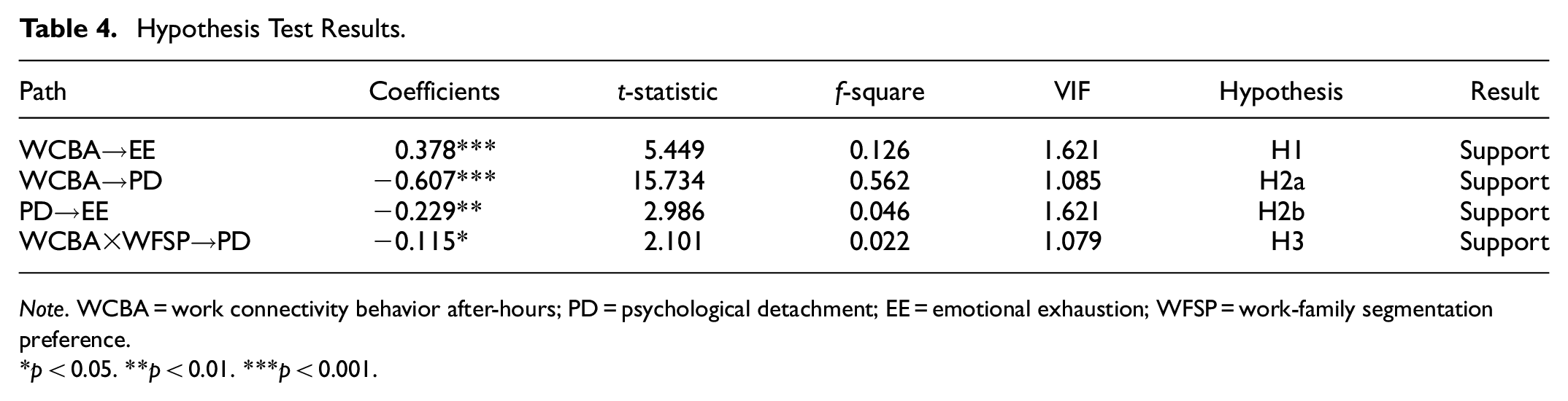
Note. WCBA = work connectivity behavior after-hours; PD = psychological detachment; EE = emotional exhaustion; WFSP = work-family segmentation preference.
p < 0.05. **p < 0.01. ***p < 0.001.
As shown in Table 5, the effects of PD-mediated WCBA and EE (indirect effects = 0.139, p < .01) were 95% confidence intervals of [0.049 to 0.226], excluding 0. Therefore, the mediating role of psychological dissociation was verified and H2 was supported.
The Mediating Effect of Psychological Detachment.

Note. WCBA = work connectivity behavior after-hours; PD = psychological detachment; EE = emotional exhaustion.
A simple slope analysis is used to understand the modulating effect of the WFSP. Figure 3 shows that the negative effects of WCBA on psychological dissociation are more pronounced when WFSP is high.

Moderating effects of work-family segmentation preference.
Discussion
The three research questions that this study seeks to investigate are as follows: (1) Does WCBA affect the emotional exhaustion of retail employees? (2) Is there a link mediated by psychological distancing between emotional exhaustion and WCBA? (3) Does the relationship between psychological dissociation and WCBA have a moderating effect of WFSP? In the following sections, we will discuss our findings accordingly.
Effects of WCBA on emotional exhaustion
According to the study, WCBA can lead to more severe emotional burnout among retail employees. This finding is consistent with Xie et al. (2018), Derks and Bakker (2014), and Fan et al. (2021).The results of the studies conducted were consistent. The work demand-resource model shows that when retail employees receive work-related messages and phone calls after hours, frequent interactions will cause employees to lose their original rest or relaxation time, which will not only lead to the continuous consumption of employees’ psychological resources, but also increase their negative emotions, which in turn leads to emotional exhaustion. At present, with the rapid development of information technology, the occurrence of WCBA has gradually become the norm, and how to reasonably plan the daily work content of retail enterprise managers to reduce the occurrence of WCBA plays an important role in alleviating the negative psychological and physical impact of employees.
The mediating role of psychological dissociation
The results showed that WCBA and emotional exhaustion were mediated by psychological distancing. This result further supports the workload recovery model. Psychological distancing as a restorative experience, when WCBA occurs, retail employees do not have access to the resources they need to recover from psychological distancing (Sonnentag et al., 2014), and the depletion of employees’ long-term mental and physical resources leads to physical and mental exhaustion, resulting in emotional exhaustion (Fritz et al., 2010). This study provides empirical support for future research by confirming that psychological distancing is an important factor between WCBA and employee emotional exhaustion in retail firms. Business managers should understand the psychological state of employees, especially to help them achieve psychological distancing, which is important for the sustainable development of the company’s human resources.
The moderating role of WFSP
Studies have shown that WFSP moderates the effects of WCBA on psychological alienation. In other words, the higher the WFSP, the stronger the negative impact of the WCBA on psychological alienation. This result contradicts the research hypothesis but confirms the findings of Wang et al. (2023).
In response to this surprising finding, this study suggests that this result may be caused by both “insiders” and “outsiders” within the organization. According to LMX, “insiders” represent high-quality leader-member exchange relationships. As a result, leaders tend to trust “insiders” more and give them more autonomy in their work and additional role behaviors, while “insiders” tend to work harder to maintain their relationships with leaders (Brower et al., 2000). “Outsiders” are low-quality leader-member exchange relationships with which they have a simple hierarchical relationship with the leader and are only required to complete the work assigned by the leader and perform the corresponding duties (Brower et al., 2000). Specifically, when WCBA occurs, employees with higher WFSP cannot accept work-family overlap. However, retail employees who are “insiders” actively put their time and energy into their work to deepen or maintain relationships with their leaders. Retail employees who are “outsiders” may be pressured by leaders to deal with work-related issues during non-working hours. Therefore, whether they are “insiders” or “outsiders", the higher their WFSP, the greater the negative impact of the WCBA on their psychological alienation.
Conclusions and limitations
Theoretical contributions
Firstly, it enriches the research on the impact mechanism of WCBA. At present, WCBA has become the norm of work, and the study of it is in a stage of rapid development. To date, most research on WCBA has focused on its negative effects. For example, work-family conflict (Derks et al., 2016), reduced well-being at work (Ohly & Latour, 2014), etc. However, few scholars have focused on the negative state of employees. Therefore, this study explores the mechanism of the impact of WCBA on emotional exhaustion, in order to expand the scope of research on the negative effects of WCBA and help us better understand the negative effects of WCBA on employees.
Secondly, this study enriches the relevant research on psychological dissociation. Most previous studies have focused on the moderating role of psychological alienation (Kilroy et al., 2020; L. Lu & Chou, 2020; Boekhorst et al., 2017), largely ignoring the mediating role it plays. Therefore, this study uses the effort recovery model as a theoretical support to explore the mediating role of psychological separation between WCBA and emotional exhaustion. In addition to deepening the understanding of the effort recovery model, it also enriches the research on the mediating role of psychological alienation.
Finally, based on the work-family boundary theory, this study validates the moderating role of WFSP in the relationship between WCBA and psychological separation. Previous studies from an organizational perspective have found that the negative effects of WCBA on psychological dissociation are lower when the supply of tissue segmentation is higher (Wu et al., 2018). Surprisingly, this study found from an individual perspective that the negative impact of WCBA on psychological alienation was higher when WFSP was higher. Although the source of segmentation preferences is the employees themselves, it produces the opposite result. This result is one of the important findings of this study, but more research is needed in the future to consolidate our findings and deepen the theoretical implications of WFSP.
Actual contribution
The results of this study can provide additional insights to researchers from the perspectives of WCBA, psychological responses, and the negative state of retail employees, and have implications for human resource management practices in the retail industry.
First, the negative effects of WCBA should be reduced. The results of the study showed that WCBA significantly affected the psychological alienation and emotional exhaustion of employees. In an ever-changing market environment, employees are critical to the sustainability of a company, especially in the retail industry. Therefore, retail managers should control the WCBA to mitigate the negative psychological and status effects of employees. For example, managers should make detailed plans for daily tasks and control workloads in advance, actively communicate with employees when assigning tasks, and try to avoid WCBA. At the same time, for the necessary WCBA, employees should be contacted in advance, the time, place, object, method and content of communication should be determined in both directions, and appropriate wage subsidies and moral incentives should be given to reduce the negative impact of WCBA (Boswell et al., 2016).
Second, it is necessary to enhance the psychological detachment of employees; as a kind of recovery experience, psychological detachment is very important to adjust the psychological state of employees. Achieving psychological detachment requires not only the help of the company but also the adjustment of the employees themselves. For retail companies, when it is necessary for WCBA to occur managers should regularly carry out psychological detachment related training to teach employees psychological detachment methods and skills. At the same time, companies can regularly carry out training and counseling on mental health and reasonably guide employees to vent their negative emotions. For employees themselves, while improving their stress tolerance and optimism, they should pay attention to their own rest time and ensure sufficient sleep. In addition, employees can also enrich their leisure time outside of work and achieve psychological detachment.
Finally, create a segmented atmosphere. From a corporate perspective, employees should be given sufficient autonomy. For example, employees can refuse WCBA, essentially creating segmentation conditions for employees. From the employee’s point of view, make or negotiate the division rules with the company and family. For example, do not reply to any work-related messages after 8 p.m. on weekdays, to ensure that work and family can be separated.
Limitations and Future Research
This study has several limitations and possible future directions. First, this study collected samples by means of a network survey and did not strictly follow the principle of random sampling, so there are certain limitations in the rigor of sampling. At the same time, because participating in online surveys may attract certain types of respondents, it may miss people who do not have access to the Internet, which may cause sampling bias. Therefore, future research can employ more stringent sample methods.
Second, the demographic information collected in this study is relatively basic, so the potential impact of demographic characteristics of respondents on this study cannot be fully understood. As a result, future studies can gather more in-depth demographic information, such as income and sector of work.
Third, this study mainly adopts a questionnaire survey and mainly relies on self-reports, so the actual behavior or experience of the respondents cannot be fully understood, and there will inevitably be potential response bias. Therefore, future studies can adopt mixed research methods to make the results as reliable as possible.
Fourth, for the cross-sectional data used in this study, all variables are measured at the same stage, but WCBA will occur in different places. In order to acquire higher persuasiveness, it is advised that analysis in the future be done using an experimental method or a longitudinal study design.
Fifth, the sample of this study is Shanghai, which is a city with good retail industry development in China, but there are certain limitations in the selection of samples. Due to the increasing differences in characteristics and environment between industries, especially those regions or industries with unique cultural or economic characteristics. For this reason, future studies can also be carried out in other industries or regions in order to verify the universality of the research model.
Finally, WCBA can have not only positive but also negative effects. In this study, we only analyzed the negative effects (emotional exhaustion) of WCBA, but the scope of negative effects can be broadened in the future, such as cognitive ability and information anxiety. Additionally, this study used the WFSP of individuals as a moderating variable. The relationship between WCBA and other variables can be moderated from an organizational perspective in future studies. In addition, the variables involved in this study were represented in the form of employee self-assessment, to reduce common method bias and to ensure as much diversity of sample sources as possible. Future studies may consider using the CFA marker technique (Podsakoff et al., 2003) to address common method bias (CMB).
Footnotes
Acknowledgements
We are very grateful to the people who participated in this investigation and supported us.
Declaration of Conflicting Interests
The author(s) declared no potential conflicts of interest with respect to the research, authorship, and/or publication of this article.
Funding
The author(s) received no financial support for the research, authorship, and/or publication of this article.
Ethic Statement
As a voluntary survey, there were no ethical issues associated with this survey.
Research Direction
Yue Hu: Research Direction: Human Resource Management, Studies in Portuguese-Speaking Countries, etc.
Tingyue Kuang: Research Direction: Human Resource Management, Human Capital, Industrial Economics, etc.
Yan Lu: Research Direction: Human Resource Management, Consumer Behavior, Studies in Portuguese-Speaking Countries, etc.

Data Availability Statement
Data sharing not applicable to this article as no datasets were generated or analyzed during the current study.