




Abstract
Leadership is about having the capacity to make a vision a reality. In the context of transformational leadership, this study examines creative behavior as a key factor in Pakistan’s IT sector. Examining the relationship between transformational leadership and innovative behavior is the main goal of this study. While transformational leadership affects people because it inspires them, fosters morale, and boosts productivity. A moderated mediation model based on social cognitive theory was provided in this study. In contrast, the functions of mediation and moderation were played by knowledge sharing, organizational identification, and learning goal orientation. In this cross-sectional study, we implemented the convenience sample method and gathered 391 valid responses from the IT sector. Using the use of AMOS 26 and SPSS 23, the authors measured the latent variables and discussed their connection using a descriptive and correlational approach. The findings showed that transformational leadership has a favorable and substantial impact on innovative behavior. As a result, the mediation of knowledge exchange unites innovative behavior with transformational leadership. When two moderators’ organizational identification and learning goal orientation are effective, knowledge sharing mediates transformational leadership and innovative behavior. By highlighting the mediating function of knowledge sharing in promoting particular traits of innovative behavior, this research has broadened the scope of social cognition theory.
Keywords
Introduction
Every second, technology has been changing the world. The organizations faced global competition and sought alternative ways to sustain their competitive advantage (Anwar, 2018; Naveed et al., 2022). Globally, the Information Technology (IT) sector will grow more than a third of the market in 2021, and the continent of Asia is anticipated to be a significant contributor to this sector (John, 2021). Even so, the Pakistani government is highly passionate about the progress and development of the IT industry and establishing it as a distinct source for software development, Business Process Outsourcing, and freelancing. With the purpose of promoting and using Pakistan’s economic potential in the IT sector, the Pakistani government formed the Pakistan Software Export Board (PSEB). By 2025, it’s anticipated to reach $20 billion (PSEB, 2021).
The effectiveness and efficiency of the management create innovative behavior (IB) among employees, which promotes the company’s competitive edge. Rather than being exclusive to breakthrough growth, “innovation” is used widely in industry to refer to virtually any positive transition (X.-H. Wang et al., 2015). Companies have long sought ways to improve their potential for innovation. As a result, the employees’ innovative behavior develops fresh concepts for the execution of their processes, new ideas connected to the products and services, and a competitive advantage in their industry (Rajapathirana & Hui, 2018). They still imitate, though, and find it difficult to innovate since there are not enough leadership strategies for it. Literature from the past demonstrates how different leadership philosophies influence innovative behavior in diverse ways. Nonetheless, there is stagnant dearth of knowledge regarding transformational leadership and its influence by using mediation and moderation to bring novelty to literature (Lei et al., 2020).
Transformational leadership is a “type of leadership that transforms” (TL). Teamwork, ambitions, aspirations, and values inspire individuals to work harder than they should (Buil et al., 2019) . Yet, leaders must set an example by constantly contacting team members / followers. Withal leadership encourages collaboration and confidence among those required to accomplish IT industry goals. They encourage employees, managers, and departments to engage in frequent feedback loops and prioritize psychological safety so that employees can freely share their knowledge without fear of competition or job insecurity. It also guarantees that staff is honest about their lack of knowledge (Ma et al., 2021).
The organization’s leading force and disciple stimulation for learning new skills characterized transformational leaders (Le & Lei, 2018). Besides leadership, organizational identification affects the relationship between leadership and knowledge. The way an individual behaves within the organization is the organizational identification. So, it is pivotal for the organization to engage in knowledge-sharing activities that precede innovation and cohesiveness. Furthermore, knowledge sharing is required to enhance the employees’ capabilities. So, the organizations must provide a natural and comfortable atmosphere for their employees to share their thoughts and knowledge. Regardless of accomplishing the organizational goals more effectively, the dual process of knowledge sharing relieves transformational leaders, which includes sharing knowledge associated with the task and idea-sharing with supervisors and co-workers (Islam et al., 2021).
The learning goal orientation analyses a person’s general inclination to acquire new tidings and skills in a social setting through knowledge sharing (Shariq et al., 2019). Employees that place a high value on learning put learning first and look for difficult work. They are more likely to identify possibilities in issues and swiftly pick up new information to get past challenges and innovate to make breakthroughs (Li et al., 2022). According to SCT, one can learn in an environment where people actively and reciprocally collaborate with one another as well as in organizations and via individual conduct (Bandura, 1989). But the effective leader has tenacious, self-confident, energy-intensive, environmentally attentive, situation adaptive, committed, and objective-driven qualities. It is stated in the SCT of Bandura (1989) that three types of leadership factors, namely cognition, behavior, and environment, must be examined to comprehend the leadership process properly.
Despite the quantity of data suggesting a positive correlation between TL and IB in the literature, with little empirical studies on the IT industry in developing nations, there is still a potential to explore new countries for study and compare results. As per Zhu and Zhang (2020), a previous research disagrees that transformational leadership has a favorable impact on employees’ innovative behavior. The current study attempts to fulfil this void through researching the influence of transformational leadership on innovation performance in a developing nation. Regarding cultural and management practices, developing countries differ from industrialized ones, which might influence how organizations adopt leadership styles and how their followers perceive and inspire them (Lei et al., 2021).
Currently, the organizations now look for innovations that provide a variety of prospects, the opportunity for a new market, and the ability to stay up with current trends. Employees envision and carry out the organization’s aim to become innovative. So, the organizations subsidize their employees to make them innovative. In this regard, rising research (Zhu & Zhang, 2020) has shown that leaders need to measure the appropriate traits of innovative behavior for idea realization and idea implementation, that is, transformational leadership. This study seeks to demonstrate how transformational leadership may benefit both organizations and their employees, via inspiring and motivating employees, fostering a sense of shared purpose, opening the pursuit of new possibilities, promoting corporate values, and elevating employee productivity. Despite these finding, the underlying cognitive processes by which transformational leader triggers employee innovative behavior in the IT industry of Pakistan has been under-explored. Prior researchers (Abukhait et al., 2019) have noted that it is almost impossible to conceive of any knowledge-free innovative behavior because the relationship between innovative behavior and knowledge sharing is like the root and soil of a plant. Knowledge sharing is not an automatic process the immediate leaders have the potential to influence the extent of knowledge sharing. Besides this, some boundaries alter and can serve as internal cognitive elements which include employee’s organizational identification and learning goal orientation which remains unexplored in the IT industry of Pakistan. Hence, using KS as a mediator, OI, and LGO as moderators in the Pakistani IT sector, the study explores the boundary condition of the link between TL and IB. In Pakistan’s IT sector, this link is examined and analyzed using the quantitative method. In addition to contextualizing the statistical analysis of IT developers, this study will offer fresh approaches to problems that have already been addressed in the literature.
The research will be useful to IT persons and academicians for recruitment and training. The primary cause of the cutting-edge is, without a doubt, innovation. Although there are some adverse outcomes of innovation, change is inescapable, and in most cases, innovation leads to positive change. Innovative behavior inspires workers to come up with fresh concepts. When transformational leadership creates opportunities for knowledge exchange, employees are strong organizational identities. Leaders and managers conduct a variety of events to promote employee identity and organizational identification. Regarding innovative behavior, there are a few studies that are accessible, however there are few studies that focus on the Pakistani IT context. Transformational leadership enlivens an innovative organization’s vision, devises a collaborative working environment, and agitates employees’ academic activities, positively influencing employees’ innovative behavior. Building teamwork by organizing training programs and seminars facilitates a knowledge-sharing climate among innovative employees.
Literature Review
Transformational Leadership and Employee Innovative Behavior
Leadership that encourages inspires, and motivates employees is known as transformational leadership. It is centered on the development and transformation of others, pays attention to their traits, and interacts with followers. Still, they work for the benefit of their organization and society. It also assists in bringing about substantial and beneficial changes by encouraging his followers (Reid et al., 2018) . Furthermore, the previous researchers Hadi and Tola (2019) explained that when an employee or group of employees engages, introduces, and implements new ideas related to the product, processes, and procedures, they show innovative behavior. On the other hand, a wide range of activities are involved in innovative behavior; including brainstorming sessions, identifying common problems (Schuckert et al., 2018), technical product design, the power of persuasion (Zia, 2020), taking risks, and collaborating with colleagues (Hansen & Pihl-Thingvad, 2019).
According to one study (Farahnak et al., 2020), transformational leaders understand how their values align with those of the organization (person-organization value congruence) by educating their followers on the significance and importance of specific rewards and how to get them. At the same time, the leader should emphasize the financial benefits of such achievement. Transformational leaders assist individuals in their quest for self-fulfillment and understanding of the need for change, and they instill a feeling of urgency in their managers. It encourages proactive action from subordinates (Buil et al., 2019), emotional intelligence (Awang et al., 2020), empowerment (Williams et al., 2018), and focuses resources where they are most needed (Inceoglu et al., 2018) . The transformational leader also commits to excellence (Farahnak et al., 2020), takes a long-term view (Arnold, 2017), and fosters trust (Islam et al., 2021).
High-performance organizations hire and have a basis for innovative employees to maintain a competitive advantage because employees interact outside and inside. Organizations recognize the value of their innovative employees who deliver the most exemplary ideas as an intangible assets. So they see the possibilities for change in products and processes (Kwon & Kim, 2020) . Leaders and managers in organizational management work together with personnel to develop fresh ideas, assure executive-level attention to inventive individuals, make investments in idea development, and develop additional resources for innovation (Lee et al., 2020).
IB does not imply that an employee acts independently of company strategy. Throughout the recruitment process, management saw two qualities: innovative behavior and an entrepreneurial attitude. Furthermore, the CEO and leader stress transformational leadership to improve employee innovative behavior (Ding & Yu, 2020). They continually pursue innovation; take risks and encourage risk-taking (Amuna et al., 2019); emphasize collaboration (Plastino & Purdy, 2018); and integrate development and production (Kremer et al., 2019).
The influence of transformational leaders on their employees fosters them in approaching their common goal. Innovative behavior needs strong intentions, and inquisitive thinking stimulates higher levels of intellectual from followers, which transformational leaders may deliver (Qi et al., 2019). Moreover, employees’ innovative behavior needs job autonomy and approval from the company, supervisor, or top management (Asbari et al., 2021). The leaders involved their employees in several activities in which some generated ideas, some promoted these ideas, and most importantly, some pursued the realization in that new products or services can create (Lee et al., 2020).
Prior researchers (B.-J. Kim et al., 2018) have also found that organizational commitment and job satisfaction increased by the motivational activities given by TL. A high level of transformational leadership, on the other hand, may elicit negative emotions in subordinates and limit the breadth of their thought and conduct. This behavior is analogous to the disadvantage of having too much self-confidence (Zheng et al., 2019). It is believed that TL has the greatest impact on fostering learning competency in businesses. Moreover, it is thought that the major catalyst for constructing IB is knowledge sharing (Suhana et al., 2019) .
Researchers have examined the combined impact of transformational leadership and top management on innovative behavior (Afsar & Umrani, 2020; Hui et al., 2018; Naguib & Naem, 2018). The findings demonstrate how transformational leadership fosters interpersonal trust and boosts creative capacity, which has a significant influence on innovation. Business leaders must build a clear common vision and precise goals while continually looking for new opportunities to further the practise of transformational leadership for innovation. It has been demonstrated that TL has a favorable impact on EIB (Choi et al., 2016). With the help of above discussion, the given hypothesis is developed;
H1: There is a positive influence of Transformational Leadership on employee Innovative Behavior.
Mediation of Knowledge Sharing
Knowledge sharing (KS) inside an organization is the process to make knowledge accessible to others. It is a crucial team activity where participants communicate to share information, arguments, and ideas on their ongoing projects (Wang & Liu, 2019). Corporate culture, individual learning, technological environment, and organizational structure were shown to be the four main building blocks of knowledge sharing. Organizations today place an emphasis on their competency and talents to increase production and human efficiency (Thulin et al., 2019).
Organizational employees come from a variety of socioeconomic and racial origins, have varying experiences, and desire to share information with their coworkers, which results in a special area of expertise. Also, a culture that encourages knowledge sharing is one where team members feel highly trusted and agree that sharing information is helpful. Leaders who promote knowledge-sharing initiatives improperly do not encourage productive, creative activity. The growth of workers’ innovative behavior may be sparked by leaders placing a high value on knowledge sharing (Le & Lei, 2018). Knowledge sharing has a crucial role as a mediator in the transmission of organizational justice, which directly influences IB behavior (Akram et al., 2020).
The researchers Dwivedi et al. (2020) study how knowledge sharing plays a mediating role in the relationship between transformative leadership and workforce productivity. According to the study, team members are more likely to be productive and effective when leaders impart their knowledge and experience to the group. There is empirical evidence for the mediating role of KS with leadership and innovative behavior (Khassawneh et al., 2022; Udin et al., 2022).
In light of this conversation, it is hypothesized that;
H2: Knowledge Sharing mediates the relationship between Transformational Leadership and employee Innovative Behavior.
Organizational Identification as a Moderator
Organizational identification (OI), a passion in which employees think of themselves as members of the organization, is a vital component in the study of organizational behavior. Previous studies have shown that workers who exhibit high identification traits are more likely to comprehend and be intensely interested in their leader as well as readily share their expertise with teammates (Wolfinbarger et al., 2021).
Prior research supports the view that particular individual and work-related factors are likely to reduce the influence of leaders on followers’ behaviors. OI acts like a border state that influences TL and employee adaptation (H.-J. Wang et al., 2017). Bose et al. (2021) identified psychological empowerment as an essential mental mechanism that affects employees’ identification through transformational leadership.
H. Liu et al. (2021) found that identification with an entity, as implemented via TL, encourages workers to make advantage of their freedom. Also, researchers Zulfiqar and Khan (2021) discovered a strong correlation between organizational identity and knowledge sharing behavior, whereas the moderating effect of collectivism was shown to be minor in this connection. Employee flexibility and work design are successfully increased under transformational leadership. But the researchers hypothesized the many components of organizational identification, such as adherence, leadership support, a feeling of oneness, and affinity. To optimize staff talents and address workplace difficulties, transformational leaders promote a knowledge-sharing atmosphere Srivastava and Madan (2020). The authors (Bose et al., 2021) shown that employees get more (strong) identified with the company as a result of their observation of facts and affinities, which motivates them to voluntarily impart knowledge to teammates.
As a result, we hypothesized that
H3: Organizational Identification moderates the relationship between Transformational Leadership and Knowledge Sharing.
Learning Goal Orientation as a Moderator
Goal orientations influence why and how people work to accomplish certain goals and are related to the overarching aims of accomplishment behavior. Those who have a learning goal orientation (LGO) are driven to develop oneself by picking up new skills, dealing with unforeseen circumstances, and broadening their knowledge. The researchers Guo et al. (2019) investigated the effects of psychological innovation, autonomous cultures, and creative information system use on employees’ goal orientation and the boundary conditions that govern it. While Zia (2020) confirmed the link between performance-based innovation performance and knowledge management behavior, which serves as a mediator between the two but it scrutinize the moderating role of LGO and performance goal orientation. The study of T. T. Kim and Lee (2018) research compared the effects of two different types of knowledge-sharing behaviors—knowledge gathering and knowledge donating—and two different types of goal orientations—learning goal orientation and performance goal orientation at hotel industry.
Strong learning goal orienteers are encouraged to contribute their expertise and innovative minds, according to Ng and Lucianetti (2018). LGO are thought to have numerous different combinations of distinctive characteristics and have been examined at varied levels of stability. In accordance to research, employees who have a high LGO are more ready to learn, to develop their abilities, and to share and use their knowledge (Lazarides et al., 2018). Prior research, indicates that LGO affects learning activities are approached by trainees and allocate their energy throughout learning Garcia-Marquez and Bauer (2021). High learning objective orienteers focalize on learning new abilities, developing self-discipline, drawing on the proficiencies of their coworkers and superiors, effectively managing time, and taking part in fresh initiatives. KS with people who have a high degree of LGO produces positive feelings and attitudes about employees, promoting high identification with the company. Higher results suggest that individuals with a high LGO report superior adaptation to a radar-tracking test (Stasielowicz, 2019) (Figure 1).

Theoretical framework.
The following hypothesis is proposed;
H4: Learning Goal Orientation moderates the relationship between Knowledge Sharing and employee Innovative Behavior.
Social Learning Theory served as the foundation for Albert Bandura’s Social Cognitive Theory. Modeling, self-efficacy, outcome experience, and identification are the four parts of SCT. It claims that when people act in accordance with a model, they are recalling the facts and circumstances that will direct their conduct in the future. When a transformational leader performs, followers or subordinates retain or pass along the knowledge they learned from the leader, which prompts IB in response to a particular stimulus. Employees need to copy other people’s actions in order to learn new behavior; they cannot accomplish this on their own (Bandura, 1999).
In accordance with SCT, OI and LGO are internal cognitive aspects of employees that relate TL with IB. While LGO might serve to lessen the influence of KS on employee IB, OI is a barrier between TL and KS. With mastery experiences and LGO, self-efficacy may be fostered, encouraging employees to seek out tough work and absorb new material to make breakthroughs. With KS acting as a mediator and OI and LGO acting as moderators at various stages, the delicate framework demonstrates the boundary conditions of the link between transformational leadership and employee innovative behavior.
Methodology
To determine how TL stimulate employee IB in Pakistan’s IT industry, authors performed a cross-sectional study. Data from Pakistan was gathered between August 2021 and November 2021. The Pakistan Software Houses Association (P@SHA) was established by a group of software companies to serve as the industry’s trade body. Pakistan has above 7,000 IT companies and has more than 100,000 English speaking employees. The required sample size for a population of 100,000 was 384 (P@SHA, 2021). The IT sector employs more than 100,000 English-speaking individuals, many of whom are top experts in the field’s most recent and forthcoming goods and technologies (PSEB, 2021).
In correspondence to Krejcie and Morgan (1970) the required sample size for a population of 100,000 was 384. Using Google Forms, an electronic questionnaire was employed to guarantee a minimum of 384 responses. In reaction to the COVID-19 pandemic like various studies, the online questionnaire was distributed to IT companies registered at P@sha in August 2021 (Irshad et al., 2021; Rehmani et al., 2022). In Pakistan’s high-tech cities, the P@sha questionnaire was issued to more than 1,000 IT companies. About 395 of the 979 email addresses that were sent the email were returned, yielding a response rate of 58%. A Google Form was used to gather the data, and all fields had to be filled out in order for it to be submitted. Because of neutral, disagree, and strongly disagree responses, four unengaged comments were removed from the record.
The TL style was assessed using a 20-items by using 5-point behavioral scale version of the Multifactor Leadership Questionnaire (MLQ; Bass & Avolio, 1996). A modified version of the OI scale with five items that were measured on 5-point disagree/agree scales was developed Smidts et al. (2001). The five items of Bock et al. (2005) for KS variable were adapted for the study. The Six statements of VandeWalle (1997) were adapted and measured on a 5-point Likert scale for the variable of LGO. Similarly, for IB, the six items of Scott and Bruce (1994) were adapted and measured by using 5-point Likert scale.
Data Analysis
The current study performs the data analysis with two-steps (Anderson & Gerbing, 1988). Composite Reliability and Cronbach alphas was initially established in order to verify the reliability. Then the confirmatory factor analysis was conducted and model 21 of Preacher and Hayes (2004) was used to find the moderated mediation analysis. In order to determine the connection between the constructs, regression analysis was performed. AMOS 26 and SPSS 26 were used to conduct the entire analysis.
Demographic Characteristics
This section discusses the demographics of responders and their supervisors. There are a majority of male respondents around 84% and the remaining 16% are females. Most supervisors around 94% are men and their age falls in the category of 36 to 45 years which is 56% while 36% were under the range of 46 to 55 years of age. The larger part of the respondents and supervisors had a graduate degree which was 80.31% and 86.20%. The only respondents who said they have spent more than 20 months at job was a percentage of 34.52. The least figure was for those who had spent fewer than five months, which was 2.56%. Table 1 illustrates the figures for demographic characteristics of the respondents.
Fitness of Model.

p < .01.
Descriptive Statistics
Descriptive statistics are a series of short descriptive coefficients that describe a data set, which might be a representation of the complete population or a sample of the population. The mean, standard deviation (SD), minimum value, and maximum value are all included.
The data has a minimum value of 1 and a maximum value of 5. TL’s mean and SD are 3.71 and 0.45, respectively. For moderator OI, the mean is 4.07, while the SD is 0.51. The mean and SD of the mediator KS are 4.01 and 0.37, accordingly. LGO is another moderator between KS and IB, with a mean and SD of 4.09 and 0.43. IB as DV is made up of 3.91 mean and 0.31 SD.
Results and Discussion
The internal consistency of the reliabilities was determined. Also, we used the CFA to assess the convergent and discriminant validity of our research variables (Anderson & Gerbing, 1988). The model’s suitability for CFA was assessed using the chi-square test and a number of fit indicators. The goodness of fit score for the χ2 was 882.129. The square approximation error, according to the root, was 0.102. Bentler’s proposed figure for the Comparative Fit Index (CFI) found to be 0.901; the actual result was 0.902. According to Bentler (1990), the Normed fit index (NFI) was 0.932 and SRMR value of 0.084, ranging from 0 to 1. To ensure discriminant validity, the hetero trait mono trait (HTMT) ratio is calculated and the value was 0.8363 as per the threshold value to be below 0.85 or 0.90 (Rasoolimanesh, 2022). The statistical findings demonstrated the models’ appropriate overall fitness.
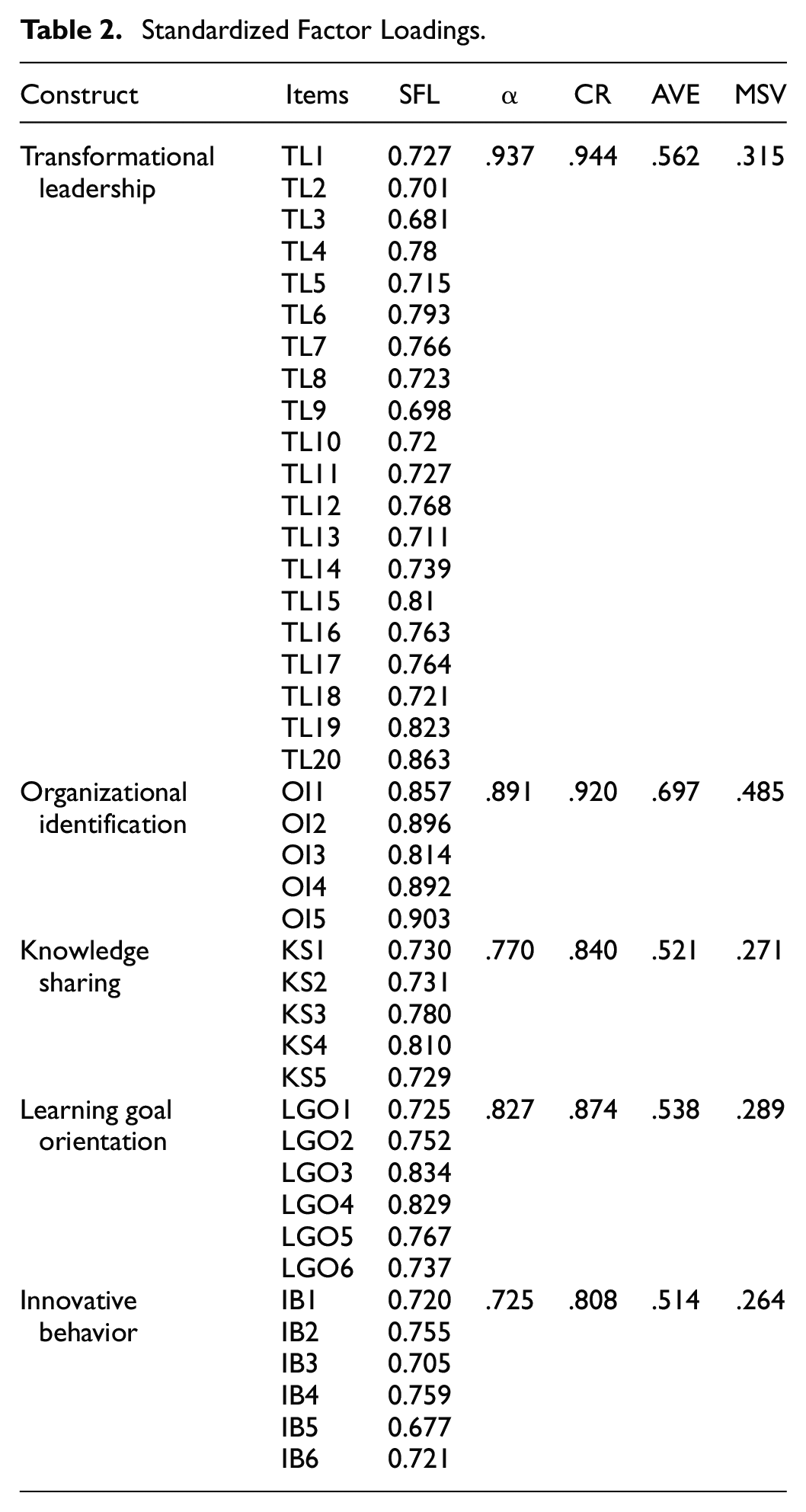
With SFL for every item being greater than 0.7, the study instrument provided outstanding validity and reliability for the operation of latent constructs. Nevertheless, the three items with the values 0.677, 0.698, plus 0.681 found to be valid as supported by the literature (Ursachi et al., 2015).
All components’ Cronbach alpha results were between .725 and .937. The composite reliability ratings were more than .70, ranging from .808 to .945. All AVE values were over the threshold of .50, falling between .63 and .83. Between .264 and .485, MSV was smaller than the AVE, showing that structures account for the majority of variation (Fornell & Larcker, 1981; Table 2).
Standardized Factor Loadings.
Regression Analysis
TL and IB were shown to be causally related (β = .286, p < .01) using linear regression analysis. There is a direct positive association between TL and IB. This relationship can be guaranteed so that an increase in TL will eventually lead to an increase in IB, and a decline in TL will result in a decrease of PS. If R2 = .561, where a single unit variation in TL will result in 0.561 units of rising change in IB, this figure will have a considerable impact. As a result, H1 is supported and approved since p < .01 indicates a significant relationship between TL and IB.
OI (Moderator) and TL (Independent Variable) have a positive link (r = .505**, p < .01) in Table 3. Moreover, there is a positive link between OI and KS (r = .564**, p < .01) as well as LGO (r = .512**, p < .01), TL (r = .561**, p < .01), and IB (r = .502**, p < .01). Another moderator in the model is LGO. Also significant and positively correlated with the variables TL (r = .537**, p = .01) and IB (r = .698**, p < .01) is this variable. The TL, and the IB, likewise have a substantial and favorable link (r = .577**, p < .01).
Correlation Analysis.

Note. OI = organizational Identification; KS = knowledge sharing; LGO = learning goal orientation; TL = transformational leadership; IB = innovative behavior.
p < .01.
Mediation Analysis
The LLCI and ULCI (lower-level and upper-level confidence intervals) for the indirect impact of TL and IB are 0.218 and 0.369, respectively. Hence, with a value of p = .000, KS mediated the effect of TL and KS. It may be inferred that mediation is taking place because Table 4 demonstrates that ULCI and LLCI both have positive signs. Hence, H2 acknowledges that KS acts as a bridge between the transformational leadership and innovative behavior.
Mediation Analysis.

Note. N = 391; IV = independent variable; DV = dependent variable; M = mediator; LL = lower limit; UL = upper limit; CI = confidence interval.
p < .01.
The mediated model is illustrated as Figure 2 where transformational leadership is the independent variable, innovative behavior is dependent and knowledge sharing is the mediator.

Coefficient of mediated model.
Moderation Analysis
The results showed that OI and KS were directly correlated, rise in OI increased KS and vice versa (β = .142, p = .001). In this case, the value is positive, suggesting a favorable result, and R2 = .0158, showing that one positive change in TL generates .0158 positive changes in KS. OI moderates the relationship of TL with KS, and indicated by the p value of .001. A 391-person statistical sample population’s standard deviation (SD) is approximately 0.0446, or standard error (SE).
Table 5 illustrates the correct forecast of H3, which states that the interaction terms “TL × OI” moderate the relationship between “TL and KS.” since there is no zero and both values have the same sign. The ULCI and LLCI are 0.230 and 0.045. Therefore, the theory is liable to be admitted. Since the interaction term is positive and exhibits regression coefficients (β = .142, p = .001), OI modifies the link between TL and KS.
Organization Identification Moderation Analysis.

Note. SE = standard error.
p < .01,
Table 6 shows that the conditional indirect influence of TL on KS rises as OI levels rise, with both having the same sign and the indirect effect being significant (β = .389 at a low level to β = .254 at a higher level).
Moderated Mediation Analysis.

The second moderator was the LGO that existed between KS and IB. LGO, in accordance with H4, alters the link between KS and IB. Table 7 displays the results of the moderation analysis of proposal 5. This makes the case for accepting Moderation Hypothesis 4 stronger. This is done so that the “KS × LGO” can control the relationship between “KS and IB.” The LLCI and ULCI for this connection are both 0.140.
Learning Goal Orientation Moderation Analysis.

Between the ULCI and LLCI, both of which have a positive sign, there is no 0 value. The interaction term has a positive and significant regression coefficient (β = .690, p = .0001) with KS, similar to how LGO modifies the connection with KS. This demonstrates how LGO more successfully modifies the relationship. It may be argued that this validates or accepts H4 for moderation. Table 8 shows that the conditional indirect effect of KS on IB strengthens as LGO concentrations rise, with both having the same sign and the indirect effect being significant.
Moderated Mediation Analysis.

Discussion
This study investigates the connection between transformative leadership and employees’ innovative behavior. Organizational identity (OI) and learning goal orientation (LGO) are regarded as personal cognitive factors that influence employee knowledge sharing (KS) and innovative behavior (IB), according to social cognitive theory. TL is perceived as a part of the outside environment.
The study’s conclusions give statistical evidence on the link between the TL and IB’s approval of the SCT (β = .286, p < .01, R2 = .561) and the outcomes of earlier studies (Hadi & Tola, 2019; Ismail & Mydin, 2019; Nardo et al., 2019; H.-J. Wang et al., 2017) . These studies’ authors made the case that when they create awareness and purpose, TLs widen and elevate the interests of their teammates and employees. The current research showed that TL favorably effects KS, encouraging the IB, and this hypothesis was confirmed to be valid and acceptable. Empirical data show that TL plays a key role in elevating the IB, and as a result, TL positively causes IB. The findings show that TL affects IB while KS is involved. KS mediated the effect of TL and IB, with a lower- and upper-level confidence interval of 0.218 and 0.369 respectively. The research by Ibrahim et al. (2020) look at IB with KS as mediating factors in their study approach. By examining the mediation impact of knowledge receiving, it was revealed that the usage of information and communication technologies is strongly associated with innovative behavior. Many studies have established the direct and indirect effects of TL on employees’ IB and confirmed the findings of earlier research (Y. Liu et al., 2019; Zheng et al., 2019).
Organizational identification (OI) and learning goal orientation (LGO) serve as the study’s two moderators. In confirmatory with the findings, KS aids in bridging the gap between TL and IB when OI and LGO are strong. Strong identifiers who are both cognitively and emotionally bonded to the company demonstrate their psychological tie by freely sharing information with coworkers (Bose et al., 2021). OI moderates the relationship between TL and KS due to its positive interaction term (β = .142, p = .001).
High-learning people prioritize learning new abilities, developing self-discipline, picking up lessons from their bosses’ or coworkers’ mistakes, managing their time well, and taking on challenging initiatives (Bulent et al., 2015). They encourage creative initiatives across the whole organization. Stasielowicz (2019) giving KS to those with a high degree of LGO causes positive feelings and attitudes in the workers, promoting high identification with the company. In response to the objective of how LGO moderates the association with KS, the interaction term has a positive and significant regression coefficient (β = .690, p = .0001) with KS. According to the evidence, TL positively affects EIB through KS, and IB are not wholly internal and are subject to be affected by leadership style and other external social environments. Because TL provides role models, workers tend to be more willing and aggressive about sharing ideas with fellows. The outcomes of this study’s analysis show that KS bridges TL and EIB (Farheen et al., 2023).
Practical and Theoretical Implications
From product innovation to employee skill development, knowledge is crucial for global economic progress, and this study made contributions both practically and theoretically.
At first, the erudition, knowledgeable, and discernment process that includes TL affecting IB in the Pakistani industry of information technology is demonstrated in this paper as a contribution to leadership theory. By creating an integrated model through data collected from this industry, it also advances future study on leadership in Pakistani cultural contexts.
Second, OI is a personal cognitive component that influences workers’ performance and learning, enhancing the relationship between TL and KS. Investigating the interplay impact of TL features and individual cognitive factors advances theoretical understanding of KS behavior.
Third, the current study discovered that when team members are solidly LGO, KS has a noticeably more profound relationship with IB. By outlining the function of the contextual moderator in knowledge sharing, this work adds to the body of literature on knowledge management.
Fourth, the HR department should plan events, activities, seminars, and workshops to strengthen employee identity in terms of hiring and training.
Finally, strategic rivalry has been spawned by globalization, which has offered new opportunities. This study demonstrates the importance of TL and KS for the IB environment and the IT sector. Both TL and an effective and efficient KS are possible when leaders can take control of implementing OI and LGO in the organization. Both OI and LGO are useful and effective. The skills of the appropriate personnel, as well as their organization identification and learning goal orientation, has been a remarkable contribution to the literature of leadership and innovative behavior.
Future Directions and Limitations
One of the research’s potential limitations is the lack of additional leadership-related antecedents of individual innovative behavior. Autocratic leadership, participative leadership, moral leadership, and charismatic leadership will all be studied in the future. Data was collected in the restricted part of industry to allow upcoming scholars to mimic present research in different professions and industrial segments. Longitudinal survey is likewise required to build on the current cross-sectional study. Future research should focus on the interaction between latent factors and the moderating effect of corporate ownership structures on the conversion of KS into superior innovation. Additional mediating factors should be considered, such as the knowledge management process and its elements, emotional commitment and job satisfaction Future studies might focus on IB at the team level rather than employee level, as this study did.
Conclusion
After conducting research on the IT industry in Pakistan, the study aimed to investigate the interplay between transformational leadership (TL) and innovative behavior (IB). To address the gaps in existing research, the study employed the use of learning goal orientation (LGO) and organizational identification (OI) at diverse stages, while data were collected from IT companies in high-tech locations, with 391 questionnaires answered. The results revealed a strong correlation between TL, IB, and knowledge sharing (KS), which were supported by the Social Cognitive Theory (SCT). SCT asserts that enhancement of knowledge occurs under a social context where individuals interact dynamically and reciprocally with their environment and behavior. Hence, TL’s behavior in an organizational setting significantly impacts the innovative behavior of workers. The Findings also explored the association of TL with KS and how OI moderates the connection between the two, while LGO modifies the association of KS with IB in IT industry of Pakistan.
Generally, present research sheds light on the critical role of TL in promoting IB and KS. Additionally, it highlights the immense benefits of learning goal orientation and organizational identification. These findings provide crucial insights for researchers in this field to better understand and explore the relationship between TL, IB, and KS in the information technology sector in Pakistan.
Footnotes
Acknowledgements
We would like to express our sincere appreciation to all individuals who have contributed to this manuscript. Specifically, we extend our gratitude to Mr. Naveed Anwer and Mr. Hafiz Ihsan Ur Rehman for their valuable contributions during the first revision stage. We also acknowledge the support of Mr. Umer Iftikhar in the early stages of this project, particularly in the conceptualization of the framework. Their insights and efforts have greatly enhanced the quality of this work.
Declaration of Conflicting Interests
The author(s) declared no potential conflicts of interest with respect to the research, authorship, and/or publication of this article.
Funding
The author(s) received no financial support for the research, authorship, and/or publication of this article.
