




Abstract
Consumers live in a social media environment and naturally form a set of trust mechanism from close circles, internet celebrities, and online articles. However, no sufficient research to examine these relationships with social influence and the effect of trust on social influence. This study integrates these factors and brand image to examines their impact on purchase intention. A questionnaire and SEM were used to test the reliability and validity of the hypothesis. The results support that purchase intention is significantly influenced by social influence and brand image. The outstanding contributions are as follows: first, it expands the research scope of social influence; second, it is found that close circles is the vital dimension of social influence, followed by social media viewership and e-WOM readership. Finally, based on the trust mechanism, marketing suggestions are put forward.
Plain Language Summary
Consumers live in a social media environment and naturally form a set of trust mechanism from close circles, internet celebrities, and online articles. However, no sufficient research to examine these relationships with social influence and the effect of trust on social influence. This study integrates these factors and brand image to examines their impact on purchase intention. A questionnaire and SEM were used to test the reliability and validity of the hypothesis. The results support that purchase intention is significantly influenced by social influence and brand image. The outstanding contributions are as follows: first, it expands the research scope of social influence; second, it is found that close circles is the vital dimension of social influence, followed by social media viewership and e-WOM readership. Finally, based on the trust mechanism, marketing suggestions are put forward.
Introduction
Social influence has a profound impact on the general consumers’ attitudes, beliefs, and actions (Argo & Dahl, 2020; Cambra-Fierro et al., 2021; Hsu & Lin, 2016; Kelman, 1958; Mi et al., 2019).This phenomenon is even emphasized in today’s platform marketing strategy. It present an unprecedented breadth and depth of influence and most of company get much fetch from platform, and resulting in a marketing industry worth more than $13 billion (Rahal, 2020), up to $13.8 billion in 2022 (Influencer Marketing Hub report, 2021). About 92% of social network users said they had followed at least one celebrity or influencer, 36.2% of users had tried products recommended by celebrities, and 20.4% of users had purchased products recommended by the influencer (Statista, 2021). About 90% of marketers believe that influencer marketing is effective (Dimitrieska & Efremova, 2021). It has been documented that these profits come from the influence and credibility of key opinion leader, micro-influencer, blog influencer, celebrity influencer, and social media influencer (Argo & Dahl, 2020; Dimitrieska & Efremova, 2021; Hsu & Lin, 2016; Mi et al., 2019). These social influence mechanisms have thoroughly changed the way of product promotion and communication with users, boosting product sales. Maximizing sales with the least cost is the most important thing for businesses. However, the research on the difference in the degree of influence of social influencers on consumer behavior change is lacking. Therefore, Therefore, this study aims to provide a basis for enterprises to formulate marketing plans according to the influence of different celebrities.
Trustworthiness is netizen’s perception of the influencers’ integrity, expertise and competence and as the core antecedent factor affect consumer behavior (Argo & Dahl, 2020; Hsu & Lin, 2016; Mi et al., 2019). Trust in psychologically refers to a party’s confidence in the trustee’s positive behavior and expects better results and valuable resources from cooperation and as an essential prerequisites for building relationships between strangers. Trust transfer theory states that an individual’s trust can be transferred from a trusted source to an unknown target if there is a specific association between them (Doney & Cannon, 1997). Thus, therefore, various types of influencers can influence the attitude, cognition, and behavior of Internet followers toward the products they endorse. Kirschman (2022) pointed out that the originality of the post, the number of followers, and the brand’s name prominently placed can affect the credibility of the product, while simply publishing a new product post has no effect. Such as the famous soccer Cristiano Ronaldo, who has more than 500 million followers (Al Rabadi, 2022), and can be able to draw their attention to the brands he’s promoting. But studies have noted that the more famous a football personality’s value, the more positive and negative comments they garner (Kucharska, 2018). Not surprisingly, family and close friends and their recommendations are considered the most reliable and valuable (Dimitrieska & Efremova, 2021. Stemming from familiarity with each other’s preferences, close friends can be seen as customized experts and give sound judgments (Gellerstedt & Arvemo, 2019); On the other hand, they can become good friends, which indicates that homogeneity is relatively high, which affects trustworthiness and expertise and therefore credibility (Ayeh et al., 2013; Gellerstedt & Arvemo, 2019). However, most extant studies have focus on credibility of influencers, while the consumer’s psychological mechanism (i.e., trust) changes has not been well explained. This may has lead to the neglect of other variables (psychological factors) in the process of transmitting trust.
To fill this gap, we introduce social influence and brand image in this study as key factors influencing trustee’s trust transfer to brand purchase intention. Social influence is one of the most critical sources influencing consumers’ behaviors actively or passively (Argo & Dahl, 2020; Cambra-Fierro et al., 2021). Brand image has been identified as one of key antecedent directly influencing purchase intentions (H. W. Kim et al., 2012; Leader et al., 2021; Lien et al., 2015; Y. H. Wang & Tsai, 2014).
Social influence in network is more diverse and complex than the traditional influence of friends and salespeople. For the research purpose, family and close friends, key opinion leaders, micro-influencers, blog influencers, celebrity influencers, and social media influencers can be classified as follows: face-to-face friendship, e-WOM readership, and social media viewership. “These types of communication are the most important sources of information about products or services in digital contexts” (Tobon & García-Madariaga, 2021, P607) and then examine they relationship with social influence, between social influence along with brand image and brand purchase intentions, meanwhile take trust as a moderating variable.
Literature Review and Hypotheses Development
Social Influence Theory
Social influence theory proposed by Kelman (1958), refers to an individual’s attitudes, beliefs, and subsequent actions or behaviors influenced by referent others (Bartal et al., 2019), which include compliance, identification and internalization. Burger et al. (2001) pointed compliance occurs in one’s response to the request of the person they like or approve based on reciprocity influence, and the more significant perceived similarity between two people will enhance compliance, even the apparent similarities (Burger et al., 2001; M. Kim & Kim, 2020). By the same logic, consumer comply with celebrities with physically attractive personalities that match consumers (Loughran Dommer et al., 2013; Zhuang et al., 2021). Identification usually occurs in these two scenarios: hope to gain approval or avoid punishment (Deutsch & Gerard, 1955).
And only trusted information has a real influence, which genuinely change personal attitude and behavior (Turner & Oakes, 1986). Thus, information source credibility is the prerequisite factor for influencing people’s behavior (Fleury et al., 2020; Schwarzwald et al., 2001; Turner & Oakes, 1986; T. Zhang et al., 2020). Mi et al. (2019) suggested that the potential source of influence is interpersonal and social; interpersonal influence comes from family and friends. Socially related forces refer to the power of online social networks (Zhuang et al., 2021). Social influence can be described using different constructs by different theories depending on the research context.
To get an in-depth study of social influence, we also compare those fields mentioned above to understand how trust establishes from the social influence circles and further impacts consumers’ purchase intention.
The Social Influence and Reflective Indicator
Face-to-Face Friendship
Face-to-face friendship here refers to friends sharing common interests and thinking alike, familiar with each other’s personalities and preferences (Gellerstedt & Arvemo, 2019). Friendship is a critical driver of personal life satisfaction and psychological well-being (M. Kim & Kim, 2020). Individuals follow their peer’s suggestions because of the congruence of value systems, language similarity, and interest similarity (M. Kim & Kim, 2020), or fear of losing peer support (Engels et al., 2004), sometimes to build and maintain friendships (Tucker et al., 2014). In addition, personal attitudes and self-concepts can be influenced by family, friends, or colleagues (Yang et al., 2007).
Godey et al. (2016) showed that 81% of teenage girls get trend information and 45% of decision-making advice from their friends and family. Studies have proved that when shopping with friends, personal behavior changes: increases purchase amount, spend more money, positive attitudes toward merchants, and increased non-compulsive impulse shopping (De Vries et al., 2018).
Online Social Network
The occurrence of social influence does not require purposeful or conscious efforts to change the behavior of others, nor does it require direct contact between two actors. This kind of social influence is of particular interest in the subfield of social networks and online purchasing as it links the structure and composition of networks and the individual behaviors and outcomes of actors embedded in them (Filieri et al., 2018; Perry & Ciciurkaite, 2019).The direction of influence theoretically depends on the attitude, attribute, or behavior of the participants in the network (Bartal et al., 2019) and the relationship between participants in social networks and the extent of the influence (Argo & Dahl, 2020). Further expanding based on previous research on the forces of social influence, Zhuang et al. (2021) classified social influence as the influence from the information, action, and structure, which include duration, intimacy, emotional intensity, reciprocal services between users, and interaction activity between people (type, frequency, and context). Based on the research results of Zhuang et al. (2021), we summarized social influence types within online influence as follows:
E-WOM Readership
Reviewer online (e-WOM readership) refers to any positive or negative statement about a product or company made by a potential, actual, or former customer that can be made available to the people over the Internet and is considered trustworthy (Alsoud et al., 2022; Chih et al., 2013). Social media and social platforms allow consumers to share their shopping and product usage experiences. The reliable and trustworthy source of information that provides referential and diagnostic for the potential buyer, who can overcome purchase uncertainty (Al-Adwan et al., 2022; Putri Utami et al., 2020), and avoid the punishment caused by making a wrong decision (Singh & Matsui, 2017; Bastos & Moore, 2021). Consumers are used to searching for unfamiliar product information online and trust other peer comments more than marketers (Al-Adwan et al., 2022; Doh & Hwang, 2009; Mi et al., 2019). And research indicated that the information from Online Consumer Reviews (OCR) is more useful than that from opinion leaders (OL), and the influence is more potent when OCR includes the shopping experience. Meanwhile, consumers will be less influenced by OLs as they have more online shopping experience (Tobon & García-Madariaga, 2021).
E-wom’s credibility is related to the writer’s expertise, relevance, timeliness, accuracy, comprehensiveness, and quantity of the content (Majali et al., 2022; Putri Utami et al., 2020; Sa’ait et al., 2016). The good or bad signals of products obtained by online searches may directly or indirectly influence personal online shopping decisions (Alsoud et al., 2022). Therefore, e-WOM occurs in choosing phone brands (Yang et al., 2007), tour destinations (M. Kim & Qu, 2017), and green products choice (Mi et al., 2019).
Social Media Viewership
Live streaming refers to marketers’ promotion and sale of goods through influential mainstream media on social media channels alongside charismatic online celebrities. And live streaming e-commerce is developing rapidly, and the amount of merchandise sold via live streaming is staggering (Meng et al., 2021). Through their individuality, expertise, and attractiveness, persuasion-oriented performances, celebrities influence consumers’ attitudes toward endorsed products (Huhn et al., 2018; Meng et al., 2021; Mi et al., 2019). Celebrity congruence with products or congruence with the consumer’s ideal self-image are particularly persuasive (Choi & Rifon, 2012; Hui, 2017). People tend to reflect on their real self-image or express their ideal self-image through the product (Mi et al., 2019). When people find that celebrities can promote their self-image or demonstrate congruence with their perfect self-image, they will adopt the recommended suggestions and even imitate the celebrity’s behavior to change themselves (Loughran Dommer et al., 2013; Zhuang et al., 2021). Meanwhile, online celebrities who can arouses consumers emotional trust will influence their decision (Meng et al., 2021).This is typical internalization behavior of social influence (Loughran Dommer et al., 2013). Another internalization study of social influence showed that a non-smoker in a network became a smoker because the person’s network included a smoke; this is the most robust evidentiary material (Simons-Morton & Farhat, 2010).
Based on summarizing the literature mentioned above, it is found that consumers’ behavior and decision-making are significantly affected by face-to-face friendship, e-WOM readership, or social media viewership, which have core features: trust the influencer and get the benefit. As a powerful psychological mechanism of influence theory, based on reciprocity, affection, and recognition in nature, trust influence people’s behavior and attitude (Acedo-Carmona & Gomila, 2014; Zhu et al., 2013), and brand image will support consumers in recognizing their needs and wants, and trust brand image promotes purchase intention (H. W. Kim et al., 2012; Lien et al., 2015).
Our study proposed the three types of influencers as the observed variables and reflective indicators of social influence. The study of social influence will be more complex and more difficult. At the same time, our research extends the research scope of trust.
Research Framework and Hypotheses Development
Based on the above-mentioned social influence literature, we recognize the correlation between social influence, brand purchase intention, brand image, and trust. Furthermore, we frame the following hypotheses to examine the empirical considerations.
Social Influence on Brand Purchase Intention
Social influence includes a range of distinct but related processes, for example, conformity, peer pressure, persuasion, socialization, and social regulation (Cialdini & Goldstein, 2004).The influence effect and degree of interaction between individuals are restricted by the relationship between communicator and receiver (Kelman, 1958), the status of communicator, personality charm and information credibility, communication skills and subjective state of receiver, etc. The strength of social influence depends on the relationships among individuals, timing, characteristics of networks, groups, individuals, and viral networking (Domingos & Riehardson, 2001). Consumers’ purchase intentions can be influenced by celebrity endorsements, advertising and expert recommendations in e-communities (Tang & Yang, 2012).
In summary, we investigate individual decisions from the circles of face-to-face friendship, e-WOM readership, and social media viewership and how those processes and actions create the social influence to impact consumers’ brand purchase intentions.
Thus, our first hypothesis is extended to brand purchase intention as follows:
Trust and Social Influence
Trust is the core of promoting positive interpersonal relationships in any environment and the center of interaction between people (Berscheid, 1994). It is a power psychological mechanism that affects what people do and choose to do (Chin et al., 2009; Dasgupta, 1988). Rousseau et al. (1998) defined trust as a psychological states, referring to the individual intention to accept the failure of expectations based on positive expectations of the behaviors or preferences of other. Therefore, trust includes affective and cognitive trust (Zhu et al., 2013). The former is based on socio-emotional bonds and concentrates on the exchange of socio-emotional benefits between friends (McAllister, 1995), while the latter is based on the evaluation of the other’s distinctive personal characteristics such as integrity, ability, credibility, and reliability, to follow the other’s suggestions (Zhu et al., 2013). Thus, trust is the antecedent influencing consumer behavior (Chin et al., 2009).
Trust transfer theory states that an individual’s trust can be transferred from a trusted source to an unknown target. Thus, an individual willing to follow the recommendations from their best friends, the credibility celebrities, or e-WOM, in turn boosting a positive attitude to the product (Leader et al., 2021; Burger et al., 2001; Davoudi & Chatterjee, 2018; Erdogan, 1999; M. Kim & Kim, 2020).
Therefore, we assume that:
Brand Image and Consumer Behavior
Brand image is the general impression consumers perceived, and it can cause personal association and recall of related series of products (Y. H. Wang & Tsai, 2014). A brand is a name, term, symbol, design, or all of the above, which is used to distinguish personal products and services from competitors (Kotler, 2000). Therefore, brand image does not exist in features, technology, or actual products themselves, but is brought by advertising, promotion or users (Y. H. Wang & Tsai, 2014). Keller (1993) noted that brand image refers to a series of associations related to brand in consumers’ memory (Keller, 1993, p. 2; X. Bian & Moutinho, 2011). It is an external clue for consumers to evaluate goods before purchasing in relation to a brand’s overall quality superiority relative to other brands (Y. H. Wang & Tsai, 2014).
Research shows that brand image makes customers play a moderating role in the credibility of product quality, and affects their purchase intention and loyalty (X. Bian & Moutinho, 2011). Kahn and Louie (1990) noted that a good brand image has a positive impact on quality and value of products, and has a positive effect on purchase intention. Therefore, we assume that:
Based on the above theoretical framework, we explore the research model is shown in Figure 1.

Research model.
Methology
Instrument Development
Measurement items were adapted from previously validated studies and were modified to fix the context of the current study. Social media viewership (three items) was adapted from Lee and Watkins (2016). Face-to-face friendship was measured by three-item scale adapted from X. Wang et al. (2012). Three items measuring e-WOM viewership were derived from Putri Utami et al. (2020), Sa’ait et al. (2016), and Singh and Matsui (2017), and social influence (three items) measurement items were adapted from Q. Bian and Forsythe (2012). Articles about trust (three items) were drawn from Zeng et al. (2020). The items measuring brand image (three items) came from Nyadzayo and Khajehzadeh (2016). Three measurement variables of brand purchase intentions were adapted from Park et al. (2021) and Hsu and Lin (2016). All items were measured using a five-point Likert scale (1–5), where 1 = strongly disagree and 5 = strongly agree.
Since the data were collected in China, the questionnaire was translated into Chinese by bilingual professionals and reviewed by other professionals to ensure that the translation was not distorted. Furthermore, we also conducted the pilot test with 30 samples to improve content validity. This pre-test resulted in a slight modification of the questionnaire, which is shown in Table 1.
The Measure.

Data Collection and Sample Characteristics
We conducted an empirical survey in China to test the proposed research model. Due to the ubiquity of the Internet and various APPs such as live broadcasts, Weibo, shopping and mobile payment, etc., Chinese people are highly dependent on mobile phones, which is very suitable for our research. We distribute questionnaires through Sojump. To ensure the validity and authenticity of the questionnaire, we set up a mobile phone questionnaire and paid for it. So far, 402 questionnaires have been recovered from June 2021 to July 2021, and 398 were valid questionnaires. The ratio of the number of replies to the number of items is 10:1, which meets the requirements of the questionnaire survey.
The demographic characteristics of respondents are shown in detail in Table 2. Interestingly, more than half of the respondents followed at least one celebrity, and all have online brand-buying experience. As for age, 206 respondents were male (52.02%), 190 were female (47.98%), 288 (72.73%) were aged between 21 and 30, and 108 (27.27%) were between 31 and 40. Moreover, 76.77% of participants said they buy brand goods once a year and spend at least 10,000 RMB on brand products. The questionnaire content is suitable for this study based on the demographic information provided,.
Respondents’ Demographic Characteristics.

Data Analysis and Results
The current study used the AMOS 23.0 program to analyze the collected data. The analytical procedure was a two-step process: the measurement and the structural model were checked by structural equation modeling (SEM) methods and exploratory factor analysis (EFA).
Measurement Model
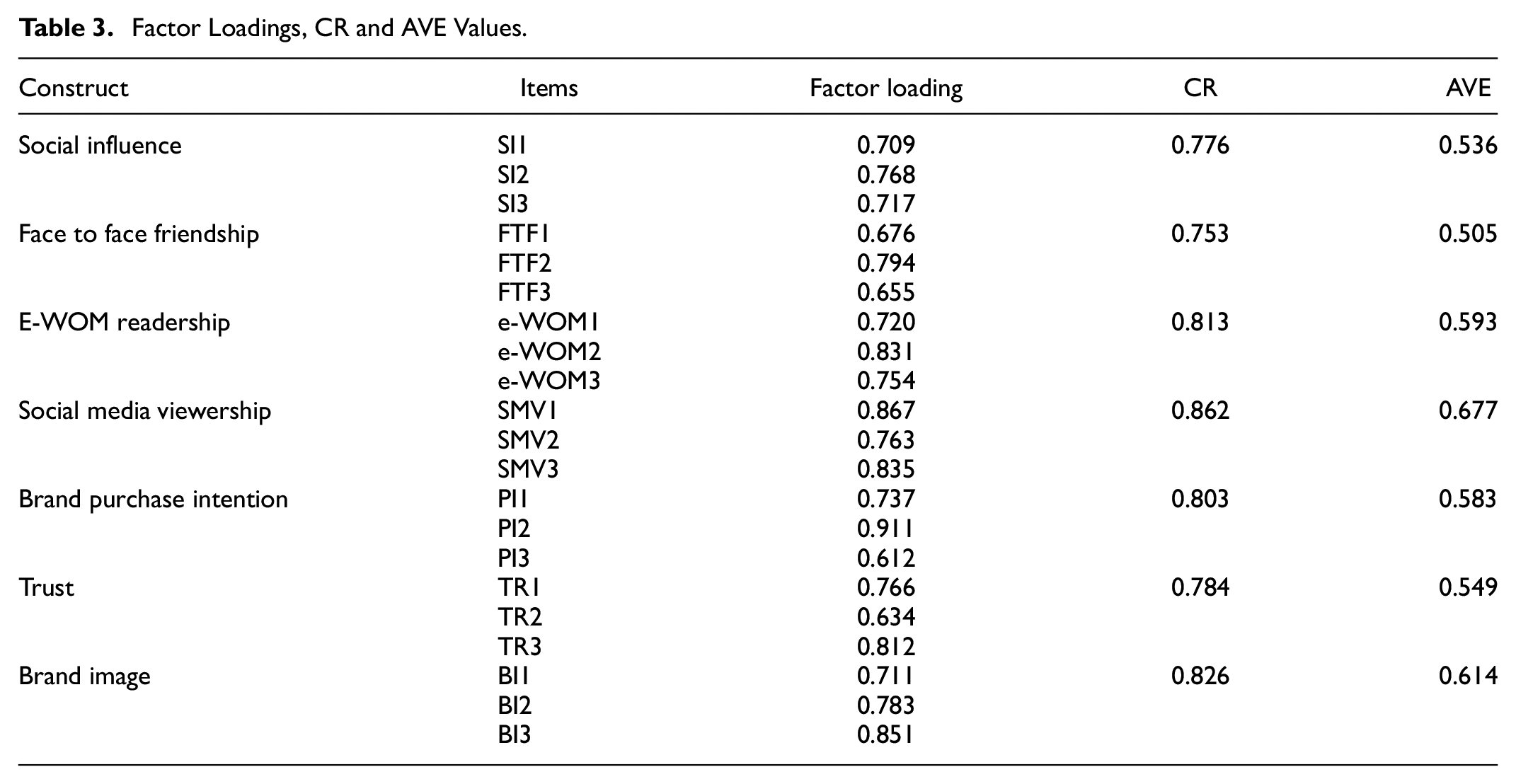
This study applied the threshold of 0.6 as the standard value of factor loading (Hair et al., 2012). The analysis results show that the factor loading of all 15 items in the measurement model exceeded the 0.6 criteria, and all of them were retained for reliability and validity evaluation.
According to Nunnally (1978), the composite reliability (CR) values should be higher than 0.7. The results showed that the combined reliability of the five constructs ranged from 0.753 to 0.862 and exceeded the recommended criteria, achieving acceptable reliability (Table 3). The average variance extracted (AVE) for each construct is higher than 0.5 (Fornell & Larcker, 1981). Table 3 shows that the AVE values of the five contracts ranged from 0.505 to 0.677 and exceeded the threshold of 0.5. Furthermore, all constructs met the conditions suggested by Fornell and Larcker (1981), indicating that the instrument achieves convergent validity.
Factor Loadings, CR and AVE Values.
Additionally, the measurement model achieves discriminant validity (Fornell & Larcker, 1981) when the squared root of the AVE for each construct exceeds the correlation between the shared correlations between each pair of constructs as seen in Table 4. This result confirmed the discriminant validity of the measurements.
Results of Discriminant Validity.
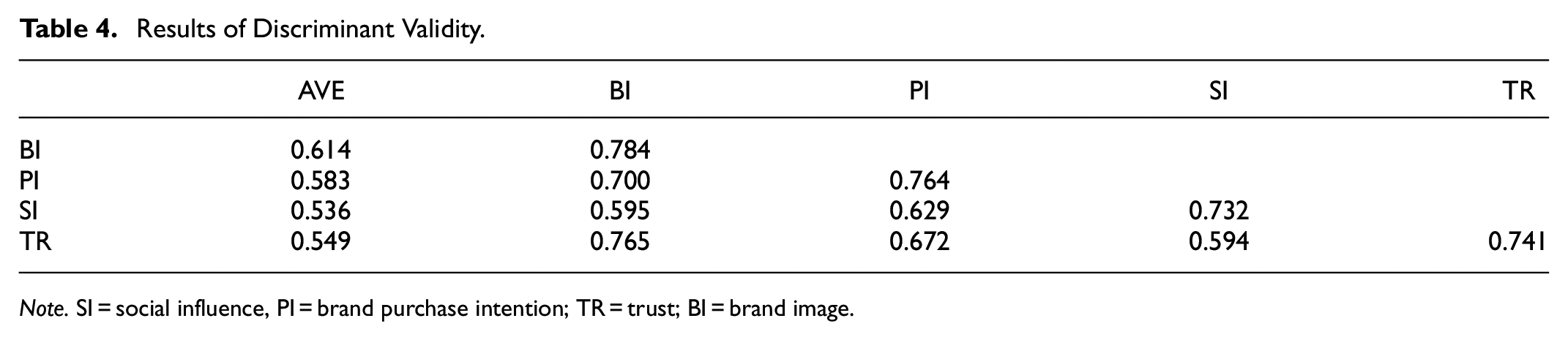
Note. SI = social influence, PI = brand purchase intention; TR = trust; BI = brand image.
Common Method Variance and Pearson Test
The contents of the questionnaire may cause co-variability due to various factors, so it is necessary to use statistical methods to check the issue of common method bias (CMB). SPSS was used to perform this test as factor analysis, in which all the items were loaded with a threshold to attain one factor. The results showed that a single element contributes to 39% of the total variance extracted, which is well below 50%. This confirms that CMB is not a significant concern for this study (Hew & Syed Abdul Kadir, 2016).
Pearson correlation coefficients were used to verify items’ multicollinearity in our study. Correlation between the items lower than .7 indicated the good multicollinearity of the items (Dancey, 2004). The results support the hypothesis because the correlation coefficient between social influence and brand image is .56, which is the required range (Dancey, 2004). Therefore, the results indicate that multicollinearity was not a severe issue in this study.
Structural Equation Model
The structural model and hypothesis were tested by applying SEM via the AMOS 23.0 software. The result illustrates overall fit indicators of the structural model, in which χ2/df (2.429), CFI (0.941), NFI (0.904), GFI (0.901), IFI (0.941), TLI (0.932), RMSEA (0.060), and RMR (0.023) all achieved the cut-off criteria. Therefore, the structural model satisfied the fit indices. Figure 2 also illustrates the hypotheses testing results in terms of the principal path coefficients and explains endogenous variables’ variance (R2). The results indicated that all paths of the research model were supported. In detail, the relation between social influence and brand purchase intention was statistically significant (β = .72; p < .001), thus supporting H1. As expected, the effect of trust and social influence (β = .93, p < .001), and brand image is positively associated with brand purchase intention (β = .27, p < .005), supporting H2 and H3. Additionally, the structural model accounted for 33% and 48% of the variances in social influence and brand purchase intention, respectively. The results of the hypotheses testing are depicted in Table 5, and the statistical analysis of the study show in Figure 3.

The path coefficients of the structural model.
Testing Results of the Hypotheses.

Note. PI = brand purchase intention; SI = social influence; TR = trust.
p < .05; all path coefficients are in standardized format.

The statistic analysis.
Reflective Specification of Social Influence Test
Figures 4 and 5 show that the results for both the first-order and second-order reflection model are statistically significant.

First-order model.
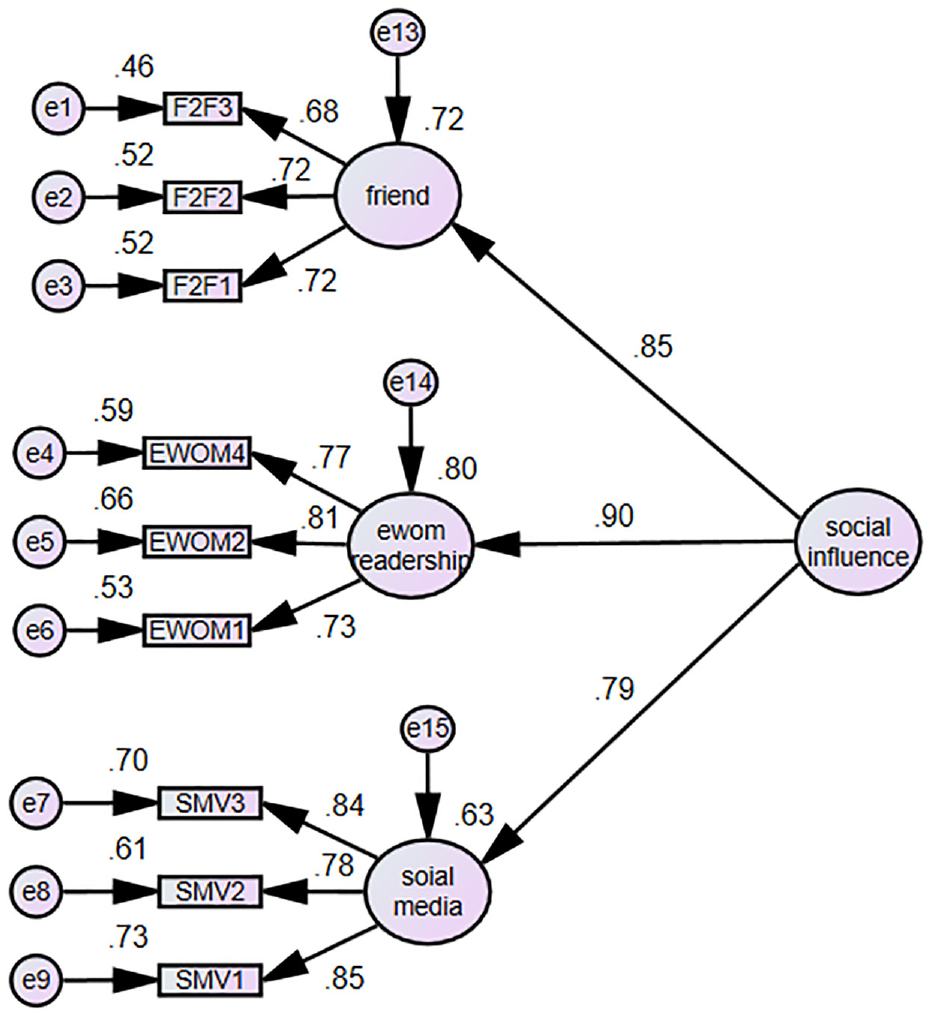
Second- order model.
The results of the second-order reflective model indicate that social influence has a substantial impact on face-to-face friendship (β = .851, p < .001), e-WOM readership (β = .896, p < .001) and social media viewership (β = .791, p < .001) as well as a good fit: χ2 = 54.640, DF = 24, p = .000, χ2/df = 2.277, GFI = 0.971, AGFI = 0.946, CFI = 0.981, IFI = 0.981, TLI = 0.972, RMSEA = 0.057, and RMR = 0.017. The results indicated that the three response indicators of social influence have good validity and reliability, which meet the standards of the reflective model.
Conclusions and Implications
This study explores the research on social influence impact on product purchase intention and brand image on brand purchase intention. The research results align with Lien et al. (2015) and Aghekyan-Simonian et al. (2012). That is, social influence has a positive effect on purchase intention; The impact of purchase intention has a significant correlation.
With the development of networks and technology, the sources of information on social influence have become diverse and complex. Social platforms and social media make individuals get the message about products easier than traditional advertising models. In this case, the study of the influence of trust on social influence in psychological mechanisms is critical. Our research explores the relationship between the two and fills in the research gap. In addition, the network influencers enhance consumers’ cognition, attitude, and decision-making on products. Among the various influencers, which influence is the most convincing is particularly important for the formulation of marketing strategies of enterprises and organizations. Our research fills the corresponding research gap again.
As the reflective dimension of social influence, our research shows that information from face-to-face friendships is the most influential; close friends are the ones who understand each other’s psychological demands and reactions best; the second is the network influence in live-streaming. It is a more powerful influence than that from e-WOM viewership. The live-streaming mode can enhance the interaction between people and promote emotions, allow consumers to see the product’s relevant information intuitively, and increase the product’s awareness and trust.
Therefore, our research provides a basis for enterprises to formulate and implement marketing strategies.
Theoretical Implications
The relationship between social influence and consumer psychological mechanism trust is relatively complex. Consumer behavior change cannot be explained by a single mechanism, but reflects the process of multiple potential causal relationships. Moreover, the causal relationship between social influence and behavioral change is partly manifested not as a primary influence factor but as an interaction, exhibiting a dynamic relationship related to contextual changes provided by technological development. The research on social influence under socio-technical changes which have important implications for both scholars and practitioners. The diversity of factors influencing consumer buying behavior highlights the need for different approaches to exploring models, as well as a more complex psychological mechanism in research model.
Our study provides empirical evidence on the extent to which individuals influence changes in consumer behavior. These have been less studied in the previous literature. The influence of face-to-face friendship is the most powerful. Therefore, marketing strategies must be carefully tuned to different marketing environments and maximize their impact on influencers.
First, this study verifies that friendship is the most trustworthy and reliable among all interpersonal and social relationships. It also confirms the conclusion of Mead et al. (2014) and McMillan et al. (2018) that people constantly change their behaviors by viewing their friends’ opinions to maintain a friendship or ensure belonging to the friends’ group. In the study by M. Kim and Kim (2020), friendship significantly impacts on individual personal life satisfaction and mental health (De Vries et al., 2018). Therefore, this may be the core value of people’s trust in friends, along with the reason that generates compliance with the change of thinking when friends recommend a product. The intimate relationship between circle friends is the core and the strongest association, which is suitable for viral marketing. Our research lays the theoretical foundation for viral marketing and enables customers’ friends to become corporate customers through customer recommendations.
Secondly, based on the theory of cognitive trust, celebrities’ credibility and reliably are the key factors that influence consumers’ attitude toward products. The psychological mechanism of internalization influence should come from consumers’ demand for improving their image or perceiving that the celebrity represents their ideal image. As M. Kim and Kim (2020) suggested, consistency with the inner ideal self-image is the social influence of internalization motivation. At the same time, this study fills in the theoretical research on the impact of celebrity congruence with the consumer in consumers’ purchase behavior, which can serve as the theoretical basis for similar research and expand academic research, which is a contribution of this study.
Third, faced with unfamiliar products, people often refer to the information on the Internet. Demonstrating the reliability and credibility of information sources is the key to selling products online.
We emphasize the intermediary role of social influence between reference sources and purchase decisions. This kind of emphasis has been limited in previous studies. Social relations directly or indirectly affect people’s purchase behavior, showing varying psychological changes in compliance with recommendation, identification, and internalization. Trust is the psychological mechanism that influence consumers’ willingness and decision. Marketers need to adjust marketing strategies according to the theory.
Practical Implications
The extant literature shows that social influences affect consumers’ attitudes toward a product brand.
Marketing managers focus on the power of customer circles. Marketing activities should establish friend-like relationship with customers while product value matches customers’ needs; Encourage social shopping with referral links, shared coupons, and money-saving offers.
Select the appropriate network influencers and select a celebrity who is attractive and similar to the target customer group as the brand spokesperson.
Based on focusing on brand management, managing customer reviews, handling customer experience with a positive attitude, and increasing the credibility of positive review content.
Limitations
The subjects of the experiments come from different classes, and their brand consumption habits and concepts are pretty other. People usually need to refer to various sources of credible information before making brand shopping decisions. We just made a simple comparison of a few variables.
Future research will explore how companies build friendship with consumers and discuss the influence of friendship on marketing performance compared with the previous relationship with consumers.
Footnotes
Declaration of Conflicting Interests
The author(s) declared no potential conflicts of interest with respect to the research, authorship, and/or publication of this article.
Funding
The author(s) received no financial support for the research, authorship, and/or publication of this article.

Data Availability Statement
Data sharing not applicable to this article as no datasets were generated or analyzed during the current study.