




Abstract
Social media influencers, a new type of opinion leader, are considered followers’ role models and strongly affect their attitudes and behaviors. Although their power on social media platforms is an emerging phenomenon, the studies exploring the impact of influencers’ endorsement of products on their followers’ buying intentions are still limited. By employing 272 respondents exposed to influencers, this study used PROCESS models to test hypotheses. The results demonstrate that the desire to mimic influencers and the sense of materialism mediate the effect of influencers on followers’ buying intentions. In addition, fear of missing out (FOMO) plays a moderation role in these relationships by altering the impact of influencer exposure on materialism and buying intention. These findings contribute to the current literature on social media influencers, the desire to mimic, materialism, and FOMO and also yield suggestions for influencers and marketers in their strategies.
Introduction
Along with the development of social media, social media influencers have become an indispensable source of information on current trends and product reviews. Social media influencers, hereafter referred to as influencers, reflect a dynamic phenomenon (Hudders et al., 2021). Influencers have a strong power over how customers think and behave (Tafesse & Wood, 2021), making them a vital part of brands’ efforts to attract potential customers (Hughes et al., 2019). However, how can an influencer affect social media users? Are any factors included in the process, from exposure to influencers’ content on social media to buying the recommended products? This study tries to answer those questions by establishing a new model to explore factors helping influencers persuade their audiences.
As a new type of independent third-party endorser, influencers affect their audiences’ attitudes and behavior via their blog or video content on social media (Freberg et al., 2011). With their strong connection with audiences and potential for creating and maintaining engagement, influencers can drive the conversation to introduce products or services to target audiences and then persuade customers to buy endorsed brands (Dinh & Lee, 2022; Lou & Yuan, 2019). As online opinion leaders, influencers have the desirable characteristics that companies look for and are ideal partners for electronic commerce. Based on such power on social media users, influencers have become a successful tool for companies to connect with their potential customers (Castillo-Abdul et al., 2021), and the importance of influencers in marketing activities has risen in recent years (Boerman & Müller, 2022). For example, the value of influencer marketing peaked at $13.8 million in 2021 (Statista, 2021), and in 2022, 75% of marketers plan to include influencers in their campaigns (Geyser, 2022).
Although influencers have a vital role in connecting customers and extending the reach of brands, there are gaps in previous research about how and when consumers’ attitudes and behaviors are impacted by influencers (Boerman & Müller, 2022; Vrontis et al., 2021). Previous research on influencers has mainly focused on influencers’ endorsements (C. Ki & Kim, 2019; Lou & Yuan, 2019; Schouten et al., 2020; Taillon et al., 2020), comparisons between traditional celebrities and influencers (Kay et al., 2020), and influencer marketing (C. W. Ki et al., 2020). However, a model to explain the consumer journey from their exposure to influencers to their buying intention endorsed product is still under-researched and needs to be explored.
This study applies Scheer and Stern’s (1992) framework about how one wants to influence another to take a specific action, such as purchasing a product. Influencers try to transfer their messages via their content on social media and aim to impact audiences’ attitudes. Exposure to influencers’ content subtly pushes followers’ tendency to mimic influencers. It also increases their materialism, which turns into purchasing endorsed products. Scheer and Stern’s (1992) framework has only explained the general journey audiences go through when audiences are exposed to the source. However, there is still a need to explore the potential moderators that can alter the decision of social media users. Based on this gap, this study proposes a new model that can examine influencers’ power over their followers under the fear of missing out (FOMO).
As visible individuals on social media, influencers act as role models, so many followers are likely to mimic their actions and choices (C. Ki & Kim, 2019). Consumers desire to mimic their role models by consuming related products to connect to that model (Ruvio et al., 2013). In addition, influencers build a deep psychological connection with their followers via social media content to reveal their lifestyles and interests (Ladhari et al., 2020). This strong relationship can impact followers’ buying decisions, which has been discovered in previous research. Nevertheless, those studies mainly focused on the parasocial relationship aspect with influencers (Hung et al., 2011; Shan et al., 2020). To get a deeper understanding, this study uses the desire to mimic as a buffer to give a broader experience of the impact of influencers on followers’ purchase intention.
The connection to influencers on social media can increase materialism among social media users and then push them to consume endorsed products. Influencers usually appear with a “wanna-be” lifestyle (Chae, 2018) with lots of possessions. When followers interact with influencers on social media, it can enhance followers’ desire for material value. Influencers drive their followers’ materialism by constantly promoting products in their content (Kim et al., 2021), which correlates with a higher potential for buying those products (Islam et al., 2018). Hence, it is reasonable that this study employs materialism as mediation in the influencers’ exposure to customer buying intention, which has been rarely mentioned in previous research.
The present study examines the indirect associations between exposure to influencers and purchase intention moderated by the fear of missing out (FOMO). FOMO is usually considered a type of social anxiety, the desire to be noticed and connected with others because they fear that others might be enjoying better experiences (Alt, 2015; Przybylski et al., 2013; Wegmann et al., 2017). Although the impact of influencers on their followers’ attitudes and behaviors has been suggested in previous research (Dinh & Lee, 2022; Freberg et al., 2011; Tafesse & Wood, 2021), the condition that can alter this relationship has rarely been examined before. FOMO can be considered the desire for social connection that turns exposure into a deep relationship (S. V. Jin, 2018). In addition, materialistic people are not satisfied with just ownership of a variety of goods, but these goods must indicate a unique and apparently superior social status (Watson, 2003). Therefore, this study employs FOMO as a motivation to test how FOMO can control the effects of influencers on materialism and strengthen purchase intentions.
This study is made to address the gaps that have been underexplored in the literature. While previous research has explored the direct effect of influencer endorsement on consumers’ buying intention, this study extends existing findings by assigning the mediation roles of desire to mimic and materialism. We propose that through the arousal of desire to mimic and materialism, followers want to consume influencers’ endorsed products as they are “social media stars.” By suggesting those hypotheses, this study aims to bring a better understanding of not only the influencer phenomenon but also the influence of materialism and the desire to mimic on purchase intentions through influencer marketing. Moreover, although exposure to influencers may impact followers’ desire to mimic materialism and buying intentions, how this relationship can change due to the fear of missing current trends is still an unanswered question. FOMO is a consumer motivation, but the study exploring its effect as a moderator is rare. To provide a more holistic understanding, this study employs FOMO as the conditional to test the impact of influencers on followers’ purchase intention.
Literature Review
Influencers
Influencers cultivate committed followers by making convincing stories about their main interests through blogs or tweets to attract audiences via social media platforms (Lou & Yuan, 2019). Influencers usually communicate with sizable social networks (De Veirman et al., 2017) by sharing their opinion on various aspects of life, for example, fashion, lifestyle, and travel (S. V. Jin et al., 2019), via exciting and valuable content (Vrontis et al., 2021). Therefore, they can reach widespread social media users and impact their thoughts and behaviors. Influencers can affect the purchase decisions of followers based on their authority, knowledge, position, or deep relationship with their followers (Geyser, 2022). They affect their follower’s attitudes and persuade followers to accept their advice about product-related decisions (De Veirman et al., 2017).
The framework of Scheer and Stern (1992) is applied in this study to explain the power of influence on audience behavior. First, the target has some attitudes toward the content influencers create. Influencers impact audiences through the resources that audiences value. Audiences evaluate influencers and their content and show a favorable attitude to influencers’ tastes and opinions (Lyons & Henderson, 2005). Second, audiences decide to comply with and engage with the content influencers create. Audiences want to follow influencers when they agree with the influencers’ recommendations. Audiences adore the lifestyles, recommendations, or behaviors that influencers show in their posts or vlogs (Ruvio et al., 2013). This favor can be presented in the form of desiring to mimic (C. Ki & Kim, 2019) or overvaluing material possessions (Kim et al., 2021). Lastly, audiences will react to the persuasion messages if they choose to follow the recommendation. Audiences show favorable attitudes, such as sharing influencer’s posts, enhancing word-of-mouth, or developing the intention to buy the same products as influencers (C. Ki & Kim, 2019).
The power of influencers on their follower purchase intention has been tested in previous research through the effect of their endorsements. For example, perceived expertise increases followers’ engagement (Hughes et al., 2019) and buying intention (Uribe et al., 2016) because influencers are perceived as experts in their specific fields (Hudders et al., 2021). Furthermore, social media users consider influencers a credible source with honest, sincere, and truthful content (Lou & Yuan, 2019). Thus when influencers introduce new products, they are confident in trying such products (Uzunoğlu & Misci Kip, 2014). In addition, perceived similarity and opinion leadership lead to higher engagement (Casaló et al., 2020) and influence purchase intention (Farivar et al., 2021). In summary, followers who perceive high influential power from influencers are more likely to engage with endorsed brands and have a greater intention to buy (Jiménez-Castillo & Sánchez-Fernández, 2019). Therefore, the following hypothesis is established:
Mediation Effect of Desire to Mimic
Mimicry in the marketing context is defined as the conscious desire to mimic a role model’s purchase behavior to ensure similarity and connectedness (Ruvio et al., 2013). Interaction with influencers on social media allows customers to see influencers as trustworthy, expert, and unique. The admiration of influencers pushes followers to want to imitate influencers (Cheng et al., 2021). C. Ki and Kim’s (2019) research reveals that when consumers consider influencers as their role models, they follow influencers’ recommendations about products and buy the same products to mimic influencers.
The desire to mimic is usually formed through exposure to influencer-related content. Influencers have deep knowledge of a specific aspect and early notice of the market trend compared to most consumers (Keller & Berry, 2003). They adopt new products and services related to their domains and have the advantage of giving an insight into products in their posts (Aral, 2011). Mimicry is not an unconscious behavior but a planned process to build self-identification (Xiao et al., 2021). The need to look, feel, act, and live like influencers drives followers to mimic (Kemp et al., 2012). Followers exposed to influencers choose the behaviors, activities, or aspects they want to imitate (Ruvio et al., 2013). The more frequently consumers are exposed to influencer content, the stronger the impact of influencers (Lou & Kim, 2019) and the higher the level of engagement with influencers (S.-A. A. Jin & Phua, 2014).
The positive attitudes toward influencers make followers want to mimic them and purchase endorsed products (C. Ki & Kim, 2019). The deep connection between influencers and followers maintains their engagement and triggers followers’ purchase intention. Previous study reveals that consumers’ trust and wish to identify with their role models increase the potential of purchase intention toward endorsed products (Shoenberger & Kim, 2019). The desire to mimic plays a mediating role in the relationship between influencers’ exposure and buying endorsed product intention. Followers inspired by influencers want to be like them and try to mimic their portrayal by purchasing their recommended products and following their advice (C. Ki & Kim, 2019). Based on these discussions, we propose the following:
The Mediating Effect of Materialism
Materialism is defined as a personal value that refers to the degree of belief one has about the need to acquire and possess material objects to achieve a happy and successful life (Richins & Dawson, 1992). Materialism includes three dimensions: (1) acquisition centrality, (2) acquisition as the pursuit of happiness, and (3) possession-defined success.
Exposure to influencers drives followers’ desire for material values. Influencers’ main function is to spread their thoughts and experiences on social media to their audiences (Freberg et al., 2011). Thus, influencers always post attractive images, and high-quality content of an exciting life, with numerous products to draw attention (Aral, 2011). When followers get to know influencers via daily posts, they notice the advantage of owning products that would bring a more satisfying and successful life (Kim et al., 2021). Kim et al.’s (2021) research shows that material values directly correlate with accepting a favorite influencer’s posts because of followers’ thirst for being noticed by others. In other words, a follower’s interest in possession is driven by constant exposure to influencers’ content about endorsed products (Lou & Kim, 2019).
Significantly materialistic social media users prefer purchasing products to establish and maintain their status and increase happiness (Brown et al., 2016). Influencers are trend settlers that followers refer to when forming their self-concept. Their suggestions about owning possessions to gain benefit increase followers’ materialistic thoughts (Clark, 2015). The relationship between materialism and buying intention has been discovered in previous research. For example, exposure to influencers leads to social comparison, which in turn causes raises the probability of buying endorsed products (Islam et al., 2018). Previous studies also found that frequent exposure to influencers creates parasocial relationships and increases materialism (Lou & Kim, 2019). Therefore, materialism plays a mediating role in the relationship between exposure to influencers and purchase intentions toward endorsed products. This study proposes:
Moderation Effect of FOMO
FOMO signifies “a pervasive apprehension that others might have rewarding experiences from which one is absent” (Przybylski et al., 2013). FOMO also refers to the uneasy feeling of losing connection with what peers are doing or missing out on material possessions that others own (Chen, 2013). In other words, FOMO is the anxiety about losing social interactions and meaningful experiences, especially on social media platforms (Alt & Boniel-Nissim, 2018). The FOMO concept usually goes along with low self-concept (Dutot, 2020), social anxiety (Zhang et al., 2020), the need to belong (Wang et al., 2019), the desire to stay in touch (Beyens et al., 2016), worry about losing social interaction (Przybylski et al., 2013), or the fear of falling behind (Good & Hyman, 2020).
Following influencers could be an important trigger for online FOMO because communication with influencers, among other things, is marked by high stability and intimacy (Abidin, 2016). Hence, exposure to influencers creates the thirst for staying continually connected with what influencers are doing and building a parasocial relationship with influencers (S. V. Jin et al., 2019). Based on Table 1, FOMO plays various roles in previous research, such as independent, mediator, and dependent variables. However, previous research shows a notable gap in how FOMO moderates the relationship between exposure to influencers and purchase intention. Therefore, this study tries to test the moderation effect of FOMO in this relationship as well as in mediation relationships.
Fear of Missing Out on Related Variables and Topics.

Note. M = mediator; IV = independent variable; DV = dependent variable.
People with high FOMO are more likely to feel happy and excited even at the pre-purchase stage, as they know that regularly engaging with influencers can help them maintain and strengthen their relationship with society (Chan et al., 2022). Moreover, individuals with socially related psychological issues rely on influencers to figure out and fulfill their identification. By associating closely with their preferred influencers, followers seek to enhance their self-concept and build a more stable identity (Lee et al., 2021). Engagement with influencer posts increases followers’ materialistic tendencies (Richins, 2011). Influencers’ appearance with expensive products, trendy styles, and high-quality visuals arouses their followers’ thirst for materialistic value (Dinh & Lee, 2022). When consumers feel uncertain about themselves or fear falling behind social trends, they are more likely to self-present to catch up (Xi et al., 2022). In addition, materialists buy to maintain social status and avoid feelings of low self-esteem (Watson, 2003). Therefore they must continue to acquire more possessions to enjoy a high standard of living as superiors on social media (Fitzmaurice & Comegys, 2006). Hence, once followers are exposed to influencers on social media and hope to belong to society and enhance their social status, they will acquire more. The mediating role of materialism on the effect of exposure to influencer content engagement is enhanced when the need to belong is higher rather than lower (Kim et al., 2021).
Methodology
Based on previous research’s gap, this study aims to examine the effect of influencer exposure on their followers’ buying intention (H1) through the mediation effects of desire to mimic (H4) and materialism (H7). Followers are exposed to influencers, desire to mimic their ideal model (H2), and then want to buy their endorsed products (H3). In addition, through the connection with influencers’ content, followers’ materialistic thoughts increased (H5), leading them to buy products recommended by influencers (H6). The impact of influencers on followers’ materialism and buying intention was altered by FOMO (H8, H9). This study framework is presented in Figure 1.
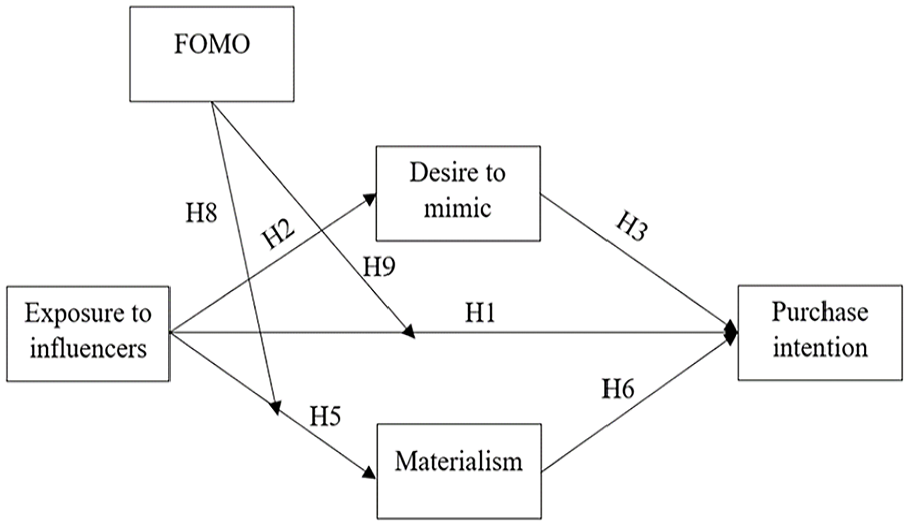
Theoretical model.
Sampling
This study was conducted via Amazon’s Mechanical Turk (MTurk) platform in the US in 2020. A total of 300 respondents participated and completed the questionnaire. The participants had to have had experiences with influencers. Therefore, participants who reported not being exposed to influencers before were excluded from this study and finished the survey. After filtering out invalid responses, the final sample was 272 valid participants.
The respondents’ gender was nearly equal, with 133 male (48.9%) and 139 female respondents (51.1%). Respondents aged 18 to 49 were employed in this study because the ages of most social media users are between 19 and 49 (Chaffey, 2022). Further, those in their 20s (25.7%) and 30s (44.9%) constitute a significant portion.
Measurements
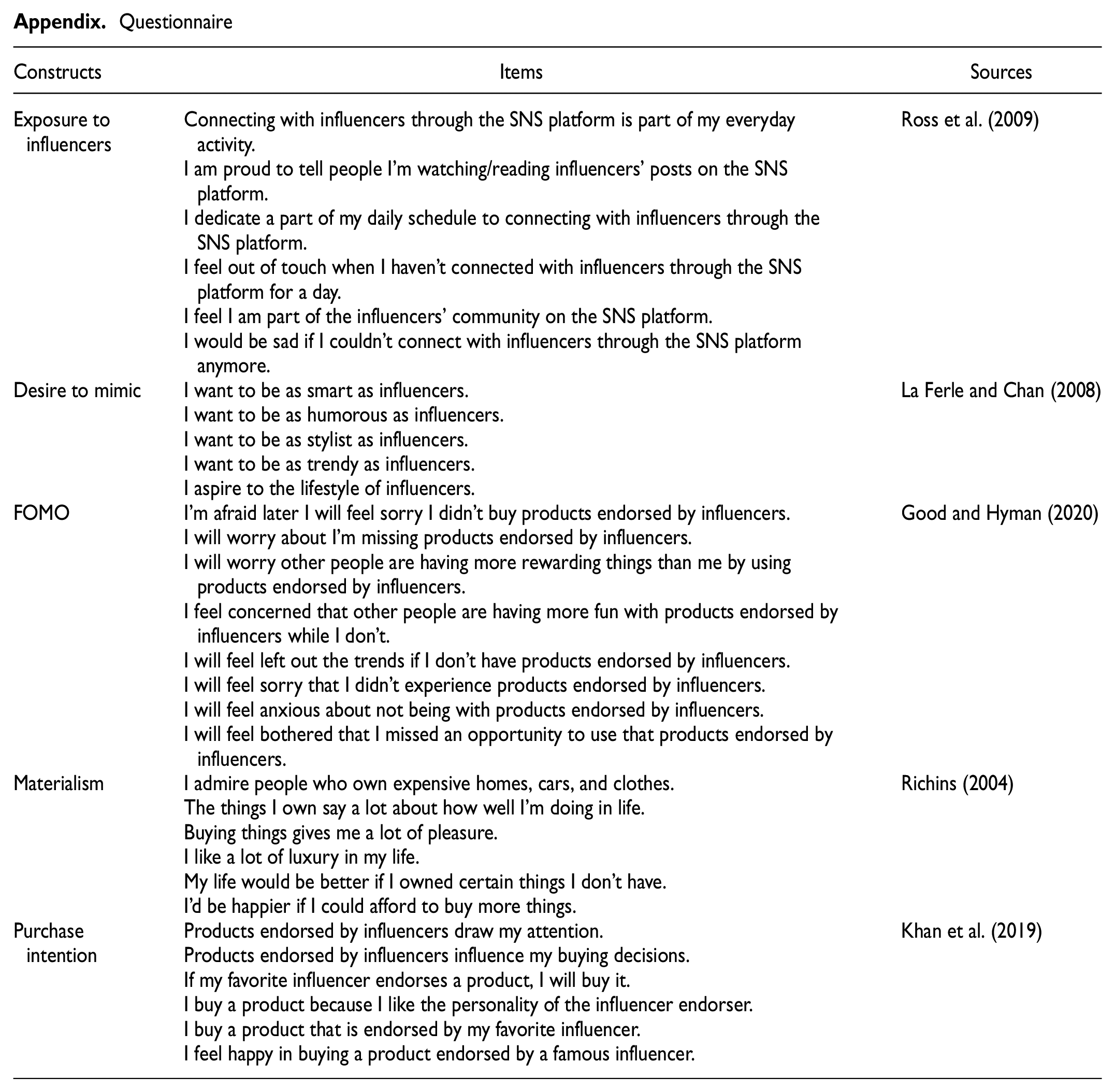
This study used the measurement scales from previous research to measure constructs. Each construct scale was refined to fit the research context better. Likert scale with seven levels (from 1: strongly disagree to 7: strongly agree) was used to measure items in this study because it proved accurate and appropriate for an online survey (Finstad, 2009).
Exposure to influencers (
Desire to mimic (
Materialism (
FOMO (
Purchase intention (
Results
Preliminary Analyses
Means (M), standard deviations (SD), and correlations for variables are presented in Table 2. All estimated path coefficients were statically significant, which meant that all the constructs were relatively correlated to others. For example, exposure to influencers was positively associated with desire to mimic (r = .564, p < .01), materialism (r = .489, p < .01), and purchase intention (r = .715, p < .01). Besides, the desire to mimic and materialism were also associated with purchase intention (r = .527, p < .01 and r = .546, p < .01, respectively). Moreover, FOMO was positively associated with exposure to influencers (r = .273, p < .01), desire to mimic (r = .246, p < .01), materialism (r = .308, p < .01), and purchase intention (r = .261, p < .01).
Descriptive and Correlations of Variables.

Note. N = 272. M = mean; SD = standard deviation.
p < .01.
Mediation Effects
This study used bootstrapping procedure with5,000 samples of the PROCESS macro model 4 of Hayes (2018) to test the direct and mediation effects. All the results are presented in Table 3. Multiple regression analysis indicated that, in the first step, exposure to influencers is significantly associated with purchase intention, b = 0.72, p < .001 (see Model 1), which supports Hypothesis 1. Second, to test Hypothesis 2, Model 2 was run. The positive relation between exposure to influencers and desire to mimic was confirmed with b = 0.57, p < .001. The results confirmed Hypothesis 5 about exposure to influencers positively affecting materialism based on Model 3 (b = 0.49, p < .001). Those two hypotheses were tested based on the results of Model 4. This finding showed that desire to mimic and materialism was significantly related to purchase intention (b = 0.12, p < .05, and b = 0.23, p < .001, respectively).
Mediation Effects of Exposure to Influencers on Purchase Intention.

Note. N = 272. Each column is a regression model that predicts the criterion at the top of the column.
p < .05. ***p < .001.
Finally, the bias-corrected percentile bootstrap method revealed that the mediation effect of exposure to influencers on purchase intention via desire to mimic and materialism was significant. Hypothesis 4 described the mediation effect of the desire to mimic on exposure to influencers and purchase intention was supported with ab = 0.07, SE = 0.04, CI [0.01, 0.15]. In addition, materialism also mediated the relationship between exposure to influencers and purchase intention, which supported Hypothesis 7 (ab = 0.11, SE = 0.05, CI [0.03, 0.21]).
Moderation Effects
To test the moderation effect of FOMO, this study used the bootstrapping produce with5,000 samples of PROCESS macro Model 8 by Hayes (2018). This study tested FOMO on the relationship between exposure to influencers and materialism in Model 1 and the relationship between exposure to influencers and purchase intention in Model 2. The parameters of the two models are shown in Table 4 when all the variables were standardized.
The Moderation Effect of FOMO.

Note. N = 272. Each column is a regression model that predicts the criterion at the top of the column.
p < .05. **p < .01. ***p < .001.
According to Table 4, there was an effect of exposure to influencers on materialism with b = 0.39, p < .001, and this relationship was moderated by FOMO, b = 0.13, p < .05. Therefore, Model 1 indicated that FOMO moderates the relationship between exposure to influencers and materialism, supporting Hypothesis 8. To describe this effect, this study plotted materialism against exposure to influencers, separately for low (1 SD below the mean) and high (1 SD above the mean) levels of FOMO, as shown in Figure 2. This result revealed that the effect of exposure to influencers on materialism is stronger when FOMO is high (b = 0.51, p < .001) than when FOMO is low (b = 0.26, p < .01).

FOMO moderates the effect of exposure to influencers on materialism.
To test Hypothesis 9, model 2 was established. This study found a moderation effect of FOMO on the relationship between exposure to influencers and purchase intention (b = 0.17, p < .001), supporting Hypothesis 9. The finding described in Figure 3 showed that the effect of exposure to influencers on purchase intention is stronger when FOMO is high (b = 0.64, p < .001) more than when FOMO is low (b = 0.30, p < .001).
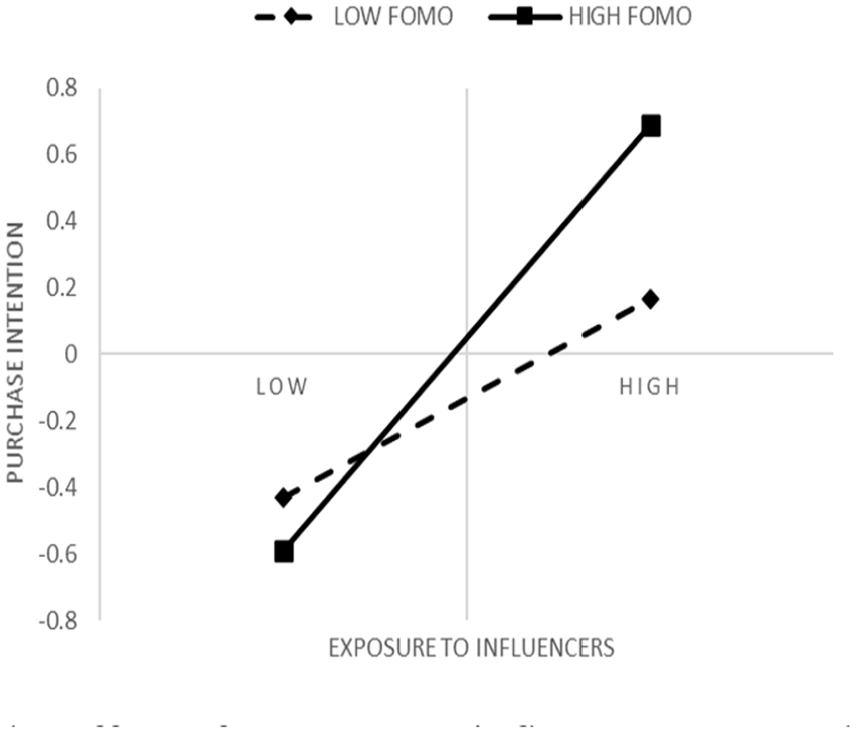
FOMO moderates the effect of exposure to influencers on purchase intention.
The results of this study are summarized in Figure 4.

Hypothesis testing.
Discussion
Although the power of influencers on purchase intention was discussed in previous research, little effort has focused on a model based on the influence theory to explain the effect of influencers on followers’ purchase intention. This study found that the desire to mimic and materialism mediate followers’ experiences before purchasing. Moreover, FOMO is also utilized as a moderator affecting those relationships between variables.
Exposure to influencers has both direct and indirect effects on buying intention. This study empirically tested this effect and found that influencers have the power to influence the purchase decisions of their followers when followers are exposed to influencers’ content on social media. Influencers are trendsetters who can affect their followers’ attitudes and behavior and ensure a greater likelihood of product consumption by the followers (Lou & Yuan, 2019). Although Dinh and Lee’s (2022) research has found that influencers greatly affect consumers’ buying decisions, this study goes beyond those findings. It reveals the relationship between influencers and purchase decisions under the FOMO effect to gain broadened results. The power of influencers on followers’ buying decisions is stronger when FOMO is high than when FOMO is low.
The findings also found that followers who are deeply exposed to influencers are more likely to engage with influencers’ content and desire to mimic their favorite influencers. C. Ki and Kim (2019) found that followers want to look and behave just like their role models. In addition, the parasocial relationship between influencers and audiences and wishful identification (S. V. Jin et al., 2019; Xiao et al., 2021) make followers want to imitate their social media models. This result demonstrates that the desire to mimic mediates the relationship between influencer exposure and followers’ buying decisions and proves the vital role of influencers in persuading customers to buy products or brands.
Moreover, this study also considers the importance of materialism as a buffer against exposure to influencers. Previous studies found that when individuals are exposed to others in daily life with materialistic content, they desire to own more possessions and a better life (Lou & Kim, 2019). The interest in material possessions motivates customers to own more wealth to enhance their status (Aral, 2011). Based on those findings, this study confirms the effect of materialism in the influencer context and upgrades the result by testing it under the moderating impact of FOMO. There is an interaction between FOMO and exposure to influencers when it affects materialism. High FOMO followers are more likely to form materialism when exposed to influencers than low FOMO followers.
Conclusions
This study’s findings contribute to the existing literature by shedding light on the impact of influencers on followers’ purchase intentions. It develops and empirically tests a complete model with the mediation of desire-to-mimic and materialism under the explanation of influence theory. Previous research tested influencers with endorsements as expertise, attractiveness, credibility, authenticity, and opinion leadership (C. Ki & Kim, 2019; Lou & Yuan, 2019; Schouten et al., 2020; Taillon et al., 2020). However, this study analyzes the influence process by examining how it affects followers’ motivation to buy endorsed products. By adding the mediation of desire-to-mimic and materialism as the affected attitudes after exposure to influencers, this finding brings a different viewpoint that sheds greater light on influencers’ effect on their followers.
Moreover, this study expands the literature on influencers and FOMO by adding the moderating role of FOMO to explain influencers’ effects. Although FOMO is a rising phenomenon wildly studied to explain customers’ attitudes and behavior (Dinh & Lee, 2022; Lee et al., 2021; Przybylski et al., 2013), very few studies have discovered FOMO as a moderator to control influencers’ effects on materialism or followers’ buying intention. Therefore, this study tries to fill the gap by adding FOMO to see the change in such relationships that would broaden views on this phenomenon.
This research also provides practical implications for influencers and marketing practitioners who want to use influencers in their strategies. Influencers can use these findings to gain insights into how their followers are affected when exposed to their content. To strengthen the impact of influencers as endorsers, it is necessary to ensure that followers can frequently be exposed to their content and that using content becomes a daily activity. Therefore, it is essential to increase exposure so the influencers can connect with followers closer and more frequently. An influencer’s power can be stronger when they create content continuously in short intervals rather than occasionally, allowing followers to consume the content with high frequency.
Moreover, this study confirmed that exposure to influencers increases the desire to mimic and materialism, which can eventually lead to purchase intention. Therefore, they should try to appear more modern to attract and firmly establish their position among followers. Influencers should not simply show off the products with their description but present them in their daily lives, which consumers can then desire. Once influencers can evoke followers’ desire for their lives, the products they appear with would be followers’ cravings.
This study found that FOMO can enhance purchase intention. Thus, influencers can foster FOMO by boosting buzz around events or purchases to encourage the feeling of not wanting to miss out on the action or conversation, such as using language that creates a sense of exclusivity, such as “only a few spots left” or “this is the hottest event of the year.” Another suggestion for influencers is to fight FOMO by providing a curation service so that followers can feel they have access to the latest, hottest items and content. They could curate a selection of the most popular items or content and share it with their followers, along with their recommendations and reviews. This can help followers feel like they have access to the latest and hottest items and content without feeling like they are missing out on something.
This study provides marketers with more insight into how influencers can persuade potential customers to buy a brand’s products based on their recommendations. The relationship between influencers and followers represents an exciting marketing potential for brands and companies (Geng & Maimaituerxun, 2022; Hudders et al., 2021; Vrontis et al., 2021). Therefore, marketers can sponsor influencers to introduce their products in their content and collaborate with them to reach their followers directly. Influencers could promote the brand’s new product on their social media channels, including Instagram, YouTube, and TikTok, and they could create content that showcases product benefits to their followers. Product reviews, viral social media campaigns, and collaboration are helpful suggestions that brands can connect with influencers to gain consumer engagement.
Moreover, advertising is considered a communication tool, while influencer marketing is related to organic marketing. Consumers rarely pay much attention to advertising because it seems abstract and is lost in the noise. Hence, the findings from this study again highlight the importance of emerging influencers in marketing strategy. Content created by influencers tends to be more organic by converting marketing activities into events in consumers’ daily lives. Influencers could incorporate products into their regular content to make the content feel more organic and relatable for their followers. The influencers could host a giveaway or promotion encouraging their followers to try the products. This can lead to increased engagement and sales, as consumers are more likely to trust and relate to content created by influencers they follow and admire.
This study has some limitations that future research should address. First, the sample size of this research was small, with only 272 valid respondents from the MTurk platform in the US. This sample size and sampling method limit the reliability and generalizability of the study results. Future studies should operate in larger sample sizes to provide greater statistical power results. Second, this study uses the desire to mimic and materialism to explain the effect of influencers on followers’ purchase intention. It also employs FOMO as the moderating test for how FOMO can control influencers’ direct and indirect impact on buying recommended products in an empirical test. However, this study is limited in exploring these effects under control variables that can affect the followers’ several types of purchasing. In the future, more social and self-related factors should be employed in the influencers’ context, such as self-presentation, social comparison, and social norms (Geng et al., 2022; Reer et al., 2019; Vrontis et al., 2021). Finally, although there are different types of influencers, such as travel and food influences, they can have diverse impacts on followers’ purchase intentions. Future studies can explore these differences to gain general and specific results.
Research Data
sj-sav-1-sgo-10.1177_21582440231197259 – Supplemental material for How Does the Fear of Missing Out Moderate the Effect of Social Media Influencers on Their Followers’ Purchase Intention?
sj-sav-1-sgo-10.1177_21582440231197259 for How Does the Fear of Missing Out Moderate the Effect of Social Media Influencers on Their Followers’ Purchase Intention? by Thi Cam Tu Dinh, Mengqi Wang and Yoonjae Lee in SAGE Open
Footnotes
Appendix
Questionnaire
| Constructs | Items | Sources |
|---|---|---|
| Exposure to influencers | Connecting with influencers through the SNS platform is part of my everyday activity. | Ross et al. (2009) |
| I am proud to tell people I’m watching/reading influencers’ posts on the SNS platform. | ||
| I dedicate a part of my daily schedule to connecting with influencers through the SNS platform. | ||
| I feel out of touch when I haven’t connected with influencers through the SNS platform for a day. | ||
| I feel I am part of the influencers’ community on the SNS platform. | ||
| I would be sad if I couldn’t connect with influencers through the SNS platform anymore. | ||
| Desire to mimic | I want to be as smart as influencers. | La Ferle and Chan (2008) |
| I want to be as humorous as influencers. | ||
| I want to be as stylist as influencers. | ||
| I want to be as trendy as influencers. | ||
| I aspire to the lifestyle of influencers. | ||
| FOMO | I’m afraid later I will feel sorry I didn’t buy products endorsed by influencers. | Good and Hyman (2020) |
| I will worry about I’m missing products endorsed by influencers. | ||
| I will worry other people are having more rewarding things than me by using products endorsed by influencers. | ||
| I feel concerned that other people are having more fun with products endorsed by influencers while I don’t. | ||
| I will feel left out the trends if I don’t have products endorsed by influencers. | ||
| I will feel sorry that I didn’t experience products endorsed by influencers. | ||
| I will feel anxious about not being with products endorsed by influencers. | ||
| I will feel bothered that I missed an opportunity to use that products endorsed by influencers. | ||
| Materialism | I admire people who own expensive homes, cars, and clothes. | Richins (2004) |
| The things I own say a lot about how well I’m doing in life. | ||
| Buying things gives me a lot of pleasure. | ||
| I like a lot of luxury in my life. | ||
| My life would be better if I owned certain things I don’t have. | ||
| I’d be happier if I could afford to buy more things. | ||
| Purchase intention | Products endorsed by influencers draw my attention. | Khan et al. (2019) |
| Products endorsed by influencers influence my buying decisions. | ||
| If my favorite influencer endorses a product, I will buy it. | ||
| I buy a product because I like the personality of the influencer endorser. | ||
| I buy a product that is endorsed by my favorite influencer. | ||
| I feel happy in buying a product endorsed by a famous influencer. |
Acknowledgements
None
Declaration of Conflicting Interests
The author(s) declared no potential conflicts of interest with respect to the research, authorship, and/or publication of this article.
Funding
The author(s) received no financial support for the research, authorship, and/or publication of this article.
Research Data for Review
Data are available if requested to the author.

References
Supplementary Material
Please find the following supplemental material available below.
For Open Access articles published under a Creative Commons License, all supplemental material carries the same license as the article it is associated with.
For non-Open Access articles published, all supplemental material carries a non-exclusive license, and permission requests for re-use of supplemental material or any part of supplemental material shall be sent directly to the copyright owner as specified in the copyright notice associated with the article.
