




Abstract
The study’s objective is to explore the predictors of organic food purchase intention in a nascent organic market in one of the developing countries in South Asia. Further, the study also attempts to establish the mediating role of trust in organic food purchase intention.
The quantitative data is collected from two cities of Pakistan through a structured questionnaire. A total of 325 responses are collected, out of which 312 responses are considered for further analysis. Structural equation modeling technique is used to test the hypothesis. “Personal attributes” is found to be a more significant predictor of organic food purchase intention than other attributes. Trust in organic food partially mediate personal attributes and product attributes with organic food purchase intention. The study contributes to understanding the primary attributes responsible for the purchase of organic food in a nascent organic market and establishes trust. This study also provides guidelines for the policymakers to shift their focus to organic farming, which will bring considerable benefits to health and the environment and a profitable business because consumer’s intentions coincide.
Introduction
Organic foods may be defined as natural, free from impurity and containing no extra menace of food poisoning, may encompass more nutrients than conservative foods (Chen, 2007; Heaton, 2001), and consumers consider foods branded as organic to be improved than conservative foods (Grankvist & Biel, 2001). Organic food consumption has witnessed unprecedented growth in the last two decades. The organic market reached USD89.7 billion in 2016 from USD17.9 billion in 2000 (Willer et al., 2018). According to the latest research report from the Research Institute of Organic Agriculture FiBL-IFOAM, 178 countries out of a total of 195 countries have undertaken organic activities. A total area of 57.8 million hectares used for organic agriculture has been recorded in 2016 as compared to 11 million hectares in 1999 (Willer et al., 2018). Although the global sales of organic food and drinks are densely concentrated in North America and Europe, that is almost 90%. However, more than 87% of the world’s organic producers are based in developing countries and emerging markets. Based on the regional classification, the contribution from Asia is highest in this regard, that is 40%, and India is ranked at the first position with the highest number of organic producers (Willer et al., 2018).
Further, the statistics on land utilized for organic agriculture reveal China as the third-largest country in the world. The figures mentioned above point out a rapid adoption of organic agriculture practices and organic food consumption in South Asian countries. Although major developments seen in China, India, the Philippines, and Bangladesh, however, the organic food is also gaining popularity in other countries of the region. For example, in Pakistan, an increase of 20,298 hectares has been recorded in organic agricultural land since 2013 till 2016.
Although organic food has remained a choice of consumers in Pakistan, industrial and technological development has tremendously affected agricultural practices. Industrial wastewater, which includes pathogens and complex chemicals, is dumped into rivers, canals, and streams. Thus, crops that are being irrigated with this water are becoming contaminated and ultimately posing serious threats to human health. To worsen the situation, in an attempt to increase yield and productivity, pesticides and fertilizers consumption have increased manifold in the last three decades. The augmented use of chemical fertilizers and pesticides has resulted in harmful food production, consumption of which is resulting in—threatening life diseases.
Moreover, one after another, several food scandals are creating severe safety concerns among consumers about the food they consume. Such as, the adulterated milk scandal appears consistently for the last several years. In 2008, City District Government Food Department Lahore claimed that 80% of the packed and unpacked milk was adulterated and contaminated with urea, formalin, melamine, unhygienic water, and detergent powder. The government-led several steps to stop the adulteration and contamination of milk but remained unsuccessful as it continued even in 2016 when upon chemical examination of 10 pasteurized milk samples by the Pakistan Council of Scientific and Industrial Research (PCSIR), only 1 found fit for human consumption. Likewise, many other food scandals keep on arising, which have intensified the safety concerns of consumers about food consumption. On a large scale, consumers suspect threats to their health because all these reasons mentioned above have made food consumption very risky in Pakistan. As a result, consumers in Pakistan have started to look for alternative food choices, and entrepreneurs from multiple fields have taken initiatives to re-establish the organic food consumption trend.
Since 2013, farmer markets are operating in Pakistan at regular intervals, of which the most famous ones are “Khalis Food Market” and “Haryali Food Market.” These farmer markets aim at promoting organic food. However, other product lines have also been added to the market. These markets have remained successful in managing a sizable number of organic sellers and organic buyers. Moreover, specialized stores dealing in organic food are operating successfully as well as organic products may be found in retail stores. Moreover, an institute named the National Institute of Organic Agriculture (NIOA) has been set up under the Pakistan Agriculture Research Council (PARC), which offers technical assistance to various customers, educationists, extension agents, researchers, and farmers for producing organic crops and vegetables. In addition, various trainings have been organized for farmers and other stakeholders on producing bio-fertilizers, bio-pesticide, and bio-herbicide.
Meanwhile, organic production has also been demonstrated at National Agriculture Research Center, and it is also playing its role in establishing organic farms nationwide. Thus, the government is encouraging people for organic farming, and holding seminars with the theme of organic entrepreneurial opportunities and these seminars aim at encouraging business graduates to adopt organic farming. This view indicates that the organic market is growing and expanding because consumers are increasingly becoming aware of the health and environmental benefits of consuming organic food.
There are many studies discovering various socio-psychological reasons behind the purchase of organic food, which include concerns about health, environmental benefits, societal concerns, and animal wellbeing (Asif et al., 2018; Fotopoulos & Krystallis, 2002; Magnusson et al., 2003; Padel & Foster, 2005; Pearson et al., 2011; Rana & Paul, 2017). A plethora of studies may be found which explored various aspects of organic food consumption and organic farming, especially in the context of Europe and other Western countries (Briz & Ward, 2009; de Magistris & Gracia, 2008; Hamzaoui Essoussi & Zahaf, 2008; Hjelmar, 2011; Janssen & Hamm, 2012; Oates et al., 2014; Stolz et al., 2011; van de Vijver & van Vliet, 2012; Zagata, 2012). Notable studies may also be found in the Asian region, most of which have been conducted in China (Asif et al., 2018; Ayyub et al., 2018; Chen, 2007; Roitner-Schobesberger et al., 2008; Sangkumchaliang & Huang, 2012; Yin et al., 2010). However, the number of studies in the Asian region is relatively small, which may be attributed to immature organic markets and fewer consumers buying organic food. Previous research lends some insights into the phenomena causing the growing development of organic food consumption. Yet, there is a knowledge gap concerning the causes that promulgate its actual consumption (Hansen et al., 2018), particularly in the perspective of developing economies (Pham et al., 2019).
Although organic food consumption has started to grab attention, however, it is quite low in Pakistan (Raza et al., 2019). In Pakistan, the research on this subject is just beginning, and very few studies may be found that have endeavored to understand the drivers of organic food consumption. The above analysis of the situation of the Pakistan food industry provides an impetus for this study. The current study aims to explore the factors that shape organic food purchase intention in Pakistan because the findings from other countries and especially from the developed ones may not be generalized in this country. The economic situation, societal up and level of development, etc. are factors that make it unique geography, from other regions in which much of the research has been conducted, especially North America, Europe, and China.
This study attempts to answer the call for understanding determinants of organic food purchase intention in developing countries as it will provide useful insights for the policymakers, researchers, and sellers of organic food. The current strand of research will contribute to theory by revealing important insights into the consumer behavior toward organic food in Pakistan and making a practical contribution by providing an understanding on the factors that consumers take into account while purchasing organic food. Therefore, the current study has two objectives. Firstly, it will investigate the consumer behavior toward organic food consumption in Pakistan through exploring the predictors of organic food purchase intention. Secondly, the study will attempt to establish trust as a mediator between the independent variables and dependent variable because trust is an important factor on which consumers’ decision depends on purchasing organic food as evident from numerous previous studies. Besides, the situation of trust in the Pakistani consumer market is relatively complex as consumers seek the authenticity of the claim about organic products.
Literature Review and Hypothesis Development
Since the 1990s, a large body of research has attempted to investigate the drivers that underlie consumers’ organic food purchase intention, using various approaches. Earlier studies have remained successful in identifying important considerations which are primarily responsible for shaping the behavior of organic food consumers. Among these motivations, health-consciousness, environmental concern, and animal welfare concern appeared to be the most influential in a plethora of studies (Asif et al., 2018; Kushwah et al., 2019a, Lee & Yun, 2015; Magnusson et al., 2003; Padel & Foster, 2005; Pearson et al., 2011; Rana & Paul, 2017). Tandon et al. (2020) discovered that consumers might be stimulated to purchase organic food frequently by drawing attention to values that reflect motivations arising from ethical consumerism, health, and social benefits. Also, Tandon et al. (2020) suggested that value, that is, health consciousness has a significant positive relationship with reasons (for and against), while attitude and reasons (for) ensued favorable purchase intention for organic food.
However, the motivations for consuming or purchasing organic food are not limited to only these factors; instead, various other predictors have been unraveled in different contexts and under differing considerations. As discussed earlier, organic food consumption has begun to gain popularity in developing countries also. Although the organic markets in developing countries are immature, the trend of organic food consumption is evolving and developing faster.
The growth in organic food consumption has attracted researchers in developing countries to disentangle the factors responsible for shaping the behavior of organic food consumers. The factors influencing organic food purchase intention and their priority rank may differ from country to country (Rana & Paul, 2017). Ethical responsibility, quality, safety, knowledge, and health appeared to be the most significant factors in case of developed countries, while availability, education, health, marital status, and family size appeared to be the most influential factors in the case of developing countries (Kushwah et al., 2019c; Rana & Paul, 2017).
The research in the field of organic food consumption in Pakistan is just beginning, and there is a lack of understanding of the factors that drive organic food consumer behavior. Al-Swidi et al. (2014) used the Theory of Planned behavior to evaluate the direct and moderating impact of subjective norms on attitude perceived behavioral control and purchase intention, in the context of purchasing organic food in Pakistan. Mehmood et al. (2016) explored the impact of alternative farming systems on the physiological characteristics of fruits, and findings revealed that the organic farming systems resulted in better results than others. More recently, a study revealed that people in Pakistan are using the concept of “good food” to reduce their disconnectedness with nature, food systems, and social identities (Hasnain, 2018). Further, price, accessibility, freshness, purity, origin, and Pakistani-ness were discovered as the main motivations behind the consumption of “good food” (Hasnain, 2018). Moreover, there may be found research attempts for explaining the scientific growth and benefits of organic food (Jaffar & Masud, 2003; Mehmood et al., 2016; Sadiq Butt et al., 2005), but organic food consumption and purchase behavior in the context of Pakistan is largely unfathomed. Therefore, the current study examines different variables for possible contribution toward forming organic food purchase intention of consumers.
Theoretical Foundation
The current study uses cue utilization theory as the conceptual framework to derive the essential variables for research investigation regarding organic food purchase intention. Originally, Cox (1962) offered cue utilization theory and proposed that products contain various cues that point toward the quality. Further, the cue utilization theory was extended by Olson and Jacoby (1972), and they put forward that buying decisions may be determined through intrinsic cues and extrinsic cues. Both of the cues help consumers evaluate the quality of the product and when it is difficult to find intrinsic cues, consumers depend more on extrinsic cues (Zeithaml, 1988). Asymmetric information theory postulates that product attributes can be classified into three categories, namely search, experience, and credence (Darby & Karni, 1973; Nelson, 1970). The category of search attributes in the case of organic food comprises color, size, and price. In contrast, the category of experience attributes comprises taste and freshness, and the category of credence attributes comprises nutrition, ecological conservation, animal wellbeing, and country of origin (Zander & Hamm, 2010). The study undertakes the role of revealed information in organic food labels for possible influence on the consumer purchase intention as the extant studies have claimed that consumers are more conscious regarding credence attributes in the case of organic food.
Further, the study also explores the role of moral attitude and health consciousness is driving the organic food purchase intention. These two variables belong to the category of credence attributes; they may also be considered personal attributes of the consumer. Next, the study examines the influence of naturalness, which belongs to the experience attributes, on consumers’ organic food purchase intention. Organic food is considered as a credence good (Ford et al., 1988; Janssen & Hamm, 2012) because consumers cannot verify whether the product has been produced using the organic farming practices, neither at the time of the purchase nor after purchase and consumption (Ford et al., 1988). Therefore, customers seek other sources of information as product packaging and label to ensure the ingredients and process of production. According to Cue utilization theory (Cox, 1967), if consumers are not sure of the product’s quality, they look for intrinsic and extrinsic cues of the product. The extrinsic cues include the packaging and label information. Product labeling has been recognized as an instrument for obtaining consumers’ trust in credence goods markets (Loureiro & McCluskey, 2000). The label information serves as a source of trust and food product quality (Ayyub et al., 2018; Lassoued & Hobbs, 2015). There may be found many studies verifying the role of label information in building the interest of consumers in organic food (Gracia & De Magistris, 2007; Howard et al., 1988; O’Fallon et al., 2007). It has been observed that consumers perceive those products healthier, which come with organic labels compared to the goods that do not have organic labels (Ellison et al., 2016; Sörqvist et al., 2015). Therefore, the current study considers it interesting to explore the role of revealed information in the organic label as a credence attribute of the product in shaping organic food purchase intention. So, the first hypothesis can be stated as.
Another stream of research argues that the personal attributes of the consumer also guide organic food purchase. Organic food consumption can be better understood by connecting product attributes with more abstract personal values (Aertsens et al., 2009). Among these personal values, moral attitude, or moral norm has been investigated by the researchers for its possible influence on organic food consumption behavior, and it turned out to be an essential determinant of organic food consumption behavior (Arvola et al., 2008; Kushwah et al., 2019b; Thøgersen & Ölander, 2002). The motivations behind the consumption of particular food (which includes diet-minded foods and sustainability-minded foods) may vary. However, one major key driver of consumer food purchase behavior is being personally connected with doing what is right or moral (Baron, 1999). “Moral attitude aims to measure the favorable self-evaluations which arise from anticipated compliance with one’s moral principles” (Schwartz, 1977). Moral attitude reflects the concern of an individual for himself, for society and the environment. The moral norms affect the Choice of consumers between conventional and organic wine (Thogersen, 2007). Extant literature recommends that a person’s moral values have a significant impact on his/her intention in conditions where his/her personal interest does not match with the interests of others (Fornara et al., 2016). Further scholarship has revealed that the prediction of intentions is considerably enhanced by adding a moral element, for example, recycling (Botetzagias et al., 2015) and renewable energy sources (Fornara et al., 2016). Moral attitude is possibly useful in the perspective of organic food because buying organic food shows a person’s concern for him/herself and society and the environment. A recent study (Saleki et al., 2019) found that moral norm has a significant positive effect on consumer intention to purchase organic food. Furthermore, it has been observed that the impact of moral attitude on organic food purchase intention varies from context to context as it depends on the organic market maturity (Hamm et al., 2002). As in the context of Pakistan the organic market is not mature enough so the study finds it interesting to examine the impact of moral attitude on the purchase intention which can be hypothesized as.
Health consciousness is another critical personal attribute of consumers which is verified by several studies as a key motivator behind the purchase of organic food (Aertsens et al., 2009; Asif et al., 2018; Chakrabarti, 2010; Davies et al., 1995; Magnusson et al., 2003; Zanoli & Naspetti, 2002). Health consciousness may be defined as the willingness of an individual to take healthy actions (Becker et al., 1977; Schifferstein & Oude Ophuis, 1998). It may be considered as a level to which the considerations about health are incorporated into an individual’s daily routine (Jayanti & Burns, 1998). Health consciousness is positively associated with organic food purchase intention (Teng & Lu, 2016). Yadav and Pathak (2016) also found health consciousness as a critical determinant of organic food product purchase intention. Although numerous studies in literature found a positive association between health consciousness and organic food purchase intention and organic food consumption behavior, however, a study conducted by Michaelidou and Hassan (2008) revealed that health concern helps in developing a positive attitude toward organic food but does not have influence on the purchase intention. Further, according to Squires et al. (2001), the impact of health consciousness on organic food purchase intention varies from context to context (Squires et al., 2001). In the case of Pakistan, health consciousness is increasing among consumers because of the persistently appearing food scandals and media reports on these food scandals. So, health consciousness is expected to play a positive role in shaping consumers’ organic food purchase intentions in Pakistan as also revealed by a recent study (Asif et al., 2018). So the third hypothesis can be proposed as.
Human beings have an instinctive inclination toward natural objects (Wilson, 1984). The consumers’ preference for natural food is not something new. This attribute of the food products has always remained on the priority list of consumers, and even it may be traced back to several movements in different geographies of the world, for example, “Life Reform” in Germany and “Natural Food Movement” in America (Gusfield, 1992; Lockeretz, 2011). Naturalness is defined as “free of pesticides, artificial ingredients, chemicals, preservatives, hormones, and antibiotics” (Lockie et al., 2004). The products that are considered “naturally healthy,” such as organic food products or functional foods, are becoming popular (Aschemann-Witzel et al., 2013; Guilabert & Wood, 2012; Mellentin, 2013; Willer & Lernoud, 2016). There may be found numerous studies have focused on the role of food naturalness in shaping consumer intention or consumer behavior toward the consumption of organic food (Asioli, Canavari et al., 2014; Bäckström et al., 2004; Chen, 2007; Hasselbach & Roosen, 2015a; Lockie et al., 2002, 2004; Lyerly & Reeve, 2015; Mouta et al., 2016; Onwezen et al., 2013; Urala & Lähteenmäki, 2007).In Pakistan’s context, consumers have always been trying to seek naturalness in food products. The concept of naturalness is considered imperative in the current study context because certain quail and poultry farms in Pakistan claim to be rearing the birds free from antibiotics. The success of these farms shows the acceptance of their claim by the consumers. So, the next hypothesis can be proposed as:
Trust in organic food has always been a significant concern for the consumers, and trust in food can be defined as “an expression of the alternative to have to make an individual decision, and just assume that food is safe” (Green et al., 2005). It has been acknowledged as an essential element in the revelation of food consumption behavior as it has the potential to be used as a “shortcut” to manage the overriding information to which consumers pay attention when making a purchase decision (Hobbs & Goddard, 2015). Especially for decisions relating to food consumption, heuristics is a significant component of decision making (Chalamon & Nabec, 2016; Schulte-Mecklenbeck et al., 2013). Organic labeling has gained importance as being a tool for building trust in consumers about the quality of the food which they are consuming (Janssen & Hamm, 2014). The revealed information on the label serves as a source of trust and quality of food products (Ayyub et al., 2018; Lassoued & Hobbs, 2015). The perception of naturalness as perceived by consumers may also lend support to the consumer in building trust in organic food products as several studies have established a positive relationship between food naturalness and consumer intention or behavior to consume organic food products food (Asioli, Canavari et al., 2014; Bäckström et al., 2004; Chen, 2007; Hasselbach & Roosen, 2015a; Lockie et al., 2002, 2004; Lyerly & Reeve, 2015; Mouta et al., 2016; Onwezen et al., 2013; Urala & Lähteenmäki, 2007). The trust leads to the food safety of the product (Chen, 2008), concern for safety (Sapp & Bird, 2003), and consumer confidence (De Jonge et al., 2007, 2008). Trust reduces the uncertainty of consumers toward organic food (Hart & Saunders, 1997). The trust in organic food seems to be positively related to both toward making the consumer’s attitude and toward purchase intention of organic food (de Magistris & Gracia, 2008; Wu & Chen, 2005; Yin et al., 2010). So the next hypothesis can be defined as.
Methodology
The quantitative data was collected from Lahore and Islamabad, the two major cities of Pakistan, through a structured questionnaire. Data has been collected in person from consumers outside the supermarkets in 10 different locations of Lahore and five different locations of Islamabad where the organic food was sold. The participants were chosen based on their visit to these organic shops, which means they are interested or motivated to buy organic food products. The convenience sampling method was used to collect the data from respondents. Data was collected from almost every consumer coming out of the supermarket and incentivized through small gifts. The mall intercept method of data collection proved to be a better method of having more response rate (Bush & Hair, 1985). The questionnaire was adopted from previous studies as revealed information from, moral attitude from Arvola et al. (2008), Health Consciousness from Tarkiainen and Sundqvist (2005), naturalness from Lockie et al. (2004), trust from Krystallis and Chryssohoidis (2005) and purchase intention from Ajzen (2002), Arvola et al. (2008), and Lee et al. (2010). The constructs were measured on a seven-point Likert scale. A total of 325 responses were collected, out of which 312 responses were considered for further analysis because of missing values and repetitive responses. The data was collected from the respondents on the spot, so there may be chances of common method bias which was checked through Herman’s one factor test. The variance was found to be 23.27% which was less than the threshold of 50%. The common method bias was also checked through common latent factor technique and CFA marker variable (MacKenzie & Podsakoff, 2012). These tests further confirmed the absence of common method bias in the study. The conceptual framework hypothesized as Figure 1.
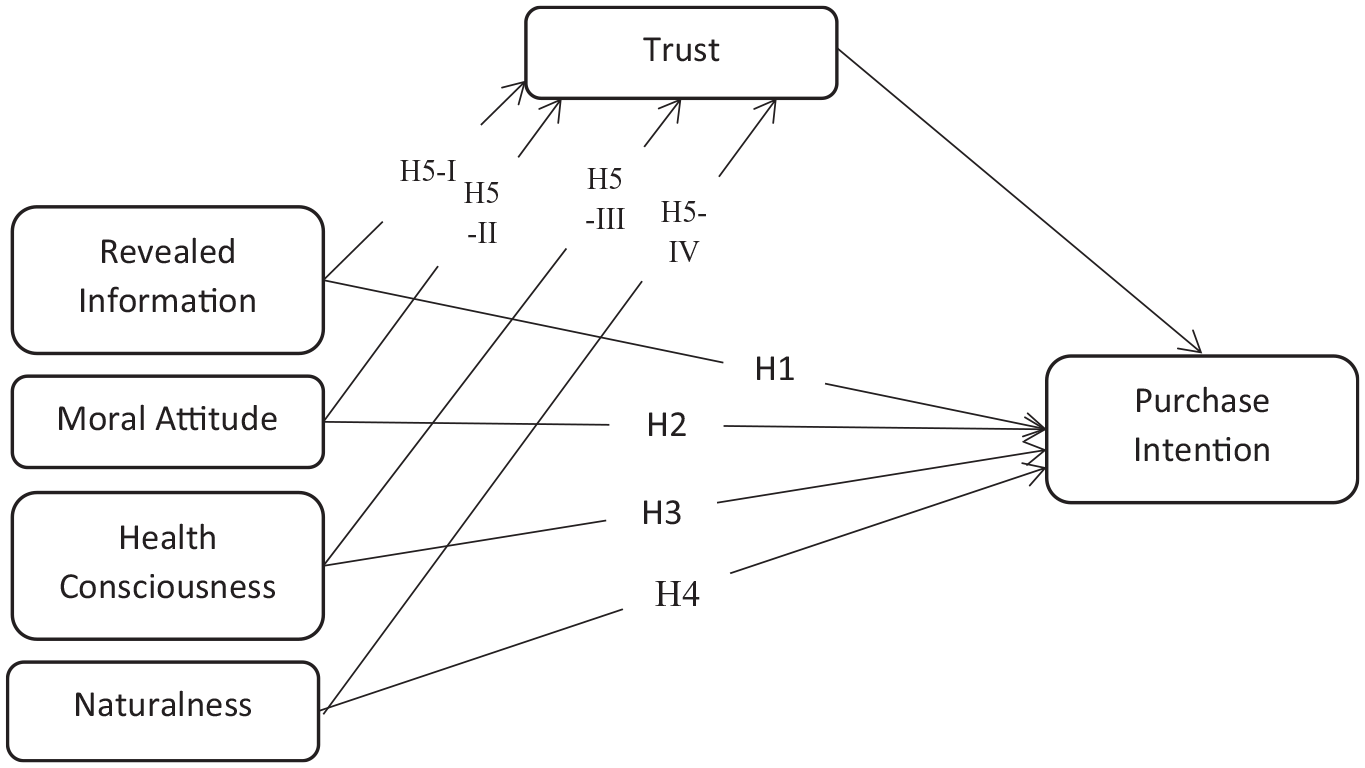
Conceptual Model.
Analysis and Results
The descriptive analysis of the data reveals that almost 54 % of the respondents were male, and 46% were females. The Age of the respondents ranges from 25 to 55 years. The income level of the consumers ranges from 500 US dollars to 1,500 US dollars per month. The convergent validity was ensured through reliability analysis, composite reliability, and factor loadings in the measurement model. The Cronbach’s alpha values were above the cut-off value of .70 (Hair et al., 1998). The composite reliability values ranged from 0.791 to 0.887, which were also above the accepted limit of 0.6 as per Bagozzi and Yi (1988). The discriminant validity was ensured through average variance extracted values ranging from 0.558 to 0.664 and were found above the cut-off value of 0.5 by Hair et al. (1998). The confirmatory factor analysis reveals the factor loadings which range from 0.69 to 0.86, which were also above the accepted limit of 0.6 by Chin et al. (1997). The model fit values (Goodness of fit index (GFI) = 0.910, Adjusted Goodness of Fit (AGFI) = 0.872, Comparative fit Index (CFI) = 0.926, Tucker Lewis Index (TLI) = 0.914, and Root mean square error of approximation (RMSEA) = 0.047) of the model were above the cut-off level as suggested by Bagozzi and Yi (1988) and Chau and Hu (2001). The detail values can be found in Table 1.
Reliability and Validity Table.

Note. RI = revealed information; MA = moral attitude; HC = health consciousness; NC = naturalness; T = trust; PI = purchase intention.
After ensuring reliability and validity, the structural model was tested by structural equation modeling. The model fit values were as Goodness of fit index (GFI) 0.921, Adjusted Goodness of Fit (AGFI) was 0.89, Tucker Lewis Index (TLI) was 0.968, Comparative fit Index (CFI) was 0.983 and mean square error of approximation (RMSEA) was 0.045 and all these values were above the cut-off values suggested by Bagozzi and Yi (1988) and Chau and Hu (2001). The path coefficient values reveal that the revealed information and moral attitude were significant with purchase intention of organic food with estimate values of .210 and .208 with the significance of .000. Health consciousness and naturalness were also found to be significantly impacting the purchase intention of organic food with estimated values of .223 and .172 at a significance of .000. The path coefficients can be found in Table 2.
Hypothesis Testing.

Trust in organic food products was found to be partially mediate the relationship of moral attitude, health consciousness, and naturalness with organic food purchase intention as per Baron and Kenny Approach (Baron & Kenny, 1986) and also confirmed through bootstrapping and the significance values of bootstrapping can be found below Table 3.
Mediation.

Note. Bootstrapping significance values. Moral attitude = 0.002; health consciousness = 0.009; naturalness = 0.003.
Discussion
The current study endeavored to explore the attributes responsible for organic food purchase intention in a Pakistan nascent organic market. The findings show that revealed information (credence attribute) became an essential determinant of organic food purchase intention. The study’s finding is consistent with the existing literature (Janssen & Hamm, 2012; Ozimek & Żakowska-Biemans, 2011; Vermeir & Verbeke, 2006). This finding points out that consumers look for relevant and necessary information in the labels on organic products to ensure the ingredients and process of production. Although the organic market is not organized and established in Pakistan, however, the farmer’s markets are paying attention to the verification of organic claims through the use of SAFA (Sustainability Assessment of Food and Agriculture), a system developed by FAO (Food and Agriculture Organization, United Nations). In addition, the established brands are also getting their products certified by foreign international certification and accreditation bodies. Therefore, the current situation underlines the importance of revealed information on the label in guiding consumers toward organic food.
Further, the investigation into personal attributes revealed that moral attitude is significantly associated with purchase intention for organic food, which means that consumers’ perceived moral standards are positively related to consumption of organic food, which is also in alignment with the findings of Arvola et al. (2008), Dowd and Burke (2013), and Yadav and Pathak (2016). This finding points out that the individuals who consider themselves as morally responsible for preserving the environment for saving mankind from harmful effects of environmental abnormalities, curtailing the degradation of resources such as soil, water, etc., and helping to establish a sustainable food provisioning system are more importantly willing to purchase organic food. Pakistani society is considered high in moral standards where observation of moral norms brings a good reputation. Therefore, this finding makes sense that people who have personally high moral attitudes are more concerned about consuming organic food. Trust found to be partially mediating the relationship between moral attitude and organic food purchase intention. This implies that trust in organic food, when combined with a positive moral attitude, will lead toward intention to purchase organic food.
Next, health consciousness (Personal attribute) was the best motivator for organic food purchase intention with the highest estimate value in the model. So the consumers purchase organic food because they are concerned about their wellbeing, and these findings are supported by Davies et al. (1995), Lea and Worsley (2005), Williams and Hammitt (2001), and Zanoli and Naspetti (2002). Presently, many individuals are catching various fatal diseases, such as cancer, Hepatitis-C, hormonal disturbances, etc., due to consumption of unhealthy food. Therefore, consumers seek healthy eating options, which lead them toward the adoption of organic food. Moreover, trust was also found to mediate the association between health consciousness and purchase intention for organic food. This implies that trust in organic food increases the probability that health consciousness will lead toward organic food purchase intention.
Further, the investigation into product attribute naturalness has also a significant association with organic food purchase intention, which means that consumers buy organic food based on natural contents of organic food, and this finding lends support to the studies conducted by Asioli, Næs, et al. (2014), Bartels and Onwezen (2014), Hasselbach and Roosen (2015b), Lockie et al. (2004), Lyerly and Reeve (2015), and Mouta et al. (2016). It means that consumers seek to consider organic food as natural, which is why they intend to buy organic food. Moreover, it was also concluded that trust partially mediates in the relationship between revealed information, moral attitude, health consciousness, naturalness, and purchase intention for organic food. This implies that revealed information on organic food labels drives consumer intention toward organic food purchase. This information lends support to consumers’ trust in organic food, which ultimately leads to purchase intention.
Similarly, the findings reveal that the moral attitude of a consumer assists him/her to trust organic food as a choice that is beneficial for environmental conservation and benefits for him/herself, and this trust ultimately drives the organic food purchase intention. Similarly, the trust in organic food that it provides health-related benefits provides a reason for health-conscious consumers to form their purchase intention toward organic food. Finally, the trust in organic food associated with its being natural also helps the consumer to shape its intention toward purchasing organic food.
Conclusion
The findings of the current study revealed health consciousness as the strongest predictor of the organic food purchase intention of consumers, which indicates that consumers are becoming more concerned about their health and wellbeing. Therefore, they are looking for those food alternatives which are considered beneficial for health. So, organic food becomes their priority as it is considered as healthy Choice. The findings further indicate that the personal attributes of individuals are the most important antecedent of organic food consumption in the context of Pakistan. It may be noted that there is no greater significant variation among the estimate values for all the independent variables. However, still, we may prioritize the relevant significance of each variable in the current context.
Theoretical Contribution
The current study extends the literature on organic food by investigating the factors related to organic food purchase intention in developing countries because these regions present different kinds of geographical variables that are not the same as the case of developed countries. Therefore findings of the studies focused on developed countries do not apply to these countries, especially Pakistan. Further, the literature on organic food consumption is still immature in Pakistan despite the increasing interest and consumption of organic food. Therefore, the current study analyses the factors responsible for driving purchase intention toward organic food based on a carefully designed conceptual framework based on a well-known theory of cue utilization.
Practical Contribution
The study has several implications for producers, sellers, marketers, and policymakers. Firstly, revealed information appears to be an effective tool for guiding consumer intention toward the purchase of organic food. Therefore, providing accurate, relevant, and necessary information regarding ingredients and the production process will increase consumers’ likeliness to purchase organic food. The study results guide the marketers in devising a marketing strategy and retailers in highlighting the importance of label information. It may also help suppliers to communicate the benefits and credibility of organic food products. Secondly, this study also provides guidelines for the policymakers to shift their focus to organic farming, which will bring huge benefits to health and the environment and a profitable business because consumers’ intentions coincide. Finally, the study also serves as a guideline for the traditional sellers of natural products in increasing their market share by highlighting the naturalness (product attribute) as a unique selling point because product attribute positively impacts buying intention of organic food.
Limitations
Although the current study provides significant implications for producers, sellers, marketers, retailers, and policy makers it still has several limitations. Firstly, the study focused on two major cities of Pakistan in data collection, so further studies can be expanded by collecting data from other provinces and cities of Pakistan to increase population representation. Secondly, the study may be improved by considering the role of price and availability of organic food in shaping the behavior of consumers toward organic food purchases a number of previous studies have reported price and availability as significant variables which influence organic purchase intentions. Moreover, in the case of Pakistan also, it has been observed that organic food prices are 10% to 30% higher than the other food products, and organic food is not widely available. Thus, these variables also make relevance in the context of Pakistan. Thus, the current study provides a direction for future researchers to explore the consumer behavior regarding organic food purchasing by incorporating various other context-related variables. Academicians may take it as an opportunity to explore this phenomenon in Pakistan through pertinent other theories to increase the validity and predicting power of models used in these studies.
Footnotes
Declaration of Conflicting Interests
The author(s) declared no potential conflicts of interest with respect to the research, authorship, and/or publication of this article.
Funding
The author(s) received no financial support for the research, authorship, and/or publication of this article.
