




Abstract
Small mining towns are often single-industry towns that turn to ghost towns or face negative socio-economic impacts upon mine closure. This study qualitatively explores the roles that mining companies and other key stakeholders (should) play in the development of local economies of the small mining communities to bring about economic sustainability, employing a constant comparative analysis. A small mining town in South Africa is the case study. Legislative and policy frameworks were scrutinized for their effectiveness in promoting economic sustainability. In-depth interviews with key stakeholders were carried out. Key factors limiting the effective implementation of developmental strategies were also explored. The study finds that weak community involvement, lack of trust, poor collaboration, poor municipal capacity, and legislation and policy flaws impact economic sustainability. Sustainable local economic development efforts are reported though. However, such efforts are insufficient because of the legislation and policy frameworks that are promoting short-term growth. Also, the town’s overdependence on the mining company, local government not optimally fulfilling their roles and responsibilities, and minimal community members’ participation on local economic development are other hindrances. However, the fact that the mining company and local municipality do acknowledge the shortcomings in their efforts towards promoting economic sustainability is a promise in minimizing the socio-economic effects of mine closures.
Plain Language Summary
The purpose of this study is to find ways to minimize the socio-economic effects that bedevil small mining towns when the extraction of the mineral becomes unviable. Often, small mining towns are single-industry towns and so they turn to ghost towns or face negative socio-economic impacts upon mine closure. The current study qualitatively explores the roles that mining companies and other key stakeholders (should) play in the development of local economies of the small mining communities to bring about economic sustainability. The study uses a small mining town in South Africa as the case study. Legislative and policy frameworks were scrutinized for their effectiveness in promoting economic sustainability. In-depth interviews with key stakeholders were carried out. Key factors limiting the effective implementation of developmental strategies were also explored. The study finds that weak community involvement, lack of trust, poor collaboration, poor municipal capacity, and legislation and policy flaws impact economic sustainability. Sustainable local economic development efforts are reported though. However, such efforts are insufficient because of the legislation and policy frameworks that are promoting short-term growth. Also, the town’s overdependence on the mining company, local government not optimally fulfilling their roles and responsibilities, and minimal community members’ participation on local economic development are other hindrances. However, the fact that the mining company and local municipality do acknowledge the shortcomings in their efforts toward promoting economic sustainability is a promise in minimizing the socio-economic effects of mine closures.
Keywords
Introduction
Mining projects, the backbone of many small towns worldwide, have a lifespan. The lifespan of an iron ore mine, for instance, is on average between 6 and 24 years (Anglo American, 2013) and thereafter mineral depletion sets in. Economic factors (Burger et al., 2018) and geological factors (Ackermann et al., 2018a) can also render mineral extraction unprofitable. The South African mining sector has been experiencing challenges due to fluctuations in global resource markets, high operational costs, wage strikes, and falling sector productivity, and these factors have led to a drop in mining contribution to the GDP from 21% in 1980 (Statistics South Africa, 2017) to approximately 8.1% in 2019 (Mineral Council South Africa, 2020). Devastating effects of mine closures that pose economic sustainability challenges in South Africa are reported by Ackermann et al. (2018b) for Grootvlei and Orkney mines; Marais (2013a) for Free State Gold Fields; E. L. Nel et al. (2003) for mines in KwaZulu-Natal, and by Lawyers for Human Rights (2017) for Blyvooruitzicht mine.
The socio-economic challenges emanating from mine closures are well known (Ackermann et al., 2018a; Chapman et al., 2015; Marais, 2013b; Stacey et al., 2010; Tonts et al., 2012; World Bank, 2002) and the South African government amended the Mineral Petroleum Resources Development Act No. 28 of 2002 in 2013 to reduce the environmental and socio-economic impacts of mine closures through the Social and Labour Plans. Also, the Municipal Systems Act No. 32 of 2000 requires local municipalities to produce Integrated Development Plans (IDPs), an approach that involves the municipality and relevant stakeholders in finding the best framework/plan for local economic development (LED). Frameworks and plans such as the National Framework for Local Economic Development, National Framework for Sustainable Development, and the National Development Plan (NDP) guide local municipalities to put together local development plans.
Despite the above-mentioned Acts and frameworks and plans, the closing down of mines in South Africa such as Blyvooruitzicht gold mine in the Gauteng Province (in 2013) and Orkney mine in the North-West Province (in 2010) has resulted in severe socio-economic challenges for retrenched workers. By 2018, the former employees of the above-mentioned mines had not received any compensation and by late 2019, residents in those mining towns did not have access to the basic services cut off after the company liquidation (Malope, 2019). These experiences motivated the current study that questions why small mining towns are not economically sustainable after mine closure despite the legislation in place on sustainable LED that requires mining companies and local municipalities to plan for and mitigate the socio-economic problems that come with mine downscaling and closure.
Such research is very limited in developing countries (Burger et al., 2018; Littlewood, 2014). De Mesquita et al. (2017) report that despite the increased publications related to mining and sustainability, the focus is still largely on environmental studies. Similarly, Burger et al. (2018, p. 6) state that “the environmental and technical issues have received attention, but the socio-economic effects of downscaling or closure have been decidedly under-researched.” This research study attempts to fill the gap in literature using a small mining town in South Africa (Kathu town as a case study) with an increased likelihood of undergoing mine downscaling or closure.
Kathu is a small town in the Northern Cape province, dependent on Sishen mine (owned by Kumba Iron Ore), the primary provider of employment to an estimated 85% of the local community (Anglo American, 2016a). A recent drop in commodity prices had a severe impact on the local community of Kathu town. Sishen mine decreased the number of employees (permanent and contractors) from 8 277 in 2011 to 5 466 in 2016 (Anglo American, 2016a) and a significant number of businesses in Kathu town closed down due to their inability to sustain the losses (Steyn, 2016). Forecasted iron ore prices depict a grim future for iron ore based mining operations (Chia, 2018), the outlook that leaves Kathu town with a high probability of downscaling and/or closure in the near future. Hence, its choice as the case study, both for policy and knowledge advancement. In addition, Sishen mine reported a concern over low labor absorption rate in other non-mining activities given its potential closure in the next 15 years (Anglo American, 2018a).
Using a case study approach, this study explores and provides recommendations on the roles and responsibilities of stakeholders, stakeholders’ relationships, and legislation and policy frameworks and how these influence the economic sustainability. The study therefore, has four specific objectives. First, we determine whether legislation and policy frameworks around small mining towns support economic sustainability. Second, we assess the roles and responsibilities of stakeholders regarding the planning for the economic sustainability. Third, we investigate the relationship between mining companies, local municipality, business owners, and community members considering economic sustainability. Last, we highlight key factors that may influence the implementation of LED strategies for economic sustainability.
To the best of our knowledge, this is the first South African study to focus on the roles and responsibilities of stakeholders in creating an economically sustainable small mining town for post mining closure, and methodologically, applying constant comparative analysis approach. The study does policy document analysis and supplements that with semi-structured interview data. So far, South African economic and social research studies that include small mining towns include Marais and Cloete (2013), Emuze and Hauptfleisch (2014), Gardiner (2017), and Louw and Marais (2018) and these studies report on housing development and impact on migrant labor, mining induced urbanization, socio-economic well-being, and public finances. The lacking local South African literature on the dimension of economic sustainability in small mining towns, as informed by the stakeholders’ experiences and incites, is what the current study attempts to provide. Overall, the study puts at bare the practices by different stakeholders in a small mining town setting and the development areas for successful execution of LED strategies.
The remaining part of the paper is structured as follows. Next is the literature review. The third section covers the methodology. The fourth section presents and discusses the results. Policy implications are discussed in the fifth section and the final section concludes and outlines key limitations of the study.
Literature Review
Single-industry towns are characterized with economic crises, sometimes beyond revival and resulting in a ghost town (Zheltonozhko et al., 2020). Such cases arise because the town did not develop beyond a single-industry economic base. Zheltonozhko et al. (2020) note that with single-industry towns, the city-forming enterprises that produce exported products are dominant as opposed to city-servicing enterprises producing for the needs of the town itself. Small mining towns are prototype single-industry towns, dominated by city-forming enterprises. Their economic sustainability after mine closure can only occur if the towns sufficiently develop to pass all stages that make them poly-functional centers.
There are two theories that are critical in explaining a small mining town’s economic sustainability or lack thereof, when the ore is exhausted. These theories highlight the fundamental roles of city-forming enterprises and city-servicing enterprises. The first theory is the Economic Base Theory. The Economic Base Theory proposes that a “community’s economic growth is directly related to the demand for its goods, services, and products from areas outside its local economic boundaries” (Blakely & Leigh, 2017, p. 113). In the small mining town perspective, the Economic Base Theory is obviously relevant in the short run because that is when the town’s economic viability depends on the availability of the extracted and exported product, the ore. Small mining towns that do not grow beyond the decree of the Economic Base Theory are bound to become ghost towns post mining phase.
The Internal Combustion Theory, however, explains the possibility of economic sustainability beyond mine closure. The theory suggests a scenario in which entrepreneurs essentially start their own businesses that provide goods and services for export or for local industries, provided the government maintains the infrastructure and services (Daniels, 1989). The theory emphasizes the retention, expansion, and creation of businesses. The role of the government in this theory is important in the sense that they need to provide entrepreneurs with incentives to invest in the local area, such as subsidies, lower payable taxes, and loans. For the Internal Combustion Theory, the growth of the local area would also depend on a growing population, that is, growth machine hypothesis (Atkinson, 2008; Daniels, 1989). In the South African context, small towns usually have a growing population but lower consumer income as a result of high unemployment, which discourages entrepreneurial drive to invest locally (Atkinson, 2008). Neil et al. (1992) earlier argued that mining dependent towns lack entrepreneurial tradition because of factors such as high dependency on mining companies.
There is a need therefore, for developmental strategies that promote small mining towns’ economic sustainability by facilitating city-servicing enterprises. Local Economic Development (LED) is one such developmental strategy, having originated from Western Europe and the global North (World Bank, 2002). Historically, planning at a local level was very technical, focusing more on land use and infrastructure, less on social and economic dimensions (Abrahams, 2003), and adopting a top-down approach (Abrahams, 2003; Rogerson & Rogerson, 2010). However, modern LED takes a territorial approach and focuses on developing a locality; adopts a bottom-up development strategy where the local institutions identify areas of concern and cooperate with local stakeholders to formulate development strategies; and tends to steer away from fostering economic activity through large industrial projects and infrastructural investments (Tijmstra & Rodriquez-Pose, 2005). The modern LED approach was recognized for combating social and economic problems in the global North during the last four decades (Garidzirai & Meyer, 2019; Rogerson & Rogerson, 2010). In South Africa, modern LED aims to adopt a systems approach to sustainability where ecological, socio-political, and economic sectors are integrated and mutually compatible and Heinrichs et al. (2016) called this a sustainable LED. E. Nel and Rogerson (2005, p. 4) suggested the core focus of a modern approach to LED as “partnerships, economic growth, job creation and the improvement of quality life and places within the context of communities or at local level.”
Modern LED could be pro-poor, focusing on human resource development, poverty alleviation, promotion of local initiatives and redistribution of resources (Abrahams, 2003) or pro-growth, targeting economic infrastructure constraints, and enhancing skills and building partnerships (Economies Region Learning Network, 2016). E. Nel and Rogerson (2015) argued that pro-poor LED was over emphasized and suggested a balanced approach. Various Integrated Development Plans (IDPs) articulate LED approaches and Rogerson and Rogerson (2010) confirmed that LED becomes more effective with the encouragement and support of partnerships, collaboration between businesses and community members, facilitation of skills development and education, and support for improvements in the standard of living.
In South Africa, the mining sector is under legal pressure to not only prove its commitment to sustainable development through building sustainable communities in case of mine closure (Van Druten & Bekker, 2017), but also working toward eliminating poverty and reducing inequality (National Planning Commission, 2011). For this reason, the Mineral Petroleum Resources Development Act was established to deepen the mining companies’ commitments toward LED and to start planning for mine closure from the moment the mine opens (Centre for Development Support, 2006). The requirement for mining companies to produce Social and Labour Plans and local municipalities to produce IDPs potentially encourage stakeholders to develop effective LED strategies. IDPs are an important tool for local municipalities in addressing developmental issues from consultation with community members and mining companies. Rogerson (2011, p. 13381) noted that “IDPs offer a basis for leveraging cooperation and partnership between mining enterprises and local government and that the existing shortcomings in IDP processes must thus be identified and addressed as ‘first level blockages’ to the making of effective cross-sectoral partnerships.”
However, as LED policies encourage mining companies to play a vital role in development, the support provided by the mining company can cause the local municipality to take less charge in community development and make communities less involved in entrepreneurial activities and development initiatives (Centre for Development Support, 2006). Marais (2013b) explains that the oversight in legislation and guidelines in a mining context have yielded mixed results with regards to infrastructure projects preferences, vision sharing and trust among stakeholders, common framework to assess project applications, feasibility studies, monitoring and evaluation, and funds availability toward addressing the long-term environmental impacts of mining.
Methodology
Research Design
This qualitative study adopts an interpretative case study design. Yin (2013, p. 13) defines a case study as “an empirical study that investigates a contemporary phenomenon in depth and within its real-life context, especially when the boundaries between phenomenon and context are not clearly evident.” The search for an understanding of the effects of mine downscaling or closure (a contemporary phenomenon) on economic sustainability within Kathu town (a real-life context) warrants a case study design as appropriate. A qualitative approach was considered ideal for the study as we sought to obtain detailed local information about the stakeholders’ knowledge and understanding of their roles and responsibilities toward economic sustainability pre and post mine closure. The degree of execution of the roles and responsibilities of the stakeholders, with emphasis on sustainable local economic development practices, depicts the selected case study’s state of readiness with regards to mitigating the negative socio-economic challenges associated with mine downscaling and closure. In-depth interviews suit collection of such data. Literature review on LED, economic sustainability, and impacts and lessons learned from mine downscaling and closure elsewhere, provided the point of departure for this study. We organized the collected primary data accordingly and analyzed it using the constant comparative analysis method. Findings were presented in the form of qualitative narrative passages where key responses were documented.
Sampling, Data Collection Processes, and Transcription
Interviewing is the most common form of data collection process in a case study design (Skovdal & Cornish, 2015) and literature review and document analysis form the base for the interview questions in the current study. Secondary data, from existing documents such as legislation, national and provincial policy frameworks, IDPs, Social and Labour Plan, socio-economic impact assessment, and annual reports from mining companies, were gathered through document analysis. Most of these documents are available online with the exception of the complete Social and Labour Plan. Instead, an extract pertaining to LED from the Social and Labour Plan was obtained from Anglo American’s website. Primary data were collected using semi-structured interviews with key stakeholders from the local municipality, mining company, business owners, and community members.
Initial participants were selected using purposive sampling. Purposive sampling is a technique widely used in qualitative research for the identification and selection of information-rich cases for the most effective use of limited resources (Patton, 2002). Initial participants included Social and Labour Plan coordinators and implementers from the mining company, local municipality officials responsible for LED, business owners from different sectors, community leaders and one expert on small mining town research. Primary data were collected by adapting theoretical sampling that Glaser and Strauss (1967, p. 45) defined as “the process for data collection for generating theory whereby the analyst jointly collects, codes, and analyses data and decides what data to collect next and where to find them, in order to develop a theory as it emerges.” In the current study, the purpose was not necessary to develop a theory, but to get a deeper understanding on whether legislation and policy frameworks support small mining towns’ economic sustainability; the roles of stakeholders regarding this economic sustainability; the relationships of these stakeholders, and LED implementation hindrances.
We used semi-structured interview questions and Thomas (2017) pointed out that such interview questions provide a structure of a list of issues to be covered as well as the freedom to follow up points, as deemed necessary, to enhance the data. Questions were formulated based on the research objectives. Each stakeholder group received a set of questions before the initial interview, which enabled the interviewee to gather their thoughts regarding the subject matter. The stakeholders then proceeded to provide the interviewer with their responses during the actual interview. For most part of the interview schedules, the questions remained the same but specific questions regarding, matters such as legislation and policies, were tailored more towards the mine and local government. Four interview schedules were administered to four stakeholder group participants. Seven of the interviews were via Skype (voice call) together with one face-to-face interview in which the participant’s responses were voice recorded. Where necessary, the interviewer widened the scope of existing interview questions by using follow-up questions. In other words, once the interviewer identified a topic that needed further explanation or different viewpoints, relevant stakeholders were asked about it during the subsequent interviews. Three participants responded to the interview schedules in writing. Seven out of the eight interviews were conducted in English and one in Afrikaans. The average time for the interviews was 49 minutes. The first interview was conducted on October 8th, 2019 and the last interview on February 28th, 2020. As for the written responses, two were completed in Afrikaans and one in English. The Afrikaans responses were translated into English and combined with the other written English responses. All in all, the study consists of 11 fully completed interviews and data saturation was achieved.
An online website, Transcribe by Wreally, was then used to transcribe the voice recordings. To improve the accuracy of the transcription, voice recordings were listened to several times and necessary changes and adjustments were made. The transcribed data and written responses were captured in MAXQDA.
Data Analysis and Interpretation
This study employed a grounded theory method-like to extract a deeper meaning from the data collected, using a constant comparative analysis. In the literal sense, the constant comparative analysis incorporates four stages: “(1) comparing incidents applicable to each category, (2) integrating categories and their properties, (3) delimiting the theory, and (4) writing the theory” (Glaser & Strauss, 1967, p. 105). From the grounded theory literature, there are two approaches: the Straussian approach and Glaserian approach. The Straussian approach is more descriptive in nature while the Glaserian approach is more conceptual. Van Niekerk and Roode (2009) explained that the purpose of the Glaserian approach is to generate concepts (abstract theory) and relationships that explain the variation in behavior for an area of study whereas the Straussian approach describes the full range of behavior in that area (explanatory theory). The two approaches also differ in that Straussian approach incorporates an additional coding stage, that is, axial coding, whereby connections between categories and subcategories are found while the Glaserian approach does not. In addition, the Straussian approach allows for the reading of some literature in the beginning to formulate questions and assist with sampling whereas the Glaserian approach delays any form of reading to avoid forming preconceptions. The Straussian approach was thus ideal in our study as we conducted a literature review and document analysis for the formulation of interview questions. Below we outline the adapted Straussian approach in our study.
After conducting each interview, whose questions were informed by the literature review and document analysis process, data were transcribed, and field notes typed up. The transcribed data were imported into MAXQDA and three forms of coding followed: open coding, axial coding, and selective coding. Open coding was the first stage of the process where the data was read and broken down analytically using the constant comparative method to compare one part with another to form categories. Accumulation of categories prompted us to reflect on the data and keep a record of reflections through writing memos. The second stage was axial coding, where the researcher identified relationships between the open codes and core categories emerged. The first two coding stages highlighted themes that needed further clarification sometimes. Before proceeding to the final coding stage, additional data were gathered through theoretical sampling and asking additional or follow up questions to explore certain themes. This was done until theoretical saturation was reached. The final coding stage, that is, selective coding, was “the process of selecting the core category, systematically relating it to other categories, validating those relationships, and filling in categories that needed further refinement and development” (Corbin & Strauss, 1990, p. 116). These categories were then integrated into a theoretical framework and findings presented in a qualitative narrative passage (see Figure 1). Quotations from the key participants’ interviews were used to substantiate the findings.

Illustration of research strategy for primary data component of study.
Reliability and Validity
The study incorporates validity strategies to check the accuracy of the findings. First, the triangulation of data sources resulted in the accumulation of multiple sources of evidence. Denzin, (1970, p. 291) defines triangulation as “the combination of methodologies in the study of the same phenomenon.” The interviews and document analysis provided with multiple viewpoints and a more comprehensive understanding of the stakeholders’ respective roles and responsibilities with regards to sustainable economic development strategies. Second, we kept a detailed record of all data obtained (using code names to keep anonymity). Third, we presented different interview responses in support of or disagreement with the perspective of the theme. Lastly, the use of theoretical saturation ensured that the categories were fully developed. The proposed validity strategies increased the accuracy and validity of the findings.
Results and Discussion
The results presented here are organized in line with the four specific objectives that we provided in the introduction section. Subsection “Economic Sustainability in Legislation and Policy Frameworks” directly addresses the objective of whether legislation and policy frameworks around the small mining towns support economic sustainability. Subsections “Key Stakeholders’ Efforts Toward an Economically Sustainable Kathu Town,”“Level of Dependency,”“Partnerships and Collaborative Planning,” and “Gamagara’s Use of Funds Compromises Trust Between Stakeholders” relate to the objective of exploring the roles and responsibilities of the stakeholders. Subsection “Stakeholder Relationships and Community Involvement” reports on the objective on relationship between stakeholders while subsections “Local Government’s Capacity to Execute Developmental Responsibilities” and “Funding and “Political Make-up” as LED Implementation Key Detractors” cover the factors influencing the implementation of Local Economic Development (LED). Together, this set of results illustrates an exploration of issues relating to economic sustainability in small towns, and paves way for recommendations.
Economic Sustainability in Legislation and Policy Frameworks
An in-depth analysis of legislation and policy frameworks documents revealed that sustainability is viewed as having three pillars: economic, social, and environment. However, the Constitution of South Africa, in section 24, gives a uni-dimensional approach that focuses a lot more on environmental and neglecting the economic and social dimensions. Sustainable development and LED are poorly defined in the Constitution of South Africa, Municipal Systems Act, Mineral Petroleum Resources Development Act, policies such as National Framework for Sustainable Development and National Framework for Local Economic Development. However, the same documents promote planning processes, including in national and provincial development programs and drafting of IDPs and Social and Labour Plans. One can argue that National Framework for Sustainable Development promote economic sustainability through the employment drive; infrastructure and skills development; and small, medium, and micro-enterprises (SMMEs) promotion, aspects addressed in these documents. One study participant from Gamagara Local Municipality (hereinafter Gamagara) commented on the effectiveness of these policies and states that “So all of those policies, they are very good tools, for us to be able to do our work very much easily and also to mobilize for all the resources that you will need within that particular space.” This is an indication that some users of the policy documents view them as adding value to the LED.
However, a successful implementation of LED requires stakeholder involvement, partnerships, good relationships, capacity, and funding (Atkinson, 2005; Blakely & Leigh, 2017; E. Nel & Binns, 2003; Rogerson, 2012; Stacey et al., 2010). Document analysis in the current study shows that the Municipal Systems Act and National Framework for Local Economic Development encourage community involvement and collaboration and yet the Mineral Petroleum Resources Development Act together with the Social and Labour Plan do not promote partnerships. The oversight in the mining legislation regarding partnerships has implications for a small mining town such as Kathu. Marais (2013b) highlights that the oversight in legislation means that the town might experience lack of trust, short-term unsustainable projects, and preference for infrastructure projects, an aspect to be explored in this study.
Key Stakeholders’ Efforts Toward an Economically Sustainable Kathu Town
Kathu town’s understanding of the LED is best explained using IDP, Social and Labour Plan and socio-economic impact assessment analysis together with the interview responses. An examination of the IDP; Social and Labour Plan and socio-economic impact assessment provided a view of the LED strategies adopted by both Gamagara and Sishen mine, respectively. In the foreword (page xi) of the IDP, the municipal manager writes that “By the end of 2030 Gamagara should have developed into an industrial town and developing towards a manufacturing town.” Gamagara’s (2017) IDP strongly promotes the development of the manufacturing and agricultural sectors but also acknowledges that LED should steer away from project-based initiatives and focus more on skills development, locally promote SMMEs development, tourism, and the promotion of local economies. Participant (GLM01’s) comment reads, “We already have a plan in place to say we have maybe a manufacturing activity or we have an agricultural activity or other sectors that will also enhance the economic development of the particular area.” Although Gamagara has listed all of projects in the IDP, we questioned whether the execution thereof will be successful. A study by the Centre for Development Support (2006) highlights that IDPs stand out as plans that rarely get executed because of lack of funding, incapacity and unrealistic expectations. Participant (GLM01) estimates the successful implementation of LED to be in the region of 60% to 70% due to elements of silo planning.
The socio-economic impact assessment reports Sishen mine’s efforts toward economic sustainability in the form of promoting SMMEs development, portable skills development, Youth Empowerment Programme, and the municipality capacity building program. These increase the likelihood of residents to become self-employed or more attractive to other employment sectors. Figure 2 illustrates Sishen mine’s proportional spending on community economic development areas, and enterprise development and poverty alleviation. The proportional split between education and skills development; health and welfare; enterprise development and poverty alleviation, and institutional capacity development and donations were similar for the year 2018.
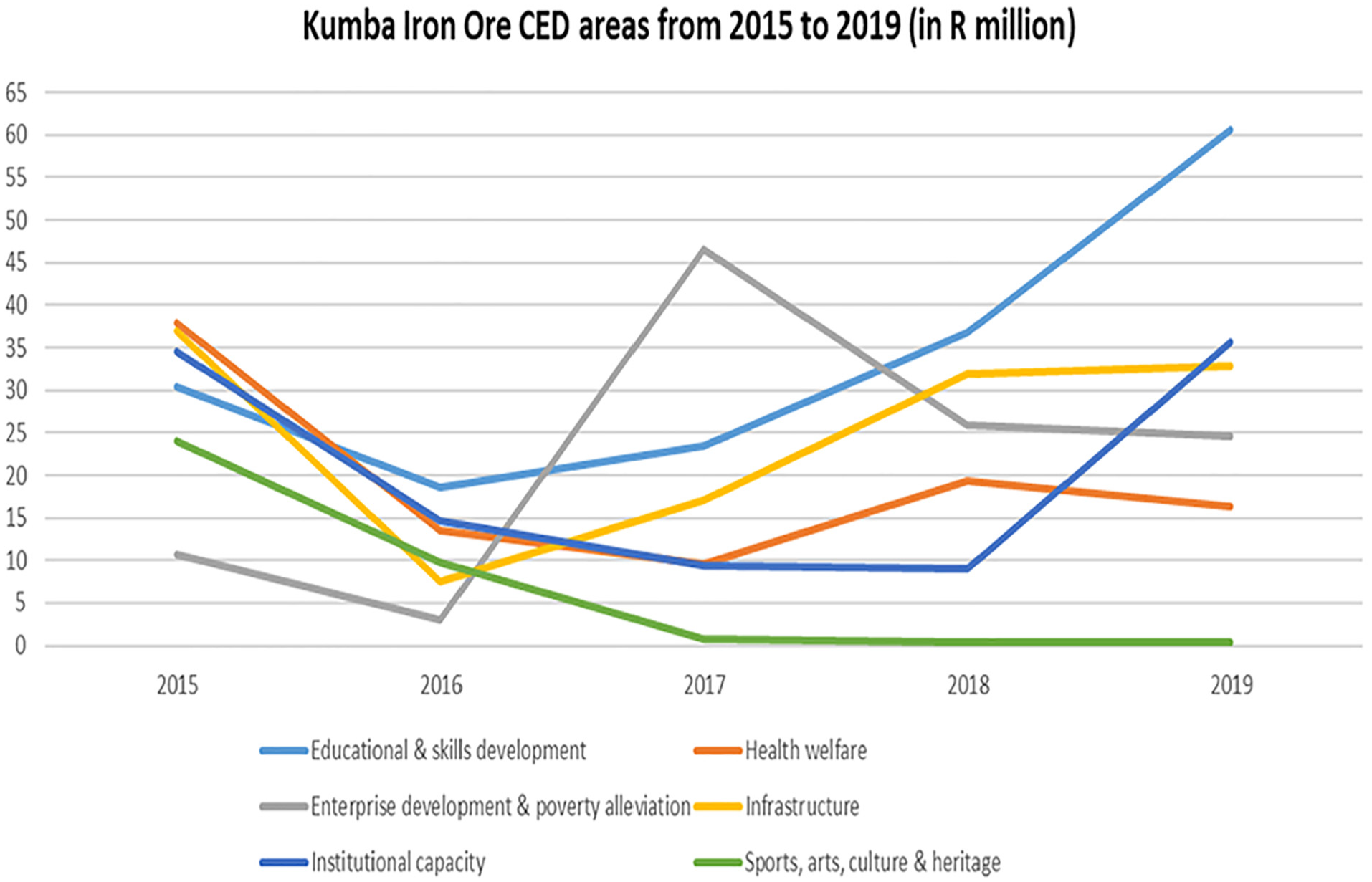
Sishen mine’s community economic development proportional spending 2015 to 2019.
With regards to key stakeholders’ execution of the LED projects for Sishen mine and Gamagara, the interviewed business owners and community members provide starkly different responses. In response to the question, “Is Sishen mine contributing to LED? Do you think Sishen mine can do more to grow Kathu’s economy?,” all of the community members concur that Sishen mine contributes extensively to the development of Kathu town. However, for the same question with reference to Gamagara, community members and business owners strongly felt that the Gamagara fails to promote social and economic development, citing lack of job creation, housing, infrastructure improvement, and skills development. Marais (2013b) argued that communities’ preference for short-term projects may be the driver of responses such as these ones, and Gamagara acknowledged their involvement in such projects but suggested the intent to move away from such.
One can argue that both Gamagara and Sishen mine realize what LED entails for economic sustainability but Gamagara follows more of pro-growth LED strategy and not pro-poor LED strategy, an approach ineffective in addressing negative socio-economic impacts (Abrahams, 2003; Rogerson & Rogerson, 2010). Sishen mine, however, adopts a combination of both pro-poor and pro-growth LED strategies in which areas such as skills development, capacity, infrastructure, and SMMEs development are given priority.
Level of Dependency
Kathu town is a single-industry town, relying on Sishen mine and thus stands the risk of becoming a ghost town when the mine closes. One participant argues that the international market behavior of this mineral tends to influence the town substantially, including its sustainability. This observation is also confirmed in Anglo American’s reports that Sishen mine remains particularly susceptible to the global iron ore price.
The price of iron ore fell a staggering 39% in 2015 (see Figure 3) as China’s demand for steel declined and some of the world’s largest iron ore mining companies expanded production in Australia and elsewhere, leading to an oversupply of iron ore in the market (United Nations, 2019). The lower iron ore prices affected Kathu town in various ways. First, Sishen mine’s operating profit decreased from R19,192 million in 2014 to R2,644 million in 2015 (see Table 1), which resulted in a reduction of its workforce by 32.5%. This had a negative effect on Kathu town, as Sishen mine employs on average 84% of locals. Kathu town’s unemployment levels rose due 2015/16 downscaling. The low rate of absorption for job losers arose from a lack of transferable/portable skills (Anglo American, 2018a).
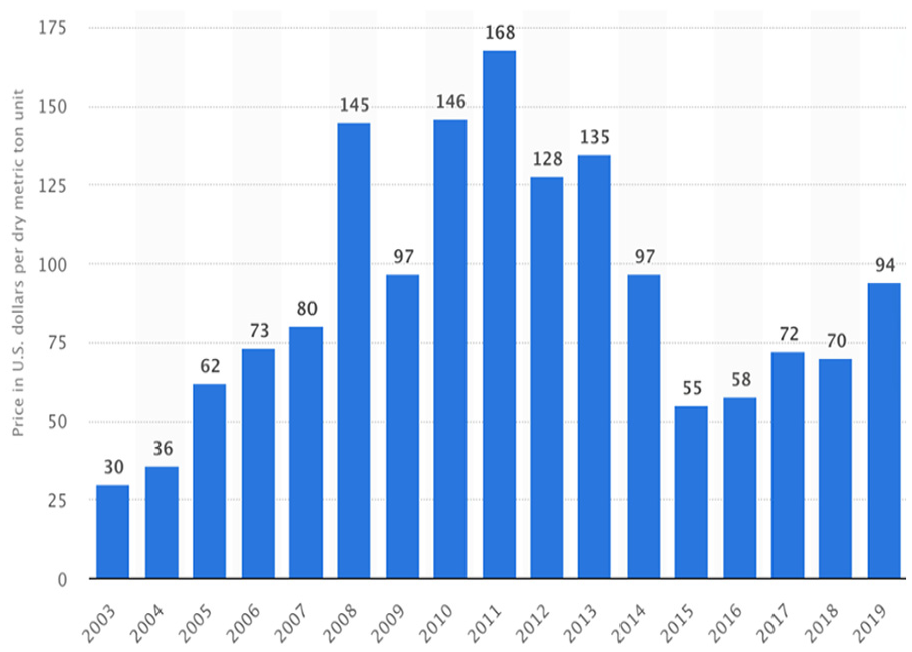
Historical chart of iron ore prices 2003 to 2019.
Kumba Iron Ore/Sishen Mine Key Financial Information and Statistics 2014 to 2019.

Source. Anglo American (2019).
Notes. KIO = Kumba Iron Ore.
Second, the downturn resulted in a decrease of Sishen mine’s social and community project spending for Kathu town from R70,9 million in 2015 to R11,4 million in 2016, but it has since increased again to R62,1 million in 2019 (see Table 2). These projects include education and skills development, health and welfare, enterprise development and poverty alleviation, infrastructure, institutional capacity development, and donations.
Kumba Iron Ore Sishen Mine LED Statistics 2014 to 2019.
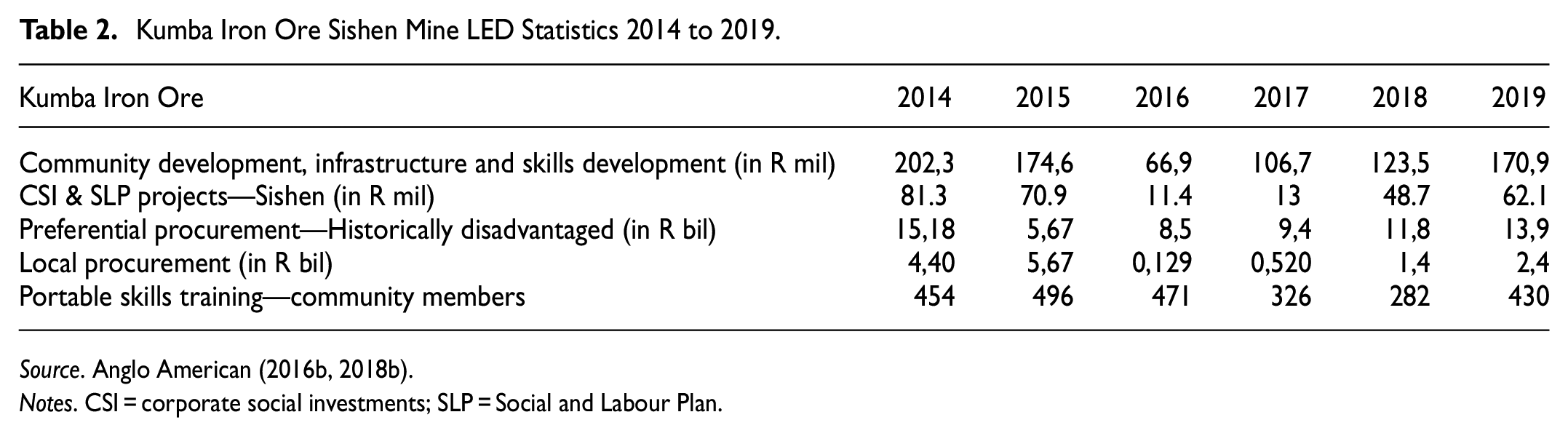
Source. Anglo American (2016b, 2018b).
Notes. CSI = corporate social investments; SLP = Social and Labour Plan.
Last, increased unemployment levels had a knock-on effect on the businesses. Demacon, a private company specializing in economic research services, conducted an economic analysis for Sishen mine in 2016 (Anglo American, 2018a). The analysis highlighted the way other sectors are, to a great extent dependent on Sishen mine. The findings from the interviews we conducted strongly agree with the view that Kathu town relies on Sishen mine. All of the business owners reported that the previous downturn had a significant impact on their businesses. In addition, participant (BO02), commented that, “Yes, it had a huge impact on our mall. From a finance point of view, it had a huge impact.” Other responses from the interviews referred to businesses that closed down or were liquidated because of the 2015/2016 downscale.
The current study finds that Gamagara is taking the lead in planning for diversification to lower the dependency and improve economic sustainability of Kathu town. Gamagara (2017) proposes to build some projects, such as the Kathu Supplier Park, Agri-Park, Farmer Support Units, a textile-manufacturing factory, a brick making industry, Fuel Depot, solar panel manufacturing plant and regional airport. This, however, is viewed by interviewees as very difficult to achieve for a small mining town such as Kathu town.
Partnerships and Collaborative Planning
The responsibility on planning for economic sustainability rests with all levels of government, key stakeholders, and local communities ( E. L. Nel et al., 2003; Stacey et al., 2010; World Bank, 2002). The World Bank (2002) sets out the roles and responsibilities expected of a mining company, and these include planning for mine closure early on, working in partnerships with local governments and communities and availing funds for development. The requirement to compile Social and Labour Plans and IDPs and align the Social and Labour Plans to the IDPs, was an attempt toward collaborative planning between the local government and mining companies, but Marais et al. (2017) discuss how this is hardly achieved. Earlier, Marais (2013b) argued that policy guideline oversight results in a lack of shared vision among stakeholders for project implementation and thus omission of partnerships from the Social and Labour Plans. As discussed above, Gamagara and Sishen mine plan for economic sustainability differently. One participant (GLM01) attributed the poor LED attempts to silos planning and interviews with Sishen mine and Gamagara key informants reveal conflicting views about alignment. Participant (GLM01) is of the view that the alignment is in the region of 80%. However, Sishen mine key informant commented that, “Yes, it is aligned. So, there is no project that is appearing in our Social and Labour Plan document that is not aligned to the priorities in the IDP.” Such conflicting views suggest weak partnership between Gamagara and Sishen mine, and hence poor alignment of the Social and Labour Plan with the IDP. Also, lack of collaborative planning and partnership risks long term economic planning. One Sishen mine informant (SM01) acknowledges that currently what the mines are doing is ineffective as the different mining companies each do their own kind of development for Kathu town, an argument also supported by the key informants from Gamagara.
Gamagara’s Use of Funds Compromises Trust Between Stakeholders
A comment from one of the community members (CL03) reads, “The community feels betrayed because of all the municipal debt the municipality finds itself in for example Eskom.” As Rogerson (2012, p. 130) explains, “trust is at the heart of improving partnerships for joint planning relating to issues of LED, alignment with IDPs, infrastructural delivery, human resource development, and sustainable development.” When it is compromised, challenges arise especially on integrated planning. Lack of trust among stakeholders was reported in various circumstances in the current study. The effective use of funds is questioned by the community as developmental funds that could have been used, for example, for skills development and SMMEs development, were claimed to have been used to upgrade the existing infrastructure although financial evidence lacks in that area (Gamagara, 2017). A community member (CL01) comments, “The administration places a lot of pressure on their financial department, as they are not very effective.” The business owners felt that a great amount of financial resources is spent on salaries and fraudulent activities as reflected by municipal officials affording expensive cars.
Both the community and Sishen mine lack trust in Gamagara while Gamagara key informant (GLM01) reports that Sishen mine do not entrust Gamagara with the initial planning for development. A separate study by Louw and Marais (2018) for Kathu town reported that the mines prefer not to entrust project funding to the municipality. Thus, mining companies prefer to implement municipal projects themselves or to entrust the implementation to entities under their direct control. The current study can conclude that the level of trust between key stakeholders and Kathu town’s community is very low.
Stakeholder Relationships and Community Involvement
As literature state, the success of LED is driven by partnerships, trust, capacity, funding, entrepreneurial drive, good relationships, and stakeholder involvement (E. Nel & Binns, 2003; Rogerson, 2012; Stacey et al., 2010). In the current study, weak partnerships and low trust between Sishen mine and Gamagara are reported and one key informant (GLM01) comments that, “We have had fights with the product stakeholders like our mines. The other thing is we still have a problem with Sishen mine.” On the contrary, an informant from Sishen mine (SM01) is of the opinion that the relationship is good. The SM01’s statements during the interviews suggest social desirability bias (Grimm, 2010), when responses are coined to be socially desirable and not reflective of true feelings. However, GLM01’s responses appear open and honest and are corroborated by an expert on small mining research’s comments. The expert is of the opinion that the poor relationship is because of the creation of dependencies that beget expectations, in line with a comment by one business owner (BO04) who blamed the community members for feeling entitled and thus expecting handouts from Gamagara or being employed by Sishen mine despite lack of skills.
Section 16 (a) of the Municipal Systems Act encourages local communities to participate in the preparation, implementation and review of its integrated development plan (Republic of South Africa, 2000). Throughout the IDP, the municipality acknowledges the importance of good stakeholder relations and the contribution they can make in the development of the municipality (Gamagara, 2017). Responding to the following question, “How often do you attend community forum meetings held by Gamagara local municipality?,” half of the interviewed business owners and community members confirmed that they attend the meetings while the other half seems uninterested or blames Gamagara for not inviting them, suggestive of a mixed feeling. The lack of community involvement can be traced back to local governments’ exclusion of the community, but the current study did not find such evidence for Gamagara. Sishen mine informant (SM01) confirms that Gamagara creates an opportunity for stakeholders to be involved in the statement that, “later they complain that the municipality is implementing projects, which are not talking to their needs but forgetting that they did not attend the meeting. It is unfair because the municipality created an opportunity for everyone to come but not everyone attended.” However, when community members were asked whether their inputs during forum meetings were taken into consideration, the consensus was that their inputs were registered but seldom executed.
One community leader (CL02) laments that, “The meeting of 2017 has not implemented anything at all for example broken street poles, accounts, water leakages, payment of Eskom, Sedibeng’s water, Kumba etc.” Although Sishen mine held a roadshow in 2015 where they informed the stakeholders of the future expectations and how they were to be affected, stakeholders felt that Sishen mine was not open to any of their inputs and showed little interest in the stakeholder concerns. The socio-economic impact assessment also shows that Sishen mine’s consultations with stakeholders was sporadic and decisions are taken in isolation (Anglo American, 2018a). The current study confirms that both Gamagara and Sishen mine gives low value to the inputs from the community. While stakeholder involvement is encouraged when planning for sustainable local economic development, key stakeholders here fail to include the community in the decision making process.
Local Government’s Capacity to Execute Developmental Responsibilities
Community leaders suggest terrible service delivery and lack of capacity in almost all municipality departments as dominant in Kathu town. Earlier, Rogerson (2012) reported lack of capacity in the local municipalities in South Africa’s mining-dependent towns. Overall, the business owners and community members feel that Gamagara is unable to perform its duties well. Sishen mine is also of the opinion that Gamagara is in need of capacity building. Gamagara’s (2017) plan of action in the IDP that states prioritization of human resource development with properly skilled individuals to bring back the community’s confidence in the municipality, confirms that the local government is aware of this weakness. The socio-economic impact assessment also highlights that Sishen mine accepted the responsibility for developing and strengthening Gamagara’s capacity and there is evidence to that effect (Anglo American, 2018a). Nonetheless, Gamagara suggests that the mine should rather capacitate communities with portable skills instead of the local municipality.
Funding and “Political Make-up” as LED Implementation Key Detractors
Gamagara’s revenue collection for the years 2016/2017 was at 50%. The weaker local economy gave rise to lower investor confidence, which resulted in developers and potential investors withdrawing their plans to invest in Gamagara (2017). One key informant (GLM01) emphasizes the point by saying, “There are no funds available and resources. Only when we can also come up with very stringent measures of debt collection. It is the issue of non-payment that has come up to our communities of thinking that actually the municipality owes them. Not them owing the municipality.” The Gamagara (2017) Municipal report suggests that the municipality further experienced poor revenue collection due to the teething problems with the new financial management system and as a result, revenue collection was at 51% in 2017/2018. Major expenses for the municipality were salaries, development of new infrastructure, and maintenance of old infrastructure. For the 2017/2018 financial year, the municipality received an unqualified audit due to insufficient evidence for spending on infrastructure investment (Gamagara, 2017). Louw and Marais (2018), for instance, attribute Gamagara’s lack of funding mainly to the lack of capacity for long term planning and planning for decline while community members and business owners attribute that to abuse of funds through excessive spending on high salaries. Related to this is the distrust of Gamagara in terms of fund allocations by Sishen mine and thus the mine does not provide development funds to Gamagara. According to the Sishen mine informant (SM01), all stakeholders, both locally and nationally, should provide their share of funding in order to have a greater impact in the small mining towns. The current study questions the level of involvement of the national government in the development of small mining towns, in light of the small town in consideration.
The last aspect that emerged from the interviews, political make-up of key stakeholders, is an important factor that influences LED implementation in Kathu town. Earlier, we highlighted poor stakeholder relationships and a lack of both community involvement and trust in Kathu town. Interview memos also suggest political make-up in Kathu town as a contributing factor to lack of community involvement and trust that the stakeholders have in Gamagara. Sishen mine key informant (SM01) raised this issue and explained that “some people will not support the municipal leadership if they know the political party they support.” Also, the disagreements between the political and municipal leadership themselves result in a compromise of service delivery and SM01 illustrated that as follows, “by the beginning of the financial year, the municipality has a certain budget for example to construct roads within this community but because of the political infighting inside the municipality, the road either doesn’t get constructed or get implemented late.” Another key informant (CL02) commented that, “Politics should be kept out of the municipality… and the political game should be stopped” an indication of how politics influence the roles of municipalities. Examining how the political climate contributes to the relationship between the stakeholders and hinders development could be a good avenue for future research as it is out of the scope of the current study.
Policy Implications
This study proposes some recommendations. Legislative and policy frameworks should include a proper definition of what local economic development (LED) entails and the guidelines on how to implement it effectively in a small mining town as capacity, funding, and stakeholder involvement might be more challenged. A better explanation and inclusion of early planning, planning for decline and guidelines on how stakeholders should plan for closure should be provided for. There is need to create a separate fund that deals with socio-economic problems post-mining and funds spent on major developments, which have a tendency to also suffer with mine closure, can be redirected into a funding scheme to assist mining communities after the mine closes down. Clarity on the roles and responsibilities of mining companies regarding partnerships and collaborative planning is imperative, as this will encourage all stakeholders’ involvement.
At micro-level, building trust between stakeholders is recommended and this can be done by promoting transparency, including making local municipality’s financial reports accessible, and executing community concerns raised during annual meetings. Investment in post-secondary education, transferable skills, and entrepreneurial skills development may promote growth of SMMEs, an important source of employment in many developing countries. Success on this will ensure economic sustainability after mine closure.
Conclusions and Limitations
Mine closures are not a new phenomenon and there exists many cases. The current study reported on the weaknesses of legislation with regards to the definition of LED and guidelines for planning for sustainable LED, Gamagara’s pro-growth LED inclination, Kathu town still highly dependent on the mine, and poor partnership between stakeholders. Also, Gamagara’s poor allocation of funds is illuminated together with limited community involvement. There is also the influence of politics in the development related activities. Since this is a real-life case study, report back on these issues may improve on how Kathu town’s stakeholders will work together in addressing the challenges. Given the need for city-servicing enterprises, an aspect mentioned but not explored in the current study, there is room for future investigations that attempt to establish the contribution of such enterprises and assess the preparedness of Kathu town when the mining projects come to an end.
The study has two important limitations. First, the document analysis is weakened by the authenticity of the IDP and limited available version of the Social and Labour Plan. IDPs are planning documents and do not contribute to the community and economic sustainability until the actual implementation thereof. IDPs are at times outsourced (as is the case with Gamagara) and those tasked with putting them together are not realistic in their planning goals. The IDP as a public document can include information intended for investment purposes, stakeholder approval, or community satisfaction and not be executed at all. Nonetheless, questions were asked during the interviews to gauge the likelihood of the execution of the projected plans to ascertain whether the IDP was internally drafted and whether the IDP contributes to development. An extract of the Social and Labour Plan LED document could be obtained online but the extensive Social and Labour Plans document was not obtained despite Section 7.1 in the Mining Charter requesting that the consulted and approved Social and Labour Plan be published within 30 days of approval on the company’s website, local newspapers and hard copies to be placed in local libraries and municipal offices.
Second, the census data for the socio-demographic factors for the case study town is limited to the period 2001, 2011, and some 2016 data (Community Survey results), which is not a true reflection of the contemporary situation of the town. An effort was made though, through interviews and socio-economic impact assessment material, to obtain an improved representation of case study’s status.
Footnotes
Author’s Note
Data is available from authors upon request.
Declaration of Conflicting Interests
The author(s) declared no potential conflicts of interest with respect to the research, authorship, and/or publication of this article.
Funding
The author(s) disclosed receipt of the following financial support for the research, authorship, and/or publication of this article: The authors acknowledge the financial support from the University of the Free State.
Ethics Statement
This article uses anonymized data. The study received an ethics approval from the University of the Free State’s General Human Research Ethics Committee (GHREC) [UFS-HSD2019/1471].
Informed Consent Statement
Informed consent was obtained from all subjects in the study.
Data Availability Statement
Data is available from authors upon request.
