




Abstract
In the past few decades, the local economic development (LED) policy has gained prominence in Ghana as an effective bottom-up approach for poverty reduction and rural development. Adopting this bottom-up approach to reducing poverty, this paper investigates the impact of local business and local employment creation on poverty reduction in Ghana by employing the moderating role of LED policy. Data were obtained through an online survey platform from 357 respondents from local government officials working within the various districts across the northern parts of Ghana. The study used structural equation model analytical tool to examine the relationships between the variables. The findings affirmed both local business and local employment creation as positive determinants of poverty reduction. Also, employing LED policy as a moderator, local business creation plays the most significant role in reducing poverty at a 1% significant level. However, the moderating role of LED policy between local employment and poverty reduction was insignificant. Also, local employment insignificantly mediated local business and poverty reduction. Therefore, there is a need for development actors at local and international levels to collectively make a continuous effort to drive the local economic development policy agenda. This can be done through the promotion of local businesses creation to improve standards of living and reduce poverty to the lowest level in Ghana and other developing countries at large.
Introduction
Poverty has, over the years, been identified as a significant problem facing countries globally, breaking down economies, communities, and families (Coudouel et al., 2002; Yin et al., 2021). Poverty is causing diseases and bringing suffering to humanity (Greeley, 1994). It is estimated that more than half of the world’s impoverished people live in Sub-Saharan Africa (World Bank, 2014). Statistics have it that over 413 million people in the world live on less than US$1.90 a day in 2015, and more than half of this figure live in the Sub- Saharan regions (L’Huillier, 2016). If this trend continues, by 2030, approximately 9 out of 10 extreme poor will be in this region (L’Huillier, 2016; World Bank, 2014).
Nonetheless, most of the world’s poor people live in rural areas; they are poorly educated and primarily engaged in subsistence farming (Nchu et al., 2019). Poverty has attracted many governments and organizations worldwide, coming together to form policies and strategies for its reduction. Millennium Development Goal number one (MDG 1) posits that poverty and hunger, in all its forms everywhere, must end by 2030 (World Bank Group, 2013). This goal tasks global leaders to devise effective strategies for a world free of poverty. Many researchers around the globe argue that several strategies can be used to attain poverty reduction. Past and present government agencies in Ghana have adopted and implemented many policies to foster development and reduce unemployment and poverty after gaining independence in 1957. Ghana was in an excellent position to execute the industrialization program in 1960, which was directed toward increasing cocoa, gold, and wood exportation, thanks to a supply of an educated workforce and the availability of industrial development loans from both sectors in the global cold war. The industrialization program was confronted with intense technological challenges, unfavorable exchange profits, and administrative flaws, resulting in sluggish economic progress. After 40 years of wandering in the economic wilderness, Ghana was poised to transition from the economics of rebuilding and rehabilitation to the economics of accelerated growth in the economy’s private and governmental sectors. Between 2001 and 2010, the government adopted the Growth and Poverty Reduction Strategy one and two (GPRS I & II) together with other Presidential Special Initiatives (PSIs) and Social Protection Programs with comprehensive socio-economic policy initiatives, all geared toward the elimination of the worst manifestations of poverty and social deprivation in the Ghanaian economy.
Despite the massive efforts to achieve this post-independent aim, challenges such as inadequate human and material resources, the politicization of poverty alleviation programs, complex and unclear procedures, low citizen participation, and the inability to efficiently and effectively mobilize capabilities and resources, among other challenges still exist in the search for effective developmental interventions (Azunu & Mensah, 2019). As a result, poverty levels continue to increase and persistently lowers economic growth in Ghana and other sub-Saharan African countries (Awanyo & Attua, 2018; Hilson, 2009). The above situation has led governments and other growth actors to reassess alternative ways to stimulate growth and development (Ayee, 2013). As a result, the local economic development (LED) strategy came into Ghana. The LED policy is probably a helpful tool for surviving locally and building sustainable growth for impoverished communities, according to Mensah et al. (2017). LED strategy and programs have the potential of harnessing local economic opportunities to improve the living conditions of local community members (Auriacombe & van der Waldt, 2020; Mensah et al., 2017). Rogerson and Rogerson (2012) argue that a weaker community can become resilient in economic growth if community stakeholders promote local businesses and local employment avenues. In general, the LED policy is seen as an activity that is locally based and concentrates on building interventions and strategies that bring many development stakeholders together using all hands-on processes to utilize resources such as humans, organizations, physical assets, among other community resources, to build the local economy (Mensah et al., 2017; Varol, 2010). Helmsing (2001) suggested three approaches to achieving LED. In his view, community economic development, locality development planning, and enterprise development are the critical factors to local economic development. Helmsing (2001) and Perry and Larcombe (2003) characterized community economic development as a system whereby residents build local organizations and associations that connect businesses through profit maximization and empowerment of community members. These goals are achieved through training and development of local businesses and human capital building through ventures like youth empowerment programs.
While the effect of local businesses and employment creation on poverty reduction is quite evident in literature (Bannor et al., 2021; Geoffrey Deladem et al., 2021), the underlying mechanisms through which local businesses and employment creation reduce poverty have become an issue of great concerns to stakeholders. The influence of local businesses and employment creation on poverty reduction remains debatable as prior studies have shown inconsistencies in their findings. To begin with, previous studies have found a connection between local businesses and poverty reduction. Kelikume (2021) argued that the development of local businesses has a significant positive effect on poverty reduction, implying that as local businesses are promoted, poverty among community members is reduced. Si et al. (2015) also found that local businesses had a significant role in poverty reduction in China. However, Geoffrey Deladem et al. (2021) found that leaving local business creation through tourism in the hands of private individuals can lead to a failure on the part of the local government to create jobs to reduce poverty. Thus, reducing poverty through local business promotion must be left solely in the hands of local government agencies. The differences in their findings suggest an ongoing debate on the relationship between local business creation and poverty reduction, and thus, further studies need to be carried out.
Another factor that can influence poverty reduction is the creation of local employment avenues. To delve deeper, Zulher and Ratnasih (2021) revealed that employment creation by the local government affects poverty reduction in Indonesia. Zhang et al. (2021) wrote that the irrigation schemes initiated through the support of the local government created jobs for community members and again increased their financial gains, thereby reducing their poverty levels to minimum levels in Tanzania. This suggests that the researchers found a significant positive link between local employment creation and poverty reduction. Consequently, Ravallion (2019) argued that huge costs are often associated with the local governments’ provision of local employment schemes. This creates ineffectiveness in achieving poverty reduction among workers. Osabohien et al. (2020) found that employment creation is negatively related to poverty reduction. This suggests that employment creation which affects economic growth does not significantly impact poverty reduction. Based on the above literature, it is evidenced that researchers continue to get varying outcomes in exploring the link between local employment creation and poverty reduction, thereby necessitating its inclusion in the current study.
The current study investigates poverty reduction factors based on the above highlights by including variables such as local business promotion, local employment creation, local economic development (LED) policy, and poverty reduction in Ghana. This research seeks to examine the nexus between local business promotion, local employment creation, and poverty reduction by employing the moderating role of the LED policy. This study, therefore, contributes to the extant literature in the following ways: First, to the best of our knowledge, this is the first study to examine local business-local employment-poverty reduction nexus in the Ghanaian context while employing the moderating role of LED policy. Second, Structural Equation Modeling SmartPLS version 3 has rarely been adopted to explore the link between local economic development and poverty reduction in northern parts of Ghana. This analytical tool is, however, advantageous because it produces robust and reliable results in analyzing primary data with moderation/ mediation variables (Hair et al., 2013; Sharma et al., 2019; Tackie et al., 2020). Therefore, employing such an analytical tool could help produce reliable results for better policy recommendations. Third, limited research has focused on measuring local business promotion and employment creation on poverty reduction in the northern part of Ghana by employing the moderating role of LED policy. Therefore, this research was undertaken to fill this identified gap as the findings will further widen the literature in this area. LED policy was chosen as a moderating variable because its primary purpose is to oversee economic development, planning, and enterprise development at the local levels, which are critical to economic growth and poverty reduction.
The methodologies employed for this study are appropriate because the researchers followed the laid down procedures needed to analyze primary data of this nature before it was chosen. To begin with, Statistical Package for the Social Sciences (SPSS) version 23 was used to ascertain the demographic information of the respondents who took part in this study. The second stage of the analysis employed Structural Equation Modeling; thus, SEM SmartPLS version 3. The researchers divided the analytical procedure into two parts thus, the measurement model and the structural model analysis. The measurement model analysis, also known as the preliminary tests, was performed to establish the reliability and validity of the data collected. The measurement model analysis included tests for factor loadings of the various constructs, the Cronbach’s alpha (CA), composite reliability (CR), average variance extracted (AVE), and the Heterotrait-Monotrait (HTMT) Confidence Interval. The second part of the SEM SmartPLS analysis tested for the relevance of the research model as suggested by Hair (2021). This part of the analysis established the various links between the variables employed in the study.
It is well-known that empirical findings on the nexus between local economic development and poverty reduction vary significantly among different groups of societies and countries, owing to the different economic situations each society or country faces. Therefore, a study of this nature will increase the understanding of local economic development-oriented policies and conditions of other developing countries worldwide. The researchers also appeal that the study’s findings will ignite the interest of academicians for further studies to be taken on this current topic of research. Apart from the introduction, part 2 of this study outlines the various supportive literature; the third part presents the methodology; the fourth part presents the study’s results; and the last part tackles the conclusion and policy implications of the study.
Literature Review, Hypotheses Development, and The Conceptual Framework
Local Business and Poverty Reduction
Over decades, many scholars have researched the impact local business creation by citizens has on poverty reduction. For instance, Nambiar (2019) researched the impact forestry and wood business have on the development of rural areas in developing countries. The researchers found a positive relationship between the availability of the local wood businesses and poverty reduction in the selected rural areas. They recommended that stakeholders invest more and strengthen the wood business sector as that will be an effective strategy to develop rural communities and reduce poverty.
Chao et al. (2021) researched e-commerce and poverty reduction in China. The researchers used a “village-level survey data and Heckit” approach to establish the relationship e-commerce has on the income levels of rural settlers in some selected areas in China. They found a positive relationship between e-commerce and income levels, which leads to improvements in livelihoods and poverty reduction in the long run.
Vestergaard et al. (2021) assessed the work small and medium scale enterprises (SMEs) do in terms of partnerships for development to reduce poverty among less developed countries (LDCs). The researchers found that SMEs with government support and female-owned ones attained success and good remuneration packages for workers. Their research supported the idea that ceasing opportunities associated with the local business environment can improve livelihoods, leading to poverty reduction at all levels of society. Based on the above literature, we hypothesize that:
Local Employment and Poverty Reduction
Different scholars have researched how local businesses contribute to citizens’ and communities’ economic well-being in any human jurisdiction. Using the resource-advantage theory (R-A), we explain how the availability of local resources can positively affect poverty reduction. The R-A theory is based on the principle that resources are varied and immovable, tangible or intangible, including land, labor, capital, financial, physical, legal, human, organizational, informational, and relational assets (Hunt, 2018). Therefore, individuals, businesses, and communities with resources have a competitive advantage over others that do not have and thus stand a greater chance of improving their well-being when they are transformed into valuable economic assets.
Across the globe, unemployment issues have contributed to the ever-growing poverty rates among citizens living in marginalized areas. Many studies have revealed that most people living in abject poverty are usually those without regular income sources (Krishna, 2020). This means that every government or country that seeks to improve income distribution and its citizens’ well-being must make sure employment opportunities are available at all economic levels.
A study conducted by Scheyvens (2002) in Botswana professed that ecotourism with the involvement of the local citizens created lots of job and enterprise opportunities, development of skills, and control over the community’s resources of the rural poor living within catchment areas and has therefore improved upon their standards of living at least to a considerate level (Lepper & Schroenn Goebel, 2010). Another study conducted by Gehrke and Hartwig (2018) suggests that public works programs and other income generated programs can help the poor preserve and, over time, build physical assets that will enhance their opportunities for economic growth and well-being.
Based on the above literature, we hypothesize that:
Local Business and Local Employment Creation
Herman (2012) asserts that local business creation has significantly affected employment creation in Romania. The researchers examined the nexus between small and medium-scale enterprises and creating employment avenues in the country using data within a decade. Their empirical results showed that SMEs in Romania have positively impacted local employment creation. The researchers proposed that local businesses employ more innovative and competitive methods to serve as propellers for more sustainable and better job creation.
Determining the extended period effect of distinct economic sectors on local employment and industrial groups creation in China, Wang (2013) conducted a comparison study in some selected rural counties. Their study revealed that the creation of new firms and expansion of existing ones increased employment in the rural counties chosen for the research.
Shifting from the paradigm of unemployment to self-employment, Danson et al. (2021) evaluate enterprise policy’s impact on poverty reduction. The researchers’ findings suggest that many local businesses and new startups do not have enough capacity to create sustainable employment avenues since they do not have enough say regarding resource allocation. Therefore, they recommend that stakeholders who can effectively allocate resources must create enabling environments for individual businesses to thrive to achieve sustainable economic development and poverty reduction. Based on the above literature, we hypothesize that:
The Mediation Role of Local Employment
According to Yunus (2009), the less privileged in the society can lift themselves out of poverty if they collectively bring entrepreneurship activities into their communities. The local businesses have empowered the poor to mobilize and manage their welfare and be part of the community’s beneficiaries of economic activities. This economic activity is essential for a complete economic growth strategy for individuals’ and societies’ well-being (King & Rebelo, 1990). Community-based business ventures are a helpful tool to build economic capacity in any less privileged society (Parwez, 2017). The millennium development goal handbook also clearly states that community development requires fostering economic opportunities for local citizens through windows like trade retentions, local business developments, and training (Sachs & McArthur, 2005).
Research steered by Werhane (2009) states that more than three billion people living in poverty are either unemployed or underemployed. As a result, they have inadequate economic resources and capabilities to meet their daily needs (Werhane, 2009). So, the literature above affirms that when there are employment opportunities within any given social setting, improvement in income and living standards are achieved, thereby alleviating poverty. Based on the literature established above, we hypothesize that:
The Moderation Role of Local Economic Development (LED) Policy
This segment reveals a brief account of LED programs and their impact on local businesses and local employment creation after independence. The LED policy was barely practised in Ghana because no standard modules served as guidelines (Mensah et al., 2019). After its implementation in 1985, the LED policy used a community development approach to kindle community members to engage in self-initiated projects and programs to improve their well-being. Through this approach, there was considerable growth in local enterprise development with partial support from the government (Asiedu, 2002). Small-scale businesses were promoted through the National Board for Small Scale Industries (NBSSI) initiatives. In 2003, the NBSSI supported the local government in establishing about 120 startup businesses. About 10,738 local participants benefitted from 362 training programs and workshops the institution organized (Mensah et al., 2019).
In 2005, the NBSSI organized entrepreneurship programs for final-year students from tertiary institutions to acquire entrepreneurial skills to undertake local business opportunities. This whole idea was to inspire business-minded students to explore options in the business sector, ranging from local marketing, local production, and exports to foreign trade and negotiations. Government-supported these young entrepreneurs financially by providing loan facilities with flexible payment terms to boost the local business sector (Arthur, 2005).
In 2017, Ghana’s government introduced another initiative dubbed “one district, one factory” under the local economic development (LED) program. The “one district one factory” policy’s core mandate is to stimulate the local economy by establishing local factories for production in every district in Ghana. The production line for each factory depends on the type of raw materials available to each district. Again, this initiative empowers local citizens to use the local natural resources available to manufacture goods for economic gains both locally and internationally. It is part of its (“one district, one factory”) core mandate to create local business opportunities and employment for people within its catchment areas. This initiative is expected to create about 7,000 to 15,000 jobs in every district and generates GHC 1.5 million to GHC 3.2 million in income through the jobs it is expected to develop (Mensah et al., 2019).
Rural Enterprise Program (REP) is another LED-initiated program that seeks to improve small and medium scale enterprises in Ghana’s rural areas. REP is characterized by four main components, which are; support for promoting rural enterprises (SPRE), rural finance service support (RFSS), rural technology (RT), and infrastructure support (IS). The first component operates through NBSSI’s Business Advocacy Centers (BAC), working in some districts nationwide. It provides business training and skills to business-minded people who want to enter the local business environment. The second component offers financial support and facilities to rural entrepreneurs, whereas the third assists these rural enterprises in adopting technology in their dealings. The fourth component of the REP initiative provides planning and physical structures for local businesses operating in rural areas across the selected districts in Ghana (Agyapong, 2020; Azunu & Mensah, 2019; Mensah et al., 2017). In 2000, an evaluation of the BAC programs under the local economic development’s REP initiative revealed that over 4,000 individuals benefitted from these training and workshops organized to equip young entrepreneurs with business management skills (Mensah et al., 2019).
Concerning local employment creation, another LED-oriented program was introduced in 2017 by Ghana’s government called the alternative livelihood program to enable rural communities to expand their economic gains and well-being. The alternative livelihood mainly intended to provide local employment opportunities for rural communities heavily dependent on small-scale mining activities, otherwise known as “galamsey,” for survival (Eduful et al., 2020; Mensah et al., 2017). Therefore, through the Ghana Minerals Commission, the government of Ghana gave several mining companies the mandate to undertake mining activities. This government aims to discourage people from engaging in artisanal mining activities that degrade the environment and provide job opportunities to the affected rural communities to uplift their economic status (Eduful et al., 2020). Some of these mining companies have provided several benefits, ranging from improved agricultural training to scholarship schemes for brilliant but needy students; in the communities. Even though the alternative livelihood programs looked promising, the impact of its initiative on the affected communities does not look as great as expected because most of these benefits were forced on the people. Based on the above literature, we hypothesis that:
H5b: Local economic development (LED) policy significantly moderates the relationship between local employment and poverty reduction
The Conceptual Framework
Based on the literature and policies reviewed, the conceptual framework is presented in Figure 1.

The conceptual framework.
Materials and Methods
The Study Area
The northern part of Ghana was chosen as the study area because of the high poverty rates recorded over decades (Zereyesus et al., 2017). Although several organizations are making efforts to reduce the poverty prevalence (Awadari, 2020), the 3 regions among the 10 are rated last in terms of economic growth anytime living standard surveys are conducted across the country (Novignon et al., 2012). Poverty incidence among these regions that form the northern part of Ghana, as reported by the Ghana Statistical Service’s poverty trends in Ghana is 61.1% for the Northern Region, 54.8% for Upper East Region, and Upper West Region bearing the highest figure of 70.9% as against the national poverty incidence rate of 23.4% (Ghana Statistical Service, 2018).
Figure 2 shows the population share among the various regions and their respective percentages of the poor populace. The values show that the Northern Region has the greatest proportion of the poor, thus 17%, with a population share of 9.3%. The Upper East and Upper West regions that form part of the northern part of Ghana have the least population share of 4% and 3%, respectively, yet have more than half of the population living in moderate and abject poverty. Meanwhile, the Ashanti Region has the highest population share of 19% and 13% of multidimensionally poor people. The above current information about poverty trends in the various regions of Ghana affirms that, indeed, the northern parts of the country are heavy poverty-stricken areas. It is important to note that data for the MPI 2020’s report by the Ghana Statistical Service was collected when the country was still operating under 10 administrative regions; however, after 2018, Ghana now operates under 16 administrative regions.
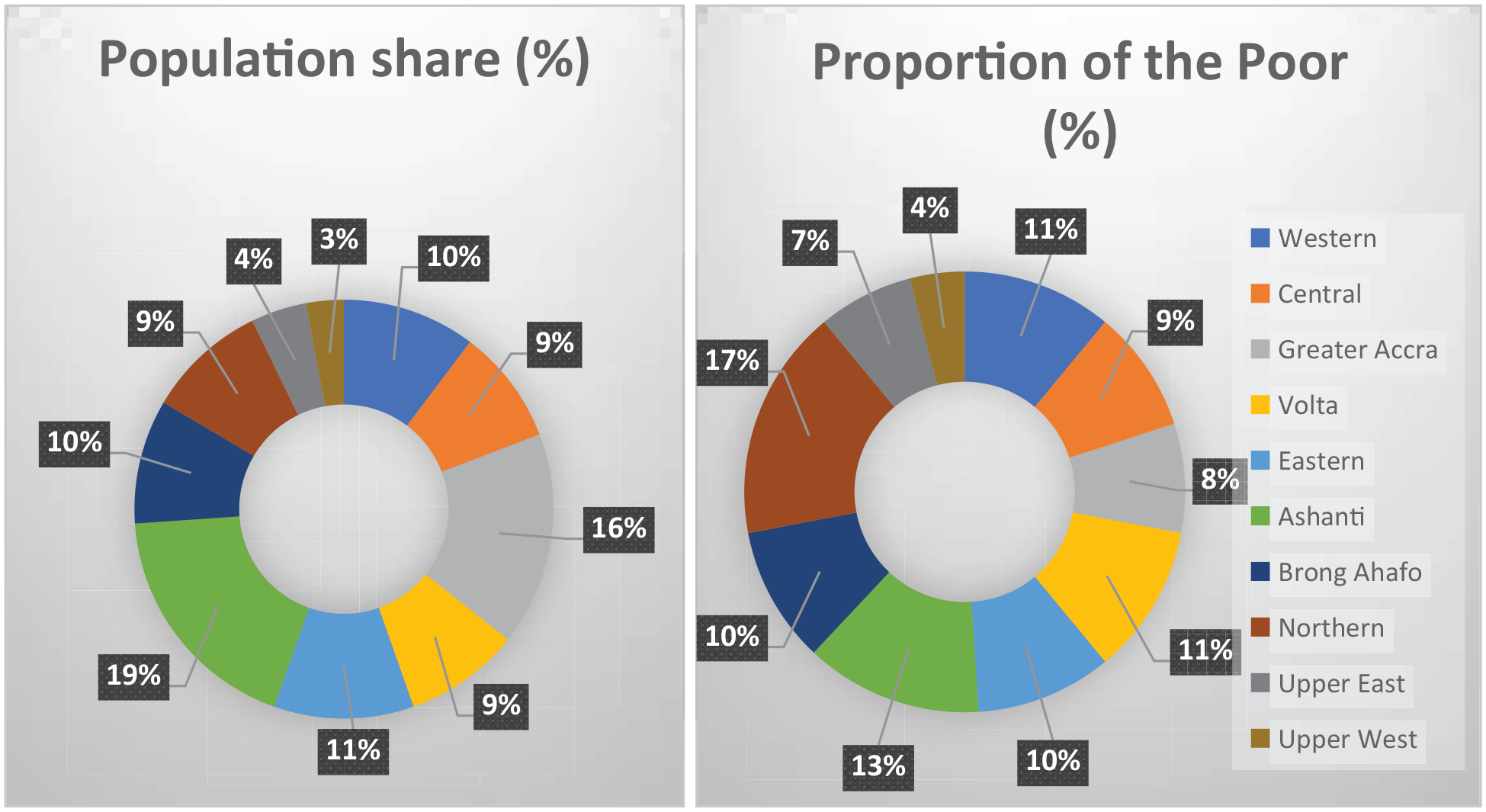
Population share and the composition of the poor in Ghana.
Survey Instrument
Data were collected between June and July 2021. Through an online platform, opinions were collected from 357 respondents from local government officials working within the various districts across the northern parts (Northern, Upper East, and Upper West regions) of Ghana. The questionnaire intended to seek views from the selected population about the impact of local economic development policy, local businesses, and local employment on poverty reduction. The selected items were measured using a 5-point Likert scale with scale parameters starting from one (1), “Strongly Disagree” to five (5), “Strongly Agree” (Adeniran, 2019).
Questionnaire Design, Data Collection, and Analysis
The questionnaire was created using an online survey tool (google forms). The study’s language choice, English, was purely based on the questionnaire being designed to be administered online to respondents who have had some formal education. Respondents were assured of the confidentiality of their responses before they began answering the questionnaire. They were also informed that their involvement in responding to the questionnaire was voluntary and not legally obliged to partake in the survey. The researchers’ contact information was also available for the respondents to contact directly if they needed clarification concerning the questionnaire administered.
Three hundred fifty-seven (357) responses were retrieved and extracted from the online platform into an excel spreadsheet for easy access and cleaning. However, only 300 accurate responses were used in the data analysis. The remaining 57 were discarded due to partial responses or missing values. Thus, the total response rate was 84% which was higher enough for the analysis to be carried out. In structural equation modeling (SEM), 200 is considered an adequate sample size, while 300 sample sizes are suitable statistically (Sharma et al., 2019). So, our sample size of 300 was statistically good for the analysis. The questionnaire on poverty was adapted from (Laura, 1998), whereas the questionnaire on LED was adapted from Fordfoundation Institute (2013). The questionnaire on local business and local employment was adapted from Williams and Cowling (2009) and ILOSTATS, Ghana Statistical Service (2017). IBM SPSS version 23.0 was used to extract values for the descriptive statistics. Following a two-stage approach, a Partial Least Square (SmartPLS) analysis tool was used to analyze the measurement and structural models. A check on data normality was performed since Structural Equation Modeling (SEM) does not allow for data to violate the condition of normality.
Measurement Instruments
Table 1 presents the individual constructs, the number of items measured, their notations, and literature sources.
Measurement of Variables.

Note. LB = local business; LE = local employment; PR = poverty reduction; LED = local economic development.
Results
Descriptive Statistics
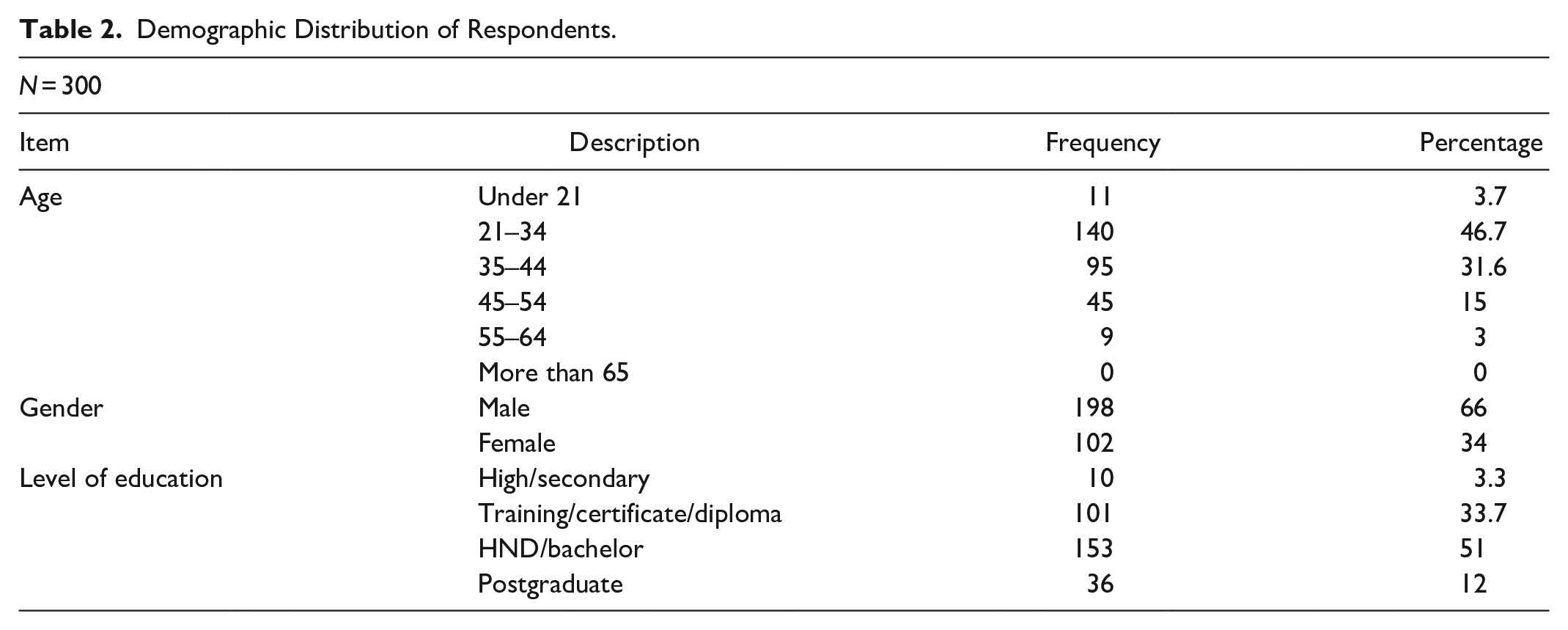
Table 2 presents the demographic characteristics of the respondents. Beginning with the gender distribution, male respondents represented 66%, whiles the remaining 34% represented female respondents. With the age distribution, 3.7% of the total respondents represent the ages under 21 years, 46.7% represent the ages between 21 and 34 years, 31.6% represent ages between 35 and 44, 15% represent the age range between 45 and 54, 3% represents the ages between 55 and 64. No respondent was above the age of 65 years. The age distribution revealed that most respondents are young people in the active labor age range. In terms of education, 51% of the total respondents had attained HND/Bachelor’s degree, representing the majority, whereas the minority of the respondents representing 3.3%, had attained High/secondary school education.
Demographic Distribution of Respondents.
Assessment of the Measurement Model—Preliminary Tests: Construct Reliability and Validity
The measurement model analysis included internal consistency and reliability tests of the data obtained for this research. These tests encompassed average variance extracted (AVE), Cronbach α, composite reliability (CR), and collinearity statistics (VIF) test. The validity test combined the criteria for the Fornell-Larcker and Heterotrait-Monotrait ratio (HTMT).
Table 3 illustrates the results of the tests for internal consistency reliability. The factor loadings, average variance extracted, Cronbach α and composite reliability values of the latent constructs were determined. This assessment forms part of the preliminary tests to check for the reliability of the measurement model. According to Hair (2021) and Hooper et al. (2008), the estimated minimum thresholds accepted for factor loadings = 0.6, for Cronbach α = .70, CR = .60, and AVE = .50. So, from Table 3, it can be seen that the factor loadings for the dependent variable, poverty reduction, are between the range 0.742 and 0.816; for the independent variables, LED policy, values stretched from 0.755 to 0.813, local business, values were between 0.787 and 0.848, and last but not least, local employment, also met the required estimated threshold value with figures ranging from 0.791 to 0.909. Figure 3 also depicts the factor loadings for each construct.
Construct Reliability.

Note. LB = local business; LE = local employment; PR = poverty reduction; LP = local economic development policy; CR = composite reliability; AVE = average variance extracted.
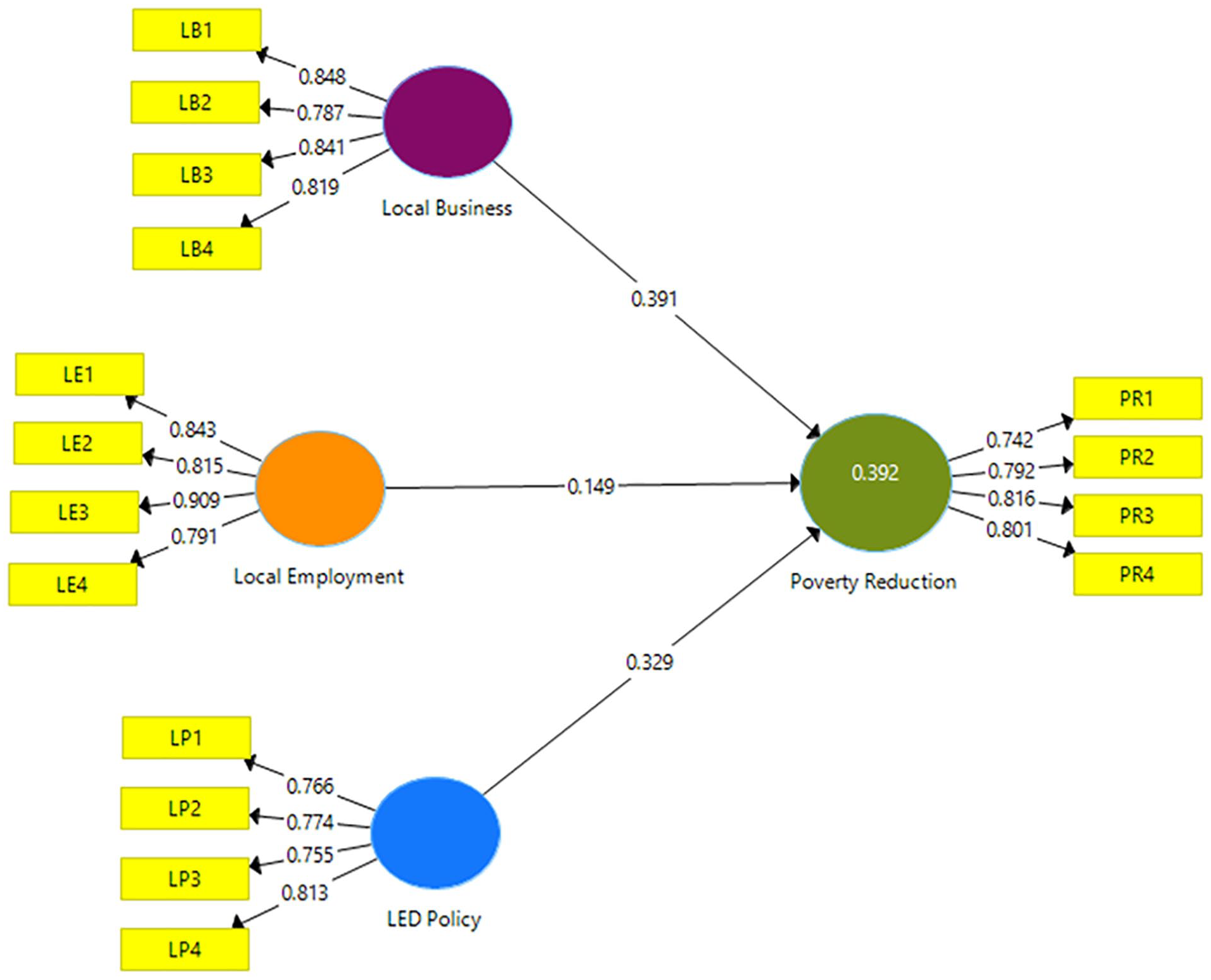
Result of the direct relationships.
With regards to the AVE, poverty reduction had a value of 0.621, LED policy had a value of 0.604, local business had an AVE value of .676 whereas, local employment had 0.707 (see Table 3). All of the constructs satisfied AVE’s minimum needed value of .50 proposed by Hooper et al. (2008). The Cronbach α values of all the constructs scaled between .783 and .862, with local employment having the highest value. Last, the composite reliability of all the constructs was assessed, and the obtained values were within .859 and .906, with local employment bearing the highest value. The HTMT values in Table 3, which measure the confidence interval do not include one, as suggested by (Hair et al., 2011). The internal consistency and reliability tests were successful, and the measurement model was found to be accurate enough to measure the structural model according to the minimum threshold criteria suggested by (Hair et al., 2011; Hooper et al., 2008).
Collinearity Statistics (VIF) Test
Table 4 presents the VIF assessment, which is the collinearity values of the various constructs. Johnston et al. (2018) posited that the collinearity technique evaluates the relationship between an endogenous variable and exogenous variables. Several researchers, including Grewal et al. (2004), contended that a collinearity issue between latent variables might arise when the sample size utilized for the study is small. On the other hand, perfect collinearity might occur when the study variables have similar linear characteristics (Dormann et al., 2013). A collinearity issue exists in a model if the VIF values are more than five, according to Kim (2019). In contrast, the model has collinearity issues when the variance inflation factor values are less than five. According to the results of the VIF evaluation in Table 4, values lesser than 5 were found, indicating that the model used in this study does not suffer from collinearity, supporting those of Ahakwa et al. (2021b, 2021c), Chen et al. (2022), and Odai et al. (2021).
Collinearity Statistics (VIF): Outer VIF Values.

Note. VIF = variance inflation factor; LB = local business; LE = local employment; PR = poverty reduction; LP = local economic development policy.
Discriminant Validity Test
All the constructs are subjected to a discriminant validity test to determine the extent to which they do not reproduce themselves in the model’s analysis. Two different criteria are combined to evaluate the model’s discriminant validity, thus Fornell-Larcker’s and the Heterotrait-Monotrait Ratio (HTMT) proposed by Henseler et al. (2015).
Henseler et al. (2015) refuted Fornell- Larcker’s criterion for reporting discriminant validity because it is insufficient to establish discriminate validity amid variables in standard research. As a result, the researchers introduced the Heterotrait-Monotrait (HTMT) ratio. The HTMT is suggested to be adequate to test for the discriminant validity of research variables. In this research, the two criteria were employed to measure the discriminant validity of the variables because we wanted to ensure the research variables were adequately valid. Table 5 demonstrates Fornell-Larcker’s criterion, whereas Table 6 depicts Henseler’s HTMT criterion. The results from both assessments indicate that there was no issue with discriminant validity for both criteria as they all met the thresholds values of 0.85 for HTMT as well as AVE square root values greater than the correlation coefficient for the Fornell-Larcker criterion (Fornell & Larcker, 1981; Henseler et al., 2015).
Fornell-Larcker Criterion.

Note. LED = local economic development).
Values on the diagonal (bolded) are the AVE’s square root, while the off diagonals are correlations.
Heterotrait-Monotrait Ratio (HTMT).

Note. LED = local economic development.
Shaded boxes are the standard reporting format for the HTMT procedure.
Assessment of the Structural Model
Direct relationship, mediation, and moderation analysis were performed by employing Hair Jr (2021)’s bootstrapping technique. We assessed the R2, path coefficient (β), corresponding t-statistics, and p-values of the model through this technique. In addition, the predictive relevance, thus, (Q²) and the effect sizes (f2) were performed to establish the relevancy of the research model, as suggested by Hair (2021). The last part of the analysis presented the results of the PLSpredict values, also recommended by Shmueli et al. (2019), to assess the predictive error degree in the model.
The SEM-PLS direct estimation model for the direct relationship
Table 7 presents the model’s path coefficients, p-values, and t-statistics for the direct relationships. Figure 3 equally presents the various paths coefficients of the variables. From the Table 7, local business had a significant positive effect on poverty reduction with a path coefficient (β) = .391, t-statistics = 8.144, and p = .000 and <.01 therefore, H1 is supported. Also, local employment has a significant positive effect on poverty reduction with (β) = .149, t-statistics = 3.264, and p = .001 and <.01, therefore H2 is supported.
Testing for the Direct Relationships.

Means 1% significance level.
Testing for the mediation role of local employment
Table 8 presents the model’s mediation path coefficients, p-values, and t-statistics. Figure 4 also depicts the paths coefficient along the various paths of the mediation model. From the Table 8, it can be seen that, local business had an insignificant effect on local employment with (β) = .048, t-statistics = 0.766, and p = .444 and <.05 and does not support the H3. In the mediation effect, local employment insignificantly mediates the relationship between local business and poverty reduction with (β) = .010, t-statistics = 0.725, and p = .469 and <.05 where the critical t-value is 1.96 and thus, H4 not supported.
Mediation Effect.


Result of the mediation analysis.

Result of the moderation analysis.
Testing for moderation role of LED policy
The moderation role of LED policy between local business and poverty reduction is significant, with path coefficient (β) = .096, t-statistics = 2.108, and p = .036 at a significant level of p < .05 (see Table 9). Also, LED policy insignificantly moderated the relationship between local employment and poverty reduction at (β) = .056, t-statistics = 1.085, and p = .278 at significant level of p < .05 (see Figure 5). In assessing the overall R2 of the model, local business, local employment, and LED policy explained 40.5% of the total variance in poverty reduction; thus, R2 = .405 is greater than the minimum value of .26 suggested by Cohen (1988, see Table 9). This means the overall model of the research was substantive, thus resulting in robust results, collaborating with those of Ahakwa et al. (2021a, 2021d) and Quagraine et al. (2021). According to Korankye et al. (2021) and Ying et al. (2021), a Q2 value more than 0 means the research model is higher in its predictive relevance. From Table 9, we obtained a Q2 value of 0.230, which suggests high predictive relevance of our research model.
Moderation Effect.

Suggests 5% significant level.
Simple slope analysis for moderation effect
Figure 6 depicts the slope analysis of the moderation effect of LED policy on local business and poverty reduction. The x value is the high and low limits of the independent variables. According to Hair (2021), R 2 values must range from 0 to 1, which is a percentage measure of how good a model plotted is. The R2 value of 1 means the model is 100% accurate and thus close to the points used in plotting the graph. From Figure 6, it can be seen that when the LED policy is high, the linear relationship between local business and poverty reduction increases. The finding shows that LED policy strengthens the positive relationship between local business and poverty reduction, supporting the moderation results.

The main moderation effect of LP on LB and PR.
From Figure 7, it can be seen that, at a high LED policy, the linear relationship between local employment and poverty reduction increases. However, Table 9 confirms this relationship as immaterial. This implies that the increase or decrease of LED policy does not influence the relationship between local employment and poverty reduction, providing insignificant moderation results.

The main moderation effect of LP on LE and PR.
The Effect Size (f 2)
Effect size measures the exogenous construct on the endogenous construct using the f ² proposed by (Cohen, 1988). Table 10 shows the results of the f2 assessment of the model. The minimum estimates values of 0.02, 0.15, and 0.35 represent Cohen’s weak, medium, and strong coefficients. So, from Table 10, local business to poverty reduction had a medium f2 value of 0.235, local employment to poverty reduction also had a medium f2 value of 0.037, LED policy to poverty reduction had a value of 0.151, which is also a medium. Meanwhile, the moderation role of LED policy between local business, local employment, and poverty reduction recorded weak f2 values of 0.018 and 0.005, respectively. Although weak f2 values are recorded for the moderation assessment, the results cannot be eliminated because those variables are vital to the whole model analysis. Therefore, the overall effect size of the model can be termed as medium (see Table 10).
Effect Size of Exogenous Factors.

Note. LED = local economic development; LB = local business; LE = local employment; PR = poverty reduction.
Assessment of PLSpredict
According to Hair (2021), the PLS prediction evaluates the model’s overall predictive power. Thus, the linear regression model is divided by the manifest variables (LM/MV). Shmueli et al. (2019) suggested that the PLS prediction is the latest method for evaluating a model’s predictive power. It allows assessing a model’s predictive power out of the analyzed samples. To continue with the PLS prediction analysis, a component called the Q2-predict needs to be established first (Shmueli et al., 2019). The researchers proposed that when the Q2-predict values are greater than zero (0), the prediction error of distribution is symmetrical. Therefore, the Root Mean Squared Error (RMSE) values of the MV predictions should be evaluated for the predictive power out of the sample. So, in Table 11, the Q2-predict shows values greater than zero (0), indicating high symmetrically distributed prediction errors; therefore, the RMSE values were used for the assessment.
MV Prediction Summary.

Note. RMSE = root mean squared error; LM = linear regression model; MV = manifest variables; PR = poverty reduction; LE = local employment.
Shmueli et al. (2019) concluded that the model has high predictive power with the MV predictions when all the PLS-SEM values are less than the LM values. Also, when most of the PLS-SEM values are lesser than the LM values, the model has medium predictive power, and finally, when all the values of the PLS-SEM are greater than the LM values, then the model has low predictive power (Shmueli et al., 2019). Table 11 indicates that the predictive power of the overall model is medium. This is because the PLS-SEM values are lesser than the LM values for the majority of the indicators, as established by Shmueli et al. (2019).
Discussion
The structural equation model assessed the connection between the variables based on Tables 7 to 9. In Table 7, the direct relationship between local business and poverty reduction was positive and significant. This finding suggests that an increase in local business results in a corresponding increase in poverty reduction. The result advocates that as people become industrious, their financial resources increase, which reduces their poverty levels. The finding supports that of (Bannor et al., 2021; Geoffrey Deladem et al., 2021), who also found a positive link between local business creation and poverty reduction. However, this finding contradicts Geoffrey Deladem et al. (2021), who found that creating and promoting local businesses at the individual level does not necessarily lead to poverty reduction.
Again, Table 7 shows a positive and significant relationship between local employment and poverty reduction. This result suggests that the upscale of local employment can lead to an increase in poverty reduction. The result is not astonishing because the thriving of every economy depends on the purchasing abilities of its citizens. If more employment avenues are created, more people will earn wages and salaries, which are the absolute way for the ordinary masses to survive. As this happens, living standards increase, reflecting positively in their poverty reduction levels. This finding supports that of Zulher and Ratnasih (2021), Zhang et al. (2021), and Krishna (2020), who found that local employment creation leads to poverty reduction. Nonetheless, this finding refutes that of Ravallion (2019) and Osabohien et al. (2020), who found that local employment creation does not have a positive link with poverty reduction.
Another finding in Table 8 shows that local business has an insignificant relationship with local employment. This means that the increase or decrease in local business has no material effect on local employment creation. This suggests that when more businesses are created and promoted, it does not necessarily reflect an increase in the employment rate in the economy. This outcome is not surprising because local business creation is usually left in the hands of individuals with little resources and sometimes no external support to expand their businesses and create employment avenues for others. This result supports Rita and Laosebikan (2021) and Danson et al. (2021), who also found that local businesses creation does not significantly impact employment creation. On the other hand, this outcome contradicts the findings of Herman (2012) and Wang (2013), whose research outcomes show a positive and significant relationship between local business and local employment creation.
The mediation role of local employment between local business and poverty reduction in Table 8 was insignificant. This result suggests that employment creation does not affect local business, nor does it affect poverty reduction. This outcome is realized because the results obtained between local business and local employment creation were insignificant, thus, causing this outcome. This could mean that the provision of local employment does not necessarily lead to local businesses promotion and poverty reduction. The result opposes the research conducted by Werhane (2009) and Gehrke and Hartwig (2018), who found that employment creation increases local business creation, which in turn leads to poverty reduction.
The moderation role of LED policy between local business and poverty reduction was also significant in Table 9. This result suggests that the increase in LED policy causes a rise in local business and poverty reduction. The outcome is a positive move towards the role LED policy plays in local economic development. As stipulated by development actors, the main aim of the LED policy is to stimulate the local business industry towards poverty reduction and economic growth. This result agrees with Belas et al. (2019), Azunu and Mensah (2019), Mensah et al. (2017), and Rogerson and Rogerson (2012), who believe that LED policy serves as a channel through which local businesses can thrive for community poverty reduction to be achieved.
Again, the moderation role of LED policy between local employment creation and poverty reduction was insignificant in Table 9. This result means that an increase or fall in LED policy does not directly affect local employment and poverty reduction. The outcome can hold because institutions like the Ghana Regional Appropriate Technology Industrial Service (GRATIS), whose main aim is to promote rural industry development through entrepreneurship and jobs creation, have failed over the years posited by Azunu & Mensah (2019) and Mensah et al. (2019). This outcome agrees with Azunu and Mensah (2019) and Mensah et al. (2019) also found the same outcome. Furthermore, the result contrasts with Varol (2010) and Helmsing (2001), who believe that LED policy can lead to local employment creation, reducing poverty in the long run.
Conclusion and Policy Recommendations
The study investigated the nexus between local business promotion, local employment creation and poverty reduction in the northern part of Ghana, employing the moderating role of the LED policy. The northern parts of Ghana were specifically selected for the study because of the prevalent poverty rates recorded anytime the living standard surveys are conducted across the country. The research variables were selected because the LED policy’s main aim is to promote local business and employment creation. As a result, the study sought to investigate if the LED policy can indeed stimulate these economic sectors for poverty reduction in the northern parts of Ghana. Data were therefore obtained from local government officials who are responsible for the smooth implementation and evaluation of the LED policy. These respondents were selected because they have in-depth knowledge and information about how the LED policy works and its impact on the Ghanaian economy. The data obtained were analyzed using SPSS version 23 and SmartPLS version 3 to ascertain the study’s results. The analytical procedure was divided into two parts thus, the measurement model and the structural model analysis. The measurement model analysis established the reliability, validity, and normality of the data collected before the structural model’s analysis. The results obtained revealed that local business promotion and employment creation could cause poverty reduction in Ghana. In establishing the indirect link between LED policy strategies, local business, local employment, and poverty reduction, the study’s findings revealed that LED-oriented business policy positively promotes Ghana’s local businesses, as reported by Mensah et al. (2019). The approaches used in this study demonstrate that the findings are reliable and accurate for formulating policy recommendations. As a result, the following recommendations were made:
Local business promotion leads to poverty reduction. Therefore, as a policy recommendation, policies that regulate the local business environment should be made flexible and conducive enough to support startups and existing firms to ensure continuity and longevity for these industry operators. At the same time, policies that regulate foreign companies operating within the economy must be strict and complex to protect the local firms. Also, stakeholders must encourage the use of locally made goods and services to ensure the sustainability of local businesses. This will go a way to increase local economic growth, and as a result, high poverty levels will be reduced.
Local employment creation leads to poverty reduction. As a policy recommendation, local governments must stimulate local employment creation and make it attractive for the younger generation to utilize their skills and capabilities fully. This can serve as a solution to the problem of brain-drain developing countries face. Thus, retention of the active labor force will promote economic growth, leading to the overall goal of poverty reduction among the developing economies.
Local business promotion through local employment creation does not lead to poverty reduction. Over the years, local employment creation has been left in the hands of private individuals who, most often than not, do not have enough resources to expand their businesses. As a result, the local business sector cannot offer employment avenues to help mitigate the unemployment rate in the country. As a policy recommendation, the local government must bring out effective and workable policies that stimulate the local business sector. When this happens, the local business sector will boom, creating employment avenues for the masses who are unemployed or under-employed. As an outcome, high poverty levels will be reduced in the northern parts of Ghana and other developing economies at large.
LED policy stimulates the progress of local businesses and local employment creation, which impacts poverty reduction. As policy recommendations, LED policy formation and implementation procedures should engage all its stakeholders to achieve the core aim of the establishment. It must be a joint effort of several actors; thus, local governments, local communities, business owners and entrepreneurs, and civil society organizations, among others, must collectively work together to promote favorable conditions for the local economy to thrive and reduce poverty in Ghana. Again, the politicization of business and employment opportunities LED policy offers should be minimized so that irrespective of one’s political affiliation, everyone can enjoy equal benefits to achieve a more holistic result in poverty reduction across the various regions of Ghana. It is also recommended that international development agencies who are the main initiators of LED-oriented programs adopt procedures and strategies familiar to the local people to ensure continuity when these external services and supports are withdrawn after program implementation. It is again recommended that; local governments and other stakeholders put proper actions to encourage community participation in the decision-making processes of LED-oriented initiatives.
Limitations of the Study
Even though the study accomplished its goal, there are still some inherent limitations. First, the study collected primary data from local government officials responsible for implementing and evaluating the LED policy and its impact on poverty reduction in northern Ghana. Therefore future studies can retest this study’s model by obtaining data from the local citizens who are directly affected by the LED policy programs to achieve an extensive generalization of the research results. Also, we suggest that future studies could use civil society organizations as a moderator together with variables such as community resources and capabilities mobilization for poverty reduction. Last, this study focused on only the northern parts of Ghana, where poverty is prevalent according to literature, so the findings may not apply to other impoverished areas; therefore, future studies should be conducted in other poverty-hit areas to obtain a generalized result across the country and other developing countries at large.
Footnotes
Authors’ Contributions
EAT, IA, SA, and KAA: Conceptualization, writing-original draft preparation, data curation, formal analysis, investigation, methodology, project administration, software, validation, visualization, writing review, and editing. HC: Supervision, Funding acquisition, investigation, project administration, resource, validation, writing review, and editing. All the authors have read and approved the submission of this article.
Declaration of Conflicting Interests
The author(s) declared no potential conflicts of interest with respect to the research, authorship, and/or publication of this article.
Funding
The author(s) disclosed receipt of the following financial support for the research, authorship, and/or publication of this article: This work is supported by the National Social Science Foundation of China (NSSFC; 18BGL255).
