




Abstract
Studies from developed western societies have shown that the legitimacy of correctional officers is pivotal to incarcerated offenders’ voluntary compliance and deference. However, we are uncertain if such an assertion holds for incarcerated offenders in transitional African correctional settings, such as South Africa. From a cross-sectional survey of participants from selected correctional centers in South Africa (Male = 89.6%; African = 85.1%; Mage = 25 years, SD = 0.81), this paper explores incarcerated offenders’ perception of the legitimacy of correctional officers. Findings indicate that procedural justice, the effectiveness of the correctional officers, gender, and offender citizenship predicted the perception of correctional officers’ legitimacy. The implications of these findings for the effective management of custodial institutions are discussed.
Plain Language Summary
This article aimed to explore the views of incarcerated offenders about the legitimacy of correctional officers in South African correctional centers. To conduct this research, we adopted a survey approach and selected participants from six correctional centers that covers three provinces of South Africa (Gauteng, Free State, and KwaZulu-Natal). Our results show that procedural justice experience of the offenders predicted their perceived legitimacy of correctional officers, more so than other factors. The implications of findings for the effective management of correctional centers in South Africa are explicated.
Introduction
The effective application of correctional rules is determined in part by how incarcerated offenders perceive correctional officers to enforce the rules (Steiner & Wooldredge, 2015). Correctional rules were designed to regulate offenders’ behaviors, and correctional officers, as the custodial authorities’ physical representation, are empowered by the law to enforce those rules (Steiner & Wooldredge, 2015). Judgment about the legitimacy of correctional officers is instrumental to offenders’ compliance with correctional rules (Franke et al., 2010; Meško & Hacin, 2019, Steiner & Wooldredge, 2018). If incarcerated offenders consider correctional officers legitimate, they are more likely to defer to them and comply with correctional rules, ahead of their personal interests (Bello & Matshaba, 2022a, 2023; Steiner & Wooldredge, 2015; Tankebe, 2013). Beyond offenders’ interests, deference to correctional officers and custodial rules is also instrumental to promoting offender well-being, safety, and institutional effectiveness (Bottoms & Tankebe, 2012; Steiner & Wooldredge, 2015).
The importance of the legitimacy of correctional officers to compliance and actualization of correctional goals has attracted significant attention in recent times and evolved to become an interesting area of research (Bello & Matshaba, 2022b; Steiner & Wooldredge, 2009; Steiner & Wooldredge, 2015; Tyler, 2010; Zhao et al., 2020). While research in this area has grown in developed western societies, a significant gap in criminological literature is the paucity of empirical research that assesses incarcerated offenders’ perception of the legitimacy of correctional officers from developing African correctional settings. The sparseness of such research in a transitional African society like South Africa is even more explicit. For instance, studies from the west have consistently found that offenders’ positive perception of the legitimacy of correctional officers predicted voluntary compliance and deference (see Brunton-Smith & McCarthy, 2016; Hacin, 2018; Meško et al., 2017; Reisig & Meško, 2009).
It is unknown whether incarcerated offenders see correctional officers as legitimate and worthy of being deferred to in the South African correctional context. We are also unsure of what shapes the perception of incarcerated offenders in their regular encounters with correctional officers in South African correctional centers. Considering the different correctional environments, in a country like South Africa, it is important to assess whether findings on perception research in the West can be generalized to the South African correctional context.
In recent years, South Africa has witnessed frequent clashes between correctional officers and offenders in correctional centers. Most of these clashes have emanated from rule-breaking, and the use of excessive force, complaints, or protests over dissatisfaction with services, perceived corruption, and abuse, to mention a few (see Postman, 2020). These clashes have often turned violent resulting in several unwarranted fatalities and attracting wide condemnation from relevant stakeholders (see Postman, 2020). Beyond the condemnations, these issues raise concerns about how incarcerated offenders see correctional officers. Whether they will see correctional officers as legitimate authorities vested with the powers to enforce correctional rules and deserving of their deference, is an empirical puzzle this study intends to solve.
This study is therefore important in helping correctional managers, policymakers, or academics understand the dynamics of corrections and the roles played by correctional officers in offender behavioral transformation. It is also important that as academics we be acquainted with the perceptions or views of incarcerated offenders about the legitimacy of correctional officers, and how their views could influence their conduct, compliance, and cooperation throughout their incarceration cycle.
To the awareness of the authors of this current study, there is no known empirical research that has assessed incarcerated offenders’ perception of the legitimacy of correctional officers in South Africa. This study, therefore, constitutes the first attempt to empirically assess incarcerated offenders’ perception of the legitimacy of correctional officers in South Africa. The purpose is to provide information that transcends from what is barely known to what can be learned, to contribute to the existing body of knowledge on the perception of legitimacy in correctional settings, particularly from a transitional African correctional setting perspective. Of utmost importance is how perceptions of correctional officers shape incarcerated offenders’ consideration of South African correctional officers as legitimate authorities worthy of being obeyed and deferred to.
Correctional Officers’ Legitimacy
The importance of correctional officers’ legitimacy to offenders’ compliance and cooperation is an important area of research considering the regular contact between offenders and correctional officers (Bello & Matshaba, 2023; Franke et al., 2010; Hacin, 2018). Aptly defined by Sunshine and Tyler (2003) as the “property of an authority or institution that leads people to feel that that authority or institution is entitled to be deferred to and obeyed.” (p. 514), legitimacy is critical to the effectiveness of legal institutions. Where the legitimacy of a correctional institution or correctional officer is lacking, offenders may decide to disregard institutional rules and resort to self-help. The legitimacy of correctional officers, therefore, is what nurtures in offenders the belief that correctional officers are authority figures and should be obeyed and respected (Bello & Matshaba, 2022a; Bottoms & Tankebe, 2012; Steiner & Wooldredge, 2015; Tankebe, 2013; Tyler, 2006). Research maintains that the perceived legitimacy of correctional officers is critical for order and safety in corrections (Bello & Matshaba, 2023; Hacin & Meško, 2018).
Incarceration imposes some physical and structural constraints on offenders who need to adjust and adapt to carceral life (Crewe, 2012). Offenders’ perception of the legitimacy of correctional officers plays a significant role in their overall adaption (Brunton-Smith & McCarthy, 2016; Meško & Hacin, 2019; Zhao et al., 2020). Such perception has also been found to be instrumental to the reduction of misconduct in corrections (Meško & Hacin, 2020), as well as fostering healthy relationships between correctional officers and incarcerated offenders (see Hacin & Meško, 2018; Tyler et al., 2008). Strain relationships between the two groups have been reported to increase the social distance in the corrections (Meško & Hacin, 2019). The perception of correctional officers by offenders as legitimate power-holders has been found to have a significant positive effect in reducing the social distance between them (Meško & Hacin, 2019).
Correctional officers’ legitimacy is motivated by two broad factors: normative and instrumental factors (Bottoms & Tankebe, 2012; Tyler, 2006). While the normative factors are rooted in standardized expectations, instrumental factors consider performance (i.e., effectiveness), distributive justice, and risk of sanctioning (Murphy & Cherney, 2011). These two broad factors are drawn from Tyler’s process-based model of regulation—a dominant model often adopted in explaining how legal authorities secure peoples’ deference and cooperation in literature (see Sunshine & Tyler, 2003).
A key normative factor of legitimacy is procedural justice. Procedural justice is the judgment people form based on “the fairness of the processes through which legal authority make decisions and exercise authority” (Sunshine & Tyler, 2003, p. 514). Tyler and his colleague found that perceptions of legitimacy mediate the relationship between people’s perceptions of procedural justice and outcome variables, such as self-reported voluntary compliance with regulations and self-reported willingness to cooperate with an authority figure (Sunshine & Tyler, 2003, pp. 527, 528). Additionally, they declared “no direct effects on cooperation for procedural justice when legitimacy was not in the equation. In other words, the influence of [procedural justice] flows through legitimacy” (Sunshine & Tyler, 2003, p. 527).
Scholars have averred that it is possible to achieve a certain degree of internal legitimacy in corrections through fair and respectful attitudes toward incarcerated offenders (Hacin & Meško, 2018; Steiner & Wooldredge, 2015; also see Sparks et al., 1996). That is, incarcerated offenders will likely acquiesce to custodial regulations and defer to correctional officers when they perceive the procedures used by the officers in dealing with them as fair (Campbell et al., 2020). However, the arbitrariness or unfairness of correctional officers when exercising their authority would lead to defiance, alienation, and noncompliance by incarcerated offenders (Beijersbergen et al., 2015; Sunshine & Tyler, 2003).
Propounding the procedural justice theory, Thibaut and Walker (1975) identified two basic features of procedural justice that influence satisfaction with legal authority’s decision-making processes and the outcome of decisions. In corrections, offenders’ satisfaction with correctional officers is influenced by both the perceived legitimacy of the officers and the fairness of the treatment they received from them (procedural justice; Hacin & Meško, 2018; Steiner & Wooldredge, 2018). That is, correctional officers’ treatment of offenders during their routine encounters related to rule violations could influence inmates’ perceptions of the legitimacy of correctional officers and the rules they enforce (Barkworth & Murphy, 2021; Liebling, 2004; Steiner & Wooldredge, 2015). Unfortunately, procedural justice research has only received a sporadic assessment from a South African correctional setting.
Besides procedural justice (a subset of normative factors), instrumental factors also play a significant role in shaping offenders’ perception of correctional officers’ legitimacy. Instrumental factors specify that people’s decision to defer to legal authorities is associated with their evaluation of the performance or effectiveness of such authority, as well as their judgements of distributive justice and risk of sanctions (see Sunshine & Tyler, 2003). In the institutional correctional context, it implies that correctional officers will gain acceptance and deference when they are viewed by incarcerated offenders as (1) effective (in terms of their performance), (2) creating credible sanctioning threats to rule breakers (risk of sanctions), and (3) fairness in the distribution of services (distributive fairness; see Sunshine & Tyler, 2003). When these factors increase or improve, legitimacy will be enhanced and sustained, but a decrease will undermine it (Sunshine & Tyler, 2003).
Beyond the above instrumental factors, corruption remains endemic in correctional centers. Order, cooperation, and compliance in corrections do not occur in a vacuum. They require some degree of compromise. The asymmetric power relations between correctional officers and offenders often create a dynamic order that accommodates conflict between the two groups, as well as fosters some compromises (i.e., a give and take) needed to enjoy relative order in the facility (Goldsmith et al., 2018). These compromises (or concessions) are sometimes rooted in corruption, which sometimes manifest in the form of trafficking of contraband into correctional centers, assaults, excessive use of force, and misuse of offender information, to mention a few. These factors account for the reasons correctional officers sometimes turn a blind eye to certain breaches within correctional centers (Goldsmith et al., 2018). Although corruption is illegal in the corrections, we contend that it is a key instrumental factor that could shape offenders’ judgment of the legitimacy of correctional officers. Corruption has been reported to have a negative effect on offender perception of the legitimacy of correctional officers (Symkovych, 2018).
Demographic variables, such as offenders’ age, gender, race, nationality, and length of sentencing, amongst others, have also been found to shape offenders’ perceived legitimacy of correctional officers (Brunton-Smith & McCarthy, 2016; Reisig & Meško, 2009; Steiner & Wooldredge, 2018). For instance, from a perception study conducted in England and Wales, Brunton-Smith and McCarthy (2016) found lower levels of legitimacy perception amongst black, Asian, and minority ethnic prisoners. A similar result was also reported by Jackson et al. (2010). Older incarcerated offenders were also reported to have more favorable views of correctional officers’ legitimacy (Brunton-Smith & McCarthy, 2016). Research has also shown a relationship between offenders’ educational level and the perceived legitimacy of correctional officers (Brunton-Smith & McCarthy, 2016; Franke et al., 2010). Educational level was found to be positively related to offenders’ perceived legitimacy of correctional officers (Brunton-Smith & McCarthy, 2016). Offense classification and sentence classification have also been reported to shape offender compliance and by extension their perceived legitimacy of correctional officers (Campbell et al., 2020; Reisig & Meško, 2009; Steiner & Wooldredge, 2018).
Institutional Corrections in South Africa
The history of institutional corrections in South Africa dates to the apartheid era. The goal of corrections at that time was punishment, and incidences of inmate abuse and brutality were common. Although several reforms have been introduced to the custodial institutions in the post-apartheid era, including the changing of the institutional name from the prisons to correctional services, there are still some structural and institutional practices akin to the experiences of the past. Hence, there is a reason to believe that the notion of legitimacy and procedural justice would be viewed differently by the current set of incarcerated offenders.
In the current post-apartheid democratic era, correctional centers in South Africa have continued to witness some form of violence, especially between correctional officers and offenders (see The Judicial Inspectorate for Correctional Services [JICS, 2021]). These incidents were often instigated by clashes between the two groups owing to maltreatment and other forms of misconduct by correctional officers (Bruce, 2019; Geldenhuys, 2017). From the JICS record, a total of 335 complaints were received from correctional centers across the country (JICS, 2021). Most of these complaints bother on maltreatment, corruption, assaults, torture, and health-related issues (see JICS, 2021). These incidents may impact negatively on the relationship between the two groups and limit the possibility for offenders’ consideration of correctional officers as deserving of their deference (see The Judicial Inspectorate for Correctional Services (JICS), 2021). Likewise, offenders’ ratings of the distributive fairness and effectiveness of correctional officers will likely be poor (Maguire et al., 2021; see Figure 1).

Model showing the linkages between the concepts.
The current study aimed to explore incarcerated offenders’ perception of correctional officers’ legitimacy in South Africa. It sought to test two main hypotheses:
Perceived procedural justice (or fairness) and effectiveness predict the perception of correctional officers’ legitimacy.
Perceived procedural justice predicts correctional officers’ legitimacy more so than their effectiveness.
The study also attempted to test the effect of distributive justice, officers’ corruption, and some demographic variables on perceived legitimacy. This research extends the scope of legitimacy research, especially from a transitional African correctional setting.
Method
Research Site and Participants
This study adopted a quantitative approach. Data were collected between 2020 and 2022, through a cross-sectional survey of participants from six (6) Correctional Centers in three provinces of South Africa (i.e., Gauteng, Free State, and Northern Cape). These centers include: Boksburg, Zonderwater, Kroonstad Medium A, Kroonstad Medium B, Kroonstad Female correctional centers, and Kimberley). From the total population of incarcerated offenders in these six correctional centers, we surveyed a sample of 570 participants. Although a combination of simple random and convenience sampling was adopted, purpose sampling was the dominant approach. While a simple random technique was adopted at the latter stage of data collection in 2022, convenience sampling was inevitable during the early stage (in 2020) owing to the effect of the COVID-19 pandemic. Following the declaration of a national state of disaster, South Africa’s President (Cyril Ramaphosa) declared a national lockdown to curb the spread of COVID-19 that ravaged the country at that time, including correctional centers. Strict measures were also put in place by the authorities of the DCS to limit access to the offenders. Nevertheless, we were granted access based on strict protocols and agreement to ensure social distance is maintained during the duration of our survey in 2020. A combination of health concerns, the need to maintain social distance, time constraints, and other risk factors, made convenience sampling the most viable option at that time. Regardless, we were able to secure a representative sample of 570 participants that mirror the demographic diversity of incarcerated offenders in the centers selected for the survey.
Procedure
Prior to data collection, the authors had formally contacted and secured authorization from the Department of Correctional Services for the survey. This was followed by notifications of survey days, time, and duration. On scheduled survey days, participants were briefed about our study, and those willing to participate went to the designated halls while adhering to safety protocols and social distancing. Before questionnaires were administered, the authors reiterated the aim of the study and ethical issues to the participants. Thereafter, with the support of research two assistants, we distributed consent forms to those who volunteered to participate in the survey. After the retrieval of the completed consent forms, we distributed a total of 700 hard-copy questionnaires. Out of a total of 700 distributed questionnaires, we were able to retrieve 570 completed questionnaires. The outstanding questionnaires were either improperly completed or returned from voluntary withdrawal. The study was conducted in line with the University of South Africa, College of Law Ethical Committee stipulated guidelines in Protocol (ERC Reference No.: ST30-2021). The demographic composition structure of the study participants is presented below in Table 1.
Demographic Composition Structure of the Sample.

Measures
Measures used for this study were adapted from previous studies—from related police science research and corrections, to assess five constructs reputed to shape the perception of correctional officers’ legitimacy (see Bottoms & Tankebe, 2012; Meško & Hacin, 2019; Murphy & Cherney, 2011; Steiner & Wooldredge, 2018; Sunshine & Tyler, 2003). These measures include procedural justice, distributive justice, risk of sanctions, effectiveness (performance), and corruption. While correctional officers’ legitimacy is the dependent (outcome) variable, the other five constructs are independent (predictor) variables. Previous research has shown that offenders’ perceptions of the legitimacy of correctional officers are shaped by the assessment of the procedural justice /fairness of correctional officers, distributive fairness, risk of sanctioning, effectiveness, and corruption (Bottoms & Tankebe, 2012; Reisig & Meško, 2009; Ryan & Bergin, 2022; Steiner & Wooldredge, 2018). All instruments were measured on a 4-point Likert-type scale ranging from 1 = strongly disagree to 4 = strongly agree, or 1 = extremely unlikely to 4 = extremely likely. A high score on the scale indicates a greater perception of the measure.
Correctional Officers’ Legitimacy
This scale was operationalized using a 5-item reputed to assess the extent to which legitimacy is determined. Specifically, the measure assessed participants’ views on their willingness to obey and defer to correctional officers. Questions under this scale include: “It is wrong to disobey Correctional officers, even when you think you can get away with it,” and “You should do what Correctional officers tell you to do even if you disagree,” etc. The Cronbach’s alpha was α = .76; M = 2.77; SD = 0.60. A moderate score on this scale indicates a moderate perception of legitimacy.
Procedural Justice
Procedural justice was measured using a 6-item scale adapted from previous studies (see Bottoms & Tankebe, 2012; Campbell et al., 2020; Sunshine & Tyler, 2003), reputed to assess the fairness of correctional officers. Items under this scale include: “Correctional officers treat inmates fairly,”“Correctional officers are courteous to inmates,”“Correctional officers explain their decisions to inmates before taking decisions,” etc. The Cronbach’s alpha was α = .88; M = 2.36; SD = 0.67. A high score on this scale indicates correctional officers adopted fair procedures in their interactions with offenders.
Distributive Justice
This scale was designed to assess the fairness of correctional officers in providing equitable services to all inmates. It was operationalized using a 2-item scale adapted from previous studies (see Campbell et al, 2020; Sunshine & Tyler, 2003). The two items under this scale are: “Correctional officers give some inmates less help than they give others,” and “Correctional officers do not treat all inmates equally.” The Cronbach’s alpha was α = .78; M = 2.45; SD = 1.00. A high score on this scale indicates that correctional officers render services equally and fairly.
Risk of Sanctions
Risk of sanctions was operationalized using a 4-item scale adapted from previous research (see Maguire et al, 2021; Sunshine & Tyler, 2003). Items in this scale were designed to measure participants’ views on the availability of credible sanctioning threats to rule-breaking within the facility. The Cronbach’s alpha was α = .88; M = 3.53; SD = 0.68. A high score on this scale indicates the availability of credible sanctioning threats.
Performance/Effectiveness
Institutional Performance (effectiveness) of correctional authority was operationalized using a 3-item scale. It was specifically designed to measure participants’ assessment of the performance of correctional authority. Items on this scale include “the DCS has done a good job controlling gang-related problems in correctional centers,”“the DCS has done a good job controlling drug sales in correctional centers,” and “The DCS has done a good controlling job controlling violence in correctional centers.” The Cronbach’s alpha was α = .82; M = 1.47; SD = 0.70. A high score on this scale indicates that correctional officers are effective.
Corruption
Officers’ corruption was designed using a 3-item scale adapted from previous studies (Bottoms & Tankebe, 2012; Liebling, 2011). Items on this scale were designed to assess participants’ views on corrupt practices by correctional officers, and they include “Correctional officers take a bribe,”“Correctional officers are corrupt,” etc. The Cronbach’s alpha was α = .76; M = 2.55; SD = 0.89. A high score indicates that inmates perceive correctional officers as corrupt.
Data Analysis and Results
IBM SPSS Version 28 was utilized for data analysis. To analyze our data, three analyzes were computed (i.e., Mean and Standard Deviation, Correlation, and Hierarchical Regression). Of these three, hierarchical regression analysis was of utmost importance to our research owing to the reliability of the method in identifying the variables that have an impact on a subject matter. Likewise, regression analysis enables us to use more than two independent variables, it helps to determine the impartial relationship between two or more variables by controlling for the effects of other variables.
The mean and standard deviation analysis was conducted to determine the skewness of the scale items. Table 2 shows the wordings of each of the scale items. The results show an overwhelming positive skewness in the scale items. A skewness value that is greater than 1 or less than −1 indicates a highly skewed distribution.
Mean and Standard Deviation for Each Variable Item.

For correlation analysis, we conducted a Pearson bivariate correlation to establish the relationship between the scales. The correlation results in Table 3 showed that correlations between the six constructs were within acceptable limits and did not violate the singularity assumptions. Singularity occurs when one independent variable is a combination of other independent variables (see Pallant, 2010, p. 149). Moreover, the highest correlation value was .53, below the recommended value of .7 (see Pallant, 2010, 158).
The Descriptive Statistics and Correlations.

Correlation was significant at p < .01.
In correlation analysis, multicollinearity exists when the independent variables are highly correlated (see Pallant, 2010, p. 149). Specifically, when r ≥ .9 and above. The results of the current study, however, show that the multicollinearity assumptions were within acceptable limits. This was further confirmed by the Variance Inflation Factor (VIF) results (see Pallant, 2010, 158). A VIF usually reveals the measure of the amount of multicollinearity in regression analysis. The correlation results show that while the perceived legitimacy of correctional officers and perceived procedural justice were significant and positively correlated (r = .35, p < .01), other scales were not significantly correlated with the perceived legitimacy of correctional officers. This implies that offenders who continue to experience or receive fair treatment from correctional officers are likely to defer to correctional officers and consider them legitimate.
Predicting Correctional Officers’ Legitimacy
For the regression, we computed a two-stage hierarchical regression analysis to determine the predictors of correctional officers’ legitimacy in a sample of incarcerated offenders. In stage 1, seven demographic variables (age group, gender, race, highest level of education, offense category, sentence category, and citizenship status) were added to the model. From the results, only citizenship status was a significant predictor of correctional officers’ legitimacy. However, its relationship with legitimacy was negative. This implies that most incarcerated offenders who are citizens are less likely to consider correctional officers worthy of their deference.
In stage 2, citizenship status, procedural justice, and effectiveness or performance were significant predictors of legitimacy. While citizenship status (r = −2.20, p < .01) and effectiveness (r = −.71, p < .01) were negative predictors of legitimacy, procedural justice was positive (r = 6.56, p < .005). This implies that just as most citizens offenders were less likely to defer to correctional officers, those who believed the latter was ineffective in discharging their duties were also less likely to consider them legitimate. However, offenders who held the notion that correctional officers treat them fairly and are procedurally just are more likely to consider correctional officers as legitimate and deserving of their deference (see Table 4).
Correctional Officers’ Legitimacy Model—Using Hierarchical Regression.
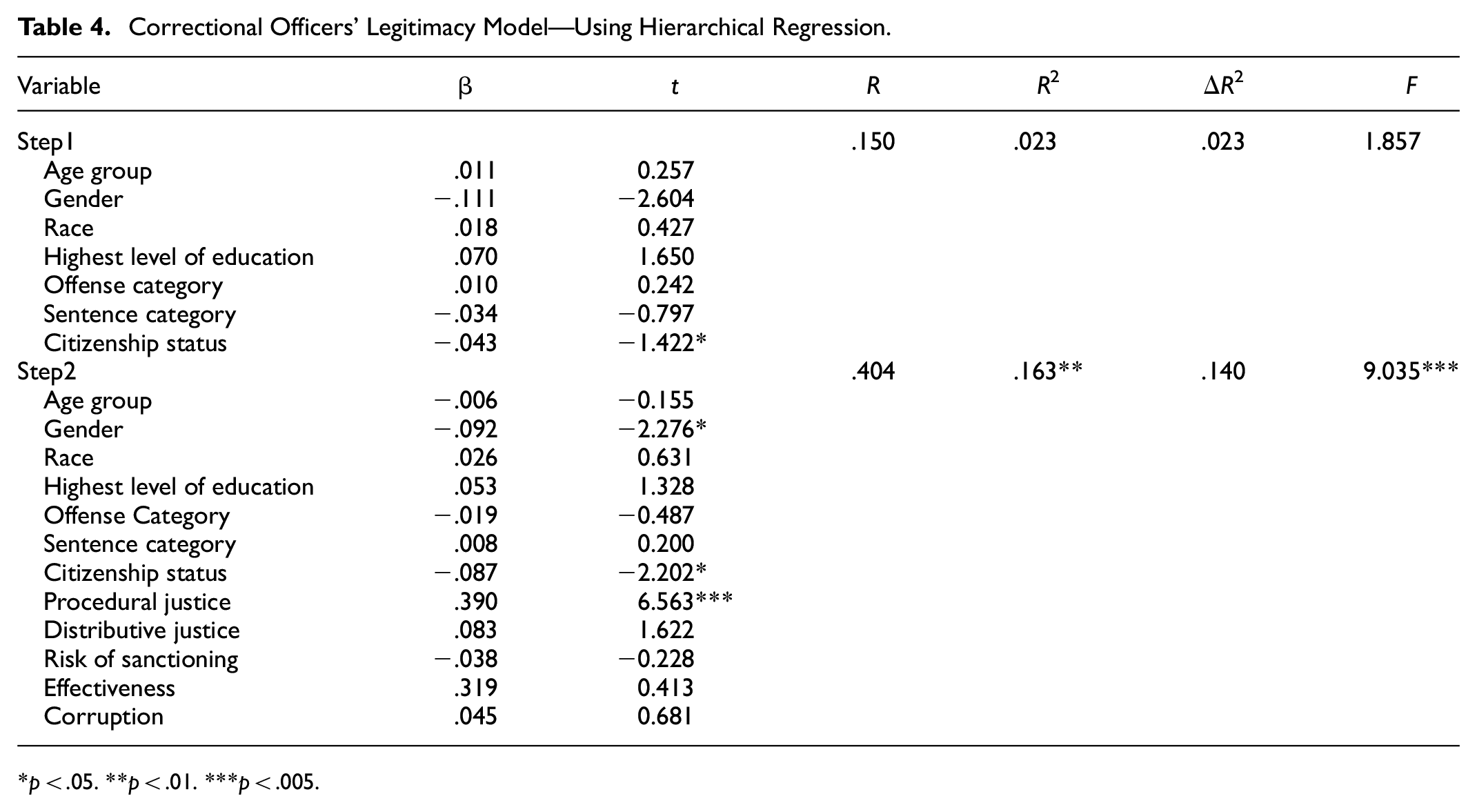
p < .05. **p < .01. ***p < .005.
Discussion
This study aimed to examine the determinant of correctional officers’ legitimacy from a sample of incarcerated offenders in South Africa. We earlier established that previous research from developed western societies found procedural justice as a key normative factor that shapes incarcerated offenders’ perception of the legitimacy of correctional officers (see Campbell et al., 2020; Hacin & Meško, 2018; Steiner & Wooldredge, 2018). We also indicated that we are unsure if similar findings will be recorded if replicated in South Africa.
Our results show that perceived procedural justice predicted the perceived legitimacy of correctional officers. This implies that offenders who experienced or received fair treatment from correctional officers were likely to obey correctional officers and consider them worthy of their deference. This outcome is consistent with previous findings (Meško & Hacin, 2019, Steiner & Wooldredge, 2018). As reported in those studies, procedural justice was also found to be the most significant predictor of the perceived legitimacy of correctional officers in the current study. This points to the value placed on the fairness of treatment incarcerated offenders expect to receive from correctional officers, including the fairness and quality of the decisions they make. When incarcerated offenders are treated fairly, and their views are taken into consideration by correctional officers when making decisions, there is a high possibility that they will voluntarily obey correctional officers and consider them legitimate (Franke et al., 2010; Steiner & Wooldredge, 2018).
The model also displays a significant effect of gender and citizenship status on incarcerated offenders’ perception of correctional officers’ legitimacy. It implies that some demographic factors could play a significant role in shaping offenders’ perceptions of the legitimacy of correctional officers as reported in previous studies (Brunton-Smith & McCarthy, 2016; Steiner & Wooldredge, 2018). Specifically, our findings show that male offenders are less likely to voluntarily obey correctional officers and consider them legitimate. Although these findings may be expected considering the high volume of conflicts between correctional officers and incarcerated male offenders and the increased number of male incarcerations in most correctional centers in the country. Violence between correctional officers and incarcerated offenders is commonplace in most male correctional centers in South Africa (see Postman, 2020). Such frequent conflicts could account for this result. However, this result is also a pointer to the nature of relationships between correctional officers and incarcerated offenders in south African correctional centers. Correctional managers should therefore adopt models that promote mutual respect, trust, and internalized normative feelings in offenders to obey and comply with correctional officers.
Offenders’ citizenship status was tested in this study to determine if it will have any significant effect on the perceived legitimacy of correctional officers. Beyond this, it was included in the demographics against the backdrop of the prevailing, albeit misconceived notion that crime is perpetrated more by foreign nationals than by the citizens of the country. Specifically, the results show that incarcerated offenders who are South African citizens were less likely to consider correctional officers worthy of their deference. Again, this may be unexpected considering the population of incarcerated South African citizens, and the conflicts that often ensue between them and correctional officers.
Unexpectedly, distributive justice, risk of sanctioning, and corruption did not prove to have any significant impact on perceived legitimacy. Some explanations may account for such outcomes. It could imply that unlike the findings in previous research from developed western societies, issues of distributive justice, risk of sanction, and corruption might not be prioritized by incarcerated offenders in South African correctional centers. Likewise, such an outcome could have been driven by frustration on the part of the offenders who might have experienced or witnessed unlawful or sharp practices from the correctional officers. The combination of frustration and helplessness based on the notion that they could be sanctioned if they complain reported or challenged the officers could make them resolve to be indifferent.
Study Limitations and Recommendations for Further Research
The current study is susceptible to limitations. Considering the cross-sectional nature of the work, and the sample size, it will be challenging to make an accurate causal conclusion. Hence, the findings should be considered with caution as it does not represent the perspectives of the whole incarcerated offenders in South African correctional centers. However, such limitations do not undermine the credibility of this study especially the importance of perceived legitimacy in shaping incarcerated compliance in institutional corrections. Future research may adopt a longitudinal approach and consider factors not measured in this study.
Consequentially, correctional managers and policymakers should develop or adopt models from other climes that promote a culture of fairness in correctional centers. A culture that nurtures internalized feelings in inmates to voluntarily obey correctional officers and defer to them. Such a philosophy should also instill in correctional officers an understanding that the reactions they generate from the offenders are partly shaped by the quality of their relationship with the offenders, particularly how they treat them. Rather than use force or other traditional approaches to enforce compliance and maintain order in correctional centers, a normative approach that motivates perceived legitimacy should be embraced and popularized.
Conclusion
This study was conducted to assess offenders’ perception of the legitimacy of correctional officers using data delineated from a cross-sectional survey of participants from six (6) correctional centers, covering three (3) provinces of South Africa. The current findings have significant implications for corrections management in South Africa, particularly the management of the relationship between correctional officers and incarcerated offenders. If the state desires to truly reform the corrections and achieve the purpose for which the institution was established, then factors that will promote procedural justice, and by extension, the legitimacy of correctional officers should be prioritized.
Footnotes
Declaration of Conflicting Interests
The author(s) declared no potential conflicts of interest with respect to the research, authorship, and/or publication of this article.
Funding
The author(s) received no financial support for the research, authorship, and/or publication of this article.

Data Availability Statement
The data and materials used in this study are available upon request. Interested parties can contact the corresponding author for access to the relevant data and materials.