




Abstract
Small and medium-sized enterprises (SMEs) use social media to communicate effectively with stakeholders. However, little is known about the influence wielded by social media adoption on sustainable performance during COVID-19. Based on the technology–organization–environment (TOE) framework, our study developed an integrated model to explore the factors affecting social media adoption and its effect on sustainable performance in SMEs in the Saudi Arabian context. The quantitative method of a survey was used to collect data from SMEs owner-managers and CEOs. Partial least square was used to analyze data collected from 609 respondents. The findings revealed that environmental factors (i.e., the intensity of the competition, competitive pressure, and the bandwagon effect), technological factors (i.e., relative advantages and compatibility), and organizational factors have been the key drivers of social media adoption in SMEs during COVID-19. It also indicated that social media adoption is a key predictor of social, environmental, and economic sustainability. This study provides SMEs with meaningful implications about ways of fostering sustainable performance.
Keywords
Introduction
During the Covid-19 pandemic, small and medium-sized enterprises (SMEs) were severely harmed by the lockdown measures enforced by governments around the world (Al-Adwan & Kokash, 2019; Hu et al., 2023). Although the pandemic has had a significant impact on the supply and demand situations faced by businesses of all sizes, a report by the OECD (2020) claims that small and medium-sized enterprises (SMEs) have suffered more because of their inability to adapt quickly to sudden changes in the environment (Hu et al., 2023; M. A. Kumar & Ayedee, 2021). Furthermore, in relation to large enterprises, SMEs are especially susceptible to external environmental disturbances due to a lack of liquid and non-liquid resources. There has been a worldwide failure of small and medium-sized enterprises (SMEs), and this has been especially notable in emerging nations. Prior research claims that, due to these countries’ heavy reliance on SMEs, Covid-19 has pushed economies to the verge of collapse (Alghamdi, 2023; V. Kumar et al., 2022; Ragazou et al., 2022). More than half of the labor force is employed in the unofficial sector, while small and medium-sized enterprises (SMEs) account for 95% of the private sector and produce 40% of the countries’ GDP (Abed, 2020). For instance, the Central Bank of Jordan (CBJ) has initiated a quantitative easing strategy with a 500 million Jordanian dinar stimulus package in light of the seriousness of the Covid-19 threat to SMEs (Al-Adwan et al., 2020). Nevertheless, small and medium-sized enterprises (SMEs) have been given the chance to experiment with innovative methods of crisis planning, thanks to Covid-19 (Al-Ajlouni, 2021; Alismaili et al., 2020). Thus, digital technologies, especially social media, offer a one-of-a-kind venue for SMEs to connect with consumers and boost their long-term viability. Covid-19 has been lauded for compelling companies to use both traditional and digital distribution methods (Alrousan et al., 2020).
Many studies have looked into the advantages for companies of using social media for and have determined that they outweigh the disadvantages (Basit et al., 2020). Previous examination revealed that 70% of people in the United Arab Emirates (UAE) said they rely on social media for product recommendations before making a purchase (Bertoni, 2020). Some data show that the social media expands audience size via user-generated content and brand interaction (Bhattacharya & Wamba, 2015). Therefore, people think of social networking sites as an online bazaar where they may buy and sell goods and services (Arora & Predmore, 2013). Small and medium-sized enterprises (SMEs) can use the social media to reach customers in new regions without establishing a physical presence there (Bakri, 2017). SMB owners like it since it eliminates the need to worry about such matters as travel time and distance (Batikas et al., 2012). Because of its relevance to SMEs, social media has emerged as a key theme in academic studies of business and entrepreneurship (Beatty et al., 2001).
Prior study indicates that, with their low resources, SMEs might profit greatly from employing alternative business management tools like social media (Beebe et al., 1998). Much earlier research focused on B2C (business-to-consumer) applications of social media. Numerous studies have looked at the effects of social media on various aspects of business, including customer service (Bergeron et al., 2001) advertising (Bilbao-Osorio et al., 2014) market research (Blanchard, 2011) and word-of-mouth advertising (Buonanno et al., 2005). It is surprising that so few researchers have examined the impact of social media use on sustainable performance in the setting of SMEs (Capterra, 2022). Social media’s potential to enhance business management and, more specifically, its effect on company performance has been the subject of only a small number of studies so far (Cassel et al., 1999). Although social media use, its obstacles and metrics, have been the subject of research in the context of SMEs (Biucky & Harandi, 2017), the impact of social media adoption on the long-term success of SMEs in the Middle East, and particularly in Saudi Arabia, remains unclear. Therefore, our study seeks to develop an integrated model that explains the factors affecting social media adoption and its effect on sustainable performance. It also explores the moderating role of COVID-19 on these relationships.
The current competitive situation is characterized by increased unpredictability and quick changes in market-demand, a lack of resources (financial, organizational, and human), and an increase in competition because of globalization (Qalati et al., 2021). Furthermore, some businesses delay adopting and using social media because of a lack of technical skills and trust considerations (Hu et al., 2023), the diversity of its existing forms, and a misunderstanding of how to implement and manage its utilization (M. A. Kumar & Ayedee, 2021). These factors may contribute to the widening gulf between SME adopters and non-adopters in developing economies. Because of its low cost and ease of use, social media can help small and medium-sized enterprises (SMEs) reach many clients. Despite the rise in popularity of social media platforms, many individuals in Saudi Arabia are still wary of sharing personal information online (Abed, 2020). Despite citizens’ lack of trust, government regulation of e-commerce is ubiquitous in Saudi Arabia (Abed, 2020). However, there aren’t enough research on how SMEs in underdeveloped nations like Saudi Arabia use social media. The conditions and the context in which SMEs are affected by social media are gradually becoming the attention of SMEs and industrial marketing researchers (Qalati et al., 2021).
The purpose of this study is to provide a better understanding of the elements that influence the feasibility and efficacy of social media adoption at the small and medium-sized enterprise (SME) level within the context of the technology-organization-environment (TOE) paradigm. According to Qalati et al. (2020), the TOE framework is made up of three different elements: the technological, the organizational, and the environmental. The term “technological construct” is used to describe the organization’s use of both existing and emerging technologies. Organizational theory pertains to the various facets of organizations, such as their structure, size, scope, management hierarchy, and associated problems. The term “environmental” describes the context in which businesses function, including the presence of regulatory bodies, industries, and rivals. Linear models such as the Technology Acceptance Model (TAM) and the Unified Theory of Acceptance and Use of Technology (UTAUT) have been employed in previous research (Erjavec & Manfreda, 2022; Khan et al., 2021), however it has been suggested (Qalati et al., 2020) that these models fail to account for contextual elements such organizational culture. Thus, the TOE has integrated human and non-human characteristics into a single model, giving it an edge over more conventional frameworks like UTAUT and TAM (Qalati et al., 2020). In addition, Chang et al. (2022) stated that SM adoption in SMEs employing framework has received insufficient attention. Moreover, Abed (2020) showed that very little work has been done in the context of Saudi Arabia.
The next section describes the study background and hypotheses development. Conceptual Framework and Hypotheses Development section concerns the research methods, while Methods section contains the study analysis and results. Results section outlines the discussion and implications, while Discussion and Implications section indicates the limitations of the research and some directions for further study.
Research Background
Social Media Adoption in SMEs
Using social media has been shown to improve a company’s bottom line in a number of studies before now (Ahmad et al., 2019). The usage of social media has been found to raise revenue, decrease costs, enhance customer service, expand the company’s reach and brand awareness, increase website traffic, and strengthen B2B partnerships (Hoffman & Fodor, 2010). As a result, many companies view it as a top priority and incorporate it into their day-to-day operations as a matter of course (McCann & Barlow, 2015). However, businesses need to think about why they’re using social media and how they’ll know whether it’s working (Hoffman & Fodor, 2010). Small and medium-sized enterprises (SMEs) who do not utilize social media strategically are less likely to reap its full benefits, according to research by McCann and Barlow (2015). The divide between those who have found social media success and those who haven’t is expanding as a result. As a result, long-term viability for non-adopters is reduced (Dwivedi & Pawsey, 2023).
By using social networking sites (SNSs), social media facilitates the very rapid sharing of ideas, opinions, and other expressions amongst a large group of people (Chiu et al., 2017). Twitter, Facebook, Instagram, LinkedIn, and countless blogging platforms are just a few of the many SNSs that have sprung up over the years (Chong & Olesen, 2017; Dutot & Bergeron, 2016). The resource-based view (RBV) of enterprises, which asserts that a company’s competitive advantage arises from its rare, precious, inimitable, and non-subsumable talents, insists on the importance of SNS for SMEs in the current crisis (Zahra, 2018). It has been shown that SMEs) that were able to deploy SNSs amid lockdown limitations fared better than those that were not, making the RBV of competitive advantage particularly useful during crises like Covid-19 (Tajvidi & Karami, 2017).
Social media/digital marketing has been found to have a greater impact on communication, credibility, price, and control mechanisms than traditional marketing communication techniques like advertising, sales promotions, public relations, and personal selling (Auh & Menguc, 2005). This brief analysis demonstrates that social media is a crucial tool that SMEs can use to mitigate the effects of the Covid-19 issue (Norris et al., 2017). Many SMEs are wary of implementing this strategy due to concerns about the potential effects on their business from a variety of factors (Auh & Menguc, 2005). Because there are many different influences on SMEs’ adoption of social media, this study utilizes the TOE framework to develop a conceptual framework to understand the factors affecting social media adoption which in turns impact SMEs sustainable performance.
The Technology–Organization–Environment (TOE) Framework
Tornatzky (1990) created the (TOE) framework. It has been validated as a helpful tool for examining the technological, organizational, and environmental factors at play in an organization’s adoption of new technologies. Many studies have applied the TOE model to examine the rate and nature of technology adoption by micro, small, and medium-sized organizations. Using the TOE model, Alshamaila et al. (2013) analyzed how SMEs in the UK went about adopting cloud computing. Eleven factors that the authors feel significantly affect cloud computing adoption among UK SMEs were found. Perceived value, difficulty, geographical constraints, adaptability, liability, scope, backing from upper management, history of innovation in the industry, business sector, market penetration, supplier initiatives, and outside computing help were some of the factors considered. Likewise, Sugandini et al. looked at how 250 SMEs in the Yogyakarta area of Indonesia used social media to deal with the aftermath of the Covid-19 outbreak. The research found that small and medium-sized enterprises (SMEs) affected by the Covid-19 problem recognize the value of social media and are eager to start using it. However, their intents to do so are heavily influenced by things like their perceptions of relative advantage, complexity, compatibility, employee abilities, management’s backing, a competitive edge, government assistance, and environmental uncertainty. Organizational innovation adoption can be broken down into three categories using the TOE framework (Baker, 2012): technological, organizational, and environmental. Technology adoption research has relied on the TOE framework (Qalati et al., 2021) due to its robust theoretical foundation and empirical backing. A literature assessment on technology adoption in SMEs was carried out to determine the structures within the TOE framework for this investigation. Khan et al. (2021) identified various elements that may affect the adoption of social commerce by SMEs as a result. Therefore, this study adopts the TOE framework to understand factors affecting social media adoption in SMEs enterprise in Saudi Arabia.
Sustainable Performance
The industrial sector’s use of natural and green resources has vastly improved as the sector itself has developed and expanded (Yavuz et al., 2023). In particular, this circumstance has drawn on the availability of natural resources, leading to environmental depletion. As a result of rising expectations, the situation has become increasingly dire (Abdelmoety et al., 2022; Datta et al., 2019). Environmentalists and ecologists have praised companies for incorporating green practices and cutting-edge research into their operations (M. A. Kumar & Ayedee, 2021). These issues have also been addressed as aspects of sustainable development in the modern literature on environment management. Experts and academics who are giving the topic its prominence at the moment still disagree on the concept and meaning (Aboul-Dahab et al., 2021; Mousa & Othman, 2020). Sustainable development, as defined by the “World Commission on Environment and Development” (WCED, 1987), is universally agreed to mean “development that satisfies the requirements of the present without compromising the ability of future generations to satisfy their needs.” For the sake of this concept, sustainable performance takes into account not only financial but also environmental and social factors. The “triple bottom line” (TBL) encompasses three pillars of sustainable performance that will be important for present and future generations (Agag, 2019; Kaplan & Haenlein, 2010). Giving equal weight to the environment, economy, and society, it may be called an integrative theory of sustainability (Agag et al., 2020; Trainor et al., 2014).
To measure sustainability, we focus in this study on the environment and on economic and social sustainability. Managing industrial waste properly, cutting down on toxic waste and carbon dioxide emissions, lowering the probability of dangerous incidents in manufacturing facilities, and making eco-friendly products are all crucial to SMEs (Ahmad et al., 2015; Denkta et al., 2020). We need to rein in industrial decline for the sake of environmental sustainability if we want to forestall global warming and unpredictable weather. As a second point, economic sustainability (ECOS) is closely linked to the urge, for instance, to save money, make money, conserve energy, and turn trash into cash (Agag and El-Masry, 2016; Ainin et al., 2015; Alarcon et al., 2015). In fact, businesses that prioritize environmental sustainability by cutting down on the harmful byproducts of production will see their bottom lines improve as a result (Agag et al., 2023a; Coombs, 2007). Last but not least, social sustainability (SOCS) is concerned primarily with promoting open lines of communication between the public and private sectors, guaranteeing everyone an equal shot at success, and protecting and improving the public’s health, safety, and welfare (Agag et al., 2023b; Dahnil et al., 2014; Davis, 1989; Leonardi & Vaast, 2017). Many strategic combinations, including the use of social media, have been shown in recent research to be vital for attaining sustainable development (Agag et al., 2024a; Maduku et al., 2016). Thus, sustainable performance can be understood as “an improvement that incorporates environmental, economic, and social elements.”
Conceptual Framework and Hypotheses Development
This study developed an integrated model based on TOE framework to explain the variables affecting social media adoption in Saudi Arabian SMEs. It also explores the influence of social media adoption on sustainable performance through the moderating effect of COVID-19 (Figure 1).

Research model.
Environmental Factors
According to E. Rogers (2003), the company’s culture can be a driving force for or a stumbling block in the introduction of new technologies. Here, the term “environmental context” refers to the surrounding conditions that must be favorable to a company in order for it to thrive. Forces from suppliers, a firm’s associates, and competitors all play a role in pushing SMEs to use e-commerce platforms (Agag et al., 2024b). However, businesses can’t embrace technology unless they have the resources to do so and the backing of the government. According to research conducted by Ragazou et al. (2022), small and medium-sized enterprises (SMEs) in Jordan can reap benefits from adopting digital marketing strategies. The benefits, however, will not be realized until there is sufficient network infrastructure and government assistance. The firm’s external environment consists of the market structure and factors that make up the environmental construct. Competitive pressure, regulatory support, external pressure, competitive intensity, the bandwagon effect, and institutional pressure are all elements that make up an organization’s surrounding environment (V. Kumar et al., 2022; Qalati et al., 2021). In keeping with previous research, the environmental component of the TOE framework in the context of SMEs has been taken to be competitive pressure, intensity, and the bandwagon influence.
Prior research revealed that the corporate setting is a major influence on whether or not employees are willing to embrace new technologies (Abu Bakar et al., 2019; Agag and Eid, 2020). Here, we understand the environmental context to refer to the non-internal forces that must align in order for a company to thrive. Prior examination claims that suppliers, a firm’s colleagues and its competitors all exert immense pressure on SMEs to use e-commerce platforms (Agag et al., 2024c; Haseeb et al., 2019). Without the proper resources and political backing, however, businesses cannot adopt new technologies. Researchers found that SMEs could reap benefits from adopting digital marketing strategies (Agag et al., 2019; Godina et al., 2020). Nonetheless, the intensity of the competition, the pressure to survive the competition, and the “bandwagon effect” are driving the widespread use of social media by small and medium-sized enterprises.
The present study maintains that SMEs in developing nations can use the cutting-edge technology of the social media to implement new strategies and react to competition. Moreover, prior research has argued that this is especially important for SMEs today, which operate in a more volatile business environment as a result of globalization and increasing digitalization (Aldossary et al., 2024; Dias Canedo et al., 2020). In this regard, competition intensity is one of the primary causes of an unfriendly ecosystem. When there are many competitors in a market but few ways for any of them to advance, the result is often a high level of competitive intensity (Alghamdi and Agag, 2023a; Qalati et al., 2021). Research based on the adoption of information systems shows that organizations can exert influence on their respective industries and markets if they adopt cutting-edge technologies. However, it could affect how rivals do business, providing the early adopter an edge. This research stated that the theory can be used to SM since it represents a novel technological platform for small and medium-sized enterprises (SMEs) in emerging economies. In addition, Qalati et al. (2021) revealed that this is necessary because SMEs today operate in a more volatile business-environment due to the effects of globalization and the increasing adoption of digital technology. Therefore, we suggest the following hypothesis:
Competitive pressure is the degree to which an organization perceives pressure from competitors operating within the same industry or market. The bigger the number of competing organizations, it is argued, the greater the predicted number of technologies to be adopted (Alrawad et al., 2023; Pateli et al., 2020). Technology, globalization, and the rapid dissemination of new technologies may also have a role in this phenomenon. An industry has greater opportunities for innovation and progress when many different companies are operating in the same industry (Alsuwaidi et al., 2022; Studen & Tiberius, 2020). Previous studies indicate that there is a causal link between competitive pressure and output (Zhang et al., 2019). It has been stated that in the context of SMEs, the bigger the number of competing organizations, the greater the projected number of technologies to be adopted (Hu et al., 2023). Technology, globalization, and the rapid spread of new technologies could also play a role. According to Qalati et al. (2021), competition encourages creativity and technological progress within an industry. In addition, in a study of 167 Malaysian CEOs and executives from SMEs a significant influence has been discovered between the strict implementation of competition laws and the rise of e-commerce (Alyahya et al., 2023a; Seo et al., 2020). That the social media (SM) is subject to the same logic is not surprising. Thus, this research contends that rivalry also affects SM adoption and SMEs’ efficiency. Thus, we propose the following hypothesis:
This is the contagion effect, or the “bandwagon effect.” It’s a psychological phrase that suggests companies or people may act in a certain way (such using cutting-edge technology) simply because their rivals or peers are doing the same thing (Abed, 2020). The phenomenon is known as the bandwagon effect or the contagion effect. This psychological term suggests that companies or people may act in a certain way (such as using cutting-edge technology) simply because their rivals or peers are doing the same thing (Tella & Ukwoma, 2020). As more businesses in each sector or industry adopt a given technology, the pressure on those businesses that have yet to do so increases (Alzaidi and Agag, 2022; Geurin & Burch, 2017), typically due to the fear of underperformance (Alyahya et al., 2023b; Ngai et al., 2015). More volatile environments, like the digital one, magnify the impact of the bandwagon effect (Alyahya et al., 2023c; Reyaee & Ahmed, 2015). Thus:
Technological Factors
Several technological variables, such as relative advantage, complexity, perceived usefulness, and cost effectiveness (Abed, 2020; Qalati et al., 2021), have been discussed in prior studies as impacting SM adoption. Traditional research grounded on the theory of diffusion innovation (DOI) have focused on relative advantage and cost effectiveness as reliable forerunners of technology adoption (Eid et al., 2019; Khan et al., 2021). Three variables of technology were examined in this analysis: cost effectiveness; relative advantage, and compatibility.
Using the TOE framework, which describes the internal and external developments that apply to a corporation (Rodriguez et al., 2015), the diffusion of innovation model was used to investigate the technological aspects influencing the adoption of social media by SMEs in Saudi Arabia (Eid et al., 2020; Rodriguez et al., 2015). However, the interactive platform that SM provides, with features like comments and answers enabling firms to communicate with customers, is essential to its uptake and utilization. According to a survey of 210 small and medium-sized enterprises (SMEs) conducted by Khan et al. (2021), SM has a number of advantages for both product and service-based SMEs. How much more productive and beneficial a new technology is in relation to its cost is what we mean when we talk about its cost-effectiveness. This factor in the spread of new technologies is widely recognized as an important one (Abed, 2020). From an SM vantage point, organizations can have timely, direct interaction with end-consumers at low costs and with more efficiency than with traditional forms of communication-tools (Elbaz et al., 2018; Qalati et al., 2021). Therefore, we suggest the following hypothesis:
Researchers have invoked the relative advantage factor because it is widely acknowledged to play a significant role in the diffusion of novel technologies (C. R. Rogers, 1996; E. Rogers, 2003). In this context, “relative advantage” refers to the extent to which a given individual believes that a certain innovation is superior to existing technologies (E. M. Rogers, 2010). Therefore, the likelihood of adoption increases the more of an innovation’s proportional advantage the SMEs perceive. It has been shown that the relative advantage factor plays a crucial role in easing the transition to new technologies (Elbeltagi and Agag, 2016; Elhoushy et al., 2020; Scupola & Nicolajsen, 2013). The belief in one’s own organization’s relative advantage has also been praised for its positive effects on productivity and efficiency within an organization (Alghamdi, 2023; Elhoushy et al., 2020; Sheth, 2011). Thus, we suggest the following hypothesis:
Compatibility refers “to what extent innovation is appropriate with regard to the technology infrastructure, value, work practices, and culture that already exist in the firm” (Rahayu & Day, 2015, p. 144). According to these authors, technology is more likely to be adopted within an organization if it is consistent with its values, meets employees’ needs, and fits in with its established norms and practises. In addition, businesses can quickly and easily spread the word about what they have to offer to a wide range of people by incorporating social media activities into firm operations in a way that is consistent with the firm’s objectives, policies, and values (Ahmad et al., 2019). Compatibility with the adopters’ ideas, experiences, and wants is the hallmark of this technological element (Siamagka et al., 2015). Technology adoption is less likely to fail when it is aligned with the organization’s systems (Hamdy et al., 2024; Sin Tan et al., 2009). Equally, SMEs would be more likely to use social media if they believed that doing so would align with the organization’s values.
Organizational Factors
The organizational structure is related to the characteristics of the company itself, including its size, number of employees, degree of the formalization or decentralization of operations, and management concerns (Stockdale et al., 2022). It is well known that a firm’s core-members make key-strategic decisions that affect the firm’s overall performance and its future operations, and that this makes clear the importance of management support (Sun, 2003). Despite the advantages of IT, businesses should evaluate whether or not they have the internal infrastructure and personnel to successfully use SM (Laradi et al., 2024; Teo & Pok, 2003). As has been found in other research (Al-Adwan & Kokash, 2019; Bakri, 2017), the concept of management support is widely employed to represent the TOE framework in organizations. Managerial approval entails the approval of a company’s owner or manager for implementing a company-wide project, policy, or change (Jin & Hurd, 2018). Similarly, prior research notes that, in the context of (SMEs), the acceptability of IT-based solutions is mostly impacted by the top management, whose members make most of the decisions about daily operations and investment opportunities (Bocconcelli et al., 2017).
Top management support is defined as “resources that are available to managers as part of strategic view of the organization” (Zwikael & Levin, 2008, p. 22). It can be developed by the implementation of rules and standards, the use of available information resources, and open lines of contact with other supervisory personnel. Gradually, in the context of innovation adoption, the term “top management support” has been adopted in the existing literature (Chen et al., 2022; Selim et al., 2022). Adoption of innovations requires a conducive atmosphere and adequate resources, both of which can be facilitated by management’s backing (Abed, 2020; Sharkasi and Agag, 2024). Furthermore, the top management has effects on coordination and the availability of resources by verifying that adequate human talents, time, and financial resources are accessible for SM adoption (E. Rogers, 2003). In view of this, the present study can state that the owners or CEOs typically govern SMEs due to the highly centralized nature of the system in these organizations. Previous studies revealed that top management support is a key driver of social media adoption (Abed, 2002; Shaalan et al., 2022; Qalati et al., 2021). Thus, we propose the following hypothesis:
Without the proper expertise, a company’s attempt to adopt cutting-edge technology is doomed to fail (Erjavec & Manfreda, 2022). According to research by Ahmad et al. (2019), a lack of IT skills is a significant obstacle to SMEs adopting technology. There have been a number of research (Ahmad et al., 2019) that have found that experienced workers are more likely to make good use of technology.
Previous examinations reveal that SMEs are more likely to adopt SM if their senior management are well-versed in the technology, optimistic about its potential, and committed to seeing it implemented (Ringle et al., 2015). There is a close correlation between the effectiveness of an organization’s senior management and the data presented (e.g., Alshamaila et al., 2013). Firms’ willingness to adopt new technologies has been hypothesized to hinge on the encouragement of upper management.
Social Media Adoption and Sustainable Performance
Technology has been shown in many studies (e.g., Cao et al., 2018; Shehawy et al., 2018) to enhance corporate operations and productivity. Several studies reveal a correlation between a company’s use of social media and an increase in profits (Zahra, 2018). Research shows that engaging with customers via social media boosts sales results (Shehawy et al., 2024; Zieba et al., 2016). Organizational social capital was found to increase as a result of social media use, which in turn improved performance (Li et al., 2020). Using Facebook to connect with customers was demonstrated to increase sales performance for SMEs (Manfreda et al., 2008; Wood et al., 2021). One study indicates that social media can dramatically affect businesses by swaying consumers’ decisions to make purchases (Chang et al., 2022). Results from these studies corroborate those from earlier literature on the effects of technology adoption on business outcomes, both monetary and otherwise (Basit et al., 2020).
Previous research has explored the relationship between SMEs’ performance and mediating factors such communication effectiveness (Khan et al., 2021), trust and selling abilities (Alghamdi, 2023), and marketing prowess (Erjavec & Manfreda, 2022). However, this study asserts that SMs adoption also play a mediating function between TOE components and SMEs’ sustainable performance, which is consistent with, for example, (Abed, 2020; Youssef et al., 2022). Positively influencing the relationship between behavioral intention and user motivation, social media experience was discovered to exist (Erjavec & Manfreda, 2022). Accordingly, Chen et al. (2022) proposed that the adoption of social media would serve as a mediator between the TOE factors and SMEs sustainable performance. Thus, we propose the following:
The Moderating Role of COVID-19
As a result of a Covid-19 response, such as the adoption of social distance, online purchasing channels have become the only ways in which enterprises and customers can communicate (Lashitew, 2023). Several internet retailers, including Amazon, Target, and Wal-Mart, made profits throughout the pandemic (Ngo et al., 2023). At the same time, despite government aid, SMEs have faced closure since customers have been unable to visit stores owing to pandemic-related restrictions (Gao et al., 2023). While digital technologies have been identified as the only means for SMEs to adapt to quarantine restrictions (Lukito-Budi et al., 2023), however, their use, particularly in the context of Saudi SMEs, remains limited. Despite the rise of social media marketing, most SMEs in Saudi Arabia continue to rely on traditional marketing strategies, resulting in low productivity (Putritamara et al., 2023). The business rationale for implementing social media marketing is acknowledged as increased income, cost reduction, and improved organizational effectiveness. Social media has been praised for allowing businesses to communicate with customers in a variety of ways. Businesses can leverage client feedback to improve customer satisfaction with SMEs (Ahmad et al., 2019), and social media, as opposed to expensive traditional marketing tactics, gives cost-effective ways of engaging customers (Alrousan et al., 2020). Saudi Arabia has seen great growth in social media users, with a 7.4% increase to 5.7 million users between 2019 and 2020, accounting for 56% of the Saudi population (Abed, 2020). As a result, the social media has a huge influence in Saudi Arabia and has become an important promotional tool for the country’s SMEs. Prior research claims that research can make theoretical contributions by proposing new concepts, evaluating well-established and verified theories in new contexts, and discovering new links between diverse concepts (Li et al., 2020). The purpose of this study is to investigate why Saudi SMEs were digitally unable to respond fast to the Covid-19 issue, despite the widespread use of social media platforms.
Methods
Sampling and Data Collection
The data for this study were drawn at random from a directory of SMEs in Saudi Arabia. Since 90% of private companies in Saudi Arabia are SMEs, we should expect to compile a representative sample easily and receive a respectable number of replies. Owner-managers and chief executive officers (CEOs) were sought out as primary respondents since they are in the best position to understand their company’s environment and performance (Zaid et al., 2018). In this case, SMEs were chosen because of the negative impact that Covid-19 has had on their performance.
Survey Monkey’s online poll platform was used to administer the survey to a pool of more than 1,000 possible participants (www.surveymonkey.com). All eligible individuals were invited to take part in the study by electronic mail, which included an in-depth description of the study and a link to the survey. The survey was available online from October 15, 2022, November 15, 2022. Due to their speed, ease of use, and low cost (Fornell & Larcker, 1981), online surveys are now widely regarded as indispensable for contemporary research (Bakri, 2017; Rodriguez et al., 2015). Furthermore, the collection period is shortened, and additional instructions can be added to provide help when it is needed (Biucky & Harandi, 2017). The present study utilized quota sampling technique for the data collection purposes. National representativeness quotas were identified based on respondents age and gender according to the Saudi Arabia population data from Office for National Statistics (2019). The final response rate was 609 out of a possible 1,000, despite attempts including phone calls and emails to persuade more people to fill out the surveys. Bartlett et al. (2010) propose using a minimum of 10 cases per predictor to determine the sample size for PLS estimation, and this sample size (609) is consistent with that recommendation. The number of possible routes to the trust construct was the most difficult regression in our model. According to this guideline, we would need a minimum of 80 cases to conduct our study. With a total of 609 cases, the current sample size is large enough to employ PLS with confidence. Westland (2010) proposed an alternative test formula: n ≥ 50r 2 – 450r + 1,100, where n is the number of observations and r is the indicator-to-latent variable ratio. The current study’s sample size of 609 cases is adequate for structural equation modeling, as recommended by Westland (2010).
Most of the respondents were owners, executives and managers, and 69% were male. This is unsurprising, given the typical demographics of business owners and managers in the Middle East, including Saudi Arabia (E. M. Rogers, 2010). Most of the respondents (43.2%) were under 40 years old, with a university or postgraduate degree (71%). This suggests that decision makers in SMEs using social media tend to be younger and better educated. They may also be more aware of business developments in their industry and beyond.
Conceptualization of Measures
Valid measurements of all the study variables were adopted from previous studies. Technological factors (i.e., relative advantages, cost effectiveness, and compatibility) were measured using scales from previous valid measurements (Ahmad et al., 2019; Odoom et al., 2017; Qalati et al., 2020). Environmental factors were adopted from prior research (Ahmad et al., 2019; Qalati et al., 2020). Organizational factors were evaluated from previous studies (Ahmad et al., 2019; Qalati et al., 2020). Social media adoption was assessed using a scale adopted from prior research (Parveen et al., 2016). Sustainable firm performance was evaluated based on economic, social, and environmentally sustainable data from prior studies (Yusliza et al., 2020; Zhu et al., 2013). Finally, COVID-19 was assessed using a scale adopted from previous examinations (Chen et al., 2022). All measurements were assessed using a 5-point Likert scale.
Common Method Bias
Due to the nature of the collection process, self-reported data is prone to common method biases (CMB), including the consistency theme and social desirability bias (Wang et al., 2021). When calculating how much CMB was present in our samples, we turned to statistical analysis. CMB was evaluated using SPSS. As a reinforcement, a prior study suggested conducting a CFA, loading all items on a single variable, and analyzing the fit indices (Li et al., 2020). The use of a single variable was interpreted as a “methods factor 2,” suggesting that bias may have played a role in data gathering. Weak fits were discovered for one-factor models, but the fit for the hypothesized model was statistically significant. As a means of detecting CMB, we employed the correlation marker method (Bagozzi & Yi, 1988). These unrelated variables were used to eliminate some of the correlations that were caused by the CMB. We used the reasoning of prior examination to assess the importance of the associations (Zieba et al., 2016). Our results showed that the importance of the connections remained the same. The analysis revealed that standardized regression weights of the models with and without the common latent factor were found to be comparable (“differences less than 0.20”). Both models had comparable model fit indices (“model with common latent factor: χ2/df = 2.3904; model without CLF: χ2/df = 2.6210”). Thus, the official survey data does not suffer from a severe common method variance problem. According to these findings, any variation in commonly used methods has little effect (CMV). To look for non-response bias, we used a technique developed by prior research (Abu Bakar et al., 2019). We tried to determine whether or not there was a significant difference between the early and late groups of respondents. No significant differences between early and late responders were found using the chi-square test at the 5% significance level. Therefore, we concluded that non-response bias was not a serious problem.
Measurement Model
Internal consistency reliability, convergent validity, and discriminant validity were used to evaluate the measurement quality of these reflecting instruments. Cronbach’s alpha, composite reliability (CR), and the average extracted variance were used to determine the dependability of the study’s internal consistency (AVE). Cronbach’s alphas, composite reliability, and average AVE were all above 0.8, as indicated in Table 1. The obtained values for Cronbach’s alpha, CR, and AVE seem respectively to indicate sufficient internal consistency reliability and convergent validity, with acceptable threshold values of 0.7, 0.7, and 0.5 (Hair et al., 2011). We examined the square root of the AVE of each construct and their correlation coefficients with other constructs to test their discriminant validity. It can be shown from Table 2 that the AVEs had satisfactory discriminant validity because their square roots were greater than their associated correlation coefficients.
Measurement Statistics of Construct Scales.

Discriminant Validity of the Correlations Between Constructs.
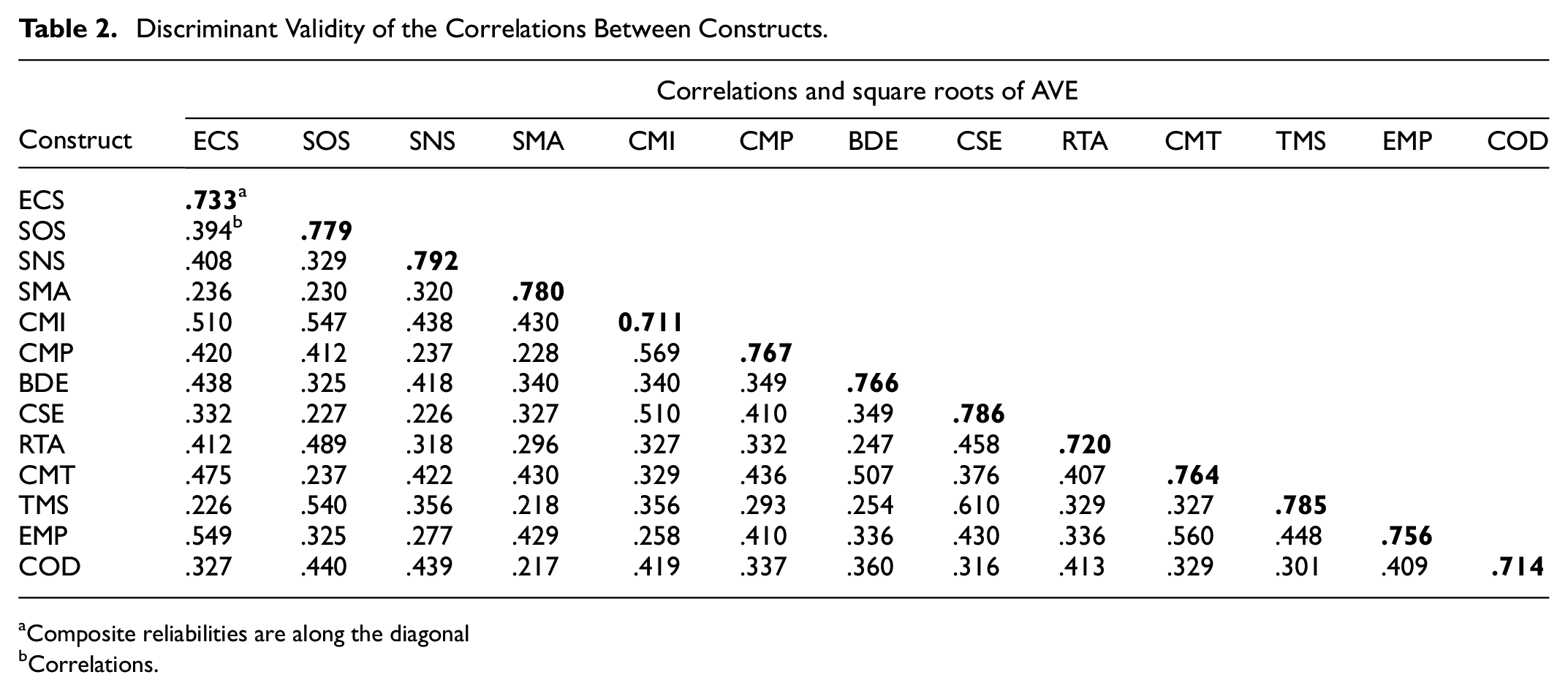
aComposite reliabilities are along the diagonal
Correlations.
Results
This study used Partial Least Scale Structural Equation Modeling (PLS-SEM) to test the relationships between the study variables.
Hypotheses Testing
Table 3 and Figure 2 indicate the hypothesis testing results using SEM/PLS. All the proposed hypotheses were supported, except H4. Specifically, environmental factors (i.e., competitive intensity, competitive pressure, and bandwagon effect) were found to have a significant effect on social media adoption (β = .406, p < .001; β = .290, p < .001; β = .637, p < .001; respectively). Therefore, H1, H2, and H3 are supported (Table 4).
Results of Hypotheses Testing.
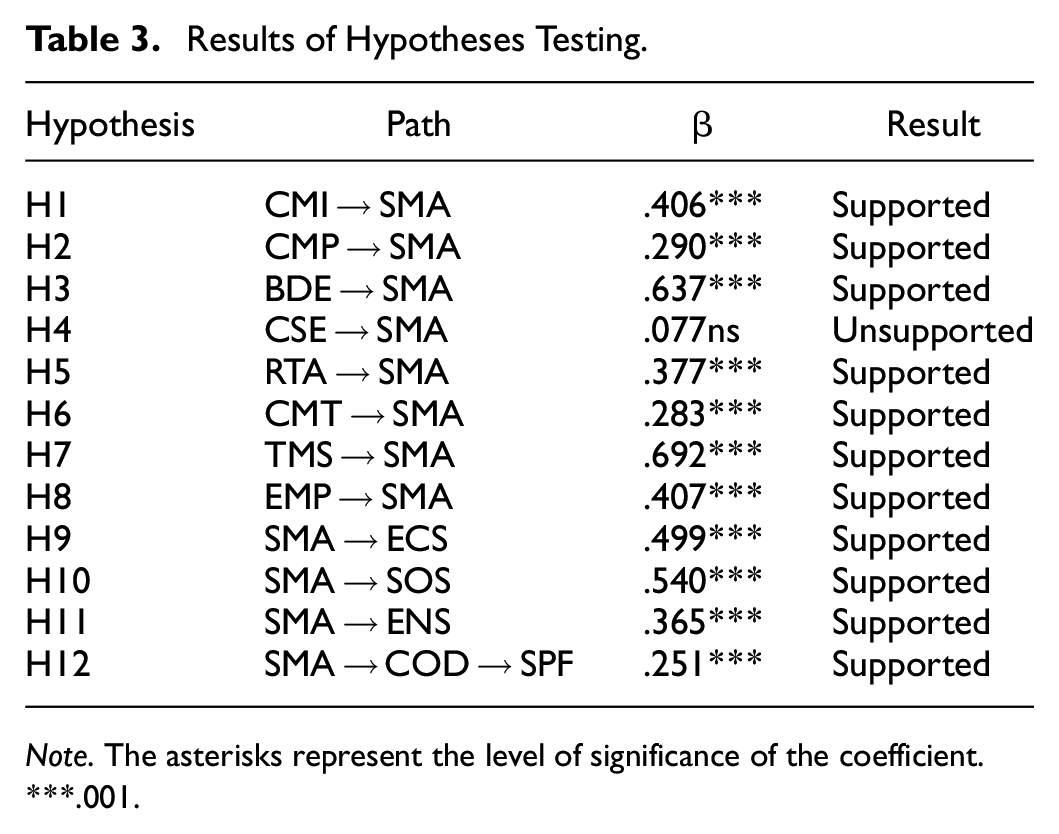
Note. The asterisks represent the level of significance of the coefficient. ***.001.
Variables Measurement.

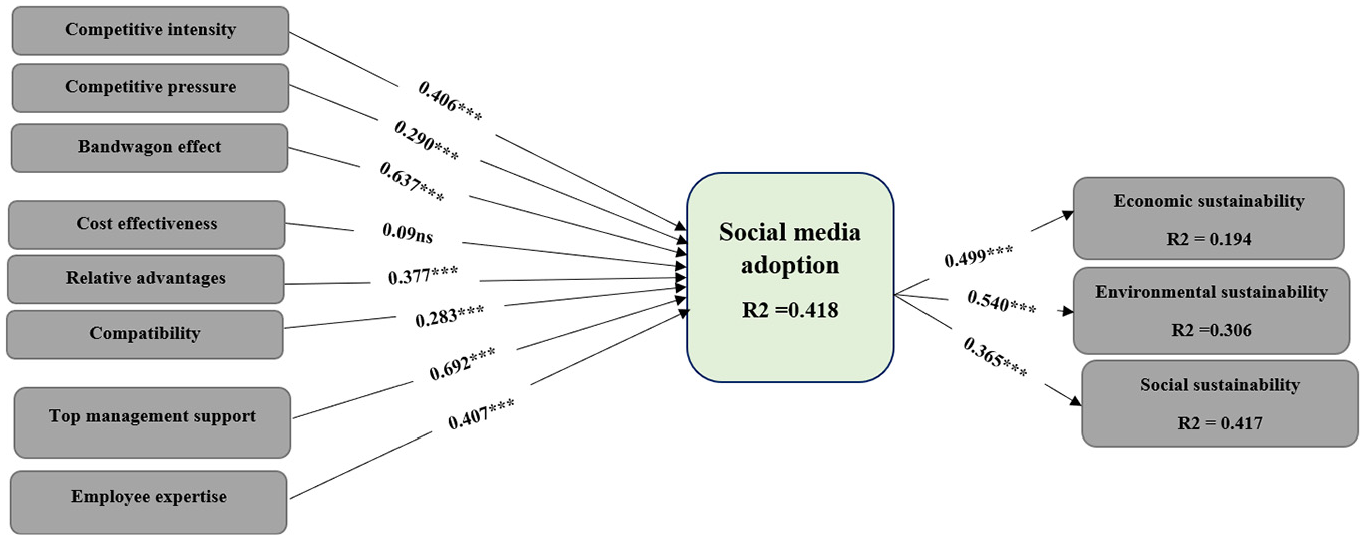
Structural model with standardized path estimate.
Technological factors (i.e., relative advantages, and compatibility) were found to have a significant effect on social media adoption (β = .377, p < .001; β = .283, p < .001; respectively). Therefore, H5 and H6 are supported but H4 was rejected. Regarding the organizational factors, our study revealed that top management support and employee expertise have a significant effect on social media adoption (β = .692, p < .001; β = .407, p < .001; respectively). Therefore, H7 and H8 were supported. Our study indicated that social media adoption has a significant influence on economic, environmental, and social sustainability (β = .499, p < .001; β = .540, p < .001; β = .365, p < .001; respectively). Thus, H9, H10, and H11 are supported. A multiple group analysis using PLS/SEM was conducted to explore the moderating role of COVID-19 on the links between social media adoption and sustainable performance. The results of the analysis indicated that COVID-19 has a significant effect on these relationships. Thus, H12 was supported.
Discussion and Implications
Key Findings
The main purpose of this study was to develop an integrated model that can explains the factors affecting social media adoption and its effects on sustainable performance in SMEs in Saudi Arabia. It also examined the impact of COVID-19 on these relationships.
Environmental factors were found to be a significant predictor of social media use. These results are consistent with previous studies that have found that external factors, including competitive intensity, competitive pressure, and the bandwagon effect, significantly affect social media adoption (Abed, 2020; Khan et al., 2021). This result demonstrates that SMEs need to use social media as a countermeasure to those taken by their competitors in order to obtain competitive advantage and information, respond to customers, and develop the best possible connections with customers and other stakeholders. The findings also show that some SMEs adopt new technologies solely because their competitors have started using them. Some businesses also made the switch out of concern for the loss of clients and loss of ground to their competitors. Since globalization and increased rivalry within an industry and a particular market have destabilized the environment in which SMEs in developing nations operate, these businesses must keep constant attention on the shifting conditions in order to reap the benefits they provide. The findings of this study showed that SMEs in Saudi Arabia regularly account for and adapt to changes in their external environment.
The present study’s findings, which are confirmed by previous examinations (Cao et al., 2018; Li et al., 2020; Sin Tan et al., 2009), show that technology has a favorable and significant effect on the performance of SMEs. These findings corroborate those of previous studies (Li et al., 2020; Qalati et al., 2021). As a result, it can be said that technological advancement and stringent management are prerequisites for long-term growth and financial success. Innovations, through new products and technology, have an immense impact on the development of organizations. In particular, inventive activity, which becomes the major explanation for the competitive advantage and performance of firms (Alshamaila et al., 2013; Denkta et al., 2020; Zieba et al., 2016), allows SMEs to contribute significantly to economic growth and job creation. Technological construct has been found crucial in SMEs’ decisions to embrace and use SM. The present study’s results are consistent with those of other research done in developing nations like Malaysia, Africa, the United Arab Emirates, and China (V. Kumar et al., 2022; Pateli et al., 2020; Trainor et al., 2014). This research implies that the major reasons for SM adoption in SMEs operating in Saudi Arabia are the predicted benefits (interactivity, cost-effectiveness, compatibility, relative advantage, and visibility). The country’s acceptance of social media is still in its infancy (Ringle et al., 2015; Stockdale et al., 2022; Zieba et al., 2016), therefore more focus should be placed on fostering the sector’s expansion and raising its profile. Moreover, the results of this study reveal that the use of technology in SMEs is outsourced by upper management, who ask personnel to use it in tactical or marketing operations. We hypothesize that the relatively young age and high education level of respondents may indicate that they are personal users of the technology, which in turn may explain their interest in using it for commercial purposes.
Earlier research has demonstrated that the backing of upper management is crucial for SM implementation. To a great extent, this result accords with the findings of others (Abu Bakar et al., 2019; Hu et al., 2023; Zieba et al., 2016). Results suggest that management buy-in is critical in influencing SM adoption and motivating staff to use it extensively in marketing. Additionally, the current research suggests that young, well-educated owners and managers in Saudi Arabia prefer to adopt SM as a marketing strategy because they already use it in their everyday lives and connect with friends and family by this means. Additionally, it has been documented that SMEs in other developing nations lacked management assistance when it came to the implementation of cutting-edge technologies (Alghamdi, 2023; Cao et al., 2018).
There was strong evidence that SMEs’ long-term success was correlated with their use of social media. This suggests that SMEs’ sustainable performance (i.e., enhanced environmental, social, and economic sustainability) and access to a wide number of clients are strongly influenced by the adoption and use of social media. This result agrees with what has been found before (Li et al., 2020). Findings demonstrated that SMEs reaped benefits from their efforts in this area. According to a prior study, gauging the success of one’s social media efforts should not be attempted too soon, given that such efforts are inherently experimental (Alghamdi, 2023). The author advocated in Hu et al. (2023) for an increase in reports detailing the returns on investment in social media by businesses of all sizes.
Theoretical Contributions
This research adds to the body of knowledge on the topic of SMEs’ use of social media in developing countries like Saudi Arabia. This study’s results are applicable to other emerging countries of the same kind, where there is a dearth of relevant research. This research builds on previous work by expanding the TOE framework to analyze the rising trend of SMEs’ use of social media. The current study adds new empirical support to the previous literature by focusing on the role of social media as a mediator. Even though prior research has looked into the direct effects of TOE constructs on social media adoption and the long-term performance of SMEs (Bakri, 2017; Basit et al., 2020; Jin & Hurd, 2018; Ngai et al., 2015), more study is needed.
Considering that some emerging technologies may start to seem the same, and that many businesses may want to use unique platforms for the same tasks as their competitors’, this disparity is significant. Academic attention on the topic of SMEs’ adoption of social media in developing nations has been scant. Earlier researchers have either looked at the constructs in isolation or in a number of contexts (Li et al., 2020) or asked for further empirical investigations on theory formation and validation in third world nations. By using the Theory of Everything (TOE) paradigm, this study offers a practical and efficient approach to analyzing this occurrence in the academic literature. The origins and effects of numerous IT-based technologies have recently been studied (Stockdale et al., 2022; Zahra, 2018; Zieba et al., 2016). However, little has been written on the adoption of social media in the context of SMEs. Therefore, the current study adopted an integrated framework to investigate the causes of SMEs’ sustainable performance in developing countries via the TOE framework and social media.
Practical Contributions
Based on the ongoing discussion on the pros and downsides of social media use and the way in which it affects long-term performance by SMEs, the present study illuminates the full scope of the issues in play, enabling business owners and managers to grasp accurately the impact of social media use. This article should help readers to understand quickly how better managing SMEs’ use of social media may boost their economic, environmental, and social sustainability. For instance, the data shows that SMEs can benefit greatly from using social media in terms of lowering the expenses associated with general operations and marketing. Using social media to interact with customers actively helps to strengthen ties with them and boosts loyalty. The use of social media also raises the awareness of a business, facilitates communication with a large audience, and makes it easier for consumers to find answers to their questions. Since the advent of the social media, two-way contact between businesses and their customers has been much easier, giving consumers greater say in product development and feedback mechanisms.
In addition, SMEs can spread their goodwill and positive brand images to the general public. Adopting and using social media has also aided SMEs to connect with prospective partners and customers. This research demonstrates that SMEs in developing nations, particularly Saudi Arabia, can benefit from using social media. It was also mentioned that owners and managers might encourage SMEs to use social media because doing so may boost a business’s overall performance. SMEs benefit from TOE structures because of the favorable environment that they provide for the use of social media. Few studies have supported the idea that SMEs use social media because of the influence of their competitors. This wasteful behavior by SMEs causes them to have to scrape by on a daily basis, which means that their adoption of social media may not produce the expected benefits. But, as this research shows, SMEs need to know not only why they should use social media, but also how, when, and why it might work for them. Finally, this research shows why and how social media can be effectively used in SMEs during COVID-19.
Conclusions
The main aim of this paper was to explore the main factors affecting social media adoption in Saudi Arabian SMEs and its effect on their sustainable performance within the TOE framework. It also explored the impact of COVID-19 on this relationship. Our study used the quantitative method to collect data and analyze it using PLS/SEM. The analysis revealed that environmental factors (i.e., competitive intensity, competitive pressure, and the bandwagon effect); technological factors (i.e., relative advantages, and compatibility); and organizational factors have been key drivers of social media adoption in SMEs during COVID-19. It also indicated that social media adoption in SMEs is a key driver of economic, environmental, and social performance.
One of the main limitations of the current study is that it focused on SMEs. Future studies can test our model in large companies. Second, our study focuses on exploring the factors affecting social media adoption in the Saudi Arabian context. It would be interesting to test this study model elsewhere, such as developed countries to understand the role of the national culture in these relationships. Third, our study used the quantitative method to test the relationship between the study variables. Future studies can use mixed methods to provide more in-depth insights into these relationships. Finally, our study used a survey to collect the required data. Future research can use experimental methods to explore the relationships that have been developed in our conceptual framework.
Footnotes
Declaration of Conflicting Interests
The author declared no potential conflicts of interest with respect to the research, authorship, and/or publication of this article.
Funding
The author disclosed receipt of the following financial support for the research, authorship, and/or publication of this article: The authors are thankful to the Deanship of Graduate Studies and Scientific Research at Najran University for funding this work under the Easy Funding Program grant code (NU/EFP/SEHRC/13/22).
Institutional Review Board Statement
The study was conducted according to the guidelines of the Declaration of Helsinki and approved by the deanship of scientific research ethical committee, Najran University (project number: NU/EFP/SEHRC/13/22, date of approval: 10 February 2022).
Informed Consent Statement
All subjects gave their informed consent for inclusion before they participated in the study. The study was conducted in accordance with the Declaration of the author university, and the protocol was approved by the Ethics Committee.

Data Availability Statement
Data is available upon request from researchers who meet the eligibility criteria. Kindly contact the first author privately through the e-mail.