




Abstract
Based on the provincial statistical data of the Beijing-Tianjin-Hebei region this paper uses the health distance model and obstacle degree model to explore the spatiotemporal mismatch of the development of the Beijing-Tianjin-Hebei regional innovation chain and analyzes the obstacle factor affecting the healthy development of Beijing-Tianjin-Hebei innovation chain. The results show that: (1) In terms of timing characteristics, the overall mismatch of the innovation chain in the Beijing-Tianjin-Hebei region shows a downward trend, and the absolute and relative difference of regional mismatch both show a “V” shaped development trend, which first decreases and then increases. (2) In terms of spatial characteristics, the mismatch of the innovation chain in the Beijing-Tianjin-Hebei region develops from unbalanced to balanced and then unbalanced, and the spatial pattern evolves from low in the middle and high around to high in the southeast and low around. (3) In terms of the obstacle factors, scientific research and development institutions, the number of college students, and the number of innovation platforms at or above the provincial and ministerial level are the obstacle factors to the more frequent occurrence.
Plain Language Summary
This study aims to examine the spatio-temporal differentiation of the regional innovation chain in the Beijing-Tianjin-Hebei region of China. It investigates the mismatch between different components of the innovation chain and analyzes the factors that hinder its healthy development. The research utilizes the entropy method, health distance model, and obstacle degree model to calculate and analyze the innovation chain mismatch. Arc GIS geometric method is employed to divide the mismatch into different levels. Data from 2015 to 2019 is used to assess the evolution of the innovation chain mismatch over time and across different regions. The study reveals that the innovation chain mismatch in the Beijing-Tianjin-Hebei region has shown a declining trend during the study period. The overall mismatch has weakened, indicating significant progress in the coordinated development of the region. Beijing has played a leading role, while Tianjin and Hebei Province have also witnessed improvements, although to a lesser extent. The development difference among the three regions has been reduced, but significant disparities still exist. The findings highlight the importance of regional collaboration in promoting innovation chain development. The study provides insights for policymakers and stakeholders to enhance the coordination and integration of innovation activities in the Beijing-Tianjin-Hebei region. It emphasizes the need for further efforts to reduce development disparities and enhance the efficiency of innovation development. It is important to note that this study focuses specifically on the Beijing-Tianjin-Hebei region, and the findings may not be directly applicable to other regions or countries. The analysis is based on available data and selected models, which may have certain limitations and assumptions. Further research is needed to explore additional factors and dynamics influencing the innovation chain in the region.
Introduction
Promoting the deep integration and development of the innovation chain is an important measure for China to deal with the restructuring of the global industrial chain. The Beijing-Tianjin-Hebei city cluster is an important gathering place of innovation resources, a node of the innovation network, and a regional carrier of innovation (Zhu & He, 2020). Due to regional development differences and physical geographical characteristics, the development of innovation chains in the Beijing-Tianjin-Hebei region has the characteristics of complementarity and spatial adjacency (X. Tian & Liu, 2020).
However, in terms of the practical effects of the development of the innovation chain in Beijing-Tianjin-Hebei, there are still serious problems such as the lack of innovation factors flow, the weak cooperation of innovation chain main body, the fracture of innovation chain or the mismatch of functional structure (Yu & Yang, 2020). China’s economy is in a critical period of transformation from old growth drivers to new ones (Ye & Li, 2019). Despite the progress made in the region’s coordinated development, serious challenges still need to be overcome. These challenges include the lack of innovation factors flow, weak cooperation among the main actors in the innovation chain, fractures within the innovation chain, and mismatches in the functional structure.
The purpose of this research is to evaluate and diagnose the mismatch degree of the Beijing-Tianjin-Hebei innovation chain development and identify the obstacle factors that hinder its coordinated development. By the evaluation of the degree of mismatch and the diagnosis of obstacle factors, the problems and shortcomings in the development of the innovation chain in the Beijing-Tianjin-Hebei region are solved. Contribute to improving the high-quality development efficiency of the regional innovation chain. Provide valuable insights for policymakers, government agencies, and relevant stakeholders to formulate effective strategies and policies to promote the coordinated and integrated development of the Beijing-Tianjin-Hebei region.
Literature Review and Research Framework
Literature Review
The innovation chain has been gradually and deeply studied by Chinese and foreign scholars in the research process of more than 20 years and has been highly valued by scholars in economics, management, and other interdisciplinary research fields. But at present, the research on innovation chain and its mismatch are still in the stage of paradigm discussion, theoretical discussion, and multi-dimensional practice, and there is still a large space for exploration in the theory and practice of innovation chain and its mismatch research.
Research on Regional Innovation Chain
Although the innovation chain has a strong driving effect on the economy and society, its development started late and the basic theoretical research results are limited. The concept of an innovation chain was first conceived by Visvanathan in 1977. In 1992, Marshall and Vredenburg formally proposed the concept of an innovation chain (Yang et al., 2019). Academic research on the innovation chain focuses on resource integration (Fu et al., 2015; Sun et al., 2020), main body construction (Xiaolan, 2021), organizational model (Xie, 2015), function play (Kang & Hu, 2017), innovation efficiency (Huo et al., 2022; T. Zhao, 2023), and collaborative governance (Anokhin et al., 2019; B. Liu et al., 2022). The research methods of the innovation chain are mainly qualitative analysis (Jiang & Liu, 2017) and DEA efficiency measurement (H. Liu & Chen, 2011).
Limited research on innovation chain development in the Beijing-Tianjin-Hebei region: While the region is known for its economic dynamism and innovation resources, there is a lack of comprehensive research specifically focused on the development of the innovation chain. This research seeks to fill this gap by providing a detailed analysis of the innovation chain in the region, its current status, challenges, and potential areas for improvement.
Research on Spatial Mismatch Degree
The concept of “mismatch” was first proposed by Kain (1968). Since then, the spatial mismatch theory has been widely applied by scholars in various fields, such as the spatial relationship between residence and employment (Galster & Killen, 1995; Wu & Zhou, 2017), public transport-employment mismatch (Roddy et al., 2022; Tyndall, 2017), public service and demand mismatch (Kawabata, 2011; X. Li et al., 2014), and tourism economic system mismatch (Ma et al., 2018) etc. scholars have the increasingly mature application of “spatial mismatch” theory, focusing on the measurement of mismatch in different spatial ranges or different fields, leading to the diversity of research conclusions.
Previous studies have acknowledged the existence of challenges and issues in the innovation chain development in the region (Salam & Senin, 2022), but there is a lack of quantitative analysis and evaluation of the mismatch degree. This research aims to provide a comprehensive assessment of the extent and nature of the mismatch, enabling a deeper understanding of the specific areas that require attention and intervention. Inadequate identification of obstacle factors: While some research has identified certain obstacles to the coordinated development of the innovation chain in Beijing-Tianjin-Hebei, there is a need for a more systematic and comprehensive analysis of these factors. This research aims to identify and categorize the key obstacle factors, examining their interrelationships and impacts on the innovation chain.
Research on Regional Collaborative Development
The research on regional collaborative development can be traced back to the division of labor theory of Smith’s (1937) classical school. Fan and Liu (2020) have made a systematic study on the ideal collaborative governance model of innovation chain governance in the Guangdong-Hong Kong-Macao Greater Bay Area. Su et al. (2021) establishes the tripartite evolutionary game model of government, enterprises, and universities. Fraser (2021) proposes that creating shared value can produce more sustainable results than traditional CSR methods.
The research literature often focuses on specific aspects of regional development or individual components of the innovation chain. However, there is a need for a more holistic perspective that takes into account the multidimensional nature of the innovation chain and its interdependencies with other factors such as regional governance, spatial layout, and ecological environment. This research seeks to bridge this gap by providing a comprehensive analysis that considers the various dimensions of coordinated development in the Beijing-Tianjin-Hebei region.
Research Framework
Based on the analysis of the existing research results (Y. Li & Chen, 2019; Zhang & Du, 2020), this paper considers that the innovation chain mismatch is a measure of the comprehensive development level of the innovation chain resource allocation, and regards the innovation chain as a system (Figure 1).

Main body development framework of regional innovation chain.
This paper holds that the innovation chain is a system with innovation demand as the guide and innovation subject as the core. Innovation subjects include institutions of higher learning, research institutes, government departments, enterprises, intermediary agencies, and other organizations. It covers several horizontal innovation chain subjects and reflects the main contents of the innovation chain, such as basic research, application research, design and development, experimental improvement, production and sales, and industrial diffusion. An innovation chain analysis framework is constructed from four innovation dimensions: innovation input, innovation collaboration, innovation output, and innovation environment. Due to the interference and stimulation of the internal elements of the system, the allocation of innovation chain resources is mismatched. Mismatch refers to discrepancies or imbalances between different stages or components of the innovation chain, which may hinder the smooth flow of innovation and limit the region’s overall innovation capacity.
Research Methods and Data Sources
According to the establishment of the Beijing-Tianjin-Hebei innovation chain mismatch degree evaluation index system and based on the entropy value method and the health distance model, the degree of innovation chain mismatch in the Beijing-Tianjin-Hebei region is measured. Use the Arc GIS geometric method to divide the mismatch degree of the innovation chain in the Beijing-Tianjin-Hebei region into five levels: high mismatch, medium mismatch, low mismatch, medium mismatch, and high mismatch (Y. Li & Chen, 2019), and use the obstacle degree model to use EViews 8.0 software deconstructs the obstacles that restrict the healthy development of the Beijing-Tianjin-Hebei innovation chain.
Construction of Analysis Framework and Evaluation System
In 2016, the CPC Central Committee and The State Council issued the Outline of the National Strategy for Innovation-Driven Development. Based on the National Innovation-Driven Development Strategy Outline (State Council, 2016), based on the principles of science, objective, comprehensive, accessible, and applicable, and combined with the actual situation of Beijing-Tianjin-Hebei cooperation, a quantifiable innovation chain mismatch evaluation index system for the Beijing-Tianjin-Hebei region was obtained (Table 1).
Beijing-Tianjin-Hebei Innovation Chain Mismatch Evaluation Index System.

First of all, innovation input is an important support for the development of the Beijing-Tianjin-Hebei innovation chain. The development of the innovation chain not only needs the support of the local economy but also needs high-tech platforms and high-level scientific and technical talents to transform the resource advantages of the innovation chain into the advantages of the market economy. Therefore, specific indicators such as regional per capita GDP, R&D investment intensity, the number of colleges and universities, and students are used to calculate.
Second, innovation synergy is an effective channel to drive the coordinated development of the Beijing-Tianjin-Hebei region. The innovation synergy dimension involves subject integration and regional cooperation, and the cross-regional cooperation ability of high-tech industries is often reflected by the absorption rate of technology introduction (Tyndall, 2017). In the Beijing-Tianjin-Hebei collaborative development pattern, the region is slightly weak in terms of innovation resources and development strength. Beijing, as the capital, has a strong resource adsorption capacity.
Therefore, in the dimension of innovation synergy, it is necessary to consider regional cooperation relations and reasonably give play to the regional role of Beijing-Tianjin-Hebei. It is mainly measured by indicators such as the position of senior executives of Beijing high-tech enterprises in Tianjin-Hebei enterprises and the number of joint patents granted by Beijing-Tianjin-Hebei enterprises. Moreover, innovation output is an objective standard to test the development quality of the Beijing-Tianjin-Hebei innovation chain.
This paper divides the dimension of innovation output into two parts: knowledge achievement and market achievement. Knowledge achievement is an effective standard to test the scientific research strength of Beijing, Tianjin, and Hebei, which is mainly measured by indicators such as the number of topics or author cooperation in Beijing, Tianjin, and Hebei patent authorization in China National Knowledge Network. However, the pure growth of scientific research and technological strength cannot meet the requirements of high-quality economic and social development, so it is necessary to measure the development status of the market industry with indicators such as the main business income of the high-tech industry and the transaction volume of the technology market. Finally, the innovation environment is related to the network pattern of the Beijing-Tianjin-Hebei innovation chain development. The financial environment and social environment are important aspects affecting the development of the innovation chain, and they will play a role in the sustainable and healthy development of the innovation chain. Therefore, indicators such as risk absorption and equity, amount of investment, and number of popular science books published are selected to measure.
Data Sources
This paper takes the Beijing-Tianjin-Hebei region as the case study, and the research data mainly comes from the 2016 to 2020 China Statistical Yearbook of Science and Technology, China High-tech Industry Statistical Yearbook, Beijing Statistical Yearbook, Beijing Technology Market Statistics Annual Report, Beijing Yearbook, Tianjin Statistical Yearbook, Tianjin Statistical Yearbook of Science and Technology, Hebei Economic Statistical Yearbook, Beijing, Tianjin and Hebei local government national economic and social development statistical announcement, local statistics Bureau and other official public data. The moving average method was used to estimate the missing data to ensure the integrity of the research data.
Research Model
Data Standardization Processing and Weight Determination
Innovation chain mismatch needs to integrate evaluation information from multiple perspectives and indicators, so it is necessary to standardize the initial data. In this paper, the data will be standardized according to the range method, so that the data index values will be distributed within the range of [0, 1] after standardization. The specific calculation formula is as follows:


In the formula,
The Healthy Distance Model
In this paper, the healthy distance model is used in this study to examine the spatiotemporal mismatch in the development of the Beijing-Tianjin-Hebei regional innovation chain. It provides a quantitative measure of the degree of mismatch between different regions in terms of their innovation chain development. By analyzing the healthy distance, the study aims to identify the areas where the innovation chain is lacking and where improvements are needed. The healthy distance model logic is used to measure the development mismatch of the Beijing-Tianjin-Hebei innovation chain. Assuming that A and B are the optimal and actual state of innovation chain development respectively,
(1) In the development state B of the actual innovation chain, the optimal value method is used to select
(2) Measure the relative distance from to. The specific calculation formula is as follows:

In the formula,
(3) Measure the relative comprehensive distance from system A to system B. The specific calculation formula is as follows:

In the formula,
Obstacle Degree Model
The obstacle degree model is employed in this research to analyze the factors hindering the healthy development of the Beijing-Tianjin-Hebei innovation chain. This model quantifies the degree to which various factors act as obstacles to the progress of the innovation chain. By assessing the obstacle degree, the study aims to identify the specific factors that impede the smooth functioning and synergy of the innovation chain in the region.



Where,
Result
Time Series Evolution Characteristics of Innovation Chain Mismatch Degree
According to the calculation results of innovation chain mismatch based on the entropy method and health distance model. The innovation chain mismatch of the Beijing-Tianjin-Hebei region showed a downward trend during 2015 to 2019, with slightly different decreasing rates of mismatch in different regions, as shown in Figure 2.
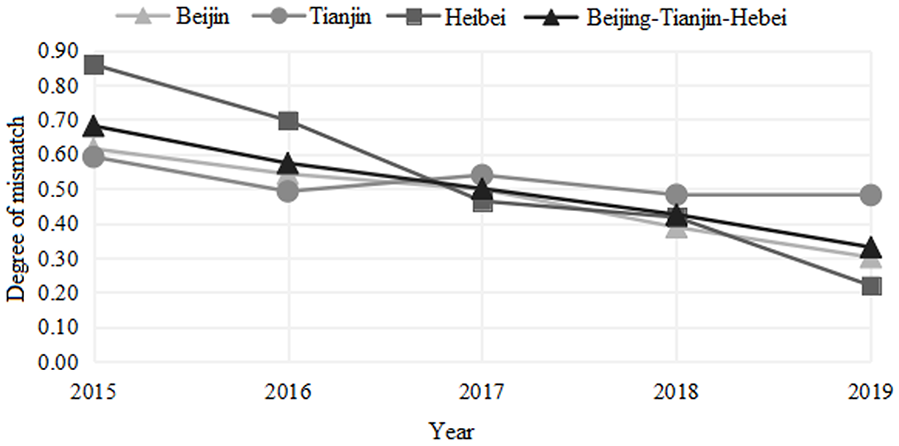
Level of innovation chain mismatch in Beijing-Tianjin-Hebei from 2015 to 2019.
In terms of the overall development of the Beijing-Tianjin-Hebei region, the innovation chain mismatch of the Beijing-Tianjin-Hebei region was 0.682 in 2015, which was in a state of moderate mismatch development. Beijing was in a state of moderate mismatch, and Tianjin was in a state of low mismatch, which was mainly caused by the high mismatch of innovation chain development in Hebei Province, indicating that the innovation chain mismatch of Beijing-Tianjin-Hebei region was relatively high.
During the study period, the overall degree of mismatch of the innovation chain in Beijing-Tianjin-Hebei shows a gradual weakening trend, which is in line with the reality of the coordinated and in-depth development of the Beijing-Tianjin-Hebei region. In particular, in recent years, Beijing has intensified efforts to relocate non-capital functions from the two regions, Tianjin and Hebei have received more high-tech industries, the mobility of innovation factors has been effectively enhanced, and the regional development differences of the innovation chain have become smaller. In 2019, the innovation chain mismatch of Beijing-Tianjin-Hebei was 0.331, which was significantly improved compared with 2015, indicating that the development of the innovation chain of Beijing-Tianjin-Hebei was in a moderately matched development state. During the study period, the innovation chain mismatch of Beijing-Tianjin-Hebei decreased by 51.47%, indicating that the innovation chain mismatch of Beijing-Tianjin-Hebei was weakened, indicating that the regional innovation synergistic development of Beijing-Tianjin-Hebei achieved remarkable results.
In terms of the development situation of Beijing, Tianjin, and Hebei, the improvement of innovation chain mismatch was the most significant in Hebei Province, which decreased by 74.48%, and its development status changed from high mismatch to moderate mismatch. The reason is that Hebei Province is in a disadvantageous position in the development pattern of Beijing-Tianjin-Hebei. The development of the innovation chain started late and the foundation is poor. However, with the continuous deepening of the coordinated development of Beijing, Tianjin, and Hebei Province, and Hebei Province actively encourages the innovative development of industry and service industry, the innovation chain of Hebei Province has gradually entered the track of high-quality development.
Secondly, the innovation chain mismatch in Beijing improved better, with the innovation chain mismatch decreasing by 50.97%, and the development status changed from moderate mismatch to moderate matching. The reason is that Beijing is in the core leadership position in the development pattern of Beijing-Tianjin-Hebei, which has a strong siphon effect. Rich in innovation resources, Beijing has actively promoted the construction of a national science and technology innovation center, strengthened the core position of innovation, and promoted integrated and innovative high-quality development. Innovation has produced remarkable results as a new driving force for economic development.
Finally, the innovation chain mismatch in Tianjin improved significantly, and its innovation chain mismatch decreased by 18.71%, always in a state of low mismatch development. The reason is that Tianjin plays a deputy core role in the development pattern of the Beijing-Tianjin-Hebei region. The conditions of innovation technology and capital are worse than in Beijing, and the development of its innovation chain is relatively stable. It is worth noting that although the improvement degree of innovation chain mismatch in Tianjin is worse than that in Hebei Province, from the perspective of the overall development of Beijing-Tianjin-Hebei, Beijing, and Tianjin take the lead, while the pattern of Hebei Province’s following development has not changed fundamentally (R. Zhao & Wang, 2017), and Tianjin’s comprehensive development strength of innovation chain is still stronger than Hebei Province.
Based on the calculation of the innovation chain mismatch of the Beijing-Tianjin-Hebei region, the range, standard deviation, and coefficient of variation of the innovation chain mismatch of the Beijing-Tianjin-Hebei region during 2015 to 2019 were obtained according to relevant formulas (Figure 3).
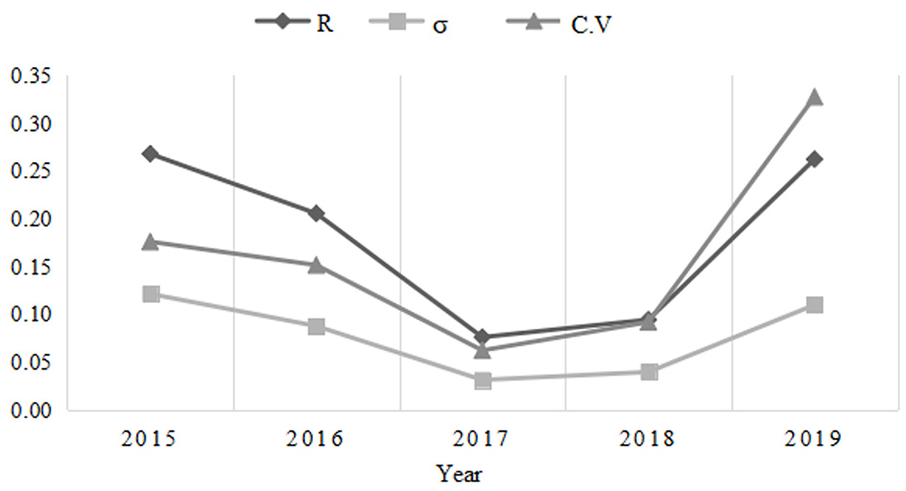
Range, standard deviation, and coefficient of variation of innovation chain mismatch in the Beijing-Tianjin-Hebei region during 2015 to 2019.
As can be seen from Figure 3, the development difference of innovation chain mismatch in Beijing-Tianjin-Hebei from 2015 to 2019 firstly decreased and then increased. In terms of the overall development difference of the Beijing-Tianjin-Hebei innovation chain, both the absolute difference and the relative difference showed a “V” shaped development trend of first decreasing and then increasing. The development difference of the Beijing-Tianjin-Hebei innovation chain gradually narrowed from 2015 to 2017, but gradually increased from 2017 to 2019. The year 2017 is a key year for implementing the coordinated development strategy of the Beijing-Tianjin-Hebei region. The innovation chain of Beijing-Tianjin-Hebei developed steadily under the drive of various external forces, and the regional differences gradually narrowed. The range, standard deviation, and coefficient of variation of innovation chain mismatch reached the lowest point of development in the research stage, which was 0.076, 0.031, and 0.062, respectively. In 2017 to 2018, the development difference of the Beijing-Tianjin-Hebei innovation chain was generally flat, but the development trend of upward expansion has begun to appear. In 2018 to 2019, the development difference of the Beijing-Tianjin-Hebei innovation chain was significantly enhanced, and the coefficient of variation even exceeded the basic value at the early stage of the study. This indicates that although the state actively advocates the Beijing-Tianjin-Hebei coordinated development strategy, Beijing has a strong siphon effect, which has a limited radiation-driving effect on the region, Beijing, Tianjin, and Hebei Province have great differences in innovation development, coupled with the input-output hysteresis and low innovation efficiency of the innovation chain, the development difference between the Beijing-Tianjin-Hebei innovation chain is still very significant.
Spatial Evolution Characteristics of Innovation Chain Mismatch Degree
Based on the evaluation of the time sequence development of the Beijing-Tianjin-Hebei innovation chain, the dynamic development of the Beijing-Tianjin-Hebei innovation chain is analyzed from the perspective of spatial evolution Show the situation. According to the calculation results of the innovation chain mismatch, the innovation chain mismatch of Beijing-Tianjin-Hebei developed from unbalanced to balanced and then to unbalanced in space during 2015 to 2019, the overall regional mismatch changed from moderate mismatch to moderate matching, and the innovation chain mismatch was gradually optimized, and the development difference of regional innovation chain was effectively reduced, as shown in Table 2.
Distribution of Innovation Chain Mismatch in the Beijing-Tianjin-Hebei Region From 2015 to 2019.



From the analysis of Table 2, it can be seen that the development of innovation chain mismatch in the Beijing-Tianjin-Hebei region during 2015 to 2018 was mainly dominated by mismatch status, and the degree of innovation chain mismatch in Hebei Province was the most serious. Among them, in 2015, the Beijing-Tianjin-Hebei mismatch was mainly medium-high, Beijing and Hebei Province were in moderate and high mismatch levels respectively, while the Beijing-Tianjin-Hebei innovation chain mismatch level was moderate, mainly because the development of the Beijing-Tianjin-Hebei innovation chain was still in its infancy at that time, and the regional innovation chain development was significantly different. And the innovation chain-related system, technology, capital, and experience of the lack of a common cause.
From 2016 to 2018, the innovation chain mismatch in the Beijing-Tianjin-Hebei region remained at a low level, and the innovation chain mismatch was significantly improved. With the deepening of the coordinated development strategy of the Beijing-Tianjin-Hebei region, the flow of innovation factors and resources in the region has accelerated, regional cooperation and cooperation between local enterprises have increased, regional innovation capacity has been significantly enhanced, and the construction of an innovative service platform has achieved remarkable results. In 2019, the development of the innovation chain mismatch in Beijing-Tianjin-Hebei was mainly in the medium matching state, and the innovation chain mismatch in Beijing and Hebei Province was at the medium matching level, which was the best period for improvement of the mismatch state in the research stage.
In 2019, the economic support of the Beijing-Tianjin-Hebei region remained stable, the regional innovation radiation capacity was significantly enhanced, the concentration of innovation subjects and cooperation capacity were significantly improved, and the integrated development path of the innovation chain and industrial chain was gradually defined. The positive effects of the construction of the Xiong’an New Area, economic restructuring, and the transformation of scientific and technological innovation output all provided strong support for the healthy development of the innovation chain in this period.
As can be seen from the analysis of Table 2, the innovation chain mismatch of Beijing-Tianjin-Hebei changes from low in the middle and high in the periphery to high in the southeast and low. In 2015, the mismatch of the Beijing-Tianjin-Hebei innovation chain is ranked as follows: Hebei > Beijing > Tianjin and the development of the innovation chain in Hebei Province is in a highly mismatched state. By 2019, Beijing and Hebei Province in the Beijing-Tianjin-Hebei innovation chain will have great changes, respectively from moderately mismatched to moderately matched, and highly mismatched to moderately matched. It should be noted that Tianjin is in the deputy central leading position in the Beijing-Tianjin-Hebei collaborative development framework. The development trend of the innovation chain is stable, and it is always in a low mismatch development state during the research stage. Although the overall spatial pattern of innovation chain mismatch in Beijing-Tianjin-Hebei was higher in the southeast and lower in the four regions, the spatial pattern of mismatch was not stable in the research stage. In 2017, the innovation chain mismatch of Beijing, Tianjin, and Hebei presented a full-low matching development pattern, and the innovation chain mismatch of Beijing, Tianjin, and Hebei was 0.498, 0.540, and 0.464, respectively, which were all at the low mismatch level. With the in-depth development of Beijing-Tianjin-Hebei coordination, the mismatch of Beijing’s innovation chain was significantly improved in 2018, and the mismatch grade of Beijing’s innovation chain changed from low mismatch to moderate mismatch. The spatial pattern of the Beijing-Tianjin-Hebei innovation chain mismatch showed a development trend of high on the four sides and low in the middle. In summary, although the spatial imbalance of innovation chain mismatch in Beijing-Tianjin-Hebei has been significantly improved, regional differences are still significant. Beijing’s ability to radiate technology to Tianjin and Hebei Province is still very limited. It is necessary to further promote the Beijing-Tianjin-Hebei coordinated development strategy, strengthen the flow of innovation factor resources in Beijing-Tianjin-Hebei, and improve the efficiency of innovation development.
Diagnosis of Obstacle Factors
The obstacle factors that hinder the healthy development of the Beijing-Tianjin-Hebei innovation chain were calculated according to the obstacle degree model, and the top five obstacle factors with the highest frequency were counted according to the innovation chain mismatch type. The results are shown in Table 3.
Top Five Obstacle Factors of Innovation Chain Mismatch in Beijing-Tianjin-Hebei From 2015 to 2019.

From the analysis of Table 3, it can be seen that from the perspective of the overall development obstacle factors of the Beijing-Tianjin-Hebei innovation chain, the number of scientific research and development institutions, the number of university students, and the number of innovation platforms above the provincial and ministerial level (including) are frequently occurring obstacle factors. Among the mismatch obstacle factors of the Beijing-Tianjin-Hebei innovation chain from 2015 to 2019, they appear seven times, six times, and six times respectively. That is, the obstacles affecting the healthy development of the Beijing-Tianjin-Hebei innovation chain are mainly concentrated in the innovation input criteria, which are specifically manifested in R&D manpower and science and technology platform. This indicates that the mismatch development of the Beijing-Tianjin-Hebei innovation chain is closely related to innovation input, and the existing conditions such as the science and technology platform and R&D personnel scale cannot effectively meet the objective requirements of high-quality development of the Beijing-Tianjin-Hebei innovation chain.
From the perspective of the time sequence development of the innovation chain, the factors restricting the mismatch of the Beijing-Tianjin-Hebei innovation chain also have stage characteristics. From 2015 to 2018, the dominant factors restricting the mismatch development of the innovation chain in Beijing, Tianjin, and Hebei were the number of university students, the per capita GDP of the region, the proportion of enterprise funds in the internal expenditure of R&D funds and scientific research and development institutions, namely, at this stage, the conditions for innovation investment in Beijing, Tianjin, and Hebei were insufficient. Although the regional collaborative strategy of Beijing, Tianjin, and Hebei had been implemented for a long time, however, the regional innovation structure still needs to be optimized, the innovation elements have the characteristics of high aggregation and low mobility, and the basic conditions of scientific and technological innovation in Tianjin and Hebei are relatively disadvantageous, which makes innovation input become the main aspect restricting the healthy development of the innovation chain of Beijing, Tianjin, and Hebei at this stage. In 2019, the R&D expenditure of the Beijing-Tianjin-Hebei region increased by 13.9% compared with that of 2018, and the knowledge outcome factor gradually developed into the obstacle factor of the mismatch of the Beijing-Tianjin-Hebei innovation chain, and the restriction criterion layer changed from innovation input to the coexistence of innovation input and innovation output.
To quantitatively analyze the relationship between obstacle factors and innovation chain mismatch, based on the calculated value of the entropy method, From the level of innovation input, innovation collaboration, innovation output, and innovation environment, the factors of scientific research and development institutions (I1) several Beijing enterprises’ subsidiaries in Tianjin-Hebei (I2) main business income of high-tech industry (I3) enterprise risk absorption (VC) and equity (PE) investment (I4) are selected as explanatory variables. Beijing-Tianjin-Hebei innovation chain mismatch (Y) is the explained variable. Based on the principle of the least square method, multiple regression analysis is conducted by using Eviews 8.0 software, and the results are shown in Table 4.
Multiple Regression Analysis of Influencing Factors of Innovation Chain Mismatch in Beijing-Tianjin-Hebei From 2015 to 2019.
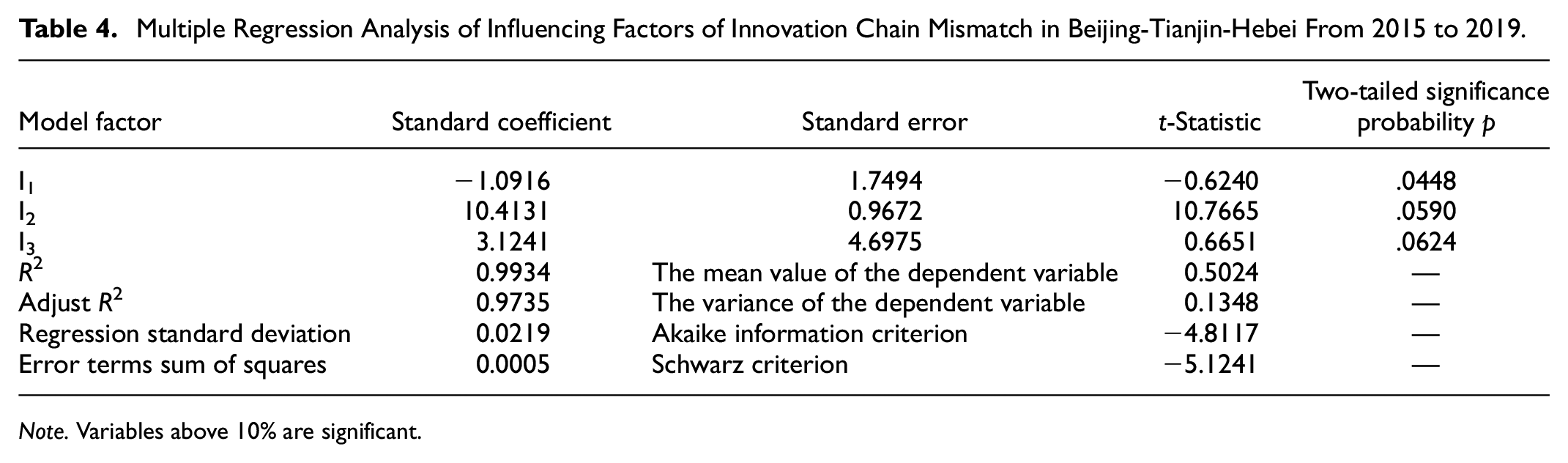
Note. Variables above 10% are significant.
According to the results of multiple regression, there is no significant relationship between venture absorption (VC) and equity (PE) investment amount (I4) and the mismatch of the Beijing-Tianjin-Hebei innovation chain (p = .792), while the other three factors are significantly correlated with the mismatch of Beijing-Tianjin-Hebei innovation chain. Economic innovation input plays a key role in the development of the innovation chain, which is directly related to the development efficiency and speed of the innovation chain, and also related to the aggregation and flow of innovation factors. Science and technology platforms and the scale of R&D personnel are also key factors affecting the development of the innovation chain. These aspects form the input conditions for the healthy development of the innovation chain.
Coordinate the Development Path of the Beijing-Tianjin-Hebei Innovation Chain Integration
In the coordinated development system of the Beijing-Tianjin-Hebei innovation chain, Beijing, as an extremely high point of innovation and development, needs to draw on high-level talents, technologies, and other innovation factors to build itself into a national innovation and development center and plan for global innovation and development. As the deputy center of collaborative innovation development, Tianjin needs to continuously strengthen its cooperation ability, seek high-tech development opportunities, take the initiative to connect the national and capital innovation and development network system, consolidate and enhance the city’s comprehensive development strength, and promote the transformation and optimization of Tianjin’s economic development engine. The development foundation and resources of the innovation chain in Hebei Province are relatively weak, and its core utilization demand is to effectively embed in the collaboration of the Beijing-Tianjin-Hebei innovation chain and effectively improve the realistic dilemma of “big but not strong” innovation development in Hebei Province. According to the stakeholder theory, the coordinated development of the innovation chain in the Beijing-Tianjin-Hebei region as a whole is based on the innovation chain as the core. Through the interactive development of the industrial chain and innovation chain, a spiral-type closed-loop innovation development network is formed to optimize the matching function and structure of regional economic development, create a national innovation development highland, and realize the breakthrough innovation development of the regional economy, as shown in Figure 4.

Multi-value appeal and development system of Beijing-Tianjin-Hebei innovation chain synergy.
Market Guidance for a Balanced Flow of Innovative Development Elements in Beijing-Tianjin-Hebei
The elements of innovative development are the key components of implementing the innovation-driven development strategy and improving the regional innovation system. We should deploy innovation chains around the industrial chain and layout industrial chains around the innovation chain. To build a world-class regional industrial chain in the Beijing-Tianjin-Hebei region, we must strengthen the decisive role of the market in the allocation of factor resources for innovative development. According to the actual needs of enterprises, research institutes can set up research and development projects, and the government and research institutes can cooperate to lead teams to carry out innovative technology research, to promote the scientific and technological achievements to be put into large-scale production in manufacturing enterprises, to achieve the seamless connection between enterprises, universities, and research institutes in different regions. Guided by marketization, we will promote the integrated and coordinated development of the Beijing-Tianjin-Hebei region, form a complete regional industrial chain, and formulate a list of key enterprises in the middle and middle of the innovation chain and a list of key breakthrough areas. The regional adjustment of industrial structure should be carried out from the whole region. As for the industrial relocation areas, the employment of residents should be properly handled, as well as the restoration and reuse of land. At the same time, innovation-oriented enterprises should be introduced according to the need of upgrading the industrial structure. For the industrial relocation, according to the characteristics of the industry to choose the industrial infrastructure, supporting industries gathered in the city, the second should be examined.
Consider the location conditions of the city itself, including traffic environment, ecological environment, cultural environment, etc., and choose the development environment that fits with the industrial structure. Governments in the Beijing-Tianjin-Hebei region should provide sound and complete services to enterprises, create a favorable policy and market environment, and stimulate the vitality of innovation and development of enterprises, no matter where the industry is relocated.
Strengthen the Construction of Innovation Chain Space Carrier and Innovation Chain Spillover Quality
The industrial layout of the innovation chain should abandon the original single-city layout and plan cooperatively from the perspective of regional integration. Coordination of industrial spatial carrier layout in the Beijing-Tianjin-Hebei region is the only way for the region to become world-class. Clear the direction of industrial development in the “Beijing-Tianjin-Hebei” region, relying on the regional characteristics of the advantages of industrial layout. As the national political center, cultural center, international exchange center, and scientific and technological innovation center, Beijing has a high level of economic development, strong scientific and technological innovation ability, and mainly modern service industry. Relying on the national advanced manufacturing research and development base and industrial transformation and upgrading pilot zone, Tianjin and Hebei can develop and undertake high-tech industries from Beijing and upgrade their industrial structure. Improve regional infrastructure construction to better undertake innovative technology industries. New industries do not mean completely abandoning the traditional industries, but based on the old industries to bring forth the new. Therefore, traditional industries and new industries are mutually reinforcing and promoting relations. Carry out the integration and promotion of innovation chain space carriers within the region. Coordination and unification within the region to solve the current constraints such as traffic congestion and poor liquidity, and guide the flow of people and logistics funds to industrial spatial carrier aggregation. Under the premise of protecting the ecological environment, optimizing the local environment of the industrial structure of various cities, especially the innovative industry, must get rid of the cookie-cutter industrial plant type structure form, pay attention to the integration of industry and city culture, to achieve the healthy and orderly development of the new industrial system.
Focus on Improving the Development Ability of Scientific and Technological Innovation Operation Subjects in Hebei Province
In the Beijing-Tianjin-Hebei Development Report 2020, it is pointed out that Hebei has not yet formed an innovation chain based on the industrial chain layout, and lacks industrial links, especially the benign interaction between the industries in Beijing and Tianjin, which leads to the phenomenon of “chain break” in the innovation chain, and also leads to the serious shortage of technology undertaking from Hebei to Beijing. To further promote the regional collaborative governance between Beijing, Tianjin, and Hebei, it is urgent to focus on improving the development ability of scientific and technological innovation operation bodies in Hebei Province. The main operating bodies of scientific and technological innovation in Hebei Province mainly include the government, enterprises, and universities including research institutes. As the main body of innovative development, the government needs to constantly promote its reform to adapt to economic and social development. At the same time, the government is also the “propeller” of innovation and development, providing institutional support and guarantee for enterprises and universities to carry out innovation. Colleges and universities have always been an important base for knowledge theory innovation because of the gathering of talents, the intensive knowledge, and the comprehensive cross of various disciplines. Cooperation between schools and enterprises should be strengthened, to accelerate the transformation of scientific and technological achievements and promote large-scale industrialization, to fill in the gaps in the innovation chain.
Secondly, rational allocation of innovation resources should be carried out. At present, there is a large difference in the level of innovation between the Beijing-Tianjin-Hebei region, among which there is also a large difference between different regions within Hebei Province. The scientific innovation capability of other cities is significantly lower than that of the provincial capital Shijiazhuang, which makes Hebei Province fail to show its due strength in collaborative innovation. It is necessary to adapt to local conditions, start from the characteristic and advantageous industries of each city, and connect the innovation chain and industrial chain with Beijing and Tianjin. We will build on new strengths in development and accelerate the application of innovation. Once again, we need to increase investment in innovation funds. The results of local research show that innovation capital input is positively correlated with the local innovation level. Innovative products from team technology research and development, to field application and then to large-scale production, the cycle is long. Therefore, it may increase the cost in the short term, but in the long term, innovative products will bring more abundant returns to the local area. In addition to the increase in tax revenue and GDP, more importantly, a benign environment for innovative development is created.
Diversified Cooperation to Optimize the Coordinated Development Environment of the Beijing-Tianjin-Hebei Innovation Chain
To promote the coordinated development of the Beijing-Tianjin-Hebei region, we need to make sure that Beijing does not function as the capital. We need to carry out cooperation in various forms and through various channels. The coordinated development of the Beijing-Tianjin-Hebei region involves many subjects and multi-interests, and there are also constraints of the system mechanism. Therefore, we should break away from the original thinking of limited administrative regions, and start from the regional integration of the system governance. The industrial layout should be carried out according to superior resources in each region, and the industrial structure should be optimized, to straighten out the industrial chain and strengthen the development impetus of the innovation chain, and form an upstream and downstream linkage mechanism with smooth information between regions. Beijing makes use of its talent advantages for theoretical innovation, Tianjin relies on its advanced manufacturing research and development base for R&D transformation, and Hebei, as a pilot zone for industrial transformation and upgrading, has complementary advantages among regions and industrial docking and cooperation to build an integrated innovation platform for industry-university-research, helping the Beijing-Tianjin-Hebei region improve its scientific and innovation capacity.
In addition, the Xiongan New Area will be built to carry out institutional innovation, including administrative system reform and scientific and technological system reform. Zhangjiakou and Beijing jointly organize the Winter Olympic Games, providing opportunities for Hebei and Beijing, and Tianjin to connect in medical care, ecological protection, and the sports industry. In coordinated poverty alleviation, the Beijing-Tianjin-Hebei region has overcome the impact of the epidemic and exceeded the agreed tasks, accumulating a lot of experience for coordinated agricultural development. At the same time of coordinated development within the region, as a community opening to the outside world, it should absorb advanced innovation achievements, to improve the regional comprehensive innovation efficiency. We will introduce innovative technologies from other parts of the world and make use of them based on the actual situation of Beijing, Tianjin, and Hebei, to promote the upgrading of local technologies, expand the sales of local products, and better connect with the international market.
Discussion and Conclusion
Innovation has become a decisive attribute to measure regional and national competitiveness (Castellacci & Natera, 2013; Fagerberg & Srholec, 2008; Perroux, 1970). This article focuses on the spatiotemporal evolution of the innovation chain mismatch in the Beijing-Tianjin-Hebei region from 2015 to 2019. The analysis was conducted using methods such as the entropy method, health distance model, Arc GIS geometric method, and obstacle degree model. By evaluating the mismatch degree and diagnosing the obstacle factors, we can come to the following research conclusions:
First, in terms of the time series evolution characteristics of the innovation chain mismatch degree, it was found that the innovation chain mismatch in the Beijing-Tianjin-Hebei region showed a downward trend during the study period. The overall degree of mismatch decreased, indicating progress in the coordinated and in-depth development of the region. The improvement in innovation chain mismatch was most significant in Hebei Province, followed by Beijing and Tianjin. Beijing, being in a core leadership position (W. Li et al., 2022; W. Tian et al., 2022), experienced notable improvement by enhancing its core position of innovation. Tianjin, in a deputy core role, maintained a relatively stable development of its innovation chain. Hebei Province, although starting from a disadvantageous position, made considerable progress due to active efforts in promoting innovative development.
Second, regarding the spatial evolution characteristics of the innovation chain mismatch degree, it was observed that the overall regional mismatch changed from moderate mismatch to moderate matching. The development difference in the innovation chain gradually narrowed from 2015 to 2017 but started to increase from 2017 to 2019. Beijing exhibited a strong siphon effect (Gao et al., 2021; Yuan et al., 2022) and played a leading role in innovation development, while Tianjin remained in a low mismatch development state. The spatial pattern of innovation chain mismatch showed variations over time, with a higher mismatch in the southeast and a lower one in other regions. Despite improvements, significant regional differences persisted, and the ability of Beijing to radiate technology to Tianjin and Hebei Province was limited.
Third, the number of scientific research and development institutions, the number of university students, and the number of provincial and ministerial-level innovation platforms were identified as obstacle factors. Knowledge networks and innovation clusters play an important role in promoting regional cooperation (Kraus et al., 2021; Maghssudipour et al., 2020). Collaboration among universities, research institutions, and businesses facilitates knowledge sharing, research collaborations, technology transfer, and joint innovation projects. These networks enhance regional competitiveness and economic growth.
This research can provide valuable insights for policymakers, government agencies, and relevant stakeholders in formulating effective strategies and policies to promote the coordinated and integrated development of the Beijing-Tianjin-Hebei region. It can help identify areas that require attention and improvement to enhance the efficiency and effectiveness of the innovation chain, which is crucial for achieving high-quality development and maintaining China’s competitive advantage in the global industrial chain.
Limitations and Future Work
This study is helpful to solve the problems and weaknesses in the development of the innovation chain in the Beijing-Tianjin-Hebei region, but it inevitably has some limitations, which also indirectly. The shortcoming of this paper is that there is no clear optimal standard for the allocation of regional innovation chain resources. Therefore, the applicability of the criterion for the mismatch of the regional innovation resource chain in the Beijing-Tianjin-Hebei region proposed in this paper needs to be further discussed. In addition, the selection of the regional innovation chain mismatch index also needs to be updated and improved in future research. Although the mismatch of regional innovation chain is measured by a quantitative model, the research scale is limited to the province.
Future research should focus on further refining the criteria for resource allocation in the innovation chain, updating and improving the selection of the mismatch index, and expanding the research scope to lower administrative levels. Additionally, exploring the city and county-level dynamics within the Beijing-Tianjin-Hebei region would provide more granular insights into the innovation chain’s development and integration.
Footnotes
Acknowledgements
Over the course of my researching and writing this paper, I would like to express my thanks to all those who have helped me. First, I would like express my gratitude to all those who helped me during the writing of this thesis. A special acknowledgment should be shown to Professor Weng Gangmin, from whose lectures I benefited greatly, I am particularly indebted to Mr. Wen who gave me kind encouragement and useful instruction all through my writing. Sincere gratitude should also go to all my learned Professors and warm-hearted teachers who have greatly helped me in my study as well as in my life. And my warm gratitude also goes to my friends and family who gave me much encouragement support respectively.
Declaration of Conflicting Interests
The author(s) declared no potential conflicts of interest with respect to the research, authorship, and/or publication of this article.
Funding
The author(s) disclosed receipt of the following financial support for the research, authorship, and/or publication of this article: This work was supported by Key Research Base of Humanities and Social Sciences of Colleges and Universities in Hebei Province Research on Resource Integration Mode and Collaborative Development of Innovation Chain in Beijing-Tianjin- Hebei Regional (JJ2204).
Ethical Approval
Animal and human studies were not involved.

Data Availability Statement
Data openly available in a public repository.