



Abstract
This study aimed to comprehend the patterns and scope of the education mismatch in the Moroccan labor market by collecting and analyzing an extensive database of the types of skills that fuel economic expansion and growth. A self-assessment approach was used to determine the extent of mismatch in Morocco by adopting the World Bank’s Skills Toward Employment and Productivity (STEP) survey, which applies mainly to low- and middle-income countries. The study sample consisted of 416 respondents who matched the stipulated criteria. Various statistical tests like the descriptive test, chi-square, and Spearman’s r coefficient were employed to determine the correlation between the three modules of the STEP program and demographic aspects of the respondents. Under the self-assessment approach, the results showed a preponderance of mismatched employees at 55.1%, while 44.9% were matched. The mismatch was found to be vertical. The findings imply that cognitive skills are statistically significant with the required job-specific skills. This is one of the few studies that address the skill mismatch in the North African region and the first to examine the Moroccan case.
Introduction
A skill mismatch is the disparity between an employee’s specialized and general talents and the job’s requirements (Organization for Economic Co-operation and Development, 2012). The International Labor Organization defines it as a mismatch of the skills required by the work marketplace and those possessed by graduates of the prevailing educational arrangement in a country (European Centre for the Development of Vocational Training, 2015; McGuinness et al., 2017). However, skill mismatch encompasses other elements such as over-skilled/qualified and under-skilled/qualified; these have been the subjects of a broad class of studies that examine the relationship between these concepts and their effects on labor productivity (Figueiredo, 2019; Flisi et al., 2017; Maslov & Zhong, 2022; Sloane, 2020).
There are two types of skill mismatch that affect both employers and graduates in the labor market (Rudakov et al., 2019). A vertical mismatch of skills exists when graduates are either over- or under-qualified for the labor market (Chevalier, 2003; Rudakov et al., 2019). The horizontal mismatch of skills arises when the job market cannot find candidates with the requisite skills needed for the available jobs or when candidates have skills inconsistent with the requirements of the jobs available (McGuinness et al., 2017; Nordin et al., 2010; Robst, 2007). The horizontal skills mismatch is the most prevalent type of mismatch in the labor market; it occurs when graduates are placed in jobs unrelated to their main educational field or training (Capsada-Munsech, 2015; Kelly et al., 2010). Although the phenomenon has been widely conceptualized, its measurement remains a complex issue for researchers. The nature of the skills under study, together with questions of reliability and feasibility, determine the usefulness of each technique for academic or policy objectives.
The lack of accessible, individual-level objective data on skills makes it challenging to quantify the skill mismatch (Allen, 2001; Leuven & Oosterbeek, 2011). Therefore, the self-assessment method is used to overcome this issue. Self-reported evaluations are simple to administer in a survey, allowing current data on skill mismatches to be collected easily (Allen & Weert, 2007; Green et al., 2002; McGuinness et al., 2017). However, the method is prone to biases because respondents sometimes tend to exaggerate the demands of their professions and elevate their own standing at work (Hartog, 2000). In Western countries, self-evaluation is a typical or common method for measuring skill mismatch. Jackson (2014) observed the use of formative self-assessments in the Australian context to enhance employability skill development in undergraduates. She surveyed 1,232 enrolled students and reported a rating difference between student self-assessments and academics in terms of employability skills. In Hong Kong, Chan and Luk (2021) created an instrument to measure how holistically competent undergraduate students perceived themselves to be. The instrument was reliable and valid enough to be used in further educational research and practice. Similarly, Jackson and Bridgstock (2021) examined 510 creative industries, businesses, and graduates from three Australian institutions to ascertain their perceptions of the importance of events conducted for improving skills, networking, developing career possibilities, and acquiring professional experience. According to various reports, embedded and extracurricular apprenticeships and activities are essential for increasing employability. In contrast, the objective approach uses the availability of skill expertise and skill data to enable a large-scale assessment. It employs national datasets that allow the assessment of key mismatch indicators, such as the International Assessment of Adult Competencies (PIACC), Adult Literacy and Life skills Survey (ALL), Household Income and Labor Dynamics in Australia (HILDA), World Bank Enterprise Surveys (WBES), and STEP Survey. In this context, the Moroccan labor market grew at an annual average of 3.5% and 3.1% during the periods 1983 to 1991 and 1993 to 2001, respectively. Morocco is classified as a lower middle-income country according to the World Bank’s World Development Indicators (WDI) with a per capita gross national income of US$2,850 in 2016 (World Bank Group, 2018). Significant population growth led to a reduction of per capita income in the labor market. Relative to other low- and middle-income and Middle East and North Africa nations with comparable per capita incomes, the country’s workforce remains unskilled (Agenor & El Aynaoui, 2015). Given the shifting arrangement of skill mandates, it would be useful to discover the distribution and typology of skills to address effective policies according to recent evidence. STEP is appropriate for addressing mismatch issues since it offers parallel measurements for employees and occupations, allowing for a more direct correlation between skill levels and instructive accomplishment; this is suitable for the context of our study.
Conceptual Framework
The skills presented in the framework used in this study are defined according to the World Bank’s STEP survey (Bank, 2014; Darvas et al., 2017). This project by the World Bank aims to check the level of skill mismatch in low-income nations. In the following section, we define each of these skills and their inter-relationships in the conceptual framework and then explain the rationale of using human capital theory with qualifications and skills proxies, as shown in Figure 1.

Conceptual framework informed by human capital theory.
Human capital theory posits a positive correlation between earnings and financial investments in education (Becker, 1962; Chiswick, 2006). Selection problems may arise because some highly educated individuals may have human capital weaknesses, and less-educated people may have the reverse (Rubb, 2006). Because of this, a highly educated worker will prioritize gaining search-oriented experience (generic human capital) over gaining firm-specific experience. From the perspective of human capital theory, it is generally accepted that a mismatch (over-education) occurs when a person tries to improve their earnings potential by investing in ways to compensate for deficiencies in their work-related human capital. Individuals with high levels of education, categorized as over-educated, may be less productive than those with a lower level of education, which might result in their getting paid less. There is also demotivation arising from the non/poor-fit between their high skills set and the description of their current jobs. Thus, in the context of human capital theory, ignoring individual variability could lead to the skewed pay impacts of over-education. Like queueing theory, human capital theory is based on economics and recognizes a direct relationship between education and productivity (Di Stasio & van de Werfhorst, 2016).
Cognitive skills involve thinking and problem-solving abilities, which are developed through education and life experiences. The measurement of cognitive skills depends on the combination of an individual’s actual competence and the motivation or opportunity to act while using their talents (Hanushek & Woessmann, 2008). Thus, cognitive skills capture the intensity of using writing, reading, and arithmetic proficiency in everyday life and the workplace.
Socio-emotional skills, including social, emotional, personality, behavioral, and attitudinal skills are examples of non-intellectual abilities. The measures used to capture behavioral attributes are less established than those used to measure cognitive skills. The five main aspects of personality, openness, extraversion, conscientiousness, stability, and agreeableness are widely accepted taxonomy for capturing personality traits. Socio-emotional skills continue to develop over an individual’s lifetime, leading to the evolution of their personalities (John & Srivastava, 1999). These non-cognitive skills are also called character skills and are used to describe the personal attributes of an individual (Heckman & Kautz, 2014). The literature on this subject uses many terms for socio-emotional attributes interchangeably, including soft skills, non-cognitive abilities, personality traits, non-cognitive skills, and character skills. Although character skills are overlooked in most contemporary policy discussions and economic models of choice behavior, personality psychologists have been studying these skills for the past century.
Job-specific skills are necessary to perform well on the job and include a mix of cognitive and non-cognitive talents. They are directly tied to the tasks that need completion and are intended to capture an individual’s technical skills, reflecting their acquired knowledge in particular areas (Kirby & Riley, 2006). Hence, job-specific skills help to extract a series of skills related to a particular qualification requirement, for instance problem-solving and learning, the current job, autonomy and repetitiveness, contact with clients, learning times, computer skills, physical tasks, and supervision.
Cognitive and socio-emotional skills are associated with determining an individual’s ability to be productive in a particular workplace. Thus, cognitive skills are taught during apprenticeships, which rely on the person’s qualifications; while socio-emotional skills that are transferrable or generic skills represent the non-cognitive skills that an individual gains through his career trajectory, which further affect cognitive performance, educational attainment, and labor market outcomes. However, job-specific abilities are mostly inferred from the individual’s replies to questions about their education (cognitive skills) and work activities. Job-specific skills include the number of years of previous experience needed for the present position and amount of time necessary to master the demands of the current position, which are generated from a worker’s experience after transiting to the labor market. Taken together, cognitive, socio-emotional, and job-specific skills make up a broader category, which this study refers to as transversal skills in today’s workplace; these are also called generic skills. They represent an association between the soft skills related to problem-solving, teamwork, motivation, and communication and cognitive skills such as sharing information, collaborating, and negotiating, but also encompass information and communication technology and languages (Almeida et al., 2018; Goggin et al., 2019). These go beyond the confines of specific fields of study and occupational applications.
Methodology
Design
Since the World Bank set up the STEP survey in 2013, it has been widely used by low- and middle-income nations, mainly in urban areas. The survey provides a unique opportunity to collect information on skill application and competence and offers the possibility to collate an extensive database of skills that are required to fill the category of skilled positions that promote or lead to economic expansion. The STEP survey also collects data on skill levels, the completed level of education, and work history to better understand if the scope and structure of education are mismatched with economic requirements in the developing world. Additionally, the STEP survey includes information about (a) self-reported cognitive skills, that is, a subjective valuation of an individual’s use of foundation skills (numeracy, writing, and reading in daily life and the workplace); (b) assessed cognitive skills (that is, a subjective valuation of reading literateness based on the respondents’ self-assessment of their reading skills); (c) socio-emotional skills (personality traits, behavior, and risk and time preferences); and (d) job-specific skills (an indirect assessment of the skills used at work; Handel et al., 2016). Thus, the survey gathers precise information on the jobholders’ education and area of study, their cognitive skills, and whether their jobs include cognitive tasks, as shown in Figure 2 (Handel et al., 2016; World Bank, 2019b). In the African region, Ghana and Kenya undertook the World Bank project before Morocco, along with 12 other low- and middle-income nations, to represent the four main global regions (Darvas et al., 2017; Handel et al., 2016; World Bank, 2019a).

The STEP survey instrument.
This study uses the self-assessment approach to estimate mismatch; this is the strongest feature of this approach (Van der Velden & Van Smoorenburg, 1997) as it emphasizes how an individual perceives the professions in the labor marketplace (Alba-Ramírez, 1993; Duncan & Hoffman, 1981; Hersch, 1991; Linsley, 2005; Robst, 1995; Sicherman, 1991; Sloane et al., 1999). Through this study and the STEP survey, an attempt has been made to present a dataset that is the first step in understanding the current skillset in urban Morocco. The STEP survey evaluates three categories of skills: (i) cognitive (self-reported and direct assessment), (ii) socio-emotional, and (iii) job-specific. Table 1 outlines these skill categories.
Definition of Skill Categories.

Source. Pierre et al. (2014).
Sampling
Convenience sampling and the STEP survey were used. “The respondents in convenience sampling should be a reasonable resemblance to the study actual general population” (Rea & Parker, 2005, p. 38). In the Moroccan case, we relied on these criteria to guide the distribution of the STEP questionnaire among students, along with some government and non-government organizations in the selected regions that represent the urban areas of Morocco. The sample consisted of individuals between the ages of 15 and 64 years, randomly selected from the population living in urban areas. We adopted sample size determination techniques from Cochran (1977) and Yamane (1967) for calculating the required sample size for this study. Yamane’s (1967) formula is as follows:

where, n = Desired sample size; N = Population of the study (extracted from the World Bank and Higher Planning Commission in Morocco, N = 23,994,000); and e = Precision of sampling error (0.05). The tabulation yielded a sample size of n = 399. Accounting for a 10% drop rate, 39 more people were added, and we obtained n = 438 as our study’s final theoretical sample size.
Validity and Reliability
Cronbach’s alpha was calculated for the socio-emotional skills scale and cognitive skills to ensure the reliability of the survey in the Moroccan context. The Kaiser-Meyer-Olkin (KMO) and Bartlett’s tests were applied for high internal consistency and reliability of the socio-emotional skills scale. As seen in Table 2, the KMO test results for all the socio-emotional skills subscale items yielded values between 0.721 and 0.886, which is greater than 0.6 and thus, indicated that factor analysis was appropriate for this matrix, while the high degree of significance in the Bartlett’s test indicates that the matrix is not an identity matrix (Tabachnick & Fidell, 2007). Cronbach’s alpha ranges between 0 and 1 (Eisinga et al., 2013). The greater the alpha value, the higher the coherence and reliability of the scale. However, some researchers have argued that even with a critical alpha value of .70, the researcher can be confident and consider the scale reliable (Lavrakas, 2008, p. 210). Tables 3 and 4 show the Cronbach’s alpha results.
Kaiser-Meyer-Olkin Test of Socio-emotional Skills Scale.

Adequate since p value is .000.
Socio-emotional Skills Cronbach’s Alpha.

Cognitive Skills Cronbach’s Alpha.

The high alpha score for both factors (e.g., cognitive skills and socio-emotional skills) provided good confidence to the reliability of the scales. The combination of KMO test and a high alpha coefficient provided a good degree of confidence that these scales had good construct validity and is a reliable measure.
Data Analysis
This study used descriptive statistics to analyze the means, frequency, and standard deviation (SD) of the demographic characteristics that were categorized into three skills (i.e., cognitive, socio-emotional, and job-specific), followed by estimating the chi-square value to determine how skill distributions interact with key demographic variables (i.e., age, gender, region, and socio-economic status) and employment status. Non-parametric analysis (NPA) assume that the variables under consideration were measured ordinally or in rank order (Sprent & Smeeton, 2001). The main reason for using NPA as an alternative for ANOVA is because the data doesn’t meet the assumptions of parametric tests. According to Field’s (2013), a non-parametric test can be conducted if data is not normally distributed. The Spearman rank-order correlation, also called the Spearman’s ρ, is used to compare the relationship between ordinal, or rank-ordered, variables. In this study, the job specific skills are at the ordinal level. The chi-square analysis identifies whether the observed values differ significantly from expected ones. Along with this statistic, a probability value is computed (McCarthy et al., 2019a). The value of p denotes the likelihood that the difference between observed and predicted values examined by the χ2 statistic is attributable to random variation. With p = .05, it is generally accepted that the observed values deviate considerably from the predicted values, and that the two variables are interdependent.
By calculating chi-square, this research attempted to find the correlation between cognitive skills, key demographic variables, and within-job specific skills. The correlation between socio-emotional skills, cognitive skills, and within-job specific skills were tabulated. Thereafter, the skills mismatch indicator was also calculated to identify the type of mismatch in urban Morocco and the distribution of skills through the participants’ self-assessment method.
Findings
Demographics
The sample population of this study comprised Moroccan urban individuals aged between 15 to 64 years. The sample was female dominated, including 232 females (55.8%) and 184 males (44.2%). Most respondents belonged to the age group of 25 to 34 years (41.8%), followed by 20 to 24 years (29.6%), and 15 to 19 years (19.7%). Those aged between 45 and 64 years represented 8.9% of the sample. Most participants belonged to the middle socio-economic category (82.7%) against 11% and 6.3% from the low and high categories, respectively.
In terms of their professional situation, most participants were employed, while only 20.9% were unemployed. Among the unemployed, 8.9% belonged to the category of “Not in Employment, Education or Training” (NEET), and 15.4% were inactive. Of the sample, 89.9% had attained the highest grade of formal education; 7.5% of the respondents had an upper secondary education, while 2.4% had less than an upper secondary education. Tertiary graduates had higher employment rates than upper secondary graduates in the urban Moroccan context, as also found in all OECD countries.
In decreasing order, the distribution of the geographical origin of the participants was West, North, East, and South representing 41.2%, 29.2%, 16.4%, and 13.2%, respectively. In terms of the sector of work, most participants were either from the public sector (45.6%) or structured private sector (48.2%), and only 6.2% of the respondents were from the informal private sector, which indicates that the structured private sector creates more jobs and attracts more graduates. Regarding economic status, most participants were from the high value-added sector (67.8%), followed by the low- to mid-value-added sector (19.3%), while the agriculture, fishing, and mining and manufacturing sectors represented a lower participation of 5.9% and 7%, respectively. In terms of employment status, 83.7% were formal and 7.5% were informal employees. Furthermore, just 8.8% were self-employed. The high average formality of the urban Moroccan labor market was reflected in the sample’s demographics, which showed a preponderance of females (55.8%), youth (62.2%), and formal employment (83.8%).
Descriptive Statistics
This research included measures of central tendency, variability, and distribution shape. The distribution’s shape specifies how the data are spread. Skewness and kurtosis are measurements that are widely used to characterize the form of a curve (McCarthy et al., 2019b). Frequency, mean, SD, K of the kurtosis, and Sk of the skewness are also tabulated in Tables 5 to 11.
Descriptive Statistics (n = 416).

Note. Mean, standard deviations, skewness, and kurtosis have been calculated for STEP survey’s skills modules. SD = standard deviation; SE = standard error; V = variance; Sk = skewness; K = Kurtosis.
Descriptive Statistics of Cognitive Skills Components.

Descriptive Statistics of Job-Specific Skills Components.

Descriptive Statistics for Socio-Emotional Skills Components.

Note. SD = standard deviation; SE = standard error; V = variance; Sk = skewness; K = Kurtosis.
Correlation of Numeracy and Demographic factors.

Correlation Matrix Between Socioemotional Skills and Cognitive Skills.

Correlation is significant at the .01 level (two-tailed).
Correlation is significant at the .05 level (two-tailed).
Correlation Matrix Between Socioemotional Skills and Job-specific Skills.

Correlation is significant at the .01 level (two-tailed).
Correlation is significant at the .05 level (two-tailed).
According to the results of the M and SD, writing skill has the strongest value compared with numeracy and reading (M = 1.21, SD = 0.65) in the cognitive skills module. In terms of job-specific skills module, cognitive challenge skill has the strongest value compared with other job-specific skills (M = 2.3822, SD = 0.68). While for the socio-emotional skills module, decision-making and perseverance skills remain the strongest (M = 3.13, SD = .76, M = 3.04, SD = .75). Consequently, these variables from the descriptive statistics suggest that they have a strong influence in determining the skills mismatch given that they had the highest means.
A general guideline for some studies of skewness is that if the number of Sk is greater than +1 or less than −1, it indicates that the distribution is significantly skewed. While for kurtosis, a distribution greater than +1 means the distribution is too peaked and if less than −1, it means a flat distribution (Hair et al., 2010, p. 54). Based on Hair’s recommendations, we conclude the non-normality of our data.
Distribution of Skills Mismatch
Evidence from the self-assessment approach revealed that 55.1% were mismatched employees and 44.9% were matched; this revealed the type and extent of skill mismatch in the Moroccan labor market. The mismatch is categorized as vertical because the percentage of mismatched recruits is higher than that of the matched segment, qualification/qualification in the industry differs from the required level (see Figure 3). STEP data showed that 44.9% of urban employees accepted that their education was closely related to the skills they required to perform their jobs well, while 15.9% and 39.2% acknowledged that they were over-educated and under-educated, respectively. The exploratory analysis revealed that more than two-thirds of the sample replied positively that their fields/subjects of study had some resemblance to the nature of their jobs; hence, their education was somewhat or highly beneficial. A minority of 13% felt that their education had little or no relation to their present positions. Although over half of the sampled population believed their studies were relevant to the workplace, 43% said their studies were not; only 13% said that that their studies were entirely useless. Of the sample, 24% and 13% claimed their studies were beneficial and moderately beneficial, respectively. In terms of the distribution of over-/under-education and its relationship with the respondents’ professional situations, the results showed that employed respondents were highly matched, while under-education was high among inactive persons, followed by the unemployed, whose formal education was not in accordance with the requirements of the labor market. Over-education was high among the respondents belonging to the category of unemployed, in terms of both education and training.

Prevalence of mismatch.
Interestingly, most of the over-educated group seemed to use their skills creatively (23.98%), compared to 17.49% who argued that their education was pertinent to their work sphere. Thus, it seemed apparent that there is a high use of skills. The result seemed the same for other groups, such as those with low education and those who were well-matched.
Cognitive Skill Use Within Demographical Factors
Writing Skills and Educational Level
The level of use of writing is significantly associated with their educational attainment (p = .0001, χ2 = 28.892, df = 1). Results show that those who did not reach tertiary education were more likely to use reading less than those who reached tertiary education. Tertiary education respondents were more likely to use reading more.
The intensity of cognitive skill utilization differed by gender, age, occupational category, and educational level. Those with a higher degree of education utilized their writing talents in the workplace more frequently than those with lower levels of education. As anticipated, those with minimal formal education had the highest prevalence of no skill usage in writing ability. Simultaneously, lower, and upper secondary schools employed writing skills relatively little.
Reading Skills Use and Socio-Economic Skills
Regarding reading skill usage, the resulting p = .0046/χ2 = 13.001, df = 2) implies that the respondents’ level of use of reading is significantly associated with their level of educational attainment and significantly associated with their area of residence (p = .0272/χ2 = 18.77, df = 1). Those who did not reach tertiary education were more likely to use reading less, as compared to those who reached tertiary education. Tertiary education respondents were more likely to use reading more. Unsurprisingly, those with higher education are more likely to use reading abilities at work than those with elementary or secondary education.
North, East, and south Moroccan respondents were found associated with medium use of reading. Whilst respondents from west of Morocco were found associated with higher use of reading.
Numeracy Skills Use and Educational Level in Urban Morocco
The resulting p = .1467/(χ2 = 13.367, df = 9) implies that the respondents’ level of use of numeracy is not significantly associated with their professional situation, neither with their level of educational attainment (p = .2395/χ2 = 6.792, df = 8).
Numeracy skill use had no correlation with educational attainment or professional situation. According to the matrix of correlations, there is a somewhat strong and positive relationship between educational attainment and other cognitive skills like reading and writing. However, the link between educational attainment and numeracy is much weaker. This finding suggests that numeracy may be acquired through less conventional methods despite literacy, which is mainly gained via formal education.
Job-Specific Skills
Several job-specific skills, such as presenting, supervision, computer use, driving, and interpersonal proficiency were evaluated across occupational groupings and economic industries. The distribution of computer skill utilization by socio-economic position revealed that those with a middle socio-economic status demonstrated the lowest frequency of computer skill usage. These results are not surprising since they support previous findings.
Correlation Between Computer Use and Socio-Economic Status
The resulting p-value of .0005 and (χ2 = 24.335, df = 2) implies that their level of use of computers is significantly associated with socio-economic class. Lower status class is associated with not using the computer, while medium class were more likely to use a computer at medium level. Similarly, among high, most of them were a high computer user. Employees report using a variety of skills in their jobs. About 40% to 60% of employees utilize cognitive skills, both fundamental (numeracy and reading) and higher order (learning new tasks and problem-solving), to a moderate or high degree on the job. Interpersonal skills (when cooperating with customers and team associates) are a vital element of the profession for almost 70% of professionals regarding socioemotional skills.
Correlation Between Computer Use and Employment Status
In the case of computer skill usage, the resulting p-value of .0001 and (χ2 = 39.819, df = 1) implies that their level of use of computers is significantly associated with their professional situation. Employees were associated with higher use of the computer, while those who were unemployed, NEET, and inactive were associated with not using the computer. While idle persons led the proportion of those who did not use computers in their orientation area, the urban employed had the most significant prevalence of skill utilization. There does not seem to be a significant distinction between the industrial and commercial sectors in their computer skills. Again, little unexpectedness is shown by these results since they are consistent with earlier predictions.
Correlation Between External Interpersonal Skills and Demographic Factors
The resulting p-value of .0069 and (χ2 = 12.156, df = 1) implies that their level of use of external interpersonal skills is significantly associated with attending any training in the past 12 months and with their professional situation (p = .0001/χ2 = 23.039, df = 1).
Specifically, those with training were associated with higher use of external interpersonal skills while lower levels for those who could not attend a training in the past 24 months. Moroccan adult population living in the urban area continue their skills development by participating in skills training courses, informal apprenticeships, or industry certificates.
Employed respondents were associated with higher use of that skill, while those who were unemployed, NEET, and inactive were associated with either no skills or low level of skills. The level of computer users is significantly associated with the socio-economic class (p = .0005);/(χ2 = 23.039, df = 2), significantly associated with their level of educational attainment (p = .0001)/(χ2 = 36.171, df = 2), and significantly associated with whether they were able to complete vocational training or not (p = .002)/(χ2 = 10.047, df = 1), and significantly associated with their professional situation (p = .0001)/(χ2 = 39.819, df = 2).
Lower status class was associated with no use of computer, while medium class were more likely to use the computer at medium level. Similarly, among high, most of them were high user of the computer. Respondents with lower educational attainment were associated with lower use of the computer, while higher use for tertiary education attainment. Participants who were able to finish vocational training were associated with high usage of computers, while those who did not are associated with either not using or medium usage. Moreover, employed were associated with higher use of computer, while those who were unemployed, NEET, and inactive were associated with no use of computer. The use of autonomy and repetitiveness was significantly associated with whether they were able to complete an apprenticeship or not (p = .0187/χ2 = 9.982, df = 2) and significantly associated with their professional situation (p = .0106/χ2 = 21.507, df = 2). Those who were able to complete an apprenticeship or training are more likely to be somehow autonomous, while those who do not completed an apprenticeship are not using autonomy neither repetitiveness as a skill.
Correlation of Socio-Emotional Skills and Cognitive/Job-Specific Skills
To determine the correlation level between STEP’s skills, Pearson’s correlation matrix was applied. Furthermore, spearman r results and p-value were given for each subscale of the socioemotional skills in relation to the cognitive and job-specific skills components to support the evidence of these correlations.
Openness Versus Cognitive and Job-specific Skills
The results show that socio-emotional skills, specifically openness, were significantly associated with the self-reported use of reading (r = .238, p = .0001), self-reported writing (r = .311, p = .0001), computer use (r = .198, p = .0001), external interpersonal skills (r = .136, p = .0056), cognitive challenge skills (r = .199, p = .0001), and autonomy and repetitiveness (r = .103, p = .0362) (see Table 12).
Spearman Results of the Correlation Between Openness and Cognitive and Job-specific Skills.

Significant.
All the Spearman r coefficients indicated a positive and direct relationship between the variables. The higher the socio-emotional skills and openness, the higher the level of use of reading, writing, computer use, external interpersonal skills, cognitive challenge, and autonomy and repetitiveness.
Conscientiousness Versus Cognitive and Job-Specific Skills
Conscientiousness was significantly associated with the self-reported use of reading (r = .195, p = .0001), self-reported writing (r = .127, p = .0098), and computer use (r = .131, p = .0076). Specifically, the results showed that the higher the respondents’ socio-emotional skills and conscientiousness, the higher their level of use of reading, writing, and computers (see Table 13).
Spearman Results of the Correlation Between Conscientiousness and Cognitive and Job-Specific Skills.

Significant.
Extraversion Versus Cognitive and Job-Specific Skills
Extraversion was significantly associated with the respondents’ self-reported use of reading (r = .114, p = .0207), self-reported writing (r = .184, p = .0002), computer use (r = .164, p = .0008), and external interpersonal skills (r = .128, p = .0090; see Table 14).
Spearman Results of the Correlation Between Extraversion and Cognitive and Job-Specific Skills.

Significant.
The higher their socio-emotional skills of extraversion, the higher their level of use of reading and writing, computer use, and external interpersonal skills.
Persevering Versus Cognitive and Job-Specific Skills
Persevering was significantly associated with the respondents’ self-reported use of reading (r = .237, p = .0001), self-reported writing (r = .34, p = .0001), numeracy (r = .099, p = .0434), computer use (r = .184, p = .0002), external interpersonal skills (r = .152, p = .0019), cognitive challenge (r = .175, p = .0003), and autonomy and repetitiveness (r = .188, p = .0001; see Table 15).
Spearman Results of the Correlation Between Persevering and Cognitive and Job-Specific Skills.

Significant.
Interestingly, the results showed that the higher their socio-emotional skills and perseverance, the higher their level of reading, writing, numeracy, computer use, external interpersonal skills, cognitive challenge, and autonomy and repetitiveness.
Decision Making Versus Cognitive and Job-Specific Skills
The Spearman factor showed that decision-making was significantly associated with the respondents’ self-reported use of reading (r = .206, p = .0001), self-reported writing (r = .252, p = .0001), computer use (r = .17, p = .0005), external interpersonal skills (r = .172, p = .0004), cognitive challenges (r = .102, p = .0367), and autonomy and repetitiveness (r = .118, p = .0158; see Table 16).
Spearman Results of the Correlation Between Decision Making and Cognitive and Job-Specific Skills.
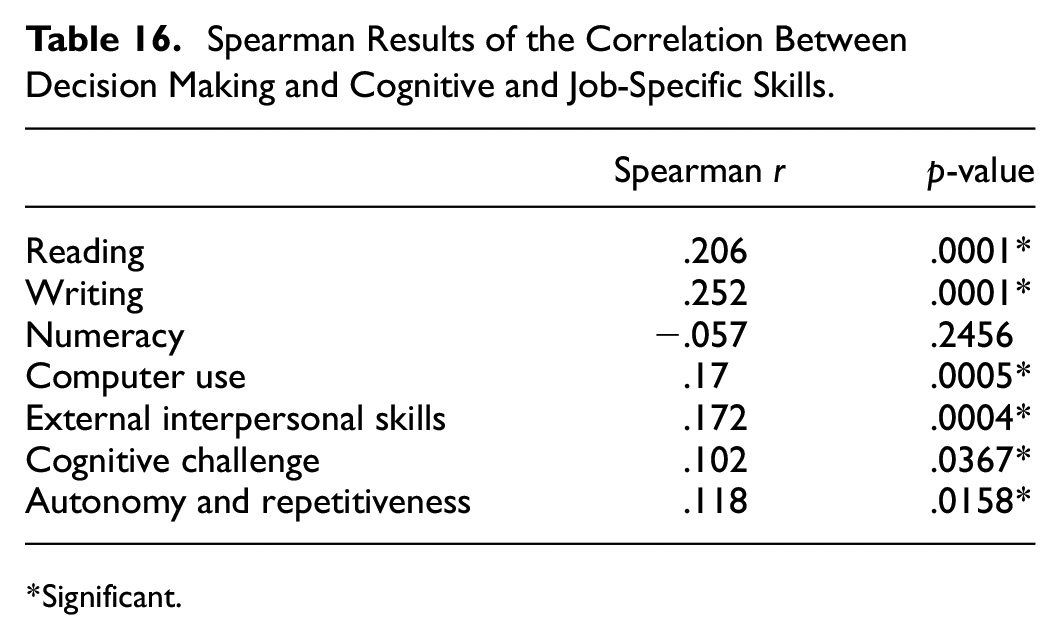
Significant.
The higher their socio-emotional skill of decision-making, the higher their level of reading, writing, computer use, external interpersonal skills, cognitive challenges, and autonomy and repetitiveness.
Emotional Stability Versus Cognitive and Job-Specific Skills
Emotional stability is significantly associated with computer usage (p = .0398) by the respondents. The more emotionally stable they become, the lower their use of the computer. The resulting r value of −.101 indicates an inverse relationship (see Table 17).
Spearman Results of the Correlation Between Emotional Stability and Cognitive and Job-Specific Skills.

Significant.
Agreeableness Versus Cognitive and Job-Specific Skills
Agreeableness was significantly associated with the respondents’ self-reported use of reading (r = .21, p = .0001), self-reported writing (r = .186, p = .0001), computer use (r = .127, p = .0096), external interpersonal skills (r = .101, p = .0391), and cognitive challenges (r = .119, p = .0149; see Table 18).
Spearman Results of the Correlation Between Agreeableness and Cognitive and Job-Specific Skills.

Significant.
The results showed that the higher their socio-emotional skills and agreeableness, the higher their level of reading, writing, computer use, external interpersonal skills, and cognitive challenges.
Discussion
Several studies have examined the skills mismatch in low-income nations. Handel et al. (2016) conducted a comparative investigation of STEP data and studied different kinds of mismatch across 12 low- and middle-income countries. He revealed that the calculated vertical mismatch indices for Bolivia, Laos PDR, and Kenya are 55%, 65%, and 60%, respectively. He found that the mean rate of over-education is 34%, but countries with the lowest incomes (e.g., Ghana, Laos, Kenya, Sri Lanka, and Vietnam) demonstrated mismatch rates of 41%, 40%, 25%, 70%, and 46%, respectively. As opposed to the urban projections in Macedonia (27%), Armenia (34%), Georgia (33%), and Ukraine (28%), the Moroccan statistic is much higher on average and higher than the Ghanaian average of 53.91%, as reported for low and middle-income STEP nations.
Moreover, El-hamidi (2009) evaluated Egypt’s over- and under-education rates using a realistic match approach. It was established that the overall education rate in Egypt is modest at 11.4%, and that the ratio of over-education is somehow higher in Tunisia with a percentage of 12.2%, while under-education is higher in both Egypt (16%) and Tunisia (22%). In 10 of the 12 STEP nations, higher education relates to a high penalty salary, according to the STEP data analysis. Chort (2017) analyzed the mismatch from a different perspective by exploring migrant workers from two developed economies, Italy and France, and two under-developed nations, Cote d’Ivoire and Mauritania. The author argued that while the rate of horizontal mismatch is comparable, the vertical mismatch rate remains higher in developed countries. Vertical mismatch (over-education) is much more significant in developed countries, with a percentage of 12.7% against 2.2%. Moreover, the author deliberated on the causes of these disparities and stressed the uneven transferability of talent across nations.
There are distinct differences in skill application across education levels, occupational sectors, and industries. A high association between cognitive skill disparities and the educational requirement of a profession is evident. Socio-economic and demographic variables influence the mismatch. The more expertise a worker acquires and develops, the more likely they are to ward off entry-level positions and the more equipped they are to advertise their talents for highly compensated and highly skilled positions (Desjardins & Rubenson, 2011). When highly skilled people are engaged in lower-level positions, their productivity is constrained, but employment in higher-level positions increases productivity.
The Spearman’s r coefficient also showed a positive relationship between socio-emotional skills and some job-specific skills. Conscientiousness remains positively related to performance and training proficiency (Li et al., 2013). As argued by Heckman and Corbin (2016), like conscientiousness, abilities such as making wise decisions, guiding one’s life by reflective reasoning, and planning ahead are often neglected in scientific analyses and policy discussions. Preliminary findings in the literature have shown that more conscientious, emotionally stable, and determined workers find their first jobs faster (Wiersma & Kappe, 2017). Specifically, Heckman et al. (2006) estimate the causal effect of cognitive and socio-emotional (character) skills on a variety of outcomes. Their study shows that character skills promote educational attainment, beneficial labor market outcomes, and health. Although social ability appears to matter for wages, a mismatch between a worker and an occupation along this dimension does not seem to affect wages too much (Heckman & Corbin, 2016; Heckman et al., 2006; Heckman & Kautz, 2012, 2014). Similarly for switching behavior, a mismatch in social skills does not greatly affect other skill requirements, while switching occupations.
Therefore, this research provides valuable insights into the nature of the mismatch using the STEP survey, allowing the capture of an extensive database of the cognitive and non-cognitive skills required to fill different positions.
Conclusion
Using the participants’ self-assessment method, nearly half of the sampled group (43%) concluded that their studies applied to the workplace. In comparison, only 13% stated the opposite. One-fourth of the sample (24%) said that their studies were somewhat helpful, and 13% categorized themselves as belonging to the group whose studies were moderately beneficial. This study’s sample appears to be dominated by women (55.8%) and younger individuals (62.2%), with a significant presence of formal employment (83.8%), indicating the more formal nature of the urban Moroccan labor market. These results establish the Moroccan labor market’s vertical mismatch (over-education). The form of mismatch highlights the disparity between a person’s level of education or abilities and employment requirements. Therefore, the overall vertical mismatch was 55.1%. This percentage represents the proportion of individuals whose level of education is not aligned with the jobs undertaken by them.
In terms of correlation, the Spearman’s r coefficient indicates a positive and direct relationship between socio-emotional skills (i.e., openness, conscientiousness, extraversion, persevering, decision-making, emotional stability, and agreeableness) and self-reported cognitive skills (i.e., self-reported use of reading and self-reported writing). Specifically, openness and conscientiousness were significantly associated with the respondents’ cognitive skills (i.e., self-reported use of reading and self-reported writing).
In terms of employment, between 40% and 60% of employees utilize cognitive skills to a moderate or high degree on the job. These cognitive skills incorporate basic (numeracy and reading) and higher-order (learning new tasks and problem-solving) skills. On the other hand, interpersonal skills (when interacting with clients and colleagues) as a socio-emotional domain are a critical component of the job for almost 70% of professionals.
Practical Implications
The STEP data have been constructed to help other researchers draw their own implications regarding skills mismatch in urban areas. This study provides a ground for comparative evidence on how mismatch differs across low- and middle-income countries pursuing the World Bank project. Within the framework of our analysis, there is evidence that regardless of the level of education attained, some level of on-the-job training and competency-based upskilling must be undertaken consistently by the worker to continue to fit the job. Thus, training provided for workers should enhance the quality of their attained skills to improve their employability and allow the transferability of their skills.
An important lesson from the economics of human development is that cognitive skills are only part of what is essential for success in life. Personality skills or soft skills like decision-making, perseverance, attention, motivation, self-confidence, and interpersonal skills are also important. The ability to make wise decisions, guide one’s life by reflective reasoning, and plan ahead are skills that are often neglected by scientific analyses and policy discussions which are captured by STEP survey.
Limitations and Further Research
Although, this study assessed both cognitive and non-cognitive skills, using large scale assessments would also allow a comparison of the mismatch factors occurring in both urban and rural areas. Merging both databases would be beneficial for analyzing the whole country’s persisting mismatch.
Furthermore, qualitative research using in-depth interviews with different stakeholders (e.g., graduates, educators, and recruiters) would be interesting to comprehend the actual experience of mismatch present in the current skillset landscape of the workplace and connotate the nature of engagement required between suppliers of labor market and employers.
Footnotes
Acknowledgements

Declaration of Conflicting Interests
The author(s) declared no potential conflicts of interest with respect to the research, authorship, and/or publication of this article.
Funding
The author(s) received no financial support for the research, authorship, and/or publication of this article.
Ethical Approval
For ethical purpose, a consent form alongside with the survey has been provided to ensure the respondents’ consent.